Balkans, Anatolia, Caucasus, Levant and other Middle East, Iran, Afghanistan, South Asia, occasional forays into southern Italy, Spain or eastern Europe, minorities, the nation-state and nationalism — and whatever other quirks or obsessions lurk inside my head.
Yes, I know she’s technically from Pozzuoli and not the comune of Naples specifically, but that’s still part of the greater metropolitan area. Stumbled upon these and had to post them.
Sophia Loren Miss Italia 1950Sophia Loren wins Oscar for “Two Women” (“La ciociara”) in 1962Sophia Loren with husband and film producer Carlo Ponti, 1964
The sense of theater and audacious confidence of the Italian Baroque always blows me away — a slap in the face to the snobbery of modernist minimalism — more is more…
And, of course, as per millenial-cum-major-victim, Ayesha Siddiqui…
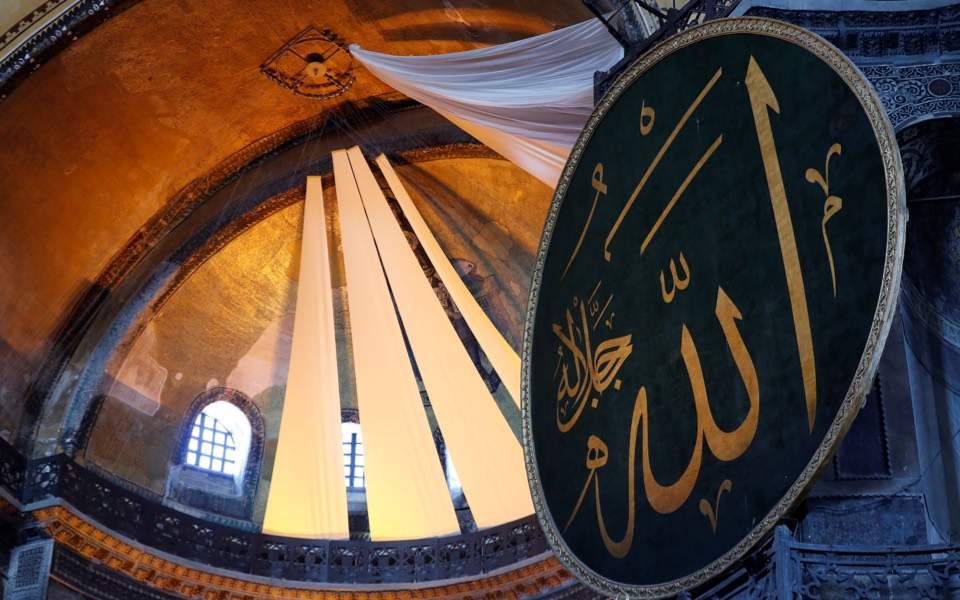
“…unless you’ve had 90% of your cultural and artistic heritage — the product of what was one of the main poles of human civilization for two millenia — destroyed and lost, with the remnants still being vigorously vandalized today, in 2020 AD, “I don’t think I can really be that close to you.”
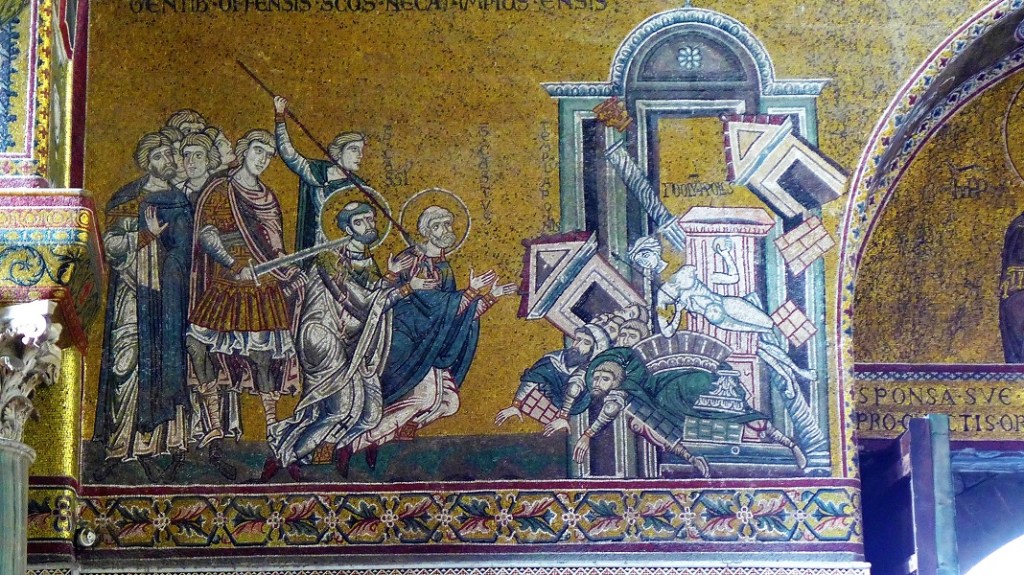
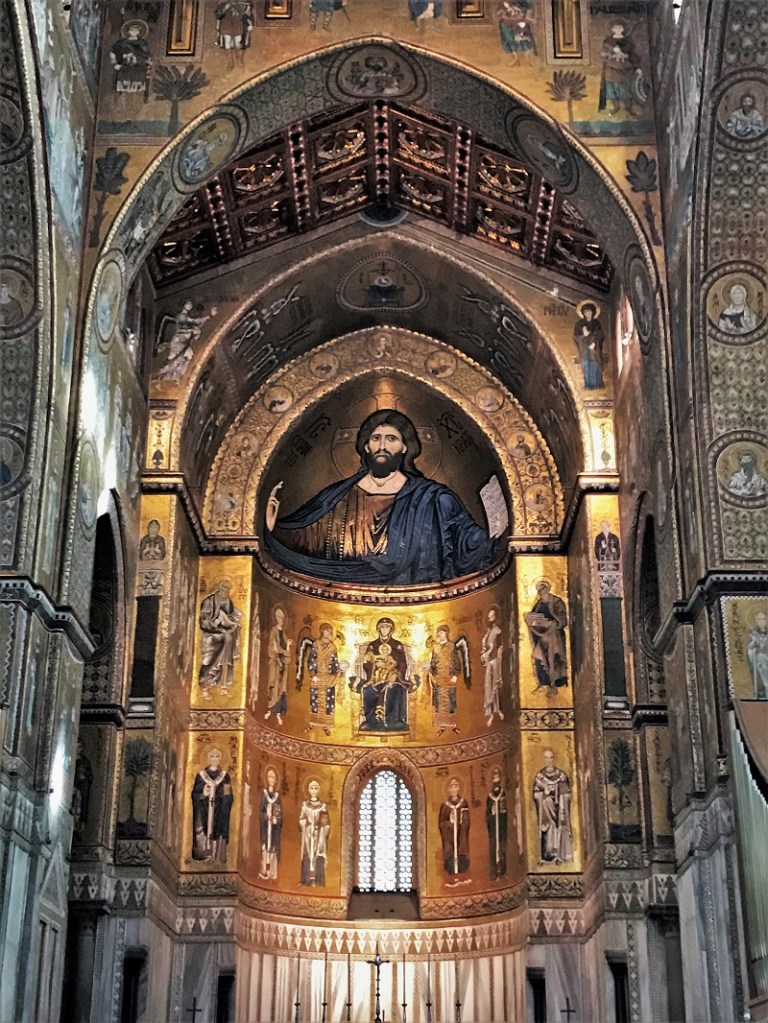
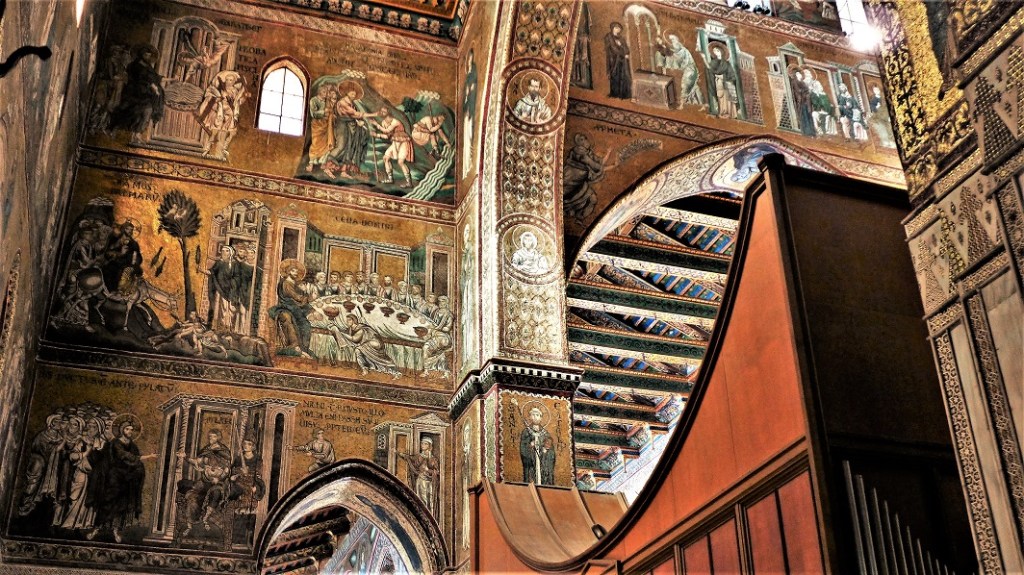
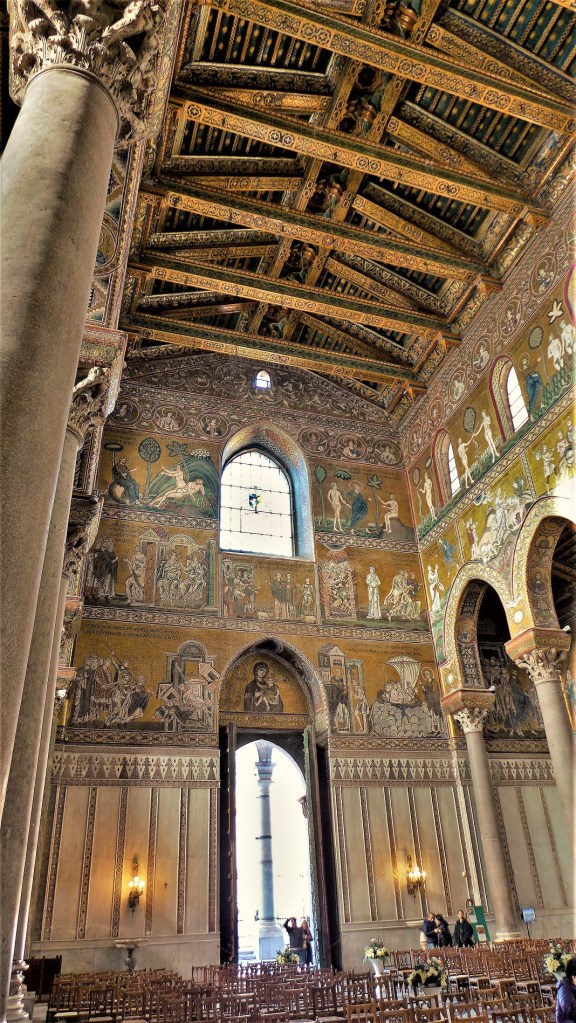
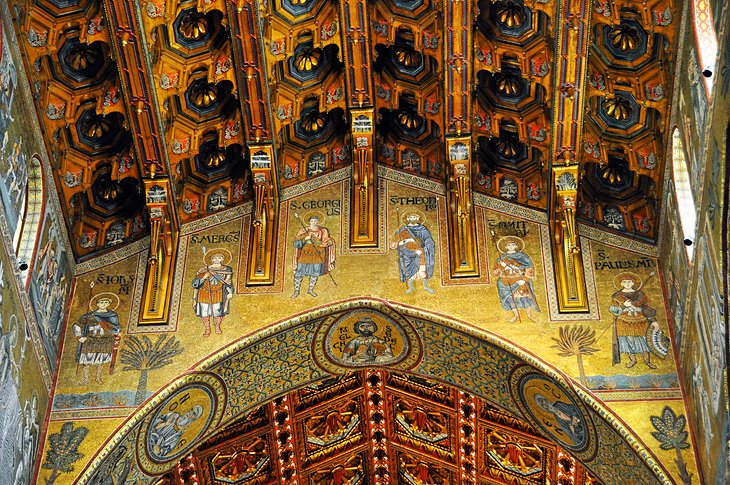
The Normans weren’t exactly our best friends once they embarked on their conquests and rise to power in the Mediterranean. But when they had settled in, they started developing certain Mediterranean civilized habits that almost no one who comes to this part of the world is immune to.
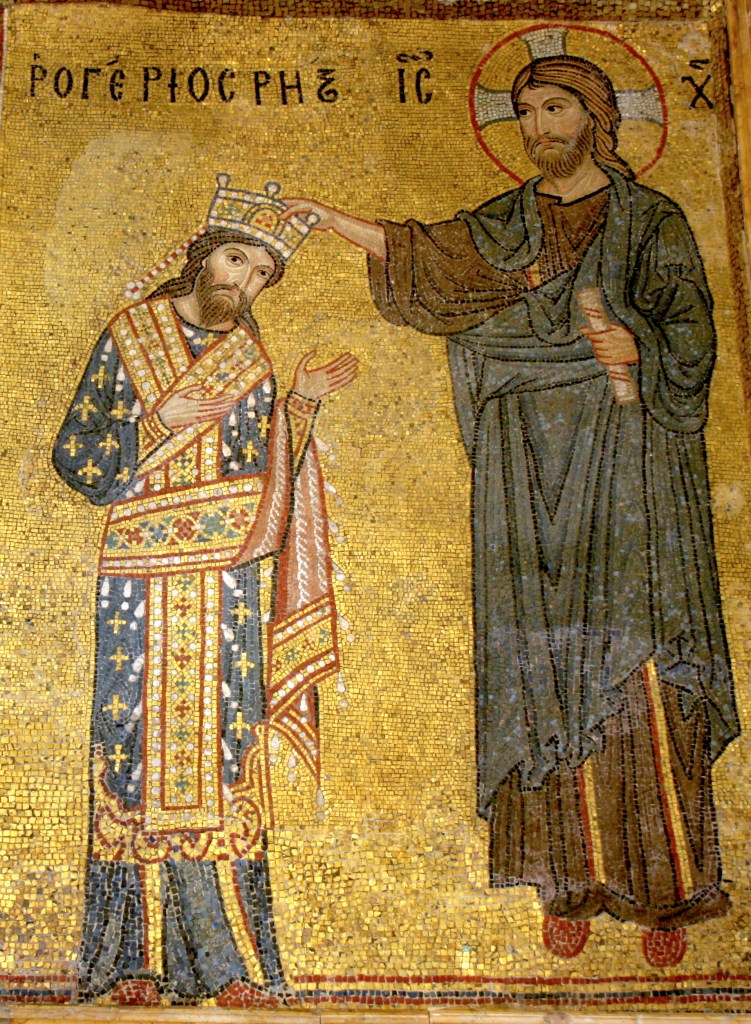
For example, when they wanted something beautiful built and decorated they knew where to place the want ad: either C-Town or among the Greeks who already inhabited Sicily and parts of the Italian south. And, after the Normans, the Angevins, Aragonese, Bourbons, Piemontesi, and, finally, the republic of Italy, kept it all safe.
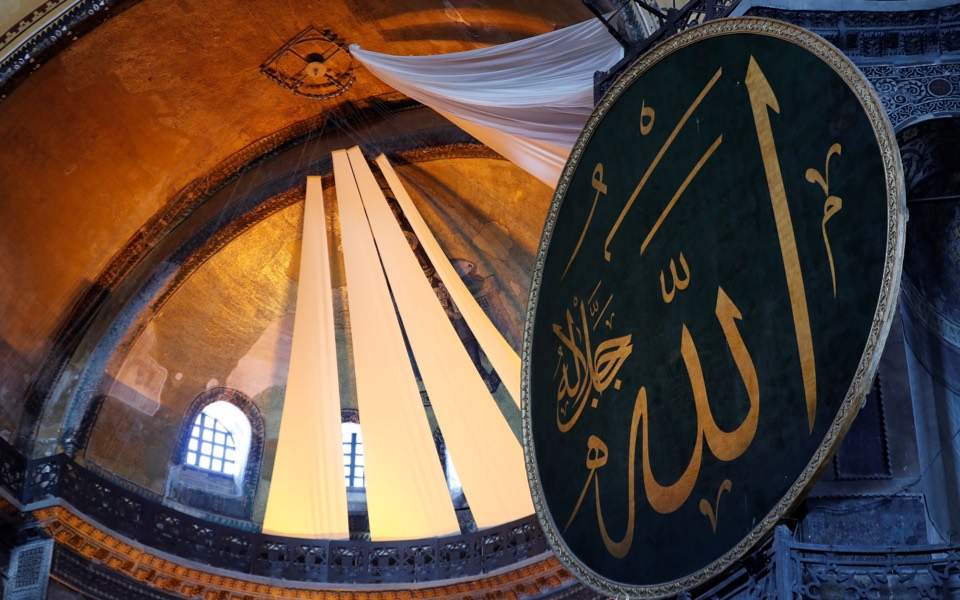
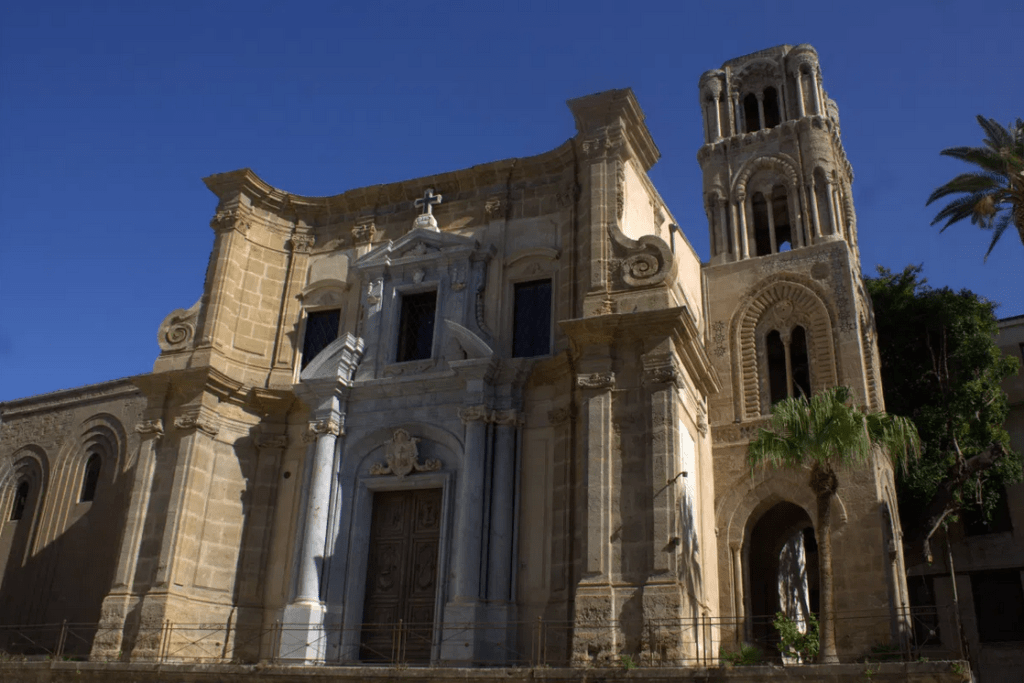
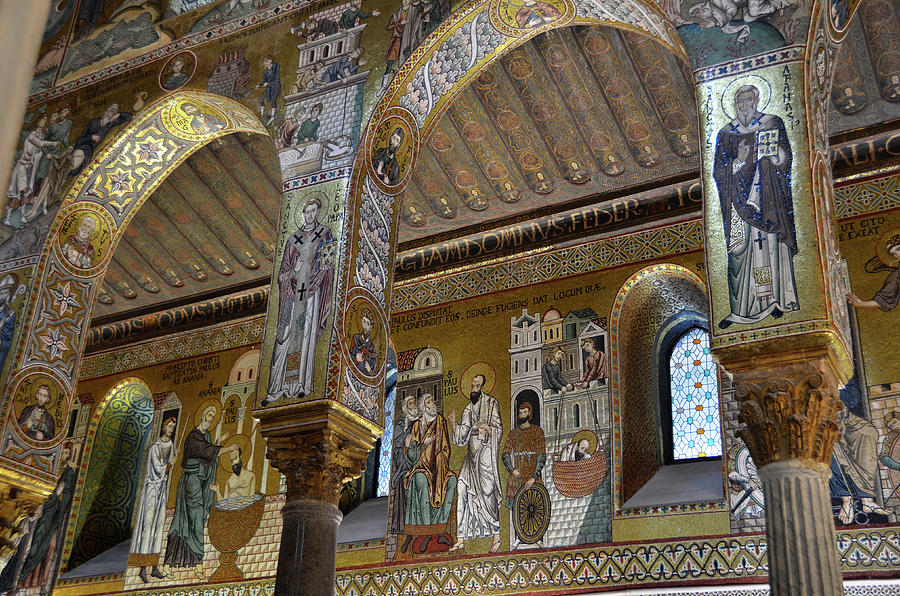
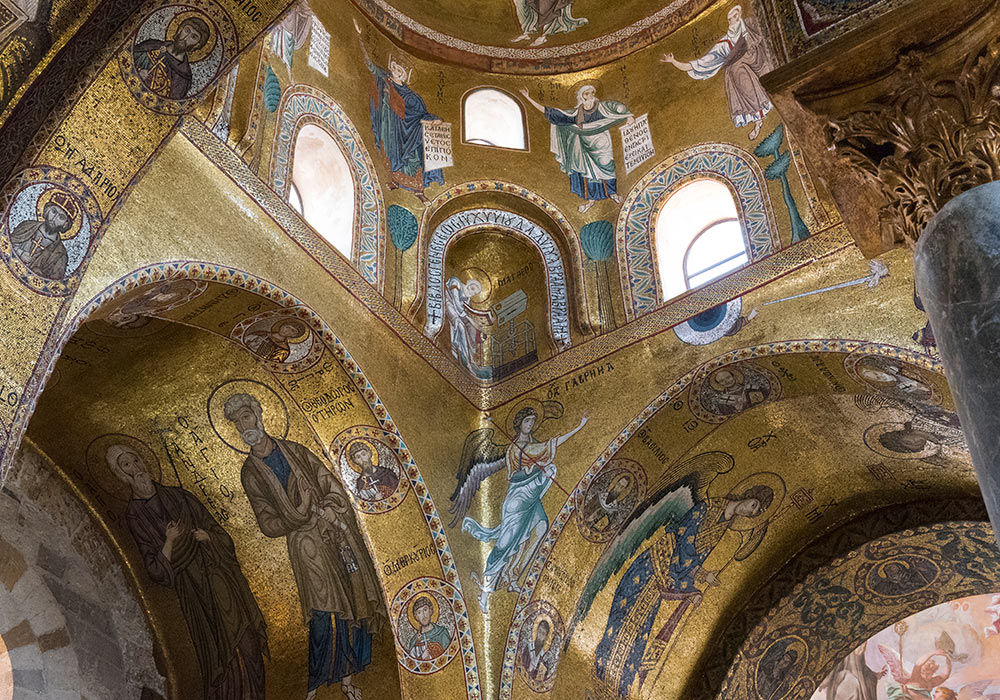
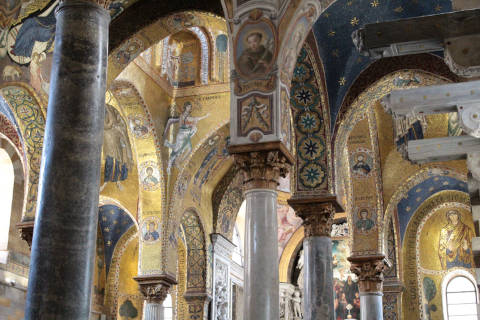
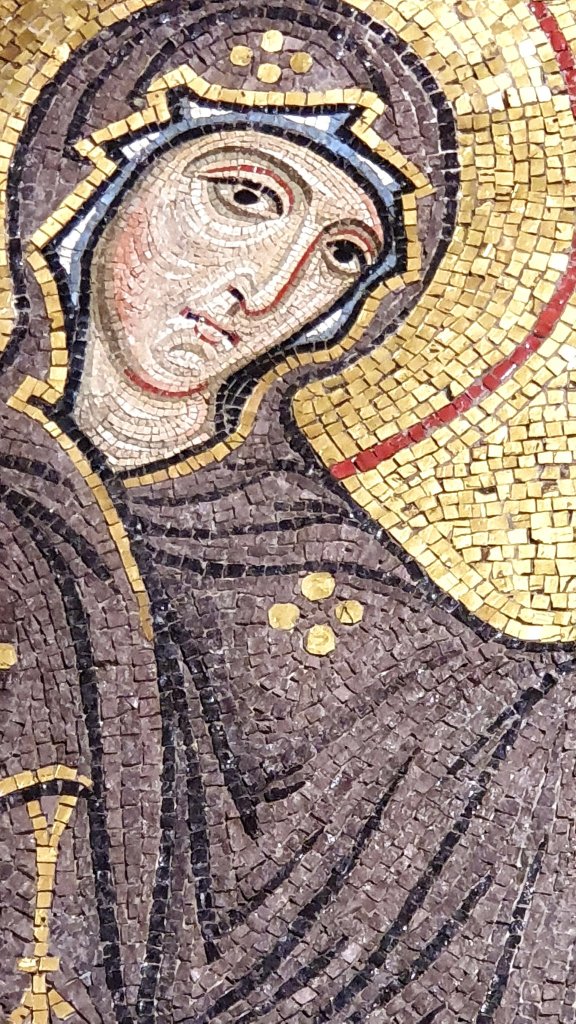
Mostly people think Ravenna when they think of things Byzantine in Italy. But no part of Italy is as laden with high Byzantine beauty as Sicily is. And the church of the Martorana may be the single most important site for in situ Byzantine art in the world. Read about it. It’s really fascinating. Not least for “belonging” to the Albanian-Italian community of Sicily:
[Otherwise, of course, “there is no compulsion in religion.”me, NB, my emphasis above as well]
Here are some photos I put together:
And, of course, as per my chum Ayesha Siddiqui, unless you’ve had 90% of your cultural and artistic heritage — the product of what was one of the main poles of human civilization for two millenia — destroyed and lost, with the remnants still being vigorously vandalized today, in 2020 AD, “I don’t think I can really be that close to you.”
You know, you can’t just throw together anything you feel like…like, I dunno, the Pennsylvania polka with polyphonic southern Albanian orchestration or background singers, and call it music. There’s a great Greek expression for what would result: “May God call that [whatever] …” music, in this case; то есть, only God can give this thing the existential status it’s claiming for itself.
Fusion happens organically. Egyptian pop has a çifteteli rhythm Greeks like, and slowly Greek pop develops a whole genre that is heavily Egyptian sounding. Klezmer musicians, especially Romanian and Moldavian ones, heard Greek Balkan tunes in Bucharest and Constanța and Istanbul and incorporated them into their repertoire. Serbs are attracted to Greek music, to its tone and melodies and especially to its affective nature, so lots of the new starogradska music (which literally means “old city” music, meaning popular, but urban, not folk, like Greek λαϊκά) develops a deep Greek vibe. Greeks loved Bollywood in the 50s, so a whole genre (one railed against by many, including Tsitsanes, which is why I can’t forgive him), of some really beautiful music, developed out of some plain rip-offs, and some imaginative reworking, of the Indian material that Greeks liked in their movies.
I’ll soon bring you examples of all of the above. My point is simply that these intermeldings happen organically and if they’re forced, consciously and stupidly, the product kinna sucks.
I’m sure the intentions of the Khoury Project — four Palestinian brothers from Jordan, with a last name that probably indicates Christian (“Khoury” means priest in Levantine Arabic) — are good…oh, Lord, please don’t let them be misunderstood. But the result is atrocious. It’s a little bit classical Um Kalsoum Arab suite, a little bit Balkan brass band or tamburaša, a little bit demek jazz improv’ — and it’s all made worse by the lust for speeeeeeeeeed our civilization suffers from, to cover up for lack of art, because form is sacrificed on the altar of cheap excitement, till form becomes illegible, rhythm becomes unfollowable, and melody disappears…and it all turns into a dog whistle that we can’t even hear.
Everything is like coked-up Bregović.
And what did that poor kanun do to this dude, that he’s banging away at it like it’s a heavy metal drum set, or like he’s hoping to snap a few of its strings?
Ok, there is one cool idea they’re working with, and that’s in the title: “RUMBA”. It’s not a ton of people who know that, but the musical and other cultural influences that Spain, especially Andalucía, sent to the Caribbean, were matched by the musical influences that the Caribbean, especially, of course, that heavenly font of music, Cuba, sent back to Spain. (You can probably trace the popular music of the whole twentieth-century world to either this one island of ten million people or the Mississippi Delta…or to the West Africa that both sprouted from.) Rumba, for example, is a flamenco genre, as is tango, though they don’t much look like their Latin American namesakes in their Andalusian gypsy forms (Morente gives us a moment of Cuban/Andalusian “rumba” dance moves at 6:56). But sevillanas and bulerías also have rhythmic structures and verbal phrasing and dance moves that have earlier Cuban antecedents.
The reason most people don’t know this is because there’s no more cliché-bound human than the modern tourist. And the academic tourist, who you think would have more outré interests to pursue when he travels, is often the worst of all. So as far as Spain goes, they’ll go to Barcelona, because it’s just such a “hip,” “cosmopolitan” Mediterranean (Christ, sometimes I hate that word) city, and skip the edgier, scruffy, by far more involving urban vibe of Madrid.* And if they’re under 35 they’ll go to Ibiza; over 35 will go to Mallorca. The MESA or other academic folk won’t go to either (if they want beach action they’ll come to one of our more remote Cyclades); rather, after Barcelona, they’ll do the Glories of Al-Andalus tour of Córdoba and Granada and then hightail it back home.
And you can’t get a full picture of flamenco in any of those places. Yes, there’s clearly a gypsy community in Granada that has created its own sound (including Estrella Morente and the whole Morente clan). But “gypsiness” and flamenco are to be truly appreciated in lower Andalusia, the flat river-delta of the Guadalquivir (the al-wādī l-kabīr in Arabic, the “great river”, like the kabir in this blogs’ name.) The great (or “kabir”) flamenco palos or genres, the great flamenco singers and guitarists, are almost all from the Gypsy barrios of Seville, Jerez, Cádiz, Sanlúcar, Puerto deSanta María, or the large village/towns of the region, like Osuna, Écija, Carmona, Utrera. This was not just the entry point for Spanish contact with its American colonies; it was the region that soon after the Reconquista came to be made up of large estates, latifundia, and a large rural proletariat that worked those estates and a large urban proletariat that lived in semi-employed poverty. Unfortunately, this was the pattern that Spain exported to not just its American colonies, but to southern Italy and Sicily during the centuries that it ruled those lands. What’s so fascinating about Naples and Palermo (like, of course, Seville) is that they were the first large, third-world cities of European modernity, overgrown, over-densely populated, surrounded by a countryside where land ownership was wildly unbalanced, cities of fabulous wealth and a dispossessed urban proletariat that still characterizes the modern and post-modern megalopolis — from Bombay to New York.
The Guadalquivir
Unfortunately or not, the pressure-cooker of urban poverty seems to be the petri dish of fantastic music: whether it’s Havana or Seville or Naples or New Orleans or New York and Chicago or Smyrna or Piraeus. We owe it to the creators of this music, and their suffering, to not mangle it the way the Khoury Project has done in this and in many other videos of theirs.
That’s why I’m bringing you more than just one of the original versions of the Cuban classics that Morente and the Khoury project butcher beyond recognition. Take the time to listen to both: the several original versions and the shameless interpretations the new fusion versions bring.
At 6:15, Morente sings the historic Cuban song “Songoro Cosongo”. This was a “son”, an Afro genre from eastern Cuba that, in the early twentieth century, became the more or less national dance (out of which the mambo and then salsa grew) replacing, even in polite society, the danzón. The lyrics are not original “Afro”; they’re Art-Afro, from the Black Cuban poet Nicolás Guillén — y de allí you get into all kinds of questions of authenticity that basically lead you nowhere. What’s important is that this first version was sung by the Septeto Nacional, which was the first group of Black musicians who were allowed to play in the Havana Tennis Club in the 1920s, marking the entry of Blacker music into the social mainstream of Cuban life (or maybe that was the Sexteto Habanero?). Here’s the original version. For Colombians, forget the baldosa please and watch the first part of the video and incorporate some movement into the dance; drop the screwdriver step.
And here’s Hector Lavoe’s 1970s big band sound, salsa version:
The other Cuban/PR classic that the Khoury Project and Morente make kokoretsi out of (at 7:10) is the piece known alternately as “Mandinga” or “Bilongo” or “La Negra Tomasa”.
Here’s a Cuban έντεχνο version from pianist Rubén González of the Buena Vista Social Club:
And here’s the truly breathtaking salsa version, again from the 70s, of Eddie Palmieri, with singer Ismael Quintana: “Kikidi-boom, Mandinga, Kikidi-boom Mandinga….”
Y aquí la tienen, la Negra Tomasa:
La Negra Tomasa, like Mamá Inés (“ay Mamá Inés, ay Mamá Inés, todo’ lo’ negro’ tomamo’ café.”) It’s amazing how powerfully Pan-American this archetype of the Black woman is: Mamá Inés, La Negra Tomasa, Aunt Jemima, the Black woman who, despite the misery and servitude of her existence, still feels and expresses genuine love for those she has to care for. Here’s the scene from Gone with the Wind where Hattie McDaniel gave the performance that garnered her the first Oscar to go to a Black woman:
Ok…
And back to Estrella Morente’s outta space performance. I don’t want to sound like one of the judges on #MyStyleRocksGR (though I’d like to have a drink with Stelio Koudounare — below)** but, Estrella, you’re a magnificent woman. But you’re also a modest Gypsy girl. Don’t wear a strapless dress that you’re constantly tugging up for fear it’ll fall off and reveal your ample bosom. It cramps your style, especially for a number as fast this “Rumba”.
(There’s something that’s so interesting about the semiotics of Gypsy and flamenco sexuality, a really interesting interaction between the revealing and openly erotic and the puritanical and covered up — that’s maybe a real remnant Indian cultural trait. We had a long-time Gypsy tenant, Mandy, who rented a commercial space in a building we owned in Manhattan for her Tarot-reading business; how they made the rent for a midtown Manhattan space offa Tarot readings is anyone’s guess. And whenever I dropped by at that time of the month, she was always dressed kind of like Lola Flores in this video below of commercial, movie, kitschy but beautiful copla-flamenco [look up “copla”; it’s a critical bridge between flamenco and other Spanish popular music]:
A tight top, but with straps — please — and an ankle-length skirt, tight around the hips and flaring out from the knees, like Gypsy women all over the world wear. The use of the skirt in flamenco dance, the flipping and turning around, the gathering up of its ample folds and ruffles and waving them back and forth or stuffing them between the legs, almost up into the crotch…all of those moves become especially powerful because revealing of the lower body seems so taboo. Not to mention the similarities between the prop manipulation of the long skirt in flamenco and that of the cape in the corrida, or bullfight.)
* There’s a wonderful expression in Spanish: “De Madrid no se ve el mar.” — “From Madrid you can’t see the sea” which condenses the whole personality of the city. Madrid is really nowhere. It doesn’t occupy a strategic position, like the older cities of old Castille. It’s not on an important navigable river. The weather sucks: the famous “nine months of winter and three months of hell” (“nueve meses deinvierno ytresdeinfierno”), though I love the cold, sunny weather of a Castillian winter (“colder than a Lutheran” says one character in the film version of Alatriste), and the food is perfect for the climate. It was simply built by royal fiat as a court and imperial capital in the early 16th century because there was an old, Moorish town there in the geographic center of Iberia, on the high, arid and underpopulated central plateau, or meseta, of Spain.
And yet this isolated city — from where “you can’t see the sea” — in the middle of nowhere became the sophisticated, highly cultured and rich capital of a massive empire. The contradiction is that it couldn’t ever really evade or deny its roots. Madrid remained and remains a deeply castizocity. “Casticismo” is a complicated term that means “pure”, “[Spanishly] authentic”, “native”, “conservative” and even a solid melding of all of those together won’t give you the precise sense of the word. Casticismo is what makes Spain Spain. I’m tempted to find Greek analogies and thought that it might beRomiosyne as in versus Hellenismos. But no…
When you’re in a bar somewhere in the center of Madrid in July, and there’s a cold, sweaty caña, or half-pint, of beer and an equally sweaty few slices of ham in front of you, when there’re dirty paper napkins or toothpicks (or there used to be; this custom has sort of fallen out of style) or peanut shells on the floor (the more garbage there was piled up on the floor, the more it signalled to potential customers that, “oh, this is a fun bar that people like…let’s drop in here”) and you’re packed in with super-friendly, inquisitive Spaniards speaking at a totally unnecessary decibel level…and it’s only 11:00 am — well, that’s the right time to get a feel for casticismo, even if it’s just a sensory feel that you can’t express discursively.
And that’s kind of the essence of Madrid, a liberal, tolerant, mad creative, open place that’s still closed and stubbornly archaic and even anarchic: even cañí (tacky) or hortero (red-necky, rough, kitschy, or vulgar). As opposed to the dizque sophisticated-acting, cosmopolitan but actually staid bourgeois air of Barcelona, Madrid is more a microcosm of Spain: one of the West’s and Europe’s most progressive, advanced in every way, societies, that’s simultaneously not part of the West or Europe at all, but a wild, limit-pushing land that is something totally itself, where the grappling between the “raw” and the “cooked” is as interesting and powerful as anywhere.
The go-to book on casticismo is by my saint-hero-philosopher Miguel de Unamuno who wrote it in the early 20th century, when the question of identity — especially after the disastrous Spanish-American War of 1898 when Spain lost its last colonies to the United States — and how Spain needed to generate some kind of new dialectic between its “deep” identity and the modernity it had to face was a red hot, controversial issue. As a Basque, he had a particular insider-and-outsider take on Spain and if you read Spanish or can find an English translation — which I’m not sure there is — it should be on your reading list before your next visit there.
Stelios Koudounares, Greek fashion designer and guest judge on #MyStyleRocksGR
I’ve never been even remotely interested in fashion. I mean, I like to know that what I’m wearing looks ok, but in terms of high-end, concept fashion that nobody really wears…nothing’s ever bored me more. So don’t ask why I’ve gotten hooked, and on a daily basis, to #MyStyleRocksGR. Yeah, I like Stelio, but it’s basically because the judges and contestants on the show are all having so much fun…and when it’s mean it’s because there’s some serious Greek shade being thrown around that, ultimately, no one takes seriously. Any way, I’m addicted.
Next: between occasional blogging and working on my translation of Polites’ Stou Hadjifrangou, I’ve also gotten addicted to reality show #BigBrotherGR. (Owning up: I was addicted to Jersey Shore too.) The other night I sat transfixed through three-and-a-half hours of the special live Friday night broadcast they do, because I was afraid that my favorite room-mate, Demetres Kehagias (Δημήτρης Κεχαγιάς)below, was going to get booted off the show.
I don’t like Kehagia just ’cause he’s good-looking. I like him ’cause he’s echt-Greek/Rhomios.He’s always grouchy and irritated about something and someone and getting into fights with everyone around him, talks a mile a minute in thick Athenian attitude and intonation… And then suddenly becomes all loving and caring and sweet in a way that makes everyone around melt. Luckily he survived.
Here he is in rare form against his nemesis room-mate, the woman with the fried peroxide hair, Anna Maria from Chania (that’s just what they were missing on this show, a Cretan woman of a certain age with fried, peroxide hair…) Check them out in this video below; the fun starts at around 2:17. Yes, the two guys in the black t-shirts are identical twin brothers (makes for all kindsa nuttiness), Zac (Ζαχαρίας) in the Marine t-shirt says and does absolutely nothing in any episode except look pretty, and the zaftig chick in the fuchsia top with the fan, splendidly named Aphrodite!!! is the loving Big Mama that me and apparently all Big Brother addicts in Greece — so say the polls — adore, and she spends lots of her time trying to de-escalate arguments like these. Enjoy. This is a perfect Greek kavga, the Turkish word we use for pointless, steam-letting, “let’s-have-some-fun” arguing. I’m not going to translate or tell you what it’s about….because it doesn’t matter!!!It’s not about anything! They’re just arguing!
I started watching ΣΚΑΪ (SKY) because it’s the of right-of-center channel that still maintains (despite these trashy shows I’m into) some sense of cultural and social standards out of all Greek TV stations. And also because a right-of-center good friend of mine got voted in as MP in Greek Parliament this year and he appears as the go-to expert on Greece’s international relations — especially at a tight time in Greek-Turkish relations like now — on ΣΚΑΪ‘s news broadcasts. But then I get back to work and leave the television on with no sound. Explains how I got hooked on these shows.
Addendum: they’ve also been broadcasting American Crime Story: The Assassination of Gianni Versace these past two weeks. It’s fascinating. Because it’s not about Versace almost at all. It’s about his tragically psychotic murderer, Andrew Cunanan. And it leaves you with the very disturbing sense that he wasn’t so distantly psychotic from the rest of us, that he just wanted what we all want; things just came together in a way that pushed him over the edge. It’s on Netflix; check it out.
Darren Kriss as Andrew Cunanan in The Assassination of Gianni Versace
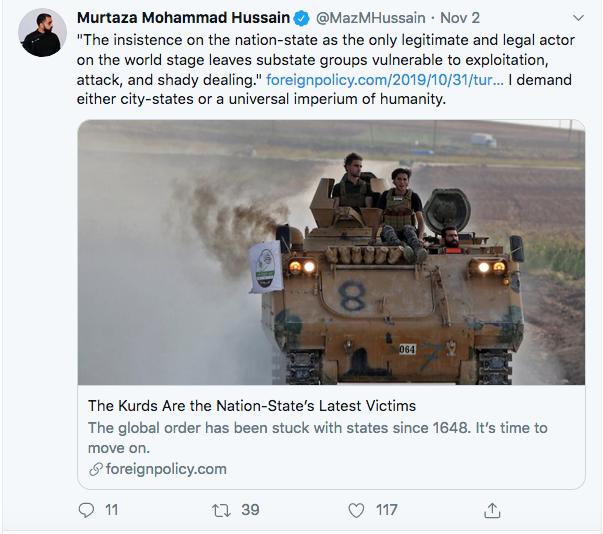
Murtaza Mohammad Hussain (@MazMHussain) does some great work at The Intercept (@TheIntercept), on a broad variety of issues. Check him out. Here he comments on an article from Foreign Policy on the Kurds and the nation-state that’s worth looking at. Lifted the motto from there. Whole text of FP piece by Malka Older pasted below.
Turkish-backed Syrian fighters patrol the northern Syrian Kurdish town of Tal Abyad on the border with Turkey on Oct. 31. Bakr Alkasem/AFP via Getty Images
–
Turkey’s invasion of Kurdish-held areas of Syria is horrific and the decisions that led to it shameful. But it is also representative of a larger problem. The global system is built around sovereign states, and it shows. This is an enormous problem for groups that define themselves, or are defined by others, as distinct from the country within whose borders they happen to reside, and it’s also terrible as a framework for navigating the global politics of a rapidly changing world.
Sovereignty is usually traced back to the 1648 Treaty of Westphalia, which was pivotal in shifting conceptions of government toward a secular state with entire authority inside inviolable territorial borders. Designed as a diplomatic solution to catastrophic religious wars among feudal, monarchical territories, its tenets have persisted into the modern world largely due to the entrenched power of those states, jealously guarding their unfettered rule over their slice of geography. An arrangement of convenience between princes to end a religious war has become the be-all and end-all of the way the world is governed. Even as sovereigns in Europe fell, the idea of the nation came to the fore—with all its possibilities for excluding those who were not truly German or Italian or Polish. And even as European empires crumbled elsewhere in the world, they left behind a very particular view of nationhood.
Over the next several centuries, as the power of monarchy eroded and European countries needed something else to inspire loyalty among their citizens, the ideal of the nation-state—that the people within those arbitrary borders would feel some sort of collective identity—became popular. This led to more wars as European states expelled or converted anyone who didn’t fit their concept of nation: not French enough, not German enough, not Italian enough. They also spread this idea to their colonies, exporting successive waves of destructive conflicts.
Today, norms have shifted to a greater focus on individual rights, and power has eked out to nonstate players, but governments still harass, expel, and attempt to exterminate minority groups in the name of the nation-state ideal, and sovereignty still gives them carte blanche to do so.
The insistence on the nation-state as the only legitimate and legal actor on the world stage leaves substate groups vulnerable to exploitation, attack, and shady dealing.
The Kurds have been promised and denied so many times over the past century that it would be a wonder that they trusted anyone anymore if they had a choice. But the issue isn’t limited to the Kurds. In the news this week are Rohingya refugees stuck between two countries that don’t want them, Uighurs forced into detention camps, and Catalan protests for independence. History offers even more parallels, from the United States repeatedly breaking treaties with Native Americans to World War II, in which the United States was willing to go to war to protect the territorial integrity of France along with the people in it but was not willing to accept refugees fleeing the Holocaust. The nation-state system is designed to protect itself and its members, rather than people.
–
True, strong states screw over weaker states sometimes, too. But nonstate groups are at a particular disadvantage. Though they may hold de facto territory, they don’t hold it legally; they have no international rights to a military or to self-defense. They have no seat in international or supranational organizations, leaving them outside global decision-making and with no recourse in attempting to hold states accountable for their actions. Their leaders are not accorded head of state status, and they have no official diplomats. Since even the most generous autonomy statutes don’t confer the protections of statehood, separatist groups are often willing to risk high losses to win independence, fueling conflicts.
The global order provides more mechanisms for states to deal diplomatically with each other than with the people inside them. While interstate conflicts have fallen over the past 50 years, intrastate fighting has soared. These wars disrupt trade and world politics, weaken countries, and raise uncertainty in neighboring states. On the other hand, states have proved themselves adept at using substate actors to further their own interests within foreign countries while evading responsibility for it, from the United States arming the Contras in Nicaragua to Sudan and Chad supporting each other’s rebel movements.
The state-focused global order has shown itself poorly equipped to deal with these conflicts. States remain reluctant to break the collective agreement on the legitimacy of sovereignty. They are similarly reticent about adding more states to their exclusive club, in part because it might suggest to dissidents within their own area that renegotiation of borders is possible. Although a large number of states emerged from the Soviet Union in the 1990s, and there have been a few more recent exceptions such as Timor-Leste and South Sudan, it remains difficult to garner international recognition for a new state. That leaves mediators attempting to convince vulnerable groups to settle for something less, in the face of all evidence that a recognized state is their best chance for security and self-determination.
There have been some efforts to mitigate the effects of sovereignty. The responsibility to protect movement posits that states must protect their citizens and that if they fail to do so, others can step in to assist. It is intended as a way to justify and streamline the use of U.N.-sanctioned force in saving populations from genocide or other attacks perpetrated by the government they are subject to, but so far at least it has not proved successful as a way of overcoming the reluctance to breach sovereignty.
Substate groups are not the only example that the system is failing. Nonstate actors from terrorist groups to multinational corporations have increasing impacts on global politics, and traditional geopolitical theory does not do a great job of dealing with them. Even for bilateral issues, the nation-state is not always the most useful unit of analysis.
Take the numerous headlines and articles proclaiming that Russia interfered in the 2016 U.S. presidential election. To imagine this as a coherent national policy designed to attack the United States is not an accurate depiction of reality. Russia is not a democracy, and such interference is not aimed at, for example, winning territory from the United States. A more precise description would be that Russian elites attempted to tip the scales of U.S. leadership in order to win more modern spoils: unfettered soft power in their region, access to trade, and, notably, the ability to infringe on other countries’ sovereignty without consequences.
Dear Niko, yesterday I found Jadde-ye-kabir and your email, and here I am. I was so happy to read what you think of Hellenism!!!!! It’s exactly what I think. In my latest book I quoted Ion Dragumis when he wrote that Hellenism is a far larger place than Greece.
I studied ancient Greek at school ages ago, and I’ve been going to Greece as often as I can. It’s the mother-country of my choice! I have also studied modern Greek which I can read and write, which doesn’t make a tourist of me, but a traveller. I wrote a book about the (Losanna) population exchange, which implied travelling in the North of Greece and in Anatolia: a wonderful journey. But I’ve found Greece, or better Hellenism, in Alexandria (looking for Penelope Delta among other things), and in Crimea, and I’m looking forward to going to Pakistan in the footsteps of Alexander. I’m in a hurry now, but I’d like to talk with you longer. Where do you live?
I do like what you write and I completely agree with you! Let’s keep in touch! Have a nice day, Claudia from Verona (I’m going to Bari in a few days to present my book on Greece and I’ll use some ideas in your blog. Thanks!!). Ciao, as we say
Thanks Claudì! Keep reading! And yes, stay in touch.
Balkans, Anatolia, Caucasus, Levant and rest of ME, Iran, South Asia
Me, I'm Nicholas Bakos, a.k.a. "NikoBako." I'm Greek (Roman really, but when I say that in English some five people in the world today understand what I'm talking about, so I use "Greek" for shorthand). I'm from New York. I live all over the place these days. The rest should become obvious from the blog.


























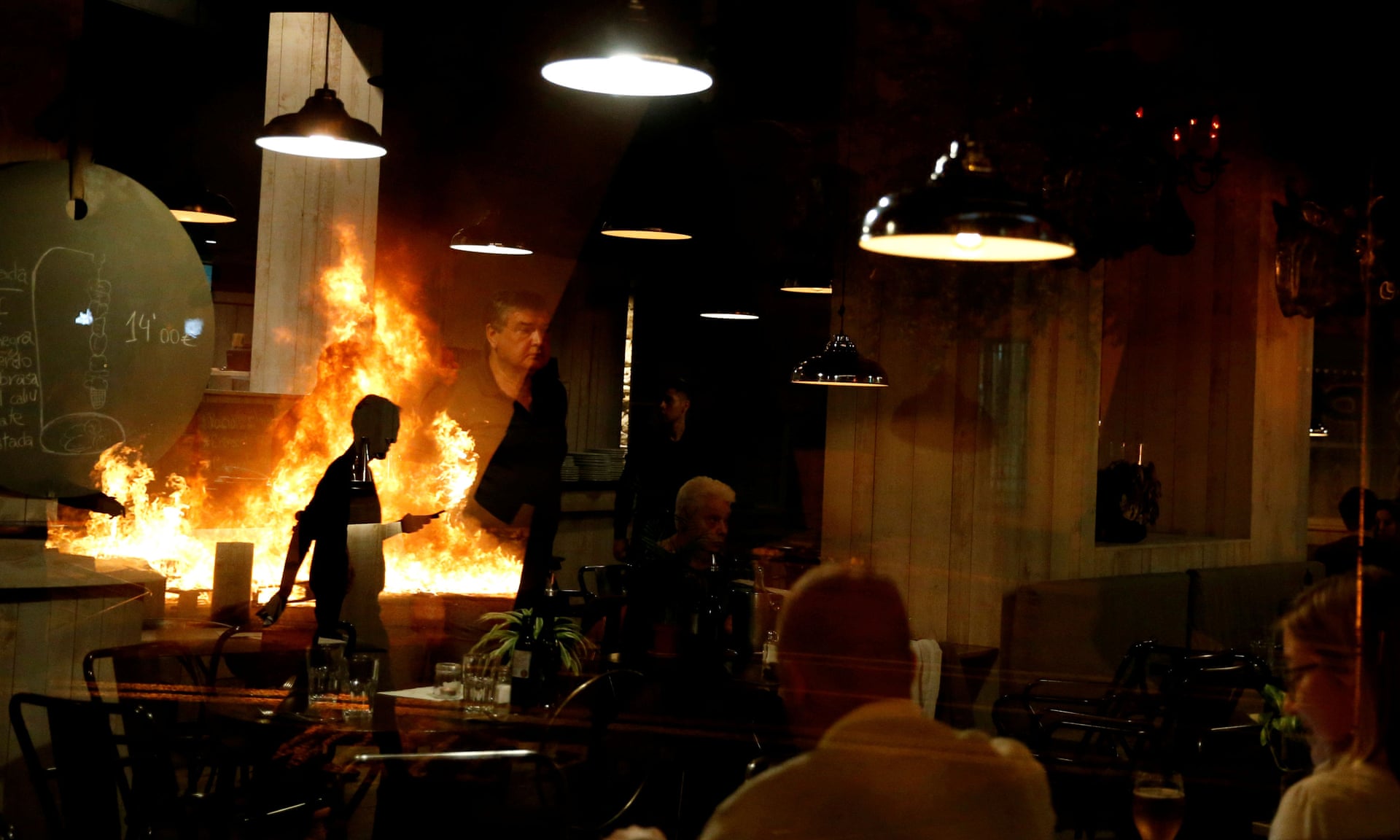 A fire is reflected in a restaurant window after riots break out in Barcelona. Photograph: Rafael Marchante/Reuters

 Jadde: from Bosnia to Bengal