
Moishe Oysher sings Kol Nidre – 1939 Yiddish film
Comment: nikobakos@gmail.com
(Sorry…only now getting a chance to respond to some of these)

The Arch of Titus in Rome, built to commemorate the Roman suppression of the first Jewish revolt in 70 A.D. (click)
In reference to Jadde posts: “Romney in Israel: How High To Jump?“and “Tisha B’av?,” “Jewish London” writes:
“it seems appropriate that he should visit on Tisha B’Av, a day when great calamities befell the Jewish people”
Oooooofffff… This is like teaching…when you’ve spent hours researching and preparing, and then another half hour conducting, a brilliantly detailed and structured, thrillingly executed lesson on participial phrases, only to have one student, while you’re catching your breath right after, ask a question that proves none of the class has understood shit the entire time you were lecturing.
My point was simply that there’s a genre of Ashkenazi jokes, among the many, based on “When is Tishabuv?” Beinart’s point, “Mitt Romney Misuses Judaism…” is that in the long tradition of Rabbinic and Talmudic learning, Tishabuv has been a time to reflect on why a certain tragedy has struck Jews and not just commemorate that tragedy in a victimized and ad nauseum form.
Yes, brother, “terrible calamities befell the Jewish people” on Tishabuv. The Second Temple, the One and Only House of God in the One and Only Holy City, was levelled. Jews were slaughtered in unbelievable numbers. In trying to figure out whether these events happened as part of the Roman response to the Jewish rebellion of 70 A.D. or that of 135 A.D. — which has never been clear to me — I learned that there’s a trend of Jewish mystical thought that fascinatingly believes all Jewish tragedies occurred, occur and will occur on Tishabuv: the selling of Joseph into slavery; Moses’ shattering of the first tablets at seeing the Jews revert to idolatry; the destruction of the First Temple and the Babylonian captivity; the destruction of the Second Temple; the first massacre of European Jews at the beginning of the Crusades; the issuing of the Edict of Expulsion from Spain in 1492; the day the first train left for Auschwitz – all become mystically assimilated into Tishabuv. That’s a tragic and moving idea. However, I do know that the Roman suppression of the revolt of 135 A.D. was so brutal in its massacre and expulsion of Jews that it’s easy to say that it officially marks the beginning of the Jewish Diaspora.
Tishabuv is also intimately related to Jewish messianic thought. The revolts themselves were partly inspired by messianic expectations. And the crushing of those hopes by the greatest cluster of disasters to befall Jews before the Holocaust made Rabbinic thought retreat into the sharpest of all cautions against any such expectations. This, I suspect, is what marked the final rupture between Christian Jews and the rest of Jewry. It’s not that Jews didn’t succumb to the temptation again. Kabbalism is a mystic desire to correct the world that is a barely concealed messianic impulse. And there was the great fever of messianic ecstasy that swept the Jewish world in the seventeenth century, when Sabbatai Zevi, a rabbi from Smyrna, started declaring himself the Messiah – one of the most fascinating and, in the end, sadly absurdist, episodes in Jewish history. Zevi, either a con artist or a psychotic, had raised Jewish expectations to such a frenzied pitch, that when he ended up converting to Islam and becoming a ward of the Sultan, it sent shockwaves of psychological distress, not only through Ottoman Jewry, but throughout the entire Jewish world; in fact, due to renewed persecution and massacres at the time in Eastern Europe, the effects on Ashkenazi Jewry may have been even greater than on Sephardim. The crisis sent the Eastern European Jewish universe careening into two different directions: on the one hand a trend that reemphasized Rabbinical textualism and that eventually responded to the Jewish Enlightenment, the Haskalah, the movement out of Germany that attempted to bring European Jewry into the modern world; and on the other, a retreat into the most introverted mysticism, out of which Hasidism, and an even greater immersion in Kabbalistic thought, grew. To some extent, this split is one that old New York Jews still codedly refer to, whether they know it or not, as “Litvaks” and “Galizianers” (explanation in subsequent post). See Michal Waszynski’s 1937 film version of S. Ansky’s Dybbuk. I think there’s no greater primary text of Jewish spiritual impulses and its conflicts.

Lili Liana as Lea, the bride who becomes possessed by the spirit of her wronged beloved on her wedding day to another man, in Waszynski’s 1937 Yiddish film, the Dybbuk. (click)
(Two interesting notes that I’d like to make here. One is that the Jewish revolts of the early first millennium were partially led by political groups whom we, today, wouldn’t hesitate to compare to, not only the first New England Puritans, but even the Taliban, and who engaged in certain tactics, like the surprise slaughter of masses of innocent civilians that we like to associate with Palestinian “terrorism” – or that of…errrr….Irgun, Haganah, the Stern Gang, Mssrs. Ben Gurion and Begin and all the rest. The other is that maybe the real basis of Tishabuv jokes is still unconsciously based in messianic expectations, the way older Greek women who, say, have missed a bus, will mumble: “Oy, now we’ll be waiting till the Second Coming.”)
But if “Jewish London” is to understand my point, he needs to better understand the transformation that Tishabuv has undergone in Israel since its founding, because I suspect that, not living among the most vibrant Diaspora communities in the world, Israel is his model. Obviously, Zionism didn’t need to worry about the Messiah, since it had solved the “Jewish Question,” as must be obvious to anyone who throws even a cursory glance at the Middle East today and sees the peace and happiness in which Jews there live can attest to, and no Messiahs need apply anymore. Tishabuv had been forgotten by the Jewish Diaspora, reduced to such an obscure holiday that it was the object of humour; I’ve lived most of my life in a city, and worked for a great part of it in an environment, where, believe me, it was impossible to not know that a great, or even just important, Jewish feast was being celebrated or was coming up, and Tishabuv wasn’t one of them. In Israel, however, the “secular” Jewish state raised Tishabuv to new, official status as a holiday-fast day. But not as a day of introspection; but as a day to remember, as “Jewish London” puts it, “a day when great calamities befell the Jewish people.” This is because “calamities” are Israel’s justification for being; it was Israel’s down-payment and it’s still how it pays its mortgage; it’s the currency in which it trades. And the ignorant Romney’s visit to the Western Wall with Netanyahu or whoever on that day, was just another slimy exchange in that same currency — and, in fact, a dishonour to centuries of Jewish suffering.
But back to the Diaspora, and a time when Judaism hadn’t locked itself into a barricaded nation-state. More than just self-reflection and introspection, the repeated, century-after-century dashing of Jewish hopes may have generated an even more important element in the Jewish psyche: doubt. The great Christopher Hitchens, quotes the equally great Rebecca West in his introduction of her book, Black Lamb and Grey Falcon, and her own ruminations about the origins of anti-Semitism:
“West reflects on the virus of anti-Semitism, shrewdly locating one of its causes in the fact that ‘many primitive peoples must receive their first intimation of the toxic quality of thought from Jews. They knew only the fortifying idea of religion; they see in Jews the effect of the tormenting and disintegrating ideas of skepticism.’”
That’s why on Easter night, the night of the Resurrection, I always remember to have one, only one, glass of wine that’s offered to the suspicion – the same one born out of the fact that Elijah never actually walks through that open door at Passover — that this whole idea is bullshit.
So what is Tishabuv for (when we know when it is)? Introspection, moral responsibility, skepticism, doubt and the saving beauty of being eternally able to convert suffering into humour and irony – these last may be the most important — a pretty whole summation of what Jews have given us, given me, at least.
When “Jewish London” can tell me what Israel has given us, he should let us know. These Days of Awe might be the perfect time to think about that.
Comment: nikobakos@gmail.com
Sorry, but it’s pretty funny that Romney’s trip has made of Tisha B’Av such a central metaphor for contemporary Israeli politics and the problematics of Jewish conscience (see previous post). In old Ashkenazi humour — at least as I know it from Brooklyn — Tisha B’Av, Ti-shabuv in Yiddish pronunciation, is used ironically because it’s such an obscure holiday that no one ever knows when it is.
“When is he gonna finally paint the kitchen? Who knows? At Tishabuv…”
“If you’re waiting for the perfect girl to come along, you’ll be waiting till Tishabuv…”
And the like…
But Beinart’s piece, Mitt Romney Misuses Judaism to Support Israel and Buttress His Own Campaign, is truly beautiful, expressing the best tradition of Jewish moral self-reflection, which time and again has saved them and saved us too, in ways too complex to get into here:
“Sorry, but that largely misses the point. Tisha B’Av is less about steeling Jewish resolve against our enemies than fostering self-reflection about the Jewish misdeeds that allowed those enemies to prevail. The Talmud says that God allowed the Babylonians to destroy the First Temple because the Jews committed idolatry, bloodshed, and sexual sins. Similarly, the Romans are bit players in the Talmud’s intricate explanation of the chain of Jewish sins that led to the Second Temple being destroyed. Among those sins—none of which easily lends itself to a GOP stump speech—are “baseless hatred” among Jews and a concern for ritual stringency so obsessive that it trumps concern for human life. [my emphases]”
What other people, even if they lapse so often and so often tragically, are so honest and clear-eyed about their faults?
Comment: nikobakos@gmail.com
It’s almost two weeks old already but I felt obliged to reproduce this sum-up of Romney’s Israel trip from Andrew Sullivan’s Dish because it’s such a thorough review from all quarters:
30 Jul 2012 12:54 PM
Haaretz’s Barak Ravid goes over the speech:
The speech itself sounded as if it could have been written by Netanyahu’s bureau. So it’s no surprise that when the two met later for dinner, Netanyahu thanked him for his “support for Israel and Jerusalem.” In general, Netanyahu embraced Romney as no Israeli prime minister has ever before embraced a candidate running against an incumbent U.S. president: Aside from their working meeting in the morning, Netanyahu also hosted Romney and his wife and sons for dinner at his official residence.
The crowd told you everything you need to know:
Religious American immigrants dominated the crowd; secular Jews and native-born Israelis were few and far between. Those present included Jewish-American millionaires, settler leaders like the former chairman of the Yesha Council of settlements Israel Harel, and former Netanyahu aides such as Dore Gold, Naftali Bennett, Ayelet Shaked and Yoaz Hendel.
Settlers and religious fanatics: it’s striking how the entire foreign policy position of the GOP in the Middle East has essentially been out-sourced to the Likud. The reasons for that, one senses, are multiple. The most powerful way that Romney can win over the religious right, given his past wobbliness on such issues as abortion and gay equality, is to back the Likud and its associated religious parties in their twin goals: permanent occupation of the West Bank and a war against Iran. That’s what the Christianists passionately believe in. Moreover, adopting wholesale the Israeli position – that Iran cannot enrich uranium even for peaceful and inspected purposes – is tantamount to declaring war, either by Israel or the US. In office, how will Romney not back Netanyahu in whatever he wants? And not because he has made an assessment of the realities of America’s interests in the region, but because any daylight between Romney and Netanyahu would produce a revolt among the pro-settler, end-times Christianist right that now runs the GOP.
Notice how often Romney cited “providence” for Israel’s establishment and prosperity. Notice how for Romney, there is no more glowing characteristic of a nation than its economic wealth (a sign of its holiness). Note how the democratic revolutions in the Arab world, wished-for by Bush, encouraged by Obama, are now dark forces for Romney, because they might elevate Islamism in the Middle East in the short or medium term, and if you are Israel (but not necessarily America) that must be countered immediately.
I honestly don’t know whether Romney in office would follow the logic of this long campaign – he spoke platitudes about “a two-state solution” which his chief funder, billionaire fanatic Sheldon Adelson, has contempt for. But I do think his cartoonishly neocon posture in the Middle East is a huge liability and makes a return to Bush-Cheney global polarization more likely. Then there’s the tone-deaf issue:
Mitt Romney told Jewish donors Monday that their culture is part of what has allowed them to be more economically successful than the Palestinians, outraging Palestinian leaders who suggested his comments were racist and out of touch with the realities of the Middle East…
“It is a racist statement and this man doesn’t realize that the Palestinian economy cannot reach its potential because there is an Israeli occupation,” said Saeb Erekat, a senior aide to Palestinian President Mahmoud Abbas. “It seems to me this man lacks information, knowledge, vision and understanding of this region and its people,” Erekat added. “He also lacks knowledge about the Israelis themselves. I have not heard any Israeli official speak about cultural superiority.”
More pro-Israel than many Israelis; and too jejune to know you keep these sentiments quiet. Frum applauds the speech and says it helps Obama, because Romney was acting “as ‘bad cop’ to the administration’s ‘good cop,’ intensifying pressure on the Iranian regime to do a deal now—before the next administration offers yet tougher terms.” Oookaay. What strikes me as more significant is that Romney is the first presidential candidate not to endorse a two-state solution along 1967 lines with land-swaps. That’s a huge victory for the Israeli far right.
Shifting focus, Goldblog calls the timing of Romney’s photo-op at the Western Wall “vulgar”. Beinart elaborates:
In his Jerusalem speech, Romney went on to insist that “we cannot stand silent as those who seek to undermine Israel voice their criticisms. And we certainly should not join in that criticism.” But Tisha B’Av [the fast day that commemorates the destruction of the First and Second Temples] is all about the importance of criticizing Jewish behavior; that’s why, on the Sabbath before it, we read a portion of the Torah in which Moses rebukes the Jewish people before they enter the land of Israel. Obviously, some criticism truly is destructive and unfair. But to use Tisha B’Av to suggest that the country that most clearly wishes Israel well—the United States—should never publicly disagree with Israel’s actions isn’t just bad foreign policy. It’s bad Judaism.
Relatedly, Juan Cole lists the “Top Ten Most Distasteful things about Romney Trip to Israel.” One obvious one:
It is distasteful the Romney will not commit to a two-state solution within 1967 borders or demand Israel cease illegal squatting on and unilateral annexation of Palestinian land. If he is going to this Middle East hot spot, why doesn’t he visit a Palestinian refugee camp so as to understand the nub of the dispute, instead of hobnobbing with the uber-rich in Jerusalem.
Because understanding the nub of the dispute would mean empathizing with Muslim Arabs and getting outside his comfort zone. Romney, alas, can barely empathize with his own dog.
(Photo: US gaming tycoon Sheldon Adelson arrives to hear Republican presidential candidate, former Massachusetts Gov. Mitt Romney delivers foreign policy remarks on July 29, 2012 in Jerusalem, Israel. Romney is in Israel as part of a three-nation foreign diplomatic tour which also includes visits to Poland and Great Britain. By Lior Mizrahi/Getty Images.)
Comment: nikobakos@gmail.com
Olympic year or not, London has always had it all over us in terms of theater — in variety, quality, daring and in its still central role in the city’s life:
“Perhaps the most logistically ambitious part of the festival was Globe to Globe, in which leaders of Shakespeare’s Globe Theater spent nearly two years lining up 37 international theater companies to mount one of the plays in their native languages at the Globe over six weeks this spring. The shows included a new “Balkan trilogy” with theaters from Serbia, Albania and Macedonia each performing one of the three parts of “Henry VI” — not coincidentally a play about civil war — as well as productions of “The Comedy of Errors” from the Afghan troupe Roy-e-Sabs and “The Merchant of Venice” from the Habima theater company of Israel (which drew protesters waving Palestinian flags).”
Give the guys a break, dudes, they’re doing “The Merchant of Venice.”
And Afghans doing “The Comedy of Errors” is too perfect.
London, 1666 (click)

Comment: nikobakos@gmail.com
Not the most brilliant thing I’ve read lately but one important, though really flawed, point:
“BY 1900, only two genuine multinational empires remained. One was the Ottoman, which was by then in the process of abandoning its traditional religious toleration for Turkish nationalism and even racism. [A completely, unfair, simplistic and un-historical assessment] The other was Austria-Hungary, home to 11 major national groups: a paradise in comparison with what it was to become. Its army had 11 official languages, and officers were obliged to address the men in up to four of them.
It wasn’t terribly efficient, but it secured an astonishing degree of loyalty. It also brought rapid economic and cultural progress to an area extending from the Swiss border to what is today western Ukraine. During World War I, Austria-Hungary fielded eight million soldiers commanded by, among others, some 25,000 Jewish reserve officers. Thirty years later, the nation-states that succeeded the empire sent most of the surviving Jewish officers to the gas chambers.”
Unfortunately, the poison of the ethnic-based nation-state ideal had gotten too far by then. Even the portrait of Austria-Hungary he gives us is completely idealized and existed in the form he describes for less than a century.

(Click above)
How sweet though, to have lived in a world that interesting instead of the stupefying monotony of the modern nation-state. But that idea is so powerful — no, not because it’s natural and inborn, but because the modern, bureaucratic state was the first with the technical apparatus to impose it on its population(s) — that it deletes all historical files dealing with plurality. Not a single European tourist who comes to New York fails to make the same comment: “Amazing…all these peoples living together…” and I want to explain that that’s how humanity lived for most of its civilized existence — or just pull my hair out — but I usually don’t bother.
But that reminds me: I do live in a world that “sweet” and “interesting:”

Mr. Deak (Hungarian?) is also wrong on an even more crucial point. The Ottoman and Austro-Hungarian empires were not the world’s last multi-ethnic states. There’s still China. Most of southeast Asia. And Russia. And most ex-Soviet republics. And certain Latin American countries. And almost all of Africa. And Syria and Lebanon and Iraq and Iran and Afghanistan and Pakistan and the world’s great wonder, India. Even Turkey. (And wherever ethnic nationalism is a problem in those countries it’s based on the Western intellectual model.) In fact, most of the world still lives in “plural” situations. Only Europe (and even in Europe there’s Spain and the U.K.), has an issue with this concept, but it seems to be fading even there. Its last bastion will probably be the growing number of viciously homogenized, ugly little states of Eastern Europe and the Balkans. Which brings us back to Michael Ignatieff:
“The misery of the Balkans stems in part from a pathetic longing to be good Europeans — that is, to import the West’s murderous ideological fashions. These fashions proved fatal in the Balkans because national unification could be realized only by ripping apart the plural fabric of Balkan village life in the name of the violent dream of ethnic purity.”
From Blood and Belonging: Journeys into the New Nationalism, Michael Ignatieff
Comment: nikobakos@gmail.com
The question is: does Israel — or the rest of the world — want these guys as soldiers? Seems to me it’s a toss-up as to whether they’ll be completely incompetent or the most vicious bunch yet. Or, they’ll just move back to Borough Park and annoy us.
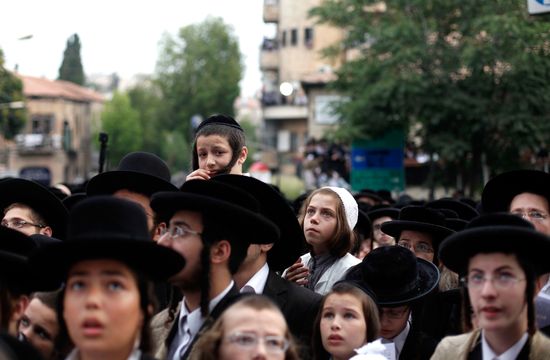
Ultra-Orthodox Jewish men and boys (some of them dressed in sacks as a sign of mourning) protest against Tal Law replacement on June 25, 2012 in Jerusalem, Israel. The Tal Law, which exempts ultra-Orthodox yeshiva students from mandatory military service, was declared unconstitutional by the High Court in February and is due to expire in August. (By Lior Mizrahi/Getty Images.)
Comment: nikobakos@gmail.com


(West Bank: Second Intifada)
Jerusalem
EARLIER this month, at a private meeting with the Israeli prime minister, Benjamin Netanyahu, and his security advisers, a group of Middle East experts and former intelligence officers warned that a third Palestinian intifada was imminent. The immediate catalyst, they said, could be another mosque vandalized by Jewish settlers, like the one burned on Tuesday, or the construction of new settlement housing. Whatever the fuse, the underlying source of ferment in the West Bank is a consensus that the Palestinian Authority president, Mahmoud Abbas, has reached a dead end.
Mr. Abbas’s political strategy was premised on the notion that security cooperation between the Palestinian Authority and the Israeli government would make Israel feel safer and remove its primary justification for continuing to occupy the West Bank, thereby clearing the way for a Palestinian state. Ironically, owing to the success of his efforts, many Israelis have had the luxury of forgetting that there is an occupation at all.
Thanks to the American- and European-financed peace that Mr. Abbas’s government has been keeping in the West Bank, Israelis have come to believe they can eat their cake and have it, too. A majority of citizens polled earlier this year said their state could remain Jewish and democratic without relinquishing any of the West Bank. Years of peace and quiet in Tel Aviv allowed hundreds of thousands of Israelis to take to the streets last summer to protest the high price of cottage cheese, rent and day care without uttering a word about Palestinians in the West Bank. The issue has ceased to be one of Israel’s primary security concerns. Mr. Netanyahu would have to be either politically suicidal or exceptionally forward-thinking to abandon a status quo with which a vast majority appears satisfied.
By contrast, Palestinians today see their leadership banging its head against a wall, hoping against reason that a bit more good behavior will bring about an independent state. As a result, longstanding debates over how to achieve national liberation — by comforting Israel or confronting it — have now been resolved. Palestinians of all political stripes are no longer arguing about whether to make Israel’s occupation more costly, but how.
During the 1990s, Mr. Abbas was one of the key architects of the Oslo peace process, which envisioned a phased Israeli withdrawal from the West Bank leading to a permanent peace agreement (though not necessarily to a Palestinian state). Today, he is perhaps its last remaining believer. He has been forced to pay lip service to the demands of those who advocate confrontation by issuing repeated pledges to confront Israel — by dismantling the Palestinian Authority or refusing to negotiate unless Israel freezes settlement construction — only to renege on each one.
As the gap between the Palestinian president’s words and actions has grown, so has the distance of his policies from public sentiment, leading to his government’s turn to greater repression: torturing political opponents, blocking Web sites and arresting journalists and bloggers critical of Mr. Abbas. Even Mr. Abbas’s close advisers confide that he is at risk of becoming another Antoine Lahad, the leader of Israel’s proxy force during its occupation of southern Lebanon. The chief steward of Mr. Abbas’s policies, the unelected prime minister, Salam Fayyad, has acknowledged, “I think we are losing the argument, if we have not already lost.” And Mr. Abbas himself has admitted that the peace process is “jammed” and that his government had merely helped create “a good situation” for Israel, which, enjoying years of unprecedented cooperation with Palestinian forces in the West Bank, lacks incentives to agree to any change.
But these days, Palestinian security forces have little reason to believe their efforts are advancing national goals, and Israel can’t assume that the Palestinian Authority will provide security indefinitely. Last month, as gunfire returned to the streets of Jenin, and 1,600 Palestinian prisoners entered the fourth week of a hunger strike, Mr. Abbas said: “I cannot control the situation. I am afraid, God forbid, that the security system here will collapse.” That sentiment echoed remarks by Yuval Diskin, the recently retired head of Israel’s internal security agency: “When the concentration of gas fumes in the air is so high,” he said, “the question is only when the spark will come to light it.”
The root cause of this instability is that Palestinians have lost all hope that Israel will grant them a state. Each attempt to exert what little leverage Palestinians possess has been thwarted or has proved ineffective. Boycotts of settlement jobs and products haven’t gained mass support, and would not stop settlement growth even if they did. The Palestinians could have pushed for a vote last September in the United Nations General Assembly — a move that frightened Israel and America because of its implications for Palestinian accession to the International Criminal Court. Mr. Abbas abandoned that effort in favor of a petition for statehood at the Security Council, which was always guaranteed to fail, and then deftly sold his capitulation as defiance.
These failures have left Palestinians who hope to make present conditions untenable for Israel with only two options: popular protest and armed resistance. The first option faces enormous obstacles because of political divisions between Hamas in Gaza and Mr. Abbas’s Fatah in the West Bank. Each faction regards mass mobilization as a potential first step to its overthrow, as well as a means of empowering a new generation of leaders at the expense of existing ones.
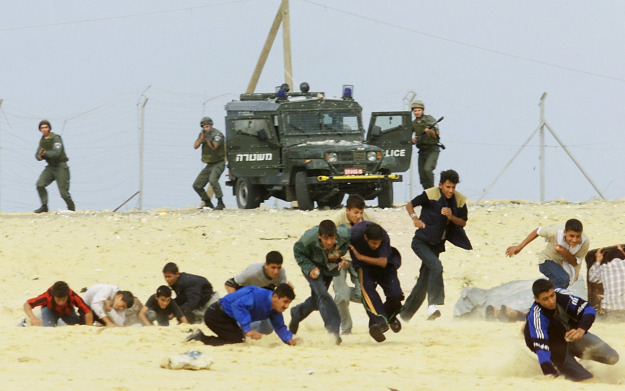
If mass demonstrations erupted in the West Bank, Israel would ask Palestinian security forces to stop any protests near soldiers or settlers, forcing them to choose between potentially firing on Palestinian demonstrators or ending security cooperation with Israel, which Mr. Abbas refuses to do. As he knows and fears, mass protests could quickly become militarized by either side. For that reason, his government has offered little more than rhetorical support for the small weekly protests so beloved by foreign activists and the Western press, and has actively prevented demonstrators from approaching any Jewish settlements.
The second option is armed confrontation. Although there is widespread apathy among Palestinians, and hundreds of thousands are financially dependent on the Palestinian Authority’s continued existence, a substantial number would welcome the prospect of an escalation, especially many supporters of Hamas, who argue that violence has been the most effective tactic in forcing Israel and the international community to act.
THEY believe that rocks, Molotov cocktails and mass protests pushed Israel to sign the Oslo Accords in 1993; that deadly strikes against Israeli troops in Lebanon led Israel to withdraw in 2000; that the bloodshed of the second intifada pressured George W. Bush to declare his support for Palestinian statehood and prodded the international community to produce the Arab Peace Initiative, the Geneva Initiative, and the Road Map for Middle East Peace. They are also convinced that arms pressured Ariel Sharon, then Israel’s prime minister, to evacuate settlers and troops from Gaza in 2005. That pullout also had the effect of freezing the peace process, supplying “the amount of formaldehyde that is necessary,” as a Sharon adviser put it, “so there will not be a political process with the Palestinians.”
For more militant Palestinian leaders, who never believed in the peace process, the lesson was clear: “Not an inch of Palestinian land will be liberated,” Mousa Abu Marzook, deputy head of Hamas’s political bureau, told me, “while Israelis feel that controlling it exacts few costs.” Matti Steinberg, a former senior adviser to Israeli security chiefs, described Mr. Abbas as the most obliging, nonviolent Palestinian leader Israel has encountered and warned of taking him for granted. “The Israeli center is caught in a vicious cycle,” he said. “It argues that it cannot make peace while there is violence, and when there is no violence it sees little reason to make peace.”
History may credit Mr. Abbas with reigning over the more virtuous phase of this cycle, but he has likely laid the groundwork for the uglier one. Hamas, meanwhile, has already moved on. “Israelis had a golden opportunity to sign an agreement with Abbas,” Hamas’s health minister, Basem Naim, told me in Gaza last November. “But the chance has already passed. They will not get it again.”
Nathan Thrall is a Middle East analyst at the International Crisis Group.

Nablus (2005)
Comment: nikobakos@gmail.com

 Jadde: from Bosnia to Bengal