Tag Archives: Nationalism

Albanians in Greece and the “documentary that shocked Greece” from SKAI

26 Jan

In my recent post Occitan and “endangered languages”, I wrote about the (mostly former) Albanian-speakers of central and southern Greece and how they had never posed an assimilation problem for the Greek state.  Quite the contrary:

“…Peloponnesian Albanians were already Greeker than the Greeks in their ethnic consciousness and had proven it by essentially fighting our war of independence for us; it seems that, historically, you give Albanians — Christian or Muslim — an incentive to go to war and they’ll become more zealous crusaders of your cause than you are yourself.”

Elsewhere I’ve written about Greeks and Albanians as practically co-peoples, such has been the extent of migration and intermingling over the past millenium.  This winter I read John V.A. Fine, Jr.’s six-hundred page The Late Medieval Balkans: A Critical Survey from the late Twelfth Century to the Ottoman Conquest, which I know sounds like a joke about dry academic reading, but it was actually fascinating.  The chaos that followed the fall of Constantinople to the Franks in 1204 produced a bewildering number of Greek and Frankish successor states to the Byzantine Empire throughout the Greek peninsula, all constantly at war with each other and at a time when the Albanian highlands were suffering from demographic overload.  Thus, whether as mercenaries in the hire of anyone who paid best, or as shepherding nomadic clans who took advantage of the extensive areas of the peninsula depopulated by constant war or epidemic diseases, Albanians in huge numbers were constantly on the move southwards for the next two centuries if not more.  (I suspect that this is when their descent into Kosovo begins as well, filling in the gap as as the center of gravity of the Serbian nation moved northward.)  Further waves came after the Ottoman conquest in response to Islamization campaigns in recently conquered Albania, but this time not just south to Greece but westwards to Italy and Sicily as well.  And settling everywhere you could possibly imagine: Thessaly, southern Epiros, Roumeli (in the Greek meaning of the term), the Ionian islands, places as far flung and unexpected as the islands of Cythera or Ios!  My point, without having any Fallmereyer-an agenda — not because I disagree with his basic theses but because I don’t thing “race” means anything — is that regions of Albanian settlement in the past were likely far larger than the regions where we find the language still spoken in the early twentieth century, shown on these maps:
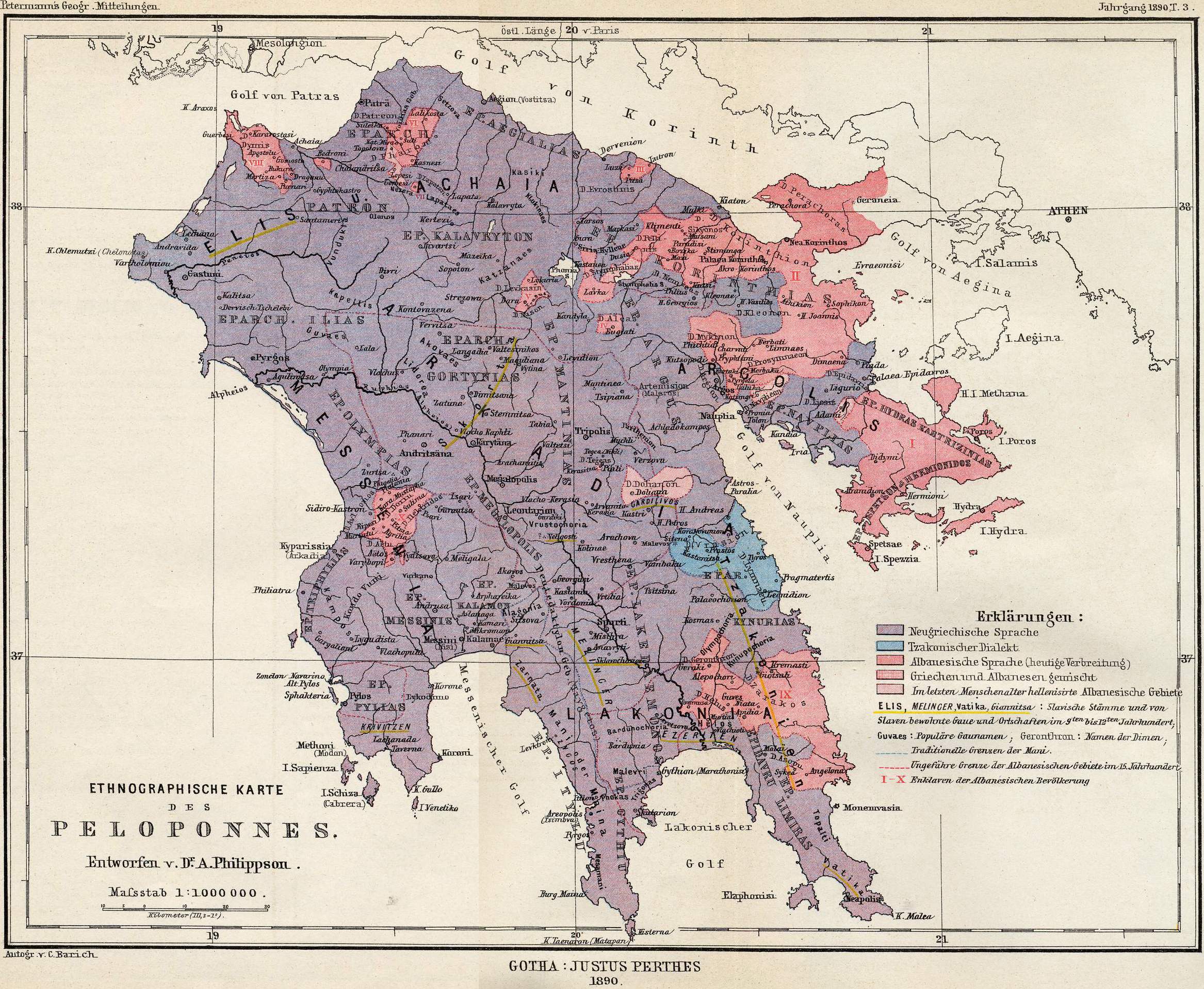
Pelopones_ethnic

Albanian-speaking areas in 1890 shown in pink above, green below (click)

Arvanitika map

This documentary that “shocked Greece” was produced by SKAI Television and called 1821 after the year the Greek revolution against Ottoman rule began and the reason it “shocked” is that it debunked long-held myths about the uprisings that eventually led to the establishment of the independent Kingdom of Greece; but really, that anybody was shocked at any of these revelations: for example, that the uprising was accompanied by the wholesale massacre of Muslims (and Jews) throughout the Peloponnese and central Greece;* that the Church anathematized it and did not support the movement (paid the price anyway with the execution of the Patriarch in Constantinople); that the “secret schools” where poor “enslaved” Greek youth were taught Greek in secret at night because the Turks had forbidden the teaching of Greek is a totally concocted fable (and such a projection of twentieth-century, nationalist, totalitarian policies back onto the Ottomans; there is practically not a single European observer of Ottoman life since at least the beginning of the eighteenth century that doesn’t comment on the quality and extent of Greek educational institutions in all Ottoman cities and even smaller towns and villages); that many if not most of the revolution’s “heroes” were Albanians, some who spoke no Greek at all; that the fustanella is originally an Albanian garment…and on and on — that any of these shocked Greeks in the early twenty-first century is just proof of how pathetically brainwashed and historically ignorant nationalism usually leaves a people.  And this is the point where the documentary pulls a very cowardly copping out — by claiming that such is the price of building a new nation; it has to create new “myths” of its own.  Why a nation — or a people preferably — is not stronger and better off if it knows the whole truth about its past is never delved into.  But it’s worth watching, and it has English subtitles:


In any event, such was the Albanian contribution to the struggle that one wonders if the Porte let go of the Peloponnese, not because it was so far from the center of imperial authority, not because it had always been something of a provincial backwater, not because of foreign intervention, but because of some tough-*ss Albanian warriors that the Ottomans felt were no longer worth resisting.  After all, they themselves knew the value of an Albanian fighter: favorite recruiting regions for the Janissaries in the classical Ottoman period had always been Albania and Serbia — not random choices.

There’s a beautiful song recorded in 1949 by Sophia Vembo, one of greatest Greek voices of the twentieth century, called “The Song of the Morea” (since at least early Byzantine times until the modern Greek state revived the clasical name, the Peloponnese was called the Morea) which is partly a homage to the role of the region in the struggle for Greek independence (ok, even as a New Territory Greek, I’ll grant them that.)  And the refrain says:

“Hail and be well brother Moraites, and health to your women too; Greece owes its freedom to your manhood!”**

And I have a deeply-loved but eccentric cousin, highly intelligent but an unrehabilitated nationalist dinosaur unfortunately and to whom much of this blog is indirectly directed — or one might even say dedicated — who is so profoundly moved by the blood shed by Peloponnesian and Spetsiote and Hydriote Albanians for the cause of Greek independence, that he thinks the refrain should run:

“Hail and be well brother Arvanites (Albanians), and health to your women too; Greece owes its freedom to your manhood!”

Here it is; the music and Vembo’s voice are beautiful even if you don’t speak Greek:

The song has always provoked a strong reaction in me as well, a testimony to the power of patriotism if it can move someone who finds nationalism as repulsive as I usually do.  But even that reaction is contradictory.  The 1949 date of the song is not insignificant; it was recorded in the middle of the most brutal period of the Greek Civil War and was actually more a call to unity and an appeal to brotherhood than a commemoration of the revolution of 1821.  Like many Greeks perhaps, my family suffered more losses in the civil war than they did in the Nazi occupation that had preceded it, and the opening lyrics of the second verse always make me tear up for a moment:

“Now that the earth sweats the blood of brothers, and Greece is drowning Greece in the hills..”

and then my heart goes cold again, because the next line is:

“Come out of your grave Thodoris Kolokotronis, and make all Greeks brothers again.”

…because it’s impossible for me to forget that Kolokotronis was the “hero” who boasted of riding his horse over Muslim corpses from the gates of Tripolitsa to its citadel, when that major city of the Morea fell to the rebels in September of 1821.

So I’d like to end this post with just a little bit of perspective, a reality check we all need every so often, because though the documentary mentions a lot of previously taboo subjects, it glosses over a few of them a little too quickly.  The following is taken from the blog of a Greek-Australian, and apparently fellow Epirote (though he seems to have Samiote heritage as well), Diatribe from a post called “Revolution Unblinkered.”  It’s foreigners’ eye-witness accounts of the Massacre of Tripolitsa, interspersed with some of his own comments:

**********************************************************************************************************************************************************************************************

From “Diatribe”:

A month later, in September, a combined force led by Kolokotrones and Petrobey Mavromihalis captured Tripolitsa.  Historian W Alison Philips tells a horrific tale of mutilation and slaughter  “For three days the miserable inhabitants were given over to lust and cruelty of a mob of savages. Neither sex nor age was spared. Women and children were tortured before being put to death. So great was the slaughter that Kolokotronis himself says that, from the gate to the citadel his horse’s hoofs never touched the ground. His path of triumph was carpeted with corpses. At the end of two days, the wretched remnant of the Mussulmans were deliberately collected, to the number of some two thousand souls, of every age and sex, but principally women and children, were led out to a ravine in the neighboring mountains and there butchered like cattle.”

A Prussian officer described the incidents that took place after the capture of Tripolitsa by the rebels, as follows:

“A young Turkish girl, as beautiful as Helen, the queen of Troy, was shot and killed by the male cousin of Kolokotronis; a Turkish boy, with a noose around his neck, was paraded in the streets; was thrown into a ditch; was stoned, stabbed and then, while he was still alive, was tied to a wooden plank and burnt on fire; three Turkish children were slowly roasted on fire in front of the very eyes of their parents. While all these nasty incidents were taking place, the leader of the rebellion Ypsilantis remained as a spectator and tried to justify the actions of the rebels as,’we are at war; anything can happen’.”

Based on the accounts of one hundred European officers who were present at the scene, and did nothing to intervene, William St. Clair wrote:
“Upwards of ten thousand Turks were put to death. Prisoners who were suspected of having concealed their money were tortured. Their arms and legs were cut off and they were slowly roasted over fires. Pregnant women were cut open, their heads cut off, and dogs’ heads stuck between their legs. From Friday to Sunday the air was filled with the sound of screams… One Greek boasted that he personally killed ninety people. The Jewish colony was systematically tortured… For weeks afterwards starving Turkish children running helplessly about the ruins were being cut down and shot at by exultant Greeks… The wells were poisoned by the bodies that had been thrown in…”
 
Although the total estimates of the casualties vary, the Turkish, Muslim Albanian and Jewish population of the Peloponnese had ceased to exist as a settled community after the early massacres. Some estimates of the Turkish and Muslim Albanian civilian deaths by the rebels range from 15,000 out of 40,000 Muslim residents to 30,000 only in Tripolitsa.   According to historians W Alison Phillips, George Finlay, William St. Clair and Barbara Jelavich, massacres of Turkish civilians started simultaneously with the outbreak of the revolt, while Harris J. Booras considers that the massacres followed the brutal hanging of Ecumenical Patriarch Gregory V of Constantinople.  Finlay has claimed that the extermination of the Muslims in the rural districts was the result of a premeditated design and it proceeded more from the suggestions of men of letters, than from the revengeful feelings of the people.  St. Clair wrote that: “The orgy of genocide exhausted itself in the Peloponnese only when there were no more Turks to kill.”*
 
There were also calculated massacres towards the Muslim inhabitants of the islands in the Aegean. This is because one of the aims of the Greek revolutionaries was to embroil as many Greek communities as possible in their struggle.  By engineering some atrocity against the local Turkish population, diverse Greek communities would have to ally themselves with the revolutionaries fearing retaliation from the Ottomans. In one case, in March 1821, Greeks from Samos landed on Chios and attacked the Muslim population living in that island. Among the Samian belligerents was an ancestor of mine, Dimitrios Kalymnios. When the Samians withdrew to the safety of their island, the Ottomans descended upon defenceless Chios and carried out an atrocity that horrified the rest of the world: the massacre of Chios.
[my, N.B., emphases throughout this last paragraph — just so that nobody is allowed to take something like the the Massacre of Chios out of historic context again]

The final word, if there is one, goes to Theodore Kolokotronis, who in his account of the fall of Tripolitsa, was unrepentant to the last: “When I entered Tripolitsa, they showed me a plane tree in the market-place where the Greeks had always been hung. “Alas!” I said, “how many of my own clan — of my own race — have been hung there!” And I ordered it to be cut down. I felt some consolation then from the slaughter of the Turks. …”

DEAN KALIMNIOU
 
First published in NKEE on Saturday 6 April 2013.
READ HIS WHOLE POST: “Diatribe” ; it’s very intelligent.
**********************************************************************************************************************************************************************************************
Wow.  First thing I have to say is that if this guy is allowed to publish this kind of stuff in Melbourne’s “Neos Kosmos” English-language newspaper, then Greek Australia is eons ahead of Greek America in its sophistication on such issues.  I can’t imagine a single effing channel or venue of the Greek media in New York where someone could get away with writing or saying things like this.
Then, the irony is that these revolutionaries, Greek or Albanian, were probably not fighting for a Greek state, but fighting a religious-cum-tribal war out of which they were hoping to carve out little fiefs and principalities of their own, no different than the Ottoman pashaliks that had preceded them and the internecine chaos that followed ‘liberation’ is proof of that — so let’s not over-romanticize their zeal for the “cause” or exaggerate the degree to which they were fighting for the “freedom” of the “Hellenic nation.”  Finally, is the irony that many of the “Turks” these fighters were massacring in a place like Tripolitsa, were probably Albanians like themselves, only converts to Islam.
And one sad little detail I discovered somewhere else, though I can’t find the source for it:
“European officers, including Colonel Thomas Gordon, who happened to be at Tripolitsa during the massacre, witnessed the hair-raising incidents there, and some of them later recalled these events in all their ugliness. Colonel Gordon became so disgusted with the Greek barbarities that he resigned from the service of the Greeks. A young German philhellene doctor, Wilhelm Boldemann, who could not bear to witness these scenes, committed suicide by taking poison. Some of the other European philhellenes who were extremely disillusioned, followed suit.”
The poor, idealistic, Werther-like German Romantic, come to fight and  liberate the sons of Pericles and Leonidas, kills himself out of disappointment…it just seemed to encapsulate the whole patheticness of a certain kind of European Helleno-latry.
**********************************************************************************************************************************************************************************************
* Why isn’t that genocide?  A question for those who objected to my post on Genocide last November.
** Forgive me the crude translation of “leventeia” as “manhood;” it’s just too complex an attribute to go into in an already long post.
 

Where Do Antiquities Belong?

10 Sep

From Andrew Sullivan’s Daily Dish:

A variety of Bronze Age earrings from Penn’s “Trojan Gold.” (Courtesy of Penn Museum)

Blake Gopnik looks at how two American museums dealt with objects in their collections originally obtained under questionable circumstances. One, the Cleveland Museum of Art, decided the benefit of displaying a historical piece of art to the masses outweighed any ethical questions about its origins. The other, the University of Pennsylvania, worked out an arrangement to return 24 gold objects to Turkey, the country from where they believe the works had been originally looted:

There’s [a] downside to repatriations like the one Penn has announced. They play into the notion that the countries in today’s U.N. have a unique claim to every object ever made within their modern borders, as part of their trademark “cultural heritage.” [My emphasis]

[Cleveland Museum of Art Director David] Franklin points out that with his head of Drusus [Minor, a portrait discussed in the article as having a questionable paper trail], “you have an object where the marble seems to be Turkish and the artist was probably Roman, working in Algeria … The whole concept of ownership by a country goes against the way art was made.” Does the Drusus head really belong to Turkey, where it was born and the Roman empire ended its days, or to Algeria, where Drusus would have been worshipped, or maybe even to the Italians of modern Rome? Or maybe it belongs just as much to some little girl in Cleveland, who has read about the Romans from the time of Christ, and wants to see what one of them looked like and what kind of artworks they would have treasured. Franklin points out that, uniquely in a museum like his, she can compare that marble head to a long history of Christian art that either rejected a Roman model or tried to match it.

“They play into the notion that the countries in today’s U.N. have a unique claim to every object ever made within their modern borders, as part of their trademark “cultural heritage.””  Of course, the ludicrous idea that culture, past or present, corresponds with political borders could only be brought to you by the stupidity of the nation-state ideological model.

Read Gopnik’s article.


Comment: nikobakos@gmail.com

Where’s Charlemagne When We Need Him?

1 Jul

Huh?

Not the most brilliant thing I’ve read lately but one important, though really flawed, point:

“BY 1900, only two genuine multinational empires remained. One was the Ottoman, which was by then in the process of abandoning its traditional religious toleration for Turkish nationalism and even racism. [A completely, unfair, simplistic and un-historical assessment]  The other was Austria-Hungary, home to 11 major national groups: a paradise in comparison with what it was to become. Its army had 11 official languages, and officers were obliged to address the men in up to four of them.

It wasn’t terribly efficient, but it secured an astonishing degree of loyalty. It also brought rapid economic and cultural progress to an area extending from the Swiss border to what is today western Ukraine. During World War I, Austria-Hungary fielded eight million soldiers commanded by, among others, some 25,000 Jewish reserve officers. Thirty years later, the nation-states that succeeded the empire sent most of the surviving Jewish officers to the gas chambers.”

Unfortunately, the poison of the ethnic-based nation-state ideal had gotten too far by then.  Even the portrait of Austria-Hungary he gives us is completely idealized and existed in the form he describes for less than a century.

(Click above)

How sweet though, to have lived in a world that interesting instead of the stupefying monotony of the modern nation-state.  But that idea is so powerful — no, not because it’s natural and inborn, but because the modern, bureaucratic state was the first with the technical apparatus to impose it on its population(s) — that it deletes all historical files dealing with plurality.  Not a single European tourist who comes to New York fails to make the same comment: “Amazing…all these peoples living together…” and I want to explain that that’s how humanity lived for most of its civilized existence — or just pull my hair out — but I usually don’t bother.

But that reminds me: I do live in a world that “sweet” and “interesting:”

Mr. Deak (Hungarian?) is also wrong on an even more crucial point.  The Ottoman and Austro-Hungarian empires were not the world’s last multi-ethnic states.  There’s still China.  Most of southeast Asia.  And Russia.  And most ex-Soviet republics.  And certain Latin American countries.  And almost all of Africa.  And Syria and Lebanon and Iraq and Iran and Afghanistan and Pakistan and the world’s great wonder, India.  Even Turkey.  (And wherever ethnic nationalism is a problem in those countries it’s based on the Western intellectual model.)  In fact, most of the world still lives in “plural” situations.  Only Europe (and even in Europe there’s Spain and the U.K.), has an issue with this concept, but it seems to be fading even there.  Its last bastion will probably be the growing number of viciously homogenized, ugly little states of Eastern Europe and the Balkans.  Which brings us back to Michael Ignatieff:

“The misery of the Balkans stems in part from a pathetic longing to be good Europeans — that is, to import the West’s murderous ideological fashions.  These fashions proved fatal in the Balkans because national unification could be realized only by ripping apart the plural fabric of Balkan village life in the name of the violent dream of ethnic purity.”

From Blood and Belonging: Journeys into the New Nationalism, Michael Ignatieff


“In the Land of Blood and Honey”

20 May

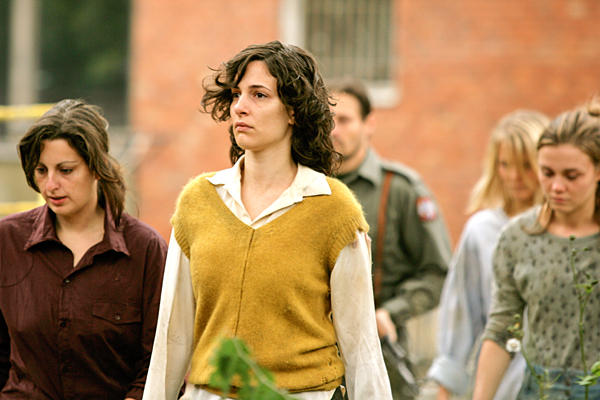
A lot of us probably had our doubts about this one – in retrospect, unfair doubts and probably (not a little bit) sexist ones.  La Jolie has made a film about us Balkanians…  How could she possibly understand our mystery, our inscrutable savagery, the complexity of our past?  A Hollywood vanity project, for sure.

It turns out this is a great film.  It’s beautiful as a film: beautifully written, shot, acted (some tragic editing errors or omissions though).  And it’s beautiful and intelligent as ethnography and history as well.  She’s modest about her descriptions of her work, but whatever corner of the collective unconscious belongs to our fucked up little part of the world, she was channeling it.

The film recently “premiered” in Belgrade.  A few dozen people showed up and half of those left after the first few scenes, which tells you how much progress we’re making on the Serbian front.  But it struck me really hard that Jolie didn’t attend either.  I thought it was cowardly and, after the love and intelligence she’s obviously put into the project, just plain stupid on her part. Granted, some of the actors, all Bosnian, meaning Serb and Muslim, have been threatened, had their car windows smashed but, you know, all great art has always provoked…

No really, why was she not there?  I clearly, for whatever historical or cultural or mostly emotional reasons, have a special love for Serbs.  I understand they often come across as — or are even – unruly, contrarian, inat-driven, loose cannons (this word, “inat,” deserves an entry of its own and can’t be wrapped up in a footnote).  But I know that more than anything they want to hear and be heard; they crave a healthy confrontation.  That the nineties continue to be simplistically narrated as the story of their villainy rightly pisses them off to no end and they want the chance, at least, to present another narrative; if they pretend that they don’t give a shit what the world thinks it’s just hurt pride or they’ve just given up trying.  Without wanting to add to the reams of crap written about what macho lunatics they are, Serbs are guys – by which I mean the women too – and if Jolie had gone it would’ve gained her instant balls and street cred’ in their eyes and led to all kinds of productive discussion and exchange; I’m not kidding one bit.  If she had truly wanted to say something about the Balkans or the Yugoslav wars and not just about women, she undid more than half the good she could’ve done.

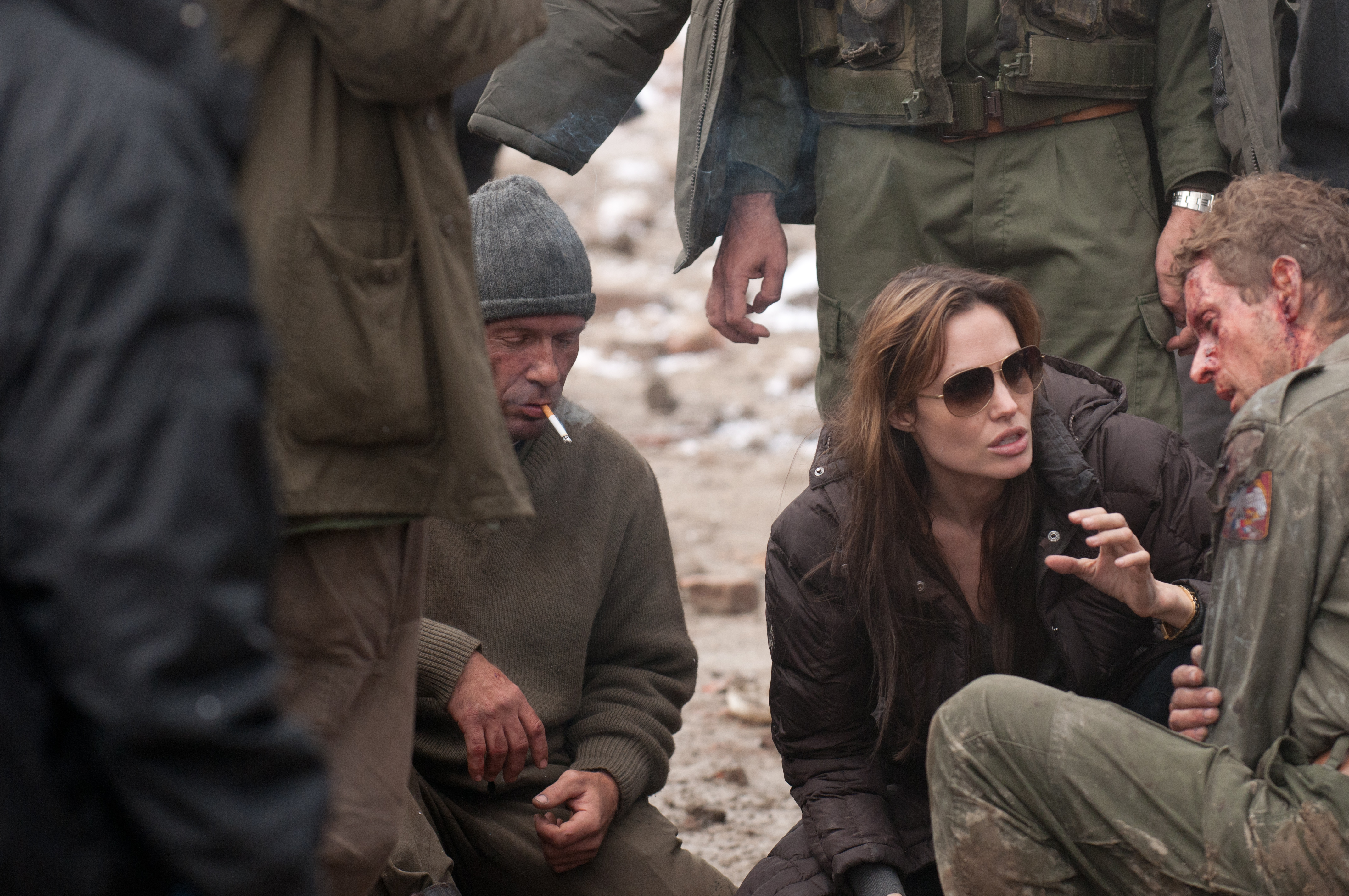
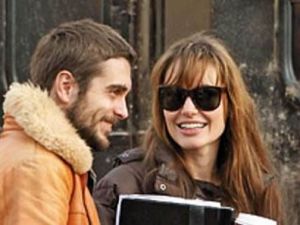
Jolie with extras

One thing that makes you furious about the isolation that was the result of that pointless separating into dumb little countries is that we don’t otherwise know these actors; we got a near fatal dose of Kusturica while Bosnia was on our screens and then it disappeared.  (See below for some extra photos of all.)  Their performances are flawless and their technical competence is proven, if by nothing else, than by the fact that they pulled off the amazing feat of shooting the entire film in both languages.  Not dubbing or anything.  They shot the entire film twice: once in SerboCroatoBosnoHerzegovinoMontenegrin (to be scrupulously correct but which I’ll just call Serbian from here on) and once in English.  Jolie and her team had something to do with how well this came off too.  They let the actors speak the English they speak, which is literally perfect but has the tiny idiosyncrasies that a non-native speaker’s naturally has.  This is the opposite of what Hollywood usually does, which is write a role for, say, Penelope Cruz, in an absolutely impeccable American English which someone with her incomprehensible accent couldn’t possibly speak and which makes her even more incomprehensible and cripples what might otherwise be a decent performance.  But beyond that, they’re all great.  If this one Sarajevo can produce all these actors it makes you want to live there just to go to the theatre or wait for someone to make their next film.

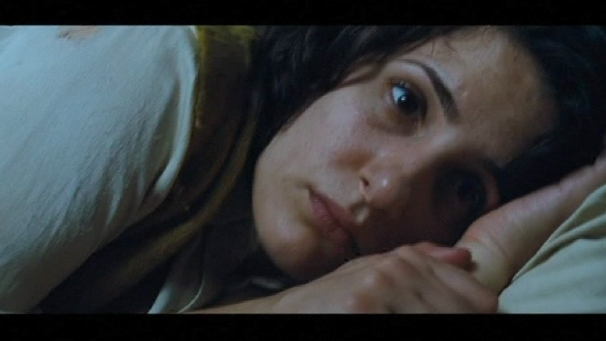
Of course the two you can’t take your eyes off and can’t get out of your head afterwards are the two leads: the painfully sexy Goran Kostić as Danijel, the Serbian cop thrust into the role of Bosnian Serb army captain, and Žana Marjanović as the inscrutable Ajla, the Muslim woman he falls for, one of those close to six-foot Dinaric beauties that make you hate all ex-Yugos; she goes out in one of the opening sequences in heels, a blue dress and a traditional silverwork belt and makes you want to cry, for all kinds of reasons.  I say inscrutable partly because a South American friend who saw the film described her as “parca,” which means dry or stiff or cold — the same root as “parched” maybe – and I had to explain that that attitude implies nobility in our parts, a posture that Ajla doesn’t slip from even for one moment, despite the hell she’s put through; in fact she clings to it even more desperately throughout, her dignity the only thing she has left, her only weapon against male power.  (“Archontia” is another word I need to give a full entry to at some point.)

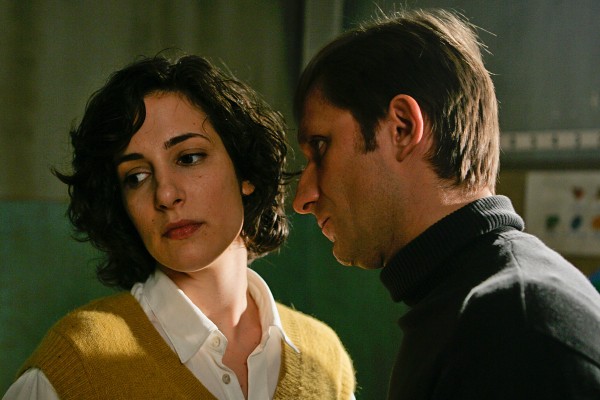
Goran Kostić (Danijel) and Žana Marjanović (Ajla)

They meet, fall in love just before the war — he in a spellbound way that would be unbelievable if Kostić’s performance didn’t make it so naively magical that you buy it — and then, under circumstances which also strain belief a tiny bit but which you forgive, she ends up in his “custody” as a female POW, for lack of a better word.  Jolie says some trite stuff in the “Making of…” about a “love story that could’ve ended up in happiness, in marriage and children and what war does to that” but, whether she knows it or not, she’s made a film about something so much more complex and true.  Ajla (Marjanović) is both terrified and in the grips of the acute, aching desires of Stockholm Syndrome, but though Danijel is constantly groping around blindly in her heart, he never knows whether she’s there because she “wants” to be with him or not.  Kostić plays the perfect good soldier and officer — the way perfect good soldiers have always been perfect: he’s brave, tough, loves his men, is completely scared to death the whole time and never finds the slightest relief from the tormenting doubts of what he’s doing.

This is a film about anything but a love story — or it’s about a real love story, since these two are in love not in spite of, but because of, war.  It’s a story about the fear that women feel in the presence of potential male violence, something that no man will ever, ever understand in his gut, and Marjanović, like the painter her character Ajla is, gives you a hundred different shades of that fear; it’s about how men will never stop feeling the temptations of that violence; it’s about how sex and love are always about fear and violence.  It’s about how your tribal affiliations are not the product of the Western media but will burst out of you under the slightest pressure in what you had thought was a forgotten and buried language of hatred; it inverts the traditional Muslim-Christian power structure of the region’s sexual captivity narratives; it confronts your loyalties and asks what they’re worth to you; it throws your capacity for betrayal in your face and challenges you to deny it.  Serbian viewers might have been slightly flattered by the discursive lip service given to the Serbian position in the conflict.  But if the film has any real compassion for that position it’s in how the two lovers end up, a subtle and powerful metaphor for the two societies.*  Ajla is battered to no end — and a horrible one; it leaves you feeling crushed in ways that I am unable to describe and, as a man, wouldn’t try to.  But she achieves a kind of heroic closure ultimately that Danijel never can.  He’s the film’s true tragic figure, driven by a child’s insatiable thirst to be loved that’s impossible to quench and that ultimately destroys him in ways that she’s spared.

(* The absent Croats in this metaphor are that species of bad driver who never gets into any accidents himself but causes them all around him — just a calculating version.)

Get the Blu-Ray if you can.  It gives you a choice between the English or Serbian.  On either DVD or Blu-Ray, watch the “Making of…” segment and definitely see the “Deleted Scenes” because I don’t know what they were thinking when they cut these segments out of the final film.  If it was to fit Hollywood commercial length expectations it was particularly dumb because that audience is just not going to see this film anyway.  There are several segments in there that help you understand the sado-masochistic intensity of Danijel and Ajla’s relationship and how they get to that point.  And there’s one scene of priceless beauty where Ermin Bravo (Mehmet), sings what I think is a “sevdalinka,” a Bosnian love song, to his beloved, Vanesa Glodjo (Lejla) — see both below – a scene that breaks your heart with the realization that even another’s most exquisite tenderness will only relieve the agony of a tragic loss for a brief moment.  Every soul is on its own.

Some of the rest of cast:

Vanesa Glodjo (Lejla)

Ermin Bravo (Mehmet)

Boris Ler (Tarik)

And with Jolie

Ler and Bravo in a great shot (from another, unknown stage production) — again, this city must have great theatre… (photo: Irfan Redzović)

Comment: nikobakos@gmail.com


“…the innocent boy of seventeen…”

12 May

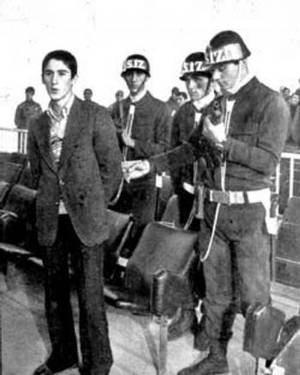
Though it was only incidental to the previous post, the image of Erdal Eren has haunted me for the rest of the night; perhaps it’s the photo of him and its painful youth and innocence; obviously the terrifying quote: that he looked forward to his execution in order to avoid thinking of the torture he had witnessed; maybe it’s that hanging has always struck me as a particularly obscene form of capital punishment’s obscenity (the setting looks prison-like, like he’s actually entering the gallows chamber there…)

Then the eerie reminder of the Cavafy poem: “27 June 1906, 2 p.m.”

27 Iουνίου 1906, 2 μ.μ.

Σαν το ’φεραν οι Xριστιανοί να το κρεμάσουν
το δεκαεφτά χρονώ αθώο παιδί,
η μάνα του που στην κρεμάλα εκεί κοντά
σέρνονταν και χτυπιούνταν μες στα χώματα
κάτω απ’ τον μεσημεριανό, τον άγριον ήλιο,
πότε ούρλιαζε, και κραύγαζε σα λύκος, σα θηρίο
και πότε εξαντλημένη η μάρτυσσα μοιρολογούσε
«Δεκαφτά χρόνια μοναχά με τα ’ζησες, παιδί μου».
Κι όταν το ανέβασαν την σκάλα της κρεμάλας
κι επέρασάν το το σκοινί και το ’πνιξαν
το δεκαεφτά χρονώ αθώο παιδί,
κ’ ελεεινά κρεμνιούνταν στο κενόν
με τους σπασμούς της μαύρης του αγωνίας
το εφηβικόν ωραία καμωμένο σώμα,
η μάνα η μάρτυσσα κυλιούντανε στα χώματα
και δεν μοιρολογούσε πια για χρόνια τώρα·
«Δεκαφτά μέρες μοναχά», μοιρολογούσε,
«δεκαφτά μέρες μοναχά σε χάρηκα, παιδί μου».

“27 June 1906, 2 p.m.”

When the Christians brought him out to be hanged
the innocent boy of seventeen
his mother there near the scaffold
was dragging and beating herself in the dust,
under the sun, the savage noon-day sun,
and now would screech, and now would howl like a wolf, like a beast,
and then exhausted the martyred woman would keen
“You only lived these seventeen years my child.”
And when they raised the boy up on the scaffold,
and passed the rope around his neck,
the innocent boy of seventeen,
and his body swung hideously in the void
wracked by the spasms of his black agony
the beautifully made youthful body,
the martyred mother rolling in the dirt
was no longer keening of years,
“Seventeen days only” she keened,
“Seventeen days only did I enjoy you, my child.”

(my translation)

Erdal Eren

Cavafy wrote the poem in remembrance of the 1906 Denshawi affair, one of Britain’s unfinest hours.  Apparently some British military personnel were returning from Cairo to Alexandria and, near the village of Denshawi, shot some pigeons that belonged to the locals.  A scuffle ensued; a rock was thrown that hit a British soldier on the head and, though he died of what was later proven to be sunstroke, like a delicate E.M. Forster memsahib, five of the residents of Denshawi, including the seventeen-year old of the poem, were imprisoned.  Fortunately, there was such a public outcry after the execution of the young man that the other four men were released, though not till two years later in 1908.  The episode still remains disgusting and Cavafy’s poem one of his most chilling, a register he usually didn’t work in.

At the same time it’s a beautiful reminder of his humanity on several levels.  One is his life-long opposition to capital punishment: “Whenever I have the opportunity I declare this,” he wrote in 1902.  The other, without re-outfitting him as a post-colonialist before his time, is his affection for and lack of alienation and estrangement towards Egypt itself.  He could have had the cloistered emotional outlook of an erudite fag in the European cocoon of Alexandria, yet the otherness that life imposed on him taught his heart the right lessons.  The above poem (even his use of “the Christians,” which in the context can mean nothing less than “the kafirs,”* is a jarring statement of identification) is only his most poignant expression of his love for the country, not just the historical Egypt of so much of his poetry, but the actual Arab Egypt he lived in; “To glyky mas Misiri,” as he calls it in one poem: “Our sweet Misiri” — our sweet Egypt.**

I wonder what he would have thought of the current state of Greek politics – not that he ever cared much for either the Neo-Greek statelet or its inhabitants.  What would a man that lived and wrote on the cusp of every possible human margin and in every plural space conceivable, who would have died before he let his Hellenism be trapped by geography, nationalism or its idiocy, have thought of Greece having the most potentially powerful Nazi (I’m tired of dignifying them with the prefix neo-) party on the European continent?  And that granted to them by a significant youth vote.  A thirty-something Athenian, and a left-leaning one at that, recounting to me the multiple incidents of petty anti-immigrant animosity that she had been witness to in Athens even before the current crisis, recently said to me, in glib defensiveness: “Well, we’re not used to strangers in our country.”  This from us, malaka, the inventors of migration and its pain, who since the beginning of our historical presence have been strangers in every stranger’s land on the planet, except those corners ventured into only by more intrepid or desperate Jews or Gypsies.  It’s beyond even remotely doubting for me that it’s partly the loss of a diaspora consciousness on Neo-Greeks’ part, and the wider sense of world it gives you, that has made us such closed, parochial idiots, just as Israel — sorry to say — has had the same effect on Jews.  And the comparison doesn’t end there; in both cases the diaspora is not just forgotten and ignored, but a source of embarrassment and shame, and each state and its official and/or fabricated culture has the hubris to think itself the metropolitan standard that those left outside should aspire to, when neither state in question contained a serious metropolitan center of either Hellenism or Jewishness until the twentieth century (…with Israel causing a progressive closing of the Jewish mind everywhere — a disaster for all of us).  Now maybe that some young Greeks have had to start emigrating again some of that attitude will get a real reality check.  The economic crisis in Greece is a source of genuine consternation for me and I’m guardedly on the anti-EU/Troika side; at the same time some humility may be exactly what that society needed.  Maybe…though voting for Nazis doesn’t exactly indicate humility but childish rage.


*Qafr, kafir: infidel

**Masr is Egypt in Arabic.  Cavafy uses “Misiri” because in Modern Greek words can only end in certain consonants.  This is something  — tzatziki, kazani, kadaifi, kokoretsi, duvari — that makes Turks giggle and strikes them as particularly funny when they hear it in Greek and the kick they get out of it has always struck me as particularly sweet in return.  I think Cavafy intended it to have this effect.


Comment: nikobakos@gmail.com

Priorities…

10 May

http://boycottlondonolympics.com/Greeks-Boycott-London-Olympic-Games.html

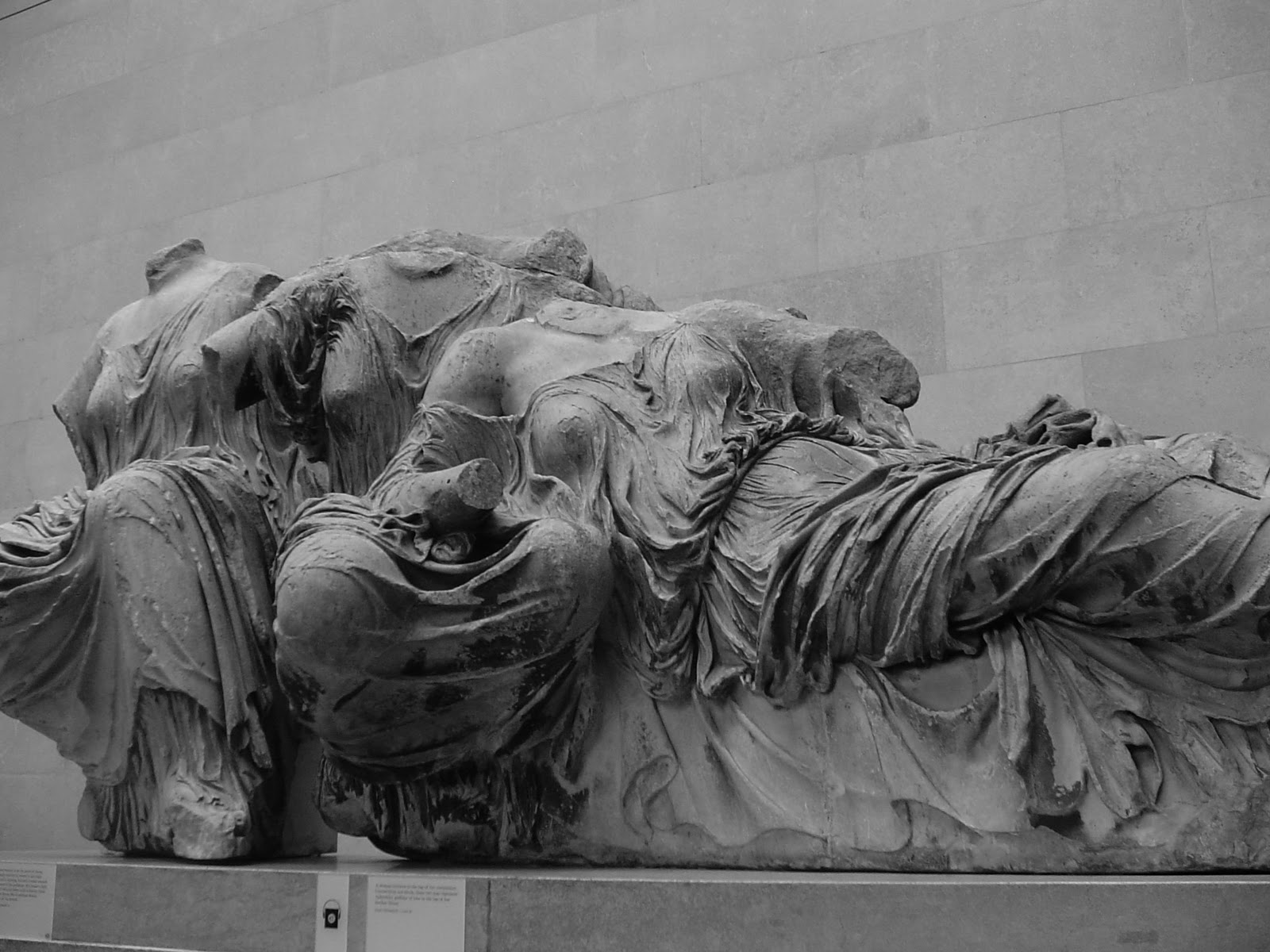
Our sheer, bloody patheticness…and delusional self-importance!  See the above website if you think the London Olympics should be cancelled over the Elgin Marbles.  Snort.

“The Greek protesters say the Olympic Flame should not be sent on its way to London if the looted marbles have not been returned.  They have set a deadline of July 27th 2011 [woops] by which they want the marbles rightfully situated at home.  After this date they will begin their protests to have the games shut down. [my emphasis]”

(photo by Stephanie McGee: http://stephaniemcgeephotography.blogspot.com/)


Comment: nikobakos@gmail.com

How cities produce creativity — Jonah Lehrer

8 May

From Andrew Sullivan’s Daily Beast:  http://andrewsullivan.thedailybeast.com/

Jonah Lehrer believes that cities “pry the mind open” by forcing us “to interact with strangers and with the strange”: [my emphasis]

I think we need to ensure that we don’t surrender too much of our cities to the loveliness of upscale boutiques, fancy espresso bars and high-end restaurants. Money in a metropolis typically buys isolation – we get a little peace of mind and our very own parking space – but the creativity of a city depends on our constantly mixing and mingling.

That said, I have no doubt that the best cities will always maintain a few Low Road neighborhoods. The Greenwich Village described by Jacobs ceased to exist decades ago – longshoreman no longer loiter in the bars alongside poets – but New York City has continued to supply its poor creators with a wealth of other spaces. There was Soho and then Soho became a mall. Williamsburg was hip until it was too hip. Nevertheless, there are still so many corners left in Chinatown and Brooklyn and Queens and the Bronx. When people start complaining that all the suffering artists in Staten Island are being evicted by yuppies, I’ll start to worry. Until then, I have little doubt that our cities will manage to survive the problem of too many rich people.

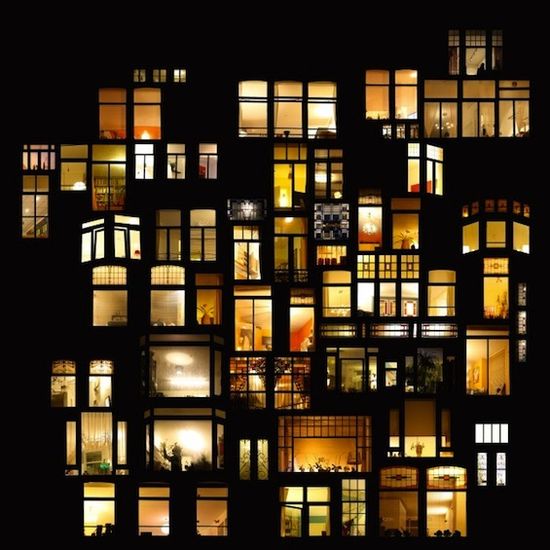
(‘Tableaux d’intimité’ by Anne-Laure Maison via Notcot)

To take this on a slight tangent, I am subjected to constant, tiring accusations that my cosmopolitanism is a projection of American multi-culturalism on our part of the world and its ‘naturally’ homogeneous and ‘eternally’ existent nations.  The tragic and ignorant un-historicalness of this position (which regularly entails my being told that I don’t know my history, aside from the secondary question of why American multi-culturalism — not as the woosy, politically correct and ideologically empty posture that it’s become, but as an existent on-the-ground, socio-cultural fact — is a bad thing) is irritating because heterogeneity, that which pries open the mind “by forcing us to interact with strangers and with the strange,”  is what always characterized human existence, especially in our part of the world, on both the city and larger state level.  It’s the forced homogenization of the nation-state and its capacity to make us retroactively forget the past’s plurality that is just a blip on history’s screen.

Comment: nikobakos@gmail.com

No Refuge

7 May

A British Dateline story from last year that deals with the plight of Afghan immigrants in Greece:


Comment: nikobakos@gmail.com

Ain’t that America?

14 Apr

Oh…  But wait…  No!  It’s Greece!  Who’da thought it?

New York Times‘  cover story today:  “Hard Times Lift Greece’s Anti-Immigrant Fringe” about the gaining of political traction by Greece’s neo-fascist party/movement, Golden Dawn. http://www.nytimes.com/2012/04/13/world/europe/far-right-golden-dawn-sees-opening-in-greeces-woes.html?_r=1&ref=world# 

See their website t-shirts http://xabooks.blogspot.com/  for some of the more sickening (and just plain embarrassing) manifestations of the bogus “Hellenic” classicism, which is the fabricated basis of Neo-Greek identity.  Inevitable, if you ask me.  Christoule mou — the word “Hellas” makes my skin crawl.

Few money quotes:

“This is our party’s program, for a clean Greece, only for Greeks, a safe Greece,” Ilias Panagiotaros, the group’s spokesman and a candidate for office, said as he handed out leaflets.”

“But even if Golden Dawn fails to enter Parliament, it has already had an impact on the broader political debate. In response to the fears over immigration and rising crime, Greece’s two leading parties — the Socialist Party and the center-right New Democracy Party — have also tapped into nationalist sentiment and are tacking hard right in a campaign in which immigration has become as central as the economy.”

“Greek society at this point is a laboratory of extreme-right-wing evolution,” said Nicos Demertzis, a political scientist at the University of Athens. “We are going through an unprecedented financial crisis; we are a fragmented society without strong civil associations” and with “generalized corruption in all the administration levels.”

“Mr. Kasidiaris added that he believed that all illegal immigrants should be “deported immediately,” and that Greece should plant minefields along its border with Turkey “Not to kill the immigrants,” he said, “but to clearly define an area that would stop anyone from thinking of accessing the country.””

“If Pakistanis squat your front door, call me, not the cops,” he [Michalis Karakostas] said.

Humanity is so depressingly predictable.  Boy, it was so easy to call Americans vicious racists as long as Greeks were sophisticated, liberal Europeans living the Southern California high life with “xena kolyba,” wasn’t it?

“If Pakistanis squat your front door, call me, not the cops…”  Mwr’ ti mas les…  Greece was always a society where mangia came very cheaply; it’s no surprise that in times of crisis it’s even easier to indulge in.  So, just so that the boys at Auge youth headquarters know, most of the Pakistani immigrants in Greece come from the ethnic  group that constitutes the majority of internal migrants in Pakistan itself; they’re Pashtun mountain kids from the northwest highlands (the people almost evenly divided by the Pak-Afghan border), who are generally known as the most hard-core warriors on the planet, who scared away the British, the Soviets and the Americans, who can handle a Kalshknikov at age ten, a good butcher’s knife by seven, and about whom Congressman Charlie Wilson said in the eighties: “I’d rather spar with a live chainsaw than go up against these guys.”  I’d love these little Athenian tsoglania to meet up with them on their home turf and put their physical well-being where their posturing fascist mouths are.  It’s easy to beat up a lone Albanian on a Patissia side-street.  Let’s see how tough these “Hellenic” pallikaria are when they run the risk of ending up with their heads on a pike.

Lots of unexplained vocabulary in that one — sorry — but it was mostly directed at my paesani anyway.  As the Golden Dawn website says: Kale Anastase…


Comment: nikobakos@gmail.com

“…a pathetic longing to be good Europeans…”

10 Apr

From Blood and Belonging: Journeys into the New Nationalism, Michael Ignatieff:

“The misery of the Balkans stems in part from a pathetic longing to be good Europeans — that is, to import the West’s murderous ideological fashions.  These fashions proved fatal in the Balkans because national unification could be realized only by ripping apart the plural fabric of Balkan village life in the name of the violent dream of ethnic purity.”


Comment: nikobakos@gmail.com