Balkans, Anatolia, Caucasus, Levant and other Middle East, Iran, Afghanistan, South Asia, occasional forays into southern Italy, Spain or eastern Europe, minorities, the nation-state and nationalism — and whatever other quirks or obsessions lurk inside my head.
…and great pride that enough, decent ordinary Greeks are resisting this wave of fascist, anti-immigrant violence.
A vehemently racist Neo-Greek nationalist — in which I’m oddly in the position of occasionally corresponding with, when I can stomach it — tried to convince me recently that something on this scale would happen in America or Germany if they were hit with a wave of immigration like Greece has been, that — in his words — the Ku Klux Klan would be elected into office in the U.S. and that Germans would have resurrected Hitler himself. Bullshit. I can’t speak for Germany but as for the United States, there is no comparison between the ratio of anti-immigrant attacks that have occurred in just the past year, let’s say, in a country of 300 million compared to a country of 10 million. For all the power that the lunatic-fringe right has acquired in the U.S., I look at Greece today and recognize once again what an essentially open, welcoming and tolerant country this is.
Egyptian fishermen who have lived in Perama for ten years and destitute, terrified Afghans in Plateia Attikes aren’t your problem. Greece’s fake prosperity crumbled, as it was bound to — and I will continue to repeat the “fake” position until someone convinces me otherwise — and the Neo-Greek showed the ugliest part of his face. This was once one of the most open, world-curious, innately friendly and cosmopolitan peoples of the world. Immigrants didn’t change that. The delusions of the past few decades and the cheap, ugly culture it created did.
For non-Greek readers, forgive me for the Greek-heavy content of recent posts. Elections are tomorrow, the German best-selling tabloid rag Bild, printed — in both German and Greek — a highly incendiary, ugly, neo-colonist editorial today essentially threatening the Greek electorate to vote the “right” way, in a Mafia-like tone, replete with threats of repercussions if they reject the ‘offer they can’t refuse,’ and the sadness, anger and frustration are very great.
*Rezil is a Turkish word — don’t know its original derivation — that means shame or public humiliation.
“The widespread feeling of loss is worsened by the understanding that we wasted most of the past four decades — the longest period of peace and prosperity that the country has known. Greece made great strides toward achieving the standards of its European partners, with major infrastructure projects, hospitals and schools, and with European Union subsidies and markets helping to create a booming economy and a new middle class. But we allowed development to become a bubble. We lost the self-discipline, moderation and inventiveness that once helped the Greeks achieve great things, and we succumbed to political expediency, delusions of grandeur and a fatal sense of entitlement.[my emphasis]
“The world’s biggest game of chicken comes to a climax this week, in the run-up to the Greek elections, on June 17th. Hurtling toward the cliff in one lane is the electorate, with the threat that it will vote for parties who refuse the austere terms of the bailout agreed on by the “troika” of the European Union, the European Central Bank, and the International Monetary Fund. Gunning alongside it is the troika, the other E.U. governments, President Obama, and just about every mainstream economist alive, all of them warning that a vote against the bailout would involve a Greek exit from the euro zone, and subsequent economic calamity.
“Greek polls show that voters hate the bailout terms, and also hate the idea of leaving the euro. But people speak out against the mnimonio, the memorandum attached to the bailout money, rather than the bailout per se. The memorandum contains the loathed austerity terms: pay cuts, job losses, tax hikes—all of which have helped to cause the Greek economy to shrink by sixteen per cent, the sharpest decline in any developed country since the Great Depression. Previously comfortable middle-class Greeks are rummaging through garbage cans for food—often after nightfall, when the neighbors can’t see. It’s easy to understand why they want the bailout without the mnimonio. The one thing in Greece’s favor is that it would be much, much cheaper for the E.U. governments to bail it out again than to pay for the consequences of an exit.
“The economic powers, especially Germany, the most powerful and richest country in the E.U., are keen to see that the Greek refuseniks don’t get their way. Christine Lagarde, the head of the International Monetary Fund, let some of her irritation show last month in an interview with the Guardian, in which she complained about “all these people in Greece who are trying to escape tax.” That was seen as a fair charge, even though Lagarde’s own salary of close to half a million dollars comes tax free. Tax collection from the better-off sectors of the Greek population—those who take the Leona Helmsley view that taxes are for “the little people”—remains weak, and tax revenues over all fell by a third last year. Even Alexis Tsipras, the young, charismatic leader of the far-left anti-bailout Syriza coalition, implicitly endorsed Lagarde’s words, in the course of denouncing her. “Greek workers pay their taxes, which are unbearable,” he said, adding, “For tax evaders, she should turn to Pasok and New Democracy”—the two pro-mnimonio parties that have run Greece for decades—“to explain to her why they haven’t touched the big money and have been chasing the simple worker for two years.” But that’s the point. An unsustainable burden is being loaded on those sectors of the population who were already paying.
“The sense of stuckness and imminent disaster radiating out from Greece has infected the entire euro zone, and anxieties from there are, in turn, stalling the global economy. Exit from the euro was supposed to be impossible; if that turns out not to be the case, what other impossibilities should we be contemplating? At the top of the list is a meltdown in Spain. The problem there is a refreshingly old-fashioned banking crisis, brought about by bad property loans. The government took over the country’s fourth-biggest bank, Bankia, on May 9th, only to have it call for a further bailout on May 25th, for a total cost of twenty-three and a half billion euros. The markets grew anxious about a full-bore crisis, and the government’s borrowing costs have, as a result, approached levels that would in effect shut Spain out of international markets. This crisis means that Spain’s banks are going to need a bailout. The fear is that, because Spain is the fourth-biggest economy in the euro zone—the thirteenth-biggest in the world—it is therefore in that nightmare version of the sweet spot where it is both too big to fail and too big to save.
“A peculiar feature of the euro situation is that the solutions to it are economically obvious. They are to federalize euro debt, and spread it across the euro zone; to introduce new euro-zone-wide institutions and fiscal rules to supervise the currency and the debt; and to adopt a medium-term strategy for growth, which would include structural reforms and increased competition. Unfortunately, the Germans hate the federalized debt, because they will end up paying most of it; the indebted countries hate the new rules, because of the loss of sovereignty that they entail; and the creditor countries in northern Europe hate the idea of a growth plan that will involve more deficit spending of the sort which, in their view, started all the trouble in the first place.
“What we have instead is a Continent-wide austerity policy, led by Germany’s Angela Merkel, that is manifestly making things worse, and has led to an anti-incumbent mood that has triggered changes of government in Ireland, Spain, France, Portugal, Italy, Finland, Slovakia, Slovenia, and the Netherlands. It has also produced the worst-ever result for Merkel’s Christian Democratic Union in North Rhine–Westphalia, Germany’s most populous state. If anything is likely to provoke a softening of the austerity-first line, it is this evidence that Merkel’s austerity measures are starting to prove unpopular at home—given that she faces a general election next year.
“The other country where the crisis has resulted in a change of government is, of course, Greece. Greeks are fond of pointing out that they invented democracy; they invented tragedy, too, and that is what their situation increasingly looks like, whoever wins the election. The problem is that in recent years they haven’t invented much of anything else. If Greece leaves the euro, the big hope for recovery would be to sell more and export more—but more of what? Greece has been described as the “richest country in the world that doesn’t make anything.” An exit from the euro, therefore, offers no magic solution. As for staying in, even if the Greeks get their amended mnimonio, the quid pro quo would surely include external control by foreign bankers and bureaucrats. That would compromise sovereignty so badly that it would be like having lost a war. Faced with these alternatives, perhaps it is no wonder that Greek voters and politicians are looking at the precipice in front of them, and starting to think that there’s only one way this ends. ♦”
“Constantinou, a tall, thin man who has spent years running an organisation that protects migrants, is, like a growing number of Greeks, convinced that it is the police who have facilitated Golden Dawn. “Without police cover and protection Golden Dawn would not have survived,” he said. “And the proof of that is the failure to capture Kasidiaris.”
This can’t possibly be be news to anybody other than those who have expended all their energy freaking about Tsipras for the past month. Greece has had one of the most corrupt, unprofessional — not to mention snide, arrogant and useless — police forces in Europe for a long time now. As I said here: Batsoi
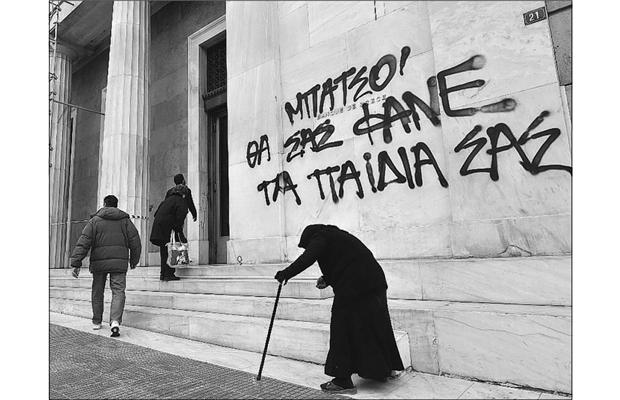
Elderly woman begging outside Bank of Greece headquarters in Athens (photo: Getty Images). Graffiti reads: “Cops, your kids will eat you.” Again, maybe only our irreverence and humour will save us.
This priceless piece of ethnographic footage illustrates a deeply revered Greek tradition: that of talking to yourself but only on the condition that others be present. Ironically, in fact, the Nazi Golden Dawn thug, Kasidiaris, is the only one at the panel that actually starts off by trying to make a point he wants to communicate. It’s not that I’m not absolving him of anything; I can’t wait to see him in jail — he already has a criminal record — except for my fears of what his arrest or indictment will cause in the streets of that much-suffering city when it happens.
It’s just that the lyrics of an old song by Guatemalan Ricardo Arjona come to mind about twenty times a day when I’m in Greece and where I usually spend most of my time silent: “Le sobran opinones y le faltan argumentos,” “He’s long on opinions and short on arguments.” I don’t think anybody has the right to judge Kasidiaris’ outburst until he’s had to face a Neo-Greek reciting his treatise at you, punctuated only by the occasional sarcastic smile at how stupid you are, or had to sit in a group of them ranting past each other as in this video, addressing only some distant mirror of self-satisfaction. Kasidiaris’ violence is unprecedented, but the whole exchange is just a more extreme manifestation of a political and journalistic scene — and a culture of personal interaction — that has been conducted on this juvenile discursive level for as long as I can remember. Even a rational person would be tempted to call the Communist MP Kanelle an “old commie,” given she’s mumbling to herself (on the grounds that she doesn’t talk to “fachitos”) in a series of comments and rhetorical questions that sound like they were issued by the Cominform circa 1950, and Dourou, the Syriza MP, the party that’s supposedly a coalition of the old “intelligent” and “cultured” Left, gets splashed in the face only after pronouncing one of those cheap coffeehouse pronouncements that the Neo-Greek soul has a fatal weakness for.
And so it goes in the ‘land that gave us democracy’ (“…except with lots of slaves which is much better.”)
ATHENS, Greece — Greece’s election campaign turned ugly Thursday on live TV: The spokesman of the extreme-right Golden Dawn party, after trading insults of “commie” and “fascist,” lunged at two female left-wing politicians on a mainstream morning talk show, throwing water at one and smacking the other three times across the face.
The violent display reminiscent of trash TV, a week and a half ahead of crucial elections, stunned Greeks as they seek to avoid a catastrophic exit from Europe’s common euro currency. A prosecutor issued an arrest warrant for Ilias Kasidiaris, whose party alarmed Europe by gaining 21 of Parliament’s 300 seats in Greece’s inconclusive May 6 elections.
Golden Dawn, which vehemently denies the neo-Nazi label, has been accused of violent attacks against immigrants in Athens. The party denies involvement in the attacks, insisting it is a nationalist patriotic group. It campaigned on a platform of ridding the country of illegal immigrants and cleaning up crime-ridden neighborhoods, and advocates planting anti-personnel mines along Greece’s borders to stop migrants from sneaking across.
The attack “put on public display what was widely known,” said the radical left-wing Syriza party, whose member Rena Dourou was splashed with water on the show. “The true face of this criminal organization.”
Tempers frayed on the daily morning political show on the private Antenna television station during a political debate, to which representatives of all seven parties that won parliamentary seats on May 6 had been invited.
Discussion had turned to the country’s natural resources. But it went off on a tangent about political history in Greece, which suffered a vicious civil war between Communists and the right-wing after World War II, and a seven-year military dictatorship that ended in 1974.
Kasidiaris, his temper wearing thin, shot an insult of “you old Commie” at 58-year-old prominent Communist Party member Liana Kanelli, in return for her branding him a “fascist.” Kasidiaris, 31, who served in the military’s special forces, also took offense at a reference by Dourou to a court case pending against him.
It all careened into violence when Dourou said there was a “crisis of democracy when people who will take the country back 500 years have got into the Greek parliament.” Kasidiaris bounded out of his seat and hurled a glass of water at her, shouting an insult loosely translated as “you circus act.”
Talk show host Giorgos Papadakis – shouting `’no, no, no!” – ran over to Kasidiaris, attempting to calm him down. But the Golden Dawn member turned on Kanelli, who had stood up and appeared to throw a newspaper at him.
Kasidiaris hit Kanelli three times – with hard right-left-right slaps to the sides of her head.
Papadakis tried and failed to restrain him.
The channel cut to a commercial break, and returned five minutes later without Kasidiaris.
The court case Dourou referred to was one in which Kasidiaris is accused of participation in a 2007 attack on a student. He faces charges of assisting in robbery and bodily harm after his car was allegedly used in the incident in which a student had his identity card stolen. Kasidiaris claims the accusation is politically motivated by Syriza members. The case was to be heard in court on Wednesday but has been postponed to June 11.
Papadakis and Kanelli later said attempts had been made to restrain Kasidiaris after the scuffle by shutting him in a room in the TV channel’s building, but he broke through the door and left. Police were searching for him to serve the arrest warrant, which under Greek law must be carried out within 48 hours. If he is not arrested within the time limit, the case is dealt with under ordinary court procedures, with a court case being scheduled.
“The government condemns in the most categorical way the attack by Golden Dawn spokesman Ilias Kasidiaris against Liana Kanelli and Rena Dourou,” government spokesman Dimitris Tsiodras said. “This attack is an attack against every democratic citizen.”
Tsiodras called on Golden Dawn to condemn its member’s actions.
For its part, Golden Dawn said it was Kanelli who first attacked Kasidiaris, “hitting him unprovoked in the face with a packet of documents.”
“Golden Dawn continues its fight for a strong nationalist movement against everyone, and naturally against the orphans of Marx, who dominate on the (broadcast) channels and are playing a dirty propaganda game,” the party said in a statement.
“If you want us to condemn our co-fighter for a truly unfortunate moment, you should first condemn the insults and the attack by Liana Kanelli, otherwise you are nothing but sad hypocrites following orders.”
The party, which blasted journalists for a mud campaign against it in cohort with the other political parties, said it would boycott the media.
“We announce to the Greek people that before the media shut us out, we are shutting them out. We don’t need them. We have half a million Greeks on our side,” it said in a statement posted on its website.
Golden Dawn won nearly 7 percent of the vote on May 6, giving it 21 seats in the 300-member Parliament. It was a radical increase from its showing in the previous elections in 2009, when the party won just 0.31 percent of the vote.
Greeks reeling from two years of austerity amid their country’s vicious financial crisis punished the two main parties, the conservative New Democracy and socialist PASOK, turning instead to smaller radical parties to the right and left.
The 300 deputies took up their seats for a day last month before parliament was dissolved and new elections called as no party won enough votes to form a government. Coalition talks collapsed after 10 days.
“The people voted for them because they didn’t know what Golden Dawn was. They didn’t know they’re a new form of neo-Nazis,” said Athenian Maria Misaridaki walking through the capital’s central Syntagma Square. “They saw the violence. It should open their eyes so as not to vote for them.”
One of the Little Rock Nine*, among the Black students who were the first to bravely attend officially desegregated high schools in 1957 despite the violent opposition.
If you’re Greek, and your wish that the earth would open up and swallow you hasn’t materialized yet, here’s some videos of Greeks acting like the crazed yahoos in the background of the above, now classic, photo, only towards the destitute and suffering migrants stuck in their country by EU stupidity.
One report from Al Jazeera:
And another two-part but short documentary by a Norwegian production crew that I couldn’t get any more information on:
Epiros, the beautiful but rocky and barren part of Greece readers must by now know that my family is from, is known f0r two kinds of folk songs especially: dirges to be sung at wakes for the dead (or on other occasions too, just for the cathartic pleasure they give, which tells you a lot about the region and its people), and songs of emigration (“xeniteia” — “kurbet” — yes, the Turks have a word for it too). Xeniteia, from “xeno-” strange or foreign, is not so much emigration itself, as it is the state of being in a foreign place, away from your home, your people. For as far back as I know, meaning up to three generations, every man on all sides of my family worked and lived abroad for perhaps the greater chunk of his adult life, in places as diverse as Constantinople, Bucharest, Buenos Aires, New York and Watch Hill, Rhode Island. When my father’s village had around fifteen hundred people, there were around another five hundred Dervitsiotes living in Peabody, Massachusetts, working mostly in that town’s tanneries; they would joke that “Peabody, Mass.” meant “Our Peabody” — “mas” being the first person plural possessive pronoun in Greek. Many of Epiros’ villages were inhabited almost entirely by women, children and old people; it was almost inconceivable that an able-bodied young man would just stay home and not try his luck abroad somewhere.
But Epirotes are not the only Greeks for whom xeniteia constitutes (or did) a deeply embedded chunk of consciousness and identity. There wasn’t a Greek family from any region that didn’t have someone living and working abroad, and the longing and sorrow of that condition was something everyone instinctively felt; it was a collective emotion.
And that’s what makes these outbursts of anti-foreigner violence even more shameful and disgusting. Again, one sees how the loss of diaspora consciousness is one of the things that has so cheapened and impoverished the Neo-Greek soul in the past few decades. Again, I suggest, as I did in a previous post, that we all re-watch Gianni Amelio’s beautiful 1994 Lamerica: “…which is the story of how a cool, smug Young European Sicilian gets stranded in Albania and realizes that he’s only a generation away from being counted among the wretched of the earth himself — and how dangerous it is to forget that.”
I bash my peeps a lot. There are reasons for it, complicated ones, but among them is the responsibility I feel to make sure my tribe’s slate is clean before I criticize anybody else. But an equal object of my bashing here is the European Union, which aside from proving itself to be a neo-colonialist endeavour masquerading as the Highest Achievement of Western Humanism Project, has also revealed itself to be a half-assed, thrown together mess on so many institutional and bureaucratic levels. (Yes, neo-colonialist: the Frangoi** gave up their colonies after the war and then discovered the exploitable potential of Europe’s own periphery again.) A large part of these destitute peoples’ problem has been caused by EU refugee-immigration policy, which dictates that you can’t expel an asylum-seeker from the Union, but you can return him to his country of entry, which, since 2009, when Spain and Italy, with their greater resources, tightened up their maritime border security, has been Greece, the country least able to absorb them economically or deal with them administratively. The above videos are two years old, but since that time, when by some estimates, one million refugees had accumulated in the country, all Europe did was ignore the problem while prescribing more diet pills for Greece.
Only this past spring did Brussels even give some aid to Greece to open up frighteningly named “closed hospitality centers,” detention camps on unused military sites, which given the condition I imagine those sites are in, and the fact that Greek police, who recently voted for the Nazi Golden Dawn party at a rate of more than fifty percent in some districts in Athens, will be involved in running them, will be a human rights paradise, I’m sure:
Thank God, the Merciful and the Compassionate, that we have a large, healthy Turkish minority in the northeast that provides imams, like the one in the second video, to give a decent burial to the mostly Muslim, anonymous and alone migrants who get blown up or who drown trying to cross our Rio Grande.
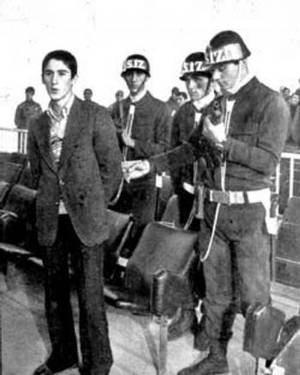
Though it was only incidental to the previous post, the image of Erdal Eren has haunted me for the rest of the night; perhaps it’s the photo of him and its painful youth and innocence; obviously the terrifying quote: that he looked forward to his execution in order to avoid thinking of the torture he had witnessed; maybe it’s that hanging has always struck me as a particularly obscene form of capital punishment’s obscenity (the setting looks prison-like, like he’s actually entering the gallows chamber there…)
Then the eerie reminder of the Cavafy poem: “27 June 1906, 2 p.m.”
27 Iουνίου 1906, 2 μ.μ.
Σαν το ’φεραν οι Xριστιανοί να το κρεμάσουν το δεκαεφτά χρονώ αθώο παιδί, η μάνα του που στην κρεμάλα εκεί κοντά σέρνονταν και χτυπιούνταν μες στα χώματα κάτω απ’ τον μεσημεριανό, τον άγριον ήλιο, πότε ούρλιαζε, και κραύγαζε σα λύκος, σα θηρίο και πότε εξαντλημένη η μάρτυσσα μοιρολογούσε «Δεκαφτά χρόνια μοναχά με τα ’ζησες, παιδί μου». Κι όταν το ανέβασαν την σκάλα της κρεμάλας κι επέρασάν το το σκοινί και το ’πνιξαν το δεκαεφτά χρονώ αθώο παιδί, κ’ ελεεινά κρεμνιούνταν στο κενόν με τους σπασμούς της μαύρης του αγωνίας το εφηβικόν ωραία καμωμένο σώμα, η μάνα η μάρτυσσα κυλιούντανε στα χώματα και δεν μοιρολογούσε πια για χρόνια τώρα· «Δεκαφτά μέρες μοναχά», μοιρολογούσε, «δεκαφτά μέρες μοναχά σε χάρηκα, παιδί μου».
“27 June 1906, 2 p.m.”
When the Christians brought him out to be hanged the innocent boy of seventeen his mother there near the scaffold was dragging and beating herself in the dust, under the sun, the savage noon-day sun, and now would screech, and now would howl like a wolf, like a beast, and then exhausted the martyred woman would keen “You only lived these seventeen years my child.” And when they raised the boy up on the scaffold, and passed the rope around his neck, the innocent boy of seventeen, and his body swung hideously in the void wracked by the spasms of his black agony the beautifully made youthful body, the martyred mother rolling in the dirt was no longer keening of years, “Seventeen days only” she keened, “Seventeen days only did I enjoy you, my child.”
(my translation)
Erdal Eren
Cavafy wrote the poem in remembrance of the 1906 Denshawi affair, one of Britain’s unfinest hours. Apparently some British military personnel were returning from Cairo to Alexandria and, near the village of Denshawi, shot some pigeons that belonged to the locals. A scuffle ensued; a rock was thrown that hit a British soldier on the head and, though he died of what was later proven to be sunstroke, like a delicate E.M. Forster memsahib, five of the residents of Denshawi, including the seventeen-year old of the poem, were imprisoned. Fortunately, there was such a public outcry after the execution of the young man that the other four men were released, though not till two years later in 1908. The episode still remains disgusting and Cavafy’s poem one of his most chilling, a register he usually didn’t work in.
At the same time it’s a beautiful reminder of his humanity on several levels. One is his life-long opposition to capital punishment: “Whenever I have the opportunity I declare this,” he wrote in 1902. The other, without re-outfitting him as a post-colonialist before his time, is his affection for and lack of alienation and estrangement towards Egypt itself. He could have had the cloistered emotional outlook of an erudite fag in the European cocoon of Alexandria, yet the otherness that life imposed on him taught his heart the right lessons. The above poem (even his use of “the Christians,” which in the context can mean nothing less than “the kafirs,”* is a jarring statement of identification) is only his most poignant expression of his love for the country, not just the historical Egypt of so much of his poetry, but the actual Arab Egypt he lived in; “To glyky mas Misiri,” as he calls it in one poem: “Our sweet Misiri” — our sweet Egypt.**
I wonder what he would have thought of the current state of Greek politics – not that he ever cared much for either the Neo-Greek statelet or its inhabitants. What would a man that lived and wrote on the cusp of every possible human margin and in every plural space conceivable, who would have died before he let his Hellenism be trapped by geography, nationalism or its idiocy, have thought of Greece having the most potentially powerful Nazi (I’m tired of dignifying them with the prefix neo-) party on the European continent? And that granted to them by a significant youth vote. A thirty-something Athenian, and a left-leaning one at that, recounting to me the multiple incidents of petty anti-immigrant animosity that she had been witness to in Athens even before the current crisis, recently said to me, in glib defensiveness: “Well, we’re not used to strangers in our country.” This from us, malaka, the inventors of migration and its pain, who since the beginning of our historical presence have been strangers in every stranger’s land on the planet, except those corners ventured into only by more intrepid or desperate Jews or Gypsies. It’s beyond even remotely doubting for me that it’s partly the loss of a diaspora consciousness on Neo-Greeks’ part, and the wider sense of world it gives you, that has made us such closed, parochial idiots, just as Israel — sorry to say — has had the same effect on Jews. And the comparison doesn’t end there; in both cases the diaspora is not just forgotten and ignored, but a source of embarrassment and shame, and each state and its official and/or fabricated culture has the hubris to think itself the metropolitan standard that those left outside should aspire to, when neither state in question contained a serious metropolitan center of either Hellenism or Jewishness until the twentieth century (…with Israel causing a progressive closing of the Jewish mind everywhere — a disaster for all of us). Now maybe that some young Greeks have had to start emigrating again some of that attitude will get a real reality check. The economic crisis in Greece is a source of genuine consternation for me and I’m guardedly on the anti-EU/Troika side; at the same time some humility may be exactly what that society needed. Maybe…though voting for Nazis doesn’t exactly indicate humility but childish rage.
*Qafr, kafir: infidel
**Masr is Egypt in Arabic. Cavafy uses “Misiri” because in Modern Greek words can only end in certain consonants. This is something — tzatziki, kazani, kadaifi, kokoretsi, duvari — that makes Turks giggle and strikes them as particularly funny when they hear it in Greek and the kick they get out of it has always struck me as particularly sweet in return. I think Cavafy intended it to have this effect.
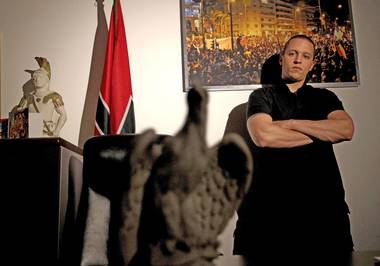
Greece has the official honor, I think, of being the first European state since WWII that may be about to seat Nazi MP’s, twenty-one of them, in it’s Parliament. This is a reziliki and embarrassment of major proportions which shows up the childishness of so much of the Greek electorate, which, faced with economic hardships that I don’t want to minimize but hardly justify this response, gave some 8% of its votes to these morons, the Golden Dawn, who have no platform, no ideas other than racism and an embarrassing mish-mash of “Hellenic” Fascist symbolism, and who will probably have to buy their first suits, if a government is formed, to sit in the hallowed halls of the 300. At the press conference of Nikos Mihaliolakos, the party’s leader, journalists were ordered to stand by one of the party’s black-shirted thugs when their leader came in (in incorrect classicized Greek; it’s “egertheti” not “egerthetw,” ass…) at which a good part of them stood…and walked out. Again, let’s hope Greek irreverence is our saving virtue.
Mihaliolakos also warned at the press conference, for those who stayed, that: “The time has come for those who betray the Fatherland to be afraid. We are Greek nationalists”:
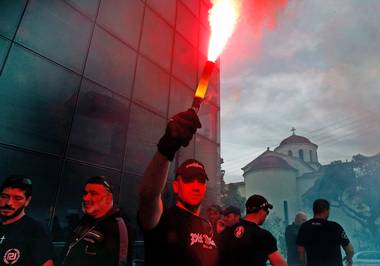
The Independent has a scary article on Golden Dawn, Greece’s Neo-Nazi party that has gained impressive traction in Greek politics over the past few years, to the point where they might soon have Parliamentary representation. (See my April 14th post: “Ain’t that America”) This is not the far right EPEN of the 1980’s, or LAOS, or anything like Le Pen in France, father or daughter. These are Neo-Nazis, pure and simple. They give Nazi salutes, worship Hitler, sell copies of Mein Kampf at their rallies, attack and harass immigrants on a daily basis, and, most disgustingly, often have the tacit, passive approval of the police:
“It started, as many days do in Greece, with a trip to the kiosk to buy cigarettes. Still half-asleep, Panayiotis Roumeliotis was surprised to be asked to show his identity card by two young men with shaved heads. It was his first direct contact with the vigilante groups that have become a feature of everyday life in some areas of the Greek capital.
“They were calling themselves the residents association but they were just fasistakia (little fascists),” said the 28-year-old.
Over the last two years, Mr Roumeliotis has watched the central Athens neighbourhood of Ayios Panteleimonas, where he grew up, undergo an ugly transformation. Taking the bus on another morning soon after, a gunshot shattered the back window and a gang of men forced the driver to stop. When the doors opened, they came on to the bus and started to assault the non-Greek passengers. The attackers were wearing T-shirts from the right-wing extremist group Golden Dawn. While panicked people were trying to escape from the bus the men were hitting them with flagpoles.
“They were beating people with the Greek flag,” said Mr Roumeliotis.
When the police arrived they stood off until the thugs had finished. When he asked the police why no one had been arrested one of the officers replied to him: “Why, did they do something to you?””
The above is a quote from my April 22nd post: “Turkey in Europe”
Just to get a minor point out of the way first. The sheer arrogance of this “Hellas” and “Hellene” campaign — that speakers of other languages should change a word in their vocabulary to suit our bloated fantasies — enrages me. “Griego,” for example, is not a Greek word that you can change; it’s a Spanish word that Spanish-speakers use to refer to Greeks. Are you going to make them change it, Katinaki? You don’t hear Hungarians running around insisting the world call them Magyars, or Finns launching a campaign to have us all call them — do you even know? — Suomalaiset. (Unfortunately, there are some annoying Turks who are trying to get everyone to say “Turkiye” instead of “Turkey,” with the lip-pursed umlaut on the ‘u’ and the the extra syllable at the end.)
The occasion for this post is this ridiculous personage below: Katerina Moutsatsou, who hasn’t just posted one video but is all over the web and is apparently a Greek actress, though she sounds and acts Greek-American to me:
Grrrrrrrr…… You didn’t invent the West, yavrum; the West invented you — ki akoma na to pareis habari — and in deep, profound ways your refusal to see that is fundamental to the current crisis. Because once the West invented you, motivated by cultural and ideological desires of its own that had nothing to do with you, once it got you to internalize its image of you so that two hundred years later you’re still trying to squeeze cultural capital out of that internalized colonial identity — because this stupid “Hellene” campaign is just an expression of that pathology — the West proceeded to ignore you and still does. But keep preaching that gospel and see how far you get.
Happily, she’s not being taken seriously by most. Here’s a great riposte to Moutsatsou’s video, which in contrast to her inflated silliness, is the best of what a Greek can be: ironic, angry, smart, aware and funny. This guy Spyros originally had a little cut of Moutsatsou in the beginning so viewers could get the reference, but the young miss made him remove it for — not kidding — copyright reasons, and he had to re-edit and repost it. He says in Greek in his comments: “I reposted without the part where Mouts’ [Moutsatsou] is talking…” — “mouts” being suspiciously close to gay Greek slang for “annoying chick” — probably unintentional but you never know. “Malakas,” for those who aren’t Mexican or haven’t otherwise worked in a New York diner kitchen, is a multi-toned word. Originally meaning “masturbator” I guess, it now means “asshole” or “jerk” but among young men (and increasingly young women) it can be a totally innocuous interjection like “mate” or “buddy” or “dude.” Spyros absolutely means it in the harder-core “asshole” sense. I was especially moved by: “I don’t blame globalization; I blame immigrants.” (see my April 14th post: “Ain’t that America”)
And then there’s Manos, a talk show host who just goes on an all-out firebombing of Moutsatsou’ pretensions. The one Greek phrase he uses and that I feel obligated to translate is when he says, “if I owe any money…it’s because “Hoi hwraioi echoun chree” (“Hot guys have debts…”) which is the refrain of a Greek pop song — a piece of crap as music but the refreshing heights of Greek impudence given the current situation — whose lyrics go: “Hot guys have debts…and they pay them with kisses…so tell me what I owe and we’ll settle accounts in my arms.” Dedicated to Angela Merkel.
Any issue like this becomes an instant riot-fest of satire in Greece, something maybe we did invent, because give them a good story and it suddenly turns into a country of ten million very sharp-witted, merciless, gossipy housewives. God help you if they find even the tiniest crack in your position or your posturing. Miss Moutsatsou is going to get run out of the country soon; once Greeks are on to you, you’re finished. As Cavafy wrote: “…κ’ οι Aλεξανδρινοί τον πάρουν στο ψιλό, ως είναι το συνήθειο τους, οι απαίσιοι.”
Balkans, Anatolia, Caucasus, Levant and rest of ME, Iran, South Asia
Me, I'm Nicholas Bakos, a.k.a. "NikoBako." I'm Greek (Roman really, but when I say that in English some five people in the world today understand what I'm talking about, so I use "Greek" for shorthand). I'm from New York. I live all over the place these days. The rest should become obvious from the blog.






 Jadde: from Bosnia to Bengal