Tag Archives: Ottomans

“Syria Is Not A Country” — Andrew Sullivan lets fly another one of his kotsanes and then rushes to cover his tuches

27 Jan

Sykes-Picot

He got enough flak for the post (read through all the ctd.’s too — very interesting) and I feel kind of bad giving him more after so many months, but it’s been in the back of my mind since the fall and the argument is so irritating that I had to put in my own two cents.

It seems that every Sullivan-type pundit rushed out in 2001, or more probably 2003 when they were making their Iraq predictions, and bought some book about the Paris Peace Conference: “Paris 1919” “The Peace to End All Peace” — it’s an entire genre in itself.  And there they found out about some magic secret, like in a Dan Brown novel, called the Sykes Picot line, that supposedly explains everything about the Middle East’s dysfunction, and like a little kid who realizes he’s said something that the adults have found smart or funny, they go around repeating it ad nauseum: “Sykes-Picot Line”…”Sykes Picot Line” … “this guy Sykes and this guy Picot”…”The Sykes Picot Line…”  Listen to Sullivan’s own pedantic tone:

“Syria as we now know it was created by one Brit, Mark Sykes, and one Frenchman, Francois Georges-Picot in 1920. Originally, it included a chunk of Iraq (another non-country), but when oil was discovered there (in Mosul), the Brits wanted and got it. With that detail alone, you can see how valid the idea is of a Syrian “nation” is.”

The whole point is that most of the nations of the present Middle East are artificial, colonial creations — arbitrary lines drawn on a map –and that explains everything.  First, these lines are not arbitrary.  Whatever you might want to say about Sykes or Picot, or Churchill or Lloyd George or Clemenceau — that they were gross imperialists (which is not even redundant really but simply a tautology: “The King is a gross monarchist…”) or anything else, they weren’t ignorant or anistoretoi.*  The units they put together corresponded, as so many of Sullivan’s readers point out to him, with regions with long, historically recognized identities.  Where you look at a map of the Middle East and do see straight artificially drawn lines, they were drawn through places where nobody lives.  Otherwise, within every one of those lines, there has always existed a shifting, changing, re- or de-centralizing identity, but one with clear continuities nonetheless.

(*Anistoretoi – ανιστόρητοι – is a Greek word that I like very much, because it literally means “un-historied” — historically ignorant, obviously, but there’s something about “un-historied” that just seems to me like a sharper condemnation of inexcusable lack of knowledge — no? — so you’ll see it on this blog here and there.)

Thankfully, no one says this about Egypt, because it so obviously has a longer continuous history of unified consciousness than even China.  But what Sullivan, so damn pompous — or just so gay and so Magdalen — dismisses as the “non-country” of Iraq, the flatlands of the Tigris and the Euphrates basin, even when semi-splintered into northern, central, and southern parts, as Iraq seems to be doing now, was always seen as a unit: certainly geographically but even culturally.  The two regions the Greeks called Libya and Cyrene may correspond to a west-east division that is still apparent in modern Libya (Tripoli and Benghazi), but their union is not necessarily artificial or inherently problematic.  The headland to the west of Libya we call Tunisia was the first region called Africa by the Romans, where their ancient enemy Carthage had once stood.  And the region where the northwestern section of the Fertile Crescent bends over and meets the Mediterranean has been called Syria since the Greeks and was probably seen as a recognized cultural entity far before them.  The mountainous Mediterranean littoral of this Syria — what’s now Palestine and Lebanon and maybe a new Alawite state waiting to be born — was always a space slightly apart and more heterogeneous, but Syria nonetheless.  (The arid plateau across the Jordan, inhabited by the Moabites and Edomites and Nabataeans and all those other peoples the Israelites are always defeating in the Old Testament because God loves them more, was also a region of a recognized coherence of sorts not just made up by the Brits when they decided to call it Trans-Jordan.)  Syria was the birthplace of Christianity as an organized religion.  Syria was the Romans-Byzantines’ richest and most sophisticated eastern province.  Syria was the prize catch for the Crusaders; the real studs among them who could, got themselves a piece of booty there, not the “Holy Land.”  When Zainab bears her lament to the people of Shaam (Syria or the Levant) in Agha Shahid Ali’s beautiful poem she cries out: “Hear me Syria…” addressing the people of the seat of Umayyad power in Damascus — the one in Syria — that had massacred her sacred family.  Sykes and Picot didn’t make this stuff up.

What Sullivan wants to say, and what’s truly problematic about his assertion, is that Syria is not a country because it’s not ethnically or confessionally homogeneous, and dismissing it as a state for those reasons is a far more eurocentric, and anistoreto, an idea than he may know.  Because if those are our standards for nation-hood, there are very few countries in the world.  By those standards, if Syria is not a country, then England and France aren’t countries either.  Because a polity called the Kingdom of England, or the Kingdom of France — both of which one could argue were “artificially” created by the powers that be of the time — had existed for far longer than Englishmen and Frenchmen have.  And the process by which a unified national consciousness was created to match these pre-existing political units — England or France — was a long and complex one and one that followed the particular course it did only in Western Europe and trying to force it onto the peoples of states in other parts of the world is impossible and extremely dangerous.  Forget what Sullivan thinks is the Machiavelian divide-and-rule politics of the colonizers that pitted ethnic groups in Syria and Iraq against each other; these colonizers were probably never as devilishly smart as we like to imagine them.  What Sullivan finds inconceivable is that one can be a Latakian Alawite or a Sunni from Homs or an Aleppo Christian or a northeastern Kurd and still function as a citizen of a legitimate country called Syria; that these groups have always had boundaries that fluctuated or were permeable; and, that though relations between them historically were better at some moments than others, they were brought together in this place called Syria by organic historic processes and not corraled together there by outsiders.  And by believing that it’s inconceivable they can all function as citizens of this place, he’s actually participating in the creation of a discourse that pits these groups against each other in a manner far more fatal than the supposed manipulations of the British or French.  He’s creating a poetics of sectarianism, pure and simple.  One only has to look at how reinforcing ethnic differences, often with the naive supposition that satisfying each group’s demands will lead to peace, only exacerbated the tragedy — the tragedies — of Yugoslavia in the 90s to see where thinking like Sullivan’s leads.

To his credit, Sullivan gives the Ottomans credit for maintaining a semblance of peace and stability in the region for several centuries.  But the Ottomans had molded, over the centuries, a complex and flexible system of negotiated corporatism and autonomy that recognized the different groups of their empire and yet that held them together in one unit successfully until modern nationalism started making that impossible.  What Sullivan is doing with blowhard statements like the above is just continuing that process: making it impossible for the peoples of the region that have to live together to do so peacefully and productively.

Finally, as a somewhat tangential but important aside, I’d really be interested in finding out why Sullivan doesn’t think that India is “not a country.”

And, folks, what is going on in Syria?  I’ve been in France for a month and my French isn’t good enough to follow the news and the American stuff on-line seems to have less and less coverage.  Has some sort of stalemate been reached?  Is some kind of compromise being forged?  Are people just tired?  Anyone want to enlighten me?

Where’s Charlemagne When We Need Him?

1 Jul

Huh?

Not the most brilliant thing I’ve read lately but one important, though really flawed, point:

“BY 1900, only two genuine multinational empires remained. One was the Ottoman, which was by then in the process of abandoning its traditional religious toleration for Turkish nationalism and even racism. [A completely, unfair, simplistic and un-historical assessment]  The other was Austria-Hungary, home to 11 major national groups: a paradise in comparison with what it was to become. Its army had 11 official languages, and officers were obliged to address the men in up to four of them.

It wasn’t terribly efficient, but it secured an astonishing degree of loyalty. It also brought rapid economic and cultural progress to an area extending from the Swiss border to what is today western Ukraine. During World War I, Austria-Hungary fielded eight million soldiers commanded by, among others, some 25,000 Jewish reserve officers. Thirty years later, the nation-states that succeeded the empire sent most of the surviving Jewish officers to the gas chambers.”

Unfortunately, the poison of the ethnic-based nation-state ideal had gotten too far by then.  Even the portrait of Austria-Hungary he gives us is completely idealized and existed in the form he describes for less than a century.

(Click above)

How sweet though, to have lived in a world that interesting instead of the stupefying monotony of the modern nation-state.  But that idea is so powerful — no, not because it’s natural and inborn, but because the modern, bureaucratic state was the first with the technical apparatus to impose it on its population(s) — that it deletes all historical files dealing with plurality.  Not a single European tourist who comes to New York fails to make the same comment: “Amazing…all these peoples living together…” and I want to explain that that’s how humanity lived for most of its civilized existence — or just pull my hair out — but I usually don’t bother.

But that reminds me: I do live in a world that “sweet” and “interesting:”

Mr. Deak (Hungarian?) is also wrong on an even more crucial point.  The Ottoman and Austro-Hungarian empires were not the world’s last multi-ethnic states.  There’s still China.  Most of southeast Asia.  And Russia.  And most ex-Soviet republics.  And certain Latin American countries.  And almost all of Africa.  And Syria and Lebanon and Iraq and Iran and Afghanistan and Pakistan and the world’s great wonder, India.  Even Turkey.  (And wherever ethnic nationalism is a problem in those countries it’s based on the Western intellectual model.)  In fact, most of the world still lives in “plural” situations.  Only Europe (and even in Europe there’s Spain and the U.K.), has an issue with this concept, but it seems to be fading even there.  Its last bastion will probably be the growing number of viciously homogenized, ugly little states of Eastern Europe and the Balkans.  Which brings us back to Michael Ignatieff:

“The misery of the Balkans stems in part from a pathetic longing to be good Europeans — that is, to import the West’s murderous ideological fashions.  These fashions proved fatal in the Balkans because national unification could be realized only by ripping apart the plural fabric of Balkan village life in the name of the violent dream of ethnic purity.”

From Blood and Belonging: Journeys into the New Nationalism, Michael Ignatieff


Names: “Istanbul (not Constantinople)”…and Bombay!

21 Jun

I reckon I’ve now received enough emails complaining about my use of “Constantinople” that it’s time to address the issue.

Constantinople – Kwnstantinoupoles — is Istanbul in Greek.  It’s the Greek word for Istanbul.  Istanbul comes from the word Constantinople.  It’s that simple.  The way Moscow is the English word for Moskva.  The way Parigi is the Italian word for Paris.  Constantinople is the Greek word for Istanbul.  It’s that simple.

That the Republic chose to change its official name to the time-honored Turkish name of Istanbul in the 1920’s does not obligate speakers of other languages to call it that, especially not those with as heavy an emotional, historical and spiritual investment in their own name for it as we have.  Just like the world will hopefully never be obligated to call Greece “Hellas” by the idiots who are attempting to do so.  Where Istanbul is concerned, the Ottomans themselves were content, at least for official purposes, with using the Arabic Costantiniyye until very late – till the very end, 1923, if I’m not mistaken.  And it took the rest of the world several more decades, as well, to abandon “Constantinople” and conform to the Turkish Republic’s new orders — for those who thought the name just disappeared in 1453.

What exactly is the problem?  If readers think I have some nationalist, much less irredentist, reasons for referring to the city as Constantinople, then they haven’t read anything else on this blog, and know nothing about me.  If there even is any discernible pattern in my switching back and forth between the two names, it’s not easy to identify.  I mostly refer to the city’s Greek community as Constantinopolitan Greeks, usually when I’m talking about a time when there was a community.  When the present is involved I usually say something like “Istanbul Greeks.”  I call Greeks from Istanbul “Polites” and will often say “Pole,” or even “the City” in English to evoke some sense of its importance to Greeks – and to me.  And all sorts of various combinations of the above.

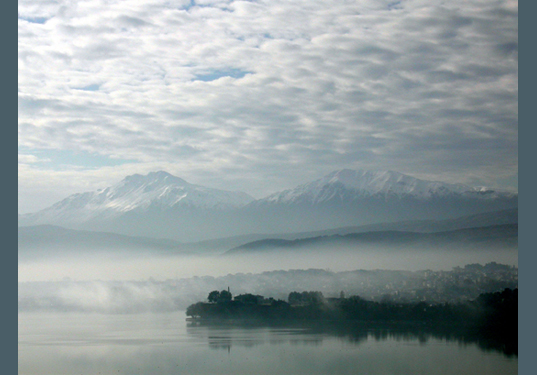
In both print and speech I never hear Turks call Salonica “Thessalonike” but Selanik – except for the occasional overly p.c. Turk who thinks that “Thessalonike” is what I want to hear.  And not only does Selanik not annoy me, not only do I not take issue with it or get offended by it, but it moves me.  Obviously, when a Turk calls Jiannena — one of my many hometowns – Yanya, it moves me even more.  A Turk who says Yanya is asserting his connection to that city, and that assertion becomes an immediate bond between me and him: a bond we both share to its streets, its lake and its mists, its mosques, its churches, its synagogues, its borek, the mahallades my mother used to tell me were Turkish before the twenties, including the one where she grew up, the parks she used to tell me were paved over Muslim cemeteries, that used to scare her as a girl when the region’s interminable rains would expose bones and skulls in their mud — all told with her peculiar sensitivity and strange sadness that would make you think these things were all her own; I never heard a word of ethnic animosity or hatred for anybody out of her mouth — not ethnic or any other kind — and not from my father either.

Yanya: the lake, mosques, the beautiful gate of the Ic Kale, streets, the front gate and interior of the Old Synagogue, 18th c. (The New Synagogue, 19th c., outside the city walls, was blown up by the Nazis.)

And when a Turk says Selanik, he’s asserting his deep historical connection to that city; whether he’s from there or not, he’s using a name which carries all his historical references to that place, which I’m nothing but happy to grant him.  I don’t even call it Thessalonike, but ‘Salonike.  When I think of Byzantine Thessalonike, of Selanik, Salonico, Salonica, they all evoke for me a great and ancient Mediterranean city; for a long time, the second city of the Byzantines, of St. Gregory Palamas and Nicholas Kabasilas; Salonico makes me think of the heir to the philosophical and poetic heritage of Jewish Spain; the great center of Sephardic learning, both rabbinical and the deep Kabbalistic learning that Jews brought with them from their previous homeland; I think of a Turkish city that was a flourishing center of a variety of Ottoman Sufi orders; the city where so much of Turkey’s new Republican bourgeoisie came from, just as ours came from the other direction.

Frontispiece of a Salonican Zohar, a seminal Kabbalah text, originally written in Leon, Spain.

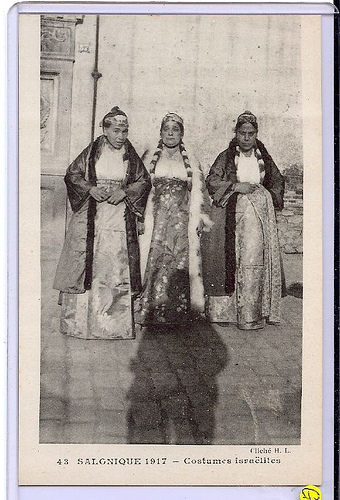
Salonican Jews

Great caption; “the fanatical sect of Islam” being referred to are the Mevlevis!!!

 When I think of modern Thessalonike, on the other hand, I think of an unattractive, humid Balkan town with a serious second-city complex. 

But I’m a “manic lover” of St. Demetrius, its patron, so I have to visit every now and then.

Mosaic of St. Demetrius, originally from the church of St. Sophia in Kiev (or is it Kyiv?), currently in the Hermitage Museum, St. Petersburg (or is it Leningrad? or Petrograd? or just the name that everyone who knows her and truly loves her calls her, Peter…)

Funny that it took me so long but I recently realized why I dislike both Salonica and Izmir so much; despite their history, despite Salonica’s plethora of classical and Byzantine monuments even, neither of them — for reasons we all know — feel like organically old cities, the way even Athens does, though in its modern incarnation it’s far newer.  They both feel like one city was removed from that location and another one hastily put in its place.  Remade.  They don’t feel grounded.  What you feel in both of them mostly is the absence of history.*

Can you even tell which is which? — except for a few giveaway signs…

With all that said, therefore, I think we have to be very careful about whether it’s the renaming of places or persevering in the old name that represents the more nationalist impulse.  I recently confirmed for an Indian friend that, yes, Greeks still refer to Istanbul as “the City,” and he shook his head and mumbled something about the “narcissism of nationalism.”  But an increasingly fundamentalist and nationalist India may be the perfect example to start with.  Granted, Calcutta was always Kolkata in Bengali.  But what was wrong with Madras?  And what nationalist Tamil mythology does Chennai justify?  The BJP (fundamentalist Hinduism.…you’d think it’d be an oxymoron) in fact, has a list for changing the names of almost all the cities of India to more appropriately Hindu ones, not just obvious targets like Allahabad, but Delhi itself and others: see the list if you’re interested.  Aung San Suu Kyi calls her country by its perfectly legitimate name of Burma, yet for a couple of decades we were content to use the name imposed on it by its military dictatorship, Myanmar, and never asked why or by whom it had been changed.  The State is not to be questioned.  If you said “Burma,” people looked at you like you were uninformed.

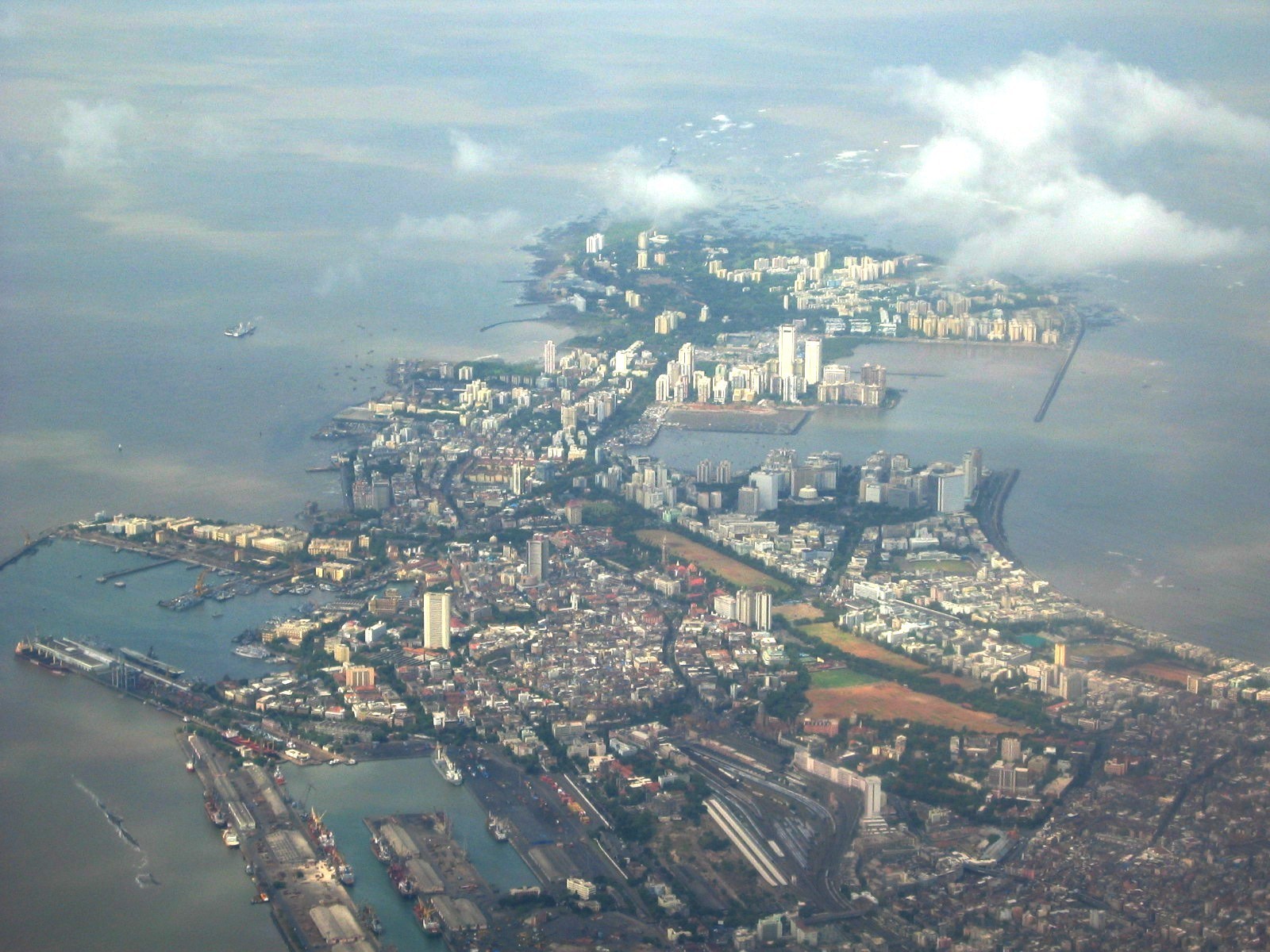
The most unfortunate and vulgar change of all is “Mumbai,” but almost no one knows or cares about how that change happened.  It was once generally accepted that Bombay comes from the Portuguese “bom bahim,” or good little harbour, just north as it is from Portugal’s long-time colony of Goa.  But even if that etymology is bogus, it was under the name Bombay that it flourished and grew under the British into the most important and cosmopolitan city in South Asia.

Bombay (gotta click on this one)

But in 1995, the Shiv Sena party (the Army of Shiva…) won control of the state government of Maharashtra, of which Bombay is a part, though it’s so different in social and ethnic make-up from the rest of that state that it deserves a separate federal district type status like Delhi has, or Mexico City, or D.C.  Shiv Sena, being a party whose power base is rural Maharashtra and poor migrant Marathis who feel they deserve more power in the city, is actively hostile to Bombay’s dizzying diversity and especially its large Muslim population.  It’s essentially a Marathi branch of the BJP, only worse (and they haven’t been getting along lately): a virulently Hindutva bunch that have not only been found to be involved in Bombay’s drug, prostitution and extortion circles, but ordered and even carried out much of the more vicious anti-Muslim attacks during the Bombay riots of 1992-93: the kerosene-dousing and burning of individuals and the burning tire around the victims’s neck were a couple of their trademarks.

When, despite all that, Shiv Sena were voted into state office in Maharashtra, their response to the poverty, massive infrastructural challenges, crime and destitution of this barely manageable city of more than twenty million was to change its name to Mumbai.  This was based on the supposed fact that there was (or is, or if there hadn’t been, I’m sure there now is) a temple of a Marathi goddess of that name on the site before the colonial city rose up, which may or may not be true, but, given the fact that every square yard of India contains at least one shrine or temple to someone or something, doesn’t mean very much.

And yet the whole world fell in line.  Thinking that, like Myanmar, if it’s coming from there it must have some sort of indigenous, authentic root, filled with post-colonial guilt and worried about offending what we thought were Indian sensibilities, we all dutifully started calling it Mumbai.  Fearing that using the old name would immediately make others imagine us to be jodhpur-clad gin-swillers, we let a bunch of criminal thugs and violent nationalists change the name Bombay — the name by which this great, open-to-the-sea-and-the-world, mercantile, diverse, cosmopolitan, sexy metropolis, a microcosm of India itself and its modern face to the world, was known for almost three centuries – and nobody asked why or breathed a word of resistance.

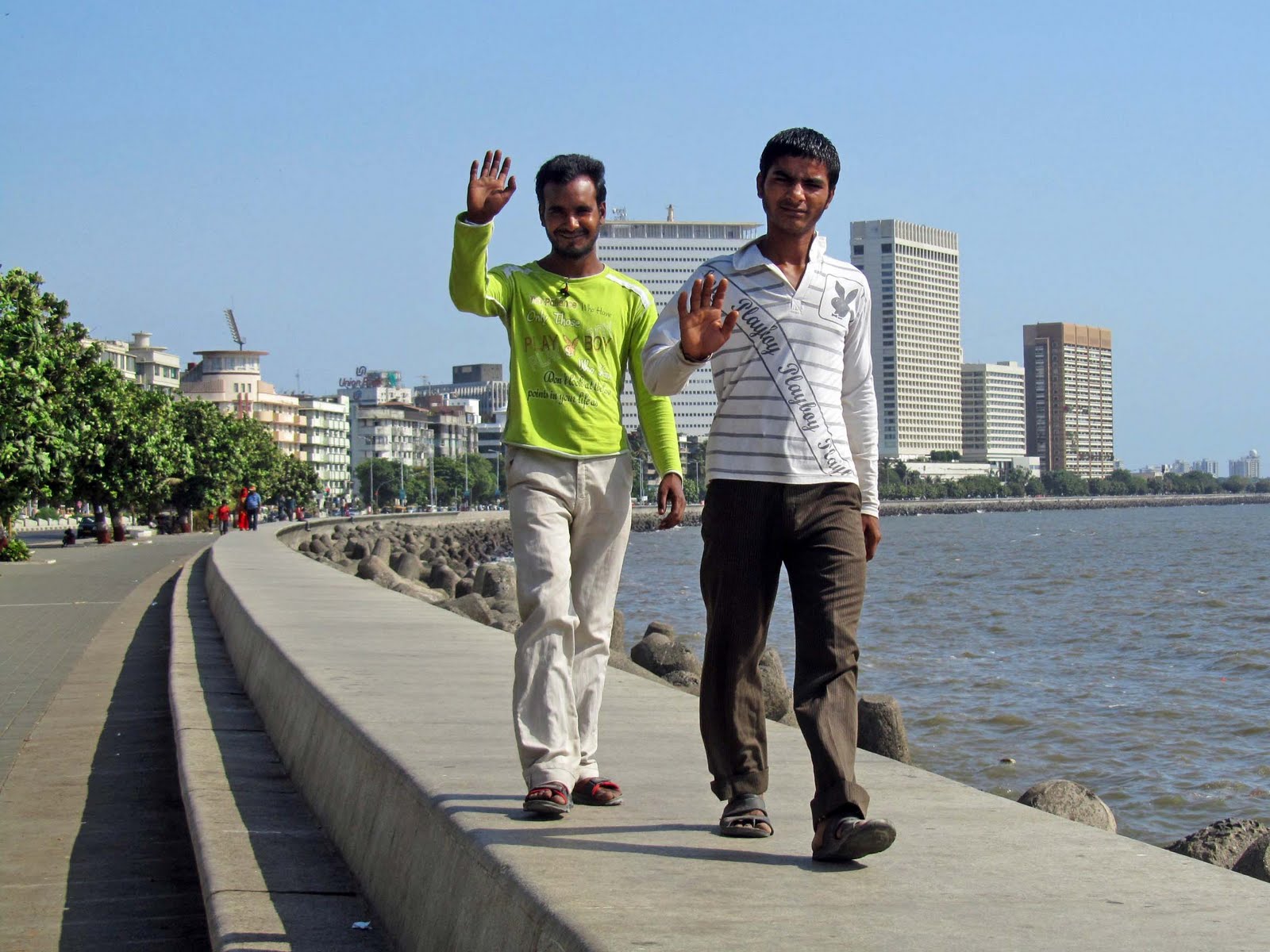
Bombay — Marine Drive — Queen’s Necklace

So as for C-town, you choose which is more “nationalist.”  Calling the city the name by which it was known to most of humanity for more than sixteen centuries?  Calling it an also venerable name that the nationalist, anti-cosmopolitan, Turkification project of a military dictatorship whose attitude to the City, its legacy, history and population was actually hostile for much of the time decided the world should call it?  Or just calling it both?

Or how ‘bout who cares?  As long as we know which city we’re talking about.

* See next post


Comment: nikobakos@gmail.com


Something beautiful from Greece: “Minore tes Auges” — rebetiko

17 Jun

This goes out to my best friend in the world.  We’re different — maybe it’s the complementarity that has sustained the friendship since I was eighteen — and we like to rag on each other a lot.  I call him a technocrat who can’t understand anything unless it can be put on a spreadsheet; he calls me a poetry-addled flake from another planet; both contain a large dose of truth.  At the same time he has the largest heart and the most profoundly musical soul of any person I have ever met.  He remembers how when he first heard this song at eight years old, he fell into a crying fit that kept him awake all night; it wasn’t the lyrics, it was the melody that “turned him into rags” as we say in Greek, “my mother at my bedside asking me ‘what’s wrong, my son?,’ me sobbing uncontrollably…”

I can’t post the original 1947 video he sent me because some copyright b.s. makes it unviewable in the U.S., so I found a beautiful rendition (along with odd but interesting video) by the great Swteria Mpellou, one of the great cultural icons of modern Greece; read about her fascinating, heroic life; like with many flamenco or blues singers, it wasn’t the classical beauty or timbre of her voice that made her great; it was her voice’s indefinable character, its soul.

The lyrics:

Ξύπνα, μικρό μου, κι άκουσε
κάποιο μινόρε της αυγής,
για σένανε είναι γραμμένο
από το κλάμα κάποιας ψυχής.

Το παραθύρι σου άνοιξε
ρίξε μου μια γλυκιά ματιά
Κι ας σβήσω πια τότε, μικρό μου,
μπροστά στο σπίτι σου σε μια γωνιά.

Wake up my little one,

and hear a dawn minore,

written for you by the weeping

of some soul.

Open your window

and throw me just one sweet glance,

and then let me be extinguished, my little one

in some corner, outside your house.

Swteria Mpellou

“A Dawn Minore” is a rebetiko — though a late-style, more commercial example of that genre — music which has its origins among the Greek proletariat of Anatolian cities — more so Smyrna than Constantinople (I imagine that in C-town the classical tradition was too strong and the other alternatives were more a la Franca, though whatever more popular genres contemporary “arabesque” comes from must have been present).  It took its definitive form, however, among the largely refugee proletariat of Athens, Piraeus, and Salonica, after the Population Exchange of the 1920’s.  Because of its association with Turkey, the poor, crime, drugs, the underworld, but mostly because its “orientalness” didn’t sit well with the Westernizing agenda of the Neo-Greek bourgeoisie, it was subject to much discrimination, marginalization and even official bans of varying efficacy.  Eventually, however, and with the recognition of geniuses like Hatzidakis, it became the basis of modern Greek music, especially that of its Golden Age between the fifties and the seventies, when Greece produced popular music that, for the quality of its compositions and high poetic standard of its lyrics, may be unmatched in any modern commercial genre, and which, along with Cavafy, I consider the great cultural achievement of twentieth-century Greek culture.  Under unknown circumstances, this musical florescence suddenly expired in the early eighties at some point (Pasok and its lethal, lefty didacticism?).  A craze for old rebetika (pl.) which suddenly exploded in Greece at the same time, probably represented a need to fill the gap: nostalgia is usually a symptom of creative sterility.

Irony: Tsitsanes, lionized as the greatest rebetiko composer and bouzouki player, but who I never thought was all that, published a series of virulent, racist rants against the Hindi-film influenced genre of popular music that developed in Greece in the fifties, decrying its “corrupt, oriental cheapness,” that could have been written, with the same vocabulary, by a Greek bourgeois ranting against rebetiko itself two decades earlier.

Irony: Many of the young Neo-Greeks that have fetishized rebetiko since the eighties (the little Athenian snots who will only listen to authentic rebetiko first renditons off of 78’s — that, or Miles) till the point where the aural environment of Greece became so saturated with it that it could drive you nuts, will also still express the same Orientalist, petit bourgeois anti-“easterness” towards other music that previous generations did toward rebetiko.  “I can’t tolerate any form of Eastern music” a thirty-something Athenian recently told me (with the crucial condescending stress difference between “anato-li-tike” and “anatoli-ke) which for the sociological type in question almost always means any microtonal, highly chromatic music, which, freed from polyphony — except for the simple drones of Hindustani classical music or of certain Balkan folk music — and the structural complexities of Western harmonies, can throw all its craft into the highly embroidered monophonic melodic line — which essentially means all music from Greece eastwards.  This was announced to me with great disgust while I was listening to a sublime Shajarian rendition of a Fereydoon Moshiri poem, disparaged as “amanedes”* (if she only knew the caliber of artists she was talking about…)  “Eastern music?”  I replied.  “So, you mean our entire musical tradition before “Barba Yianne me tis Stamnes?”**  She didn’t have an answer to that.

Heresy: Most rebetika contain neither the intriguing depth of Western harmony nor the possessing melodic intricacy of Arab or Persian classical music, or even Greek ecclesiastic music, which is why I often find them a bit tedious and am not part of the general fan club, and I consider its popular offspring of later decades (the Golden Age, a masterful combination of rebetiko, various folk genres, western forms and the best poetry of the period — prepare for a “Golden Age” series of posts) to be the by far superior music on every level.

Positive: Rebetiko, in a strangely poetic voyage back across the Aegean, became wildly popular in Turkey in the nineties, with Turks forming their own groups and everything (I’ll find an example) and has since become a happy space where much musical collaboration and explicit mutual affection is expressed.

Final YouTube comment from a Greek on another video: “Πέθανε αυτή η Ελλάδα. Ας το καταλάβουμε μπας και γλυτώσουμε από τα ΑΚΟΜΑ χειρότερα…”  “That Greece is dead.  If we get it through our heads maybe we’ll be spared EVEN worse.”

*”Amanedes” are a light classical Turco-Greek genre that flourished in early twentieth-century Smyrna.  I don’t think it ever called itself that; the mostly negative term comes from the frequent repetition of “aman,” mercy in Turkish, in its lyrics.  It’s mostly disparaging, like when used by the person above, to deprecate some kind of music as “Turkish” “Eastern” “oriental wailing” etc…

**”Barba Yianne me tis Stamnes” is an exemplary piece of an extremely silly barber-shop quartet genre that became popular in early twentieth-century Greece, based on the Italianate “cantada” tradition of the Ionian islands, which is like bad Neapolitan music without the passion, wit, complexity or subversiveness.  I can’t find a recording of it.  The thought that if it hadn’t been for the refugee influx of the twenties, that could have become the future of Greek music sends chills down my spine.  (Here you go– from a Turkish website — go figure.)

Comment: nikobakos@gmail.com

Why Euro(pe) is doomed?

6 Jun

Derek Thompson at The Atlantic:

Here is what this chart shows. Compared across more than 100 factors measured by the World Economic Forum Global Competitiveness Report, from corruption to deficits, JP Morgan analyst Michael Cembalest calculates that the major countries on the euro are more different from each other than basically every random grab bag of nations there is, including: the make-believe reconstituted Ottoman Empire [my emphasis]; all the English speaking Eastern and Southern African countries; and all countries on Earth at the 5th parallel north.

And here is your tweetable fact: A monetary union might make more sense for every nation starting with the letter “M” than it does for the euro zone.


Comment: nikobakos@gmail.com

Fethih 1453

2 Jun

Wow! This looks cool.

Anybody seen it?  I won’t even look on-line for comments ’cause I don’t expect to find anything but the usual crap.

Or maybe I will…


Comment: nikobakos@gmail.com

Domes

10 May

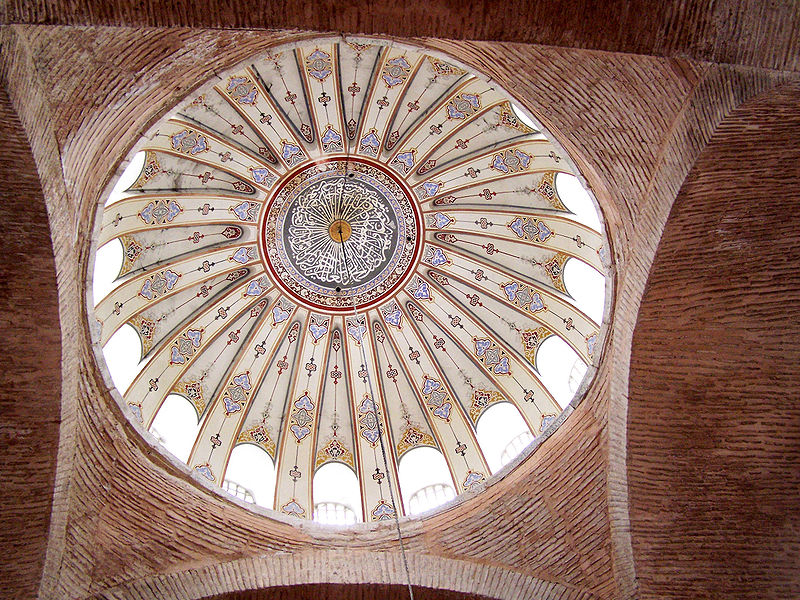
I love the remnant decoration against the bare brick of certain churches/mosques in Istanbul.

Ho Akataleptos or He Theotokos Kyriotissa/Kalenderhane Camii

He Pammakaristos/Fethiye Camii

Ho Hagios Swstes tes Choras/Kariye Camii

or just bare entirely, He Mone tou Libos or He Mone tou Prodromou/Fenari Isa Camii (top and bottom)


Comment: nikobakos@gmail.com

Milosevic Party Emerges as Kingmaker

8 May

“Milosevic Party Emerges as Kingmaker,” New York Times

Daniel Zdravkovic, a 21-year-old mechanic, was too young to remember the Milosevic era but said that he, too, was nostalgic for the socialist equality his parents and grandparents had known. He said he liked Mr. Dacic because he was honest, strong and decisive.

“I am too young to remember the Milosevic years, but they couldn’t have been worse than today when no one has a job,” “I would rather have closer ties with Russia, which is a better friend to Serbia than Europe.”

…though there’s no historical precedent for believing in that friendship other than vague notions of Orthodox solidarity.  At no point in its two-century-long war with the Ottomans or after did Russia in the Balkans behave in a way that could even remotely be interpreted as anything other than acting in its own imperialist self-interest.

Except for Count Vronsky of course…and poor Garshin.


Comment: nikobakos@gmail.com

Turkey in Europe

22 Apr

According to Stephen Kinzer, New York Times correspondent and the paper’s bureau chief in Istanbul for a good part of the nineties, the appeal of EU membership to those countries waiting for it is (or was) political, social, and economic.  “For Turkey it is also psychological,” he writes in his 2001 Crescent and Star:

“The central question facing Turks today is whether their country is ready for full democracy, but behind that question lies a more diffuse and puzzling one: who are we?  The Ottomans knew they were the servants of God and lords of a vast and uniquely diverse empire.  The true heart of their empire, however, was not Anatolia but the Balkans…  But by caprice of history the founders of the Turkish republic found themselves bereft of the Balkans and masters instead of Anatolia.  To make matters worse, through a series of twentieth-century tragedies Anatolia lost most of the Armenians, Greeks and Jews who had given it some of the same richness that made the Balkans so uniquely appealing.”

There’s a lot there I’m not sure of, like the Ottomans’ heart having been in the Balkans and their backs turned on Anatolia.  I also don’t know if “who are we?” isn’t too categorical a way to phrase the dilemma Kinzer is talking about.  Unlike Greeks, Turks know who they are; their growing willingness to accept, not only the former existence of their neighbors among them, but the plurality of their own ethnic make-up would indicate that: Albanian fraternal associations, Tatar and Circassian language classes, seem to be coming out of the woodwork of the Republic’s forced homogenization, and even the lay-low-and-keep-your-head-down Alevis have found a new courage in asserting themselves.  (Poor Republic: no sooner does it harass one minority out of its existence, another one pops up to take its place.)  That’s a process that requires confidence, whereas we remain isolated in our ignorant dream of purity — and banging our feet to prove it to the rest of the world on top of it — a ringing sign of insecurity.  As mangled as Turks’ knowledge of themselves may have become by their own nationalism, I think phenomena like nostalgia for the multiethnic or the Neo-Ottomanism that has pervaded cultural life and even motivated political life and foreign policy in Turkey recently (and I don’t think that’s a bad thing or necessarily a “threat” to anyone; we, Greeks, might want to take advantage of it actually) is an attempt to right that disfigurement, not a deep existential reorientation.  Proof might be that since Kinzer wrote his book in 2001, Turkish membership in the European Union has pretty much become a dead-in-the-water issue.  And that may be partly because, in almost head-on contrast to Kinzer’s interpretation, Turkey was looking for political and economic benefits and not for Europe to validate its psychological needs, as the Neo-Greek statelet always has since its beginnings, a craven and cringingly embarrassing pandering to the West’s classical image of what Greeks are supposed to be being the foundation of Neo-Greek identity.  However the Ottomans may have felt about the Balkans or wherever modern Turks end up with their renewed embracing of the Ottoman past, they seem to be increasingly feeling — even the old, staunchly Kemalist bourgeoisie, or at least their children — that they don’t need European validation to prove they’re part of a civilization that they’re not.  And good for them.  I wonder when we’ll get the message.

On a lighter note, it’s not often one hears the Balkans described as “so uniquely appealing.”  It’s a line I’ll have to remember.  Often when people find out I’m Greek, they launch into delirious and happy memories of the Aegean and little white houses and sparkling blue waters and then I have to watch their faces drop as I tell them: “Well, the part of Greece my family is from is really more the Balkans than the Mediterranean…  And it rains all the time.”

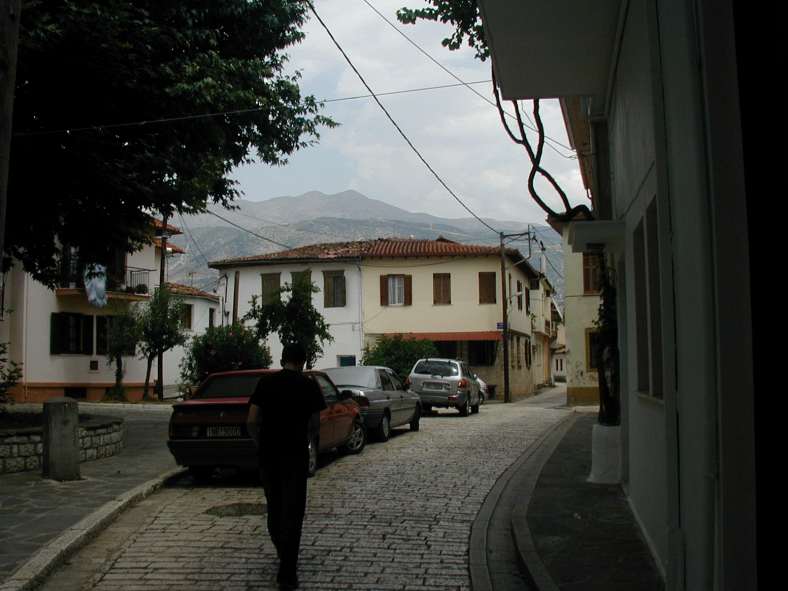
Landscape approaching my mother’s village, in its usual mood. (click)

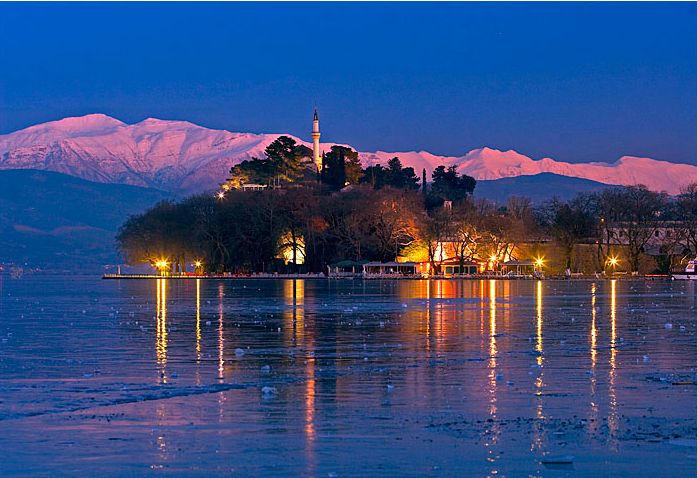
But then it is often “so uniquely appealling,” to get back to the Turks and the Balkans.  The main city of the region (Epiros) is Jiannena/Yanya, a beautiful little city by a lake that always had an air of luxuriant civility about it, proof of which may be that the Greek population didn’t rush to pull down the minarets or demolish all the mosques of the city as soon as the last Turks left in the twenties.*  It’s one of those Balkan cities the Turks loved.  Here’s a winter photo of Yanya’s main cami, the Aslan Pasha Mosque, overlooking the icy lake, below. (click)

Jiannena deserves a post of its own.  I gotta dig up some 2010 notes I have.

* On the other hand, the city government and developers have done all they can since WWII, including harassment and straight-out vandalism, to expropriate the city’s large and very romantic Jewish cemetery, which unfortunately for the city’s 40 surviving Jews, sits on some prime real estate.  Last I heard they had taken the issue to the EU, which makes me very happy.  Maybe the economic slump will give them a reprieve.  More on Jiannena’s Jews in the future.


Comment: nikobakos@gmail.com

The name of this blog

6 Apr

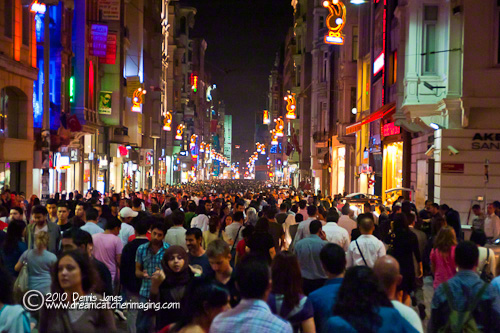
The name of this blog is the old Ottoman name for the main street of the new, ‘European’ side of Istanbul, the part of the City that grew and developed on the northern side of the Golden Horn beginning more or less in the late eighteenth or early nineteenth century, the neighborhood known as Pera or Beyoglu, the Greek Pera reappearing in more and more contexts lately as nostalgia about the city has become a minor industry and cultural phenomenon (Robinson Crusoe, easily one of the coolest bookstores in the world, now refers to itself as a “bookstore in Pera”).  Originally, I was going to confine this blog to Greek and Turkish issues and though that’s changed, I’ve kept the name because it’s the main drag of what – as far as I’m concerned – is still the zone’s keystone city.  I had thought of the street as an appropriately symbolic piece of territory where Greek and Turkish interaction was for a time at its most intense, most claustrophobic, even risky.  But even more, I thought of it as a space that best represents our mutual delusions, lies and hypocrisies.

Greeks think of the Jadde as the Main Street of Greek Istanbul, but neither the neighborhood nor Istanbul itself was ever as demographically Greek as the fantasy has it.  Further, the obvious wealth to which the street’s architecture bears witness always smelled a bit too much to me of nineteenth-century minority pretensions, by which I mean those six or seven post-Tanzimat* decades during which we enjoyed unprecedented access to the Empire’s wealth and financial resources without paying any of the obligations of being part of it; it’s apparently where Greek crowds had become so brazen that they gathered to yell: “Zwa! Zwa!”…”Animals!” at Turkish troops during the Balkan War as they left for the front and the mind-boggling casualties they were to experience there.  It’s also when, as soon as traditional restrictions on church construction were lifted, our new confidence raised up the three ugliest Greek churches ever built in the entire history of Constantinople – quite a feat.  And the palatial embassies of the Great Powers that breathed down the neck of the Ottomans for two hundred years and made those idyllic conditions possible for us still line the street.

Turks in the past couple of decades have spent considerable resources ‘restoring’ the area: the street was pedestrianized at some point in the late eighties I think; they set up a cute retro trolley car that runs down the middle and seems to serve no purpose but to annoy the crowds that have to constantly get out of its way; they’ve put some money into remodeling some buildings.  All of this has come hand in hand with a subtle psychological process running in many urbanized Turks’ minds that has gradually made of the neighborhood a symbol of Istanbul’s historically multi-cultural essence, which in many and moving ways it is.

It’s also where hundreds of  Armenians were murdered in a shockingly urban episode of the Hamidian massacres of 1896**, right there in the middle of all the Belle Epoque elegance and the cafes and the hotels, an event so brilliantly handled in the ‘duck with bamya’ (bamiyeh, bhindi, okra) chapter of Loksandra, and where, in one night of September 1955, every single Greek business on the street (marked beforehand in a perverse, inverted Passover), from Taksim to Tunel, down the Yuksek Kaldirim to Karakoy, along with almost every Greek church and cemetery in the rest of the city, were vandalized or completely destroyed in what turned out, after much bogus blaming and bullshitting, to have been nothing less than a government organized pogrom — pure and simple.  The event was later cynically used as one of the lesser charges brought against Adnan Menderes, the first ever democratically elected Prime Minister of Turkey, who had been in power at the time (‘55), by the military junta that removed him in 1960 and then hanged him and several other members of his government in 1961.  That doesn’t mean he wasn’t guilty of his part in organizing the riots — this, thefirst ever democratically elected Prime Minister of Turkey – he was; that’s just not why the Turkish military hanged him.  He was later exonerated, in fact, and has been semi-canonized since.  The Greek community got bubkes in compensation.  The riots were the beginning of the end, a shocking wake-up call to the complacent sense of security the City’s Greeks had started to feel in Turkey again after the fear and discrimination of the WWII years had passed, and they produced a massive exodus, exacerbated by other measures taken against them in the early sixties, as tensions over Cyprus and the usual tit-for-tat stupidities between the two countries grew.  (One will often hear Greek Polites*** bitterly blame Greek Cypriots for the progressive dissolution of their world, in the sad tones of one irrationally seeking a reason for an unassimilable loss.)  By the late seventies, their numbers had dropped below that point of critical mass that makes the sustaining of a meaningful community life possible: old people waiting to die, young people waiting to move to Greece.  I’m sure Thracian Turks in Greece can identify.

All this unpleasantness is usually excised from the contemporary Turkish nostalgia phenom’.  I remember on my first trips to Turkey as a teenager in the eighties even, often finding myself in the confusing position of being told: “Oh, lots of Greeks used to live around here,” in a smiling and totally sincere attempt at bonding and with a totally blissful indifference or maybe ignorance as to why they didn’t anymore, leaving me feeling both touched and irritated.  Granted, people have become markedly more sophisticated since then.

Anyway…  I could have called this blog the Istiklal Caddesi, which has been the street’s name since the nineteen-twenties and which I’m usually forced to use as well so people know where I’m talking about or don’t think I’m some freaky history nerd, but that would’ve been — no offense — too Republican.  I could have called it He Megale Hodos, but nobody ever really called it that except in the most official contexts (Greeks just called it the Straight Street, ‘Ho Isios Dromos’).  The a la Franca pretensions of la Grande Rue are just as self-evident.  So the old Perso-Ottoman “Great Way,” Jadde-ye Kabir, most fit my gousta and purposes.  Jadde means “street” in Farsi (and in modern Turkish and Arabic too; they’re originally Arabic — both words) but I like “way” because I liked the sort of ironic counterpoint between the great ceremonial routes of the old Imperial city on the other side with this thoroughly bourgeois little avenue.  The “path” too, says my Farsi dictionary, which also had a nice Zen ring.

Istanbul has twice septupled in size since the middle of the last century and Greek life there has faded away into nothing: the City has turned into a gigantic, intractable monstropolis like so many others.  Almost no one in Istanbul is from Istanbul anymore.  Yet this relatively small stretch of one small street still attracts massive daily and nightly crowds.  After a couple of depressed decades caused by the minority exodus, some criminally abusive urban planning projects and the criminal neglect of its architectural heritage, the street and the whole neighborhood have come back into their own again, and then some, in a way that frankly makes me so giddily proud and happy whenever I’m in C-town that any of the past’s bitterness just vanishes — it’s ok it’s not “ours” anymore; it’s still mine.  It’s perhaps the most instant snapshot one can get of Turkey’s current cultural dynamism, sophistication, prosperity, and growing freedom – in however tricky a state that freedom still may be.  Despite the clubs and malls of the northern or Asian suburbs, and despite the even more endless suburbs beyond them, inhabited by Anatolian migrants who may have never even seen it, the Jadde still gives the impression of being the default destination of any Istanbullu who’s meeting friends, looking to consume an urban pleasure of some kind, or just has nowhere else to go or anything else to do.  It’s a delicious, overwhelming mix of commercial crassness, elegance, sexiness, good music, cool bookstores, garbage and great food: an Eastern flaneur’s paradise.  In fact, aside from the Nevsky in Petersburg, I can think of no one street in which one can read so much of a great metropolis’ experience of modern urbanity as the Jadde.  It’s one of my favorite places on earth.

— For C., Istanbul, 2010

*Tanzimat: the “reforms” I think…or the “new order” maybe.  I don’t know if it refers to the actual beginning or the whole long nineteenth-century process; the response to the barrage of external and internal problems faced by the Ottoman Empire starting in the late eighteenth century: the interference of Western power interests and extortion; the loss of Balkan and Black Sea territories and the non-stop influx of refugees from those areas; the rise of local warlords (like Ali Pasha of Jiannena) who controlled large fiefdoms that were practically independent of Constantinople; an attempt to modernize the army in an attempt to recentralize things; the attempt to enfranchise the non-Muslim minorities (who didn’t, however, give up their nationalist aspirations in return) without totally freaking out the Muslim clerical establishment; a new constitution at some point, which was then suspended by Abdul Hamid, etc., etc.  Here, read about it yourselves: Tanzimat  The politics of the period are so torturously complex that no matter how much I read, I still can’t grasp the entire process.  I can’t remember which Sultan was pro-reform and which anti and which tried to take a middle path, except for A.H., who was eventually proven to be fairly undemocratic and a bit of a paranoid nut but was responsible for some impressive modernization projects anyway.  I don’t know when or how the Young Ottomans morphed into the Young Turks or who belonged to which group.

I know that it was all a titanic, often heroic, struggle to turn the Empire into a modern state.  I know there was a half-sincere, but belated and pathetic attempt to create a sense of “Ottomaness” among all its subjects/citizens; I won’t be the first one to make the comparison to Hapsburg Austria.  I know that when the constitution was restored in 1908, a year before Abdul Hamid was finally deposed,  there are stories — way too many, frankly, to be believable – of men of all ethnicities and imams and priests embracing in the streets of cities throughout the Empire in the spirit of their new found Ottoman brotherhood.  Then just five years later, in 1912, Greece, Bulgaria and Serbia joined forces and effectively ended what was left of the Ottoman presence in the Balkans and the Turks decided: “Well, fuck this…” and started concentrating on building a modern Turkish nation-state for Turks just like everyone else was doing for themselves.  And the rest, as they say…

It’s an important period for Greeks to know about because it puts into perspective the fact that our influence and wealth in nineteenth-century Turkey was not just due to our diligence and ingenuity and brilliance — to daimonio tes fyles — but also because we were operating in a host body weakened by daunting, almost insurmountable challenges, both internal and external.

** In August of 1896, a group of Dashnaks, an Armenian independence group, took hostages at the Ottoman Bank in Karakoy – I can’t remember what their demands were — and I think set off some grenades or something.  The Pera murders were a response to this, though violence against Armenians and inter-communal violence between Armenians and Muslims, especially in the southeast, had been growing exponentially in the months and years beforehand, all during the reign of Abdul Hamid (“Ho adikiorismenos,” as Loksandra would call him), hence “Hamidian.”

*** Greeks will often refer to Constantinople as “The City” “He Pole” – since it goes without saying which city one means.  “Polites” then are Greeks from The City.

Comment: nikobakos@gmail.com