Tag Archives: Serbs

“The Graves Are Walking”: Was the Great Potato Famine a genocide?” (And, let’s rethink “genocide” in general)

20 Aug

“A new book argues that free-market ideology, not murderous intent, killed Ireland’s millions.”  See Salon‘s entire review of the book here.
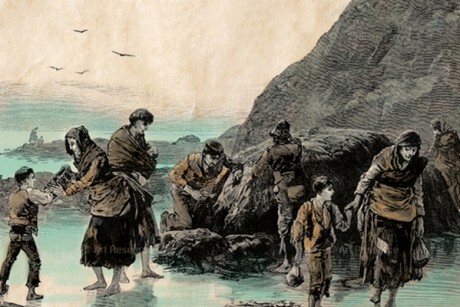
Some quotes:

“Citing an Irish nationalist author who accused Britain’s Assistant Treasury Secretary Charles Trevelyan of infecting Irish children with a special “typhus poison” in a government laboratory, he writes that the man “should have stuck to the truth. It was incriminating enough.” The story Kelly tells in “The Graves are Walking” is indeed damning, a shameful, bloody blot — and far from the only one — on the history of the British Empire. But calling it a genocide, however satisfying that pitch of moral condemnation may be, only acts to obscure the chilling contemporary relevance of Ireland’s 19th-century agony.”  [my emphasis]

Exactly.  Even if there was “no murderous intent,” it was still criminal.

“Kelly, like most historians, places the brunt of the responsibility for this fiasco on the shoulders of Trevelyan. As the policy leader of the famine response program, Trevelyan was not a Mengele-style mad scientist but a civil servant known for his “unbending moral rectitude and personal intensity.” Unfortunately for the Irish, the faith he embraced was a fusion of Moralism, “an evangelical sect that preached a passionate gospel of self-help” and the laissez-faire economics of Adam Smith and Edmund Burke. At several key points in the evolution of the catastrophe, when strategic intervention might have fended off thousands of deaths, Trevelyan refused, maintaining that there was no greater evil than interfering with market forces. When a subordinate protested, he would send him a copy of Burke’s “Thoughts and Details on Scarcity.”” [my emphases]

See my older post Maybe Germans ARE Scary, my commentary on a borderline Nazi opinion piece that appeared in the New York Times“German Austerity’s Lutheran Core”, in which I argue that Protestantism-s (except for Anglicanism, which grew out of very different historical circumstances and forms of “protest”) aren’t really religions at all but moralist codes, on which capitalism depended for its growth, and for which, whatever transcendent entity their adherents may believe in, serves only as divine confirmation of their righteousness.  It was the aggressive evangelical fervor that swept Methodist, Presbyterian and “low church” Britain in the mid-Victorian age that was perhaps the primary cause of the Indian Rebellion only a decade after the Irish catastrophe (see William Dalrymple’s brilliant The Last Mughal: The Fall of a Dynasty: Delhi, 1857).

“These strategies amount to the 19th-century version of what Naomi Klein has dubbed the “Shock Doctrine”: an attempt to force economic reforms on a population reeling in the aftermath of a disaster.”

Like Germany and southern Europe today?  (Read Klein’s great book: The Shock Doctrine: The Rise of Disaster Capitalism)

“Both sides were ignorant and shortsighted, confident in their stereotypical notion of the irresponsible, fanciful and lazy “Irish character” but oblivious to all the ways that rural subsistence economies cannot be expected to start functioning like England’s more developed agricultural one overnight.”

The classic accusation of laziness in these situations (like against Greeks, who, it turns out — when they had employment — worked more hours than the population of any EU country) is just infuriating.  People don’t work when they don’t have an incentive to, when the technological and political and class restrictions imposed on them limit them to anything more than subsistence or, in the Irish case, even rob them of the means of subsistence.  That the Irish are lazy, man…  To know what work-horses, and I mean that only with great respect and admiration, these Irish kids are, who are coming to New York again in the wake of the Euro-crisis and to even think “lazy”…

Yes, well, not England’s finest hour — though it’s a nation and a people I respect and feel a curiously personal pride in.  And yes, Ireland is outside the borders of the “Jadde” world.  But I love the Irish so much that they’ll keep appearing from time to time and, actually, they’re as much objects of Western imperialism as we are.

But really I’m posting this piece because I think it’s past time that we, in the “Jadde” world, begin some serious discussion on the use of the term “genocide.”  I think it’s getting thrown around much too loosely lately, and that not only disrespects the victims of true genocides, it pariah-fies and unfairly singles out certain groups for vilification (Turks, Serbs) and creates simplistic analyses of complex historical events that then become conventional wisdom, all in ways that makes deeper dialogue between our peoples impossible.  So, we need to talk about it and what “it” really is.


Comment: nikobakos@gmail.com

O-k-a-y….

9 Aug

Our man keeps the Rogers in Montreal, little subdued, more thoughtful game…  Keep my advice anyway.


Comment: nikobakos@gmail.com

Brother

7 Aug

Do something.

Good luck here at the Open.  I wish you the best.  But then you gotta do something.

Get the fuck out of Monaco.  Monaco is for Russian mafiosi.  You’re not a Russian mafioso.  Stop acting like a movie star and a super model.  Put your pants back on.  And start acting like an athlete again.

And a Serb.

Go home.  I dunno: go to Chilandar for a while if you want.  Then go up to Durmitor or somewhere and get a cabin by yourself – or better, a cave.  Don’t play.  Run on the trails up there.  Your knees will be fine.  What do you need high-tech oxygen low barometer chambers or whatever the fuck they are for?  Run at high altitudes.  Grow a beard, eat stale proja and raw meat.

When the snows melt come down at Easter and find a court.  Does the one you first learned on still exist?  Go play there.  Do something for others; you’re a generous guy.  Help Marko with his game.  Or just give free lessons to anyone who wants them. “The giver’s glance gleams like gold,” Nietzsche says.  “You have a golden child,” your first trainer told your parents.  The problem isn’t your game or your body; it’s the spirit.

You let a couple of losses drag your ego down into a vicious cycle.

Be a Serb instead.

Your fans all love you like you don’t know.

NB

Durmitor (click)


Comment: nikobakos@gmail.com
New burial of Srebrenica victims – no comment

11 Jul

The forensics’ teams of the International Commission of Missing Persons considers this one of their most challenging cases ever, since the original mass grave, which they now think may have contained up to 9,000 bodies and not the original rough estimate of 7,000, was dug up with bulldozers for Serbian fear of its being found (of all things, this is what they decided they were going to get retroactive cold feet about?) and the bodies reburied in smaller pits all over Bosnia, damaging evidence, obviously, and leaving one individual’s body parts in a potential multitude of sites.  Some of the ICMP people have identified bodies that they say may have been buried, dug up and reburied up to three or four times and fewer than six thousand have been identified, subjecting Bosnians to this incessant wound re-gashing as the process continues and newly identified remains are buried in mass funerals.  It almost makes you wonder whether modern forensics and DNA technology are such a great thing.


Where’s Charlemagne When We Need Him?

1 Jul

Huh?

Not the most brilliant thing I’ve read lately but one important, though really flawed, point:

“BY 1900, only two genuine multinational empires remained. One was the Ottoman, which was by then in the process of abandoning its traditional religious toleration for Turkish nationalism and even racism. [A completely, unfair, simplistic and un-historical assessment]  The other was Austria-Hungary, home to 11 major national groups: a paradise in comparison with what it was to become. Its army had 11 official languages, and officers were obliged to address the men in up to four of them.

It wasn’t terribly efficient, but it secured an astonishing degree of loyalty. It also brought rapid economic and cultural progress to an area extending from the Swiss border to what is today western Ukraine. During World War I, Austria-Hungary fielded eight million soldiers commanded by, among others, some 25,000 Jewish reserve officers. Thirty years later, the nation-states that succeeded the empire sent most of the surviving Jewish officers to the gas chambers.”

Unfortunately, the poison of the ethnic-based nation-state ideal had gotten too far by then.  Even the portrait of Austria-Hungary he gives us is completely idealized and existed in the form he describes for less than a century.

(Click above)

How sweet though, to have lived in a world that interesting instead of the stupefying monotony of the modern nation-state.  But that idea is so powerful — no, not because it’s natural and inborn, but because the modern, bureaucratic state was the first with the technical apparatus to impose it on its population(s) — that it deletes all historical files dealing with plurality.  Not a single European tourist who comes to New York fails to make the same comment: “Amazing…all these peoples living together…” and I want to explain that that’s how humanity lived for most of its civilized existence — or just pull my hair out — but I usually don’t bother.

But that reminds me: I do live in a world that “sweet” and “interesting:”

Mr. Deak (Hungarian?) is also wrong on an even more crucial point.  The Ottoman and Austro-Hungarian empires were not the world’s last multi-ethnic states.  There’s still China.  Most of southeast Asia.  And Russia.  And most ex-Soviet republics.  And certain Latin American countries.  And almost all of Africa.  And Syria and Lebanon and Iraq and Iran and Afghanistan and Pakistan and the world’s great wonder, India.  Even Turkey.  (And wherever ethnic nationalism is a problem in those countries it’s based on the Western intellectual model.)  In fact, most of the world still lives in “plural” situations.  Only Europe (and even in Europe there’s Spain and the U.K.), has an issue with this concept, but it seems to be fading even there.  Its last bastion will probably be the growing number of viciously homogenized, ugly little states of Eastern Europe and the Balkans.  Which brings us back to Michael Ignatieff:

“The misery of the Balkans stems in part from a pathetic longing to be good Europeans — that is, to import the West’s murderous ideological fashions.  These fashions proved fatal in the Balkans because national unification could be realized only by ripping apart the plural fabric of Balkan village life in the name of the violent dream of ethnic purity.”

From Blood and Belonging: Journeys into the New Nationalism, Michael Ignatieff


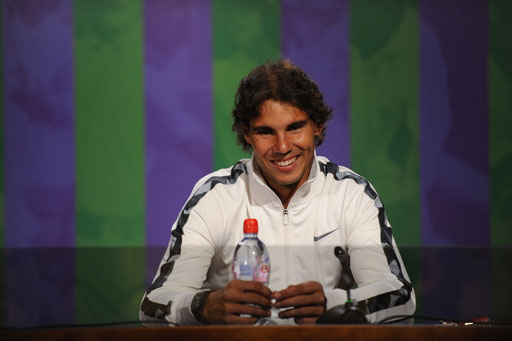
Nadal Stunned in Second-Round Knockout

29 Jun

DAMN!…I soooooo wanted Nole to be the one to do this!!!

Nadal in loser mode…and against whom?

An “unknown Czech” knocks him outta Wimbledon…

“But Rosol, who has never gone beyond the third round of a grand slam, broke serve in the opening game of the second set and stunned Nadal with a succession of venomous serves and pinpoint groundstrokes.

Nadal was powerless to stem the tide and was clearly upset by the 26-year-old Czech’s aggressive style but the 11-times grand slam winner dug in to break serve at the start of the fourth set and repeated the feat to level at two sets all.

Officials decided to close the roof to enable the match to be finished and after a half-hour delay the players returned.

Most people expected Nadal to ease through the deciding set but Rosol had other ideas.

The Czech immediately broke serve and continued to subject the world number two to a barrage of big serves and outrageous winners, sealing victory with an ace to set up a third-round match against German Philipp Kohlschreiber.

It was the first time Nadal had lost before the third round of a grand slam since he was beaten by Gilles Mueller in the second round at Wimbledon in 2005.”

Rafa being as gracious a loser as a Catalan is capable of…


And Nole acting like a sixteen-year-old….. :)


Nole!!!

5 Jun

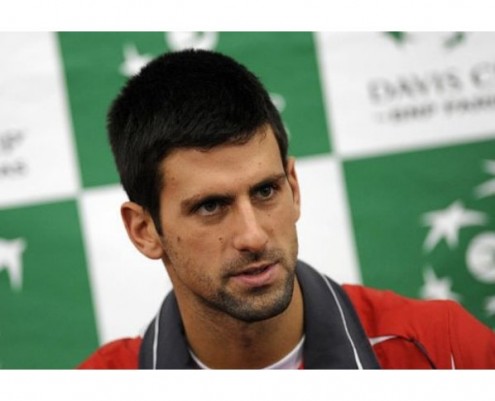
Djokovic beats Tsonga on home-turf in Mens’ Quarterfinals at Roland Garros, Paris.  Federer’s next.  (photos: Thomas Coex, AFP/Getty Images)


Comment: nikobakos@gmail.com

Did Serbia just build a higher wall around herself?

20 May

http://www.nytimes.com/2012/05/21/world/europe/serbian-presidential-elections.html?pagewanted=1&ref=world

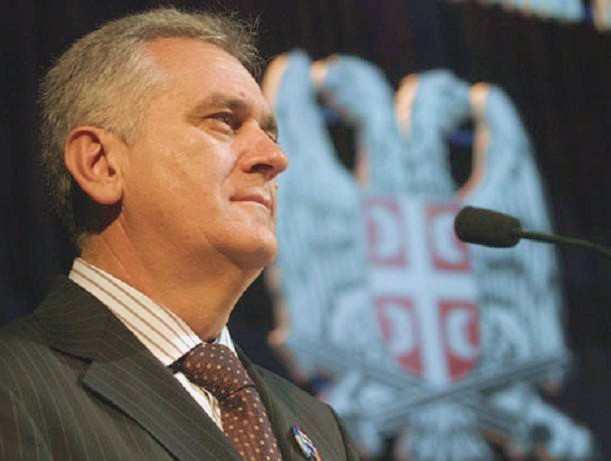
Tomislav Nikolic, a nationalist and former cemetery supervisor, declared victory on Sunday in Serbia’s presidential runoff election, a surprising result that cast doubt on whether Serbia would remain on its path toward entry into the European Union or look east toward Russia.”

The most depressing, and what may turn out to be the most dangerous, part is the apathy — only 36% of the electorate voted.

See “Milosevic Party Emerges as Kingmaker” May 8


Comment: nikobakos@gmail.com
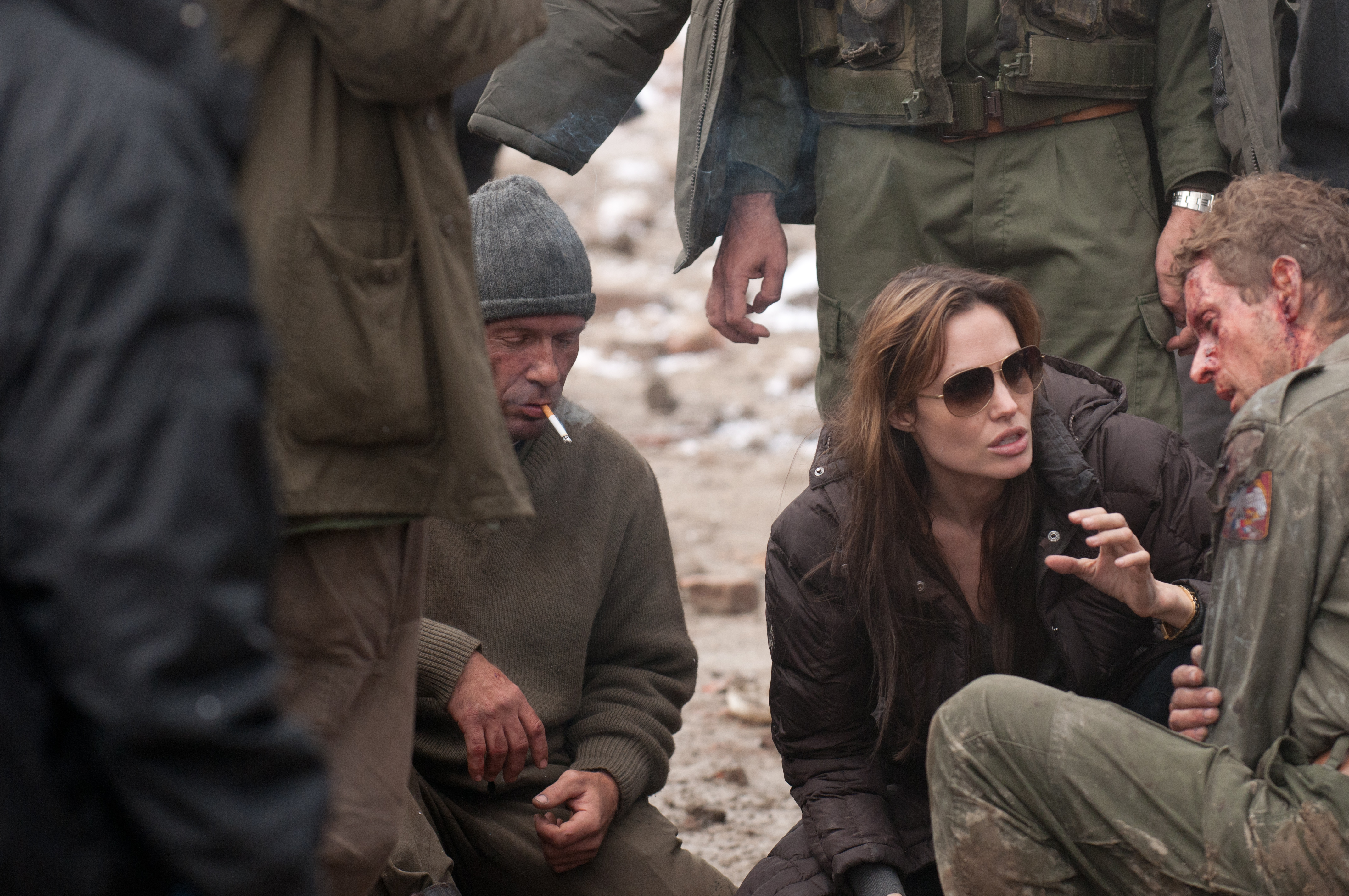
“In the Land of Blood and Honey”

20 May

A lot of us probably had our doubts about this one – in retrospect, unfair doubts and probably (not a little bit) sexist ones.  La Jolie has made a film about us Balkanians…  How could she possibly understand our mystery, our inscrutable savagery, the complexity of our past?  A Hollywood vanity project, for sure.

It turns out this is a great film.  It’s beautiful as a film: beautifully written, shot, acted (some tragic editing errors or omissions though).  And it’s beautiful and intelligent as ethnography and history as well.  She’s modest about her descriptions of her work, but whatever corner of the collective unconscious belongs to our fucked up little part of the world, she was channeling it.

The film recently “premiered” in Belgrade.  A few dozen people showed up and half of those left after the first few scenes, which tells you how much progress we’re making on the Serbian front.  But it struck me really hard that Jolie didn’t attend either.  I thought it was cowardly and, after the love and intelligence she’s obviously put into the project, just plain stupid on her part. Granted, some of the actors, all Bosnian, meaning Serb and Muslim, have been threatened, had their car windows smashed but, you know, all great art has always provoked…

No really, why was she not there?  I clearly, for whatever historical or cultural or mostly emotional reasons, have a special love for Serbs.  I understand they often come across as — or are even – unruly, contrarian, inat-driven, loose cannons (this word, “inat,” deserves an entry of its own and can’t be wrapped up in a footnote).  But I know that more than anything they want to hear and be heard; they crave a healthy confrontation.  That the nineties continue to be simplistically narrated as the story of their villainy rightly pisses them off to no end and they want the chance, at least, to present another narrative; if they pretend that they don’t give a shit what the world thinks it’s just hurt pride or they’ve just given up trying.  Without wanting to add to the reams of crap written about what macho lunatics they are, Serbs are guys – by which I mean the women too – and if Jolie had gone it would’ve gained her instant balls and street cred’ in their eyes and led to all kinds of productive discussion and exchange; I’m not kidding one bit.  If she had truly wanted to say something about the Balkans or the Yugoslav wars and not just about women, she undid more than half the good she could’ve done.

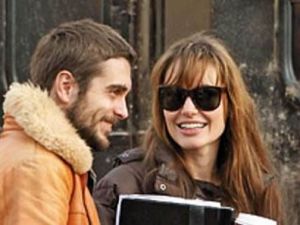
Jolie with extras

One thing that makes you furious about the isolation that was the result of that pointless separating into dumb little countries is that we don’t otherwise know these actors; we got a near fatal dose of Kusturica while Bosnia was on our screens and then it disappeared.  (See below for some extra photos of all.)  Their performances are flawless and their technical competence is proven, if by nothing else, than by the fact that they pulled off the amazing feat of shooting the entire film in both languages.  Not dubbing or anything.  They shot the entire film twice: once in SerboCroatoBosnoHerzegovinoMontenegrin (to be scrupulously correct but which I’ll just call Serbian from here on) and once in English.  Jolie and her team had something to do with how well this came off too.  They let the actors speak the English they speak, which is literally perfect but has the tiny idiosyncrasies that a non-native speaker’s naturally has.  This is the opposite of what Hollywood usually does, which is write a role for, say, Penelope Cruz, in an absolutely impeccable American English which someone with her incomprehensible accent couldn’t possibly speak and which makes her even more incomprehensible and cripples what might otherwise be a decent performance.  But beyond that, they’re all great.  If this one Sarajevo can produce all these actors it makes you want to live there just to go to the theatre or wait for someone to make their next film.

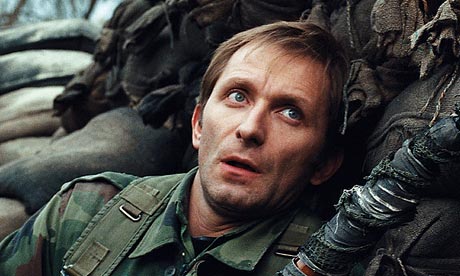
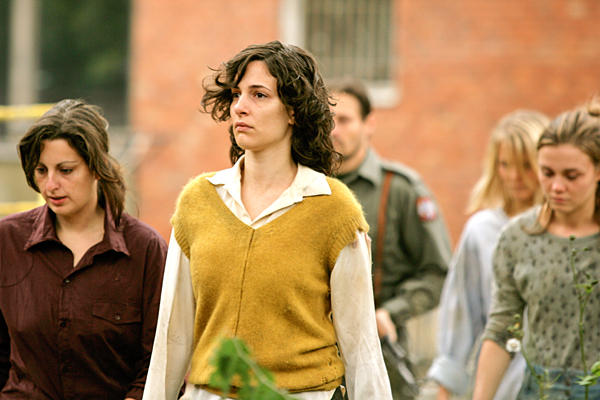
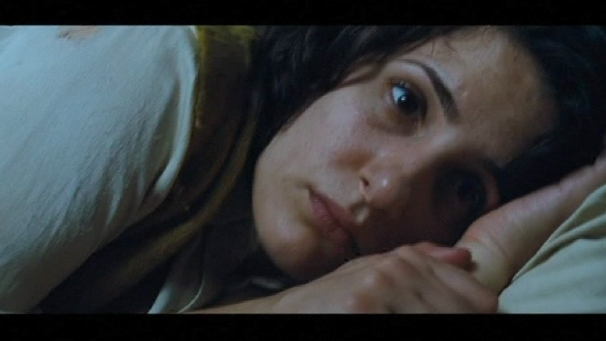
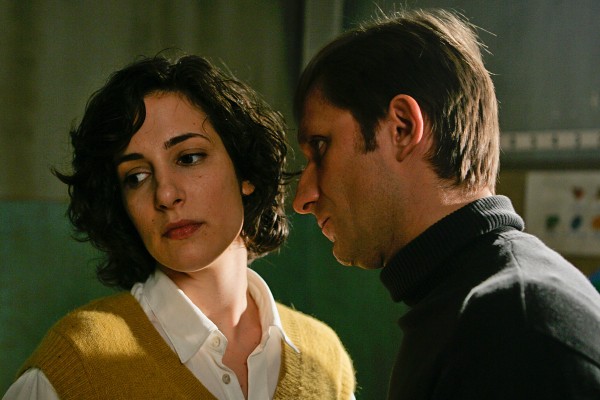
Of course the two you can’t take your eyes off and can’t get out of your head afterwards are the two leads: the painfully sexy Goran Kostić as Danijel, the Serbian cop thrust into the role of Bosnian Serb army captain, and Žana Marjanović as the inscrutable Ajla, the Muslim woman he falls for, one of those close to six-foot Dinaric beauties that make you hate all ex-Yugos; she goes out in one of the opening sequences in heels, a blue dress and a traditional silverwork belt and makes you want to cry, for all kinds of reasons.  I say inscrutable partly because a South American friend who saw the film described her as “parca,” which means dry or stiff or cold — the same root as “parched” maybe – and I had to explain that that attitude implies nobility in our parts, a posture that Ajla doesn’t slip from even for one moment, despite the hell she’s put through; in fact she clings to it even more desperately throughout, her dignity the only thing she has left, her only weapon against male power.  (“Archontia” is another word I need to give a full entry to at some point.)

Goran Kostić (Danijel) and Žana Marjanović (Ajla)

They meet, fall in love just before the war — he in a spellbound way that would be unbelievable if Kostić’s performance didn’t make it so naively magical that you buy it — and then, under circumstances which also strain belief a tiny bit but which you forgive, she ends up in his “custody” as a female POW, for lack of a better word.  Jolie says some trite stuff in the “Making of…” about a “love story that could’ve ended up in happiness, in marriage and children and what war does to that” but, whether she knows it or not, she’s made a film about something so much more complex and true.  Ajla (Marjanović) is both terrified and in the grips of the acute, aching desires of Stockholm Syndrome, but though Danijel is constantly groping around blindly in her heart, he never knows whether she’s there because she “wants” to be with him or not.  Kostić plays the perfect good soldier and officer — the way perfect good soldiers have always been perfect: he’s brave, tough, loves his men, is completely scared to death the whole time and never finds the slightest relief from the tormenting doubts of what he’s doing.

This is a film about anything but a love story — or it’s about a real love story, since these two are in love not in spite of, but because of, war.  It’s a story about the fear that women feel in the presence of potential male violence, something that no man will ever, ever understand in his gut, and Marjanović, like the painter her character Ajla is, gives you a hundred different shades of that fear; it’s about how men will never stop feeling the temptations of that violence; it’s about how sex and love are always about fear and violence.  It’s about how your tribal affiliations are not the product of the Western media but will burst out of you under the slightest pressure in what you had thought was a forgotten and buried language of hatred; it inverts the traditional Muslim-Christian power structure of the region’s sexual captivity narratives; it confronts your loyalties and asks what they’re worth to you; it throws your capacity for betrayal in your face and challenges you to deny it.  Serbian viewers might have been slightly flattered by the discursive lip service given to the Serbian position in the conflict.  But if the film has any real compassion for that position it’s in how the two lovers end up, a subtle and powerful metaphor for the two societies.*  Ajla is battered to no end — and a horrible one; it leaves you feeling crushed in ways that I am unable to describe and, as a man, wouldn’t try to.  But she achieves a kind of heroic closure ultimately that Danijel never can.  He’s the film’s true tragic figure, driven by a child’s insatiable thirst to be loved that’s impossible to quench and that ultimately destroys him in ways that she’s spared.

(* The absent Croats in this metaphor are that species of bad driver who never gets into any accidents himself but causes them all around him — just a calculating version.)

Get the Blu-Ray if you can.  It gives you a choice between the English or Serbian.  On either DVD or Blu-Ray, watch the “Making of…” segment and definitely see the “Deleted Scenes” because I don’t know what they were thinking when they cut these segments out of the final film.  If it was to fit Hollywood commercial length expectations it was particularly dumb because that audience is just not going to see this film anyway.  There are several segments in there that help you understand the sado-masochistic intensity of Danijel and Ajla’s relationship and how they get to that point.  And there’s one scene of priceless beauty where Ermin Bravo (Mehmet), sings what I think is a “sevdalinka,” a Bosnian love song, to his beloved, Vanesa Glodjo (Lejla) — see both below – a scene that breaks your heart with the realization that even another’s most exquisite tenderness will only relieve the agony of a tragic loss for a brief moment.  Every soul is on its own.

Some of the rest of cast:

Vanesa Glodjo (Lejla)

Ermin Bravo (Mehmet)

Boris Ler (Tarik)

And with Jolie

Ler and Bravo in a great shot (from another, unknown stage production) — again, this city must have great theatre… (photo: Irfan Redzović)

Comment: nikobakos@gmail.com

Un-believable…

16 May

I know that just a few entries ago I commended Cavafy for his anti capital punishment beliefs, but this is one of those cases where you wanna say: ok, just take this guy out and stone him…or: we’re dealing with such a psychopath that this isn’t the proper venue.

From the AP:

“Bosnian Serb Gen. Ratko Mladic taunted Srebrenica survivors on Wednesday at the start of his trial for genocide, running his hand across his throat in a gesture of defiance to relatives of the worst massacre in Europe since World War II,” Reuters writes from The Hague.

The wire service says Mladic “made eye contact with one of the Muslim women in the audience, running a hand across his throat, in a gesture that led Presiding judge Alphons Orie to hold a brief recess and order an end to ‘inappropriate interactions.’ ” [my emphasis]

According to The Telegraph, “Mladic made throat-cutting gestures to Munira Subasic, a woman who lost 22 relatives to Bosnian Serb military forces when the enclave of Srebrenica was overrun in July 1995, as she watched the trial from the glassed off public gallery.”

http://www.npr.org/blogs/thetwo-way/2012/05/16/152817980/at-trial-serb-gen-mladic-taunts-survivors-with-throat-cutting-gesture

That’s why I’m so infuriated by “we-lived-so-happy-there-was-no-difference-between-us” garbage.  The readiness with which such — I’m loath to call them “traditional” — emotions, actions, gestures like Mladic’s resurface gives such obvious lie to any such simplistic, glib fictions.

And while we’re remembering Srebrenica, here’s something to make crisis-ridden Greeks proud and take their minds off the impending Tsipras tsunami:

“Greek Volunteers controversy”

Main article: Greek Volunteer Guard

According to Agence France Presse (AFP), a dozen Greek volunteers fought alongside the Serbs at Srebrenica.[148] They were members of the Greek Volunteer Guard (ΕΕΦ), or GVG, a contingent of Greek paramilitaries formed at the request of Ratko Mladic as an integral part of the Drina Corps. Some had links with the Greek neo-Nazi organisation Golden Dawn, [my emphasis] others were mercenaries. The Greek volunteers were motivated by the desire to support their “Orthodox brothers” in battle.[8] They raised the Greek flag at Srebrenica after the fall of the town at Mladic’s request, to honour “the brave Greeks fighting on our side.”[149] Radovan Karadžić subsequently decorated four of them.[150][151][152][153]

In 2005 Greek deputy Andreas Andrianopoulos called for an investigation of the Greek volunteers’ role at Srebrenica.[154] The Greek Minister of Justice Anastasios Papaligouras commissioned an inquiry, which had still not reported as of July 2010.[155]

In 2009 Stavros Vitalis announced that the volunteers were suing the writer Takis Michas for libel over allegations in his book Unholy Alliance, in which Michas described aspects of the Greek state’s tacit support for Serbia during the Bosnian war. Insisting that the volunteers had simply taken part in what he described as the “re-occupation” of the town Vitalis acknowledged that he himself was present with senior Serb officers in “all operations” for Srebrenica’s re-occupation by the Serbs.[156][157] Michas notes that the volunteers were treated like heroes and at no point did Greek justice contact them to investigate their knowledge of potential crimes to assist the work of the International Criminal Tribunal for the former Yugoslavia at The Hague.[158]”


Comment: nikobakos@gmail.com