Tag Archives: Syria

From Al Jazeera: “Turkish police find factory making fake lifejackets in Izmir.” Nice…

8 Jan

4664

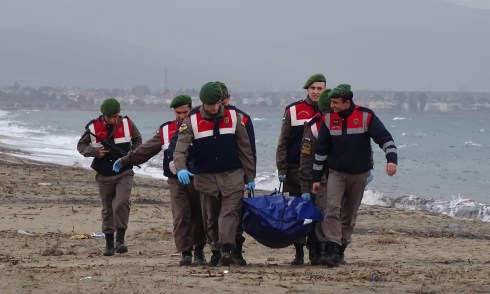
Officers carry the body of a refugee that washed up on the shore in Izmir, Turkey. Photograph: Depo/Rex

Turkish police have uncovered a factory producing fake lifejackets, shining a light on a booming cottage industry that has emerged as a byproduct of the refugee crisis and heightened the risks for those hoping to reach Europe by sea.

Police allegedly seized 1,263 lifejackets filled with non-buoyant materials from an illegal workshop in Izmir that employed two Syrian children, according to Agence France-Presse and Dogan news agencies.

The raid came in the same week that the bodies of more than 30 people washed up on Turkish beaches, having drowned in their attempt to reach Greece. Some of the dead were pictured wearing lifejackets, leading to suspicions that they may have been fake.

Whole article.

Comment: nikobakos@gmail.com

Syria, Russia, ISIS and what to do about everything

7 Dec

syria

syria-11

I’m going to have to write this post in bullet points of varying length, that I guess reflect the tragic fragmentation of my subject matter in some way, because putting it all together into a coherent “opinion piece” is as hard as finding coherent policy to deal with the problem itself has been. I was against talking about Syria in the beginning of its crisis as if it were an inherently fragmented and “artificial” colonial creation, as it had become the fashion to speak of most of the Levant at some point or another. I particularly objected to Andrew Sullivan’s obnoxious Syria [or Iraq] is not a country declarations. But since then, that’s become the reality – an insistent enough discourse makes itself a reality — so it seems to be more useful to take on all the regions, factors and players involved one at a time…and if I can bring them together usefully at the end, I will.

Russia and Assad: It’s obvious that Russia is pursuing its own agenda in Syria, but frankly — isn’t everyone? — so that’s no great cogent or original observation, and to be very frank, shouldn’t play into our response to either Assad or Putin, given the point to which things have reached at this point, because the degree to which you or I can stomach either Assad or Putin is not the point. The point is that right now I can see no great tragedy in an Assad-run — for how long can be decided later, with Russia (see below) — Russian semi-protectorate that would run from the Latakya Alawite coast down the Hama-Homs-Damascus-Dar’a, corridor, that would provide security and stability for even the region’s originally anti-Assad Sunni population, and even attract Sunnis from the rest of the country who could make their way there: such – I would think – is the ethical questionability of the various Sunni groups (aside from just ISIS I mean) into whose hands the original uprising has fallen and the degree of their war-weary victims’ terror; and — because I think it’s important to declare your subjective affinities before you can honestly put forth your hopefully objective suggestions or propositions – I hope such an entity would also provide a safe haven for part of what’s left of Syrian Christianity as well. (Yes, MESA girls, you’ve caught me again.) It would also be a good idea if we learned a little bit about the Assads and the Alawite past in the region (as it would be equally good for us to know something of Turkish/Kurdish Alevis as well), not to exonerate Assad for anything, but so that we know what we’re talking about before we start unproductively babbling about villains just sprouted out of the earth – like we did in Lebanon in the past about the Gemayels and Maronites or the Jumblatts and Druzes or southern Shiites and Hezbollah. This is homework one would like to assign to the Levant and the Middle East’s Sunni majority as well: a request that it examine its moral conscience, if such a thing exists, and its treatment of minorities in the past, but I understand that that’s probably a tall order that we can’t wait for them to comply with in order to bring some relief to the current hellishness.  Assad remaining on as President of at least part of Syria is an ugly proposition.  But more resistance is a luxury for Western intellectuals at this point.

So let Russia go for what it wants for now; it’s in most everyone’s interest and let’s try to turn it to everyone’s advantage instead of attacking her for every move she makes. ENGAGE RUSSIA. I beg everyone. A plea I will make later as well and repeatedly.

The Shiite crescent or triangle: This is the very real alliance of Bashar al-Assad, Hezbollah in Lebanon, a largely Shiite entity that’s essentially what’s left of Iraq, and Iran. It’s not a product of Israel’s paranoid imagination, but only Israel thinks it has any real reason to be worried about it and therefore Israel should be promptly ignored on every point and aspect of those worries.
bashar-al-assad-hang-the-bastard

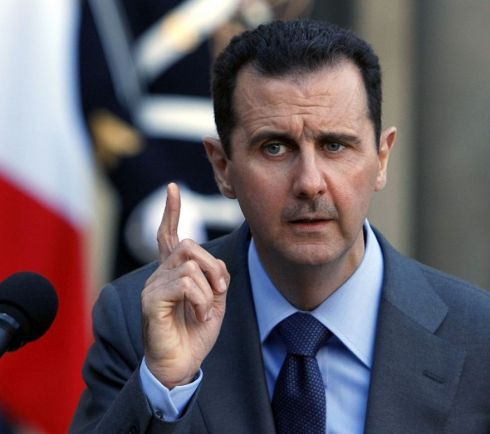
Bashar al-Assad

Neither Iraq nor the Iraqi army are functioning entities, so we can temporarily remove them from our discussion. I think I’ve addressed the moral “problematicness” of Assad: that there can be no solution in Syria till he’s gone, though, is a moralistic pose and not a truly moral position — sadly, one even Obama is fond of striking — and is an excuse for doing nothing and a recipe for letting the current holocaust continue. As for Hezbollah: whatever we think of its origins or the nature of its religiosity or its political ideology, it’s a highly professional organization with a highly professional, well-trained and hardened army, and the only Arab or other force that has put Israel in its place twice – took a little longer the first time but was pretty snap the second – and has pretty much served as an Akritai line that has kept it there since and, whatever its political tactics are (I honestly can’t say), it seems to me to be the one force that has kept Lebanon relatively stable (yes, as had Syria) for the past twenty years or so.
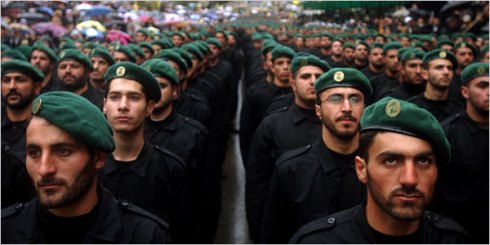
hezbollah.xlarge1

Of course, it does this with the massive organizational and material help of Iran. Which brings us to…

Iran: Get over Iran. It became a comforting cliché, with which the Middle Eastern Studies academic left aunanized itself for several decades: that the imperialist West had aborted every modern attempt at a democratic, civil society in the Muslim world and that that was therefore responsible for the rise of political Islam. Tell me which countries we’re talking about and who the leaders were who were going to lead them to this heavenly, secular modernity? The even more militaristic and fascist and statist successors of Kemal in Turkey? Look how that’s turning out and it’s still incomparably the best of the batch and, ok, there’s still hope recent setbacks can be reversed. Who else? Nasser and Egypt? Arafat or current Palestinian leadership?  The Ba’athist successors of the Hashemites in Iraq? Maybe in Jordan? Ben Bella and Algeria? Bourguiba even and Tunisia? The Saudis? Jinnah’s successors, further east, or even Jinnah himself? Maybe the Afghan royal family? Who?

The only country in the Muslim world that in my humble opinion seemed to have had many of the prerequisites for a secular, civil society, perhaps a constitutional, truly assembly-based government, and a leader with an appropriately intellectual, bourgeois background and education — and accompanying democratic inclinations — was Iran and Mohammad Mosaddegh. And the Anglo-Americans destroyed that experiment. And yet Iran still seems to be the country, which despite the powerful institutional obstacles, has, on a popular level at least, the temperamental prodiagrafes for the development of such society and is poll-wise the most pro-American in the region. What is the rationale behind continuing to villainize and sanction and isolate? Ok, maybe not “what is the rationale?” But I’m simply calling for the acceptance of the fact that allowing Iran to open up to the world would inevitably – no, don’t give me Russia or China as examples – lead to an internal opening up as well, and both Iranians and the rest of the world have only to gain, when, and not if, that happens. Let it happen faster. As fast as you can.
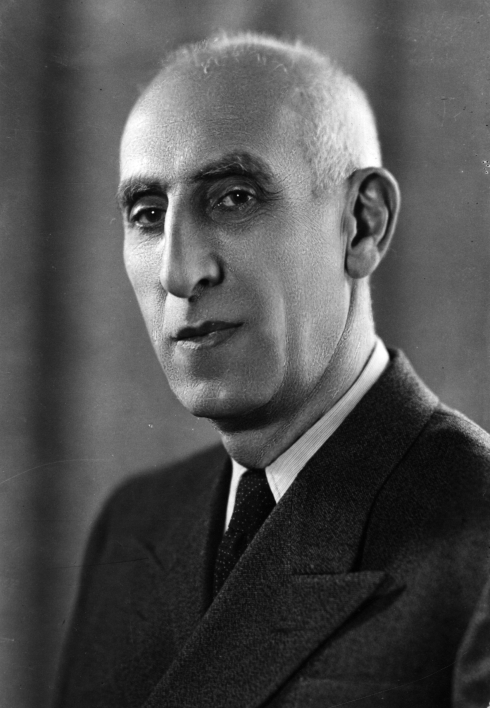
Mohammed-Mossadegh.jpg

Mohammad Mosaddegh

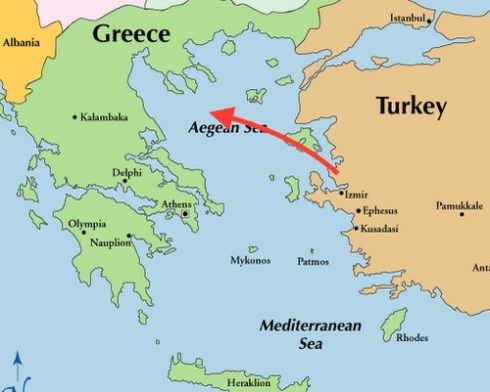
Turkey: There probably isn’t a country that, though never “officially” colonized, is a better object lesson in how to endure the machinations, infiltrations, exploitation, hypocrisies and pousties of Western manipulation – from the 18th century to this day – and how to then flip them to your advantage like a bad-ass judoka than Turkey.  In dismembering the Ottoman Empire, all the Great Powers did their best to make the process of our separating from our neighbours into independent nations as long and complicated and bloody as they possibly could. When after WWI, they realized the Turks weren’t going let them split even a remnant Anatolia into six or seven parts and give those away too…suddenly…Turkey…could…do…NO…wrong…and still can’t. It’s fabled “privileged geographical position,” which no Western power was able to grab for itself, allows it to do anything it wants: supress all and any pressures for democratic change; conduct a vicious decades-long civil war against – I dunno, can it still be called a minority when it’s one-fifth of your population – its Kurds; violently harass its supposedly Lausanne-protected Greek community till they all leave en masse, while invading Cyprus to protect its Turkish minority there…and on and on and on. And now that President-to-be-for-at-least-a-decade-I-figure Erdoğan has sat on the throne Turks themselves put him on, the anti-democratization process: the societal and governmental Islamization; the assassinations and imprisonments, the suppression of journalistic rights and other democratic voices; the bullying of neighbours and throwing around of irresponsible, expansionist language; the destruction of a painfully wrought peace process that Turkish Kurds showed remarkable maturity in struggling towards, and the unleashing of the formidable, American-backed and supplied power of the Turkish military on them once again; the probable aiding and abetting of the animals of ISIS in various ways, plus the shooting down of a Russian air force jet out of pure pissing-contest impulses; not to mention the ever greater and egomaniacal vandalizing of one of humanity’s greatest and most ancient cities – all continue. And the world breathes not a word. Obama did not even address the downing of the Russian jet: all I saw him do is rudely turn around in his chair at some banquet at the Paris Climate Change Conference and off-handedly say to some journalist: “Well, a nation has the right to defend its air space.” The next day six Turkish fighter jets flew almost two-thirds the way across the Aegean into northeastern Greek airspace , and we didn’t say a word and wouldn’t have had our call taken even if we had tried, since it happens on a practically monthly basis. NATO allies, you see…
photo_verybig_111705

Nobody reported the story except the Greek press.

The Kurds: “I have a dream,” as they say, for Kurds: that they will recognize the fact that Iraqi Kurdistan with a capital at Erbil is already a de facto independent state and not complicate things in the neighbourhood by please resisting the urge to declare de jure independence.
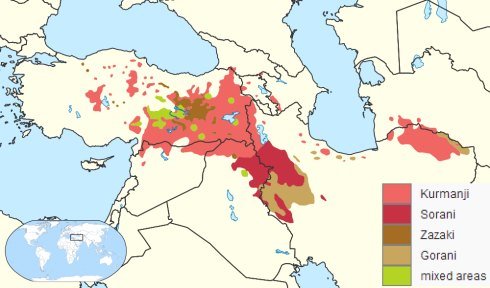
Kurds

Kurdish-inhabited regions of the Middle East and Caucasus, according to tribal break-down.

This centrally located political entity can serve as the hub of a wheel of still-to-be-worked-for, autonomous, Kurdish regions encircling it, and by not insisting on independence and union, they will be able to put more resources and energy into developing what they have and not fighting to defend it forever. I don’t know; maybe the future of the world will involve the devolving of nation-states into affiliated groups of semi-autonomous units with perhaps overlapping or varying degrees of jurisdiction – Holy Roman Empire style – and the Kurds may be the first to experience this as a people and benefit from it: that is, to see diaspora (if that word really applies to a non-migrating group), or political “multiplicity,” as a finger in every pie and not as separation, and be able to reap the advantages of that. Plus, again, as vehemently secular-minded, it will hopefully remain what it has already become: another safe space for the remnants of Syro-Mesopotamian Christianity.
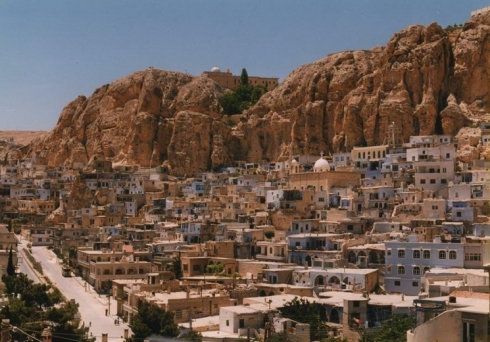
108-270_b

The Christian village of Maluula in Syria

Saudi Arabia and the rest of them down there: I admit that for a very long time I didn’t get this one. The fear of Russian power and the resentment of the Iranian Revolution, the obvious reasons for catering to an obnoxious Israel’s every whim and demand and the kid-glove coddling of Turkey all make some sense, though my ultimate point here will be that they no longer do. But the Saudis…no clue. Did any-one need their oil in particular? Wasn’t the United States itself already energy self-sufficient? Why? That the West always does what it does because Jews control Washington and everyone wants Saudi oil seemed to me to be the political theories of Athenian taxi-drivers.

Yet I was just speaking to someone from the ministry of energy here in Greece the other night and it turns out that compared to that of other oil-producing nations, Saudi oil (and I guess other Gulf State oil as well?) is unusually high in quality, demanding minimal refining and easy drilling as well, since its gigantic reserves are all close to the surface. The price of oil can plunge to rock bottom and they will still have monstrous amounts of a desirable product with which they can undersell any other country in the world and that will keep them filthy rich into the foreseeable future. And capable of funding jihadism everywhere.  Including the spiritual “inner struggle” kind.
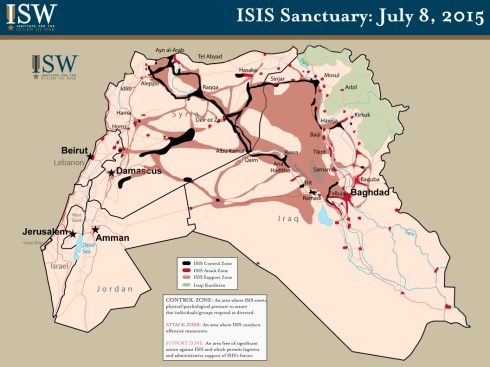
these-maps-show-the-progression-of-isis-control-in-iraq-and-syria

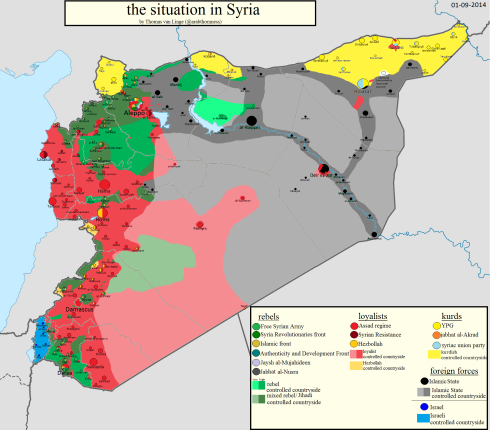
So we’ve ended up here, with a nice neat circle drawn around ISIS territory because that is our major problem and that’s the entity we’re looking to eradicate plain and simple. And it can’t be done without a profound shift in how we – I don’t how we want to define “we:” the West, the civilized world, how about just humanity? – treat and engage each and every one of the players involved in the above scenario. Because while our objective is to destroy ISIS, almost all the above policies are based on either almost irrationally selfish and small-minded views, or even more so, on a Cold War logic that simply no longer applies, and that will do little to impede the danger ISIS presents, in almost anyway you take at it or from wherever you look at it.

First and foremost and again: let Russia in. ENGAGE RUSSIA. We all have everything to gain and nothing to lose if we stop treating Russia like a pariah nation. Russian power is not a threat and can instead prove massively useful to the world if we bring Russia into the fold instead of trying to desperately keep her out of everywhere and even foolishly try and fence her in. It may be a little more complicated than a simplistic “more flies with honey” theory but whatever it is we choose to describe as Russian aggression, Russia sees as defensive and that may not be an irrational response from a powerful nation that sees itself treated as an amoral being that is constantly excluded from all the West’s major moves.

And I’m talking about radical engagement: not just lifting sanctions and trade blocks and visa requirements. I’m talking about making Russia a part of the European family of nations, as laughably dysfunctional as that family may be looking right now. Why are Montenegro or Georgia on the list of candidates for NATO membership — Montenegro probably as some sleazy old promise offered to it if it seceded from Serbia; and Georgia, one of the oldest polities in the Russians’ sphere of influence (for better or worse and partly of its own initiative at the start) and with a complicated love-hate relationship between them – while Russia itself is not?  Too big to absorb. Well, yes, but my point is to stop thinking of her as an entity to control and absorb and start thinking of her as a political and especially military power that’s just too enormous to not have as an ally in the current struggle we’re engaged in.

ISIS (and Turkey to some degree) ticked off the Russians bad and they have already done more to weaken the “caliphate” in the past few weeks than all other Western actions combined. Is it escalating the conflict? There is no escalating this conflict: when your enemy is sworn to escalate it to the maximum, and there’s no reason to think they’re bluffing, you’re already there. Yes, there’s reason to fear that Russia – which uses Powell-Doctrine-type “overwhelming force” more than the United States ever has – will go too far and turn central Syria and Raqqa into a Chechnya and Grozny, but the best way to limit those kinds of excesses are to enter into some coordinated action with Russia and not just allow her to act alone. Because we’re going to need Russia when the air campaign needs to stop, when at some point it will. And that’s when I predict that Russia will also be willing to send in men on the ground and I don’t mean just a few special operations groups. While they’re certainly not eager to send their young men off to die in another Afghanistan or Chechnya, this has already – again, for better or worse – become a sort of Holy War for Russians and they will be far less squeamish about sending in troops than any other European society or even the United States at this point. And working with them on such an operation will not only increase its efficacy but limit the risks and excesses.

In the end bringing Russia in from the outside will also change it from the inside; as the nation itself feels less like it has to be on the constant defensive, then so will the Russian government adopt a more open and progressive attitude to its own internal political life.   This is what we saw happening in Turkey in the early 2000s when European Union accession was still a negotiable reality; much of what Turkey and Erdoğan have turned into since are a result of those cards being taken off the table. Do it for everyone then, for us and for them. Engage Russia; it’s a win-win proposition.

As for the rest…

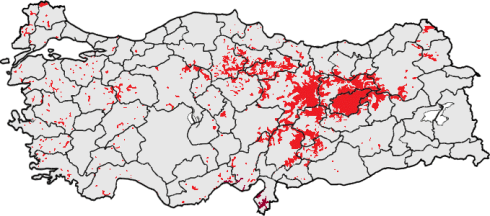
I’m sorry to say this, since being or acting or thinking positively about Turkey and Greco-Turkish relations has been one of my intellectual and emotional priorities for most of my adult life. But something when I got to Istanbul the day after the elections this November felt like a massive internal, tectonic shift for me — like something had snapped.  Slap just half the sanctions and forms of isolation we’ve imposed on Russia and Iran on Turkey instead and let’s see how quickly Erdoğan’s tough guy stance lasts. And cut off military aid completely. As long as its going to a state that buys ISIS oil (which is the least we know of in terms of aiding them), as long as its being used, again, to terrorize its own Kurdish population into submission – cut it off completely. I would say take some of that aid and channel it into civil funding and assistance to Demirtaş and his HDP (Kurdish People’s Democratic Party), but that would probably be illegal, make them an even more vulnerable target and generally backfire. I would say do the same for Alevis in Turkey, whose agenda overlaps with both Kurdish and generally those of all democratic impulses there, but that would backfire even more horribly, since Alevis are a much, much more vulnerable target. (See: “Turkish Alevis and Syrian (or Lebanese…or Turkish?) Alawites — a Twitter exchange)

alevis_in_turkey

Demographic distribution of Alevis in Turkey
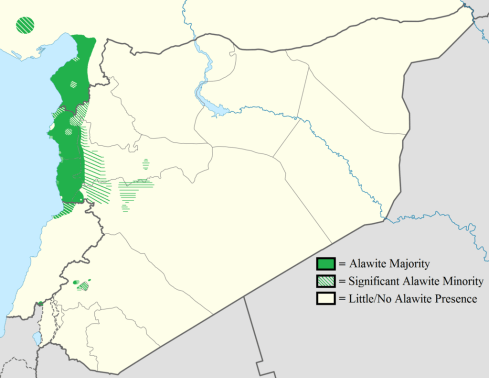
1024px-alawite_distribution_in_the_levant

And distribution of Alawites in the Levant, which, aside from Syria, clearly shows major concentrations in Turkish Antakya and also northern Lebanon.

The Kurds: Give the Kurds EVERYTHING they need. They’re creating a society, both in Iraqi Kurdistan and in the internal socio-political life of Turkish Kurds that is nothing short of revolutionary in its civic-mindedness, democratic tendencies and secular steadfastness. Yes, nothing’s perfect there either but it’s by far the best we have. And the loose confederation of Kurdish regions that I spoke of earlier may have perhaps an even more strategically valuable position to offer the rest of the world than Turkey does. Beg Turkish Kurds to swear to abide by ceasefire terms despite all provocations by the Turkish state; insist that Iraqi Kurdistan not declare independence. And then give them everything they need, even if it means billions in aid. Because, along with the Russians, they’re the ones who’ll probably have to do even more of the ground fighting when the airstrikes campaign reaches its inevitable limits – and starts harming civilians, which it unfortunately already has — even though they now insist that they’re not spilling any more of their own blood for anything outside of Kurdish-inhabited regions.

The rest will – if it hasn’t already – cause the reader to accuse me of fomenting a Middle East wide Sunni-Shia war, with my sympathies, both personal and ideological, firmly Shiite and that I’m proposing Russia and the West join in on the Shia side. Perhaps it is. Slap down Erdoğan (for whom this is certainly a Sunni-Shia struggle) and keep doing so till his ego is under control or he becomes a lame duck political force. Hard, but not impossible, if Turks start to see the real price they have to pay for so stupidly supporting him. Ignore Israel for now and let the Saudis (for whom this is also certainly a Sunni-Shia Struggle) stew in their own juices and cut off oil purchases if they try anything more radical. And as part of the inevitable opening of Iran and the inevitable growth of its role on the world stage, let it, Hezbollah, the, yes, despicable Assad and the, yes, still dubiously motivated but driven and highly motivated Russians all go to work on ISIS, Da’esh, whatever, and its ridiculous, vicious “caliphate.”

Sound risky? Yes, I know it does. It is. Got a better idea?

Comment: nikobakos@gmail.com


From the Guardian: Turkey could cut off Islamic State’s supply lines. So why doesn’t it? David Graeber

19 Nov

Turkey — or rather, Turks — could do a lot of things.  Why they don’t is a psychological issue, perhaps, more than anything else.  My take on the infuriating mood in post-elections Istanbul will come soon.  Meanwhile, great article from the Guardian, which, as usual, is not afraid to shove uncomfortable questions — and accusations — in our faces.

2835

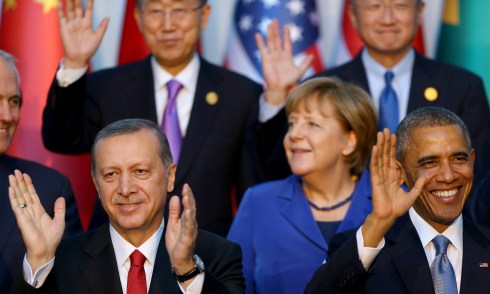
G20 leaders with Recep Tayyip Erdoğan in Antalaya on 15 November. ‘It may seem outrageous to suggest that a Nato member would in any way support an organisation that murders western citizens in cold blood.’ Photograph: Anadolu Agency/Getty Images

Some quotes:

“In the wake of the murderous attacks in Paris, we can expect western heads of state to do what they always do in such circumstances: declare total and unremitting war on those who brought it about. They don’t actually mean it. They’ve had the means to uproot and destroy Islamic State within their hands for over a year now. They’ve simply refused to make use of it. In fact, as the world watched leaders making statements of implacable resolve at the G20 summit in Antalaya, these same leaders are hobnobbing with Turkey’s president Recep Tayyip Erdoğan, a man whose tacit political, economic, and even military support contributed to Isis’s ability to perpetrate the atrocities in Paris, not to mention an endless stream of atrocities inside the Middle East….”

“How has Erdoğan got away with this? Mainly by claiming those fighting Isis are “terrorists” themselves. It is true that the PKK did fight a sometimes ugly guerilla war with Turkey in the 1990s, which resulted in it being placed on the international terror list. For the last 10 years, however, it has completely shifted strategy, renouncing separatism and adopting a strict policy of never harming civilians. The PKK was responsible for rescuing thousands of Yazidi civilians threatened with genocide by Isis in 2014, and its sister organisation, the YPG, of protecting Christian communities in Syria as well. Their strategy focuses on pursuing peace talks with the government, while encouraging local democratic autonomy in Kurdish areas under the aegis of the HDP, originally a nationalist political party, which has reinvented itself as a voice of a pan-Turkish democratic left…

4000.jpg

‘Bloody terrorist bombings inside Turkey seemed to target civilian activists associated with the HDP. Victims have repeatedly reported police preventing ambulances evacuating the wounded, or even opening fire on survivors with tear gas .’ Photograph: Murat Bay/AFP/Getty

“…In June, HDP success at the polls denied Erdoğan his parliamentary majority. Erdoğan’s response was ingenious. He called for new elections, declared he was “going to war” with Isis, made one token symbolic attack on them and then proceeded to unleash the full force of his military against PKK forces in Turkey and Iraq, while denouncing the HDP as “terrorist supporters” for their association with them.

There followed a series of increasingly bloody terrorist bombings inside Turkey – in the cities of Diyarbakir, Suruc, and, finally, Ankara – attacks attributed to Isis but which, for some mysterious reason, only ever seemed to target civilian activists associated with the HDP….”

“The exact relationship between Erdoğan’s government and Isis may be subject to debate; but of some things we can be relatively certain. Had Turkey placed the same kind of absolute blockade on Isis territories as they did on Kurdish-held parts of Syria, let alone shown the same sort of “benign neglect” towards the PKK and YPG that they have been offering to Isis, that blood-stained “caliphate” would long since have collapsed – and arguably, the Paris attacks may never have happened. And if Turkey were to do the same today, Isis would probably collapse in a matter of months. Yet, has a single western leader called on Erdoğan to do this? [my emphases]

The next time you hear one of those politicians declaring the need to crack down on civil liberties or immigrant rights because of the need for absolute “war” against terrorism bear all this in mind. Their resolve is exactly as “absolute” as it is politically convenient. Turkey, after all, is a “strategic ally”. So after their declaration, they are likely to head off to share a friendly cup of tea with the very man who makes it possible for Isis to continue to exist.”

Comment: nikobakos@gmail.com


This is the saddest story: Syria’s last Jews leave — By Sami Moubayed, Special to Gulf News

12 Nov

Aleppo’s last Jewish family leaves Syria

Family separated for the first time after Israel rejects Muslim members

SOURCE: Govorkov Central Synagogue of Aleppo

By Sami Moubayed, Special to Gulf News

Beirut: The last Jewish family has left Aleppo, according to sources in northern Syria, ending a long and illustrious chapter in the diverse demographic and religious history of the city that is now torn by war due to almost five years of a vicious conflict.

Chances are that Aleppo Jewry will never return as the city remains at the crosshairs of an ongoing war between Syrian troops, Russian airplanes, and a large variety of rebels fighting on Syrian soil.

Armenian photographer Derounian’s 1914 photograph of a Jewish wedding party in Aleppo. The men, women and children are all dressed in European fashion, except for one Fez-wearing family member


The family was that of Mariam, a salt-and-peppered haired feeble 88-year old Jewish grandmother, born in Aleppo during a military uprising against French colonial rule in 1927. Childhood memories of foreigners running around her city with their light arms would have remained vividly imprinted in her mind — Frenchmen, Brits, Turks, Nazi Germans, Indians in the British Army. All of them passed through Aleppo at some point during her life in the city, either right after the First World War or throughout the Second.

More recently so have Chechens, Tajiks, Saudis, Jordanians, Iraqis, Moroccans, and a colourful assortment of European Islamist radicals who have all flocked to join Daesh.

As Daesh closed in on Aleppo earlier last summer, Mariam’s nerves collapsed. Fearing slaughter at the hands of Abu Bakr Al Baghdadi’s men, she nodded helplessly when her two daughters showed up saying that they must leave Halab — as the city is known in Arabic and Hebrew — immediately.

An Israeli-American tycoon named Moti Kahana stepped in with a mission to get the city’s last Jews out. Israel has in the past run secret operations to get Arab Jews it perceives to be in danger out of their countries.

A Central Synagogue of Aleppo. Picture taken pre-1940s


With very little luggage, Mariam sluggishly boarded a minibus provided by Kahana with her two daughters Gilda and Sarah, a single woman in her 40s, and all of her grandchildren. Present with them was Khalid, the Muslim husband of Gilda. All the women wore the Muslim headscarf — the hijab, to avoid arousing unnecessary attention at Islamist checkpoints. They waited for the guns to go silent at noon prayer then whizzed through the streets of Aleppo, driving through debris and dead bodies, crossing checkpoints manned by the Al Qaida-affiliated Al Nusra Front and Daesh. It took them 36-long hours to reach safety at a small apartment in Istanbul, where Moti Kahana was waiting for them.

Kahana was very proud of his feat — himself a loud opponent of the Syrian regime who posts online photos of himself carrying the green tricolour of the Syrian uprising. According to Kahana’s own account of the story, since no member of the Syrian Jewish family agreed to speak to the press, only Mariam and Sarah were allowed safe passage into Asqalan (Ashkelon), where they have now settled.

Gilda and her family were turned down because her husband was a Muslim and she had converted to Islam three years ago, in keeping with Israeli law that only allows naturalisation Jews. The Muslim members of the family were told to stay in Turkey but they refused, preferring to return to their war-torn country than live in refugee camps.

After a painful separation from her aging mother, Gilda returned to Aleppo with her Syrian passport, and now lives there in silence with her Muslim husband and children, refusing to ever comment about the entire ordeal. Moti Kahana was the person to break the story, saying: “I got the last Jewish woman out of Aleppo. I feel very emotional when I think about it.”

Coexistence lost

Just 15 years ago, there were approximately 200 Jews living in Syria, a small number compared to the country’s then-population of 23 million. The number dropped significantly over the past decades, once standing at 15,000 during the short-lived Syrian-Egyptian Union (1958-1961). In 2000-01, 150 Jews lived in Damascus while the rest were divided between Aleppo and Qamishli in north-eastern Syria.

According to the US annual International Religious Freedoms Report, the number of Jews inside Syria had dropped to no more than 80 by the year 2005. Last December, various sources put the number at approximately 50 Jews, mostly living in Hay Al Yahud (the Jewish Quarter) within the walled Old City of Damascus, side-by-side with Shiites.

The Jewish community of Aleppo was once a powerful and wealthy one, well-connected in overseas trade and deeply rooted in the city’s ancient history. As early as 1901 they established the Aleppo Jewish Community Synagogue in occupied Jerusalem and bankrolled Syrian Jewish migrants who fled to the Americas during the First World War.

Aleppo was considered the unofficial capital of Sephardic (eastern) Jews and according to popular lore the city’s Grand Synagogue was erected by one of the Biblical King David’s generals.

The community started to gradually to lose influence and leave Aleppo, either to Israel or to Brooklyn, New York after 1948, when their homes and synagogue were attacked by hoodlums during the first Palestine War.

One of its celebrated figures was Yom Tov Assis, an Aleppo-born reputed historian who now teaches at the Hebrew University in occupied Jerusalem and chairs its centre of Aleppine Jewry, an institute dedicated exclusively to studying the city’s Jewish community.

Sami Moubayed is a Syrian historian and former Carnegie scholar. He is also author of ‘Under the Black Flag: At the frontier of the New Jihad’.

Comment: nikobakos@gmail.com

Bulgaria: Why countries resist immigration…what are they afraid of? Well then, whither away in depopulated stagnation…

6 Oct

Despite Shrinking Populations, Eastern Europe Resists Accepting Migrants — The New York Times

Bulgarian kid zonar

Petrunka Yankova helping her grandson, Stoyan Dodrikov, into traditional Bulgarian dress.  (Dmitry Kostyukov for the New York Times)

“In the most recent World Population Prospects from the United Nations, the 10 countries in the world expected to lose the most population between now and 2050, per capita, are all in Central and Eastern Europe, with Bulgaria in first place.

“In 1990, just after the fall of Communism, Bulgaria had about nine million citizens, making it slightly bigger than Sweden and Austria. Today, the official population is 7.2 million, much smaller than Sweden or Austria, and projections are that it will lose 12 percent of its population by 2030 and 28 percent by 2050.

“Romania is not far behind, expected to lose 22 percent of its population by 2050, followed by Ukraine (down 22 percent), Moldova (20 percent), Bosnia and Herzegovina (19 percent), Latvia (19 percent), Lithuania (17 percent), Serbia (17 percent), Croatia (16 percent) and Hungary (16 percent).”

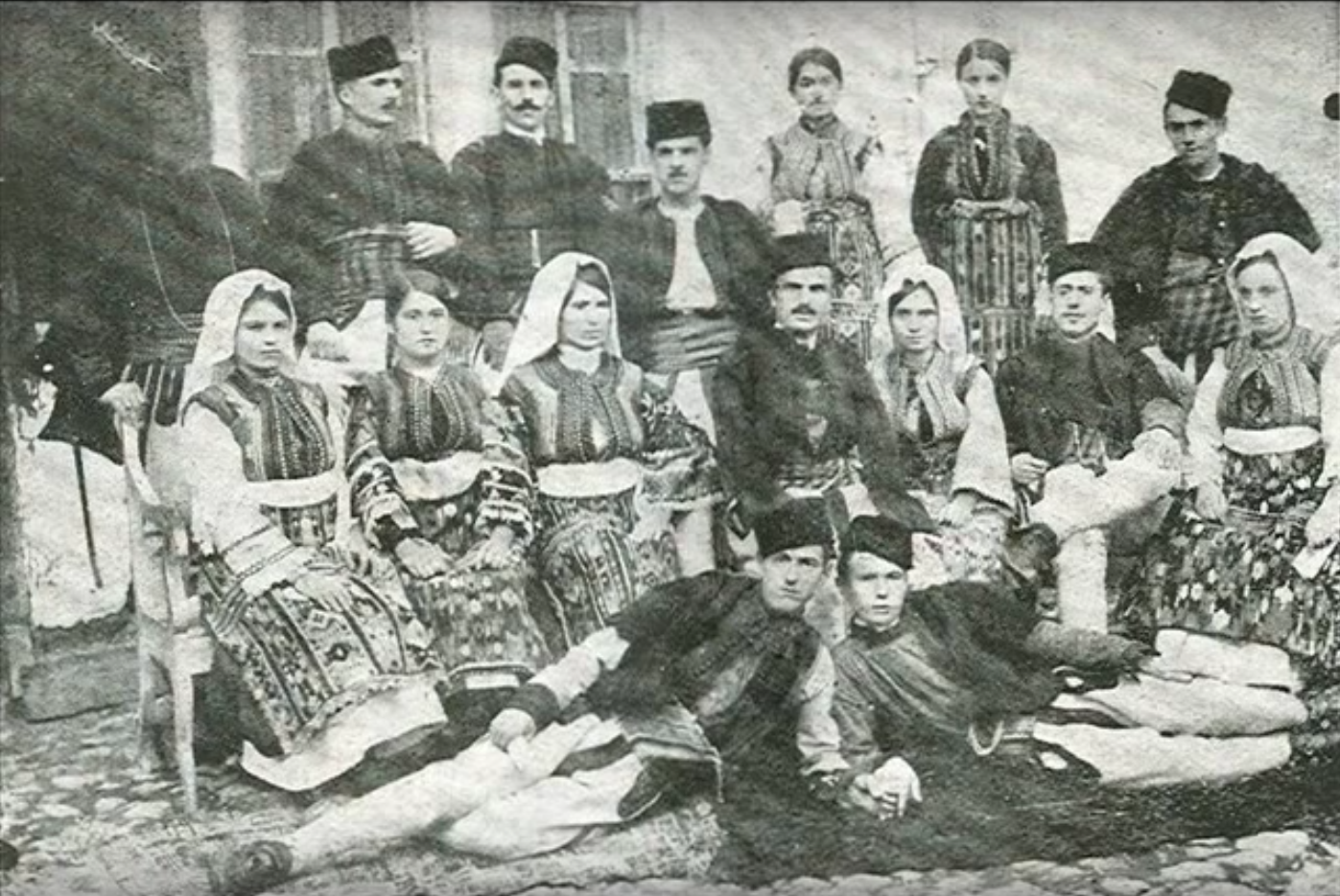
And yet people are against immigration.  What can I say.  You hear this less in Greece, but still.  It’s beyond my comprehension what people are afraid of.  “Losing their country” says the Prophet (formerly the Messenger).  Your country already belongs to Europe, America and, actually, international financial institutions.  Losing your culture?  Your culture is already long gone, a victim of modernity, globalization, vapid consumerism and the indifference of several generations of your own people, including your own, sacrificed on the altar of your own insecurity and internalized snobbery.  It’s a museum piece, like you sense in the picture above (click) without there being any real telling signals — except the suspicion that the a real Bulgarian pallikari, like the guys in the picture below, would never have traditionally put on such an ugly, cheap satin sash for anything in the world (just compare the obvious difference in material quality between the two, that comes through even the black and white of the bottom photo); he’s obviously dressing for some folklore ensemble performance or to receive a minister come visitting to their town.  Your Bulgarianness, your Polishness, your friggin’ fascist Hungarianness — were it still a dynamic living organism — would not be threatened by your country becoming 5 or 10 or 20% or even majority Syrian or Muslim.  It would survive as a thriving, blossoming minority — if it still had any life left in it.  But it doesn’t.

At no point in history did in-migration represent anything but a more dynamic, hard-working, creative population moving into a different region where there was an already pre-existing energy and dynamism gap — and no, not just in America Mr. Prophet: but Mexicans moving into the depressed American South and Southwest, where the native population, Black and White, has been dumbed to the point of idiocy and uselessness by its own government…or just the inevitable historical trajectory of things…is a great example  And you can stop that if you want by a sudden burst of spiritual fortitude (forgive me, for example, for my obvious affective bias, but I refuse to believe that Serbs will just shrink away into moronized proles), but not by building walls or hating.  That’ll only make you smaller.

And it’s only in Greece where I’ve heard from the most surprising quarters — not intellectuals, of course — but housewives and cab-drivers, that: “What the hell?  Let some of them stay.  It might do us good.”  Maybe they’re remembering what the infusion of Albanian blood into the country did in the 90s — nothing except what it’s always done through the centuries, but imbue us with greater energy and working and fighting spirit.  Or maybe they’re just smarter than their intellectuals and politicians.

Bulgarians

(click)

Comment: nikobakos@gmail.com

Must, must, MUST see doc: BBC’s Chidren of Syria

29 Dec

https://dailymotion.com/video/x22fhfu


I hope the BBC forgives me for posting this.  And maybe takes it as a homage instead.  I’ll gladly comply with a “cease-and-desist” request.  I just think it’s some of the most gripping work on Syria to come out since the conflict began.

The cheap vulgarity of what you’re made to watch before the video begins with the material that follows kind of turns your stomach.

Comment: nikobakos@gmail.com

Image

Photo: Syria

29 Dec

Syria_man_child_getty_976(click)

“When Western evil is fused with Arab stupidity…”

29 Nov

Iraqi TV Host Breaks Down in Tears at Plight of Christians

http://www.youtube.com/watch?v=ioUS_xwFfXw

And a super-outspoken (now that he’s safe in Erbil) Bishop from Mosul: “..Western evil is fused with Arab stupidity…”

http://www.youtube.com/watch?v=GLXKx1z2dj0

Might wanna retake a look at my Who are the MESA Thought Police?:

“…or if you were caught even suggesting, heaven forbid, that maybe — just maybe — Arabs had simply conquered what were already the most sophisticated and civilized parts of the Greco-Roman and Sassanian worlds…”

And yes, “kanun,” law, is a Greek word.

Oh, yeah.  And so is “kalam,” pen…

Comment: nikobakos@gmail.com

Catalonia: “Nationalism effaces the individual…”

7 Nov

…fuels imaginary grievances and rejects solidarity. It divides and discriminates. And it defies the essence of democracy: respect for diversity. Complex identities are a key feature of modern society. [my emphasis] Spain is no exception.”

A brilliant op-ed piece from the Times today by Mario Vargas LLosa, among others, that exposes all the petty narcissism and destructiveness of the orgy of separatist movements that Europe has seen come to the fore in the past few decades: A Threat to Spanish Democracy .”

Catalunya+Prov+EnglishOther money quotes:

“In their attempt to undermine the workings of the constitutional government, Catalan separatists have displayed a remarkable indifference to historical truth. Catalonia was never an independent state. It was never subjected to conquest. And it is not the victim of an authoritarian regime. As a part of the crown of Aragon and later in its own right, Catalonia contributed decisively to making Spain what it has been for over three centuries: an impressive attempt to reconcile unity and diversity — a pioneering effort to integrate different cultures, languages and traditions into a single viable political community.

“Compared with the crises occasioned by the collapse of dictatorships in many European states, Spain’s transition to democracy, following the 1975 death of Francisco Franco, was exemplary, resulting in a democratic constitution granting broad powers to Spain’s autonomous regions. Yet Catalan separatists have glossed over the positive aspects of the transition.”

and:

“But the advent of democracy brought official recognition to Spain’s distinctive cultures, and set the foundations for the autonomy the Catalans enjoy today. Catalonia has its own official language, its own government, its own police force. Catalans endorsed the Constitution overwhelmingly: 90 percent of them voted yes in the referendum of Dec. 6, 1978. The millions of tourists who flock to Barcelona every year, drawn by the beguiling blend of Gothic and Gaudí, attest to the vigor of Catalonia’s culture. The claim that Catalonia’s personality is being stifled and its freedoms oppressed is simply untrue.”

The piece pretty much says it all: the bogus democraticness of separatist rights and the supposed right to self-determination completely debunked as nothing more than “little” nationalisms, which as Vassily Grossman points out in this post …the nationalism of little nations,” can be just as dangerous and certainly as small-minded as that of “bigger” nationalisms.  Ditto this op-ed for Abkhazia, South Ossetia, Ukraine (both sides), for Belgium, Scotland and, of course, for the most nightmarish manifestation of these tendencies in our time, the tragic break-up of Yugoslavia.  And that’s without even going as far back as the Partition of India, or the Greco-Turkish Population Exchange of the 1920s.

“Complex identities are a key feature of modern society.”  No, no and no…  Complex identities are not just a key feature of modern society, but humanity period, a feature of pre-modern society since the beginning of time.  The roughly two centuries of modernity or “the modern,” which we can probably date from the French Revolution on, is the only period in history when the ethnicity-based nation-state and its brutal, levelling, anti-humanist attempt to “de-complicate” human identity held sway as the predominant form of sociopolitical organization.  It’s just a blip on the screen of history and will soon come to be seen as such.  Multiple cultural identities and stable state political organization can co-exist easily.  Thinking otherwise is an idea whose burial is long overdue.

So, what irritates me most about separatist movements like that of the Catalans is that they’re really retrograde ideologies disguised as liberation movements.  Since the Barcelona Olympics of 1992, when the autonomous Catalan government had the impudence, I remember, to plaster New York City subway cars with ads that read “Catalonia is a country in Spain,” (???) Catalans have been engaged in a massive public relations campaign to project an image of sophistication, liberalism, bogus hipness, and artistic innovation (including culinary — if you can actually call the molecular nonsense Ferran Adrià put out food…) all meant to be juxtaposed against a clichéd, “Black Legend” stereotype of Spain — under whose repression Catalonia suffers — that’s just plain racist. Catalan nationalism rests mostly on the laurels of its Republican-ness and struggle against the forces of Spanish reaction in the 1930s — Hemmingway and Orwell’s “Homage.”  But the attitude of today’s average Catalan nationalist more resembles that of the average member of Italy’s Northern League, a far-right if not quite fascist but certainly racist bunch of jerks: the same smug sense of superiority towards their co-citizens and the same petit bourgeois self-righteousness about how their wealth and resources get sucked up by the parasitic rest of the country.

There is no convincing evidence that Catalan society is any more liberal or open or sophisticated than the rest of Spain.  See González Iñárritus film “Biutiful” (if you can bear to watch it; I couldn’t make it though a second viewing…but it’s the perfect antidote to Woody Allen’s nauseating “Vicky, Cristina, Barcelona”), for how much better Catalonia treats its immigrants, for example, including those from poorer parts of Spain, than any other part of Europe, or do some reading up on the discrimination Castillian-speakers in Catalonia suffer.  Catalan independence is not a liberal or liberatory idea; it’s exclusionary and elitist to the core.  The problem is that most of the world falls for the discourses of these movements –the way the West did with Croatia in the 90s — because they’re so good at playing victim.

The finger-flipping at the impressive democratic achievements of Spanish society since 1975 is particularly galling.

See also my Leader of Catalonia Calls for Independence Vote (September 27th).  And  More on Alevis and Alawites…or Alevis and Kurds…or Iraqi Kurds…or…Christian Kurds…or Assyrians…or… (September 27th)


catalonia-5-x-3-flag-3475-p

Comment: nikobakos@gmail.com

Lebanese Christians, Hezbollah and Syria

2 Nov

baalbek-1-superJumboThe Rev. Ibrahim Nehmo expressed a shared ambivalence about Hezbollah’s power in the village of Ras Baalbek, Lebanon. Diego Ibarra Sanchez for The New York Times (click)

“In recent statements, Hezbollah’s leaders have credited their fighters with defending Lebanon against a wave of extremist Sunni militancy that could threaten the country, the most religiously diverse in the region. Al Akhbar, a left-leaning Lebanese daily, recently published a telephone poll conducted last month by the Beirut Center for Research and Information that found that two-thirds of Christians said Hezbollah was protecting Lebanon.

In Ras Baalbek, that sentiment is strong, but it comes with some ambivalence. The Rev. Ibrahim Nehmo, the priest at St. Elian Greek Catholic Church, put it this way: “We feel positive about Hezbollah today, but not as positive as their communities do.

“We are not asking them to come here,” he said. “But I profit from Hezbollah. I am not fully with Hezbollah, but if Hezbollah is powerful, I am not sad.”

At the church, deserted on a recent weekday, red and blue stained glass filtered light into a quiet sanctuary. A sign on the door displayed the insecurities of Christians, who are more powerful in Lebanon than in any other Arab country but see themselves as increasingly beleaguered in the region.”

“This land belongs to our people,” it read. “Some of us have died, some of us are still alive, but some of us haven’t been born yet. This land is not for sale.”

Whole article: Clashes on Syrian Border Split Lebanese Town 

Comment: nikobakos@gmail.com