Archive | Uncategorized RSS feed for this section

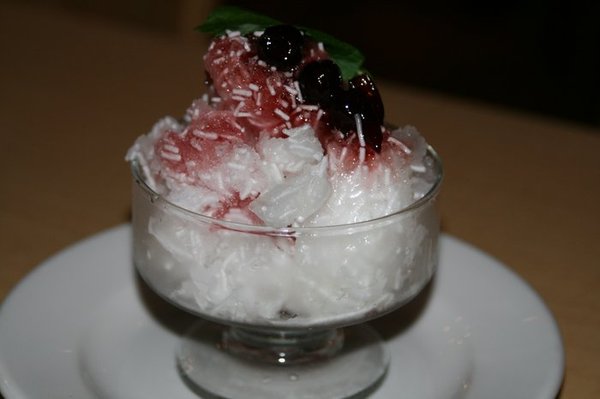
This is what I want in this heat: Faloodeh

12 Jul

It’s frozen vermicelli noodles made either from corn starch or rice flour, with sour cherry syrup on it and lotsa lime juice, sometimes pistachios or mint leaves too.  The lime heightens the sweet-tartness of the vyssino-visne-sour cherry tartness in that subtle, complex juxtaposition of fruitiness and sourness that Iranians are such experts at (in desserts and all foods), and it turns into the most refreshing, delicious slushy you could ever want to eat.  Sold on the street apparently in Iran, it must be heaven to have in the heat and dust.  I fantasize about it when the weather gets like this.

Kheyli mamnun to my beloved friend F. for introducing me to it.

A saffron ice cream with a chewy, masticha-sakiz-like texture is my second favorite…


Köprüdekiler

11 Jul

“Bridge-on-that-(are)-ones” would be the name of this film if you constructed a literal calque in English from the Turkish word order.  We used to play a game like that in grad school — the Turks and the rest of us poor schmucks who were trying to learn Turkish — would play at having whole conversations in an English constructed on the fascinating syntactic structure of Turkic languages.  “Sent-me-by book you-to yet came, huh?” if I remember correctly;  “huh?” was what we used to serve as the Turkish interrogative particle “mi?” — like the Japanese “-ka” — because it was the best we could come up with.  It was pretty silly but a lot of fun.  And when I was teaching ESL, one thing every Turkish student of mine learned from me when he asked an Asian student whether Korean or Japanese was more similar to Chinese was that Korean and Japanese are more grammatically similar to Turkish than either of them are to Chinese.  Their reaction was interesting.  They swallow the silly Turanianism of Turkish Republican ideology whole, but don’t seem to like being confronted by it in such bluntly real and not mythic terms.  “Wait a sec…me…and this Korean guy?”

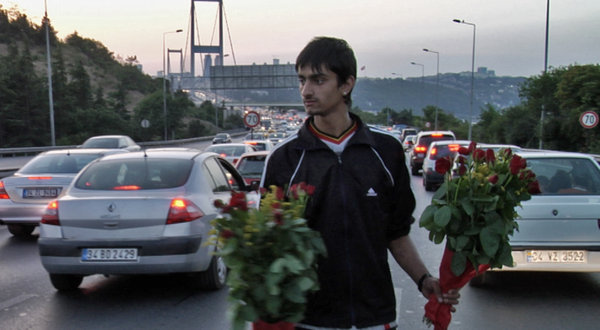
“The Men on the Bridge” — to get back to the post here — is about three men in İstanbul who are connected only by the fact that they work on the Bosphorus Bridge, the older and southernmost span between the two sides of the city.  One is a gypsy boy who sells flowers to people stuck on the bridge’s usually horrendous traffic; he tries to find other employment but is functionally illiterate, can’t even hold down a job at a working-class lokanta, and ends up back on the bridge.  The other is a poor, exhausted dolmuş driver (group taxi — same root as dolma, “stuffed,” which gives you an idea of how comfortable they are, though the new ones are actually very nice), who’s usually stuck in the bridge’s horrendous traffic and tormented by a frankly bitchy wife, who can’t understand why he can’t make enough money to move into a bigger apartment, though she herself doesn’t work and has no skills to get a job either, who, like most of her type, is fairly useless around the house as well, and whom any self-respecting Turkish man would have long sent packing back to her mother.  The third character is a traffic cop who tries to keep the horrendous traffic moving, including by harassing the gypsy boy with the flowers and giving the dolmus driver a ticket when his wife has called him to bitch about something and won’t let him get off his cell.  Played by the only professional actor in the film (his brother is an actual traffic cop), he’s a slightly dorky but handsome kid from Kayseri, with the shy, good manners that still exist in the Turkish provinces.  He’s doing a bit of religious exploring, misses home, works out, and tries to find girls to date on-line — snotty İstanbullu chicks he meets up with who start looking at their watch when he says “Kayseri” and suddenly have to leave when he says “a village near Kayseri.”  He’s particularly proud of his Turcoman clan lineage, one of the first, he claims, to come to Anatolia, and launches into its history with one of these girls, which I wanted to hear more of; she yawns, I think.

“Köprüdekiler” is not some major work, but it’s a very Turkishly melancholy and sweet film that makes its point powerfully enough: that is, that even if all of the recent years’ hype about Booming İstanbul and Booming Turkey is real and not the product of a good American public relations firm — like one sometimes suspects — that certainly not every Turk has gotten to be a part of it.  Aslı Özge makes that point most effectively by refusing to show us even one shot of the glamorous New İstanbul that gets a major piece in the Times travel section, The New Yorker and Travel and Leisure at least once every other issue.  Even the city’s beautiful sea views are almost invisible — and this in a film about a bridge — and even the one scene shot on the Jadde, a scene that makes you want to cry, where the gypsy kid and a friend are innocently checking out CD’s on a stand outside a shop and are suddenly hustled away by security to be frisked and brutally threatened, is shot in such close frame that you see none of the street’s other activity or entertainment or crowds.  She takes an effective swipe at Turkish militarism and nationalism too while she’s at it.

The dumb psychedelic lights they’ve put on the bridge — which if you know how it dominates the City’s sea-and-landscape you must know are particularly irritating — weren’t present in the film and I wondered why.  And then I checked and found it was made in 2009.  I wondered why so many films come even to New York so late and then remembered what profit pigs and cowards American distribution companies are.  I saw it at a one time screening at MOMA last month.  But it’s worth the effort to find.  See it.  Trailers below.

New burial of Srebrenica victims – no comment

11 Jul

The forensics’ teams of the International Commission of Missing Persons considers this one of their most challenging cases ever, since the original mass grave, which they now think may have contained up to 9,000 bodies and not the original rough estimate of 7,000, was dug up with bulldozers for Serbian fear of its being found (of all things, this is what they decided they were going to get retroactive cold feet about?) and the bodies reburied in smaller pits all over Bosnia, damaging evidence, obviously, and leaving one individual’s body parts in a potential multitude of sites.  Some of the ICMP people have identified bodies that they say may have been buried, dug up and reburied up to three or four times and fewer than six thousand have been identified, subjecting Bosnians to this incessant wound re-gashing as the process continues and newly identified remains are buried in mass funerals.  It almost makes you wonder whether modern forensics and DNA technology are such a great thing.


Turkey gets a pass?

11 Jul

I was thinking it must be a relief for the Neo-Greek mind (because as for heart and soul, there’s not much to be said these days) to have someone other than Turkey to blame for their Statelet’s social chaos, political ridiculousness, economic void, failed cultural delusions and its people’s spiritual ugliness and childishness.

“They said, ‘You’re the cause of Greece’s problems. You have seven days to close or we’ll burn your shop — and we’ll burn you,’” said Mohammed Irfan, right, a legal Pakistani immigrant who owns a hair salon and two other stores. When Mr. Irfan called the police for help, he said, the officer who answered laughed and said they did not have time to come to the aid of immigrants like him.

(Eirini Vourloumis for the International Herald Tribune)

You can read the whole Times here.  Oh, but no…maybe it’s the Times — that New York Jewish rag, that has always tried to make the Statelet look bad.

“You’re the cause of Greece’s problems…,malaka…  Can they get any more delusional?


P.S. NYC Cab Drivers: One of My Heroes

10 Jul


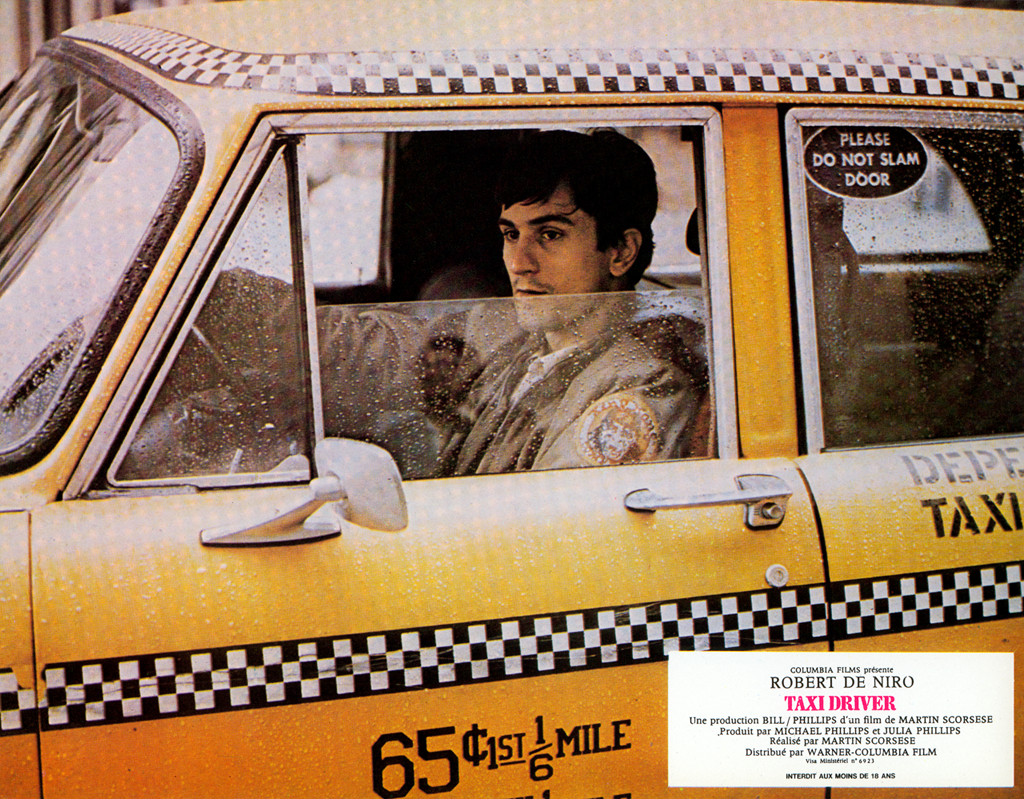
Some sympathy for NYC cab drivers

10 Jul

The description in this Times article of the exploitative nineteenth-century style racket these guys are subject to makes you think again about how much they can piss you off sometimes: the pressures they work under, why they can be so nasty, why they drive the way they do; the frustration must be unbearable; you almost want to compare their plight to early twentieth-century textile workers.  What a third-world city this remains on so many levels; and I don’t mean immigrants; I mean how it uses and abuses them:

A few families have owned thousands of cabs since the Great Depression, or shortly thereafter. Each taxi must have a medallion affixed to its hood. There are fewer than 14,000 medallions, and the price for each has increased to $1 million from $275,000 in 2002.

A vastly profitable corporation, Medallion Financial, owned by the grandson of one of those original cab owners, provides financing for the medallions. It borrows at less than 1 percent and lends at 6 percent.

If a poor schlemiel falls behind? The city plays repo man and takes back the medallion.

It is a can’t-miss business plan.

Years ago, drivers didn’t have to rent their cabs, and they didn’t pay for gas. They split their daily proceeds with garage owners. Slow nights hurt both.

Now drivers are “independent contractors,” which is a winsome way of saying owners transferred risk onto their backs.

If it is a slow night in August, and a driver limps home after 12 hours with $30, too bad.

Just make that lease payment.

“It’s sharecropping economics, and it only works for the plantation owner,” [my emphasis] said Edward Rogoff, a professor at Baruch College, and himself a former cabby.


This is mass murder: Austerity and Addiction — “…cases of HIV in the city center had gone up last year by 1,450%…”

10 Jul

From: The Fix: Addiction and Recovery Straight Up

Greece’s financial crisis has led to an alarming surge in intravenous drug use, overdoses, prostitution and HIV infections, according to experts in the field as well as academics studying the problem. Prior to the crisis, Greece had a historically low prevalence of HIV. But last year, the number of new infections spiked 57% over 2010, according to the Hellenic Center for Disease Control and Prevention, spreading most rapidly among a growing population of dirty needle users, among whom the rate was 15 times higher than in 2010. Little wonder, since the country saw a 20% rise in heroin use in 2010—to an estimated 24,100 users from about 20,200 the previous year, according to a report last fall in the British medical journal The Lancet.

“Drug use in Greece was already on the rise before the crisis,” said Alexander Kentikelenis, a public health policy expert at Cambridge University and the lead author of the Lancet report. “What changed after the crisis were cuts to money for needle exchange programs, condom distribution and drug rehabilitation,” he told The Fix. “So you have more people injecting drugs at the same time that you have less money available to cater to the needs of this group, and that creates a dangerous situation…..”

Last February, Greek joblessness hit a record 27.1%, with nearly 1.1 million people out of work, mostly in Athens and other cities. Hardest hit are the young—the ones most likely to turn to drugs and prostitution. A record 54% of Greeks between the ages of 14 and 25 are out of work. With a national debt that is 142% of GDP [gross domestic product], Greece had to borrow $170 billion from the International Monetary Fund under crippling austerity measures, slashing government spending by 30%. “When you have a radical drop in GDP, you need labor-market programs to help these people re-renter the job market and not become the long-term ill and unemployed,” Kentikelenis said.

In Greece, budget cuts in 2009 and 2010 killed a third of the country’s outreach programs to counsel and treat prostitutes, addicts and the homeless. An October 2010 survey of 275 drug users in Athens found that 85% were not in a drug-rehabilitation program. Reveka Papadopoulou, the general director of Medecins sans Frontieres’ Greek branch, said cases of HIV in the city center had gone up last year by 1,450%, according to The Guardian. The medical charity attributed the rise largely to the suspension of the capital’s needle exchanges. [my emphasis]

One Thousand Four Hundred and Fifty Percent!!!

If it were east Africa somewhere, do-gooder German activists with cute glasses would have mobilized an army of health crusaders to do something…

Omonoia Square, Athens

©Angeliki Panagiotou
lightstalkers.org/angeliki-panagiotou01   View all images in this gallery


“India’s Blood-Stained Democracy” by Mirza Waheed

7 Jul

Kashmiri women attend a protest organized by the Association of Parents of Disappeared Persons in Srinagar in November 2010.  (Rouf Bhat/Agence France-Presse — Getty Images)


from The New York Times, July 6th

India’s Blood-Stained Democracy, by Mirza Waheed

“LAST September, a lawmaker in Indian-controlled Kashmir stood up in the state’s legislative assembly and spoke of a valley filled with human carcasses near his home constituency in the mountains: “In our area, there are big gorges, where there are the bones of several hundred people who were eaten by crows.”

“I read about this in faraway London and was filled with a chill — I had written of a similar valley, a fictional one, in my novel about the lost boys of Kashmir. The assembly was debating a report on the uncovering of more than 2,000 unmarked and mass graves not far from the Line of Control that divides Indian- and Pakistani-controlled Kashmir. The report, by India’s government-appointed State Human Rights Commission, marked the first official acknowledgment of the presence of mass graves. More significantly, the report found that civilians, potentially the victims of extrajudicial killings, may be buried at some of the sites.

“Corpses were brought in by the truckload and buried on an industrial scale. The report cataloged 2,156 bullet-riddled bodies found in mountain graves and called for an inquiry to identify them. Many were men described as “unidentified militants” killed in fighting with soldiers during the armed rebellion against Indian rule during the 1990s, but according to the report, more than 500 were local residents. “There is every probability,” the report concluded, that the graves might “contain the dead bodies of enforced disappearances,” a euphemism for people who have been detained, abducted, taken away by armed forces or the police, often without charge or conviction, and never seen again.

“Had the graves been found under Col. Muammar el-Qaddafi’s compound in Libya or in the rubble of Homs in Syria, there surely would have been an uproar. But when over 2,000 skeletons appear in the conflict-ridden backyard of the world’s largest democracy, no one bats an eye. While the West proselytizes democracy and respect for human rights, sometimes going so far as to cheerlead cavalier military interventions to remove repressive regimes, how can it reconcile its humanitarianism with such brazen disregard for the right to life in Kashmir? Have we come to accept that there are different benchmarks for justice in democracies and autocracies? Are mass graves unearthed in democratic India somehow less offensive?”


I See Kashmir from New Delhi at Midnight

                              Now and in time to be,

                             Wherever green is worn…

                             A terrible beauty is born.

                                              — W. B. Yeats

1

One must wear jeweled ice in dry plains

to will the distant mountains to glass.

The city from where no news can come

Is now so visible in its curfewed nights

that the worst is precise:

                                        From Zero Bridge

a shadow chased by searchlights is running

away to find its body. On the edge

of the Cantonment, where Gupkar Road ends,

it shrinks almost into nothing, is


nothing by Interrogation gates

so it can slip, unseen, into the cells:

Drippings from a suspended burning tire

Are falling on the back of a prisoner,

the naked boy screaming, “I know nothing.”

2

The shadow slips out, beckons Console Me,

and somehow there, across five hundred miles,

I’m sheened in moonlight, in emptied Srinagar,

but without any assurance for him.


On Residency Road, by Mir Pan House,

unheard we speak: “I know those words by heart

(you once said them by chance): In autumn

when the wind blows sheer ice, the chinar leaves

fall in clusters –

                                 one by one, otherwise.”

“Rizwan, it’s you, Rizwan, it’s you,” I cry out

as he steps closer, the sleeves of his phiren torn.

“Each night put Kashmir in your dreams,” he says,

then touches me, his hands crusted with snow,

whispers, “I have been cold a long, long time.”


3

“Don’t tell my father I have died,” he says,

and I follow him through blood on the road

and hundreds of pairs of shoes the mourners

left behind, as they ran from the funeral,

victims of the firing. From windows we hear

grieving mothers, and snow begins to fall

on us, like ash. Black on edges of flames,

it cannot extinguish the neighborhoods,

the homes set ablaze by midnight soldiers.

Kashmir is burning:


                                   By that dazzling light

we see men removing statues from temples.

We beg them, “Who will protect us if you leave?”

They don’t answer, they just disappear

on the roads to the plains, clutching the gods.


4

I won’t tell your father you have died, Rizwan,

but where has your shadow fallen, like cloth

on the tomb of which saint, or the body

of which unburied boy in the mountains,

bullet-torn, like you, his blood sheer rubies

on Himalayan snow?


I’ve tied a knot

with green thread at Shah Hamdan, to be

untied only when the atrocities

are stunned by your jeweled return, but no news

escapes the curfew, nothing of your shadow,

and I’m back, five hundred miles, taking off

my ice, the mountains granite again as I see

men coming from those Abodes of Snow

with gods asleep like children in their arms.


                                      (for Molvi Abdul Hai)


*******************************************************************************************************************************************************************************   

*  “Don’t tell my mother / my beloved brother / my sister….I’m dead” is also a common stock phrase in Balkan epic poetry of guerrilla fighters, kleftes, haiduci.

*  “By that dazzling light we see men removing statues from temples”…”Who will protect us if you leave?”…”men coming from those Abodes of Snow with gods asleep like children in their arms.”

Shahid Ali’s universalist soul was as hurt by the exodus of Kashmiri Hindus (Pandits) from the region as he was by the brutality of the Indian Army against its innocent Muslim majority.  I can only assume that the men with the gods asleep in their arms is a reference to this exodus.  Shahid suffered from a recurrent nightmare, in fact, that the last Hindu had left Kashmir, and he fought that haunting image through the curious fashion of reproducing their distinctive cuisine as meticulously and often as possible — he was an excellent cook; there are now hardly any Hindus left in the tormented region.  “Who will protect us if you leave?,” directed to the departing Hindu gods, is a line that always breaks my heart, and could only come from a poet of as sophisticated a background and from as beautifully Sufi-syncretic a region as Kashmir.
“I See Kashmir from New Delhi at Night” reprinted from The Veiled Suite: The Collected Poems by Agha Shahid Ali. English translation copyright © 2009 by Daniel Hall. With the permission of the publisher, W.W. Norton & Company, Inc.


Photo: San Diego, CA

5 Jul

No idea…


Wikileaks begins release of 2.4 million emails from Syrian government

5 Jul
Wow…

WikiLeaks spokesman Sarah Harrison told a news conference the emails from Syrian political figures, government ministries and companies dated from August 2006 to March 2012.

She read out a statement quoting WikiLeaks founder Julian Assange as saying: “The material is embarrassing to Syria, but it is also embarrassing to Syria’s opponents.

“It helps us not merely to criticise one group or another, but to understand their interests, actions and thoughts. It is only through understanding this conflict that we can hope to resolve it,” she said.