
Djoković king of the court: “…a chilling and simple declaration of intent.”
20 NovFrom the Guardian:
1 Novak Djoković
2014 Won 61 Lost 8 Titles 7 Prize money $14,250,527
There is no sensible argument about who is the best player still standing at the end of 2014. Advocates of Rafael Nadal have to acknowledge the dominance of Novak Djoković, below, at least until the Spaniard returns to full fitness, while Roger Federer, sitting just behind the Serb in the rankings after a rousing surge at the end of the season, is now also struggling with a back problem. In the jungle of modern tennis Djoković is not only the best but the strongest. He declared on Sunday, “Right now I’m at my pinnacle in the career. I physically feel very fit. I’m very motivated to keep on playing on a very high level.” That is a chilling and simple declaration of intent. [my emphases]
 –
–
Comment: nikobakos@gmail.com
–
Photos: Orthodox Jewish man cries during the funeral of Rabbi Moshe Twersky in Jerusalem, Israel on November 18, 2014.
19 Nov
 By Lior Mizrahi/Getty Images. (click)
And…
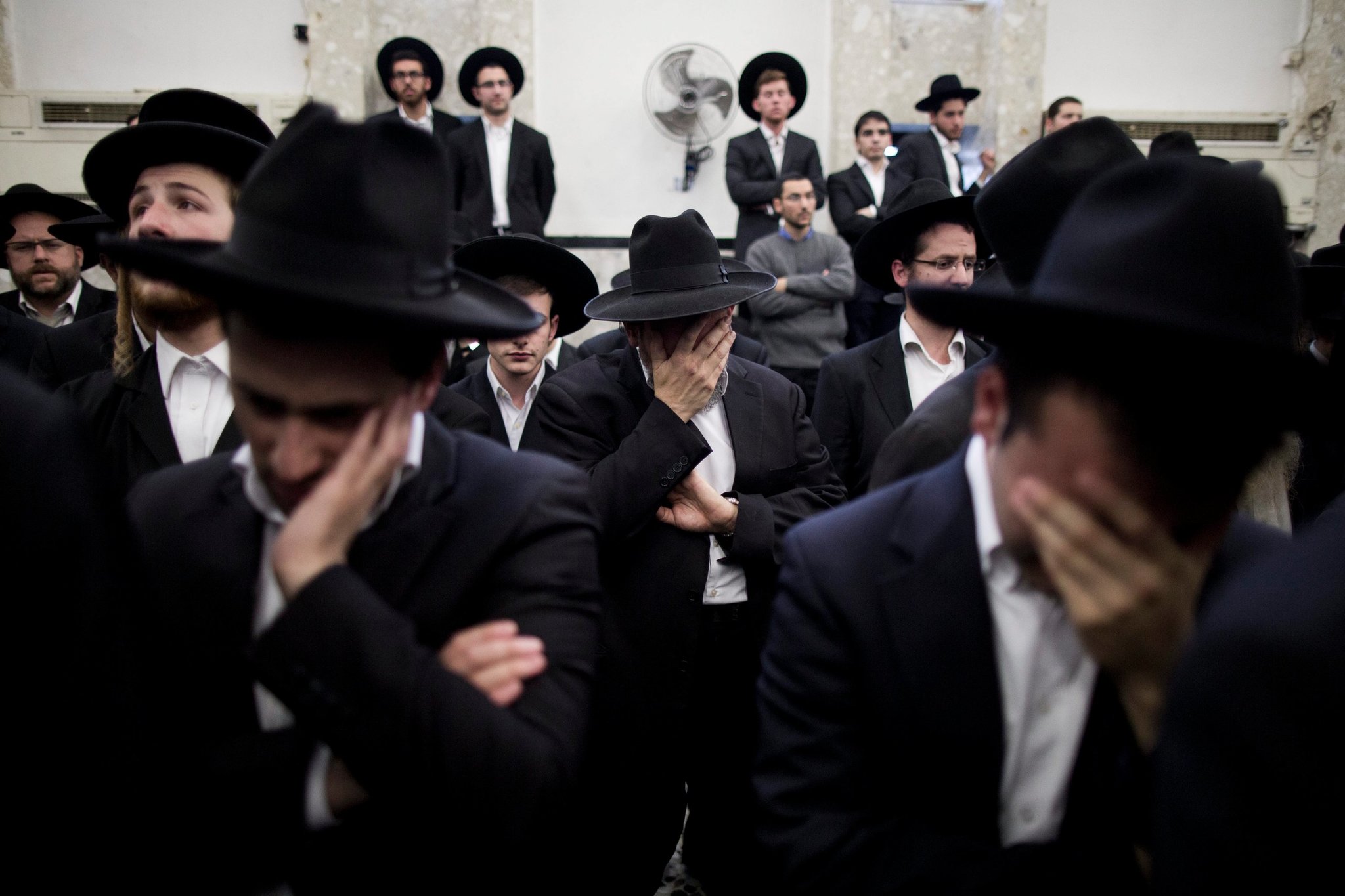 Orthodox Jews mourned during a eulogy ceremony before the funeral of the rabbi Moshe Twersky on Tuesday in Jerusalem. Abir Sultan/European Pressphoto Agency (click)
–
Comment: nikobakos@gmail.com
–
Dateline Jerusalem: And all sides acting in as asinine and inane a way as possible…
18 NovFour Killed in Jerusalem Synagogue Attack (NEW YORK TIMES)
Prime Minister Benjamin Netanyahu of Israel has repeatedly said he will not alter the status quo at the site, [“a holy site in the Old City known to Muslims as the Noble Sanctuary and to Jews as the Temple Mount.”] where non-Muslims are allowed to visit but not openly pray. Even so, President Mahmoud Abbas of the Palestinian Authority has called on Palestinians to protect the area and has warned of a “holy war” if it is “contaminated” by Jews.
“They carried out this operation because of the fire in their hearts — they were under pressures, pressures, pressures, and in one ripe moment, the explosion took place,” said a relative of the attackers who gave his name as Abu Salah, holding photographs of the men. “I say in full mouth, it is a religious war which Netanyahu has started,” he added. “It will end the way we like.”
Mr. Netanyahu called Tuesday’s attack “the direct result of the incitement” led by Mr. Abbas and Hamas, the militant Palestinian faction, and vowed to “respond with a heavy hand to the brutal murder of Jews who came to pray, and were eliminated by despicable murderers.”
The prime minister ordered the demolition of the homes of the perpetrators of the recent assaults. According to a statement from his office, he also “directed that enforcement against those who incite toward terrorist attacks be significantly increased.” The statement referred to “the series of additional decisions that have been made to strengthen security throughout the country,” but it offered no specifics. [my emphases]
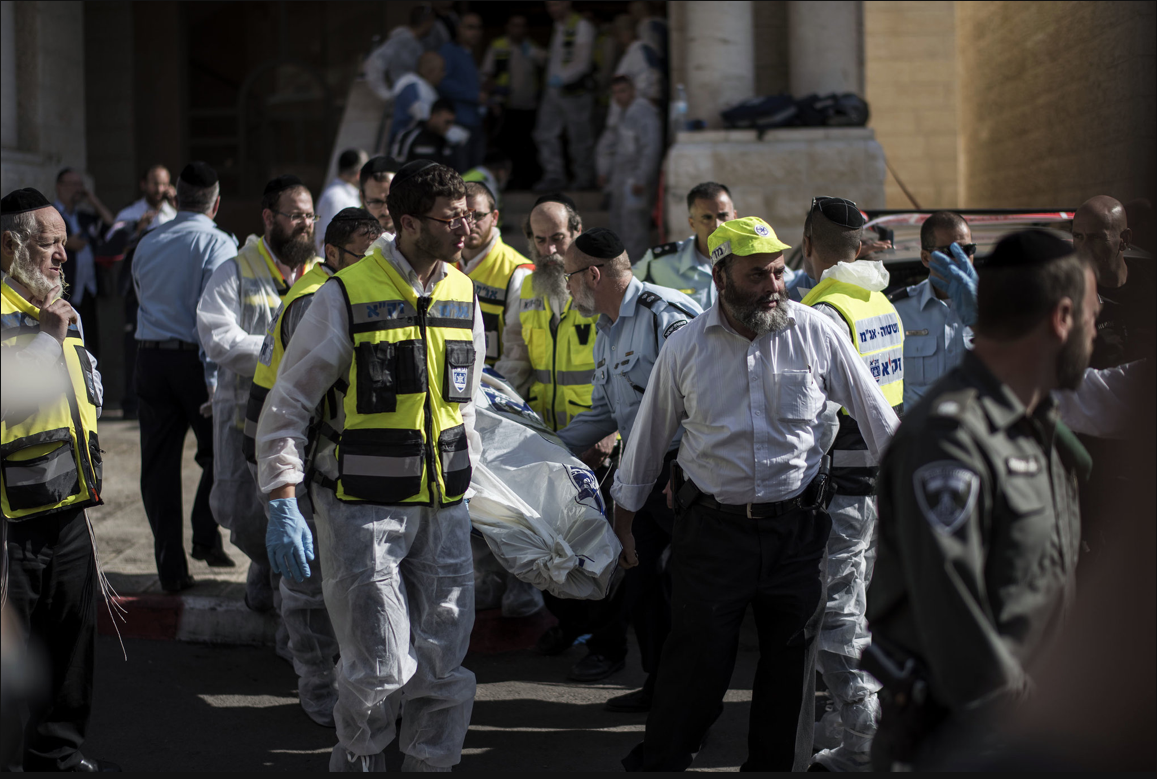 Israeli emergency personnel carry the body of an Israeli man from the synagogue, a complex that houses several prayer groups and a large community hall on a quiet street in Har Nof. The four victims were all rabbis, one born in England and three in the United States. Ilia Yefimovich/Getty Images (click)
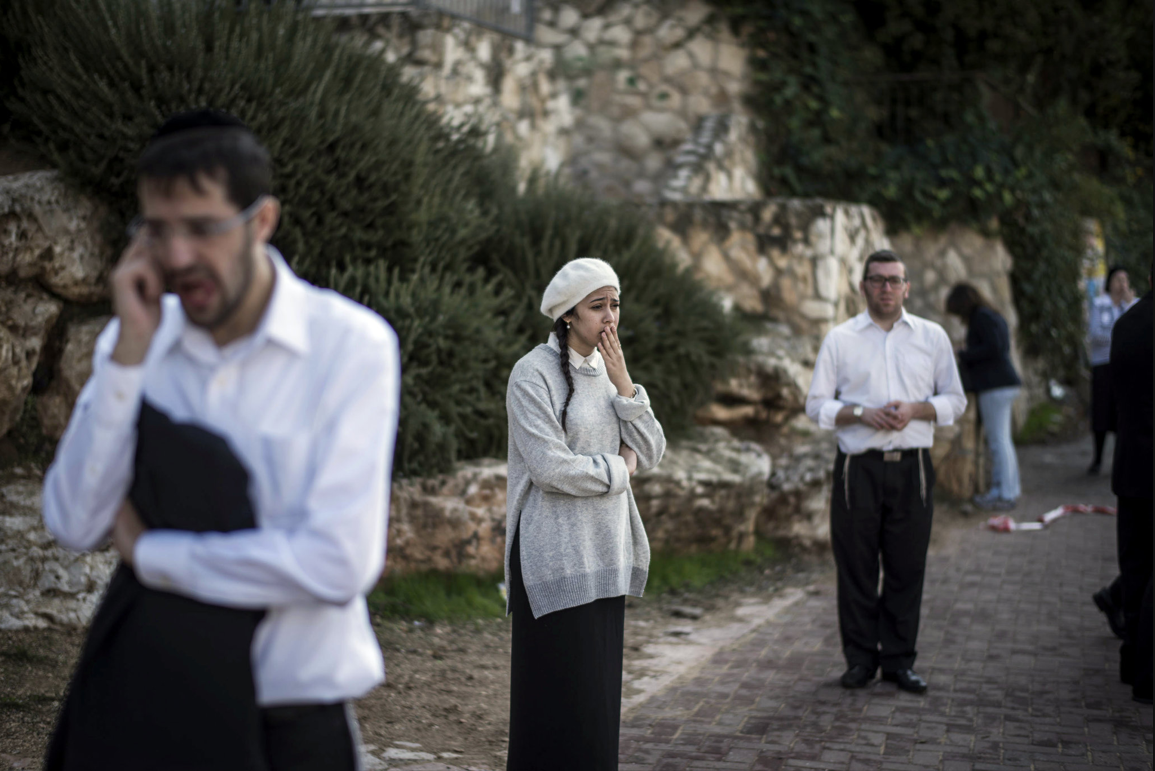 People react after the killings in an ultra-Orthodox Jewish neighborhood of West Jerusalem. Ilia Yefimovich/Getty Images (click)
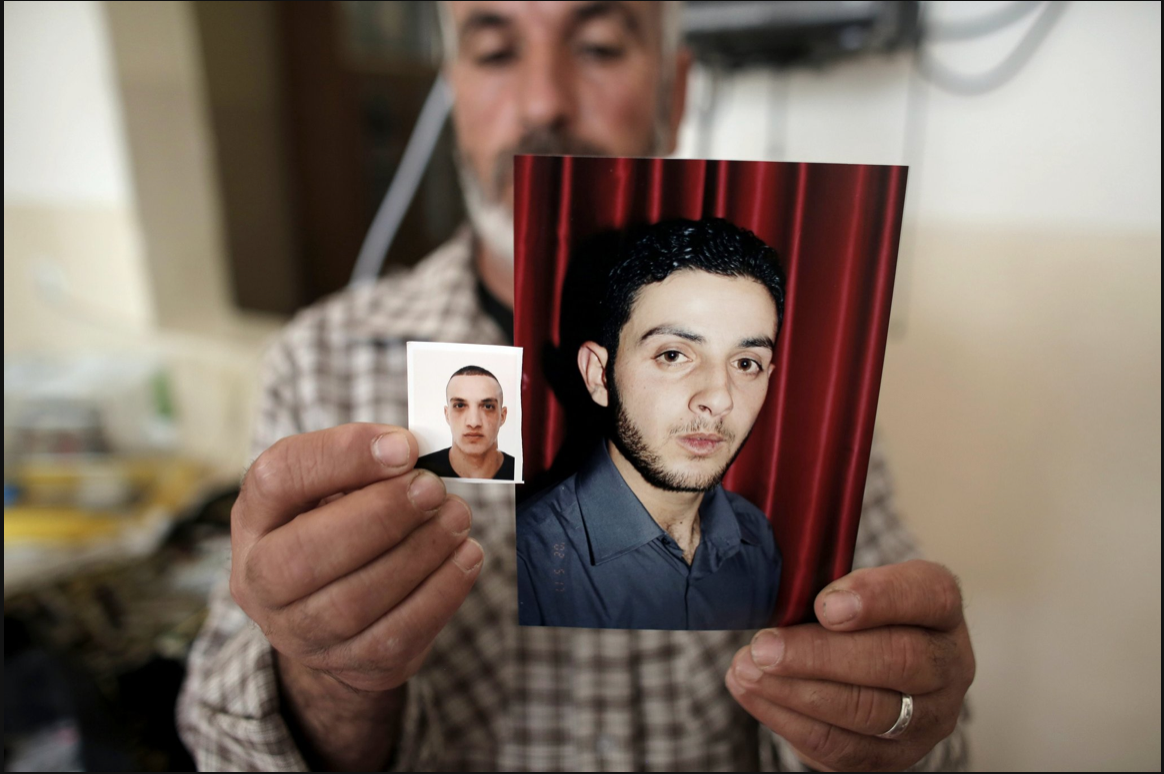 The two Palestinians were identified by relatives as cousins Odai Abed Abu Jamal, left, and Ghassan Muhammad Abu Jamal. Ahmad Gharabli/Agence France-Presse — Getty Images (click)
–
Comment: nikobakos@gmail.com
–
“Greece, though, has gotten nothing but fiscal and monetary tightening.”
17 Nov
Greece’s crisis-stricken economy has returned to growth following six years of recession, official data showed Friday, marking an end to one of the steepest and longest economic contractions in postwar European history.
But Matt O’Brien warns that “Greece’s comeback, like its collapse, will be nasty, brutish, and long”:
Greece’s depression … is still nowhere near done. You can see that easily enough in the chart above, which I’ve modified from The Economist. It compares Greece the past few years with what used to be the gold standard of economic catastrophe: the U.S. during the Great Depression. Now, Greece’s economy fell marginally less than America’s did back then — around 27 percent at its worst — but the biggest difference between the two is the slope of the recovery. The U.S., as you can see, rocketed back once FDR devalued the dollar and started spending more. Only the double whammy of premature fiscal and monetarytightening knocked it off track in 1937.
Greece, though, has gotten nothing but fiscal and monetary tightening.
Comment: nikobakos@gmail.com
–
“Soothed by sadness” — from Andrew Sullivan’s Daily Dish
10 Nov
Tom Jacobs flags a new study that explains why we take solace in sad songs:
The results reveal that sad music brings up “a wide range of complex and partially positive emotions, such as nostalgia, peacefulness, tenderness, transcendence, and wonder,” the researchers report. Nostalgia was the most frequently reported emotion evoked by sad music (although it came in number two among Asians, behind peacefulness).
“The average number of emotions that participants reported to have experienced in response to sad music was above three,” they write. “This suggests that a multifaceted emotional experience elicited by sad music enhances its aesthetic appeal.”
In terms of timing, “our data suggest that people choose to listen to sad music especially when experiencing emotional distress or when feeling lonely,” the researchers report. “For most of the people, the engagement with sad music in everyday life is correlated with its potential to regulate negative moods and emotions, as well as to provide consolation.” In other words, sad music is “a means for improving well-being,” they write.
Something Epirotes have known for centuries…
–
Comment: nikobakos@gmail.com
–
Cool story: the restoration of Adam statue at the Met
9 Nov
From Times: “Indian Muslims Lose Hope in National Secular Party”
9 Nov“Indian Muslims Lose Hope in National Secular Party“
 Many Muslim voters of Maharashtra State supported a new sectarian political force in October. Divyakant Solanki/European Pressphoto Agency (click)
Comment: nikobakos@gmail.com
–
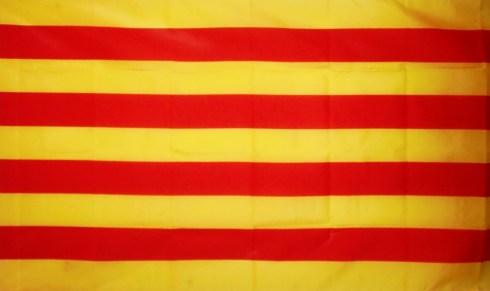
Catalonia: “Nationalism effaces the individual…”
7 Nov…fuels imaginary grievances and rejects solidarity. It divides and discriminates. And it defies the essence of democracy: respect for diversity. Complex identities are a key feature of modern society. [my emphasis] Spain is no exception.”
A brilliant op-ed piece from the Times today by Mario Vargas LLosa, among others, that exposes all the petty narcissism and destructiveness of the orgy of separatist movements that Europe has seen come to the fore in the past few decades: “A Threat to Spanish Democracy .”
 Other money quotes:
“In their attempt to undermine the workings of the constitutional government, Catalan separatists have displayed a remarkable indifference to historical truth. Catalonia was never an independent state. It was never subjected to conquest. And it is not the victim of an authoritarian regime. As a part of the crown of Aragon and later in its own right, Catalonia contributed decisively to making Spain what it has been for over three centuries: an impressive attempt to reconcile unity and diversity — a pioneering effort to integrate different cultures, languages and traditions into a single viable political community.
“Compared with the crises occasioned by the collapse of dictatorships in many European states, Spain’s transition to democracy, following the 1975 death of Francisco Franco, was exemplary, resulting in a democratic constitution granting broad powers to Spain’s autonomous regions. Yet Catalan separatists have glossed over the positive aspects of the transition.”
and:
“But the advent of democracy brought official recognition to Spain’s distinctive cultures, and set the foundations for the autonomy the Catalans enjoy today. Catalonia has its own official language, its own government, its own police force. Catalans endorsed the Constitution overwhelmingly: 90 percent of them voted yes in the referendum of Dec. 6, 1978. The millions of tourists who flock to Barcelona every year, drawn by the beguiling blend of Gothic and Gaudí, attest to the vigor of Catalonia’s culture. The claim that Catalonia’s personality is being stifled and its freedoms oppressed is simply untrue.”
The piece pretty much says it all: the bogus democraticness of separatist rights and the supposed right to self-determination completely debunked as nothing more than “little” nationalisms, which as Vassily Grossman points out in this post “…the nationalism of little nations,” can be just as dangerous and certainly as small-minded as that of “bigger” nationalisms. Ditto this op-ed for Abkhazia, South Ossetia, Ukraine (both sides), for Belgium, Scotland and, of course, for the most nightmarish manifestation of these tendencies in our time, the tragic break-up of Yugoslavia. And that’s without even going as far back as the Partition of India, or the Greco-Turkish Population Exchange of the 1920s.
“Complex identities are a key feature of modern society.” No, no and no… Complex identities are not just a key feature of modern society, but humanity period, a feature of pre-modern society since the beginning of time. The roughly two centuries of modernity or “the modern,” which we can probably date from the French Revolution on, is the only period in history when the ethnicity-based nation-state and its brutal, levelling, anti-humanist attempt to “de-complicate” human identity held sway as the predominant form of sociopolitical organization. It’s just a blip on the screen of history and will soon come to be seen as such. Multiple cultural identities and stable state political organization can co-exist easily. Thinking otherwise is an idea whose burial is long overdue.
So, what irritates me most about separatist movements like that of the Catalans is that they’re really retrograde ideologies disguised as liberation movements. Since the Barcelona Olympics of 1992, when the autonomous Catalan government had the impudence, I remember, to plaster New York City subway cars with ads that read “Catalonia is a country in Spain,” (???) Catalans have been engaged in a massive public relations campaign to project an image of sophistication, liberalism, bogus hipness, and artistic innovation (including culinary — if you can actually call the molecular nonsense Ferran Adrià put out food…) all meant to be juxtaposed against a clichéd, “Black Legend” stereotype of Spain — under whose repression Catalonia suffers — that’s just plain racist. Catalan nationalism rests mostly on the laurels of its Republican-ness and struggle against the forces of Spanish reaction in the 1930s — Hemmingway and Orwell’s “Homage.” But the attitude of today’s average Catalan nationalist more resembles that of the average member of Italy’s Northern League, a far-right if not quite fascist but certainly racist bunch of jerks: the same smug sense of superiority towards their co-citizens and the same petit bourgeois self-righteousness about how their wealth and resources get sucked up by the parasitic rest of the country.
There is no convincing evidence that Catalan society is any more liberal or open or sophisticated than the rest of Spain. See González Iñárritu‘s film “Biutiful” (if you can bear to watch it; I couldn’t make it though a second viewing…but it’s the perfect antidote to Woody Allen’s nauseating “Vicky, Cristina, Barcelona”), for how much better Catalonia treats its immigrants, for example, including those from poorer parts of Spain, than any other part of Europe, or do some reading up on the discrimination Castillian-speakers in Catalonia suffer. Catalan independence is not a liberal or liberatory idea; it’s exclusionary and elitist to the core. The problem is that most of the world falls for the discourses of these movements –the way the West did with Croatia in the 90s — because they’re so good at playing victim.
The finger-flipping at the impressive democratic achievements of Spanish society since 1975 is particularly galling.
See also my “Leader of Catalonia Calls for Independence Vote“ (September 27th). And “More on Alevis and Alawites…or Alevis and Kurds…or Iraqi Kurds…or…Christian Kurds…or Assyrians…or… “ (September 27th)
 –
–
Comment: nikobakos@gmail.com
–
 Jadde: from Bosnia to Bengal