After the conflict in Kosovo ended, in June, 1999, a tribunal in The Hague set out to punish the perpetrators of atrocities. Louise Arbour, the lead prosecutor, described Kosovo—a former province of the Federal Republic of Yugoslavia—as “one vast crime scene.” Her investigators’ primary target was Slobodan Milosevic, the Serb who led Yugoslavia. Milosevic had claimed that Kosovo’s majority group, ethnic Albanians, treated ethnic Serbs like slaves, and armed forces under his control had waged a campaign of mass murder there, slaughtering more than ten thousand Kosovars. NATO, relying heavily on American forces, launched air strikes to stop Milosevic, and received crucial assistance from the Kosovo Liberation Army, the main rebel force in the region. K.L.A. scouts relayed Serbian tank coördinates to Green Berets, who passed on the information to American fighter jets. Three months after the air strikes began, Serbia surrendered. Milosevic was eventually arrested and sent to The Hague, where he died in prison, of a heart attack.
In Kosovo, meanwhile, the K.L.A. officially disbanded, but many of its members joined political parties. A party led by Hashim Thaci, the K.L.A.’s political chief, rose to power. In 2008, Thaci became the first Prime Minister of an independent Kosovo. Two years later, Vice-President Joe Biden hailed him as “the George Washington of Kosovo.”
Today, nearly two thousand people remain missing in Kosovo, a country that José Pablo Baraybar, a Peruvian who headed the U.N.’s Office on Missing Persons and Forensics, described to me as “one of the most exhumed places on earth.” DNA technology has helped investigators identify hundreds of bodies, many of them buried in mass graves. But, even in an era of sophisticated forensic science, definitive evidence can be elusive: in one case, the Serbs burned hundreds of corpses in a lead smelter.
Dozens of Serbs have been convicted of war crimes since the fighting stopped, but they were not the only ones responsible for violence. In Pristina, the capital of Kosovo, rumors circulated that, in the summer of 1999, K.L.A. paramilitaries had trucked prisoners across the border to secret detention camps in Albania, where they were tortured and, sometimes, killed. But, in public, Kosovars embraced a “silence taboo,” in the words of Vehbi Kajtazi, a journalist in Pristina. The men who led the K.L.A. remained a fearsome presence in the country, posing a threat to anyone who spoke out, and ethnic Serbs were a powerless bloc, falling to less than two per cent of the population. Unlike Argentina, South Africa, and Sierra Leone, Kosovo failed to establish its own truth-and-reconciliation commission.
The task of accounting for the missing was left largely to outsiders. One of them was Michael Montgomery, an American radio journalist who had helped expose the massacre of forty-one Kosovar Albanians by Serbian forces in the village of Qyshk, on May 14, 1999. He began amassing troubling stories involving the K.L.A. Multiple sources told him that, in the days after Milosevic’s defeat, the K.L.A. had shipped accused traitors to camps in Albania. A former K.L.A. member recalled guarding seven prisoners in the back of a van, their mouths taped and their hands cuffed, as they crossed the border. A K.L.A. driver said that he had been given orders not to hurt anyone; once his captives were in Albania, they were taken to a house where doctors were present. The driver heard that the doctors sampled the prisoners’ blood and assessed their health. Several sources implied that this caretaking had a sinister purpose: the K.L.A. was harvesting the prisoners’ organs and selling them on the black market.
Montgomery was concerned that these stories might be propaganda planted by the Serbian government, so he tracked down additional sources. Three people recalled taking prisoners to a yellow house outside the Albanian town of Burrel. Another K.L.A. driver told Montgomery that there were only two places where he “brought people but never picked anyone up”: the yellow house and a cream-colored farmhouse near the airport in Tirana, Albania’s capital. The farmhouse, he noted, had a “very strong smell of medicine.” The driver added that he sometimes heard other drivers talking about “organs, kidneys, and trips from the house to the airport.” Since the late nineteen-nineties, Istanbul—a short flight from Tirana—has been a destination for transplant tourism.
In late 2002, a K.L.A. member told Montgomery that the group had made “a fortune” by trafficking body parts, primarily kidneys. C., as Montgomery called the source, claimed that the K.L.A. received about forty-five thousand dollars per body. Most shipments involved body parts from “two or three Serbs,” though C. knew of an instance when the K.L.A. “did five Serbs together.”
In late 2002 and early 2003, Montgomery travelled with a colleague to Albania, carrying a map drawn by his informants. It directed them to the yellow house and to the farmhouse near the airport. But they didn’t knock on the doors. Montgomery thought that they needed stronger evidence before confronting the occupants. “The only way we felt we could report this was if bodies were recovered and matched with missing people,” he told me.
Montgomery decided to put his investigations aside, but he didn’t let the matter go entirely. He sent a memo to the U.N.’s missing-persons office in Kosovo, asserting that, in 1999 and 2000, between one hundred and three hundred prisoners were taken to Albania, where some were dispatched to a “makeshift clinic” that extracted “body organs from the captives.” The U.N. forwarded the memo to the International Criminal Tribunal for the former Yugoslavia, or I.C.T.Y. The tribunal, established in The Hague in 1993, was designed to bring a measure of justice to those who had suffered horrors in the Balkans. The Serbs did not see the tribunal as impartial, and they have remained hostile to it. Tomislav Nikolic, Serbia’s current President, said recently that the tribunal “was founded to try the Serbian people.” In fact, most of the convictions in I.C.T.Y. courtrooms have been of ethnic Serbs, in part because the Milosevic regime made little effort to conceal its crimes. In Qyshk, Serbian militia members responsible for the massacre left behind photographs of themselves posing with machine guns; the images were later used to identify some of the culprits.
The lead prosecutor at the I.C.T.Y. was Carla Del Ponte, an indefatigable fifty-six-year-old lawyer from the Italian-speaking region of Switzerland. She had joined the tribunal in September, 1999, and she had tried dozens of Serbs for crimes against humanity. The K.L.A., she suspected, had committed significantly fewer war crimes, but scale is not exculpatory.
Del Ponte received Montgomery’s memo as she was preparing to indict Ramush Haradinaj, a former bouncer who joined the K.L.A., rose to commander, and then went on to become the Prime Minister of U.N.-administered Kosovo. She intended to charge Haradinaj with “planning, instigating, ordering, committing, or otherwise aiding and abetting” the abuse of dozens of prisoners. The indictment also accused him of participating in “the abduction of persons who were later found murdered.” In documents sent to Del Ponte, Montgomery quoted his source C. saying that Haradinaj “must have known” about organ trafficking, in part because his brother Daut was close to someone “heavily involved” in the trade. (In 2002, a U.N. court convicted Daut, a former K.L.A. member, of involvement in the murder of four political rivals.)
Del Ponte was not alone in her dim view of the K.L.A. President Bill Clinton’s Balkan envoy, Robert Gelbard, had called the K.L.A. a “terrorist group,” and the organization had regularly been accused of gangsterism. In the late nineties, Italian police had arrested an Albanian for trafficking women and marijuana across the Adriatic Sea by speedboat; the suspect confessed to brokering drugs-for-guns deals between the K.L.A. and the Mafia. An Interpol representative, appearing before Congress in 2000, testified that the K.L.A. had “helped transport two billion dollars’ worth of drugs annually into Western Europe.” After the war, critics have alleged, many former K.L.A. members continued to nurture strong ties with the underworld.
Del Ponte knew that securing a war-crimes conviction against Haradinaj would not be easy. Insurgencies tend to be improvised affairs, without battle orders or formal communiqués. The K.L.A. prized secrecy and stealth. Looking to buttress the case, Del Ponte authorized Michael Montgomery to escort a U.N. team to the mysterious yellow house. One morning in 2004, under a low, granite sky, Montgomery, Baraybar—the Peruvian U.N. official—and half a dozen U.N. and I.C.T.Y. personnel travelled, in a convoy of S.U.V.s, down a dirt road outside Burrel. Following protocol, they brought along Arben Dyla, an Albanian prosecutor, who mocked their “silly” expedition. “There are no Serbs here,” he told the group. “But, if anyone did bring Serbs here and killed them, that would have been a good thing.” (Dyla denies making this remark.)
They arrived at the yellow house that Montgomery had seen a year earlier—only now it was white. Baraybar got close enough to determine that, beneath a thin coat of fresh paint, “the thing was yellow.”
The owner reluctantly let them inside. Baraybar, who was trained in forensic science, pulled on a white Tyvek suit and walked around the place. It smelled stale and sour. He sprayed Luminol—a chemical that causes traces of blood to glow—and identified a stain on the living-room floor. The owner explained to a translator who was part of the U.N. contingent that his wife had given birth at home; later, he said that the blood had come from a slaughtered animal. “Do you slaughter chickens in your living room?” Baraybar asked me. “It was quite bizarre.” Moreover, the stain had a square edge, as if blood had dripped off the corner of a table. “Is that proof of anything?” Baraybar said. “No, it isn’t. But it’s a clue.”
At one point, Baraybar went into the back yard, and noticed a pile of trash inside a thicket of brush. He dug past food scraps and plastic and retrieved gauze, syringes, drip bags, vials, an empty bottle of Tranxene, and an empty foil packet of Buscopan. He called a doctor at the U.N., who told him that Tranxene was an anti-anxiety drug and Buscopan a muscle relaxer and anti-spasmodic; both could be used to sedate patients. Baraybar asked the owner about the pharmaceuticals. He said that a nurse visited the house “on occasion” and doled out pills and medical supplies. Baraybar found the explanation “incoherent.” He placed the items in Ziploc bags, along with a fragment of cloth that he deemed “consistent with surgical overalls.”
There was a cemetery near the property, and when Baraybar walked over to it locals confronted him and told him to leave. The U.N. investigators decided to return to Pristina. Baraybar shipped the Ziploc bags to The Hague, and Del Ponte’s team inspected the material. Though suspicious, it wasn’t strong enough to anchor a case, and it couldn’t be connected to Haradinaj. Archivists at the I.C.T.Y. filed the objects away. Eventually, someone threw them out.
Del Ponte pressed ahead with prosecutions, but she discovered that it was extremely difficult to secure witnesses. A Kosovar who had testified in the murder trial of Haradinaj’s brother Daut was gunned down; an internal U.N. document noted that the Kosovar had been expected to deliver “vital” testimony in “other war-crimes cases.” Another witness told the court that “there were persons . . . whose names don’t even appear on witness lists, because they have been killed.” The I.C.T.Y. had a witness-protection program, but it was largely ineffective. Although public transcripts protected witnesses by using pseudonyms, defendants learned their identities before trials, and, during proceedings, sat only a few feet away from them. “Who were we protected from?” one witness told me. “Everyone in the court knew me.” In April, 2008, judges in The Hague acquitted Haradinaj, but they noted their “strong impression that the trial was being held in an atmosphere where witnesses felt unsafe.” (No evidence has come to light connecting Haradinaj to organ trafficking. His lawyer denied that his client had committed or sanctioned any crimes, and said that it was “false and defamatory” to suggest that Haradinaj’s acquittal was “tainted by intimidation.”)
The prosecution of Fatmir Limaj—a former K.L.A. leader and a close confidant of Prime Minister Thaci—had unravelled in similar fashion. In February, 2003, Limaj surrendered at a ski resort in Slovenia, where he was vacationing with Thaci. Limaj was accused of overseeing a detention camp, in Llapushnik, Kosovo, where prisoners were subjected to beatings, starvation, and torture. Two of his deputies were also indicted.
Del Ponte wouldn’t need to prove that Limaj wielded an axe or fired a pistol—only that he knew about atrocities and did not stop them. Her prosecution was guided by the legal theory of “command responsibility,” which dates to the fifteenth century, when Peter von Hagenbach, a governor under the Duke of Burgundy, was tried, convicted, and beheaded for presiding over the brutal occupation of a town in the Upper Rhine. “Not only was this the first recorded international war-crimes trial; it was the first recorded trial in which a commander was held responsible for crimes by his subordinates,” David Luban, an expert on war crimes at Georgetown University, told me. After the Second World War, tribunals vigorously applied the doctrine of command responsibility to Japanese and Nazi officers.
According to an internal I.C.T.Y. document from 2004, Limaj’s relatives and associates launched a campaign of “serious intimidation of and interference with potential witnesses.” Two men showed up at the house of one witness and warned him not to testify, adding, “If you make the mistake of going there, you will be dead.” Someone called the wife of a second witness and threatened, “You will be liquidated.” A third witness withdrew after a relative overheard a group of men, at a café in Pristina, saying of any people who testified against Limaj, “We will burn them, their families, and their houses.” A fourth witness refused to meet an I.C.T.Y. investigator, explaining that he “did not want to die.” Nazim Bllaca, a former K.L.A. member, told me, “This is how the Limaj case ended.” On November 30, 2005, the tribunal acquitted Limaj, though the judges observed that a “context of fear, in particular with respect to witnesses living in Kosovo, was very perceptible throughout the trial.” (A relative of one of Limaj’s indicted deputies was convicted of contempt, because he “knowingly interfered with” a witness.)
Bllaca says that he participated in more than a dozen violent acts on behalf of former K.L.A. members, including murder, kidnapping, and witness intimidation. Now under witness protection, he has testified in two cases, both of which have led to convictions. “It was very simple,” he told me. “We worked in three lanes. Kill collaborators, kill Hague witnesses, and kill L.D.K. people”—members of the Democratic League of Kosovo, the chief rival of the party led by Thaci and Limaj. In the months after the war, many L.D.K. members were murdered; one was killed at home on his couch, and another was assassinated on a street in Pristina, in the middle of the day.
In a leaked 2005 memo, Germany’s foreign spy service asserted that Haradinaj and other Kosovar leaders had inoculated themselves against criminal investigations by leveraging their connections in Kosovo’s military and intelligence agencies, and throughout the Balkan underworld. Kosovar leaders had avoided “getting their hands dirty” even as their henchmen engaged in tactics such as contract killings and bribing officials.
Last year, I met with Limaj in Pristina. He denied any responsibility for prisoner abuse. When I asked him whether he had directed his subordinates to frighten witnesses into recanting testimony, he said, with a pinched smile, “I was in The Hague. If someone here did something which was wrong, this person has to respond.” After Limaj was released from detention, Kosovars celebrated in the streets of Pristina.
In December, 2007, Del Ponte stepped down as the lead prosecutor, saying that it was “time to return to normal life.” She soon published a memoir, “Madame Prosecutor,” in which she recounted her successes in chasing Italian mobsters, Rwandan genocidaires, and Serbian generals. But she fumed about her inability to make charges stick against the K.L.A. The Limaj and Haradinaj investigations were “the most frustrating” part of her time in The Hague—and proof that “impunity shrouds powerful political and military figures” in Kosovo. She voiced her suspicion that the K.L.A. had trafficked the organs of prisoners, and offered an account of her team’s visit to the yellow house.
Del Ponte told me that “the international community” had shown a “fear-driven reluctance to apply the law” in Kosovo, adding that the United States had displayed “no political will to find out the real truths.” The K.L.A. had been a reliable ally of the Americans during the war, but it struck Del Ponte as hypocritical for the U.S. to ignore possible crimes by the group’s leaders, given the U.S. condemnation of Serbian misconduct. She also felt that allowing alleged perpetrators of war crimes to achieve leadership positions in Kosovo undermined the country’s prospects for stability.
After the publication of Del Ponte’s book, the Council of Europe decided to look deeper into the matter of organ trafficking. It assigned the task to Dick Marty, a senator from Switzerland who represented his country at the council, and who had looked into alleged human-rights abuses across the continent. His team had located C.I.A. “black sites” in Poland and Romania, and had exposed the murder of political opponents in Chechnya. Marty sent several investigators into the field. Experts in the region told him to expect a challenge, noting that the criminal networks in Albania and Kosovo were “probably more difficult to penetrate than the Cosa Nostra.”
Just as Marty’s team was getting to work, Hashim Thaci became the Prime Minister of Kosovo. In February, 2008, a month after taking office, he declared Kosovo’s independence. Joyous crowds in Pristina launched fireworks, and a giant yellow sculpture, forming the word “newborn,” in English, was installed in a plaza. Thaci stood before Kosovo’s parliament and declared, “From this day onward, Kosovo is proud, independent, and free.”
Not everyone saw Thaci in heroic terms. The 2005 German intelligence document claimed that, after the war, Thaci presided over an organized-crime empire whose leaders came from the Drenica Valley, in central Kosovo. The Drenica group allegedly coördinated its activities with Albanian gangsters throughout Europe, engaging in money laundering and maintaining links to arms and drug smugglers. According to the German report, the group kept a “professional killer” in its employ.
Not long after Thaci became Prime Minister, Lutfi Dervishi, a urologist in Pristina, began pushing to open a transplant clinic. In Kosovo, doctors need official approval to perform such operations, so Dervishi turned to a former associate, Shaip Muja, a surgeon who was working as Thaci’s health adviser. Muja made several inquiries, and in March, 2008, Dervishi opened a clinic. During the next eight months, two dozen organ transplants took place there.
That October, a young Turkish man, who had agreed to accept twenty thousand dollars for one of his kidneys, arrived at the clinic in Pristina. The kidney was removed and placed inside a seventy-four-year-old Israeli man, who had paid ninety thousand euros for it. The operations were performed by Dervishi and by a Turkish surgeon, Yusuf Sonmez, who is known in the Turkish press as Dr. Frankenstein, for his prominent role in the black-market organ trade. (Buying organs from volunteers is outlawed everywhere in the world except Iran; Luc Noël, a doctor at the World Health Organization, told me, “Human bodies should not be the source of financial gain.”)
The Turkish donor was released from the hospital while he was still woozy, and, when he got to the airport, police officers began questioning him. He said that he had donated a kidney, but the officers were suspicious and raced to the clinic, where they arrested Dervishi and his son. (Sonmez had fled.) The clinic was shut down, and Dervishi, his son, and three others (including Sonmez, who remains a fugitive) were charged with human trafficking and organized crime by the European Union Rule of Law Mission in Kosovo. The trial is currently under way, and a verdict is expected soon. According to the indictment, high-ranking Kosovars were complicit in the clinic’s activities and encouraged health officials to grant a bogus license.
Two days after prosecutors released the indictment, Dick Marty, the Swiss senator, published the results of his investigation. Marty claimed that Thaci and the Drenica group, which included Fatmir Limaj, had built a “formidable power base in the organized criminal enterprises” in the late nineties, and had exerted “violent control” over the heroin trade in the region. During and after the war, Marty wrote, Thaci was the “boss” of a “network of unlawful activity”—one that included a constellation of detention camps in Albania, where some prisoners were subjected to abuse, including torture, murder, and organ harvesting. One of the “leading co-conspirators,” Marty suggested, was Shaip Muja, the surgeon who became Thaci’s health adviser. Marty identified four sites, among them the yellow house outside Burrel, that had served as “way stations” in an organ-trafficking trade. At the farmhouse near the Tirana airport, prisoners were killed, “usually by a gunshot to the head,” before “being operated on.”
The sale of organs at Dervishi’s clinic, Marty wrote, indicated that Kosovars had continued organ trafficking after the war, “albeit in other forms.” He concluded, “Signs of collusion between the criminal class and high political and institutional office bearers are too numerous and too serious to be ignored.” He acknowledged that Serbia’s campaign of ethnic cleansing in Kosovo had been “appalling,” but insisted that the dynamic of violence was “more complex” than many had assumed: “There cannot and must not be one justice for the winners and another for the losers.”
His accusations had an explosive effect in Kosovo. Thaci called Marty’s report “an attack” on “Kosovo, the Albanian people, and me, but also against the U.S., the U.N., and NATO.” Thaci appeared on an Albanian television program and threatened to expose every Kosovar and Albanian who had assisted Marty, saying, “These individuals will be disgraced.”
In private, Thaci spoke with less bravado. He fretted to friends about whether he could still look his eleven-year-old son in the face. He summoned the American, French, German, Italian, and British envoys. “He was rocked,” Jean-François Fitou, the French Ambassador to Kosovo at the time, recalled. Thaci offered to resign if they considered him a diplomatic liability. They discussed Marty’s report. Although it was based on a sustained investigation, it did not provide conclusive details of any single crime, nor did it name sources, other than identifying them as “distinct and independent” K.L.A. insiders. Moreover, Marty’s findings carried no judicial weight. The ambassadors told Thaci that, unless hard evidence emerged, he could count on their support.
Last spring, I flew to the Balkans and visited Serbia’s Office of the War Crimes Prosecutor, in Belgrade. I traded my passport for a security badge, and was escorted upstairs to see Bruno Vekaric, a deputy prosecutor. Vekaric, a Serb who started his job in 2003, has helped secure the convictions of dozens of people for war crimes—nearly all of them Serbs. He has pursued the organ-trafficking allegations as intensely as anyone. His goal, he has said, is to find out “who committed those monstrous crimes, who was capturing and killing people for trafficking in their organs.” He is not the only Serbian government official who speaks as if it were an established fact that the K.L.A. trafficked organs. Such officials contend that the problems with securing witnesses at the Limaj and the Haradinaj trials, coupled with the discarded evidence from the yellow house, strongly suggest a coverup. Recently, Serbia’s minister of justice said that the I.C.T.Y. had “spat in the face of Serbian victims.”
Vekaric, who had invited me to visit, excitedly led me into a boardroom, its windows obscured by venetian blinds. At the end of a table sat a man wearing a black baseball cap that shaded his eyes. Vekaric introduced him and offered to let me conduct an interview, provided that I used a pseudonym for the man, who was in Serbia’s witness-protection program.
He was thirty-nine years old, with a mustache and a broken nose, and asked that I call him Adrian. Half Albanian, he grew up in Switzerland, where he became part of a community of Albanian expatriates. In 1997, he joined the K.L.A. Upon enlistment, he said, he went off to train with the French Foreign Legion. Then he travelled to Albania. Once there, he said, he headed toward the border with Kosovo, stopping at a camp near Kukes. Michael Montgomery and Dick Marty have both identified Kukes as the site of an abandoned factory that the K.L.A. transformed into a weapons depot, a barracks, and a jail.
“I met some doctors and started training with them,” Adrian said. “They told me how to take organs out, how to put them aside, and how to transport them.” One of the doctors, he noted, was Lutfi Dervishi—the urologist from the transplant clinic in Pristina.
One day in the spring of 1998, Adrian’s commander stepped on a land mine while on patrol in Kosovo, suffering grave injuries. Adrian and five others carried him, on a stretcher, to the Albanian border, but he died along the way. A van arrived at the border to pick up the commander’s body. Adrian accepted a ride, and was dropped off near the village of Helshan, where another K.L.A. camp had been established—a few tents and a converted schoolhouse. Adrian noticed that two senior K.L.A. leaders were present: Jakup Krasniqi and Sabit Geci. Krasniqi was then the spokesman for the K.L.A., and is now the president of Kosovo’s parliament. Geci headed the K.L.A.’s military police.
This was a crucial turn in Adrian’s story. In July, 2011, a European Union court found Geci guilty of war crimes, based on evidence of prisoner abuse at Kukes and another camp, Cahan. Former K.L.A. officials had long denied the existence of detention camps in Albania, but the Geci trial proved otherwise, and marked one of the most prominent convictions to date of a K.L.A. leader. The judges rendered their verdict after sixteen witnesses, most of them former captives, testified to scenes of depravity.
A Kosovar Albanian I’ll call Enver testified about being detained in Kukes, along with his brother. They had been accused of being spies—charges that they denied. One night, the guards took Enver and his brother into an interrogation room. Enver said that Geci watched as guards beat another prisoner, clubbed him with a rubber-wrapped baseball bat, and rubbed salt into his wounds. Geci himself beat the prisoner with a crutch. He pistol-whipped Enver, and told his men to beat him with metal bars; Enver repeatedly lost consciousness, and they tortured him further by dunking his head in water. On another occasion, the guards at Kukes fitted him and his brother into bulletproof jackets and fired Kalashnikovs at their stomachs until they collapsed. Later, a guard shot Enver’s brother in the knee. Enver begged for help, but his brother bled all night and died the next day.
After saluting Geci and Krasniqi at the camp in Helshan, Adrian told me, he was summoned to the converted schoolhouse. The K.L.A. officers there knew him, and were aware of his medical training. “There were school desks, three in a row, that formed a table,” he said. Three doctors, including Dervishi, stood around the table. K.L.A. guards dragged in a young man—“nineteen or twenty years old”—and lifted him onto the desks. “I didn’t know who he was or his nationality at the time,” Adrian said. The young man’s face was covered with fresh-looking bruises.
Someone tore off the young man’s shirt and splashed rubbing alcohol over his chest. Guards grabbed his wrists and ankles. Adrian suddenly realized what was happening: the prisoner’s organs were to be harvested. He gripped a scalpel and “started cutting” into the young man’s chest. Adrian recalled hearing him scream, in Serbian, “Bože pomozi mi! Nemojte to da mi radite!” (“God help me! Please don’t do this to me!”)
“That was when I figured out that he wasn’t an Albanian,” Adrian told me. Next, he sawed through the rib cage with a bayonet. While two doctors, standing across the table, lifted the prisoner’s ribs, he carved out the heart as it was still pulsing. The young Serb died.
Adrian said that he placed the heart in a box filled with preserving liquids. He put the box in a small cooler and carried it outside to an idling green Volvo 704 sedan. He fitted the cooler into the trunk’s spare-tire cavity. The entire procedure took about forty-five minutes, though to Adrian it “felt like an eternity.” Before he left the camp, Geci congratulated him and slapped him on the back.
Six months later, Adrian said, he received orders to collect a cooler from a house outside Burrel—the notorious yellow house. Adrian said that a doctor, in scrubs, met him at the door and handed him the cooler. Adrian drove to a military airport near Tirana, where a guard opened a gate to a runway. “Then we saw a private jet,” Adrian said. “It had a Turkish flag on the back of the plane.” I now grasped why Vekaric had been so eager for me to meet Adrian: his eyewitness account filled gaps that had stymied prosecutors and investigators for years.
When I asked Adrian if these episodes had darkened his view of the K.L.A., he said that he had “made a wall” in his mind and continued fighting for the group, and for another separatist movement. But in 2002, he said, “I had a problem with my conscience.” He renounced both groups but stayed in Kosovo. Not long afterward, he said, a former K.L.A. commander retaliated by kidnapping him, beating him, and administering electric shocks. He complained to a U.N. police officer; the assailant was eventually convicted of battery. Soon afterward, Adrian said, someone tossed a grenade at his home. He went into hiding, in various Balkan countries, before finally heading to Belgrade and seeking protection from the Serbian authorities.
I asked him if he felt like a traitor.
“I’m not speaking against the Albanian people,” Adrian said. “I’m speaking against people who committed crimes. I gave up everything I had in Switzerland to fight for the K.L.A., so I am not a traitor or a spy. I’m just trying to become a good person. It’s been enough for me to hide all these things in my life. I cannot do it anymore.”
He admitted, though, that he still had some secrets. “There are too many things, too many stories, too many murders that no one has ever heard about,” he said. “Many people saw things. If all of them speak as I speak, these cases would be resolved.”
Adrian’s testimony was striking, but it also seemed to connect one too many dots. By his account, he had participated in the barbaric murder of a Serb, received praise from a notorious war criminal, taken a suspicious package from a doctor at the yellow house, and delivered this parcel to a plane bound for Turkey. And his description of the surgery seemed bizarre: why, for example, had the Serb not been fully sedated?
I decided to see how much of Adrian’s story checked out. The K.L.A. had indeed encamped in Helshan, and in 2004 prosecutors presented in court the testimony of someone who claimed that a K.L.A. veteran had beaten him and administered electric shocks; the initials of the accuser matched those of Adrian’s real name. That same year, the BBC reported that a grenade had been lobbed at the house of someone sharing Adrian’s real name. But most of the story was difficult to authenticate. Dervishi, who was under indictment, and Geci, who was imprisoned, refused to talk. Krasniqi denied ever visiting Helshan in 1998 and told me that the episode Adrian described “could only be constructed in legends and films.”
Prem Shekar, a cardiac-transplant surgeon at Harvard Medical School, told me that Adrian’s tale was medically implausible, starting with the rubbing-alcohol detail. A heart transplant requires a truly sterile environment, he said: “If you take a heart that is harvested in a contaminated scenario, the recipient will get a terrible infection.” He disparaged the notion of removing a warm, pulsing heart. Typically, the heart is injected with a cardioplegia solution while it is still inside the donor, paralyzing the organ. “Only once the heart has cooled and stopped can you take it out,” he told me. Shekar also doubted Adrian’s claim that he had sawed through the Serb’s ribs. In hospitals, Shekar said, hearts are harvested through a “midline split”; a sternal saw is used to crack the breastplate in half. Moreover, a heart can last only four to six hours outside a body. There was simply no way you could transport a heart from a remote camp in Albania to a hospital in Turkey, and then complete a lengthy operation, without the heart failing first. The surgery that Adrian described, Shekar said, would suffice only as “an extremely primitive form of torture.”
I did find Adrian’s supposed commander—the one who had allegedly stepped on a land mine—on a list of K.L.A. martyrs. But the official date of death was May, 1999, a year later than Adrian had indicated. Then I scanned the roster of K.L.A. veterans, but Adrian’s name was not on it. He told me that authorities in Kosovo were “doing their best” to erase his memory from the archives.
I interviewed Adrian four times—twice in person and twice over Skype—and the disparities piled up. Even after I notified him that the commander’s date of death was 1999, he insisted that the Helshan episode had taken place in 1998. “I saw a lot of dead people,” he replied, opening the possibility that he had mistaken the commander for someone else. Originally, he claimed that he hadn’t seen Lutfi Dervishi, the urologist, since that day in Helshan; a month afterward, he said that he had seen Dervishi “later on, way after the war,” at a reception in Kosovo.
He told me that he now lived with his wife in Belgrade; his ex-wife was in Kosovo, and was related to a “very high-level, V.I.P. person.” I tracked down one of Adrian’s relatives in Europe and called her to ask about these purported family connections. (Adrian refused to tell me his ex-wife’s name, or the names of any former K.L.A. fighters who could corroborate his story.) The woman laughed, dismissing Adrian as a pathological liar who had never belonged to the K.L.A. but had served time in Germany for dealing drugs. I discovered that Adrian also had a police record in Serbia, which included vehicle theft, threatening an official with an axe, and lying to police.
Meanwhile, Adrian, under the auspices of Serbia’s Office of the War Crimes Prosecutor, was sharing his tale with others. He got a very receptive hearing from Serbian state television, which, on September 10th last year, broadcast a ninety-minute documentary, “Anatomy of a Crime.” The opening twenty minutes featured Adrian—his face obscured and his voice distorted—describing how he cut out the heart of the young Serb. Vekaric, the deputy prosecutor, also appeared, telling the host, “We absolutely are convinced that he did what he says he did.”
The program’s message was clear: just as Serbian leaders had been held accountable for war crimes, Kosovar leaders needed to be held accountable for the kinds of acts described by Adrian. Within days, Adrian’s story was disseminated around the world, as the A.P., the Telegraph, and other media outlets published summaries of the program. An Agence France Presse report, which quoted Adrian describing how “the blood started pouring” as he made incisions in the rib cage, bore the headline “GRUESOME DETAILS ON WARTIME KOSOVO ORGAN HARVESTING.”
In July, 2010, an appeals court in The Hague granted prosecutors another opportunity to try Ramush Haradinaj, the former K.L.A. commander. (The tribunal does not prohibit double jeopardy.) Not long afterward, the Office of the War Crimes Prosecutor in Belgrade notified prosecutors in The Hague that it had found a witness—one of Haradinaj’s subordinates in the K.L.A.—who had firsthand knowledge of Haradinaj’s misdeeds. That November, a prosecutor from The Hague, Paul Rogers, flew to Belgrade to meet the prospective witness.
Rogers approached the meeting with caution: it seemed unusual for a crucial witness to emerge five years after the indictment. He was also concerned about the possible bias of the Serbian government. But he assigned the witness a number, Eighty-one, and heard him out. In the summer of 1998, Eighty-one said, three men—one Serb and two Roma—were arrested by the K.L.A., accused of collaborating with Serbia, and thrown into a basement near the village of Jabllanice, in southern Kosovo. Haradinaj came to check on the captives. For the inspection, the three prisoners were taken into a courtyard. A Haradinaj lieutenant, nicknamed Toger, sliced off one of the Serb’s ears, while another lieutenant, nicknamed Maxhup, beat the Roma men with a baseball bat. Later, Eighty-one said, Toger cut out one of the Serb’s eyeballs with a knife.
Rogers noticed some inconsistencies in Eighty-one’s narrative, but people often waver when relating disturbing memories. Certainly, the account conformed to suspicions that prosecutors in The Hague had long held about K.L.A. leaders. And so, in November, 2011, Eighty-one flew to The Hague to testify, and underwent ten hours of direct examination in the courtroom.
Haradinaj’s lawyer, an Englishman named Ben Emmerson, leafed through a stack of Eighty-one’s previous statements. “The first account you gave to the prosecution was that only one of the boys’ ears was cut off and that it was cut off by Maxhup and that it was the Roma’s ear,” Emmerson said. “The second account you gave was that only one of the boys’ ears was cut off, but that it was cut off by Toger and that it was the Serb boy’s ear. . . . Now you’re saying two ears were cut off—one of a Roma and one of the Serb.” Emmerson also said, “I appreciate that it’s difficult for you to keep up with the various versions that you’ve given—but that’s because you’re making them up.”
At one point, Eighty-one blamed poor translation for the confusion. Emmerson produced a copy of a document that Eighty-one had signed earlier, attesting to the accuracy of the translations. “This is theatre!” Emmerson said. “The reason why you can’t keep them straight is because they’re all inventions.”
During closing arguments, Rogers conceded that Eighty-one’s testimony had been a disaster, and requested that the judges “ignore that evidence” while contemplating their verdict. Emmerson, in turn, said that Eighty-one was “so slippery with the slime of dishonesty that one felt the need to wash one’s hands.”
A few days later, Emmerson told me he was certain that Eighty-one had been “actively tutored” by Serbia’s intelligence agencies. Last November, Haradinaj was acquitted a second time; the judges cited Eighty-one’s “unreliable” statements as a factor.
Reading the transcripts of Eighty-one’s testimony, I noticed several similarities between him and Adrian. Both had offered unusually detailed accounts of K.L.A. savagery. Both had spent considerable time in the company of Serbian officials. Both had grown up in Switzerland. Both had a rap sheet in Serbia. In their testimony, both emphasized the importance of rank and mentioned saluting K.L.A. leaders—observations that could help prosecutors make a “command responsibility” argument.
I also learned something about the 2004 case in which Adrian had apparently testified to being kidnapped and abused by the former K.L.A. soldier. In March, 2007, the Supreme Court of Kosovo had ordered a retrial, arguing that the accusations were not “in any way corroborated by evidence.” Three years later, the prosecution withdrew its charges. At the time, the case had seemed another example of K.L.A. fighters evading accountability. Now it seemed one more instance of fabulation by Adrian.
Many questions remained. Had the Serbian government, frustrated with its inability to find conclusive evidence of Kosovar organ trafficking, deliberately planted a false story? When, and why, had Adrian begun working for Belgrade? Had his criminal record made him vulnerable to exploitation by the Serbian government? And why, if he was a trained Serbian asset, was he so incompetent?
Then, there was the role of Bruno Vekaric, the prosecutor in the Belgrade office. In his country, he told me, he had been criticized for prosecuting mainly Serbs and for his coöperation with The Hague. Was Vekaric hoping to demonstrate his patriotic credentials by advancing Adrian’s story? When I asked Vekaric if he had been duped by Adrian or was complicit in his fiction, Vekaric responded, “Maybe he is a liar. But in this organ-trafficking story I am sure he is right.”
When I last spoke with Adrian, over Skype, I asked him to confirm that he was also known as Eighty-one. He put on a blue baseball cap and tugged it over his eyes. Pushing himself away from the table, he mumbled something, in Serbian, to a female handler off-screen. She appeared in the frame and said, “He does not want to speak anymore.”
Forensic police procedurals like “C.S.I.” are predicated on the idea that every murder leaves behind a trail of evidence, however faint. In reality, some crimes prove impossible to trace. Conspiracies are hatched in dark rooms; corpses are dissolved in acid; witnesses take secrets to their graves.
Several K.L.A. leaders have survived repeated prosecution. After Fatmir Limaj, Thaci’s confidant, was acquitted in The Hague, the European Union Rule of Law Mission in Kosovo charged him with torture and prisoner abuse at a second camp. Prosecutors had persuaded a former guard, Agim Zogaj, to talk. At the camp, Zogaj had kept a diary that contained the names of prisoners. According to a report in Koha Ditore, a Kosovo daily, a “plus” or a “minus” sign beside the name signalled whether the prisoner had been freed or executed—in some cases, on Limaj’s orders. But in September, 2011, a month before Limaj’s trial began, Zogaj was found hanged in a park in Duisburg, Germany—an apparent suicide. The judges declared the diary inadmissible and acquitted Limaj. In November, 2012, however, the judges reversed their decision on the diary, and a retrial is expected to begin soon. Limaj is currently under house arrest in Pristina. A spokesman for the E.U. justified Limaj’s detention by citing the risk that he might tamper with evidence.
A senior E.U. war-crimes investigator told me he was certain that “criminality in Kosovo has not been accounted for.” Yet Serbia’s efforts to promote Adrian’s story had clearly backfired: such tactics only made it easier for the lawyers representing K.L.A. leaders to protest that their clients were victims of slander. Michael Montgomery said that Bruno Vekaric’s office in Belgrade had, in its investigation of organ trafficking, “gone out of its way to screw up everything.”
Nevertheless, the E.U. investigator told me, “With the appropriate degree of rigor, I remain convinced, it is possible to account for the most severe crimes in Kosovar Albanian factions, the K.L.A., and their affiliates, even the most complex criminal conspiracies to traffic human beings for organ extraction.” In August, 2011, the E.U. formed a “special investigative task force” to sort out the organ-trafficking saga once and for all—including the possible role of Kosovo’s leaders.
The E.U. has put an American prosecutor, Clint Williamson, in charge of this effort. Before taking the job, Williamson, a former United States Ambassador-at-Large for War Crimes Issues, examined the material gathered by Dick Marty’s team, and concluded that a full-scale investigation was merited. Williamson, an experienced diplomat, knows Kosovo well, and a decade earlier he had worked in The Hague, helping to draft the indictment against Milosevic. It would be hard to depict him as inexperienced or partisan.
Williamson set up his office in Brussels, in a nondescript E.U. government building that is protected by twenty-four-hour surveillance and a secure communications network. He told me that the failure to have a proper reckoning in Kosovo had left a “dark cloud” over the Balkans. He plans to finish his probe in 2014.
Court records pointed to glaring oversights in some previous prosecutions of K.L.A. leaders. For example, a witness in the trial against Sabit Geci—the military-police chief convicted of abuses at Kukes and Cahan—testified that one of Thaci’s top advisers had driven him to Kukes, but the judge dismissed the comment, saying that the adviser was “not a defendant in this trial.” Why hadn’t the prosecutor pursued this potential link between Thaci and Kukes?
There were other possible leads. A former detainee in the Cahan camp has said that guards there “put guns at our heads and made us beat, shoot, even sodomize other prisoners.” He noted, “Our torturers were our fellow-Albanians, the K.L.A., who were supposed to be fighting for our freedom.” The detainee, who remembered Limaj giving orders, said that, at one point, Thaci came in, looked at the prisoners, and “saw that we were tied up, injured, and in such a dirty place.” Thaci and Limaj “knew exactly what they were doing to us.” Parts of the detainee’s story eventually appeared in Le Monde, but prosecutors have not picked up the thread. (At least one other witness has placed Thaci at a detention camp: Enver, the prisoner accused of spying, recalled seeing Thaci at Kukes, wearing civilian clothes.)
In 2011 and 2012, Williamson travelled to Albania. He told me that he considered Albania, not Kosovo, the “single most important operational zone” for the K.L.A.’s alleged crimes. One place of particular interest is the farmhouse by the airport—the spot where, according to Marty, kidneys were removed from prisoners who had been shot in the head. (The owner of the farmhouse, which is in the village of Fushe-Kruje, denies any wrongdoing; he filed a claim to sue Marty for defamation, but the claim was thrown out.)
Williamson admits that the chances of finding a “smoking gun” are slim, since so much time has passed since crimes allegedly occurred. If corpses had to be moved, or videotape destroyed, it was probably done years ago. Without physical evidence, Williamson will have to rely almost entirely on testimony. He noted, “It’s one thing for people to talk to Marty or talk to a journalist. It’s quite another to participate in a criminal investigation where you ultimately have to go into a courtroom and point your finger at very powerful people.” That said, Williamson spent several years working in the Justice Department’s organized-crime-and-racketeering section, and he had found that, with the right combination of incentives, protective measures, and appeals to conscience, “even the most intractable insiders will turn witness.”
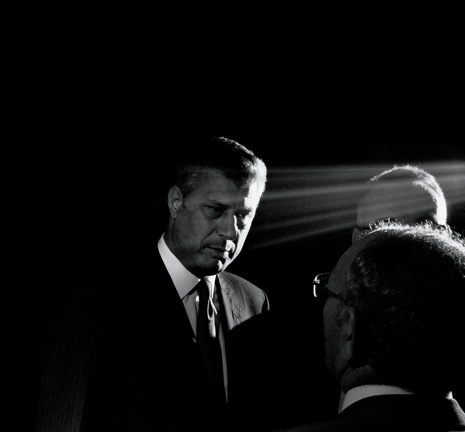
Last year, I met Prime Minister Thaci in his office, on the second floor of a drab fourteen-story tower in central Pristina. Jean-François Fitou, the French Ambassador to Kosovo, had told me that Thaci was “the Mick Jagger of the K.L.A.,” and Thaci is indeed dashing, with a clean smile, carefully groomed hair, and a buttery complexion.
Within the K.L.A., Thaci had been known as the Snake—a reference to his slippery evasion of Serbian authorities. The nickname, it seemed, was still appropriate. “Until the war broke out, the Serbs wanted to imprison me,” he said. “In wartime, they tried to kill me. After the war, they tried to compromise me, to destroy my reputation.” Thaci denies having ever been connected to a criminal syndicate and says that he was unaware of any prisoner abuse.
At one point, the conversation turned to Sabit Geci. Germany’s spy agency reported that Thaci had maintained “very good contacts” with him, but Thaci disputed this, saying, “To be frank, he was not my friend.” As we talked about Geci’s crimes, Thaci’s face turned the color of gravel and his smile contorted, as if he could taste his reputation souring on his tongue. “The K.L.A. was big, and you always have abusers in such organizations,” he said. It was almost five o’clock, and many of his aides and assistants had gone home for the day. He sank into a black leather chair and unfastened the top button on his shirt.
If Williamson found conclusive evidence that the K.L.A. had trafficked the organs of prisoners, Thaci said, “that would leave the worst legacy for Kosovo and our people.” But “never did something like this happen” with his knowledge. “That’s why I gave my full support to the task force,” he said. “In order to have the truth prevail.”
The late-afternoon sun slanted across the room. “I give my full support to justice,” he added. “I will be on the side of justice, no matter who is on the other side.”
Regaining his color, Thaci said, with a grin, “The only laws I have violated were Milosevic’s laws. And I feel very proud of that.” ♦









 Jadde: from Bosnia to Bengal