Turns out salt isn’t bad for you.
Along with fat, sugar, lard, wheat, carbs, butter, milk, eggs, red meat, organ meats or cholesterol.
Good.
Can we eat now?
Comment: nikobakos@gmail.com
Turns out salt isn’t bad for you.
Along with fat, sugar, lard, wheat, carbs, butter, milk, eggs, red meat, organ meats or cholesterol.
Good.
Can we eat now?
Comment: nikobakos@gmail.com
Derek Thompson at The Atlantic:

Here is what this chart shows. Compared across more than 100 factors measured by the World Economic Forum Global Competitiveness Report, from corruption to deficits, JP Morgan analyst Michael Cembalest calculates that the major countries on the euro are more different from each other than basically every random grab bag of nations there is, including: the make-believe reconstituted Ottoman Empire [my emphasis]; all the English speaking Eastern and Southern African countries; and all countries on Earth at the 5th parallel north.
And here is your tweetable fact: A monetary union might make more sense for every nation starting with the letter “M” than it does for the euro zone.
Comment: nikobakos@gmail.com
Djokovic beats Tsonga on home-turf in Mens’ Quarterfinals at Roland Garros, Paris. Federer’s next. (photos: Thomas Coex, AFP/Getty Images)


Comment: nikobakos@gmail.com

On top of being a mosque “that was built on the site of a basilica dedicated to St. John, which was built on the site of a Roman temple to Jupiter, which was built on the site of an Aramean temple of Hadad-Ramman, god of thunder and lightning,” the Great Mosque is also an important Shi’ia shrine because several events from Shi’ism’s core Karbala drama are said to have taken place here. This building must have the most exhalted religious pedigree of any house of worship in the world.
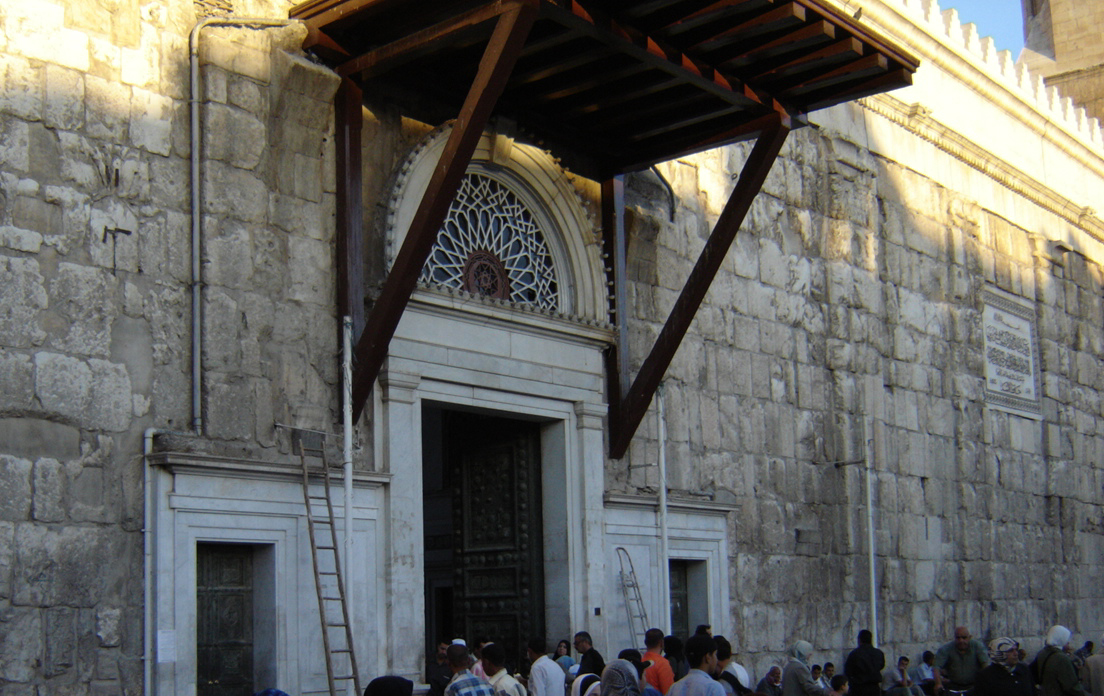
External view of the gate that the prisoners of Karbalā were made to stand at for 72 hours – “Bāb as-Sā‘at” [The “gate of the hours”?]

The place where all the other heads of those who fell in Karbalā were kept within the Mosque.

The white pulpit marks the place where ‘Alī ibn Husayn addressed the court of Yazīd and the raised floor in front of it marks where the prisoners of Karbalā stood during that time.
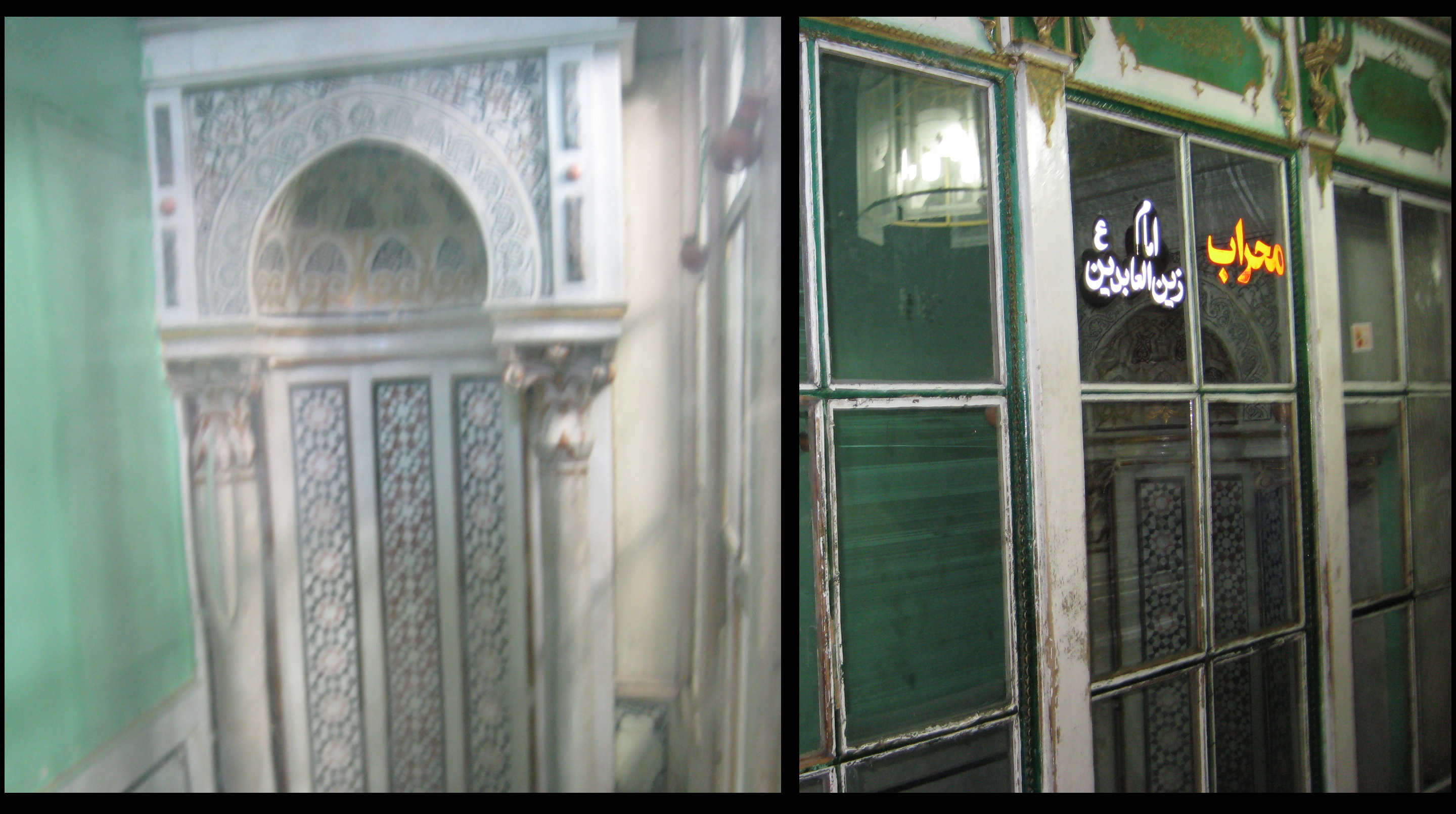
The place where ‘Alī ibn Husayn used to pray while imprisoned.
Comment: nikobakos@gmail.com
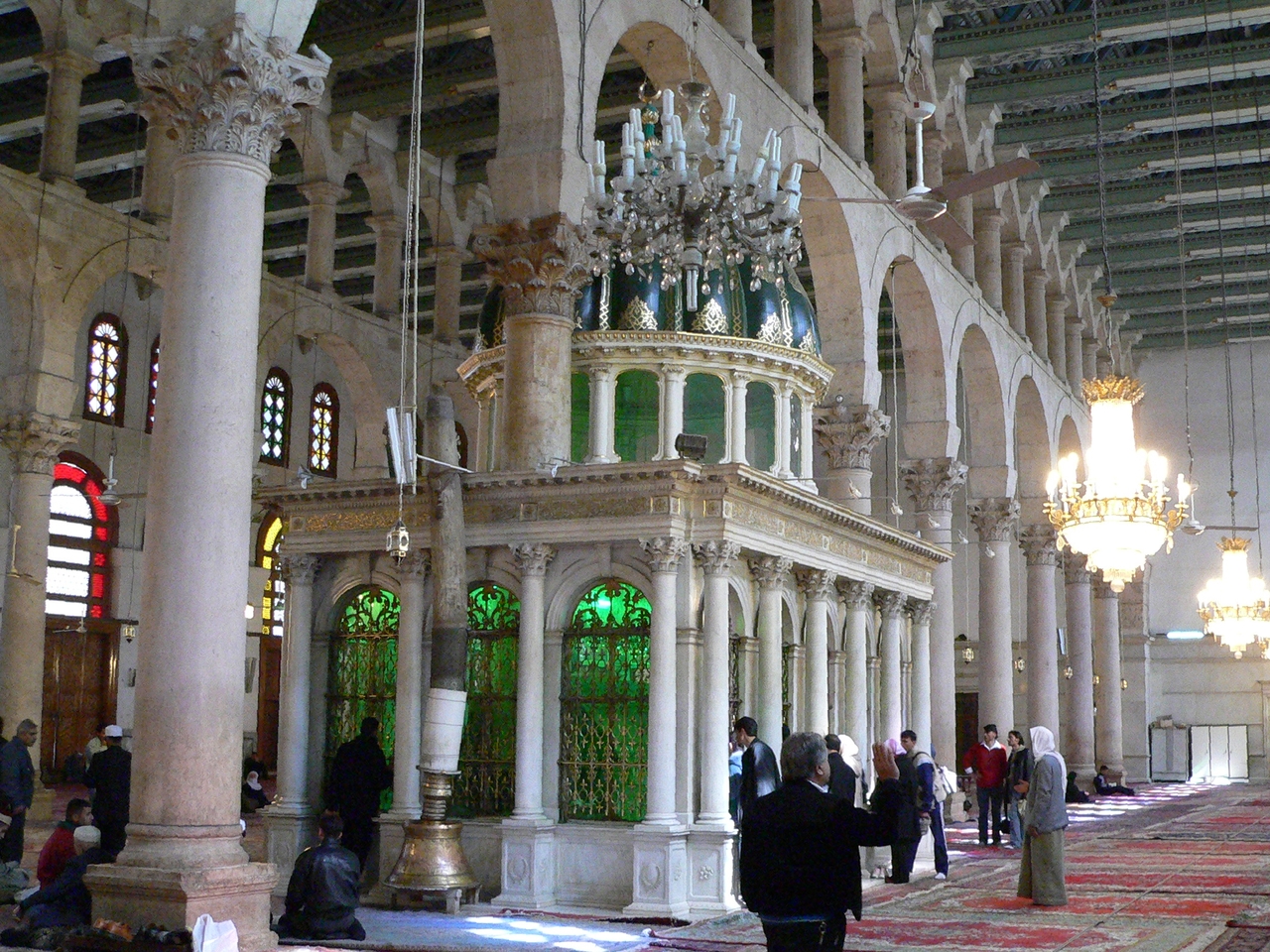
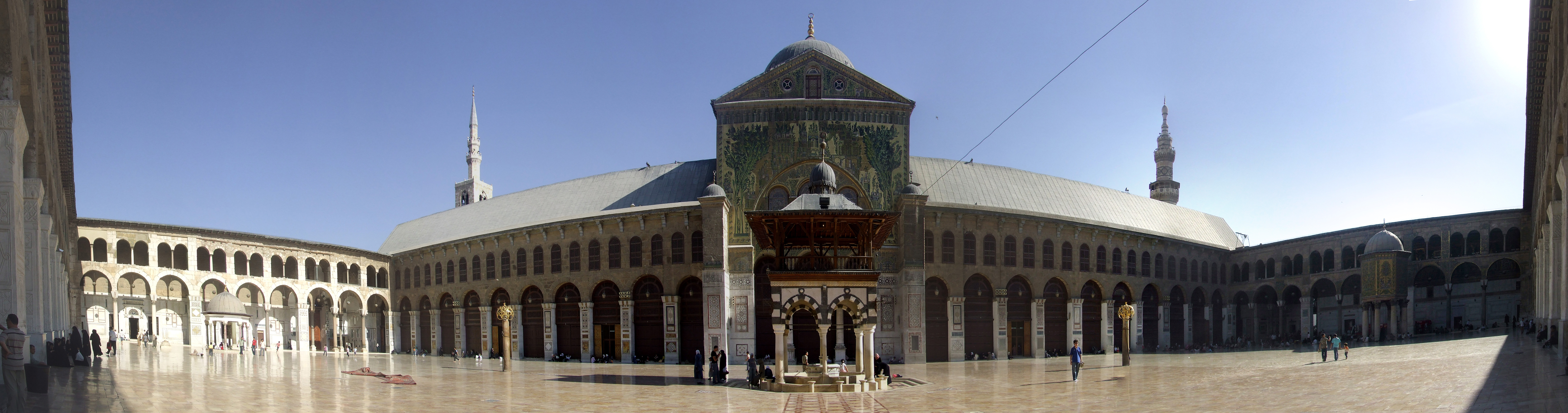
Shrine of St. John in the Umayyad Great Mosque of Damascus, said to contain the head of John the Baptist. The mosque was built on the site of a basilica dedicated to St. John, which was built on the site of a Roman temple to Jupiter, which was built on the site of an Aramean temple of Hadad-Ramman, god of thunder and lightning. (Click on photo; also Google Image this magnificent building; it gets much less visual exposure than it deserves — a spectacular extra wide-angle shot of the mosque’s exterior.)
Walter Russel Mead reiterates what I’ve commented on in previous posts: What Russia doesn’t forget:
“The roots of Russia’s support for Butcher Assad go deep. This is much more than nostalgia for Russia’s last Middle East ally from Soviet days. This is about getting back in touch with Russia’s pre-communist foreign policy traditions, and about Putin’s relations with one of his most reliable and important bases of support: the Russian Orthodox Church. The Church has historically exerted a strong pull on Russian policies overseas, especially in defense of Christian minorities in the Balkans and Middle East. Throughout the events of the Arab Spring, Russia has been reluctant — to put it kindly — to join the efforts to unseat dictators like Hosni Mubarak and Bashar Assad. Though these tyrants have often been brutal toward many of their citizens, Christian minorities have, by and large, thrived under their rule.”
Some commentators, like Andrew Sullivan, find this “a novel explanation for Putin’s intransigence.” It’s not news to some of us. That Eastern Christians have been stuck between a rock (Western manipulation and imperialist intrusion) and a hard place (Islam when it grows intolerant, often, but not always, in response to the former) for something like a millenium now, is a fact that one has to know very little about the region to not be aware of. Mead’s historical run-down on the discomforts of that position is extremely thorough though pretty simplistic, but his post is full of good links if you want to check them out.
I have a substantial investment in being an Orthodox Christian: on one hand, because it’s simply a supremely intelligent and beautiful form of Christianity; on the other, because it’s simply the lesser of all Christian and, by extension, monotheist evils; Rebecca West’s observation that “The Eastern Church never forgot that the primary purpose of religion is magic” is at the heart of both those sentiments. I guess I feel some sense of Orthodox solidarity too — warily (and phenomena like Greeks going off to help Serbs kill Muslims in Bosnia or Orthodox skinheads in Moscow killing Central Asian migrants always pop up to keep me wary). But as I’ve mentioned before here and here, there’s no indication that Russia has ever done anything in the Balkans and Near East that was not in its own imperialist self-interest and that did not often end in disaster for those it was trying to “help.”
Even less, as Mead points out, should be expected from the West:
“Linked to that memory are memories of Western Christian treachery and betrayal. From the Fourth Crusade, ostensibly sent to protect Eastern Christians but turned into a piratical assault on Constantinople [“piratical assault”?? How about thorough and almost complete looting and destruction?], to memories of how the westerners made their help conditional on Orthodox submission to the authority of the Popes, a history of betrayal shapes the Orthodox political mind in many of these countries.”
The seed of this blog was a very early, indisputably emotional and personal, desire to heal Turks’ and Greeks’ feelings for each other, which I realized could only be accomplished by fixing Greeks’ warped sense of where they belong in the world (probably a hopeless project) and which later grew into a wider ideal of regional integration and community, so this issue is really one that goes to the heart of why I write here. Pretending that you’re French or Ancient Greeks that need help in a rough neighborhood won’t cut it. Islamophobic panic or seeing one’s self as the Christian frontier or bastion against the Saracens leads to the group pathology of Serbs or Maronites. Greek and Armenian alliance choices in the early twentieth century almost immediately resulted in the complete eradication of Christianity from Anatolia. Cultural emulation intended to garner support leads to the skewed self-image of contemporary Greeks.
Tying your survival to extra-regional players or regimes like Assad’s that are destined to soon make their exit is a losing strategy for the region’s Christians. The threat of Islamist violence is probably real. Iraq and even Egypt certainly seem to indicate that. But their only choice is probably the tricky dance of fostering, or just going with, the flow of democratic change while keeping themselves as least vulnerable as possible. Forget Russia. And, as Constantine XI had to heroically face in the end, there’s certainly no help coming from the Frangoi.* If you want to live in peace and security, look to your neighbor because, ultimately, he’s the only one who can provide it for you.
* I promised an explanation of this term but haven’t gotten to it yet; for now, let’s just say a derogatory term for Western Europeans.

The church above, which Read uses in his post, is the Church of the Savior in St. Petersburg, built in a Neo-Muscovite mediaeval style, which sticks out like a sore thumb amidst the Neoclassical elegance of the city, on the spot where Alexander II was assassinated in 1881, modelled on the style of the church of St. Basil on Red Square below. Both are routinely used to immediately signify “Russia!” and its exoticness or orientalness.

Comment: nikobakos@gmail.com

(Photo: Isaac Mizan (R), a survivor of the Holocaust, shows his tattooed serial number to university students in the Philosophical department at the University of Athens, May 29, 2012, in Athens, during an event dedicated to the remembering of the Holocaust. Greek Holocaust survivors made a rare public appearance today to challenge a neo-nazi party whose leader has cast doubt on the genocide and which won its first seats in parliament this month. They told of their ordeals during the killings and deportations by the Nazis that decimated the Greek Jewish population during World War II, a part of wartime history that is little talked about in Greece. By STR/AFP/GettyImages.)
Did they talk about the pre-war experiences of Greek Jews? That they faced discriminatory re-housing policies after the 1917 fire that destroyed most of the Jewish-inhabited areas of Salonica, including about thirty of what were probably some of the oldest and most historic synagogues in the world? About violence against the community by fascist elements during the twenties and thirties, uncontained by any government, including the Campbell Riot of 1931 that destroyed shops, homes and synagogues? That the great Venizelos had the community registered on a separate electoral role to neutralize any political power they might have on the grounds that you could not have a “foreign arbiter” playing a role in Greek politics, but really because Greek Jews were generally monarchists in their sympathies.* About the community’s running battle with the municipality of Salonica during the inter-war years to prevent appropriation of its cemetery, one of the oldest and largest in the world that contained an estimated 350,000 graves before the war? About how after the Germans destroyed it the municipality used discarded gravestones as sidewalk pavement and built the city’s university on the ruins? That there’s been no effort to save relics of the cemetery found at any point during the university’s expansion or during the recent metro construction through the area?
* See Syrian Christians; minorities have almost always feared “liberals” and “democrats,” wary of the tyranny of the majority without a protecting “patron” of their own.
Comment: nikobakos@gmail.com
Wow! This looks cool.
Anybody seen it? I won’t even look on-line for comments ’cause I don’t expect to find anything but the usual crap.
Or maybe I will…
Comment: nikobakos@gmail.com
…and Syrian Christians in particular…a bunch of frigging priests calling the shots:
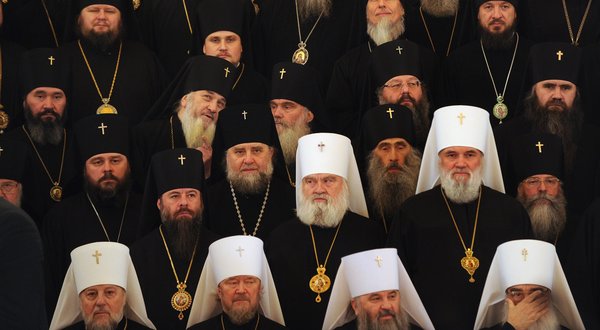
(Pool photo by Alexander Nemenov)
From: The New York Times
“Someone once said George Soros was the only American citizen who has his own foreign policy,” said Andrei Zolotov Jr., a leading religion writer and chief editor of Russia Profile. “Well, the Moscow patriarchate is the only Russian entity with its own foreign policy.”
Three and a half months ago, intent on achieving a commanding win in presidential elections, Vladimir V. Putin sought support from Russia’s religious leaders, pledging tens of millions of dollars to reconstruct places of worship and state financing for religious schools…
Western analysts acknowledge the dangers faced by Christians in Syria, but say the church would be wise to distance itself from the Assad government and prepare for a political transition.
“What we see now in Syria is systemic failure — it’s brutal, it’s now an insurgency — but in the end it’s just systemic failure,” said Andrew J. Tabler, a fellow at the Washington Institute for Near East Policy and an expert on Syria. “If the Christian population and those that support it want a long-term future in the region, they’re going to have to accept that hitching their wagon to this brutal killing machine doesn’t have a long-term future.”
The Russian Orthodox Church regularly meets with the Russian Foreign Ministry to discuss its agenda outside Russia’s borders, and is seen by most experts as eager to render support to the Kremlin.”
Obviously “hitching their wagon” to the Assad regime is not a strategy with a long-term future, just like hitching your hopes to Western — even, especially, Russian — protection has certainly always been a losing strategy for Middle Eastern Christians for a few centuries now, but resisting the temptations such ‘protection’ or ‘stability,’ wherever it comes from, seem to offer is easier said than done, especially once the sectarian killing machine has gotten rolling.
As for Russia, somebody needs to put a muzzle on the Moscow Patriarchate and the Russian Church generally — and this is from someone who thought Church freedom and the fall of communism would only happen at the Second Coming and who was overjoyed and stunned to watch it collapse so easily, but they’ve become way too powerful and vocal (fortunately, Russians have that finely honed Orthodox ability for maintaining emotional adherence to the faith while completely ignoring the clergy and the Church-as-institution generally.) Unfortunately, the only person who could muzzle them a bit is the man who’s muzzled the rest of the country, Putin himself, and as long as the reciprocal back-scratching continues… To watch this KGB murderer in church with his candle, crossing himself and bowing, turns my stomach.
A friend of mine in Petersburg told me at some point in the mid-nineties: “Everyone who was a communist before has become Orthodox and everyone who was Orthodox before has become Buddhist and the Buddhists just went back to drinking.”
Comment: nikobakos@gmail.com
A film about Turkish immigrants in Germany and a homecoming trip they go on that looks delightful. What a creative voice German Turks have become.
The little boy is terrified of the crucifix because the other boy earlier in the trailer tells him that in Germany they eat swine-flesh and people: “They eat people? Yeah, and on Sunday they get together and eat them and drink their blood!,” which is sure throwing the anti-Jewish blood libel in Christianity’s face; it’s that slight chill that always makes a good laugh funnier.
The other, more poignant scene — scenes of which I have an infinite file of from my own childhood — is of the mother trying as hard as possible to give her kids a real German Christmas: “Nooooo!” they yell at her, “you’re supposed to wrap them!” And the sad little tree…
I don’t know all this because the Holy Spirit suddenly blessed me with the ability to understand German but because I caught a discussion with the filmmakers on — where else — Al Jazeera. I couldn’t find a trailer with English subtitles, though you can put it on your Netlix “saved” list already.
Does there always have to be a white-girl girlfriend in these movies? You can so predict what the jokes and problems are gonna be…
Comment: nikobakos@gmail.com

The New Yorker‘s Philip Gourevitch in this week’s Comment:
“Syria cannot be addressed in isolation. What concerns the United States most in the region is trying to avert war between Israel and Iran. (Last week, during negotiations in Baghdad to curtail Tehran’s nuclear program, Washington’s hopes ran prematurely high.) There is a risk of a regional Sunni-Shiite conflagration, as Saudi Arabia, which backed Bahrain’s crackdown on Shiite protesters, has advocated arming Syria’s opposition. There are Turkish misgivings about Kurdish rebels establishing bases in Syria; and Israeli anxieties about Assad’s accelerating military assistance to Hezbollah forces. There is also the question of Syria’s enormous chemical-weapons stockpiles: might Assad use them? Can they be secured if he falls? And there is the problem of Russia’s support for Syria—its lone remaining client state in the Middle East—and China’s support for Russia, particularly after both countries were angered by NATO’s use of its U.N. mandate to provide humanitarian protection in Libya to achieve regime change there. (Russia has called on the International Criminal Court to investigate allegations of NATOwar crimes in the campaign against Qaddafi.)…
“…none of the conditions that worked to NATO’s advantage in Libya—its geographical and political self-containment, Qaddafi’s abandonment, the efficacy of the opposition forces, the ease of executing the mission from the air—pertain in Syria. Instead, the situation has all the makings of just the sort of quagmire that NATOis impatient to get out of: the main item on the agenda in Chicago was to declare the plan to withdraw all combat troops from Afghanistan in 2014 “irreversible.”
http://www.newyorker.com/talk/comment/2012/06/04/120604taco_talk_gourevitch
Comment: nikobakos@gmail.com
 Jadde: from Bosnia to Bengal