Balkans, Anatolia, Caucasus, Levant and other Middle East, Iran, Afghanistan, South Asia, occasional forays into southern Italy, Spain or eastern Europe, minorities, the nation-state and nationalism — and whatever other quirks or obsessions lurk inside my head.
Somebody on Twitter posted something I hadn’t thought of: these two planets, Jupiter♃ (Δίας, Ζεύς) and Saturn♄ (Κρόνος), are father and son, meeting at 0 degrees Aquarius. Everybody, but especially Leos ♌and Aquarii ♒, think about what that might mean to you: meaning…authority; inspiration…structure; ideals…worldly advancement…bla bla…
Will the apocryphal stories continue or will one day both sides acknowledge the other’s memories? For answers, I revisited the pages of Italo Calvino’s Invisible Cities. “The city of Zora is like a honeycomb,” he wrote, “in whose cells each of us can place the things he wants to remember: names of famous men, virtues, numbers, vegetable and mineral classifications, dates of battles, constellations, parts of speech.” And what if Shushi, too, were to become a honeycomb in whose cells memories coexisted without vitiating or privileging one over the other? What if we included in those cells not just the names of famous women, places, fictions, and nonfictions that we have been taught or lived and gotten to know, but other such signs, peoples, and meanings that can be acquired outside ourselves and communities? Can we not meet halfway in those liminal spaces to build new histories of inclusion?
[my emphases]
SHOUSHI, NAGORNO-KARABAKH – OCTOBER 12: A view of the inside of a church which was struck twice by UAV strike on October 12, 2020 in Shoushi, Nagorno-Karabakh. On the day after a ceasefire was broken between Azerbaijan and Armenia, war continues to wage between the two countries over the contested Nagorno-Karabakh region. The Nagorno-Karabakh’s capital was left largely untouched by the latest spate of Azeri shelling, with fighting in the south intensifying and the city of Hadrut sustaining the heaviest damage. (Photo by Alex McBride/Getty Images)
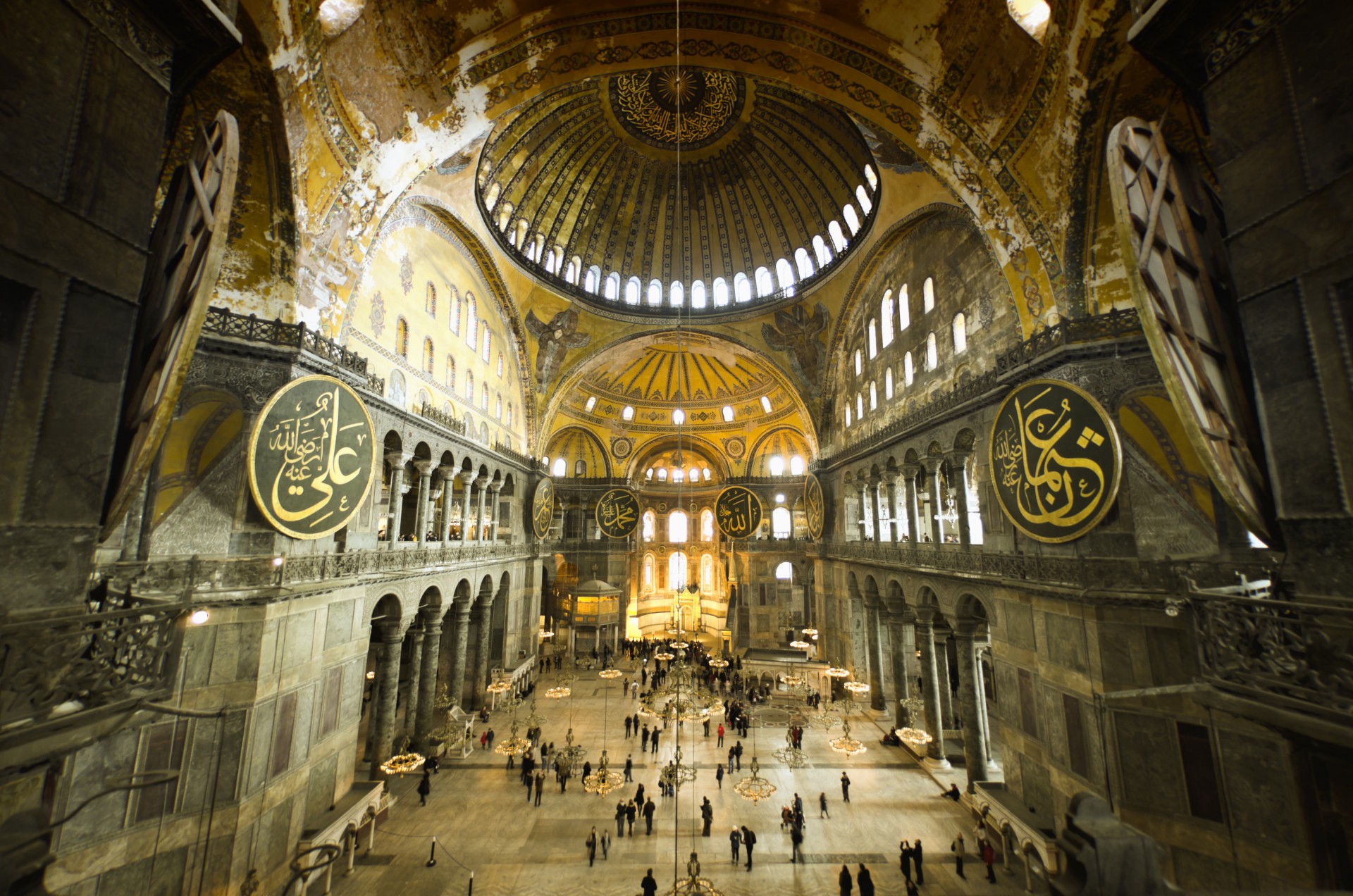
I once got into an argument with a Turkish art historian friend of mine after I referred to the eight round canvasses with the first caliphs’ names on them (I think) in Hagia Sophia as “the hideous green billboards”. She, of course, thought they were “cool” or “pastiche-y” or “palimpsest-y”. I thought, and think, that they not only mar the space by covering the joints between the massive square space and the massive dome which are perhaps the most ingenious aspect of this miracle of Roman engineering, but that they were meant to send a clear message of who was now in charge. Hers is a typical “woke” take on these things. In the article below, Axel Çorlu highlights the dangers of such gleefully amoral, post-modern celebrations of funky “conjunctures” and how they essentially elide the historical facts of violence, persecution and appropriation from our picture of the past, and how — in the particular case of Hagia Sophia — these academics end up feeding the discourse of both Ottoman/Muslim triumphalism and the oppression and displacement of religious minorities by the nationalism of the Turkish Republic.
In short, you may want to get past “conquest narratives”; Erdoğan — who justified the reconversion by the “right of conquest” — doesn’t.
My money quotes:
They [Patricia Blessing and Ali Yaycıoğlu, titled “Beyond Conquest Narratives: Hagia Sophia, Past and Present”] conclude this section with the heart of their essay: “…in this essay, we would like to divert the conversation and discuss how the conquest narrative, which is shared by those who oppose and support the decision, does not do justice to Hagia Sophia and its architecturally, spiritually, and emotionally charged history.” This sort of interjection, very appealing to the academic mind, nonetheless includes ominous terminology such as “doing justice” to the Hagia Sophia and its “…emotionally charged history.”
This narrative at once establishes the issue of “justice,” not in the sense of the expropriation and destruction of Christian and/or minority populations and the appropriation of their cultural heritage, but as in, “Let us not be unfair to the Ottomans or the Turkish Republic…” and the fact that those who respond to the Hagia Sophia issue might be affected by the same “emotionally charged” aspects. In other words, the authors are guiding us to focus on “justice,” as long as it is to protect the powerful who do not need any protection –there appears to be no need to consider the concept of justice for the dispossessed, whom the Hagia Sophia also symbolizes. […]
While the republican regime was indeed interested in recasting the Ottoman past (usually not in a very bright light, as it also distanced itself from many of its aspects and dictated a highly selective version of its history) and kept busy trying to prove that “Turks” had existed in Anatolia for millennia through the Hittites and other ancient peoples with an eclectic mix of the racial theories and pseudo-science of the time (including the infamous obsession with the morphology and measurements of skulls), it hardly made an effort to understand, teach, or preserve its Byzantine past, let alone “making a claim” to it, if what we mean by “making a claim” is anything more than a possessive but not inclusive approach.
Indeed, the Byzantine past of Turkey remained either buried, neglected, or carefully molded in the public imagination, as nothing more than the “other” that had happened to be there before.At no point did the republic genuinely try to make a direct connection to the Byzantines beyond their role as the adversary in history textbooks, the adversary that had been vanquished, the adversary that had nothing to do with the ethnicity or cultural heritage of the people in Turkey. […]
Beyond its [the conversion of Hagia Sophia into a museum] practical use as described, it was neither part of a grand historical or intellectual vision, nor a noble gesture of “tolerance” by a regime that did its very best to eliminate the remaining diversity of cultures and religions in its lands for decades to come through acts ranging from the population exchange with Greece, to the Izmir Economics Congress of 1923 where the elimination of “foreign” bourgeoisie and its replacement with a “national” one was planned, to the Varlik Vergisi (Capital Tax) of 1942, among many other examples. Such a regime surely could not care less about multiculturalism, inclusivity, or the Byzantine past as the authors suggest. […]
This idea also worked very well for the urban Kemalist elite and their newly created middle class throughout the 20th century, because it did not require them to symbolically come to terms with the vast destruction visited upon the minorities of the land, from whom they had acquired significant aspects of their material and cultural wealth via direct or indirect appropriation…
I agree that a narrative that “equates Ottoman approaches to Hagia Sophia with iconophobia and iconoclasm is incorrect” but I do not think it is necessarily “marked by Islamophobia and Orientalism” given the fact that Byzantine art and architecture suffered tremendous degradation and damage, sometimes in the name of Islam, and other times at the hands of unscrupulous republican bureaucrats, treasure hunters, or the common public in more recent times. Any scholar, casual observer, or visitor of Byzantine, Armenian, or Syriac heritage sites in Turkey will be more than cognizant of the intentional damage done to frescoes, mosaics, and other elements of Christian architecture. The damage was done over a period of centuries under different conditions, the perpetrators were/are not a homogeneous group, and the practice ranges from officially undertaken projects to “simply” neglected sites. This is an undeniable fact, and it would be disingenuous to suggest that the few token examples in the Ottoman era, republican era or today somehow represent a “preservationist” or “tolerant” attitude when in the vast majority of locations they were covered at best and destroyed at worst. …..Today, the Turkish state uses sites such as the restored Aghtamar Cathedral of the Holy Cross or the Sumela Monastery as tokens of its hollow “multiculturalism” and “tolerance.” As scholars, we have a grave responsibility to challenge this narrative. This multiculturalism narrative and tokenism of Turkey is a propaganda tool designed to cover the simultaneous appropriation and destruction of the past and the present, motivated to a significant extent by the conquest narrative. The conquest narrative was a real factor in history, and it is a real factor today. Ignoring it, reducing it to merely an “incorrect” historical interpretation, or diminishing it to an ahistorical approach is dangerous. […]
The reconversion of the Hagia Sophia is about power; in a world where power relations past and present influence the lives of millions of people, and history is weaponized for various agendas, we do not have the luxury of pretending to “stay above it” in a noncommittal manner.
The interior of Hagia Sophia with the eight “hideous green billboards”. Getty Images.
Dangers of Convenient Universalism: Power Relations and Responsibility of Scholars on the Hagia Sophia
2020-08-08
By Axel B. Çorlu, Ph.D.
The recent reconversion of the Hagia Sophia into a mosque by the (Turkish President Recep Tayyip) Erdogan regime generated heated debates among scholars, politicians, and the public. A recent article by Patricia Blessing and Ali Yaycioglu, titled “Beyond Conquest Narratives: Hagia Sophia, Past and Present” offers sophisticated but ultimately convenient universalism, where both the past and the present are presented from a distorted lens, with strategic omissions.[1]
According to Blessing and Yaycioglu, there is a binary “conquest narrative” that both the supporters and opponents of the Hagia Sophia reconversion utilize, and that in essence this simplistic view does not reflect the “complex history of Ottoman Hagia Sophia.” The authors go on to label the concerns about the protection of the structure, especially regarding the issue of the mosaics as ahistorical “disinformation,” and offer a “correct” version of history.
I will follow their text in the same order, and point out the multiple issues… (see below)
Ibn Khaldun, the great medieval historian, noted with surprise that the Gospels consisted largely of sermons and stories, “and have an almost complete lack of laws”. It was this lack, in the opinion of medieval Muslim jurists, that served to condemn Christianity as an inadequate and superceded revelation. Unlike the Jews, who at least had a written law from God, Christians were forever changing their minds, devising new law codes, revising the ones they already had. How were such people possibly to be taken seriously? […]
Perhaps it is no surprise, then, that Islamist radicals, when they look at the history of France, should see in it a sinister continuum. In 2015, when the Islamic State issued a statement claiming responsibility for the murderous attacks on the Bataclan and a range of other atrocities, it readily conflated the era of Louis IX with the vices of a more recent and godless materialism. Paris was condemned both as “the carrier of the Banner of the Cross in Europe”, and as “the capital of prostitution and obscenity”. […]
The Islamic State, when they identified France as the capital of everything that it most hated, were not so far wrong. Eldest Daughter of the Church and the home of revolution, the land of saints and philosophes, Catholic and laique, it is her fate — and perhaps her privilege — to serve, more than any other country, as the very embodiment of the West.
Tom Holland is a writer, popular historian and cricketer. He is not an actor. His most recent book is Dominion
November 2, 2020
In 1798, Napoleon embarked on the first French invasion of Egypt since the era of the Crusades. He prepared for it with his customary attention to detail. Conscious that he was travelling to a predominantly Muslim land, he sought to make a careful study of Islam. Top of his reading list was, of course, the Qur’an. Raised as he had been to view the Bible as the archetype of scripture, he found it a surprising text. The character of Muhammad’s revelations, he realised, was radically different from that of the New Testament.
The Qur’an did not content itself with what Napoleon had been brought up to think of as “religion”. Its scope was much broader than that. From fiscal policy to sumptuary laws, it offered prescriptions for entire dimensions of what, in Europe, had long since come to be defined as “secular”. Napoleon, sorting out the library in his cabin, duly catalogued it, not under “Religion”, but under “Politics”.
Q: My in-laws are kind, delightful people, and I enjoy spending time with them, except on Christmas. Their family tradition is for everyone to take turns unwrapping gifts. Last year, we unwrapped gifts for almost two hours, stopped for lunch, and then unwrapped gifts for another hour after lunch. Each person receives a modest number of gifts, so it’s not quantity that is causing the problem. The recipient is expected to carefully unpackage and read product instructions before moving along to the next gift, and, when there are no instructions or awkward packaging, the recipient will wax poetic for 10 minutes about how the sweater reminds them of their deceased grandmother’s beloved cocker spaniel, etc. My husband agrees it is out of hand, but we don’t know how to politely speed things along. Any advice, or do we just need to keep quiet?
A: This year you two should insist going first. Then give each other Fitbits, put them on, explain how you both are so excited about getting into better shape that you’re going to use them right now—then sprint out the door and don’t return until the excruciating performance-art project “Endless Unwrapping” is done. Your husband needs to have a talk with his parents and say the gift exchange needs to be speeded along, that an hour is more than sufficient (insanely so) for this, and he’ll be in charge of keeping things moving. If your in-laws insist on this torturous ritual, it’s perfectly fine for you two to say you’ve got to stretch your legs, then don’t make a return appearance until it’s time for lunch.
On this day a century ago the Government of Ireland Act 1920 became law, allowing for the formal division of Ireland. In the latest in his series of articles on Partition, historian Cormac Moore examines the genesis and legacy of this defining piece of legislation
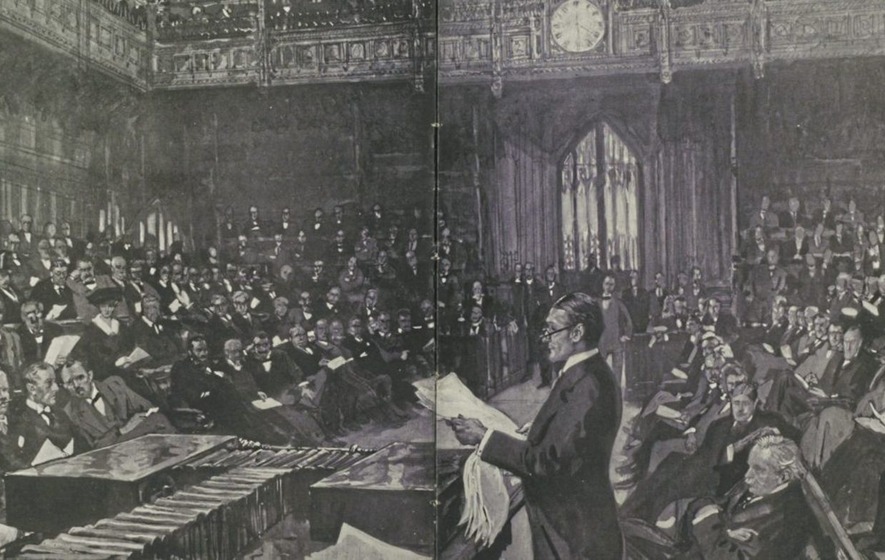
Ian MacPherson, Chief Secretary of Ireland, introducing the Bill to the House of Commons in February 1920 in a sketch published in The Illustrated London News under the headline: Designed ‘To Settle Once And For All This Age-Long Difference’
23 December, 2020 01:00
King George V gave royal assent to the Government of Ireland Act 1920 100 years ago today
ON DECEMBER 23 1920 the Government of Ireland Act 1920 received the royal assent from King George V. Despite the significant opposition to the Act at the time, it became operational with the establishment of Northern Ireland in May 1921, resulting in the partition of Ireland.
While the Act was introduced to safeguard the unionist minority of north-east Ulster, it had the effect of creating new minorities in Ireland without guaranteeing any safeguards for them, particularly so in the case of northern nationalists.
The genesis of the Act came in the latter half of 1919. Home Rule was still on the statute book since 1914 and could no longer be postponed. It was scheduled to come into operation automatically when hostilities were formally concluded with the signature of the last of the peace treaties after the First World War. To prevent this, the British prime minister David Lloyd George set up a committee chaired by cabinet member Walter Long to draft another bill, the Government of Ireland Bill.
The make-up of Long’s committee was unionist in outlook. There was no nationalist representation whatsoever nor was the advice of any nationalist sought. Leading Ulster unionist James Craig and his associates were the only Irishmen consulted during the drafting of the bill.
Long’s committee rejected the idea of holding a plebiscite in Ulster, with Arthur Balfour claiming plebiscites were only suited to “vanquished enemies”.
The committee proposed to create two distinct legislatures for Ulster and the southern provinces, linked by a common council, comprising representatives from both. This was the first time a British government proposed a separate parliament for Ulster.
Before the end of the war, the exclusion of Ulster, or at least some of Ulster, was the only option being considered in terms of special treatment for the province. The common council proposed in the Government of Ireland Bill was a Council of Ireland to be composed of 20 members from each Parliament. The British government publicly claimed it hoped the council would lead to “the peaceful evolution of a single parliament for all Ireland”.
The leading nationalist MP left in Westminster, Joseph Devlin, believed the creation of a parliament for Ulster would result in the “worst form of partition and, of course, permanent partition”.
The Ulster unionist leader Edward Carson saw some attractions to an Ulster parliament, stating, “Once it is granted, it cannot be interfered with”. He also stated the desertion of Protestants in the south “cuts me to the quick”, but the reality was that there was “no alternative to the Union unless separation”.
The Irish News described the Bill as “a plan devised by unscrupulous politicians to assassinate Ireland’s Nationality”. The Freeman’s Journal deridingly named the Bill, “The Dismemberment of Ireland Bill”.
With Sinn Féin in the ascendancy in the south and west of Ireland, the British government knew the Bill was unenforceable outside Ulster. The Bill was drafted and amended just to accommodate Ulster unionists. It was an attempt to solve the Ulster Question and not the overall Irish Question.
The amendments accepted included the limiting of the powers of the Council of Ireland from the Bill’s original draft, and the ability to remove the Proportional Representation (PR) system of voting after three years, measures Ulster unionists sought and were granted to make partition more durable.
Initially, there were many objections from Ulster unionists who did not seek their own parliament. The main problem was with the area to be included in the Ulster parliament. Ulster unionists sought the six counties of Antrim, Armagh, Derry, Down, Fermanagh and Tyrone, and not the nine counties of Ulster as this was the maximum area they felt they could dominate without being ‘outbred’ by Catholics.
James Craig, who became Northern Ireland’s first prime minister in 1921, even suggested the establishment of a Boundary Commission to examine the border area for northern and southern Ireland to avoid the jurisdiction of the northern parliament extending over the whole of Ulster. Subsequently, he emphatically opposed the “odious” Boundary Commission established under the Anglo-Irish Treaty of December 1921. By that stage he had his northern “citadel” which he intended to sit on “like a rock”.
The decision of the Ulster Unionist Council which was accepted by the British government was deeply unpopular among the 70,000 Protestants of Donegal, Cavan and Monaghan who were sacrificed to the southern administration. Belfast unionist MP Thomas Moles explained that the three counties had to be abandoned in order to save the six counties: “In a sinking ship, with life-boats sufficient for only two-thirds of the ship’s company, were all to condemn themselves to death because all could not be saved?”
Even though the Ulster unionists endorsed the Government of Ireland Bill reluctantly, many eventually “concluded that the scheme proposed in the Government of Ireland Act would cause the least diminution of their Britishness”. Some, such as Craig’s brother Charles, began to see the great benefits Ulster unionists would garner from having their own parliament: “The Bill practically gives us everything that we fought for, everything we armed ourselves for”.
It has often been cited that the Government of Ireland Bill was allowed to pass relatively unchallenged due to the vacuum in nationalist representation at Westminster. There were just seven Irish nationalist MPs remaining (six from Ireland and TP O’Connor from Liverpool) after the 1918 general election, instead of 80, due to the 69 (who held 73 seats) Sinn Féin MPs/TDs abstaining and establishing Dáil Éireann.
It could be argued that even 80 nationalist MPs would have made little difference considering the make-up of the House of Commons after the election – the Conservative Party, Lloyd George’s Coalition Liberal Party and Irish unionists won over 500 seats, an overwhelming majority.
What little voice the seven nationalist MPs had was further diminished by the Catholic Church’s belief that they should not participate in the committee stages nor suggest amendments to the Bill. The Catholic Church was virulently opposed to partition and believed that participating in the framing of the “Partition Bill” would be seen as a sign of its acceptance.
The Bishop of Derry Charles McHugh claimed Catholic Ulster would never submit to “become hewers of wood and drawers of water for Sir Edward Carson”. Joe Devlin condemned the bill as “conceived in Bedlam”. He voted against it but did not in any way contribute to its final shape.
With Sinn Féin’s policy on partition almost non-existent, it chose to ignore the Government of Ireland Bill. As the Bill was making its way through parliament, the British government was waging a war with Sinn Féin and its military wing, the IRA.
Sinn Féin leaders stuck steadfastly and naively to the view that Ulster would readily come into an all-Ireland parliament once Britain was removed from the island. Sinn Féin failed to grasp the intense hostility Ulster unionists felt towards being governed from Dublin. That the Government of Ireland Act came into law as Britain was at open war with Sinn Féin, supported by a considerable majority on the island, shows the total air of unreality that surrounded the Act.
It was in an atmosphere of violence and boycotts that the Bill became an Act 100 years ago today, a “ghastly Christmas gift”, according to The Irish News.
Cormac Moore is author of Birth of the Border: The Impact of Partition in Ireland.
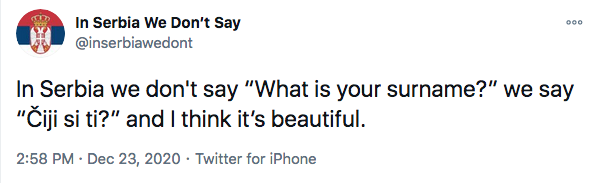
Ah, “whose are you” literally? That’s what older folk in rural Greece used to say — Τίνος είσαι; — when they ran into you and they didn’t recognize you but assumed you were related to someone in the community or else what would you be doing in their God-forsaken village.
They don’t say that any more, because with cars and roads and planes and weird places like some villages in Epiros or formerly “infertile line” islands like Donousa which used to take two days to get to becoming hip, anybody can be expected to do outlandish things like show up in your village even when they’re not related to any one!
Balkans, Anatolia, Caucasus, Levant and rest of ME, Iran, South Asia
Me, I'm Nicholas Bakos, a.k.a. "NikoBako." I'm Greek (Roman really, but when I say that in English some five people in the world today understand what I'm talking about, so I use "Greek" for shorthand). I'm from New York. I live all over the place these days. The rest should become obvious from the blog.







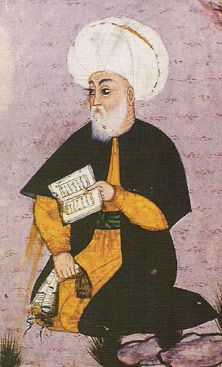
 Jadde: from Bosnia to Bengal