
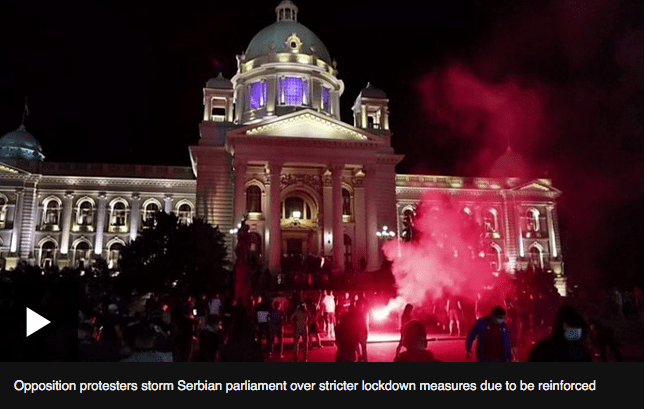
Dozens of police and protesters have been hurt in riots that broke out outside the National Assembly in the Serbian capital Belgrade.
The protests began peacefully on Tuesday evening and included students and families, angered by a move to re-impose a weekend curfew because of a rise in coronavirus infections.
Protesters broke into the assembly, prompting police to intervene.
Clashes erupted and police fired tear gas to disperse the protesters.
Far-right nationalists have been blamed for stirring up the unrest and storming the assembly building. Serbian media said they included an MP who has pushed anti-vaccine and anti-5G conspiracy theories.
Serbian President Alexander Vucic on Wednesday condemned what he described as the most brutal political violence for years and appealed for the protests to end, citing the risk of increased infection.
On Wednesday evening police again clashed with protesters, firing teargas as bottles, stones and flares were thrown from the crowd.
Why the protests began?
Serbia saw its deadliest day so far in the pandemic on Tuesday. President Vucic announced in a televised address that there had been 13 further deaths and 120 people were on ventilators, with 4,000 people being treated in hospital.
The situation was most alarming in Belgrade, he said, before imposing a ban on gatherings of more than five people from Wednesday, with a curfew in force from 18:00 local time (16:00 GMT) on Friday until 05:00 on Monday morning.
Mr Vucic said on Tuesday the curfew would apply only to the capital, but he was keen for it to be extended nationally.
However, in a sign that situation was being reassessed on Wednesday, Serbia’s chief epidemiologist, Predrag Kon, said later that Belgrade was improving and a lockdown in the city was “unlikely”.
In a further TV address on Wednesday, President Vucic said a curfew would probably not be imposed on the capital, but stricter measures would be announced. A decision will now be taken by the Covid-19 crisis response team on Thursday.
Serbia has seen a dramatic rise in cases and authorities have announced a state of emergency in several towns and cities.
Opponents accuse the president of lifting the lockdown far too early, in May, allowing football matches with spectators and few limitations on movement ahead of elections on 21 June that Mr Vucic’s party won by a landslide.
Critics also accuse the government of not giving the true number of deaths during the initial weeks of the pandemic. Serbian authorities say there have been 341 deaths and 17,076 cases. Some 300 new infections are being reported daily.
Some restrictions were brought back last week in areas where the virus is most prevalent. Prime Minister Ana Brnabic was booed when she visited Novi Pazar, one of the cities worst hit by the new outbreak
What happened outside parliament
The protests against a fresh curfew began with a mixture of locals, including students and members of the “Don’t let Belgrade drown” citizen movement, which described the gathering as spontaneous. Many of them observed social distancing although not everyone wore masks.
Scuffles broke out between police and protesters later in the evening and shortly after 22:00 local time (20:00 GMT), a large group entered the assembly building, reportedly involving ultra-nationalists and anti-vaccine campaigner Srdjan Nogo. Crowds could be heard chanting “Serbia has risen”.
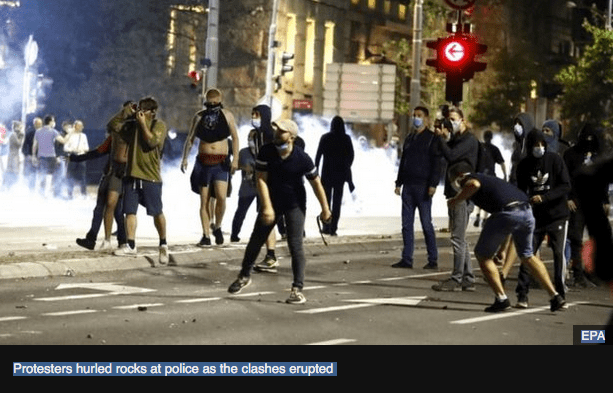
Image copyright EPA Image caption Many of the protesters outside parliament wore masks, but not everyone
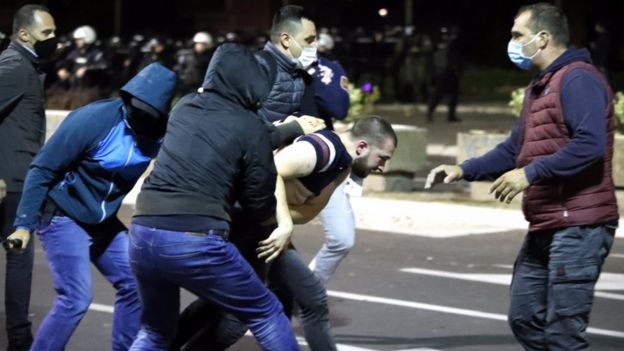
After about 15 minutes, police managed to clear the assembly building, but clashes continued outside. Rocks were thrown, police used tear gas and protesters set police cars alight.
Authorities said 43 police were among those wounded. Rights groups called for an investigation after video showed protesters being kicked and beaten by police with truncheons.
A sour mood in Belgrade
Small-scale protests are common in Belgrade. An atomised political opposition, and more recently an election boycott, means disgruntled citizens have to take to the streets to make their voices heard.
But the protests don’t normally feature police swinging batons and firing tear gas while protesters hurl stones and set light to police vehicles. The scenes reflect a sour mood in Serbia’s capital triggered by Mr Vucic’s warning of a weekend lockdown. Image copyright EPA Image caption Protesters hurled rocks at police as the clashes erupted
Some protesters expressed anger at the government’s rapid removal of restrictions to allow last month’s parliamentary election to go ahead. Tens of thousands attended football matches and nightclubs reopened, signalling that normal life had resumed. The SNS gained the massive majority they wanted, but the Covid-19 infection rate has been rising ever since.
Authorities have placed barricades around the National Assembly to prevent a repeat on Wednesday evening.
President Vucic on Wednesday described the attack on parliament as an illegal, aggressive protest that had more to do with extreme right-wing politics than Covid-19. He said another 11 people had died of the virus in the past 24 hours.
“There are no free beds in our hospitals,” he warned, having said the day before that hospitals in Nis, Novi Pazar, Zemun and other cities were filling up fast.
In a separate development, neighbouring Romania said on Wednesday that it had seen a record number of 555 cases in the past 24 hours. Romania has had more than 30,000 infections but only once, in April, has it seen more than 500 cases in a day.


 Jadde: from Bosnia to Bengal