
Why did we know that even if we were not definitely told by anybody? i.e., that the whole culture and ceremony of meze-fish-rakı is a Greek contribution to İstanbul.

The last Greek restaurant, İmroz (Ίμβρος) on Nevizâde Sokağı closed soon after its owner passed away in 2015. Before that there was still İnci, the patisserie on the Jadde itself that was momentarily a part of the Gezi protests in 2013. See my: “Nobody really cares about Gezi Park: Greek thoughts on the protests of 2013“.
So, it’s over; I think it’s now official. At least as far as I know. I’m 99.9% certain that there are no longer any Greek retail businesses left in the City. Anyone who knows any different, let me know.
*************************************************************************************

On any given night, bustling, narrow Nevizade Street in the heart of Istanbul’s Beyoğlu district buzzes with thick crowds of evening revelers searching for the best table while clean-shaven waiters in their customary uniform of pressed white shirts and V-neck sweaters attempt to lure the crowds into their establishments.
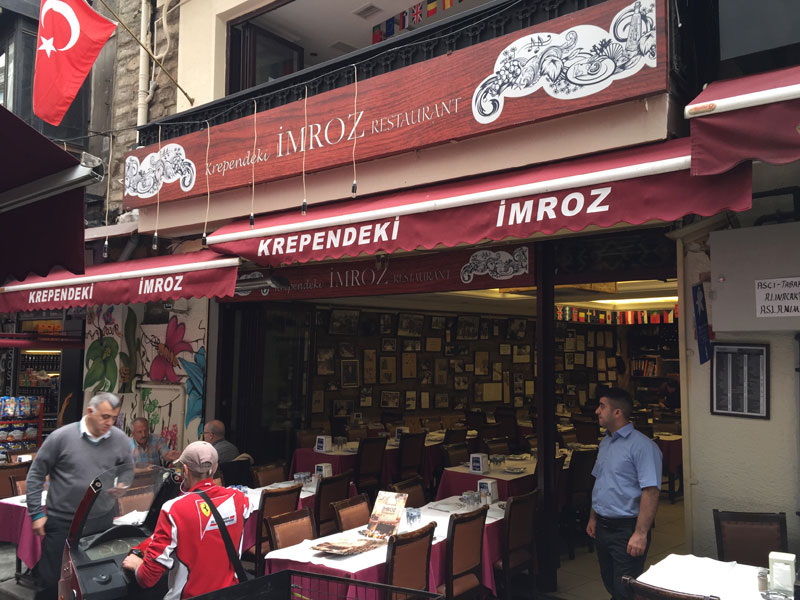
Hyperactive as it may be, Nevizade – a hub for the meyhane, the Turkish taverna where plates of meze are enjoyed alongside slowly sipped rakı and grilled fish – has for decades had one distinctive, constant presence: Yorgo Okumuş, co-owner of the meyhane Krepen’deki İmroz and sole proprietor of a pair of almost comically bushy white eyebrows and an enigmatic mien that seemed to say he’s seen it all (which he probably had).
This week, sadly, Nevizade lost its elder statesman, with Yorgo Baba (as he was affectionately known) dying at the age of 94 after a short period of bad health. With the passing of Yorgo, a member of Istanbul’s dwindling Greek community, Beyoğlu lost one of the living links to its once vibrant multicultural and cosmopolitan past. At the same time, with his meyhane, Yorgo leaves behind an Istanbul institution that itself serves as a link to that past and that tells the incredible story of the fall and rise of the Beyoğlu neighborhood and its nightlife and dining scenes.
 While Nevizade and the streets surrounding it comprise one of the most lively and well-known nightlife hotspots in Istanbul, the meyhanes there trace their roots to a humbler, grittier period from where a time traveler would find the Beyoğlu of today utterly unrecognizable. “We were the first meyhane to arrive in Nevizade, in 1982. No one else was around in those days, and there was a mortician next door,” 57-year-old Mustafa Yıldırım, co-owner of Krepen’deki İmroz, told us during a recent visit. The name, which translates as “İmroz from Krepen,” is a nod to the island (known in Greek as İmroz and Gökçeada in Turkish) from which Yorgo hailed and a reference to its former location, the late Krepen Pasajı, where it opened in 1941.
Built sometime in the second half of the 19th century, the arcade was home to shoemakers and tailors until the early 1940s, when meyhanes began to move in one by one, resulting in a rowdy alcove of debauchery, where good-natured hell was raised on a nightly basis until the passage was razed in 1982. It was later rebuilt as a more mild-mannered arcade for secondhand bookshops, and remains so to this day.
Krepen might have been demolished, but Yorgo and Mustafa decided to carry on, relocating to Nevizade Street, just off Beyoğlu’s fish market, and İmroz became Krepen’deki İmroz so that it would be recognized by patrons from the previous era. “The backstreets were dangerous,” Mustafa said of Beyoğlu in the ’70s and early ’80s. “They were terrible back then. As far as a woman walking through during the day, forget it. It was even difficult for men to pass by. There were drunks and junkies, and the possibility of a fight breaking out was high.”
“We really struggled against this,” he said, adding that mafia pressure (still a factor in Beyoğlu today) was a major reality back then, with legendary kingpin Dündar Kılıç exerting a formidable presence in the area.
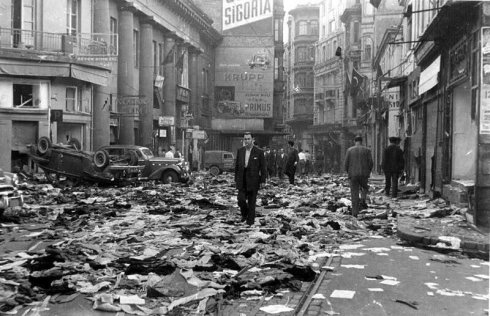
The cosmopolitan feel of Beyoğlu created by the Greeks, Armenians, Jews and Levantines (residents of European descent) who once dominated the area began to disintegrate in the second half of the 20th century, when non-Muslim Istanbullites vacated the area en masse, leaving a wealth of gorgeous, European-style architecture behind as tokens of their once established presence. The devastating anti-Greek pogrom of September 6-7, 1955, set its sights on minority-owned homes and businesses throughout the city, but the damage in Beyoğlu was particularly severe, resulting in a large number of Greeks leaving the country. Just under a decade later, thousands of Istanbul Greeks were expelled from the city as Greek-Turkish relations turned sour over Cyprus, a nail in the coffin for the once robust community and the urbane quality of Beyoğlu.
Krepen Pasajı, with its raucous array of meyhanes run by both Turks and Greeks alike, successfully navigated those complicated twists and turns in Beyoğlu’s social life. The Turks learned the trade from the Greeks, and Yorgo was perhaps the last meyhane proprietor of his kind in Istanbul, where the Greek population has now fallen below 2,000.
 Yorgo and Mustafa opened Krepen’deki İmroz in 1982, but the two had actually worked together since 1970, when a 12-year-old Mustafa was hired on as a busboy in the meyhane where Yorgo was working as a waiter at the time. When they opened their own place, the beginning of a new social life began to take root in Beyoğlu. “In the 1970s, while working in Krepen, there were no female customers. Maybe in a month you would see one or two. Families would not go there,” recalled Mustafa. “The atmosphere was one of vulgar, slang-ridden conversations between men. After we moved to Nevizade in the ’80s, women started to show up, and the men began to watch their mouths.” Kadir’in Yeri (“Kadir’s Place”), one of İmroz’s neighbors from Krepen Pasajı, followed suit by opening on Nevizade under its current moniker, Krepen’deki Kadir’in Yeri.
At that time, Beyoğlu was far from the vast entertainment hub that it is known as today. The back alleys were beyond sketchy, and young people did not go there to socialize, instead heading to the quarters of Ortaköy, Nişantaşı and Etiler, which now rank among the most expensive and luxurious neighborhoods in the city. Krepen’deki İmroz was part of Beyoğlu’s gradual change, which surged after 1988, when the district’s main avenue, İstiklal, was designated pedestrian-only, and the adjacent Tarlabaşı Boulevard was expanded across six lanes.
“Eventually the pavyon segment of Beyoğlu began to transform into one of pubs, cafés and grillhouses, and young people began to come hang out,” Mustafa said, referring to a kind of “gentlemen”-only nightclub where customers would pay to have women flirt with them tableside and which was once a main fixture of the district during its seedier days.
 Dining habits in the meyhane also changed in the post-Krepen era, Mustafa told us. Back then, the meze affair was much simpler: While İmroz’s meze tray today groans with the weight of some 40 selections, it only carried a half-dozen or so in the old days. Not-for-the-faint-of-heart choices such as grilled kidney and ram’s testicles were also on the menu once upon a time, but have since quietly disappeared.
The years treated Mustafa and Yorgo well until recently. Mustafa said that the Gezi Park protests of 2013 and the subsequent iron fist of police violence that slammed down on Beyoğlu for months afterward have irreparably damaged business, sinking revenues by as much as 50 percent. The constant cat and mouse of police and protestors – and the ensuing tear gas – routinely spilled over into backstreets like Nevizade and profoundly affected the area.
“Since we’ve been around for so long, we have been able to stay on our feet. Some of our neighbors are having a harder time,” Mustafa said solemnly.
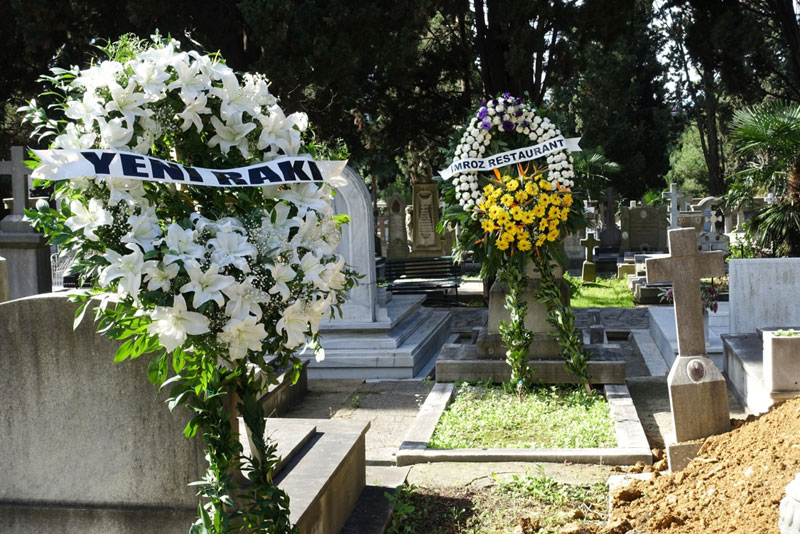
 Many of those neighbors turned up for Yorgo’s Wednesday funeral at the Greek cemetery in Istanbul’s Şişli neighborhood. Meyhane keepers, merchants from the Beyoğlu fish market and waiters, some in their work attire, all came to pay their respects. One man walked through the greeting line wearing an apron. Near Yorgo’s grave was a large funeral wreath from Coşkun Kasap, an old-time Beyoğlu butcher who supplies many of the meyhanes. Not far from that wreath was one sent by Yeni Rakı, Turkey’s largest distiller of the anise-flavored spirit.
Old customers were there in force as well, unshaven, many looking hungover. They smoked and gathered in knots, as if congregating in the dining room of İmroz, all wearing a photo of Yorgo pinned to their jackets. “He was the last of the Mohicans,” Emre, a tour guide and regular, told us. A spice merchant from the fish market said, “He was a four-star human, a beautiful person.”
One old regular of İmroz recalled Yorgo’s occasional temper, which over the years became part of his charm. “Many times I’d do something to annoy him and he’d blow up on me. But that came from his love,” he said. “Love and friendship – that should stay in our minds when remembering Yorgo Baba.”
Yorgo’s son, giving an interview to a television station, simply said, “He was the heart of Beyoğlu, the heart of the fish market.”
Not far from the freshly dug grave, a group of friends caught up with each other. “We’re getting the team back together,” one said. “5:30, İmroz.” They all nodded. “5:30, İmroz!”
Additional reporting was contributed by Ansel Mullins.
(photos by Ansel Mullins, Paul Osterlund and Yigal Schleifer)
–
Comment: nikobakos@gmail.com
–
Tags: Alexandros Massavetas, Ara Guler, Beyoglu, Constantinople, Erdogan, Galata, Gezi Park, Greeks, Hafiz, Hagia Triadha, Inci, Istanbul, Mechanism of Catastrophe, minorities, minority exodus, Pera, Pogrom of 1955, Polites, Speros Vryonis, Taksim protests, Tarlabasi, the Greek Daemon, Turkey, Turks

 Tahini pours into tins stamped with Joyva’s signature sultan logo. Gwynne Hogan
  Workers at Joyva’s confectionary plant in East Williamsburg, which may relocate after 99 years to take advantage of soaring real estate values. Gwynne Hogan
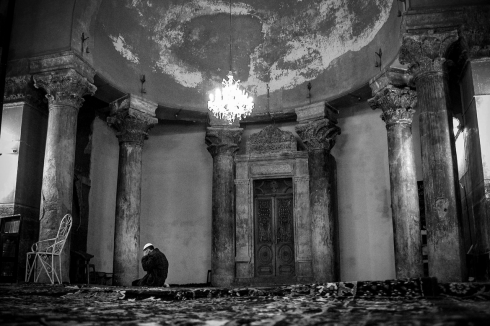






 Jadde: from Bosnia to Bengal