Balkans, Anatolia, Caucasus, Levant and other Middle East, Iran, Afghanistan, South Asia, occasional forays into southern Italy, Spain or eastern Europe, minorities, the nation-state and nationalism — and whatever other quirks or obsessions lurk inside my head.
For years I had hoped that someone, even Turkish Islamists, might have the good taste to remove those hideous green billboards. Instead it just got worse and the puritanism and neurotic iconophobia of monotheism wins out. Oh well. У другом животу…in another life.
I’ve had more than one old Constantinopolitan Greek say to me: You [metropolitan Greeks] call us Byzantines but we’re not any more “Byzantine” than you. “Because when the Conqueror entered the city,” Kyra Smaro says, “he slaughtered any Greeks that had remained.” And this is born out by legit historical sources. Greeks — and other ethnicities of the empire — started repopulating Constantinople, now the Ottoman capital, after Mehmet consolidated his rule; ironically often brought in large numbers by force by the Ottomans to repopulate the almost empty city.
Maybe the inevitable escalation of violence, especially against civilians after the entry of the Turks into the City will make later episodes more disturbing, since The Religion of Peace gives an army three days’ right to loot, murder, rape and enslave if a city resists and doesn’t capitulate on its own.
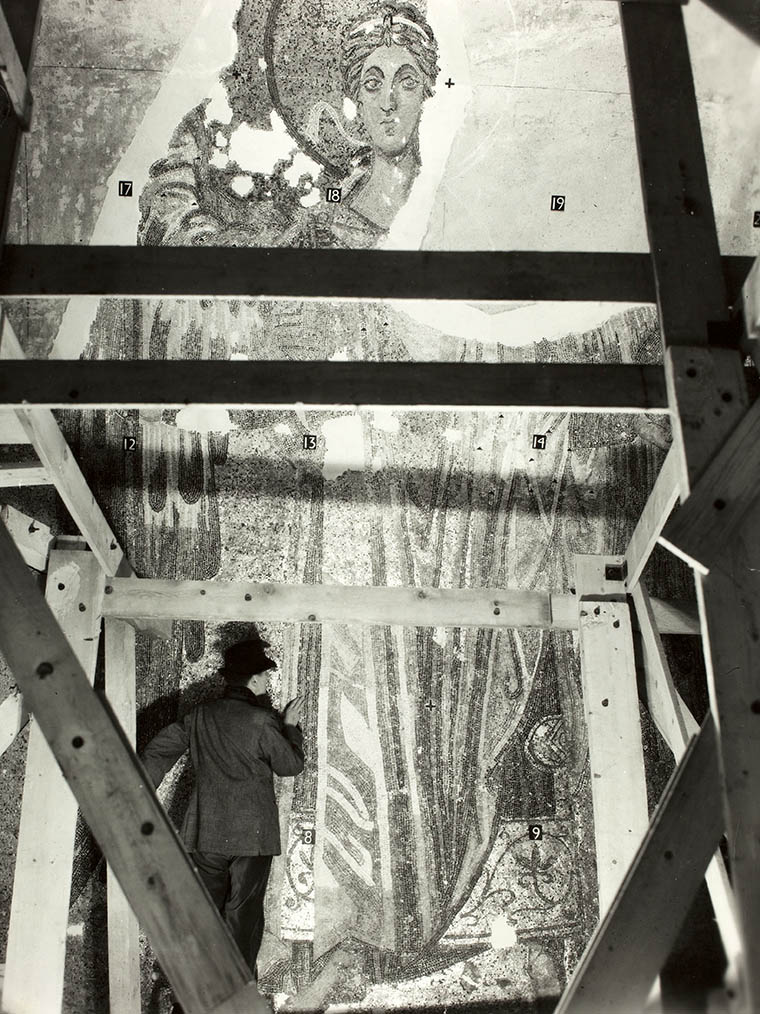
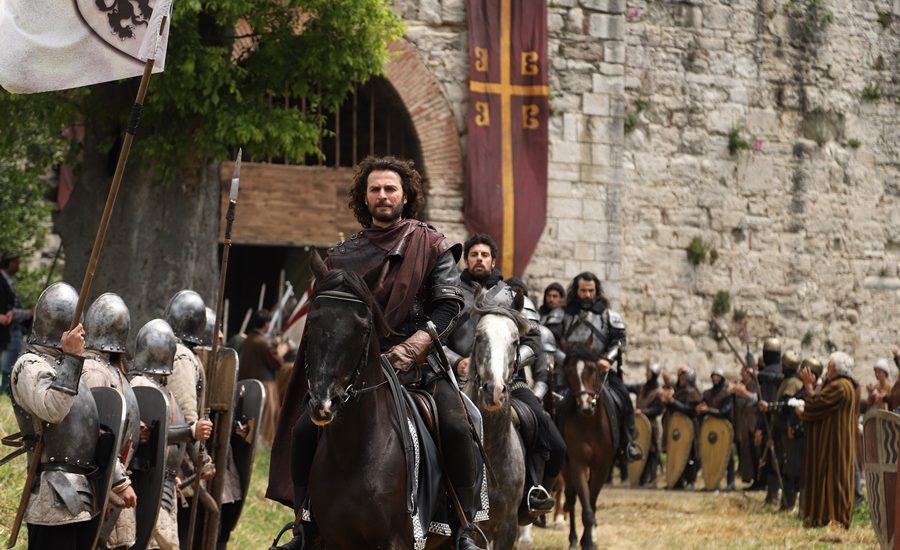
Instead of glorifying the violence, though, the production totally whitewashes it, and I don’t know what’s worse or what I find more annoying. None of the massacring or enslavement of the remaining inhabitants of the City is shown, and though we know for a fact that large mobs of Greeks had packed themselves into a barricaded Hagia Sophia, hoping to be saved there, and that when the Turks finally broke in, everyone in the church was put to the sword (try and remember the butchery in the cathedral in Andrey Tarkovsky’sAndrey Rublev, when the Tatars finally break in), Netflix gives us an infuriating segment of Mehmet tranquilly walking into an empty, sanitized, already de-imaged Hagia Sophia and beatifically walking about in wonder, amazed at the building and the fulfillment of his own miraculous destiny.
And then there’s the sidebar story ofLoukas Notaras, megas doux, the Grand Duke, something like a Prime Minister or Grand Vizier, to Constantine XI:
I do dread the thought of how they’re going to treat the fate of the Notarades, though. It’s much too scintillating to just leave out of the whole narrative, yet to show it to us they’d have to admit that their revered Fatih Mehmet was what we would today call bisexual, and that he was also a cruel sadist, and I don’t know how that would have sat with the Turkish side of the production.
I think we do know that Notaras tried to cooperate with the new rulers and perhaps tried to buy Mehmet off in exchange for his and his family’s safety. But apparently, soon after the fall, Mehmet ordered that he be sent one of Notaras’ handsome sons, Jacob, a notably beautiful teenager, who had inevitably caught Mehmet’s eye, to do…well…whatever with. Notaras refused and Mehmet then had the boy and perhaps his other brothers decapitated in front of his father and then decapitated Notaras himself.
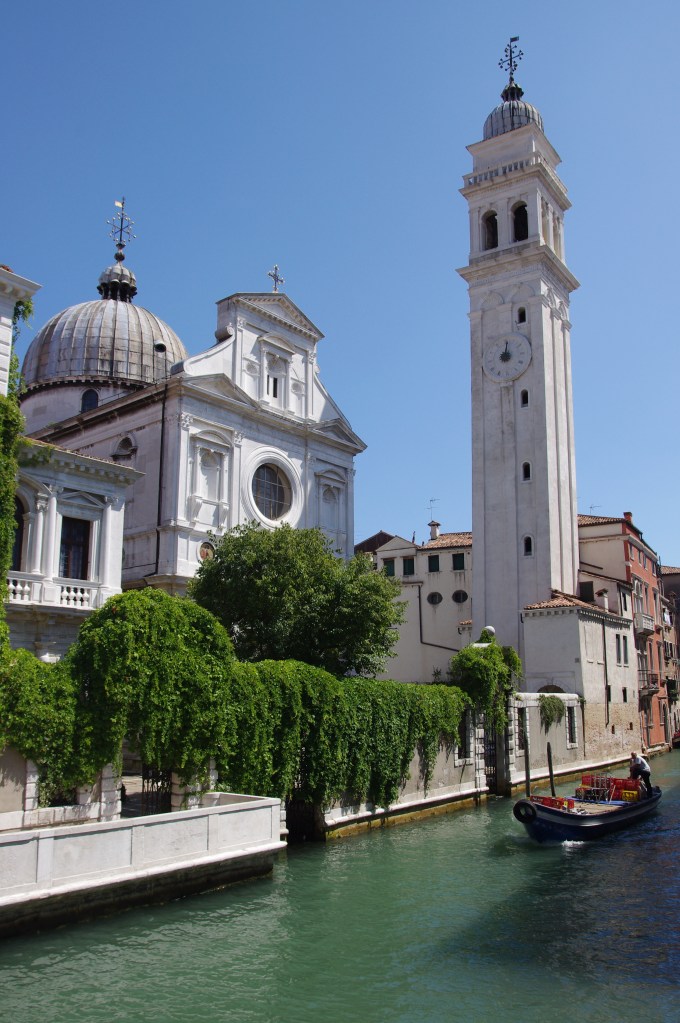
A daughter of the family, Anna, somehow ended up in Venice — whether she had escaped before the fall of the City or not is not clear — but became a sort of Queen Mother in exile and benefactress to the large Greek community there,(Notaras, being a “spins-gold-out-of-thin-air” Greek, had invested most of his wealth in real estate in the Venetian Republic) creating a Greek school and setting in motion the construction of the first Greek church in Venice, San Giorgio dei Greci (below) or St. George of the Greeks, a truly gorgeous church, with an adjacent icon museum that shouldn’t be missed if you’re in Venice next; seriously, it’s one of the sites in the city critical for understanding its role and position in the larger Mediterranean.
And it might seem odd, given that so much of this blog is dedicated to making Greeks’ understand (or accept) their relationship to the East, that I’m now musing on our relationship to the West. But San Giorgio itself is — along with the glorious icons from Venetian Cretan School, along with other things that then come to mind…the unique urban beauty of the city of Corfu, or the couple dances, balos, of the Aegean islands, and the liltingly beautiful music that accompanies them, or reading Erotokritos, or El Greco — among the things that beg the question: “What if?” What if the Ottomans hadn’t prevailed? At least not for so long and over such a huge piece of territory? What would we “look” like now?
Anyway, the story of Mehmet and Notaras’ son, Jacob, is so lurid and full of orientalist tropes about sexually depraved Muslims that it’s hard to know if it’s apocryphal or not (that Mehmet was bisexual, or at least what we would call bisexual today, is not in doubt, however. But, again however, bisexuality was par for the course in the mediaeval Muslim world, as it was in the classical Greco-Roman world which had preceded it, so it was not a particularity or idiosyncrasy of Mehmet’s nor would it have been considered immoral at the time). And some historical sources claim that Jacob wasn’t beheaded but ended up in Mehmet’s harem or serving him at his new court, and later escaped to Venice to join his sister Anna and two other siblings of his. I can tell you one thing: the whole story of the Notarades is so fascinating and complicated that someone should give it a historical fiction chance, print or screen, at some point.
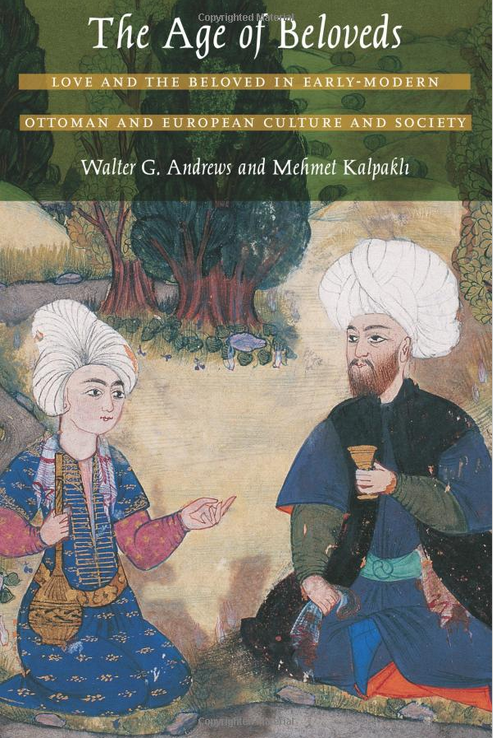
There is this fascinating and kinda wacky book out there, The Age of Beloveds: Love and the Beloved in Early-Modern Ottoman and European Culture and Society, by Walter G. Andrews and Mehmet Kalpaklı, that describes a homoerotic and bisexual court culture that the authors argue existed in both East and West in the early modern Mediterranean, that starts off with the story of Mehmet and the Notaras boy, and that claims the whole incident was a cultural misunderstanding, and that Mehmet was honoring the Notaras family by seeking the intimacy of the handsome young Greek boy. I’m not doing the book justice; it’s complicated and parts are actually very beautiful. Check it out; it’s very interesting.
As for “Ottoman”, it ends up being an atypically Netflixian anodyne treatment of a fascinating historical moment.
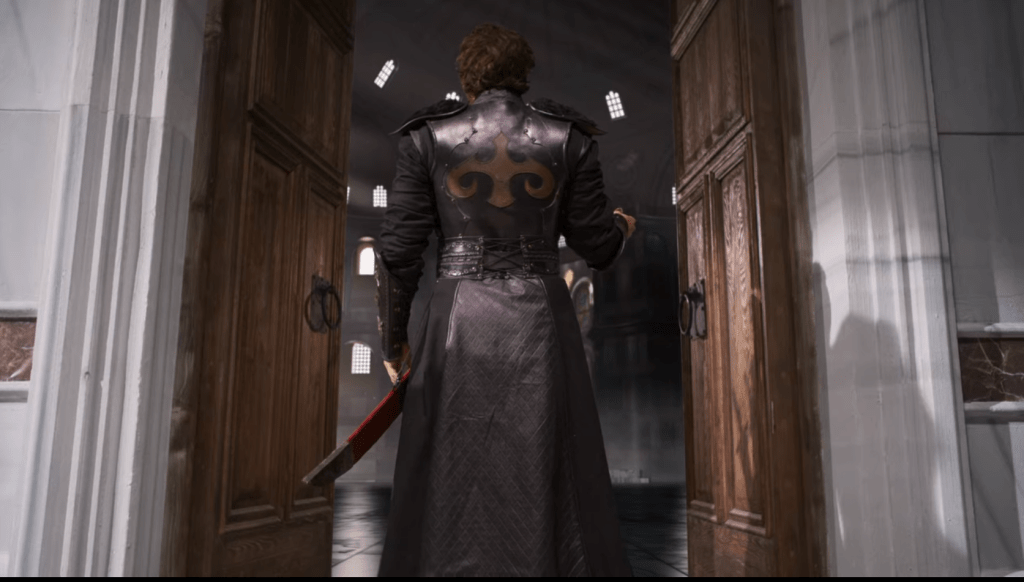
Last night I figured I’d just buck up, get over with it, and start watching the Netflix docudrama — got through first two episodes — and it’s actually pretty good. Some key notes: The Turkish perspective is not insufferably jingoistic or Islamically triumphalist, like it was in that trashy 1453 film that came out a few years ago, which I also put off watching for a while because I thought it would be disturbing, but I ended up turning off after 20 minutes, not because I was disturbed or offended but because the script and acting were so horrendous and the production values so cheap — it looked like the set was composed of stuff bought wholesale from a Moroccan antique shop in the East Village or Çukurcuma– that it was simply unwatchable.
* We’re not portrayed as craven cowards or decadent dinosaurs à la Gibbon, whose destiny it was to float off into extinction. Both Constantine and Mehmet are portrayed as equal opponents, Hector-Achilles style: it’s probably no accident; both were, I’m sure, as acquainted with the Iliad as the other. Constantine’s heroic and complex combination of resistance and resignation are portrayed as thoroughly as possible: he did everything he could until there was nothing to be done anymore; Mehmet’s impressive intellect, cosmopolitanism and warrior skills are highlighted without going overboard. And both are pretty sexy, as is Giustiniani, as is even Notaras père (costumes and sets are beautiful too). I do dread the thought of how they’re going to treat the fate of the Notarades, though. It’s much too scintillating to just leave out of the whole narrative, yet to show it to us they’d have to admit that their revered Fatih Mehmet was what we would today call bisexual, and that he was also a cruel sadist, and I don’t know how that would have sat with the Turkish side of the production.
* Unexpectedly, I thought, we’re called “Romans” from the beginning of the series, in the fictional segments (and I think some of the Italians, Giustiniani even, calls us “Greeks” at one point); there’s more “Byzantine” used in the doc segments obviously. Either way, it’s hard to say whether they wanted to take a calculated risk in doing that, because using “Romans” probably leaves all non-Greek viewers baffled, or because “baffling” and confusing were the desired result for what’s always been the Turkish state’s policy: that is, separating us from the Byzantines/Romans and not giving us our due rights to claim descent for ourselves there, by calling us something different, the same reason Turkey calls Istanbul’s 3,000* remaining Greeks “Rum” to this day, while the rest of us are “Yunan”. It’s satisfying to hear, in any event.
* Whether advertently or not, it punctures some pretty giant holes in the Turkish mythology of heroic feat. One, by admitting the fact that we were outnumbered by the tens of thousands, so that the speed with which, for example, Rumelihisarı was built doesn’t seem quite so miraculous, plus there were already foundations on the site from an older Roman fortress. Two, by showing the glaring technological disparities between the two sides, meaning, that the Siege and Fall of Constantinople was the last great military event between mediaeval fortifications and early modern cannons and artillery, so that instead of being an incredible military achievement, it was more like the Spanish conquest of Tenochtitlán, with as dogged and determined a defense. And enough already with the “genius” of dragging the ships over from what, I would guess, would be somewhere near Kabataş, over the ridge, down Dolapdere into the Horn. It must have taken an enormous amount of manpower — too bad Erdoğan’s tunnel wasn’t there yet — yet not everything that’s just super-hard is necessarily “genius”.
* And stop comparing it to fucking Game of Thrones. GOT was Tolkien with sex and was the most maddening piece of trash to enthrall the masses in a long time. Ottoman is about a series of deeply traumatic events in the history of a real people that still exists, and who have been persecuted and are still threatened and harassed by Mehmet’s descendants to this day: US.
All in all it’s good; watch it. I mean, wtf, whatever. Maybe the inevitable escalation of violence, especially against civilians after the entry of the Turks into the City (The Religion of Peace gave an army three days’ right to loot, murder, rape and enslave if a city resisted and didn’t capitulate on it own) will make later episodes more disturbing. And the long arm of Erdoğanism is always felt throughout the whole thing. If Netflix were to produce a series portraying the destruction of the Second Temple and the horrendous brutality with which the Romans massacred and expelled most Jews from Judaea that made the Romans look even slightly heroic for even a second — “due to be released next Tisha B’av” — there’s not even a question of whether it would face a howling riot of protest or not; it would simply never have been produced. That’s not a “Jews control Hollywood” argument. It’s the truth. Just too many people would be offended. But even as Turkey sinks deeper into self-isolating dictatorship, it does wonders projecting a certain image to the rest of us and the rest of the Ummah.
But, at best it’s an exercise in what Helequin above calls “understand-[ing] an oppenents [sic] mythology”. You don’t have to be a trained Jungian to understand (or at least try) that “myth” is the only “reality”. That means understanding the other’s myth/s is crucial to the development of empathy, the one form of intelligence that homo sapiens [?] are still tragically deficient in.
It’s certainly the only thing in Palestine, or between Hindu and Muslim in India, and in the continuing bad divorce that is Greek-Turkish relations that will inevitably make a difference. Put yourself in a Turk’s position. Think about the massive baggage of tradition around the idea of taking Constantinople that animated them. And then [smerk]… put yourself in our position: if everybody wanted it so badly for 1,200 years, it must have been one puta madre of a city we had built there.
And in the 19th and 20th centuries, we built them another real city — “over there” — the likes of which they also had never known, and they threw us out of there too.
What are you gonna do? After a certain point, anger is too tiring. And they pay and are paying the price for their political culture anyway.
************************************************************************* The number of Greeks today in Istanbul is somewhere in the 2,000 to 3,000 range, there’s an issue of whether deaths and marriages and births will keep things in the range of critical mass… Near 300,000 in a city of around a million in the 1920s, three-thousand — in a city of 15 million today.
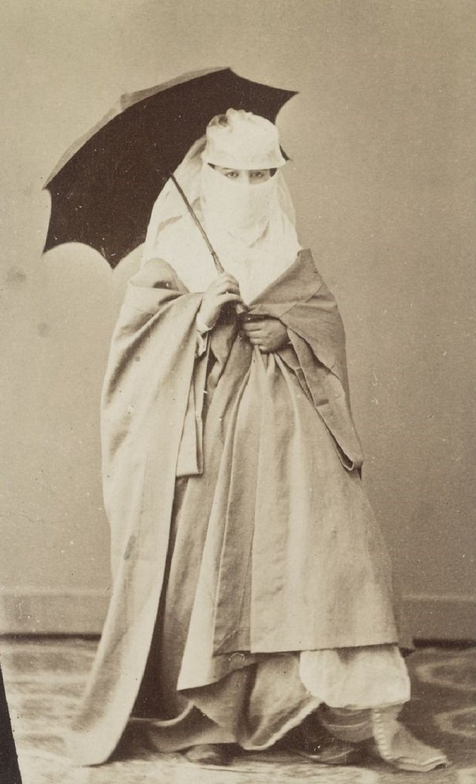
Jeez, you know, I don’t want to be snide, but what’s being photographed here? Is it the umbrella? Is it so her children and grandchildren can remember how blindingly white her mandyli always was? How gracefully the kimono-like folds of her doulama always fell? The embroidered edges of her salwaria against her elegant pasoumakia?
Why is she, herself, even in the picture?
Vah, but Ayşe Teyze‘s eyes always gliterred when she smiled… Vah va…
But wait… Is that Ayşe Teyze?………
Portrait of a Woman, Istanbul, 1870s Bir İstanbul Kadını, 1870’ler
Do you think these photos were actually used as family photos? I always saw these photos (and there are a LOT of them) as made for westerners, and serving a few purposes.
I think there’s the “look at how strange/exotic these musselmans are!” angle, for sure. But have you ever seen a studio photo of a tribal woman with a veil on? I haven’t seen any that I can think of.
More often than not, these studio photos feature (very pale) women in very fashionable Western clothes, with either a super sheer veil, or a super (blindingly white, for instance) obvious one. I think they were intentionally designed as sexual objects – they demanded the viewer imagine what was underneath. And I’m sure some Victorian dudes were more than happy to oblige.
The other photos of women that were part of these commercial sets tend to be darker women lounging seductively with nargiles. Those are pretty clear in their intentions, I think.
These “hidden” ladies are just a sexy lady with the added benefit of performing their upper classness, right? I don’t see religiosity in them anywhere.
Maybe this is all obvious, and you were just being funny. But I spend a lot of time typing “Istanbul” into digital image collections and not having anyone to share my critique of what I find. ;)
*************************************
Alison,
I was trying to be funny but I’ve clearly failed. Here I was trying to be snarky about Islam and the covering of women (I’ve seen plenty of these photos around C-town and it never occurred to me — naivëly that they were posed any tourist objects of any kind. As you rightly point out: “These “hidden” ladies are just a sexy lady with the added benefit of performing their upper classness, right? I don’t see religiosity in them anywhere.) Instead they flipped a perfect Orientalist ippon on me.
Share some more of these with us? I and reader will greatly appreciate. Come to New York, chavala
Jeez, you know, I don’t want to be snide, but what’s being photographed here? Is it the umbrella? Is it so her children and grandchildren can remember how blindingly white her mandyli always was? How gracefully the kimono-like folds of her doulama always fell? The embroidered edges of her salwaria against her elegant pasoumakia?
Why is she, herself, even in the picture?
Vah, but Ayşe Teyze‘s eyes always gliterred when she smiled… Vah va…
But wait… Is that Ayşe Teyze?………
Portrait of a Woman, Istanbul, 1870s Bir İstanbul Kadını, 1870’ler
This is seriously disturbing. I mean I theoretically “hate” Venice as much as the next Roman, but there are wacky amateur Byzantinists on-line who are gloating about the destruction because they’re loons who consider this disaster retribution for 1204and the Fourth Crusade and they’re just ridiculous. We’re losing what may be humanity’s most beautiful city. I, at least, think only Rome and Paris even come close.
The infuriating thing is that so much can be done. The dam walls that can be raised in storm conditions to keep the lagoon safe from Adriatic floods have been held up for years by Italian bureaucracy and corruption. The siphoning off of the city’s ground water tables by mainland industries has not been stopped. Even something that should be as easy as banning huge cruiseships, which cause waves that eat at buildings’ foundations has not been banned, as far as I know. The destruction of Venice is not inevitable.
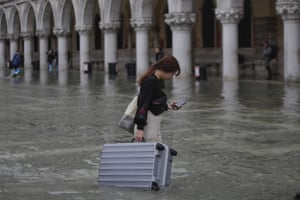
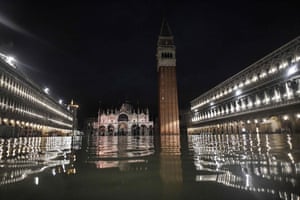
A woman crosses the flooded Piazza San Marco. Photograph: Marco Bertorello/AFP via Getty Images
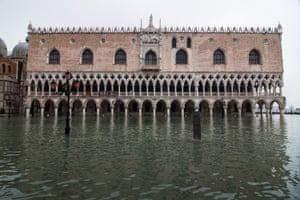
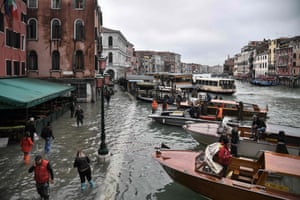
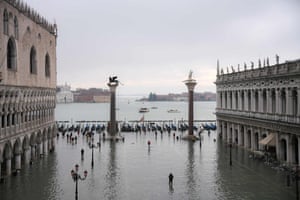
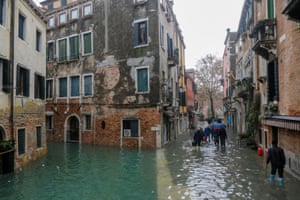
Flooding in the canal city has reached its highest level since the 1960s. The high-water mark hit 187cm (74 inches) late on Tuesday, leaving more than 85% of the city under water. In 1966, the highest level recorded was 198cm (78 inches).
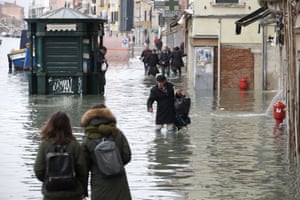
The Doge’s Palace in Piazza San Marco. Venice was hit by the highest tide in more than 50 years late on Tuesday, with tourists wading through flooded streets to seek shelter as a fierce wind whipped up waves in St Mark’s Square.
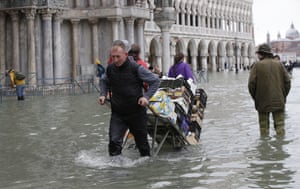
A greengrocer pulls his cart through high waters Photograph: Luca Bruno/AP
A tourist carries her luggage in a Piazza San Marco
Photograph: Luca Bruno/AP
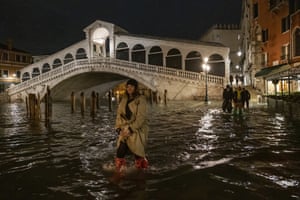
The flooded embankment by the Hotel Rialto (left) and the Grand Canal, seen from the Rialto bridge. Photograph: Marco Bertorello/AFP via Getty Images
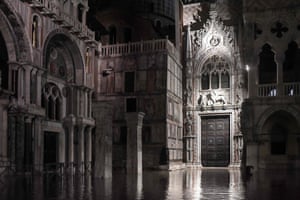
The flooded Piazza San Marco, the Doge’s Palace (left), the Lion of St. Mark winged bronze statue and the Venetian lagoon after the exceptional overnight high tide water level. Photograph: Marco Bertorello/AFP/Getty Images
Venetians make their way through flooded streets. Photograph: Manuel Silvestri/Reuters
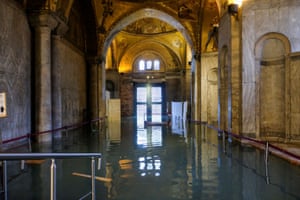
The flooded crypt of St Mark’s Basilica. Photograph: Manuel Silvestri/Reuters
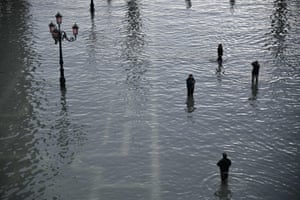
People wade through water during the high tide. Photograph: Luca Bruno/AP
Venetians cross the Piazza San Marco. Photograph: Marco Bertorello/AFP via Getty Images
St Mark’s Basilica and the Doge’s Palace on the flooded Piazza San Marco. St Mark’s Basilica was flooded for the sixth time in 1,200 years. Four of those inundations have come in the last 20 years, most recently in October 2018. There was no immediate word on any damage inside the church. Photograph: Marco Bertorello/AFP/Getty Images — In 2018, the administrator said the basilica had aged 20 years in a single day.
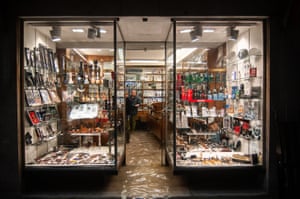
Shopkeepers survey the damage. Photograph: Simone Padovani/Awakening/Getty Images
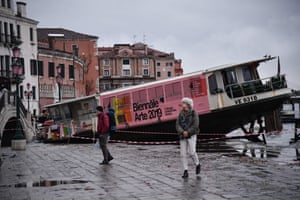
People walk past a stranded taxi boat on Riva degli Schiavoni. Photograph: Marco Bertorello/AFP/Getty Images
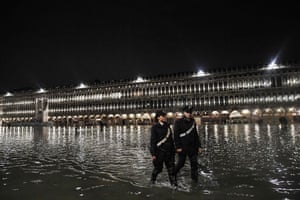
Police patrol the flooded Piazza San Marco, which was submerged in more than one metre (3.3 feet) of water. Photograph: Marco Bertorello/AFP/Getty Images
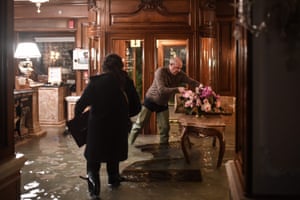
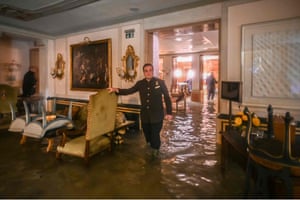
Employees of the Gritti Palace protect furniture. Photograph: Marco Bertorello/AFP/Getty Images
The flooded Piazza San Marco. Venice’s mayor blamed climate change for the ‘dramatic situation’ and called for a speedy completion of a long-delayed project to construct offshore barriers.
A room in the flooded Gritti Palace. Photograph: Marco Bertorello/AFP/Getty Images
A tourist walks near the Rialto bridge. Photograph: Stefano Mazzola/Awakening/Getty Images
“I would love to see these people try and live somewhere like Pendik or Küçükçekmece, and commute to work for 4 hours total/per day in crowded public transport for 3,000 TL/month… like most of Istanbul… and then see what they have to say.
“At least these people aren’t as terrible as the (appallingly numerous) Westerners who think Dubai is a lovely holiday destination.”
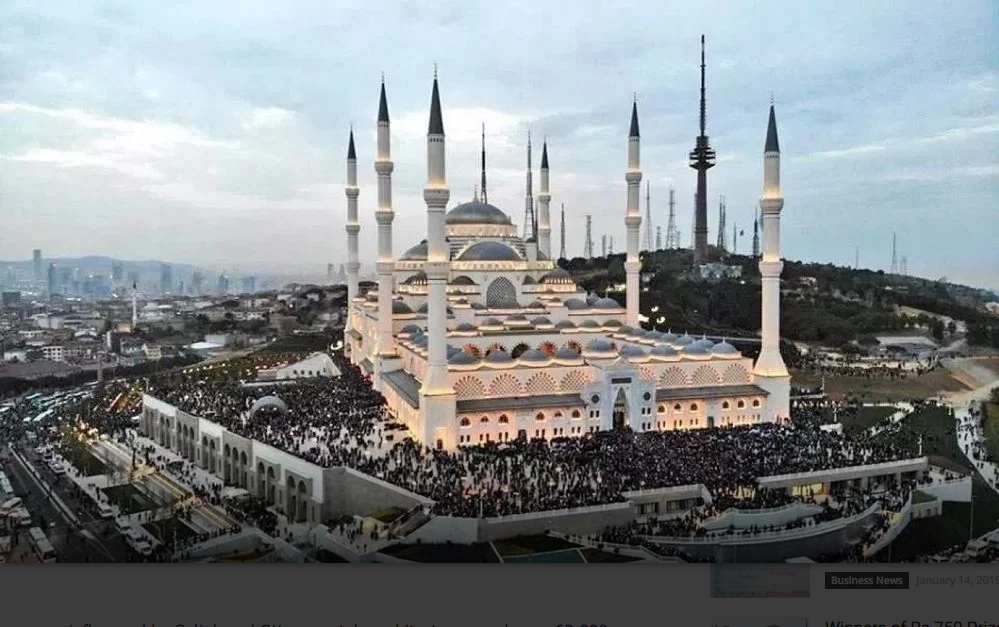
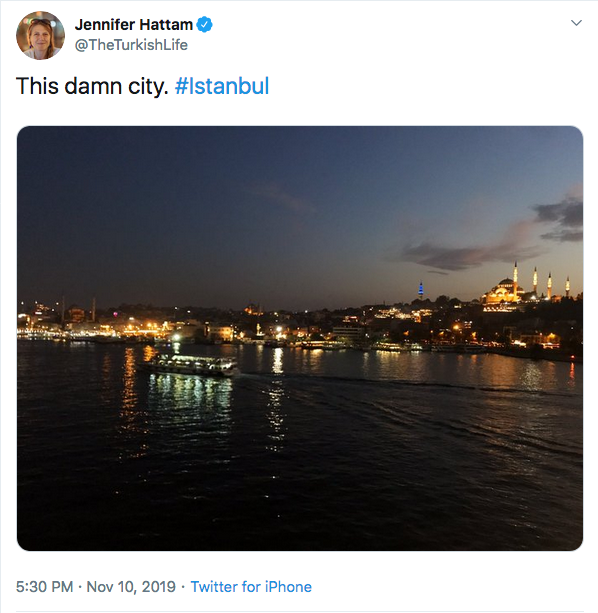
Dubai? Who needs Dubai when Erdoğan builds hideous and hubristically six-minaretted mosque monstrosities like this:
For 2,676 years, the Megaran Greeks who founded the city, the Romans, meaning the the Italian ones and us, and the Ottomans only built things that added to the beauty of Istanbul. Only Erdoğan had the arrogance to build something so hideous on a site so conspicuous that it mars the entire sea-landscape, horizon and view of the City.
…are so blissfully ignorant of how much ugliness and violence went into creating the questionably “beautiful” city you see today. Your type probably wept in the 90s (if you’re even that old), along with Susan Sontag and Angelina Jolie, for the violent segregation and ethnic cleansing that evil Serbs inflicted on poor Sarajevo. But there’s apparently a statute of limitations on such crimes where Istanbul is concerned. And if, like most ex-pats, your existence is pretty much limited to the axis between Karaköy to Bebek — maybe some 0.5% of the territory of the city — with an occasional foray to the islands or to Kadıköy to go eat at AKP Çiya, and you’ve ingested enough Turkish tourist propaganda, then you’ll believe anything.
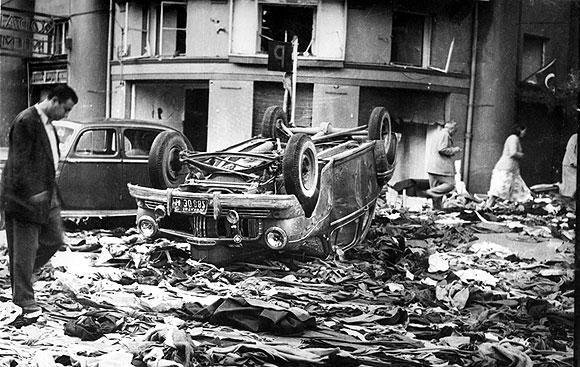
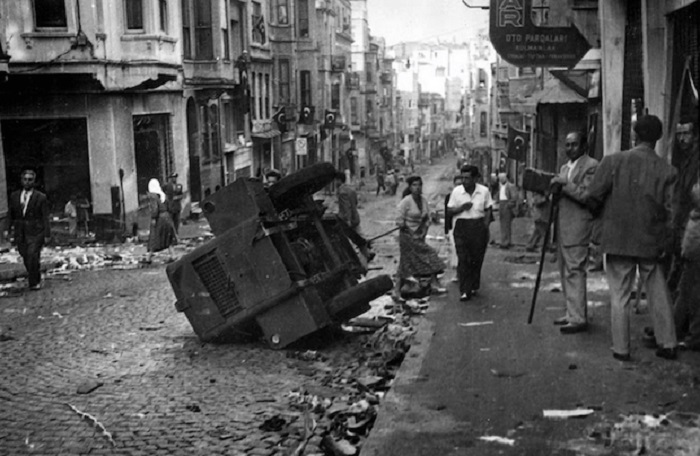
You know nothing about Istanbul. You know nothing of the violence, massacre, pogroms, property destruction and confiscation, discriminatory taxation and imprisonment, expulsions and deportations that created the wonderful East-West playground you love so much. You know nothing of the genuine Mediterranean worldliness that’s been displaced by rural Anatolian puritanism. You know nothing of the last muhallebici in Pera that’s been replaced by another kitschy restaurant with women in salwar and headscarves kneading flatbreads in the window. You know nothing of the subtlety and sophistication of the City’s cuisine that’s been totally replaced by the monotony of kebab/köfte joints that you think are authentic and cool.
Yes, it still has a modicum of its old charms. And it’s hard to beat its stunning physical location, though the Padishah’s monster kitschario-mosque has managed to mar even that. But mostly, Istanbul today is a Baudrillardian simulacrum of the city that it was for centuries. And you buy it up. It’s a massive — and aside from the axis mentioned above — hideous monstropolis of 15 million, 99.9% of whom are Turkish or Kurdish Muslims, and yet still manages to sell itself as multicultural.
Look at what a tiny bit of the actual city you really have any relation to:
And how ignorant you are of even the neighborhoods that you do move about in. How clueless you are about who used to live there. (see below)* About who was displaced to house you and your Turkish yuppy friends. The zoning corruption that’s destroyed neighborhood after neighborhood and the woodlands and wetlands of the City’s environs and replaced them with massive high-rise developments that make the Queensbridge Houses in New York look like the Place des Vosges. The megalomaniacal mega-mosques disfiguring Taksim or Çamlica, that are more Riyadh or Dubai than Istanbul. The cheezy, glitzy Gulfie shopping malls…
Plus, how glibly non-concerned you seem to be about political developments…Islamist dictatorship…more imprisoned journalists than any other country in the world…whatever.. It’s exhausting to even talk to you.
This “DAMN” city is right.
Enjoy your Turkish Life.
Oh, that’s the Sülemaniye on the right, isn’t it? and the Yeni Camii in the distant left?
“All – I thought a lot about whether I should use “almost all” in this sentence and decided against it –becauseall the hippest, funkiest, most attractive, gentrified neighborhoods in the historic parts of İstanbul are neighborhoods that were significantly, if not largely, minority-inhabited until well into the twentieth century: not just Pera and Galata, but Cihangir and Tarlabaşı, and even Kurtuluş — of course — and up and down the western shores of the Bosphorus and much of its eastern towns too, and central Kadiköy and Moda and the Islands. (And if serious gentrifying ever begins in the old city it’ll be in Samatya and Kumkapı and Fener and Balat; I wouldn’t put any big money into Çarşamba just yet.) If young Turks are fighting to preserve the cosmopolitan character of areas made cosmopolitan by a Greek presence, among others, is it a recognition of that presence, however vestigial, that I want? Yes. Is it because some recognition might assuage some of the bitterness of the displacement? Perhaps. Is the feeling proprietary then? Does the particular “cool” quality of these neighborhoods that protesters have been fighting to protect register for me as a form of appropriated “coolness?” I’m afraid that yes, sometimes it does. In darker moments this spring and summer, these Occupy Gezi kids annoyed me: “What’s wrong mes p’tits? The Big Daddy State threatening to break up your funky Beyoğlu party? Do you know the Big Daddy State made life so intolerable for the dudes who made Beyoğlu funky that they not only had to break the party up, but shut down shop altogether and set up elsewhere? That your own daddies and granddaddies probably stood by and watched, approved even? Do you know that now? Do you care?”
“As the villagers fled to Diyarbakir from the surrounding areas, it became a Kurdish city. In time, the Diyarbakir Kurds began to recognize that their role in the genocide was a kind of original sin in their modern political history. “I remember this one Armenian priest,” Demirbaş told me. “A Kurd was insulting him, and this priest told him, ‘We were the breakfast for them, you will be the lunch. Don’t forget.’ And that was important for me.'”” [My emphasis]
While we’re on Armenians, at a time when Syria plunges more deeply into hell than we had ever thought possible, when the West abandons the Kurds to Erdoğan and Assad, proving again that the U.S. is Turkey’s hamali, or that Turkey’s tail wags the dog, if you prefer, a historical reality check might be called for.
The American and almost every other media might be too superficial or too impatient to dig so deep historically because they’d lose their audience, but there is one, and one big thing that disproves Donald Trump’s assertion that Turks and Kurds have been fighting each other for centuries and are “natural enemies“ (see video below). And that is the fact that perhaps the greater portion of the massacres of Armenians and other Christians in eastern Anatolia during the last decades of the 19th c. and first two and a half decades of the 20th c. were conducted by Kurds.* Not by the Ottoman military, but by Kurdish para/irregular forces or just Kurdish tribal chieftains craving more land and authority and wealth, and conducting/justifying their campaigns of mass murder with the rippling green banner of Islam, under which Turks and Kurds were just brothers in defense of the faith. Only when the forces of modern nationalism started displacing the older bonds of religion and empire, did Kurds arguably start to feel themselves a separate entity from Turkish Muslims, and did the power of clan loyalties shift from semi-feudal to Kurdish nationalist ones; it’s even arguable that Republican Turkey’s anti-ağa, anti-religious and Turkification campaigns stoked the fires of the new Kurdish nationalism more than anything else. (Somewhat of a similar process occurs between the Ottomans and Muslim Albanians in the early 20th c., and Orthodox Greeks and Orthodox non-Greeks: Bulgarians, Macedonians, Vlachs, Albanian Christians — as the latter groups discovered/invented new identities to replace the old religious-institutional bonds.)
An Armenian woman and her children who were refugees of the massacres and sought help from missionaries by walking far distances. Photo unknown provenance.
So I’m sorry that couldn’t counter Trump’s claims ofeternal Turkish-Kurdish enmity with something pretty about how — on the contrary — eternally well they have gotten along but rather by implicating both parties in coordinated mass murder. And forgive me the occasional snicker at Greek pro-Kurdish poses and the general sanctification of Kurds that we’ve witnessed in the past couple of decades.
Armenian victims of the massacres being buried in a mass grave at Erzerum cemetery. Photo unknown provenance.
* From Wiki:
(“In 1890-91, at a time when the empire was either too weak and disorganized or reluctant to halt them, Sultan Abdul Hamid gave semi-official status to the Kurdish bandits. Made up mainly of Kurdish tribes, but also of Turks, Yöruk, Arabs, Turkmens and Circassians, and armed by the state, they came to be called the Hamidiye Alaylari (“HamidianRegiments“).[16] The Hamidiye and Kurdish brigands were given free rein to attack Armenians, confiscating stores of grain, foodstuffs, and driving off livestock, and confident of escaping punishment as they were subjects of military courts only.) [my emphasis]
And not just eastern Anatolia. Istanbul’s Kurdish population played a major role in the 1896 Hamidian Armenian massacres in the City, where hundreds were killed right there in Pera, in ab-fab Beyoğlu, in the middle of the elegant, Beaux Arts, now garish and overlit Istiklâl. Referred to this before and to how brilliantly these events are handled in the “Duck with Okra” chapter in Maria Iordanidou’sLoxandra.
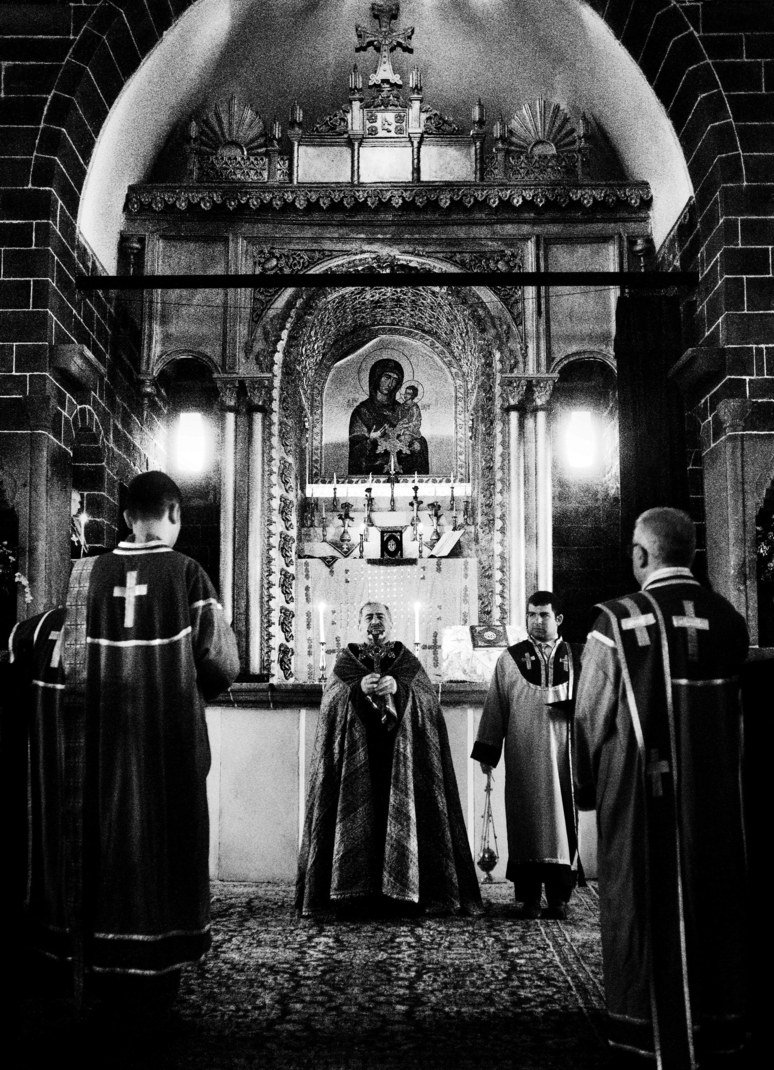
Only fair, however, that I include a reference to this 2015 article from The New Yorker, “A Century of Silence: A family survives the Armenian genocide and its long aftermath.“ by Raffi Khatchadourian, in which the then mayors of Diyarbakır and the separate municipality of the Old City, Osman Baydemir and Abdullah Demirbaş respectively, apologize for the Kurdish role in the Armenian massacres and rebuild and restore the city’s main Armenian church, Sourp Giragos (Hagios Kyriakos in Greek) and allow it to function (see photo above) for the handful of Armenians left in the city. Khatchadourian‘s article has some beautiful photos too by Pari Dukovic.
“We Kurds, in the name of our ancestors, apologize for the massacres and deportations of the Armenians and Assyrians in 1915. We will continue our struggle to secure atonement and compensation for them.”
But “bully” is such an apt term for the Turkish Republic and the Turkish body politic (“thug” also comes to mind), that I think anything that puts Turkey in its place is a positive development.
A march in Los Angeles in April commemorated the 104th anniversary of the Armenian genocide. Credit…Mario Tama/Getty Images
Power’s money quotes:
Although Turkish officials may see the vote as retaliation for Turkey’s recent forced displacement of Syrian Kurds, that operation — as well as President Recep Tayyip Erdogan’s sweeping human rights crackdown in Turkey and his purchase (over American and NATO protests) of a Russian air defense system — simply reduced the impact of Turkish blackmail.
……..
First, as a baseline rule, for the sake of overall American credibility and for that of our diplomats, Washington officials must be empowered to tell the truth.
Over many years, because of the fear of alienating Turkey, diplomats have been told to avoid mentioning the well-documented genocide. In 2005, when John Evans, the American ambassador to Armenia, said that “the Armenian genocide was the first genocide of the 20th century,” he was recalled and forced into early retirement. Stating the truth was seen as an act of subordination.
When I became ambassador to the United Nations in 2013, I worried that I would be asked about the Armenian genocide and that when I affirmed the historical facts, I could cause a diplomatic rupture.
Second, when bullies feel their tactics are working, they generally bully more — a lesson worth bearing in mind in responding to threats from China and Saudi Arabia. The Turkish government devotes millions of dollars annually to lobbying American officials and lawmakers: more than $12 million during the Obama administration, and almost as much during the first two years of the Trump presidency. Turkish officials have threatened to respond to genocide recognition by suspending lucrative financial ties with American companies, reducing security cooperation and even preventing resupply of our troops in Iraq.
On Friday, the Turkish ambassador warned that passage of the “biased” House resolution would “poison” American-Turkish relations, and implied that it would jeopardize Turkish investment in the United States which provides jobs for a “considerable number of American citizens.”
It is easy to understand why any commander in chief would be leery of damaging ties with Turkey, an important ally in a turbulent neighborhood. But Turkey has far more to lose than the United States in the relationship. The United States helped build up Turkey’s military, brought it into NATO and led the coalition that defeated the Islamic State, which carried out dozens of attacks on Turkish soil. Over the past five years, American companies have invested some $20 billion in Turkey.
If Mr. Erdogan turns further away from a relationship that has been immensely beneficial for Turkey in favor of deepening ties with Russia or China, it will not be because the House voted to recognize the Armenian genocide. It will be because his own repressive tactics are coming to resemble those of the Russian and Chinese leaders. [my emphases]
Balkans, Anatolia, Caucasus, Levant and rest of ME, Iran, South Asia
Me, I'm Nicholas Bakos, a.k.a. "NikoBako." I'm Greek (Roman really, but when I say that in English some five people in the world today understand what I'm talking about, so I use "Greek" for shorthand). I'm from New York. I live all over the place these days. The rest should become obvious from the blog.












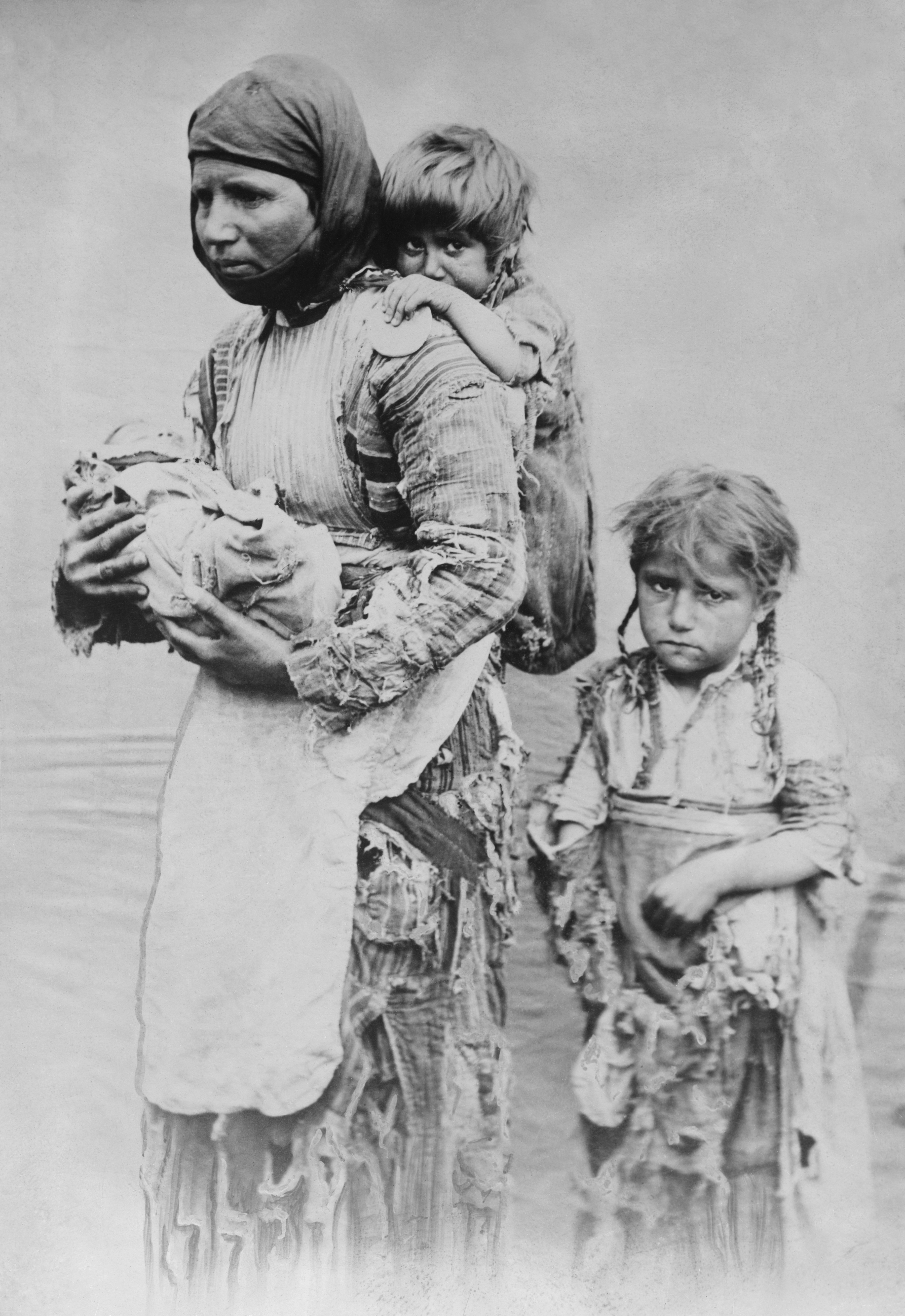 An Armenian woman and her children who were refugees of the massacres and sought help from missionaries by walking far distances. Photo unknown provenance.
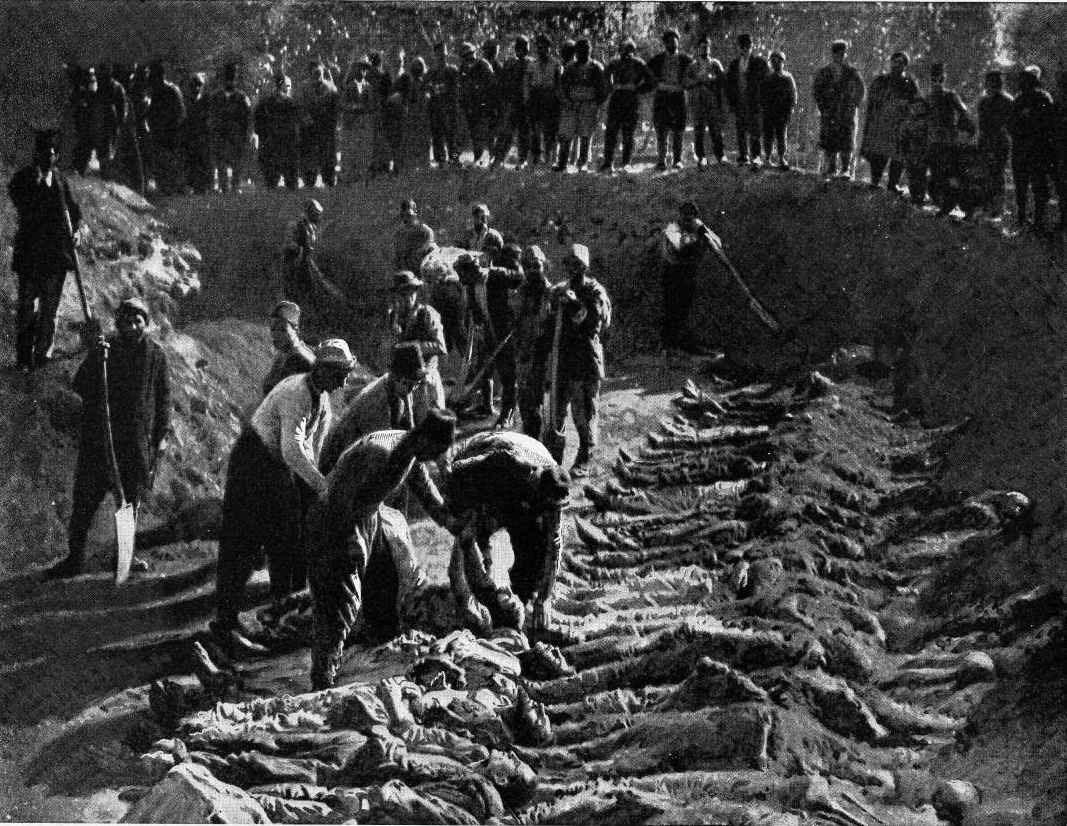 Armenian victims of the massacres being buried in a mass grave at Erzerum cemetery. Photo unknown provenance.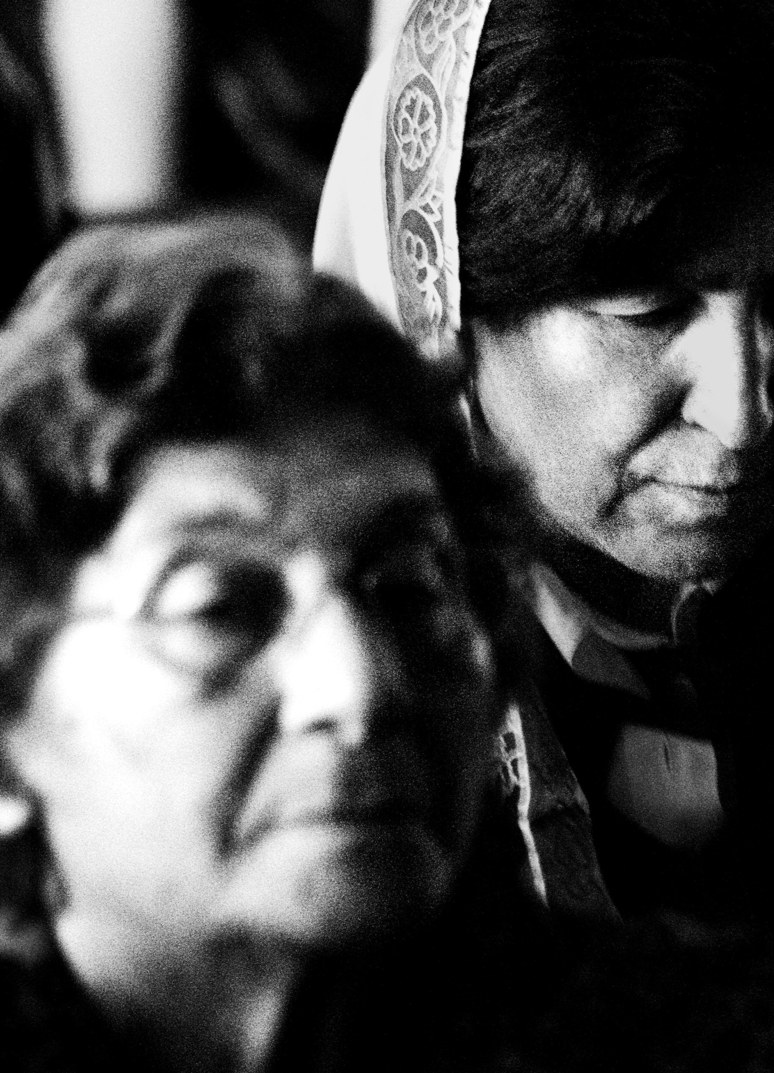

 Jadde: from Bosnia to Bengal