Tag Archives: Croatia

Times: “Top Secret Russian Unit Seeks to Destabilize Europe, Security Officials Say”

8 Oct

No kidding.  Is this a surprise to anybody? 

Someone I know in the Greek foreign service once said to me that he thinks Western policy towards Russia is not even leftover post-Cold War, but that it’s perhaps even an unconscious but very persistent and irrational remnant of Great Game mentality left over in the Anglo-Saxon world/mind that influences the rest of the West.  And if you know a bit, that’s a smart analysis.

But even if you start from there you immediately have to turn to the chicken-or-the-egg dynamic that’s happening here and that has obtained in the world’s policy towards  Russia and vice-versa for almost forever.  You can’t always treat Russia like the big, drunken thug that needs to kept out of the club by the bouncers and not expect them to react with a defensive — and offended — stance.

It seems impossible to get out of the West’s mind the sense that Russia is an inherent enemy that needs to constantly and aggressively be watched and contained instead of accepted, and expect it to not be actively aggressive in return.  What “accepting” Russia would mean exactly is tricky and needs to be thought out — but needs to be given a chance in terms of policy.  We might get our rocks off by saying that Putin is a bad, strong-man who’s unacceptable in x amount of ways, undemocratic blah blah.  But some thoughtful expressions of good will towards Russians might eventually be the precisely the “soft power” that prods Russians on to getting rid of Putin themselves — and all the other huge flood of positive changes that might, and will, come in his eventual disappearance from the scene.

I’ve said before, in “Syria, Russia, ISIS and what to do about everything” :

“First and foremost and again: let Russia in. ENGAGE RUSSIA. We all have everything to gain and nothing to lose if we stop treating Russia like a pariah nation. Russian power is not a threat and can instead prove massively useful to the world if we bring Russia into the fold instead of trying to desperately keep her out of everywhere and even foolishly try and fence her in. It may be a little more complicated than a simplistic “more flies with honey” theory but whatever it is we choose to describe as Russian aggression, Russia sees as defensive and that may not be an irrational response from a powerful nation that sees itself treated as an amoral being that is constantly excluded from all the West’s major moves.

“And I’m talking about radical engagement: not just lifting sanctions and trade blocks and visa requirements. I’m talking about making Russia a part of the European family of nations, as laughably dysfunctional as that family may be looking right now. Why are Montenegro or Georgia on the list of candidates for NATO membership — Montenegro probably as some sleazy old promise offered to it if it seceded from Serbia; and Georgia, one of the oldest polities in the Russians’ sphere of influence (for better or worse and partly of its own initiative at the start) and with a complicated love-hate relationship between them – while Russia itself is not?  Too big to absorb. Well, yes, but my point is to stop thinking of her as an entity to control and absorb and start thinking of her as a political and especially military power that’s just too enormous to not have as an ally in the current struggle we’re engaged in.

“ISIS (and Turkey to some degree) ticked off the Russians bad and they have already done more to weaken the “caliphate” in the past few weeks than all other Western actions combined. Is it escalating the conflict? There is no escalating this conflict: when your enemy is sworn to escalate it to the maximum, and there’s no reason to think they’re bluffing, you’re already there. Yes, there’s reason to fear that Russia – which uses Powell-Doctrine-type “overwhelming force” more than the United States ever has – will go too far and turn central Syria and Raqqa into a Chechnya and Grozny, but the best way to limit those kinds of excesses are to enter into some coordinated action with Russia and not just allow her to act alone. Because we’re going to need Russia when the air campaign needs to stop, when at some point it will. And that’s when I predict that Russia will also be willing to send in men on the ground and I don’t mean just a few special operations groups. While they’re certainly not eager to send their young men off to die in another Afghanistan or Chechnya, this has already – again, for better or worse – become a sort of Holy War for Russians and they will be far less squeamish about sending in troops than any other European society or even the United States at this point. And working with them on such an operation will not only increase its efficacy but limit the risks and excesses.

“In the end bringing Russia in from the outside will also change it from the inside; as the nation itself feels less like it has to be on the constant defensive, then so will the Russian government adopt a more open and progressive attitude to its own internal political life.   This is what we saw happening in Turkey in the early 2000s when European Union accession was still a negotiable reality; much of what Turkey and Erdoğan have turned into since are a result of those cards being taken off the table. Do it for everyone then, for us and for them. Engage Russia; it’s a win-win proposition.

And in The first two of my cents on Ukraine and Russia…“:

“So treating Russia like a pariah will only play into Putin’s hand.  That’s, in fact, what has happened; the whole country has fallen in line behind him and anything like the РОССИЯ БЕЗ ПУТИНА — “Russia without Putin” — protests of two years ago would be considered, in a spontaneous act of socially unanimous censoring, pure treason these days with no one even daring to publicly air such opinions in the current heady climate of nationalist excitement.”

“History, climate, geography have always conspired to isolate Russia.  And, in a sense, the pathos that drives Russian history and is the force behind her brilliant civilizational achievements (and, yes, her imperialism too), is  that of a constant, heroic struggle to break out of that isolation and find her place in the larger world.  Yacking on, like Snyder, about how Ukraine is somehow “essential” and central to the very idea of Europe (when, ironically, it’s very name means “the edge”…the edge of what? of Russia/Poland…the EDGE of Europe…what an elevation of status Snyder grants Podunk…), while treating Russia as dispensable or as a dangerous threat that needs to be hemmed around and contained — isolated again — is criminally unfair to Russians (if not to Putin and his cronies) and will end up backfiring on the West in ways it hasn’t even begun to anticipate.  Russia is not dispensable.  Nor is she to be ignored or patronized.  We think of her in those terms and the results will just get uglier and messier.”

Comment: nikobakos@gmail.com


Wow! Someone dares at least a couple of paragraphs of truth on Croatia — I can barely believe it

7 Oct

From New Statesman — Croatia: the fragile heart of the Balkans

“The consensual view of the war of the 1990s, which Croatians call the homeland war, is that the Serbian clique around Slobodan Miloševic was overwhelmingly to blame but that there were also Croatian atrocities (the best short account I know is in Tony Judt’s 2005 masterwork, Postwar). Not all of these are yet fully accounted for, mainly because the Croats – as both victims and victors – have not had the reckoning that comes with defeat.

“Yet that is not the only war in living memory. In what Britain still calls “the last war”, Croatia was under direct Nazi rule from the local variant, the Ustaše, led by Ante Pavelic, who may have been second only to Hitler as a genocidal maniac. [my emphases] Again the reckoning was incomplete: even Pavelic died in bed, in Franco-era Spain. Croatia is a place where there are secrets and lies, a sense of unfinished business, of an unconfronted past. A loud country, where some subjects have to be discussed in whispers.”

I’m starting to verge on the manic with this, I know.  But they’ve gotten away with it every single time.  And while you can find Serbs who know and admit what they did or what was done in their name and are horrified and wouldn’t even think of justifying any of it to you, I’ve never met a Croat who doesn’t bow up on you the second you mention their questionable political past.  And that takes how unlikable they otherwise already are to the second power.

Below is the pic from the article, an illustration, as the piece mentions, of the Mediterranean and Viennese masquerade Croatia ceaselessly tries to draw cultural capital from.  A leader “who may have been second only to Hitler as a genocidal maniac.” couldn’t possibly come from such a civilized country.  In fact, “second only” to the Nazis is not quite accurate, since Berlin told the Ustaše to chill out, that the degree of its atrocities was so extreme it was giving impetus to a Serbian resistance movement that was becoming a greater challenge to control than the Nazis could deal with at the time.  So Pavelić and his crew might have been “second” to the Nazis, but that’s only cause Adolf himself got on the phone and told them to cool it.

Nor is it ever mentioned that the only peoples in eastern Europe who did have a real resistance to the Nazis and didn’t collaborate are us, Poles…and Serbs.

comment: nikobakos@gmail.com

2018_06_croatia

Check it out: Croats not on this list of victims

7 Oct

I think the key word is “antifascists.”  Clearly Horthy couldn’t find any Croatians that qualified.

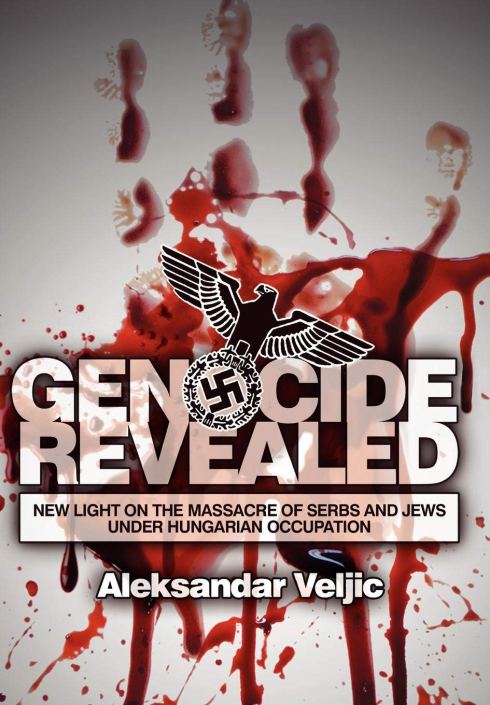
“The untold story of the massacre named “Razzia” (Raid) which took place in January 1942, committed by the Hungarian Nazi forces in an occupied part of northern Serbia – Backa. This book unveils the most important details of the massacre, implicating the Hungarian regent (governor) Miklos Horthy. Besides murdering Serbs, Jews and Roma, Horthy had also committed numerous crimes over Ukrainians, Romanians, Ruthenians, Slovaks, Russians and Hungarian antifascists. The book primarily deals with the genocide committed in January 1942, where at least 12,763 civillians had been tossed into icy rivers Tisa and Danube. One of the main perpetrators, Sandor Kepiro, was released in Budapest court on July 18, 2011. He died in Budapest in September 3 of the same year.”

71UWbSgY4tL

comment: nikobakos@gmail.com


“The Balkans in Rightwing Mythology” — Read the article (past the touching Srebrenica graphic); it’s not about the “Balkans” in Rightwing Mythology; it’s — AGAIN — only about SERBIA in rightwing mythology

4 Oct

You’d think that just to cammo their biased asses, these people might occasionally write about someone else, to then make it easier to go back to blaming Serbs again.  Here’s some suggestions:

* Croatia: Are there any people on the planet, not just Europe, who have gone more scot-free of being confronted and taken to task for their more-Nazi-than-the-Nazis, vicious, genocidal, more-of-their-population–slated-for-elimination-than-any-other-Nazi-collaborating state, Vatican-blessed murderous project than Croatians and the Ustaše?

* Has anybody written a biography whose title might be: “Subtle Brother: The Rise and Fall of Alija Izetbegović and his plan for a Muslim Bosnia.”?  Maybe Mr. Delalić could include a foreword or afterword there about Bosnian Muslim collaboration with the Ustaše.

or:

* “Kosovo: an Experiment in Mafia Statehood”

or

* “Operation Storm: The Story Behind NATO-armed Croatia and the Yugoslav Wars’ Single Greatest Episode of Ethnic Cleansing.”

or on a lighter note:

* “Buenos Aires: Here We Come!  How the Papacy Spirited Away the Leaders of Fascist Croatia to Latin America So They Could — and Did — All Avoid War Crimes Prosecution.”

You can squeeze stuff that inspires contemporary nut-cases out of the noxious right-wing ideology contained in each of those I think.  Just to distract people so that you can then return to your usual agenda — Serbia.  Particularly rich, of course, to have this all come from Germans, who don’t seem to realize that their hyper-earnest, Mea Culpa Show is getting really boring, but has also hypocritically and ironically made them the self-appointed, moralizing arbiters of the rest of humanity’s behavior: like, in some perverse way, ‘they should know’ — know it when they see it.

And almost all the murderous right-wing psychos, that think Karadžić is a hero and that they list in the article, are Germans or Teutons of some sort.  So maybe the fault, dear Germans, lies not in Greater Serbian Nationalism but in yourselves.

Ah, then one last idea: how about “Instant Independence: Slovenia, Croatia and How Germany led Europe into Mass Death and Destruction for the Third Time in One Century.” ?

4dFreEA_

The Balkans in Rightwing Mythology
by Adnan Delalić and Patricia Zhubi for Die Wochenzeitung (Switzerland)
11 April 2019 (original post in German)

Racist memes, nationalist myths, and crude conspiracy theories: within the ideology of the New Right, southeastern Europe appears as a transitional space where the future of the West is being decided.

Investigations into the 15 March 2019 Christchurch attack took on an international dimension ten days later when federal security and intelligence agents searched Martin Sellner’s apartment in Austria under orders from the prosecutor’s office there. Sellner is a leading functionary of the Austrian Identitarian Movement (Identitäre Bewegung Österreich, or IBÖ). He came under the authorities’ scrutiny because of a €1,500 donation he had received from the Christchurch shooter in January 2018.

After the search, Sellner portrayed himself on YouTube as a victim of state repression. While politicians and commentators argue about the nature of the IBÖ, its members organize demonstrations and solidarity actions and drum up social media and financial support from around the world. A donation does not make Sellner an accomplice to a massacre—but there are ideological bridges that connect the Identitarian Movement (also known as Generation Identity) as well as other extreme rightwing groups to the Christchurch mass-murderer.

Undesirable Foreign Foods

Attempts to distinguish the IBÖ from “ordinary” rightwing radicalism are specious not only because Sellner, according to media reports, used to paste swastikas on synagogues in his youth; beyond that, he belonged to the social circle around Austrian Holocaust denier Gottfried Küssel, whose blog Alpen-Donau.info was removed from the internet by the Austrian interior ministry in 2011. This kind of increased legal and police pressure led to the founding of the IBÖ a year later, which attempts (in the tradition of Alain de Benoist, an early progenitor of the New Right) to replace völkisch-nationalist vocabulary with terms carrying less historical baggage—terms like “identity.”

In a YouTube vlog from early 2015, Sellner posed—with hipster glasses and a sharp part in his hair—in front of a food stand menu offering burgers, hotdogs, and Bosna sausages. His goal: to educate his viewers about Austrian cuisine and undesirable foreign foods. Austrians! Do not eat at McDonald’s—and certainly not at kebab stands, the epitome of “multicultural capitalist mania”! In this online broadcast, Sellner sells the message additionally with his choice of t-shirt (available at his online store…). Upon it are the words “Restore Europe, Remove Kebab, Restore Empire.” Precisely this reference, “Kebab Remover”—a racist internet meme endorsing the genocide of Bosnian Muslims—was on display both on the Christchurch terrorist’s weapon as well as in his manifesto. Sellner has also cracked wise on Twitter about being in “Remove Kebab Mode.”

The Christchurch shooter referred to the Balkans in other ways as well. On the way to committing his act of terror, he listened to a song honoring the Serbian war criminal Radovan Karadžić, who would only a few days later be sentenced to life in prison at the Hague. In addition, the shooter is alleged to have traveled to several countries in the Balkan region in order to visit the sites of historic battles. The engravings on his weapons with the names of figures from Serbian, Montenegrin, Polish, and Spanish history also point to a deep fascination with struggles against the Ottoman empire. Southeastern Europe, in the imagination of the New Right, is a kind of transitional space where Christianity and Islam clash.

This motif is not new, and has many variants, alternately glorifying the Spanish Reconquista, the defense of Vienna, or the Russian-Ottoman wars. Karadžić referred to the genocide at Srebrenica as “just and holy”—in his view, his troops had prevented the establishment of an Islamist caliphate. The Norwegian rightwing terrorist Anders Breivik, in turn, called Karadžić an “honourable Crusader and a European war hero.” Occasionally, the motif appears in reference to a supposed transnational Muslim conspiracy against the Christian West, in which Serbia is presented as the bulwark against a neo-Ottoman invasion of Europe. The Christchurch shooter referred to Kosovar Albanians as “Islamic occupiers.”

An Appealing Trope

There are other points of contact. The Christchurch shooter’s manifesto was titled “The Great Replacement”—clearly named after the racist conspiracy theory popularized by Renaud Camus, an ideological godfather of the New Right in France. In his imagination, Europe’s white, Christian population is being systematically replaced by predominantly Muslim “invaders” from Africa and the Middle East. There are many variations on this demographic panic. It is the glue that holds the Fascist International together.

It can be observed as a central motif in the Greater Serbia ideology of Radovan Karadžić, which purports that Bosnian and Kosovar Muslims are secretly pursuing a “demographic jihad.” In the SANU [Serbian Academy of Science and Arts] Memorandum of 1986, a milestone of Serbian nationalism, it is claimed that the high birthrate of (predominantly Muslim) Kosovar Albanians is a central component of their drive for an ethnically pure Kosovo. The former Bosnian-Serb general Ratko Mladić justified war crimes against Bosnian Muslims with the claim that the Islamic world possesses, if not an atomic bomb, then a “demographic bomb.” Breivik, for his part, refers to this as an “indirect genocide.”

The obsession with birthrates and these paranoid theories of intentional displacement and replacement do not necessarily lead to violence—but they do mentally prepare their proponents for it.

The Islamophobia inherent to the ideology of Greater Serbia, in which traditional and contemporary motifs are bound together, is emerging in the globalized context as an appealing trope for the Fascist International. The specter of multiculturalism can only be overcome with a fundamental reordering of space along ethnic dividing lines that faded out of relevance long ago. The aim of this “racism without races” is the establishment of ethnically homogeneous societies, side by side but separate.

In September 2018, Sellner took part in a torchlight march “in honor of the heroes and saints of 1683.” In this case, Vienna symbolized the bulwark against past and future Islamic invasions. “I don’t get how there can be people from the Balkans who spit in the faces of their forefathers and their defensive struggle against the Ottomans,” tweeted Sellner in June 2017. So Islam must be fought and defended against—but without violence, apparently: “Rightwing terrorism is, like all other kinds of terrorism, to be morally rejected,” announced the leading identitarian figure immediately after the Christchurch attack. How this is supposed to work, when—judging from slogans like “Stop the Great Replacement!”—the Ottoman army is already pounding at the gates, is unclear. War symbolism and fear-mongering only fit into the self-conception of the “moderate migration critic” when rhetorical fear-mongering can be cleanly separated from real terrorism.

No matter how much Renaud Camus and Martin Sellner try to distance themselves from the terror attack in Christchurch, the insistence of the IBÖ that it is not a radical rightwing movement is simply untenable. The fight against this ostensible “replacement” and the IBÖ’s concomitant declaration of war on multicultural society are not “moderate” positions. The claim that coexistence is impossible is not meant merely as a description of conditions but rather as a goal. For Karadžić it was not only about the fight against Islam. Tolerance and the multicultural character of Bosnia were also to be erased and made impossible for generations to come.

Ideological Cocktail

The ideas that became socially acceptable with the rise of Serbian nationalism in the 1980s soon found their concrete political implementation. What emerged was an ideological cocktail of racism, demographic panic, conspiratorial paranoia, and revanchism that ultimately proposed an urgent need for action against an allegedly existential threat. The destruction of the Other became necessary to ensure Our survival. Karadžić still argues to this day that he was acting defensively against a “toxic, all-destructive Islamic octopus.”

It is not particularly surprising that paranoia about demographic “invaders” also takes an antisemitic shape. The Serbian nationalist cult director Emir Kusturica, for example, is among those who pin the blame for the “refugee crisis” on the Jewish American billionaire George Soros. According to social theorist Moishe Postone, modern antisemitism is not merely a form of racism, but at the same time a way of explaining the world which promises mistaken paths out of one’s misfortune. We can understand conspiracy theories like “the great replacement,” which declare as enemies both the weakest among us as well as global elites, in a similar manner. Islam and Judaism overlap as bogeymen, as both sublate the particularity of individual nationalisms. Unity is imperative in fighting the great enemy.

Karadžić’s ideology is neither unique to the Balkans nor the result of “centuries-old blood feuds.” It also is not a genuinely Serbian phenomenon. Rightwing radicalism does not have a country of origin; it derives inspiration from everywhere. The ideological store of the Fascist International feeds on various traditions and regions. What has evolved is a globally available repertoire of nationalist myths, symbols, and tactics to choose from. Events in Bosnia and Kosovo show what kinds of consequences such ideas can bring—and not just there.

Berlin historian Patricia Zhubi studies the past and present of antisemitism and the transnational structures of the radical right. Bosnian-German sociologist Adnan Delalić does research on Islamophobia and genocide, among other things.

Translated by Antidote and printed with the kind permission and help of the authors.

Featured image: artwork by Bosnian-American Samir Biscevic displayed at a ten-year commemoration of Srebrenica at UN headquarters in New York in 2005.

Bosnian Woods: Edelman and the 90s in Bosnia

3 Oct

Screen Shot 2019-10-03 at 2.05.55 PM

What happened in Bosnia in the 90s was “a posthumous triumph” for the vicious fascism of the Croatian Ustaše, and Bosnians’ gleeful collaboration with them on both occasions.

Honestly…if anybody can explain to me because I find it baffling.  What was in it for Bosnians to collaborate with Croats during both WWII and the wars of the 90s?  What could possibly have been of more benefit for them to work together with the Ustaše instead of joining Serbian partisan resistance or just sitting out the conflict?  Wasn’t the virulent Catholicism of the Ustaše enough to put them off?  Did they just figure that Serbs were the previously and potentially again most hegemonic people in the state so they sought help from another little brother?  Did they really think that after accomplishing their stated aims of cleansing the NDH of Serbs, Jews and Gypsies, that Croat fascists wouldn’t come after Bosnian Muslims next?  Like Martin Niemöller’s poem: “Then they came for me.”  And Bosnian’s chumming up with them in the 90s: how’s that worked out for you, guys?

Comment: nikobakos@gmail.com

Ndh_1941

Yikes — I just got twenty Croatian hits in an hour — and dunno why

30 Sep

They’re onto me…

thumb.pagespeed.ce.XfM1lrgNPP

Ooopppsss…  Sorry, I meant:

2759252_0

Yugo p.s. “So, this was Bosnia before the war?” Er…no.

3 Nov

That “self-determination” is just nationalism — and often a fiery, violent kind — writ small and wanting to be bigger, may be one of the most important issues we need to face in the 21st century.

Maybe the most frustrating, teeth-gritting moment of news coverage — in terms of the selective blessing of nationalisms and self-determinations — I’ve ever experienced was a BBC report, which unfortunately I haven’t been able to find and post, that aired on the July anniversary of the Srebrenica massacre the summer of 2016.

At the end of it the BBC reporter was interviewing a Bosnian man, in his forties maybe, selected for his Bosnian-ness — tall and handsome — whose father had been killed by a Serbian sniper in Sarajevo in the 90s.  In their interview on a bridge over the lovely, gurgling Miljacka, he talked about how he was happier that he was the child of that sniper victim and didn’t have to live with the conscience of being the child of that sniper instead.

He then pulled out a photo of his high school class:

“See…

“This guy was Serbian.  This guy was Croatian.  This guy was Croatian.  This guy was Bosnian.  This guy was Serbian…  That’s how it was then.”

“So,” says the dull-tool BBC reporter:

“This was Bosnia before the war?”

“Yes,”

says the Bosnian, shaking his head sadly with the weary, self-righteous pride of the victim,

“This was Bosnia before the war.”

No, buddy.  That wasn’t BOSNIA before the war.  That was YUGOSLAVIA before the war.  AND YOU DIDN’T WANT TO PART OF IT ANYMORE…

So, to paraphrase the identity-politics, American new “left” cliché: “Check your victimhood!”

Yugo ethnic breakdown

Comment: nikobakos@gmail.com

More indication that Catalonia is bringing YUGOSLAVIA up again as an object of moral reflection

3 Nov

Just one line in Guardian article Catalonia isn’t just Spain’s nightmare – it is Europe’s:

Old feuds are rekindled and jealousies revived. Hypocritical Britain cannot talk. It long opposed Irish separatism and denied devolution to Scotland and Wales, while it sent soldiers to aid the break-up of Yugoslavia. [my emphasis]

My hope is that there will be new de-villainizing discussions of certain past, led by a new review of Serbian actions in a dissolving Yugoslavia, or even early twentieth-century Ottomans/Turkey (might want to see my “Screamers:” Genocide: what is it and why do we need the term?“)

While we’re adjusting our moral compasses about whose self-determination is “cool” and whose isn’t, we might want to look at the role the public relations industry plays in so manipulating the image of political conflicts throughout the world.  And I don’t mean that as a metaphor: both Croatia and then Bosnia hired American public relations firms to push their cause during the Yugoslav War; this is covered extensively by Diana Johnstone in her Fools’ Crusade: Yugoslavia, Nato and Western Delusions.  Unfortunately, since Johnstone’s thesis is that NATO aided and abetted the break-up of Yugoslavia as part of its plan to weaken a Serb-hegemonied Yugoslavia, which wouldn’t play along with NATO, the European Union or the post-communist, Neo-Liberal, New World Order; that is, that these forces wouldn’t tolerate, just like Stalin couldn’t, Yugoslavia’s fairly benign and most successful of communist states’ strength, and the power a post-communist, unified Yugoslavia would still hold — she’s dismissed as a conspiracy theorist or a crackpot.  Her argument, however, is perfectly documented and argued.

But even a good friend of mine who’s incredibly smart about and immersed in things Yugo said to me: “Really, Nick?  I dunno…  Diana John-stone…”

fool's

Yeah.  Diana John-stone.  Read it.

And next time you go back to your fun and Euro-spring-break memories of unbearably hip Barcelona, thing of how advertising and public relations got you to spend your tourist dollars there — and how that indirectly funded, both in terms of real and symbolic capital, the current crisis in Spain.

Comment: nikobakos@gmail.com

Ha… Catalonia is finally getting the West to rethink what it did to YUGOSLAVIA!

10 Oct

Sapnish flag demonstrationProtesters hold a giant Spanish flag during a demonstration to support the unity of Spain on 8 October in Barcelona. Photograph: Lluis Gene/AFP/Getty Images
The Guardian has an interesting take on things in Spain: A dangerous time for Catalonia, Spain and the rest of Europe that is original in that it brings together commentators from different parts of Europe who each have their own particular p.o.v. on what’s going on in terms of secession and identity politics.  They’re each interesting in their way — though I expected Gerry Adams to have something more compelling to say and sort of can’t tell if he’s being ironic (David Cameron?).  The most important one for me, though, is the comment on Kosovo (though it also angers you because it took so long for someone to say this):

“Since Nato illegally bombed Serbia in 1999 to wrest control of Kosovo from the Balkan nation, we have witnessed a significant increase in the number of secessionist efforts around the world as borders have unravelled in Ukraine and elsewhere (Catalan president vows to press on with independence, 5 October). Western leaders should be ashamed at having encouraged the hopes of terrorists worldwide that borders can be changed and national sovereignty and international laws are meaningless if they can get Nato to support their cause. Get ready for a lot more trouble ahead.”

Dr Michael Pravica
Henderson, Nevada, USA

1280px-Flag_of_Kosovo.svg

Comment: nikobakos@gmail.com

From Politico: “Brussels says Catalan referendum was ‘not legal’” — thank God

2 Oct

I was getting this knot in my stomach that this was going the way of Yugoslavia, but maybe Europe (or the Germans, at least, who are the most responsible for the Yugoslav disaster, but are still so focused on the other little misdemeanors in their history that they haven’t yet begun to face their complicity in the Balkans) has learned something.

SPAIN-EU-VOTE-CIUA boy holding a European flag waits for the start of the Catalan Convergence and Unity party (CiU) rally marking the last day of the European Parliament elections campaign in Barcelona on May 23, 2014 | Josep Lago/AFP via Getty Images

Brussels says Catalan referendum was ‘not legal’

The EU repeats its position that Catalan independence is ‘an internal matter.’

Sunday’s Catalan independence referendum was “not legal,” European Commission chief spokesman Margaritis Schinas said Monday.

Schinas also repeated the EU’s line that if Catalonia does become independent, it will be “outside the European Union.”

Catalan regional President Carles Puigdemont appealed directly to the EU last night after the results of the disputed referendum, which were overwhelmingly in favor of independence. Puigdemont said the EU “can no longer continue looking the other way.” But Schinas stuck to the Commission’s line on the dispute, repeating that it was “an internal matter.”

The spokesman batted away criticism that the Commission responded to the issue too late, saying: “We react at the time when all the elements of the event are in place.”

Schinas also said that Spanish Prime Minister Mariano Rajoy is scheduled to speak with Commission President Jean-Claude Juncker on the phone later today.

Referring to the more than 800 civilians injured on Sunday, Schinas said “violence can never be an instrument in politics,” without attributing responsibility.

He also called on “all relevant players to now move very swiftly from confrontation to dialogue.”

Asked if the police actions were proportionate, Schinas declined to answer, repeating the line that “violence can never be an instrument of politics.”