Balkans, Anatolia, Caucasus, Levant and other Middle East, Iran, Afghanistan, South Asia, occasional forays into southern Italy, Spain or eastern Europe, minorities, the nation-state and nationalism — and whatever other quirks or obsessions lurk inside my head.
Beautiful and also interesting, because their dress is very close to traditional folk dress of the region, and I would have expected prosperous, Christian bourgeioses women in a large city like Trebizond at the time to be dressed in more Western clothes.
I like that they dress the women up in a way that recognizes Constantinopolitan Greeks’ deep, deep bourgeoisness and αστισμό — perhaps the most precious thing we lost through that community’s destruction. But Polites didn’t talk with that weird accent and that thick Turkish “λ”. They spoke perfect, accentless Modern Greek.
Anyway, I guess it’s significant and positive that they remain an archetype Greeks are still conscious of.
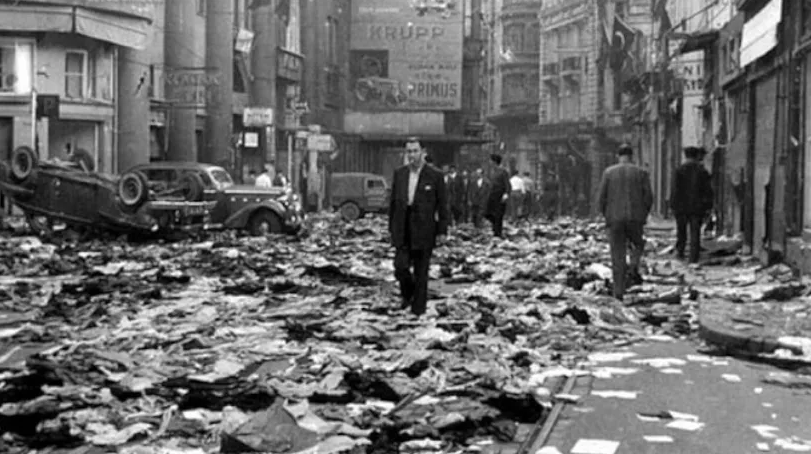
Turkish Parliament Speaker’s Office has rejected to hear a draft bill seeking to have the Istanbul pogrom, anti-Greek riots of Sept. 6 and 7 in 1955, recognized as a national day of mourning. Parliament Speaker Mustafa Şentop said that he found the wording used in the draft bill as “rough and hurtful.”
Meclis Başkanlığı bütün bu vahşi 6-7 Eylül linç olaylarını görmezden gelerek, bizim bunları apaçık ifade eden “Pogrom” kelimesini kullanmamızı “Kaba ve yaralayıcı” olarak bulmuştur. Asıl skandal buradadır, apaçık gerçeği reddetmek üstünü örtmeye çalışmaktadır. pic.twitter.com/K23nwNsHqJ
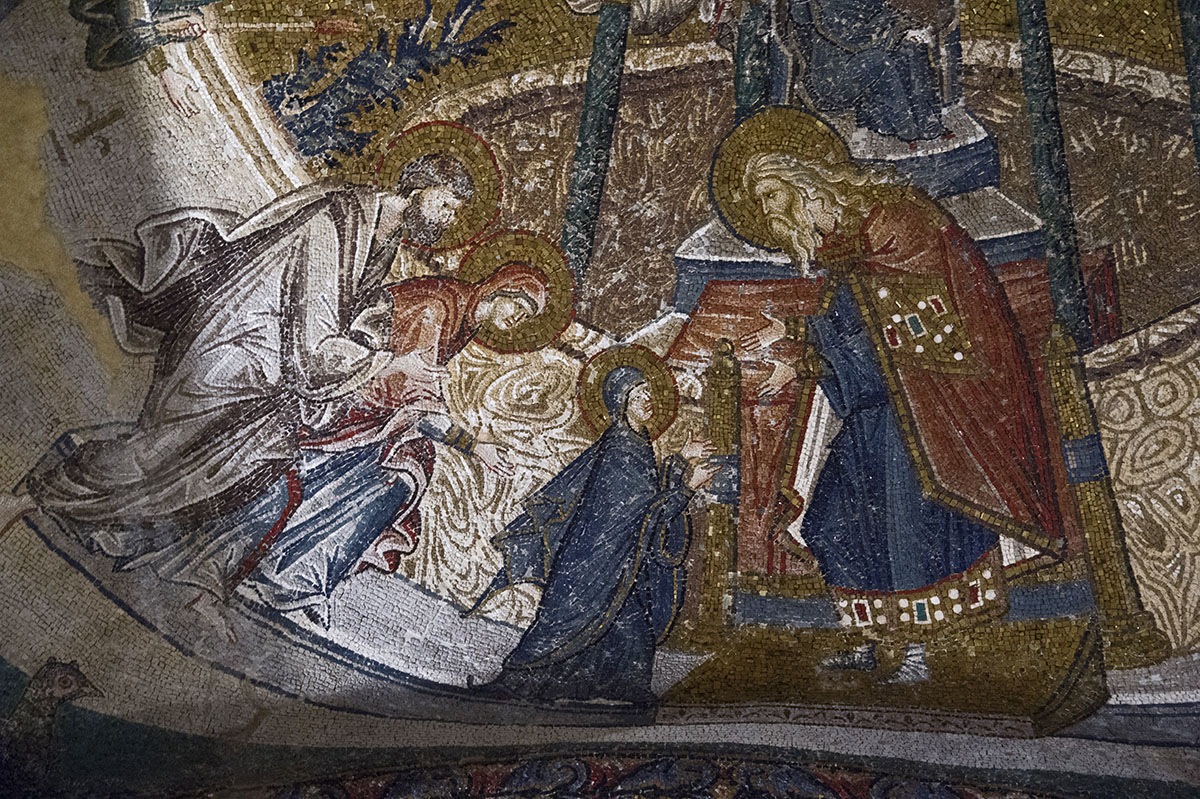
Today, November 21st is one of my favorite Orthodox holidays, the Presentation (Εἴσόδια/Воведение) of the Virgin to the Temple. God gives Joachim and Anna, who have not been able to have a child, the blessing of conceiving Mary. Riding on the old Jewish story of Sarah, Abraham’s wife, also not being able to conceive, until the angels visit Abraham and announce that Sarah, already 80 years old, will conceive the male child who then becomes Isaac(in a wonderful moment of irreverent Jewish humor, Sarah hears all this from the kitchen and laughs out loud), Anna herself names the Jewish matriarch in her prayers to God, asking him to perform the same miracle for her.
(Sadistically, God then later orders Abraham to sacrifice Isaac and Abraham obeys, but God then puts a ram in Isaac’s place at the last moment; don’t ask me to explain this one-more story of the monotheist God’s perversity and cruel power plays — listen to Benjamin Britten’s beautiful setting of the story below. *1)
When she’s three years old, Joachim and Anna take the toddler Mary to live in the Temple in Jerusalem, in order to thank God for the miracle of her birth or to keep her pure, since she’s such a holy baby, or until she starts to menstruate and thus turns of marrying age — it’s not very clear which it is (and let’s, again, ignore Semitic monotheism’s misogynist obsession with female purity.)
But they somewhat sadly leave her at the Temple, and as they walk away they turn and look, and the child Mary is not only not crying for the parents who have abandoned her here with all these long-bearded old men, but she’s dancing happily — “with her feet” — delighted to be living in the Lord’s house, and all the years she spends there an angel descends daily and feeds her “like a dove.”
Click and enjoy these here because if you go to the Church of the Chora in Istanbul today, these and many other beautiful mosaics and frescoes will be covered by the drapes of “the hysterics and puritans of monotheism.”
And a couple of Western images of the holiday (below), though it has largely fallen into obscurity today in the Catholic Church:
Giotto’s fresco of the event in the Scrovegni Chapel in Padua (above)
And Titian’s spectacular fresco (above) — along with details (below) — in the Gallerie dell’Accademia in Venice
The story of the Presentation of the Virgin is not found in any of the canonical gospels but only in the apocryphal Gospel of St. James, also known as the Infancy Gospel. This is probably why it’s been forgotten in the Catholic West; the Catholic Church, in its lame post-Vatican II attempts at modernization, deleted important saints from the Church calendar, like George and Catherine and Nicholas, because we have no scientific evidence of their miracles (hellloooo…do we have “scientific evidence” of the Incarnation or the Resurrection or any “scientific” proof of the doctrine of the Transubstantiation/Communion? Don’t get me started and let’s not go there…), they certainly were not going to give any credence to an apocryphal tall tale, even though, as the above masterpieces of Giotto and Titian testify, it was still an important enough Catholic holiday during the Renaissance.
Below is the Greek text in screen shots; sorry couldn’t find a cut-and-paste form of the passage with full Greek accent system and I always try to when I post something; you’ll have to click:
and English:
“When the child turned three, Joachim said, “Let’s call the pure women of the Hebrews. Let them take up lamps and light them so that the child will not turn back and her heart will never be led away from the temple of the Lord.” And they did these things until they went up to the temple of the Lord. And the priest welcomed her. Kissing her, he blessed her and said, “The Lord God has magnified your name for all generations; through you the Lord will reveal deliverance to the children of Israel in the last days.” And he set her down on the third step of the altar and the Lord God poured grace upon her. She danced triumphantly with her feet and every house in Israel loved her.”
And her parents went down, marveling at and praising and glorifying the Lord God because the child had not turned back to look at them. While Mary was in the temple of the Lord, she was fed like a dove and received food from the hand of an angel.” (emphases mine)
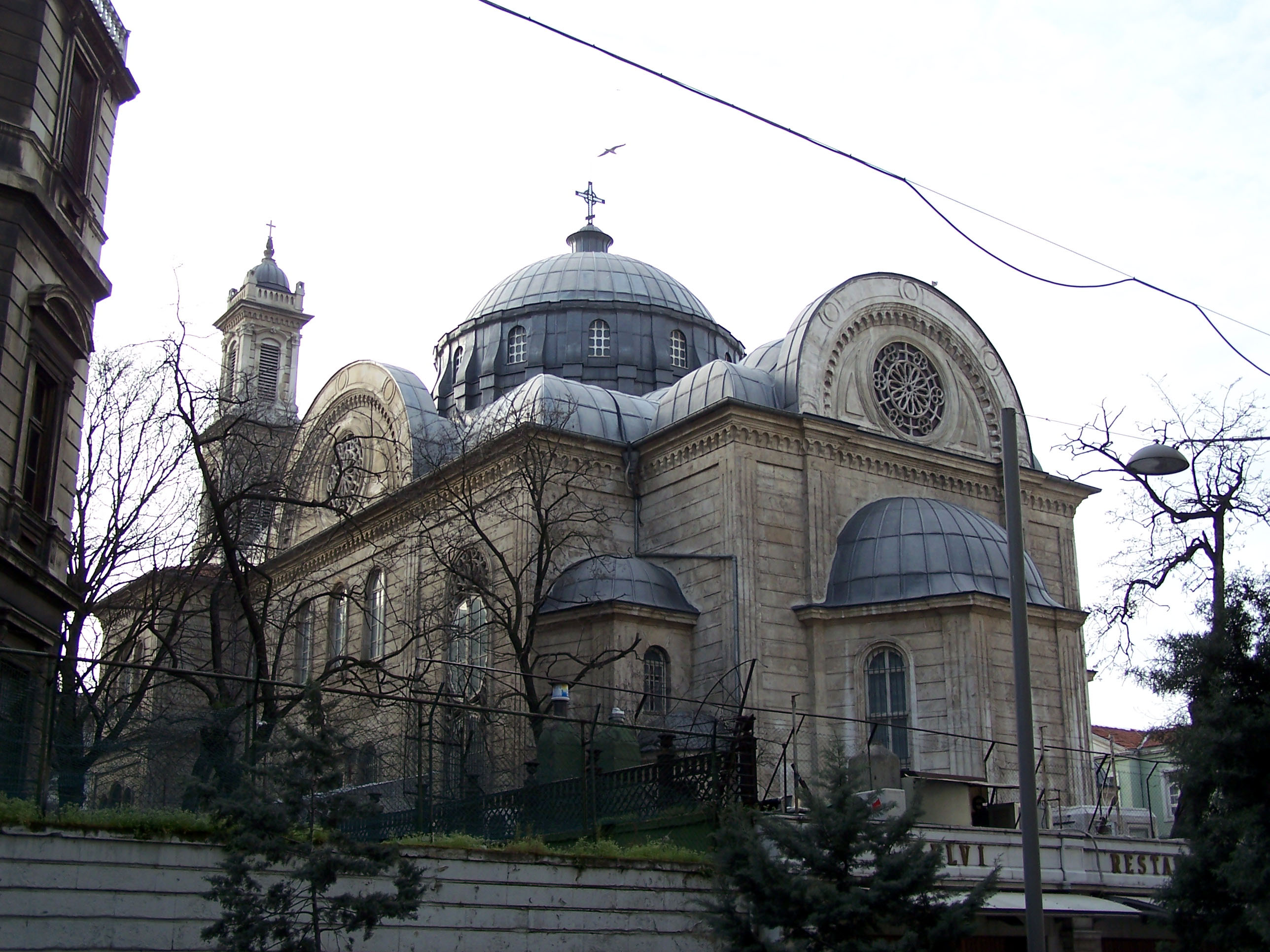
The church is a little hard to find, since it’s one of Istanbul’s pre-Tanzimat churches, meaning it was built before the 19th century reforms (1789) that lifted traditional restrictions on the building of non-Muslim places of worship; before the reforms churches had to have low, barn-like roofs because domes were not allowed, had to have high walls surrounding their premises, so that they were not conspicuous from the street, were prohibitted from having bell-towers (all church bell towers in Istanbul date from after the 1850s), and generally could not be higher or be more visible than any neighboring mosques (Wait…you mean, Islam isn’t the most tolerant religion in the world?).
View of Panagia Pera from above, hidden by surrounding buildings; western facade; and eastern facade with conspicuously later bell-tower. (below)
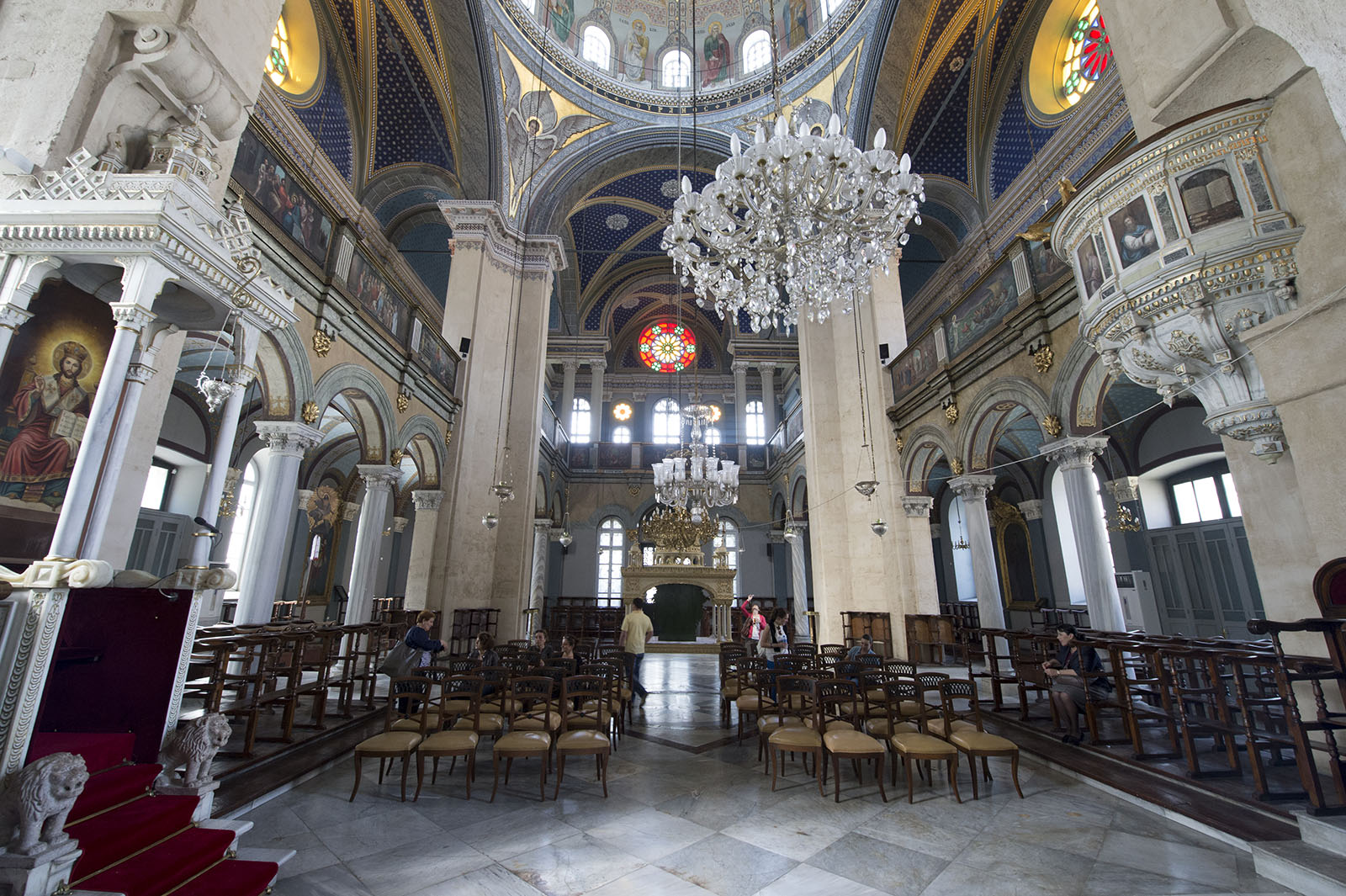
So, while the exterior was traditionally Ottoman in its plainness and modesty, the interior testifies to the fact that this Pera parish became Istanbul’s most extravagantly wealthy community beginning in the early 19th c. (pics below, from Iason Athanasiadis‘ “Τί χαμπέρια από την Πόλη;“)
Even more compelling about Pera’s Panagia is that it survived unscathed the Anti-Greek Pogrom of September 1955. Of course, the old ladies will tell you that that was a miracle…why almost all of the rest of Istanbul’s 90 plus churches were completely ransacked or totally destroyed is a question you’re tempted to ask. Did its enforced inconspicuousness save it? I dunno. Yes, it’s a little hard to find, but it’s only about 50 yards off Pera’s main drag and the rioters of this Menderes-government-organized orgy of destruction knew every single Greek business on the street and in the neighborhood and every single other Greek church throughout Istanbul… It’s hard to believe that they didn’t know of Pera’s second largest Greek church, after the Holy Trinity in Taksim, which was thoroughly gutted. Let’s just call it a nice surprise.
Hagia Triada (below), now restored:
The neighboring Zappeion, (above) once Istanbul’s most prestigious lycée for girls: “Surrounding buildings of the Aya Triada are still left black from the arson attack in 1955. The priests of the Church refuse to clean the surface so that the memory of the Istanbul riots will be remembered.”
More… Today, on the Julian (Old) Calendar still used by Russians, Serbs, Bulgarians and Macedonians, but not Romanians — I think — is November 8th the Feast of the Archangels, Michael and Gabriel. Always a thirteen-day difference, so you know.
It’s the Slava of the Đokovići. A Слава/Slava is…(from an old post):
“…Serbs are the only Orthodox Christians to not observe personal namedays.
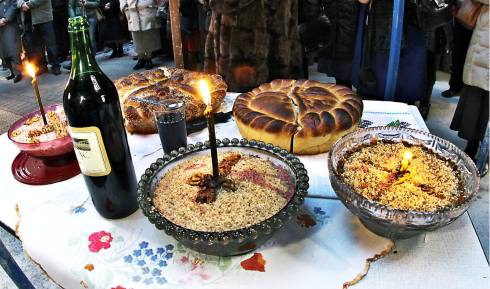
ὁ σῖτος, ὁ οἶνος καὶ τὸ ἔλεον τοῦ δούλου σου — the wheat, wine and oil of Thy servant
– Instead they observe the saint’s day on which their clan’s ancestors first converted to Christianity in a beautiful celebration called a slava, (the “glory”) and here — worth reading — which is essentially an offering and feast of remembrance, a ritual of ancestor-worship that proves that Serbs probably have more of one foot still in the pagan past than any other Slavic people…
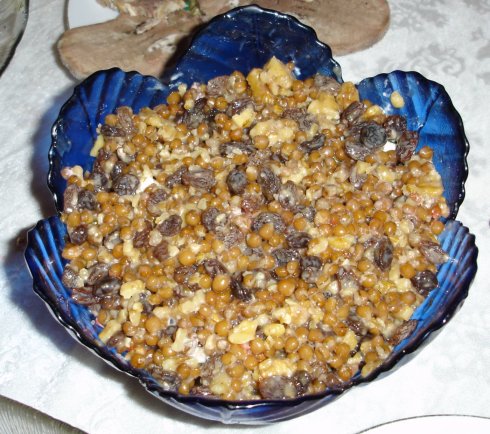
Many of their funerary customs are similar to ours — like the artos or artoklasia above and koljivo below — meaning they developed together spontaneously or they represent the influence of known Slavic sub-strata in the language, genes and culture of modern Greeks — and now that I said that I’ll have to go into a witness protection program.
Koljivo or Koliva just like Greeks make. Commemorating the dead with the seeds of life.
So my man, Novak Đoković tweeted a message on the occasion of his family’s Slava today:
Outside Rome the West lacked the relics of important apostles. This was rectified in Venice by the theft of St Mark the Evangelist from Muslim Alexandria in AD 828. Not to be outdone by the Adriatic pirates, however, the Spanish promptly discovered St James the Greater’s tomb at the Galician fishing town of Padron at some point between 818-42.
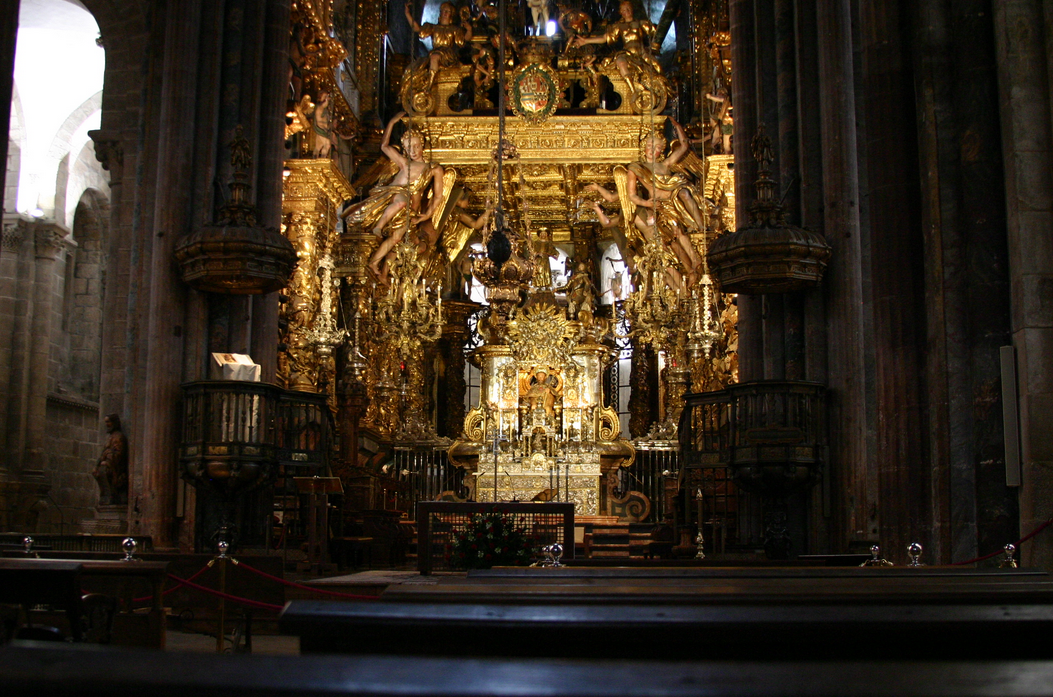
The interior and exterior (below) of the cathedral of Santiago in Santiago de Compostela, Galicia, Spain.
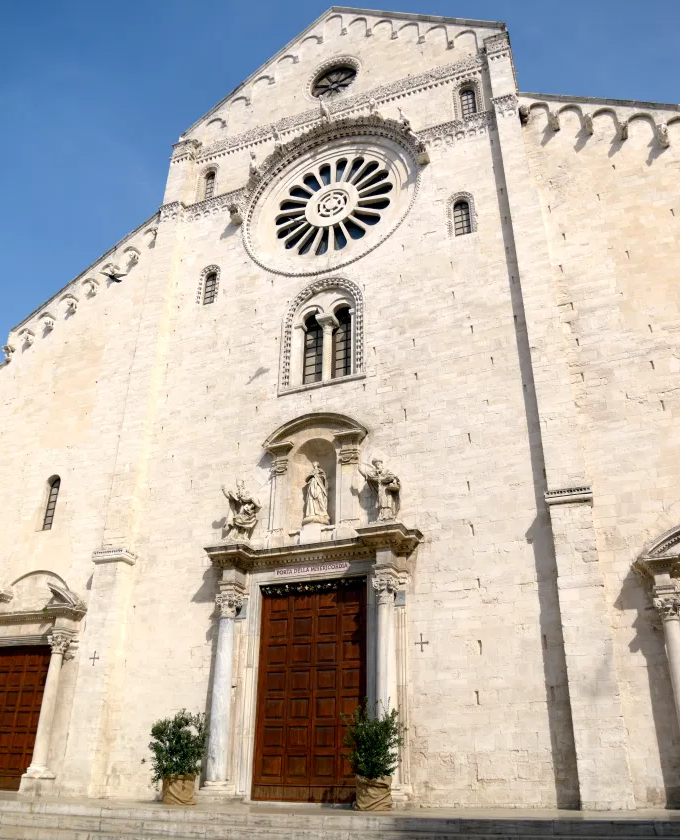
The Cathedral of St. Nicholas of Bari below; I love the combo-contrast between the austere Romanesque of Norman churches in southern Italy and later Baroque additions, like the ceiling here.
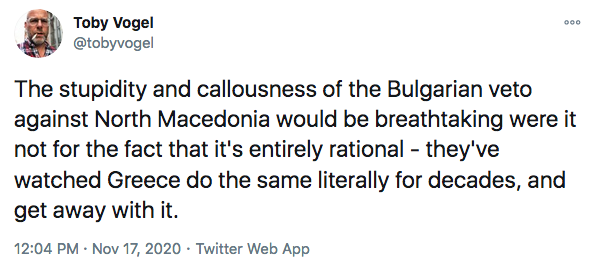
Bulgarian Prime Minister Boyko Borissov (right) and Northern Macedonian Prime Minister Zoran Zaev in Sofia on November 10. Photo: EPA-EFE/BULGARIAN GOVERNMENT PRESS OFFICE
The photos don’t say much, but they do capture the smart, urbane joy of Constantinopolitan life; and begs the question: did Greeks have a special sensory feel for the pleasures of Istanbul life, or did Greeks themselves generate that joy, now sorely missing from the contemporary city and its overgrown vulgarity?
And the scene from Politike Kouzina, with the family, deported and once settled in Athens, waits for the grandfather to come from Istanbul for a family wedding:
“I’ll tell you something and get it into your thick heads. Grandpa won’t come tomorrow and never intended to. Grandpa wouldn’t come to Greece even if Aemilios was marrying a film star. Grandpa hasn’t come all these years because he didn’t want to. He would never leave the City. None of us would, for anything in the world…
“Constantinople was called the City because it was the most beautiful city in the world.”
…unfortunately. Or at least for as long as our fear of being labelled an un-p.c. racist makes us overcompensate in the other direction in terms of how we view the history of Arabs/Islam. And for as long as our post-Christian Christianophobia makes us unable to relate to Byzantine civilization and ignore the extent to which it was the keystone civilization of western Eurasia for a millenium and a half.
Balkans, Anatolia, Caucasus, Levant and rest of ME, Iran, South Asia
Me, I'm Nicholas Bakos, a.k.a. "NikoBako." I'm Greek (Roman really, but when I say that in English some five people in the world today understand what I'm talking about, so I use "Greek" for shorthand). I'm from New York. I live all over the place these days. The rest should become obvious from the blog.





 ὁ σῖτος, ὁ οἶνος καὶ τὸ ἔλεον τοῦ δούλου σου — the wheat, wine and oil of Thy servant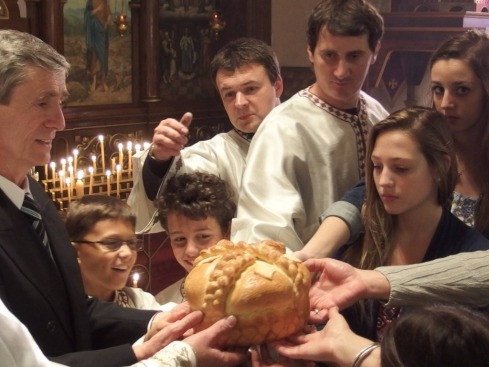








 Jadde: from Bosnia to Bengal