Balkans, Anatolia, Caucasus, Levant and other Middle East, Iran, Afghanistan, South Asia, occasional forays into southern Italy, Spain or eastern Europe, minorities, the nation-state and nationalism — and whatever other quirks or obsessions lurk inside my head.
Iran has cleaned up at the Olympics in weightlifting and wrestling, so far taking home 4 gold and 7 overall medals in the sports. Max Fisher takes a look at how Persian history has played into this success:
The surprisingly rich academic literature on Iran’s impressive records at wrestling, weightlifting, and tae kwon do consistentlyconnects all three to an ancient Persian sport called Varzesh-e-Bastani [PDF], which literally translates to “ancient sport.” To Westerners, Varzesh-e-Bastani might look like an odd combination of wrestling, strength training, and meditation. Though there’s no known link between Varesh-e-Bastani and yoga, it might help to think of it as something like a Persian version of this athletic practice that’s also a method of personal and community development — and a symbol of cultural heritage.
Though Western cultures typically treat wrestling as an aggressive, individualistic, and deeply competitive sport, traditional Persian Varzesh-e-Bastani emphasizes it as a means of promoting inner strength through outer strength in a process meant to cultivate what we might call chivalry. The ideal practitioner is meant to embody such moral traits as kindness and humility and to defend the community against sinfulness and external threats. The connection of weightlifting with character development might sound odd, but it’s perhaps not so different from, for example, the yogic practice of Shavanasa, a meditative pose meant to bolster the spiritual and mental role of yoga’s stretches and poses.
Meanwhile, the Guardian‘s Saeed Kamali Dehghan looks at how the Olympics have played out back in Iran, including the reactions of ordinary Iranians:
The country’s success at the Olympics comes at a time of financial stringency and threats of war. But it is lifting the spirits of a nation gripped by sorrow and anxiety. “Despite all the pressure, there’s at least something positive out there to talk about and that’s the Olympics,” [a college student named] Reza said. His comments are echoed my many of his countrymen. “It’s so nice to see people discuss our success on public transport and share some joy,” said Ameneh, a 22-year-old Iranian student. “It’s also nice to see Iran’s name mentioned in some positive context. In the middle of all these financial difficulties, we have almost forgotten how to be happy,” she said.
(Photo: Yunior Estrada Falcon of Cuba (blue) wrestles against Ghasem Gholamreza Rezaei of Iran in the Men’s 96kg Greco-Roman Quarter-Final on Day 11 of the London 2012 Olympic Games at ExCeL on August 7, 2012 in London, England. Rezaei subsequently won the Gold for his weight class. By Mike Hewitt/Getty Images)
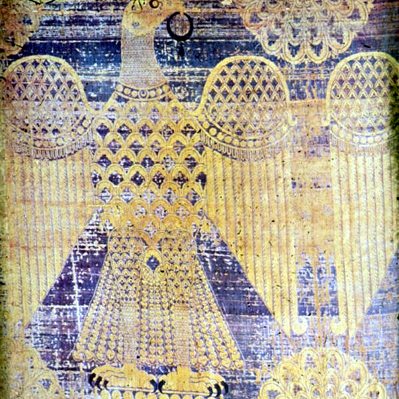
…is a 6th century Sassanian silk textile — pre-Islamic Iran — from the Metropolitan Museum of Art. This is the culture that is essentially the aesthetic foundation and parent of our entire region, and I think it’s a sufficiently neutral one to not have anyone arguing about “whose” eagle that is.
One can only imagine what it looked like when t was first woven.
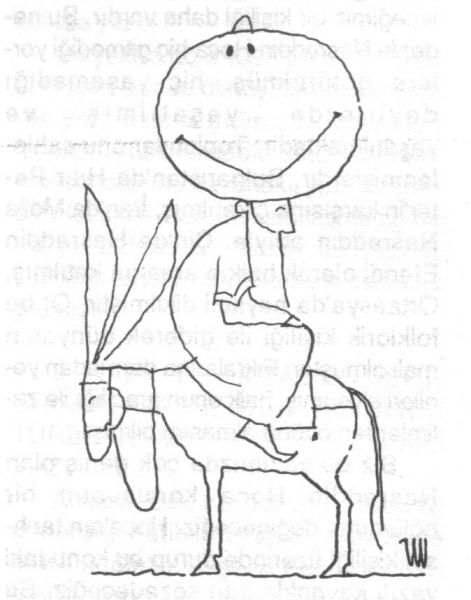
Nasreddin Hoca had a donkey. One day he got it into his head that he could save a lot of money on feed by training the donkey not to eat. So every day he gave his donkey just a little less food. At first the animal seemed to labor on as if nothing had changed. Even after his diet had been halved, the poor strong young donkey just soldiered on. But eventually, as his daily caloric intake got reduced to almost nothing, he got weaker and weaker and slower and slower, but Nasreddin was so happy at the money he was saving through his brilliant austerity plan that he didn’t even notice.
Then one fine day, the poor, martyred beast just up and died on him, on the road, right from under his legs.
Dead.
“Damn,” said Nasreddin, “and just when he had learned not to eat.”
And without a donkey’s back to ride, he had to walk.
(All Nasreddin Hoca stories are versions learned from my father and I think would be public domain already anyway.)
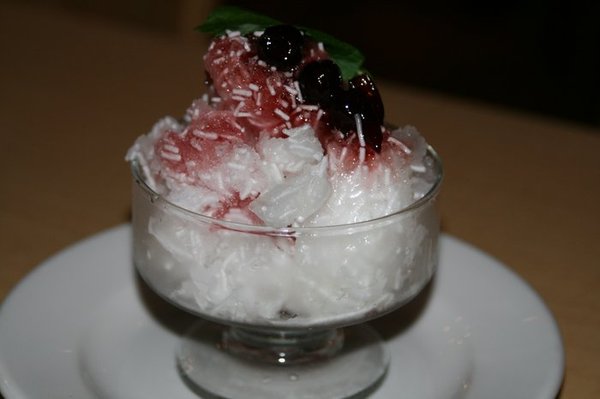
It’s frozen vermicelli noodles made either from corn starch or rice flour, with sour cherry syrup on it and lotsa lime juice, sometimes pistachios or mint leaves too. The lime heightens the sweet-tartness of the vyssino-visne-sour cherry tartness in that subtle, complex juxtaposition of fruitiness and sourness that Iranians are such experts at (in desserts and all foods), and it turns into the most refreshing, delicious slushy you could ever want to eat. Sold on the street apparently in Iran, it must be heaven to have in the heat and dust. I fantasize about it when the weather gets like this.
Kheyli mamnun to my beloved friend F. for introducing me to it.
A saffron ice cream with a chewy, masticha-sakiz-like texture is my second favorite…
Not the most brilliant thing I’ve read lately but one important, though really flawed, point:
“BY 1900, only two genuine multinational empires remained. One was the Ottoman, which was by then in the process of abandoning its traditional religious toleration for Turkish nationalism and even racism. [A completely, unfair, simplistic and un-historical assessment] The other was Austria-Hungary, home to 11 major national groups: a paradise in comparison with what it was to become. Its army had 11 official languages, and officers were obliged to address the men in up to four of them.
It wasn’t terribly efficient, but it secured an astonishing degree of loyalty. It also brought rapid economic and cultural progress to an area extending from the Swiss border to what is today western Ukraine. During World War I, Austria-Hungary fielded eight million soldiers commanded by, among others, some 25,000 Jewish reserve officers. Thirty years later, the nation-states that succeeded the empire sent most of the surviving Jewish officers to the gas chambers.”
Unfortunately, the poison of the ethnic-based nation-state ideal had gotten too far by then. Even the portrait of Austria-Hungary he gives us is completely idealized and existed in the form he describes for less than a century.
(Click above)
How sweet though, to have lived in a world that interesting instead of the stupefying monotony of the modern nation-state. But that idea is so powerful — no, not because it’s natural and inborn, but because the modern, bureaucratic state was the first with the technical apparatus to impose it on its population(s) — that it deletes all historical files dealing with plurality. Not a single European tourist who comes to New York fails to make the same comment: “Amazing…all these peoples living together…” and I want to explain that that’s how humanity lived for most of its civilized existence — or just pull my hair out — but I usually don’t bother.
But that reminds me: I do live in a world that “sweet” and “interesting:”
Mr. Deak (Hungarian?) is also wrong on an even more crucial point. The Ottoman and Austro-Hungarian empires were not the world’s last multi-ethnic states. There’s still China. Most of southeast Asia. And Russia. And most ex-Soviet republics. And certain Latin American countries. And almost all of Africa. And Syria and Lebanon and Iraq and Iran and Afghanistan and Pakistan and the world’s great wonder, India. Even Turkey. (And wherever ethnic nationalism is a problem in those countries it’s based on the Western intellectual model.) In fact, most of the world still lives in “plural” situations. Only Europe (and even in Europe there’s Spain and the U.K.), has an issue with this concept, but it seems to be fading even there. Its last bastion will probably be the growing number of viciously homogenized, ugly little states of Eastern Europe and the Balkans. Which brings us back to Michael Ignatieff:
“The misery of the Balkans stems in part from a pathetic longing to be good Europeans — that is, to import the West’s murderous ideological fashions. These fashions proved fatal in the Balkans because national unification could be realized only by ripping apart the plural fabric of Balkan village life in the name of the violent dream of ethnic purity.”
From Blood and Belonging: Journeys into the New Nationalism, Michael Ignatieff
This is Khurshid-e-Arzu, the “Sun of my Desire,” a piece both composed and sung by Shajarian junior. The lyrics are from a poem of Fereydoun Moshiri’s. Moshiri is one of Iran’s great twentieth-century poets, credited with, if not ‘modernizing’ Persian poetry, at least creating a newer language that would get past the moth-and-flame, rose-nightingale, classical imagery (but every twentieth-century Iranian poet I learn about is credited with the same thing — such is the weight of their literary past I guess.) This particular piece, at least, seems pretty traditional in its emotional tone, which is not in any way a negative assessment; I can’t tell how the language might be used differently.
This isn’t a ‘song.’ This is a composition, based on a mode like most of our music is. It’s a suite — part of one, at least — meaning it has a structure, an architecture, a narrative arc. If you don’t have twelve minutes to listen to it all in one piece (it’s already been cut from its original eighteen minutes) or twelve-minute’s worth attention span generally, then it’s best you don’t bother. All you’ll hear is an “amanes*,” some ‘oriental wailing.’ *(See footnote to “Something Beautiful from Greece: Minore-tes-Auges-Rembetiko” June 17th)
The translation obviously leaves a bit to be desired I imagine. But until we all get it together to learn Farsi, as any civilized man should, it’ll have to do. Sorry, as well, for the hokey video. It’s hard to find video of live performances. Lyrics in Farsi and English below. Enjoy.
بگذار سر به سینه ی من تا که بشنوی آهنگ اشتیاق دلی دردمند را
شاید که پیش از این نپسندی به کار عشق آزار این رمیده ی سر در کمند را
بگذار سر به سینه ی من تا بگویمت اندوه چیست، عشق کدام است، غم کجاست
بگذار تا بگویمت این مرغ خسته جان عمریست در هوای تو از آشیان جداست
دلتنگم آنچنان که اگر ببینمت به کام خواهم که جاودانه بنالم به دامنت
شاید که جاودانه بمانی کنار من ای نازنین که هیچ وفا نیست با منت
تو آسمان آبی آرام و روشنی من چون کبوتری که پرم در هوای تو
یک شب ستاره ها ی تورا دانه چین کنم با اشک شرم خویش بریزم به پای تو
بگذار تا ببوسمت ای نوشخند صبح بگذار تا بنوشمت ای چشمه ی شراب
Lay your head on my chest to hear
The song of desire of a heart in agony,
Perhaps you would no longer favor, in the affair of love,
To hurt this ensnared startled bird.
Lay your head on my chest and let me tell you
What sorrow is, what love is, where grief is.
Let me tell you of this weary bird,
So long away from its nest in yearning for you.
So much am I sick at heart that if I see you,
I wish to forever cry at your feet,
So you might stay with me forever,
Oh love, you are not true to me!
You are the blue sky, bright and still,
I, like a dove flying in your air.
One night I will pluck your stars one by one,
And with my humble tears, I will pour them at your feet.
O sweet smile of morning, let me kiss you!
O fountain of wine, let me drink you!
I long for your laughter; laugh more!
You are the sun of my desires; shine more!
Fereydoun Moshiri
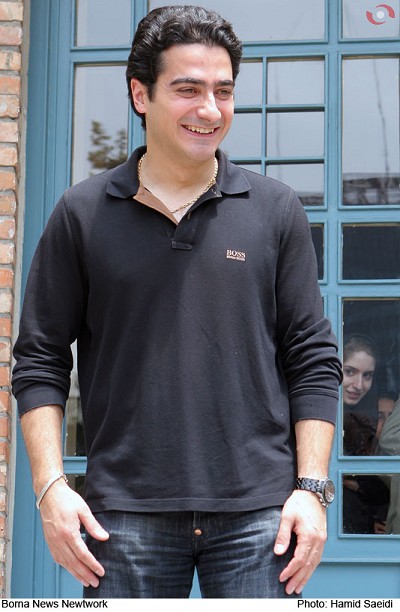
Homayoun Shajarian:enjoying a reluctant bit of a star moment… But always dead serious about his music; this is a rare shot of him smiling…
Shajarian and a very young Homayoun perform the Molana-Rumi verse (with Alizadeh and Kalhor)
Perhaps the main reason I started my attempt to learn Farsi was pure spite (the other was to go to Afghanistan). I had gotten tired of asking Iranians whether they liked this or that translation of Saadi or Hafez and being smugly told or categorically barked at: “NO! None of them; Persian poetry can’t be translated,” or reading some poor soul on You Tube gush: “My God, what beautiful music! Can someone translate the lyrics, please?!!” only to be shot down by an Iranian: “you dont know all the metaphors references you won’t understand you cant translate poetry.” Well, yes you can translate poetry, ‘cause if you can’t, you can’t translate anything else either. Or you can create a set of reasonably analogous concepts that gives the other language-speaker a strongly analogous idea, at least, and just as strong a sensory feel. In the end, the set of incommunicable ideas we’ve each got locked in our heads is pretty much as different as that between any two languages, so if you doubt translation you’re doubting the hope of any human communication really – which might, I understand, be a reasonable theory. But we’ll forgive the Persians their snobbery because, as they say in Spanish in an expression I love: “tienen con que…” literally “they got what with…” meaning “they have reason to be” or “they a have a right to…”
But then there’s this sweet and very generous attempt of one You Tube reader to give an almost calque-like translation of this Rumi piece:
If you are going to the drunkards, become drunk
If you go towards the drunk, go drunkenly! Go drunkenly! (mastâne is a compound from mast (drunk) and the prefix -âne, which is_ a particularizer (pertaining to the qualities of X, in a X manner) e.g. from mard we have mardâne (men’s, for men; …
You should become all soul, until you are worthy of the spirits[?]
You should become all soul until you become deserving the sweetheart (beloved)
And then become the cup [?] that holds the wine of love
And then become a cup for the wine of love! Become a cup! (in English, if I’m not mistaken, one says “become a member of X” so I translated it as “become a cup…” rather than “become the cup”)
Make your heart like the [other] hearts [?], wash it seven times [till it is free] of grudges
Go and wash the chest of hatreds seven-water-ly like [real] chests (chest is the house of heart. I think, in English, one says “like a [real] chest”. Ancient people believed that washing something with water of seven seas makes it purely clean.)
And then come live with the lovers
And then, come [and] become homemate with lovers! Become homemate! (ham- = homo-, xâne = home -> homo-home like homo-phone but anyway: homemate)
Become a stranger to yourself, ruin your own home [destroy the_ nafs]
[both] make yourself alien (stranger) and make the house ruined (I think it means “desert your past and your belongings”)
And from the heart of the flame, come out, become a moth
And into fire, enter! Become a butterfly! Become a butterfly! (candle (šamë)
Abandon your deceit, O lover, become mad
O lover, abandon deceit! Become mad! Become mad! (hilat is Arabic_ form of hila -> hile. In Persian, we have sometimes taken an Arabic word as -at and sometimes as -a. Well, as for hilat, it’s not found in common Persian and we only say hila/e)
And a Farsi transliteration, not all included in the above performance:
Aan goushvaar-e shaahedaan, hamsohbat-eh aarez shodeh,
Aan goush-e aarez baayadat! dordaaneh sho, dordaaneh sho(2),
Chon Jaan-e to shod dar hava, zafsaneh-ye shiereen-eh ma,
Faany sho O chon aasheghaan! afsaaneh_ sho, afsaaneh sho(2),
Andiesheh-at Jaaie ravad, aangah to ra aanja barad
The moth-and-flame is one of the most classic of those ‘untranslatable’ metaphors: the constant injunction to become a moth and throw yourself into the flame, surrender to the annihilation of love. The crucial surrender here, of course, is to ignore the full spectrum of interpretations – from the religious pedant’s to the equally irritating contemporary gay ‘reads’ (those of what Joseph Massad calls “The Gay International”) – about whether the flame is God or your spiritual master or a hot kid and really surrender the urge to interpret entirely, forget about metaphor, stop the transference, which is what “metaphora” means in Greek, something that the ghazal’s connected/disconnected structure is so conducive to and which gives it so much of its power — and which probably leads to the common assumption of untranslatability. This is what Agha Shahid Ali’s poetry does so successfully in English.
That said, I’ve never seen a moth actually do this. I’ve heard mosquitoes incessantly frying themselves on those machines on summer nights in the sweltering plains of northern Greece while I’m trying to enjoy a roast pig crackling, but not a moth actually burn itself in a candle or other flame — or maybe Persian moths are greater emotional risk-takers. In my experience, whenever a moth runs into trouble around light it’s usually ended up like this guy who I found in my icon lamp.
And this is what I’ve found most contemporary humans’ experience of love to be too: stuck in a viscous mess, your wings oil-logged, pedaling frantically and unable to escape your slow suffocation till life picks you out with a paper-towel and squishes you. Don’t we wish it were instant incineration; we’d save ourselves much pointless humiliation. But our hearts just aren’t up to such sacrificial leaps into the abyss anymore.
“Whom the flame itself has gone looking for, that moth — just imagine!” – Bollywood song
Perhaps it’s petty or arrogant of me to take it personally when artists of this stature don’t schedule a New York concert, but I do. What are these? “Bringing culture to the provinces” tours? The National brings Wedekind to Bradford with Urdu supertitles and such? I thought only Europe had (or had had) money for such lavish patronage. I went to see Alizadeh and Kalhor at the Kennedy Center two years ago; it was well worth it, especially their transporting instrumental first set. But I also love D.C. Not going to Boston, sorry, one of my least favorite cities on the planet — not even for the great ustaad. Maybe if his son Homayoun had come along…
But here’s a old video of Shajarian when he was very young:
And an interview with him that can be fond here at Tehran Bureau, the go to site for anything Iranian He talks about his music, the poetry he loves best and, very subtly, about his not-so-passive role in Iranian events since 2009.
And here he is in a pyrotechnic a capella duet with Homayoun, perhaps the most beautiful section for me of their last recording together Faryad (The Cry) performed a few years ago at their concert at BAM. One can only guess at the intensity of a father-and-son relationship like theirs. Many think Homayoun is destined to be an even greater singer than his father, but probably respect and Persian manners keep it from being said too much. To paraphrase Virginia Woolf: ‘…this being Iran, everyone pretended not to notice.’
The Valley of Dropoli, the pass up to the Pogoni plateau near Libochovo, and in the distance, the snowcapped peaks of Nemerčka, from the Monastery of the Taxiarches in Derviçani, Easter 2014 (click)
When my father used to say “ta mere mas” (literally “our parts”) he was referring to the thirty or so Greek-speaking villages in the valley (shown above) and surrounding mountains of southern Albania where he grew up. It was a term that, before I had gotten too deep into my childhood, before I could even name those places, I had understood instinctively, almost oppressively. I knew who these people from our parts were, these landsmen, exotic even to me in certain ways. I knew how they comported themselves, knew their body postures; I knew how they spoke, how they treated a guest. I knew how they danced, how they sang; I knew their weird, haunting music before I could articulate why it stirred me so deeply. I knew how they prayed; I knew how they grieved. They didn’t laugh much. Or smile easily.
Later, in graduate school, students from Greece, the Balkans, Turkey, Iran, the Arab Middle East and even South Asia seemed to instinctively gravitate towards one another, and not just because they were all working in the history or the politics of the area but, well, mostly because we partied well together. I started using my father’s “our parts” semi-ironically, a little guiltily as well because it was without the Appalachian tone of mystery with which he used it, to indicate the region that all of us were somehow connected to – the region that, however vast and varied, and where, however viciously we treated each other in past and present — seemed to bring us together in an automatic comfort and feeling of ease. The term inevitably caught on and without irony. I guess it was bound to.
This blog is about “our parts.” It’s about that zone, from Bosnia to Bengal that, whatever its cultural complexity and variety, constitutes an undeniable unit for me. Now, I understand how the reader in Bihać, other than the resident Muslim fundamentalists, would be perplexed by someone asserting his connection to Bengal. I can also hear the offended screeching of the Neo-Greek in Athens, who, despite the experiences of the past few years, or the past two centuries, not only still feels he’s unproblematically a part of Europe, but still doesn’t understand why everyone else doesn’t see that he’s the gurgling fount of origin and center of Europe.
But set aside for one moment Freud’s “narcissism of petty differences,” if we have the generosity and strength to, and take this step by step. Granted there’s a dividing line running through the Balkans between the meze-and-rakia culture and the beer-and-sausage culture (hats off to S.B. for that one), but I think there’s no controversy in treating them as a unit for most purposes; outsiders certainly have and almost without exception negatively. And the Balkans, like it or not, include Greece. And Greece, even more inextricably, means Turkey, the two being, as they are, ‘veined with one another,’ to paraphrase the beautiful words of Patricia Storace. Heading south into the Levant and Egypt, we move into the Arab heartland that shares with us the same Greek, Roman-Byzantine, Ottoman experiences, and was always a part of the same cultural and commercial networks as the rest of us. East out of Anatolia or up out of Mesopotamia I challenge anyone to tell me where the exact dividing line between the Turkic and Iranian worlds are, from the Caucasus, clear across the Iranian Plateau into Afghanistan and Central Asia.
Granted, the descent into the suffocating Indo-Gangetic plain and its polytheism, from the suffocating monotheism of the highlands, is a cultural and most of all perhaps, a sensory rupture. But one has to know nothing about the “dazzlingly syncretic” civilization of north India to not know how much of it is Islamo-Persian in origin or was at least forged in an Islamic crucible, and if you do know that then the Khyber pass becomes what it always was, the Khyber link.
Are the borders of this zone kind of random? Maybe. But to step into Buddhist Burma is somehow truly a leap for me, which maybe I would take if I knew more. And in the other direction, I stop in Bosnia only because for the moment I’d like to leave Croatia to Europe – mit schlag – if only out of respect for the, er, vehemence with which it has always insisted that it belongs there. Yes, I guess this is Hodgson’s “Islamicate” world, since one unifying element is the experience of Islam in one form or another, but I think it’s most essential connections pre-date the advent of Islam. I’ll also probably be accused, among other things, of Huntingtonian border drawing, but I think those borders were always meant to be heuristic in function and not as hard-drawn as his critics used to accuse him of, and that’s the case here as well.
Ultimately what unites us more singularly than anything else, and more than any other one part of the world, is that the Western idea of the ethnic nation-state took a hold of our imaginations – or crushed them – when we all still lived in complex, multi-ethnic states. What binds us most tightly is the bloody stupidity of chilling words like Population Exchange, Partition, Ethnic Cleansing – the idea that political units cannot function till all their peoples are given a rigid identity first (a crucial reification process without which the operation can’t continue), then separated into little boxes like forks after Easter when you’ve had to use both sets – and the horrendous violence and destruction that idea caused, causes and may still do in “our parts” in the future.
What I hope this blog accomplishes, then, is to create even the tiniest amount of common consciousness among readers from the parts of the world in question. A very tall order, I understand, maybe even grandiose. Time will tell if it all ends up an unfocussed mess and I end up talking to myself; it’s very likely. But hopefully readers will respond and contribute material or comments even if they don’t feel the entire expanse of territory as their own. I hope it’ll be a place where one can learn something, including me; in fact, I expect most of my posts will end with “does anybody know anything more about…” or “can anyone explain…” I’ll be using vocabulary and making references from all over the place, sometimes footnoting them with an explanation, but if not hoping that readers will be interested enough to please, please ask when a word or topic is unfamiliar.
Clearly my intentions are more than just explicitly anti-nationalist, but please feel free to contribute even if you consider yourself ardently opposed to those intentions (just refrain from vulgarity please). Feel free to tell us how you’re the origins of civilization or how you saved it or how you restarted it or that you speak the first language that came from the Sun or that we don’t understand that you’re surrounded by enemies or that — in the language of a grammar school playground — you were here first and they started it, or how everything beautiful about your neighbors is ripped off from you and how everything ugly about you is the unfortunate result of your neighbor’s polluting influence. Feel free to express legitimate concerns and disagreements as well. Please.
I’m also sure that sooner than later the subject matter will spill over into neighboring areas (the rest of eastern Europe and southern Italy immediately come to mind), and that there’ll be occasional comments on American socio-political reality, which for better or worse affects us all. And there will probably be the more than occasional post on New York, because that’s where I live, that’s where I’m from, because it’s only from a vantage point that’s both heterogeneous and external that the phenomena I’ll be talking about can be apprehended in their fullness and because that’s where, more than any other single place or any single time in history, the cosmopolitan ideal that motivates me has manifested itself in one actual, throbbing, hopelessly chaotic and deeply sure of itself city.
I’ve been collecting material for this blog for a long time before actually sitting down to start it up, partly because life got in the way, as it tends to do, and partly cause I’m a technological spaz, so some stuff will be old (including some journal entries from a couple of years ago when I took a trip through the region), but my comments will be contemporary. If there’s any one out there in NYC who is inspired or interested enough to help me out with things like the blog’s design or things like Greek or Arabic fonts or Turkish letter markings (sorry, on a volunteer basis for now) please feel more than free to contact me at: nikobakos@gmail.com
Balkans, Anatolia, Caucasus, Levant and rest of ME, Iran, South Asia
Me, I'm Nicholas Bakos, a.k.a. "NikoBako." I'm Greek (Roman really, but when I say that in English some five people in the world today understand what I'm talking about, so I use "Greek" for shorthand). I'm from New York. I live all over the place these days. The rest should become obvious from the blog.







 Jadde: from Bosnia to Bengal