Tag Archives: Islam

Maybe it’s time to make the Hajj a metaphor

1 Oct

Hajj Stampede Near Mecca Leaves Over 700 Dead from the NY Times

Hajj

You know, like that Harvard valedictorian who spoke on how “jihad” was really a metaphor for an inner spiritual struggle, and not something that involves violence of any sort.  Or at least make Umrah the spiritual equivalent so that everybody doesn’t have to go at the same time.  We’re not talking about one man, peace be upon him, his clan and their followers.  We’re talking about a billion and a half people in the age of reasonably affordable — at least once in a lifetime — air travel.

I don’t mean to be (too) disrespectful, but I’ve never met anyone who has been on hajj and, after the preliminary caveats about how it was the most spiritually edifying moment of his life, did not go on to describe a totally abysmal experience.  But then again every one I know who has been on hajj has been Afghan or South Asian and were made to feel by the Saudis and other peninisular/gulf Arabs like they should be cleaning the toilets and not praying.

I don’t know.  Just an idea.  I know I wouldn’t be caught dead near Jerusalem at Easter or Christmas on either calendar.  Or maybe ever.

Comment: nikobakos@gmail.com

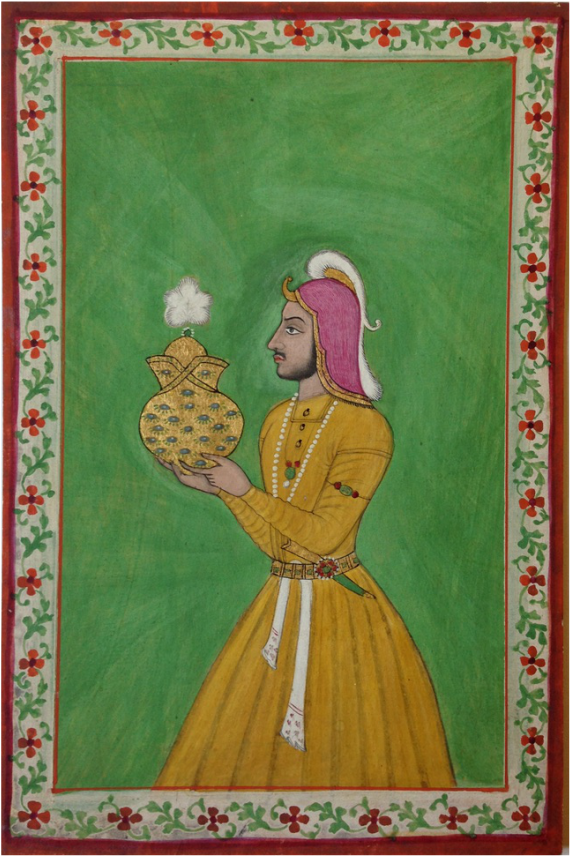
Cool Deccani painting, 18th century: Alexander the Great holding the Cup of Jamshid

30 Mar

Alexander the Great Deccani(click)

Through the ShahnamehAlexander, sometimes as an invading villain, sometimes as a great hero, (but then the Shahnameh is an intensely complex work morally), has entered the legend canon of all Persianate societies.  Pashtuns in particular, for whom the melding of “invading villain” and “great hero” must have a special resonance (smile…) think that Alexander — Sikandar — is a particularly lucky and propitious name to give a boy.  (See: The Cup of Jamshid)

And…see best, most recent translation of the Shahnameh in English, and Reza Aslan’s interesting review for the Times from 2006: “The Epic of Iran” — where he discusses the work’s — and Iranians’ — ambiguous relation to Iran’s pre-Islamic past and the Arab conquest:

“FOUR hundred miles from the bustling metropolis of Tehran lie the magnificent ruins of Persepolis. Built some 2,500 years ago, Persepolis was the royal seat of an Iranian empire that, at its height, stretched from the Indus Valley to the Mediterranean Sea. Though the imperial city was sacked two centuries later by Alexander “the Accursed” (as Iranian chroniclers referred to him), the towering columns and winged beasts that still stand guard over the lost throne of Iran serve as a reminder of what was once among the most advanced civilizations on earth.

“I first visited Persepolis two years ago. Born in Iran but raised in the United States, I knew the place only from dusty academic books about the glories of pre-Islamic Iran. I was totally unprepared for the crowds I saw there. Busloads of schoolchildren from nearby Shiraz filed through the complex of temples and palaces. A tour guide walked an older group up a stone stairway etched with row upon row of subject nations humbly presenting themselves before the king, or shah, of Iran. Families laid out sheets and napped in the shade cast by the intricately carved walls.

“Breaking away from the crowd, I noticed a boy scrawling graffiti on the side of a massive stone block. Horrified, I shooed him away. When I moved closer to see what he had written, I immediately recognized a verse, familiar to many Iranians, taken from the pages of Iran’s national epic, the “Shahnameh.”

          Damn this world, damn this time, damn this fate,
          That uncivilized Arabs have come to make me Muslim.

“Written more than a thousand years ago by Abolqasem Ferdowsi, the “Shahnameh,” or “Book of Kings,” recounts the mythological history of Iran from the first fitful moments of creation to the Arab conquest of the Persian Empire in the seventh century A.D. Ferdowsi was a member of Iran’s aristocratic class, which maintained a strong attachment to the heritage of pre-Islamic Iran…”

51M7Cz+GYHL

Reza_aslan_2013Reza Aslan (click)

Comment: nikobakos@gmail.com

The Classical Liberals: “On the Balkans, the Former Yugoslavia, and the Unity of Spaces”

4 Jan

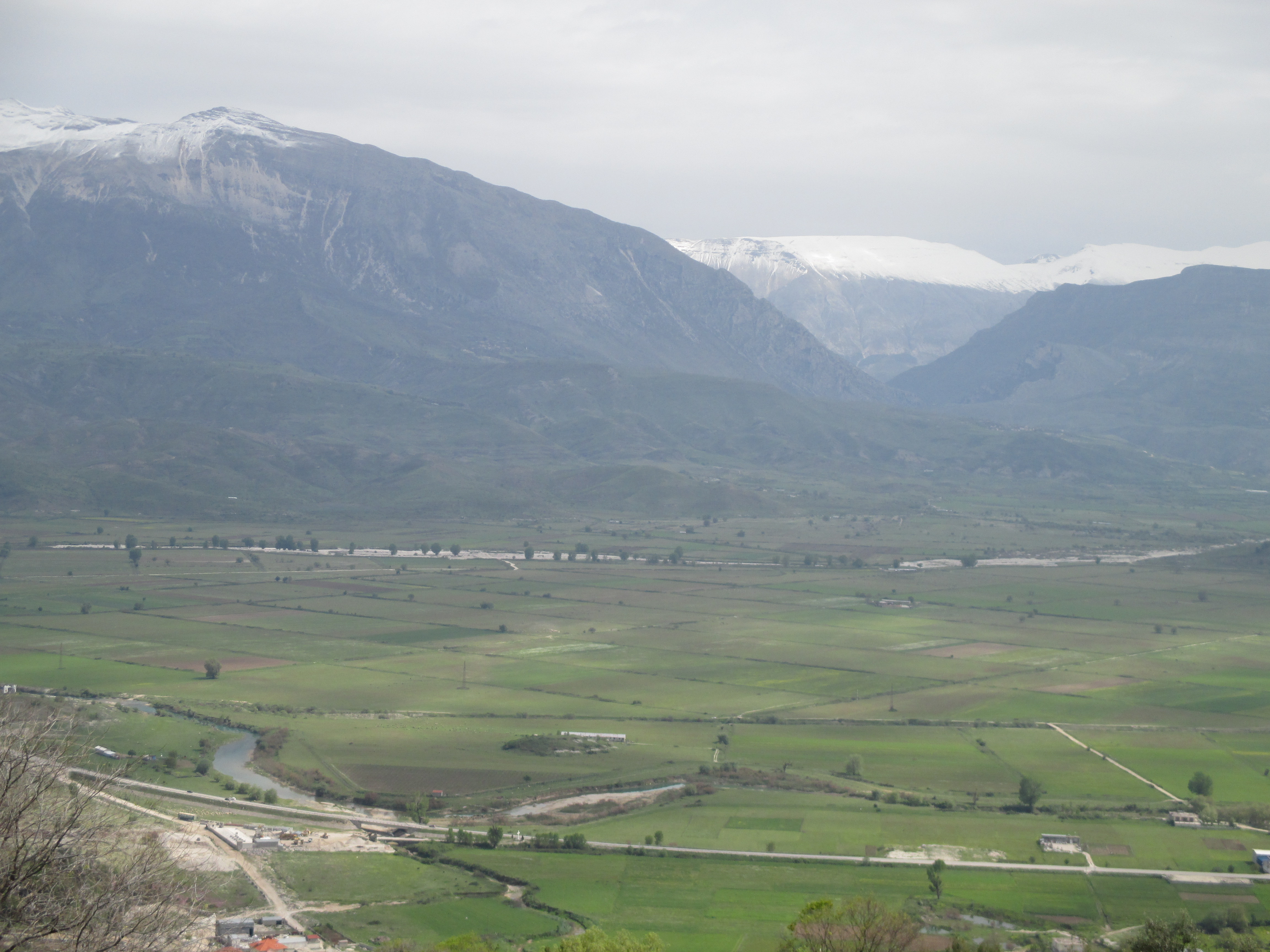
dropoliThe Valley of Dropoli, the pass up to the Pogoni plateau near Libochovo, and in the distance, the snowcapped peaks of Nemerčka, from the Monastery of the Taxiarches in my father’s village of Derviçani, Easter 2014 (click)

I’m honored by the fact that this really intelligent blog quotes extensively from the Jadde’s mission statement in a recent post: Jadde — Starting off — the Mission.

Check them out: The Classical Liberals: At least, most of the time  Smart, perceptive, interesting stuff.

The author of the post below and the person I suspect is largely behind the editing of the blog is one Eoin Power, not just a fellow Balkan-freak along the lines of me or Rebecca West, but also a fellow Epirote.  He demurs a bit — though not very convincingly — at being called an Epirote, because his lineage is multiple and complicated and the connection to Epiros is fairly distant historically.  But he’s from one of the most archetypically and ancient Epirotiko villages — where they still own their patriko — in one of the most archetypically Epirotiko regions of Epiros and he carries himself with the requisite Epirotiko dignity and soft-spokeness and if I, NikoBakos, have conferred the title on you, it’s ’cause you deserve it.

***************************************************************************************************************************************************************************

On the Balkans, the Former Yugoslavia, and the Unity of Spaces

The other day, as she is wont to do, my mother sent me a link to something on the Internet; this time it was to Nicholas Bakos’ blog, which you can find here. If you’re reading this blog, we’re probably friends in real life (thanks for reading!), and so it’s probably obvious why something like that would be of interest to the both of us. I have admittedly only skimmed sections of his posting so far, but in his introductory one, it was especially gratifying to read this:

This blog is about “our parts.”  It’s about that zone, from Bosnia to Bengal that, whatever its cultural complexity and variety, constitutes an undeniable unit for me.  Now, I understand how the reader in Bihać, other than the resident Muslim fundamentalists, would be perplexed by someone asserting his connection to Bengal.  I can also hear the offended screeching of the Neo-Greek in Athens, who, despite the experiences of the past few years, or the past two centuries, not only still feels he’s unproblematically a part of Europe, but still doesn’t understand why everyone else doesn’t see that he’s the gurgling fount of origin and center of Europe.

But set aside for one moment Freud’s “narcissism of petty differences,” if we have the generosity and strength to, and take this step by step.  Granted there’s a dividing line running through the Balkans between the meze-and-rakia culture and the beer-and-sausage culture (hats off to S.B. for that one), but I think there’s no controversy in treating them as a unit for most purposes; outsiders certainly have and almost without exception negatively.  And the Balkans, like it or not, include Greece.  And Greece, even more inextricably, means Turkey, the two being, as they are, ‘veined with one another,’ to paraphrase the beautiful words of Patricia Storace.  Heading south into the Levant and Egypt, we move into the Arab heartland that shares with us the same Greek, Roman-Byzantine, Ottoman experiences, and was always a part of the same cultural and commercial networks as the rest of us.  East out of Anatolia or up out of Mesopotamia I challenge anyone to tell me where the exact dividing line between the Turkic and Iranian worlds are, from the Caucasus, clear across the Iranian Plateau into Afghanistan and Central Asia.

Bakos suggests that for people of “those parts” displaced to another environment (e.g. grad school in the West), this kind of geographical unity came, at least in a social context, fairly naturally, so perhaps I shouldn’t be all that surprised and delighted at seeing it reconstituted in blog form. But in fact I think the basic unity of the geographical zone outlined here often gets lost in the way these places are understood by outsiders and, ironically enough, in no small part due to the vehement insistence from each of the zone’s component peoples that they could not possibly be compared with those uncultured idiots with whom they share a border.*

Explaining the rationale for delineating “his parts” the way he does, Bakos writes:

But to step into Buddhist Burma is somehow truly a leap for me, which maybe I would take if I knew more. And in the other direction, I stop in Bosnia only because for the moment I’d like to leave Croatia to Europe – mit schlag – if only out of respect for the, er, vehemence with which it has always insisted that it belongs there.  Yes, I guess this is Hodgson’s “Islamicate” world, since one unifying element is the experience of Islam in one form or another, but I think it’s most essential connections pre-date the advent of Islam.  I’ll also probably be accused, among other things, of Huntingtonian border drawing, but I think those borders were always meant to be heuristic in function and not as hard-drawn as his critics used to accuse him of, and that’s the case here as well.

Ultimately what unites us more singularly than anything else, and more than any other one part of the world, is that the Western idea of the ethnic nation-state took a hold of our imaginations – or crushed them – when we all still lived in complex, multi-ethnic states.  What binds us most tightly is the bloody stupidity of chilling words like Population Exchange, Partition, Ethnic Cleansing – the idea that political units cannot function till all their peoples are given a rigid identity first (a crucial reification process without which the operation can’t continue), then separated into little boxes like forks after Easter when you’ve had to use both sets – and the horrendous violence and destruction that idea caused, causes and may still do in “our parts” in the future.

Having not, at least north of the equator, yet made it further east than Istanbul, I am in no position to question Bakos’ perception of the fundamental apartness of Buddhist Burma. But the loose border he posits to the north and west is one I’ve crossed many times, and it’s one that is both deeply present and functionally invisible.**

At the very least it is present in people’s minds; I can vouch for the vehemence (to use Bakos’ word again) with which Slovenes and Croats will insist that their countries are European, and not Balkan. It’s also pretty visually observable – you could mistake Zagreb or Ljubljana for a city in Austria or Germany in a way you simply can’t for, say, Sarajevo or Belgrade. And on one frantic trip from Dubrovnik back to Ljubljana (the ferry which I’d intended to take from Dubrovnik to Ancona decided not to arrive from Split, leaving me nothing to do but beat a hasty retreat back north) you could, if you were looking for it, see an actual tangible difference in the way things were done in the world – bus tickets in Mostar and train tickets in Sarajevo had to be paid in cash and a conductor on the train north from Sarajevo let me pay in a mix of Croatian kuna, Bosnian marks,  and euros. In Zagreb I could pay with a credit card, the train station had working and appealing amenities, and you couldn’t smoke in the train. This is a terribly squishy thing to write, but it did feel more “European-y”.

On the other hand, if the relatively old Huntingtonian dividing line between formerly Orthodox and Ottoman lands to the south, and formerly Catholic Hapsburg lands to the north is visually (and, at least in terms of credit card viability in 2009, functionally) discernible, the comparatively recent unifying experience of Yugoslavia is also unavoidable. Here, too, the first signs are in architecture and appearance; Soviet-style architecture and the legacy of 1950s industrialization has left the same physical scars on cities from Nova Gorica to Skopje. But they run deeper than that – the protestations of linguistic nationalists notwithstanding, Slovene, Bosnian, Croatian, Serbian, Montenegrin, Macedonian (hell, even Bulgarian a bit) all exist along a spectrum of of mutual intelligibility; state apparatuses, all having those of the former Yugoslavia as their common predecessors, share similar characteristics. Indeed, to me as a foreigner, the similarities often seem more salient than the differences.

Just on the basis of whether or not there “is” a usefully differentiating border to be drawn where Croatia meets Bosnia, it seems you can argue fairly fruitfully either way, depending on whether your sympathies lie with a sort of longue duree emphasis on deep civilizational splits or a faith in the primacy of modern political experiences. But by Bakos’ own ultimate criteria, it seems a bit odd to leave the northernmost bits of the former Yugoslavia out of things (though there is a nice alliterative symmetry to covering “from Bosnia to Bengal”) . If you’re going on the basis of, “the bloody stupidity of chilling words like Population Exchange, Partition, Ethnic Cleansing,” surely things like Jasenovac or the Istrian exodus argue for the inclusion of all of the former Yugoslavia?

Of course, any exercise in boundary-izing is a bit arbitrary, and in this case there are good reasons to put one in between Croatia and Bosnia and not, say, in between Slovenia and Austria (two countries for which there also exist plenty of historical reasons to consider them as part of a unified space). So if all of this does anything, it is perhaps to show how much more liminal are most places than we or their inhabitants often care to admit; whether or not you see a border somewhere often depends as much on your level of zoom as anything else.

*Or at least their nationalist politicians – many average people (whatever that means) in Bosnia and Serbia, for example, will quickly stress to you the fundamental similarities between the two countries and their inhabitants
**People sometimes marvel at my overstuffed passport but really something like 40% of the stamps come from the Dobova and Dobrljin border posts.

**************************************************************************************************************************************************************************

Again, check these guys out; you won’t regret it: The Classical Liberals

Comment: nikobakos@gmail.com

“Might they open the doors of the wine shops And loosen their hold on our knotted lives? If shut to satisfy the ego of the puritan Take heart, for they will reopen to satisfy God.” — Hafez

3 Nov

WineryimageFrom Pulse News: Beer, wine flow in West Bank Christian hamlet”  by TIA GOLDENBERG | November 3, 2014

TAYBEH, West Bank (AP) — A tiny Christian enclave in the overwhelmingly Muslim West Bank has for years crafted the only Palestinian beer and brought thousands of visitors flocking to its annual beer fest. Now, it is adding wine to its list of libations, hoping a boutique winery will be another tourist draw and contribute to keeping the small village afloat.

While Christians around the Middle East have seen their numbers dwindle due to conflict and the lure of better economic opportunities abroad, Taybeh has remained an exclusively Christian village, the last in the West Bank.

The family behind the wine and beer says they are carrying out “peaceful resistance” by investing in their homeland and staying put.

“This is how we believe the state of Palestine can be built: by people like us to invest in the country and encourage other Palestinians to come and invest in their country,” said Nadim Khoury, who founded the brewery and winery.

I’ve always been fascinated by the association, in so much Persian(ate) poetry, of alcohol with non-Muslims — and by extension, licentiousness, sexual desire, subversiveness, sin, etc.  There’s probably a dissertation out there somewhere that I should try looking for.  I thought about it a lot in my rant on the Gezi Park protests and the symbolic importance of Pera in the İstanbul imaginary that I wrote from Kabul last November.  In fact, it was pretty much the thesis of the piece:

“And here we run into our first paradox, or the origins of a chain of paradox: that this now central “heart” of Istanbul began as a space of marginality.  The Byzantines originally put some of their unwanted Catholics there: Galata’s mother city is actually Genoa.  In Ottoman times, Christians and Jews lived there and made wine and everybody else came there to drink it.  While not an exclusionary, extramural ghetto of any sort – to their credit the Ottomans didn’t often do that kind of thing – it was sort of the wrong side of the tracks: the Ottoman equivalent of the suburbs or the across-the-river Zoroastrian neighborhoods in Iran where Hafez and company went to drink the infidel’s wine and torment themselves with the beauty of the innkeeper’s son: the other side of town, the refuge of disbelief and transgression, of unorthodoxy and the unorthodox in every sense.  The alcohol…”

…….

If 2013’s protests then – at least Istanbul’s –were at their core about protecting aspects of the essential urbanity of Istanbul, and Greeks played such a large role in shaping that urbanity, shouldn’t that be acknowledged?  If Turkish society is playing out – again, at least in Istanbul – its most intense culture wars on a ghost blueprint of vanished minorities, then wouldn’t making that a more explicit part of the contest be immensely productive – all around.

See it all:Nobody really cares about Gezi Park: Greek thoughts on the protests of 2013


image007

Comment: nikobakos@gmail.com

Eid al-Adha

26 Oct

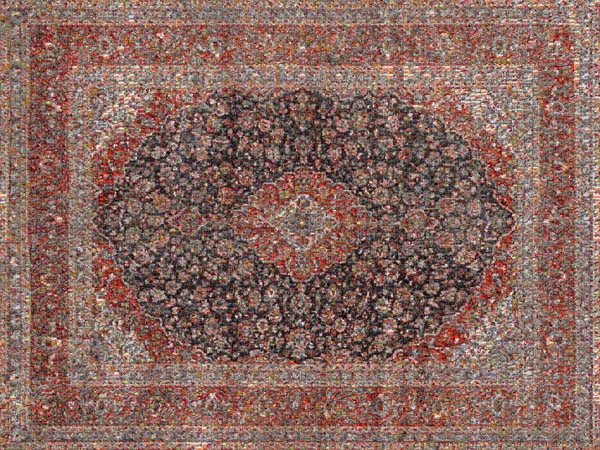
The above “carpet,” by Pakistani artist Rashid Rana, is made up of thousands…tens of thousand? hundreds?…of photographs taken of animals being slaughtered* in homes, streets and slaughterhouses all over Karachi.  To be honest, I don’t know if all these photos were taken on Eid al-Adha or just over a period of time, but it seemed appropriate to the day.  Eid al-Adha, known as Kurban Bayrami in Turkey and in the Balkans, Eid e Qorban in the Iranian world, commemorates the willingness of Ibrahim (Abraham) to sacrifice his son (Ismail, right? not Isaac…) according to God’s will.  It also marks the end of the Hajj.  Anyone who can afford to,  sacrifices an animal and distributes part of the meat to neighbors, relatives and the poor.  I think for many Muslims it’s the major holiday of the year.  It’s always struck me as a feast that had some of the mixed solemnity-joy of Easter (aside from just the obvious element of the sacrifice of the Son), as opposed to the candied, Christmasy festivesness of Eid al Fitr.

(Kurban, which I assume is an Arabic word, is the source of the beautiful Farsi expression “Qorban-e-to” “your sacrifice” — meaning “you’re welcome” or “at your service” or “my pleasure” — I’m all yours; do with me as you wish…here’s my throat…)

Below is a detail of Rana’s piece:

I wish there were a more close-up shot of it available somewhere.  It was beautiful.

It was shown here in 2010 at the Asia Society as part of an exhibit of contemporary Pakistani artists called Hanging Fire: Contemporary Art from Pakistan, which was really fascinating (starting with the title).

Some of my other favorite pieces at this exhibit was the work of Imran Qureishi, who does Mughal-style, Shah Jahan period-type portraits (one of my great aesthetic weaknesses) with figures from contemporary Pakistani reality:

But perhaps the most interesting pieces for me were from Faiza Butt, an artist born in Lahore but now working in London.  Her discussion of her work should be checked out:

“My choice of medium was a reactionary response to my years as a student at the Slade School of Art, where large, physical, muscular and “technologically advanced” work held more worth than contemplative intellectual responses. [my emphasis]  I started to create ambitious, highly detailed drawings with ink pens that rival “spectacles” of work and focus on art historical and gender issues.”

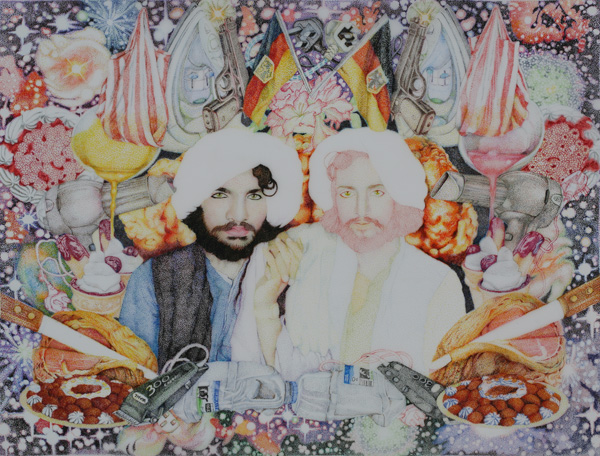
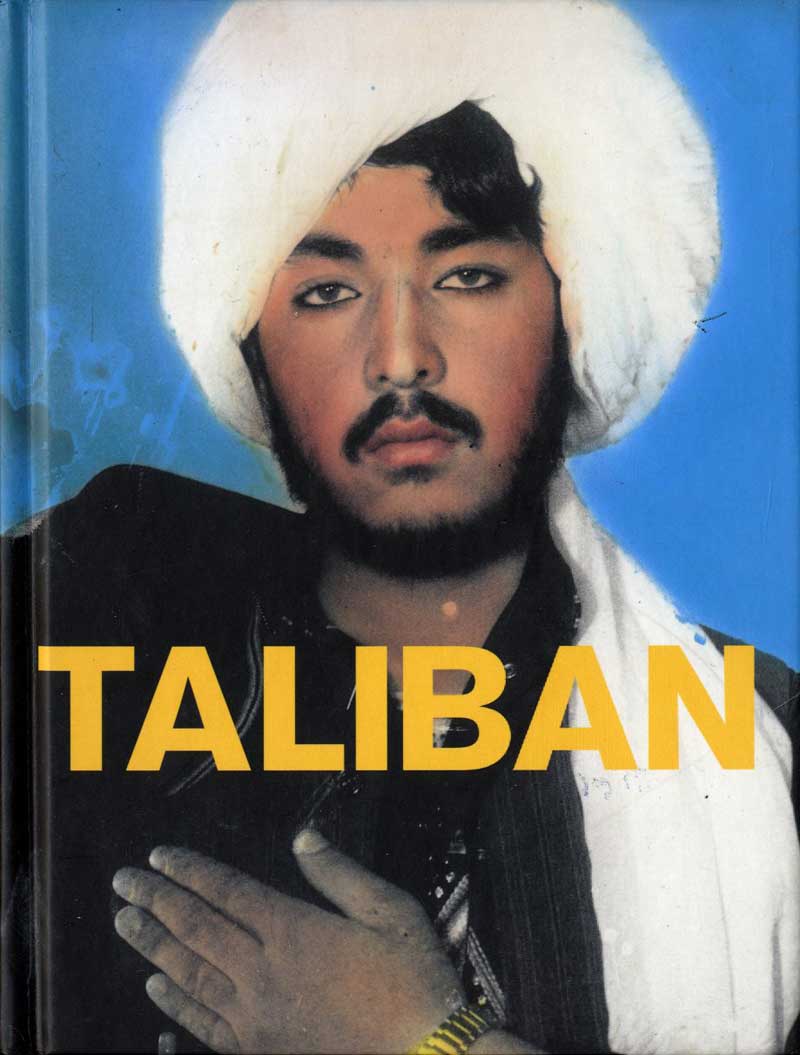
At the the exhibit were displayed two collage pieces she did out of the famous Taliban photos discovered by German photographer Thomas Dworzak in photo studios in Kandahar in 2001.  The photographers were happy to give them to him; ‘most of them are dead” one said.  Butt called the pieces she made out of these photos: “Get out of my dreams – I and II”:

I still can’t figure out what she means.  “Get out”?  “Dreams”?  I think there are stunning ideas behind these pieces and not the least stunning was the title.  Is the strange eroticism of these men, with their khol-lined eyes out of a Perso-Indian opium dream, what draws and compels her?  Or are they just Taliban monsters, whom she wants not out of her dreams, but out of her nightmares?  I had seen the photographs before of course — American journalist Titan Jon Lee Anderson has compiled them into a beautiful edition (below) with an intro by Dworzak, after they first appeared in The New Yorker — but thanks to Butt, they got into my head in a new, strange and beautiful way.

A wildly divergent tangent from Eid al-Adha, eh?  Or maybe not.  Good feast to all.

Also the feast of St. Demetrius today, by the way, Dmitriy Solunskiy — my patron.


Comment: nikobakos@gmail.com


*Sorry for the PETA girls — “slaughter” here has absolutely no moral or ethical connotations for me; it’s just how you kill animals.  When applied to human beings, of course, it has a different meaning, though I know they’re both on the same ethical plane for you.

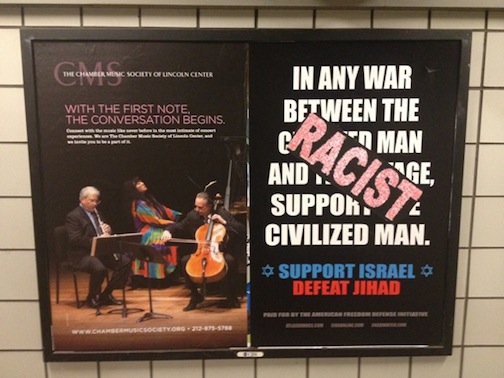
New Yorkers Plaster ‘Racist’ Stickers Over Islamophobic Subway Ads

28 Sep

From Thinkprogress.org:

By Ben Armbruster on Sep 25, 2012 at 9:15 am

After the anti-American protests erupted in the Middle East earlier this month, Pam Geller’s American Freedom Defense Initiative (AFDI) decided to re-up its anti-Muslim ad campaign in New York’s subway system. The ad, borrowing from an Ayn Rand quote, is meant to imply that Muslims are savages.

New York City transit authorities did not want to display the ads but a federal court said refusing the ads would violate AFDI’s First Amendment rights. But now that the ads are up, New Yorkers are taking matters into their own hands, writing “RACIST” and “HATE SPEECH” over the ads in certain subway stations […]

AFDI is trying to run a similar campaign in the Washington DC Metro but authorities there have so far been successful at blocking the campaign “out of a concern for public safety.” (HT: Mondoweiss)

Even Fox News, who has promoted Geller in the past, called her group’s ads “inflammatory” and “anti-Muslim.”


Comment: nikobakos@gmail.com

Olympic athletes fasting for Ramazan

20 Jul

Two videos — God give them strength.


Comment: nikobakos@gmail.com

Pious Turks Push for Labor Justice

11 May

http://www.nytimes.com/2012/05/10/world/middleeast/pious-turks-push-for-labor-justice.html?pagewanted=1&ref=world

Turkish kids think new Turkish capitalists (and the AKP) aren’t morally Muslim enough.

Turkish demonstrators at a May Day rally at Taksim Square in central Istanbul, Turkey, on May 1, 2012. (European Pressphoto Agency)

“Now that there are many rich Muslims, they have begun to regard themselves as a separate class,” Mr. Icoz said. “They live in their new suburbs, far away from the poor, to comply with the admonition of the Prophet against ‘sleeping sated while one’s neighbor goes hungry.’ That’s how low they have dragged Islam.

“They think it is enough to perform the rituals of Islam, like praying, fasting, the Hajj,” he added. “They exploit the workers and then go to prayers. They give no thought to the spiritual, moral side of Islam.”

If even twenty years ago you had told me that any prosperous Turkish middle class would be described in these terms I wouldn’t have known what country you were talking about.  Praying…fasting…the Hajj…huh?  Who?

Nor would I have imagined much of the below.  Whatever their government and political factions, their military or the wild wolves of the Altai mountains might be up to, average Turks continue to exceed my expectations at an almost dizzying rate:

In their march, the youths brandished placards demanding an end to nuclear energy, a right to conscientious objection, a lifting of the head scarf ban and more rights for Kurds and Armenians.

“All Property Belongs to God,” proclaimed one sign; “All Oppressed Are Equal,” said another. A large banner read “Freedom From Slavery” in Kurdish, Armenian and Arabic as well as in Turkish. Some of the female marchers wore head scarves, while others went bareheaded. An impromptu manifesto read out at the rally included quotations from the Bible and the Torah as well as the Koran.

“They are very open and inclusive,” Ihsan Eliacik, a theologian whose writings have influenced the students, said in a telephone interview last week.

“They are also very courageous,” he added, alluding to the fate of former Turkish youth activists such as the iconic Deniz Gezmis, who was hanged at the age of 25 exactly 40 years ago this week, or Erdal Eren, executed at age 16 along with other young activists after the 1980 coup.

Deniz Gezmis: http://en.wikipedia.org/wiki/Deniz_Gezmi%C5%9F

http://en.wikipedia.org/wiki/1980_Turkish_coup_d%27%C3%A9tat

http://tr.wikipedia.org/wiki/Erdal_Eren  “One notable victim of the hangings was a 17-year-old Erdal Eren, who said he looked forward to it in order to avoid thinking of the torture he had witnessed.”


Comment: nikobakos@gmail.com