Tag Archives: Turks

Nobody really cares about Gezi Park: Greek thoughts on the protests of 2013

1 Nov

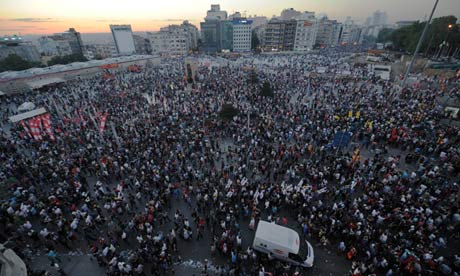
Taksim Square protest

“Oh, is that what it’s called?” I remember saying to myself when last summer’s protests erupted, and I suspect I was joined by quite a few lovers of İstanbul and even natives when they found out that the scruffy, forlorn lot north of Taksim and behind the Arab nargile places along the Cumhurriyet actually had a name.  I may have spent about four or five accumulated months of my life in İstanbul over the years and I think I’ve been inside this park once; one look is enough — and the much bandied-about slogan about “saving the last green space in central Istanbul” becomes comical.  A sudden nostalgia for the place sprang up at the time; everyone suddenly had memories of playing there as a child, but they didn’t seem very convincing.  Nobody cares about Gezi park.  Or did last summer.

What young Turks cared about was Taksim, but even more the string of neighborhoods south of Taksim to Karaköy and their enormous importance in the life of İstanbul.  Proof enough – and weighty proof at that – is that serious civil disobedience began in the area back in the spring, not when the government tried to start construction in Gezi, but when it tried to impose limitations on alcohol consumption in the neighborhood.  Remember the alcohol – it’s a central part of our story, enough for us to maybe have called the whole upheaval the Rakı Revolution and not the Taksim/Gezi protests.  But somehow the press and the people itself forgot that.  Somehow that got lost as the movement morphed into a catch-all protest with a not particularly convincing “green” bayraki propped up as its mascot in a shabby, dirty park.

Unclear?  Yes.  It is to me too and I’m sorting it out as I write.

It goes like this: Pera and Galata — because those are the core areas of the municipality of Beyoğlu that really concern us (Taralabaşı too but as a side show, another story) — were, until the middle of the previous century, heavily Greek.  And Armenian and Jewish, but Greek enough so that pidgin Greek was the quarter’s common means of communication till the early nineteen-hundreds. Pera and Galata were centers of non-Muslim life in İstanbul and Pera and Galata were where you went to drink.  Not a coincidence obviously.  And Pera and Galata are still where you go to drink and party – in fact even more than ever.  And that’s why the fact that attempted restrictions of alcohol consumption set off the civil disobedience of 2013 is so important.

The tourist literature and the press never tire of calling this the center of contemporary Istanbul and tourists who used to stay in Sultanahmet and wonder at the eerie emptiness of the old city’s streets at night have finally started to discover the area – the “Old New Town” as Alexandros Massavetas calls it in his loving, lyrical Going Back to Constantinople: a City of Absences.  And truly, as I’ve written before, these neighborhoods dominate the contemporary social and cultural life of İstanbul in a way that’s not comparable to any other major metropolis I’m familiar with.
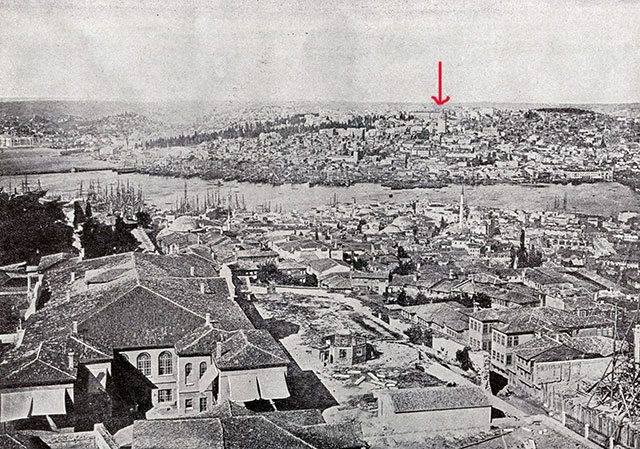
A060512g

Buyuk_Beyoglu_Haritasi

The neighborhoods we’re talking about, Beyoğlu, with Pera (“over there” in Greek, meaning from the old Byzantine/Ottoman city) at its center. (click)

And here we run into our first paradox, or the origins of a chain of paradox: that this now central “heart” of İstanbul began as a space of marginality.  The Byzantines originally put some of their unwanted Catholics there: Galata’s mother city is actually Genoa.  In Ottoman times, Christians and Jews lived there and made wine and everybody else came there to drink it.  While not an exclusionary, extramural ghetto of any sort – to their credit the Ottomans didn’t often do that kind of thing – it was sort of the wrong side of the tracks: the Ottoman equivalent of the suburbs or the across-the-river Zoroastrian neighborhoods in Iran where Hafez and company went to drink the infidel’s wine and torment themselves with the beauty of the innkeeper’s son: the other side of town, the refuge of disbelief and transgression, of unorthodoxy and the unorthodox in every sense.  The alcohol…

The nineteenth century marked Pera and Galata’s – Pera’s especially — transformation into uprent enclaves: gentrification avant-la-lettre in effect.  The Christian-ness of the area only attracted more of them, then foreign Europeans; the influx of non-Muslims from the rest of the city concentrated its gavur character even more deeply.  There were foreign embassies.  Foreign embassy cultural activities followed.  Cafés.  Theaters.  Neoclassical Row houses and apartment buildings in an eclectic mix of local versions of the Neoclassical or Art Nouveau.  All the apparatus of contemporary European urbanity developed: a place of often obscene display of non-Muslim privilege that reminds one of Durrell’s Alexandria or descriptions of the foreign concessions in Shanghai before the revolution, and increasingly alienating to the average un-Westernized Muslim.  But a city.  One as we mean it.  In the Benjaminian sense.  With everything that the modern city at the time implied and still does: socializing and the public space, boulevard culture, entertainment, exteriority…  WOMEN…  Alcohol, of course…  And with Kyr Panos’ taverna and Monsieur Avram’s textile shop still flourishing alongside.

Az081210mnisuaz

The Jadde at its height, probably early Republican times, by the gates of Galatasaray Lycée (above).  This was the neighborhood known as the Staurodromi by Greeks, the “crossroads” because it’s where the Grande Rue meets Yeni Çarşı Caddesi (the New Market — not sure what that referred to — food market around Balık Pazarı?)  (Click)  Bottom photo is by Ara Guler*

And then all the Kyr Panoses and the Monsieur Avrams went away, for reasons readers know and this blog touches on often and will inevitably look back at again.  And this “center of the city” sat in a kind of rancid aspic for a few decades until a young and dynamic and sophisticated Turkish society reclaims it.  And it comes alive again.  And yet the paradox still stands, now sharper than ever (though how conscious and to whom is very much up for debate and may be my real question): that this is the cosmopolitan center of İstanbul; but what made it cosmopolitan were populations that don’t live there any more, but whose legacy is in both the air and breath of the place and in its physical matter itself.  And what we, Turks today, do about that – how we reconfigure a center of our city so laden with the presence and absence of others in order to suit our contemporary needs – is, to a great extent, what progressive Turks and Erdoğan were fighting about last summer.  Not Gezi park.

Some of Erdoğan’s ideas don’t seem so bad to me; a tunnel for one (already built?), that as I gather goes under in Dolapdere and emerges somewhere in Kabataş I think, that would finally free Taksim, never an aesthetically promising piece of real estate, from having to be a major traffic circle,  though Harvard’s Hashim Sarkis’ idea that: “We know from the 1960s that pedestrianizing everything doesn’t work…Managing the balance is better…” makes sense, and I often wonder about the wisdom of having pedestrianized the İstiklal itself.  The (now aborted?) reconstruction of the Ottoman barracks may turn out to be a piece a kitsch, but you never know.  In Moscow, for example, much that was destroyed by Stalin has been carefully reconstructed and it’s lovely; and some of the rest unnecessary, and garish – and often silly.  Either way, I wouldn’t miss the park.

The true big elephant in the Taksim room is a big old elephant of a Greek church that lords over the whole space.  The church of the Hagia Triadha is one of the post-reform churches of İstanbul, churches that were built during the Tanzimat, when traditional restrictions that imposed visual discretion and inconspicuousness on non-Muslim places of worship were lifted and Greeks in İstanbul built some very conspicuous –and often conspicuously ugly — churches.  The Hagia Triadha is actually one of the lovelier of them – it reminds me of the Balyan mosques a little – and gives you a real sense of just how confident Greeks in the City felt in the late nineteenth century.  But its presence is almost impudent; I can only imagine how more traditional Ottoman Muslims must have felt as they saw these giants go up after the 1850s, and to be honest as I’ve walked by at times even I’ve found myself overtaken by what I can only describe as a mild shtetl-anxiety and thinking: “But so big?  And right here?  Can this be good for the Jews?”  So you can imagine that to Erdoğan and the Turkish Islamist mind its bulk must be doubly provocative, and presents a problem that needs to be solved.  The “central square” of the “modern center” of İstanbul just can’t be left looking so…well…so Christian.

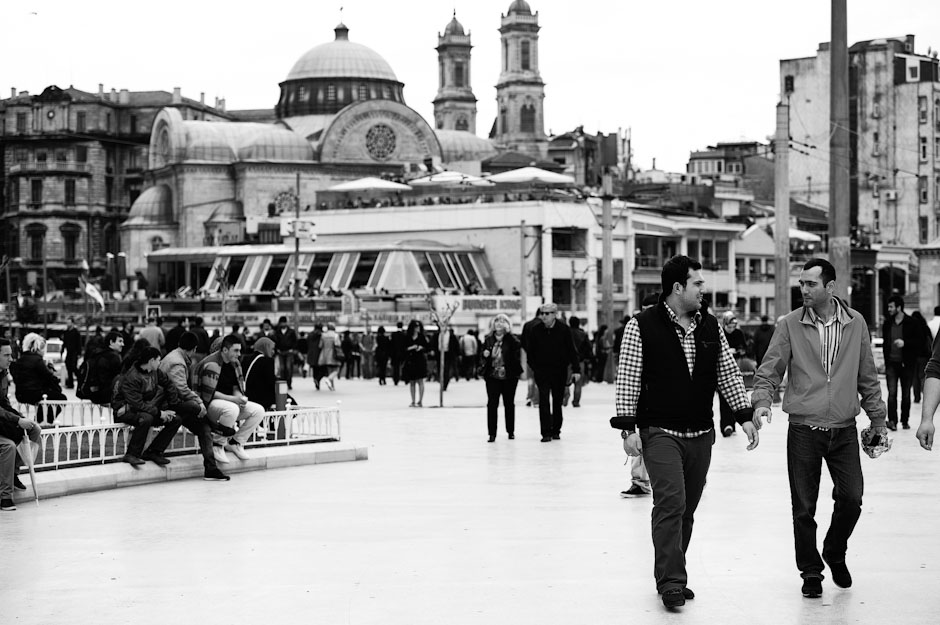
Agia_Triada_Greek_Orthodox_Church,_İstanbul

dsc3663

The church of the Hagia Triadha alone and surrounded by its kebab shops.  (Click on both)

0053 - Istanbul - Taksim Square - Hagia Triada - Orthodox Church

15fk7xv

And another aerial view of the church, the school and surrounding area that gives a clearer idea of layout (click)

So Erdoğan is going to make good on a long-term promise/threat to build a large mosque there to balance out the religious character of the space.  First, he’s going to tear down the circle of döner and kokoreç stands that surround the Hagia Triadha and the neighboring Zappeion, once İstanbul’s most elite Greek school for girls, which is a shame because a circle of smoking lamb fat wafting around the billowing clouds of a church’s incense was always a beautiful olfactory image to me – this is what the Temple must’ve smelled like – and because neighborhood partiers will be deprived of much-needed early morning sustenance.  But philistines like Erdoğan don’t like the smell of lamb fat – probably too familiar — or as Auntie Mame might have said, when you’re from Kasımpaşa you have to do something, so the döner stands will have to go.  And I originally had no sources for this other than my own suspicions, but I was wondering if the döner stands aren’t part of the church’s vakoufia (religious trust properties) and that removing them is another act of expropriation of Greek community real estate that has been going on steadily for decades now; and the Greek community is indeed split into warring camps already about whether taking down the stands is expropriation of parish property or is a good thing; only Greeks can be reduced to a community of about a thousand people, mostly over seventy, and still find energy to bicker about everything; but then there are two Jews left here in Kabul — two –and they’re not speaking to each other over some maintenance issue concerning their one synagogue.  Anyway, the official claim, however, is that the food stands will have to go – get this — in order to make the church more visible so that it and its new neighboring mosque can clearly stand side by side as confessional brothers in the new, beautified Taksim.  Turkey has tried desperately over the past few decades to gain political and cultural capital through gross multicultural gestures of this sort.  This has to be the most nauseating example to date.**

The English-language coverage of the protests paid only the scantest attention to issues of this sort.  Even this piece from the New York Times by Michael Kimmelman: “In Istanbul’s Heart, Leader’s Obsession, Perhaps Achilles’ Heel,” about the reconstruction of Taksim managed to not include a single photograph of the Hagia Triadha, which is quite hard to do actually and, were I a bit more of a conspiracy theorist, would think might be intentional.  As to the former ethnic composition of the area, all reference to the area’s former cultural and linguistic character is colored by the inability of Western — whether American or European — thinkers, to think about multiethnic societies outside of the immigrant societies they know.  In this piece also from the Times that prompted my Tarlabaşı series, “Poor but Proud Istanbul Neighborhood Faces Gentrification,” Jessica Burque says: “Migrant workers have a long history of living in Tarlabaşı, dating from the early 1900s when Greek, Jewish and Armenian craftsmen lived in the area” — no sense that they had belonged to the city for generations, centuries before 1900.  And the above referenced article by Kimmelman refers to Beyoğlu as an area where: “poor European immigrants settled during the 19th century.” — no sense that these people were natives of the city, often of communities that predated the Ottomans, or that they were essential component parts of Ottoman society, from other parts of the empire perhaps, but not outsiders or “immigrants.”  There’s often some vague reference to the buzzwords “diversity” and “cosmopolitan” and no serious mention of what drove the “cosmopolitans” and “migrant workers” away; again a perception that seems informed by seeing this all through the prism of the American immigration experience: as if Pera were a neighborhood on the 7 train, let’s say, and its Dominicans have now moved on to the greener suburban pastures of Bayside.

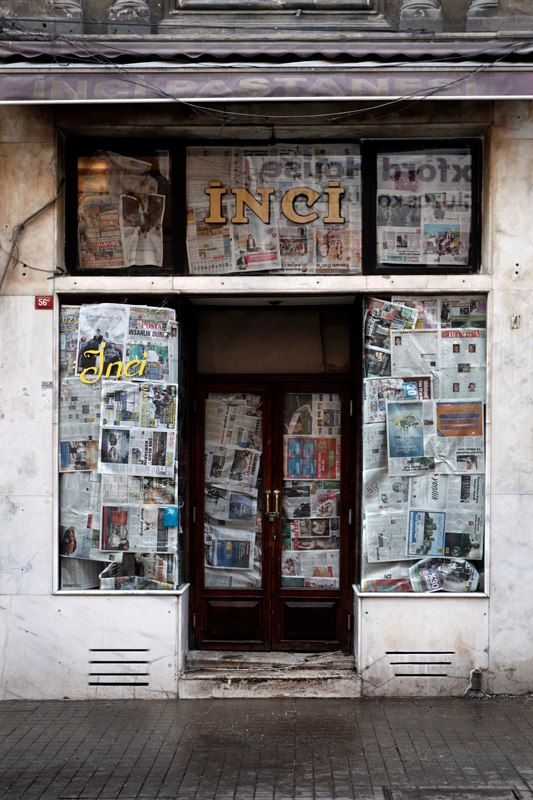
Unfortunately I don’t know if the Turkish press made any reference to the area’s former social composition when covering the protests or if any Turks did at all.  The closing of İnci, the patisserie, is what most brought this all home to me: “the closing of the historic Emek cinema and a much-loved pastry shop…”  There was quite a fuss about İnci apparently, but was any mention made at the time that this had been one of the last Greek businesses in the neighborhood?  There are two more left in all of Beyoğlu I think, İmroz, the restaurant on Nevizade and, perhaps the only growth industry in Greek İstanbul, a coffin-maker’s near the Panayia in Stavrodromi.  Inci had been there since 1947.  I leaf through Speros Vryonis’ massive “The Mechanism of Catastrophe”*** to the pages containing K. Ioannides’, a journalist from the Salonica-based Macedonia newspaper, cataloguing of ransacked Greek businesses in the area, which means all of them, without exception.  On just the İstiklal Caddesi, Meşrutiyet Caddesi, Pasaj Evropa, Yüksek Kaldırım and Perşembe Pazarı there is a list of three-hundred and twenty-nine businesses.  And you really have to marvel and wonder at whether the Greek “daemon” is more than a myth.****  After the financial decimation of the community by the Varlık Vergisi, the “estate tax” of the 1940’s, when discriminatory taxation against minority groups had wiped out many, and sent many of those who couldn’t pay to forced labor camps, Greeks had bounced back to dominating the retail business of these central neighborhoods in less than a decade – only, of course, to have it all definitively trashed a few years later.  And, sure enough, there it was, at number 27 on the list: “Pastry shop İnci of Loukas and Lefteres.”  When people mourned the loss of İnci last summer, was there any sense that something more than a charming old patisserie was disappearing?  Or that this was a place that had bounced back from total loss in one Istanbul tragedy and then went on to continue serving the city for more than fifty years?

İnci, before and during protests, after closure.

inci-pastanesi-kapatildi

inci-pastanesi_110960868246

inci (5)

inci-pastanesi_443808

inci1-F0BA-2415-C212

What do I want exactly?

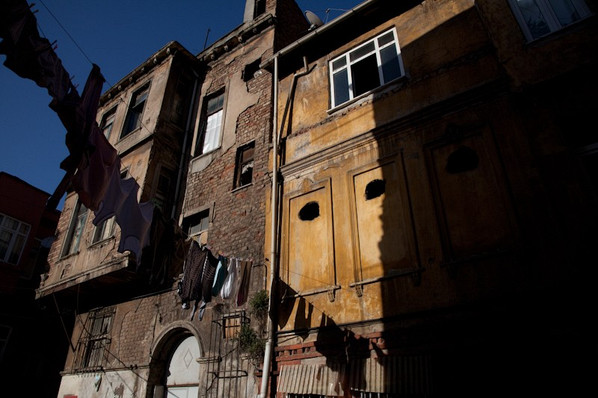
All – I thought a lot about whether I should use “almost all” in this sentence and decided against it –because all the hippest, funkiest, most attractive, gentrified neighborhoods in the historic parts of İstanbul are neighborhoods that were significantly, if not largely, minority-inhabited until well into the twentieth century: not just Pera and Galata, but Cihangir and Tarlabaşı, and even Kurtuluş — of course — and up and down the western shores of the Bosphorus and much of its eastern towns too, and central Kadiköy and Moda and the Islands.  (And if serious gentrifying ever begins in the old city it’ll be in Samatya and Kumkapı and Fener and Balat; I wouldn’t put any big money into Aksaray or Çarşamba just yet.)  If young Turks are fighting to preserve the cosmopolitan character of areas made cosmopolitan by a Greek presence, among others, is it a recognition of that presence, however vestigial, that I want?  Yes.  Is it because some recognition might assuage some of the bitterness of the displacement?  Perhaps.  Is the feeling proprietary then?  Does the particular “cool” quality of these neighborhoods that protesters have been fighting to protect register for me as a form of appropriated “coolness?”  I’m afraid that yes, sometimes it does.  In darker moments this spring and summer, these Occupy Gezi kids annoyed me: “What’s wrong mes p’tits?  The Big Daddy State threatening to break up your funky Beyoğlu party?  Do you know the Big Daddy State made life so intolerable for the dudes who made Beyoğlu funky that they not only had to break the party up, but shut down shop altogether and set up elsewhere?  That your own daddies and granddaddies probably stood by and watched, approved even?  Do you know that now?  Do you care?”
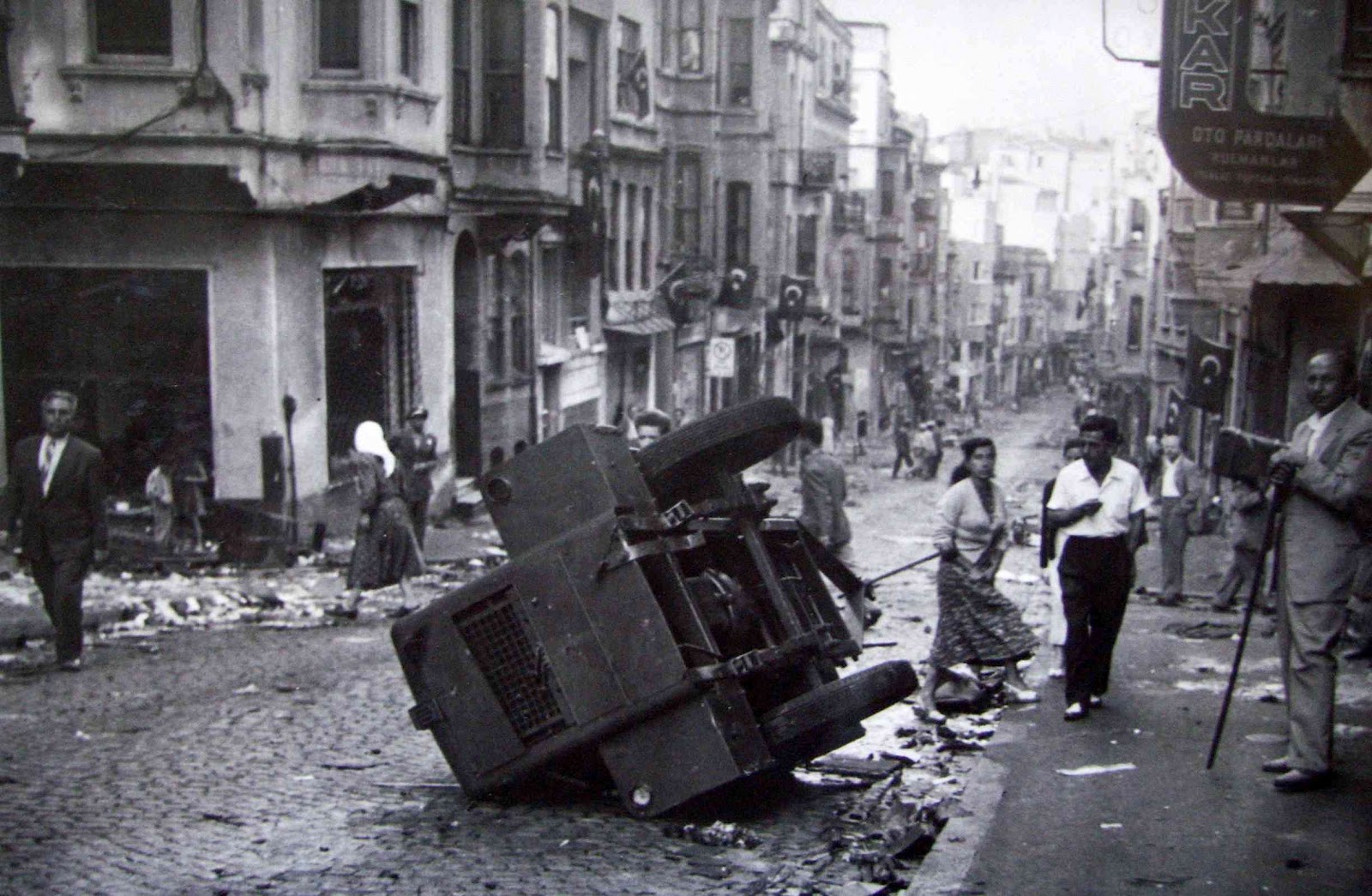
taksim4Cleaning up in a Greek neighborhood after the pogrom of 6-7 September 1955.  I’ve spared readers and myself more and worse photos. (Click)

No one in New York would think of talking about the Lower East Side, for example, or the Bronx, without due respect to the Jewish role in the formation of those areas and, by extension, every aspect of New York culture.  You mourn the passing of every Ratner’s and Second Avenue Deli even if you aren’t Jewish and even if five of them take their place in Kew Gardens or Borough Park.  Or to use a significantly more heated example: if the young white professionals now moving in large numbers into Harlem refused to acknowledge that Harlem’s atmosphere, style, musicality — that the whole Harlem phenomenon — were  largely African-American contributions to the city’s life, wouldn’t any culturally or historically conscious New Yorker find that problematic or reprehensible; not to mention how the neighborhoods Blacks would feel (and do…)  And Jews and Blacks were never driven out of New York by a systematic campaign of violence, harassment, confiscation and forced expulsion.

Therefore: If 2013’s protests then – at least İstanbul’s –were at their core about protecting aspects of the essential urbanity of İstanbul, and Greeks played such a large role in shaping that urbanity, shouldn’t that be acknowledged?  If Turkish society is playing out – again, at least in İstanbul – its most intense culture wars on a ghost blueprint of vanished minorities, then wouldn’t making that a more explicit part of the contest be immensely productive – all around?

But these grudges are usually not this deep and usually don’t last long.  Partly because I’m always on the side of the partiers – any partiers.  Partly because I trust the growing consciousness and honesty of most young Turks.  The protesters as a rule behaved so civilly and politely, their chants and slogans so witty and intelligent for the most part, that you couldn’t help but be impressed.  As opposed to Erdoğan and his party’s grand Haussmanian plans, I think they didn’t really want much: Gezi was just a convenient object.  I think they want the area neither Islamized and Neo-Ottomanized or “re-Republicanized” as it were.  I think they’re tired of those two poles, and as a close friend of mine said, they want another option.  I think they wanted the neighborhood to stay as it is and always has been: a place of pleasure and freedom and difference, of uncomfortable, musty cinemas that offer something more interesting than the suburban multiplexes, of Art Nouveau cafes, no matter how garishly over-renovated or turned into fast-food lunch shops, of badly lit meyhanes that you have to know to find, a couple of gay bars, of mini-skirts and transvestites – both separately and together — everything that the strange sensuality of Istanbul offers and the freedom to not be told how and when to enjoy it.  Every man’s inalienable right to want a sweaty glass of rakı and some leblebi or a good mojito when he wants it.
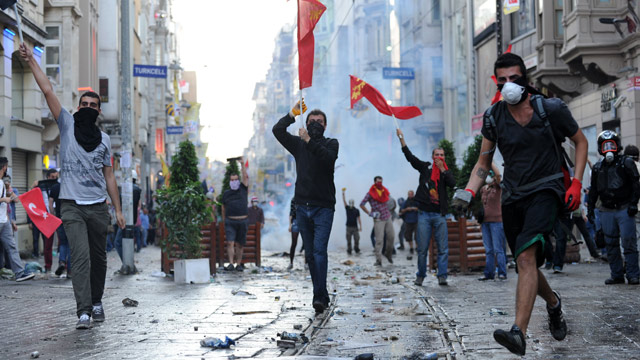
Protesters in Istanbul

And they’ll win too.  Just as Hafez says:

Might they open the doors of the wine shops

And loosen their hold on our knotted lives?

If shut to satisfy the ego of the puritan

Take heart, for they will reopen to satisfy God.

image007

                                                                                                                                                                                                                                                — Kabul, November 2013

*********************************************************************************************************************************************************************************************************************************************************

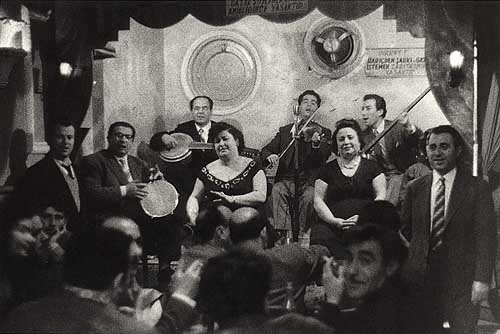
* Two more of Güler’s most famous photographs:
Guler1

D-amp-K-PASAJ-KAHVESI-BEYOGLU-ISTANBUL-ARA-GULER__51726491_0

While there’s no documentation that the subjects of these photos are Greek, the period, the neighborhood they were taken in and — well — just their look, seem to say so.  Ara Güler was a prolific photographer whose work has been sadly overexposed by excessive postcard-ization.  He once famously said: “Today, 13 million people live here. We have been overrun by villagers from Anatolia who don’t understand the poetry or the romance of Istanbul. They don’t even know the great pleasures of civilization, like how to eat well. They came, and the Greeks, Armenians and Jews, who became rich here and made this city so wonderful, left for various reasons. This is how we lost what we had for 400 years.”

He was called a racist by many leftists for that comment.  But who pays them any heed?  His website: Ara Güler: Official Website

** For more of my thoughts on the hypocrisies of multi-culti İstanbul nostalgia see my early piece The Name of this Blog, and my series Tarlabaşı I, Tarlabaşı II, and Tarlabaşı III .  Especially see Amy Mills’ Streets of Memory: Landscape, Tolerance, and National Identity in Istanbul  based on her research in the Bosporus suburb of Kuzguncuk, where she argues that nostalgia for the cosmopolitan actually serves to erase minorities and discrimination against them from public memory and reinforce Turkish Republican ethnic homogeneity.  I think that’s exactly what’s happening in Beyoğlu.

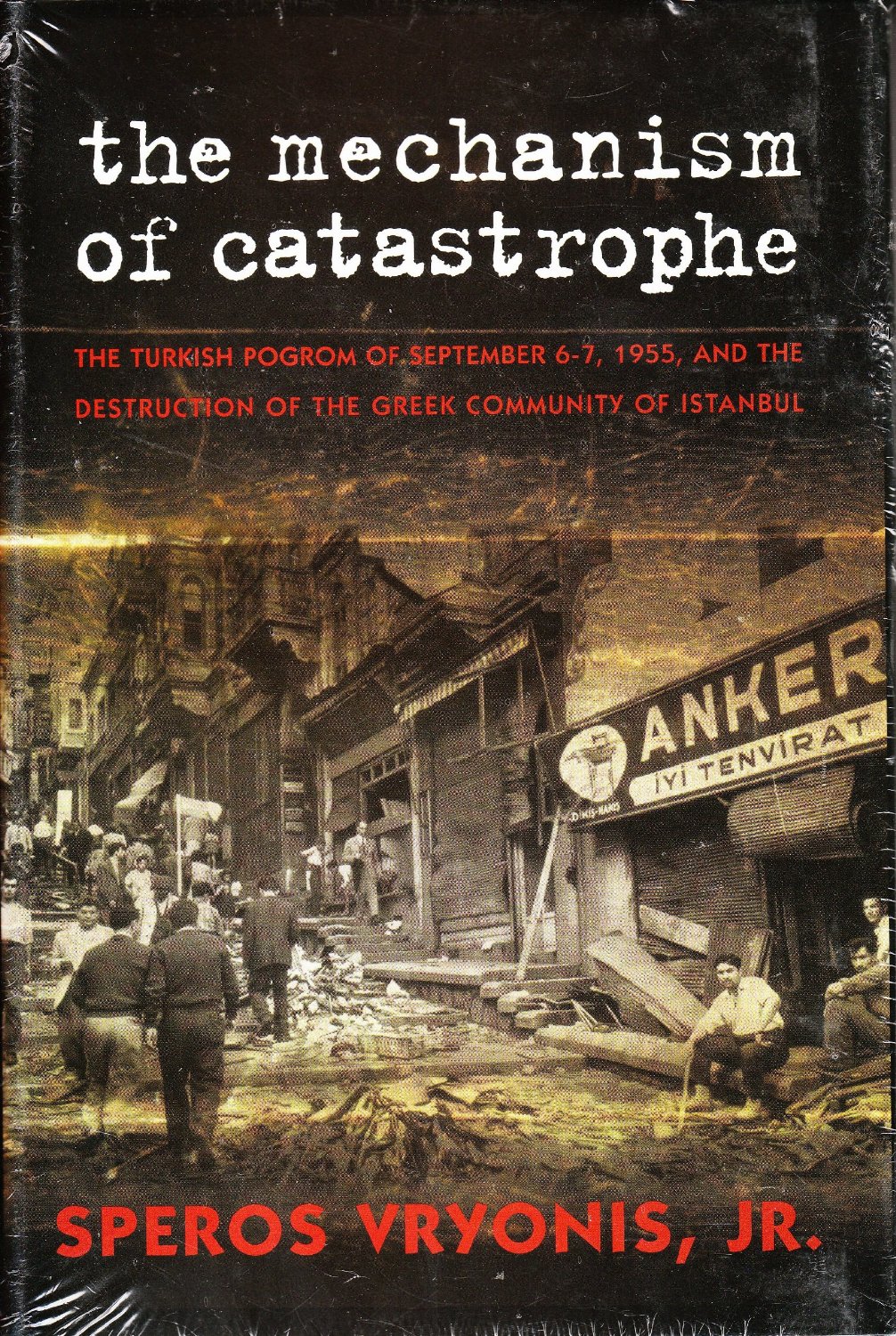
*** Speros Vryonis The Mechanism of Catastrophe: The Turkish Pogrom Of September 6 – 7, 1955, And The Destruction Of The Greek Community Of Istanbul is a magisterial life’s work and piece of historical journalism that covers the one night of September 6-7, 1955 in which a pogrom organized by Adnan Menderes’ Demokrat Parti destroyed practically the entire commercial, financial, ecclesiastic, educational and domestic infrastructure of the City’s Greek community.  I had put off reading it for quite a while — because the subject matter is upsetting and it’s long and detailled — but I was really impressed when I finally did.  I hadn’t realized the exact extent of the damage: 4,500 Greek homes, 3,500 shops and businesses (nearly all), 90 churches and monasteries (nearly all), and 36 schools destroyed and 3 cemeteries desecrated.  I hadn’t known that so many homes had been destroyed, leaving a large part of the community of then 80 or 90,000 or so homeless and destitute and that, as opposed to the traditional account of one old monk being burned alive, some 30 people were actually killed and many raped.
A1iZR7nssVL._SL1500_

The Menderes government initially, and stupidly, tried to portray this as a spontaneous outbreak of nationalist fervor against Greeks over growing Cyprus tensions, but it was actually an extremely well-planned and executed military manoeuvre (every Turk, after all, is a soldier born) carried out and directed by local cadres of the Demokrat Parti who knew their neighborhoods and its Greek properties and institutions well and through the use of Anatolians brought in from the provinces; I guess they were afraid that local İstanbullus, who knew and lived with these Greeks, would not be as easily destructive, though the record of how the city’s Turks did act during the riots is hardly edifying.  As all products of the nationalist-militarist mind, the plan was an extremely stupid move as well.  It brought the economy of Turkey’s largest city to a virtual standstill, at a time when the country was in deep economic doldrums to begin with, by ripping out its retail heart, so much of it being in the hands of Greeks and other minority groups, and in the immediate aftermath there were chronic shortages of basic supplies in the city because distribution networks had been completely severed and even bread — so many bakeries being Greek and Epirote, especially, owned — was hard to find.  It temporarily made Turkey an international pariah (though in that Cold War climate that didn’t last too long) and eventually played a role in bringing the Menderes government down and costing him his life — thought that all is well beyond the scope of this post, this blog and my knowledge.  Vryonis’ analysis is brilliant if you’re interested.

It’s become axiomatic that the riots were the beginning of the end of Greek Constantinople; the community struggled and tried, but this time things were shattered — physically and psychologically — beyond repair.

**** The Greek Daemon, “daemon” in the Roman sense of the word of animating genius — “To daimonio tes fyles” — is the idea that Greeks are resourceful enough to prosper anywhere and under any conditions — Patrick Leigh Fermor’s belief in their ability to “spin gold out of air” — and the repeated tragic setbacks and almost immediate comeback of the Greek community of İstanbul after nearly every catastrophe to befall it in the twentieth century tempts one to believe in its truth.  Thus, one of the most poignant elements in the Constantinopolitan story is their almost masochistic refusal to leave — what it took to finally make the vast majority abandon the city they loved so much was just too overwhelming in the end however.

There is one important corollary to the “Greek Daemon” myth, however: it only operates for Greeks outside of the Greek state itself, and unfortunately history seems to continue to bear this out.

Comment: nikobakos@gmail.com

Vocabulary: “Frangoi”

2 Sep

I’ve used this term several times without giving a more specific definition of it and that was a mistake because some of those posts would have made more sense if I had.

Like: “Little Rock, Greece”  (May 26th, 2012):

“But an equal object of my bashing here is the European Union, which aside from proving itself to be a neo-colonialist endeavour masquerading as the Highest Achievement of Western Humanism Project, has also revealed itself to be a half-assed, thrown together mess on so many institutional and bureaucratic levels.  (Yes, neo-colonialist: the Frangoi** gave up their colonies after the war and then discovered the exploitable potential of Europe’s own periphery again.)”

And: “Russia and Syrian Christians, ctd”  (June 5th, 2012):

“Tying your survival to extra-regional players or regimes like Assad’s that are destined to soon make their exit is a losing strategy for the region’s Christians.  The threat of Islamist violence is probably real.  Iraq and even Egypt certainly seem to indicate that.  But their only choice is probably the tricky dance of fostering, or just going with, the flow of democratic change while keeping themselves as least vulnerable as possible.  Forget Russia.  And, as Constantine XI had to heroically face in the end, there’s certainly no help coming from the Frangoi.*  If you want to live in peace and security, look to your neighbor because, ultimately, he’s the only one who can provide it for you.”

And: “Un Verano en Nueva York” (July 13th, 2012):

“In Astoria I catch the end of vespers at Hagia Eirene.  This is a church that used to be the territory of fundamentalist, Old Calendar, separatist crazies but has rejoined the flock on the condition that it was granted monastic status (and I have no idea what that means).  But it has somehow got its hands on a great bunch of cantors and priests who really know what they’re doing.  I’m impressed.  I brought friends here for the Resurrection this year and for the first time I wasn’t embarrassed.  If I hadn’t invited them back home afterwards I would have stayed for the Canon.  Only one cantor now at vespers but he’s marvelous and the lighting is right and the priest’s bearing appropriately imperial.  It’s incredibly heartening to see our civilization’s greatest achievement — which is not what the Frangoi taught us about Sophocles or Pericles or some half-baked knowledge of Plato or a dumb hard-on about the Elgin marbles or the word “Macedonia,” but this, the rite and music and poetry and theatre of the Church – performed with the elegance and dignity that it deserves.”                  

So…when the Byzantines first encountered the West and the conglomeration of Germanic kingdoms that had sprung up on the territories of the western Roman Empire, or rather, when they first felt challenged by it and not just irritated, was when Charlemagne, previously just King of the Franks, was crowned Emperor of the Romans in the year 800 by Pope Leo III, whose skin he had saved after Leo had been deposed and almost lynched by the mobs of Rome.  This, of course, was intolerable to us, because we were the Romans and we had an Emperor, with an unbroken line back to Constantine, if not Augustus.  This is close to impossible an idea for anyone today to understand; it’s even hard for modern Greeks to articulate and it’s at the core of our completely mangled identity.  It’s nearly impossible to speak definitively about consciousness or identity in the present tense, much less more than a millennium past.  But this is the simplest way I can put it: by the late first millennium, the Greek-speaking Christians of the eastern Mediterranean had a stronger sense of Imperial Roman continuity than the inhabitants of even the Italian peninsula.  Till well into the twentieth century our most common term of self-designation was “Romios” – “Roman.”  If you had asked any of my grandparents, all born Ottoman subjects, what they “were” — if they even understood the question — or even my father very often, they would’ve all answered “Roman.”  For the inhabitants of my father’s village in Albania, especially the older ones, who never had “Hellenes” imposed on them by the Neo-Greek statelet, the world is still divided into Muslim “Turks” and Orthodox “Romans,” and whether they speak Greek or Albanian is irrelevant.  The Greeks of Istanbul still call themselves “Romioi” for the most part; Turks still call them “Rum” too, out of simple historical continuity, while the Turkish state is still faithful to the appellation for partly more cynical and manipulative reasons.  I’m writing a piece with the appropriately pompous working title of “A Roman Manifesto” or “A Manifesto of Romanness” that will deal with this whole theme further.

The Frankish West (click)

So Charlemagne was a Frank, a Latinized Germanic ethnic group, and though the Pope’s primacy “inter pares” was recognized, he had no right to unilaterally crown this Frank emperor in an Italy that had become a ravaged provincial backwater from the Constantinopolitan point of view.  This didn’t end relations between the Empire and the various western European kingdoms.  They continued to trade and even contract dynastic marriages and all the rest.  But the tension, which had already been planted for quite a while before that, only went from bad to worse: power tensions; trade concessions to the Italian city-states that fatally mirror the ones the Ottomans had to make to the Western powers a millennium later; massacres of Italians in C-town that are equally mirror-like.

The West grew in confidence.  The Empire shrank.  They started bickering about theological issues, and eventually, in 1054, Rome and Constantinople excommunicated each other over some nonsense about the division of labor among the Trinity that I’ve never bothered to try and understand.  Then came the Crusades — more growing Western confidence — which the Byzantines weren’t ever really enthusiastic about because I reckon on many levels they felt less animosity for and greater cultural affinity to their the Muslim/Arab neighbors than they did to the “Franks.”  Runciman, I think writes somewhere that a ninth-century Greek felt more at home in Arab Palermo or Baghdad and Cairo that he would’ve in Paris or even Rome.

Sometimes Wiki’s gets it perfect:

“The experiences of the first two Crusades had thrown into stark relief the vast cultural differences between the two Christian civilizations. The Latins (as the Byzantines called them because of their adherence to the Latin Rite) viewed the Byzantine preference for diplomacy and trade over war, as duplicitous and degenerate, and their policy of tolerance and assimilation towards Muslims as a corrupt betrayal of the faith. For their part, the educated and wealthy Byzantines saw the Latins as lawless, impious, covetous, blood-thirsty, undisciplined, and (quite literally) unwashed.”

Then came the Fourth Crusade, led by the Venetian Doge Enrico Dandolo.  The Crusaders fell into the internecine machinations of the some Angeloi  Emperors and I think ended up feeling betrayed on some promise made to them by one party in the Byzantine political scene, and they probably were, because our latter Emperors compensated for the diminishment of their real geopolitical power and the sapped strength of their once massive military machine by becoming major manipulative sleazebags and liars, initiating a long Greek tradition that persists to our day.  In retaliation, and, or, because that had been their real object all along, the Crusaders of the Fourth Crusade, in 1204, captured the City – the first time Constantinople had ever fallen to anybody and destroyed it.

They destroyed her.  They massacred thousands, desecrated churches, including Hagia Sophia herself, and carried away what, in today’s terms, I’m sure amounted to billions in loot.  The Venetians got off with enough of a lump sum of capital to fund and run their mercantile empire for another five centuries.  But aside from the loot, which on some level is comprehensible, it’s the sheer mindless destruction of 1204 that betrays the sack as the action of thuggish, resentful provincials and their envy towards what had been the civilizational center of the Mediterranean and western Asian world for almost a millennium; it’s what an army of Tea-Partiers, NRA members or armed Texan Evangelicals would do to New York if they could.  Though pregnant already with the great traditions of this supposed thing called Western Humanism, this bunch destroyed more Classical texts and melted down or smashed more Classical sculpture into gravel than had been done at any other one time in history – far more than any fanatical Christians in any pagan city or any Arabs or Muslims in any conquered Christian city before them had.  More of the ancient world was lost to us in those few days than in any other comparable time span before that.  Just sheer idiotic vandalism.  There’s probably no more epic manifestation of Killing-the-Father in human history.

Speros Vryonis, a great historian but a seriously unpleasant man, Theos’choreston, made a career out of catalogueing the injustices done to Byzantine and post-Byzantine Greeks.  He was the great modern preacher of whining Greek victimology and one often felt that all his personal bile and biterness was poured into his work in that way; his book on the anti-Greek riots of Istanbul in 1955 is one thousand pages long; you’d think it was the most important event in twentieth-century history.  In any event, in Byzantium and Europe, he wrote:

“The Latin soldiery subjected the greatest city in Europe to an indescribable sack. For three days they murdered, raped, looted and destroyed on a scale which even the ancient Vandals and Goths would have found unbelievable. Constantinople had become a veritable museum of ancient and Byzantine art, an emporium of such incredible wealth that the Latins were astounded at the riches they found. Though the Venetians had an appreciation for the art which they discovered (they were themselves semi-Byzantines) and saved much of it, the French and others destroyed indiscriminately, halting to refresh themselves with wine, violation of nuns, and murder of Orthodox clerics. The Crusaders vented their hatred for the Greeks most spectacularly in the desecration of the greatest Church in Christendom. They smashed the silver iconostasis, the icons and the holy books of Hagia Sophia, and seated upon the patriarchal throne a whore who sang coarse songs as they drank wine from the Church’s holy vessels. The estrangement of East and West, which had proceeded over the centuries, culminated in the horrible massacre that accompanied the conquest of Constantinople. The Greeks were convinced that even the Turks, had they taken the city, would not have been as cruel as the Latin Christians. The defeat of Byzantium, already in a state of decline, accelerated political degeneration so that the Byzantines eventually became an easy prey to the Turks. The Crusading movement thus resulted, ultimately, in the victory of Islam, a result which was of course the exact opposite of its original intention.”

The Fall of Constantinople, Palma Le Jeune — 16th-17th century (click)

The Entry of the Crusaders into Constantinople –Eugene Delacroix, 1840 (click)

And, in fact, the Turks — fast-forward two-and-a-half centuries – weren’t as bad.  Maybe ’cause there wasn’t much left.  Aside from a sizeable amount of slaves, most of the loot Mehmet had promised his suicidally brave Janissaries when they finally made it into the City in 1453 consisted of cheap silver frames pried off of personal or parish-sized icons — Cavafy’s “bits of coloured glass.”  The Emperor’s tombs in the dilapidated Hagioi Apostoloi — the Byzantines’ Westminster — had already been desecrated and robbed by the Franks.  They may as well have sacked Astoria.  The rest was in Venice.  (Even the crown jewels had been pawned off to Venice a century before by Anne of Savoy, one of the most meddling Frangissa bitches in Byzantine history, to fund her episode of the Palaiologan civil wars; that’s the actual historical reference for Cavafy’s “coloured glass.”  Christouli mou, can you imagine what the Byzantine crown jewels were like?)  But one good thing happened for Greeks on Tuesday, May Twenty-Ninth, Fourteen-Fifty-Three: when the Turks finally broke into Hagia Sophia, they smashed Dandolo’s sepulcher — because, after all of the above, he had had the shamelessness to have himself interred there – and finding nothing of worth, they threw his bones out into the street and let the dogs gnaw on them.  I don’t care what else the conquering Turks did at that  point or that Menderes’ thugs did the same to the Patriarchs’ graves at Balikli in 1955; I sleep better at night because they did it to Dandolo.  I’m as close to a chaneller of the Byzantine mind and soul as you’ll find (aside from Vryonis) and I can tell you that the sweet Balkan hard-on of vengeance that image gives me even now is indescribable.

The Greeks got Constantinople back in 1261, but the City never really recovered, as the Empire itself didn’t.  Like the South Bronx in the eighties, whole parts of the City were eventually given over to orchards and bostania or just wilderness.  Yet even after that, the Byzantines managed to plant further seeds in the womb of friggin’ Western Humanism in the form of an artistic wave of unprecedented dimensions and creativity. 

The “Franks,” thereafter, were the unforgivable villains.  But even before, when Byzantine writers felt like being professional, they referred to Westerners as “Latins.”  When not, and eventually in most cases, they were “Frangoi.”  Frangoi stuck as the word for Westerners, or for Catholics at least, because Protestantism was only a minor blip on the East’s screen.   But generally it came to mean the Western Others and the Eastern Muslim world between which Byzantine and post-Byzantine Christians came to feel themselves stuck between.

“Fereng,” “Ferengi,” “Ferenj” and other variations is also a word that eventually came to be used as far east as India, but I can’t be sure whether in Iran or India it means/meant Westerner or just foreigner.  For Arabs and Turks, “Frank” came to mean those Christians over there, as opposed to “Romans,” our Christians over here.  So if you were Roman Catholic, either back home in Europe or in the Near East, you were a “Frank;” if you were an Orthodox Christian, you were a “Roman.”*  It’s confusing.  And I hope I haven’t made it worse.

For Greeks, Frangoi continued to mean Westerner both in a negative sense and not, until the nation-sate convinced us into thinking we ourselves were Westerners.  When Greek peasant men, for example, started wearing Western clothes, whereas their women wore traditional dress well into the twentieth century in many regions, those clothes were “Frangika.”  Frangoi also meant, with no negative connotation, the small communities of Catholics in the Aegean islands that were leftovers of the Crusader principalities that had been founded there after the Fourth Crusade.

It’s not used any more in common Greek parlance, but most Greeks know what you mean when you say it – though this generation is so profoundly ignorant historically that I’m not so sure.  I, of course, use it in a spirit of historical irony, though that spirit is entirely hostile.  The worst enemy of our part of the world is the European West, and not because of imperialist interventions or the usual gripes, but because of the ideological and cultural chaos we allowed it to throw us into.

Yes, Frangoi are the enemy.  I like to say that.  But it’s not true.  We think we’re Frangoi.  Unlike the Byzantines described above, who understood that their natural civilizational context was and always had been the eastern Mediterranean, we are either ignorant of the peoples to our East or despise them.  We disfigured our own identity in an attempt to remake it in the Westerners’ image.  We threw acid into our own face and now still look longingly into Europe’s eyes, and pathetically expect to see our Classical glory reflected back at us.

*One of the most graphic examples is Lebanon/Syria, where Orthodox Christians, who have long and poignantly tried to bridge the above gap, were still “Romans” into the nineteenth century and were among the founders and then long among the most loyal adherents of Arab nationalism, whereas Maronite Christians were the locals with the most exemplary Frangika delusions, always looking to the Western outsider to bolster their interests, first their “sweet mother France” and then Israel, and bringing disaster down upon their heads and that of all around them in the process.  That’s why in many previous posts my humble outsider’s advice to and hope for Syrian Christians in the current crisis has been that they think and act like Romans and not Franks.

Comment: nikobakos@gmail.com


“The Graves Are Walking”: Was the Great Potato Famine a genocide?” (And, let’s rethink “genocide” in general)

20 Aug

“A new book argues that free-market ideology, not murderous intent, killed Ireland’s millions.”  See Salon‘s entire review of the book here.

Some quotes:

“Citing an Irish nationalist author who accused Britain’s Assistant Treasury Secretary Charles Trevelyan of infecting Irish children with a special “typhus poison” in a government laboratory, he writes that the man “should have stuck to the truth. It was incriminating enough.” The story Kelly tells in “The Graves are Walking” is indeed damning, a shameful, bloody blot — and far from the only one — on the history of the British Empire. But calling it a genocide, however satisfying that pitch of moral condemnation may be, only acts to obscure the chilling contemporary relevance of Ireland’s 19th-century agony.”  [my emphasis]

Exactly.  Even if there was “no murderous intent,” it was still criminal.

“Kelly, like most historians, places the brunt of the responsibility for this fiasco on the shoulders of Trevelyan. As the policy leader of the famine response program, Trevelyan was not a Mengele-style mad scientist but a civil servant known for his “unbending moral rectitude and personal intensity.” Unfortunately for the Irish, the faith he embraced was a fusion of Moralism, “an evangelical sect that preached a passionate gospel of self-help” and the laissez-faire economics of Adam Smith and Edmund Burke. At several key points in the evolution of the catastrophe, when strategic intervention might have fended off thousands of deaths, Trevelyan refused, maintaining that there was no greater evil than interfering with market forces. When a subordinate protested, he would send him a copy of Burke’s “Thoughts and Details on Scarcity.”” [my emphases]

See my older post Maybe Germans ARE Scary, my commentary on a borderline Nazi opinion piece that appeared in the New York Times“German Austerity’s Lutheran Core”, in which I argue that Protestantism-s (except for Anglicanism, which grew out of very different historical circumstances and forms of “protest”) aren’t really religions at all but moralist codes, on which capitalism depended for its growth, and for which, whatever transcendent entity their adherents may believe in, serves only as divine confirmation of their righteousness.  It was the aggressive evangelical fervor that swept Methodist, Presbyterian and “low church” Britain in the mid-Victorian age that was perhaps the primary cause of the Indian Rebellion only a decade after the Irish catastrophe (see William Dalrymple’s brilliant The Last Mughal: The Fall of a Dynasty: Delhi, 1857).

“These strategies amount to the 19th-century version of what Naomi Klein has dubbed the “Shock Doctrine”: an attempt to force economic reforms on a population reeling in the aftermath of a disaster.”

Like Germany and southern Europe today?  (Read Klein’s great book: The Shock Doctrine: The Rise of Disaster Capitalism)

“Both sides were ignorant and shortsighted, confident in their stereotypical notion of the irresponsible, fanciful and lazy “Irish character” but oblivious to all the ways that rural subsistence economies cannot be expected to start functioning like England’s more developed agricultural one overnight.”

The classic accusation of laziness in these situations (like against Greeks, who, it turns out — when they had employment — worked more hours than the population of any EU country) is just infuriating.  People don’t work when they don’t have an incentive to, when the technological and political and class restrictions imposed on them limit them to anything more than subsistence or, in the Irish case, even rob them of the means of subsistence.  That the Irish are lazy, man…  To know what work-horses, and I mean that only with great respect and admiration, these Irish kids are, who are coming to New York again in the wake of the Euro-crisis and to even think “lazy”…

Yes, well, not England’s finest hour — though it’s a nation and a people I respect and feel a curiously personal pride in.  And yes, Ireland is outside the borders of the “Jadde” world.  But I love the Irish so much that they’ll keep appearing from time to time and, actually, they’re as much objects of Western imperialism as we are.

But really I’m posting this piece because I think it’s past time that we, in the “Jadde” world, begin some serious discussion on the use of the term “genocide.”  I think it’s getting thrown around much too loosely lately, and that not only disrespects the victims of true genocides, it pariah-fies and unfairly singles out certain groups for vilification (Turks, Serbs) and creates simplistic analyses of complex historical events that then become conventional wisdom, all in ways that makes deeper dialogue between our peoples impossible.  So, we need to talk about it and what “it” really is.


Comment: nikobakos@gmail.com
Greeks and Turks: Ramazan in old Tarlabasi

20 Jul

…a neighborhood about to be destroyed.  See their great website: Tarlabasi Istanbul

“In the early 1950s, waves of rural migration led to profound demographic and socio-economic changes in Istanbul. Empty houses in Tarlabaşı and other neighbourhoods were soon claimed by workers arriving from all over Anatolia. Young men started working alongside local master craftsmen, or usta, and sometimes went on to open their own stores and workshops. Yusuf Karapinar, a shoemaker, got his start in the profession at the age of 8, as an apprentice in a Greek family. “They were lovely people, extremely nice to me,” he said. “During the month of Ramadan, they never ate in front of me and my mentor’s wife always insisted on cooking an iftar meal for all of us.” Forty years later, Yusuf Usta is today one of the very last shoemakers in the neighbourhood and his shop is threatened with demolition. Turan Usta, who works with Yusuf and his son Kadir Karapinar and has been a shoemaker for 45 years, is angry about the prospect: “If they tear Tarlabaşı down, it will be the end of the artisans and of the craftsmanship here.””


Comment: nikobakos@gmail.com

Un Verano en Nueva York*

13 Jul

Queensborough Bridge (photo: Matt Lawson)

I don’t often get the chance to aimlessly stroll around the City much anymore – I mean Manhattan, not that City – but especially in the summertime, when New York is hot like it is today but not unbearably so, so many of it’s sensory delights, especially its human ones, are on display everywhere that if I get the chance, I can’t stop walking, eating, drinking things, and checking people out — the perfect tourist in my own city.

My shrink was unusually cute today and I had a really good time with him and that only added to my kefia and energy.  I walk straight down 5th to St. Patrick’s to give my saludos to St. Anthony, since he’s my most best beloved in the Catholic pantheon, and then turn off 5th to Madison because I can’t deal with any tourists but myself, though I’ve been finding European tourists to be significantly less obnoxious recently – and significantly less, generally — now that they don’t have any money either.

I know where I’m going anyway – at least for starts.  I’m making a bee-line for faloodeh.  Don’t ask me wtf…  I must have been dreaming about it last night and sleep-walking (which I did a lot of as a kid) when I posted that piece about faloodeh:  “This is what I want in this heat: Faloodeh”,  because it was posted at 7:00 a.m., which is the middle of the night for me, and when I got up at my usual time I didn’t even remember having put it up.  But I have faloodeh on the brain right now, man, and am heading straight for the only place in New York where I know I can get it, an Iranian restaurant on 30th St. called Ravagh.

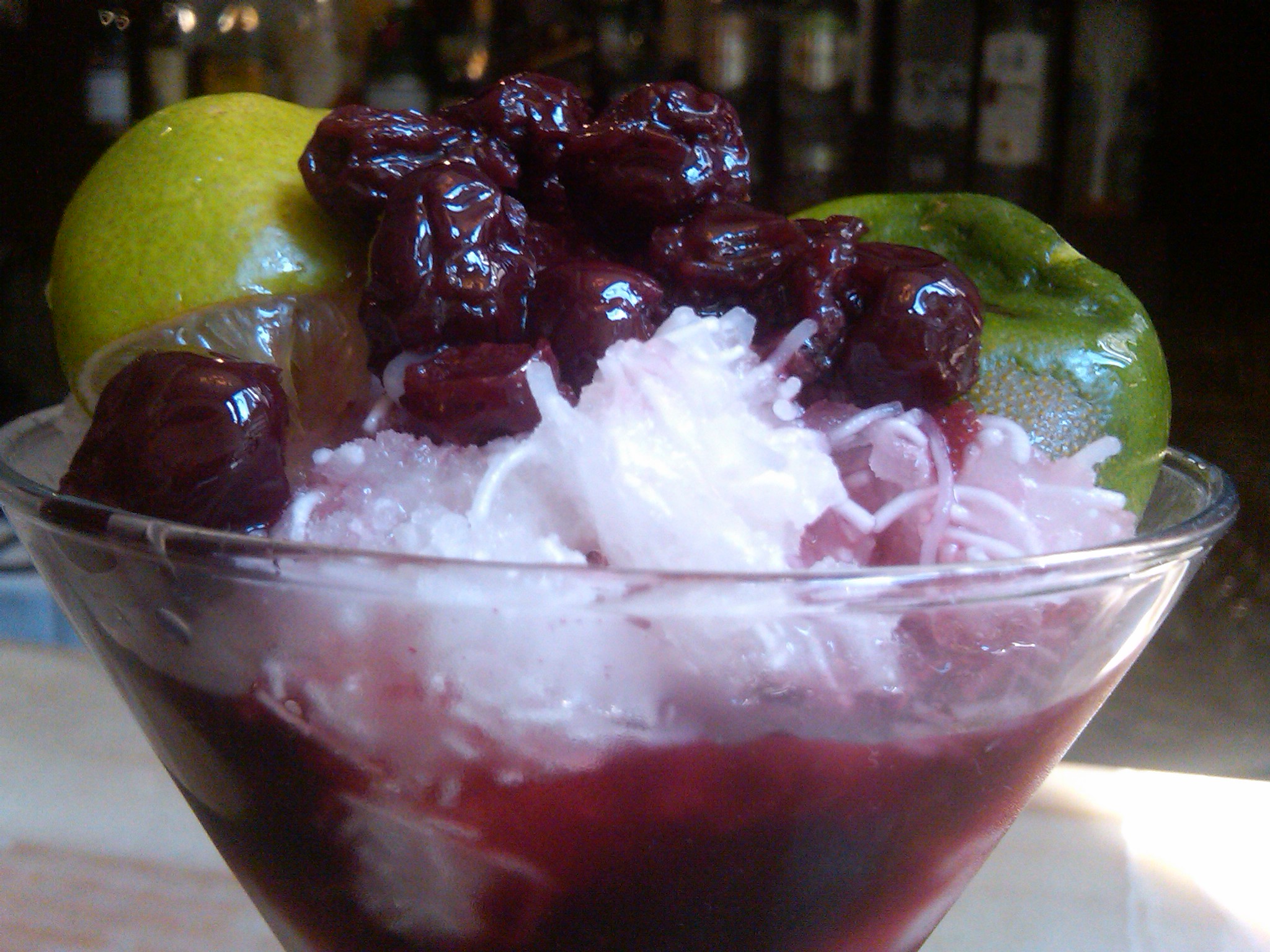
It’s better than the fantasy had been, which usually can’t be said about almost anything in life.  Look at it; it even looks beautiful.  It’s got that perfect color palette that everything Persian does, always pushing the limits of saturation but never becoming gaudy or tacky.

Faloodeh (click)

Ravagh is a pretty good place, at least in the opinion of this non-Iranian.  The appetizers are nothing to get hopped up about, but the kebabs are great, as are the khoresh and the great pomegranate and walnut fesenjun, but I’m also a sucker for any food with fruit and nuts in it, not only taste-wise but ‘cause I’m also historically stimulated by it.  In Persian food we find tastes and combinations that have, certainly, disappeared from Greek tastes (?) (a Neo-Greek can vomit if he finds so much as one raisin in his dolma) but from increasingly flattened and simplified Turkish tastes too.  Iranians, however, are still geniuses, as I said in my trance this morning, at subtle sweet-and-sour combos, at using spices without having to overwhelm you with an indigestible quantity of onion-garlic-ginger canvass on which to use them, like a lot of Indian food does, and for appreciating the taste and aroma of every herb and green thing that this earth can give us.

(It’s also the work-place of one of the most attentive waitresses and the most beautiful Uzbek woman in the world; no exaggeration, this is one of the most gorgeous women in New York, the female equivalent of one of Hafez’ dangerously beautiful young Turkish men: “Zabaan-e-yaar-e-man torki wa man torki nami daanam,”  “The language of my friend is Turkish, but I know no Turkish.”  Ok, that’s not Hafez; it’s Amir Khusrau, but I can’t think of any Hafez right now…)

I head downtown after that to the East Village to see my favorite Hanuman in the city.  Midtown’s blank Wasps, smart-looking Jewish guys and buff borough boys in tight dress shirts and ties start giving way to sweet, ethnically unidentifiable guys with lots of tattoos and scrawny beards.  I pass Mono on the way and see its beautiful, sweaty ham sitting in the window and think: ok, maybe later.

I’m irritated again my Daddy Bloomberg’s traffic lights that tell you how many seconds you have to get across a street before you’re flattened by a flock of taxi cabs.

I see New Yorkers running, frantic, across the street; New Yorkers, as long as I’ve known them, waited till they formed a critical mass on any street corner and simply marched together into the middle of the street, stopping traffic at will.  Now he’s got us running.  I wish again he would just go back to Boston.  It’s already the city that he wants to turn New York into; why is he bothering with us?  They’ll love him there.  Give him a fourth and even fifth term, make him Czar of Massachusetts Bay colony.  Just go.  Go away.

“They save lives!”  Ok.  I don’t know if they do.  But even if they do, a civilization where the saving of life is of consistent and constant greater concern than its quality, where not only do lives need to be saved but all risk — germs in bathrooms, kids getting their knees scuffed — needs to be legislated out of them, a world where, as James Hillman put it: “quantity of life is at all costs more important than quality…” is a civilization we’re not going to be very happy to have lived so long to see.

Anyway, I adore this particular Hanuman that I’m on the way to see because it’s a gigantic brass murti and he’s in his kneeling pose, which I love, because it shows off his big thighs and his great forearms holding his mace over his shoulder and the huge chest he has to have to hold that heart so enormous that God himself and everyone He loves can fit into it.  They never dress him there either, because it’s a difficult pose to dress, so whenever you go he’s always there gleaming in all his bare muscled glory, ready to go to war for Ram and his Kingdom, or for anyone who loves Ramji the way he does.

The problem is that this temple is in the East Village and its whole community is white people, which means it’s really not a Hindu temple or mandir at all but an East Village center for non-stop yoga classes or kundalini workshops, so you’re almost never allowed in for a little bit of darshan and peace and quiet with your god.  I’ve tried to suggest in the past that maybe there should be some more “open” time for someone like me.  But you can’t complain there either because these white “Hindus” have gotten modern Hinduism so frighteningly mixed up in their heads with Buddhism and any other New Age stuff they think they believe in, that if you complain and look even remotely irritated, they look at you sadly like you’re accumulating bad karma and they have no way of helping you.  On top of that, there’s only flower offerings permitted, because – I swear – laddoo and peda and other mithai have “lots of refined sugar and saturated fat” in them, so you can’t even walk away from aarti there (yes, they have aarti every evening at least) with a good piece of prasad and its gratifying sweetness in your mouth.  I really want to ask these people what it is they’re saving their bodies for sometimes; they ever heard of that whole dust to dust bit?

Again, I don’t get to see my Hanuman.

This is the pose of Hanumanji I love most, a little one at a Jackson Heights shop.  Now imagine him nine feet tall and all gleaming brass, like he is at that temple. (click)

I remember the ham at Mono though.

Casa Mono is the restaurant really; it’s part of the Batalli empire but it’s actually a very intimate place with hands down the best Spanish food in New York, and I think as good as anything I’ve ever had in Spain as well.  I always wait, no matter how long it takes, for a seat at the bar by the open kitchen because you get to see the mens’ performance there and it’s good to see men sweat and handle knives and fire and and meat and heat (the night there’s a woman behind there I won’t return, I swear; I’ll just suffer without Mono for the rest of my life**).  You also get to watch the growing status, knowledge and confidence of New York’s Mexican workers there too, their steady rise to the top, the same trajectory we followed decades before, and the way that — not only Mexican hard work — but Mexican wit and playfulness, which almost everyone now understands some of, have become the esprit de corps glue that holds together so many excellent New York restaurants like this one.  There’s often a Mexican or Ecuadorian trainee behind the counter, and a guy who I think is the line’s number two, a sexy tatooed-up Ed Norton look-alike that I really love.  But if you’re especially lucky you’ll get to see head chef Anthony Sasso back there cooking, a guy with a body that looks like he used to be an Olympic diver, who never sweats, and who cooks with such ease and elegance and what Patricia Storace (in her description of turn of the twentieth-century Greek politician Ion Dragoumis) calls “…that most erotic of qualities in a man: the capacity for sustained concentration…,” that it’s hard to take your eyes off of him, and that I, at least, only manage to do so for fear of making a total ass of myself and because I want to let the guy do his job.

But Mono is for a really good dinner when you’re feeling rich and want to drop a lot of money on good wine that Ashley, the least pretentious and most generous sommeliere in the city, will help you out with.  Today I just drop by at their annex next door, Bar Jamon, a place I also love, though if you don’t catch it at the beginning or end of the shift it’s always torturously crowded.

(It’s enough I haven’t given these places aliases; I’m not telling where they are on top of it; not everyone deserves to know.)

Jose is there today.  Great!  A Spaniard.  After being sweetly told to go away at the gringo ashram because they were cleaning their chakras or something, I need an aggressive welcome and from a people who aren’t afraid of a little aggression.  Jose always makes me happy because he’s a super-majo kid from Zaragoza in Aragon.  Majeza is a very Spanish term that encompasses such a complex of qualities that it’s difficult to explain, especially in English, which is tragically lacking in a comparable term, as its speakers (aside from the Irish) are in most of its qualities.  It means openness and frankness and humour and swagger; it means being hospitable without being in anyway servile; it means being able to put away copious amounts of wine and pig meat; being friendly and spirited and generous while always maintaining a kind of stylish dignity and flair; it partakes of some of the qualities of Greek and Turkish leventeia in that sense; in fact, it’s a word with a certain undoubtable Balkanness about it.  Soon after the term appeared in, I think, the late eighteenth-century, working-class barrios of Madrid, it almost immediately became associated during the Napoleonic Wars with the city’s street kids, who terrified the French with their suicidal bravery, so it probably originally implied a quickness to pull a knife too and no squeamishness about seeing a little bit of your own blood shed as well.  That doesn’t apply anymore, though the ferocity into which demonstrations in Madrid have descended these days makes you think twice about that; I’m proud of the angry tenacity of Spanish protests, mashallah; don’t know what they’ll accomplish but it’s good to know Spaniards can still be scary; that anger has become such a stigmatized, pathologized emotion in our civilization (“You know…I think you have a lot of anger…”) is partly what’s let banks and governments get away with what they have over the past few decades and generally has brought us to the civilizational crisis we find ourselves in.  No, it’s not the other way around.  In any event, courage is still certainly an implied element of being majo.  There’s a great, chapter-long analysis of majeza in Timothy Mitchell’s Blood Sport: A Social History of Spanish Bullfighting, if you’re interested and can get your hands on it.

blood

Jose’s bearing, humour and way of talking are the epitome of majete; I’m glad to see him, I’m hot, my feet hurt (“erkekler…pabucim sikiyor…”) and I ask him for a glass of anything cold and white.  He immediately comes up with a great Albarino, a Galician wine I usually don’t like but this particular one is beautiful.  I think of a gorgeous woman I was in love with a few years ago with blue-emerald eyes so intense they looked fake (actually her parents were Canarian – she just grew up in Santiago — so those eyes were probably Berber and certainly not Galician); she was beautiful, a good kid, and a little nuts – but beautiful.

“So a Greek and a Spaniard get together,” the joke goes — and of course these days they compare notes on how fucked up their respective countries have become.  I tell Jose that I think Spain is salvageable but that Greece seems in danger of just slipping off of the face of the earth at some point soon.  He’s not so confident.  He says people in Spain are “learning to be poor again,” getting used to a life with “un plato de alubias” — a plate of beans — a proverbial Spanish expression for just-bare-subsistence poverty.  He’s probably around thirty and he says bluntly that his generation in Spain is destroyed; that they’re going to hit their late thirties and early forties without any job experience and that unless you’ve got family money, your only option is emigration, like “old-time Gallegos” we both say in sync.  (Galicians in Spain are like Epirotes in Greece, the archetypically emigrating region, so much so that in much of Latin America all Spaniards used to be collectively referred to as “Gallegos.”)

My heart goes out to him and I respect his straight-eyed stoicism and I think he’ll be ok because he seems strong.  As hard as I try, though, my heart doesn’t go out to Greeks of his generation nor do I respect them.  I think they’re cry-babies who would be scared shitless – or worse, think it beneath them — to work in a bar in New York the way Jose does and that they deserve – richly — to relearn the cultural lessons of emigration and being poor again.  Three decades of illusory prosperity created an unbearable type of human being in Greece, a nouveau-riche culture of entitled provincials, cold, petty snobs who are snobs the way only the truly provincial can be – and I’m talking about Athens more than the provinces.  (Athens is a city I genuinely love, but it probably ranks first in the world in thinking itself more sophisticated than it really is.)  (Plus — I’m always confused a little by Cypriots, who arguably enjoyed a more solid prosperity for a longer time but never became so insufferable, and who all Athenians are always mercilessly condescending towards: incessantly mocking their clannishness, their still healthy respect for Church tradition, the beautiful musicality of Cypriot dialect.)  I’m pained by the genuinely poor and the old and the sick and the heroin addicts who are suffering and dying in Greece, and murderously angry at Frau Merkel (“murderously”…you can quote me; I think she’s a criminal and should be gone after), who needs to pay banks back and dresses it up as one of her daddy’s Lutheran sermons.  But that urban, middle-to-upper-middle-class, twenty-five to forty-five-year-old demographic in Greece…they can just go back to washing dishes in Chicago again like our grandfathers did as far as I care.  Let ‘em start from scratch; see what kind of culture they can come up with this time.

(As I listen to Jose I remember that the terrifying Catalan Company, who are still a by-word for monsters and boogey-men in parts of the Balkans — “…like Catalani and the Devil,” Albanians say….Albanians — weren’t actually Catalanes at all, but savage Aragones highlanders: Jose’s ancestors. 

The “Companyia Catalana d’Orient,” were a bunch of murderous, mercenary nut-jobs, the Blackwater of their day (I forget what Blackwater is called today) that had started off fighting in the Reconquista in Spain.  But like the Greek-Arab Akritai-Ghazi of the Anatolian frontier, they were a mixed bag, originally mostly Arab-speaking Almogavars, an Arab word meaning “scout,” the “Muslims” eating pork and downing wine like good Iberians, the “Christians” proud that they raped nuns, looted monasteries and occasionally threatened the Pope.  The only things these guys were loyal to were killing, looting and each other, in that order.  This is their hymn:

    Aur! Aur! Desperta ferro!

    Deus aia!

    Veyentnos sols venir, los pobles ja flamejen:

    veyentnos sols passar, son bech los corbs netejen.

    La guerra y lo saqueig, no hi ha mellors plahers.

    Avant, almugavers! Que avisin als fossers!

    La veu del somatent nos crida ja a la guerra.

    Fadigues, plujes, neus, calors resistirem,

    y si’ns abat la sòn, pendrèra per llit la terra,

    y si’ns rendeix la fam carn crua menjarem!

        Desperta ferro! Avant! Depressa com lo llamp

        cayèm sobre son camp!

        Almugavers, avant! Anem allí a fer carn!

        Les feres tenen fam!

Listen! listen! Wake up, O iron! Help us God!…Just seeing us coming the villages are already ablaze. Just seeing us passing the crows are wiping their beaks. War and plunder, there are no greater pleasures. Forward Almogavars! Let them call the gravediggers! The voice of the somatent is calling us to war. Weariness, rains, snow and heat we shall endure. And if sleep overtakes us, we will use the earth as our bed. And if we get hungry, we shall eat raw meat. Wake up, O iron! Forward! Fast as the lightning let us fall over their camp! Forward Almogavars! Let us go there to make flesh, the wild beasts are hungry!

Boy, people don’t like war like they used to, do they?  Even Marine chants aren’t this hard-core.  Or do they?  And it’s just shape-shifted into something else?

I think they were actually involved in one of the Crusades and then at one point one of our last moronic emperors had the brilliant idea of inviting them as mercenaries to help fight off the Ottomans.  What scheming idiots, except for poor, tragic Constantine, the Palaiologoi were — and poor Kyr Gianne Cantacouzino, so beloved by Cavafy, trying to hold together the mess they created.  And they weren’t even good schemers, which is one thing Greeks usually do well. Even Constantine tried to interfere in the succession of Mehmet II in a pathetic way that had worked before but by that point the Turks were on to them already.  He sent a delegation to Edirne to remind the new Sultan’s vezir that they held Mehmet’s brother Orhan as a guest in Constantinople, a veiled threat of provoking another succession civil war among the Ottomans, which wasn’t hard to do given the brutally absolutist methods Ottoman succession practices involved.  I always loved the balling-out the Greek diplomats got from Halil, Mehmet’s vizier:

“You stupid Greeks, I have had enough of your devious ways.  The late Sultan was a lenient and conscientious friend to you.  The present Sultan is not of the same mind.  If Constantine eludes his bold and imperious grasp, it will be only because God continues to overlook your cunning and wicked schemes.  You are fools to think you frighten us with your fantasies, and that when the ink on our treaty is barely dry.  We are not children without strength or reason.  If you think you can start something, do so… All that you will achieve is to lose what little you still have.”

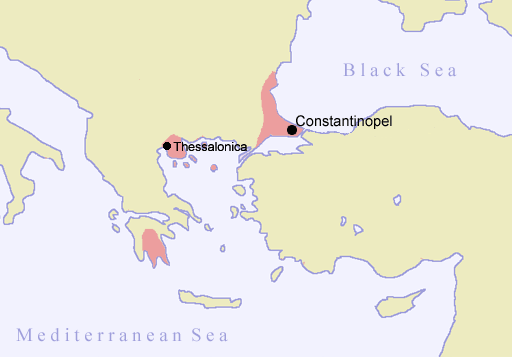
This is what they were left with in 1400.  At the time of the above event, which was fifty years later, they had lost Salonica too and almost all of the Thracian hinterlands of C-town itself.  But it was still “The Empire of the Romans.”

As for the Aragoneses the century before, they succeeded in inflicting some damage on the Ottomans at first, but had soon attracted Turkic and Greek freelancers into their ranks and of course went on a decade-long plundering spree in both Byzantine and Ottoman lands, including Mount Athos, where no Catalan was allowed to enter until recently, and only upon payment of reparations by the government of Catalonia; those monks have Byzantine memories, man.  After devastating the countryside of what remained of the Byzantine empire, they established a Duchy for themselves at Athens by taking it from some other Frangoi, which was eventually absorbed by the Ottomans, of course, though the King of Spain still carries the title, “Duke of Athens,” which the Spanish Crown inherited through the Kingdom of Aragon.)

I snap out of my historic daydreaming and pay for my Albarino and my incredibly expensive plate of ham, which was totally worth it.  It was Iberico ham from pata negra pigs from Extremadura that eat free-range, mostly acorns, so the meat is grained with a velvety fat that has an incredibly nutty taste to it and a texture unlike any other kind of pork fat.  It wasn’t allowed into the U.S. until recently because the F.D.A. or whoever had concerns about the health standards under which the pigs were raised, like they’re worried about raw milk cheeses and I don’t know what else.  I think of how irritated I get when I have to fill out an American customs form when I’m coming to the U.S. and I get to that question about whether I have any agricultural products on me.  I’m like: “Are you serious, United States of America?  Are you really asking me this question?  You?  The origin of all the plastic, poisonous, carcinogenic garbage food on the planet?  You’re really worried about two lemons from a family orchard or some sausages I might have with me and the havoc they’re going to wreak on America’s ecosystem and agriculture?  Really?”

Jamon Iberico at Mono (click)

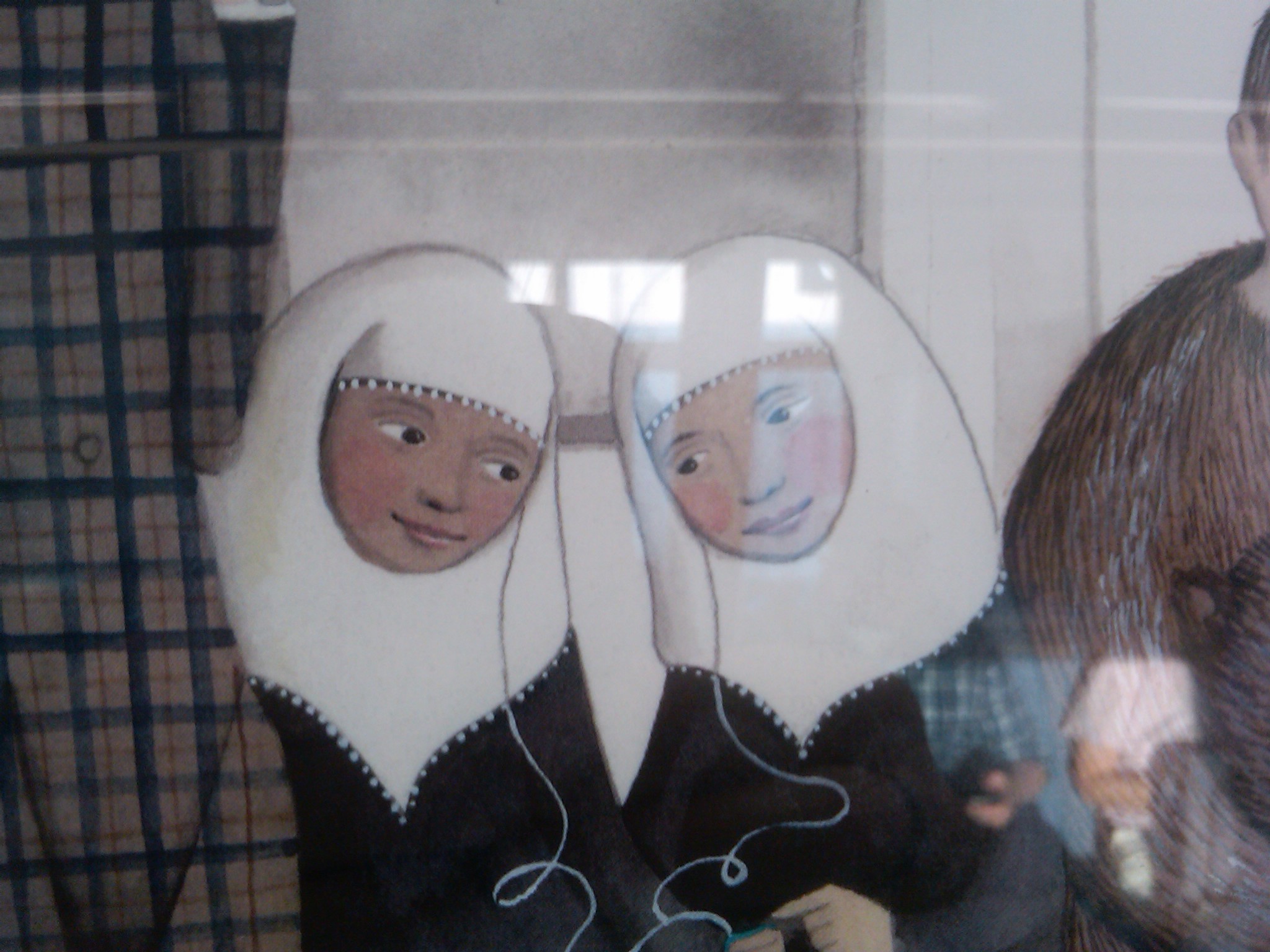
I wish Jose well, hope to have enough money to see him again soon because I’m broke these days, and head for the N back to Queens.  I expect more stimulation on the subway and am not disappointed.  But the first thing I notice is a great drawing, by an artist whose name I’m too stupid to note, that covers the entire ad space above the bench opposite me.  It’s a Bemelman-like drawing of New Yorkers on a subway bench, like the one we’re all sitting on and they’ve got it posted on both sides of the car, in fact.

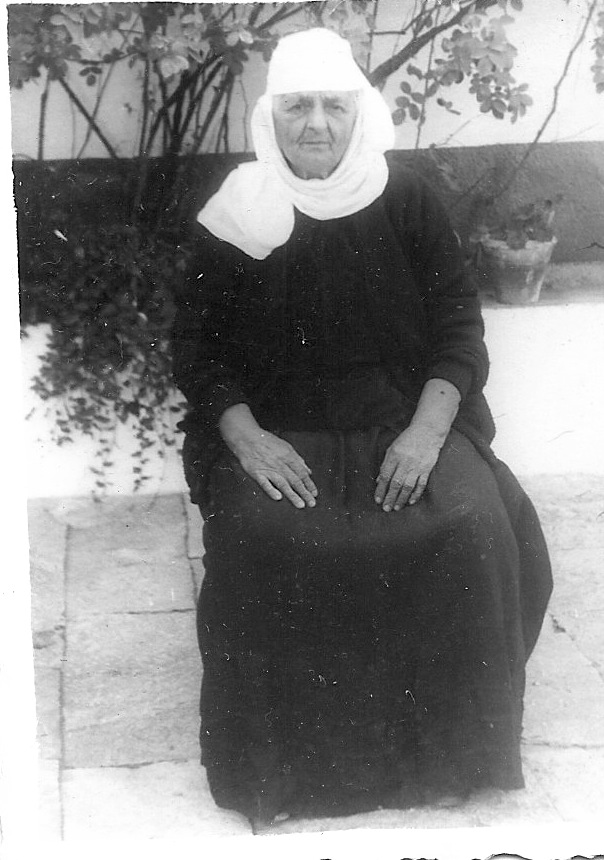
I immediately do a double-take because it looks like two of the characters in the drawing are two little Dropolitisses, women from my father’s villages in southern Albania, with their distinctive white headdresses, like my grandmother here in the last photo we have of her.  (click on all)

Then I look closer and notice their sneakers and schoolbags and realize they’re two Muslim high school girls sharing an IPad.  I smile, because the implications of and reasons for confusing the two are so obviously telling.

On the bench below the drawing are two big, sun-burnt Irish construction workers, in cut-off jeans and work-boots, t-shirts with dried sweat stains on them, who are so exhausted that they are falling asleep on each other.  Somehow, though, I know they’re gonna go for a pint when they get off the train, no matter how exhausted.  At the other end are three lanky, Bosnian giants, who have to keep their legs doubled up against their midsections practically to keep them from stretching across the whole subway car.  I stare at them with a dumb unconscious stare, listening to the subtle tonality of Serbo-Croatian (or “Bosnian”), as they goof around with each other, and I think they’d be fun to drink with – if they drink (they probably drink…).  Then suddenly the image of all that manhood and youth decomposing and scattered around the ground in pieces flashes before my eyes (I’ve had Srebrenica on the brain for the past few days too, not just faloodeh), and I snap out of it.


In the middle of these two bunches of heavy-weights is a super-elegant Pakistani kid, with a white-stitched topi on his head, with the v-shaped opening that Sindhi topis have though I don’t know where he’s from, and a carefully trimmed beard that’s always a sign of observant-but-not-nuts to me.  He’s got cool blue suede Adidas on and perfectly ripped jeans so you can see the hair against the color of his skin on his thighs and shins.  He’s got a worn wooden tespih wound around his left wrist along with a thick leather wrist-band and about half a dozen multi-color, tie-on bracelets that could’ve been bought on the beach in Cancun on his right.  But on top of it all he’s wearing a stunningly beautiful, blindingly white, short-length kurta, completely unbuttoned down to the middle of his chest, with a dense white-on-white chikan-like embroidery around the collar and button panels that even from across the subway car I can tell is exquisite (my mom taught me to recognize good needlework; she was a very skilled embroiderer herself).  I know this simple summer kurta and its kind of embroidery can cost as much as a good sherwani, and I wonder where he’s going or coming from to be wearing such an expensive piece of clothing.  He’s also got his sunglasses balanced behind the back of his head, and they don’t slide off during the whole subway ride.  This is Desi majeza.  He’s a sight.  I wonder if they’ve found a suitable girl for him yet, or if he’s even going to tolerate family choices in that kind of thing; see, that’s the thing; his whole get-up and attitude make it impossible to gauge exactly how “traditional” he is, a frequent dilemma in a city where the cultural self is so malleable, and which – aside from how handsome he is – is what makes him so fascinating to look at.  He could be the perfect obedient Muslim son; he could be a D.J. somewhere or a dancer regular at Bhangra Basement at S.O.B.’s or an ecstasy dealer, or all or any combination of those.  I bet he drinks.  I bet he fasts for Ramazan though.  I then start wondering what Whitman, who loved the men of New York so deeply: “manners free and superbopen voices–hospitalitythe most courageous and friendly young men…” would have done with the material New York would have to offer him these days.  He wrote with such passion of a totally white city; he might’ve been overwhelmed by this one.

I like betting to myself where people are going to get off the subway based on sociological info, and, of course, the Irish guys and the Pakistani get off at Queensborough Plaza to take the 7 train, the Irish guys to Sunnyside or Woodside, the cool Pakistani kid to Jackson Heights or Elmhurst.  And sure enough the Bosnians follow me to Astoria.  I think to myself that I should get a camera and a business card for this blog so I look semi-professional and not like a freak asking people if I can take their picture with my lame Blackberry.

The N train (photo: Matt Lawson)

In Astoria I catch the end of vespers at Hagia Eirene.  This is a church that used to be the territory of fundamentalist, Old Calendar, separatist crazies but has rejoined the flock on the condition that it was granted monastic status (and I have no idea what that means).  But it has somehow got its hands on a great bunch of cantors and priests who really know what they’re doing.  I’m impressed.  I brought friends here for the Resurrection this year and for the first time I wasn’t embarrassed.  If I hadn’t invited them back home afterwards I would have stayed for the Canon.  Only one cantor now at vespers but he’s marvelous and the lighting is right and the priest’s bearing appropriately imperial.  It’s incredibly heartening to see our civilization’s greatest achievement — which is not what the Frangoi taught us about Sophocles or Pericles or some half-baked knowledge of Plato or a dumb hard-on about the Elgin marbles or the word “Macedonia,” but this, the rite and music and poetry and theatre of the Church – performed with the elegance and dignity that it deserves.

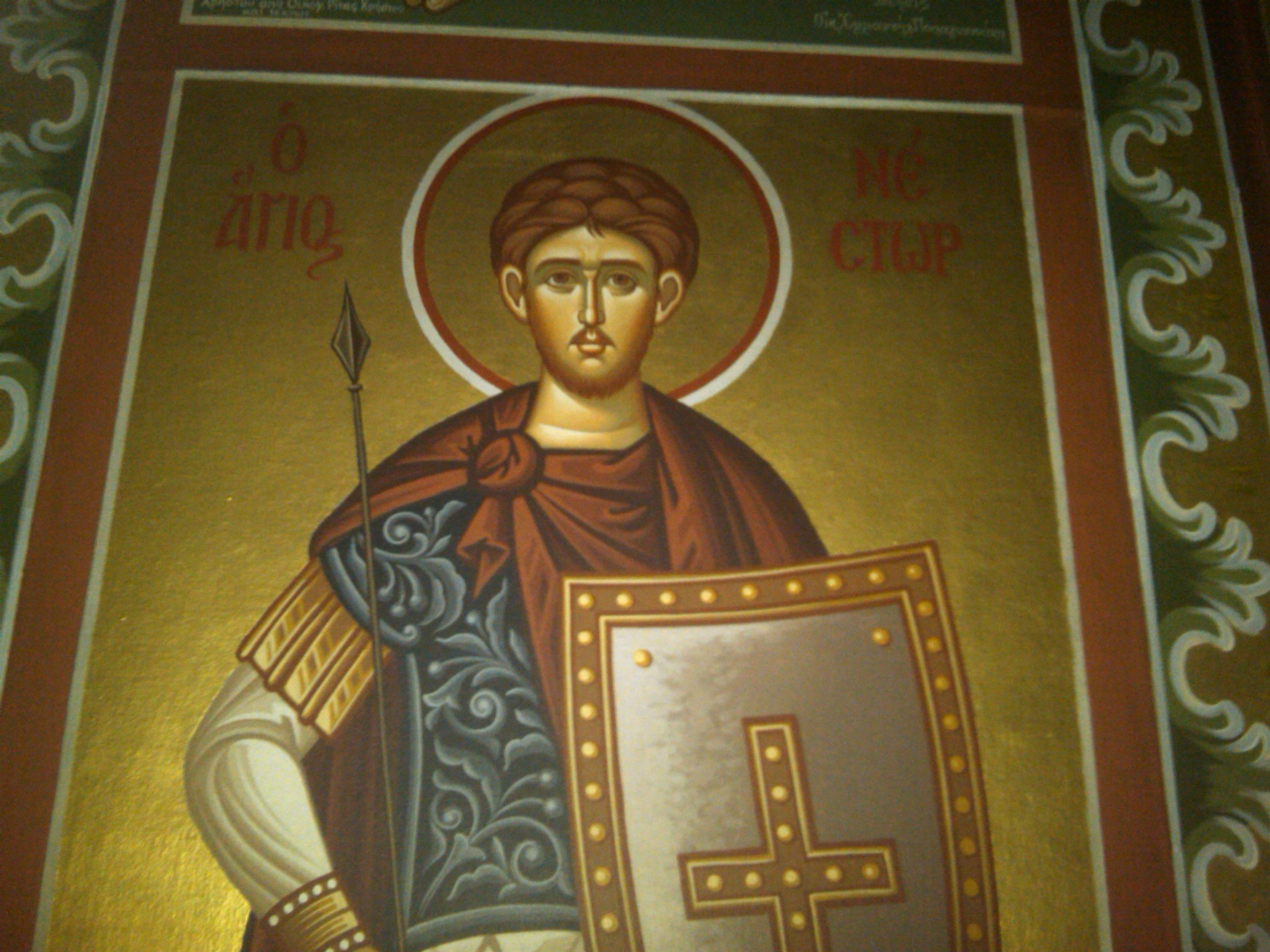
From the wall paintings at Hagia Eirene: St. Demetrius above, my patron saint, and his best army buddy, St. Nestor, below, executed together by the Emperor Maximian in Salonica in 306 A.D., because Nestor, with Dimitri’s blessing, killed the Emperor’s favorite gladiator in the arena.  Nestor was beheaded; Dimitri run through with lances — a story.  (Click)

I end up back in Sunnyside, which has become a heavily Turkish neighborhood in recent years.  The amazing thing is what a complete range of Turkish society the community consists of.  Every kind of Turk: from gorgeous young Istanbullu girls (who have disconcertingly started to destroy their beautiful faces with bad nose jobs, like Iranian girls), to old women in flowered salvar squatting outside on the steps of the neighborhood’s Art Deco apartment buildings, picking through lentils in a big sini.  On the corners are Turkish guys hanging out or you pass one every few yards as you walk down the street (“…icim sikiliyor”) and once again I curse the fact that “man torki na midaanam.”

Ah, here’s some Hafez:

“I am the slave of the eyes of that Turk who, in his sweet drunken sleep,

Has a canopy of musky eyebrows over the adorned rose-bed of his face.”

(Sorry I don’t know the Farsi.)

 Of course these guys don’t look like Hafez’ Turk would have, don’t have the eyes he would have, nor do they look like the Uzbek beauty that served me my faloodeh earlier in the afternoon.  These are “our Turks” and though quite a few do, the majority don’t bear much resemblance to their Turkic forebears anymore.  I said that once in a conversation with some Greeks – “our Turks” – to distinguish the inhabitants of Turkey from Central Asian peoples (I don’t know what we were talking about that making that distinction would have been necessary) and I got a blank stare from everybody.  But after a brief pause I realized that it felt good to say, that it was heart-warming to say: “our Turks.”  Plus, anything like that I might say that pisses off Greeks gives me a thrill that can’t be described.

I was once so mad for a Turkish guy from Sunnyside years ago that I learned how to write: “___________, you’re beautiful” in Ottoman script and graffitied it all over the neighborhood.  I thought it would be like a coded love-letter from his ancestral past and that somehow, some day, God would see to it that it were decoded for him.  Thank God that I don’t think He ever did because today I’m mortified to even remember that I did something like that — not that it’s exactly out of character.  I have much to be mortified over; and it takes much longer than you think to convert humiliating regrets into “ah-youth” nostalgia.  And I wasn’t so young either.  It’s just this guy was a knock-out.  He’d walk into a bar and my knees would get shaky; I’d have to be trashed to talk to him without stuttering.  I had to let it out somehow or I would’ve died.

I drop into my favorite Irish pub on Queens Boulevard, for a beer and to wait for a friend and, sure enough, it’s full of dusty, sweaty construction workers who couldn’t go home without a pint.  Despite the influx of Turks and Greeks and Roumanians and Armenians (it’s one of the mysteries of New York immigration that peoples who can’t stand each other back home choose to settle in the same neighborhoods when they get here), Sunnyside is still one of the city’s hard-core Irish neighborhoods, with a population of both old-time Irish-Americans and young Irish kids.  These last had stopped coming for a while, but now have sadly started again, afflicted by the eternal curse of this beautiful, heroic people.  But they, for sure, are tough enough for anything.  When you talk to them about things in Ireland, they’re attitude is basically: “Ah…young folks leaving again…things were good for a while, ya know, and now we’re back to the same old….cheers…”

The 7 train in Sunnyside.  The only attempt ever made in New York to make an elevated train attractive.  (click)

There was a genre of Ottoman literature known as the “shehrengiz,” the “shehrashub” in its Farsi prototype, which was basically a tour of a particular city cataloguing in detail all its beautiful people: men and women, but mostly young men — echoes of Whitman again.  Walter Andrews and Mehmet Kalpakli in their fascinating and highly idiosyncratic The Age of Beloveds: Love and the Beloved in Early Modern Ottoman and European Culture and Society translate the term as “city-thriller” or “city-disturber.”  One of the longest extant ones is about Gumulcine oddly enough (Komotene), ironic because the only thing that distinguishes modern Gumulcine from any miserable northern Greek city and makes it interesting and quite beautiful is its Turkish population.  People have called this corner of Greece the last remaining part of the Ottoman Empire and it truly feels that way.  The Turkish marketplace there is particularly fascinating, because of its abundance of coffeehouses and borekcidika, but also because of the beautiful traditional jewelry that’s still made in the city and sold in its numerous shops.  This isn’t the mass-produced crap of Jiannena; this is stuff of real artistry.  Wonder what the boys who worked in its sixteenth-century jewelry workshops looked like; they were obviously of high poetic caliber.

(Once when I was in Komotene I had spent the morning in the Turkish market neighborhood and later on, for some reason, walked back through its streets during siesta time, when all the shops were shuttered.  I saw that the iron gate of every single shop in the marketplace had “1955” graffitied on it, the year of the anti-Greek riots in Istanbul – see one of my first posts “The Name of this Blog”.  I thought it was the creepiest, most cowardly kind of nationalist intimidation that I’d ever seen; it still turns my stomach to remember it.)

Gumulcine

One more beer as it starts getting dark.  Today I lived my own New York shehrengiz.  Sorry for the rambling length of this post, or if any part of it was embarrassingly personal; feel for me.  I felt compelled to write it — my prose shehrengiz.  It started with the faloodeh.  It’s what a hot summer day in New York can do to you.

I am he that aches with amorous love;

Does the earth gravitate? does not all matter, aching,

         attract all matter?

So the body of me to all I meet or know.

— Walt Whitman

**********************************************************************************************************************************************************************************************

*The name of this entry is the name of one of the all-time greatest hits of the legendary Puerto Rican salsa band, El Gran Combo, “Un Verano en Nueva York” , “A Summer in New York:”  “If you want to have fun, full of enchantment and delight, all you have to do is live a summer in New York.”  Of course, given how hellish summer in New York can be, especially for inner-city residents, especially back in 1970, I always had this weird suspicion that this song was some kind of sick joke…

**Of course as fate would have it — or I must’ve insulted some goddess, Artemis, or Durga Ma probably — a couple of months after I wrote this there was suddenly a woman behind the kitchen bar at Mono and of course she’s great and of course I keep going.

Comment: nikobakos@gmail.com

Photo: San Diego, CA

5 Jul

No idea…


“It’s Turkey’s Time” — NYT

28 Jun

May 23, 2012, 8:49 am 14 Comments

By ANDREW FINKEL
(Murad Sezer/Associated Press)

ISTANBUL — If patience is a virtue, then Turkey’s place among the angels is secure. The country’s efforts to become a member of the European Union has been dragging on for some 50 years, and while Ankara has not always been free from blame, since 2005 — when negotiations began in earnest — it has been trying hard to climb over the wall of Europe’s prejudices.

Yet now there is hope at last that the process may accelerate. Voter disenchantment in the euro zone recently claimed the head of President Nicolas Sarkozy of France, the leader of the die-hard Turko-skeptics. France had been refusing to even discuss with Turkey important provisions of the accession document known as the acquis communautaire, including those about budgetary affairs and agriculture. Along with his ally German Chancellor Angela Merkel — who has also been answering to constituencies that regard Turkey as not European enough to join the European club — Sarkozy favored granting Turkey a form of association that would stop well short of full membership.

News from the latest NATO summit in Chicago is that Sarkozy’s successor, François Hollande, is trying to turn the page. German attitudes may also be changing. Last week Merkel’s foreign minister, Guido Westerwelle, a member of the Liberal Democrats — partners of Merkel’s Christian Democratic Union in the governing coalition — delivered to Ankara a message very different from hers. “What is important is to seize the opportunity that emerged after the latest elections in Europe and restart E.U.-Turkey ties,” he said.

Turkey itself must seize the moment. Making the E.U. a priority again would quiet growing criticism that the government of Recep Tayyip Erdogan is becoming more autocratic as its traditional opponents (including the military) become weaker. But doing so will not be an easy matter. If Europeans may be said to suffer from enlargement fatigue, in the case of the Turks, it’s more like narcolepsy. The Turkish government is understandably tired of banging its head against a wall.

Turkey first approached Brussels in 1959. In 1963 it signed the Ankara Agreement, which set out a path for its joining what was then the European Communities. As Europe’s economic integration became political, too, sharing sovereignty with Turkey started to look like a more elaborate project. Still, in 2004, after an intense period of reform, Turkey was declared a full candidate for E.U. membership. Enthusiasm for joining Europe among Turks shot up, with 73 percent of respondents to a survey by the German Marshall Fund saying they thought accession would be a good thing.

But then Europe’s leaders slowed down negotiations, and the Turkish public started to look on the E.U. as a club that did not want them as members. By 2010, support for E.U. membership among Turks had dropped to 38 percent.

Europe wasn’t the only guilty party. My own jaundiced take is that Ankara was more interested in becoming a full candidate for E.U. membership than in becoming a full member of the E.U. Candidacy was an advertisement that Turkey was on a stable course, and it was instrumental in attracting much-needed foreign direct investment. Actual progress toward membership, on the other hand, would have meant implementing more reforms — environmental policies, greater transparency for government tenders — all at a steep economic and political cost. Turkey also refused to recognize the E.U. member Cyprus, or even open its ports to Cypriot vessels.

Turkish attitudes may change again, though. Over the past few years, Turks had begun to flirt with the notion that the Middle East was Ankara’s natural backyard. But they’ve started to realize that the Arab Spring has brought some stormy weather. Turkey’s relations with Iraq, Iran and Syria are at a low, and its export opportunities in Libya and Egypt have taken a hit. Despite the economic crisis in Europe, Turkey still carries out about 43 percent of its trade with the E.U.

Now is just the time when Turkey should want to join the union. With Europe more skeptical about itself these days, it may be less skeptical about admitting Turkey. While Europe staggers under austerity measures, Turkey is experiencing a boom. In the last two years its G.D.P. grew by 9.2 percent and 8.5 percent. The figure for this year will likely be lower, but Turkey can present itself as an engine of Europe’s recovery; it already is the E.U.’s fifth-largest export market. And though incorporating such a big country is still a major challenge, the task may seem less daunting if a “two-tier” Europe — with political integration occurring at different rates for different countries — emerges from the current crisis.

Turkey should spin Europe’s economic problems to its advantage and revive talks for E.U. membership. To its credit, the government has begun to speak about a “new era” and a “clean page.” At a time when Turkey is trying to adopt a more liberal constitution and better enforce the civil rights of the minorities like the Kurds, progress toward E.U. membership would strengthen democracy here. That would be good for Turkey, Europe and for Turkey’s neighborhood.


Andrew Finkel has been a foreign correspondent in Istanbul for over 20 years, as well as a columnist for Turkish-language newspapers. He is the author of the book “Turkey: What Everyone Needs to Know.”


Comment: nikobakos@gmail.com

Where is this Jiannena / Yanya?

23 Jun

Here: “Ioannina”


Comment: nikobakos@gmail.com

Salonica and Izmir “…the absence of history.”

23 Jun

From my previous post’s comments on Salonica and Izmir…

A great book on the Population Exchange, with both extensive historical background that helps a reader from outside the region understand the events; a deep theoretical analysis on nationalism and ethnicity as concepts; the wars involved; the mechanics of the Exchange itself and its consequences, both large-scale and personal; how it would be considered the most objectionable kind of Ethnic Cleansing today and would raise howls of protest from the international community, but was then considered a perfectly rational way by our two Great Leaders to solve a problem and “nation-build” — move almost three million people against their will –setting a horrible twentieth-century precedent (which we’ll later see in Eastern Europe, Palestine, most tragically of all, India, in Yugoslavia…); and all somewhat miraculously condensed into a book of less then three hundred pages, is Bruce Clark’s Twice a Stranger: the Mass Expulsions that Forged Modern Greece and Turkey.

And if there’s a first book I recommend to anyone who wants to understand our complicated, often beautiful, mostly dysfunctional romance, and how it continues even after the Great Divorce, it’s this one:

Clark strikes the absolute perfect balance between historical and journalistic research and poignant personal accounts of both the Turkish and Greek refugees.  But these personal accounts are made even more moving by Clark’s own deep, emotional sense of loss and time and violence and his investment in his subject matter (his first chapter on Ayvalik, with it’s haunting, closing quote from one of his subjects: “It’s too early to remember,” is a masterpiece).  When you find out that Clark is Northern Irish, so knows of what he speaks when it comes to inter-communal viciousness, another layer of profundity is added to the experience of reading this book.  Many thanks to him for his generosity in allowing me to reproduce sections of his work.

I thought of one passage in particular, like I said, when mentioning both Salonica and Izmir’s sterility in the previous post:

“In this region of ancient settlement and civilization, there is often an unhappy mismatch between where people live now, and the places to which they feel the deepest attachment; and that mismatch is reflected in the physical environment.  Monuments and places of worship seem to be in the wrong place, or to be used for the wrong purpose.  In contrast with European cities like Bologna or Salamanca, where the past and present seem to blend quite seamlessly, the Aegean landscape is full of odd, unhappy disjunction; places where people have lived, prayed and done business for centuries feel as soulless and ill-designed as a strip development on an American turnpike.  That is partly the result, of course, of ill-managed and corrupt forms of economic development; but the legacy of an artificial exercise in social and ethnic remodeling has played a part.” [my emphases]

Some older photos that might help:

Salonika

Solun: from a Bulgarian website.  That Kievan mosaic in the previous post should actually be titled Dmitiri Solunskiy, as he’s known throughout the Slavic world, where he’s widely venerated, but especially by Bulgarians and Macedonians.

Smyrna before the twenties

Stuff like this below, though, doesn’t really help, but I find clownish and borderline offensive: Izmir’s “Aegean Greek Wine Tavern” (though the food looks great and probably is)*; I mean, if it were in Istanbul, where there’s still a living memory of Greeks, it wouldn’t be so weird, but in Izmir, where there haven’t been any Greeks in almost a century, and from where they left under horrific conditions that can’t be compared to Istanbul Greeks’ slow exodus…plus, where due to the Exchange and the flood of refugees from Greece, there are probably hardly any native Izmirli Turks to remember them either (try finding a true native Salonikan who’s not of refugee origin) makes it a little creepy.


*The classic seafood-meze-raki meyhane was almost exclusively a Greek insitution in Turkey, and clearly the association lives on.  For obvious reasons, the tavern has always been default “gavur” territory, since the beginnings even of Islamic poetic culture.  The fish tavern continued to be mostly Greek terrain (and Armenian) in Istanbul itself until well into the sixties; in what little modern Turkish fiction I know set in C-town the only Greeks are waiters in seaside restaurants.  There are still a couple of Greek-owned ones left.  Which doesn’t mean that the genre doesn’t live on without us.  It flourishes in fact, and a good Turkish seafood-meze-raki meal in Istanbul is one of life’s sublime experiences.  I pity those who die without having experienced it.

Comment: nikobakos@gmail.com

Names: “Istanbul (not Constantinople)”…and Bombay!

21 Jun

I reckon I’ve now received enough emails complaining about my use of “Constantinople” that it’s time to address the issue.

Constantinople – Kwnstantinoupoles — is Istanbul in Greek.  It’s the Greek word for Istanbul.  Istanbul comes from the word Constantinople.  It’s that simple.  The way Moscow is the English word for Moskva.  The way Parigi is the Italian word for Paris.  Constantinople is the Greek word for Istanbul.  It’s that simple.

That the Republic chose to change its official name to the time-honored Turkish name of Istanbul in the 1920’s does not obligate speakers of other languages to call it that, especially not those with as heavy an emotional, historical and spiritual investment in their own name for it as we have.  Just like the world will hopefully never be obligated to call Greece “Hellas” by the idiots who are attempting to do so.  Where Istanbul is concerned, the Ottomans themselves were content, at least for official purposes, with using the Arabic Costantiniyye until very late – till the very end, 1923, if I’m not mistaken.  And it took the rest of the world several more decades, as well, to abandon “Constantinople” and conform to the Turkish Republic’s new orders — for those who thought the name just disappeared in 1453.

What exactly is the problem?  If readers think I have some nationalist, much less irredentist, reasons for referring to the city as Constantinople, then they haven’t read anything else on this blog, and know nothing about me.  If there even is any discernible pattern in my switching back and forth between the two names, it’s not easy to identify.  I mostly refer to the city’s Greek community as Constantinopolitan Greeks, usually when I’m talking about a time when there was a community.  When the present is involved I usually say something like “Istanbul Greeks.”  I call Greeks from Istanbul “Polites” and will often say “Pole,” or even “the City” in English to evoke some sense of its importance to Greeks – and to me.  And all sorts of various combinations of the above.

In both print and speech I never hear Turks call Salonica “Thessalonike” but Selanik – except for the occasional overly p.c. Turk who thinks that “Thessalonike” is what I want to hear.  And not only does Selanik not annoy me, not only do I not take issue with it or get offended by it, but it moves me.  Obviously, when a Turk calls Jiannena — one of my many hometowns – Yanya, it moves me even more.  A Turk who says Yanya is asserting his connection to that city, and that assertion becomes an immediate bond between me and him: a bond we both share to its streets, its lake and its mists, its mosques, its churches, its synagogues, its borek, the mahallades my mother used to tell me were Turkish before the twenties, including the one where she grew up, the parks she used to tell me were paved over Muslim cemeteries, that used to scare her as a girl when the region’s interminable rains would expose bones and skulls in their mud — all told with her peculiar sensitivity and strange sadness that would make you think these things were all her own; I never heard a word of ethnic animosity or hatred for anybody out of her mouth — not ethnic or any other kind — and not from my father either.

Yanya: the lake, mosques, the beautiful gate of the Ic Kale, streets, the front gate and interior of the Old Synagogue, 18th c. (The New Synagogue, 19th c., outside the city walls, was blown up by the Nazis.)

And when a Turk says Selanik, he’s asserting his deep historical connection to that city; whether he’s from there or not, he’s using a name which carries all his historical references to that place, which I’m nothing but happy to grant him.  I don’t even call it Thessalonike, but ‘Salonike.  When I think of Byzantine Thessalonike, of Selanik, Salonico, Salonica, they all evoke for me a great and ancient Mediterranean city; for a long time, the second city of the Byzantines, of St. Gregory Palamas and Nicholas Kabasilas; Salonico makes me think of the heir to the philosophical and poetic heritage of Jewish Spain; the great center of Sephardic learning, both rabbinical and the deep Kabbalistic learning that Jews brought with them from their previous homeland; I think of a Turkish city that was a flourishing center of a variety of Ottoman Sufi orders; the city where so much of Turkey’s new Republican bourgeoisie came from, just as ours came from the other direction.

Frontispiece of a Salonican Zohar, a seminal Kabbalah text, originally written in Leon, Spain.

Salonican Jews

Great caption; “the fanatical sect of Islam” being referred to are the Mevlevis!!!

 When I think of modern Thessalonike, on the other hand, I think of an unattractive, humid Balkan town with a serious second-city complex. 

But I’m a “manic lover” of St. Demetrius, its patron, so I have to visit every now and then.

Mosaic of St. Demetrius, originally from the church of St. Sophia in Kiev (or is it Kyiv?), currently in the Hermitage Museum, St. Petersburg (or is it Leningrad? or Petrograd? or just the name that everyone who knows her and truly loves her calls her, Peter…)

Funny that it took me so long but I recently realized why I dislike both Salonica and Izmir so much; despite their history, despite Salonica’s plethora of classical and Byzantine monuments even, neither of them — for reasons we all know — feel like organically old cities, the way even Athens does, though in its modern incarnation it’s far newer.  They both feel like one city was removed from that location and another one hastily put in its place.  Remade.  They don’t feel grounded.  What you feel in both of them mostly is the absence of history.*

Can you even tell which is which? — except for a few giveaway signs…

With all that said, therefore, I think we have to be very careful about whether it’s the renaming of places or persevering in the old name that represents the more nationalist impulse.  I recently confirmed for an Indian friend that, yes, Greeks still refer to Istanbul as “the City,” and he shook his head and mumbled something about the “narcissism of nationalism.”  But an increasingly fundamentalist and nationalist India may be the perfect example to start with.  Granted, Calcutta was always Kolkata in Bengali.  But what was wrong with Madras?  And what nationalist Tamil mythology does Chennai justify?  The BJP (fundamentalist Hinduism.…you’d think it’d be an oxymoron) in fact, has a list for changing the names of almost all the cities of India to more appropriately Hindu ones, not just obvious targets like Allahabad, but Delhi itself and others: see the list if you’re interested.  Aung San Suu Kyi calls her country by its perfectly legitimate name of Burma, yet for a couple of decades we were content to use the name imposed on it by its military dictatorship, Myanmar, and never asked why or by whom it had been changed.  The State is not to be questioned.  If you said “Burma,” people looked at you like you were uninformed.

The most unfortunate and vulgar change of all is “Mumbai,” but almost no one knows or cares about how that change happened.  It was once generally accepted that Bombay comes from the Portuguese “bom bahim,” or good little harbour, just north as it is from Portugal’s long-time colony of Goa.  But even if that etymology is bogus, it was under the name Bombay that it flourished and grew under the British into the most important and cosmopolitan city in South Asia.

Bombay (gotta click on this one)

But in 1995, the Shiv Sena party (the Army of Shiva…) won control of the state government of Maharashtra, of which Bombay is a part, though it’s so different in social and ethnic make-up from the rest of that state that it deserves a separate federal district type status like Delhi has, or Mexico City, or D.C.  Shiv Sena, being a party whose power base is rural Maharashtra and poor migrant Marathis who feel they deserve more power in the city, is actively hostile to Bombay’s dizzying diversity and especially its large Muslim population.  It’s essentially a Marathi branch of the BJP, only worse (and they haven’t been getting along lately): a virulently Hindutva bunch that have not only been found to be involved in Bombay’s drug, prostitution and extortion circles, but ordered and even carried out much of the more vicious anti-Muslim attacks during the Bombay riots of 1992-93: the kerosene-dousing and burning of individuals and the burning tire around the victims’s neck were a couple of their trademarks.

When, despite all that, Shiv Sena were voted into state office in Maharashtra, their response to the poverty, massive infrastructural challenges, crime and destitution of this barely manageable city of more than twenty million was to change its name to Mumbai.  This was based on the supposed fact that there was (or is, or if there hadn’t been, I’m sure there now is) a temple of a Marathi goddess of that name on the site before the colonial city rose up, which may or may not be true, but, given the fact that every square yard of India contains at least one shrine or temple to someone or something, doesn’t mean very much.

And yet the whole world fell in line.  Thinking that, like Myanmar, if it’s coming from there it must have some sort of indigenous, authentic root, filled with post-colonial guilt and worried about offending what we thought were Indian sensibilities, we all dutifully started calling it Mumbai.  Fearing that using the old name would immediately make others imagine us to be jodhpur-clad gin-swillers, we let a bunch of criminal thugs and violent nationalists change the name Bombay — the name by which this great, open-to-the-sea-and-the-world, mercantile, diverse, cosmopolitan, sexy metropolis, a microcosm of India itself and its modern face to the world, was known for almost three centuries – and nobody asked why or breathed a word of resistance.

Bombay — Marine Drive — Queen’s Necklace

So as for C-town, you choose which is more “nationalist.”  Calling the city the name by which it was known to most of humanity for more than sixteen centuries?  Calling it an also venerable name that the nationalist, anti-cosmopolitan, Turkification project of a military dictatorship whose attitude to the City, its legacy, history and population was actually hostile for much of the time decided the world should call it?  Or just calling it both?

Or how ‘bout who cares?  As long as we know which city we’re talking about.

* See next post


Comment: nikobakos@gmail.com