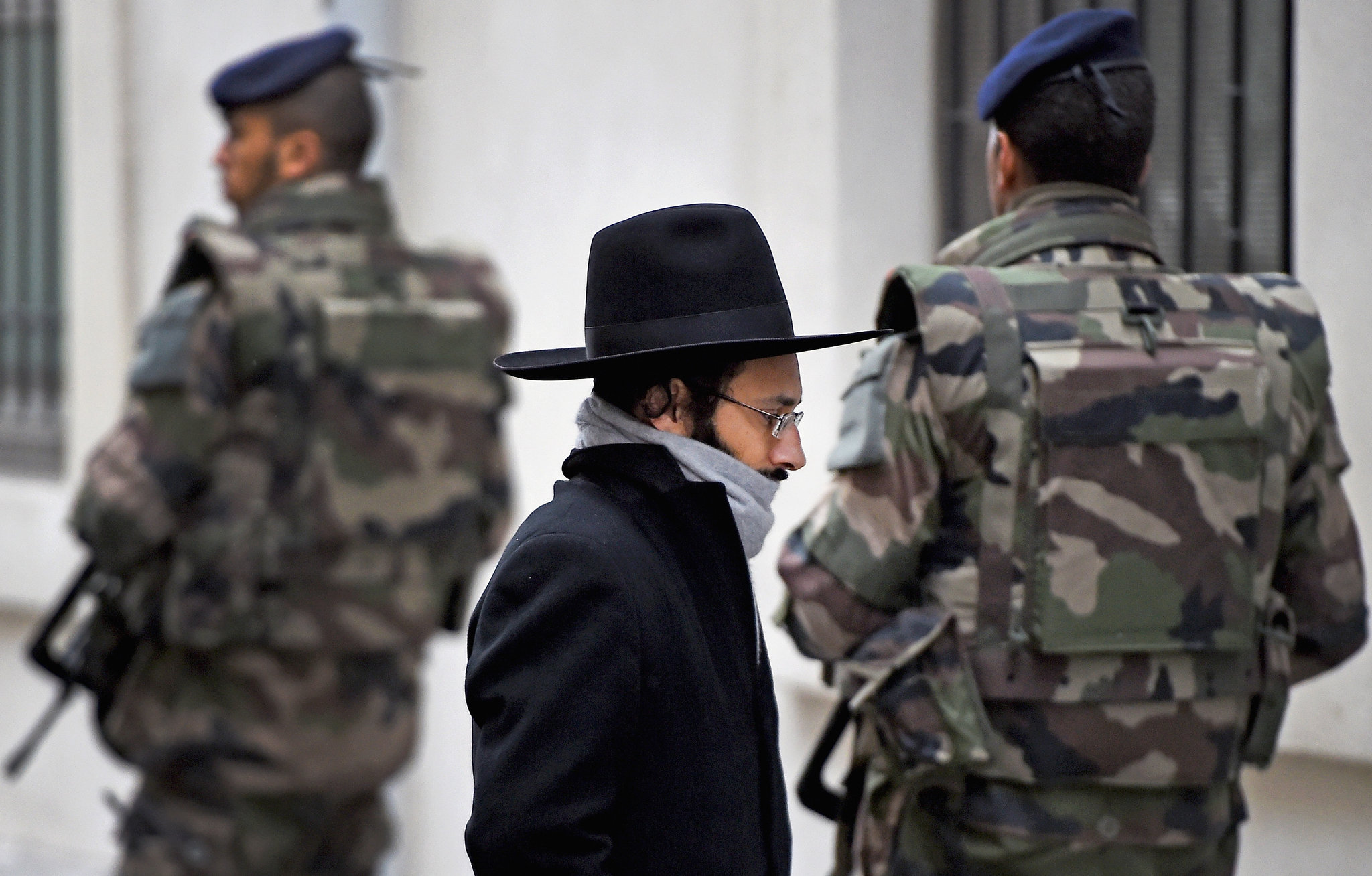
AMY GOODMAN: Yes, a massive march across France, close to four million people, took place. That march took place two days after the gunmen who attacked Charlie Hebdo, the satirical magazine, Chérif and Said Kouachi, were killed by police after a siege at a printing works following a three-day manhunt. Minutes after the print shop assault, police broke a second siege at a kosher supermarket in eastern Paris. Four hostages had already died there, and the police killed the gunman, Amedy Coulibaly. France has announced it’s deployed 10,000 soldiers on home soil and posting almost 5,000 extra police officers to protect Jewish sites, some 700 Jewish schools.
On Friday, Chérif Kouachi said he received financing by the Islamic cleric Anwar al-Awlaki in Yemen. He had made the assertion on a television station before his death. Reuters is reporting both brothers who carried out the attack against Charlie Hebdo traveled to Yemen in 2011 and had weapons training in the deserts of Marib, an al-Qaeda stronghold. Meanwhile, a source within al-Qaeda in the Arabian Peninsula, or AQAP, has provided the website The Intercept with a full statement claiming responsibility for the Charlie Hebdo attack. Jeremy Scahill was the source of information in this country about that.
Jeremy, talk about what we know about these attacks.
JEREMY SCAHILL: Well, I mean, first of all, there is a built-in motivation for a lot of different groups to try to take responsibility for these kinds of attacks, because there is a turf war going on between ISIS, the Islamic State; AQAP, al-Qaeda in the Arabian Peninsula; old-school central al-Qaeda, which is a very different organization now than it was under bin Laden now that Ayman al-Zawahiri is in charge of it. France has been actually fighting its own war in Mali and elsewhere in Africa, using drone strikes and attacks and supporting the United States battling against al-Qaeda in the Islamic Maghreb. So, we have to take everything that all of these groups say about this, you know, with a great deal of skepticism.
But what is clear to me, both from the reporting that we’ve seen at other news outlets and also from my own sources, is that AQAP, at a minimum, had these brothers in a camp, a training camp in Yemen, provided them with training, discussed with them, I understand from sources inside of Yemen, the idea that they should be attacking media outlets that have published the image of the Prophet Muhammad, particularly those that have published the image of the Prophet Muhammad in a demeaning or what they consider to be a disgraceful manner.
You know, the context of this, Amy, is that in June of 2010, al-Qaeda in the Arabian Peninsula released its first issue of a glossy, very fancy, designed magazine in the English language called Inspire. And in that magazine, they had an image that was centered around the idea of a cartoon crusade. And they called on Muslims in the West to avenge the reputation and the sanctity of the Prophet Muhammad by going and killing cartoonists who were participating in a “Draw Muhammad Day”—and the show South Park on Comedy Central did a whole issue about this, where they mocked the Prophet Muhammad—and they actually published a list of cartoonists, some of the cartoonists, that had drawn the Prophet Muhammad in this manner, including a woman in Seattle, Washington, named Molly Norris. And she had to go underground and change her name and received federal protection from the FBI. And I think, to this day, she still is underground, believing that she remains on this hit list. So this was something that was a major campaign initiated by al-Qaeda in the Arabian Peninsula. And my understanding is that these two brothers were doing this in concert, to some degree, with AQAP.
Now, al-Qaeda in the Arabian Peninsula officials have told me that “We directed this attack.” That’s very—
AMY GOODMAN: How did they get in touch with you?
JEREMY SCAHILL: I mean, I don’t want to discuss—as the CIA says, I don’t want to discuss sources and methods. But I will say this about the source. I’ve spent a lot of time in Yemen, including in areas controlled by al-Qaeda, and I would never just print something that I received from a random person whose identity I couldn’t verify. Also, this isn’t a source that just popped out of thin air for this story. This is—this source of this information is someone that in the past has given me information about what al-Qaeda was going to say or the fact that al-Qaeda was holding particular hostages before it was made public, as a way of validating that they in fact are—do have access to the highest levels of debate and discussion within the leadership of al-Qaeda in the Arabian Peninsula.
But I should say, just by way of context, well-placed sources within AQAP saying this is not an official statement from the leadership of al-Qaeda in the Arabian Peninsula. And before we go sort of all in and say, “Yeah, this is—this definitely was AQAP that directed this plot or financed this plot”—the normal way that AQAP would validate this would be to release statements and audio or video recordings through their official media channels. They have their own online television station. They have their own way of releasing things on discussion boards. Over the past year, they’ve started to shift more to Twitter in terms of announcing—making pronouncements or announcing actions that they’ve taken, hostages that they’ve taken, assaults or raids inside of Yemen that they’ve conducted.
So, what I’m going to be looking for in the coming weeks is if there’s a martyr video that was filmed in Yemen by either of these brothers, or if AQAP is able to produce photographs of them at a training camp. That’s what happened when Umar Farouk Abdulmutallab tried to blow up the airplane over Detroit on Christmas Day 2009. After that happened, AQAP eventually took responsibility, and then they began to release media showing, “Hey, this guy was with us in Yemen,” and they actually released a martyr video where he, Umar Farouk Abdulmutallab, this young Nigerian man, explained what he was going to do and why he was going to do it. So, until that happens, I think that what we have here is a very reliable source, in terms of accuracy within AQAP, saying this, and now the U.S. is saying that they believe that—that their working assumption is that AQAP was involved.
AMY GOODMAN: Now, that, the underwear—the so-called underwear bomber, it’s just coming out now, actually shared a room in Beirut, Lebanon, with [Said Kouachi, one of the two gunmen involved in the Charlie Hebdo attack].
JEREMY SCAHILL: Well, I mean, my understanding is that both Umar Farouk Abdulmutallab and at least one of these brothers spent time at Iman University in Sana’a, in Yemen. And that’s a university founded by a cleric named Zindani, who is a very, very famous radical Yemeni preacher. He denies that he has any ties to terrorism, but his message is definitely in sync, more or less, with groups like al-Qaeda in the Arabian Peninsula. And John Walker Lyndh, for instance, studied at that university. It definitely is a place where people go and then somehow find themselves going to training camps inside of Yemen. The idea that they would have been there at the same time, if in fact everything we understand to be true about these brothers is true, would not be surprising at all.
AMY GOODMAN: So, you were in Yemen. You were investigating the drone killing of Anwar al-Awlaki, as well as his son, Abdulrahman al-Awlaki, who was 16 years old, born in Denver. Talk about these connections that they’re talking about right now, the actual meeting that Awlaki had with one of the brothers.
JEREMY SCAHILL: Allegedly, yeah. Well, and first of all, just to give context on who is Anwar al-Awlaki, you know, The New York Times had a front-page piece on this over the weekend. The Washington Post had a big piece on it. CNN is now running this big profile of Anwar al-Awlaki. And a lot of what is being said about Anwar al-Awlaki in the media is sort of what Stephen Colbert called “truthiness,” you know, where like it’s sort of true, they’re kind of getting it right, but there are tremendous factual inaccuracies that actually are very relevant to understanding any potential role played by Anwar al-Awlaki here.
First of all, Anwar al-Awlaki was an American citizen who was born in the United States. His father was a very well-respected—is, still alive—very well-respected Yemeni diplomat and scholar, who got his master’s degree in the United States and had intended to live in the U.S. And then the family went back—
AMY GOODMAN: He was a Fulbright scholar.
JEREMY SCAHILL: He was a Fulbright scholar. And he also—he had multiple master’s degrees in the United States, and remains a very dignified, respected member of Yemeni society. And—
AMY GOODMAN: Anwar al-Awlaki’s father.
JEREMY SCAHILL: This is his father, Dr. Nasser al-Awlaki. And so, the family is here for some years. Then Nasser al-Awlaki goes back to Yemen, because he was a water specialist, an engineer, and tried to help deal with the crisis of water shortage in Yemen, which is perhaps the greatest threat facing Yemeni society right now, not terrorism, but its lack of actual potable water. So the family moved back there. Anwar al-Awlaki was young. He goes to school there at a bilingual school with the elite of the elite in Yemen. In fact, he went to school with the future head of Yemen’s intelligence agency, who would be one of the main collaborators with the United States in trying to hunt down and kill Anwar al-Awlaki in a drone strike.
Awlaki then returns to the United States, goes to university in Colorado, was not a particularly religious guy, becomes sort of radicalized by the Gulf War in 1991, when George H.W. Bush ordered the invasion and bombing of Iraq in response to Saddam Hussein’s incursion into Kuwait. And al-Awlaki starts to become involved with antiwar activities, ends up going to a local mosque on an invitation to speak there and becomes interested in the idea of actually becoming a religious scholar and studying to be an imam. And so his life takes a dramatic shift, and he ends up becoming an imam.
He and his family—at this point, he gets married. He’s in San Diego. Two of the 9/11 hijackers were people that had been at his mosque. The 9/11 Commission determined that Awlaki didn’t have any sort of conversations with them beyond clerical conversations that like a priest would have with a parishioner somewhere in the Catholic Church, but nonetheless that’s something that keeps being brought up, that Awlaki had connections to the 9/11 attackers. If we want to talk about that and say that that’s evidence of something, we should also mention that at a time when 9/11 attackers were going to mosques where Awlaki was the imam, Awlaki was also invited by the Pentagon, shortly after 9/11, to give a lecture at a luncheon at the Pentagon. And he in fact went to the Pentagon, at the invitation of a senior Pentagon official, and gave a lecture about the state of Islam in the world today.
Awlaki was clearly angered by the U.S. invasion of Iraq. He defended the right of the United States to go into Afghanistan to destroy al-Qaeda and denounced al-Qaeda as fake Muslims. This was all in the aftermath of 9/11. He was on NPR. He was profiled in The Washington Post. He was considered a legitimate part of the commentariat in the United States post-9/11, as a person who was brought on TV shows to make sense of the position of Muslims in the world post-9/11. And part of the reason he was invited on these media outlets is because he was condemning al-Qaeda. He was condemning the invasion of—or, excuse me, he was condemning the use of Afghanistan as a base to plot the 9/11 attacks.
Then Iraq gets invaded. Then Abu Ghraib happens. Then we start to learn about CIA torture sites around the world. We start to see Muslim prisoners in orange jumpsuits with hoods being brought. Then there’s desecration of the Qur’an that happens. And you could see Awlaki becoming radicalized by these policies. And he goes back to Yemen, and basically didn’t know what he was doing with his life. He got involved with some real estate and other things. Then he starts—he basically starts using YouTube and the Internet as his online mosque. He already was known around the world for sermons he had recorded on CDs.
And part of the reason he became so popular in the Western world is because not only was he fluent in both English and Arabic, but he spoke in the language of the street. He would make pop cultural references. He would sort of mimic the way that Malcolm X spoke, in terms of his riffs and other things. He would make references to international football teams and matches, and make comparisons with—you know, when you’re trying to spread the religion, you don’t wait to show up like the post office, you want to go at it like FedEx. And he would sort of—you know, he was a guy who, I think, has an appeal to particularly younger Western Muslims.
And, you know, I listened to many, many, many, many days’ worth of Anwar al-Awlaki’s preaching. And up until the invasion of Iraq, there was very little that you could look at and say, “Oh, here’s a guy who is going to be very anti-American.” In fact, Awlaki supported the war in Yugoslavia. He was on the same side as the United States in Bosnia. And, in fact, you know, Awlaki was calling for Muslims in the United States to fight the jihad against the Catholic forces of Croatia and the Orthodox Christian forces of Serbia, and he was on the same side as the United States. The U.S. was raising funds to arm Bosnian Muslims to fight in that war. They were on the—the U.S. was on the same side as Anwar al-Awlaki and Osama bin Laden in the war in Yugoslavia in terms of the position that they staked out on Bosnia.
Once Awlaki starts, though, preaching against the U.S. wars and saying that Muslims have a right to fight the jihad against the United States, he became a public enemy, similar to what the U.S. did with Saddam Hussein. When he’s our guy doing our kind of repression, we want him. But if he crosses that line and affects U.S. or international oil interests, he’s now tantamount to Hitler. That’s similar to what happened with Awlaki. The U.S. then has Awlaki put in prison inside of Yemen for 18 months, where he was held in solitary confinement for 17 of those months. He was interrogated by the FBI while in that prison. And then, when he was released, he was a totally changed man.
AMY GOODMAN: Where was he held?
JEREMY SCAHILL: He was held in a political prison inside of Yemen, in Sana’a, Yemen. And, in fact, I reported in my book that when the Yemeni government wanted to release Awlaki, that John Negroponte, who at the time was a senior counterterrorism official under the Bush administration—and, of course, one of the butchers of Central America during the 1980s—John Negroponte had a secret meeting with Bandar Bush, the Saudi diplomat very close to the Bush family, where he—and the Yemeni ambassador, where John Negroponte said, “Our position is that we want Awlaki kept in prison until all of these young Western Muslims forget about him.” This is a U.S. citizen who was being held in a prison in a human rights-violating country on very flimsy charges that he had intervened in a tribal dispute, and a senior official intervenes to say, “We want our citizen kept in your prison without any trial for five years, until people forget about him.”
When Awlaki eventually was released, he was a totally changed man and began increasingly to cross the line from praising people fighting against the United States, in Afghanistan, Iraq and elsewhere, to actively calling on people to come and, as he put it, fight on the fronts of jihad in Yemen or elsewhere or in your own country. And this is where he really became considered to be a significant threat by the United States, that his words—not his actions, but his words—were going to inspire lone-wolf acts of terrorism inside of the United States.
And when he really rose to international prominence was in November of 2009, when Army Major Nidal Hasan, who was a U.S. military psychiatrist that had petitioned to try to have some of his patients prosecuted for war crimes after they described to him what they had done in Afghanistan and elsewhere, he—Hasan had written—
AMY GOODMAN: This is at Fort Hood.
JEREMY SCAHILL: This is at Fort Hood, Texas. Nidal Hasan had written to Anwar al-Awlaki a number of times, praising Awlaki, offering to give Awlaki like a human rights prize of $5,000. Awlaki writes back to him and says, “Give it to the orphans and widows.” Awlaki basically was treating Hasan like kind of a disturbed character. But if you read media accounts today about Anwar al-Awlaki, they say he directed the Fort Hood attack. The declassified emails, that the U.S. government has declassified, between Anwar al-Awlaki and Nidal Hasan do not show that at all. In fact, they show Nidal Hasan as sort of an unstable stalker who’s trying to get Awlaki to like him, and Awlaki is sort of dismissing him.
Now, was Nidal Hasan inspired by Anwar al-Awlaki’s preaching and teaching to do what he did at Fort Hood? Absolutely, no question whatsoever. Anwar al-Awlaki was clearly saying—and Awlaki, in the aftermath, praised it and said, “What Nidal Hasan did was right, but I didn’t tell him to do it.” And Awlaki was not a guy who wouldn’t claim responsibility for things that he actually did. He admitted that Umar Farouk Abdulmutallab was one of his students. Now, that could mean something very serious. It could mean that he was a student, and he said, “Hey, to do something like AQAP wants you to do, to try to blow up this airplane, is acceptable under Islam, because they’re attacking us, and under these codes of the Sharia, it’s fine to do.”
But to say someone directed a plot, in the case of the underwear bomber or in the case of Fort Hood, that’s just not proven. And if we want to say that we live in a society based on the rule of law, if there’s all this evidence that Awlaki was operational within al-Qaeda in the Arabian Peninsula, why did the United States never charge him with a crime? If I were a prosecutor, I would have tried to indict Anwar al-Awlaki for directly threatening the life of this American cartoonist in Seattle. Why was he never indicted? We indicted Osama bin Laden. We indicted John Walker Lindh. Why would they not indict Awlaki? If all of this evidence that The New York Times and The Washington Post and CNN now today claim that the U.S. has had for a long time, why was there never an indictment on Anwar al-Awlaki? What did the president of the United States serve as judge, jury and executioner of an American citizen? Why did the United States advocate for a human rights-abusing government to have one of their citizens placed in prison for indefinite detention, when he hadn’t yet been charged with a crime by the United States?
AMY GOODMAN: Well, what’s the answer?
JEREMY SCAHILL: Well, I think that the U.S., on the one hand, was afraid of Awlaki’s words. They didn’t want to give him a platform in a trial. I think they also wanted to continue to be able to monitor him to see who he was working with and who he was meeting with. And I ultimately think that they—that the calculus was, if we were to capture this American citizen, this is not the same as putting Osama bin Laden on trial, this is not the same as putting Khalid Sheikh Mohammed on trial. This is an American citizen who speaks very articulate, fluent English and would probably have an incredible defense team. So I think part of it was that they never wanted him to see a day in court.
Now, I found Awlaki’s words and his involvement with a number of people who went on to commit acts of terrorism or mass violence reprehensible. That’s not the point here. The point is, if you’re going to make these allegations, you better be able to prove it. So, if Awlaki did in fact meet with either or both of the Paris shooters, that’s a relevant part of the story, but what I know from my reporting on the ground about the underwear bomber is that Umar Farouk Abdulmutallab was a deranged young man, and AQAP wanted to make sure that he followed through on his plot. And my understanding is that they brought Umar Farouk Abdulmutallab to Anwar al-Awlaki to essentially either groom him or to act as a sort of Islamic therapist who was sort of trying to get his mental health back up so that AQAP could do what they wanted to do with him. That’s my understanding of the role Awlaki played with AQAP, is that he was a guy who would help facilitate these people going to AQAP, but not that Awlaki was picking the targets or running the show.
AMY GOODMAN: We have to break. When we come back, we’re going to talk more about Chérif and Said Kouachi, about Amedy Coulibaly. Now, the French government and governments around the world are looking for Hayat Boumeddiene, the woman who they say was related to Amedy Coulibaly, not clear exactly what her role has been. They say she left France, went through Turkey, possibly is in Syria. And the person who has fallen off the map is the 18-year-old Hamyd Mourad. The day of the attack on the satirical magazine, on Charlie Hebdo, they said that he was driving the car. But he turned himself in and said, “I was in class,” and many of his classmates tweeted this same fact. We haven’t heard about him again. This is Democracy Now! We’ll be back in a minute.
AMY GOODMAN: This is Democracy Now!, democracynow.org, The War and Peace Report. I’m Amy Goodman. The winter 2014 issue of Inspire, the English-language magazine of al-Qaeda in the Arabian Peninsula, features an image of a Muslim man praying next to a pressure cooker, above an image of a French passport. The image is accompanied by text that reads, quote, “If you have the knowledge and inspiration all that’s left is to take action.” Last spring, Inspire magazine published a “wanted” poster showing the name and photograph of Charlie Hebdo editor Stéphane Charbonnier, who was killed in last week’s attack.
Our guest for the hour is Jeremy Scahill, who is co-founder of The Intercept, where his most recent article is “Al Qaeda in the Arabian Peninsula Directed Paris Attack,” according to an al-Qaeda source. His latest book, Dirty Wars: The World is a Battlefield. His film, nominated for an Academy Award, by the same title, Dirty Wars.
OK, Jeremy, if you can talk about, first of all, that latest Inspire magazine and what we know about the relationship between these attackers in France, who killed 17 people, and their relationship with AQAP? And also, where does ISIS fit into this?
JEREMY SCAHILL: Right, well, let’s take that on first about ISIS. You know, the man who did the siege at the kosher market released this martyr video that he recorded after the Charlie Hebdo offices were attacked by the two brothers. And it was like a hastily put together thing, where he put a picture of an Islamic flag on the wall behind him, and he did some exercises in front of it, and then he pledged his allegiance to Baghdadi, you know, and the caliphate trying to be established by the Islamic State. I wouldn’t read too deeply into his role with the Islamic State. It’s possible that there was, that he had gone and had some participation with members of the Islamic State. It’s also more likely that he was inspired by this and was trying to basically project an image that he was part of a bigger effort around the world to avenge the honor of the Prophet Muhammad and that, you know, this was sort of his last stand and that he was going to be a martyr. But, you know, the—
AMY GOODMAN: I want to go—
JEREMY SCAHILL: Yeah, go ahead.
AMY GOODMAN: —to the French media outlets, you know, broadcasting extracts of this video, reportedly to be Amedy Coulibaly. He said he had synchronized the attacks in Paris with the Kouachi brothers and that he was in allegiance with the Islamic State.
AMEDY COULIBALY: [translated] You attack the caliphate. You attack the Islamic State. We are attacking you. One cannot attack and get nothing in return. So you’re playing the victim as if you don’t understand what was happening for some deaths, while you and your coalition, you heading it, you regularly bombard over there. You have sent forces. You are killing civilians. You are killing fighters. You are killing.
AMY GOODMAN: That’s Amedy Coulibaly, apparently, and not clear even who he made this video with, if he make it with someone else, which brings in this—the woman who they originally said was in the kosher supermarket with him, and perhaps had killed the French policewoman the day before. But it turns out they now say she had left like January 1st or January 2nd. They say she might be his girlfriend, his common-law wife, and may have made her way through Turkey to Syria.
JEREMY SCAHILL: Yeah, and, I mean, I’m—I think we all need to be very careful in speculating about—you know, in the immediate aftermath of things like this, they go and they sweep up all sorts of people, and they make allegations that these individuals may be tied to it. And we heard—I mean, if you watch in the minutes after this happened, you start to hear that there are other attacks that may be underway and that there is going to be multiple cells that are going to be attacking Paris tonight and that they’re looking at this network of people around them. I mean, that’s what happens in the aftermath of shootings like this. They scramble to try to find anyone connected to the individuals that they know were involved, you know, and in this case you had three people that they definitely knew were involved with tremendous acts of violence and mass murder. And, you know, a lot of people get swept up in that net.
So, what her potential role in this is, we don’t know. I mean, they’re putting a lot of scary images of her on television, showing her with a crossbow pointed at a camera and showing images of her with some of the suspects in this case. I don’t think we know enough yet. I mean, my understanding is that the—
AMY GOODMAN: And she’s totally covered there; you don’t even know if it’s her.
JEREMY SCAHILL: Right. I mean, it could be anyone. And the—but that the intelligence that they have about her whereabouts is largely from signals intelligence and tracking the position of a phone that she apparently, until a few days ago, still had on her.
AMY GOODMAN: And Turkey saying that she had come through.
JEREMY SCAHILL: Yeah, Turkey, and they’re saying that maybe she’s already in Syria. But again, all that is speculation. And, you know, the scaremongering machine is in full effect. It’s not to say that there aren’t scary people on the run or that there aren’t potentially dangerous people on the run. But if you watch, as I know you do, like if you watched big corporate media coverage over the weekend, it’s Fear, Inc., you know, and they’re just revving up the fear engine again. This is a serious incident. People need to be brought to justice for this. Anyone involved with it does. But, like, the fear is counterproductive. France deploying 10,000 soldiers on the streets of its city, I mean, this is—the state will always look for a reason to overreact and to sweep up civil liberties. That’s what we saw in this country after 9/11. We’ve never been able to roll it back. That’s exactly what’s happening in France right now.
AMY GOODMAN: How do they prepare for future attacks?
JEREMY SCAHILL: Well, I mean, the discussion you would hear on big corporate television about that is going to be about how do we defend our society, how do we integrate these networks, how do we do surveillance on these people. You know, this is probably going to be an unpopular thing to say, but I’ll say it because I believe it: The only way I think we’re ever going to effectively be able to confront this kind of terrorism is to take away the justification or the motivation of people who are not already sort of committed radical individuals who believe that what they’re doing is justified and they’re not afraid to die.
You know, the Taliban fighters always say, you know, “We love death as much as you love life.” But a lot of these people who do these attacks, something happened in their life somewhere—similar to what happens with school shootings here, you know, what happened at Columbine. I liken a lot of these guys to people who go through some kind of period where they’re lost in life, and then they’re falling. Who catches you when you fall? A lot of times in a society that’s been decimated, a religion that’s been humiliated, people are looking for some kind of greater meaning, and there are a lot of people willing to take advantage of them.
But in a broader sense, what we’ve done since 9/11, and actually going back well before 9/11, with the unquestioning support for Israel, with the drone bombing campaigns, with the invasions and occupations of countries, with the torture of prisoners around the world, we have projected a message that we are at war with a religion. When Rupert Murdoch, the most powerful media figure in the world, goes on Twitter and uses the word “Moslem,” but says that basically all Muslims are to blame for this until they stop it, that’s not lost on people around the world. And Bush used the word “crusade” in the early stages of the post-9/11 aftermath. So, I’m not saying that any of this is justified as a result of U.S. policy. But if we really want to confront this, we have to understand our own role in legitimizing it.
AMY GOODMAN: It was interesting to see Hollande in the middle of the line of world leaders, and on one side of him, just a few leaders down, is Benjamin Netanyahu, the Israeli prime minister, and on the other side, the president of the Palestinian Authority, Mahmoud Abbas.
JEREMY SCAHILL: Right. Well, Netanyahu, one of the biggest war criminals in the world for his—what he’s doing in Palestine. I mean, it’s shocking that someone like him is accepted as like someone who has any business being in a march about defense, freedoms or human rights.
AMY GOODMAN: So, let’s talk about the connection between ISIS and AQAP. Is there competition? Are they joining together? And to get out there, as we get to the end of this hour, even Boko Haram, I wanted to ask if you see any possible—even if they don’t start out linked—I mean, what hasn’t even been covered in the last week, the possibility that Boko Haram in Nigeria, where we have both reported, killed possibly 2,000 people.
JEREMY SCAHILL: Yeah. I mean, these are heinous, heinous criminals, Boko Haram. But also, you know, just not to get inside baseball about Nigerian politics, but how is it that the Nigerian state—Nigeria has the most powerful military in Africa, is deployed around Africa in so-called humanitarian missions. How is it that the Nigerian military is not able to confront Boko Haram in any effective way? I’m not alleging there’s a conspiracy here, but I guarantee you that very powerful individuals in Nigeria are allowing this to happen or looking the other way, similar to what happens with the Saudi royals with acts of terrorism around the world, where, on the one hand, they say, “Oh, we’re with America, and we denounce this,” on the other hand, their cousin is one of the major funders of it.
You know, to answer your question—and we only have a little bit of time left—about ISIS, AQAP, Boko Haram, al-Shabab and others, those groups are all united in a very generic sense of perceiving that there is a world war against Islam and that they’re going to fight all of the nonbelievers, and that they’re not just going to defend themselves, but they’re also going to actively promote and project their interpretation of Islam on the world. On a micro level, the Islamic State and al-Qaeda in the Arabian Peninsula are fighting a turf war, and AQAP is aligned with other al-Qaeda-affiliated organizations throughout East Africa, North Africa, the Arabian Peninsula and a few other spots around the world. They’re battling for funds from the diaspora. They’re battling for supremacy. It’s not an active military battle right now. It’s largely a propaganda battle waged on Twitter and social media and through official pronouncements.
But at the end of the day, as the AQAP source told me, “It doesn’t matter to us who did the shooting at the kosher market or if he was working with another group; what matters to us is that he did it, and that he was a Muslim, and that he declared that he was avenging the Prophet Muhammad. And that’s more important to us than who directed this.” That, I think, is probably a widely shared sentiment across a number of these groups, many of which have issued statements praising it, but stopping short of saying, “Hey, we did this.”
AMY GOODMAN: Will there be an intensification of the drone strikes in Yemen now?
JEREMY SCAHILL: Yes. I mean, there already has been in recent weeks. And let’s remember, too, al-Qaeda in the Arabian Peninsula, if they are behind this—
AMY GOODMAN: We have one minute.
JEREMY SCAHILL: —this would be their deadliest external attack that they’ve been able to orchestrate or sort of plot or be involved with, you know, since Obama started bombing Yemen and since the creation of the group. And they’ve had a number of failed attempts. The vast majority of people who have died at the hands of al-Qaeda in the Arabian Peninsula are Yemenis and are other Muslims. But we don’t talk about that. The day the French shooting happened, AQAP attacked a police academy and killed 30 people in Sana’a. It wasn’t even a blip on the radar of media coverage. You know, and so, when we look at the future of what Obama is going to do there, if they go after them, they’ll go after them for this. They won’t go after them for killing other Yemenis or troops that are actually being funded by the United States inside of Yemen. It’s only when they scare us in our own languages or in our own societies, and the response is often disproportionate and ends up killing a lot of innocent people.
AMY GOODMAN: Do you think ISIS and AQAP are coming together?
JEREMY SCAHILL: No, I don’t. I don’t think they are, but I think they’re both happy that this happened.
AMY GOODMAN: And who do you think these three brothers—the two brothers and Coulibaly thought they were working for?
JEREMY SCAHILL: Well, we have their own words. They said that they were doing it on behalf of al-Qaeda in Yemen. They claim that they were financed by Anwar al-Awlaki, who was close to al-Qaeda. Al-Qaeda is telling me that they played a role in this, al-Qaeda in Yemen. I think until there’s an official statement, we won’t know. But for now, I think we should take seriously what they’re saying, but also in the context that a lot of people have an agenda to say, “Hey, we were behind this,” and those brothers had an agenda to say, “We are operating as part of a bigger network,” because it helps in propaganda.
AMY GOODMAN: Jeremy Scahill, co-founder of the The Intercept. His recent article, we’ll link to at democracynow.org. His latest book, Dirty Wars.















 Jadde: from Bosnia to Bengal