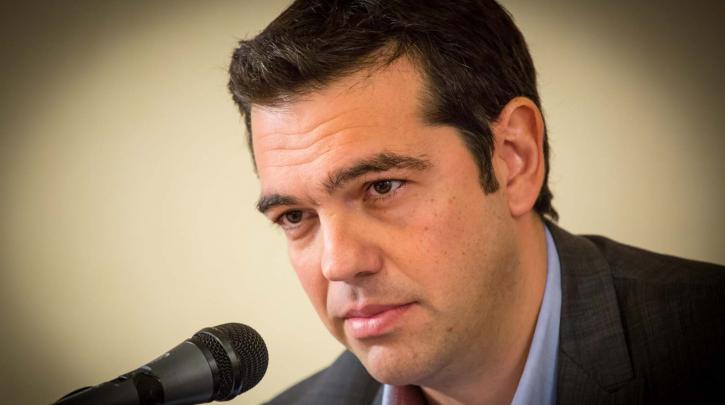
Everybody’s talking about how a Syriza victory shaking up Europe would be an unfortunate by-product: collateral damage…

25 Jan

…an accidental consequence if we’re not careful and we irresponsibly let Tsipras blindly lead us into this trap….when SHAKING UP EUROPE IS PRECISELY THE POINT!!!

Screen Shot 2015-01-24 at 11.47.15 PMGiannis Papanikos/AP (Click)

by Barbie Latza Nadeau — for THE DAILY BEAST

ELECTIONS
01.24.15
Greece’s Alexis Tsipras: The Man Who Could Break Europe
Sunday’s elections in Greece could bring to power a party that’s pitting the debt-ridden south of Europe against the rich north. Can its leader’s charisma carry the day?

In 2012, when Alexis Tsipras last ran to be prime minister of Greece, his compatriots were quite literally killing themselves in public squares because of the tough austerity measures that had strangled the country’s economy.

Tsipras, just 37 years old at the time, personable, extremely telegenic, took a page from his playbook as a student activist to rabble-rouse for a better life. Tsipras’s office was adorned with a poster of Ernesto “Che” Guevera. (His youngest son is named Ernesto.) And he rarely wore a necktie—especially when he tooled around Athens on his German BMW motorcycle.

His alternative-left Syriza party, he said, was the ticket out of the hell that Greece had become. “We have never been in such a bad place,” he told The Daily Beast back then. “Greeks are on their knees and leaving the country en masse. This is not an acceptable future for a European state.”

Back then, Tsipras promised to guide Greece to a better future, which he proposed would be one without the single European currency and thus outside what’s called the Eurozone.

In the end, Tsipras lost the election, which was played out in two rounds after no clear winner emerged from the first poll. But the fact that Syriza won 27 percent of the vote meant that more than a quarter of Greeks thought his plan had legs, and that worried mightily the powers that be Berlin and Brussels.

Leaders from the rich states in the northern tier launched an anti-Syriza campaign that hurt the untested young leader among those who worried that leaving the euro would be disastrous. “If Syriza comes first, Europe should be very afraid: my expectation is that we would have chaos,” Kevin Featherstone, head of the Hellenic Observatory at the London School of Economics told The Guardian at the time. “There would be huge instability and uncertainty on international financial markets and frenzy with a government that is a loose coalition and lacking clarity of purpose being forced to make decisions.”

Tsipras, who is back on the ballot on Sunday, has changed a lot since that last electoral run. Back then his partner was pregnant with little Ernesto. Now Tsipras spends more time carting his two kids around in the family sedan than joyriding on his beloved bike. He still isn’t photographed much in a tie, but his approach is far more tempered and moderate. This time he is running on a promise not to leave the eurozone. (He now calls his 2012 campaign promise a “paranoid plan.”) And this time, he might just win because many of the negative projections have come true and things in Greece have gotten worse. More than 200,000 Greeks have left the country in the last five years, and austerity has forced many businesses to shutter up or go off the radar. Greece’s black market economy is now estimated to account for nearly half of the country’s GDP.

More than 200,000 Greeks have left the country in the last five years, and austerity has forced many businesses to shutter up or go off the radar.

There are also signs that Europeans in other countries who once fought to keep the eurozone intact at any cost now feel they could get along pretty well without Greece. After all, it has a population of only 11 million in a European Union of 500 million and it represents only about 1.4 percent of the union’s GDP.

In early January, Germany’s Der Spiegel weekly quoted a source close to German Chancellor Angela Merkel saying that Berlin was “open” to a Greek exit, or Grexit, as the potential departure move is known.

Under pressure, Merkel was forced to backtrack, insisting unconvincingly that she wanted Greece to stay. “I as German chancellor, and also the German government, have always pursued a policy of Greece staying in the euro zone,” she said at a joint press conference with British prime minister David Cameron.

This time around, Tsipras has promised the Greeks that Europe needs them and has no choice but to renegotiate Greece’s bailout debt conditions. And Greeks like what they hear. Days before the vote, he widened his lead by nearly 7 points ahead of current prime minister Antonis Samaras’ New Democracy party, according to the last poll conducted by Greek SKAI television.

Last time, Tsipras came out swinging against Europe and its currency. This time he is picking his fights, and trying to build alliances across the southern tier of the continent.

Tsipras argues that in order to stay in the eurozone, Greece’s ruling party has negotiated a foolhardy payment schedule for its $378 million bailout debt that makes it impossible for the country to grow. The current repayment plan is 175 percent of the gross domestic product, and Tsipras wants a better deal, starting with his demand that Europe should simply erase most of the Greek debt.

“Hope is coming,” he says, repeating the Syriza campaign mantra. “Five years of destruction and fear have led nowhere. Enough is enough.”

The lessons the young leader has learned since the last elections are apparent. He has traded what amounted to fear-mongering in his last electoral campaign for consensus building, starting with a promise to some of his former naysayer European leaders. Many of Europe’s struggling countries have launched their own versions of alternative leftist Syriza parties and Tsipras had made the rounds to Italy, Spain and Portugal in recent months.

In 2012, Tsipras gave wide ranging interviews to most people who cared enough to ask. This time around, he is writing op-eds in Europe’s largest newspapers to garner support not only for voting Greeks who have moved abroad, but to get Europe’s other austerity-suffering countries to back the debt reshuffling proposal with the idea that such a precedent could help them, too.

Writing in the Spanish daily El Pais, Tsipras tries to assure Spain that Greece can lead the way for all of Europe’s struggling economies. “From the darkness of austerity and of authoritarianism, into the light of democracy, of solidarity and of sustainable development,” he writes. “For this reason, Greece is only the beginning. Within this year, Spain’s turn is coming. The change begins from the South. The defeat of the political sponsors of austerity, foreclosures, of insecurity and fear, of corruption and the scandals has its launching point in our countries.”

Tsipras changed his message slightly in a hard hitting op-ed in the Financial Times a few days later, in which he says Europe must end austerity so as not to let “fear” kill democracy. “We have a duty to negotiate openly, honestly and as equals with our European partners. There is no sense in each side brandishing its weapons,” he writes. “Unless the forces of progress and democracy change Europe, it will be Marine Le Pen and her far-right allies that change it for us.”

On January 14, Tsipras fielded questions with the hashtag #asktsipras in what turned out to be an ingenious town hall debate that garnered 32,000 tweets in the first few hours after it launched. He accused the ruling class of “creating a breeding ground for scandals” and touched on everything from tax reform to foreign policy. He tweeted, “We will not take part in NATO with a bowed head. We will not support military interventions. We will defend international legality.”

Tsipras has come a long way in just a few years, but not all of Europe is optimistic about a Tsipras-led Greece. In an interview ahead of the World Economic Forum in Davos, Switzerland, Christine Lagarde, head of the International Monetary Fund, which owns a lot of the Greek debt, quashed Tsipras’s debt renegotiation promise and said there is very little wiggle room when it comes to renegotiating debt. “A debt is a debt and it is a contract,” she told The Irish Times. “Defaulting, restructuring, changing the terms has consequences on the signature and the confidence in the signature.”

Speaking to RTLZ television ahead of the Davos meetings, Dutch finance minister Jeroen Dijsselbloem, who heads the influential Eurogroup of European ministers agreed. “There’s no political support to write off Greek debt,” he said.

And in Germany, there was that Der Spiegel report that the German government would rather have a Greek-free euro than open the way for a trend that would be costly to the richer nations. “The German government considers a euro zone exit [by Greece] to be almost inevitable if opposition leader Alexis Tsipras leads the government after the election and abandons budgetary ­discipline and does not repay the country’s debts,” the magazine reported.

Even at home in Greece, not everyone predicts that Tsipras will walk away with a clear mandate to run the country. Alexis Papachelas, executive editor of Greece’s Ekathimerini newspaper, cautions that the likely scenario of a second vote, like what happened in 2012 when the first ballot failed to produce a winner, could spell even bigger disaster for the country.

“Whichever party wins Sunday’s elections will be faced with a mountain of obligations. Tax revenues have plummeted and banks are under enormous pressure. Some inside Syriza like to believe they have a solution to every problem: Foreign lenders will give Greece ample time, the [European Central Bank] will provide unlimited liquidity to Greek banks …,” he says. “Or so they think. For if you attempt to cross-check the information you will find very little in the form of a convincing answer. It’s like they are divorced from reality.”

Tsipras’s response is typically stirring: “The struggle of our peoples for change is the struggle of common sense versus ideological fanaticism,” he says. “It is the struggle of dignity versus servitude,” he says.

But at the end of the day, somebody’s got to pay the bills.

No.  At the end of the day, one of the two forces at play here will blink…

Comment: nikobakos@gmail.com

America makes you nuts — for real…

25 Jan

Brilliant article in Salon: Living in America will drive you insane — literally.

Screen Shot 2015-01-24 at 10.10.55 PMMoney quotes:

“A June 2013 Gallup poll revealed that 70% of Americans hate their jobs or have “checked out” of them. Life may or may not suck any more than it did a generation ago, but our belief in “progress” has increased expectations that life should be more satisfying, resulting in mass disappointment. For many of us, society has become increasingly alienating, isolating and insane, and earning a buck means more degrees, compliance, ass-kissing, shit-eating, and inauthenticity. So, we want to rebel. However, many of us feel hopeless about the possibility of either our own escape from societal oppression or that political activism can create societal change. So, many of us, especially young Americans, rebel by what is commonly called mental illness.”

and:

“The reality is that with enough helplessness, hopelessness, passivity, boredom, fear, isolation, and dehumanization, we rebel and refuse to comply. Some of us rebel by becoming inattentive. Others become aggressive. In large numbers we eat, drink and gamble too much. Still others become addicted to drugs, illicit and prescription. Millions work slavishly at dissatisfying jobs, become depressed and passive aggressive, while no small number of us can’t cut it and become homeless and appear crazy. Feeling misunderstood and uncared about, millions of us ultimately rebel against societal demands, however, given our wherewithal, our rebellions are often passive and disorganized, and routinely futile and self-destructive.”

And, finally, the nail-it quote from writer and all-around Renaissance man, Lewis Mumford, written in 1951:

“The most deadly criticism one could make of modern civilization is that apart from its man-made crises and catastrophes, is not humanly interesting. . . . In the end, such a civilization can produce only a mass man: incapable of spontaneous, self-directed activities: at best patient, docile, disciplined to monotonous work to an almost pathetic degree. . . . Ultimately such a society produces only two groups of men: the conditioners and the conditioned, the active and passive barbarians.” —Lewis Mumford, 1951

Comment: nikobakos@gmail.com

Maps

24 Jan

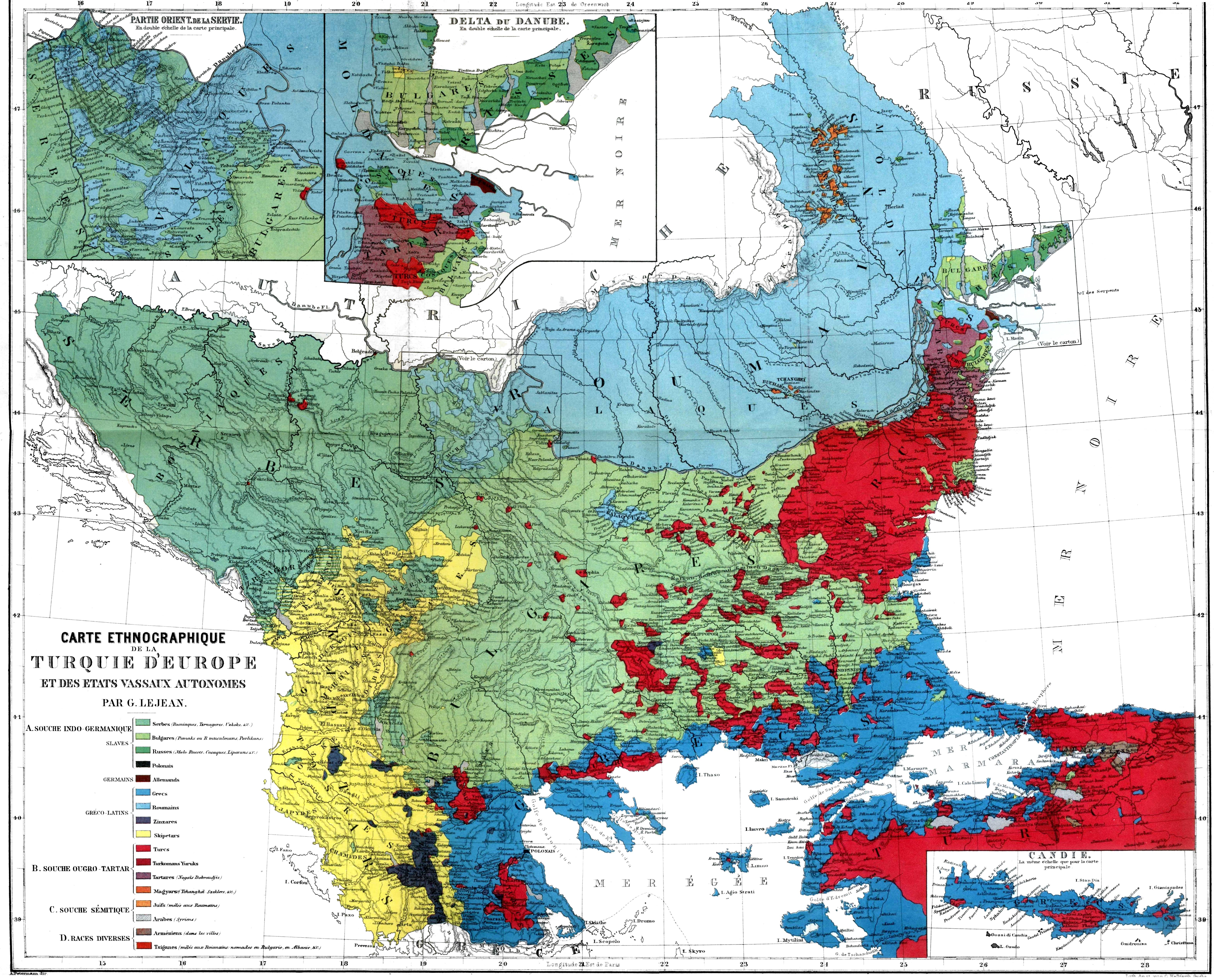
Balkans-ethnic_(1861)

Ethnic_map_of_Balkans_-_russian_1867(click)

Yes, of course, the maps I posted here, in “The Invasion of America” and have reposted above, unleashed a torrent of nationalist, hysterical emails and comments from Greeks — and only Greeks — that I have to address.

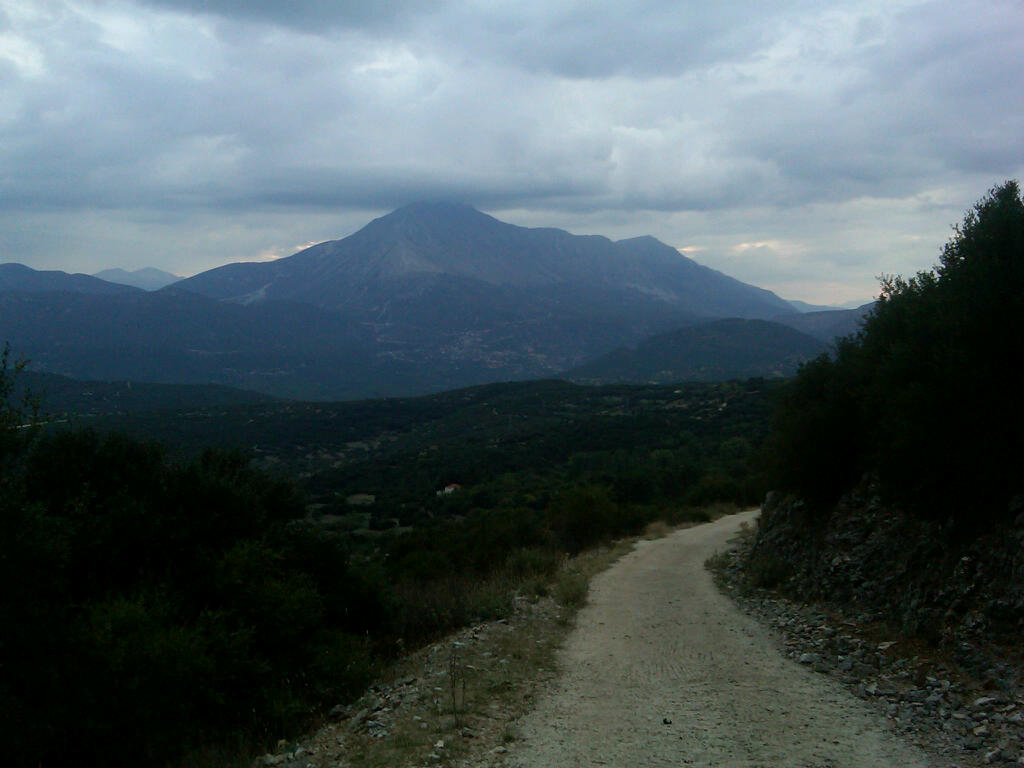
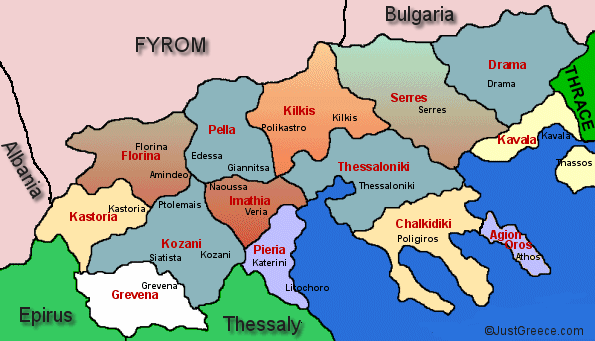
Yes, the maps are clearly inaccurate in certain respects, particularly with the territory indicated as inhabited primarily by Albanians.  That an Albanian majority lived, or that Albanian was spoken in such a solid block, as far south as the Ambrakikos Gulf (down to Preveza) in the first map, and clear down to the Gulf of Corinth on the second map, is ridiculous and is probably the result of dumb speculation on the map-makers’ part and not motivated by some nationalist agenda.  And yet, let’s not forget those periods in history when Greek Epiros was much more Albanian than it is today.  Until the early nineteenth century, the region of Souli, right behind these mountains (below) seen from my mother’s village Pesta in south-central Epiros and just north of the border with the prefecture (I guess?) of Preveza, was inhabited largely by Albanian-speaking Christians, when they were expelled and dispersed by Ali Paşa.  Just north, lowland parts along the coast of what’s now Thesprotia around the coastal city of Igoumenitsa (see map below) were primarily inhabited by Albanian Muslims (known as Çamedes and the region as Çamëria) until they were massacred and expelled by Greek Nationalist resistance forces during WWII.  And, to jump back in time, one of the splinter states that emerged from the complicated history of the Despotate of Epiros, was ruled by Albanian clans with their capital in Arta and did extend as far south as Naupaktos and the Gulf of Corinth.  Oddly enough, the second map, which ridiculously shows all of Aetolo-Acharnania as Albanian, fails to indicate the large Albanian-speaking regions of the Peloponnese. 

pestaaithanase(click)

Map EpirosEpiros

But the second of the two maps at top is also ridiculous in that the Aegean coast of Anatolia was never so solidly Greek so deeply inland.  Greeks were not a majority anywhere in the region (as Metaxas pointed out in his warning to the egomaniacal Venizelos just before he embarked on his insane campaign), and if the region had been so Greek, there wouldn’t have been any Turkish villages for the Greek army to commit its atrocities against soon after landing in Smyrna in 1919.

Of course, no Greek readers complained about that.

I found the fact that Dobruja, the Danube delta region of what’s now northeastern Bulgaria, was so solidly Muslim to be interesting — again, if the map is accurate.

Finally, what both maps do make abundantly clear, and should be abundantly true to anyone with any kind of historical integrity, is that the majority ethnic group in what’s now Greek Macedonia were once Bulgaro-Macedonians.  (I’ve been told to go fuck myself by numerous Greeks whenever I say this. And in those exact words.  And in the middle of perfectly civil conversations.  That’s the degree of infantile, paranoid anger Neo-Greeks feel about the issue.  And it’s totally obvious that that comes from semi-consciously knowing that Macedonia’s Greekness is problematic and much more historically complicated and heterogeneous than they would like it to be.)  Obviously that’s not the case today, due to their expulsion throughout the decade of the 1910s and the Balkan and Second World Wars, a population exchange with post-war Bulgaria, the massive influx of Greeks from Turkey in the ’20s, and that the fact that those Macedonian-speakers who remained and still form a most cohesive ethnic block in the northwest corner provinces of Kostur and Lerin, (see map below) are still too terrorized to speak their identity out loud, or, even more tragically, have been so brainwashed that if you even suggest that they speak some form of Bulgaro-Macedonian, they become enraged.  More Royalist than the King.  More on Macedonia in future posts.  But let’s just say that the one thing the maps show definitively is that, of all the countries to come out of the collapse of Ottoman power in the Balkans — and given the real demographics on the ground — it’s safe to say that Bulgaria came out the most short-changed and screwed.

 Two maps below: one showing the regions of Kostur (Kastoria) and Lerin (Florina) in the northwest corner of Greek Macedonia. And beneath, a map of the same regions where you can see the fake new names given to many towns and villages in the region to replace the old Slavic ones.  This did not just happen in Macedonia, but throughout Greece.  But since Macedonia was the least Greek region of twentieth-century Greece, it was imperative that this Hellenization process and obscene distortion of history be applied there most widely.  The thing is that the names of these villages are so patently fake-sounding and made up — Cold Spring, Two Rivers, Deer Hill, etc. — that they sound like American suburban developments.  Most were just completely fabricated…a village next to my mother’s called by the not particularly lyrical — yet not particularly or dangerously Slavic-sounding — name of Moulies was changed to Perdika Partridge.  No reason.  Or, they were excavated classical names based on ancient Macedonian personages, like Amyntaio, previously Sorović, or Ptolemaida, formerly Kaylar, and inhabited exclusively by Greek-speaking Turks and Yörük-type nomads settled there from Anatolia, who had preserved their nomadic lifestyle and pure Turko-Asiatic physical characteristics until the twentieth century. Then there’s the stunningly pretentious Argos Orestikon,* whose historic name was Hrupišta.  (All these can be found on the bottom map.) Or the renaming took its cue from the slightest possibility that in Classical times a settlement by that name may have existed within a hundred-kilometer radius of the present-day town — i.e. Vodena changed “back,” supposedly, to Edessa.  On top of it all, most of the real Slavic names were so much more beautiful and appropriate: Vodena or Voden (Edessa) is a pleasant little city full of babbling brooks and waterfalls and comes, precisely, from the Slavic word for water, “voda,” while the new name for the beautiful village of Neveska, shown in the second map, is simply a translation from the Slavic — Nymphaio — and means the same thing: “bridal.”  Don’t know why the village would’ve been called that.

Finally, these paranoid, nationalist name changes happened throughout the Balkans and Turkey, so you can’t just criticize the Greek state for it.

map-of-macedonia

florina-map

Comment: nikobakos@gmail.com

**************************************************************************************************************************************************************************

*  Don’t ask me what this ugly little town near Kastoria has to do with Argos in the Peloponesse, or with Orestes, the mythological scion of the cursed Atreid family, who, almost Christ-like, took his family’s curse upon him and eventually was absolved of it.  If any one has any clue, please let me know.

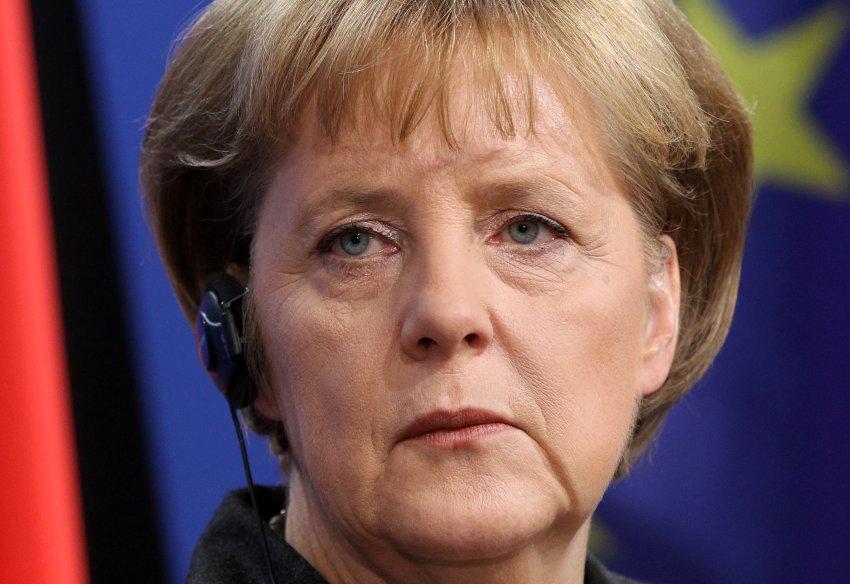
Photo: Frau Merkel

24 Jan

She’s the daughter of an East German Communist apparatckik Lutheran pastor.  I’m sorry, but that’s all I need to know…  How much more of a moralizing and, at the same time, morally compromised, background can someone possibly be from.

I don’t know if readers get the full connotation of the word “apparatchik.”  But it means a member of a Communist party in former Eastern Europe that enjoyed the kind of privileges that more than anything made the supposed egalitarianism of the “existing socialism” of Communist Europe a heinous lie and an ugly joke.  It meant living well — comfortable housing, summer houses, trips abroad — as millions suffered…terribly.  And to have been a cleric in that structure that enjoyed official favor, you had to have been the worst kind of collaborator and informant for a horrendous system of terror.  And Protestant on top of it…

And the future of much of humanity rests in her hands.

CeBIT ErËffnung 2010(click)

Comment: nikobakos@gmail.com

GREEK ELECTIONS: “Greek voters may be about to plunge the European Union into a full-fledged economic and political crisis.” For real?

21 Jan

Greek parliament

Don’t look to me for economic analyses. I think I had had my first credit card in college for a while, before I realized that the amount you paid back to them was more than what you bought with them. That means credit and debt – the foundations of Western Civilization – were things I didn’t understand until like my mid-twenties. So as far as economics are concerned, I generally listen as carefully as I can to those who seem remotely intelligent to me and weigh what I can gather.

Greece is shaking up the Eurozone again, because parliament couldn’t vote for a President, I believe, and parliament was dissolved and now we’re having elections on January 25th. And everyone, or many people, are trembling at the thought of a SYRIZA, the left-of-center party, victory. I don’t know why they chose to call themselves by an acronym that means “The Coalition of the Radical Left.” Paranoiacs who talk about them as if they were Bolsheviks are already crazed enough in their attacks on the party, and SYRIZA really is, just that, a left-of-center-party. They only seem radical because the “center” – in Greece and everywhere – has moved so far to the right in every sense for the past few decades.

People in Greece whose intellects I respect think that a SYRIZA government – since they are in the lead in polls – would be a disaster: they think the best route for getting Greece out of its economic stagnation is to continue to follow the austerity dictates of the so-called “Troika” — the European Commission (EC), the International Monetary Fund (IMF), and the European Central Bank (ECB) – though Greece has followed them pretty much to the letter and steadily for the past two years, and there are more rounds of austerity coming, and little has improved. And if I ask them the more theoretical question of why Greeks should keep voting for the PASOK/ND two-party clique whose politicians have run the show since 1974 and are a bunch of almost Putinesque cronies in their brazen, shameless corruption and who got the country in the mess it’s in in the first place, they really don’t have an answer for me. One says he just doesn’t vote at all. But how fast a way is that for turning Greece into an American kind of politics-less civil society – which should be an oxymoron.

But I have reason to think that some of the people I listen to in Greece are listening to their class interests – worse, their class instincts, in the most knee-jerk sense – so I also try to listen to Americans I respect: like and especially Paul Krugman. I’ve cited him on this blog often, especially in reference to France – a country which I care about deeply – and he’s a vociferous critic of the EU’s austerity policies towards its prodigal southern and Celtic brothers. He points out that the economy of France, to speak about the center for a moment and not the perhaps hopeless periphery, and how much better it’s doing on every indicator than even Britain itself, precisely for sticking to some of its old-fashioned, socialized (not “socialist”) ideology. And to how much better the United States is doing, because, fairly or not, it sent a fresh flush of cash into its finance industry (instead of setting up a guillotine on Wall and Broad, which would’ve been my instinct) and now is probably the first major economy to have more or less dragged itself out of the hole. He’s written e-n-d-l-e-s-s-l-y about how the Great American Depression was on the verge of ending in 1936, when the government decided to “tighten belts” again and plunged the country back into the deepest economic slump ever in 1937, until it changed policies and then WWII spending ultimately saved it. And he sees the lag in Europe’s recovery, include the euro’s precipitous plunge to near one-to-one parity with the dollar, as the result — and purely — of moralizing and moralist, German-guided, insistence on austerity.

But as far as Greece goes, all the fear-mongers have brought out their heavy artillery. Maybe because I am such an economic illiterate, I recognize the psychological poker game involved in economics so much more clearly than others may. It’s amazing how the “Masters of the Universe” – these Alpha-Male studs that run our world in ways we’re too stupid to understand, because as it turns out, they don’t really understand them either – suddenly become menacing thugs or henny-penny pussies, alternating between the two, as soon as the width of their profit margins is even slightly threatened. This may be more an American problem than a European one, but I think it is what’s going on with Greece, the prospects of a SYRIZA victory and the discourse it’s generated. “Disaster” will follow. “Germans are ready to let Greece leave the Eurozone.” Frau Merkel dusts off her Lutheran-Communist pastor daddy’s sermons, and like the Biskop in Bergman’s “Fanny and Alexander,” threatens fire and brimstone if Greece does not “koopereit.” “You must pay us,” say the lenders, “or it will be a disaster for all of us.” “We can’t…and won’t” say the borrowers, “and actually it will only be a disaster for you. You’ve already pushed us into a corner where we don’t have anything to lose, so…what are you going to do about that? Send us to debtors prison?” Hmmm…? Then what?

I’ve called the European Union “a neo-colonialist body disguised as the Highest Form of Western Humanism Project” before. And I can’t speak for Spain or Portugal or Ireland. But what I see the Union doing in Greece is engaging in the systematic destruction of a small economy.* By “small economy” I don’t mean a small territory of ten million with limited resources and a small-scale GDP. It’s a given that that’s what Greece always was. What I mean is a society of small-scale, personal, economic units. Some may balk at this idea, but I’m talking about something that’s one of the most positive aspects of our Ottoman inheritance. Late Byzantium was moving toward a system of large-scale landowners with an increasingly enserfed population – whether it was an organic development or the influence of Frankish feudalism is a big question. The fact, though, is that this process was arrested by Ottoman systems of land tenure and the block those systems put on the development of a landed, inherited aristocracy. And then in the twentieth century, Greece was the only former Ottoman country lucky enough to not have that small-scale type economy disrupted and perverted by the experiments of communism or even the economically statist policies that came to dominate Republican Turkey itself.

Why am I going so far back in history to talk about Greek elections in 2015? Because you might have to look that far back to see why we were spared the experiences of a large landless peasantry that could then be turned into a disenfranchised industrial proletariat – to a great extent at least; yes, there was Thessaly and there was Laurio, but nothing like what Western Europe or Russia experienced. The Greek entered modernity armed with few advantages, but one was a widespread public education system of fairly high standard for a country of its resources, the roots of which were already well-established in Ottoman times and put into systematic place almost immediately after independence. And the other was that, generally, he did so as an economically independent entity. A small-scale free peasant. A middle-class owner of some property. A “nation of shopkeepers,” as Napoleon condescendingly (and inaccurately) said of Britain. And all the better for it. Not even the sweeping flood of refugees from the Population Exchange of the 1920s with Turkey, which involved the absorption of an almost 30% increase in our population in less than five years; not even the tragic depopulation of rural Greece in the 1950s — for all its economic and military reasons — and the hideous Athens it created; neither of those massive sociological transformations changed the average Greek citizen from what he was: a free and reasonably independent economic agent of his own destiny.

THIS is what the “memoranda” are trying, and will succeed if allowed — if they already haven’t actually — in destroying. The tax on home-ownership and personal real estate is what I consider the most heinous and symbolic, even if it’s not the issue most Greeks are likely to get rabid about. Don’t ask me how: maybe the beauty of Athens had to be sacrificed to the πολυκατοικία, the apartment houses that I’ve called “cement-caves” where most Athenians and other Greek city-dwellers live, to create the domestic structure of Neo-Greek society. But what did emerge from the process of post-war Greek urbanization was a country where most people owned their own homes, and where – to a certain extent – a vertical version of traditional society was maintained. Relatives lived near each other, often in the same building, and though during the heady credit-backed lifestyle of the nineties it was common among Neo-Greeks to mock themselves for such domestic arrangements – grandma, or worse, your in-laws, living upstairs, and thirty-something-year-old kids living with their parents – I can’t tell you how many people I’ve seen having come to rely on precisely those networks to survive the present crisis…and actually did back then even, before things got bad, as well: a mother-in-law that will take care of the children while mom’s working and have lunch ready by mid-afternoon for the family to share together; a sister-in-law with whom you can move in for an indeterminate amount of time till you’ve found a job again; networks that extend back to one’s ancestral village, where some lone, remnant relative has some olive trees for oil or some animals for cheese or just a bostani that can provide you with some tomatoes or cucumbers or some apricots that provide you with some jam. I remarked to others on how more civil and warm people in the public sphere seemed to be towards each other the last time I was in Greece, on what a, perhaps silent, but palpable, sense of greater solidarity people seemed to feel for one another and I got a dose of that almost instinctive Greek cynicism from most: “You’re romanticizing”… “Yeah, try going downtown during the midday rush…” But I also was witness, in a very memorable conversation, to one of those cynics getting dressed down by someone else: “Μη το λες…μερικοί έχουν βρει το φιλότιμό τους…” “Don’t say that so easily. A lot of people have found their sense of honor again.”

“Honor” is a bad translation for “φιλότιμo,” which means honor and amour propre and sense of dignity and reciprocity, all in one complex structure of emotions and social acts. Basically, “philotimo” is the sense of self-respect that’s intimately tied up with the upholding of your obligations to others that held Greeks together for centuries. All readers here know I’m a fanatic opponent of reading Classicizing virtues – or Classical anything — into Neo-Greek society, but the importance of “philotimo,” I feel, even if just discursive, even if only in its lapses, is a millennia-long constant.

The reader may be excused in thinking I’ve strayed from a basic issue of economics to an excavation of Greek cultural morals. And the truth is that I’m feeling kind of challenged right now in tying together the threads of where I’ve ended up with those I started with.

Well, here then: it’s those patterns of economic independence and the traditional bonds of morality that supported them that the Troika is determined to destroy. The Greek civil sector was not particularly bloated, not even compared with France, for example, which is my prime model for a life well-lived. And if it employed more people than it actually needed, let’s stop talking, like some are, as if it were a civil sector along Soviet lines: “They pretend to pay us and we pretend to work.” The Greek worker actually worked more hours than anyone in any industrialized country but South Korea – South Korea. Not efficient? Efficient for what and to what purpose? For the surpluses the Greek or other governments should enjoy? Since when is the state a business that has to pull in big profit margins and not primarily a structure for meeting the needs of its citizens? The same for the cutting of pensions that allowed older people to live in dignity and even help younger members of the family and have now been slashed by the Troika dictates? Really? Why? For whom?

And then on top of it all to tax people’s homes… We’re used to it in the United States, but I can’t convey what a sense of shock, and rightly so, this caused among Greeks – and even me. You’re going to tax me on the one roof I have over my head, the one thing I’m sure of, the one thing that I can grab at for some form of security, even if it’s Karagözi’s corrugated tin çandiri?

alexis-tsipras-neo-cvg-cvfvAlexis Tsipras

But let better minds than mine explain. This is an interview that Costas Lapavitsas recently gave a rather lame and argument-less Stephen John Sackur on the BBC’s Hardtalk. Lapavitsas is an economist, a graduate of the London School of Economics, a professor at the University of London and a columnist for The Guardian. He has the kind of intellectual confidence, articulateness and steel-trap mind that is — not just super-sexy — but is the gift of a certain kind of Greek who makes me immensely proud.  He’s an advisor for SYRIZA and I’m sure he’s detested by the party’s opponents because they can’t dismiss him as a childish, bratty demagogue the way they can dismiss Alexis Tsipras (above), the party’s actual leader, about whom I, too, have mixed feelings. There’s the BBC interview and then if you have the patience there are another interview and two longer lectures of his that get into stuff much more deeply.


He’s compelling…and smart…and not afraid of the truth. He makes the argument for what was always the small-scale of Greek economics: that it was never a country that lived off of large-scale foreign investment, that like I stated above, it never had a large “alienated proletariat” waiting for foreign industries to come and employ – exploit — which is precisely what the European Union wants to do to all of its southern periphery. He’s realistic; he was for exiting the Eurozone back in 2011-12, but admits it’s unfeasible now. He calmly listens to interviewer Sackur pose the smuggest kind of conventional wisdom, “but, surely…” questions, and without skipping a beat, says: “No..” and proceeds to demolish him. (His response to Sackur’s attempt to use Ireland as an example in his argument is not only point-on, but historically poignant, personally moving to me as a Queens boy, and a really satisfying little slap in the Brit’s face.**) He sees his Greece as the humanitarian disaster it has become, with a GDP that has fallen 25%, 50% youth unemployment and 25% overall unemployment, skyrocketing suicide rates and other rates of psychological diseases such as acute depression.  He says that it has moved beyond melt-down into what he calls “permafrost” and a stone from which no more blood can be drawn.*** He sees high, macroeconomic finance for the poker game it is: like I said – again – a game in which those who hold the reins of power alternately disseminate panic or fear in an intentionally self-fulfilling prophecy; and that those people are bullies, who will probably back down from their demands if a critical mass refuses to be bullied by them.

The point is building that critical mass.  And I thought I could vote in Greek elections for the first time this Sunday, but there are no consular elections for ex-pats possible with Greece as there is for a multitude of other countries — typical…  But if I could vote, I know who I’d be voting for.

Comment: nikobakos@gmail.com

**************************************************************************************************************************************************************************

* Tangentially but, I think, not in the least irrelevant to this post…  One of the starkest lessons in geopolitics and political economy I was ever taught was when I started teaching English as a Second Language in New York’s CUNY system and realized that my Latin American students weren’t destitute, landless peasants from the Guatemalan highlands or Caracas slum-dwellers.  They were well-educated teachers, accountants, civil servants, small business owners…  They were part of a sizeable but fragile urban middle-class that the Neo-Liberalism applied to many South American economies in the ’80s trapped in a vice, and forced out into emigration.  And that’s what’s happening in countries like Greece and Spain and Ireland today.

** Meaning, that given the history of the British in Ireland, it’s a bit rich for an Englishman to be using that country as an example of “recovery.”  Yeah, Ireland is doing better.  Better because the tragic full-scale emigration of its youth has started again — something you can’t miss all around you in New York and especially in Queens — the continuation of a demographic catastrophe which first started when Great Britain practically depopulated the island by ripping apart the fabric of the Irish economy, its people and its civilization in the nineteenth century, with policies based on a moralizing, racist, Protestant set of arguments that are remarkably similar to those that Frau Merkel likes to spout about the European South today. And Lapavitsas makes that abundantly clear to him.  Plus Sackur’s whole fussy, donnish demeanor and Oxbridge accent make him so the perfect dude to cast if you need a target Englishman that you almost feel sorry for him; if I were him I’d need a drink after that interview.  See my: “The Graves Are Walking”: Was the Great Potato Famine a genocide?”  

And when I say “Protestant” in contexts like this, you can be sure — as per Weber — that I mean capitalist, for which most mainstream White Protestantism and its moral codes  — again, as per Weber (maybe a bit exaggerated) — is simply a front.

*** Or the homier example of Nasreddin Hoca and his donkey might make things clearer: Merkel, Spain, Greece and Nasreddin’s donkey

karikat__r_tan_oral

Comment: nikobakos@gmail.com

“The last bouzoukia in Astoria” — a video by yours truly

21 Jan

“Les Amis” — the last bouzoukia in Astoria…


Comment: nikobakos@gmail.com

And speaking of zebekiko…

21 Jan

This amazing footage…  At a 2009 Haris Alexiou concert at the Roman Odeion of Herodes Atticus , a Greek GI jumps on stage to dance to the “Zebekiko Tes Eudokias,” a legendary Manos Loizos composition from a film, I think, of the same name.  I don’t even know where to start with this piece.  I’m posting it now and maybe will come back to it later.  He’s gorgeous and a beautiful dancer and his brazen confidence and impulsiveness are deeply Greek — and she too, of course, is extraordinarily impressive woman.  And the gender semiotics of the scene are sort of unfathomable really and should just be watched.  The zebekiko, of course (see video in previous post:  “The last bouzoukia in Astoria” — a video by yours truly), is never a couple dance; it’s quintessentially solipsistic and all about a particularly male loneliness, yet at first there’s an extended moment when he, a soldier — and one of Alexiou’s classic numbers, by Loizos also and lyrics by Manoles Rasoules (which I wouldn’t have imagined) is about a lonely soldier — actually dances it to her…  In homage practically, and she, Haris Alexiou, being the reigning Queen Mother and Earth Goddess of Greek popular music for some forty years now…the whole thing is just…I dunno…  Just, just watch it.

Because, of course, then, she does pull back and leaves him to his solitude.

Comment: nikobakos@gmail.com

Hamid Behdad: Darkub (also speaking of zebekiko): “I want to climb the highest peak, and drink red wine…”

21 Jan

One of the most harrowing numbers from 2009’s No One Knows About Persian Cats by Bahman Ghobadi, a film that I’m pretty amazed I haven’t gotten around to posting about till now.  I don’t even know if the song is in Farsi or Pashto, because the dancers look like Pashtuns doing some like, but not quite, an Attan, but it’s gorgeous — and the lyrics could easily be that of a zebekiko: “I want to climb the highest peak, and drink red wine…but someone is up there waiting to imprison me…”

Comment: nikobakos@gmail.com

Asia Beats: Adi and Suhail: “Jogiya”

21 Jan

I like this “Qalandar” number, but what really hooked me on these guys was a piece called Jogiya,” which unfortunately is not on YouTube and the BBC won’t let us have, so you’ll have to watch it at their site: Asia Beats: Adi and Suhail.  The ghazal-thumri-like delicacy and eroticism, the qawwali intensity and the keyboard all in one funky mess really blew me away.  And what’s up with that gorgeous black-on-black sherwani on Suhail in the “Jogiya” video.

Comment: nikobakos@gmail.com


Al Jazeera (again): “After jail, Pussy Riot focuses on prisons”

21 Jan

Pussy20141222115050695734_20

After jail, Pussy Riot focuses on prisons

Last updated: 23 December 2014
 

Russian feminist rockers fight system holding 700,000 – the world’s largest per capita prison population after the US.

Moscow, Russia – After spending almost two years in jail for performing their “punk prayer” against Russian President Vladimir Putin at Moscow’s main Orthodox cathedral in 2012, two young women from the feminist protest band Pussy Riot chose not to go on a world tour or settle somewhere in the West to escape further persecution.

Comment: nikobakos@gmail.com