Back…

8 Oct

Sorry for the absence.  A couple of time-consuming life circumstances, a technical glitch with posting  — and a light case of what in Spanish is known as “pereza” (see below) has kept me off the Jadde for a while.  But I’m back and haven’t forgotten explanations or definitions I owe you.   Also, in response to certain friends and readers who claim they’ve on occasions wanted to make comments but didn’t want to bother with WordPress registration, I’ve highlighted my email address on the blog’s intro and at the end of every post as well.

(click)


Comment: nikobakos@gmail.com

New Yorkers Plaster ‘Racist’ Stickers Over Islamophobic Subway Ads

28 Sep

From Thinkprogress.org:

By Ben Armbruster on Sep 25, 2012 at 9:15 am

After the anti-American protests erupted in the Middle East earlier this month, Pam Geller’s American Freedom Defense Initiative (AFDI) decided to re-up its anti-Muslim ad campaign in New York’s subway system. The ad, borrowing from an Ayn Rand quote, is meant to imply that Muslims are savages.

New York City transit authorities did not want to display the ads but a federal court said refusing the ads would violate AFDI’s First Amendment rights. But now that the ads are up, New Yorkers are taking matters into their own hands, writing “RACIST” and “HATE SPEECH” over the ads in certain subway stations […]

AFDI is trying to run a similar campaign in the Washington DC Metro but authorities there have so far been successful at blocking the campaign “out of a concern for public safety.” (HT: Mondoweiss)

Even Fox News, who has promoted Geller in the past, called her group’s ads “inflammatory” and “anti-Muslim.”


Comment: nikobakos@gmail.com

27 Sep


Comment: nikobakos@gmail.com

Kol Nidre

26 Sep


Moishe Oysher sings Kol Nidre – 1939 Yiddish film


Comment: nikobakos@gmail.com

“Israel is the answer.”

24 Sep

From Andrew Sullivan’s The Dish, “Is Netanyahu Trying To Blow Up The Election?“:

“There is no just war theory on earth that can justify a pre-emptive strike against nuclear facilities which have not been used to produce a weapon in a country whose Supreme Leader has explicitly called a “sin” to deploy.

“As for a radical regime in terms of international relations, which country in the Middle East has launched more wars than any other since its creation, has occupied territory it has then sought to ethnically re-balance, has killed civilians outside its borders in the thousands, has developed a nuclear capacity outside of international non-proliferation treaties, has physically attacked both Iraq and Syria to destroy their nuclear programs, and is now threatening war against Iran, a war that could convulse the entire world into a new clash of civilizations?

“Israel is the answer. I have no doubt that this new incident of anti-American Salafist violence [response to anti-Muhammad video] in the Middle East is now being used by prime minister Netanyahu to concoct a casus belli with which to scramble global events and get rid of Obama – and his continuing threat to Israel’s illegal expansionism.”


Comment: nikobakos@gmail.com

Nasreddin’s donkey: an opposing (and perhaps convincing) view

24 Sep

In response to”Merkel, Spain, Greece and Nasreddin’s Donkey,”a reader writes:

“You‘ve taken this all wrong and gotten down this path in such a speed that you are missing the point. It isn’t the Germans starving our pathetic souls, they are actually saving us. Just when the crisis hit us the government was already in an annual deficit of 30billion euro (spending 80 billion and bringing in 50) paying pensions to dead people, epidomata to blind people who drove cars and played tennis, giving out 16 monthly payments a year to the 2000 ypalliloi of the parliament (yes, 2000 people work there) and supporting government organizatrions that do absolutely nothing (the organismos gia tin apoksiransi tis Kopaidas limnis still exists costing us money). With 30 billion minus every year, even if they had deleted all our 2009 debt of 350 billion we would have reached this debt level again in 11 years. If it were me, I wouldn’t have given a penny unless the greek people lynched the politicians, literally. [my emphasis]I don’t like Merkel either but it is us and our corrupt and inept politicians that caused and sustain the problem. And in recognition of this fact, we elected the same people back.The Europeans when asked in total distress by us (because we asked them) pledged us 120 billion in loans and they aranged almost another 100 billion in writeoffs, the biggest ever. The IMF for which we all give money gave only 30 billion and said they don’t have more. So you can blame Germans for many things but not for this. Merkel always starts off her speeches on Greece with recognizing the suffering of the Greek people in the hands of their unbelievable politicians. When was the last time our MPs stood up and aplauded another people as the Germans did some monmths ago in the parliament. They are asking us (begging us, threatening us) for more than 2 years now to do what we promised in reforms, most of them part of the pre-election promises of many governments for years, not imposed by Germans. Again, I wouldn’t have given a penny.”


Comment: nikobakos@gmail.com

A reader writes: “Tishabuv?”

24 Sep

(Sorry…only now getting a chance to respond to some of these)

The Arch of Titus in Rome, built to commemorate the Roman suppression of the first Jewish revolt in 70 A.D. (click)

In reference to Jadde posts: “Romney in Israel: How High To Jump?“and “Tisha B’av?,”  “Jewish London” writes: 

“it seems appropriate that he should visit on Tisha B’Av, a day when great calamities befell the Jewish people”

Oooooofffff…  This is like teaching…when you’ve spent hours researching and preparing, and then another half hour conducting, a brilliantly detailed and structured, thrillingly executed lesson on participial phrases, only to have one student, while you’re catching your breath right after, ask a question that proves none of the class has understood shit the entire time you were lecturing.

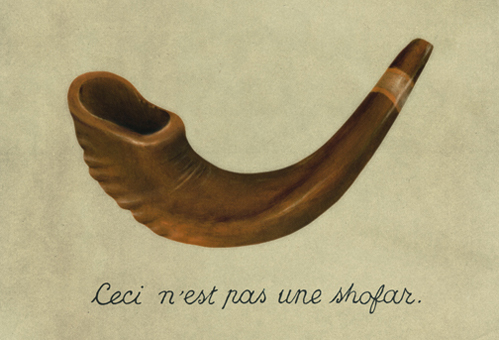
My point was simply that there’s a genre of Ashkenazi jokes, among the many, based on “When is Tishabuv?”  Beinart’s point, “Mitt Romney Misuses Judaism…” is that in the long tradition of Rabbinic and Talmudic learning, Tishabuv has been a time to reflect on why a certain tragedy has struck Jews and not just commemorate that tragedy in a victimized and ad nauseum form.

Yes, brother, “terrible calamities befell the Jewish people” on Tishabuv.  The Second Temple, the One and Only House of God in the One and Only Holy City, was levelled.  Jews were slaughtered in unbelievable numbers.  In trying to figure out whether these events happened as part of the Roman response to the Jewish rebellion of 70 A.D. or that of 135 A.D. — which has never been clear to me — I learned that there’s a trend of Jewish mystical thought that fascinatingly believes all Jewish tragedies occurred, occur and will occur on Tishabuv: the selling of Joseph into slavery; Moses’ shattering of the first tablets at seeing the Jews revert to idolatry; the destruction of the First Temple and the Babylonian captivity; the destruction of the Second Temple; the first massacre of European Jews at the beginning of the Crusades; the issuing of the Edict of Expulsion from Spain in 1492; the day the first train left for Auschwitz – all become mystically assimilated into Tishabuv.  That’s a tragic and moving idea.  However, I do know that the Roman suppression of the revolt of 135 A.D. was so brutal in its massacre and expulsion of Jews that it’s easy to say that it officially marks the beginning of the Jewish Diaspora.

Tishabuv is also intimately related to Jewish messianic thought.  The revolts themselves were partly inspired by messianic expectations.  And the crushing of those hopes by the greatest cluster of disasters to befall Jews before the Holocaust made Rabbinic thought retreat into the sharpest of all cautions against any such expectations.  This, I suspect, is what marked the final rupture between Christian Jews and the rest of Jewry.  It’s not that Jews didn’t succumb to the temptation again.  Kabbalism is a mystic desire to correct the world that is a barely concealed messianic impulse.  And there was the great fever of messianic ecstasy that swept the Jewish world in the seventeenth century, when Sabbatai Zevi, a rabbi from Smyrna, started declaring himself the Messiah – one of the most fascinating and, in the end, sadly absurdist, episodes in Jewish history.  Zevi, either a con artist or a psychotic, had raised Jewish expectations to such a frenzied pitch, that when he ended up converting to Islam and becoming a ward of the Sultan, it sent shockwaves of psychological distress, not only through Ottoman Jewry, but throughout the entire Jewish world; in fact, due to renewed persecution and massacres at the time in Eastern Europe, the effects on Ashkenazi Jewry may have been even greater than on Sephardim.  The crisis sent the Eastern European Jewish universe careening into two different directions: on the one hand a trend that reemphasized Rabbinical textualism and that eventually responded to the Jewish Enlightenment, the Haskalah, the movement out of Germany that attempted to bring European Jewry into the modern world; and on the other, a retreat into the most introverted mysticism, out of which Hasidism, and an even greater immersion in Kabbalistic thought, grew.  To some extent, this split is one that old New York Jews still codedly refer to, whether they know it or not, as “Litvaks” and “Galizianers” (explanation in subsequent post).  See Michal Waszynski’s 1937 film version of S. Ansky’s Dybbuk.  I think there’s no greater primary text of Jewish spiritual impulses and its conflicts.

Lili Liana as Lea, the bride who becomes possessed by the spirit of her wronged beloved on her wedding day to another man, in Waszynski’s 1937 Yiddish film, the Dybbuk. (click)

(Two interesting notes that I’d like to make here.  One is that the Jewish revolts of the early first millennium were partially led by political groups whom we, today, wouldn’t hesitate to compare to, not only the first New England Puritans, but even the Taliban, and who engaged in certain tactics, like the surprise slaughter of masses of innocent civilians that we like to associate with Palestinian “terrorism” – or that of…errrr….Irgun, Haganah, the Stern Gang, Mssrs. Ben Gurion and Begin and all the rest.  The other is that maybe the real basis of Tishabuv jokes is still unconsciously based in messianic expectations, the way older Greek women who, say, have missed a bus, will mumble: “Oy, now we’ll be waiting till the Second Coming.”)

But if “Jewish London” is to understand my point, he needs to better understand the transformation that Tishabuv has undergone in Israel since its founding, because I suspect that, not living among the most vibrant Diaspora communities in the world, Israel is his model.  Obviously, Zionism didn’t need to worry about the Messiah, since it had solved the “Jewish Question,” as must be obvious to anyone who throws even a cursory glance at the Middle East today and sees the peace and happiness in which Jews there live can attest to, and no Messiahs need apply anymore.  Tishabuv had been forgotten by the Jewish Diaspora, reduced to such an obscure holiday that it was the object of humour; I’ve lived most of my life in a city, and worked for a great part of it in an environment, where, believe me, it was impossible to not know that a great, or even just important, Jewish feast was being celebrated or was coming up, and Tishabuv wasn’t one of them.  In Israel, however, the “secular” Jewish state raised Tishabuv to new, official status as a holiday-fast day.  But not as a day of introspection; but as a day to remember, as “Jewish London” puts it, “a day when great calamities befell the Jewish people.”  This is because “calamities” are Israel’s justification for being; it was Israel’s down-payment and it’s still how it pays its mortgage; it’s the currency in which it trades.  And the ignorant Romney’s visit to the Western Wall with Netanyahu or whoever on that day, was just another slimy exchange in that same currency — and, in fact, a dishonour to centuries of Jewish suffering.

But back to the Diaspora, and a time when Judaism hadn’t locked itself into a barricaded nation-state.  More than just self-reflection and introspection, the repeated, century-after-century dashing of Jewish hopes may have generated an even more important element in the Jewish psyche: doubt.  The great Christopher Hitchens, quotes the equally great Rebecca West in his introduction of her book, Black Lamb and Grey Falcon, and her own ruminations about the origins of anti-Semitism:

“West reflects on the virus of anti-Semitism, shrewdly locating one of its causes in the fact that ‘many primitive peoples must receive their first intimation of the toxic quality of thought from Jews.  They knew only the fortifying idea of religion; they see in Jews the effect of the tormenting and disintegrating ideas of skepticism.’”

That’s why on Easter night, the night of the Resurrection, I always remember to have one, only one, glass of wine that’s offered to the suspicion – the same one born out of the fact that Elijah never actually walks through that open door at Passover — that this whole idea is bullshit.

So what is Tishabuv for (when we know when it is)?  Introspection, moral responsibility, skepticism, doubt and the saving beauty of being eternally able to convert suffering into humour and irony – these last may be the most important — a pretty whole summation of what Jews have given us, given me, at least.

When “Jewish London” can tell me what Israel has given us, he should let us know.  These Days of Awe might be the perfect time to think about that.


Comment: nikobakos@gmail.com

What is the Iliad about?

20 Sep

In a description of the Sarpedon vase, “The Death of Sarpedon: Who does art “belong” to?,” that used to be at New York’s Metropolitan Museum, I commented on an interesting political correcting of the Iliad that I came across on a slightly unexpected website:

“A final note.  A classic piece of regressive ideological projection from the NYU site: “Euphronios’s depiction of Sarpedon’s death is an early portrait of the barbarity of war and the needless death that is its legacy.”

Really?  Is that what you think the Iliad is about?  That’s pretty funny…”

Here’s a relevant section from Bernard Knox’ introduction to Robert Fagles moving 1990 translation, in which Knox quotes a Simone Weil essay — yes, quite a line-up.  It sets out from a Book XVI episode where Patroclus spears a Trojan charioteer, Thestor, through the jaw and lifts him out up of his chariot in a way that makes Homer think of a hooked, gasping fish.

“…clearly Homer is walking the borderline of credibility here.  He does it for a reason: that simile.  It emphasizes the grotesque appearance of violent death by a comparison with a familiar fact of every day life: Thestor is gaping like a fish on the hook.  The spearthrust destroys his dignity as a human being even before it takes his life.  But the simile does something more: it shows us the action from the point of view of the killer – the excitement of the hunter dispatching his prey, the joy of the fisherman hauling in his catch.  The lines combine two contrary emotions: man’s instinctive revulsion from bloodshed and his susceptibility to the excitement of violence.  And they are typical of the poem as a whole.  Everywhere in the saga of the rage of Achilles and the battles before Troy we are made conscious at one and the same time of war’s ugly brutality and what Yeats called its “terrible beauty.”  The Iliad accepts violence as a permanent factor in human life and accepts it without sentimentality, for it is just as sentimental to pretend that war does not have its monstrous ugliness as it is to deny that it has its own strange and fatal beauty, a power, which can call out in men resources of endurance, courage and self-sacrifice that peacetime, to our loss and sorrow and loss, can rarely command.  Three thousand years have not changed the human condition in this respect: we are still lovers and victims of the will to violence, and so long as we are, Homer will be read as its truest interpreter.”

This was recognized by Simone Weil in an essay written long before she left her native France for wartime London, where she filled her brilliant notebooks with reflections on Greek literature and philosophy in the short time left to her to live.  This classic (and prophetic) statement – L’Iliade ou le Poeme de la Force – presented her image of Homer’s poem as an image of the modern world.

“The true hero, the true subject, the center of the Iliad, is force.  Force as man’s instrument, force as man’s master, force before which human flesh shrinks back.  The human soul, in this poem, is shown always in its relation to force: swept away, blinded by the force it thinks it can direct, bent under the pressure of the force to which it is subjected.  Those who had dreamed that force, thanks to progress, now belonged to the past, have seen the poem as a historic document; those who can see that force, today as in the past, is at the center of all human history, find in the Iliad its most beautiful, its purest mirror”.

She goes on to define what she means by force: “force is what makes the person subjected to it a thing.”   She wrote these words in 1939: the article was scheduled for publication in the Nouvelle Revue Francaise, but before it could be printed Paris was in the hands of the Nazis and her compatriots, like all Europe, were subjected to force and turned into things – corpses or slaves.

“Its most beautiful, its purest mirror…”  The most marvelous lines in the Iliad owe their unearthly, poignant beauty to the presence of violence, held momentarily in reserve but brooding over the landscape.  These are the lines that end Book 8 and describe the Trojans camped on the plain, awaiting the next dawn, which will launch them on their attack on the Greek fortification:

“And so their spirits soared

as they took positions down the passageways of battle

all night long, and the watchfires blazed among them.

Hundreds strong, as stars in the night sky glittering

round the moon’s brilliance blaze in all their glory

when the air falls to a sudden, windless calm…

all the lookout peaks stand out and the jutting cliffs

and the steep ravines and down from the high heavens bursts

the boundless bright air and all the stars shine clear

and the shepherd’s heart exults – so many fired burned

between the ships and Xanthus’ whirling rapids

set by the men of Troy, bright against their walls.

(8.638 – 49)

“These are surely the clearest hills, the most brilliant stars and the brightest fires in all poetry, and everyone who has waited to go into battle knows how true the lines are, how clear and memorable and lovely is every detail of the landscape the soldier fears he may be seeing for the last time.”

And that’s what the Iliad is all about Charlie Brown…

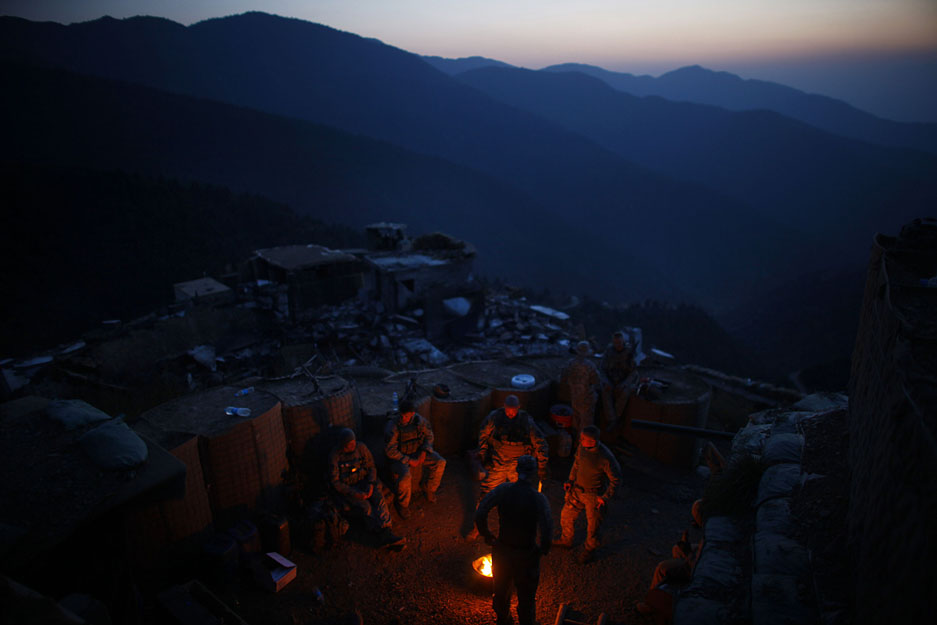
Soldiers with Alpha Company 2-327 (TF No Slack) 1BCT of the 101st Airborne Division make a small fire to keep warm high up in the mountains on border of Afghanistan and Pakistan. (David Gilkey, NPR) (Click)

Comment: nikobakos@gmail.com

Happy New Year to everyone.

17 Sep


Comment: nikobakos@gmail.com

The Death of Sarpedon: Who does art “belong” to?

10 Sep

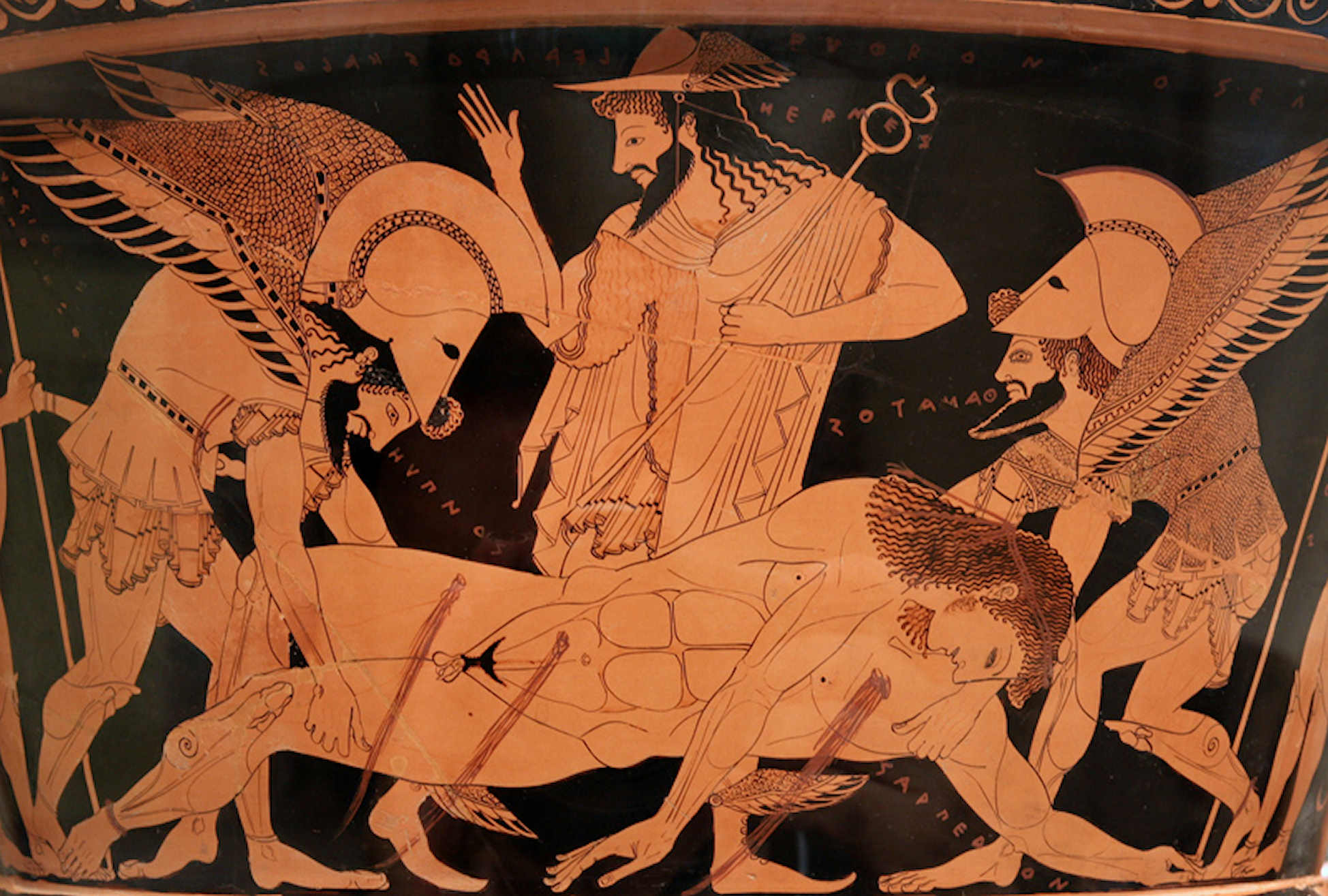
One the most irritating cases of this kind of “repatriation” of art (Where Do Antiquities Belong?)  was this red-figure Greek vase, dated around 515-510 B.C., I think of Attic origin:

(click)

This vase, one of the most beautiful depictions we have of one of the most beautiful deaths in the Iliad, was in New York’s Metropolitan Museum of Art until a few years ago, when it was “returned” to Italy because it was supposedly found and looted from a Tuscan archaeological site.  It was one of the must-see stops for me anytime I was at the Met and looked glorious in the museum’s renovated Greek and Roman art wing.  Here’s a description from NYU School of Medicine’s (?) website:

“Euphronios, one of the first to work in the red-figure method, uses his simple but skillful technique to draw the hero’s body at the moment it succumbs to death. Especially vivid are the three open wounds on Sarpedon’s body from which blood spills to the ground. Sarpedon’s eyes are closed, his limp hands drag along the ground. Zeus, powerless to prevent his son’s suffering and death, sends the god Hermes to attend to his son’s burial. Hermes, in turn, summons the caretakers Sleep and Death to transport Sarpedon to his grave.”

Yep, that’s just what Italy needed — another vase.

Italy can barely handle the maintenance and restoration of the artwork it has.  Whenever I’m there I constantly feel like I have to move very carefully at all times or else I’ll break something.  I say this to people and they look at me like I’m a psycopath, but whenever there’s an earthquake in Italy — not like the 1980 one in Campania, where thousands were killed, but this latest one, for example, in Emilia — I’m less shook up by the casualties than I am by the irreplaceable art and architecture that have been destroyed.  I guess I think maybe the destruction of the frescoes of the upper church of San Francesco of Assisi in 1997 is as tragic as a loss of life.

The Basilica of San Francesco (click)

And the interior collapsing during the 1997 earthquake

The Metropolitan’s Greek collection is not terribly impressive.  The Sarpedon vase shown like a jewel there.  In Italy, even if it had been put somewhere central like the Capitoline Museums, it would’ve been lost in the overwhelming artistic weight of everything around it.  But they put it in the Quirinale, the Presidential Palace!  Can the public even see it there?  I would expect this from Greece, which is constantly grasping at anything that it believes will bestow it with the cultural capital of antiquity.  I never expected Italy to be so petty.

A final note.  A classic piece of regressive ideological projection from the NYU site: “Euphronios’s depiction of Sarpedon’s death is an early portrait of the barbarity of war and the needless death that is its legacy.”

Really?  Is that what you think the Iliad is about?  That’s pretty funny…


Comment: nikobakos@gmail.com