I’ve used this term several times without giving a more specific definition of it and that was a mistake because some of those posts would have made more sense if I had.
Like: “Little Rock, Greece” (May 26th, 2012):
“But an equal object of my bashing here is the European Union, which aside from proving itself to be a neo-colonialist endeavour masquerading as the Highest Achievement of Western Humanism Project, has also revealed itself to be a half-assed, thrown together mess on so many institutional and bureaucratic levels. (Yes, neo-colonialist: the Frangoi** gave up their colonies after the war and then discovered the exploitable potential of Europe’s own periphery again.)”
And: “Russia and Syrian Christians, ctd” (June 5th, 2012):
“Tying your survival to extra-regional players or regimes like Assad’s that are destined to soon make their exit is a losing strategy for the region’s Christians. The threat of Islamist violence is probably real. Iraq and even Egypt certainly seem to indicate that. But their only choice is probably the tricky dance of fostering, or just going with, the flow of democratic change while keeping themselves as least vulnerable as possible. Forget Russia. And, as Constantine XI had to heroically face in the end, there’s certainly no help coming from the Frangoi.* If you want to live in peace and security, look to your neighbor because, ultimately, he’s the only one who can provide it for you.”
And: “Un Verano en Nueva York” (July 13th, 2012):
“In Astoria I catch the end of vespers at Hagia Eirene. This is a church that used to be the territory of fundamentalist, Old Calendar, separatist crazies but has rejoined the flock on the condition that it was granted monastic status (and I have no idea what that means). But it has somehow got its hands on a great bunch of cantors and priests who really know what they’re doing. I’m impressed. I brought friends here for the Resurrection this year and for the first time I wasn’t embarrassed. If I hadn’t invited them back home afterwards I would have stayed for the Canon. Only one cantor now at vespers but he’s marvelous and the lighting is right and the priest’s bearing appropriately imperial. It’s incredibly heartening to see our civilization’s greatest achievement — which is not what the Frangoi taught us about Sophocles or Pericles or some half-baked knowledge of Plato or a dumb hard-on about the Elgin marbles or the word “Macedonia,” but this, the rite and music and poetry and theatre of the Church – performed with the elegance and dignity that it deserves.”
…
So…when the Byzantines first encountered the West and the conglomeration of Germanic kingdoms that had sprung up on the territories of the western Roman Empire, or rather, when they first felt challenged by it and not just irritated, was when Charlemagne, previously just King of the Franks, was crowned Emperor of the Romans in the year 800 by Pope Leo III, whose skin he had saved after Leo had been deposed and almost lynched by the mobs of Rome. This, of course, was intolerable to us, because we were the Romans and we had an Emperor, with an unbroken line back to Constantine, if not Augustus. This is close to impossible an idea for anyone today to understand; it’s even hard for modern Greeks to articulate and it’s at the core of our completely mangled identity. It’s nearly impossible to speak definitively about consciousness or identity in the present tense, much less more than a millennium past. But this is the simplest way I can put it: by the late first millennium, the Greek-speaking Christians of the eastern Mediterranean had a stronger sense of Imperial Roman continuity than the inhabitants of even the Italian peninsula. Till well into the twentieth century our most common term of self-designation was “Romios” – “Roman.” If you had asked any of my grandparents, all born Ottoman subjects, what they “were” — if they even understood the question — or even my father very often, they would’ve all answered “Roman.” For the inhabitants of my father’s village in Albania, especially the older ones, who never had “Hellenes” imposed on them by the Neo-Greek statelet, the world is still divided into Muslim “Turks” and Orthodox “Romans,” and whether they speak Greek or Albanian is irrelevant. The Greeks of Istanbul still call themselves “Romioi” for the most part; Turks still call them “Rum” too, out of simple historical continuity, while the Turkish state is still faithful to the appellation for partly more cynical and manipulative reasons. I’m writing a piece with the appropriately pompous working title of “A Roman Manifesto” or “A Manifesto of Romanness” that will deal with this whole theme further.

The Frankish West (click)
So Charlemagne was a Frank, a Latinized Germanic ethnic group, and though the Pope’s primacy “inter pares” was recognized, he had no right to unilaterally crown this Frank emperor in an Italy that had become a ravaged provincial backwater from the Constantinopolitan point of view. This didn’t end relations between the Empire and the various western European kingdoms. They continued to trade and even contract dynastic marriages and all the rest. But the tension, which had already been planted for quite a while before that, only went from bad to worse: power tensions; trade concessions to the Italian city-states that fatally mirror the ones the Ottomans had to make to the Western powers a millennium later; massacres of Italians in C-town that are equally mirror-like.
The West grew in confidence. The Empire shrank. They started bickering about theological issues, and eventually, in 1054, Rome and Constantinople excommunicated each other over some nonsense about the division of labor among the Trinity that I’ve never bothered to try and understand. Then came the Crusades — more growing Western confidence — which the Byzantines weren’t ever really enthusiastic about because I reckon on many levels they felt less animosity for and greater cultural affinity to their the Muslim/Arab neighbors than they did to the “Franks.” Runciman, I think writes somewhere that a ninth-century Greek felt more at home in Arab Palermo or Baghdad and Cairo that he would’ve in Paris or even Rome.
Sometimes Wiki’s gets it perfect:
“The experiences of the first two Crusades had thrown into stark relief the vast cultural differences between the two Christian civilizations. The Latins (as the Byzantines called them because of their adherence to the Latin Rite) viewed the Byzantine preference for diplomacy and trade over war, as duplicitous and degenerate, and their policy of tolerance and assimilation towards Muslims as a corrupt betrayal of the faith. For their part, the educated and wealthy Byzantines saw the Latins as lawless, impious, covetous, blood-thirsty, undisciplined, and (quite literally) unwashed.”
Then came the Fourth Crusade, led by the Venetian Doge Enrico Dandolo. The Crusaders fell into the internecine machinations of the some Angeloi Emperors and I think ended up feeling betrayed on some promise made to them by one party in the Byzantine political scene, and they probably were, because our latter Emperors compensated for the diminishment of their real geopolitical power and the sapped strength of their once massive military machine by becoming major manipulative sleazebags and liars, initiating a long Greek tradition that persists to our day. In retaliation, and, or, because that had been their real object all along, the Crusaders of the Fourth Crusade, in 1204, captured the City – the first time Constantinople had ever fallen to anybody and destroyed it.
They destroyed her. They massacred thousands, desecrated churches, including Hagia Sophia herself, and carried away what, in today’s terms, I’m sure amounted to billions in loot. The Venetians got off with enough of a lump sum of capital to fund and run their mercantile empire for another five centuries. But aside from the loot, which on some level is comprehensible, it’s the sheer mindless destruction of 1204 that betrays the sack as the action of thuggish, resentful provincials and their envy towards what had been the civilizational center of the Mediterranean and western Asian world for almost a millennium; it’s what an army of Tea-Partiers, NRA members or armed Texan Evangelicals would do to New York if they could. Though pregnant already with the great traditions of this supposed thing called Western Humanism, this bunch destroyed more Classical texts and melted down or smashed more Classical sculpture into gravel than had been done at any other one time in history – far more than any fanatical Christians in any pagan city or any Arabs or Muslims in any conquered Christian city before them had. More of the ancient world was lost to us in those few days than in any other comparable time span before that. Just sheer idiotic vandalism. There’s probably no more epic manifestation of Killing-the-Father in human history.
Speros Vryonis, a great historian but a seriously unpleasant man, Theos’choreston, made a career out of catalogueing the injustices done to Byzantine and post-Byzantine Greeks. He was the great modern preacher of whining Greek victimology and one often felt that all his personal bile and biterness was poured into his work in that way; his book on the anti-Greek riots of Istanbul in 1955 is one thousand pages long; you’d think it was the most important event in twentieth-century history. In any event, in Byzantium and Europe, he wrote:
“The Latin soldiery subjected the greatest city in Europe to an indescribable sack. For three days they murdered, raped, looted and destroyed on a scale which even the ancient Vandals and Goths would have found unbelievable. Constantinople had become a veritable museum of ancient and Byzantine art, an emporium of such incredible wealth that the Latins were astounded at the riches they found. Though the Venetians had an appreciation for the art which they discovered (they were themselves semi-Byzantines) and saved much of it, the French and others destroyed indiscriminately, halting to refresh themselves with wine, violation of nuns, and murder of Orthodox clerics. The Crusaders vented their hatred for the Greeks most spectacularly in the desecration of the greatest Church in Christendom. They smashed the silver iconostasis, the icons and the holy books of Hagia Sophia, and seated upon the patriarchal throne a whore who sang coarse songs as they drank wine from the Church’s holy vessels. The estrangement of East and West, which had proceeded over the centuries, culminated in the horrible massacre that accompanied the conquest of Constantinople. The Greeks were convinced that even the Turks, had they taken the city, would not have been as cruel as the Latin Christians. The defeat of Byzantium, already in a state of decline, accelerated political degeneration so that the Byzantines eventually became an easy prey to the Turks. The Crusading movement thus resulted, ultimately, in the victory of Islam, a result which was of course the exact opposite of its original intention.”
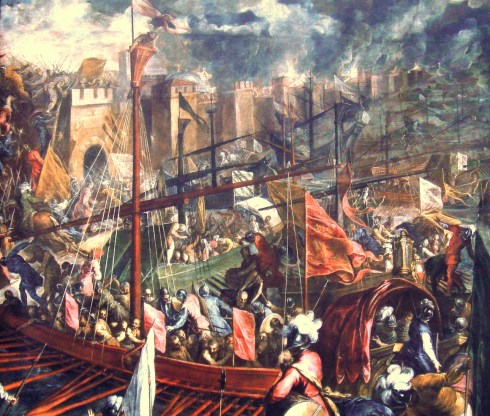
The Fall of Constantinople, Palma Le Jeune — 16th-17th century (click)

The Entry of the Crusaders into Constantinople –Eugene Delacroix, 1840 (click)
And, in fact, the Turks — fast-forward two-and-a-half centuries – weren’t as bad. Maybe ’cause there wasn’t much left. Aside from a sizeable amount of slaves, most of the loot Mehmet had promised his suicidally brave Janissaries when they finally made it into the City in 1453 consisted of cheap silver frames pried off of personal or parish-sized icons — Cavafy’s “bits of coloured glass.” The Emperor’s tombs in the dilapidated Hagioi Apostoloi — the Byzantines’ Westminster — had already been desecrated and robbed by the Franks. They may as well have sacked Astoria. The rest was in Venice. (Even the crown jewels had been pawned off to Venice a century before by Anne of Savoy, one of the most meddling Frangissa bitches in Byzantine history, to fund her episode of the Palaiologan civil wars; that’s the actual historical reference for Cavafy’s “coloured glass.” Christouli mou, can you imagine what the Byzantine crown jewels were like?) But one good thing happened for Greeks on Tuesday, May Twenty-Ninth, Fourteen-Fifty-Three: when the Turks finally broke into Hagia Sophia, they smashed Dandolo’s sepulcher — because, after all of the above, he had had the shamelessness to have himself interred there – and finding nothing of worth, they threw his bones out into the street and let the dogs gnaw on them. I don’t care what else the conquering Turks did at that point or that Menderes’ thugs did the same to the Patriarchs’ graves at Balikli in 1955; I sleep better at night because they did it to Dandolo. I’m as close to a chaneller of the Byzantine mind and soul as you’ll find (aside from Vryonis) and I can tell you that the sweet Balkan hard-on of vengeance that image gives me even now is indescribable.
The Greeks got Constantinople back in 1261, but the City never really recovered, as the Empire itself didn’t. Like the South Bronx in the eighties, whole parts of the City were eventually given over to orchards and bostania or just wilderness. Yet even after that, the Byzantines managed to plant further seeds in the womb of friggin’ Western Humanism in the form of an artistic wave of unprecedented dimensions and creativity.
The “Franks,” thereafter, were the unforgivable villains. But even before, when Byzantine writers felt like being professional, they referred to Westerners as “Latins.” When not, and eventually in most cases, they were “Frangoi.” Frangoi stuck as the word for Westerners, or for Catholics at least, because Protestantism was only a minor blip on the East’s screen. But generally it came to mean the Western Others and the Eastern Muslim world between which Byzantine and post-Byzantine Christians came to feel themselves stuck between.
“Fereng,” “Ferengi,” “Ferenj” and other variations is also a word that eventually came to be used as far east as India, but I can’t be sure whether in Iran or India it means/meant Westerner or just foreigner. For Arabs and Turks, “Frank” came to mean those Christians over there, as opposed to “Romans,” our Christians over here. So if you were Roman Catholic, either back home in Europe or in the Near East, you were a “Frank;” if you were an Orthodox Christian, you were a “Roman.”* It’s confusing. And I hope I haven’t made it worse.
For Greeks, Frangoi continued to mean Westerner both in a negative sense and not, until the nation-sate convinced us into thinking we ourselves were Westerners. When Greek peasant men, for example, started wearing Western clothes, whereas their women wore traditional dress well into the twentieth century in many regions, those clothes were “Frangika.” Frangoi also meant, with no negative connotation, the small communities of Catholics in the Aegean islands that were leftovers of the Crusader principalities that had been founded there after the Fourth Crusade.
It’s not used any more in common Greek parlance, but most Greeks know what you mean when you say it – though this generation is so profoundly ignorant historically that I’m not so sure. I, of course, use it in a spirit of historical irony, though that spirit is entirely hostile. The worst enemy of our part of the world is the European West, and not because of imperialist interventions or the usual gripes, but because of the ideological and cultural chaos we allowed it to throw us into.
Yes, Frangoi are the enemy. I like to say that. But it’s not true. We think we’re Frangoi. Unlike the Byzantines described above, who understood that their natural civilizational context was and always had been the eastern Mediterranean, we are either ignorant of the peoples to our East or despise them. We disfigured our own identity in an attempt to remake it in the Westerners’ image. We threw acid into our own face and now still look longingly into Europe’s eyes, and pathetically expect to see our Classical glory reflected back at us.
*One of the most graphic examples is Lebanon/Syria, where Orthodox Christians, who have long and poignantly tried to bridge the above gap, were still “Romans” into the nineteenth century and were among the founders and then long among the most loyal adherents of Arab nationalism, whereas Maronite Christians were the locals with the most exemplary Frangika delusions, always looking to the Western outsider to bolster their interests, first their “sweet mother France” and then Israel, and bringing disaster down upon their heads and that of all around them in the process. That’s why in many previous posts my humble outsider’s advice to and hope for Syrian Christians in the current crisis has been that they think and act like Romans and not Franks.
–
Comment: nikobakos@gmail.com
–
Tags: Arab Christians, Byzantines, Charlemagne, Constantinople, Enrico Dandolo, Fourth Crusade, Frangoi, Franks, Greeks, Hagia Sophia, Istanbul, Lebanon, Mehmet II, Neo-Greeks, Pope, Syria, Syrian Christians, Turks, Venice














 Jadde: from Bosnia to Bengal