“Screamers:” Genocide: what is it and why do we need the term?

7 Nov

Screamers

I watched “Screamers”* the other night, a 2006 documentary by Carla Garapedian about an Armenian-American synthpunk group based in California, who go around, among other things, “screaming” about the Armenian massacres of the early twentieth century and issues of genocide recognition generally.  They’re shown on tour, comparing Armenian experiences to those of Rwandans, Cambodians — Jews conspicuously less so — soliciting the support of U.S. congressmen, interviewing British aristocrats, Harvard professors and their own great-aunts and grandfathers telling their own story of the events they describe as the Armenian Genocide, all in an effort of course to get the Turkish government to acknowledge the “Genocide” as such.  And it left me with the usual thoughts I have on this issue: that this word – “genocide” – which is supposed to name an evil particular to our time and by naming it hopefully eradicate it, has come to be so overused as to be meaningless, was vague from its beginnings and has come to obscure more than it reveals about the phenomenon, if there is such.

Raphael Lemkin, the Polish Jewish Holocaust survivor who originated the term, described it as such:

By ‘genocide’ we mean the destruction of an ethnic group . . . . Generally speaking, genocide does not necessarily mean the immediate destruction of a nation, except when accomplished by mass killings of all members of a nation. It is intended rather to signify a coordinated plan of different actions aiming at the destruction of essential foundations of the life of national groups, with the aim of annihilating the groups themselves. The objectives of such a plan would be disintegration of the political and social institutions, of culture, language, national feelings, religion, and the economic existence of national groups, and the destruction of the personal security, liberty, health, dignity, and even the lives of the individuals belonging to such groups . . ..

T. Marcus Funk in Victims’ Rights and Advocacy at the International Criminal Court says genocide is “the deliberate and systematic destruction, in whole or in part of an ethnic, racial, caste or religious, or national group.” 

“…in whole or in part…” is controversially vague enough.  Then, how “deliberate and systematic” does it have to be to qualify?  And if its victims are members of any “ethnic, racial, caste, or religious, or national group,” is that not so all-encompassing as to include most of humanity?  What sets genocide apart then from any mass killing?  That it’s done to a socially or ethnically identifiable group?  Mass killing – apart from shootings in American shopping malls or movie theaters – is usually committed on such a group.  And by emphasizing that a “group,” usually an ethnic or minority group, is the object, it creates the unspoken assumption of irrationality, though most of the events we call genocides have and had a very rational end and, to be effective, must have used fairly rational means.  And thus I wonder if the word mystifies and, more importantly, decontextualizes to a point that ultimately may do more harm than good.

Obviously, our region gives us a variety of useful examples to look at.  Now, I often get emails here — most simply rants that I don’t bother publishing — in which I’m told that I am defeating the stated purpose of this blog by favoring one group over another or being so obviously preferential in some of my affections or animosities.  I’m told that I’m panderingly philosemitic; I don’t know about the “pandering” part, but otherwise, yes.  I’m accused of being both pro-Israeli and anti-Israeli, and anti-Palestinian and possessed of a blind good faith in Palestinian intentions and an enabler of their “tactics,” whatever that means; I guess if I can be all those things at once I may be doing something right.  I’m accused of being anti-Croatian: let’s leave that one to the side for a moment.  But mostly I’m accused of two things: that I’m pro-Turkish — this usually by angry Greeks — and that I’m a shameless apologist for Serbian criminality.

And here there is some truth: the two peoples may not much appreciate being linked in my heart, but one of the many reasons that I may have a special affection for Turks, or at least find myself defending them so often, is also one of the many reasons I have a special affection for Serbs: I think the two have historically been the most unfairly maligned groups in the region.  And that brings us back to the larger genocide discussion obviously.

It has always irritated me that critics of Serbia, both in the nineties and to this day, dutifully rehearse the main highlights of the “Serbian myth”: traumatic defeat at Kosovo; continued resistance to the Ottomans; among first to struggle for independence in the Balkans; a sincere if often faulty and undemocratic attempt to actually go through with the noble experiment of South Slav unity, only to have those attempts undermined from the get-go by a Croatia that was always a member of that union in bad faith; always supporters of Western causes only to be stabbed in the back after; further traumatic WWII memories – and then just blow them off as if none are legitimate, that they’re just the “mythical” or fictional building blocks of a national pathology that explains Serbs’ vicious behavior during the breakdown of Yugoslavia.

Nobody is denying the unscrupulous manipulation of the Serbian group ‘psyche,’ starting in the late eighties, by some of the most criminally opportunistic, thuggish politicians to emerge out of post-Cold War Europe.  Nobody denies the horrible war crimes of Serbs and Serbian paramilitaries, especially in the great victims of the Yugoslav wars, Bosnia and Kosovo.  But the simple fact is: Serbs had absolutely no reason to feel secure about their future in the states that emerged from the break up of Yugoslavia, especially not in Croatia, the West’s darling.  During WWII, the NDH, the Independent State of Croatia, the Ustaša, had a greater percentage of its population—Serbs, Jews and Gypsies — slated for elimination than any other of the Nazi’s puppet states in Eastern Europe.  The plan for the Serbs specifically was the famous “thirds” plan: kill one third, expel one third, convert the other third to Catholicism (the Ustaša was also fanatically Catholic and its support by the Vatican is one of the Catholic Church’s ugliest twentieth century moral “lapses”).  The numbers are uncertain, as always in these cases, but several hundred thousand Serbs were killed by the Croatian regime and – unfortunately – its Bosnian collaborators during the war.  Ustaša Croatia was the only one of the Nazi puppet states whose tactics even the Germans found excessive, and had to be told by Berlin to “tone it down” a little, because their viciousness was giving undue impetus to a Serbian resistance movement that was becoming increasingly difficult for the Germans to keep under control.  The reasons that post-Yugoslav Serbs might have felt insecure in independent Croatia or even an independent Bosnia are not simple “myths,” pathological obsessions with historical wrongs – especially when Tudjman’s Croatia started making all kinds of fascist noises again as soon as it gained recognition from its German buddies.

Turkey.  It’s maddening that what happened in early twentieth-century Turkey is never put into the broader historical context of the previous two centuries by groups like the Screamers or others who are bent on forcing Turkey to acknowledge the events as genocide.  You can talk and talk and argue and explain and then you come across a passage somewhere that condenses and puts it all into perspective.  The following is from Karen Barkey’s Empire of Difference: The Ottomans in Comparative Perspective.  Towards the end of a chapter where she’s discussing the deterioration of interethnic relations in the nineteenth-century empire, the penetration of European economic influence and the benefits that that created for Ottoman Christians and from which Muslims were excluded, she writes:

“If major misgivings regarding ethnic and religious difference and disparity were already well-rooted in the empire, competition and communal strife only got worse as Muslim refugees from the Balkans, the Caucasus, and the Crimea were settled in Anatolia.  Between 5 and 7 million refugees, mostly Muslims, were settled by the Ottoman government throughout the nineteenth century, mostly in Anatolia.  Kemal Karpat argues that between 1856 and 1876 at least 500,000 Crimean Tatars and 2.5 million Muslim immigrants from the Caucasus were settled in Anatolia, the Balkans, northern Syria and Iraq.  Not long after, in 1877-1878, the Caucasian population that had been settled in the Balkans was resettled in Anatolia together with a million others, mostly Muslims from the Balkans.  Another 2 million took refuge in Anatolia until 1914.  By the time of World War I, the immigrant [refugee] population of Anatolia represented nearly 40% of the total population. Such immigration, originating in the nationalist movements and independence politics of the Balkans, the Russian Wars, and the Ottoman defeats, brought in another element of Muslim discontent that not only altered the demographic balance of the empire, but also exacerbated social and economic tensions.”  [emphases mine]

Do we understand that?  Charles Simic has written: “Nationalists everywhere are unmoved by the suffering of people they hurt.”  But are the above figures enough to penetrate the armor-plated narcissism of the nationalist or even dent it?  Might some clubbing over the head be in order?  Let’s repeat them and see: in 1914, the year we’re supposed to think that Turks suddenly had a collective psychotic episode and just started massacring millions of people for no reason, 40% — forty percent – of the population of Anatolia, roughly the territory of contemporary Turkey, consisted of Muslims who had escaped from the various parts of the shrinking empire, usually under conditions that could be clearly labeled “genocidal” or definitely characterized as “ethnic cleansing” though for some reason they are not, and often, as Barkey alludes to, after having been brutally displaced twice in one or two generations: like the Bosnians who had settled in Salonica after 1878 and again in 1908, in such numbers that they gave their name to a neighborhood in that city, only to have to move once more to Anatolia in 1913; or the millions of Circassians, driven en masse out of their Black Sea homeland by Russia in the 1860’s and settled in the Balkans only to have to move on to Anatolia after Bulgarian independence.  Forty percent!  That is almost twice the percentage of incoming refugee population that Greece staggered under in the 1920s after the Population Exchange, and in an Empire that had dragged itself into a World War it was woefully unprepared to fight.

And here’s where we get to the question that every ethically honest Greek or Armenian has to ask himself: what did we expect Turks to do at that point?  Give up even what they had left?  Pack it up?  Go back to the Red Apple Tree?**  To expect that at some point Ottoman Muslims/Turks were not going to fight back in order to hold on to something, a state and territory of their own, is delusional in ways that only as totalizing an ideological structure as nationalism can produce.

51kGIPmTZdL

(what was a really fascinating, eye-opening book for me — highly recommended…)

At no point during the long blood-soaked mess of the past two centuries have Serbs or Turks been guilty of anything that everybody else wasn’t also doing.  Thus, one of my primary objections to the use of “genocide” as a term is that it becomes part of a tool in a chronology of preference, a political expedient for stigmatizing the bad guy of the moment.  In the late nineteenth and early twentieth centuries, when European powers were obsessing with how they were going to divide the crumbling Ottoman Empire among them, there were only Muslim perpetrators of massacre in the region, never Christian ones, only the “unspeakable Turk.”  Only a tiny group of more objective observers at the time of Gladstone’s hysterical campaign asked themselves how “speakably” the Bulgarians and their Russian supporters behaved toward the Muslim population of Bulgaria in the 1870s; only Trotsky had the intelligence and conscience to report the truth about the degree and intensity of Russian/Bulgarian atrocities against the Muslim population of those lands in the 1870’s and nearly resigned from his assignment as a reporter of a Kiev newspaper as a result — he could no longer stand to physically be around the sickening violence (See Bulgarian historian Maria Todorova‘s excellent: “War and Memory: Trotsky’s War Correspondence from the Balkan Wars”  for an excellent account of Trotsky’s reporting and, through it, his brilliant and morally courageous mind; how that mind and its obvious compassion became so twistedly cruel when he turned it on his own people and country a few decades later is one of the mysteries of Bolshevik perversity.)

Later in the century, after the Cold War gave Turkey a kind of favored nation status in the Muslim eastern Mediterranean, Turkey could and still essentially can do no wrong, even if it does conduct, like in Cyprus, campaigns of what elsewhere would be called ethnic cleansing or violates the human rights of its minorities and majorities on a systematic basis.

At the beginning of the twentieth century, Serbia was “gallant little Serbia” standing up to the Austrians, beating back two massive assaults by Austria-Hungary, almost crossing the Danube into Austrian territory itself; only when Germany came to its aid was Serbia successfully defeated, and even then while putting up some of the most suicidal and vicious resistance in military history.  Serbia was a staunch supporter of the Allies in both World Wars – essentially the liberators of the Balkans in the First World War especially.  But by the end of the same century, when Serbs refused to play along with the West’s plan for what the New Balkans would look like, they were turned into pathological savages, and locked into a pariah status from which they have still not been allowed to fully emerge.

(To switch regions and periods for a moment, and examine the selective use of terminology, we never speak of the “genocide” of urban Germans or Japanese, do we, though they were a civilian population subjected to barbaric, mass, incendiary murder on a staggering scale and of questionable strategic uses and motivations other than punitive ones.)

But perhaps my most important objection to the word “genocide” should have become obvious from the above: mass murder and expulsion is what happens during nation-state formation and labeling this kind of mass murder and expulsion with some rare-orchid terminology obscures that fact.  As long as the legitimizing principle of the modern state is ethnic/tribal identity there will be groups who by their very cultural and/or religious character cannot uphold that legitimacy and will be oppressed by it.  And the time will come when they will have to be dealt with in some way or other, either through acculturation or removal, especially if their status leads them to separatist desires.  There is no such thing ultimately as genocide.  To observe the former Ottoman sphere, which is as good as any for our purposes, the rules are: form a state by grabbing as much land as you can and keep it by eliminating those who would be opposed to being part of your state.  It’s painful to say, because Bosnians got semi-trapped and stumbled into declaring independence by their two ravenous neighbors and suffered more than any in the Yugoslav conflict: but there was no Bosnian genocide, no attempt to eliminate the cultural/ethnic group that Bosnian Muslims were from the face of the earth.  There was the brutal, systematic, cruel ethnic cleansing of Muslims from parts of Bosnia that Serbia — and, of course, Croatia — wanted to hold on to because those Bosnians wanted to be part of a separate state of their own.  There was no genocide of Anatolian or Pontic Greeks, as many Greeks have lately started referring to the events of the nineteen tens and twenties.  There were decades of chronic, inter-communal violence, a war by an invading state, and the elimination of those that supported that invasion, and mostly not even through violence or by force, but by mandatory fiat agreed upon by the leaders of the countries in question.***  It’s painful to say – they’re a familiar people, one I admire, like, am close to — but as extensive as it was, as systematic and vicious in ways that set a terrible precedent for the rest of the century, it’s hard for me to call what happened to Armenians in the early twentieth century genocide. The CUP — the Young Turks — have always seemed to me to have been a bunch of loose cannons: a nefarious, often eccentric, make-it-up-as-you-go-along group of giant egos who seemed to be talking past each other most of the time and did their best in essentially ending the Ottoman Empire in the messiest way possible; and the Armenians were their single greatest victims.  But the fact remains: a people (Armenians), in a state (the Ottoman Empire) that was being torn in a million different directions, tried to form an ethnically separate state of their own (though they constituted a majority in no single region of the territory in question), and yes, often did so through violence, armed means and with outside military help.  And they were stopped.  That it was horrifying and its dimensions staggering would be obscene to deny.  That it’s some “special” form of violence — qualitatively and not just quantitatively different — and not just an extreme example of what fundamentally happens during nation-state formation is simply unsustainable as a theory for me.  I had an Armenian-American friend, and we obviously didn’t see eye to eye on these issues.  I remember him once being incensed by what he called the “macho” insensitivity of a Turkish guy who had been arguing with him and who had said: “If we hadn’t done it to you, you would have done it to us.”  Well, it’s sad, but that’s probably the truth.

No one in Screamers, not the experts or the humanitarians, not the musicians themselves, link what they want to call ‘genocide’ to the dominant political state formation of our time.  No one sees it as inevitable that if an “ethnic, racial, caste or religious, or national group” serves as the principle legitimizing force of state organization, that then some other “group” will have to be removed.  And the Helsinki Agreement’s contradictory support of both “minority rights” and “the right to self-determination” has, needless to say, been of no help in sorting out issues of this kind; Yugoslavia was the best proof of the amateurish, do-gooder thinking behind such ideas.

In fact one wonders if it was a Jew who invented the term because he and his were really the only one victims of the irrational beast we want to call genocide and are now using rather indiscriminately all over the place.  Because I can think of only one case in history where a people were not engaged in war with another country, nor in armed or any other kind of civil conflict with the surrounding population, who did not have a separatist agenda within the states they lived in or irredentist designs on parts of neighboring states, who did not constitute any kind of threat – at least real threat – to the society around them (were, quite the opposite, in fact, among those societies’ most productive and talented members), and yet became the object of a villainizing myth of incomprehensible irrationality  that marked them for complete extermination anywhere in the world they were to be found — and that is the case of the Jews.  And since we have “Holocaust” or “Shoah” for that singular episode of human horror, do we need  “genocide” at all?

I hope I haven’t insulted — worse — hurt anyone.  I hope this is the beginning of a bigger discussion.

************************************************************************************************************************************************************************************************

* Check out the film’s Wiki site; one slightly unethical thing it does is to link the great Hrant Dink’s assassination in 2007 with the the fact that he appeared in the film the year before.  There’s also some slight misrepresentation in a scene where they show Turkish nationalists trashing a fifty-year commemorative exhibit here in Istanbul of the anti-Greek pogrom of 1955 and call it an “Armenian and Greek exhibit.”

** I have no idea of the origin of this myth, or whether it developed in late Byzantine or Ottoman times, but in Greek folklore the homeland of the Turks is a place in some distant indeterminate East called the Red Apple Tree, He Kokkine Melia, and in traditional messianic thought, when the City and Romania (what the Byzantines called their polity) were brought back under Christian rule, the Turks would go back to “the Red Apple Tree.”  Ironically, Constantinople itself was known to Muslims as the Red Apple, the prize conquest, in the centuries before the fall.  I have no idea if the two myths grew out of each other or are some kind of bizarre mirror images that paradoxically developed in opposition to each other.

*** And let us all here be disabused at once of the idea that the Population Exchange agreed to at Lausanne was something that Venizelos and his government reluctantly agreed to because circumstances had made any other solution impossible.  Lefterake, our Cretan levente, was enamoured of population exchanges and similar plans far before Lausanne or even 1919.  He thought that the section of the Aegean coast that the Allies gave Greece at Paris in 1919 was eventually going to be Hellenized through exactly such a voluntary departure of its majority Muslim population, thus giving a kind of tacit approval to the atrocities committed during those years by the occupying Greek army, and, always the careerist and opportunist, one of his earlier strategies at the Paris Peace Conference had been to promise Bulgaria eastern Macedonia (Kavalla, Drama), and move its Greek population into western Macedonia where they would offset the Slavic majority of those regions, in order to coax the allies into giving him Ionia — he was a twentieth-century nationalist social engineer of the crudest kind from the beginning.  For the definitive placing of responsibility for the disastrous Asia Minor campaign on Venizelos’ shoulders, plus an extremely competent analysis of the destructive consequences of his egotistical, polarizing political style on twentieth-century Greek political life, see Michael Llewellyn Smith’s Ionian Vision: Greece in Asia Minor, 1919-1922 — an excellent account of the entire period and a great place to start if, like me, you have embarked on a minor ideological mission to dismantle the entire Venizelos myth.

Comment: nikobakos@gmail.com

Ionian Vision

Dzhokhar Tsernaev

1 Nov

Tsernaev(click)

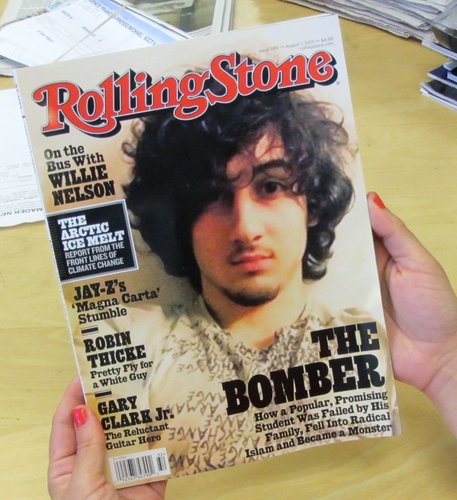
Sorry.  Many of my readers might get me wrong — or, on the contrary, may get me completely, accurately right.  But when I saw this picture, the first thing that came to my mind was what valuable commodities young male and female slaves from the Caucasus were for so many centuries, from the Byzantines to Mamluk Egypt to Safavid Iran, right down to the end of the Ottoman era.

The kid’s a star.  Rolling Stone knew exactly what they were doing.

Rolling-popup

Comment: nikobakos@gmail.com

Nobody really cares about Gezi Park: Greek thoughts on the protests of 2013

1 Nov

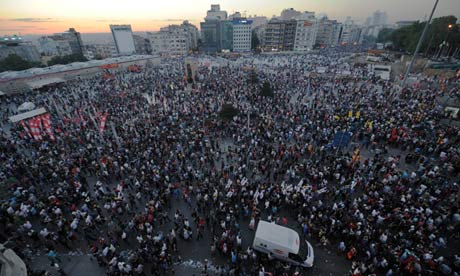
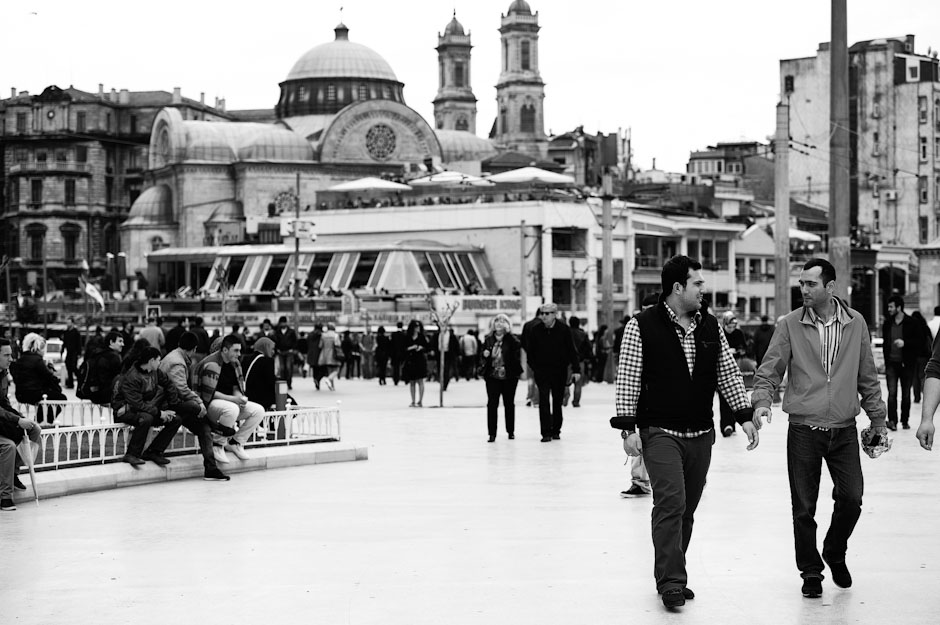
Taksim Square protest

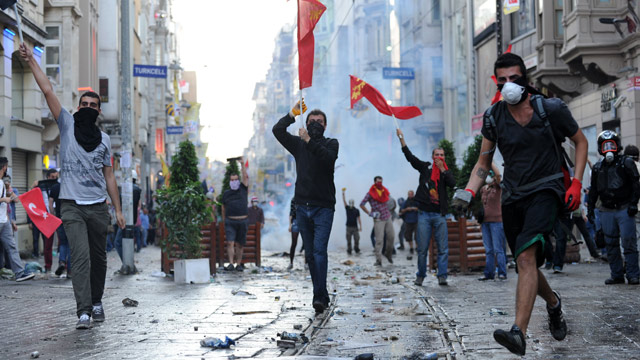
“Oh, is that what it’s called?” I remember saying to myself when last summer’s protests erupted, and I suspect I was joined by quite a few lovers of İstanbul and even natives when they found out that the scruffy, forlorn lot north of Taksim and behind the Arab nargile places along the Cumhurriyet actually had a name.  I may have spent about four or five accumulated months of my life in İstanbul over the years and I think I’ve been inside this park once; one look is enough — and the much bandied-about slogan about “saving the last green space in central Istanbul” becomes comical.  A sudden nostalgia for the place sprang up at the time; everyone suddenly had memories of playing there as a child, but they didn’t seem very convincing.  Nobody cares about Gezi park.  Or did last summer.

What young Turks cared about was Taksim, but even more the string of neighborhoods south of Taksim to Karaköy and their enormous importance in the life of İstanbul.  Proof enough – and weighty proof at that – is that serious civil disobedience began in the area back in the spring, not when the government tried to start construction in Gezi, but when it tried to impose limitations on alcohol consumption in the neighborhood.  Remember the alcohol – it’s a central part of our story, enough for us to maybe have called the whole upheaval the Rakı Revolution and not the Taksim/Gezi protests.  But somehow the press and the people itself forgot that.  Somehow that got lost as the movement morphed into a catch-all protest with a not particularly convincing “green” bayraki propped up as its mascot in a shabby, dirty park.

Unclear?  Yes.  It is to me too and I’m sorting it out as I write.

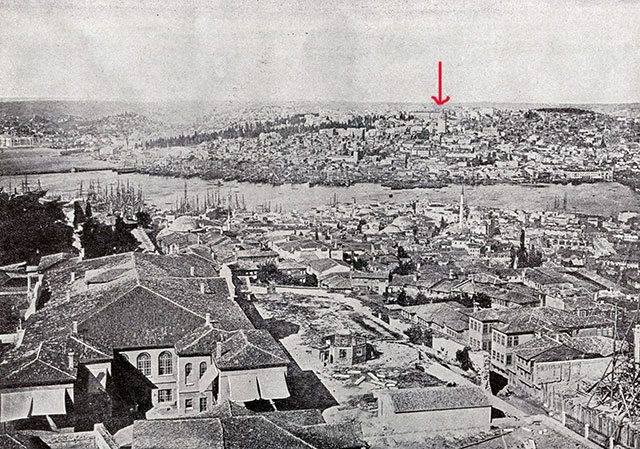
It goes like this: Pera and Galata — because those are the core areas of the municipality of Beyoğlu that really concern us (Taralabaşı too but as a side show, another story) — were, until the middle of the previous century, heavily Greek.  And Armenian and Jewish, but Greek enough so that pidgin Greek was the quarter’s common means of communication till the early nineteen-hundreds. Pera and Galata were centers of non-Muslim life in İstanbul and Pera and Galata were where you went to drink.  Not a coincidence obviously.  And Pera and Galata are still where you go to drink and party – in fact even more than ever.  And that’s why the fact that attempted restrictions of alcohol consumption set off the civil disobedience of 2013 is so important.

The tourist literature and the press never tire of calling this the center of contemporary Istanbul and tourists who used to stay in Sultanahmet and wonder at the eerie emptiness of the old city’s streets at night have finally started to discover the area – the “Old New Town” as Alexandros Massavetas calls it in his loving, lyrical Going Back to Constantinople: a City of Absences.  And truly, as I’ve written before, these neighborhoods dominate the contemporary social and cultural life of İstanbul in a way that’s not comparable to any other major metropolis I’m familiar with.

A060512g

Buyuk_Beyoglu_Haritasi

The neighborhoods we’re talking about, Beyoğlu, with Pera (“over there” in Greek, meaning from the old Byzantine/Ottoman city) at its center. (click)

And here we run into our first paradox, or the origins of a chain of paradox: that this now central “heart” of İstanbul began as a space of marginality.  The Byzantines originally put some of their unwanted Catholics there: Galata’s mother city is actually Genoa.  In Ottoman times, Christians and Jews lived there and made wine and everybody else came there to drink it.  While not an exclusionary, extramural ghetto of any sort – to their credit the Ottomans didn’t often do that kind of thing – it was sort of the wrong side of the tracks: the Ottoman equivalent of the suburbs or the across-the-river Zoroastrian neighborhoods in Iran where Hafez and company went to drink the infidel’s wine and torment themselves with the beauty of the innkeeper’s son: the other side of town, the refuge of disbelief and transgression, of unorthodoxy and the unorthodox in every sense.  The alcohol…

The nineteenth century marked Pera and Galata’s – Pera’s especially — transformation into uprent enclaves: gentrification avant-la-lettre in effect.  The Christian-ness of the area only attracted more of them, then foreign Europeans; the influx of non-Muslims from the rest of the city concentrated its gavur character even more deeply.  There were foreign embassies.  Foreign embassy cultural activities followed.  Cafés.  Theaters.  Neoclassical Row houses and apartment buildings in an eclectic mix of local versions of the Neoclassical or Art Nouveau.  All the apparatus of contemporary European urbanity developed: a place of often obscene display of non-Muslim privilege that reminds one of Durrell’s Alexandria or descriptions of the foreign concessions in Shanghai before the revolution, and increasingly alienating to the average un-Westernized Muslim.  But a city.  One as we mean it.  In the Benjaminian sense.  With everything that the modern city at the time implied and still does: socializing and the public space, boulevard culture, entertainment, exteriority…  WOMEN…  Alcohol, of course…  And with Kyr Panos’ taverna and Monsieur Avram’s textile shop still flourishing alongside.

Az081210mnisuaz

The Jadde at its height, probably early Republican times, by the gates of Galatasaray Lycée (above).  This was the neighborhood known as the Staurodromi by Greeks, the “crossroads” because it’s where the Grande Rue meets Yeni Çarşı Caddesi (the New Market — not sure what that referred to — food market around Balık Pazarı?)  (Click)  Bottom photo is by Ara Guler*

And then all the Kyr Panoses and the Monsieur Avrams went away, for reasons readers know and this blog touches on often and will inevitably look back at again.  And this “center of the city” sat in a kind of rancid aspic for a few decades until a young and dynamic and sophisticated Turkish society reclaims it.  And it comes alive again.  And yet the paradox still stands, now sharper than ever (though how conscious and to whom is very much up for debate and may be my real question): that this is the cosmopolitan center of İstanbul; but what made it cosmopolitan were populations that don’t live there any more, but whose legacy is in both the air and breath of the place and in its physical matter itself.  And what we, Turks today, do about that – how we reconfigure a center of our city so laden with the presence and absence of others in order to suit our contemporary needs – is, to a great extent, what progressive Turks and Erdoğan were fighting about last summer.  Not Gezi park.

Some of Erdoğan’s ideas don’t seem so bad to me; a tunnel for one (already built?), that as I gather goes under in Dolapdere and emerges somewhere in Kabataş I think, that would finally free Taksim, never an aesthetically promising piece of real estate, from having to be a major traffic circle,  though Harvard’s Hashim Sarkis’ idea that: “We know from the 1960s that pedestrianizing everything doesn’t work…Managing the balance is better…” makes sense, and I often wonder about the wisdom of having pedestrianized the İstiklal itself.  The (now aborted?) reconstruction of the Ottoman barracks may turn out to be a piece a kitsch, but you never know.  In Moscow, for example, much that was destroyed by Stalin has been carefully reconstructed and it’s lovely; and some of the rest unnecessary, and garish – and often silly.  Either way, I wouldn’t miss the park.

The true big elephant in the Taksim room is a big old elephant of a Greek church that lords over the whole space.  The church of the Hagia Triadha is one of the post-reform churches of İstanbul, churches that were built during the Tanzimat, when traditional restrictions that imposed visual discretion and inconspicuousness on non-Muslim places of worship were lifted and Greeks in İstanbul built some very conspicuous –and often conspicuously ugly — churches.  The Hagia Triadha is actually one of the lovelier of them – it reminds me of the Balyan mosques a little – and gives you a real sense of just how confident Greeks in the City felt in the late nineteenth century.  But its presence is almost impudent; I can only imagine how more traditional Ottoman Muslims must have felt as they saw these giants go up after the 1850s, and to be honest as I’ve walked by at times even I’ve found myself overtaken by what I can only describe as a mild shtetl-anxiety and thinking: “But so big?  And right here?  Can this be good for the Jews?”  So you can imagine that to Erdoğan and the Turkish Islamist mind its bulk must be doubly provocative, and presents a problem that needs to be solved.  The “central square” of the “modern center” of İstanbul just can’t be left looking so…well…so Christian.

Agia_Triada_Greek_Orthodox_Church,_İstanbul

dsc3663

The church of the Hagia Triadha alone and surrounded by its kebab shops.  (Click on both)

0053 - Istanbul - Taksim Square - Hagia Triada - Orthodox Church

15fk7xv

And another aerial view of the church, the school and surrounding area that gives a clearer idea of layout (click)

So Erdoğan is going to make good on a long-term promise/threat to build a large mosque there to balance out the religious character of the space.  First, he’s going to tear down the circle of döner and kokoreç stands that surround the Hagia Triadha and the neighboring Zappeion, once İstanbul’s most elite Greek school for girls, which is a shame because a circle of smoking lamb fat wafting around the billowing clouds of a church’s incense was always a beautiful olfactory image to me – this is what the Temple must’ve smelled like – and because neighborhood partiers will be deprived of much-needed early morning sustenance.  But philistines like Erdoğan don’t like the smell of lamb fat – probably too familiar — or as Auntie Mame might have said, when you’re from Kasımpaşa you have to do something, so the döner stands will have to go.  And I originally had no sources for this other than my own suspicions, but I was wondering if the döner stands aren’t part of the church’s vakoufia (religious trust properties) and that removing them is another act of expropriation of Greek community real estate that has been going on steadily for decades now; and the Greek community is indeed split into warring camps already about whether taking down the stands is expropriation of parish property or is a good thing; only Greeks can be reduced to a community of about a thousand people, mostly over seventy, and still find energy to bicker about everything; but then there are two Jews left here in Kabul — two –and they’re not speaking to each other over some maintenance issue concerning their one synagogue.  Anyway, the official claim, however, is that the food stands will have to go – get this — in order to make the church more visible so that it and its new neighboring mosque can clearly stand side by side as confessional brothers in the new, beautified Taksim.  Turkey has tried desperately over the past few decades to gain political and cultural capital through gross multicultural gestures of this sort.  This has to be the most nauseating example to date.**

The English-language coverage of the protests paid only the scantest attention to issues of this sort.  Even this piece from the New York Times by Michael Kimmelman: “In Istanbul’s Heart, Leader’s Obsession, Perhaps Achilles’ Heel,” about the reconstruction of Taksim managed to not include a single photograph of the Hagia Triadha, which is quite hard to do actually and, were I a bit more of a conspiracy theorist, would think might be intentional.  As to the former ethnic composition of the area, all reference to the area’s former cultural and linguistic character is colored by the inability of Western — whether American or European — thinkers, to think about multiethnic societies outside of the immigrant societies they know.  In this piece also from the Times that prompted my Tarlabaşı series, “Poor but Proud Istanbul Neighborhood Faces Gentrification,” Jessica Burque says: “Migrant workers have a long history of living in Tarlabaşı, dating from the early 1900s when Greek, Jewish and Armenian craftsmen lived in the area” — no sense that they had belonged to the city for generations, centuries before 1900.  And the above referenced article by Kimmelman refers to Beyoğlu as an area where: “poor European immigrants settled during the 19th century.” — no sense that these people were natives of the city, often of communities that predated the Ottomans, or that they were essential component parts of Ottoman society, from other parts of the empire perhaps, but not outsiders or “immigrants.”  There’s often some vague reference to the buzzwords “diversity” and “cosmopolitan” and no serious mention of what drove the “cosmopolitans” and “migrant workers” away; again a perception that seems informed by seeing this all through the prism of the American immigration experience: as if Pera were a neighborhood on the 7 train, let’s say, and its Dominicans have now moved on to the greener suburban pastures of Bayside.

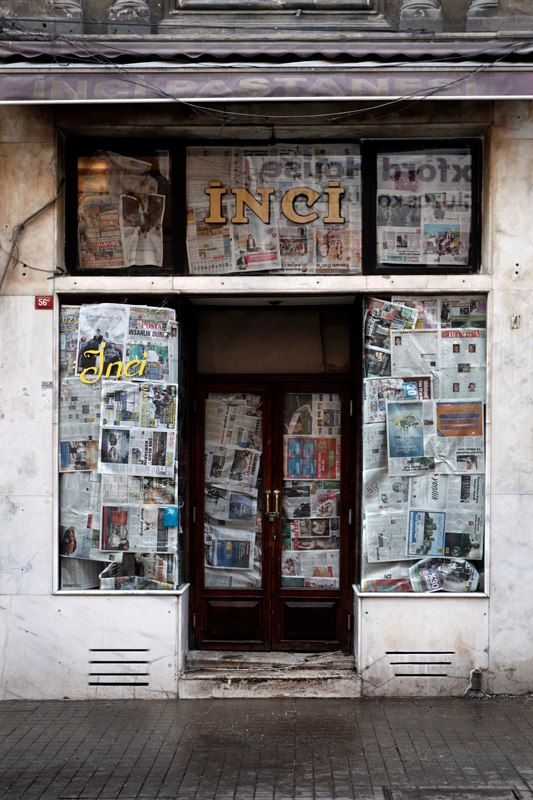
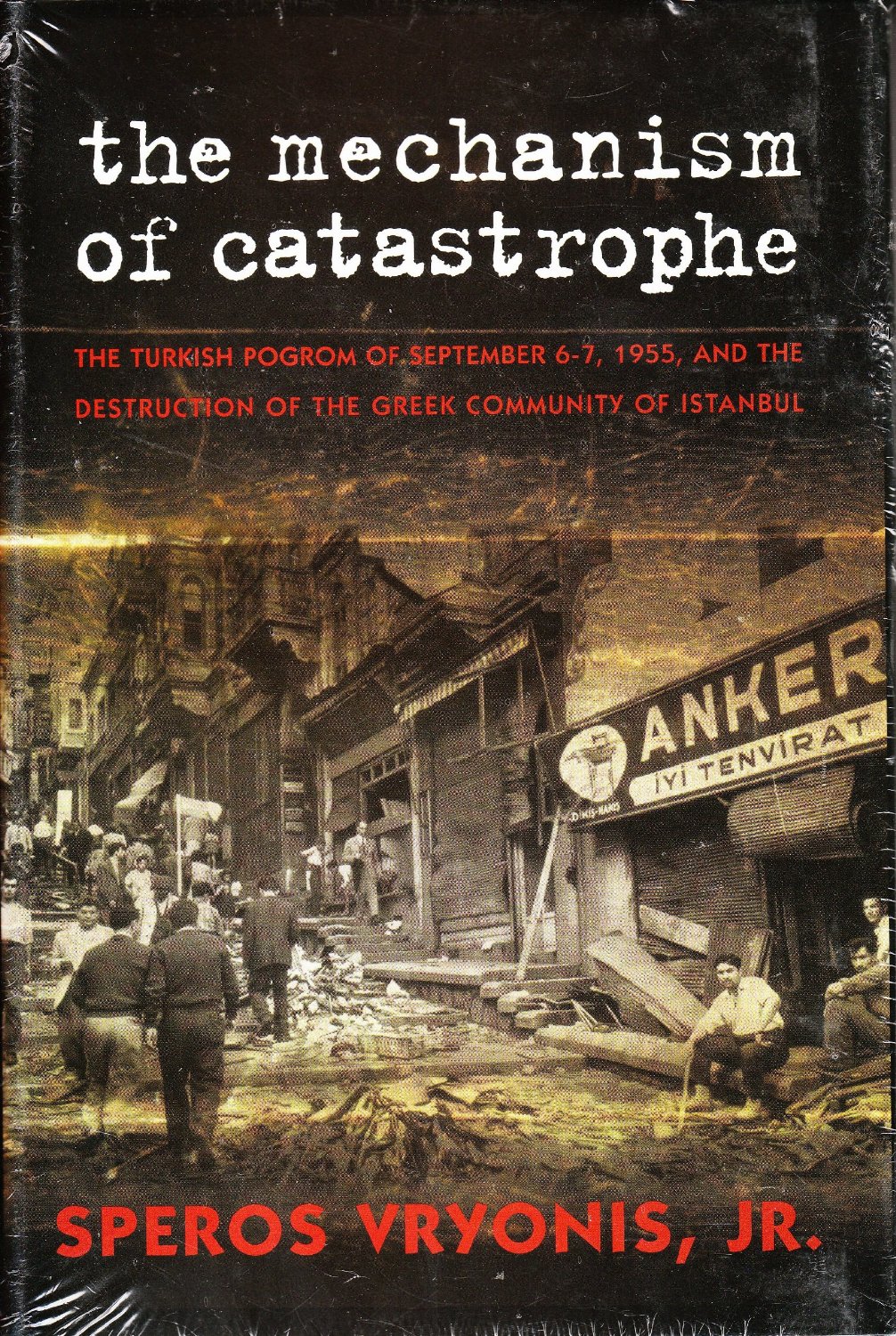
Unfortunately I don’t know if the Turkish press made any reference to the area’s former social composition when covering the protests or if any Turks did at all.  The closing of İnci, the patisserie, is what most brought this all home to me: “the closing of the historic Emek cinema and a much-loved pastry shop…”  There was quite a fuss about İnci apparently, but was any mention made at the time that this had been one of the last Greek businesses in the neighborhood?  There are two more left in all of Beyoğlu I think, İmroz, the restaurant on Nevizade and, perhaps the only growth industry in Greek İstanbul, a coffin-maker’s near the Panayia in Stavrodromi.  Inci had been there since 1947.  I leaf through Speros Vryonis’ massive “The Mechanism of Catastrophe”*** to the pages containing K. Ioannides’, a journalist from the Salonica-based Macedonia newspaper, cataloguing of ransacked Greek businesses in the area, which means all of them, without exception.  On just the İstiklal Caddesi, Meşrutiyet Caddesi, Pasaj Evropa, Yüksek Kaldırım and Perşembe Pazarı there is a list of three-hundred and twenty-nine businesses.  And you really have to marvel and wonder at whether the Greek “daemon” is more than a myth.****  After the financial decimation of the community by the Varlık Vergisi, the “estate tax” of the 1940’s, when discriminatory taxation against minority groups had wiped out many, and sent many of those who couldn’t pay to forced labor camps, Greeks had bounced back to dominating the retail business of these central neighborhoods in less than a decade – only, of course, to have it all definitively trashed a few years later.  And, sure enough, there it was, at number 27 on the list: “Pastry shop İnci of Loukas and Lefteres.”  When people mourned the loss of İnci last summer, was there any sense that something more than a charming old patisserie was disappearing?  Or that this was a place that had bounced back from total loss in one Istanbul tragedy and then went on to continue serving the city for more than fifty years?

İnci, before and during protests, after closure.

inci-pastanesi-kapatildi

inci-pastanesi_110960868246

inci (5)

inci-pastanesi_443808

inci1-F0BA-2415-C212

What do I want exactly?

All – I thought a lot about whether I should use “almost all” in this sentence and decided against it –because all the hippest, funkiest, most attractive, gentrified neighborhoods in the historic parts of İstanbul are neighborhoods that were significantly, if not largely, minority-inhabited until well into the twentieth century: not just Pera and Galata, but Cihangir and Tarlabaşı, and even Kurtuluş — of course — and up and down the western shores of the Bosphorus and much of its eastern towns too, and central Kadiköy and Moda and the Islands.  (And if serious gentrifying ever begins in the old city it’ll be in Samatya and Kumkapı and Fener and Balat; I wouldn’t put any big money into Aksaray or Çarşamba just yet.)  If young Turks are fighting to preserve the cosmopolitan character of areas made cosmopolitan by a Greek presence, among others, is it a recognition of that presence, however vestigial, that I want?  Yes.  Is it because some recognition might assuage some of the bitterness of the displacement?  Perhaps.  Is the feeling proprietary then?  Does the particular “cool” quality of these neighborhoods that protesters have been fighting to protect register for me as a form of appropriated “coolness?”  I’m afraid that yes, sometimes it does.  In darker moments this spring and summer, these Occupy Gezi kids annoyed me: “What’s wrong mes p’tits?  The Big Daddy State threatening to break up your funky Beyoğlu party?  Do you know the Big Daddy State made life so intolerable for the dudes who made Beyoğlu funky that they not only had to break the party up, but shut down shop altogether and set up elsewhere?  That your own daddies and granddaddies probably stood by and watched, approved even?  Do you know that now?  Do you care?”

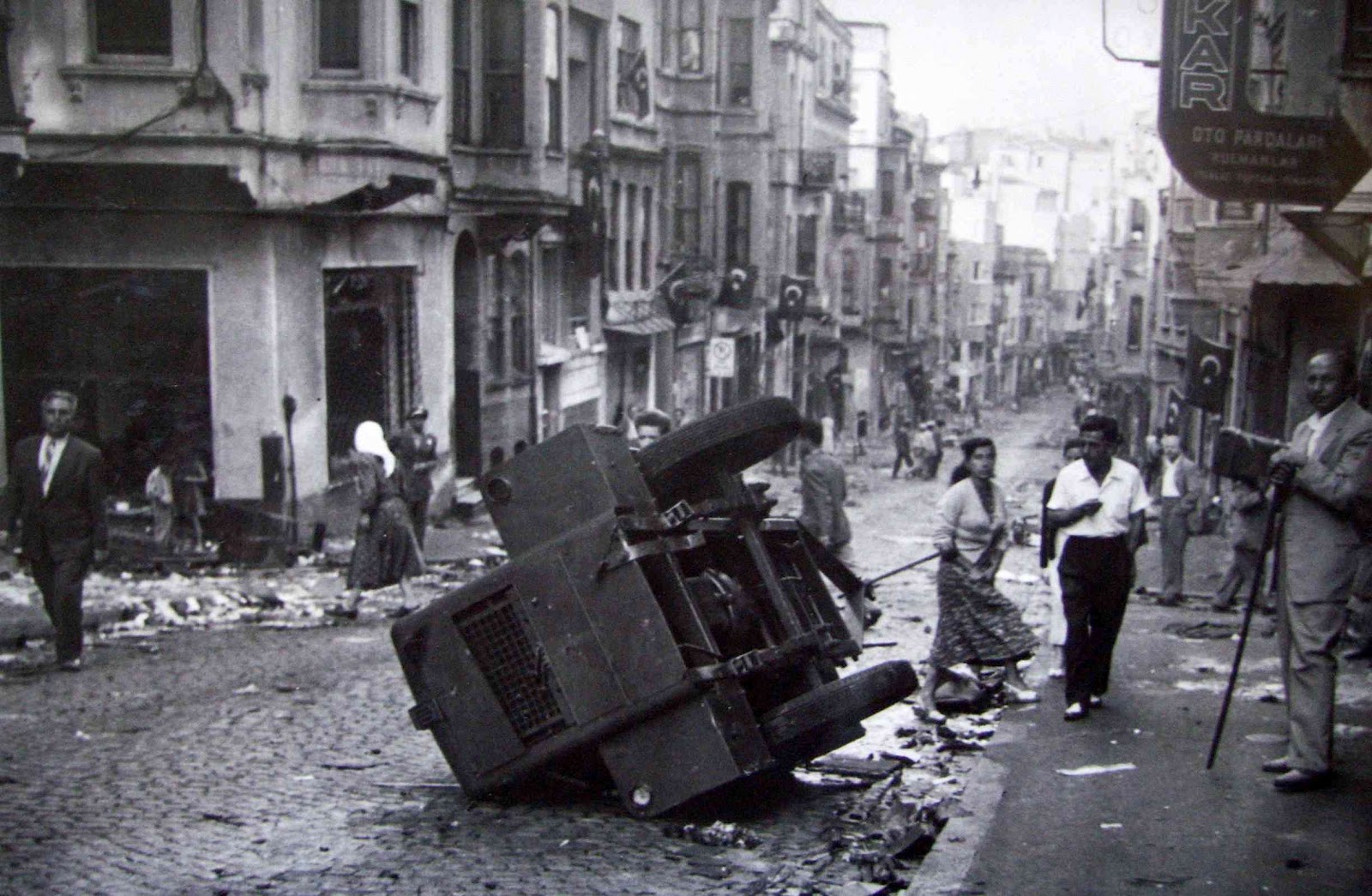
taksim4Cleaning up in a Greek neighborhood after the pogrom of 6-7 September 1955.  I’ve spared readers and myself more and worse photos. (Click)

No one in New York would think of talking about the Lower East Side, for example, or the Bronx, without due respect to the Jewish role in the formation of those areas and, by extension, every aspect of New York culture.  You mourn the passing of every Ratner’s and Second Avenue Deli even if you aren’t Jewish and even if five of them take their place in Kew Gardens or Borough Park.  Or to use a significantly more heated example: if the young white professionals now moving in large numbers into Harlem refused to acknowledge that Harlem’s atmosphere, style, musicality — that the whole Harlem phenomenon — were  largely African-American contributions to the city’s life, wouldn’t any culturally or historically conscious New Yorker find that problematic or reprehensible; not to mention how the neighborhoods Blacks would feel (and do…)  And Jews and Blacks were never driven out of New York by a systematic campaign of violence, harassment, confiscation and forced expulsion.

Therefore: If 2013’s protests then – at least İstanbul’s –were at their core about protecting aspects of the essential urbanity of İstanbul, and Greeks played such a large role in shaping that urbanity, shouldn’t that be acknowledged?  If Turkish society is playing out – again, at least in İstanbul – its most intense culture wars on a ghost blueprint of vanished minorities, then wouldn’t making that a more explicit part of the contest be immensely productive – all around?

But these grudges are usually not this deep and usually don’t last long.  Partly because I’m always on the side of the partiers – any partiers.  Partly because I trust the growing consciousness and honesty of most young Turks.  The protesters as a rule behaved so civilly and politely, their chants and slogans so witty and intelligent for the most part, that you couldn’t help but be impressed.  As opposed to Erdoğan and his party’s grand Haussmanian plans, I think they didn’t really want much: Gezi was just a convenient object.  I think they want the area neither Islamized and Neo-Ottomanized or “re-Republicanized” as it were.  I think they’re tired of those two poles, and as a close friend of mine said, they want another option.  I think they wanted the neighborhood to stay as it is and always has been: a place of pleasure and freedom and difference, of uncomfortable, musty cinemas that offer something more interesting than the suburban multiplexes, of Art Nouveau cafes, no matter how garishly over-renovated or turned into fast-food lunch shops, of badly lit meyhanes that you have to know to find, a couple of gay bars, of mini-skirts and transvestites – both separately and together — everything that the strange sensuality of Istanbul offers and the freedom to not be told how and when to enjoy it.  Every man’s inalienable right to want a sweaty glass of rakı and some leblebi or a good mojito when he wants it.

Protesters in Istanbul

And they’ll win too.  Just as Hafez says:

Might they open the doors of the wine shops

And loosen their hold on our knotted lives?

If shut to satisfy the ego of the puritan

Take heart, for they will reopen to satisfy God.

image007

                                                                                                                                                                                                                                                — Kabul, November 2013

*********************************************************************************************************************************************************************************************************************************************************

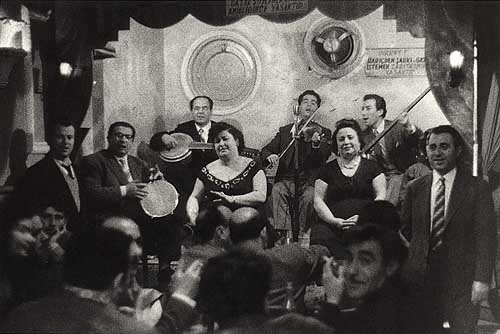
* Two more of Güler’s most famous photographs:

Guler1

D-amp-K-PASAJ-KAHVESI-BEYOGLU-ISTANBUL-ARA-GULER__51726491_0

While there’s no documentation that the subjects of these photos are Greek, the period, the neighborhood they were taken in and — well — just their look, seem to say so.  Ara Güler was a prolific photographer whose work has been sadly overexposed by excessive postcard-ization.  He once famously said: “Today, 13 million people live here. We have been overrun by villagers from Anatolia who don’t understand the poetry or the romance of Istanbul. They don’t even know the great pleasures of civilization, like how to eat well. They came, and the Greeks, Armenians and Jews, who became rich here and made this city so wonderful, left for various reasons. This is how we lost what we had for 400 years.”

He was called a racist by many leftists for that comment.  But who pays them any heed?  His website: Ara Güler: Official Website

** For more of my thoughts on the hypocrisies of multi-culti İstanbul nostalgia see my early piece The Name of this Blog, and my series Tarlabaşı I, Tarlabaşı II, and Tarlabaşı III .  Especially see Amy Mills’ Streets of Memory: Landscape, Tolerance, and National Identity in Istanbul  based on her research in the Bosporus suburb of Kuzguncuk, where she argues that nostalgia for the cosmopolitan actually serves to erase minorities and discrimination against them from public memory and reinforce Turkish Republican ethnic homogeneity.  I think that’s exactly what’s happening in Beyoğlu.

*** Speros Vryonis The Mechanism of Catastrophe: The Turkish Pogrom Of September 6 – 7, 1955, And The Destruction Of The Greek Community Of Istanbul is a magisterial life’s work and piece of historical journalism that covers the one night of September 6-7, 1955 in which a pogrom organized by Adnan Menderes’ Demokrat Parti destroyed practically the entire commercial, financial, ecclesiastic, educational and domestic infrastructure of the City’s Greek community.  I had put off reading it for quite a while — because the subject matter is upsetting and it’s long and detailled — but I was really impressed when I finally did.  I hadn’t realized the exact extent of the damage: 4,500 Greek homes, 3,500 shops and businesses (nearly all), 90 churches and monasteries (nearly all), and 36 schools destroyed and 3 cemeteries desecrated.  I hadn’t known that so many homes had been destroyed, leaving a large part of the community of then 80 or 90,000 or so homeless and destitute and that, as opposed to the traditional account of one old monk being burned alive, some 30 people were actually killed and many raped.

A1iZR7nssVL._SL1500_

The Menderes government initially, and stupidly, tried to portray this as a spontaneous outbreak of nationalist fervor against Greeks over growing Cyprus tensions, but it was actually an extremely well-planned and executed military manoeuvre (every Turk, after all, is a soldier born) carried out and directed by local cadres of the Demokrat Parti who knew their neighborhoods and its Greek properties and institutions well and through the use of Anatolians brought in from the provinces; I guess they were afraid that local İstanbullus, who knew and lived with these Greeks, would not be as easily destructive, though the record of how the city’s Turks did act during the riots is hardly edifying.  As all products of the nationalist-militarist mind, the plan was an extremely stupid move as well.  It brought the economy of Turkey’s largest city to a virtual standstill, at a time when the country was in deep economic doldrums to begin with, by ripping out its retail heart, so much of it being in the hands of Greeks and other minority groups, and in the immediate aftermath there were chronic shortages of basic supplies in the city because distribution networks had been completely severed and even bread — so many bakeries being Greek and Epirote, especially, owned — was hard to find.  It temporarily made Turkey an international pariah (though in that Cold War climate that didn’t last too long) and eventually played a role in bringing the Menderes government down and costing him his life — thought that all is well beyond the scope of this post, this blog and my knowledge.  Vryonis’ analysis is brilliant if you’re interested.

It’s become axiomatic that the riots were the beginning of the end of Greek Constantinople; the community struggled and tried, but this time things were shattered — physically and psychologically — beyond repair.

**** The Greek Daemon, “daemon” in the Roman sense of the word of animating genius — “To daimonio tes fyles” — is the idea that Greeks are resourceful enough to prosper anywhere and under any conditions — Patrick Leigh Fermor’s belief in their ability to “spin gold out of air” — and the repeated tragic setbacks and almost immediate comeback of the Greek community of İstanbul after nearly every catastrophe to befall it in the twentieth century tempts one to believe in its truth.  Thus, one of the most poignant elements in the Constantinopolitan story is their almost masochistic refusal to leave — what it took to finally make the vast majority abandon the city they loved so much was just too overwhelming in the end however.

There is one important corollary to the “Greek Daemon” myth, however: it only operates for Greeks outside of the Greek state itself, and unfortunately history seems to continue to bear this out.

Comment: nikobakos@gmail.com
What I managed to put away in a day-and-a-half in Paris and some thoughts on the “crise;” or, “…the brevity of time and the immediacy of pleasure.”

1 Nov

…not all in one sitting of course.

A ‘tarte tatin’ au boudin — a take on the traditional tatin upside-down fruit torte, with the boudin (spiced and coagulated pig’s blood) over the flakiest, probably lard-based, crisp puff pastry underneath, and a thin layer of apple and some of the most expertly caramelized onions — almost honeyed, that’s what’s seen dripping almost like syrup under the boudin — in between:

tarte tatin au boudin

(click)

A pig’s foot, braised, then breaded and fried, for the first time served with a bearnaise sauce (essentially tarragon-flavored egg yolks and butter), which was almost a bit too much even for me:

Pied de cochon pané

(click)

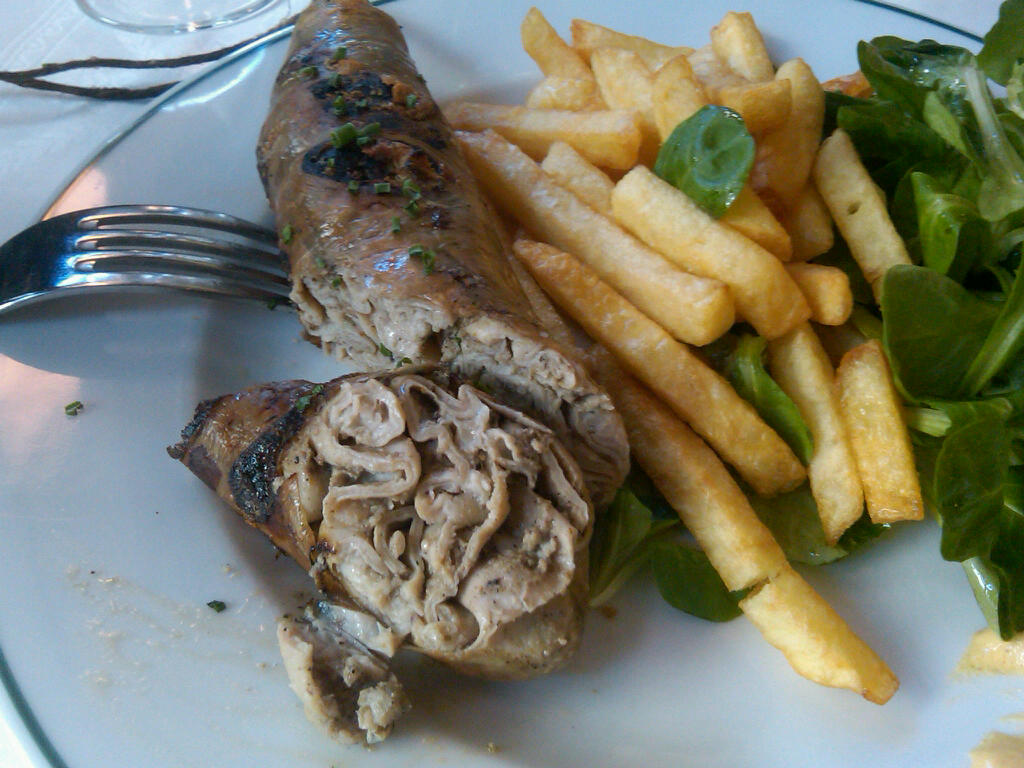
And andouillette, large pig intestine (colon) stuffed with small pig intestine and grilled, kind of like a chit’lin-loaf or mageiritsa sausage, usually served with a mustard sauce or mustard of some kind because it needs something to balance the heady fecal aroma (like the dill in mageiritsa) and really bring out its subtlety:

andouilletebalzar

(click)

And now everyone who keeps telling me that people only ate this stuff because they were so poor they had no choice must cease and desist in this absurd and ignorant argument. (See last year’s post: Chitterlings…and mageiritsa: “Then I have to listen to the anthropology tes poutsas about how people only used to eat that stuff because they were poor and they had to eat everything available, like eating intestines were the equivalent of the dirt-eating that tragically occurs in third world countries under famine conditions.”)  No.  They eat this shit ’cause it’s good.  Proof were the happy groups of Parisians all around me — even young, skinny ones — digging into the same stuff I was, who apparently hadn’t gotten the “evolution” memo from Brussels yet that now that they live in one of history’s most prosperous societies they can stop eating pig guts.

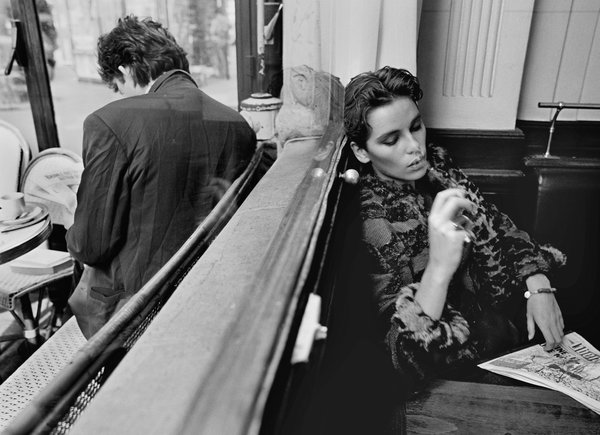
And speaking of prosperity…  Everyone I know in Paris talks incessantly of the “crise” but eventually ends up admitting things are ok for the most part, which makes me wonder that the French crisis is not an outsiders’ invention, or just a fruit of the fact that the French like to think about things and talk about them — imagine….  Ever since Adam Gopnik heroically defended French civilization (“the most beautiful daily culture ever created…lemons on trays and windows like doors everywhere you looked…”) in his Paris to the Moon, ever since the eighties Thatcher/Reagan years actually, there has been a constant schadenfreud-ish gloat-fest in what the French love to call the “Anglo-Saxon” world about how France is over: politically irrelevant, its cultural traditions either fading or ossifying, and how its economic model is simply unsustainable.  This “end of France” commentary in the English-speaking press has practically become a genre of its own; Maureen Dowd gave a classic example of this type of screed in the Times this summer, “Goodbye Old World, Bonjour Tristesse” about how depressed the French now are that France has seemingly lost in place in the world (great photo though):

07DOWD-articleLarge

Ferdinando Scianna/Magnum Photos (Paris, 1989)

and then just these past few months, Steven Erlanger produced these two models of the genre “A Proud Nation Ponders How to Halt Its Slow Decline” and “Reflections on a Paris Left Behind”, sad reflections on how… boring and sterile Paris has become, and repeating the tiringly repeated observation on how London has taken its place; London a city I still find to be trying a little too hard to make up for centuries of un-coolness, vis-a-vis Paris mostly.

Yet, they’re doing something right.  The London Review of Books had a fascinating and comprehensive review of the European Union crisis in its August 29th issue by Susan Watkins: “Vanity and Venality” where she comments on France’s seeming disappearance from the European political landscape (which it seems to be trying to make-up for by flexing military muscle elsewhere) but how it seems to be functioning fairly well internally:

“There is something anomalous about the neutralisation of France as an actor on the European stage and the brittle character of German hegemony must stem in part from it. The conventional explanation is that the French economy is too weighed down by its statist legacies for the Elysée’s word to carry much authority, but the figures don’t bear this out. France has now overtaken the UK, after a swifter recovery from the crisis .  [Could that be because it didn’t opt for Nasredin’s Donkey austerity economics as much as Britain did?]  Its public debt, including bank rescues, is lower than Britain’s and its manufacturing sector is in better shape. Unemployment is worse, but average household income is higher, inequality lower and infrastructure and healthcare in another league.”

(Also read the Watkins article for some dismal analyses of a Greek economy that has shrunk by twenty-percent and the scandalous closing of ERT, Greek Radio Television by PM Samaras)

So France and the French, it seems, keep soldiering on, and well and socially securely at that.  And it seems that some Protestant sourpuss will always be incensed that they seem to be doing it so pleasurably on top of it all, adapting to the new state of things and still enjoying themselves.  Let them bitch and judge.  I know the small part of Paris I see when I’m there is only an equally small part of French society, but if for some reason I were banished from New York tomorrow, it’d still be my first choice to seek refuge in.

PalaisRoyal

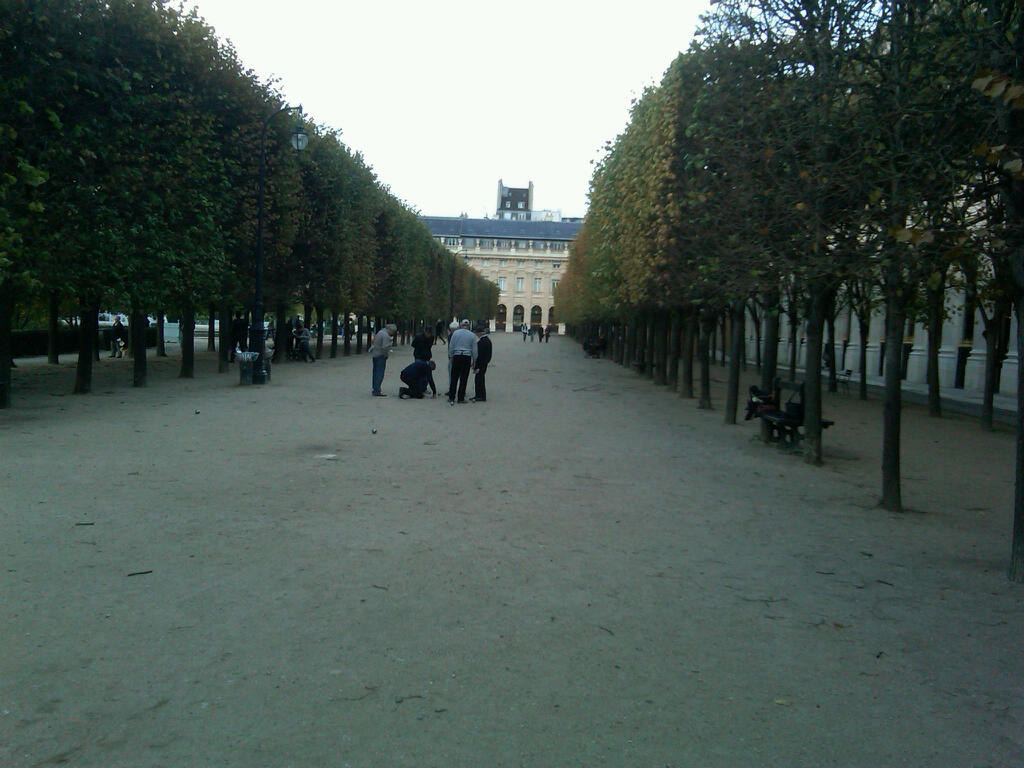
One of those single, condensing phrases that teach you so much about a thing, in this case me about the French: the writer Michèle Fitoussi hits the nail on the head when she said that her compatriots “have a keen sense of the brevity of time and the immediacy of pleasure.”

Comments: nikobakos@gmail.com

Also see the full post: Chitterlings…and mageiritsa for my general food musings, campaigns, philosophies and tirades

My President!

13 Nov

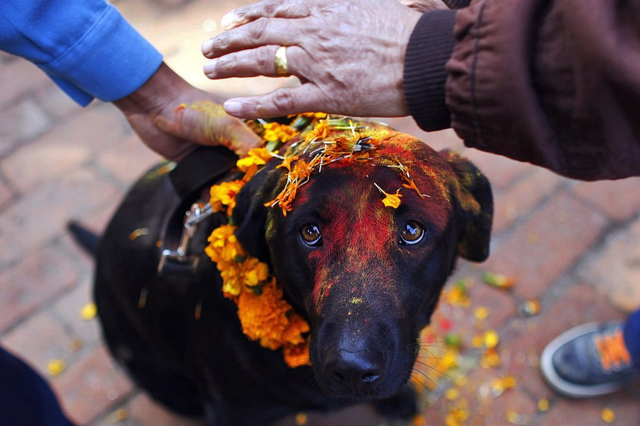
Shubh Diwali

13 Nov

Eid al-Adha

26 Oct

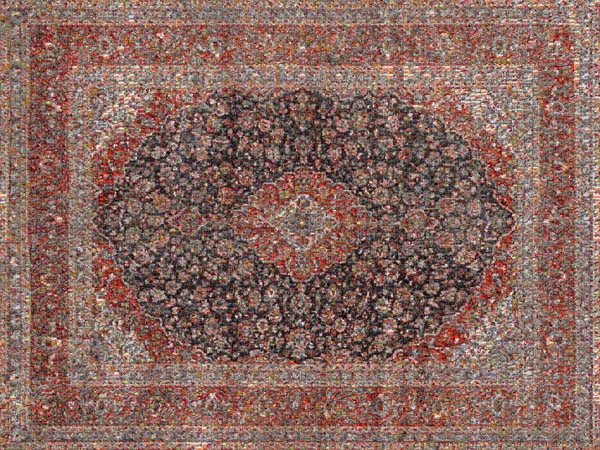
The above “carpet,” by Pakistani artist Rashid Rana, is made up of thousands…tens of thousand? hundreds?…of photographs taken of animals being slaughtered* in homes, streets and slaughterhouses all over Karachi.  To be honest, I don’t know if all these photos were taken on Eid al-Adha or just over a period of time, but it seemed appropriate to the day.  Eid al-Adha, known as Kurban Bayrami in Turkey and in the Balkans, Eid e Qorban in the Iranian world, commemorates the willingness of Ibrahim (Abraham) to sacrifice his son (Ismail, right? not Isaac…) according to God’s will.  It also marks the end of the Hajj.  Anyone who can afford to,  sacrifices an animal and distributes part of the meat to neighbors, relatives and the poor.  I think for many Muslims it’s the major holiday of the year.  It’s always struck me as a feast that had some of the mixed solemnity-joy of Easter (aside from just the obvious element of the sacrifice of the Son), as opposed to the candied, Christmasy festivesness of Eid al Fitr.

(Kurban, which I assume is an Arabic word, is the source of the beautiful Farsi expression “Qorban-e-to” “your sacrifice” — meaning “you’re welcome” or “at your service” or “my pleasure” — I’m all yours; do with me as you wish…here’s my throat…)

Below is a detail of Rana’s piece:

I wish there were a more close-up shot of it available somewhere.  It was beautiful.

It was shown here in 2010 at the Asia Society as part of an exhibit of contemporary Pakistani artists called Hanging Fire: Contemporary Art from Pakistan, which was really fascinating (starting with the title).

Some of my other favorite pieces at this exhibit was the work of Imran Qureishi, who does Mughal-style, Shah Jahan period-type portraits (one of my great aesthetic weaknesses) with figures from contemporary Pakistani reality:

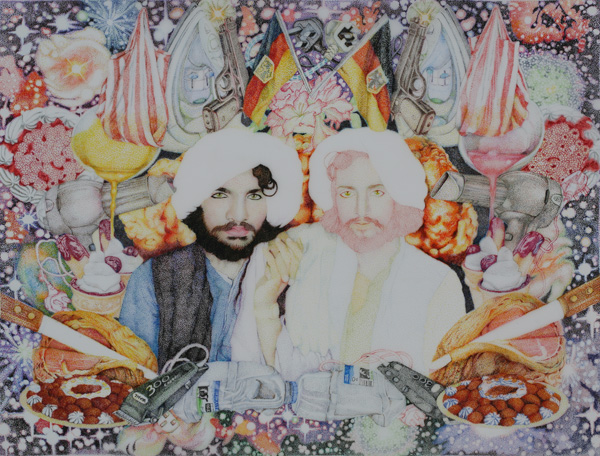
But perhaps the most interesting pieces for me were from Faiza Butt, an artist born in Lahore but now working in London.  Her discussion of her work should be checked out:

“My choice of medium was a reactionary response to my years as a student at the Slade School of Art, where large, physical, muscular and “technologically advanced” work held more worth than contemplative intellectual responses. [my emphasis]  I started to create ambitious, highly detailed drawings with ink pens that rival “spectacles” of work and focus on art historical and gender issues.”

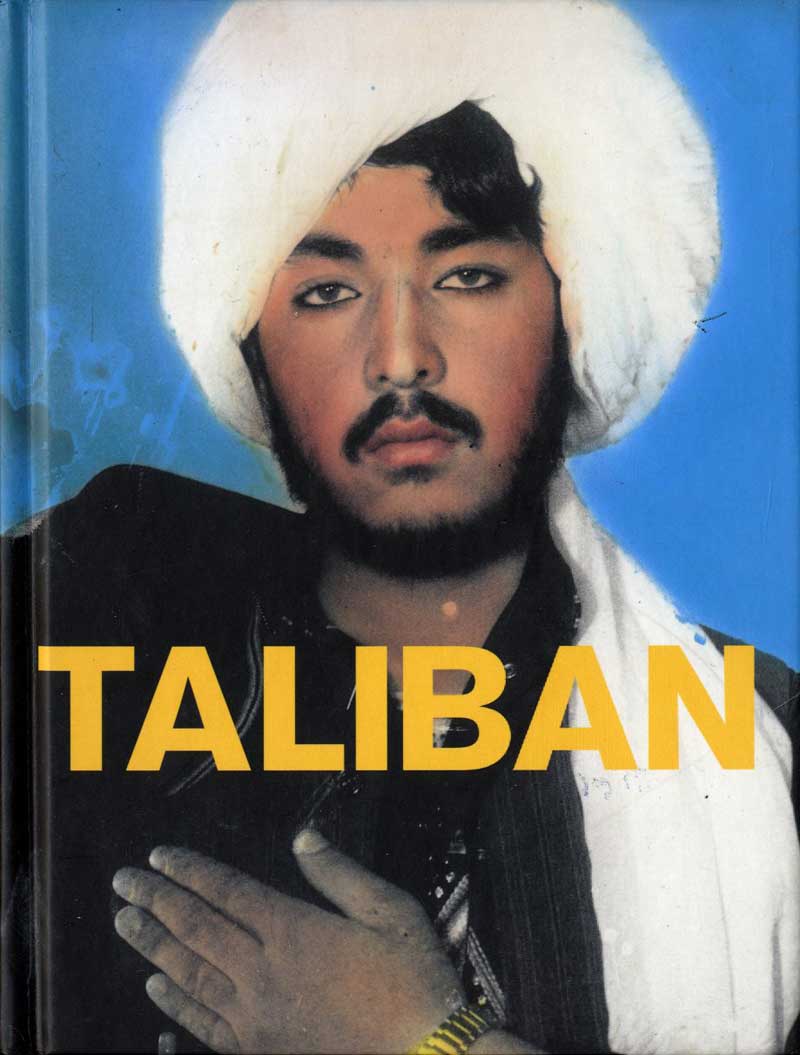
At the the exhibit were displayed two collage pieces she did out of the famous Taliban photos discovered by German photographer Thomas Dworzak in photo studios in Kandahar in 2001.  The photographers were happy to give them to him; ‘most of them are dead” one said.  Butt called the pieces she made out of these photos: “Get out of my dreams – I and II”:

I still can’t figure out what she means.  “Get out”?  “Dreams”?  I think there are stunning ideas behind these pieces and not the least stunning was the title.  Is the strange eroticism of these men, with their khol-lined eyes out of a Perso-Indian opium dream, what draws and compels her?  Or are they just Taliban monsters, whom she wants not out of her dreams, but out of her nightmares?  I had seen the photographs before of course — American journalist Titan Jon Lee Anderson has compiled them into a beautiful edition (below) with an intro by Dworzak, after they first appeared in The New Yorker — but thanks to Butt, they got into my head in a new, strange and beautiful way.

A wildly divergent tangent from Eid al-Adha, eh?  Or maybe not.  Good feast to all.

Also the feast of St. Demetrius today, by the way, Dmitriy Solunskiy — my patron.


Comment: nikobakos@gmail.com


*Sorry for the PETA girls — “slaughter” here has absolutely no moral or ethical connotations for me; it’s just how you kill animals.  When applied to human beings, of course, it has a different meaning, though I know they’re both on the same ethical plane for you.

Nole takes Murray down — finally

14 Oct

“Vengeance – this is a breath of life one shares from the cradle with one’s fellow clansmen, in both good fortune and bad, vengeance from eternity.  Vengeance was the debt we paid for the love and sacrifice our forebears and fellow clansmen bore for us.  It was the defense of our honour and good name, and the guarantee of our maidens.  It was our pride before others; our blood was not water that anyone could spill.  It was, moreover, our pastures and springs – more beautiful than anyone else’s – our family feasts and births.  It was the glow in our eyes, the flame in our cheeks, the pounding in our temples, the word that turned to stone in our throats on hearing that our blood had been shed.  It was the sacred task transmitted in the hour of death to those who had just been conceived in our blood.  It was centuries of manly pride and heroism, survival, a mother’s milk and a sister’s vow, bereaved parents and children in black, joy and songs turned into silence and wailing.  It was all, all.”

Land Without JusticeMilovan Djilas


“Resilient Djokovic SLAMS Murray”


Comment: nikobakos@gmail.com

Litvaks and Galizianers

12 Oct

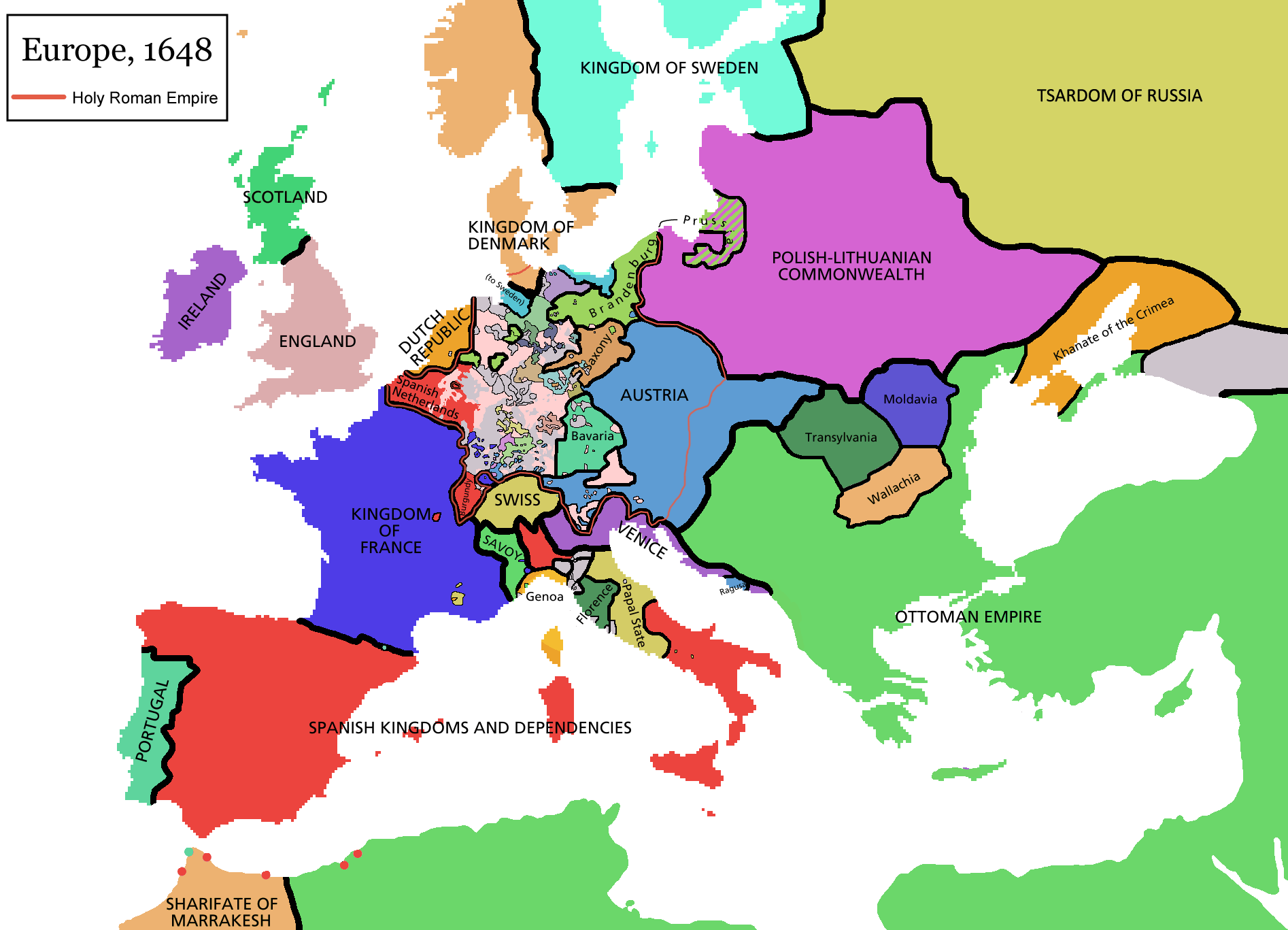
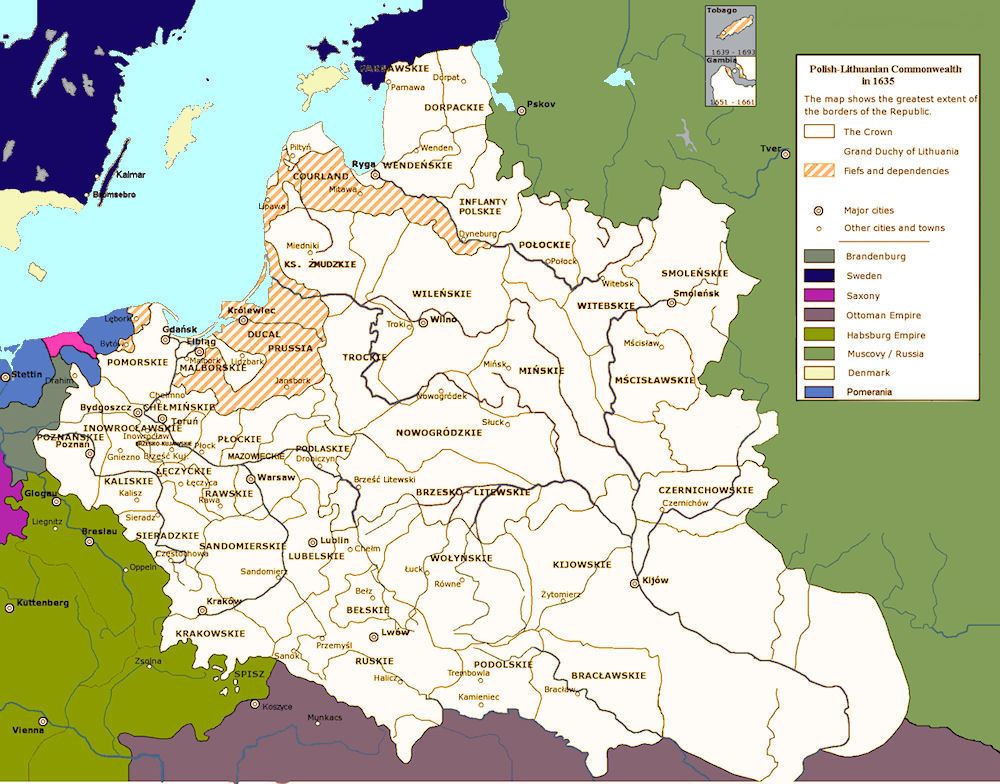
Back in a previous post/response to “Jewish London‘s” comment on “Tishabuv” I made a reference to the difference or self-categorization among Eastern European Jews as “Litvaks” and “Galizianers.”  Here’s a map of Europe in 1648.

(have to click)

Between the beginning of the Crusades and the end of the religious wars in the German states in around 1648, a giant wave of the majority of the world’s Jews moved eastwards from German-speaking lands to Eastern Europe, preserving their form of late medieval German (Yiddish, which just means “Jewish”) in their new countries, like Spanish Jewry preserved late medieval Castillian (Ladino, but which Sephardim themselves usually refer to as “Kastelyano”) throughout the Ottoman sphere and general Mediterranean area after being expelled from Spain in 1492.  What I’d like to illustrate with the maps above and below is that no Jew ever actually migrated and settled in Russia.  The vast majority of Central European Jewry moved to the united Kingdom-Commonwealth of Poland-Lithuania, because Poland was perhaps the most progressive and open and tolerant state in Europe at the time and welcomed them gladly.  Jews later ended up in Russia and Austria when Poland was finally partitioned between those two empires and Prussia in the eighteenth century.  Otherwise, what Jew in his right mind would have gone to live in Russia?  Which was then a backwards, mediaeval theocracy — as, arguably, it still is.

(click)

The term “Litvak” refers to those Jews who lived in those territories of northeastern Poland centered around Vilna, Minsk, Bialystok and eventually Warsaw — regions more advanced or somehow “modern” than the rest of the Polish kingdom.  “Galizianer” refers to those Jews who lived in the southeastern areas of Poland — and after Partition — Austria and Russian Ukraine.

“Litvak” refers to Lithuania obviously, but mostly derived its prestige as an appellation from the central role of Vilna* in rabbinical and Jewish scholarship; as a reverse honour-indication of that role, Salonika was known as the Sephardic Vilna.  Galicia, what’s now southeastern Poland and Western Ukraine, roughly round the twin urban poles of Cracow and Lwow became, and remained into the twentieth century, one of the most overpopulated and impoverished parts of Europe — so much for enlightened Austrian rule.

One can take it from there in obvious ways: Litvak was more modern and sophisticated; Galizianer was more backwards and isolated; Litvak was more open to the modernizing influences of the German Jewish Enlightenment; the Galiizianer was more closed and isolated in his shtetl life; the tragically aborted explosion of Yiddish-language literature and theater and cinema in the early twentieth century was Litvak — with its center now moved to Warsaw; many of its themes, however, were the tales and mysticism and Hasidic other-worldliness of the Galizian south.  Opposites but complimentary.  Sholem Aleichem was a Litvak who wrote about Galizianer themes.  Renaissance and Enlightenment Jewish scholarship was Litvak; klezmer and Der Dybuk and Fiddler on the Roof are Galizia.  Helen, the receptionist for take-out orders at my dad’s coffee shop in the 70’s used to say she wouldn’t eat the store’s pastrami and corned beef because they were delivered by a “dirty Galizianer,” but she and an insurance salesman who used to have lunch there — and kinda used to hit on her — used to kid about he would never trust a “sneaky Litvak” like her; by that time, both of them were joking.

The differences mean even less today, except for that, due to New York Hasidim, Galizianer Yiddish is the most alive form of the language.  But even young New York Jewish kids know what the two words imply.  For what that was worth…

********************************************************************************************************************************************************************************

*Lithuanians — yes, I get hits from Lithuania — please do not write me and tell me the name of the city is Vilnius.  For Jewish purposes it’s Vilna; for Polish, Wilno.  See: Names: Istanbul (not Constantinople)

Note: Roumanian Jews and “Bessarabtsy” (Moldavian) Jews were kind of a separate category, though I suspect that linguistically and culturally they were pretty similar to Galizianers, aside from a reputation for being especially humourous and quick-witted and high-livers and partiers, and for introducing pastrami to New York, a linguistic and culinary kin to pastirma, one of the many ways that Roumania has always been a bridge between Ottoman and Eastern-European-Russian worlds.

Comment: nikobakos@gmail.com

Yom Kippur, Kol Nidre, Moishe Oysher and the First Roumanian (a little late…sorry)

10 Oct

Yom Kippur (pronounced “Yum Kip-per” or “Yun Kip-peh” and not “Yom Kip-pur”) is the holiest day of the Jewish year; just thought I should explain, I don’t want to under or overestimate my readers’ knowledge.  It’s the Day of Atonement, which closes the ten beautifully named Days of Awe that begin with the Jewish New Year (“Happy New Year to Everyone“), when Jews fast and atone for their – “sins” is too Catholic – for their moral failures, let’s say.

Kol Nidre, the first few words of which are heard sung by Moishe Oysher in the clip from “Overture to Glory,” (see Kol Nidre) is sung on the eve of Yom Kippur.  “All Vows” in Aramaic, the prayer, which in many ways has become the center of the day’s observance, asks God for release from any promise or oath that one will make in the coming year.  Controversial even among Jews at certain periods in Jewish history, in the Gentile world the prayer has generated volumes of anti-Semitic garbage, along the lines that one can imagine: sneaky Jews starting their year off with a legal loophole, etc.  What Kol Nidre asks of God is understanding for the many ethical obligations that an honest man knows he will not be able to completely live up to in the coming year; it’s not a request for a moral pass or a license to lie.  It’s an expression of terrible honesty, in fact.

Moishe Oysher (click)

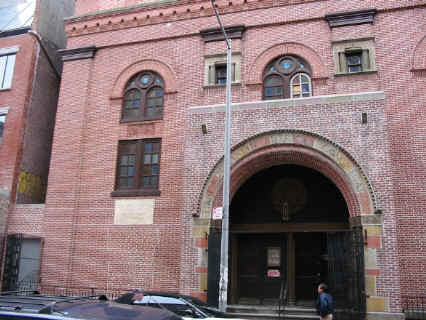
Moishe Oysher was a Moldavian-born star of Yiddish theater and cinema, first in Europe, then mostly in the Americas, who almost accidentally stumbled into the real-life role of cantor at the First Roumanian Shul* on Rivington Street on the Lower East Side.  His powerful voice, entertaining and dramatic style (disliked by many purists), and movie star looks made him, and the First Roumanian, a sensation in the 1930s and 40s when he sang there, apparently increasing the congregation’s size to overflowing.  “Ooooh yeaaaah….” the ancient caretaker who showed me and a friend the decrepit interior the one time I was in there in the early 90s, “Moishe Oysher…they say he really packed in the gallery [where the women sat] in those days, he he…”

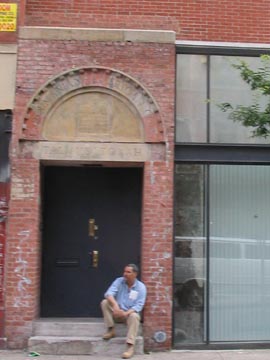
Unfortunately Oysher died young, at 51, and unfortunately the First Roumanian Shul (see below) was torn down or — like used to happen to “landmark” buildings in Greece — allowed to collapse in 2006.  It wasn’t any stunner of a building, but it was a historic center of Jewish New York and it had some of the best acoustics of any interior space in the city.  Its congregation was tiny at that point and only used the basement, even on Yom Kippur, but it could have easily been used as a concert hall or musical venue of sorts like so many houses of worship in the city whose demographic environment has changed.  In fact, it was in the process of being designated a landmark when, under shady New York real estate circumstances that may have involved the leaders of the congregation itself, city money for repairs was delayed for so long that the roof collapsed, the building was declared irreparable and the shul was demolished a few months later.

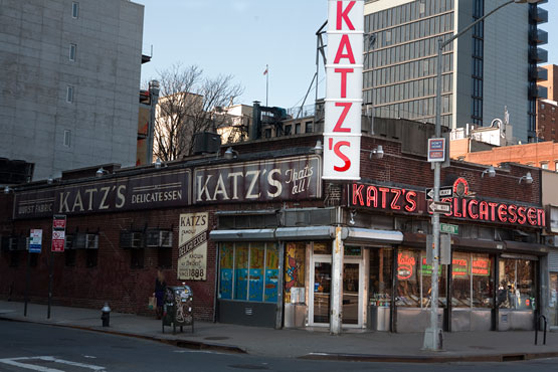
Like so much of the neighborhood, once the site of terrible poverty and the greatest population density of any equivalent set of square miles of urban space in history, but the wellspring of so much of New York’s historical and cultural and political life, the shul’s space is now occupied by a condo, with the old yeshiva side-door set into the glass façade in one of those contrived architectural pastiches that only add insult to injury for me, and Rivington Street no longer echoes to the booming voices of cantors on the High Holy Days but the screeching of drunk white girls pouring out of its series of identical bars at closing time.  At least Katz’s can still make a living.**

**********************************************************************************************************************************************************************************

*Shul: “school” literally, in Yiddish, is the traditional Ashkenazi term for “synagogue,” a Greek word which means roughly the same thing: a place to come together and pray and study (“train,” if you like, for those that recognize the second half of the word from “pedagogue” — or the movie 300…  Venetian Jews called their synagogues “scuole.”  Oddly enough, I don’t know what Sephardim call theirs.)  I don’t know where American Reform and Conservative Jews got the, frankly, sacrilegious idea of calling a “synagogue” a “Temple.”  There was only One Temple to the One God in the One City; you can’t rebuild one in Great Neck or Forest Hills.  I cringe whenever I hear it.

**Katz’s is a delicatessen on the corner of Ludlow and Houston, literally around the block from where the First Roumanian used to be.  Like most Jewish businesses on the Lower East Side by the 1980s, it was sliding downhill and hanging on by a thread, when the sudden explosion of the neighborhood (starting with, and especially, Ludlow Street) into the center of under 35 nightlife in the city gave it a new lease on life.  It’s now on every New York tourist’s itinerary and is open twenty-four hours a day, packed when the bars close after 4:00 a.m.  It has decent undistinguished pastrami, but nothing there is especially good.  A better post-bar munchies choice is Bereket, down the street on the corner of Orchard, the Turkish place that has a variety of meat-kebab-doner choices and zeytinyagli-ladera-vegetable dishes, but you have to deal with vegans there.

There’s still excellent pastrami to be had in New York around the clock, but I’m not telling where.


Comment: nikobakos@gmail.com