
From the New York-based National Herald, oldest Greek-and-English language paper in the United States
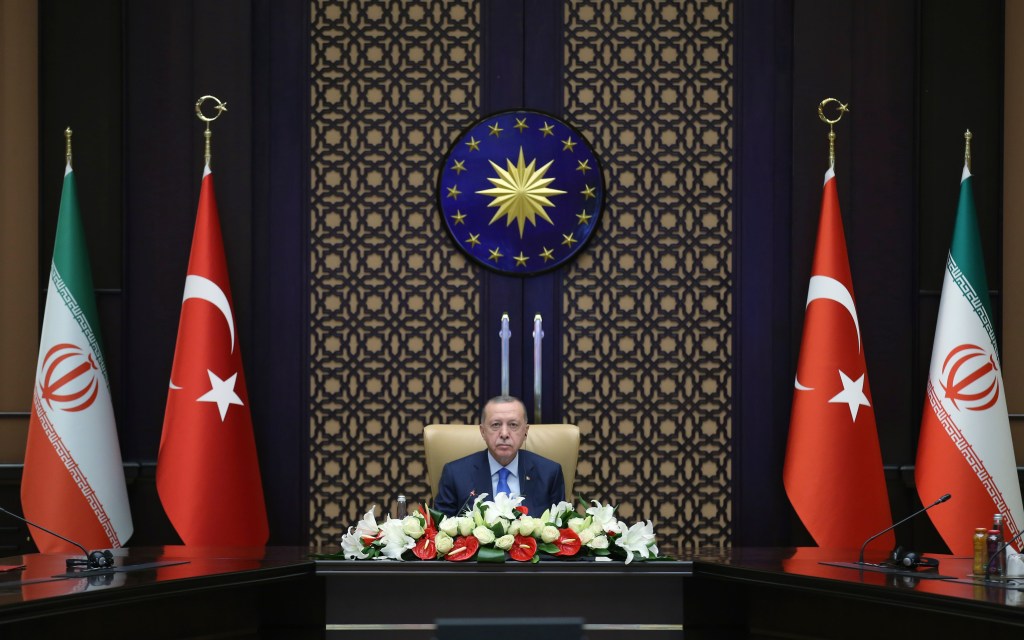
Diplomacy? Erdogan Chides Greece for Being Childish
ANKARA — Reaching out to Greece for dialogue after he sent an energy ship and warships off the island of Kastellorizo, Turkish President Recep Tayyip Erdogan threw a possible monkey wrench into the works when he accused Greece of “provocations and childish attitudes.”
Erdogan, whose rhetoric has grown more belligerent and alternated with offering to talk, said his country has always acted with the “dignity of righteousness” and will continue to “defend its legitimate rights,” which could undercut any dialogue.
Turkey’s state-run Anadolu Agency (AA) said he made the comments while speaking at an event at the Bestepe National Congress and Culture Center in Ankara, where he also said that his government would “not allow anyone to confine Turkey, the country with the longest coastline in the Mediterranean, to its coast.”
That was in reference to his open coveting of the return of Greek islands to Turkey ceded away in the 1923 Treaty of Lausanne he doesn’t accept, saying some were so close to Turkey’s coast he could shout to them.
Turkey has for now withdrawn its ships but said they would return after maintenance on the energy research vessel Oruc Reis as a Sept. 24-25 showdown meeting looms with the European Union.
Greek Prime Minister and New Democracy leader Kyriakos Mitsotakis said he wants hard and meaningful sanctions imposed for Turkey’s incursion and repeated violations of Greek airspace and waters if he can’t reach agreement with Erdogan before then.
Earlier, Erdogan ripped France, which is backing Greece in the East Mediterranean, asking whether asking whether it would return to “responsible policy” if Turkey backed down.
Speaking to members of his ruling Justice and Development (AK) Party, the Turkish president also accused the EU of double standards, the news agency report said, although Greece is a member of the bloc and Turkey isn’t.
September 16, 2020 Iraq
Persecution of Christians in Iraq: it has become increasingly clear that the Turkish government is furthering its longstanding persecution of Christians by means of its military actions against the Kurds. These actions, which have displaced 2,000 Christian families and emptied 25 Christian villages this year alone, are in keeping with its clear contempt for Christians and Christianity, as well as for Turkey’s rich Orthodox Christian heritage. These forced evacuations stem from the same beliefs, attitudes, and assumptions that gave rise to the appropriation of Hagia Sophia and the Monastery of the Holy Savior in Chora as mosques, the ongoing discrimination against of and harassment of the Ecumenical Patriarchate and the remaining Christians of Turkey; the occupation and ethnic cleansing of northern Cyprus; the numerous restrictions placed upon the activities and rights of Christian and other religious minority groups; and much more.
The Order of Saint Andrew the Apostle, Archons of the Ecumenical Patriarchate, once again appeals to the United Nations and all nations that are concerned about human rights to do all they can to protect the Christians of Syria and the Middle East in general, and to do all they can to bring an end to the unjust and illegal actions of the Turkish government.
For previous ChristianPersecution.com coverage of the persecution of Christians in Iraq, click here.
“Kurdistan, Christian villages hit by Turkish raids against the PKK (VIDEO),” Asia News, September 15, 2020:
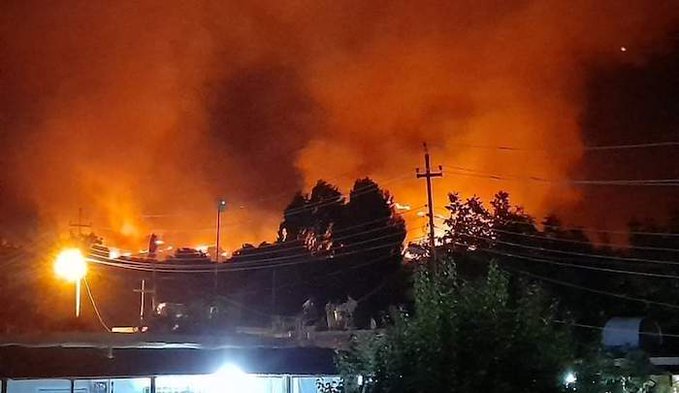
Erbil (AsiaNews) – Fear is growing among the inhabitants, including Christians, of Iraqi Kurdistan along the border with Turkey, the scene of heavy attacks by Ankara’s air force against targets of the PKK (the Kurdish Workers’ Party) refugees in the villages of the province north of Duhok. Fr. Samir Youssef, pastor of the diocese of Amadiya says “for months they have bombed our mountains to kill PKK members or attack the Kurds, regardless of whether they carry weapons, food or anything else ”.
The parish priest of Enishke sys [sic] the violence has intensified in the last period, as evidenced by the video and the photos published: “In the last month – he explains – they have killed a lot of people, just because they were close to areas controlled by the PKK . In some cases, the bombings also hit the homes of the civilian population ”. Last week, the priest stresses, “they hit a car carrying aid near the Christian village of Araden”.
It should be noted that hundreds of Christians from Mosul and the Nineveh plain, who fled in 2014 following the rise of the Islamic State (IS, formerly Isis) still live in the area today. Jihadists who, according to the accusations, often moved undisturbed and were helped by neighboring Turkey….
According to some local experts, relaunched by Christian organizations online and on social networks, among the most affected areas are the Christian villages of Chalik, Bersiveh and Sharanish. The objective of these military operations is to make the inhabitants flee from these areas, now almost deserted, in order to create Turkish bases from which to launch targeted ground operations against elements of the PKK. The bombings, a source concludes, are always followed by heavy fires that end up destroying all crops, homes and even cemeteries. Since the beginning of 2020, at least 25 Christian villages in northern Iraq have been emptied of their original population, with a scenario that recalls the years of tension and conflict between 1980 and 1990.
@Purpura57912934 tweeted:
Forgotten Bonds: Albanian armed guards protected medieval Serbian churches & monasteries in Kosovo during the last centuries of Ottoman rule. The commanders were hereditary Vojvodas, the guards permanently lived on the church grounds & were most likely Laramans (Crypto-Orthodox).

Purpura begins his tweet with the words: “Forgotten Bonds”. I think it’s safe to assume that his intentions are to show how, in some indeterminate past, Albanian Muslims and Orthodox Serbs lived in harmony together in Kosovo and in such multicultural peace that it was Albanians who guarded the extensive and dazzling ecclesiastic art heritage of Kosovo Serbian Orthodoxy (instead of vandalizing it like they do now). But he concludes by saying that most of these guards were secretly Christian. And that of course belies the whole myth of “bonds” and tolerance and happiness and how “there is no compulsion in religion.”
Read about the Laramans on Wiki . It’s a fascinating page because it puts together a whole package of phenomena that all, to some extent, grew out of Ottoman defeat in the Great Austro-Turkish War at the end of the 17th century: the retaliatory violence against the still-Christian Albanian and Serbian population that lived in the western Balkans on the corridor where much of the fighting of the prolonged conflict had occurred; the flight of Serbs to the north; the Islamization of Albanian Catholic Ghegs who then settled in a depopulated Kosovo and the parts of southern Serbia that the Serbs had fled from*; the spread of Bektashism throughout the Albanian Balkans and how that form of Sufism may have grown out of the crypto-Christianity of much of the population and even from Janissaries (with whom the Bektashi order was widely associated) of Albanian extraction; and the spread of violent Islamization campaigns to the Orthodox, mixed Albanian-Greek population, of southern Albania later in the 18th and early 19th century.

A testament to this last phenomenon — the Islamization of southern Albania — is the obstinate Christianity of the region my father was from, the valley of Dropoli (shown above). There are several songs in the region’s folk repertoire that deal with the conversion pressures of the past, but one song that is heard at every festival or wedding and could be called the “national anthem” of the region, is “Deropolitissa” — “Woman of Dropoli.” Below are two versions; the first a capella in the weird, haunting polyphonic singing of the Albanian south (see here and here and here and especially here)**; and another with full musical accompaniment, so readers who are interested can get a sense of the region’s dance tradition as well (though in the second video the dress is not that of Dropoli for some reason). If you’re interested in Epirotiko music, listen for the “γύριζμα” or “the turn” — the improv’ elaborate clarinet playing — toward the end of the second video, 4:02; the clarinet is a Shiva-lingam, sacred fetish object of mad reverence in Epiros and southern Albania.
The lyrics are [“The singers are urging their fellow Christian, a girl from Dropull, not to imitate their example but keep her faith and pray for them in church.”]:
σύ (ντ)α πας στην εκκλησιά,
με λαμπάδες με κεριά,
και με μοσκοθυμιατά,
για προσκύνα για τ’ εμάς,
τι μας πλάκωσε η Τουρκιά,
κι όλη η Αρβανιτιά,
και μας σέρνουν στα Τζαμιά,
και μας σφάζουν σαν τ’ αρνιά,
σαν τ’ αρνιά την Πασχαλιά.
σαν κατσίκια τ’ Αγιωργιού.
…and go to church
with lamps and candles
and with sweet-smelling incense
pray for us too
because Turkey has seized us,
so has all of Arvanitia (Albania),
to take us to the mosques,
and slaughter us like lambs,
like lambs at Easter, like goats on Saint George’s day.
Until the first part of nineteenth century women in Dropoli used to wear a tattooed cross on their forehead, the way many Egyptian Copts, both men and women, still wear on their wrists; there are photographs of Dropolitiko women with the tattoo but I haven’t been able to find them. Here’s a beautiful photo, though — looks like some time pre-WWII — of Dropolitisses in regional dress.

Of course, as per my yaar, Ayesha Siddiqi, “I don’t think I can ever really be that close to people…” whose ancestors didn’t experience and stand up to religious persecution of the kind mine did.
************************************************************************
* Good to know something about the traumas of Serbian history before we rail against them and villainize them in a knee-jerk fashion. I think my best summary came from this post last year, Prečani-Serbs:
Prečani-Serbs: It’s doubtful that any Balkan peoples suffered more from the see-saw wars between the Ottomans and the Hapsburgs than the Serbs did. It’s easy to see why; Serbian lands are pretty much the highway for getting from the south Balkans to Vienna.
It’s the easiest proof there is that war always had “collateral damage” and civilian casualties. The Ottomans launched rapid campaigns up through to Vienna in 1529 and 1683. Both times they failed to take the city and retreated. Thank the gods, because the idea of Turkish armies at the walls of Vienna is even more terrifying than the idea of Arab armies in the Loire valley at Tours just 70 kilometers from Paris in 732. But in 1683 they not only failed to conquer Vienna, the Hapsburgs chased the retreating Ottomans across the Danube and as far south as Kosovo. That could have meant Serbian liberation from the Ottomans 200 years before it actually happened.
But then the Austrians made the fateful decision to retreat. I don’t know why. Perhaps they felt overextended or thought they were getting too deep into imperial overreach. And of course this meant horrific retaliatory violence on the part of Turks and local Muslims against the southern Serbs who had welcomed the Austrians as liberators. And an epic exodus of the Serbs northwards, in what are called the Great Migrations of the Serbs, began. This resulted in a massive shift to the north of the Serbian nation’s center of gravity and, perhaps most fatefully, marks the beginning of the de-Serbianization of Kosovo, which was the spiritual heartland of the Serbs. And an influx of increasingly aggressive highland Albanians, now Islamicized and emboldened in their impunity as such, only accelerated the departure of Kosovo Serbs to the north.
Conditions in northern but still Ottoman Serbia were better than in the south. But for many Serbs this was not enough. A great many crossed the Danube and settled in what is now the autonomous region of Vojvodina and the parts of Croatia called Slavonia and Krajina. Ironically, just as the Ottomans made Serbia prime recruiting country for their system of enslaving young boys to turn them into the most powerful unit in the Ottoman army, the Janissaries, the Austrians themselves also recognized that Serbs were, as always, good soldier material, and they invited Serbian fighters and their families into Austria’s border regions to protect the boundaries of the Hapsburg empire from possible Ottoman aggression.
So Prečani-Serbs, refers, very broadly, to those Serbs who went and settled in the borderlands of the Austrian empire; the term comes from “preko” or “over there” or “the other side”, across the Danube, Sava and Drina rivers, in other words, that were the borders between the Ottomans and Hapsburgs for centuries.
I don’t know whether Krajina Serbs from around Knin — shown in green in map below — are considered prečani or not, those from that part of Croatia that was largely Serbian until 1995, when it’s Serbian inhabitants were expelled with American help in what was the largest single act of ethnic cleansing in the Yugoslav wars, with some 200,000 Serbs expelled from their homes. Serbs are soldiers and poets, as I’ve quoted Rebecca West saying so many times; Croatians are lawyers; but with the detestable Milošević having abandoned Krajina Serbs (Venizelos-style), and with Americans arming, training them and watching their backs, Croats proved themselves to be formidable warriors indeed.
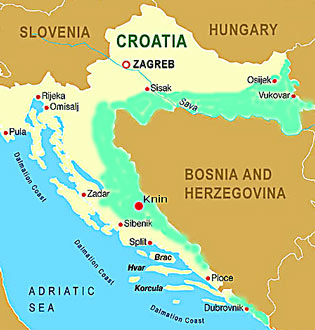
So, if one can put one’s biases aside, the poignant tragedy of this whole set of some 600-years of pain and trauma becomes clear. Bullied out of Kosovo over the centuries, Serbs move north, even so far north as to settle in Austria itself. Then, with no one’s help, they gather Serbs from Kosovo to the trans-Danube-Sava lands where they had settled over the centuries into one state. And less than 100 years later, they lose and are almost entirely expelled from both the Kosovo they had fled from and from the Krajina and Prečani lands they had fled to.
Good to know the whole stories sometimes.
** I’m pissed and disappointed at my χωριανοί, “landsmen”, who have totally abandoned this beautiful and UNESCO-protected form of singing. When I first went to Albania to see my father’s village for the first time in 1992, after the fall of its heinous Stalinist regime, and to meet relatives we only knew through the spotty correspondence that made it through the Albanian Communist καθίκια‘s censorship, a group of aunts and uncles of mine recorded two hours of traditional singing for me to take back to my father (my father put off visitting until much later, when he was very sick because I imagine he was afraid that it would be traumatic; of course, going back when he did in 2002, knowing it would be his one and last time was just as painful.)
(If you want to know more about my family’s history, see: Easter eggs: a grandmother and a grandfather.)

Now, thirty years later, no one except a few very old men still sing; they’ve totally left the playing field of the region’s song to neighboring Albanian villages; just like only a few young girls still wear traditional dress as brides, just like they’ve built horrible concrete polykatoikies without even a nominal nod to the traditional architectural idiom… Dance and dance music they’ve maintained, though they’ve sped up the tempo a little (compared to the second video above for instance) and that would have irritated my dad, since the aesthetic ideal of dance in the region is slow, almost motion-less, restraint — reminds you of Japanese Nōh drama. I carry the torch for him and get “grouchy”, as my friend E. says, when things get a little too uppity-happy on the dance floor.
************************************************************************
Write us: with comments or observations, or to be put on our mailing list or to be taken off our mailing list, contact us at nikobakos@gmail.com.
Flying Dacian@FlyingDacian Tweeted the following:
This is a map of the distribution of Jews in Romania in 1930. 728,115 or 4% of the country was Jewish. Notice that the territories lost in 1940 to Russia and Hungary account for the majority of Jewish people in Romania in 1930.
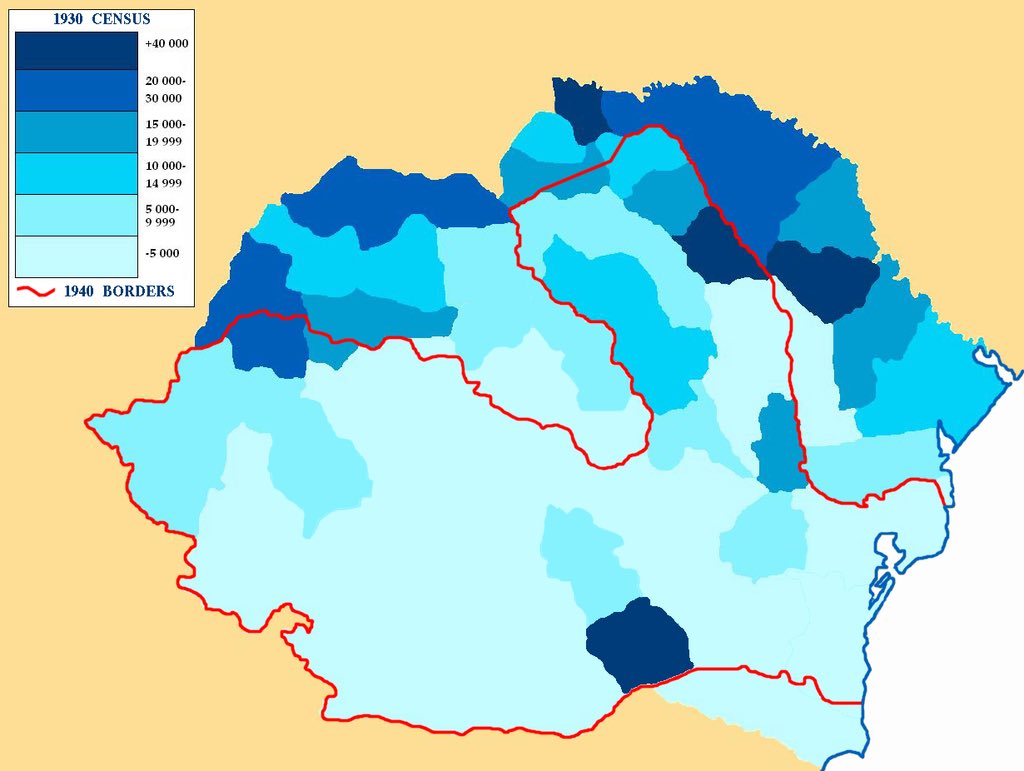
And I asked him…so…what conclusions are we supposed to draw from his map?
And immediately I realized what the most important conclusion was for me and should, therefore, be for everyone: Jewish migration into eastern Europe and the nature of the Polish state at the time.
Don’t tell me you haven’t heard it; you can’t be from New York and not have heard it. You ask a now third or fourth generation Ashkenazi Jew where his ancestors were from and he says: “Oh, Russia or Poland…the borders kept changing.”
It’s a misconception that the Jews who fled pogroms, massacres, persecution and the social chaos of the 14th and 15th centuries in Europe of which they were the primary victims, migrated east to different countries in eastern Europe. They didn’t. They only moved to Poland.
People wonder what it was that led so many Jews to migrate to poor and socially backwards areas of Europe like Russia or Ukraine. Again, they didn’t. What Jew in his right mind would have fled persecution in the Rhineland, say, and sought refuge in Russia, for God’s sake? A relatively primitive mediaeval theocracy, which it arguably still is. Jews, however, ended up in Russia and Ukraine, when Poland was partitioned twice in the late eighteenth century by Russia, Austria and Prussia/Germany. The Pale of Settlement, which my hypothetical New York Ashkenazi Jew above might have heard of — the parts of the Russian Empire were it was legal for Jews to live — were simply the parts of what is now Poland, Ukraine, Belarus’ and Lithuania that Russia got out of the partition of Poland. Upon taking control of these lands, Tsarist Russia also inherited the largest part of Polish Jewry as well.
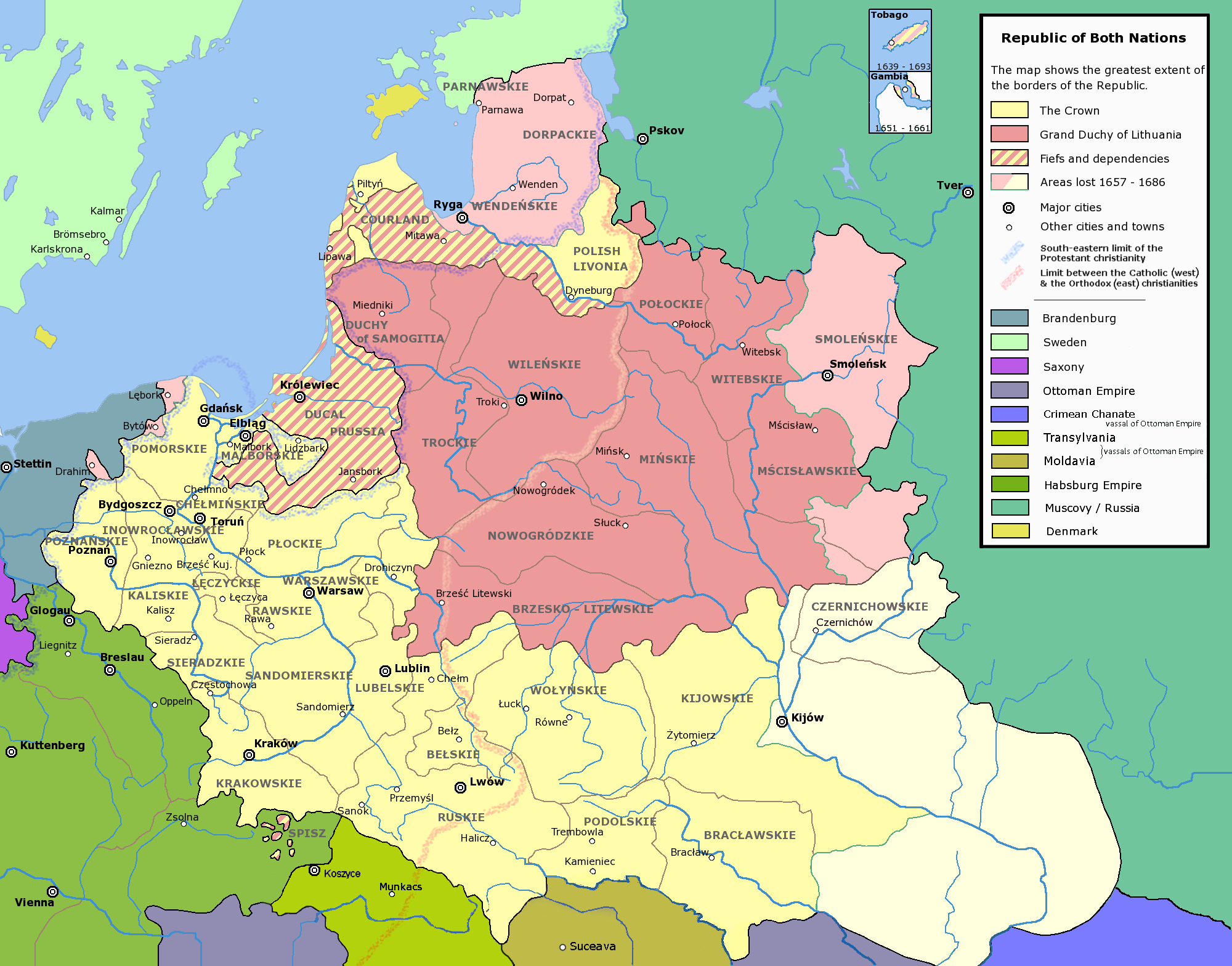
Why did they go to Poland then? Because at the time that persecution of Jews in western Europe was booming the Rzeczpospolita, the Polish-Lithuanian Commonwealth (shown in its various constituent parts in map below) was by far the most tolerant and progressive Christian state in Europe, which surprises many people, and like the Ottomans, Poles saw that Jews’ talents would benefit their state, and allowed and even organized their settlement throughout Poland.

So to address @FlyingDacian‘s curiosity, the parts of contemporary Romania that had the largest number of Jews in 1930, were simply those regions that had been Polish, then passed, some to Hungary, but most to Russia, and then ended up in modern Romania.
************************************************************************
Write us: with comments or observations, or to be put on our mailing list or to be taken off our mailing list, contact us at nikobakos@gmail.com.
…I respond with what’s now my cliché: “Yes…there…AND IN A DINKY PROVINCIAL TOWN CALLED CONSTANTINOPLE.”
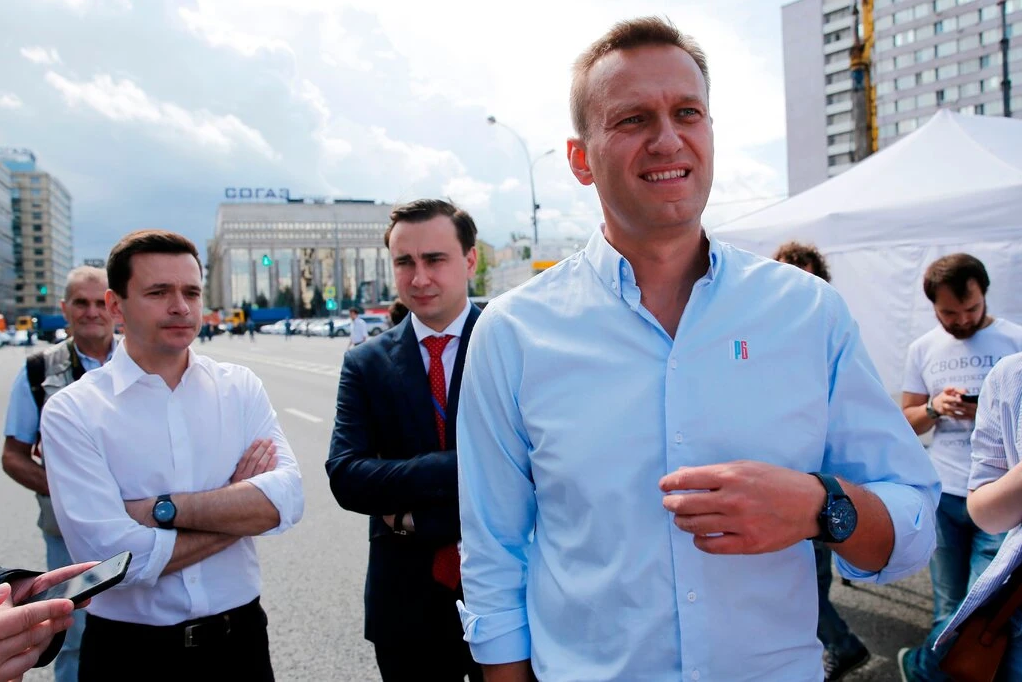
“Mr. Navalny talked with a German prosecutor about being poisoned. Word of his improvement came as France and Sweden confirmed that he had been sickened by Novichok, a Russian nerve agent.”
September 15, 202011:57
Archaeologists unearthed the bones of the communist-era political prisoners at the former Periprava labour camp in eastern Romania, where scores of dissidents died of hunger, cold and exhaustion.

A Romanian fisherman in Periprava in 2004. Archive photo: EPA/MIHAI VASILE
An archaeological excavation conducted by the Association of Former Political Detainees of Romania, AFDPR, has found the remains of 54 dissidents who died in the infamous Periprava forced labour camp between 1959 and 1964.
The area where the unmarked graves were found was established using “information obtained from elderly locals from the village and from some former employees of the labour camp”, the AFDPR said in a statement on MOnday.
“The deaths at this forced labour camp were caused by hunger and cold, by the lack of drinking water and medical care as well as by accidents due to the exhausting working conditions and the detention regime that many of them were subjected to in the camps and prisons that they were previously in,” the statement added.
Some of the detainees were shot dead, mostly when trying to run away from the camp, according to the AFDPR.
Researchers have established that at least 124 detainees died at the Periprava labour camp, which was situated in the mouth of the Danube where it reaches the Black Sea.
Periprava was one of the camps constituting what became known as the Romanian Gulag.
The Periprava camp functioned under the first Romanian communist dictator Gheorghe Gherogiu-Dej, who ruled Romania from 1947 until his death in 1965.
His rule was characterised by Stalinist repression of ‘class enemies’ and ‘undesirable elements’, and the suppression of any form of dissidence.
Thousands of Romanians were imprisoned or sent to forced labour camps such as the one in Periprava.
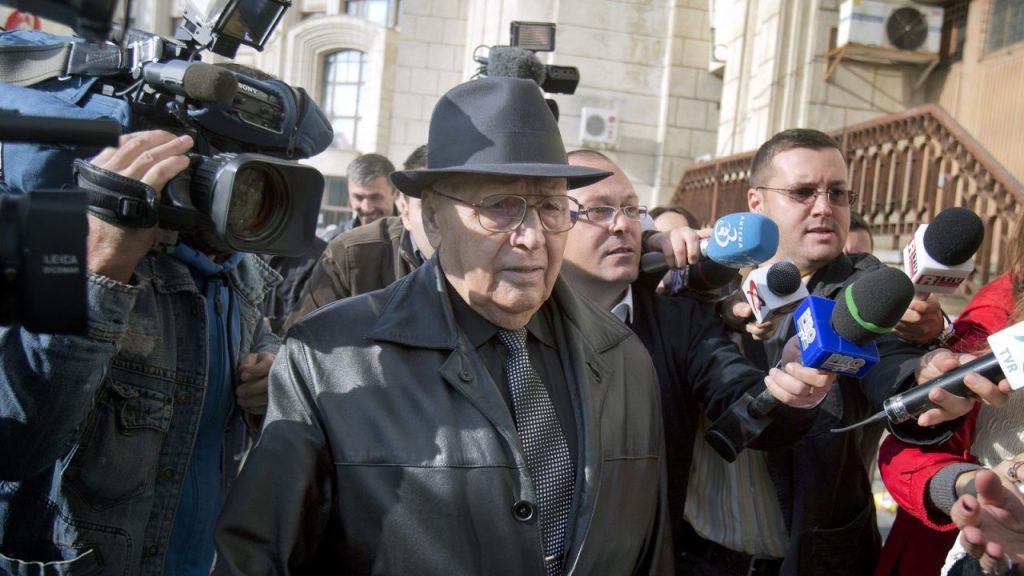
Ion Ficior (centre), former commander of the communist penitentiary labour colony at Periprava, arriving at the High Court of Cassation and Justice in Bucharest in October 2013. Archive photo: EPA/STR.
In 2016, Romania sentenced the former commander of the Periprava labor camp Ion Ficior to 20 years in prison for crimes against humanity. Ficior died in 2018 at the age of 90, after serving two years of his sentence.
“We were forced to cut reed, sometimes covered in water to the waist, together with the water rats and the leeches, and under an unforgiving sun,” one witness told Ficior’s trial.
“We were full of pus-filled wounds from that Periprava sand,” recalled the man, who also recounted how prisoners had to drink water from the Danube in order not to die of thirst.
************************************************************************

 Jadde: from Bosnia to Bengal