Tag Archives: Greece

Photo: Turkish Schadenfreude at Istanbul Airport

1 Aug

TurkishSchadenfreude

Sorry for the poor quality of this photo, but I just had to post this.  An ad all over Istanbul’s airport: “Going to Greece.  Talk to us today for suggestions on how much to take.  Make sure you have enough Euros for your stay.”

At the height of the Greek economic crisis and in the middle of the most bitter negotiations between the Greek government and the European Union over the extortionist measures of the promised bailout, this appears in Turkish airports.  This is a pure, lying attempt at sabotage of Greek tourism.  The dreaded “capital controls” that limited Greeks to taking 60 Euros a day out of ATMs to prevent a run on closed banks never applied to foreigners; i.e., you weren’t going to put your Dutch bank card into a Greek ATM to withdraw money from an account in Rotterdam and be limited to just 60 Euros.  This was really shitty and beneath Turks’ dignity.  But the truth is that I can’t really understand what’s going on in that country psychologically, so I’ll chalk it up to what seems to be a temporary suspension there of all rational discourse.

I’ve just invested so much in defending them (yeah, yeah…think you don’t need my defending? think again…) that I hate when they embarrass me with this kind of nastiness.

Comment: nikobakos@gmail.com

Tsipras’ first cool act.

27 Jan

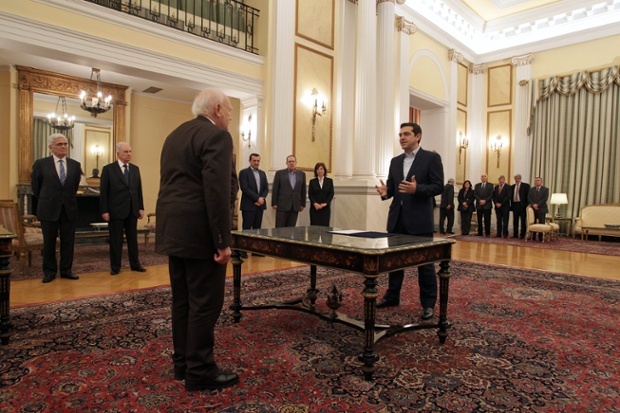
He was sworn-in in a civil ceremony without the Church or any clergy present.  I’m still unsure about this guy — as happy as I am about a SYRIZA victory — but this was a cool and definitive statement.  The Church of Greece needs to know its place — in church.

Tsipras11da7554-d82b-4bc1-a62e-ec2febfd5ced-620x413 Alexis Tsipras is sworn-in. Photograph: Simela Pantzartzi/EPA (click)

GREECE_2290790fPhoto: Alexis Tsipras (r) shakes hands with Greek president Karolos Papoulias during his swearing-in ceremony (Reuters: Yannis Behrakis)

Hands6047626-3x2-940x627Don’t understand the need to form a coalition with a member of a far-right, anti-immigrant party to gain majority in parliament.  Wasn’t there some docile old communist they could’ve taken out of the moth-balls?  But I guess strange bed-fellows is something we have to live with.

Comment: nikobakos@gmail.com

“Χριστός Ανέστη” — Christ Has Risen — and I’m so damn PROUD…

25 Jan

I swear to God those were the first words — the two most totemic in the Greek language — that instinctively leapt out of my mouth when a very loved cousin of mine in Athens answered her mobile today.

Anastasis_fresco_(Chora_Church)The Resurrection fresco in the church of the Chora in Constantinople (click)

I don’t know what will happen.  Tomorrow, me…and Greeks all over the world will wake up sober — or hungover — and have to figure out how this thing is actually going to work.

But one thing all of us need to understand is the power of language and discourse.  By “discourse” I mean the idea and interpretations that people give and ascribe to the phenomena in the world around them; that discourse is “poetic” and a process of “poiesis”— not poetic like Byron or Baudelaire — but poetic in the original Greek sense of “making” or “creating.”  What that means is that DISCOURSE: what people say about things, how people talk about and interpret reality, the opinions and analyses of that reality, are not an either accurate or inaccurate view of that reality but a code and a language that create that reality.  This is simple stuff.  Intro to Deconstruction.  Foucault 101.  And nowhere is it truer than in the “game of chicken” played in the arena of political economics.

So, like I said in GREEK ELECTIONS,” if a critical mass believes a hypothesis is true — or just possible — then it becomes true; then actions and gestures on the ground, and praxeis in the “real,” physical world will create that reality, poetically.  And if we continue to bolster — worse, think we deserve — the Troika’s Neo-Liberal discourse of exploitation, then it will continue.  If we support a discourse, if we believe that an alternative to that reality is possible, then it will emerge.  It only took some workers in a Gdańsk shipyard to say: “I’m not gonna pretend that I believe this shit anymore”; it only took a heroic Gorbachev to say: “This isn’t working”, for the most horrific political economic system that has ever been inflicted on humanity, and that seemed as eternal and as immoveable as Everest, to come crashing down like a house of cards from one day to the next.

This will work, if we let it.  They’ll feed us a language of fear, which if we swallow, will ruin us.  If we simply keep in mind: “That’s what you think — and want us to think — but we won’t,” change will come.

ALSO, we, as ROMANS, should be immensely proud that so many other left-leaning, anti-austerity parties from the rest of the European periphery: Spain, Portugal — and even from Prussia itself and other parts of Merkelstan — came to be part of these elections.  If it gives them only a tiny drop of optimism, if it makes them feel like: “Yes, we can say ‘No!’ too”, it will be a by far greater gift to them than anything else we supposedly gave the West in the past.

YESSSSSSSSSSSS!!!!!!!!!!!!!!!!!!!!

greece_2243418c

Comment: nikobakos@gmail.com


Photo: “Greece…Fuck Yeah!!!”

25 Jan

No further comment from me right now other than what I wrote in GREEK ELECTIONS: “Greek voters may be about to plunge the European Union into a full-fledged economic and political crisis“, which you might want to re-read because I’ve re-edited it some.

Screen Shot 2015-01-25 at 1.39.54 PM

(click)

The Guardian has great updates: 

Comment: nikobakos@gmail.com


-_-(

Everybody’s talking about how a Syriza victory shaking up Europe would be an unfortunate by-product: collateral damage…

25 Jan

…an accidental consequence if we’re not careful and we irresponsibly let Tsipras blindly lead us into this trap….when SHAKING UP EUROPE IS PRECISELY THE POINT!!!

Screen Shot 2015-01-24 at 11.47.15 PMGiannis Papanikos/AP (Click)

by Barbie Latza Nadeau — for THE DAILY BEAST

ELECTIONS
01.24.15
Greece’s Alexis Tsipras: The Man Who Could Break Europe
Sunday’s elections in Greece could bring to power a party that’s pitting the debt-ridden south of Europe against the rich north. Can its leader’s charisma carry the day?

In 2012, when Alexis Tsipras last ran to be prime minister of Greece, his compatriots were quite literally killing themselves in public squares because of the tough austerity measures that had strangled the country’s economy.

Tsipras, just 37 years old at the time, personable, extremely telegenic, took a page from his playbook as a student activist to rabble-rouse for a better life. Tsipras’s office was adorned with a poster of Ernesto “Che” Guevera. (His youngest son is named Ernesto.) And he rarely wore a necktie—especially when he tooled around Athens on his German BMW motorcycle.

His alternative-left Syriza party, he said, was the ticket out of the hell that Greece had become. “We have never been in such a bad place,” he told The Daily Beast back then. “Greeks are on their knees and leaving the country en masse. This is not an acceptable future for a European state.”

Back then, Tsipras promised to guide Greece to a better future, which he proposed would be one without the single European currency and thus outside what’s called the Eurozone.

In the end, Tsipras lost the election, which was played out in two rounds after no clear winner emerged from the first poll. But the fact that Syriza won 27 percent of the vote meant that more than a quarter of Greeks thought his plan had legs, and that worried mightily the powers that be Berlin and Brussels.

Leaders from the rich states in the northern tier launched an anti-Syriza campaign that hurt the untested young leader among those who worried that leaving the euro would be disastrous. “If Syriza comes first, Europe should be very afraid: my expectation is that we would have chaos,” Kevin Featherstone, head of the Hellenic Observatory at the London School of Economics told The Guardian at the time. “There would be huge instability and uncertainty on international financial markets and frenzy with a government that is a loose coalition and lacking clarity of purpose being forced to make decisions.”

Tsipras, who is back on the ballot on Sunday, has changed a lot since that last electoral run. Back then his partner was pregnant with little Ernesto. Now Tsipras spends more time carting his two kids around in the family sedan than joyriding on his beloved bike. He still isn’t photographed much in a tie, but his approach is far more tempered and moderate. This time he is running on a promise not to leave the eurozone. (He now calls his 2012 campaign promise a “paranoid plan.”) And this time, he might just win because many of the negative projections have come true and things in Greece have gotten worse. More than 200,000 Greeks have left the country in the last five years, and austerity has forced many businesses to shutter up or go off the radar. Greece’s black market economy is now estimated to account for nearly half of the country’s GDP.

More than 200,000 Greeks have left the country in the last five years, and austerity has forced many businesses to shutter up or go off the radar.

There are also signs that Europeans in other countries who once fought to keep the eurozone intact at any cost now feel they could get along pretty well without Greece. After all, it has a population of only 11 million in a European Union of 500 million and it represents only about 1.4 percent of the union’s GDP.

In early January, Germany’s Der Spiegel weekly quoted a source close to German Chancellor Angela Merkel saying that Berlin was “open” to a Greek exit, or Grexit, as the potential departure move is known.

Under pressure, Merkel was forced to backtrack, insisting unconvincingly that she wanted Greece to stay. “I as German chancellor, and also the German government, have always pursued a policy of Greece staying in the euro zone,” she said at a joint press conference with British prime minister David Cameron.

This time around, Tsipras has promised the Greeks that Europe needs them and has no choice but to renegotiate Greece’s bailout debt conditions. And Greeks like what they hear. Days before the vote, he widened his lead by nearly 7 points ahead of current prime minister Antonis Samaras’ New Democracy party, according to the last poll conducted by Greek SKAI television.

Last time, Tsipras came out swinging against Europe and its currency. This time he is picking his fights, and trying to build alliances across the southern tier of the continent.

Tsipras argues that in order to stay in the eurozone, Greece’s ruling party has negotiated a foolhardy payment schedule for its $378 million bailout debt that makes it impossible for the country to grow. The current repayment plan is 175 percent of the gross domestic product, and Tsipras wants a better deal, starting with his demand that Europe should simply erase most of the Greek debt.

“Hope is coming,” he says, repeating the Syriza campaign mantra. “Five years of destruction and fear have led nowhere. Enough is enough.”

The lessons the young leader has learned since the last elections are apparent. He has traded what amounted to fear-mongering in his last electoral campaign for consensus building, starting with a promise to some of his former naysayer European leaders. Many of Europe’s struggling countries have launched their own versions of alternative leftist Syriza parties and Tsipras had made the rounds to Italy, Spain and Portugal in recent months.

In 2012, Tsipras gave wide ranging interviews to most people who cared enough to ask. This time around, he is writing op-eds in Europe’s largest newspapers to garner support not only for voting Greeks who have moved abroad, but to get Europe’s other austerity-suffering countries to back the debt reshuffling proposal with the idea that such a precedent could help them, too.

Writing in the Spanish daily El Pais, Tsipras tries to assure Spain that Greece can lead the way for all of Europe’s struggling economies. “From the darkness of austerity and of authoritarianism, into the light of democracy, of solidarity and of sustainable development,” he writes. “For this reason, Greece is only the beginning. Within this year, Spain’s turn is coming. The change begins from the South. The defeat of the political sponsors of austerity, foreclosures, of insecurity and fear, of corruption and the scandals has its launching point in our countries.”

Tsipras changed his message slightly in a hard hitting op-ed in the Financial Times a few days later, in which he says Europe must end austerity so as not to let “fear” kill democracy. “We have a duty to negotiate openly, honestly and as equals with our European partners. There is no sense in each side brandishing its weapons,” he writes. “Unless the forces of progress and democracy change Europe, it will be Marine Le Pen and her far-right allies that change it for us.”

On January 14, Tsipras fielded questions with the hashtag #asktsipras in what turned out to be an ingenious town hall debate that garnered 32,000 tweets in the first few hours after it launched. He accused the ruling class of “creating a breeding ground for scandals” and touched on everything from tax reform to foreign policy. He tweeted, “We will not take part in NATO with a bowed head. We will not support military interventions. We will defend international legality.”

Tsipras has come a long way in just a few years, but not all of Europe is optimistic about a Tsipras-led Greece. In an interview ahead of the World Economic Forum in Davos, Switzerland, Christine Lagarde, head of the International Monetary Fund, which owns a lot of the Greek debt, quashed Tsipras’s debt renegotiation promise and said there is very little wiggle room when it comes to renegotiating debt. “A debt is a debt and it is a contract,” she told The Irish Times. “Defaulting, restructuring, changing the terms has consequences on the signature and the confidence in the signature.”

Speaking to RTLZ television ahead of the Davos meetings, Dutch finance minister Jeroen Dijsselbloem, who heads the influential Eurogroup of European ministers agreed. “There’s no political support to write off Greek debt,” he said.

And in Germany, there was that Der Spiegel report that the German government would rather have a Greek-free euro than open the way for a trend that would be costly to the richer nations. “The German government considers a euro zone exit [by Greece] to be almost inevitable if opposition leader Alexis Tsipras leads the government after the election and abandons budgetary ­discipline and does not repay the country’s debts,” the magazine reported.

Even at home in Greece, not everyone predicts that Tsipras will walk away with a clear mandate to run the country. Alexis Papachelas, executive editor of Greece’s Ekathimerini newspaper, cautions that the likely scenario of a second vote, like what happened in 2012 when the first ballot failed to produce a winner, could spell even bigger disaster for the country.

“Whichever party wins Sunday’s elections will be faced with a mountain of obligations. Tax revenues have plummeted and banks are under enormous pressure. Some inside Syriza like to believe they have a solution to every problem: Foreign lenders will give Greece ample time, the [European Central Bank] will provide unlimited liquidity to Greek banks …,” he says. “Or so they think. For if you attempt to cross-check the information you will find very little in the form of a convincing answer. It’s like they are divorced from reality.”

Tsipras’s response is typically stirring: “The struggle of our peoples for change is the struggle of common sense versus ideological fanaticism,” he says. “It is the struggle of dignity versus servitude,” he says.

But at the end of the day, somebody’s got to pay the bills.

No.  At the end of the day, one of the two forces at play here will blink…

Comment: nikobakos@gmail.com

The Classical Liberals: “On the Balkans, the Former Yugoslavia, and the Unity of Spaces”

4 Jan

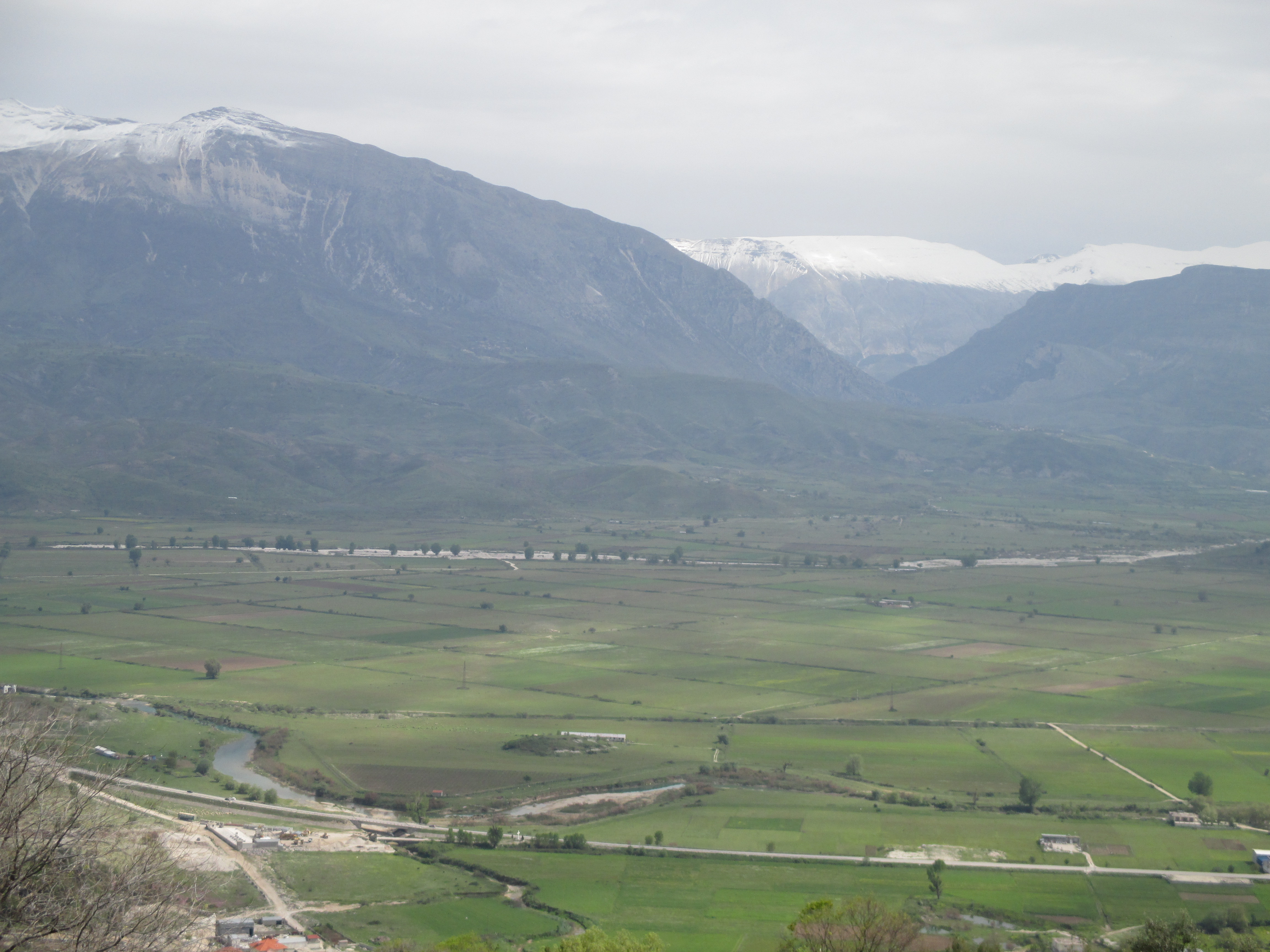
dropoliThe Valley of Dropoli, the pass up to the Pogoni plateau near Libochovo, and in the distance, the snowcapped peaks of Nemerčka, from the Monastery of the Taxiarches in my father’s village of Derviçani, Easter 2014 (click)

I’m honored by the fact that this really intelligent blog quotes extensively from the Jadde’s mission statement in a recent post: Jadde — Starting off — the Mission.

Check them out: The Classical Liberals: At least, most of the time  Smart, perceptive, interesting stuff.

The author of the post below and the person I suspect is largely behind the editing of the blog is one Eoin Power, not just a fellow Balkan-freak along the lines of me or Rebecca West, but also a fellow Epirote.  He demurs a bit — though not very convincingly — at being called an Epirote, because his lineage is multiple and complicated and the connection to Epiros is fairly distant historically.  But he’s from one of the most archetypically and ancient Epirotiko villages — where they still own their patriko — in one of the most archetypically Epirotiko regions of Epiros and he carries himself with the requisite Epirotiko dignity and soft-spokeness and if I, NikoBakos, have conferred the title on you, it’s ’cause you deserve it.

***************************************************************************************************************************************************************************

On the Balkans, the Former Yugoslavia, and the Unity of Spaces

The other day, as she is wont to do, my mother sent me a link to something on the Internet; this time it was to Nicholas Bakos’ blog, which you can find here. If you’re reading this blog, we’re probably friends in real life (thanks for reading!), and so it’s probably obvious why something like that would be of interest to the both of us. I have admittedly only skimmed sections of his posting so far, but in his introductory one, it was especially gratifying to read this:

This blog is about “our parts.”  It’s about that zone, from Bosnia to Bengal that, whatever its cultural complexity and variety, constitutes an undeniable unit for me.  Now, I understand how the reader in Bihać, other than the resident Muslim fundamentalists, would be perplexed by someone asserting his connection to Bengal.  I can also hear the offended screeching of the Neo-Greek in Athens, who, despite the experiences of the past few years, or the past two centuries, not only still feels he’s unproblematically a part of Europe, but still doesn’t understand why everyone else doesn’t see that he’s the gurgling fount of origin and center of Europe.

But set aside for one moment Freud’s “narcissism of petty differences,” if we have the generosity and strength to, and take this step by step.  Granted there’s a dividing line running through the Balkans between the meze-and-rakia culture and the beer-and-sausage culture (hats off to S.B. for that one), but I think there’s no controversy in treating them as a unit for most purposes; outsiders certainly have and almost without exception negatively.  And the Balkans, like it or not, include Greece.  And Greece, even more inextricably, means Turkey, the two being, as they are, ‘veined with one another,’ to paraphrase the beautiful words of Patricia Storace.  Heading south into the Levant and Egypt, we move into the Arab heartland that shares with us the same Greek, Roman-Byzantine, Ottoman experiences, and was always a part of the same cultural and commercial networks as the rest of us.  East out of Anatolia or up out of Mesopotamia I challenge anyone to tell me where the exact dividing line between the Turkic and Iranian worlds are, from the Caucasus, clear across the Iranian Plateau into Afghanistan and Central Asia.

Bakos suggests that for people of “those parts” displaced to another environment (e.g. grad school in the West), this kind of geographical unity came, at least in a social context, fairly naturally, so perhaps I shouldn’t be all that surprised and delighted at seeing it reconstituted in blog form. But in fact I think the basic unity of the geographical zone outlined here often gets lost in the way these places are understood by outsiders and, ironically enough, in no small part due to the vehement insistence from each of the zone’s component peoples that they could not possibly be compared with those uncultured idiots with whom they share a border.*

Explaining the rationale for delineating “his parts” the way he does, Bakos writes:

But to step into Buddhist Burma is somehow truly a leap for me, which maybe I would take if I knew more. And in the other direction, I stop in Bosnia only because for the moment I’d like to leave Croatia to Europe – mit schlag – if only out of respect for the, er, vehemence with which it has always insisted that it belongs there.  Yes, I guess this is Hodgson’s “Islamicate” world, since one unifying element is the experience of Islam in one form or another, but I think it’s most essential connections pre-date the advent of Islam.  I’ll also probably be accused, among other things, of Huntingtonian border drawing, but I think those borders were always meant to be heuristic in function and not as hard-drawn as his critics used to accuse him of, and that’s the case here as well.

Ultimately what unites us more singularly than anything else, and more than any other one part of the world, is that the Western idea of the ethnic nation-state took a hold of our imaginations – or crushed them – when we all still lived in complex, multi-ethnic states.  What binds us most tightly is the bloody stupidity of chilling words like Population Exchange, Partition, Ethnic Cleansing – the idea that political units cannot function till all their peoples are given a rigid identity first (a crucial reification process without which the operation can’t continue), then separated into little boxes like forks after Easter when you’ve had to use both sets – and the horrendous violence and destruction that idea caused, causes and may still do in “our parts” in the future.

Having not, at least north of the equator, yet made it further east than Istanbul, I am in no position to question Bakos’ perception of the fundamental apartness of Buddhist Burma. But the loose border he posits to the north and west is one I’ve crossed many times, and it’s one that is both deeply present and functionally invisible.**

At the very least it is present in people’s minds; I can vouch for the vehemence (to use Bakos’ word again) with which Slovenes and Croats will insist that their countries are European, and not Balkan. It’s also pretty visually observable – you could mistake Zagreb or Ljubljana for a city in Austria or Germany in a way you simply can’t for, say, Sarajevo or Belgrade. And on one frantic trip from Dubrovnik back to Ljubljana (the ferry which I’d intended to take from Dubrovnik to Ancona decided not to arrive from Split, leaving me nothing to do but beat a hasty retreat back north) you could, if you were looking for it, see an actual tangible difference in the way things were done in the world – bus tickets in Mostar and train tickets in Sarajevo had to be paid in cash and a conductor on the train north from Sarajevo let me pay in a mix of Croatian kuna, Bosnian marks,  and euros. In Zagreb I could pay with a credit card, the train station had working and appealing amenities, and you couldn’t smoke in the train. This is a terribly squishy thing to write, but it did feel more “European-y”.

On the other hand, if the relatively old Huntingtonian dividing line between formerly Orthodox and Ottoman lands to the south, and formerly Catholic Hapsburg lands to the north is visually (and, at least in terms of credit card viability in 2009, functionally) discernible, the comparatively recent unifying experience of Yugoslavia is also unavoidable. Here, too, the first signs are in architecture and appearance; Soviet-style architecture and the legacy of 1950s industrialization has left the same physical scars on cities from Nova Gorica to Skopje. But they run deeper than that – the protestations of linguistic nationalists notwithstanding, Slovene, Bosnian, Croatian, Serbian, Montenegrin, Macedonian (hell, even Bulgarian a bit) all exist along a spectrum of of mutual intelligibility; state apparatuses, all having those of the former Yugoslavia as their common predecessors, share similar characteristics. Indeed, to me as a foreigner, the similarities often seem more salient than the differences.

Just on the basis of whether or not there “is” a usefully differentiating border to be drawn where Croatia meets Bosnia, it seems you can argue fairly fruitfully either way, depending on whether your sympathies lie with a sort of longue duree emphasis on deep civilizational splits or a faith in the primacy of modern political experiences. But by Bakos’ own ultimate criteria, it seems a bit odd to leave the northernmost bits of the former Yugoslavia out of things (though there is a nice alliterative symmetry to covering “from Bosnia to Bengal”) . If you’re going on the basis of, “the bloody stupidity of chilling words like Population Exchange, Partition, Ethnic Cleansing,” surely things like Jasenovac or the Istrian exodus argue for the inclusion of all of the former Yugoslavia?

Of course, any exercise in boundary-izing is a bit arbitrary, and in this case there are good reasons to put one in between Croatia and Bosnia and not, say, in between Slovenia and Austria (two countries for which there also exist plenty of historical reasons to consider them as part of a unified space). So if all of this does anything, it is perhaps to show how much more liminal are most places than we or their inhabitants often care to admit; whether or not you see a border somewhere often depends as much on your level of zoom as anything else.

*Or at least their nationalist politicians – many average people (whatever that means) in Bosnia and Serbia, for example, will quickly stress to you the fundamental similarities between the two countries and their inhabitants
**People sometimes marvel at my overstuffed passport but really something like 40% of the stamps come from the Dobova and Dobrljin border posts.

**************************************************************************************************************************************************************************

Again, check these guys out; you won’t regret it: The Classical Liberals

Comment: nikobakos@gmail.com

Today’s my nameday

6 Dec

Saint_Nicholas_1550Russian icon of St. Nicholas the Wonder-worker (click)

Today’s the feast of St. Nicholas (on the Gregorian calendar — December 19th on the Julian Calendar, depending on what kind of Orthodox you are ethnically), the saint generally known in the East (and beautiful Bari, one of my favorite Italian cities) as the “Miracle-worker.”  But for me the coolest thing about St. Nick, and that’s the cause of his nauseating transformation into Santa Claus in the West, is that his miracles are deeply human and mundane and material, and actually just more good deeds than miracles: his most metaphysical, I guess, was his power to calm threatening seas; probably more to the point he prevents the execution of an accused criminal, following Christ’s example in opposing capital punishment or — my favorite — he quietly leaves three bags of gold, εν τω μέσω της νυχτώς, in the bedroom of three poor sisters who needed dowries to get married.  He didn’t preach or rail against the dowry system, like the moralist who thinks his ideological crusade is more important then the real needs of real people, who gets a hard-on from his preaching while others are truly suffering: for example, the schmucks who leave a hard-working waiter a card that says: “We don’t believe in tips; they’re exploitative, join our group at www…etc…” or like the assholes you hear in New York on the subway when a panhandler comes by and certain types go off on their “oh-I’ve-heard-that-story-before-get-a-job-you-probably-make-more-money-than-me” tirades, without thinking that if a man is reduced to begging, for whatever reason, he’s already been through hell enough and deserves your compassion.  A priest at my old parish in Whitestone, I remember years ago on this day, said in his sermon: “St. Nicholas is not one of our great theologian-intellectual saints, like the Cappadocians [though he apparently slapped someone at the First Oecumenical Council at Nicaea for saying something dumb about the Trinity…I think], or one of our warrior, defender-of-the-faith saints, like Demetrios or Mercourios or the Archangels.  More, he was a saint who always made sure that everyone under his pastorship had food to eat and a roof to sleep under.”  He was particularly venerated in the sea-faring islands of Greece, for obvious reasons (“Hagie Nikola, I implore you” sings the island girl with her sailor-man away, “carpet the seas with flowers…”) and is the patron saint of Russia.  In communist times the name still had some lingering Imperial/Romanov stigma attached to it and when I was there in the eighties, it seemed anachronistically charming to many Russians.  Now it seems there are significantly more young “Kolyas” and “Nikolays” everywhere.

Despite an almost erotic devotion to and obsession I’ve developed for St. Demetrios over the years — hard to resist a young Roman aristocrat in uniform with a pretty deep, homoerotic friendship as part of his martyrdom backstory — Nicholas is still my patron saint.  And he’s more than just important to me as saint himself, but because I love the Orthodox nameday tradition, which again varies from country to country.  Serbs have always observed a single clan nameday, the Slava, celebrating the saint on whose feast-day the family’s first ancestor supposedly converted to Christianity, a very ritualized and beautiful celebration and one of the many traditions that Serbs adhere to that makes them the Slavs that, more than any others, still have one foot in their pagan past; telling, also, to how important he is in the Orthodox world: the single largest group of Serbian clans celebrate St. Nicholas as their Slava patron.  Communism forced Russians to take their birthdays more seriously, and discouraged the celebration of the obviously religious nameday, but nineteenth-century Russian literature is full of nameday celebrations (Chekhov’s “Nameday Party,” and Tatyana’s nameday dance in Pushkin’s Onegin*), and as a semi-conscience remembrance of what the new Western-style celebration of birthdays replaced, the birthday-boy is to this day still called the “imeninets,” the “name-bearer.”

What I most love is that, among Greeks, your nameday is a day critical to your honor and reputation: it’s when you take friends out and treat them; it’s when people in small towns especially, but even some in Athens still, sit home in a house full of food and sweets and wait for everybody who has the right to — meaning every one they know essentially — and most likely will, drop by and wait for the the privilege of feeding them; most young Athenians today wait for an official invitation but massive group drop-ins are still common enough among the old-fashioned.  In smaller, provincial towns, when there was a death in the family, you used to have to put an ad in the paper saying: “Due to mourning, we won’t be accepting callers this St. Nicholas Day.”  In villages everybody just knew.  It’s a day when you make an artoklasia,  a “bread-breaking” offering and share sweetened and blessed loaves with your whole parish.  It’s a day when it’s your obligation to give and serve and prove your noblesse and not, as Western birthdays have become, a day when you sit around waiting for others to do for you or give you gifts.  Western, American, birthdays are only slightly less gross to me than the totally American ugliness of wedding and baby showers: “I’m getting married and/or I’m pregnant; so I’m having a party where you have to bring me things.”  And don’t even start me on bridal registries, where you tell people, not just that they have to bring you something, but what they have to bring you.

So: χρόνια μου πολλά…  And Многая Лета to other Nicholases everywhere.  Keep the tradition alive.

Comment: nikobakos@gmail.com

**************************************************************************************************************************************************************************

* Tatyana was not a popular name in Russia until Pushkin’s Onegin became the Bible and literary gold standard of modern Russian, and Russians took the deeply loved heroine into their hearts.  Only then did it become a widespread name and eventually, through her epic act of heroically soul-baring letter-writing probably, her nameday, January 12th or 25th — depending again on calendar — become the patron saint day of young students and scholars.

“Greece, though, has gotten nothing but fiscal and monetary tightening.”

17 Nov

Greece Is Growing

Nov 17 2014 @ 5:22pm

Greece

Finally:

Greece’s crisis-stricken economy has returned to growth following six years of recession, official data showed Friday, marking an end to one of the steepest and longest economic contractions in postwar European history.

But Matt O’Brien warns that “Greece’s comeback, like its collapse, will be nasty, brutish, and long”:

Greece’s depression … is still nowhere near done. You can see that easily enough in the chart above, which I’ve modified from The Economist. It compares Greece the past few years with what used to be the gold standard of economic catastrophe: the U.S. during the Great Depression. Now, Greece’s economy fell marginally less than America’s did back then — around 27 percent at its worst — but the biggest difference between the two is the slope of the recovery. The U.S., as you can see, rocketed back once FDR devalued the dollar and started spending more. Only the double whammy of premature fiscal and monetarytightening knocked it off track in 1937.

Greece, though, has gotten nothing but fiscal and monetary tightening.

Comment: nikobakos@gmail.com

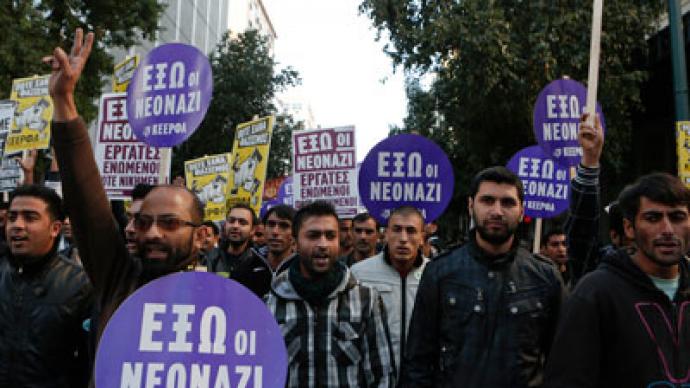
Συγχαρητήρια! Congratulations! for trumpetting Al Jazeera headline: “Greece, a front line for state-sponsored racism in Europe”

29 Sep

“…a front line for state-sponsored racism in Europe.”

Are you proud of yourselves?  Και εις ανώτερα!

immigrants-19-banners-athens.si(Reuters/Yorgos Karahalis)

“Once the cradle of European civilization, Athens is now the center of a continental decivilizing process.”  See whole article .

And I want to make sure you all know my heartfelt congratulations go out to all and every one of you, every inhabitant of the statelet that’s sat by silently doing and saying nothing all these years as this ugliness built up its now seemingly unstoppable momentum.  And instead are worried about whether Albanian genes will show up on your DNA chart

Comment: nikobakos@gmail.com


“A Greek Politician Willing to Face the People”

27 Sep

An amazingly flattering article on Rena Dourou, MP of Syriza, from the Times:

DOUROU-superJumbo “People were amazed to see me. They had never met a politician. They were touching me, saying, ‘You are Rena Dourou?’” Credit Lynsey Addario for The New York Times (click: great pic and great Greek female face — not conventionally beautiful, but sexy in our sharp and edgy and smart and witty way.)

Not in a position to judge Syriza, Dourou’s slightly left of center party; people whose opinions I respect think the party’s leader, Alexis Tsipras (see Nicholas Gage’s assessment here and and my response here) is a not-to-be-taken-seriously posturer and brat; and the truth is he reminds me and others a little too much of a young Papandreou — and smells a little like too many Athens College graduates I know, though I don’t actually know where he went to high school.  But the portrait of Dourou is convincing enough.  Just the way she’s apparently dealt with the sexism of the Greek political establishment, at least, seems something to commend her for.

Money quotes:

Easy to mock as cheap and populist:

…for the time being, Ms. Dourou’s election as prefect, the rough equivalent of the governor of New York, represents the party’s biggest victory so far.

Petite and blond, Ms. Dourou ran an American-style campaign, going door to door, something most Greek politicians avoid out of fear of being assaulted by angry citizens. [My emphasis — only ’cause I thought it was really funny] On her office wall, she kept a map of the region with dozens of pins indicating where she had traveled. Few opinion polls correctly predicted her victory.

But she brought her handshakes and her motto — “if you feel you have the life you deserve, don’t do anything and vote for the same old people” — all over the city, even to areas considered bastions of the right-wing Golden Dawn party.

“I don’t know whether it got me any votes,” she said. “But people were amazed to see me. They had never met a politician. They were touching me, saying, ‘You are Rena Dourou?’ ”

And a perfect little detail with which you can paint the Greek political establishment’s level of professionalism, and Neo-Greek spoiled loser pettiness:

But for the time being, she remains an official with few allies in office and little experience. A few months after winning and before taking office, she sent a formal letter to her predecessor asking to be briefed on the “loose ends” and “current issues” in the region. In his response, he told her the information was on “corresponding websites.”

And this is the kind of stuff for which Syriza gets my ambivalent respect:

NONETHELESS, she has already made headlines for a public brawl with the central government over the future of thousands of municipal workers in her region. The central government wants to review their credentials and evaluate their performance. But Ms. Dourou sees this as a thinly veiled starting point for cutting workers and pleasing Greece’s creditors, and she is refusing to hand over their files.

Dealing with Neo-Greek male garden slugs:

STILL, politics in patriarchal Greece can be tough on women. Last year, the vice president of the government, Evangelos Venizelos, told a female member of Parliament that “she should be pregnant.”

As Ms. Dourou was campaigning for office, a former deputy prime minister from the socialist Pasok Party, Theodoros Pangalos, said in a radio interview that he could not stand seeing posters of Ms. Dourou’s “filthy face” all over Athens. He added that he would “like to see her campaign complete with a full-body picture of her with a bikini.”

Dunno…  We’ll have to see.

Comment: nikobakos@gmail.com