Tag Archives: Jiannena

The adventures of me and my nephew Vangeli in C-town

2 Jun

IMG_0779

(click)

This is my nephew Vangeli from Tirana, who came and spent an extended weekend with me in Istanbul last week, eating a simit in the Staurodromi.  When I started this blog I said to myself I wasn’t going to include personal names.  When you represent something ideologically problematic for me, you’ll usually be described by a repeated sociological profile: “the Athenian thirty-something” or you’ll get a moniker all your own; in any event, if you read regularly, you’ll know who you are.  But the warmth of certain experiences I had with my family in my village this past spring has made me want to “call their names,” both because these are people I learned to love a great deal in a very short amount of time and to do them the honor, even if these experiences are not that interesting for the objective reader.  It’s obvious that it’s for them.

Vangeli is my second cousin Calliope’s eldest son. (See Easter Eggs… because, believe me, you don’t want me to run through all the lineages each time and I can’t do it either.)  When I first went to Derviçani in 1992, after Albania had safely opened up for good, Calliope was already living in Jiannena and we met there first, so we could get to know each other before going into Albania together.  When we arrived in the village for the first time, hers was the face I was constantly looking for as a reference point among the throngs of relatives who were constantly surrounding me.  It was her and my cousin Panto, Pantele, who is still my official bodyguard everywhere I go in the village, telling me who’s who since I can’t keep track, taking me everywhere I want to go, counting the tsipoura (raki) I have at every visit, so they don’t add up to too many in one afternoon, etc.  His mother, my Kako Poly (Polyxene), is a saintly woman who made great sacrifices caring for my grandmother in her final years under conditions of great material deprivation for all.  In video we have of my grandmother, taken by complete fluke by a cousin of my mother’s who went to Albania in 1988, a year before my grandmother died, as part of a Greek commercial exchange delegation — these groups were always taken to Derviçani as it was the showcase Greek minority village in communist times — my grandmother says: Να, αυτή είναι η Πόλυ, μ’έχει επάνω της… — “Here, this is Poly, she (lit.) carries me.”

IMG_0050This is Calliope, with her two sons Vasili (left) and Vangeli (right) on Easter night in church (click).  She’s an extraordinary and extraordinarily loveable woman: a great housewife, a competent businesswoman, funny, generous, always smiling, as flirtatious and open as a teenage girl — she’s one of my great relative-loves.  Here she is below at the Monastery on Easter Monday, having just deposited a huge piece of lamb shoulder — no, actually, a lamb shoulder — on a paper towel in front of me, cold and glistening with shiny white fat like some Homeric offering.  My father always loved cold lamb, and would never let my mother reheat it, because it reminded him of the Easter dance at the Monastery.  This is a typical pose to catch her in below, because her innate generosity is always giving something to someone.  (Click)

IMG_0119I hadn’t met Vangeli before, and if I had he would’ve been a baby.  But in church that night, when we were introduced, he said to me, in his classic Aries way — breezy and confident: “Actually, I don’t know you, but Christos Aneste!”  And my Aries replied: “I don’t know you either, but Alethos Aneste!” and I knew right then we’d hit it off.  We talked the next day at the dance; I invested some of the best days of this trip visiting them in Tirana on my way back from Montenegro, and of all the people who said they would come to Istanbul to see me while I was here, I knew he was the only one who would actually do it.  We locked horns on titles or terms of address for a while; I am literally twice his age, fifty and twenty-five, but we hang out like cousins and that’s what he used to call me, whereas I want to be called “uncle.”  He wasn’t having it.  (I have a similar problem with some nephews in New York on my mother’s side.)  For a while we agreed on “şoku,” which is “buddy” in Albanian but also meant “comrade” in communist times, so that didn’t last very long, nor did the Russian “tovarishch” which means the same thing.  Finally, when he got to Istanbul, he heard some guy addressing another as “abi” — big brother, technically, but often just “mate” — which they use in Albanian as well, so it’s been “abi” since then and that pretty much describes how we relate to each other. 

I’m an only child.  Calliope is like the big sister I never had and it’d be hard to imagine a more loving one.  But my parents also had a first son that died when he was a baby, so, even more deeply, I’ve always felt literally haunted by a living presence and desperate absence at once, and by an entirely metaphysical need for a being that I feel is out there to incarnate itself again as an older brother.  But being an older brother to someone else is just as gratifying, especially to a kid like Vangeli.

Because he’s good at his role and he did me super-proud here.  He studied computer engineering in Birmingham and speaks flawless English, dresses impeccably, works for a company that sends him to Italy on a regular basis, so he speaks some passable Italian as well.  (Some fashion-victim friend of mine from New York saw him dancing in the second video here and wrote to ask me who the funky kid with the curly hair and the Prada glasses was — she had recognized the Prada frames from five-thousand miles away…)  We went out for a classic Istanbul fish-and-rakı dinner at a really good place in Cankurtaran in the old city; he immediately recognized that this was not just any meal, but that he was in the presence of a certain ritual to be respected, like Japanese kaiseki, and he acted accordingly.  He was put off by the anise in the rakı at first — we drink ours unflavoured in Epiros — but then realized that Turkish rakı is not the cough-syrup by-product that Greek ouzo is and enjoyed it thoroughly.  He had no negative preconceptions of Turks and Turkey and he never, never — not once — tried to insert one of those slimey negative innuendos about Turkey into the conversation that almost every Greek tries to do when he’s with Turks.  He just listened to the two female friends we went out with, asked questions, tried to learn, gave his opinion, talked to them about Albania and Argyrocastro and Tirana and our families and Britain and anything else you could imagine, and charmed the skirts off of both of them.

He wanted to see everything.  I hate going into the old city.  I find it depressing, crowded.  I love the mosques, but the Byzantine monuments discourage and sadden and, sometimes, anger me, and I prefer to not be confronted with the interface between the two and just stay here in Pera, expelled from the walls in my gavuriko varoşi.  Also, getting there is alright, but getting back means trudging up and down and then up and down again some incredibly pedestrian-unfriendly streets and intersections and underpasses, unless you take some sleazy Sultan Ahmet cabdriver whose meter suddenly races to 100 lira by the time you get from Hagia Sophia to Pera.*  But for Vangeli I went.  And we saw everything there was to see.  We even stumbled upon the Rüstem Paşa mosque, which if you ever asked me to find, I never could.  We sat in the Süleymaniye for an hour and he listened to me talk about why I like sitting in mosques and watching Muslim prayer — Istanbul was the first time he had been inside one — and find them so calming and peaceful.

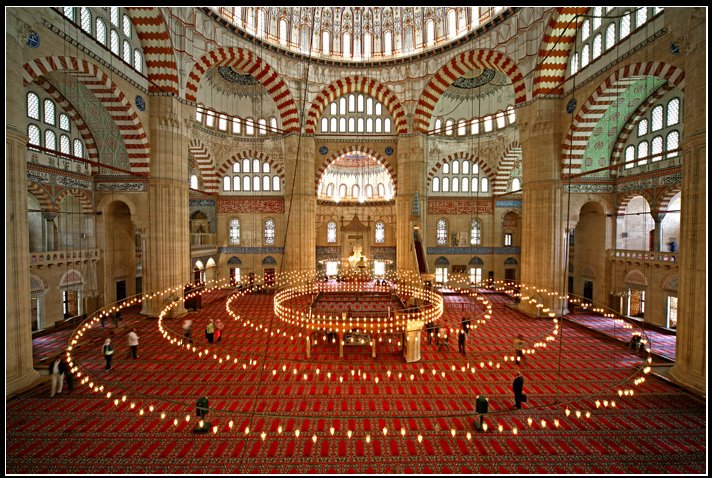
Rustem pasa tiles

Suleymaniyeimg_redirect.phpThe tiles of Rüstem Paşa above and the interior of the Süleymaniye (click)

We covered every inch of Topkapı, where I hadn’t been in years and where I was re-dazzled by that Ottoman sense of elegance and comfort that Rebecca West speaks of so often.  He was interested in the oddest things.  His favorite palace was Beylerbeyi, as it is mine, but he was fascinated by the story of the French empress Eugénie, born Eugenia de Montijo of the highest Andalusian aristocracy, who extended her state visit there for so long that it began to turn into a diplomatic scandal in Europe: he wanted to know how beautiful she was; he wanted to know whether Abdülaziz was such a stud that he was actually shagging her and how Napoléon III could have been such a nebech that he didn’t come grab her by the hair and drag her back to Paris.  “Άμ,’ ήθελες γυναίκα Ισπανίδα…” he decided, after much pondering — “that’s what you get for wanting  a Spanish wife.”  And an Andalusian one at that.  But once you’ve seen Beylerberyi, where she was put up on her visit, which is like a gigantic Turco-Venetian palazzo opening up onto the fresh, cool waters of the Bosphorus and not some smelly canal, you realize that once anchored there, leaving would be hard even if you weren’t getting any from the Sultan.

Beylerbeyi Palace (click)

beylerbeyi_palace_by_shidikujThe Empress Eugénie of France, née Eugenia de Montijo of Granada; the Jackie Kennedy fashion plate of mid-nineteenth century Europe and considered one of the most beautiful women in the world at the time (click), subject of the copla by Rafael de León and Manuel Quiroga, made famous in Concha Piquer’s incomparable rendition.

Eugénie;_keizerin_der_Fransen_(2)

The last day I was exhausted but he wanted to go look around Turkish supermarkets for yufka to compare the quality and price to what his family’s company makes; this is my Uncle Vangeli’s business; they make yufka and tel kadayif and sell it throughout Albania.  The name of the company is Demetra, like the ancient goddess of agriculture and cereals.  We went to a couple of Carrefour and he wasn’t impressed.  We went to some small bakalika and they didn’t have any at all.  And, very cutely, he made the assumption, in those hushed tones of respect that the Ottoman culinary tradition still carries with it in the Balkans, especially in the western Balkans from Epiros to Bosnia, where börek is an institution and a strong regional identity marker: “They probably open up [that’s the term we use] their own phyllo at home still.”  I didn’t want to pop his bubble.  Then he wanted to go to Dolmabahçe too — the energy of youth — but it was already too late in the day.  As compensation we went to dinner at the Çırağan, the hotel that’s now in the palace most similar to Beylerbeyi.

What I most admire about Vangeli is that he’s smart, sophisticated, has a C.V. that could take him anywhere in the world that he might want, but he wants to stay in Tirana, not just because he wants to help the family business, but because he actually wants to stay in Albania and build a program design business of his own, in the country he grew up in and lived his entire life in, and that that doesn’t get all mixed up with dumb ethnicity issues.  I didn’t ask him; he probably doesn’t “love” Albania any more than I “love” the United States.  He probably doesn’t have an answer.  But where he lives — what state he lives in, in particular — doesn’t have any bearing on who he is.  Like me.  He’s Vangjel Stavro; he’s a computer engineer; he’s Greek and he lives in Albania.  Period.  He may be the New Balkans.  In fact, soon all of the Balkans might be the New Balkans except for us, who will still be left blinkered, frozen like a deer in the headlights, wondering why the “Europe thang” didn’t go as we planned.

There are a couple of inside jokes to the photo at top where’s he’s eating a simit at the Staurodromi.**  One is that we both felt like hell that morning, which is why I’m not in the picture, not that I like being in pictures anyway.  Two nights before we had had that splendid fish dinner in the old city and had put down a fair amount of rakı, but it was with food — basically, after a few rounds of great meze, this beautiful lithrini (lüfer):

Fish20140522_214540(click)

But the night before the simit photo, I had wanted to take him to the bar on the rooftop of the Marmara Pera hotel, so he could see the places we had visited in the old city that day from across the water at night and illuminated, and then we were planning to go hear some Greek guys who play rebetika at a very cool, shabby old meyhane near Taksim.  But we spent too much time at the Marmara and by the time we got to the rebetiko place all the food was gone and all that was left were stragalia/leblebi.  Now I don’t know exactly how leblebi are made — I think they’re dry-roasted chickpeas — but I detest them as much as I love cooked chickpeas/rebythia/nohut.  Something happens to the dense, almost meaty, velvety texture of chickpeas when they’re made into leblebi that produces something that tastes like a highly compacted nugget of sand, or like taking a teaspoon of raw flour and popping it into your mouth.  I think the only reason they’re considered a drinking snack is because you’ll choke on them if you don’t have anything to wash them down with.  Vangeli hates stragalia too, but I tried to encourage him: “Come on man, this is the exclusive diet of the Great Father; this is how he defeated Turkey’s enemies and brought his country glory, with a pocket full of leblebi and a flask of rakı!”

Lebpic1340611232r779452Leblebi

So we ate as many as we could, starving as we were, and had way too much to drink in too short a time on top of it.  We then went outside when the performance was over, and suffering from the drunk munchies on which rests the drunkard’s philosophy that if you pile more crap into your stomach on top of too much booze it’ll make you feel better, we had two plates each of chicken-and-pilav from the street vendors (one of the most delicious things you can possibly eat in Istanbul — Turks are magicians with rice), and then on my corner we found Orhan, my favorite Kurdish midye kid, and I think closed down his shop that night as well; we must have had about twenty mussels each.  So we were not very happy the next morning.

The second insider joke is actually one me and Vangeli share with Epirotes down the centuries.  Legend has it that Epirotissa mothers would slap their sons on top of the heads to flatten them from the moment they were born and say: “Και σιμιτζής στην Πόλη” — “And may you become a simit vendor in the City” and that this explains the idiosyncratic beer-can shaped heads that a lot of Albanians and Epirotes have, like some of my chorianoi:
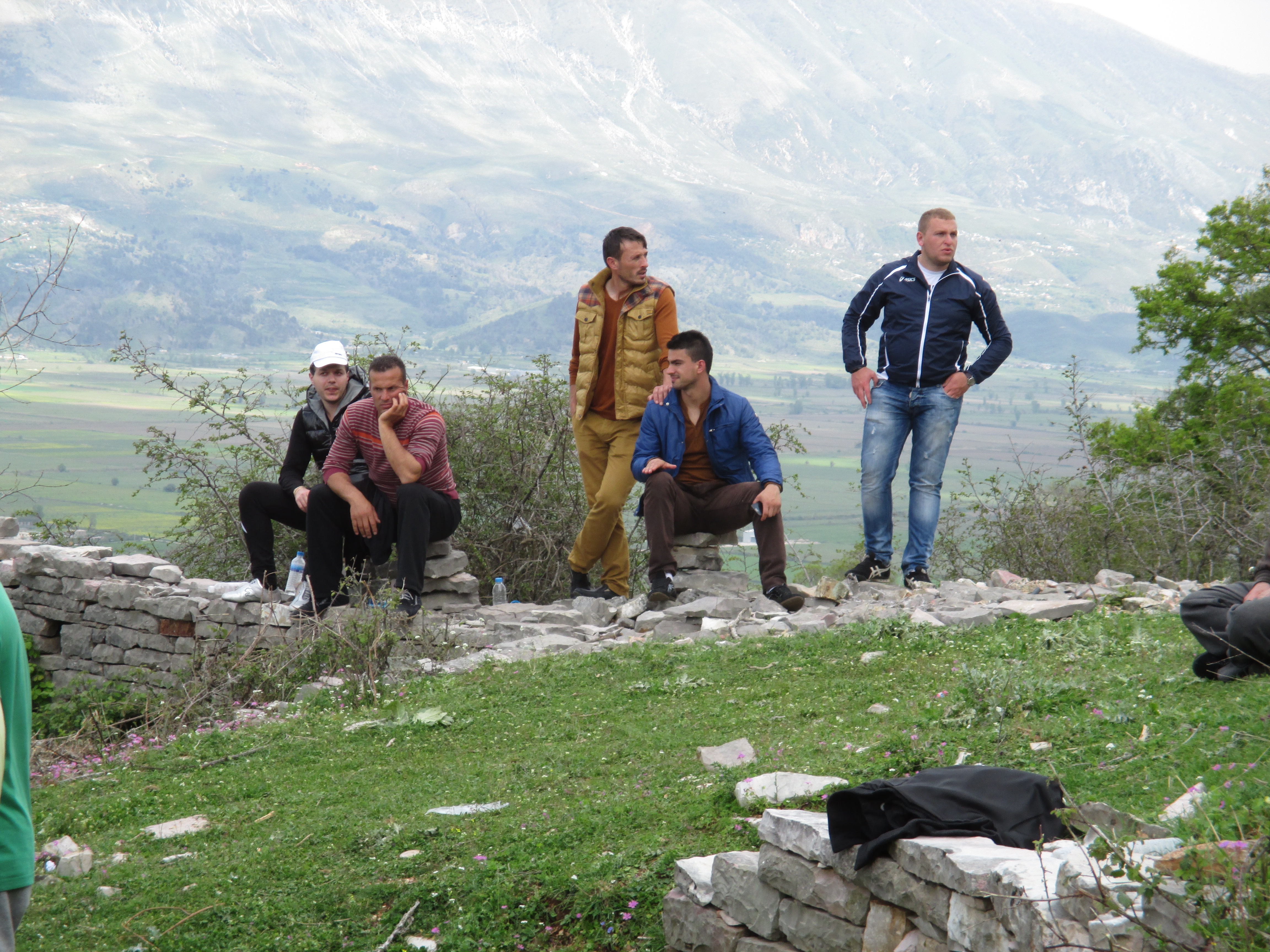
IMG_0148or a guy as seriously Kosovar-looking as Novak Djoković:

DjokBearCanBnhbw7ZCYAAgVoE.jpg_largeor me:

nikostautoteta23

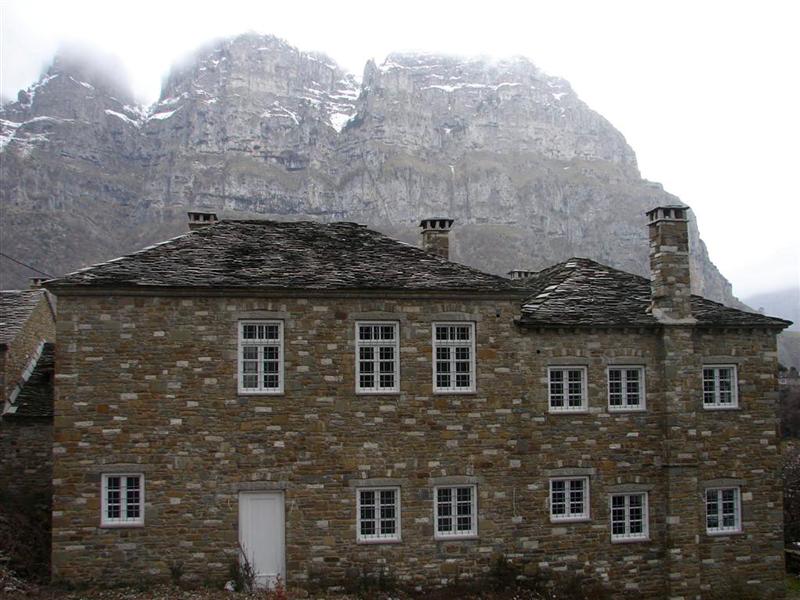
The point is that the flat top would make it easier to balance a tray of simit on your head.  Of course the joke is based on false modesty, because Epirotes did not come to Istanbul, or go to Roumania, or Odessa, or Alexandria, or the United States or anywhere else in the world to become simitçides.  They went to make money and, some of them, fabulous amounts of it.  This is why you can be driving through Epiros, through empty, lunar karst limestone landscapes where you wonder if you could even herd goats, much less sheep, much less plant anything edible, and then suddenly come upon villages with massive two or three-story stone mansions, and equally impressive churches and schools.  And this is why Epirotes contributed so greatly to the Greek Enlightenment, to the creation of the Greek state’s institutions and educational establishments, and generally had an exceptionally high standard of living and literacy — even for womenfor rural Greece, until the whole exclusively male emigration structure collapsed and was followed by a massive exodus to the cities after WWII.  Like certain islands of the Aegean or the Saronic, it was the very barrenness and lack of resources that the land could not provide that drove the movement, ingenuity and creativity of traditional Epirote culture and that allowed them to make such lives for themselves at home (at least for their families, because they themselves were gone most of the time) and make such important contributions to the wider Greek world.***  Of course, it was also the institution of emigration that led to the endemic, marrow-deep sadness of the culture as well.

Traditional Epirotiko village architecture from various parts of the region, obviously not the communities of poverty-stricken hillbillies, built with money made abroad by emigrants; the final picture at he very bottom is the front gate to my mother’s patriko, the house where she was born.  Her family made their money through three generations of baking businesses in Bucharest. (click)

000116

papingo

1704170417041704_12

Papingodsc_0416

PapingoIMG_4952

Monodendri-Hotel-22

Tsepelovo59399932

Giotopoulos gateunnamed

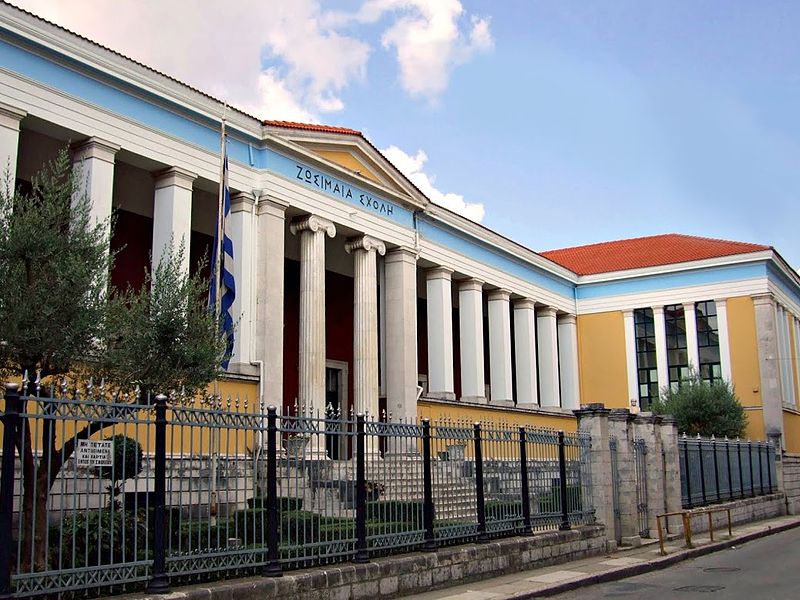
And below — in order — the Zografeion and Zappeion Lycées in Istanbul, the Zappeion exhibition hall and gardens in Athens, the National Polytechnic School in Athens, the Zosimaia in Jiannena, and the Zografeion college of Kestorati, all just a few of the institutions funded and built completely by Epirotes (click).

5694293094_8d58ab27da_z

zappeion

OLYMPUS DIGITAL CAMERA

polytechneioPatision_Complex

ZosimaiaΓυμνάσιο_Ιωαννίνων_3

ZographeionCol

I have a friend in Greece who’s from a part of Greek Macedonia that, before the refugee tents went up there in the 1920s, was inhabited exclusively by mosquitoes.  We were good friends but we had more than our share of tensions because he was an insufferable kind of arrogant Eurocrat that Greece used to produce at the time and had some supposedly hot-shot job with one of the sleazier Russian-type Greek communications moguls to appear in the nineties — μιλάμε principles yok.  And for some reason, he had this implacably neurotic competitive impulse that he would always unleash on me any time I spoke about Epiros, especially if it was with any amount of pride.  “It eez the poooorest proveens in Euuurope…Galicia in Spain and Epiros…are the pooorest proveeenses in Europe…” he would say to me constantly, like a Brussels parrot.  And after WWII, the practice of leaving families behind and going off to work abroad and returning only occasionally became untenable, and most of Epiros did become tragically depopulated.  But it was poor because it was depopulated and the only permanent inhabitants of many communities were pensioners, not because it was a region that traditionally suffered from desperate poverty.****  The hot-shot job and the whole Euro-thing has collapsed since then, along with the whole balloon in which it existed, of course, and he’s a significantly humbler person today.  But it was just so infuriatingly ignorant and anistoreto on his part to see Epiros as some Greek Appalachia and his motivations for harping on that distorted image escape me to this day.

Anyway, that morning I wanted to buy five or six simitia and pile them on Vangeli’s head as a reference to this simitçi tradition, but I could see he wasn’t having it, so I didn’t even try.  He insisted it was the anise in the rakı that made him sick and has sworn that from now on it’s only “real” raki for him — straight and Albanian — with no sissy Politiko flavorings to eff him up.

*************************************************************************************************************************************************************************************************************

* Turks are among the most honest people I have ever come across in all my travels, and not because of modern efficiency like in Europe, but out of traditional philotimo or honor.  I’ve had a Turk from a Taksim pilav stand recognize me as I walked by, and come up to me to give me one lira change he owed me because three days earlier I had eaten there and he was short.  I’ve had to fight with a Turkish simitçi because he wouldn’t sell me a simit because it was late in the day and they were stale, begging him, eventually giving up because he simply refused — the famous Turkish “yok”; when you hear it give up immediately.  I’ve had Turks — this happened to me in Afghanistan once too — run down the street after me to give me a Bic pen I had forgotten on their restaurant table.  But something happens to a Turkish cabdriver when he’s in the Sultanahmet area and he becomes the biggest sleazebag in the world.  I think that now that tourists have discovered the Beyoğlu side of the city and generally prefer to stay there, there’s greater tourist traffic between Pera and the important monuments of the old city, and these jerks take advantage of it.  But be tough with them; simply refuse to pay more than 20 or 25 lira — no matter what his rigged meter says — and walk away and tell them you’ll call the police if they don’t like it and, being cowards, like most frauds and liars, they’ll immediately back down.

The route from Şişhane or the Galata Tower, across the Galata bridge to Hagia Sophia has to be — and always has been — one of the most important pedestrian traffic axes in the city.  And instead, both Karaköy and Eminönü — the two districts and “squares” that face each other across the Horn and are like the two ventricles of the historic heart-like link of the City — are hideous, dirty, badly designed nightmares to walk through.  Instead of worrying about Taksim so much, Erdoğan might want to put some effort into redesigning this essential, central binder of the two Istanbuls.  But that would be a massive project that would involve levelling almost everything that’s been built there in the past forty years and starting with a clean slate.  Plus, you don’t want to give him too many ideas because he’s perfectly capable of building something as ridiculous as a ski-lift from Şişhane to the Hippodrome to assist tourists in their sight-seeing.

** The Staurodromi is one of the nicest spaces in Pera.  The gates of Galatasaray are beautiful, the other corners have their original turn-of-the-century buildings intact and there’s one modern, kind of semi-Brutalist building in travertine that I really like, that houses a bank and a bookstore and that you can see in the picture above behind Vangeli and in this one below.  The only thing that mars the whole space is this ugly sculpture:

Uranium piles

Does anybody know what it’s supposed to be?  Missiles of some kind?  I don’t know what enriched uranium piles look like, but during Fukushima and every time someone talks about Iran or North Korea and uranium piles, my imagination immediately conjures up this horrible sculpture.

*** This was all part of what I can only generally call the “Great Mobilization” of the Greek world that began in the early eighteenth century.  The confluence of factors that caused this are so intricate that they’re hard to summarize: the primary spark was perhaps the massive wealth accumulated by the Phanariotes — Greek aristocratic families in Constantinople prominent at the Patriarchate and, by extension, at the Porte — who had used their influence in imperial circles to turn most of what is now Romania (Moldavia and Wallachia) into their own autonomous Greek kingdoms, which they sucked dry, and how that wealth was poured into Greek institutions and trickled down into Greek hands generally; the concurrent spread of Greek educational and commercial networks in the Balkans and Eastern Europe and later in the Near East, in the rapidly modernizing economy of post-Mehmet Ali Egypt especially; the way the so-called Greek Enlightenment worked through both these kinds of networks.  The increased mobility that the nineteenth century made possible; most people, for example, don’t know this, but the Greeks of the Anatolian Aegean coast and the Marmara were almost exclusively migrants from the islands and mainland Greece — and even later the Kingdom of Greece itself, Greece basically having been an economic basket-case since the get-go — that started settling there in large numbers in the later eighteenth century and not, as we romantically like to believe, descendants of Byyzantine Hellenism; the only remnants of Byzantine Hellenism in Asia Minor were the Greeks of Pontus and Cappadocia, of course, and small pockets near Konya and Kula and Isparta and that lake region, all of whom, except for Pontioi, were Turkish-speaking until some of the men started learning Greek in the nineteenth century.  (In isolated areas of Cappadocia, a dialect of obvious Greek origin had also survived into the nineteenth century but was already dying out by then, and was so heavily Turkish in vocabulary and had even developed extensive agglutinative structures like Turkish that it’s almost impossible to call it Greek, any more than you can call Vlach Roumanian.)  Then there were the colonialist economic incursions into the Ottoman Empire and its reduction to a European debt-slave (much like “Memoranda” Greece today) that together with the privileges for Christians that the Great Powers forced the Ottomans to grant, created a space for growing Greek and Armenian prosperity from which Muslims (and Jews, for that matter) were excluded, and that produced exclusively Christian micro-economies within the Empire in which Greek rural migrants could find work and prosper.  All this had an enormous effect on Greek life everywhere.  You can see it in the village architecture of certain regions of the Greek world.  And you can see it in traditional dress of Greek rural women.

My father’s villages in the valley of Dropoli are situated in one of the few extensive, arable parts of Epiros, the fields you see in the pictures taken from atop the village itself (click):
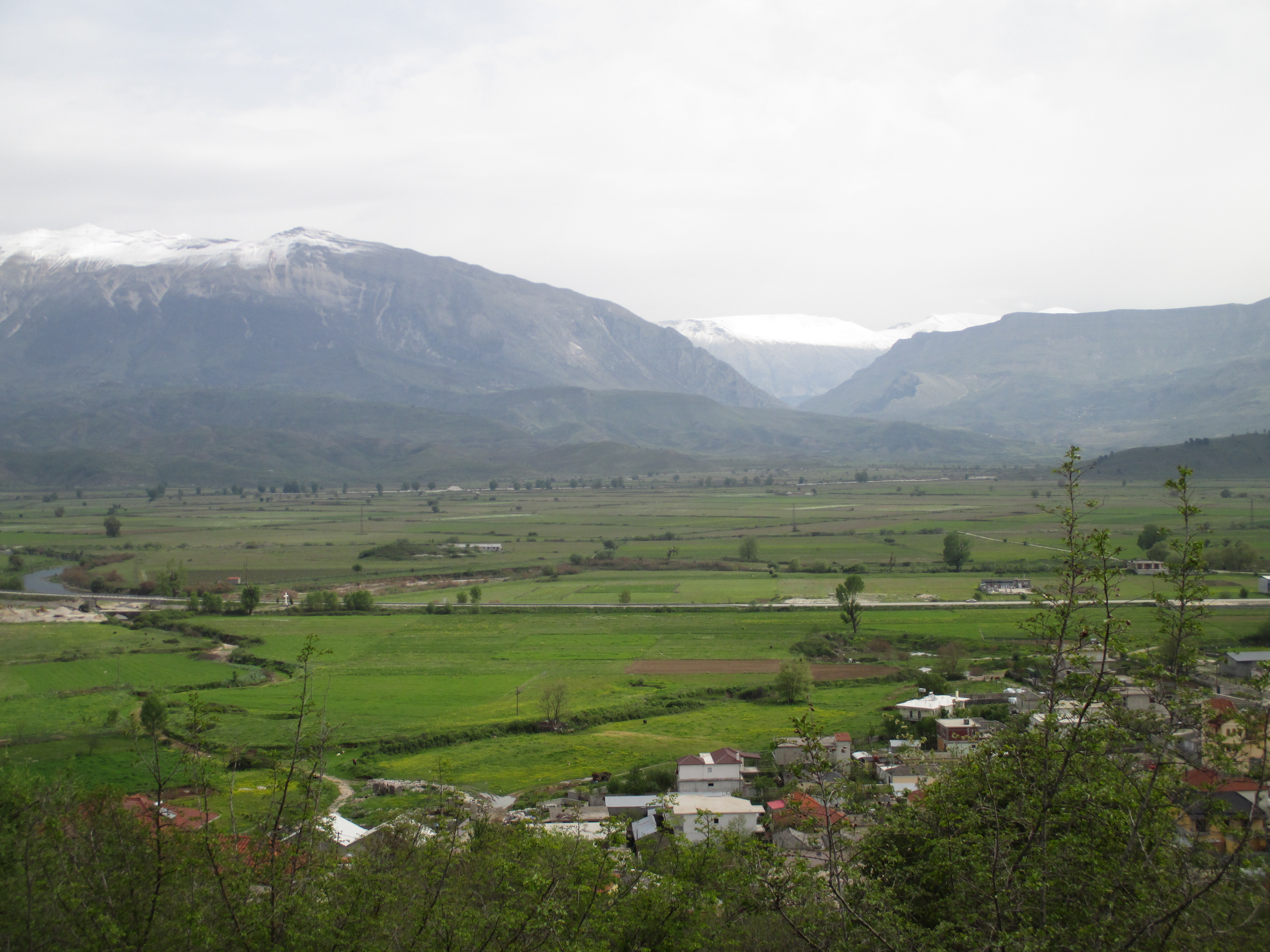
IMG_0075

Paradoxically, it was this theoretical asset that kept our villages relatively poor until the mid-nineteenth century, because these fields were all çiftlikia of Muslim landowners (“fiefs” I guess; don’t ask me to explain Ottoman land tenure to you, or tell you the difference betweeen a çiftlik or a timar or anything else, because every time I try and read about it I fall asleep and don’t remember anything I’ve read when I wake up) and we were essentially sharecroppers for them.  Only with the exponential growth of emigration in the nineteenth century did any kind of considerable prosperity come to our villages and many were even able to buy their village lands from the increasingly impoverished ağadhes themselves.  Like I said, this was markedly obvious in the changes in female costume and the complete switch of male dress to frangika, Western clothes; traditional male outfit of the region would have looked something like this, the characteristic white felt pants called poutouria (this photo is from southern Serbia actually, but was the nearest approximation I could find) and not the fustanella kilts that folklore groups in the village like to use today indiscriminately and inaccurately:
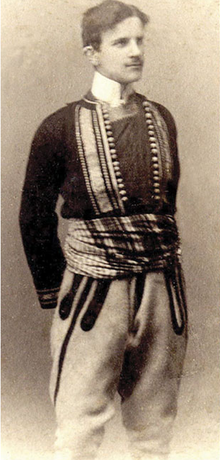
Poutouria220px-Teslacirca1880(2)

While, with the women, in extremely old photos from Derviçani, you can see that almost all the articles of the costume were home-made by the women themselves, with growing wealth you see the gradual addition of articles of clothing that had to be made by professionals.  My grandmother’s outfit here, for example, especially the vest and apron:
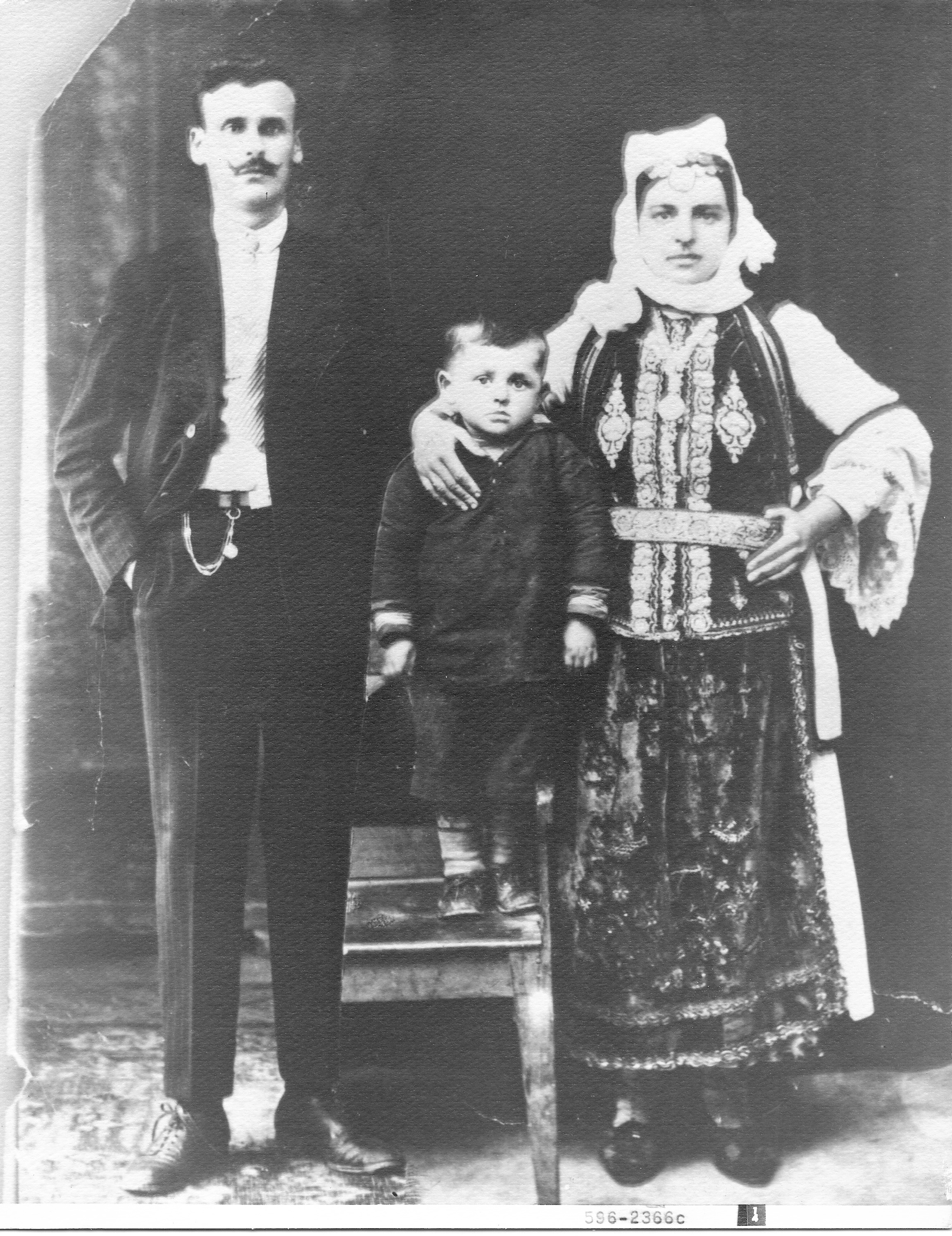
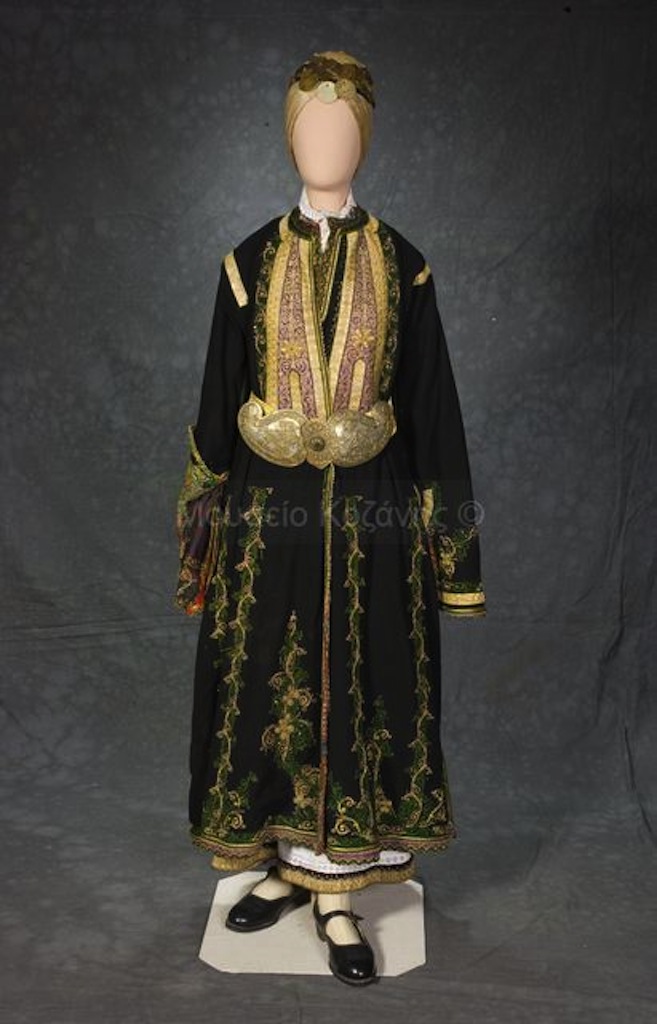
Family…obviously had to be made by a professional sirmakeşi — an embroiderer of gold thread — in Jiannena or Argyrocastro, and the dress of some particularly wealthy villages, like those of Lunxhi, behind the mountains to the left across the valley in the photo (Albanian-speaking Christians with whom we intermarried extensively and still do, the homeland of Zappas and Zographos, the benefactors mentioned above) had, by the end of the nineteenth century, simply become regional variations of Ottoman urban dress, like in this photo, which the museum of Kozani (why it ended up in Kozani?) felt it had to put its water stamp on, like someone was going to sell the design to YSL or something:
VI2M8774.TIF

**** Despite my friend’s condescension, regional funding initiatives for these “poorest provinces in Europe” have greatly expanded the university in Jiannena and developed an extensive and prestigious medical research center there, an information technologies industrial park, renovated (sometimes over-renovated) large parts of the old Ottoman city and created a general climate of growth and prosperity seemingly unaffected by the problems of the Greek economy.  Epiros has become a little bit like a Greek Bavaria or the French south-west: a traditional, somewhat backwards area that made the leap over the ugly stages of modernization to post-modern comfort and prosperity.  Half-ruined villages have been renovated, largely through the skills of Albanian craftsmen, who still were trained in the traditional building skills necessary to preserve the region’s distinctive architecture.  There’s good traditional and contemporary food in Jiannena and in some of the newly developed tourist towns.  There’s skiing in the winter; there’s hiking and mountain-climbing in the summer and gorgeous beaches only an hour-and-a-half away from each other on the new highways.  And it’s generally agreed that Jiannena is one of the most pleasantly liveable of Greek provincial cities and Epiros one of Greece’s most beautiful and pleasantly liveable provinces.

Comment: nikobakos@gmail.com

Philopomeon writes: “Easter in Derviçani”

30 May

To this April 25th’s post on Easter in my village,  Easter in Derviçani,” Philopomeon writes:

“Beautiful. It’s rare that we get a look of what is going on among Greeks in Albania without having to hear about ‘Vorio Ipiros’ and ‘Chameria’ back and forth.”

Yeah P., except for a few real old die-hards, that stuff is pretty much over, and most people, young and old, have very maturely and intelligently, gone on with their lives and accepted things as are.  The most striking example of that is that there are youth associations from each of the Greek villages in the region, with members in Jiannena or Athens or all over the rest of Greece or Albania or the States or Australia, but the old pan-Voreio-Epirotiko associations like MABH, with their irredentist discourses have pretty much dissolved.  The hate is gone too, which was the most heartening thing to feel: the on-going, still often fatal feud with the neighboring Albanian Muslim village of Lezarates is mostly personal at this point and not an issue of religion or ethnicity.  I know more infantile little fascistakia in Athens, with no relation whatsoever to our villages, who are more preoccupied with those old causes — and feel like they have a right to shoot their mouths off about them as well — than anybody in Derviçani is today and who probably are greatly disheartened by our indifference to our “national issues.”  You’ve never wanted to lose it on someone so bad as I do when your family has been through what mine has (see: Easter Eggs…”) and then have some snot-nosed Kollegiopaido  think he can lecture you on how you don’t live up to them and lack their “national feelings” and other such bull-shit.

The young people of my village, particularly, are a marvel, a youth that any society would — or should — pray to have.  They are fanatically in love with their village; they return every chance they get — dozens come from Jiannena on just a regular weekend.  They’ve organized a new panegyri (village festival on the village saint’s day) on August 15th, when the village’s population is the highest.  This has happened all over Greece; since most people go on vacation in August, depopulated villages that only fill up with returnees at that time often organize a second “unofficial” panegyri in August, along with the traditional one which could be at any time of year, to take advantage of the greater presence of chorianoiDerviçani, however, has never really had this problem, because this is a village with such a gigantic ego that no mere saint would serve; its traditional panegyri was Easter itself! culminating on Easter Friday — της Ζωοδόχου Πηγής — and always packed, then and now…   But, what can I say, it’s a party town.  The youth association pays for this summer festival out of its own pocket; they’ve put a stop to the stupid drunken brawling that used to go on, even though they themselves can pack it away for sure.  They do tons of volunteer work for the village: roads, squares, little beautification projects, football fields and basketball courts.  Natally bilingual, interacting with the “other” and crossing borders both figurative and literal all their lives, they have that innate cosmopolitanism and perceptiveness of the wider world that can’t be learned in any school and that no Northern Suburb çoğlani could buy himself with all the millions in the world or a thousand trips to Europe or New York.  They’re strong, attractive, smart, open, friendly, generous and whether they’re busting their backs at the hardest manual work in Greece or other parts of Albania, or acing it at universities in Greece or in Europe, they’ve built active, productive lives for themselves out of nothing.  I’m not ashamed to say they put me to shame in almost every way.

The most satisfying feeling and identification I shared with them though was the sense that they knew who they were: Derviçiotes, Dropolites, Epirotes, and Greeks  — and that they have absolutely no need for the Neo-Greek nation-state as a reference point to bolster those identities.  Greece never did anything for them anyway except make their lives difficult when they got there in the nineties or provide leftist intellectuals to tell them that life in communist Albania wasn’t that bad or little Athenian pricks to mock them as “Albanians.”  (As opposed to the Church of Greece, however, which I’ve always found to be an abominably reactionary institution, but has really helped a lot of Greek kids from our parts find their way in life and adjust: learn trades, increase their Greek literacy skills, get them into universities, etc. — recognition should be granted when it’s due.)  They get tired of explaining to Neo-Greeks that they’re not Albanian, but ultimately they don’t give too much of a shit: one, because they don’t think being Albanian is an insult and, two, they know they’re Greek — in fact, they know they’re Greeker.  Their generational cohort in Greece would not want to hear their opinion of most of them.

They love their Church, they love their music and they love their dancing.  Here are two videos of the early twenty-somethings, “Manastiri 1” and “Manastiri 2” (age groups and families take their turns) dancing up at the Monastery over the village on Easter Monday. My camera work on my brand-new little pocket Cannon is atrocious, but their spirit will come through.  I was astonished by how down-packed and completely internalized they had the traditional gestures and body language of the regional dance tradition — though I think dancing with open beer bottles is a new innovation and by the second video you can see they’re getting kind of sloppy.  There’s this one kid, FotoDretso, with the cartoon cowboy t-shirt, at the head of the line in the first video with the beautiful statuesque girl in the white sweater that no one can identify (“maybe she’s from another village…” the phantom beauty who showed up at our panegyri…), who is the son of GianneDretso, a village character out of Djilas’ Land Without Justice  with a fearsome reputation for leaping across borders and mountain tops like some cougar — a good rep to have around there.  Foto is also shown turning his spitted lamb in the Easter in Derviçani” post.  He seems to be something of a village youth leader, but the reason I couldn’t get enough video of him that day is, not just that he has my father’s name, but he dances exactly like my father did.  At times it was chilling.  Watch in that first video at around 1:35 when he takes lead of the dance.

IMG_0093FotoDretso, buddy and animal at the Monastery, Easter Monday 2014 (click)

In one of Misha Glenny’s books on Kosovo, Glenny asks a female Albanian politician in Tetovo, the unoffical capital of Macedonia’s some twenty to twenty-five percent Albanian minority: “Do you still dream of a Greater Albania? Where all Albanians can live in one state?”  And he got nearly the identical answer from her that I got from an Albanian guy I was talking to in the restaurant of our hotel in Tetovo: “Well…of course.  I guess we all do.  But those years are over.  The point now is not changing borders.  The point is making the borders not count.”

This is what most of my chorianoi — my “landsmen,” for New Yorkers, the rest of you can use your context clues, as we used to say in ESL — young and old seem to feel these days.  They live productive, happy as possible lives, where the border is practically a technicality and only promises to become more so as the years go on and the general integration of the region continues — a process that I see being halted only by those ideologues who get hard-ons at the thoughts of borders and nation-states and playing with little tin soldiers and tanks to defend them with.  But they’re a dying breed, unlikely to ever again reach a critical mass with which they could make a difference, whether they know or like it or not.  And the sooner the better.  So we can all get on with our lives.

Below are the kids dancing from my crappy footage.  But I have FINALLY found THE documentary video that captures the ethos of the whole music and dance tradition of Epiros as perfectly and deeply as possible but I’m thinking of the right way to set it up for readers.  In the meantime, enjoy.

This third video, ΔΕΡΒΙΤΣΑΝΗ 2013 ΧΟΡΟΣ Ι.ΜΠΑΡΟΥΤΑ,” is taken at the August dance, all generations participating.  The woman dancing at the head, Agathe Baruta — what relation to my Barutaioi I don’t know — is a stunning dancer (and a beautiful woman), and displays the precise, stylized seriousness that’s considered both beautiful dancing and proper elegant comportment for a woman.  (The kerchief is a remnant from a time when a man and a woman never touched publicly, even if related; the tall, handsome man she’s dancing with is her husband and is a member of the Greek Presidential Guard.  But some things are traditional formalities while the realities, obviously, change; one song from the new repertoire says: “Join the dance later and hand me a note with your cell number on it.”)  You’ll get a better sense of the communal joy this simple to-and-fro incites in people from this video because it’s more ordered than the kids’ dances above.  What you see here goes on, literally, for hours, till it induces an almost trance-like state; it starts at around eight in the evening and goes till dawn — for three nights in a row.  Unfortunately, I wasn’t able to capture in my videos above — nor is there a point here — a moment where the musicians slow down the tempo and the dancers get even more excited.  (At the end you get a fast number that really reminds you of how Balkan and Klezmer traditions are often connected.)  If you can, give it some time, because it needs time to build, time that we all have so little of; this whole tradition is the antithesis of the quick high and fake fun that characterizes our civilization: “Play it sweetly boys, sweet and slow, to heal the sickness I have in my heart”:

IMG_0182Meanwhile, back at Easter, some of the adolescents, watching the dance respectfully till it’s their turn.  (click)

IMG_0185The older guys, below, on dance break (click).

IMG_0196

IMG_0198

Some nephews of mine being bozos; every time I lifted the camera at them they would put their hunk of meat down and pose, so I asked them to be natural and this is what I got. (click)

IMG_0112

Comment: nikobakos@gmail.com

Σήμερον κρεμάται επί ξύλου…

17 Apr

crucifixion2

(click)

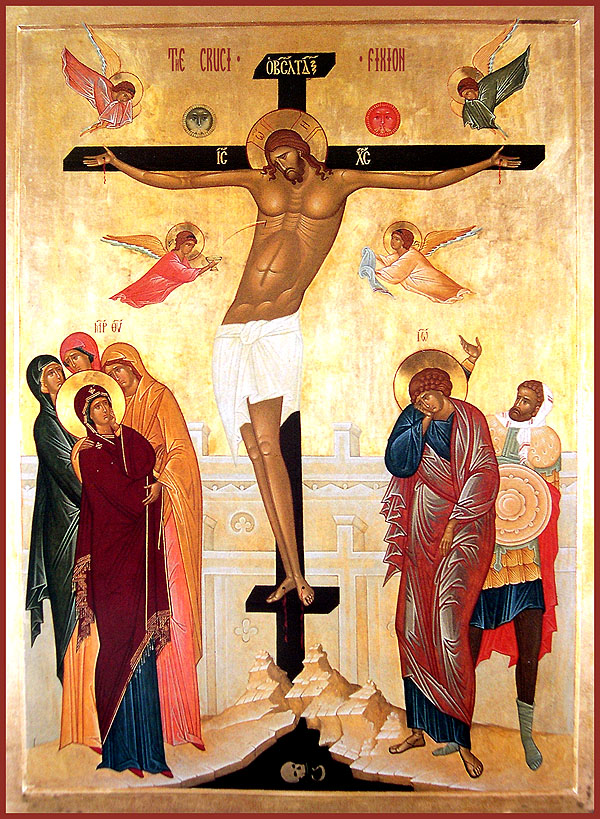
“Today hangs suspended from a piece of wood, the One who suspended the earth amidst the waters…” begins the main hymn of tonight’s service in the Orthodox Church.  It’s matins for Good Friday, sung the night before; it corresponds to the Oficio de Tinieblas in the Catholic Church, or the Via Crucis, or Stations of the Cross.  Except it’s not the forty-five minutes Cliff notes version.  It’s a four — with Russians, five plus — hour, perfectly paced and structured, oratorio that uses twelve gospel selections (it’s colloquially known as the “Twelve Gospels” among both Greeks and Russians and I imagine other Orthodox peoples), and a surfeit of beautiful and psychologically astute poetry and music to tell the story of the Last Supper, and Christ’s arrest, judgement, crucifixion, death and burial.  It’s my favorite Holy Week service.  Because it’s a masterpiece.  It doesn’t draw any of its power from made-up, sadistic Mel Gibson details that aren’t even in the gospels: like how many times Christ fell, or where they whipped Him, or where and when they spat on Him, or where He scraped his knees, or any of the bloody kitsch and sensationalism and fabricated detail so physical that it’s disrespectful and that the Catholic Church allows and encourages; one speaks of the body of Christ with a certain laconic awe I would think, no matter what it was put through.  Its power comes from the perfection of its theater and its theology and — if anything — from the spareness of the story it tells.

Background to this post…  For years, whenever I heard that relatives or friends from Greece, especially under a certain age and especially from Athens, were coming to New York to visit for Easter, my guts would get twisted up in knots of anxiety in anticipation because I just could not endure having them around at that time of year.  Anticipation of what?  Well, there came a time, for me a crucial turning point in post-1974 Neo-Greek culture — it was around the early-eighties — when Greeks started asking each other: “Where are you going for Easter?”  And I couldn’t imagine what I would answer if asked.  Where am I going for Easter?  I dunno…  I’m going to be home.  I’m going to my village.  It’s Easter.  Where should I be going?  This is because there came a point, when, for the demographic I’m talking about, Holy Week and Easter had become the equivalent of Spring Break, some free days to go off on a vacation somewhere.

So I could anticipate their attitude.  I knew they wouldn’t appreciate the subtle shift in the pace of life that occurs in a Greek neighborhood like Astoria when Palm Sunday dawns.  The sobriety mixed with the rush of preparation and excitement.  I would anticipate instead the surprise, at best, but mostly the grinning condescension, with which they’d react to how seriously diaspora Greeks still took this time of the year, how backwards and un-hip and un-Euro it was of us.  I’d know they’d want to go out to a cool baraki on Good Friday night.  I’d know they’d ask to be taken shopping on Holy Saturday, in the middle of the cooking and cleaning: there were some shoes they had seen on sale at Macy’s.  I had two Turkish roommates for a while once: totally secular, modern Istanbullu girls; they just didn’t eat pork.  And out of respect, or just to prevent possible squeamishness on their part — they had never even said anything to me — I would keep salami and pancetta and other pork products in the basement refrigerator that they never used.  On the other hand, I once had to have a screeching match with a Athenian guest about not having meat in the house on Good Friday — I ended up feeling like a friggin’ Talib — because she needed her protein and fasting reminded her of how oppressive her mother was during her childhood.  Just a couple of years ago, a cousin saw me go off to the first Nymphio on Palm Sunday evening and said to me: “You mean…like…you’re going to go be going to church…like…every night this week?  In Greece nobody goes.  That’s something left over in the diaspora…” she had the archidia to say to me.  It was never something they had lost; it was always something “left over” among us.  I said nothing.  But, as you can imagine — as opposed to the sentiment of “Next year in Jerusalem” — the idea of being stuck in Greece for Easter had always been my nightmare.  I only came this year because it was going to be one of the rare years professionally when I could go to my father’s village in Albania for what I knew would be a traditional Easter that wouldn’t infuriate me.

And instead I’ve been amazingly and pleasantly surprised.  I don’t know what Greece it is that this cousin of mine lives in where nobody goes to church, but all through Lent and especially this week, every church I’ve been in has been packed.  Tonight was the most moving “Twelve Gospels” I’ve ever attended.  The massive (as massive as a pre-Tanzimat church could be) eighteenth-century, stone cathedral of Jiannena was filled to the rafters — literally; it has a two-floor gallery where the women used to traditionally stand and even both of them were full.  The cantors were perfect.  The procession of the Cross immaculately pulled off.  I felt like Vladimir’s envoys in Hagia Sophia.

But what most moved me most was the breadth of age and sex of the crowd.  If anything, there were even more young people than there would be in New York — young guys, parea — following the text from the little black book carefully, people with that relaxed reverence that the best Greek — knowing how to be respectful, but comfortable in his father’s house — displays when in church.  Almost everyone stayed to the very end.  I really felt in my heart and gut what Yosef Eliya felt in his Purim poem when he writes: “Tonight the synagogues open their arms wide to the faithful children of my ancient people…”

Tomorrow it’s off to Albania.

Kale Anastase and Happy Easter…my ancient people.

Comment: nikobakos@gmail.com

Jiannena

16 Apr

fanari

Christ.  Especially at certain times of the year, this can be among the most melancholy places on earth — beautiful, the mountains around still snow-capped, but not for the suicidally inclined poet or the sensitive generally.  After the exuberant spring of Attica especially…  It’s in the low 50s at most, 40s at night and there’s this constant, what I can only call British drizzle falling all the time, like somebody with a spray can standing next to you every time you venture out and continuously coating you with a fine mist.

I’m here to go into Albania on Friday (everyone still says “into”), to be the first member of my family to celebrate Easter in our village in sixty years.  And I’m staying at a hotel that has this glorious turquoise pool in the central courtyard, but it’s not open for swimming, and I like cold water and cold weather swimming, but, according to the receptionists: “δεν είναι ο καιρός κατάλληλος,” the weather is not appropriate.  And I looked at them with a straight face and said: “Guys, I’m an Epirote too, ok, and even in August the weather is exactly like this.”  They just stared at me, with that soft smile…  People here are so odd.  So tough, in the middle of all this wildness, and yet so sweet and soft-spoken — like Native Americans sometimes, they remind me.  My father was like that.

(For other Greeks, we’re just a little too “heavy” — which, given where it comes from I consider a compliment.)

One of the most beautiful evocations of the melancholy — of the melancholy and stoic — ethos of Jiannena and Epiros generally is the this poem by Michales Ganas, Γυάλινα Γιάννινα, “Jiannena of Glass,” with a video put together by Vassilike Besiou.  Her choice of musical accompaniment — the keening, rocking back-and-forth melody typical of the region (all Epirotiko music sometimes seems to have grown out of funeral dirges) and simple polyphony or second voice drone — is perfect for her purposes.  Under the video are the verses of the poem itself, in English, Greek and in a probably amateurish Spanish translation I did for a friend of mine — a “this is where I’m from” gesture… ” on my part.  The poem is odd both thematically and structurally in Greek even; excuse the clumsiness of the English translation as well.

“What snow these shoulders had born, no one ever knew.  No one ever knew.  No one.”


Jiannena of Glass

On a night like this, many years earlier,

Someone walked alone,

I know not how many muddy miles.

He walked alone,

a dark and cloudy night without stars.

Walked on and on.

At dawn, he reached Jiannena.

At the first inn, he ate and slept,

three days and three nights.

He was woken up by the snow, falling softly.

He stood in the window and listened to the clarinets.

He listened to the clarinets,

blurry one moment, at his side the next,

distant and blurry one moment, the next right at his side,

as the wind carried them.

And he heard that crystal-clear voice.

From somewhere close.

A cry, like she was being killed.

But no other noise, nothing else.

It was snowing.  All that night it snowed in Jiannena.

At dawn he paid what he owed and returned to his village.

He must have been around fifty, with grey hair,

and three unmarried daughters.

A widow of four years.  Around fifty.

A widow of four years, with his black cape around his shoulders.

Ah, what snow they had born,

What snow these shoulders had born, no one ever knew.

No one ever knew.

No one.

Γυάλινα Γιάννινα
Μια τέτοια νύχτα πριν από χρόνια
Κάποιος περπάτησε μόνος
Δεν ξέρω πόσα λασπωμένα χιλιόμετρα
Κάποιος περπάτησε μόνος

Νύχτα και συννεφιά, χωρίς άστρα
Πήγαινε το δρόμο δρόμο

Ξημερώματα, μπήκε στα Γιάννενα
Στο πρώτο χάνι έφαγε και κοιμήθηκε τρία μερόνυχτα
Ξύπνησε απ’ το χιόνι που έπαιφτε μαλακά
Στάθηκε στο παράθυρο και άκουγε τα κλαρίνα
Και άκουγε τα κλαρίνα
Πότε θαμπά και πότε δίπλα του
Πότε θαμπά
Και πότε δίπλα του
Όπως τα ‘φερνε ο άνεμος

Αχ…
Και άκουσε μετά τη φωνή πεντακάθαρη
Από κάπου κοντά την άκουσε
Σαν αλύχτημα και σαν να την έσφαζαν τη γυναίκα
Κι ούτε καυγάς, ούτε τίποτα άλλο
Χιόνιζε
Όλη νύχτα στα Γιάννενα χιόνιζε

Ξημερώματα, πλήρωσε ότι χρωστούσε και γύριζε στο χωριό του
Στα πενήντα του θα ‘τανε
Με γκρίζα μαλλιά και τρεις θυγατέρες, ανύπαντρες
Χήρος τέσσερα χρόνια
Στα πενήντα του θα ‘τανε

Χήρος τέσσερα χρόνια
Με τη μαύρη κάπα στις πλάτες
Αχ, το τι χιόνι σήκωσαν
Τι χιόνι σήκωσαν τούτες οι πλάτες
Κανένας δε το ‘μαθε…
Κανένας!

Jiannena de vidrio

Una noche como esta hace ya muchos anos,

Alguien camino solo, ni se cuantas leguas fangosas,

Noche nublada, sin estrellas,

andaba camino camino.

Al amanecer, entro en Yianena.

En la primera posada, comio y durmio

tres dias, tres noches,

Lo desperto la nieve, que caia ligera,

Se paro en la ventana

y escuchaba los clarinetes.

Y escuchaba los clarinetes,

un momento lejanos y mudos,

y despues cercanos.

En un momento lejanos y mudos,

y en otros cercanos, a su lado,

segun los traia el viento.

Ay…

Y escucho despues la voz cristalina,

de una parte cerca,

como gemido, como si la estuvieran matando.

Sin lucha ni pelea, sin nada.

Nevaba.  Toda la noche en Yianena nevaba.

Al amanecer pago lo que debia

y regreso a su pueblo.

Debia tener como cincuenta anos,

canoso ya, y con tres hijas, solteras.

Viudo hace cuatro anos,

a los cincuenta,

Viudo de cuatros anos,

con la capa negra en los hombros.

Ay, cuanta nieve han portado…

Cuanta nieve portaron esos hombros,

esas espaldas, nadie lo supo nunca.

Nadie supo nunca.

Nadie.

anexartisias

Comment: nikobakos@gmail.com


A Zissen Pesach y Pesaj Alegre to everyone…

15 Apr

…or just Καλό Πάσχα, “Kalo Pascha,” as the Jews of Jiannena would say.

Passover in Ioannina Bechoropoulos & Attas Family 1933

The Bechoropoulos and Attas families celeberating Passover in Jiannena in 1933 (click)

Special thanks again to Marcia Haddad Ikonomopoulos and the Kehila kedosha Janena community in New York City for providing the photo.

Comment: nikobakos@gmail.com


It’s Purim tonight! — something like a letter to my mother…

15 Mar

Nicolas_Poussin_E_before_Assuerus_c.1640Esther before Assuereus, Nicolas Poussin, circa 1640 (click)

For Purim this year I’m posting this poem by Greek Jewish poet Joseph Eliya, who was from my mother’s hometown of Jiannena in the northwestern Greek region of Epiros.  (See the tab box on the right for the hundred references to Jiannena and Epiros on the Jadde).

The Jews of Jiannena were Greek-speaking Romaniotes, descendants of the Jewish communities of Greece, the Balkans and Asia Minor that existed since Hellenistic times and that held out culturally against the flood of Spanish-speaking Sephardim that found refuge in the Ottoman Empire after their expulsion from Spain in 1492.  They were called Romaniotes because Romania (the kingdom of the Romans) was what the Byzantines called their polity and what we too – till the early twentieth century – also called ourselves: “Romans” – which it always aggravates me to have to explain.  But it is one of the rich ironies of history that the only inhabitants of Greek lands that stayed faithful to their true name for themselves were Jews, while we sold our souls to the West for the promises and prestige we thought the re-excavated neologism “Hellene” would curry us from the Frangoi.

So Eliya’s native language was Greek, and though he wrote some of the most beautiful translations of Jewish Biblical texts into Modern Greek, particularly one of the Song of Songs and a series of love poems to Rebecca, in a rich, florid, archaic idiom, he also wrote homelier poems in a folksier Jianniotiko style like this one, “something like a letter to his mother” on the occasion of the feast of Purim.

For those who don’t know, Purim is the day that Esther, the Queen Consort to the Persian King Ahasureus, and her uncle Mordechai, foiled the plans of the king’s evil minister Haman, to have the Jews of the kingdom massacred.  It’s generally celebrated by listening to the book of Esther in synagogue, the Megilla, sending food and giving charity to the poor and dressing up in costume, an aspect of the celebration that may be an interborrowing due to the fact that it tends to fall around Christian Carnival.

Eliya was a poor schoolteacher who died at the young age of thirty, and I believe this poem was written when he was away from his beloved Jiannena, and his beloved mother, on a teaching post in the Macedonian city of Kolkush.  It’s a sad, therefore — and very Epirotiko in that sense and in tone — poem, that’s in sharp contrast to the happiness of the holiday.

This poem also has an added emotional subtext for me.  My mother’s best friend when she was in elementary school was a Jewish girl, Esther — Esther Cohen.  “Astro” they called her, in the Epirotiko diminutive; “Tero” is also another form for the same name.   And as a little girl from a peasant family recently moved to Jiannena from their village in the mountains just to the south, I could tell that her stories about her friendship with Astro were her first lessons in tolerance and difference, whether she would’ve called them that or not (we certainly wouldn’t in our day…I’ll leave them for another post).  And she may have known it even less, but her friendship with Astro may have prepared her for life in New York in ways she was probably never conscious of.  And what she may have been even less conscious of — though maybe I should give her some credit: I do know for sure that my mother’s stories of her friendship with Astro served as my first lessons in decency and openness to those different from you.  Of that there’s no doubt.  So this post is something like a letter to my mother too.

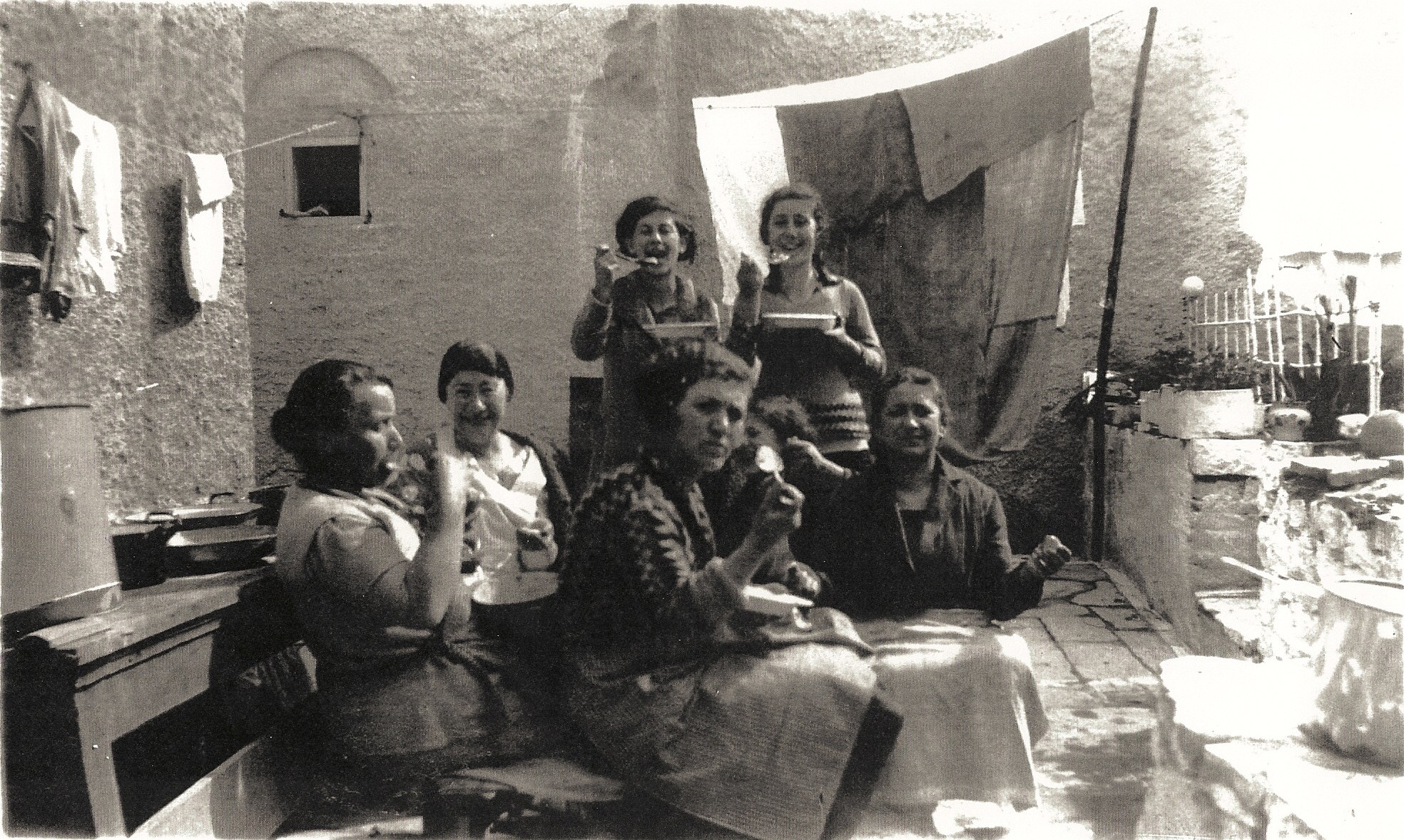
Always they ended in a kind of distracted silence, for she never knew what had happened to her friend during the war: “Τι νά’χει γίνει η Άστρω;” she would mumble.  “What can have happened to Astro?”  And what was strange was that she could’ve found out; there were surviving Jews in Jiannena that she knew and there were even Jewish Jianniotes in New York she could have asked.  But it was like she didn’t want to know.  Even odder, I’ve had several opportunities to find out as well; Kehila Kedosha Jiannena, the Jianniotiko shul in New York on Broome Street has records on the whole community.  But it’s been almost as if I don’t want to know either.

Here is Eliya’s original Greek, with my free verse translation below.

Purim

Purim

(Something like a letter to my mother)

It’s Purim tonight!  The thrill and joy of the great feast!

Light in our souls, and a smile on the lips of all.

And I, my orphaned mother, the refuse of exile*

Waste away in a chill joyless corner.

It’s Purim tonight!  And the synagogues open their arms wide to the faithful children of my ancient people.

And they read again with wonder, from the white parchment, the triumphs of Mordechai and Esther through the ages.

It’s Purim tonight!  Young and old gather at home, at hearth, to hear the Megilla’s** tale.

And I mother – with the burning lament of exile – tearily thumb through my Bible in a lonely corner.

Your son won’t be bringing you candles or flowers from shul*** tonight, mother.  And if your crying is bitter, don’t lament too deeply.  My Fate has been decided, and poverty — poverty, mammele**** – has no feel for sympathy.

**********************************************************************************************************************************************************************************************

Notes on my translation:

*”Exile” here does not imply political banishment or anything of the sort.  It’s the word “ξενητιά” as Eliya spells it, that’s so central to understanding the Greek and — it probably goes without saying — the Jewish soul, but is so devilishly difficult to translate precisely.  It means absence — absence from the place where one should be, from one’s heart’s homeland.  Through and because of emigration and poverty most often but not always; it’s often something one feels without having had to leave.  The Turkish “kurbet” is the word closest in meaning that I know from another language.

**Not to be disrespectful, but the Megilla, the Book of Esther, is quite long, and is proverbial, in at least Ashkenazi humor, for being tedious and monotonous to listen to — but one bears it.  It’s exactly the same as the Greek term “εξάψαλμος,” the Hexapsalm, a selection of six psalms that is always read at the beginning of Matins and I’m not sure if during other offices, and would be beautiful if correctly and carefully recited according to the rules of Orthodox recitation.  Unfortunately, it’s usually read in an incomprehensible blur of mumbled boredom by the lector or cantor, which actually makes it even more tedious and irritating to sit through.  It’s usually a good time to go out for a cigarette.  I just always thought the similarity was funny.  “Ωχ, τώρα θα’κούσουμε τον εξάψαλμο,” a Greek will say with dread when faced with a berating lecture or kvetch session or someone’s tiring complaint that’s so repetitive you just tune it out, just like a Jewish New Yorker will say: “I really can’t listen to his whole Megilla right now…”

***In the second verse, Eliya uses the Greek word for synagogues and I translated it as such.  In this last verse, he uses a homier, Epirotiko form whose intimacy I felt was better conveyed by “shul.”

****And last but not least, we run into the painful translation issues that are generated by the fact that English is almost completely lacking in a system of diminutive terms of affection, especially compared with the highly elaborate diminutive terminologies of Slavic languages or Yiddish (or I assume Ladino) or even Greek.  At no point in the poem does Eliya refer to his mother as “mother” but rather “my little mother” — “μανούλα’μ” — “manoula’m.”  This is a term of affection used often by Greeks and especially Epirotes to refer to anyone, not just one’s mother, not even necessarily a female (Athenian idiots making fun will darken or double up the “l” to make it sound more northern and Slavic and hickish; for me it’s just more beautiful…); one will say to a young boy or even a friend: “Come here, manoula mou… What’s wrong, manoula mou?”  Just like “mammele” is used in Yiddish.  But I felt that using “mammele” throughout would have sounded too Yiddishy and cute, and so I saved it for that last, most intimate verse, and used mother elsewhere.  After all, this is a poem that above all is an expression of the most Jewish kind of mother-son bond.  But Yiddish and its many beauties is cursed now, by its sudden, dramatic extinction in Europe, and its shadow survival only in American entertainment, with the danger of always lapsing into a default comic tone.  It’s sad.  The translation from the Greek of the last line of the poem, for example: “poverty has no feel for sympathy…” would literally be: “…but poverty doesn’t know from sympathy.”  But then I’d be writing Larry David dialogue.

**********************************************************************************************************************************************************************************************

FINALLY, I’d like to thank Marcia Haddad Ikonomopoulos for the scan of the Greek text of the poem.  I’m in Athens now, away from my library and couldn’t find it anywhere online.  I wrote to her and within five minutes she had written back to me with both “Purim” and “Esther,” another of Eliya’s poems about the biblical heroine.  She suggested that “Esther” is a poem more appropriate to the happiness of Purim than the melancholy of “Purim.”  Unfortunately, it’s written in a much more difficult, semi-biblical, archaic language that I didn’t have the time to translate.  I promise her however, that as soon as I get a chance I will work on it and post it on the Jadde — out of gratitude to her helping me out for this, and out of gratitude to the one-woman pillar of the Kehila Kadosha Janina community that she is.  I’d also like to thank the whole congregation there for always making me feel so welcome when I attend on Erev Simchas Torah; the rabbi and his stentorian voice, the three young men who lead prayer and are perhaps the community’s most precious resource — let’s see if I remember correctly: Seth, the rabbi’s son, and the brothers Andrew and Ethan, who though they’re from a Sephardic family from Berroia, devote their shabbes and yontif time to energizing this tiny community in need of outside help.  The warmth of the community has always moved me and I’m grateful for both the odd need for Jewishness in my life and the link to my mother and her childhood that they unknowingly provide.  Thank you.

Comment: nikobakos@gmail.com

fog_in_my_hometown

Jiannena


Where is this Jiannena / Yanya?

23 Jun

Here: “Ioannina”


Comment: nikobakos@gmail.com

Turkey in Europe

22 Apr

According to Stephen Kinzer, New York Times correspondent and the paper’s bureau chief in Istanbul for a good part of the nineties, the appeal of EU membership to those countries waiting for it is (or was) political, social, and economic.  “For Turkey it is also psychological,” he writes in his 2001 Crescent and Star:

“The central question facing Turks today is whether their country is ready for full democracy, but behind that question lies a more diffuse and puzzling one: who are we?  The Ottomans knew they were the servants of God and lords of a vast and uniquely diverse empire.  The true heart of their empire, however, was not Anatolia but the Balkans…  But by caprice of history the founders of the Turkish republic found themselves bereft of the Balkans and masters instead of Anatolia.  To make matters worse, through a series of twentieth-century tragedies Anatolia lost most of the Armenians, Greeks and Jews who had given it some of the same richness that made the Balkans so uniquely appealing.”

There’s a lot there I’m not sure of, like the Ottomans’ heart having been in the Balkans and their backs turned on Anatolia.  I also don’t know if “who are we?” isn’t too categorical a way to phrase the dilemma Kinzer is talking about.  Unlike Greeks, Turks know who they are; their growing willingness to accept, not only the former existence of their neighbors among them, but the plurality of their own ethnic make-up would indicate that: Albanian fraternal associations, Tatar and Circassian language classes, seem to be coming out of the woodwork of the Republic’s forced homogenization, and even the lay-low-and-keep-your-head-down Alevis have found a new courage in asserting themselves.  (Poor Republic: no sooner does it harass one minority out of its existence, another one pops up to take its place.)  That’s a process that requires confidence, whereas we remain isolated in our ignorant dream of purity — and banging our feet to prove it to the rest of the world on top of it — a ringing sign of insecurity.  As mangled as Turks’ knowledge of themselves may have become by their own nationalism, I think phenomena like nostalgia for the multiethnic or the Neo-Ottomanism that has pervaded cultural life and even motivated political life and foreign policy in Turkey recently (and I don’t think that’s a bad thing or necessarily a “threat” to anyone; we, Greeks, might want to take advantage of it actually) is an attempt to right that disfigurement, not a deep existential reorientation.  Proof might be that since Kinzer wrote his book in 2001, Turkish membership in the European Union has pretty much become a dead-in-the-water issue.  And that may be partly because, in almost head-on contrast to Kinzer’s interpretation, Turkey was looking for political and economic benefits and not for Europe to validate its psychological needs, as the Neo-Greek statelet always has since its beginnings, a craven and cringingly embarrassing pandering to the West’s classical image of what Greeks are supposed to be being the foundation of Neo-Greek identity.  However the Ottomans may have felt about the Balkans or wherever modern Turks end up with their renewed embracing of the Ottoman past, they seem to be increasingly feeling — even the old, staunchly Kemalist bourgeoisie, or at least their children — that they don’t need European validation to prove they’re part of a civilization that they’re not.  And good for them.  I wonder when we’ll get the message.

On a lighter note, it’s not often one hears the Balkans described as “so uniquely appealing.”  It’s a line I’ll have to remember.  Often when people find out I’m Greek, they launch into delirious and happy memories of the Aegean and little white houses and sparkling blue waters and then I have to watch their faces drop as I tell them: “Well, the part of Greece my family is from is really more the Balkans than the Mediterranean…  And it rains all the time.”

Landscape approaching my mother’s village, in its usual mood. (click)

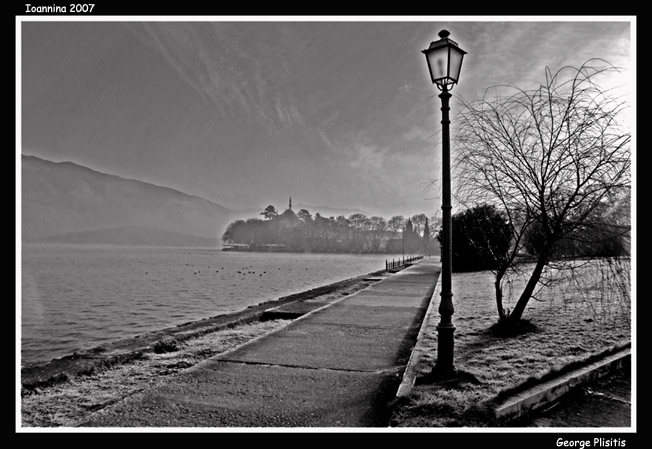
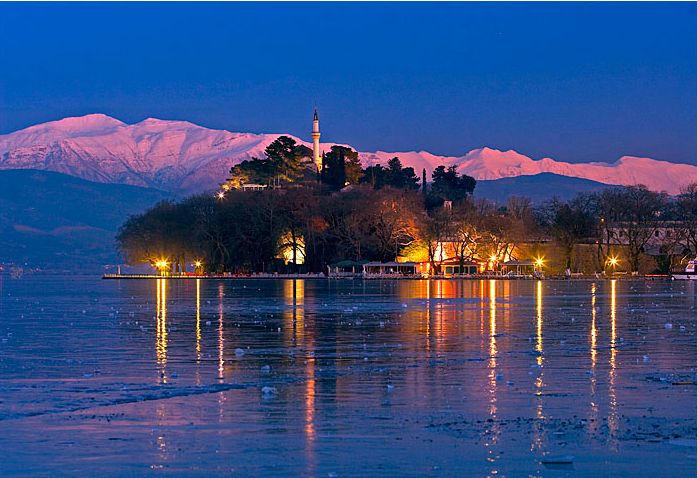
But then it is often “so uniquely appealling,” to get back to the Turks and the Balkans.  The main city of the region (Epiros) is Jiannena/Yanya, a beautiful little city by a lake that always had an air of luxuriant civility about it, proof of which may be that the Greek population didn’t rush to pull down the minarets or demolish all the mosques of the city as soon as the last Turks left in the twenties.*  It’s one of those Balkan cities the Turks loved.  Here’s a winter photo of Yanya’s main cami, the Aslan Pasha Mosque, overlooking the icy lake, below. (click)

Jiannena deserves a post of its own.  I gotta dig up some 2010 notes I have.

* On the other hand, the city government and developers have done all they can since WWII, including harassment and straight-out vandalism, to expropriate the city’s large and very romantic Jewish cemetery, which unfortunately for the city’s 40 surviving Jews, sits on some prime real estate.  Last I heard they had taken the issue to the EU, which makes me very happy.  Maybe the economic slump will give them a reprieve.  More on Jiannena’s Jews in the future.


Comment: nikobakos@gmail.com

Chitterlings…and mageiritsa

12 Apr

What are chitterlings, or chitterlins, or chit’lins?  They’re pig intestines, which people eat all over the world wherever they eat pigs.  (Where they don’t, they eat lamb intestines.)  Unfortunately, in the United States, the only people with the sensory refinement to appreciate them are African-Americans.  (And yes, girlfriend, the casing on that $25 a pound artisanal Calabrian soppressata you get at Whole Foods…pig gut.)

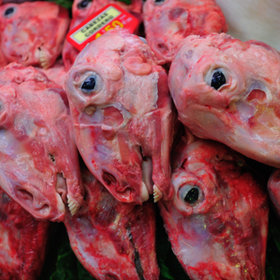
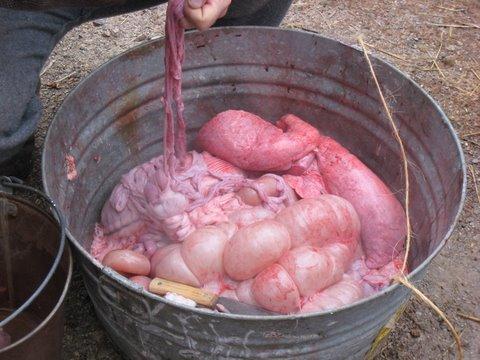
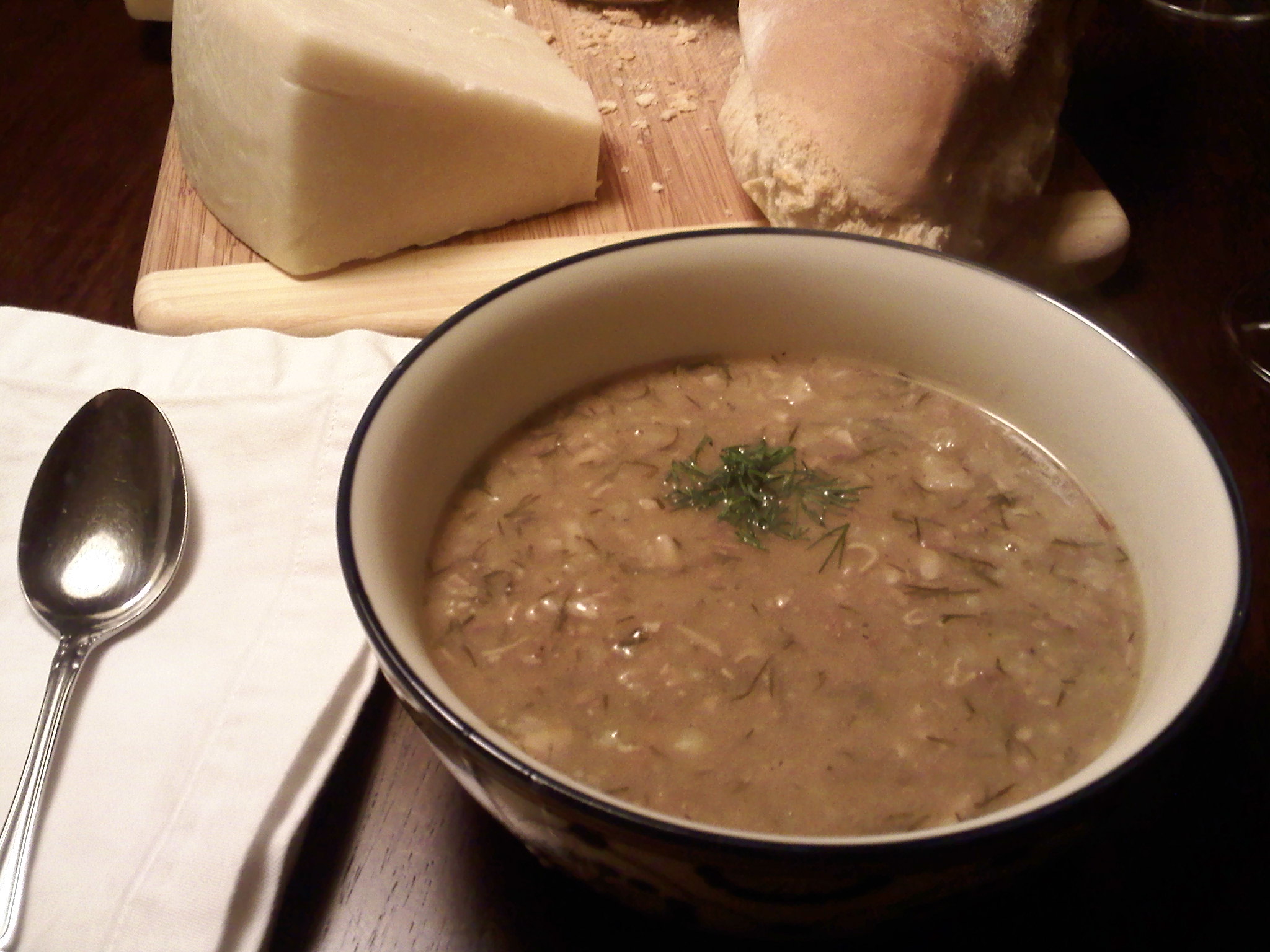
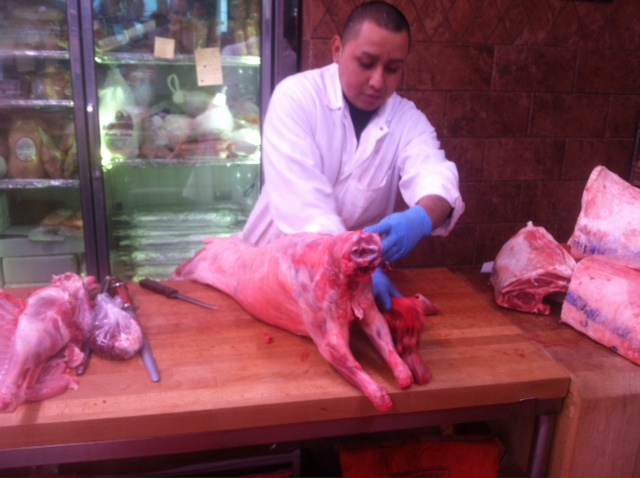
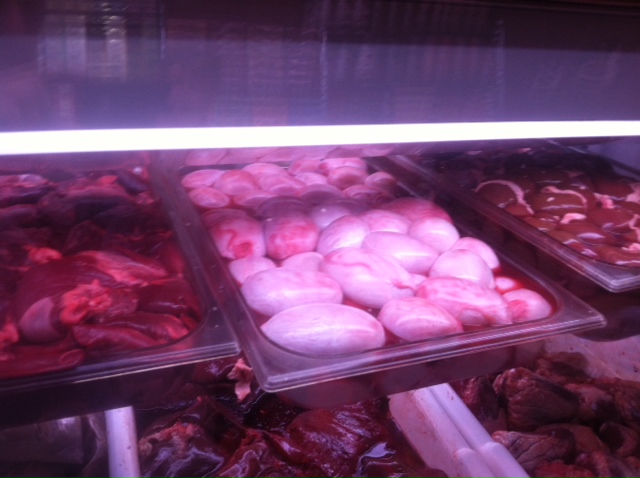
“Mageiritsa” is a Greek soup made of lamb offal that is made at – and only at – Easter.  It’s an incredibly time-consuming and labor- intensive production, which is probably why.  First comes the all-day or over-night simmering of the lamb’s heads and feet, to get the appropriately kelle paça type broth necessary.  (Kaleh pacheh seems to be a Friday after-prayer tradition in Afghanistan, so starting Thursday morning in front of all the butcher shops in Kabul, usually collected on one street, and by shacks along roads leading out of the city that seem to open just for that purpose, one sees giant piles of recently severed, bloody heads next to piles of bloody feet, both still in their fur, swarming with flies.  It’s a beautiful sight and one that, like so many other things in Afghanistan, I didn’t get a photo of while there because I thought I would embarrass people by taking pictures of things that I was afraid they would think I thought backwards.)  Then comes the cleaning out of faeces from about a football field’s length of lamb intestines (below), which is not that bad because they come from young animals that only eat grass anyway so it’s kind of the texture of baby poop.  (The European Union Daddy-State tried to ban the sale of intestines a few years ago and the Greeks to their credit, which I don’t grant them often, got into an uproar and Brussels backed down.  I actually have a theory that the intestine issue was the behind-the-scenes deal-breaker between the EU and Turkey, and rightly so; make me bend over backwards about how I run my country, make me reorganize my economy to enrich you and impoverish myself, treat me like an unwanted guest because I’m Muslim, but I’ll be damned if you take away my kokoreç.*)  Then you braise the intestines, and the sweetbreads (thymus glands) and hearts and kidneys in the broth (some people use liver or spleen and testicles too, but I don’t ‘cause the liver and spleen can get bitter and the testicles retain an unpleasant spongy texture when boiled which they don’t when grilled, or when sautéed with oil and a ton of garlic like they do with the bull’s balls in Spain after a bullfight — talk about sympathetic magic – and are quite yummy — see bottom.)  Then they’re all minced up, browned in a healthy amount of butter, added to the broth with lots of scallions and dill, some rice, and, just before serving, terbiye-d** with eggs and lemon.

Intestines

It’s generally acknowledged that I make the best mageiritsa in the world.  You can get pretty good mageiritsa lots of places, but mine is the best…in the world.  When I serve it at Easter, some people can’t get enough of it and some people politely decline.  Others, unfortunately – and tellingly, it’s usually younger Greek-American family – have always felt they have license to grimace and make faces of disgust and revulsion.

Mageiritsa — the finished product (click)

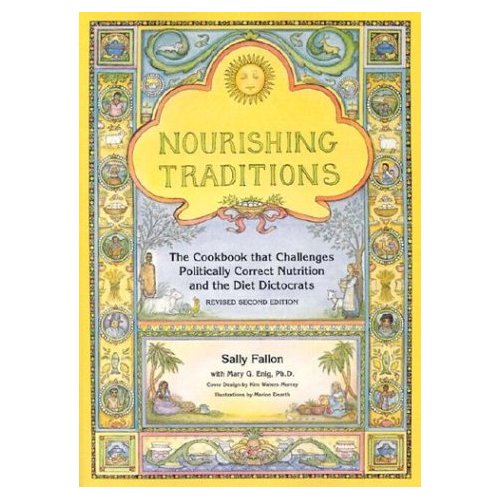
It’s bad enough that so much art and time and work on my part should be met with that kid of rudeness.  Then I have to listen to the anthropology tes poutsas about how people only used to eat that stuff because they were poor and they had to eat everything available, like eating intestines were the equivalent of the dirt-eating that tragically occurs in third world countries under famine conditions.  No they didn’t; they ate those things because they taste good.  Organ meats perform more complex biochemical functions in our and other animals’ bodies than muscle does; joints: feet and hocks, are complexly interconnected with tendons and cartilage of various kinds.  They therefore have more varied textures, mineral content and other elements, which gives them a richer and more varied taste than regular flesh has.  As mentioned in this brilliant book Nourshing Traditions: The Cookbook that Challenges Politically Correct Nutrition and the Diet Dictocrats by Sally Fallon, when a carnivorous animal (which we are, by the way; ignore false, scientifically faulty Vegan and Buddhist propaganda) kills another animal in the wild, the first thing it goes for are the guts because it instinctively knows they’re the most nutritious part.  Instead of teaching their kids the value and variety of our traditions or pointing out the beautiful economy with which our ancestors made use of every part of the animal, or their respect for and intimate knowledge of the world, the plants, and the animals which fed them, as opposed to our obscene wastefulness and complete alienation from any food which actually looks like food or reminds us of where it comes from, these people stupidly and condescendingly put it down to their poverty.

I never, ever heard anyone in older generations reminisce about the breast of any chicken or the dry, grey boti meat of a traditionally over-cooked Greek leg of lamb.  My mother used to wax nostalgic about an aunt’s Sunday pacha or the street kokoretsi they sold down by the lake in Jiannena next to the Karagöz puppet box (you’d get slices of it on wax paper, that or a cone of pumpkin seeds or a stick-full of pişmaniye and sit and watch Karagöz and Hacivat’s brilliant antics; I can’t be grateful enough that all these survived until I myself was a child.)  If a whole animal were roasted, the kids would fight over the head and its brains, tongue and the delicious, gelatinous cheek flesh.  And pig feet and andouillete are enjoyed in the best Parisian bistros, not just in supposedly impoverished Balkan or South American villages.

It’s a growing ecological disaster – a cultural one – and that’s what depresses me most.  We’re tangling ourselves (like most things modern, it starts in America but is spreading throughout the world) in such a neurotic, kosher-like web of food anxieties and hysteria that we’ll have soon lost access to half the things humanity used to enjoy at the table if we haven’t already.  I truly believe that it’s a phenomenon connected to the disappearance of other forms of diversity:

“All these seemingly disconnected events are the symptoms, you could say, of a global epidemic of sameness. It has no precise parameters, but wherever its shadow falls, it leaves the landscape monochromatic, monocultural, and homogeneous. Even before we’ve been able to take stock of the enormous diversity that today exists — from undescribed microbes to undocumented tongues — this epidemic carries away an entire human language every two weeks, destroys a domesticated food-crop variety every six hours, and kills off an entire species every few minutes. The fallout isn’t merely an assault to our aesthetic or even ethical values: As cultures and languages vanish, along with them go vast and ancient storehouses of accumulated knowledge. And as species disappear, along with them go not just valuable genetic resources, but critical links in complex ecological webs.”  — “In Defense of Differerence.”

“Oh, this is so salty.  Oh, this is so fatty.  Oh, this is so oily.  Oh, this must have so much cholesterol; I can feel my arteries clogging.  Eeew, this has liver in it.  It’s what?! Made with blooood?!”  (You can’t imagine how many people I’ve known who had heard of blood sausage but thought it was a metaphor.)  “Ugh, this is so sweet – I can’t take a second bite.”  We think we’re so sophisticated but are pretty much as incapable of thinking comparatively or relatively as an Amazonian tribe shooting arrows at airplanes.  It never occurs to us that fattiness, or cloying sweetness, or fishiness or gumminess were and are qualities that people enjoy.  One of the most interesting pieces of etymology that I’ve ever learned is that the word “funky” – one of the few African words to have passed into American English usage – actually means “stinky” in whatever West African language it comes from.  But it’s telling that it’s come to mean what it means for us: weirdly, pleasantly off-beat.  Cool — in a way you can’t put your finger on — ‘cause it’s off.  Get it?  Like certain French cheeses when they’re good and ripe and smell like your boyfriend’s unwashed underwear, or the obviously slimy texture and smell – the obviously slimy look even, with all its erotic overtones — of oysters or other raw seafood.  Funky.  Yum.

Even in foodie paradise New York — where curious Brooklyn Heights ladies are taking butchery classes and where you’ve started seeing more and more of the kind of tastes and smells I’m talking about on restaurant menus: tripe and boudin and fatback (and if that’s a good thing to you because you love good food, you’re indebted more than you know for that to one man: one of my best beloved heroes, Anthony Bourdain***, who wrote in his first best-seller, Kitchen Confidential: “My body is not a temple; it’s a playground.”) – try going out to dinner with a group of friends.  It’ll take several hours of conference calling before everybody’s food concerns and quirks are taken into consideration and then, if the night’s not over, you’ve ended up at a least common denominator restaurant where one of your group is still bound to torment a busy waiter with a barrage of anxious questions, requests for substitutions, no peanut oil, “light on the butter” or the resounding, echoing sound of “sauce on the side.”  This is most often a white girl who doesn’t cook (“sauce” is usually a fundamental component of a dish produced by the entire, holistic process of preparing it; you can’t put it on the “side;” it’s not the jarred tomato sauce you grew up eating, babe; you can’t make a blanquette de veau with the sauce on the ‘side,’ or a mole poblano with the mole on the side!) or it’s someone who has never worked in that business and has no idea what a tightly organized military operation a good New York restaurant is and what chaos that behavior throws both the floor and kitchen staff into, not to mention the offense to the chef himself and his line, who might not just be doing their jobs, but might actually be proud of the carefully conceived and prepared dishes they’re trying to put out.

I understand people have different tastes and that they even have different biochemical make-ups that might make certain tastes seriously unpleasant to them.  I mean, even Tom Colicchio doesn’t like okra, which I love, but I don’t hold it against him.  (I just know that he hasn’t eaten them properly prepared).  But the preparation and sharing of food is such a fundamental part of most human socializing and it’s become almost impossible to conduct in any civilized form through this thicket of prohibitions and fears. Which brings me to my final point: the social aspect, which includes issues of hospitality, personal pride, and what Greeks call philotimo, all heavily weighted and codified issues in ‘our parts.’

But my intestines need cleaning, so I’ll have to tackle the rest of this issue in another post.

*Kokoreç (shown below) is basically the same ingredients as mageiritsa but spitted and roasted.  The organ meats are spitted and the whole thing is wrapped around with the intestines like a giant andouillette.  In Greece, they cut it in slices and serve it like that, which I prefer.  In Turkey they usually mince it all up with red pepper after roasting and put it in a sandwich, which is delicious but doesn’t allow the texture of each constituent organ meat to be appreciated as much.

** Terbiye, what Greeks call augolemono, is supposed to be an egg-lemon liaison sauce used in many dishes or to thicken soups and is the greatest culinary hoax ever perpetrated on the peoples of the Near East.  Very simply, the recipe, as usually given, does not work, and does not produce a thickened sauce but a watery, sour mess.  When you make a béarnaise or a hollandaise you use minimal acid (vinegar or lemon respectively) only the egg yolks and pure butter, ideally clarified.  It’s impossible to scramble some whole eggs with lemon, pour some watery liquid out of a pot of cabbage sarma into it and expect that it will produce something comparable.  If you’ve ever seen a truly smooth, thick terbiye, some kind of extra binder (corn or regular flour) was added to it, and if the cook tells you otherwise she’s lying.  Never underestimate the tactics a Turkish or Greek woman (especially one from Istanbul) will resort to in order to protect her recipes and ensure no one else’s version is as good; lying is the least of it.

***Anthony Bourdain

My man Bourdain — get all his books here.

International Meats in Astoria, staffed almost entirely by Mexicans, who speak perfect Greek and know every detail of innards terminology in not only Greek, but Serbian and some Roumanian.  A Queens insituton.

Bull balls at International, with liver to the left, kidneys on the right, spleen on bottom left, hearts on bottom right.

Comment: nikobakos@gmail.com