Tag Archives: Spain

Catalonia: I find these photos GENUINELY TERRIFYING — “¡Basta ya con Cataluña!”

31 Oct

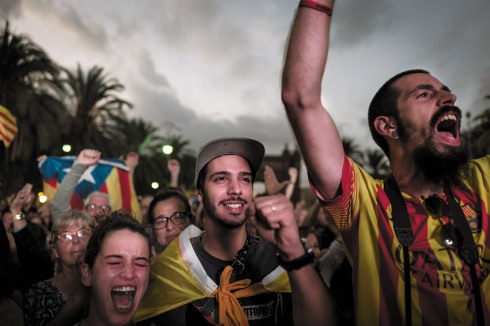
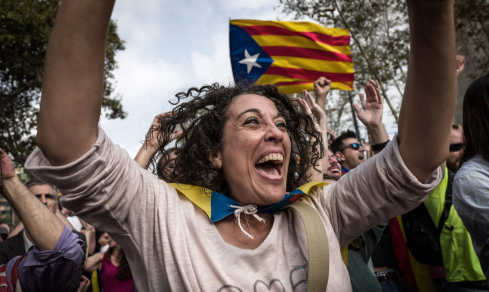
Supporters of Catalan independence outside the Catalan parliament in Barcelona during a speech by Premier Carles Puigdemont on whether he would declare independence from Spain, October 10, 2017

Screen Shot 2017-10-28 at 11.44.33 PM

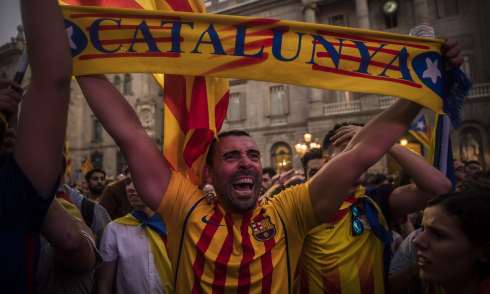
Catalan nationalist

These are photos of a jubilance that one imagines accompanied the Emancipation Proclamation or sees in images of the Liberation of Paris or of the Greek flag being raised over the Acropolis in 1944 or of V-J Day or the Fall of the Berlin Wall.

Instead, they’re photos of a sociopathic hysteria: of a people with one of the highest living standards in the world, with their language and culture (a word I’ve come to hate) fully un-threatened, living in a region with the absolutely highest level of autonomy than perhaps any region of any other state in Europe, or even the world, cumming in the streets because of an absolutely meaningless independence they think they’ve won in an increasingly interdependent world.  Meanwhile their “leaders” are having their moules frites in Brussels.

Really, they scare me.  The affect is so off, the affect level so incommensurate to the stimulus, that it suggests the haunting spectre that even people in one of the most liberal, progressive of human societies can be convinced they’re victims of something.  And like the convert, beware the victim.

There’s a name to that spectre and the victim narrative that is now haunting not only Catalonia and Spain and Europe and American democracy, but the entire world: identity politics.  As Mark Lilla has already said — please read the piece — the main problem with identity politics is that they don’t do politics: Mark Lilla’s “The Once and Future Liberal: After Identity Politics”.  It’s nonsense.  It’s a waste of all of our time, something even more precious than our energy and our resources and brain cells.  It’s a lame Fifth Avenue parade that’s supposed to actually express the soul of a particular segment of human civilization.  It’s an adolescent acting out of culture in a Mardi Gras costume in a deadly serious arena of politics that can quickly get dangerous.  And cultures that deserve to survive, will, by definition, do so on their own and don’t need constant “Pride” parades and manifestos and events and pointless — and dangerous — referenda.  (It’s bad enough to give the demos something complicated to think about; giving them an easy yes-no question is potentially fatal to any polity.)

Andrew Sullivan did a really good job in his  “I Used to Be a Human Being” for New York magazine last year, describing how being hooked up to a screen and keyboard all our lives makes our brains oatmeal, and how blogging all the years he did for his Daily Dish started to have physical health consequences for him, physical consequences that he could only deal with through treatment of his mind and soul.

I’m not in danger of that — usually.  One, I’m too lazy.  Two, I don’t “cover” running stories like Sullivan used to do on his Dish, in what really was a border-line manic-obsessive fashion.  Rather, I jump here and there, back and forth, with now and then ruminations that are all kind of “evergreens”, to use journalist sprache.

But as the child of a family that suffered terribly as an ethnic minority under a Stalinist regime, as a member of an ethnic group that was once spread all over the eastern Mediterranean and was then locked up in the pigsty of a nation-state, as an ethnic-American who always felt the world outside his window was sort of a foreign country, I’m acutely sensitive to issues of pluralism and how they should be negotiated and they strike incredibly powerful chords in me.  And they’ve made me a defender of minority rights but an even more intense critic of self-determination.  It’s not pluralist for every two-bit tribe of Balko-somethings to have their own country; you’re destroying pluralism that way — and the “way” always involves violence of some sort.  WHICH IS WHY I STILL GET SO FREAKED OUT ABOUT YUGOSLAVIA.

That’s also why a story like Catalonia can consume me for weeks if I let it.  And this post was actually meant to declare that I will not myself be writing or quoting or even linking to anything that has to do with the issue — at least until something substantive happens — which may be tomorrow…  I still have some identity politics/multi-culti-bashing pieces knocking around inside my head, but they’ll be dealing with other parts of the world.

Because Catalonia — which infuriates me — and Spain — which I love — are two players that can completely eat me alive if I let them.  For other gold-and-red semiotics, see my Bodegas.

Comment: nikobakos@gmail.com

Bodega 10

Catalonia: “…the little boxes of diversity…”

21 Oct

I couldn’t think of a better catch-all phrase for the cocoons identity politics create.  See whole article on the bubble created by all-Catalan media in Guardian.

Catalan pro unionDemonstration supporting Spanish unity in Barcelona. Photograph: Anadolu Agency/Getty Images
Comment: nikobakos@gmail.com

“Cities, rather than nation states, ‘are the future,'” says Barcelona’s mayor

20 Oct

Ada Colau, Barcelona’s leftist mayor, opposed to Catalan independence, understands and argues that an urban-based cosmopolitanism is the future of human political organization, not what I call the EBNS, the ethnicity-based nation-state.

Perfect that the more leftist your political leanings, if one listens to the debate in Catalonia, the more anti-independence you tend to be.  Certainly shows up Catalan nationalism as a force more reactionary rather than liberating, as many tend to think (see my take on Vargas Llosa’s piece on Catalonia).

Why, as the nation-state eclipses, are we forming new ones?  Is this the last orgiastic swan song of that ideological structure?

HOW CAN THE POINTLESSNESS OF YUGOSLAVIA’S DESTRUCTION NOT BE ENOUGH??!!  A city, Barcelona, and a region, Catalonia, that prides itself on its supposed openness as opposed to the inward-looking casticismo of Spain, opting to separate and isolate itself: is the oxymoron and moronic paradox here not evident to all?

Comment: nikobakos@gmail.com

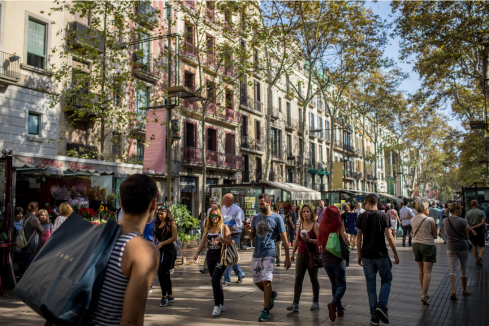
Screen Shot 2017-10-20 at 6.23.11 PMLas Ramblas, a popular boulevard in the heart of Barcelona. The city is far more diverse than other parts of Catalonia. Credit Chris McGrath/Getty Images

Catalans’ second thoughts: ‘…the last refuge of the wallet-minded’: nationalism in all its petit bourgeois glory

17 Oct

From the Times, by

14caparros-inyt-superJumboDemonstrators in Barcelona, Spain, on Thursday protesting Catalonia’s push for independence. Credit Chris Mcgrath/Getty Images

On Oct. 1, Mr. Puigdemont’s separatist cause seemed on the road to victory as images of the Spanish police beating grandmothers circled the globe and sympathy aligned with the Catalan cause.

Then came the counterattack. King Felipe VI led the charge. He stated that neither the government in Madrid nor the monarchy would negotiate with the pro-independence Catalan leaders.

But it was the joint offensive between the Spanish state and major Catalan corporations that really did the trick. On Oct. 4, the government issued a decree that would help businesses relocate from Catalonia to Spain. In the days after, the headquarters of the major Catalonian banks — Caixa and Sabadell — and the water and gas companies announced they would leave the region. Democracy also works this way: Millions of voters cast only one vote, while a few use their millions to weigh in as if they were millions…

The banks’ departure felt like a cold shower for independence supporters, willing to give it all for their motherland — except their savings accounts and their European lifestyles. For Mr. Puidgemont and his party, historically tied to those same banks, it was more like an ice-cold tsunami. [my emphasis].

It’s really tiring — and tiring, especially, is feeling the constant scathing condescension towards these idiots — to see what a playground for the puerile identity politics are.  Caparrós continues:

With the economy in danger among the waving flags and patriotic chants, it became increasingly evident that independence was more a desire than a project. For years, there has been talk about creating a new country but little discussion of its economic and social structure, which is why it was never clear how much actual social energy — how much struggle, how much sacrifice — was necessary to achieve it.

Creating a country is a complex, expensive process: To take such a step you need a huge amount of support. Usually, independence is achieved after a long war, or the fall of a colonial power. At the least, it requires the gathering of an overwhelming majority. In Catalonia, I’m glad to say, the first two options seem impossible. The third one is not in place. To start as a new but divided country would be a recipe for disaster.

Like the make-you-wanna-pull-your-hair-out Brexit: it seems — what? — nobody thought of these things?

One important thing that may have come out of, as I wrote, rethinking Yugoslavia, and the thing that Catalans and Basques, Croatians and Slovenians, and Lombards and Romagnolos, and self-righteous Brits and Germans bitching about Greek irresponsibility, should really rethink is how their supposedly parasitic South is also their major market.  See the dim shape Croatia seems to be unable to pull itself out of since independence, I’m happy to report with just a touch of schadenfreude; Croatia, which a New York Times editorial in 1992 gallingly called to be accepted “…into the West, in which it always belonged”, (see Bugarian historian Maria Todorova‘s enraged reaction in her Imagining the Balkans)…Croatia has now fallen behind the poorest countries in the EU, Romania and Bulgaria, on many indicators.

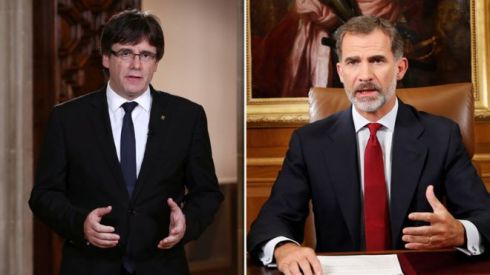
_98146567_puigdemontkingPuigdemont and Spanish King Felipe VI at recent press conferences.
Comment: nikobakos@gmail.com

Turkish Jews: A Spanish right of return redux

15 Oct

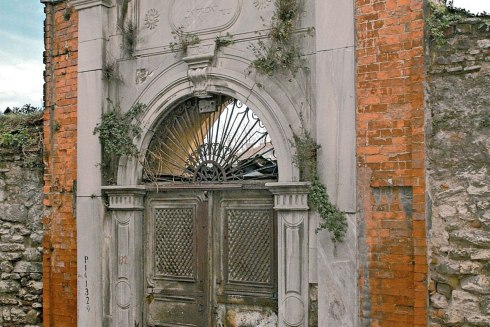
istipol-synagogue-istanbulİştipol in Istanbul

When I first came across this idea of that Spain was granting Sephardic Jews Spanish citizenship I was mildly condescending, thinking that it was the most pointless kind of Western guilt for the past and that maybe Europe had better things to think about.

Then a friend sent me this article about the shrinking Jewish community of Istanbul from Young Turkish Jews trickling away from shrinking community from the Times of Israel:

Turkey’s economic boom in the first decade of the 21st century has slowed, and its currency has lost 20 percent of its value against the dollar in the past year alone.

As tuition prices in Turkey’s increasingly competitive universities have skyrocketed in recent years, the quality of education lags behind schools in western Europe, the United States and Canada.

Like many middle-class Turks, Turkish Jews have contributed of the country’s brain drain.

“There’s no doubt anti-Semitism is a motivating factor,” said Louis Fishman, an assistant professor at Brooklyn College who has split his time in the last decade between New York, Istanbul and Tel Aviv. “But there are other groups [in the Jewish community] that are leaving because they’re part of the middle class, they can go to school in the US and get a job abroad.”

T., a 30-something resident of Istanbul who, like other Turkish Jews, preferred to speak anonymously for fear of backlash, works in a multinational company, which he said offers many Turks a means of emigrating with financial security.

“Almost all my friends think about what to do next,” said T., especially after the 2010 and 2014 anti-Israel uproar in Turkey. “Even though we are staying here, everyone is thinking of their next move.” He said that in the past five years he’s noticed a marked rise in Jewish emigration from Turkey.

Another indicator of the anxiety pervading the community is the number of Turkish Jews who have jumped at the opportunity to acquire Spanish citizenship. The vast majority of Turkey’s Jews are descendants of Spanish exiles who were welcomed into the Ottoman Empire.

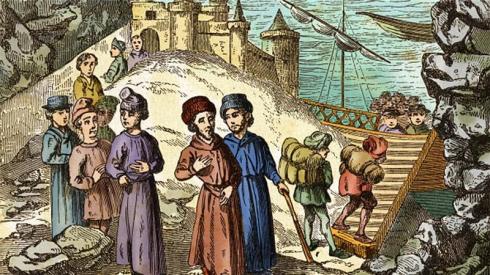
Earlier this year the Spanish government announced its intention of extending citizenship to descendants of Sephardic Jews expelled in 1492. Shortly thereafter 5,000 Turkish Jews — roughly a third of the community — applied for dual citizenship, potentially opening the doors to life in Europe, according to a recent Financial Times report. [my emphasis]

I don’t know why this idea — that Spanish citizenship would open the doors to life or work anywhere in the European Union — completely skipped my mind; it’s the reason that I got my Greek citizenship (along with a little bit of a more personal tug, granted…)  Maybe it’s because all discussion of the issue was focused on the Israelis that would be granted citizenship and I totally forgot about the only real Jewish community in the Muslim world (aside from Iran) that still exists.

Still, the article gives you enough to worry about in terms of minority life in Turkey: the people who wouldn’t go on record for the writer is just one.  And, I wonder if having dual citizenship is actually allowed in Turkey and if you’re not setting yourself up for trouble.  In 1964, Turkey expelled all Greeks who held both Greek and Turkish citizenship from Istanbul, in such an over-night fashion that it effectively meant confiscation of their property as well.   Next time you’ve found the perfect Airbnb space in Pera or Tarlabaşı, ask the owner if he knows anything about the building’s history.

Below is my first post on “Spanish right of return” and below that a 1964 article from The New York Times article on the Greek expulsions.

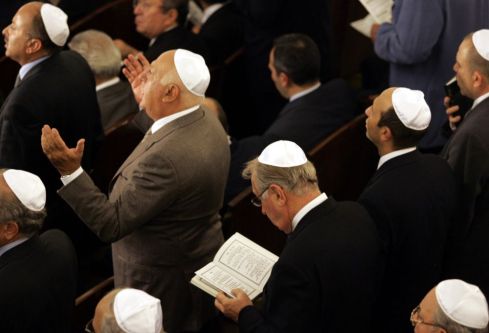
Turkish synagogueMembers of Turkey’s Jewish community pray at Neve Shalom Synagogue in Istanbul on October 11, 2004, during a ceremony to mark the official reopening of the synagogue (AP/Murad Sezer)
**************************************************************************************

A Spanish right of return for Sephardic Jews?

9 Feb

Boy, that’s a wild idea…

And I can’t help but think it’s EU-ish political correctness taken to the point of silliness.  Don’t you folks have a few other things to think about right now?

0c31974ca5f645249430604e4820ceee_18

“Why make a fuss about Spain’s ostensible effort to atone for bad behaviour, even if it’s about 524 years too late?” asks this Al Jazeera article about the Spanish offer, as it also examines some of the other complexities, ironies and…hypocrisies…behind the whole notion:

“To be sure, atonement in itself is far from fuss-worthy. Goodness knows this world could use more apologies, reparations, and truth-telling – and in fact, 1492 is not a bad place to start.

“That year happens to be rather synonymous with the decimation of indigenous populations in the Americas in the aftermath of a certain nautical expedition, authorised by the very same Ferdinand and Isabella who expelled the Jews from Spain.

“This is not to say, then, that the repercussions of centuries-old injustice aren’t alive and well; it’s merely to point out the ironies of an international panorama in which Mossad officials are granted additional homelands in Spain while Palestinians languish in refugee camps for nearly seven decades.”

And just another thought: it could hypothetically mean a minor flood of Sephardic Jews from Argentina, say, or other Latin American countries, looking for better economic possibilities.  But in Spain?  At this particular moment?  I think the days of heavy Latin American emigration to Spain have been put on hold for a while.

**************************************************************************************

ISTANBUL, Turkey, Aug. 8 —Harassment and deportation of Greek nationals in Istanbul in retaliation for Turkish set­backs on Cyprus was declared today “an open policy” of the Government.

Unless a solution to the strife between Greek and Turkish Cypriotes is found soon, the Greeks here fear that their community, once numerous and prosperous, will be dispersed before winter.

“The pressure on the Istanbul Greeks will be gradual,” said a spokesman for the Foreign Min­istry in Ankara.

Tactic Held Ineffective

Sources close to Premier Is­met Inonu said the Government believed “pressure on Greek na­tionals” was the only way left to Turkey to force Athens and the Greek‐dominated Cypriote Government to accept a satis­factory compromise.

Istanbul’s Greeks have many Turkish friends who believe the new tactic will prove as ineffec­tive as it is harsh. The consen­sus among the Greeks them­selves is that Turkey is using Cyprus as “an excuse to do what they have long wanted to do—get us out.”

This week 58 more Greeks were added to nearly 1,000 who had been deported on short no­tice since March.

New lists are expected within a few days, and the 9,000 re­maining Greek nationals are sure their days here are num­bered. Turkey has canceled, effective Sept. 15, a 1930 agree­ment under which Greeks have been privileged to live here.

There is fear now in the hearts of 60,000 Turks of Greek descent, They, too, complain of harassment, “tax persecution” and ostracism, although Premier Inonu has declared repeatedly that these minority nationals will not be discriminated against.

In the business districts of Istanbul, many Greek‐owned shops may be seen under pad­lock. They were closed on Government order or because the owners were summarily or­dered from the country. Wives and other dependents are in many cases left destitute.

Many Born in Turkey

Every morning large numbers of Greeks crowd into the arcaded foyer of the Greek Consulate to ask help and advice. Some ac­cept an emergency dole provided by the consulate; others are well dressed. Some are old and frail.

Most of those deported so far were born in Turkey, according to the consulate, and many had never been to Greece. They have no particular place in Greece to go, and they say they have no idea what to do when they get there.

Greeks scan the Istanbul newspapers for published lists, fearing they will find their names. When they do, they go to the police to be fingerprint­ed, photographed and asked to sign deportation statements. They are given a week to leave the country, and police escorts see that they make the dead­line.

Asset Sales Difficult

Families of deportees protest that it is impossible to sell businesses or personal property in so short a time. “Few want to buy from us, and no one wants to pay a fair price,” one victim said. A deportee may take with him only his cloth­ing, 200 Turkish lira (about $22) and his transportation ticket.

At first the Government de­nied that these deportations had anything to do with the dispute over Cyprus. AU the deportees were charged with “activities harmful to the Turk­ish state.”

The Greeks have found wry humor in this claim. According to a source close to the con­sulate, the deportation lists have included the names of six per­sons long dead.

There have been 121 deportees more than 70 years old and 20 over the age of 80.

Many charges have been raised against the Greek aliens: smuggling money out of the country, for example, or evad­ing taxes and military duty. The Turkish authorities say the Greeks have invested their wealth abroad and that this has damaged the Turkish economy.

Wealth Put at $200 Million

Turkish estimates of Greek wealth here have gone as high as $500 million. But recently this figure has been reduced to $200 million. Greeks say the Turks “reduced their inflated estimates when they realized that someday they might have to settle for properties taken from us.”

They blame Turkey for not having offered better invest­ment opportunities.

In addition to abrogating the 1930 agreement on residence, trade and shipping privileges, Ankara has suspended a 1955 agreement granting unrestricted travel facilities to nationals of both countries. A number of Greeks caught outside Turkey when this suspension took ef­fect are reported to be unable to return.

More seriously, Ankara re­cently decided to enforce strictly a long‐overlooked law barring Greek nationals from 30 professions and occupations. They cannot, for example, be doctors, nurses, architects, shoe­makers, tailors, plumbers, caba­ret singers, ironsmiths, cooks or tourist guides.

**************************************************************************************

Comment: nikobakos@gmail.com

Castille and Catalonia: a kulturkampf much older and psychologically complex than we think

14 Oct

Miguel_de_Unamuno_Meurisse_c_1925

The Spanish — and/or/together, autonomously together, autonomously independent but dialectically related — Basque philosopher Miguel de Unamuno, one of my highest-ranking intellectual heroes, wrote in 1905:

“Los ensayos que constituyen mi libro En torno al casticismo […] son un ensayo de estudio del alma castellana, me fueron dictados por la honda disparidad que sentía entre mi espíritu y el espirítu castellano.  Y esta disapridad es la que media entre el espíritu del pueblo vasco, del que nací y en el que me crié, y el espíritu castellano, en el que, a partir de mis veintiséis años, ha madurado mi espíritu.  Entonces creía, como creen hoy no poco paisanos míos y muchos catalanes, que tales disparidades son inconciliables e irreductibles; hoy no creo lo mismo.”

“The essays that make up my book Regarding Casticismo […] are an attempt at a study of the Castillian soul, essays I felt obligated to write due to the profound disparity between my own soul and that of Castille.  Yet this disparity is what mediates between the spirit of the Basque people, into which I was born and raised, and that of Castille, in which, since my twenty-six years of age, my own spirit began to mature.  At the time I believed, as do not a few of my compatriots and many Catalans, that these disparities were irreducible and irreconcilable: today I no longer believe so.” [my translation]

I’ve chosen to leave “casticismo” untranslated, and not take Amazon’s suggestion that it means “purity”, precisely because it means so much more than that and has a much more complex, nearly untranslatable meaning.  I mean, it’s explainable, just not with one word.  But a good explanation, to the best of my instinct, since I’m not Basque or Castillian or Spanish at all, is what I need to give readers.

I have to go back to Unamuno’s essays, which are unfortunately not available in English, to do so, however.  Just posting this as a coming attraction and to get my own head working on the issue.

Later…

Comment: nikobakos@gmail.com


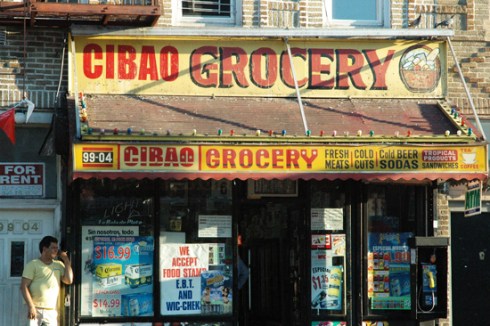
Bodegas

10 Oct

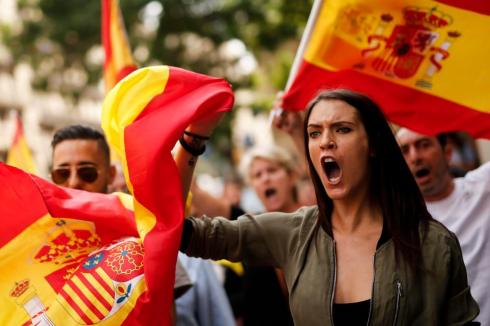
Spanish flag demonstrators

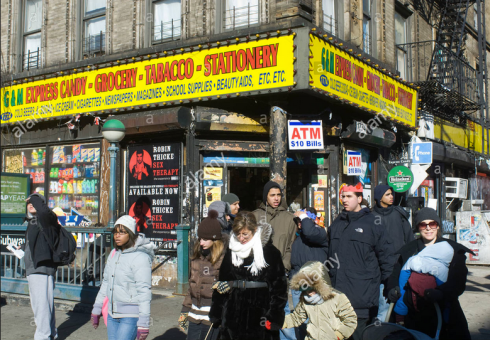
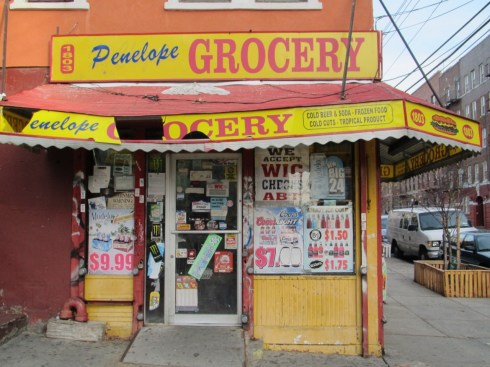
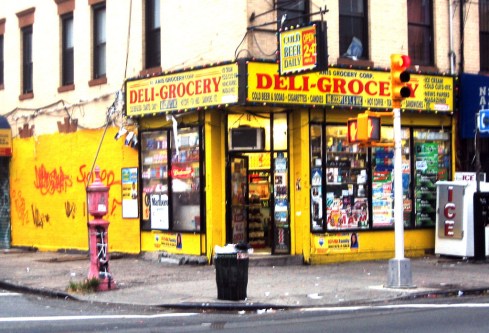
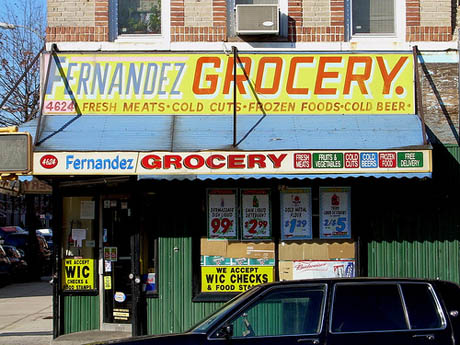
I’ve been color-numbed by the red and yellow of both Spanish and Catalan flags recently.  As a consequence though, a theory I once had that the color scheme of New York bodegas comes from the colors of the Spanish flag has resurfaced in my consciousness.

bodega 3.jpg-shot4 Philly or NYC

It’s not that far-fetched an idea.  The first large group of Spanish-speaking immigrants to New York originally came from mostly Galicia and Asturias in northwestern Spain in the late nineteenth century and settled in what are now the streets north and south of West 14th Street and in the meat-packing district.  That’s why there are still so many mediocre Spanish restaurants in the far West Village and Chelsea and there’s also the still spectacularly good El Cid on West 15th.

Unfortunately Riomar — on the corner of Greenwich Street and Little West 12th, one of the most ambient-blessed bars that this city has ever seen: a real dive, with horrible food, stale potato tortilla and sweaty chunks of bad chorizo tapas and Goya jarred red peppers you ate with toothpicks, dirt on the floor, a dismal wine list and great jukebox, the feel of a real sailors’ bar in Almería with a “manchado mostrador” out of a Concha Piquer copla, where you went to have an after-dinner argument with your girlfriend which no one paid attention to because everybody else was having their own vicious spats, interrupted only by a good merengue or when Don Can’t-Remember-His-Name from Burgos, chef and owner of El Cid, pulled out his guitar — left this world about fifteen years ago.

Riomar was one of those bars that got busy with after-shift restaurant workers (including those of El Cid) who needed a post-combat drink and the scene would really pick up after around midnight or 1:00 a.m. when the kitchens let out, and if you hung out long enough, the Nuyorican meat workers would come by for a caña before work (guess like Sheryl Crow, they liked “a good beer-buzz early in the morning”), and then you went for breakfast with the other meat-workers and the drag queens at the much-loved Florent around the corner on Gansevoort Street (three over easy on a roll for the butchers, eggs benedict for the gay dudes; this old diner managed to cater brilliantly to both its clienteles for decades), also now gone.  Infuriatingly, Riomar was replaced by some over-priced piece of mediocrity called Serafina Meatpacking with the gallingly named Gansevoort Meatpacking NYC Hotel across the street (“trendy hotel with a rooftop bar & pool, wi-fi, 259” says Google Maps).  Actually, have you seen the size of the rooms in most of these ’boutique’ hotels? “Meatpacking” might actually be the most accurate term.

Florent has been replaced by something called Bubby’s High Line.

(Grrrrrrrr….  Why did I let myself go there?  Now I’m pissed.  Does anybody even want to live in this sterile Manhattan that’s replaced that one anymore?)

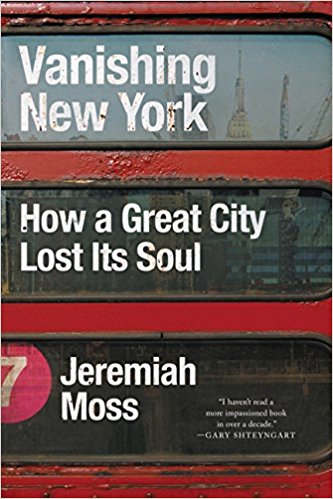
Vanishing New York Jeremiah Moss

Ok, bodegas.  A lot of the Galician and Asturian immigrants who settled in that neighborhood often came through a generation’s or less immigrant experience in Cuba or Puerto Rico, Spain’s last Caribbean colonies; if you know Havana (saludos to my pana Yusuf who does) you know two of the most imposing buildings in the city’s center are the Centro Gallego and the Centro Asturiano.  One of the innumerable fascinating things about Cuba is that while it has perhaps the richest and most vibrant Afro culture of any society in the Americas, it also has some of the closest, organic ties to Spain of any Latin American country as well.

They bring the red-and-yellow color scheme?  Why?

The only place in the Spanish-speaking world where “bodega” means a cruddy, smelly grocery store that you can’t live without is New York.  Why?

And what you call the dank grocery is the same word as the word on the label of your $300 bottle of Rioja.  Why?

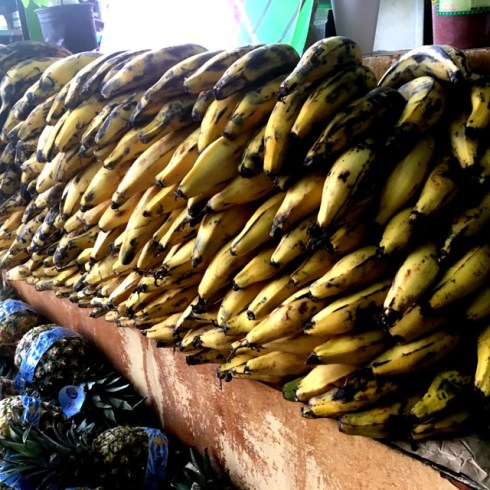
Because “Bodega” in Spanish simply means warehouse or cellar.  That’s why your wine, sherries especially, comes from “bodegas” in Spain.  But in Cuba and Puerto Rico, the sugar plantation or ingenio/refinery company store, where first slaves collected, and then indentured workers later bought, their basic food stuffs, was the company’s warehouse — the bodega.  And take a sec even today to look at the merchandise in your corner bodega, other than the beer, cigarettes and soft drinks, that really moves: plantains, yuca, yautía, malanga and other tubers, the bags of rice, beans, lard, and if it has more than just grocery pretensions, pig feet and salt pork in the counter fridge.  Slave food.

So when the guajiro plantation overseer or the Cuban-Galician neighborhood businessman came to New York in 1910, he called the little store he set up that sold Cuban food staples a bodega, and I’m guessing figured the best colors for it were Spain’s red and yellow.  And then it stuck.  And then became tradition practically.  You look for the bodega’s red and yellow lights in the streets in New York at night when you need a smoke, or a seltzer to rehydrate after drinking too much, and when you remember there’s no coffee in the house for tomorrow morning; just like you look for the flashing green pharmacy cross in a European city at night after drinking too much and when you remember there’s no ibuprofen in the house for tomorrow morning.  And though the economy that produced the term has disappeared in the islands, and if you tell anyone today in Cuba or Puerto Rico or the D.R. who hasn’t visited relatives here in the city to go down to the “bodega” and buy some milk he won’t even know what you’re talking about, it survives in New York, our huge φτωχομάνα and warehouse of the world’s darkness and exile that run a constant lament under the city’s exuberance and energy and often forced-feeling hedonism.

Bodega 10

bodega 1

Bodega 2.jpg gkjarvis

Bodega 4

Bodega 5

Bodega 6

Bodega 7

Bodega 8

platanos

Yuca

img_8353

Comment: nikobakos@gmail.com

Times: ‘I Am Spanish’

8 Oct

Thousands rallied in Barcelona, Spain, on Sunday in support of a united Spanish state and against agitators for independence. Credit Pau Barrena/Agence France-Presse — Getty Images

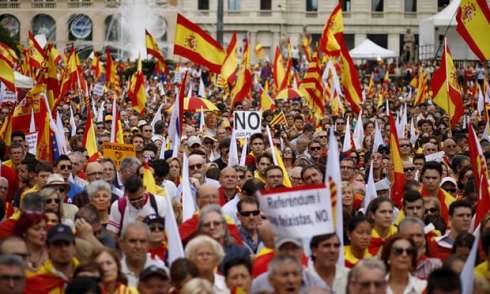
BARCELONA, Spain — Catalonia’s silent supporters of Spanish unity found their voice on Sunday, thronging into the center of Barcelona as part of a huge rally that reverberated with chants in support of a united Spanish state and against agitators for independence.

They demonstrated solidarity with the vilified national police and proudly waved a red-and-yellow national flag that for decades had carried the stigma of a taboo nationalism.

“Catalonia is not all for independence,” said José Manuel Alaminos, a 64-year-old lawyer. He said that Carles Puigdemont, the regional president who has led the independence movement, “is supposed to represent all of us.”

The separatist push has brought about one of Spain’s worst constitutional crises since the end of the Franco dictatorship nearly 43 years ago.

“But we are Catalonians too! The world doesn’t know the truth,” Mr. Alaminos said, pointing to the enormous crowd. “This is the truth.”

Prime Minister Mariano Rajoy echoed that sentiment in an interview with the Spanish newspaper El País published late Saturday, in which he said flatly that the secession of Catalonia “won’t happen” and that he was “not ruling out anything” to maintain Spain’s integrity, including a constitutional article that allows him to disband the regional leadership and assume its powers.

“We are talking about our nation’s unity,” he said.

Mr. Puigdemont is expected to address the regional Parliament on Tuesday, when Catalan leaders could declare independence, citing the results of a referendum that the national government and the courts had said was illegal and ordered suspended.

The rally also served as a coming-out party of sorts for the national flag, which has long been associated with nostalgia for the Franco dictatorship. Credit David Ramos/Getty Images

The rally on Sunday was organized to show that the referendum, which attracted international attention for a police crackdown that left hundreds injured, did not represent all Catalans. They are, in fact, deeply split over independence.

Drivers flying Spanish flags from their windows blasted staccato beeps of their horns in support of people wearing Spanish flags over their shoulders like capes. As helicopters hovered overhead, a river of supporters of Spanish unity snaked from Urquinaona Square down Via Laietana and past the city’s cathedral to its historic train station, where politicians read manifestoes in favor of a united Spain.

Along the way, thousands chanted, “Long Live Spain, Long Live Catalonia,” “I am Spanish, I am Spanish,” and “Puigdemont to Prison.” They waved Spanish, Catalan and European Union flags and wore stickers of all three on their chests.

The rally — estimated by the police at 350,000 people, though organizers said it was twice that — also served as a coming-out party of sorts for the national flag, which for decades has carried a stigma associated with the far-right groups nostalgic for the Franco dictatorship.

“Everyone thinks waving the Spanish flag means we are right wing or fascists,” said Alfredo Matías, 47, who held one edge of an oversize Spanish flag. “But we are not. We are just patriotic. It should be like the flag in America. And this is a big opportunity to make that happen.”

Mr. Rajoy, in his interview, also suggested that the time had come for the flag’s stigma to be lifted.

“People have the right to say, I’m Spanish, I’m proud of it and proud of my Constitution,” he said, adding that everyone in the country had a right to defend “your symbols, your flag, your hymn.”

He said his message to Spaniards was that “they have a government who will defend, as it is its obligation, the national unity and sovereignty.”

Many demonstrators wore flags over their shoulders like capes. Credit Manu Fernandez/Associated Press

Nadia Borrallo, a 31-year-old pharmacist from nearby Sant Boi de Llobregat, said the independence movement had tried to convince the world that all of Catalonia was on its side. “This is the reality,” she said, a Spanish flag draped over her shoulders. “Look around: I see a united people.”

As she approached a Spanish flag carpeting the street in front of a paella restaurant, she said that it looked as if Spain’s soccer team had won the World Cup.

“When Spain wins, they chant, ‘I am Spanish, I am Spanish,’ ” she said. “Now they say, ‘I don’t feel Spanish, I want my independence.’ It’s nonsense.”

As demonstrators jeered at balconies hanging pro-independence flags, organizers and security forces cleared paths for politicians and celebrity supporters of Spanish unity who had lined up at the front of the rally.

“I feel very enthusiastic and optimistic,” said Mario Vargas Llosa, the Nobel Prize-winning author who became a Spanish citizen in the 1990s and has spoken out in favor of conservative Spanish causes.

They followed a flatbed truck loaded with four speakers blasting the voices of organizers who heralded demonstrators as “the silent majority.”

Until now, supporters of independence have been the most vocal, especially after the violence on the day of the referendum gave momentum to their cause. Supports of Spanish unity complained that the regional police force, the Mossos D’Esquadra, appeared to refuse a national order to block the referendum.

Supporters of independence had thrown flowers at their feet, but the demonstrators on Sunday cursed their name. The Catalan police force — the leader of which is facing sedition charges in Madrid — was almost nowhere to be seen along the rally’s route.

The rally on Sunday was organized to show that the results of the independence referendum did not represent all Catalans. Credit Pau Barrena/Agence France-Presse — Getty Images

Instead, the officers standing outside the National Police Headquarters bathed in the adoration of demonstrators. Officers posed for selfies, received hugs and heartfelt handshakes and smiled broadly as the demonstrators chanted, “You are not alone” and “This is our police.”

“The referendum was illegal, and these police followed their instructions,” said Danile Basteller, 51, from Barcelona. He said the police had been treated shabbily: “We are here to show them they are not alone.”

Jose Luis Rencé, a retired soldier clad in his fatigues, agreed. “The law has to be followed,” he said. “With the law, everything. Without the law, nothing.”

In front of the seat of the regional government, Manuel Perales Álvarez, a 54-year-old garbage collector, shouted at the stone-face Mossos officers standing guard.

“With what authority will you present yourself,” he screamed. “You have no shame.”

Lucas Fernández, 66, from Barcelona, stood next to him, holding a Spanish flag and yelling, “Long live Spain” toward Mr. Puigdemont’s office.

“He clearly is going to receive the message, but he is pretending he is deaf to us,” Mr. Fernández said of the Catalan president. “He doesn’t listen to the people — only to the supporters of independence around him.”

Sergi Miquel, a lawmaker from Mr. Puigdemont’s party, saw little to worry about. “The demonstrations are fine,” he said. “But I don’t think anything changes, because the referendum and the Catalan elections had clear results.”

Mr. Fernández worried that the die had already been cast for a declaration of independence. He said he wished that the supporters of Spanish unity had raised their voices sooner. “It’s a little late,” he said. “It should have been done earlier.”

#CatalanReferendum: As a foil for your own nationalist narcissism, you made up the myth of an intolerant, fascist Spain …and you got it.

1 Oct

We can go on about projection, or Jung and the Shadow, but I really can’t be bothered to say anything else right now.  Check Catalonia on my tags, or go to my one post that sort of says it all re: Vargas Llosa piece in TimesCatalonia: “Nationalism effaces the individual…”  I’ll re-post it.

But for all you millenial nitwits whose hearts are now bleeding for poor Catalonia, this is the end-game of the identity politics that have become your playground.  When you “stop taking pictures of your food” as Fran Lebowitz said, or gushing about an Emmy because it’s gone to an African-American or a South Asian and not to a great actor, or worrying about stupid Confederate monuments and instead try real, organized, intelligent political action, you’ll see the difference.

Comment: nikobakos@gmail.com

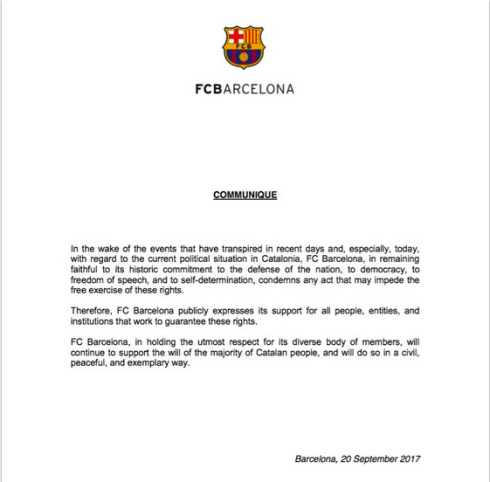
Spain and Catalan domino effect and Barca: has the European Union encouraged orgy of separatism and regionalism?

21 Sep

Screen Shot 2017-09-21 at 1.28.07 PM

The most thuggish, corrupt sport on the planet chimes in on Catalan independence.  Bloody everybody’s got an opinion.

Apparently there were rallies for a Basque referendum all over the Vascongadas in recent weeks as well, and soon the pendejito of Spanish regionalism, Galicia, will want independence too.

Is there anyone out there who knows of any studies of how European Union ideology and policy have supported regionalism and separatism in the past decades?  That a German “go-ahead” on Slovenian and Croatian independence lit the fuse on the Yugoslav bomb has, I think, become a commonly accepted view in recent years, even for the most anti-Serb-minded Westerners.  But is it the EU’s promise of support — meaning funds — what feeds these movements?  i.e., is the idea: “If I have a direct line to Brussels then I don’t need Belgrade or London or Madrid” at the root of most of it?  That would mean that Catalans are really not separatists but a form of closet centrists (which certainly proved true of Croatia); that they think they don’t need a tie to this parasitic peripheral center — Madrid — when they themselves can be parasites on a more central center, Brussels.  Any thoughts?

And Brussels, of course, is not doing what it should be doing: telling Catalans that if they want out of the borders of a EU country then they’re out of the EU entirely, which is also the secret message that the West refused to send to Croatia in the 80s, sending it on its merry path with the consequences we all know of.

Something for all you enablers of Catalan delusions of grandeur who supported them with your tourist dollars over the past couple of decades to think about.

See Ryan Heath’s Josep Borrell warns of Catalan ‘domino effect’ in Politico (“The veteran Spanish Socialist politician — himself a Catalan — says that the independence argument is based on a myth.”)

Screen Shot 2017-09-21 at 2.27.09 PM

Comment: nikobakos@gmail.com