Since people are sometimes lazy about links, and the more screen-addicted you are the more six Word pages seems like War and Peace to you, here’s Mehta’s whole piece from FB. With some of my emphases.
**************************************************************************************
This Land Is Their Land
Immigration is inevitable. When will the West learn that it promises salvation — not destruction?
By Suketu Mehta
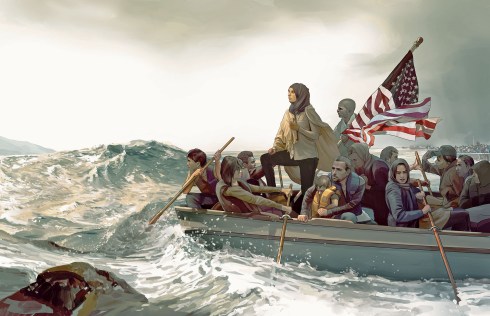
Illustration by Owen Freeman
September 12, 2017
On Oct. 1, 1977, my parents, my two sisters, and I boarded a Lufthansa plane in the dead of night in Bombay. We were dressed in new, heavy, uncomfortable clothes and had been seen off by our entire extended family, who had come to the airport with garlands and lamps; our foreheads were anointed with vermilion. We were going to America.
To get the cheapest tickets, our travel agent had arranged a circuitous journey in which we disembarked in Frankfurt, then were to take an internal flight to Cologne, and onward to New York. In Frankfurt, the German border officer scrutinized the Indian passports for my father, my sisters, and me and stamped them. Then he held up my mother’s passport with distaste. “You are not allowed to enter Germany,” he said.
It was a British passport, given to citizens of Indian origin who had been born in Kenya before independence from the British, like my mother. But in 1968 the Conservative Party parliamentarian Enoch Powell made his “Rivers of Blood” speech, warning against taking in brown- and black-skinned people, and Parliament passed an act summarily depriving hundreds of thousands of British passport holders in East Africa of their right to live in the country that conferred their nationality. The passport was literally not worth the paper it was printed on; it had become, in fact, a mark of Cain. The German officer decided that because of her uncertain status, my mother might somehow desert her husband and three small children to make a break for it and live in Germany by herself.
So we had to leave directly from Frankfurt. Seven hours and many airsickness bags later, we stepped out into the international arrivals lounge at John F. Kennedy Airport. A graceful orange-and-black-and-yellow Alexander Calder mobile twirled above us against the backdrop of a huge American flag, and multicolored helium balloons dotted the ceiling, souvenirs of past greetings. As each arrival was welcomed to the new land, the balloons rose to the ceiling to make way for the newer ones. They provided hope to the newcomers: Look, in a few years, with luck and hard work, you, too, can rise here. All the way to the ceiling.
For most of our history as a species, since we evolved from being hunter-gatherers to pastoralists, humans have not been attuned to the radical, continuous movement made possible by modernity. We have mostly stayed in one place, in our villages. Between 1960 and 2015, the overall number of migrants tripled, to 3.3 percent of the world’s population. Today, a quarter of a billion people live in a country different from the one they were born in — one out of every 30 humans. If all the migrants were a nation by themselves, we would constitute the fifth-largest country in the world.
The signal challenge for the world’s richest countries in the 21st century is accommodation of a tremendously variegated influx of migrants. As climate change and political conflict drive ever greater numbers of people from the villages and war zones of the world, the displaced seek sanctuary anywhere they can find it. You think 5 million Syrian refugees are a problem now? What happens when Bangladesh gets flooded and 18 million Bangladeshis have to seek dry land?
At the same time, there has been a dramatic rise in income inequality. Today, the eight richest individuals, all men, own more than does half of the planet, or 3.6 billion people, combined. The concentration of wealth also leads to a concentration of political power and the redirection of outrage against inequality away from the elites and toward the migrants. When the peasants come for the rich with pitchforks, the safest thing for the rich to do is to say, “Don’t blame us, blame them” — pointing to the newest, the weakest.
What is the difference between the refugee and the migrant? It is a strategic choice of words, to be made at the border when you’re asked what you are; etymology is destiny. You could be sent back if you’re just an “economic” migrant, but you could also be shunned and feared if you’re identified as a refugee. Whether you’re running from something or running toward something, you’re on the run.
The refugee, as the Polish sociologist Zygmunt Bauman said in a 2016 interview with the New York Times, brings with him the specter of chaos and lawlessness that has forced him to leave his homeland. The economic and political disorder that was caused by the orderly rich countries when they sloughed off their redundant populations into colonies and then retreated, leaving behind ill-defined “nation-states.” The refugee, though, suffers from statelessness. He cannot “go home” because his home has been wrecked by banditry or desertification.
So, bearing the burden of his failed state, he comes knocking on the West’s doors, and if he finds one of them ajar, he slips in, not welcomed but barely tolerated. He may have been a surgeon in his alleged nation, but here he is ready to perform any task — clean the bedpans in a hospital where he is more qualified than most of the doctors — but can never hope to be one of them because of the laws protecting their guild from people like him. He must be abject, renouncing claims to an equitable share of the wealth of his new habitation or to any kind of political franchise. All he can hope for is a measure of personal security and the opportunity to remit enough money back to his family so that they can send the eldest boy to a private school near the refugee camp in which they await their chance to be reunited with their father, brother, husband in his marginal existence.
We reject the refugee in the orderly nations because he is the sum of our worst fears, the looming future of the 21st century brought in human form to our borders. Because he wasn’t necessarily impoverished in the country he came from — he might have been a businessman or an engineer just a year ago, before everything changed — he is a reminder that the same thing could happen to us, too. Everything could change radically, irrevocably, suddenly.
The West is being destroyed, not by migrants but by the fear of migrants.
And yet the world’s richest countries can’t figure out what they want to do about migration; they want some migrants and not others. In 2006, the Dutch government tried to make itself unattractive to potential Muslim and African migrants by creating a film, To the Netherlands, that included scenes of gay couples kissing and topless women sunbathing. The film was a study aid for a $433 compulsory entrance exam for people immigrating for family reunification. Except those making more than $54,000 a year, or citizens of rich countries like the United States, for whom the requirement was waived. The film also showed the run-down neighborhoods where immigrants might end up living. There were interviews with immigrants who called the Dutch “cold” and “distant.” The film warned of traffic jams, problems finding a job, and flooding in the low-lying country.
In 2011, the city of Gatineau, Quebec, published a “statement of values” for new immigrants that cautioned against “strong odors emanating from cooking,” which might offend Canadians. It also informed migrants that, in Canada, it was not OK to bribe city officials. Also, that it was best to show up punctually for appointments. It followed a guide published by another Quebec town, Hérouxville, which warned immigrants that stoning someone to death in public was expressly forbidden. The warning was duly noted by the town’s sole immigrant family, which refrained from stoning its women in public.
In Germany, the country’s “welcome culture” changed in one season, from that guilt-expiating September in 2015 to “rapist refugees go home” after the Cologne attacks that same New Year’s Eve. Of all refugees, the most frightening is the womanless male migrant, his eyes hungrily scanning the exposed flesh of the white woman. The words the tabloids and right-wing politicians use to describe these Afghan or Moroccan men are similar to terminology used to describe black men in the United States in the early 20th century: as sex-hungry deviants. In 1900, South Carolina Sen. Benjamin Tillman spoke from the U.S. Senate floor: “We have never believed him [the black man] to be the equal of the white man, and we will not submit to his gratifying his lust on our wives and daughters without lynching him.”
Fast-forward to 2017: “Pro-rata, Sweden has taken more young male migrants than any other country in Europe,” said Nigel Farage, a British member of the European Parliament, in February. “And there has been a dramatic rise in sexual crime in Sweden — so much so that Malmo is now the rape capital of Europe.” This claim was quickly debunked: By 2015, the year Sweden took in a record number of asylum-seekers, sex crimes decreased 11 percent compared with the year before.
While it is true that there are horrific stories of organized rings of rapists with immigrant backgrounds — such as a group of Pakistanis in Rotherham, in the U.K., who groomed teenage girls for sex — there’s no evidence that immigrants overall rape or steal at rates higher than the general population. Mug shots of dark-skinned criminals, whether Moroccan or Mexican, somehow strike more terror in the Western imagination than those of homegrown white rapists. The fear is primal, tribal: They’re coming for our women.
Driven by this fear, voters are electing, in country after country, leaders who are doing incalculable long-term damage: Donald Trump in the United States, Viktor Orban in Hungary, Andrzej Duda and his Law and Justice party in Poland. It was fear of migrants that led British voters to vote for Brexit, the biggest own goal in the country’s history.
The phobia of migrants can be the greatest threat to democracy. Look at Germany under Chancellor Angela Merkel, with its flourishing economy and democratic institutions, and then take a look at its neighbor Poland, whose ruling party just attempted to take over its judiciary, or Hungary, where Orban has destroyed the country’s free press. It shows that when countries safeguard the rights of their minorities, they also safeguard, as a happy side effect, the rights of their majorities. The obverse is also true: When they don’t safeguard the rights of their minorities, every other citizen’s rights are in peril.
Last summer, I drove out to the Hungarian-Serbian border with a volunteer for a church-based organization providing supplies to refugees. I had been in Hungary for a week studying its attempt to win the crown of Europe’s most hostile country for refugees. All over the country, there were blue posters bearing questions like, “Did you know? Since the beginning of the immigration crisis, more than 300 have died in terrorist attacks in Europe,” and “Did you know? Brussels wants to settle a whole city’s worth of illegal immigrants in Hungary,” and “Did you know? Since the beginning of the immigration crisis, the harassment of women has risen sharply in Europe.” The government was urging its citizens to vote in a referendum against accepting an EU quota of refugees: 1,294 refugees in 2016, for a country with almost 10 million people.
We crossed the Serbian border at Roszke and spent four hours looking for a road to get to the cluster of tents we’d seen right by the side of the highway near the border. We drove on dirt roads in the depopulated countryside, past orchards of apple, peach, and plum trees. From the car window, I picked a purple plum off a branch. It wasn’t quite ripe yet.
A woman told us which road to take to the “Pakistani camp.” We rattled down a rutted road by the superhighway and came up to the camp. It was an instant South Asian slum, but with backpacking tents instead of plastic sheets, just like the Sziget music festival I’d just come from. The festival had been filled with golden children, the flowers of white Europe, who, on payment of the $363-per-person entry fee, could luxuriate in their own tent city for a week.
There were children in the refugee camp, too, but younger and brown: preteens and toddlers on the run with their families. They played cricket amid the garbage. It cost 1 euro to use the toilet at the border. So people from the long lines of cars waiting to cross used the bushes instead, which served as the migrants’ temporary home, where they slept and ate, waiting for the doors of Europe to open.
We opened the trunk of our car and handed out water bottles, chocolates, socks, and underwear. A group of men came over; when they identified me as Indian, they shook my hand and spoke to me in Urdu about their travels. One of them was from the Pakistani city of Lahore, where there were bombings and killings. He’d been here for just a few days. The Hungarians wouldn’t let him in even though he had no desire to stay in that country; he wanted to go on to Germany, Sweden. The Serbians wouldn’t let him go back to Macedonia. “It’s closed in the front. It’s closed from the back,” he said.
A large black vehicle pulled up, and two big Serbian policemen dressed in black stepped out. “Please go,” they told us; we didn’t have official permission to visit the camp. They reminded us that the Hungarians were worse than the Serbians: “They have drones and cameras” monitoring the camp from the other side of the border fence.
For the few refugees who make it over the fence, it’s no promised land. At the time, any migrant caught within roughly five miles of the border would be arrested and deported. The Hungarian provision has since been expanded to include migrants detained in any part of the country. In November 2015, Orban told Politico, “All the terrorists are basically migrants.” Like much else coming out of his mouth, this statement was factually wrong: Many of the perpetrators of terrorism, in Europe and elsewhere, are native-born, like Timothy McVeigh and Anders Behring Breivik.
Eight months later, he turned the statement on its head, broadening it: All migrants are terrorists. “Every single migrant poses a public security and terror risk.”
An essential prerequisite to denying entrance to the migrant is to posit a dualism, a clash of civilizations, in which one is far superior to the other.
In July, U.S. President Donald Trump delivered a speech in Poland about what distinguishes Western civilization:
“Today, the West is also confronted by the powers that seek to test our will, undermine our confidence, and challenge our interests.… The world has never known anything like our community of nations.
“We write symphonies. We pursue innovation. We celebrate our ancient heroes, embrace our timeless traditions and customs, and always seek to explore and discover brand-new frontiers. We reward brilliance. We strive for excellence and cherish inspiring works of art that honor God. We treasure the rule of law and protect the right to free speech and free expression. We empower women as pillars of our society and of our success. We put faith and family, not government and bureaucracy, at the center of our lives.… And above all, we value the dignity of every human life, protect the rights of every person, and share the hope of every soul to live in freedom. That is who we are. Those are the priceless ties that bind us together as nations, as allies, and as a civilization.”
All hail Western civilization, which gave the world the genocide of the Native Americans, slavery, the Inquisition, the Holocaust, Hiroshima, and global warming. How hypocritical this whole debate about migration really is.
The rich countries complain loudly about migration from the poor ones. This is how the game was rigged: First they colonized us and stole our treasure and prevented us from building our industries. After plundering us for centuries, they left, having drawn up maps in ways that ensured permanent strife between our communities. Then they brought us to their countries as “guest workers” — as if they knew what the word “guest” meant in our cultures — but discouraged us from bringing our families.
Having built up their economies with our raw materials and our labor, they asked us to go back and were surprised when we did not. They stole our minerals and corrupted our governments so that their corporations could continue stealing our resources; they fouled the air above us and the waters around us, making our farms barren, our oceans lifeless; and they were aghast when the poorest among us arrived at their borders, not to steal but to work, to clean their shit, and fuck their men.
Still, they needed us. They needed us to fix their computers and heal their sick and teach their kids, so they took our best and brightest, those who had been educated at the greatest expense of the struggling states they came from, and seduced us again to work for them. Now, again, they ask us not to come, desperate and starving though they have rendered us, because the richest among them need a scapegoat. This is how the game is now rigged.
In 2015, Shashi Tharoor, the former U.N. undersecretary-general for communications and public information, gave a compelling Oxford Union speech that made the case for (symbolic) reparations owed by Britain to India. “India’s share of the world economy when Britain arrived on its shores was 23 percent. By the time the British left, it was down to below 4 percent. Why?” he asked. “Simply because India had been governed for the benefit of Britain. Britain’s rise for 200 years was financed by its depredations in India.”
Tharoor’s speech reminded me of the time my grandfather was sitting in a park in suburban London. An elderly British man came up to him and wagged a finger at him. “Why are you here?” the man demanded. “Why are you in my country?”
“We are the creditors,” responded my grandfather, who was born in India, spent his working years in Kenya, and was now retired in London. “You took all our wealth, our diamonds. Now we have come to collect.”
If you believe you’re a citizen of the world, you’re a citizen of nowhere,” proclaimed British Prime Minister Theresa May in October 2016.
But it was only in the early 20th century that the modern, convoluted superstructure of passports and visas came about, on a planet where porous borders had been a fact of life for years beyond count. Migration is like the weather: People will move from areas of high pressure to those of low pressure. And so they will keep coming, in boats and on bicycles, whether you want them or not — because they are the creditors.
Why are Mexicans, Guatemalans, Hondurans, and Salvadorans desperate to move north, to come to U.S. cities to work as dishwashers and cleaning ladies? It’s because Americans sell them guns and buy their drugs. Their homicide figures are indicative of a civil war. So they move to the cause of their misery; they, too, are the creditors. If you don’t like them moving here, don’t buy drugs.
Why are Syrians moving? Not for the lights of Broadway or the springtime charms of Unter den Linden. It is because the West — particularly, the Americans and the British — invaded Iraq, an illegal and unnecessary war that exacerbated a four-year drought linked to global warming and set in motion the process that destroyed the entire region. They have reaped what the West has sown. If there were any justice, America would be forced to take in every Arab displaced from his or her home because of that war. The 1,600-acre Bush family ranch in Texas would be filled with tents hosting Iraqis and Syrians. You break it, you own it.
The most burdened hosts, though, are the ones that have had a much smaller role than the United States in creating the problem. In 2016, Lebanon, with a population of 6.2 million, hosted more than 1.5 million refugees. Eighty-four percent of refugees are in the developing world. The Trump administration has moved to reduce the U.S. refugee count from a proposed 110,000 to 50,000 in 2017 and may further slash the program next year. Turkey, by contrast, with a population a quarter of the size, has more than 3 million registered Syrians living inside its borders.
It is every migrant’s dream to see the tables turned, to see long lines of Americans and Britons in front of the Bangladeshi or Mexican or Nigerian Embassy, begging for a residence visa. My mentor, the distinguished Kannada-language writer U.R. Ananthamurthy, was once invited to Norway to give a talk at a literary festival. But the Norwegian government wouldn’t give him a visa until the last minute, demanding that he produce testimonials and bank statements and evidence that he wasn’t going to stay in the country. When he finally got to Oslo, the Indian ambassador threw a party for him.
“Is it easy for Norwegians to get an Indian visa?” Ananthamurthy asked the ambassador.
“Oh, yes, we make it really easy for them.”
“Why should it be easy?” my mentor demanded. “Make it difficult!”
My own family has moved all over the Earth, from India to Kenya to England to the United States and back again — and it is still moving. One of my grandfathers left rural Gujarat for Calcutta in the salad days of the 20th century; my other grandfather, living a half-day’s bullock-cart ride away, left soon after for Nairobi. In Calcutta, my paternal grandfather joined his older brother in the jewelry business; in Nairobi, my maternal grandfather began his career, at 16, sweeping the floors of his uncle’s accounting office. Thus began my family’s journey from the village to the city. It was, I now realize, less than a hundred years ago.
Enoch Powell’s 1968 speech was aimed at people like my family, particularly my mother’s — East African Asians who were beginning to migrate to the country of their citizenship. He forecast doom for an England that would be foolish enough to take them: “It is like watching a nation busily engaged in heaping up its own funeral pyre.… As I look ahead, I am filled with foreboding; like the Roman, I seem to see ‘the River Tiber foaming with much blood.’”
A half-century later, the Thames is not foaming over with blood. It’s actually the opposite. The East African Asian refugee community — Christians, Hindus, Muslims, Parsis, and Sikhs — is one of the wealthiest communities of any color in the U.K.; their educational achievements eventually outran those of native-born whites.
The Hudson is not foaming over with blood, either. “In the past decade, population growth, including immigration, has accounted for roughly half of the potential economic growth rate in the United States, compared with just one-sixth in Europe, and none in Japan,” the analyst Ruchir Sharma points out in the New York Times. “[I]f it weren’t for the boost from babies and immigrants, the United States economy would look much like those supposed laggards, Europe and Japan.”
Countries that accept immigrants, like Canada, are doing better than countries that don’t, like Japan. But whether Trump or May or Orban likes it or not, immigrants will keep coming, to pursue happiness and a better life for their children. To the people who voted for them: Do not fear the newcomers. Many are young and will pay the pensions for the elderly, who are living longer than ever before. They will bring energy with them, for no one has more enterprise than someone who has left their distant home to make the difficult journey here, whether they’ve come legally or not. And given basic opportunities, they will be better behaved than the youth in the lands they move to, because immigrants in most countries have lower crime rates than the native-born. They will create jobs. They will cook and dance and write in new and exciting ways. They will make their new countries richer, in all senses of the word. The immigrant armada that is coming to your shores is actually a rescue fleet.
A version of this article originally appeared in the September/October 2017 issue of FP magazine.
–
Comment: nikobakos@gmail.com
–

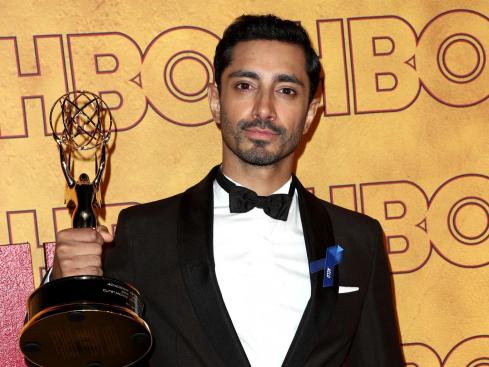 Riz Ahmed is the first man of Asian descent to win an acting Emmy Getty Images

 Nicholas Bakos
  Teomete تيوميته
 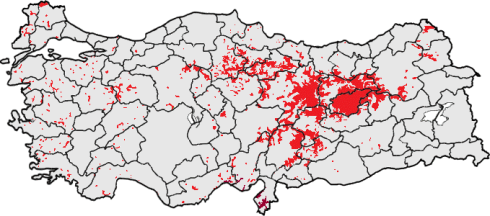 Demographic distribution of Alevis in Turkey


 Jadde: from Bosnia to Bengal