

Is there anyone else out there who thinks the Balkanist never misses an opportunity to take a swipe at Serbia? It’s gotten ridiculous and goes past any even pretense of objective journalism.
Is there anyone else out there who thinks the Balkanist never misses an opportunity to take a swipe at Serbia? It’s gotten ridiculous and goes past any even pretense of objective journalism.
From the Economist: “Poles depart: The beginning of the end of Britain’s biggest episode of migration“

It’s when immigrant/migrants/refugees are leaving that you should worry.
My often-stated opinion that the West has both the resources and the historical obligation to take in every-body that needs and wants to come still holds. That the European Union’s migration agreement with Turkey marked people fleeing a country in the condition of Afghanistan’s as “economic migrants” was a scandal. But when you’ve got a problem with Poles — whit-er, better-educated, harder-working, more Christian, cuter, better-mannered and less binge-drinking than you — then you really do have a problem. (See my “Is England ready for fresh Irish blood on its hands?“)
America’s best-kept secret, despite what Donald Trump, cretin, and his crew tell you, is that immigrants are a self-selecting group of already highly motivated people who are connected and aware enough to have heard that things are better where you are. And they’re not coming to take that from you; they’re coming to improve it. They’re the A-list crew that crashes your party because they’ve heard your parties are the ones to crash and in the process makes them even more of the hottest ticket in town. It’s a self-fufilling, auto-re-perpetuating process.
New York, in other words.
Or: go where the Jews go, in other words.
 Garry Winogrand, New York, 1969
I’m glad that there has not been much hand-wringing much less any rage here about the 65,000 refugees from the past couple of years who seem destined to stay. Still proud that Roger Cohen could write the piece that he did about Greece in 2015:
Greece has made me think about everything statistics don’t tell you. No European country has been as battered in recent years. No European country has responded with as much consistent humanity to the refugee crisis.
Greater prosperity equals diminishing generosity. Device distraction equals inability to give of your time. Modernity fosters the transactional relationship over the human relationship. The rules are not absolute, but they are useful indicators.
More than 200,000 refugees, mainly from Syria, have arrived in a Greece on the brink this year, almost half of them coming ashore in the island of Lesbos, which lies just six miles from Turkey. They have entered a country with a quarter of its population unemployed. They have found themselves in a state whose per-capita income has fallen by nearly 23 percent since the crisis began, with a tenuous banking system and unstable politics. Greece could serve as a textbook example of a nation with potential for violence against a massive influx of outsiders.
In general, the refugees have been well received. There have been clashes, including on Lesbos, but almost none of the miserable bigotry, petty calculation, schoolyard petulance and amnesiac small-mindedness emanating from European Union countries further north, particularly Hungary…
…
I asked Alexis Papahelas, the executive editor of the Greek daily Kathimerini, what Greece could teach the world: “That dignity and decency can be preserved, even through the hardest times.”
What Roger Cohen doesn’t say is that in the years after the fall of communism in eastern Europe, Greece took in almost a million migrants, nearly all of whom stayed. Granted, a large number of these were — supposedly — ethnic Greeks from the Caucasus, Ukraine or other parts of the communist bloc: ‘supposedly’ because a lot of them were about as Greek as the Soviet Jews who flooded Israel at the same time were Jewish; the Soviet passport’s famous “fifth point” that listed your nationality was often an indication of very little in terms of who you truly were culturally or linguistically. But the largest group were from Albania, of whom only a tiny fraction were actually ethnic Greeks from the south like my father. Like Mark Twain’s quip about the Holy Cross being a Holy Forest, if all of these Albanians were Greek, then Albania, a country then of about 3 million, must have had 4 million Greeks. Maybe a slightly disproportionate number were of Albanian Christian background, but the majority were Albanian Muslims, who usually shed whatever water-color memories of Islam they had upon arrival, and usually hid behind assumed Christian or conspicuously non-denominational names. “O re? back in Premete your name was Ismail; when did you become Sammy?”
Today their children are totally indistinguishable from the rest of the population. I can almost always tell because we can usually sniff each other out. But to most other Greeks, these tall, attractive, smart teenagers or twenty-somethings, with their perfect Athenian accents and Crossfit bodies and tattoos and with the huge amount of genetic matter we already share, are just other Greek kids. My assessment is that the radical improvement since the 90s in produce, food and restaurant quality — the whole retail food industry — is due to Albanian energy and work ethic. They weren’t — or didn’t have the choice to be — too proud to go to Corinth and buy apricots from the producers and sell them in Athenian farmers’ markets. They weren’t too spoiled or arrogant to work as a bakery employee or waiter in a restaurant; they now own the bakeries and the restaurants. They have a lower overall unemployment rate and they are better performers academically than the rest of the population on both secondary school and university levels.
 Albanian cellphone ad and close-up below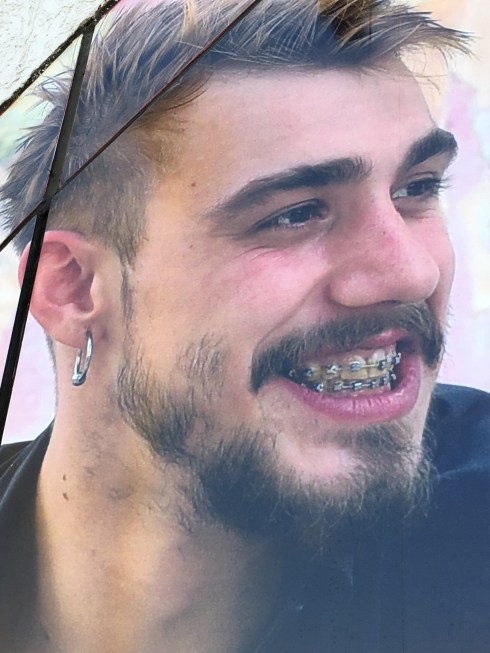
I’ve had the privilege of hanging out with lots of the ovenload of kids born to those immigrants in Greece through the masochistic process I’m putting myself through of trying to get a Greek driver’s license. I’m by far the oldest sitting for the endless hours in the pre-exam room (an exam so ridiculously technical that I’ve flunked three times) and I am fascinated by watching them interact. The Filipinos and Cameroonians are immediately identifiable even before their names are called. Then when the others are called you realize that a good half of the white kids are non-Greek ethnically too. Then they suss themselves out and soon start throwing Albanian words and clauses into the mix; then they switch to whole-passage code-switching between the two languages; then they’re just speaking Albanian. Meanwhile the Ukrainians and the Georgians are off and running in Russian, their lingua franca, which they speak along with perfect Greek and Ukrainian or Georgian. Watching them, I remember one of the seditious thrills of being a first generation Greek-American: that the rest of society never really knew where your loyalties lie. If you asked these kids, they certainly wouldn’t tell you. Aside from the more important point that they probably have better things to think about than whether they care about one state organizational structure over another.
The Right-wing Old Fart, which is what he likes to call himself — I’m not being mean — would be pulling his hair out and screaming at this point.
Maybe the coolest thing is that the middle-aged Greek bureaucrats handling them are just as fascinated. Don’t they get tired? I’m stunned at how up on things they are.
“Papashvilli? Cool, Georgian… Like Iliadis…”
…one says, striking a bicep pose, referring to Jarji Zviadauri (below), the Greek-Georgian gold medalist judoka who changed his name to Ilias Iliadis and held the flag of the Greek team, which always marches in first, at the Peking Olympics in 2008 (since I’m boycotting “Mumbai” for the 70th anniversary of Partition and “İstanbul” as long as Erdoğan is still in power, I’ve decided to apply it all around). The Georgian kid, who has some pretty nice biceps himself, smiles.
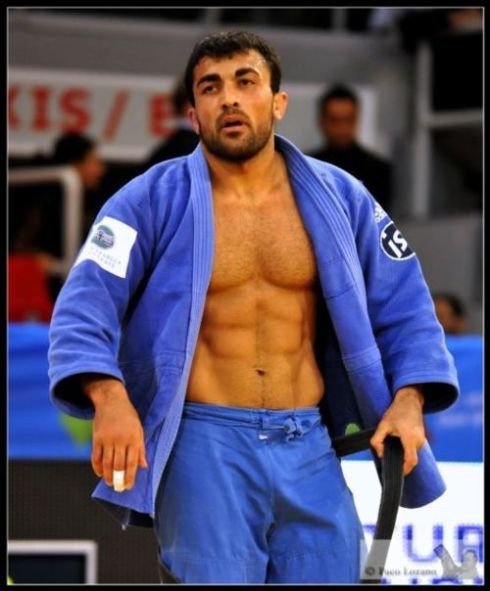
Jarji Zviadauri
The names keep getting called.
“Cameroon? Things good in Cameroon? no war, right? not like Congo…”
The Cameroonian smiles sheepishly and nods his head: “Yeah…no…good.”
Next.
“Camhi! That’s a big Sephardic clan…”
“How do you know?” smiles the pretty Jewish girl, giggling.
“Ehh, how do I know….”
More than humor, I think to myself, more than hospitality or “humanity”, curiosity, the prerequisite for any intelligence, is what’ll save Greece and Greeks. “What eats away at me and what will save me too is that I dream like Karagözi,” Savvopoulos sings.
Annia Ciezadlo’s beautiful “Be Like Water” in Guernica. Mytilene and the refugees. “Boundaries of Nations: The Nonviolent State of Iraq and Syria. The Republic-in-Motion of Lovers Not Fighters. The Government-in-Exile of People Who Just Want to Go to School.” Ciezadlo likes that the Greek word for hospitality is “philoxenia” (φιλοξενία), literally, the love for the stranger. Olympian Zeus, king of the gods, will tear your head off if you’re unwelcoming to the stranger — or worse, for a Greek, make you ugly — so you better watch out. He comes in disguise to test you. Like the angels to Abraham.

Wonder if she knows another piece of Greek etymology. Like all the Arabic in Farsi, I often wonder why loanwords come into a language when there’s already a word for it. Ok, Turks on the steppe didn’t have a word for lauraki because they didn’t have any laurakia, so, like most of their seafood they use the Greek-derived “levrek.” But عشق ? Didn’t whatever the Sassanians speak (Pahlavi?) already have a word for love that they use the Arabic “isqh”? Ah, but “isqh” has a slightly different, more longingly erotic tone than, say, the Prakrit-derived “piyar”, which still exist side by side in Urdu.
 Majnun in the wilderness
So why did we ditch the classical word for door, when we still use it in our word for window, which is literally “para-door”, and start using the Latin “porta”? And where does “spiti” (σπίτι), our word for house come from, when we had “oikos” (οίκος), which gave the world oecumenical and economy and ecology and which we still use if we’re talking about houses like Dior or Chanel. I’ll tell ya. “Spiti” comes from the Latin “hospitium”, the chamber in a Roman’s house where you received guests, and which also gave us hôtel and hostel and hospital and of course hospitality. That means for Greeks — meaning Romans — your house is not a place whose primary function is to house your family. Its primary function is receiving guests…strangers.
All that neurological research now coming out about how being bilingual (or tri or quatro-lingual like some of these kids) and bicultural from the start makes you smarter. That must explain Indians. Even not being actively bilingual but just hearing the sounds of other languages around you, apparently, sets you out with a sturdier hard drive that you can load more software onto for the rest of your life. So that explains it. Greek at home. English on TV. Weird Greek in church. Greek and English and French at school. Something called Albanian with lots of umlaut-ed “ë”-s on the envelope of the long-awaited letter from Zonja Martha Baku. Cantonese for dinner every night in elementary school because that’s what was spoken at my friend’s table where I ate until my mother could get outta work and come pick me up. Spanish in the music on a summer night and on the street later on and me and Julio down by the schoolyard in Corona and on my first girlfriend’s tongue, literally.
That’s why the exasperating Macedonian is not as smart as I am. He didn’t like all that:
“I didn’t like it.”
After a long pause in what I thought had been the merciful end of the exasperating conversation…
“Huh? What…”
“I didn’t like it.”
“Didn’t like what?”
“I didn’t like it that my mother spoke Vlach with her sisters and mixed up Greek and Vlach with us and pidgin Bulgarian with the gypsies next door. I didn’t like it. It confused me.”
Aha! There you have it. Nationalism and its blood-letting. All about the male need for purity and orthogonic control. Like the Right-wing Old Fart: “VATANDAŞ YUNANCA KONUŞ!!!” Too bad he didn’t like it. But it’s too late now. He’s not as smart as me.
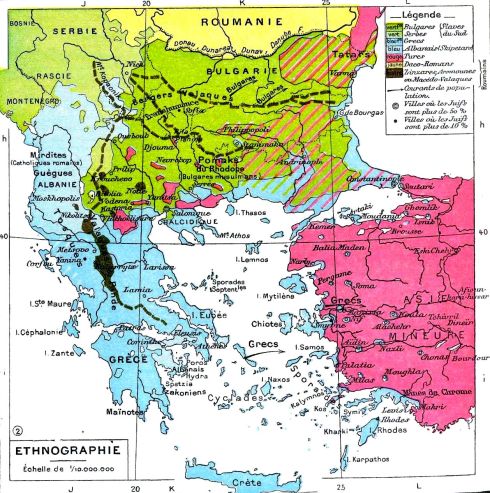 “Macedonian don’t like it!”
Those kids getting their driver’s license who speak three languages perfectly. That’s who you want coming into your country. They like it. They don’t care really. And me. We’re smart. We’ll make your countries more interesting. And interesting means stronger. And strength means freedom.
Beards. It’s absolutely clear to me that no men in the world have benefited more from the current beard fashion than young Greek men — and, of course, young Turkish men, since we share so much genetic matter. But along with making them look more handsomely classical, or more soulfully Byzantine, whichever eroto-historic imagery turns you on more (that beards make Turkish guys look more Byzantine is what really riles me up), the beards make Greek kids look much more Levantine.
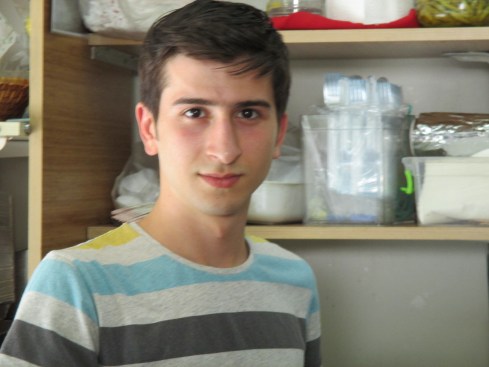 Yusef, the son of my neighborhood çiğerçi in Cihangir, the morning of Bayram/Eid after he broke my heart…and shaved. And St. Nestor below. What really broke my heart though was that when I went back in November, the çiğerçi’s had closed, to be replaced by another pretentious Çukurcuma antique store.

The bartender with the neat beard at my favorite raki place in Jiannena could be from anywhere between Niš and Herat. He’s friends with the Hazara kid whose Albanian girlfriend also works as a waitress at the bar. Turns out he’s Syrian. “Oh!” I say, surprised that my radar was off. But then I started realizing how integrated into Greek society Syrian immigrants have already become that I need to take a second look each time a bunch of kids in this university town walks by. In Jiannena, where, to my surprise, there are two helal butchers, while Athens only has one. He’s a specialist on the wines and rakia of Epiros. He speaks — aside from an occasional Jianniotiko “oooy” — perfect unaccented Greek. And he’s been here for less than two years.
The Hazara kid entertaining his buddies at the raki bar till his girl gets off work
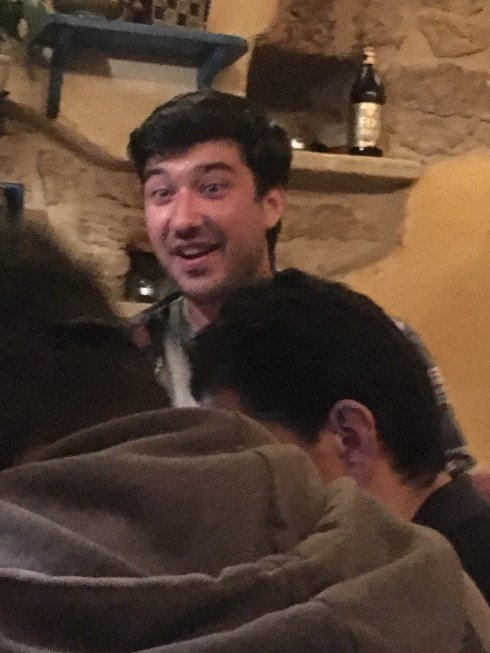
So…wooops…there they are. Here they come! They’ve arrived. And they’ve instantly made Greece a more interesting place. And interesting is strong. And strength is freedom.
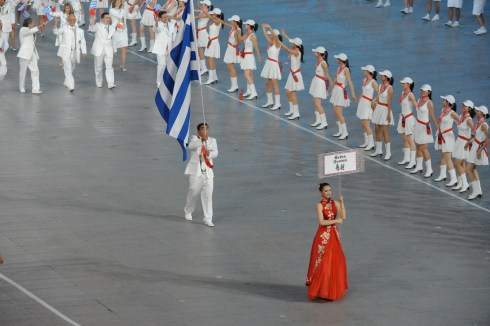 Ilias Iliadis (Jarji Zviadauri) at the 2008 Summer Olympics.
A poster below from the Workers’ Union of Vyrona, my old ‘hood in Athens, originally an Anatolian exchangées/refugee settlement from the 1920s, now still one of the most solidly leftist neighborhoods in the city:
“I don’t forget. Our grandparents were refugees. Our parents — and children — emigrants. Imperialist wars, conflict, poverty and degradation create refugees and emigration and the uprooting of peoples. Solidarity with refugees and migrants.”
–
Comment: nikobakos@gmail.com
–
Thanks to Adnan Delalić for tweeting this video.
A Colombian friend says to me: “That you can all [my blog’s world, Bosnians to Bengalis] listen to what to me sounds like exactly the same music and not get each other on everything else…I don’t understand.”
Me neither.
Geez… I forgot the other major twentieth-century British mess we’re still living the brutal consequences of: Palestine in 1948.

We ALL know — many of you detest me for it — that I’m the last person to come to if you want sympathy for Arab/Muslim dysfunction and inability to face modernity being blamed on “colonialism” and taken out on the rest of humanity. But the Brits’ track record is so awful, as I say in “Is England ready for fresh Irish blood on its hands?“, and this might, in certain ways, have been the worst of all.
–
Comment: nikobakos@gmail.com
–
Walter Dalrymple, a man I worship, has gone nuts tweeting/dumping beautiful Indian images on us for the past couple of weeks. Pleeeeeeease! Chill. It’s too much to take in all at once.

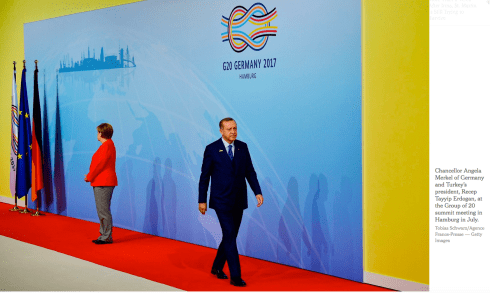 Tough-guy
‘Cause you’re the fascists!
That’s just the best of a great piece in Politico about Juncker’s speech….
*************************************************************************************
Ryan Heath | | Updated

Jean-Claude Juncker’s State of the Union address in Strasbourg — delivered in a combination of English, French and German — ended with polite standing applause.
The 70-minute speech was the most measured of Juncker’s three annual addresses since taking office in 2014. The European Commission president resisted engaging with hecklers on all but one occasion and avoided the long spontaneous riffs that were hallmarks of his previous State of the Union speeches.
Juncker hit all the expected targets: the EU’s rebound after a rocky Brexit- and populism-filled 2016; proposals on expanded military cooperation, concerted action on trade and trade defense; and the need to bridge the gap between Eastern and Western Europe.
Amid the rosy post-Brexit visions there was still plenty of subtle snark. Here’s a guide to reading between the lines.
What he said: “I have lived and worked for the European project my entire life.”
What he meant: Literally my entire life. So now you have to agree with me.
***
What he said: “We are now protecting Europe’s external borders more effectively.”
What he meant: The border is no longer a free-for-all with people drowning en masse off our coasts.
***
What he said: “Italy is saving Europe’s honor in the Mediterranean.”
What he meant: If I didn’t have these pesky Poles and Hungarians setting my policy on fire, I would do more for you, Italy.
***
What he said: “Africa is a noble and young continent … the cradle of humanity.”
What he meant: My speech committee couldn’t quite agree, then I lost my place in the script. Err, where were we again? Africa — have some more money.
***
What he said: “For me, Europe is more than just a single market. More than money, more than the euro. It was always about values … freedom, equality and the rule of law.”
What he meant: You want the money, Eastern Europe? Take a hint.
***
What he said: “East to West: Europe must breathe with both lungs. Otherwise, our Continent will struggle for air.”
What he meant: I might be a heavy smoker, but I’m not going for the lung transplant option.
***
What he said: “A more united Union should see compromise not as something negative, but as the art of bridging differences. Democracy cannot function without compromise. Europe cannot function without compromise.”
What he meant: Calling London! You have a Brexit compromise to make.
***
What he said: “It is unacceptable that in 2017 there are still children dying of diseases that should long have been eradicated in Europe.”
What he meant: I want a policy on something everyone agrees on.
***
What he said: “I am proud of our car industry. But I am shocked when consumers are knowingly and deliberately misled. I call on the car industry to come clean and make it right.”
What he meant: Pay up, and change your technology, my German friends. Or I’ll make you do it.
***
What he said: “The rule of law is not optional in the European Union. It is a must. Our Union is not a state but it is a community of law.”
What he meant: Poland and Hungary are stealing citizens’ fundamental rights. I’ll give you more fish in your fish fingers, but you better stop the ancient forest logging and let in some refugees.
***
What he said: To the Turkish government: “Stop insulting our member states by comparing their leaders to fascists and Nazis.”
What he meant: Seriously, stop calling our member countries and heads of government fascists.
***
What he said: “Journalists belong in newsrooms, not in prisons. They belong where freedom of expression reigns.”
What he meant: It would be better if you give my speech a good review. But I agree not to put you in prison if you don’t.
***
What he said: “Slovaks do not deserve less fish in their fish fingers. Hungarians less meat in their meals. Czechs less cacao in their chocolate.”
What he meant: Everyone is a first-class citizen. That also brings first-class responsibilities.
***
What he said: “The commissioner for economic and financial affairs — ideally also a vice president — should assume the role of economy and finance minister. He or she should also preside in the Eurogroup.”
What he meant: More power, more accountability for the EU. And no more Margrethe Vestager as the Commission’s only executive star.
***
What he said: “By 2025 we need a fully-fledged European Defense Union. We need it. And NATO wants it.”
What he meant: Take that, Brexit Britain!
***
What he said: “Europe would function better if we were to merge the presidents of the European Commission and the European Council … Europe would be easier to understand if one captain was steering the ship.”
What he meant: The ship will sink if we don’t do this. Bon voyage!
Tags: Diplomacy, EU staff, State of the Union
This is not a question I ask glibly or to be deliberately provocative. In fact, I think I was a little too glib in my earlier opinions about the issue of Brexit and Ireland and I’ve been sobered up a bit.
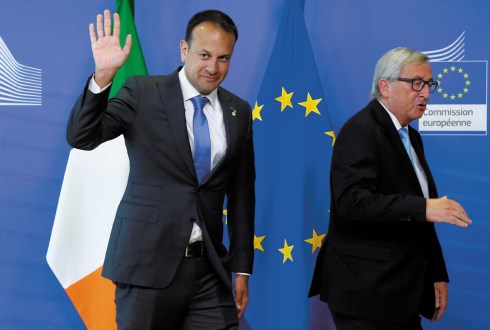 Irish Prime Minister Leo Varadkar and European Commission President Jean-Claude Juncker at a summit of the EU, Brussels, June 2017
And it’s The New York Review of Books’ excellent piece by Fintan O’Toole, “Brexit’s Irish Question“, that made me think a little more carefully about the whole issue.
I suggest everybody read the whole article since it’s open to the public, but I think even it pulls its punches a bit too much and doesn’t realize the degree of danger this “question” poses. This is not “Brexit’s Irish Question.” This is England’s Ireland Problem. AGAIN. STILL. A reversion to form. Before 1999. Before 1921. So all parties, but especially England, not Britain, should tread very carefully.
A good if rather lengthy summary/call out are the following three paragraphs from the piece:
“The Republic of Ireland was one of the most ethnically and religiously monolithic societies in the developed world. Its official ideology was a fusion of Catholicism and nationalism. The anti-homosexuality laws reflected the dominance of the Catholic Church, which was also manifest in extreme restrictions on contraception, divorce, and abortion. While the vast majority of its population was repelled by the savage violence of the Irish Republican Army’s armed campaign against British rule across the border in Northern Ireland, most agreed with the IRA’s basic aim of ending the partition of the island and bringing about what the Irish constitution called “the reintegration of the national territory.”
“But the Irish radically revised their nationalism. Three big things changed. The power of the Catholic Church collapsed in the 1990s, partly because of its dreadful response to revelations of its facilitation of sexual abuse of children by clergy. The Irish economy, home to the European headquarters of many of the major multinational IT and pharmaceutical corporations, became a poster child for globalization. And the search for peace in Northern Ireland forced a dramatic rethinking of ideas about identity, sovereignty, and nationality.
“These very questions had tormented Ireland for centuries and were at the heart of the vicious, low-level, but apparently interminable conflict that reignited in Northern Ireland in 1968 and wound down thirty years later. If that conflict was to be resolved, there was no choice but to be radical. Things that nation-states do not like—ambiguity, contingency, multiplicity—would have to be lived with and perhaps even embraced. Irish people, for the most part, have come to terms with this necessity. The English, as the Brexit referendum suggested, have not. This is why the Irish border has such profound implications for Brexit—it is a physical token of a mental frontier that divides not just territories but ideas of what a national identity means in the twenty-first century.” [My emphases]
The passage’s conclusion pretty much says it all. As the second decade of the twenty-first century comes to a close, and as Ireland approaches 100 years of freedom from almost 800 years of English rule, Ireland will enter the historical record as having taken a step forward and England as having taken a step backwards. Good riddance, to be frank, as I have to say so against some pretty deep Anglophile sentiments. It took me till much too late in life to realize that the best thing to do to an irate lover who loudly announces he’s not talking to you anymore is to ignore him, but that is what the European Union is rightly and justly doing to Britain. And Britain is doing exactly what the “irate lover” always does when you call his no-talking bluff: trying to somehow work his way back into the position where he can regain at least some of the power that he forfeited with his drama so that he can manoeuver a bit. But it’s not going to work. Europe is genuinely tired of the drama.
The issue here is that it’s unconscionable that England’s drama should again be made Ireland’s. Here’s a political map of the past two decades of Northern Irish life:
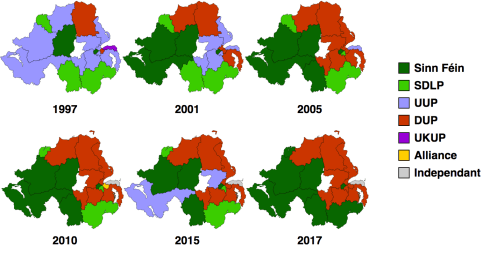
What the map shows really clearly is that, as the percentage of Protestants in Northern Ireland has declined, the two groups have actually — during almost twenty years of what we have liked to imagine was peace — grown further apart and polarized into staunchly Sinn Féin Republican constituencies and Protestant DUP constituencies. As the Review article points out Sinn Féin supporters in a non-EU Northern Ireland will now be deprived of the ability to have either or both Irish and British citizenship, something to which I cannot see them taking to very kindly. I also do not see supporters of DUP, a corrupt bunch of thugs that represents the absolute worse of the English Reformation’s traditions of Guy Fawkes’ Day, anti-Catholic hatred and racism (no, Catholics aren’t always the bad guys), easily giving up their attachments to London.
But that’s exactly what London has to do. England left Ireland in 1921 with a sizeable chunk stuck between its teeth that, like a pitbull, it would not let go of and which is why we find ourselves where we are today. It left India in 1947 like a teenager who sheepishly goes off to sleep at his girl’s after his friends have trashed his parents’ place while they were away. It left Cyprus in 1960 exactly the same, a time bomb ready to go off — which did. Under no condition should England be allowed to leave a similar mess this time. Time for the international community to make the English clean up after themselves.
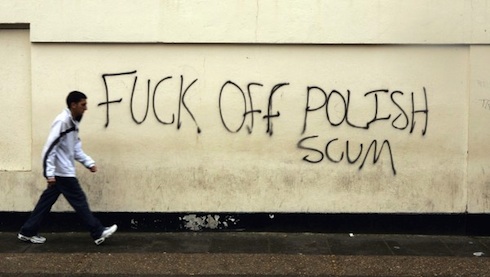
The international community and NATO more specifically did not support Portugal in its attempt to hold on to Goa after Indian independence. That means the UK neither, obviously. It’s now time for the world to tell the UK to entirely and finally Quit Ireland, its closest and perhaps most deeply brutalized colony. I’m usually not so intransigent on these issues, but the historical record calls for a complete rejection of any attempts by Irish Protestants to keep England involved in Irish affairs by “protecting” them or their rights; complicated compromises only kick the can down the road. The historical record calls for a complete rejection of even a syllable of their “position.” The historical record calls for a referendum, which Unionists will lose, and calls for London to make it clear to them that they are being cut loose. Let them keep British citizenship if they want. Come up with a resettlement scheme for them if that’s what they want, immigrants that the English can live with since they can’t tolerate detestable, lazy, dirty Poles. Otherwise, bye-bye guys…
But if Theresa May and her government of buffoni were ethical enough or had the balls to do something like that, they would have started that process already, instead of still talking gibberish about everything like they are.
This might end badly. Let’s hope not.
–
Comment: nikobakos@gmail.com
–
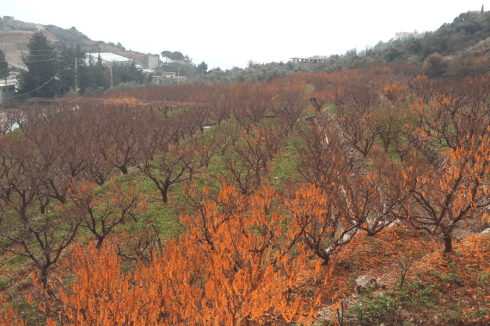 Ein Zebde peach orchards
This is one of those photos that shore up all literary descriptions you’ve ever read of Lebanon as the land of milk and honey.
Because only that sort of blessed (but unfortunately cursed too) land could produce Lebanese food. More than the landscape, the mountains, my personal emotional response to a still functioning society of Arab Christians, the post-nightmare joy that even a partly-Resurrected Beirut must offer, and more, even, than the boys — it’s the food that makes Lebanon one of the top entries on my list of must-visits. The boldness of the Lebanese culinary imagination reflects such care for both the sensuality and sanctity of food that I can’t helped being moved by just reading descriptions of it. China, India and France (mmm…yeah, ok, Iran too) are the only places that can compete, I think, with this tiny little corner of the Mediterranean in sheer kitchen creativity.
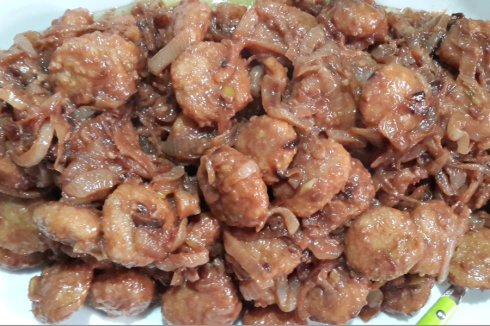
Mansoufe (below), for example: made of pumpkin-and-bulgur balls, cooked with caramelized onions and flavored with sour grape juice. Where else would people even think of this? (Though I think “dumplings” or something might have been a better word; “balls” makes it sound like pumpkins have testicles.)
But just like there’s not really any French food without the produce of France itself, and like I’ve come to believe what most South Asian friends think: that there’s no good regional Indian food outside of India, just Punjabi versions of dumb-downed Doabi-Mughlai food cooked by Sylhetis (though I know two good Bengali places in New York, one in Sunnyside, where you have to convince them you want the real stuff, and one in the Bronx, and an even better secret, a great Sindhi vegetarian place in Jackson Heights…Indian vegetarian is the only vegetarian food I’ll eat, actually the only vegetarian food I’ll honor by calling “food”), so, it seems, that if you want something other than stale felafel or inedible tabbouleh made by a dude who had too many lemons he needed to get rid of and who needs to be told that parsley isn’t a vegetable, then you need to go to Lebanon.
In steps the Food Heritage Foundation to help you get your bearings food-wise once you’ve gotten yourself to Lebanon: a great resource for anything you might want to know about Lebanese cuisine. Yesterday they posted photos of the Ein Zebde (the Shouf village with the peach orchards at top) celebration of the Feast of the Holy Cross, and the annual potato-kibbe-making event the women there have held for the past twenty-four years. Check out the page for captions on the pics below:
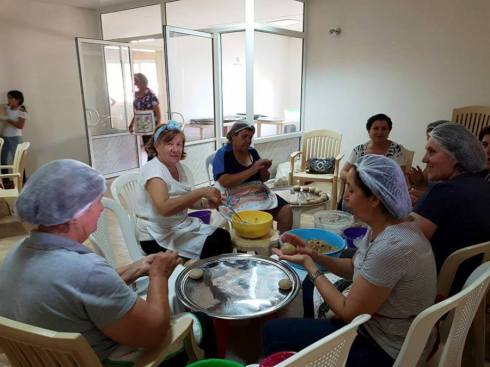
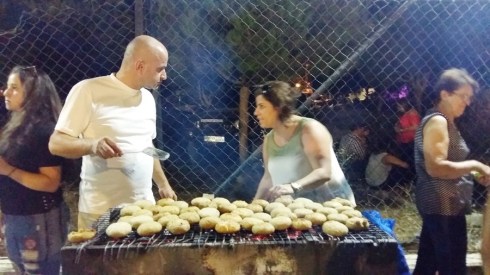
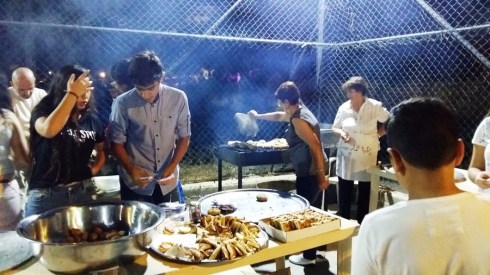
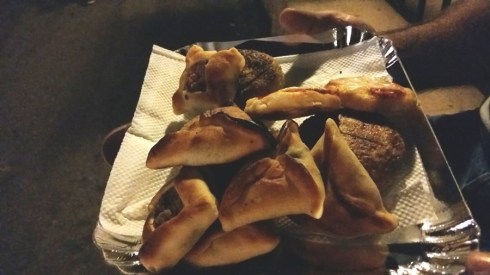
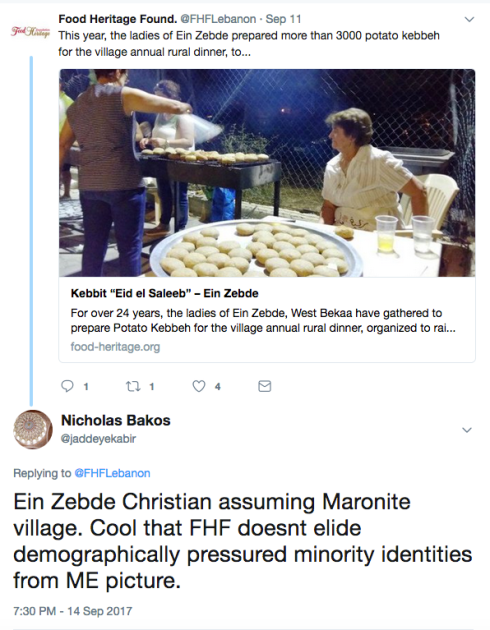
Yesterday I tweeted my kudos to the Food Heritage Foundation (above). But actually it would have been impossible to hide the fact this is a Maronite community even had they wanted to. Even if they felt they didn’t have to explain why the women were doing this, the women’s hair and bare arms would have been a giveaway.
Still, I’m just saying this because if certain people like Mlle I___m de M_____i had their way both the entire staff of the Food Heritage Foundation and I would’ve been thrown in jail for fomenting sectarianism, publicly shamed for being Islamophobic and made to wear a Green “I”, and the Ein Zebde post would have had to be mysteriously cleansed of its Christianess.
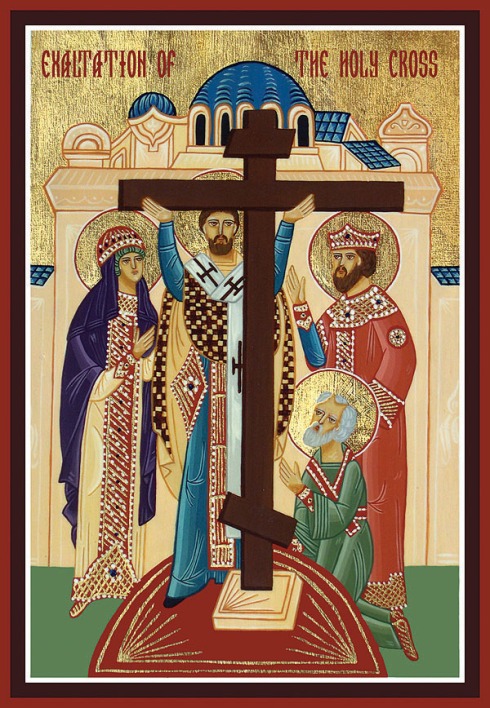
The feast of the Holy Cross — I doubt any Catholics remember or even know — commemorates the discovery by the Empress Mother Helen of the Holy Cross on which Christ was crucified, of which Mark Twain famously said there were so many splinters of everywhere that it was apparently a Holy Forest. She was the mother of Constantine, the emperor who moved the capital of the Roman Empire from Rome to the city on the Bosporus called Byzantion, renamed Constantinople (that’s İstanbul for those that don’t know), and who, like a good mother-ridden Greek boy (though he was really from what’s now Niš in in what’s now southern Serbia), unfortunately made what-a-monotheist-drag Christianity the official religion of the Empire to make her happy; though also like a good Greek boy he passive-aggressively wasn’t himself baptized till he was on his death-bed. The discovery of the Cross and the feast of Sts. Constantine and Helen, “the Equal-to-the-Apostles”, on May 21st, when Athens is paralyzed by traffic for three days because a quarter of the city is named Kosta or Helene and another half is going to visit them for their name-day, is usually commemorated in the Orthodox Church by the same image:
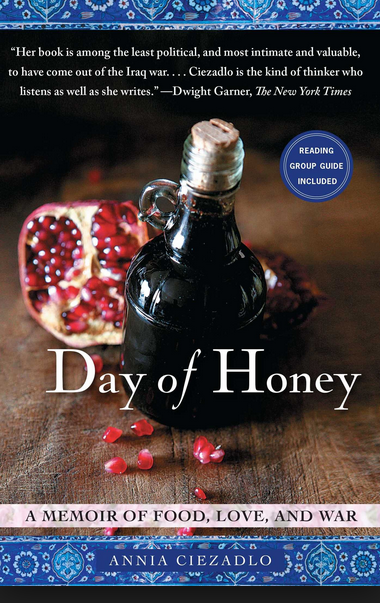
But for more fun, more lyrical descriptions of Lebanese food, mixed up with some serious butch conflict-zone reporting and a hilarious Middle Eastern mother-daughter-in-law relationship, see Annia Ciezadlo’s beautiful Day of Honey: A Memoir of Food, Love and War.
–
Comment: nikobakos@gmail.com
–

 Jadde: from Bosnia to Bengal