“What happened to the Turks of Old Greece?” 196 years ago today: the fall of Tripolica

24 Sep

On September 23rd, 1821, the city of Tripolica (Tripolitsa, modern Tripoli), the central administrative seat of Ottoman authority in southern Greece, fell to Christian rebels.  Its Muslim and Jewish populations were then subjected to a hair-raising orgy of slaughter and torture that effectively ended their presence there.  As similar massacres of non-Christians occurred throughout southern and central Greece, these regions were almost entirely cleansed of these populations.

That’s what happened, as someone once asked me, to the Turks of Old Greece (the Kingdom of Greece before 1913).  They went the way of Turks throughout the Balkans as soon as peoples there gained their independence.

Reposting an old post on a Skai documentary on the Fall of Tripolica and other taboos of Neo-Greek nationalism.  See “Diatribe’s” reposting of description of massacre and comments too.  Interestin re: “genocide” and “ethnic cleansing”.

**************************************************************************************

Albanians in Greece and the “documentary that shocked Greece” from SKAI

26 Jan

In my recent post Occitan and “endangered languages”, I wrote about the (mostly former) Albanian-speakers of central and southern Greece and how they had never posed an assimilation problem for the Greek state.  Quite the contrary:

“…Peloponnesian Albanians were already Greeker than the Greeks in their ethnic consciousness and had proven it by essentially fighting our war of independence for us; it seems that, historically, you give Albanians — Christian or Muslim — an incentive to go to war and they’ll become more zealous crusaders of your cause than you are yourself.”

Elsewhere I’ve written about Greeks and Albanians as practically co-peoples, such has been the extent of migration and intermingling over the past millenium.  This winter I read John V.A. Fine, Jr.’s six-hundred page The Late Medieval Balkans: A Critical Survey from the late Twelfth Century to the Ottoman Conquest, which I know sounds like a joke about dry academic reading, but it was actually fascinating.  The chaos that followed the fall of Constantinople to the Franks in 1204 produced a bewildering number of Greek and Frankish successor states to the Byzantine Empire throughout the Greek peninsula, all constantly at war with each other and at a time when the Albanian highlands were suffering from demographic overload.  Thus, whether as mercenaries in the hire of anyone who paid best, or as shepherding nomadic clans who took advantage of the extensive areas of the peninsula depopulated by constant war or epidemic diseases, Albanians in huge numbers were constantly on the move southwards for the next two centuries if not more.  (I suspect that this is when their descent into Kosovo begins as well, filling in the gap as as the center of gravity of the Serbian nation moved northward.)  Further waves came after the Ottoman conquest in response to Islamization campaigns in recently conquered Albania, but this time not just south to Greece but westwards to Italy and Sicily as well.  And settling everywhere you could possibly imagine: Thessaly, southern Epiros, Roumeli (in the Greek meaning of the term), the Ionian islands, places as far flung and unexpected as the islands of Cythera or Ios!  My point, without having any Fallmereyer-an agenda — not because I disagree with his basic theses but because I don’t thing “race” means anything — is that regions of Albanian settlement in the past were likely far larger than the regions where we find the language still spoken in the early twentieth century, shown on these maps:
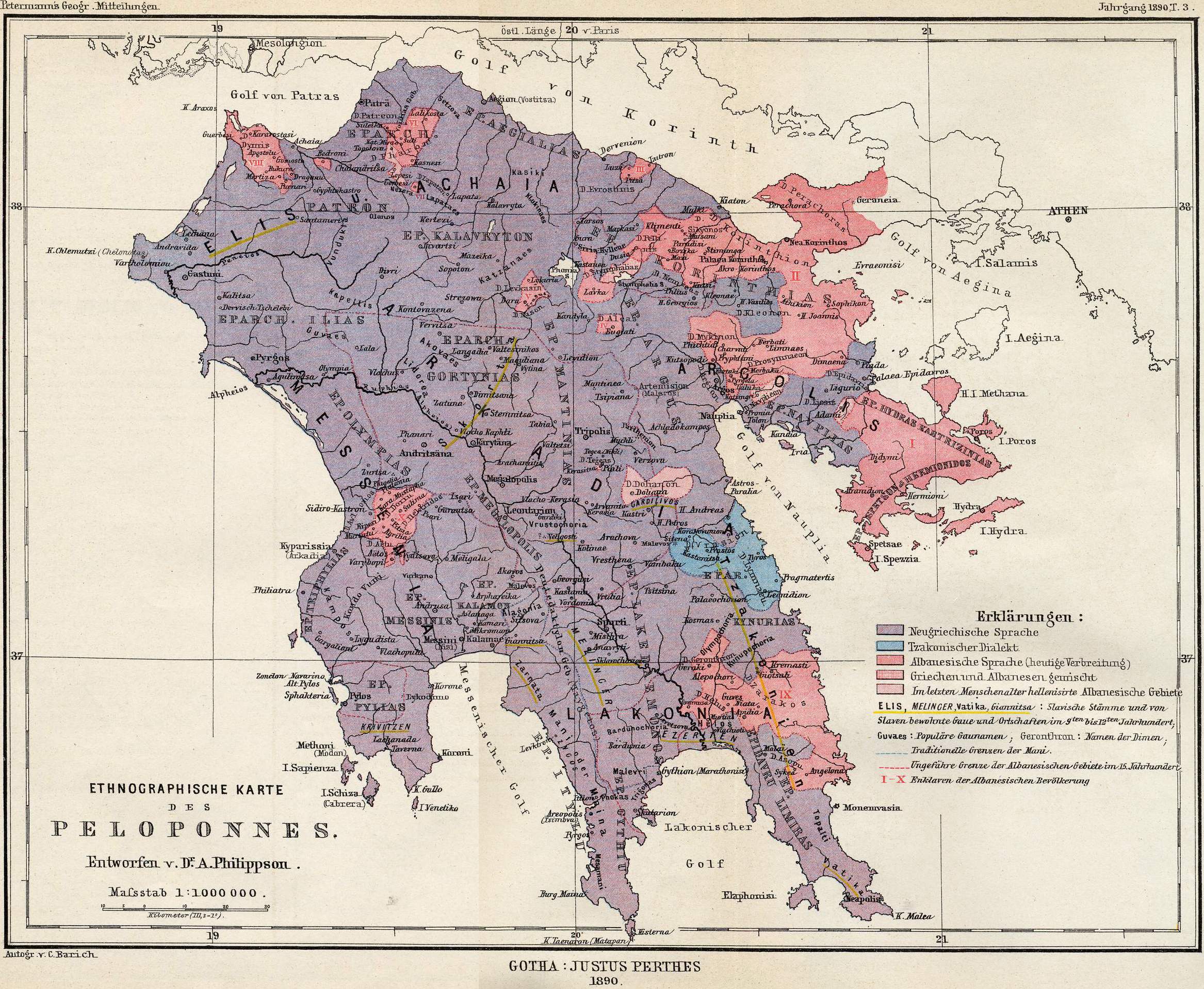
Pelopones_ethnic

Albanian-speaking areas in 1890 shown in pink above, green below (click)

Arvanitika map

This documentary that “shocked Greece” was produced by SKAI Television and called 1821 after the year the Greek revolution against Ottoman rule began and the reason it “shocked” is that it debunked long-held myths about the uprisings that eventually led to the establishment of the independent Kingdom of Greece; but really, that anybody was shocked at any of these revelations: for example, that the uprising was accompanied by the wholesale massacre of Muslims (and Jews) throughout the Peloponnese and central Greece;* that the Church anathematized it and did not support the movement (paid the price anyway with the execution of the Patriarch in Constantinople); that the “secret schools” where poor “enslaved” Greek youth were taught Greek in secret at night because the Turks had forbidden the teaching of Greek is a totally concocted fable (and such a projection of twentieth-century, nationalist, totalitarian policies back onto the Ottomans; there is practically not a single European observer of Ottoman life since at least the beginning of the eighteenth century that doesn’t comment on the quality and extent of Greek educational institutions in all Ottoman cities and even smaller towns and villages); that many if not most of the revolution’s “heroes” were Albanians, some who spoke no Greek at all; that the fustanella is originally an Albanian garment…and on and on — that any of these shocked Greeks in the early twenty-first century is just proof of how pathetically brainwashed and historically ignorant nationalism usually leaves a people.  And this is the point where the documentary pulls a very cowardly copping out — by claiming that such is the price of building a new nation; it has to create new “myths” of its own.  Why a nation — or a people preferably — is not stronger and better off if it knows the whole truth about its past is never delved into.  But it’s worth watching, and it has English subtitles:

In any event, such was the Albanian contribution to the struggle that one wonders if the Porte let go of the Peloponnese, not because it was so far from the center of imperial authority, not because it had always been something of a provincial backwater, not because of foreign intervention, but because of some tough-*ss Albanian warriors that the Ottomans felt were no longer worth resisting.  After all, they themselves knew the value of an Albanian fighter: favorite recruiting regions for the Janissaries in the classical Ottoman period had always been Albania and Serbia — not random choices.

There’s a beautiful song recorded in 1949 by Sophia Vembo, one of greatest Greek voices of the twentieth century, called “The Song of the Morea” (since at least early Byzantine times until the modern Greek state revived the clasical name, the Peloponnese was called the Morea) which is partly a homage to the role of the region in the struggle for Greek independence (ok, even as a New Territory Greek, I’ll grant them that.)  And the refrain says:

“Hail and be well brother Moraites, and health to your women too; Greece owes its freedom to your manhood!”**

And I have a deeply-loved but eccentric cousin, highly intelligent but an unrehabilitated nationalist dinosaur unfortunately and to whom much of this blog is indirectly directed — or one might even say dedicated — who is so profoundly moved by the blood shed by Peloponnesian and Spetsiote and Hydriote Albanians for the cause of Greek independence, that he thinks the refrain should run:

“Hail and be well brother Arvanites (Albanians), and health to your women too; Greece owes its freedom to your manhood!”

Here it is; the music and Vembo’s voice are beautiful even if you don’t speak Greek:

The song has always provoked a strong reaction in me as well, a testimony to the power of patriotism if it can move someone who finds nationalism as repulsive as I usually do.  But even that reaction is contradictory.  The 1949 date of the song is not insignificant; it was recorded in the middle of the most brutal period of the Greek Civil War and was actually more a call to unity and an appeal to brotherhood than a commemoration of the revolution of 1821.  Like many Greeks perhaps, my family suffered more losses in the civil war than they did in the Nazi occupation that had preceded it, and the opening lyrics of the second verse always make me tear up for a moment:

“Now that the earth sweats the blood of brothers, and Greece is drowning Greece in the hills..”

and then my heart goes cold again, because the next line is:

“Come out of your grave Thodoris Kolokotronis, and make all Greeks brothers again.”

…because it’s impossible for me to forget that Kolokotronis was the “hero” who boasted of riding his horse over Muslim corpses from the gates of Tripolitsa to its citadel, when that major city of the Morea fell to the rebels in September of 1821.

So I’d like to end this post with just a little bit of perspective, a reality check we all need every so often, because though the documentary mentions a lot of previously taboo subjects, it glosses over a few of them a little too quickly.  The following is taken from the blog of a Greek-Australian, and apparently fellow Epirote (though he seems to have Samiote heritage as well), Diatribe from a post called “Revolution Unblinkered.”  It’s foreigners’ eye-witness accounts of the Massacre of Tripolitsa, interspersed with some of his own comments:

**********************************************************************************************************************************************************************************************

From “Diatribe”:

A month later, in September, a combined force led by Kolokotrones and Petrobey Mavromihalis captured Tripolitsa.  Historian W Alison Philips tells a horrific tale of mutilation and slaughter  “For three days the miserable inhabitants were given over to lust and cruelty of a mob of savages. Neither sex nor age was spared. Women and children were tortured before being put to death. So great was the slaughter that Kolokotronis himself says that, from the gate to the citadel his horse’s hoofs never touched the ground. His path of triumph was carpeted with corpses. At the end of two days, the wretched remnant of the Mussulmans were deliberately collected, to the number of some two thousand souls, of every age and sex, but principally women and children, were led out to a ravine in the neighboring mountains and there butchered like cattle.”

A Prussian officer described the incidents that took place after the capture of Tripolitsa by the rebels, as follows:

“A young Turkish girl, as beautiful as Helen, the queen of Troy, was shot and killed by the male cousin of Kolokotronis; a Turkish boy, with a noose around his neck, was paraded in the streets; was thrown into a ditch; was stoned, stabbed and then, while he was still alive, was tied to a wooden plank and burnt on fire; three Turkish children were slowly roasted on fire in front of the very eyes of their parents. While all these nasty incidents were taking place, the leader of the rebellion Ypsilantis remained as a spectator and tried to justify the actions of the rebels as,’we are at war; anything can happen’.”

Based on the accounts of one hundred European officers who were present at the scene, and did nothing to intervene, William St. Clair wrote:
“Upwards of ten thousand Turks were put to death. Prisoners who were suspected of having concealed their money were tortured. Their arms and legs were cut off and they were slowly roasted over fires. Pregnant women were cut open, their heads cut off, and dogs’ heads stuck between their legs. From Friday to Sunday the air was filled with the sound of screams… One Greek boasted that he personally killed ninety people. The Jewish colony was systematically tortured… For weeks afterwards starving Turkish children running helplessly about the ruins were being cut down and shot at by exultant Greeks… The wells were poisoned by the bodies that had been thrown in…”
 –
Although the total estimates of the casualties vary, the Turkish, Muslim Albanian and Jewish population of the Peloponnese had ceased to exist as a settled community after the early massacres. Some estimates of the Turkish and Muslim Albanian civilian deaths by the rebels range from 15,000 out of 40,000 Muslim residents to 30,000 only in Tripolitsa.   According to historians W Alison Phillips, George Finlay, William St. Clair and Barbara Jelavich, massacres of Turkish civilians started simultaneously with the outbreak of the revolt, while Harris J. Booras considers that the massacres followed the brutal hanging of Ecumenical Patriarch Gregory V of Constantinople.  Finlay has claimed that the extermination of the Muslims in the rural districts was the result of a premeditated design and it proceeded more from the suggestions of men of letters, than from the revengeful feelings of the people.  St. Clair wrote that: “The orgy of genocide exhausted itself in the Peloponnese only when there were no more Turks to kill.”*
 –
There were also calculated massacres towards the Muslim inhabitants of the islands in the Aegean. This is because one of the aims of the Greek revolutionaries was to embroil as many Greek communities as possible in their struggle.  By engineering some atrocity against the local Turkish population, diverse Greek communities would have to ally themselves with the revolutionaries fearing retaliation from the Ottomans. In one case, in March 1821, Greeks from Samos landed on Chios and attacked the Muslim population living in that island. Among the Samian belligerents was an ancestor of mine, Dimitrios Kalymnios. When the Samians withdrew to the safety of their island, the Ottomans descended upon defenceless Chios and carried out an atrocity that horrified the rest of the world: the massacre of Chios.
[my, N.B., emphases throughout this last paragraph — just so that nobody is allowed to take something like the the Massacre of Chios out of historic context again…]

The final word, if there is one, goes to Theodore Kolokotronis, who in his account of the fall of Tripolitsa, was unrepentant to the last: “When I entered Tripolitsa, they showed me a plane tree in the market-place where the Greeks had always been hung. “Alas!” I said, “how many of my own clan — of my own race — have been hung there!” And I ordered it to be cut down. I felt some consolation then from the slaughter of the Turks. …”

DEAN KALIMNIOU
First published in NKEE on Saturday 6 April 2013.
READ HIS WHOLE POST: “Diatribe” ; it’s very intelligent.
**********************************************************************************************************************************************************************************************
Wow.  First thing I have to say is that if this guy is allowed to publish this kind of stuff in Melbourne’s “Neos Kosmos” English-language newspaper, then Greek Australia is eons ahead of Greek America in its sophistication on such issues.  I can’t imagine a single effing channel or venue of the Greek media in New York where someone could get away with writing or saying things like this.
Then, the irony is that these revolutionaries, Greek or Albanian, were probably not fighting for a Greek state, but fighting a religious-cum-tribal war out of which they were hoping to carve out little fiefs and principalities of their own, no different than the Ottoman pashaliks that had preceded them and the internecine chaos that followed ‘liberation’ is proof of that — so let’s not over-romanticize their zeal for the “cause” or exaggerate the degree to which they were fighting for the “freedom” of the “Hellenic nation.”  Finally, is the irony that many of the “Turks” these fighters were massacring in a place like Tripolitsa, were probably Albanians like themselves, only converts to Islam.
And one sad little detail I discovered somewhere else, though I can’t find the source for it:
 –
“European officers, including Colonel Thomas Gordon, who happened to be at Tripolitsa during the massacre, witnessed the hair-raising incidents there, and some of them later recalled these events in all their ugliness. Colonel Gordon became so disgusted with the Greek barbarities that he resigned from the service of the Greeks. A young German philhellene doctor, Wilhelm Boldemann, who could not bear to witness these scenes, committed suicide by taking poison. Some of the other European philhellenes who were extremely disillusioned, followed suit.”
The poor, idealistic, Werther-like German Romantic, come to fight and  liberate the sons of Pericles and Leonidas, kills himself out of disappointment…it just seemed to encapsulate the whole patheticness of a certain kind of European Helleno-latry.
**********************************************************************************************************************************************************************************************
* Why isn’t that genocide?  A question for those who objected to my post on Genocide last November.
** Forgive me the crude translation of “leventeia” as “manhood;” it’s just too complex an attribute to go into in an already long post.
 –

From the Times: “A Mix of Tradition and Trend in Kabul”

24 Sep
 A Mix of Tradition and Trend in Kabul

In Afghanistan, the photographer Loulou d’Aki made appointments to photograph stylish residents of the capital city. And when the air cooled down, she captured more natural moments in public spaces.

Credit: Loulou d’Aki for The New York Times

“I wasn’t really sure what to expect,” Loulou d’Aki said. The Swedish photographer, who is based in Athens, has worked extensively in the Middle East. Before this summer, however, she had never been to Afghanistan.

She was inspired to visit after working on stories about Afghan people in Iran and witnessing the flow of refugees from Afghanistan into Europe. Her first impressions upon her arrival in Kabul? “It’s very, very complicated,” she said. “And very dusty.” She went on: “And very intriguing and, at the same time, very frustrating.”

As a foreign photographer in Kabul, Ms. d’Aki had to travel with a driver. “You can’t really go anywhere you want and do anything you like,” she said. “I haven’t been anywhere where I’ve walked so little in three weeks.”

She did come across some of her subjects by chance, like the group above, whom she photographed during the Eid al-Fitr holiday. But for the most part, she made appointments to see people.

“I wanted to see this sort of young, well-educated group of people, because they would tend to be less traditional in the way of dressing,” Ms. d’Aki said. “I also wanted to see the traditional hairdressers and beauty parlors, just to see what people ask for when they get there.”

Credit: Loulou d’Aki for The New York Times

Ms. d’Aki photographed Ali, 14, in jeans, and Setar, 16, in traditional men’s clothing, before they went out to meet friends. When the girls were born, their mother had yet to give birth to a son. “Their parents decided to dress them as boys,” Ms. d’Aki said, in a practice known as “bacha posh.”

“For families to have a son is very important,” Ms. d’Aki said.

But as teenagers, she said, the girls are confused: “They are kind of convinced that they are boys, or they feel like boys.” And today, their parents, who now have a son, want them to behave like girls.

Credit: Loulou d’Aki for The New York Times

Niki Tak Azizi buys his clothing in flea markets on the streets of Kabul. His style is more feminine than that of most men in Kabul, Ms. d’Aki said. He told Ms. d’Aki that, like Ali and Setar, he is often harassed as a result of his appearance.

Credit: Loulou d’Aki for The New York Times

Ms. d’Aki didn’t speak to these men, who were taking photos of each other just before sunset one day during Ramadan. But they seemed to share her delight in this setting.

Credit: Loulou d’Aki for The New York Times

Sajid, a student, was home for the summer when Ms. d’Aki was visiting Kabul. She photographed him while he was taking a break at a cafe.

In Kyrgyzstan, where he’s studying, he buys his clothing in stores. “But back in Afghanistan he would have them made,” she said. He had this white suit made at Laman, a fashion house in Kabul. His inspiration: classic films.

Credit: Loulou d’Aki for The New York Times

Fatima Sanzadeh founded what may be the first women’s lifestyle magazine in Afghanistan, which she runs with the help of a small team of female staff members.

Ms. d’Aki, who spent a few hours with Ms. Sanzadeh, said she wears a mix of traditional and Western clothing. “Before I met her, I was expecting something a bit different,” Ms. d’Aki said. “But I think there’s also a limit to what you can do as a woman there.”

Credit: Loulou d’Aki for The New York Times

Ms. D’Aki wanted to find some cricket players. So late one afternoon, when the air had cooled down, she went to a field, where she came upon this eclectic group. Shekib Haqiqi, the man standing in the middle, is the team captain.

“I interrupted them,” Ms. d’Aki said. “I wanted to take a good picture of them because the light was getting nice.”

Credit: Loulou d’Aki for The New York Times

Nazo, 22, and Saida, 20, are Ali and Setar’s sisters. “They are extremely feminine,” Ms. d’Aki said. When she photographed them, they had just come home from work on a TV show, for which they were required to wear these outfits.

“For me it was strange how modern this looked — kind of daring,” Ms. d’Aki said. “They both have dyed hair and a lot of makeup.”

Credit: Loulou d’Aki for The New York Times

Samim Halat’s father owns this kite shop, which has been around for decades. “It’s going really well, but this was not kite season,” Ms. d’Aki said.

Samim, who wants to become an engineer, helps his father in the shop every Friday, when he isn’t in school. He wears the traditional clothing every day, but in school he wears jeans and a T-shirt, he told Ms. d’Aki.

Credit: Loulou d’Aki for The New York Times

These girls, dressed up for Eid al-Fitr, ran by Ms. d’Aki at the Kabul Zoo. “The colors are beautiful, and they kind of wore pretty princess dresses,” she said. “This is what you can do until you’re a certain age, and then you can’t do it anymore.”

Credit: Loulou d’Aki for The New York Times

Salim Shaheen, a prolific Afghan director and actor, is the subject of a documentary film, “Nothingwood,” by the French journalist Sonia Kronlund.

Ms. d’Aki met Mr. Shaheen, who wears tailor-made suits like this one, not long after he traveled to Cannes. She couldn’t help but notice the posters in this room and elsewhere in his house.

Credit: Loulou d’Aki for The New York Times

Habab’s style was influenced by his upbringing in Iran. His family returned to Afghanistan about a year before Ms. d’Aki met him. In their new home, he told her, he doesn’t want to change the way he dresses.

“It has been quite some time since I studied, and I haven’t found any work, either,” he told her. “To be honest, I can’t see much of a future here, so I just put my faith on Allah.”

Credit: Loulou d’Aki for The New York Times

For a few years, Shakira lived in Iran, working in beauty parlors. When she returned home to Kabul, she opened this salon.

In Iran, she told Ms. d’Aki, many women go to the salon to have their hair and nails done every week. “In Afghanistan they come for a special reason,” Ms. d’Aki said. For Shakira, whose clients don’t tend to be wealthy, business used to be better.

Shakira said that, in most cases, women come in with pictures downloaded from the internet. Other stylists in Kabul told Ms. d’Aki that people there tend to ask for modern haircuts, as opposed to more classic looks popular in the countryside. In men’s salons, Ms. d’Aki said, she saw more than one photo of Justin Bieber.

Credit: Loulou d’Aki for The New York Times

Harun Najafizada was a journalist with BBC Persian. When Ms. d’Aki met him, the organization had relocated to a temporary office after a major terror attack.

When Ms. d’Aki began photographing him, Mr. Najafizada decided to put this blazer on over his clothing. “You see men doing that,” she said.

Credit: Loulou d’Aki for The New York Times

Ms. d’Aki photographed Mustafa in front of a closed mechanic’s shop one afternoon. When she stopped to ask him about his clothes, he told her that he loves wearing traditional Afghan clothing. “It’s the Islamic way and the way of his country, so that’s how he likes to be dressed,” she said. “I think he wore his scarf very nicely.”

Ms. d’Aki took most of her outdoor photos in the late afternoon, when the swirling wind has cooled the air. “The sun goes up so early,” she said. “And even if you go out at dawn, you’re amazed by how many people are outside.”

Credit: Loulou d’Aki for The New York Times

These men in pakol hats were watching boats near the Qarghar Dam during Eid al-Fitr. “Many men wear them,” Ms. d’Aki said. “I even bought one — it’s so comfortable. I’m looking forward to the winter.”


Never was a more perfect climate wasted on so undeserving a people: how Greeks drive you nuts

24 Sep

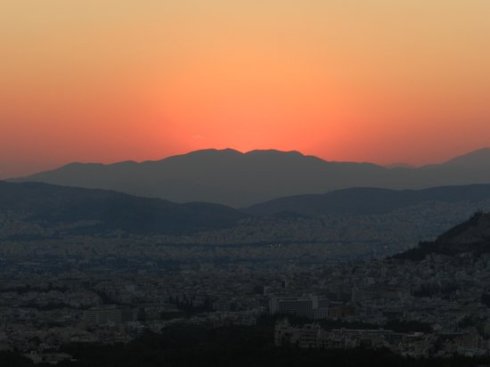
Hymettus Athens half-zoom-set-sun

After two months of brutal mid-90s and freakish humidity, it finally dropped to low 80s the day before yesterday.

And they’re cold, the whiney brats.

The feel of the air is crisp and cool.  The sky is its normal dazzling blue.  The oleander and jasmine and basil smell.  The pomegranates are ripening.  Soon there’ll be a landslide of oranges.  And forgive the cliché but the light, especially at lower angles, is working its magic again and creating all sorts of optical illusions.  There’s something about the clarity it creates that seems hyper-real or surreal.  It makes it impossible to judge distance for one: the mountain that you know is forty kilometers away looks like you can reach out and touch it; the eucalyptus tree in the yard looks like it’s at the opposite end of a football field.  No way to convey it photographically.  Everything looks totally clear yet almost flattened and two-dimensional at the same time, like an icon or a Persian miniature or a shot from a super zoom, where all optical levels and distance are reduced to one plane.  Plus it makes the ugly grayness of Athens look blindingly white.

The beauty all around is completely lost on them.  Take out your heavy hoodies, roll up the car window so that the draft doesn’t give me a stiff neck tomorrow.  They actually believe that, that drafts hit and freeze a certain body part that then hurts you for an x number of days.  Especially lethal is the rear passenger side window in a taxi.  So they run to the doctor at the slightest sniffle who gives them a beer stein of antibiotics to guzzle and that compromises their immune system even worse.  And then when they’re seriously ill five or six times every year they wonder how it’s possible because they stayed out of drafts and wore a scarf.

A screaming match in the gym by the treadmills.  She wants to close the windows.

“We’ll be sweating”, she says.

“Yeah, hon’ we’ll be sweating.  And sweat rising to your skin and drying up upon air contact is the body’s natural cooling system without which we would die.  That’s why dry climates, like this, are so comfortable and humid ones are not.”

Yok.  Now people just stay away from the treadmills when the crazy American comes.

“Stay away from the window, you’re all sweaty, you’ll get sick.”

In twenty-first century language: “It’s better to sit in your sweaty post-workout clothes, even if they’re a better environment for breeding bacteria, than to let them be dried by a draft.  Then when you get sick, wonder why.”

But as Swift said, it’s impossible to reason a man out of something he was never reasoned into in the first place.  Cold doesn’t cause colds?  Germs and bacteria that flourish in a sealed environment do?  Forget it.

“I like my mediaeval ideas, ok…” says the Right-wing Old Fart, the I-don’t-want-to-s of someone argued into a corner.  Like the “I didn’t like it” of the Macedonian.

Wish I knew wtf neuroses like these are about.

Feel the coolness of the perfect Attic night falling.  Then watch the giant Hollywood Hills windows onto the beautiful sweeping marble terraces roll shut like a prison gate and then be shuttered and boarded up on top like the zombies will get in otherwise.

And weep.

Oh, and the security door fetish.

They have their other charms, I guess.

Athens gross concrete

Comment: nikobakos@gmail.com

Howard Jacobson: two interviews, on how screens are making us stupid and the stupidity of democracy

24 Sep

One on Hardtalk with the BBC’s Stephen Sackur, the other from BBC’s Newsnight.  I’ve forwarded first video to 15:58 because the first half of the talk is a bunch of ridiculous clichés on the part of both men on Zionism, anti-semitism and Israel.  If you like you can always start it from the beginning.  Ultimately both interviews leave you wanting more.

Comment: nikobakos@gmail.com

Diyarbakır

24 Sep

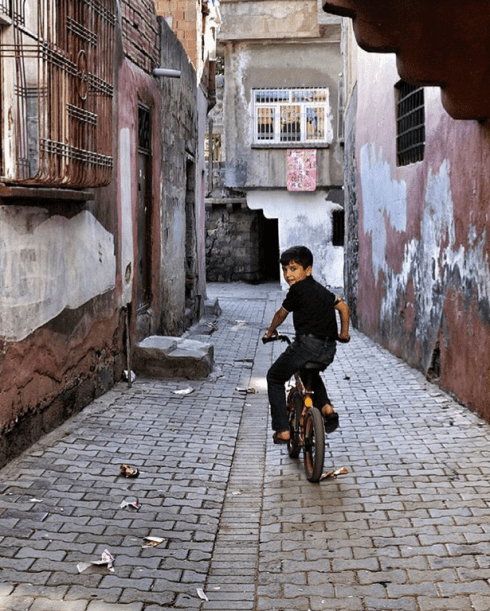
A cool Twitter account with photos of Diyarbakır, the capital of Turkish Kurdistan.  Slight weakness for the super wide angle, the last refuge of those with no compositional ideas, but interesting nonetheless.  Plus, who knows when we’ll once again be able to travel there freely.

Diyarbakir 5

Diyarbakir 3

Diyarbakir 2

Diyarbakir 4

Diyarbakir 1

Comment: nikobakos@gmail.com


Amen. From Tablet, a New Year reading.

24 Sep

Screen Shot 2017-09-24 at 9.44.06 AM

“Our beautiful boy Judah was so very lost. אִבֵּד את עצמו: our Hebrew language gently conveys; he literally could not find his way. On Tuesday, December 22, 2015, at the age of 27, my son surrendered to the torment that had been slowly destroying him.

“Our family had been working together for years in a private challenge to help our struggling Judah. My husband took 36-hour missions to Berkeley whenever he detected a certain pause in Judah’s stride, our other children rushed to cheerlead him into the next day each time they saw their brother falter. And Judah worked too—the hardest of all of us. הוי דן את כל האדם לכף זכות was his mantra; he never judged, and he insisted that we always grant others the benefit of the doubt. He had great faith in humankind. In fact, one of Judah’s favorite quotes was Anne Frank’s: “In spite of everything, I still believe that people are really good at heart.” He would share with us that if she could say that about her situation, he could say that about his.

“But ultimately his reality was incompatible with life in this world. In his very complicated brilliance, Judah understood that his journey on earth had ended. And in the final test of unconditional love, we accepted that our son had no alternative but to rescue his misplaced soul.

“My father, who spent six insufferable years in German concentration camps, often spoke of his indefatigable determination to live, in spite of the miasma of omnipresent death. Judah was the grandson who most resembled his Opa, who inherited his baby blue eyes, insatiable curiosity, and razor-sharp intellect, and also acquired his tenacious fight to survive. But the odds were impossible. Judah struggled valiantly, never sharing his pain beyond our immediate family, wearing an enormous smile while displaying profound sensitivity to everyone he encountered. And while my father refused to let himself die, my son could no longer sustain life.

“And I am the bridge between them.

“I am named for my father’s mother who died on an unknown date, in an unknown way, in an unknown place, after she was boxed on the deathtracks in late 1943. And because of all these unknowables, my father adopted the custom encouraged by the post-Holocaust Jewish world to use a designated yahrtzeit day. And that date, the tenth day of Tevet, was always marked by the candle lit atop the kitchen refrigerator, as the memory of the grandmother I never knew flickered in the Philadelphia home where I was raised. Just five days before his 28th birthday, 72 years later, I lost my son on this very same day: the tenth day of Tevet, a day of Jewish communal suffering, now a day of intense personal anguish.

“When we lose someone we love dearly, the resulting enormous vacuum exerts actual pressure that threatens to splinter our hearts into shards. It is as if their physical essence is reversed into an imploding emptiness that suctions out our own energy. We are bereft, our broken selves attempting to reconfigure to accommodate the person we can’t let go of, as we incorporate their souls into our very own so they are not completely and forever lost. The grief process is the relocation of our loved one from their body into ours, as we absorb their spirit into our go-forward existence.

“If it takes a village to raise a child, it takes an entire nation to bury him. “We will go on with living, not dying,” I repeated and repeated, my salty tears softening my crisp words, to the choreographed rows of overflowing shiva visitors who rearranged vacations to offer words of comfort. And despite the proclamations that “there are no words,” it is the bounty and beauty of kind human language that continues to help us breathe today.

“It is more difficult to drown in self-pity when friends and relatives stand by to rescue you. It becomes impossible to feel isolated when you are surrounded by people who don’t stop calling, who bring flowers and tins of cookies and teddy bear hugs, who text daily even when you don’t respond, who show up at your door laden with overflowing bags of groceries, who open your closets to set your table with china and silver because they know it tastes better when it is not served on paper, who memorize your Starbucks preference, and who—nine full months later, my reverse pregnancy complete—continue to help us grapple with the loss that would otherwise paralyze us.  Our sorrow is diminished, spread out, shared. The power of our people is the engine that pulls us forward.

“On Rosh Hashanah, as we read the Sacrifice of Isaac story, we are reminded that, in place of the son, a ram was offered instead. This very animal gifts us the shofar, whose piercing blasts this High Holiday season beacon us to find perspective and faith in the face of adversity and horror, as Abraham demonstrated in his challenges. And on this divine Day of Judgment, I will forever hear Judah’s voice calling on us to never judge our fellow man.

“It is my father’s legacy that guides me in the march from death that I have been navigating since December. I have chosen to manage my personal tragedy, as my Holocaust surviving DNA dictates: by choosing life. Because if the Holocaust survivors lost their entire families and homes and towns, their freedom, and belonging, without ever losing their dignity or hope or grace, and then sailed alone across foreign seas to strange lands to master new languages and form new families, and learned again to love and laugh with lust for life—then how can I just let myself fall?

“None of us knows what the coming year will bring. Who shall thrive and who shall perish. While we may have no control over what happens to us, we have control over how we respond. And this High Holiday season, the first since we lost our son, we pray for the continuing strength to together embrace our destiny.

“May the memory of Judah Aaron Marans be a blessing.”

See “Родные” — “Close Relations” — at the MMI in Astoria

23 Sep

Bad translation.  “Pодные”…”rodnye” means intimate, familiar, related; by extension born-beloved, dear one, cared for, same root in Russian as parents, birth, homeland, Christmas…wouldn’t be surprised if it has the same Indo-European roots as “root”.

Rodnye Vitaly Mansky

Vitaly Mansky‘s documentary is being screened this coming weekend and the next at the Museum of the Moving Image in Astoria, Queens.  (See schedule. It’s two train stops into Queens, guys.  Then you can have a nice dinner for half of what you pay in Manhttan at a good friend and koumbaro‘s place: Mar’s.)

“In this follow-up to his award-winning documentary Under the Sun, filmmaker Vitaly Mansky examines Ukrainian society amidst the 2014 national election, a period rife with political chaos and growing uncertainty over national identity and integration. As both a Russian citizen and native Ukrainian, Mansky deftly underscores personal and political complexities as he visits with relatives living in Lvov, Odessa, the Crimean peninsula, and the Donbass region, and in the process discovers a wide and disorienting spectrum of outlooks and affiliations, including his own sense of ongoing exile and unease. Close Relations is at once an intimate family portrait and a graceful journalistic endeavor, a movie of the intense present that illuminates a place caught between a troubled past and an anxious future.”

Watch the trailer below.

Lots of moving, “disorienting” footage.  Also, lots of humor, which reminds us that so much of a certain ironic, sardonic take on the world — a viewpoint “from a certain angle”, as E.M. Forster said of Cavafy — that we in the United States think is particularly Jewish, is really just a trait common to all eastern Europe, even Greece, or perhaps just a trait common to the powerless everywhere:

“Crimea was a pity, but the Donbass…they can have it.” *

But I think the most important moment in terms of geopolitics comes at 1:15:

“So Ukraine decided to join NATO.  Isn’t that its own business?”

“Nyyyyyet!”

…comes the reply without a moment’s hesitation.

“Nyet” with its palatized “n” and final “t” is one of humanity’s great no-words.  Like “yok” in Turkish, it literally means “there isn’t” or “Il n’y a pas”.  But while “yok” has a kind of know-nothing passivity about it, “nyet” is an active “Halt!  No way you’re going further down this road.  There’s no access.” **

That moment in Mansky’s doc is why, despite widespread support for a Putin I find repulsive, I can’t get as angry at Russians as I get at Trump Americans and Türk-doğans; because Russians aren’t stupid.  They’re not as smart as they used to be in the old days, при коммунизме, when everybody knew not to believe any-thing.  They now believe all kinds of nonsense.  And they went and got religion on me too, which is one of my life’s greatest watch-what-you-wish-fors.  But they’re still pretty intelligent about the world.

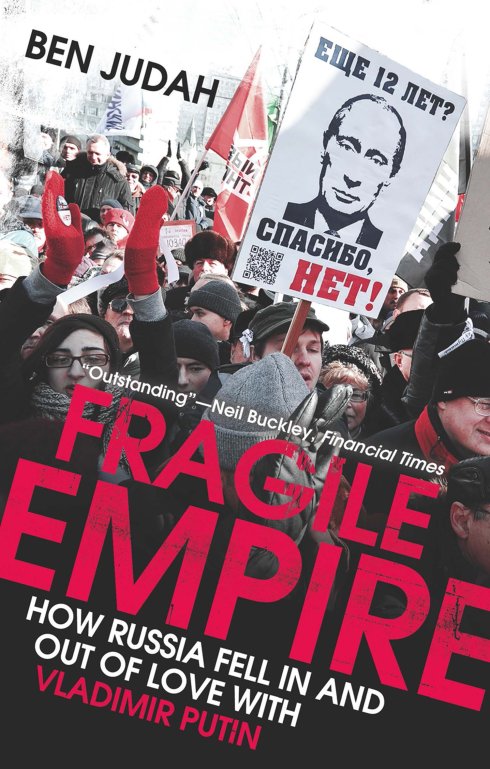
I can’t get inside Putin’s head, like Ben Judah convincingly does in what’s still the best book on the Путинщина, the “Putin-ness” or the “Putin thang.”  Judah’s thesis is that Putin is really just a nebech apparatchik who others put in his place and who now — having trampled over so many people on his way up — is terrified of stepping down and that the macho persona he so tiringly projects masks mega insecurity.  It almost makes you feel sorry for him.

But this relative of Mansky’s and her coldly realpolitik “nyet” tell you why he has so many Russians’ support.  Because it means: nyet, you can’t tell me that the U.S. and NATO suddenly developed a major crush on Estonia and Georgia; nyet, you can’t suddenly tell me you’re interested in Ukraine too, because this was already starting to feel like a corporate raid on all the old girlfriends who dumped me, but Ukraine, especially, is like hitting on my sister; nyet, you can’t moan and groan about how we’re violating a basic credo of the European Union by changing borders, when neither Russia or Ukraine are part of the European Union and you wouldn’t even have considered Ukraine — with its resources, access to the Black Sea and huge Russian population —  a candidate if it weren’t a way to totally encircle Russia; and, nyet, you can’t tell us that you’re not still treating us with a Cold War mentality that you inherited from an Anglo tradition of Great Game power struggle that doesn’t apply anymore and is now completely counter-productive.

At least talk some truth and maybe we can get somewhere.  And then I’ll reconsider breaking up with Putin.

In the meantime, we can try to think of everyone as “close relations.”

For more on these issues see: The first two of my cents on Ukraine and Russia… from a couple of years ago, and more on the imperative to engage Russia in Syria, Russia, ISIS and what to do about everything“.

Putin Judah Fragle Empire

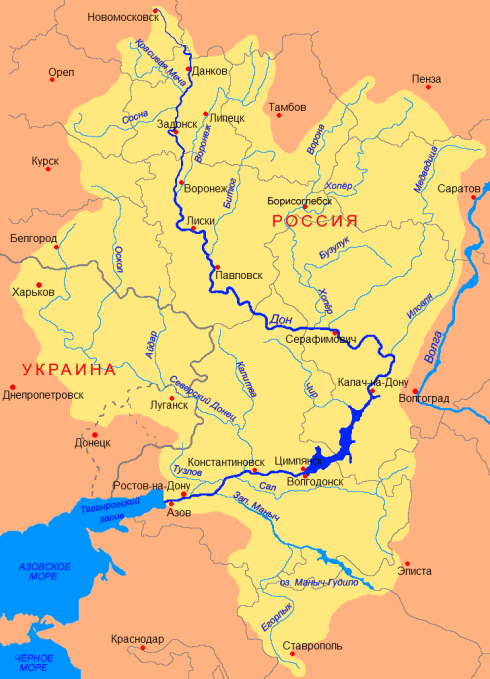
************************************************************************************* * The Donbass, the river Don basin is part of southeast Russia and the Russian-speaking parts of eastern Ukraine where the current conflict is centered.  From The first two of my cents on Ukraine and Russia“:

“Also, thence, a crucial point: that Ukraine wasn’t so much conquered, but settled by Russia…

“The independent “frontiersmen” mentality of the Russians of these areas, a sort of Russian Texas  — among its ethnic Cossack peoples especially — should not be underestimated and should not be disregarded as a possible element in the current conflict.  (See: And Quiet Flows the Don at Amazon and at Wiki.)”

“Новая Россия,” (Novaya Rossiya), New Russia, is not a Putinism.  It’s a name for these lands that goes back to Catherine the Great and the first serious subduing of Cossack rebelliousness and settling of Russians in the region in the 18th century.  It was part of the Russian empire’s most fertile grain-producing regions and then the scene of crazy industrialization under the Bolsheviks; maybe it was once a sort of “Russian Texas” but now it’s more like a sort of Russian Rust-Belt.  Hence, the “they can have it” comment.  The Soviet Army, decapitated by Stalin’s purges of its most talented and experienced, and ill-prepared and ill-equipped, only made the Nazi sweep through Ukraine grind to a halt once the Germans had made it this far east and after hundreds of thousands of Russian men had already been sent to a meaningless death and the Nazis had swept the old lands of the Pale clean of Jews through massive massacring and mass executions which were an integral part of the military strategy of the eastern front; many military historians believe that if the Nazi invasion of the Soviet Union hadn’t been slowed by German troops stopping every other community to round up and shoot its Jews (a method/process that killed more Jews than the gas chambers did), they might have been successful in beating the coming of winter and more successful in their campaign long-term.  The region then became the scene of brutal attrition warfare, culminating in the siege of Stalingrad (now reverted back to its original name, Волгоград / Volgograd on map below).  This left the region seriously trashed and so huge numbers of Russian workers were settled there post-WWII, Russianizing the Ukrainian far east even further and setting the stage for today’s conflict.

Map of the Don Basin.  The grey line shows the border between Russia (РОССИЯ) and Ukraine (УКРАИНА) and the broken grey lines in Ukrainian east indicate the Lugansk (Луганск) and Donetsk (Донетск)

Don_basin

** “У меня денег нет” (“U menya deneg nyet”) in Russian is the same structure as the Turkish “Benim param yok” — “I don’t have any money.”  Though Russian has a verb for “to have” like other Slavic languages, these structures both mean, literally: “By me there’s no money” or “My money isn’t there/isn’t by me.”  Wondering whether it’s a construction Russian acquired through contact with Tatar.  There is apparently a phenomenon where languages effect each other and transmit certain properties between them, though there’s no large bilingual population to bring them together and though they’re not genetically related, at least not closely.  The absence of an infinitive, for example, in modern Greek, Albanian, Bulgarian and Romanian/Vlach, though each are from different Indo-European families and more closely related languages have an infinitive, is one good example.  Also, Yiddish “by mir” (as in “By mir bist du shayn”) which is like the Russian по-моему (“according to me”) — for me, in my opinion.  Though German uses “bei mir” also to mean same thing.

Comment: nikobakos@gmail.com

Do Kurds need to do this right now, just at this very moment?

22 Sep

At the end of 2015 I wrote this piece: Syria, Russia, ISIS and what to do about everything where I expressed my hopes that Iraqi Kurds not declare de jure independence, since that would destabilize the region even further:

The Kurds: ‘I have a dream,’ as they say, for Kurds: that they will recognize the fact that Iraqi Kurdistan with a capital at Erbil is already a de facto independent state and not complicate things in the neighborhood by please resisting the urge to declare de jure independence.

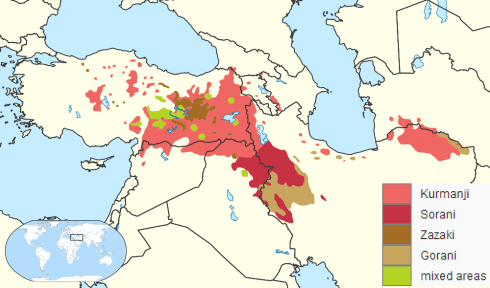
Kurds

Kurdish-inhabited regions of the Middle East and Caucasus, according to tribal break-down.

“This centrally located political entity can serve as the hub of a wheel of still-to-be-worked-for, autonomous, Kurdish regions encircling it, and by not insisting on independence and union, they will be able to put more resources and energy into developing what they have and not fighting to defend it forever. I don’t know; maybe the future of the world will involve the devolving of nation-states into affiliated groups of semi-autonomous units with perhaps overlapping or varying degrees of jurisdiction – Holy Roman Empire style – and the Kurds may be the first to experience this as a people and benefit from it: that is, to see diaspora (if that word really applies to a non-migrating group), or political ‘multiplicity,’ as a finger in every pie and not as separation, and be able to reap the advantages of that.”

And my what-to-do suggestions:

“The Kurds: Give the Kurds EVERYTHING they need. They’re creating a society, both in Iraqi Kurdistan and in the internal socio-political life of Turkish Kurds that is nothing short of revolutionary in its civic-mindedness, democratic tendencies and secular steadfastness. Yes, nothing’s perfect there either but it’s by far the best we have. And the loose confederation of Kurdish regions that I spoke of earlier may have perhaps an even more strategically valuable position to offer the rest of the world than Turkey does. Beg Turkish Kurds to swear to abide by ceasefire terms despite all provocations by the Turkish state; insist that Iraqi Kurdistan not declare independence. And then give them everything they need, even if it means billions in aid. Because, along with the Russians, they’re the ones who’ll probably have to do even more of the ground fighting when the airstrikes campaign reaches its inevitable limits – and starts harming civilians, which it unfortunately already has — even though they now insist that they’re not spilling any more of their own blood for anything outside of Kurdish-inhabited regions.”

Well, it looks like “Hope” as Poles say, “is the mother of stupidity” and nobody cares about my wish-list.

The above was written before the relationship between Turkish Kurds and the Turkish government went to hell again and descended into crazy violence, before supposed anti-Erdoğan coup, massive purges, HDP’s Demirtaş’ imprisonment, and all the other fun stuff that’s happened in Turkey since.  I hate, more than anybody, to look like I’m catering to Erdoğan’s peeves, but an Iraqi Kurdish referendum on independence just at this time is a provocation for him that may turn out to be disastrous.  Erdoğan is already massing troops on Turkey’s southern borders, and though I doubt he’ll have the balls to invade what’s pretty much an American satellite, Iraqi Kurdistan, I don’t put it beyond him to send troops into the Idlib region in Syria — maybe even hold a “referendum” and annex it like the Turkish Republic did to the neighboring region of Antiocheia in the 1930s.  A friend in C-town thinks that the third and newest Bosporus bridge is named after Sultan Selim 1st (“the Grim”) not just to stick it to Alevis (he was the ruler who committed widespread massacres of them during his reign, 1512 – 1520) but to emphasize Selim’s wresting of Mesopotamia from the hated Safavid Shia of Iran and the Levant from the Mamluks of Egypt and underline Erdoğan Turkey’s role in the region.  His Neo-Ottomanism may yet find its perfect expression in post-ISIS Iraq/Syria.

Read Barzani in the Guardian: Barzani on the Kurdish referendum: ‘We refuse to be subordinates’: “Iraq’s Kurdish leader tells the Guardian why the independence vote is so vital, and how he will defy global opposition”.

Interesting times.

Comment: nikobakos@gmail.com

“When in the Course of human events it becomes necessary for one people to dissolve the political bands which have connected them with another…”

22 Sep

“…and to assume among the powers of the earth, the separate and equal station to which the Laws of Nature and of Nature’s God entitle them, a decent respect to the opinions of mankind requires that they should declare the causes which impel them to the separation.”

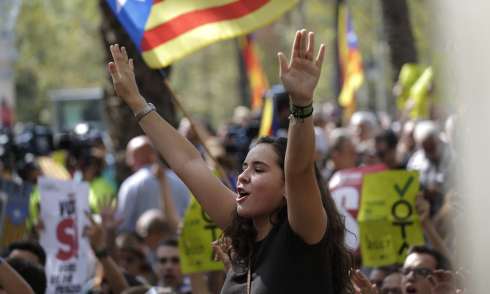
  • Are Catalan nationalists like Carles Puigdemont Founding Fathers or Confederate separatists?
  • I’m not convinced by the “causes which impel” Catalans to separation.  Are you?
  • I’m hoping Catalans don’t goad Madrid and Rajoy into doing something stupid.
  • Read .  But especially scroll through the comments; the scariest ones that should give you more pause and where the dangers of Catalan separatism become clearest should jump out at you.  There you’ll see the racist self-righteousness of “little nation” nationalism in all its smug, bourgeois glory.
  • Whenever a Catalan uses or writes “Castille” that means reactionary, Catholic, Black Legend Spain where — as one comment gallingly states — “things haven’t changed much since Franco.”  Andalucía is cool and Moorish.  The Basque Country is wealthy, enterprising and progressive like us, even if they’re a little too Catholic for our tastes.  Galicia is the sweet, melancholy home of Celtic troubadours.  It’s Castille and Aragon — oh, and Asturias, which gave birth to the ugly ideology of the Reconquista — the kingdoms of the barbarous “Reyes Católicos”, that are oppressing us.
  • Substitute “Serbia” for “Castille” and you’ll get an amazing repro of Croatian gripes.  We’re European and forward-looking — even if kinna the kings of post-Hapsburg noxious fascism; don’t leave us to the mercy of obscurantist, Orthodox, Serb savages.
  • Read Vasily Grossman in …the nationalism of little nations on Armenians and what the nationalist is really about.
  • Read Vargas Llosa about how …Nationalism effaces the individual…“.
  • Where’s Almodóvar, the face of the Madrileña “movida” from La Mancha, where “nothing has changed much since Franco” to give us his opinion?  I’m sure he has one.

Catalan independence protestor

Comment: nikobakos@gmail.com

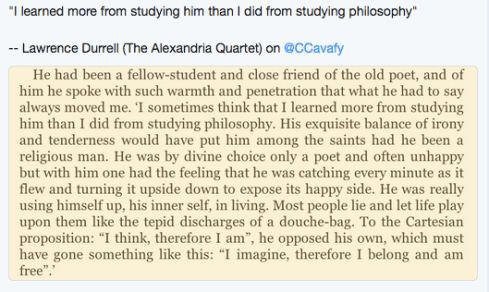
Durrell on Cavafy: “He was by divine choice only a poet…”

21 Sep

Screen Shot 2017-09-21 at 8.39.51 PM

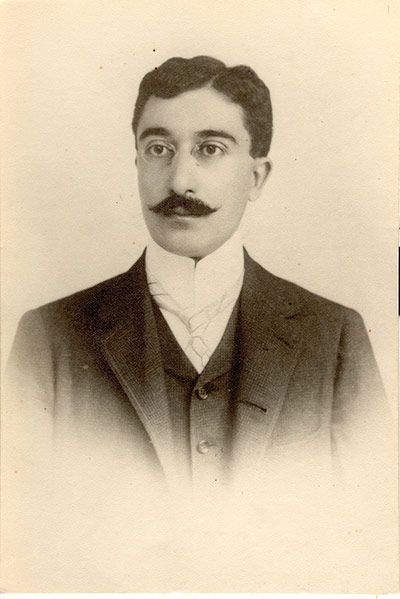
Durrell with wife Nancy and a young Cavafy (below)

Durrell Nancy

Cavafy young

Comment: nikobakos@gmail.com