
Sometimes I get really pissed off because I think certain Neo-Greeks don’t even try to say certain sounds because they don’t exist in standard Modern Greek and they’re associated with stigmatized provincial dialects and accents and that there’s a special animus against certain Slavic sounds in particular, which would be in keeping with Greek nationalist paranoias (since we’re all really Slavs!!! :) snaaaaatch!!!).
I’m not asking you to distinguish between the denser “č” and the lighter “ć” — which I even have trouble with — but can you really not even say “ch” at all? Do I have to listen to you saying “Birtsevits”? It’s painful.
Watching on mute…
Forza Serbia!!!

Stefan Birčević
“But underlying all of this, there was an even stronger impulse: the fantasy of Russia itself. Long before the Bolshevik Revolution gave the dream a very particular political content, Shaw was primed to expect a global spiritual resurrection that would begin in Russia. This hope was not as fanciful as it may now seem: In the late 19th century, when Shaw’s political and artistic consciousness was being formed, Russian music, drama and literature were at the leading edge of modern Western culture. [My emphasis.] As he later wrote to Maxim Gorky, “I myself am as strongly susceptible as anyone to the fascination of the Russian character as expressed by its art and personally by its artists.”’
When you’ve understood the urgency with which a mediaeval theocracy at the edge of the world moved to center stage of European culture in little more than a century, you’ve understood most of what’s Russian: then and — maybe more importantly — now.

Hundreds of Palestinians rallied on Saturday in occupied East Jerusalem against the selling of church property to Jewish settlers.
Protesters demanded the removal of Patriarch Theophilos III over his involvement in selling church land and called for an end to Greek dominance over their church.
They held up signs reading: “We demand the freedom of the Orthodox Church from Theophilos and from corruption” and “Church land belongs to the church and its congregants – not to Theophilos and his gang.”
Demonstrators also chanted: “Theophilos, you collaborator. Our land is not for sale” and “We want national unity, to free the Patriarchate.”
 |
| Signs read: ‘The Orthodox endowments are for the sect and not for Theophilos’ and ‘Our endowments are our past, future and present’ [Al Jazeera] |
“The people are demanding unity, transparency, and not to Arabise the church, because the church is already Arab Palestinian,” Ayman Odeh, head of the Joint List in Israel’s parliament, said in a statement at the protest.
“In the 21st century, we are here are to ensure that this a national cause. We are here to say there are those who aim to transform the conflict from a national one to a religious one. This is a conflict between illegal occupation and between the people of Jerusalem – Christians and Muslims,” Odeh added.
“There is no excuse for the selling [of] any piece of land. This land is for our people. They succeed by dividing us, or bribing us. I ask you all to sit together to form unity and to pinpoint our demands and to foster unity to succeed in this just cause.”
The rally comes amid fears in the Palestinian Christian community that Israel is attempting to “weaken the Christian presence” in the country.
READ MORE: How Israel is targeting Palestinian institutions
In a joint statement released this month, patriarchs and church leaders in Jerusalem expressed their concern over what they termed “breaches of the status quo that governs holy sites and ensures the rights and privileges of churches”.
The statement condemned a recent Israeli court ruling over the selling of two strategically located hotels near Jaffa Gate in the Old City and a large building in the Muslim Quarter to the Israeli Jewish settler group, Ateret Cohanim, which aims to expand the Jewish presence in the occupied city. The court approved the sale in early August, giving Ateret Cohanim rights over the property for a period of 99 years.
“The judgement in the ‘Jaffa Gate’ case … which we regard as unjust, as well as [a] proposed bill in the Knesset which is politically motivated that would restrict the rights of the Churches over our own property, are further assaults on the rights that the status quo has always guaranteed,” the statement noted.
The patriarchs and church leaders also vowed to support a high court appeal against the judgement and called on fellow church leaders around the world to stop further attempts to change the status quo.
 |
| The church has vowed to appeal the Israeli court’s decision [Al Jazeera] |
The Greek Orthodox Church is the second-largest owner of land in the country. The controversial deal between the church and Ateret Cohanim was made in 2004 and came to light a year later.
Although the deal was initiated by Theophilos III’s predecessor, Irenaios, who was deposed from his position for his actions, activists and residents believe Theophilos III was responsible for concluding the deal with the settler organisation.
“The Patriarch will continue to use bribes. We will not allow these bribes to continue. This church is an Arab church and its administration should be Arab. The Patriarch must be an Arab – whether Palestinian or Jordanian. We will not accept anything else,” Alif al-Sabbagh, a member of the Arab Central Orthodox Council in Palestine and Jordan, told Al Jazeera at the protest.
India’s ruling party has defended Narendra Modi’s use of Twitter after a number of users followed by the Indian prime minister appeared to celebrate the fatal shooting of a journalist this week.
Leaders from across Indian politics have condemned the murder of Gauri Lankesh, who was shot dead outside her home in Bengaluru on Tuesday, but a number of Modi supporters appeared to attempt to justify the killing.
One commented: “You reap what you sow.” Another wrote in Hindi: “A bitch died a dog’s death and all of her litter is crying in the same voice.”
Modi, who operates his own Twitter account and follows 1,779 others, has been criticised for continuing to follow accounts that have levelled abuse at Lankesh. He has yet to comment on the killing.
The head of his BJP party’s information unit, Amit Malviya, said the prime minister followed “normal people” and described the controversy as “mischievous and contorted”.
“PM following someone is not a character certificate of a person and is not in any way a guarantee of how a person would conduct himself,” he said in a statement. “[Modi] follows normal people and frequently interacts with them on various issues. He is a rare leader who truly believes in freedom of speech and has never blocked or unfollowed anyone on Twitter.”
Modi is regularly criticised for following users who post offensive content. In July 2015 he invited 150 social media users to his residence for a meet-and-greet, among them Twitter users who had used sexual slurs and levelled other abuse against women.
Malviya said Modi was frequently attacked for the actions of his supporters while abuse by backers of opposition political leaders was ignored. “This debate is not only farcical and fake, but also an exhibit of selective right to freedom of expression,” he said.
India’s information technology minister, Ravi Shankar Prasad, condemned the online abuse of Lankesh, tweeting that he “deplore[d] the messages on social media expressing happiness on the dastardly murder”.
Separately, Delhi police have filed a case against a Facebook user who published a “hit list” of journalists, activists and authors including the Man Booker prize-winner Arundhati Roy.
Police have sought the IP details of the user, who identified himself as Vikramaditya Rana, after he made a series of posts including one saying Lankesh’s killing “serves her and her kind right for the damages these so-called journos have caused our nation”.
Lankesh, whose murder is being examined by a specially appointed investigative team, had previously voiced concern about the “rabid hate” that she was subjected to online.
In her speeches and writing, Lankesh, 55, frequently criticised the Hindu nationalist ideology associated with the BJP and worked to rehabilitate guerrillas involved in the country’s five-decade-long Maoist insurgency.
Though police have not commented on the motive for her killing, friends, lawyers and colleagues of the journalist as well as some members of the BJP have speculated that it was in retribution for her work.
On Thursday the hashtag #BlockNarendraModi was used as part of a campaign to block the leader’s account and highlight the abuse that many prominent Indians, particularly women, say has become endemic online.
One prominent journalist, Barkha Dutt, wrote in the Hindustan Times this year that trolling “has become part of my daily life”. “I don’t even notice it any more; that’s how dangerously inured I have become to the gross innuendo and violent and sexually explicit abuse that is heaped on so many women,” she said.
***********************************************************************************
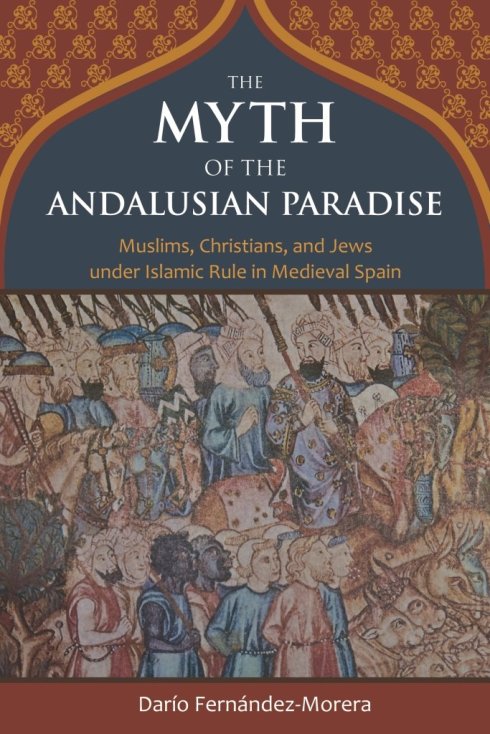
One reader’s comment that delves deeper into the book’s subject matter, repeats some of my thoughts and questions, especially that Spanish Christianity developed its militance and triumphalism in almost a millenium of constant warfare “in a society organized for war” against what for me is arguably a militant and triumphalist religion primarily organized for war, etc.; emphases are mine:
Just saw it on Amazon. Is it serious or “yellow” history? Obviously haven’t read it. If anyone has please share.
The comments/review quotes seem to be from fairly “serious” sources:
“Shows in meticulous detail . . . that intolerance, segregation, formal inequality, and brutality were the order of the day [in Islamic Spain].”
—The New Criterion“[Fernández-Morera] must be commended for daring to wade into this hazardous arena. He has come well-armed: his The Myth of the Andalusian Paradise has 95 pages of notes, and the lionisers of political correctness will not find it easy to penetrate chinks in his bibliographical armour of primary and secondary sources, many not published in English. In an exhilarating and unput-downable read, Fernández-Morera debunks the fashionable myth that Muslims, Christians, and Jews lived together (convivencia) under ‘tolerant’ Muslim rule. . . . World-class academics—hailing from Yale, Harvard, Chicago, Princeton, London, Oxford—look like fools in their apologetics for jihad.”
—Standpoint“Numerous books propagandize for Islam by calling Muslim rule in Spain during the Middle Ages a golden age of tolerance. Darío Fernández-Morera’s The Myth of the Andalusian Paradise: Muslims, Christians, and Jews Under Islamic Rule in Medieval Spain (ISI Books) cuts against PR for Islam by giving specific examples of rulers cutting off heads or applying burning candles to the faces of sexual slaves.” —World magazine, naming The Myth of the Andalusian Paradise a finalist for Book of the Year
“Often a work of historical revisionism is a dubious exercise in discovering trendy, hidden agendas with little bearing on the actual record of the past. The Myth of the Andalusian Paradise is decidedly not such a study and is instead a bracing remedy to a good deal of the academic pabulum that passes for scholarship on Jewish-Christian-Muslim relations.”
—Middle East Quarterly“A first-rate work of scholarship that demolishes the fabrication of the multiethnic, multiconfessional convivencia in Spain under Muslim rule. The book is also an exposé of the endemic problems of contemporary Western academe. . . . Space does not allow us to list all of the fables—some bizarre, others laughable, most of them infuriating—that Fernández-Morera dispatches with unassailable logic and ruthless efficiency.”
—Chronicles“I am in awe of The Myth of the Andalusian Paradise. . . . This book is an intellectual boxing match. The author shreds not just one opponent, but a series of intellectual bigots, prostitutes, and manipulators of the common man. . . . He uses research and objective facts to make his case. Nothing could be more transgressive in academia today.”
—FrontPage Magazine“The Myth of the Andalusian Paradise prompts readers to rethink their traditional notion of Islamic Spain. Fernández-Morera shows that it was not a harmonious locus of tolerance. Paying special attention to primary sources, he documents how Islamic Spain was in fact dominated by cultural repression and marginalization. The Myth of the Andalusian Paradise is essential reading. It will soon find its place on the shelves of premier academic institutions and in the syllabi of pioneering scholars.”
—Antonio Carreño, W. Duncan McMillan Family Professor in the Humanities, Emeritus, Brown University“I could not put this book down. The Myth of the Andalusian Paradise constitutes a watershed in scholarship. Throughan unbiased and open-minded reading of the primary sources, Fernández-Morera brilliantly debunks the myths that for so long have dominated Islamic historiography and conventional wisdom. We were waiting for this great breakthrough to come to light, and Fernández-Morera has done it. Bravo!”
—Raphael Israeli, Professor Emeritus of Middle Eastern, Islamic, and Chinese History, Hebrew University of Jerusalem“Fernández-Morera examines the underside of Islamic Spain, a civilization usually considered a model of dynamism and vigor. Through the study of primary sources, he questions the historiographic and intellectual view of the superiority of that civilization. This is an intelligent reinterpretation of a supposed paradise of convivencia.”
—Julia Pavón Benito, Professor of Medieval Spanish History, University of Navarra“Desperately, desperately needed as a counter to the mythology that pervades academia on this subject. This book sheds much-needed light on current debates about the relationship between the West and Islam. It displays rare good sense and a willingness to face truth that is all too often absent in discussions of this era.”
—Paul F. Crawford, Professor of Ancient and Medieval History, California University of Pennsylvania“A splendid book. This sober and hard-hitting reassessment demolishes the myths of religious tolerance and multiculturalism that have hopelessly romanticized the precarious coexistence and harsh realities of medieval Spain under Muslim rule. Well documented and persuasively argued, this book is must-reading as a window into the lessons of the past.”
—Noël Valis, Professor, Department of Spanish and Portuguese, Yale University“Fernández-Morera takes on the long-overdue topic of assessing medieval Muslim Spain’s reputation for ethnic pluralism, religious tolerance, and cultural secularism. Finding this view based on a ‘culture of forgetting,’ he documents the reign of strict sharia in Andalusia, with its attendant discrimination against non-Muslims and subjugation of women. So much for the charming fantasy of open-mindedness and mutual respect.”
—Daniel Pipes, historian of Islam and publisher of the Middle East Quarterly“Brilliant . . . A thorough and entertaining study, as masterful as it is pointed.”
—Catholic Culture“Reveals the awesome and awful truth camouflaged by many in the West who have written apologies for Muslim-ruled Andalusia . . . More than 90 pages of footnotes to contemporary sources in their original languages make his thesis unassailable.”
—New English ReviewAbout the Author:
Darío Fernández-Morera is Associate Professor in the Department of Spanish and Portuguese at Northwestern University. A former member of the National Council on the Humanities, he holds a BA from Stanford University, an MA from the University of Pennsylvania, and a PhD from Harvard University. He has published several books and many articles on cultural, literary, historical, and methodological issues in Spain, Latin America, and the United States.
But before I publish this I’ll commend myself for “daring to wade into this hazardous arena”, just about two weeks ago in: “Barcelona addendum: why the Western, “leftist” intelligentsia bears a nasty share of the guilt, part I” (part II should be coming soon):
OK…I’ve bitten off more than I can chew I think, so let me resort to bullet points. Some Al-Andalus and Crusades fun bubbles I’d like to pop:
* The happy Muslim Iberia of convivencia — co-existence — only lasted for at most two centuries, as long as the Umayyad Caliphate with its capital at Córdoba lasted. That caliphate was replaced by new and much more religiously orthodox and intolerant Berber kingdoms from North Africa under which Spain devolved into small Muslim emirates — the taifa — in which conditions for Spanish non-Muslims came to resemble those of dhimmi elsewhere in the Muslim world. (See also rayah: “…both in contemporaneous and in modern usage, it refers to non-Muslim subjects in particular, also called zimmi.” The “dh” sound of Arabic is usually replaced by a “z” sound in Irano-Turkic usage, as in Ramadhan and Ramazan.)
The taifa of the Iberian peninsula in 1031. (By 1248, when Seville fell to Christian siege, the only other major city left in Muslim hands was Granada.
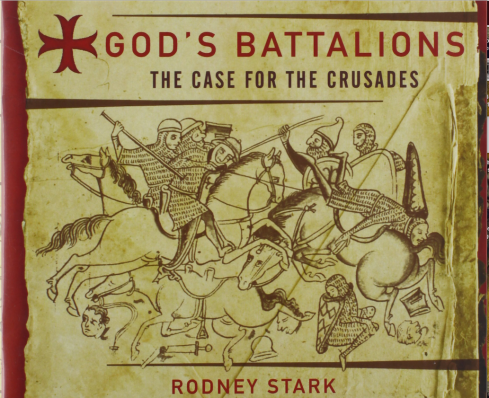
* Check out this book about the Crusades: God’s Battalions: The Case for the Crusades by Rodney Stark.
It’s a cruddy, badly written and amateurish book (but, you know…”Out of the mouths of babes…” Psalms 8:2 and Matthew 21:16; you can’t expect an academically serious historian to write something like this, as he’d lose all funding and probably his job), but it asks a serious question: why have we in the modern West come to consider the Crusades the beginning of aggressive Western imperialism, a kind of proto-colonialism, and not, as Stark asks, a perfectly predictable response to the aggression of Islam/Arabs? I mean, sorry, it’s a question I’ve always been afraid to articulate: but who conquered two thirds of the Roman Christian world and the whole of the Sassanian world in less than a century to being with?
Next:
* That the Crusades have remained a traumatic memory seared in the collective consciousness of Arabs everywhere, that Syrian mothers still scare their children into obedience by telling them that Richard the Lionheart is coming to kidnap them, is an urban myth. Arabs didn’t remember the Crusades any more than we (Greeks) collectively remembered the Fourth Crusade that dealt the fatal blow to the Eastern Roman Empire (the Ottomans really just mopped up what was left). Arabs only “remembered” the “trauma” of the Crusades when the West and the above mentioned guilty Western intelligentsia “reminded” them
* On to another inconvenient truth that follows on the above: the Byzantines recovered fairly quickly from the loss of the Levant and Egypt to the Arabs in the 7th century, and in fact, may have emerged stronger as a more compact, ethnically and linguistically Greek polity. Then, under the early Comnenoi in the 12th century (Alexios, Ioannes and Manuel), they showed their resilience again as they reconsolidated their rule over the Balkans and, taking advantage of the crumbling of the Seljuks caused by the appearance of new Turks in Asia Minor, reconquered a large part of western Anatolia, despite facing renewed aggression from the Italian/Sicilian Normans to the West and from these newer Turkic states on the East; with the First Crusade’s help, they even recaptured Antioch and the surrounding region for a brief period. The Fourth Crusade’s conquest and sack of Constantinople in 1204, though, was an event it was impossible to recover from. Several Greek successor states that emerged then reunited into an empire under the leadership of the Palaeologoi out of Nicaea and retook Constantinople in 1261, but from then on this remnant Roman Empire was, despite a new cultural and artistic flourishing, a political and military sitting duck. Add to these facts that Levantine Christians and Armenians who ended up in the reconquered Crusader states — at the time of the Crusades the regions we’re talking about were, by some estimates, still almost 50% Christian — were subjected to violent reprisals by their newly returned Muslim overlords that diminished their numbers through flight and conversion and we come to the inevitable conclusion: in the long run, the greatest victims of the Crusades were eastern Christians.
* For Jews, whose horrific experiences with the Christian Westjust went from bad to worse over two millenia, culminating in the Holocaust, and for whom it seems to have been particularly tempting to see the historical lands of Islam as the “Goldene Medina” where Jews lived in peace and acceptance, it wouldn’t hurt to keep in mind that the biggest pogrom in mediaeval Europe in terms of numbers slain occurred in 1066 in Muslim Granada. This was when a Jew-cum-uppity-nigger, Joseph ha-Nagid, became too powerful as the vizier at the emir’s court in Granada — that city whose languid beauty and graciousness is the Fetish-in-the-Crown of pro-Moorish apologists. He was crucified and, by some estimates (many consider them discredited, but you have to ask why), 4,000 Jews were killed. I don’t know if crucifixion was supposed to have some kind of retaliatory significance given he was Jewish. But, according to Bernard Lewis, the Berber Muslim mob that carried out this pogrom were egged on by a poem of a certain Muslim, Abu Ishaq:
Bernard Lewis writes:
“Particularly instructive in this respect is an ancient anti-Semitic poem of Abu Ishaq, written in Granada in 1066. This poem, which is said to be instrumental in provoking the anti-Jewish outbreak of that year, contains these specific lines:
- Do not consider it a breach of faith to kill them, the breach of faith would be to let them carry on.
- They have violated our covenant with them, so how can you be held guilty against the violators?
- How can they have any pact when we are obscure and they are prominent?
- Now we are humble, beside them, as if we were wrong and they were right!
- [my emphases]”
- –
“My emphases” are obviously meant to highlight the zero-sum game that is monotheism and particularly Islam: “obscure/prominent” and “wrong/right”. No sense that there’s room for both or many as in polytheism or Hinduism (let’s not get into whether Hinduism is really polytheism right now). Just “right” and “wrong”. If you’re wrong you’ll be tolerated as long as you don’t get too big for your britches. And: “why am I obscure when they’re prominent?” sounds like the battle cry of curdled ressentiment we’ve heard from Sayyid Qutb to Mohammed Atta and his buddies and back to Abu Ishaq if not to the very beginnings and to Ishmael himself, the rejected illegitimate son of Abraham and of the slave Hagar.
Lewis adds though: “Diatribes such as Abu Ishaq’s and massacres such as that in Granada in 1066 are of rare occurrence in Islamic history.”
Well, ok then…
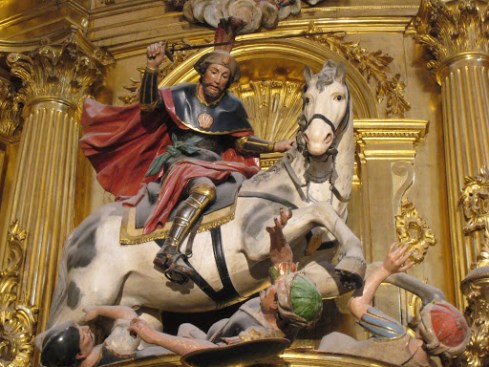
* Spanish Catholicism has been (Yes – “Nobody expects the Spanish Inquisition…”) for great periods of our common history, terrifying, especially for the Jews and Muslims the Arabs left behind in Spain and for the subjected-to-close-to-genocide inhabitants of the New World. I admit to having played around with Santiago imagery in the past, but the connotations became too hard to stomach (see this interesting article: “The Transference of ‘Reconquista’ Iconography to the New World: From Santiago Matamoros to Santiago Mataindios“). The Spanish Catholicism of the Reconquista and the Counter-Reformation is easily the most abominable form Christianity has ever taken — along with the Puritans, of course, and Luther and his Taliban, of course, and American Evangelists, of course, etc. etc. But, still, you have to ask: the legitimacy of force and conquest in the spreading of the faith; massacre or forced conversion as legitimate proselytizing methods, enslavement of the defeated enemy — where did Spanish Catholicism get those ideas from? They’re not in the Gospels. And forced conversion is not present in Judaism either, which — remember — is not interested in converting you, my little goy. Maybe — just maybe — after 800 years you start to resemble your enemy. Even the Spanish concept of limpieza de sangre — blood purity — that you have no Muslim or Jewish ancestors, probably unfeasible to impossible in Iberia — seems to mirror the chauvinism of early peninsular Arabs, and the apart-ness status they lived under in early Islam. Any ideas?
Santiago Matamoros
I’ve had quite some fun with the response to this; like I said, I should get Part II posted in a couple of days or so.
–
Comment: nikobakos@gmail.com
–
…finally gets something of the riot act read to him by the Times:
“Prime Minister Narendra Modi has let a climate of mob rule flourish in India, with his right-wing Hindu supporters vilifying “secularists.” The venom that reactionary social media trolls direct at journalists, or “presstitutes” as they call them, is especially vicious, but not entirely new. At least 27 Indian journalists have been killed since 1992 “in direct retaliation for their work,” according to the Committee to Protect Journalists. Only one of the killers has been convicted.”
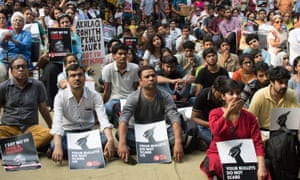
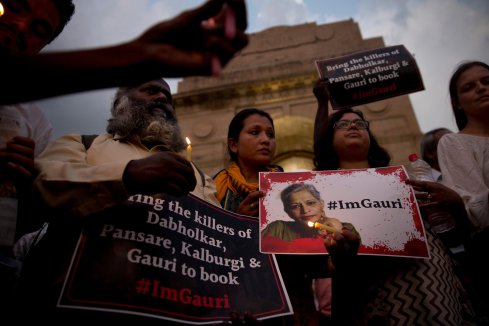 People protesting and mourning the killing of the Indian journalist Gauri Lankesh in New Delhi, on Wednesday. Credit Tsering Topgyal/Associated Press
And yet even the Times, even in an editorial against the increasing violence of Hindutva nationalism, kowtows and calls it Bengaluru instead of Bangalore. I think this is the first time I’ve seen that in print.
See my: “Names: “Istanbul (not Constantinople)”…and Bombay!“:
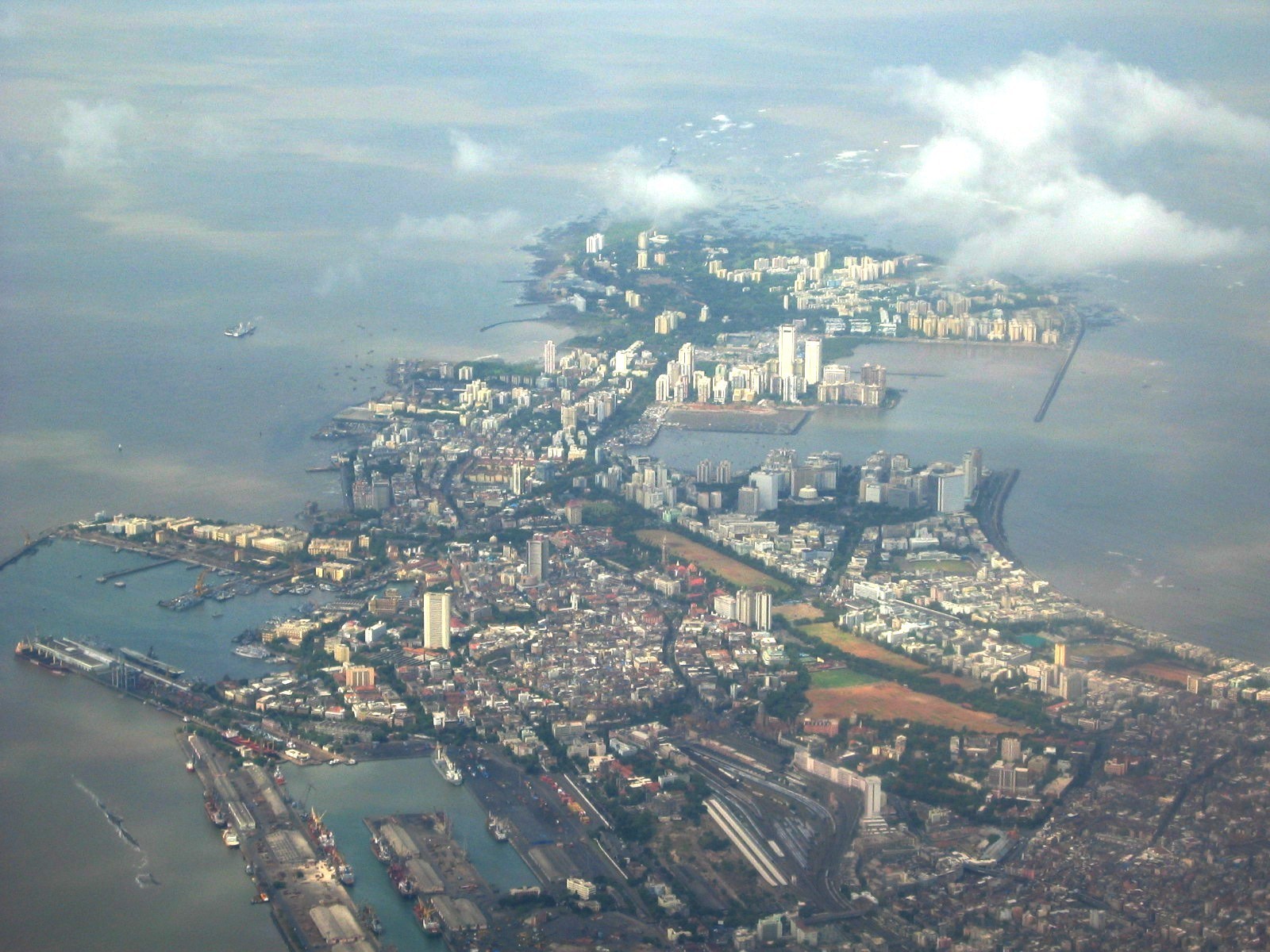
“The most unfortunate and vulgar change of all is “Mumbai,” but almost no one knows or cares about how that change happened. It was once generally accepted that Bombay comes from the Portuguese “bom bahim,” or good little harbour, just north as it is from Portugal’s long-time colony of Goa. But even if that etymology is bogus, it was under the name Bombay that it flourished and grew under the British into the most important and cosmopolitan city in South Asia.
Bombay
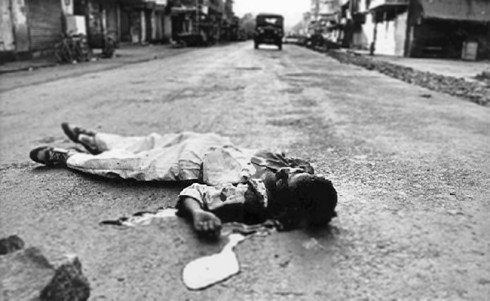
“But in 1995, the Shiv Sena party (the Army of Shiva…) won control of the state government of Maharashtra, of which Bombay is a part, though it’s so different in social and ethnic make-up from the rest of that state that it deserves a separate federal district type status like Delhi has, or Mexico City, or D.C. Shiv Sena, being a party whose power base is rural Maharashtra and poor migrant Marathis who feel they deserve more power in the city, is actively hostile to Bombay’s dizzying diversity and especially its large Muslim population. It’s essentially a Marathi branch of the BJP, only worse (and they haven’t been getting along lately): a virulently Hindutva bunch that have not only been found to be involved in Bombay’s drug, prostitution and extortion circles, but ordered and even carried out much of the more vicious anti-Muslim attacks during the Bombay riots of 1992-93: the kerosene-dousing and burning of individuals and the burning tire around the victims’s neck were a couple of their trademarks.
“When, despite all that, Shiv Sena were voted into state office in Maharashtra, their response to the poverty, massive infrastructural challenges, crime and destitution of this barely manageable city of more than twenty million was to change its name to Mumbai. This was based on the supposed fact that there was (or is, or if there hadn’t been, I’m sure there now is) a temple of a Marathi goddess of that name on the site before the colonial city rose up, which may or may not be true, but, given the fact that every square yard of India contains at least one shrine or temple to someone or something, doesn’t mean very much.
“And yet the whole world fell in line. Thinking that, like Myanmar, if it’s coming from there it must have some sort of indigenous, authentic root, filled with post-colonial guilt and worried about offending what we thought were Indian sensibilities, we all dutifully started calling it Mumbai. Fearing that using the old name would immediately make others imagine us to be jodhpur-clad gin-swillers, we let a bunch of criminal thugs and violent nationalists change the name Bombay — the name by which this great, open-to-the-sea-and-the-world, mercantile, diverse, cosmopolitan, sexy metropolis, a microcosm of India itself and its modern face to the world, was known for almost three centuries – and nobody asked why or breathed a word of resistance.
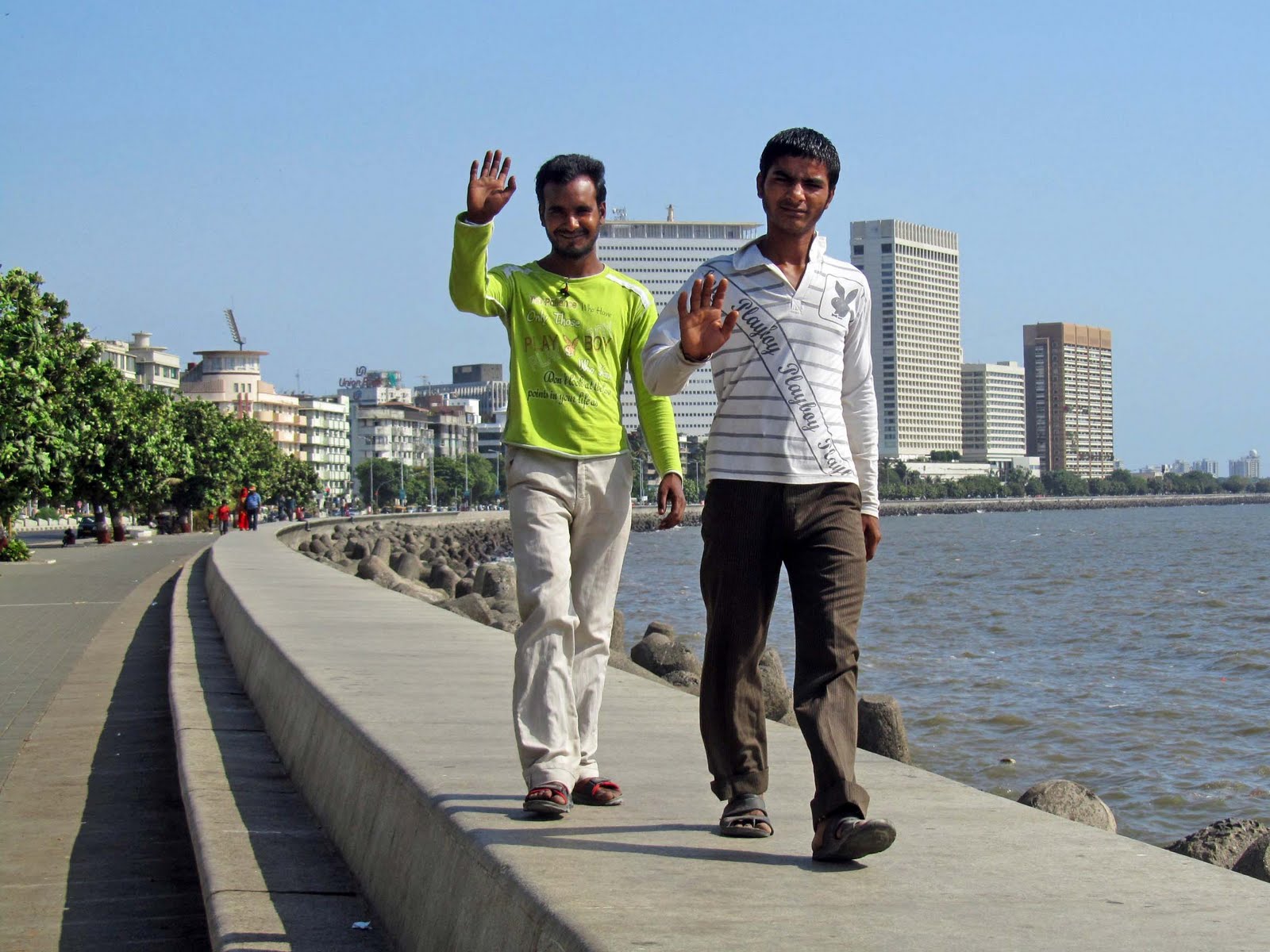
Bombay — Marine Drive — Queen’s Necklace
“So as for C-town, you choose which is more “nationalist.” Calling the city the name by which it was known to most of humanity for more than sixteen centuries? Calling it an also venerable name that the nationalist, anti-cosmopolitan, Turkification project of a military dictatorship whose attitude to the City, its legacy, history and population was actually hostile for much of the time decided the world should call it? Or just calling it both?
Or how ‘bout who cares? As long as we know which city we’re talking about.
–
Comment: nikobakos@gmail.com
–
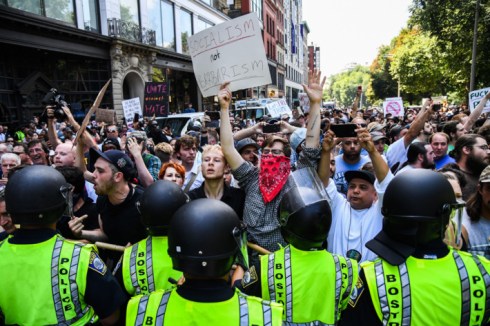 Protesters and police at the Boston Free Speech rally on August 19, 2017. Photo: Salwan Georges/The Washington Post via Getty Images
Boston was always a prickish, self-righteous city. But Sullivan makes a major point. Complete text below.
Here’s a question: At last Saturday’s massive rally against “hate” in Boston, what were 30,000 or so people actually protesting? The event in question was not organized by a neo-Nazi group, the KKK, or any other recognized hate group, but by an outfit called the Boston Free Speech Coalition. Its Facebook page claims they are “a coalition of libertarians, progressives, conservatives, and independents” aiming to “peaceably engage in open dialogue about the threats to, and importance of, free speech and civil liberties.” In the days before, the organizer, 23-year-old John Medlar, had insisted that “contrary to a lot of the rumors out there, the purpose of the rally is to denounce the kind of political violence that we have seen, a sort of rising tide throughout the country and particularly most recently in Charlottesville.” He said his group is small and young. At 23, he says he is the oldest.
If you want to check him out some more, here’s an interview he gave to the radio station WGBH: “I describe myself as a Libertarian, so I’m very much a small government guy. I think that it’s … I’ve also had a very Catholic upbringing, so my parents raised me to put a very strongly … emphasis on personal responsibility and virtues. And I think that you can’t have virtue when, you know, the government is compelling you to do things. I think society is better off when individuals take it upon themselves to build themselves up and to be the best possible people that they can be rather than, you know, that and shirking those responsibilities and leaving it to government bureaucrats who are less efficient at everything.” Not exactly elegant, but you get the drift.
And if you were ever a young libertarian and conservative (that would be me), you’d recognize these people pretty quickly. Young, over-their-heads, self-described free-speech “absolutionists,” [sic] they’ve read a little too much Ayn Rand, and tend toward easy, abstract extremism and a lot of naïvete. And so it doesn’t completely surprise me that their original speaker list did indeed include far-rightists, eager to use their platform: anti-feminist flame-thrower Gavin McInnes; Augustus Invictus, a young eugenicist with a fascist haircut who has apparently engaged in goat sacrifice; Joe Biggs, an Infowars nut behind “Pizzagate”; and one genuine New Zealand white nationalist, Kyle Chapman. But the group had always insisted they were open to far-leftists as well, and openly invited anyone to speak.
One who signed up was Rinaldo Del Gallo, a Bernie Sanders supporter, who is a candidate for the Massachusetts State Senate, and favors, among other things, single-payer health care, GMO labeling, and free college tuition. In the end, he didn’t speak. The police told him he was not on their speaker list and when he demanded to be allowed in, antifa activists surrounded him menacingly, yelling “White trash!” “I thought I was going to be lynched,” he told the Boston Herald. Another, Samson Racioppi, a young congressional candidate, wanted to use the occasion to denounce hate, neo-Nazis, the KKK, et al. He didn’t make it to the podium either because the crowd was too large to get through, he said.
Someone who actually spoke was Deaconess Anne Armstrong of the “Healing Church,” a cannabis-centered religious group which recently petitioned to conduct a service in a chapel at Washington’s Catholic Basilica, as long as it had comfy chairs. (She was seen blowing weed smoke out of a shofar before the event.) Another speaker was an Indian immigrant, Shiva Ayyadurai, who is a Republican candidate running against Elizabeth Warren, and who claims to have invented email. In one photo of his speech, he was surrounded by posters saying “Black Lives DO Matter,” and railing against Monsanto. He says he wants to unite all races against the Establishment.
What about the handful of their supporters? The Daily Beast reported that they were “mostly young men from Massachusetts, in their teens and early 20s, as well as several young men of color, and a few women.” The one thing, it seems, that most of them agreed on was drug legalization. Somehow, I’m not surprised.
What did they say? We still don’t know, and may never know. And that’s what bugs me. The reason is that Boston’s mayor and police department actually banned reporters and members of the public from being close enough to the rally to hear it (and the group couldn’t even afford a sound system). The reason was safety, but it’s hard to believe that a few reporters — let’s say, just one — couldn’t have been allowed close enough to hear the speeches and let us know what was in them. If an event is in a public space, and is advertised as a “free speech” rally, doesn’t the press have a right to access? In an interview, the mayor, Marty Walsh, shrugged: “Why give attention to people spewing hate?” In another: “You can have your free speech all day long, but let’s not speak about hate, bigotry, and racism.” The Boston police commissioner was more explicit: “I’m not going to listen to people who come in here and want to talk about hate. And you know what? If [reporters and others] didn’t get in, that’s a good thing because their message isn’t what we want to hear.” As it was, the scheduled two-hour event lasted less than 50 minutes, none of the far-rightists spoke, and the few speakers were rushed out in vans for their safety.
Who cares who they were, if the point was to denounce the hatred displayed in Charlottesville? Well, I do. I find it creepy that a crowd of 30,000, a city government, and a police force effectively shut down an event that was designed to defend free speech! I find it even creepier that masked members of the violent antifa group, who openly despise free speech, mixed openly and easily with the crowd and delighted in disrupting the event, while hurling rocks and bottles of urine at the police.
Mercifully, a few others have weighed in. WBUR reporter Bruce Gellerman recalled Frederick Douglass’s “Plea for Free Speech,” where Douglass took on Boston’s mayor and police department for suppressing an abolitionist rally. There is a right to speak, Douglass said, but “equally clear is the right to hear.” Veteran free-speech advocate Harvey Silverglate also wrote a stirring piece: “Boston shortchanged itself and the nation last weekend when, in effect, it gamed the First Amendment.”
As Boston, an allegedly liberal city, undoubtedly did. It seems to me that the acid test of whether a “free speech” rally is just a cover for white supremacists is whether it truly upholds free speech (which means inviting a spectrum of opinion, including the far right and the far left), whether it invites people of many races, whether it denounces violence, and whether it invites dialogue and engagement. This one did all of the above — and the organizers were deemed Nazis for it.
This is what happens when a society is at war with itself. Nothing matters but which side you’re on. And for a week, the Boston free-speech activists were on the “wrong” side and suffered the consequences. They do, I suppose, have one consolation. If their intent was to prove how parts of the left and Boston’s mayor and police department now oppose freedom of speech if they disagree with it, well, they succeeded beyond their wildest imagination.
A simple posting on the web broke my already broken heart this week. It was by Freddie deBoer, one of the heroes of the old blogosphere, and one of those old-school lefties who is prepared, at times, to take on his fellow socialists. He’s also a beautiful writer and a brilliant thinker. Money quote: “Shortly I will be headed to the Richmond University Medical Center to pursue intensive treatment for my mental illness. My day-to-day existence has become entirely unmanageable, and I fear for my health and safety … It is clear that I can never return to my old ways of engaging online, and I must leave semi-public life permanently, among many other changes. All I want is to build a quiet and simple existence where I can live and work privately without hurting myself or others.” And then, as so often with Freddie, the shocking honesty: “I would give everything I own to be anyone other than who I am. Goodbye and thank you for everything.”
Freddie is someone I barely know in physical space, but feel intensely close to. In the years of hourly blogging, he was one of a handful of people I always tried to read and who guest-blogged for me on my vacations. I happily gave space to someone whose views are very different than mine because they were so sincerely held, so clearly expressed, and he was capable of challenging his own side. There was something of Orwell in him. But I also discovered in those years what he found out: that living online is deeply dangerous to mental and physical health, that the pressures of the online crowd can overwhelm individual thought, and, in the end, thought itself. Twitter is not a place to air diverse viewpoints; it is a desiccating swarm of like-mindedness, moving as a single mutating mass, shimmering with every minuscule ripple in the news cycle, destroying all perspective, undermining learning, destroying the very process of reading, and deeply corrosive of a liberal society. If you are in the middle of the online stream, as I was for a decade and a half, and you are intelligent and attempt to be conscientious and honest, the emotional toll will be crushing. If, like Freddie, you are already bipolar, it is a deeply unsafe space.
Freddie saw this very clearly only a week ago, explaining why he had drastically culled his online content: “I wanted to look past what we once called ideology: I wanted to see the ways in which my internet-mediated intellectual life was dominated by assumptions that did not recognize themselves as assumptions, to understand how the perspective that did not understand itself to be a perspective had distorted my vision of the world. I wanted to better see the water in which my school of fish swims.” So he tried to find a new perspective, but still failed. He realized what I once saw. You cannot edit this stream. It edits you in the end. This is self-knowledge: “[T]he fact that so many people like me write the professional internet, the fact that the creators of the idioms and attitudes of our newsmedia and cultural industry almost universally come from a very thin slice of the American populace, is genuinely dangerous.”
It is — and getting more so. I just want to say this to my friend: You have checked yourself in not because you are insane, but because you tried to retain your sanity. It is America that is going nuts; and the internet is one reason why.
The art of the public apology is one few have mastered — although there are many public-relations pros who can tell you how to do it. I suspect it’s become even rarer these days because true contrition has as well. In our president, we see a man who has contempt for any idea of self-reckoning, and I worry that this will make things even worse. (Everything this man touches, including this country, he befouls.)
And then you stumble across a little story and regain a little hope. I refer to the column a Catholic priest just wrote, prompted by the Charlottesville horror. It speaks for itself: “What most people do not know about me is that as an impressionable young man, I was a member of the Ku Klux Klan. It’s public information but it rarely comes up. My actions were despicable. When I think back on burning crosses, a threatening letter, and so on, I feel as though I am speaking of somebody else. It’s hard to believe that was me.” But it was. “The images from Charlottesville are embarrassing. They embarrass us as a country, but for those who have repented from a damaging and destructive past, the images should bring us to our knees in prayer.”
What he sees is something easy to forget: Those marchers were not merely propagating evil, they are also its victims. Believing that human beings are somehow inferior or superior because of their innate characteristics is not only to believe a lie; it is to live in a prison. It is putting you and others into a false category from which none of us can escape. To see nothing in one’s own body and soul but whiteness or blackness dehumanizes the self and others. Those marchers, like the president who excused them, are not just hateful; they are also miserable. Sometimes I think we see transcending racism as a delusion, and perhaps it often is. I share the view held by the civil-rights movement in its heyday that transcending it is only possible through a greater power than ourselves; and that its essential characteristic is liberation. It is a pathway to being fully human.
The priest, by the way, is not merely writing beautiful words. In a note appended to the article, the Diocese writes: “Father William Aitcheson’s article was written with the intention of telling his story of transformation. He voluntarily asked to temporarily step away from public ministry, for the well being of the Church and parish community, and the request was approved.”
See you next Friday.


 Jadde: from Bosnia to Bengal