
Image

Happy New Year

18 Feb

Chinese-New-Year-fireworks-fountain-Fox-Z(click)

From the Guardian: “Pablo Iglesias: If the Greek olive branch is rejected, Europe may fall.”

15 Feb

The new despots who are trying to persuade us that Europe’s problem is Greece are putting the European project itself at risk

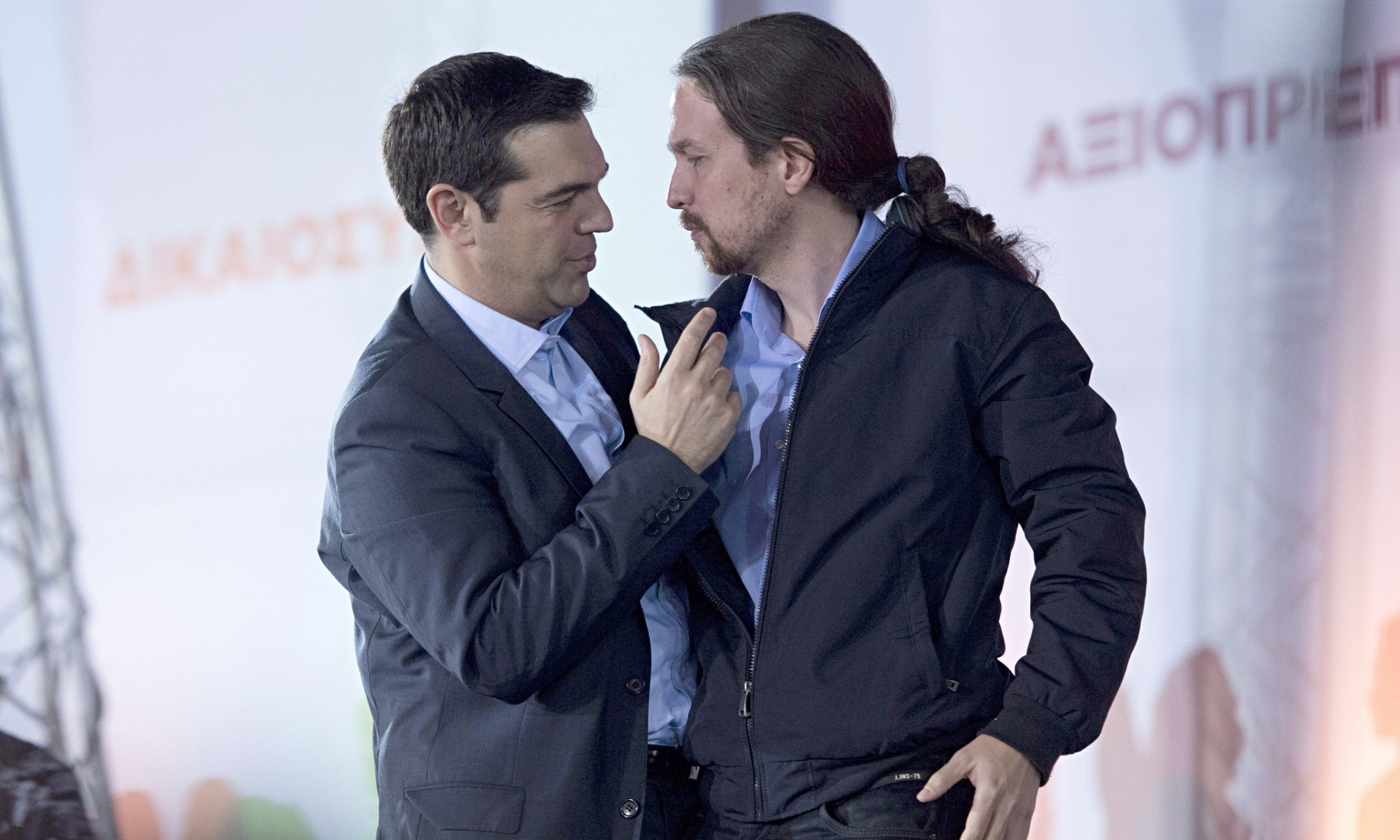
Alexis-Tsipras-and-Pablo--009Alexis Tsipras of Greece, left, and Pablo Iglesias, author of this piece. ‘The diktats of those who still appear to be running things in Europe have failed. And the victims of this inefficiency and irresponsibility are Europe’s citizens.’ Photograph: Luigi Mistrulli/Sipa/Rex  (click)

“During his swearing-in speech as Greece’s prime minister, Alexis Tsipras was clear: “Our aim is to achieve a solution that is mutually beneficial for both Greece and our partners. Greece wants to pay its debt.”

“The European Central Bank’s (ECB) response to the Greek government’s desire to be conciliatory and responsible, was also very clear: negative. Either the Greek government abandons the programme on which it was elected, and continues to do the very thing that has been disastrous for Greece, or the ECB will stop supporting Greek debt.

“The ECB’s calculation is not only arrogant, it is incoherent. The same central bank that recognised its mistakes a few weeks ago and began to buy government debt is now denying financing to the very states that have been arguing for years that the role of a central bank should be to back up governments in protecting their citizens rather than to rescue the financial bodies that caused the crisis.

“Now, instead of acknowledging that Greece deserves at least the same treatment as any other EU member state, the ECB has decided to shoot the messenger. Excesses of arrogance and political short-sightedness cost dear. The new despots who are trying to persuade us that Europe’s problem is Greece are putting the European project itself at risk.

“Europe’s problem is not that the Greeks voted for a different option from the one that led them to disaster; that is simply democratic normality. Europe’s threefold problem is inequality, unemployment and debt – and this is neither new nor exclusively Greek.

“Nobody can deny that austerity has not solved this problem, but rather has exacerbated the crisis. Let’s spell it out: the diktats of those who still appear to be running things in Europe have failed, and the victims of this inefficiency and irresponsibility are Europe’s citizens.

“It is for this precise reason that trust in the old political elites has collapsed; it is why Syriza won in Greece and why Podemos – the party I lead – can win in Spain. But not all the alternatives to these failed policies are as committed as Syriza and Podemos are to Europe and to European democracy and values.

“The Greeks have been pushed to the point of disaster, yet the Greek government has reached out and shown great willingness to cooperate. It has requested a bridge agreement that would give both sides until June to deal with what is little short of a national emergency for the majority of the Greek population.

“It has proposed linking repayment of the debt to growth (the only real way of paying creditors and of guaranteeing their rights), and has indicated its desire to implement those structural reforms needed to strengthen an impoverished state left too long in the hands of corrupt elites.

“Greece has accepted a primary surplus (1.5% of GDP instead of the 3% that the troika had demanded) to give a minimum margin for dealing with the social consequences of the crisis and to devote, if necessary, a portion of the profits made by central banks after buying Greek bonds.

“This means, pure and simple, making sure the European money destined to help Greece is in fact aid for citizens and for the economy, and not a way of rewarding the banks and slowing down recovery. However, faced with the statesmanlike moderation of a government that would have every reason to be more drastic, the ECB and the German chancellor, Angela Merkel, respond with a dogmatic arrogance that sits ill with European values. The question is: who will pay for their arrogance? The most short-sighted cynics perhaps think that this is the Greek government’s problem and it does not affect the rest of the European family.

“Yet we need only look at what has happened to the Greek socialist movement Pasok; the formerly mighty German SPD, which is now utterly subordinate to Merkel; the ideological collapse of the French Socialist party, heading for historic humiliation at the hands of Marine Le Pen; and at the socialists in Spain, who are so desperate they would prefer the right to win the coming election rather than Podemos.

“Austerity has shattered the political space historically occupied by social democracy, so it would be in the interests of these parties to rectify this and support the Greek government.

“It seems that Italy’s Matteo Renzi, despite his lukewarm support, is alone in fully grasping what is at stake in Greece. Or do people perhaps think that if Europe’s leadership refuses to budge in its attitude, then the “normality” of austerity can be restored? It is unwise to put a democratic government between a rock and a hard place. The wind of change that is blowing in Europe could become a storm that speeds up geopolitical changes, with unpredictable consequences.

“The viability of the European project is at stake. Pro-Europeans, especially those in the socialist family, should accept the hand offered by Tsipras and help curb the demands of the pro-austerity lobby. It’s not just their own political survival that is at stake but that of Europe itself.”

Comment: nikobakos@gmail.com

Varoufakis, a dead Greek cosmopolitanism, and a Greece that now has nothing else

8 Feb

bdec44f200d445ceb018834ba071fe73_18(click)

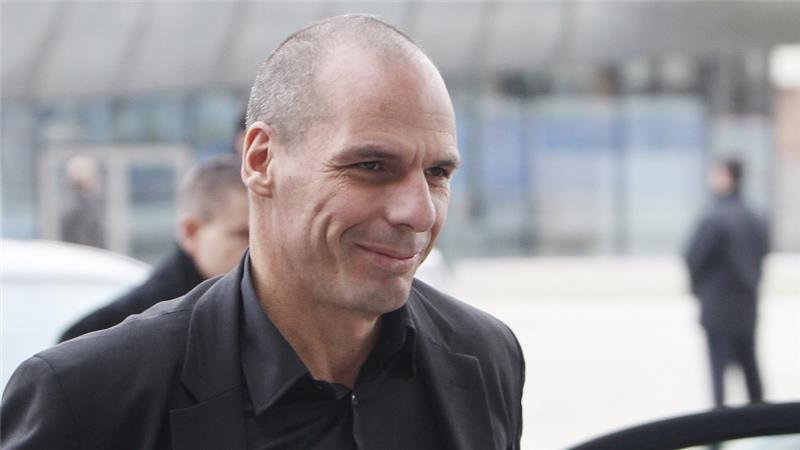
From Al Jazeera by Iason Athanasiadis: The Greek Varometer: The irreverent, shaven-headed, motorbike-riding academic’s arrival is viewed in messianic terms.

I’m posting this for completely tangential reasons.  Because as I’ve said before, I’m not in the least capable of any political economic analyses, and, though I’m instinctively and emotionally happy about SYRIZA‘s victory, I really can’t tell how things are going to turn out.

(This Guardian article paints things as pretty dire, though of course that might just be more bullying and threat masked as “inevitability”: Tsipras favours Greek jobless over creditors in defiant policy speech:

The British chancellor, George Osborne, admitted the UK had already embarked on contingency plans in preparation for a Greek exit from the single currency. “This standoff between Greece and the eurozone is increasing the risks every day,” he told the BBC’s Andrew Marr show on Sunday, adding that Athens’ departure from the bloc would not only send European financial markets into a tailspin, but cause “real ructions” in the UK.

Earlier, Alan Greenspan, the former head of the US Federal Reserve, said it was only a matter of time before the country left the eurozone. He said it was difficult to see why anyone would be willing to lend Greece more money and that without additional loans, the country would be forced to default and leave the euro.

“It’s just a matter of time before everyone recognises that parting is the best strategy,” he told BBC Radio 4’s The World This Weekend. “It is not a decision where they are going to come to an agreement. All the cards are being held by the members of the eurozone.”

Greenspan also conceded that a Greek exit might trigger a meltdown in global financial markets: “I don’t think we have a choice.”)

But that’s not what was most interesting to me in Athansiadis’ article.  What was most interesting — and most gratifying, though it confirms a sad truth about the Greek statelet — is that Athansiadis chooses to portray Varoufakis as a product of a giant Greek Diaspora that the twentieth century, and twentieth-century nationalism, destroyed:

“He [Varoufakis] is also a kind of Greek largely eclipsed from the international stage since the 1960s; polyglot, adventurous, and hailing from a lively and vibrant Greek diaspora before it solidified into small-minded communities nurturing a parochial definition of Hellenism fossilised sometime circa 1950. Varoufakis’ father was born and grew up in Cairo’s fabled Greek community, directs a major Greek metallurgical interest, and maintains an interest in Hellenistic civilisation on the Mediterranean seaboard.”

and

“Varoufakis seems to hail from another Hellenism, the one defeated at the end of the 19th century when politics and circumstance conspired to ensure that the Hellas that entered the 20th century was narrowly defined by national borders, rather than the spread-out Greek-speaking cosmopolitanisms of North Africa, the Levant and Anatolia.

“Always a protectorate of the West, modern Greece was trapped by small-minded nationalisms (including its vendetta with post-Ottoman Turkey), resulting in the homogeneous and small-minded parochialisms from which the Golden Dawn impulse springs today.”

[my bold emphases in all of above]

Yes, thanks, Iasona…  For stating so clearly what the essential thesis of this blog is: that Hellenism was, and is, doomed in many ways since it contracted into an EBSN (ethnicity-based nation-state).  The sad truth is that the economic and cultural loci of the Greek world were always outside the Helladic peninsula (see my: Upon escaping from Greece… from this past September and myriad other posts) from early Classical times until the 1960s.  The modern Greek kingdom/state was always an economic basket-case from its beginnings and dependent on the Greek diaspora for its economic existence and, in fact, its cultural wealth and vibrancy as well.  There has rarely been a time that modern Greece was not teetering on the brink of insolvency or bankruptcy and the credit-backed 80s and 90s were simply smoke-and-mirrors that obscured that reality.

The reality is that Greece itself has nothing.  And never did.  “Φτώχεια, καλή καρδιά”…and mostly γκρίνια…*(1)  Its dying agriculture doesn’t and never did produce anything that its Mediterranean or even Balkan neighbors don’t produce in greater quantity and often better quality.  (Even my mother used to buy Bulgarian feta when I was a kid.**[2])  Its industry was always rudimentary and not particularly competitive — certainly not for export — and has practically disappeared.  If Greece ever had the potential of becoming a regionally important service center economy, like Singapore or Hong Kong or, closer to home, Lebanon before its civil war, that potential has never been realized — except in Cyprus to a certain degree — for a whole panoply of reasons that I think I’m not qualified to get into.  And whereas the great Greek financial magnates and industrialists and merchants of Alexandria and Odessa and Constantinople and Smyrna and Bucharest and Constanța and Iași in the nineteenth century liberally poured their wealth into building the institutions of the new state,***(3) the Greek families that today control our one potentially and traditionally great economic resource, commercial shipping, largely choose to keep their wealth off-shore.

I’m sorry to say that I can’t see what could possibly change this picture.  More tourism?  Neither reforms of the the Troika or the SYRIZA type will change fundamental material realities.  I’m afraid that Hellenism only flourishes when it’s part of a larger regional political economic network and I’m not sure that Europe is that network.  But then who?  A Turkey we always choose to respond to with hostility****(4) — to which it obligingly reciprocates?  Or the Balkans, which we denigrate, while Turkey is busy building commercial and economic and cultural ties with Balkan Muslims in Bosnia and Kosovo?*****(5)  Or the total basket-case countries of the Arab world?  Or Russia in its current pariah-state condition?

And yet those were the parts of the world where the most dynamic communities of Greeks always existed.  Modern nationalism destroyed them.  And not just Greek nationalism, of course.  But Turkish and Egyptian nationalism and that of everyone else in the region.  Every one in their own box.

I’m just afraid that that contraction cost us more than it did anyone else. 

And I don’t see how it can be reversed.

Med19304(click)

**************************************************************************************************************************************************************************

*(1) The lyrics from a famous Xarkakos song: “Poverty, a good heart, and lots of kvetching…”  Here’s the great Bithikotses’ recording of it.

**(2) And being from a village and region with a largely pastoral economy, she knew her feta; but the Bulgarian product tasted more like the hard, fattier, well-brined cheese she was used to, as compared to the cream-cheese mush Greece used to export in those days.  Granted, the quality has improved greatly since then.  As has that of Greek wines.  Especially the whites.  Build an economy on that.

At some point in the late nineteenth century, the economy of the Greek kingdom was deeply dependent on one thing: black (often called “Zante”) currants.  Forget Cuba and sugar or the Gulf states and oil.  This was a mono-crop dependency that rested wholly on prayers that Brits would continue to use copious amounts of these currants in their plum puddings at Christmas and not find another source for them.  When they did, or when demand for them stopped for whatever reason, the Greek economy collapsed.

***(3) One of the most obnoxious traits of the Neo-Greek middle-class is their denigrating, mocking, condescending attitude toward what constitutes the Diaspora of today, mainly Greek-Americans and Greek-Australians.  The dynamics of cultural assimilation in both countries and in the modern world generally will assure that New York or Melbourne will never become a Greek Constantinople or Alexandria, of course.  But that Neo-Greeks choose to look at their compatriots that left the country in the twentieth century, not as tragic victims of the country’s material limitations and war-time chaos, nor as an incredibly dynamic and enterprising group of Greeks who left for foreign shores and “spun gold out of thin air” there, in Patrick Leigh Fermor‘s famous words, but as rubes and hicks to be made fun of, while they sat home on their asses waiting for a growing welfare state to feed them, is just one of the most infuriating manifestations of Neo-Greeks’ blinkered worldview.  Snobs in a way that only the truly provincial can be — which I always say.  Much more to say about that.

****(4) Of course, there is the phenomenon of the so-called “Neo-Polites,” the considerable number of young Greeks who, for economic, or intellectual, or historic, or cultural, or sentimental reasons, have recently started to migrate “back” to İstanbul — though the extent to which we can call this a reconstituting of Constantinopolitan Greek life is pretty questionable.  It’s much more likely that a Roman life of sorts in İstanbul will ultimately be given a new lease by the Syrian Christians who have moved to the City in large numbers in the past decades.  Also much more to say about all that.

*****(5) Now, many Greeks in Albania, who are strikingly uninterested in Greece, have started to extend commercial and manufacturing networks into the rest of the country from the small pocket of territory they inhabit in the south; I have close relatives who, out of nothing, have built a phyllo/yufka manufacturing company, based in my father’s village of Derviçani, that sells throughout Albania and is looking how to expand into neighboring countries as well.  How far that will go is also to be seen.

Comment: nikobakos@gmail.com


Krugman: Is the EU just Germany’s debt collector?

6 Feb

From today’s Times:

A Game of Chicken — Paul Krugman

On Wednesday, the European Central Bank announced that it would no longer accept Greek government debt as collateral for loans. This move, it turns out, was more symbolic than substantive. Still, the moment of truth is clearly approaching.

And it’s a moment of truth not just for Greece, but for the whole of Europe — and, in particular, for the central bank, which may soon have to decide whom it really works for.

Basically, the current situation may be summarized with the following dialogue:

Germany to Greece: Nice banking system you got there. Be a shame if something were to happen to it.

Greece to Germany: Oh, yeah? Well, we’d hate to see your nice, shiny European Union get all banged up.

Or if you want the stuffier version, Germany is demanding that Greece keep trying to pay its debts in full by imposing incredibly harsh austerity. The implied threat if Greece refuses is that the central bank will cut off the support it gives to Greek banks, which is what Wednesday’s move sounded like but wasn’t. And that would wreak havoc with Greece’s already terrible economy.

Yet pulling the plug on Greece would pose enormous risks, not just to Europe’s economy, but to the whole European project, the 60-year effort to build peace and democracy through shared prosperity. A Greek banking collapse would probably lead Greece to leave the euro and establish its own currency — and if even one country were to abandon the euro, investors would be put on notice that Europe’s grand currency design is reversible.

Beyond that, chaos in Greece could fuel the sinister political forces that have been gaining influence as Europe’s Second Great Depression goes on and on. After a tense meeting with his German counterpart, the new Greek finance minister didn’t hesitate to play the 1930s card. “Nazism,” he declared, “is raising its ugly head in Greece” — a reference to Golden Dawn, the not-so-neo-Nazi party that is now the third largest in the Greek legislature.

What we’re looking at here is, in short, a very dangerous confrontation. This isn’t diplomacy as usual; this is a game of chicken, of two trucks loaded with dynamite barreling toward each other on a narrow mountain road, with neither willing to turn aside. And all of this is taking place within the European Union, which is supposed to be — indeed, has been, until now — an institution that promotes productive cooperation.

How did Europe get to this point? And what’s the end game?

Like all too many crises, the new Greek crisis stems, ultimately, from political pandering. It’s the kind of thing that happens when politicians tell voters what they want to hear, make promises that can’t be fulfilled, and then can’t bring themselves to face reality and make the hard choices they’ve been pretending can be avoided.

I am, of course, talking about Angela Merkel, the German chancellor, and her colleagues.

It’s true that Greece got itself into trouble through irresponsible borrowing (although this irresponsible borrowing wouldn’t have been possible without equally irresponsible lending). And Greece has paid a terrible price for that irresponsibility. Looking forward, however, how much more can Greece take? Clearly, it can’t pay the debt in full; that’s obvious to anyone who has done the math.

Unfortunately, German politicians have never explained the math to their constituents. Instead, they’ve taken the lazy path: moralizing about the irresponsibility of borrowers, declaring that debts must and will be paid in full, playing into stereotypes about shiftless southern Europeans. And now that the Greek electorate has finally declared that it can take no more, German officials just keep repeating the same old lines.

Maybe the Germans imagine that they can replay the events of 2010, when the central bank coerced Ireland into accepting an austerity program by threatening to cut off its banking system. But that’s unlikely to work against a government that has seen the damage wrought by austerity, and was elected on a promise to reverse that damage.

Furthermore, there’s still reason to hope that the European Central Bank will refuse to play along.

On Wednesday, the central bank made an announcement that sounded like severe punishment for Greece, but wasn’t, because it left the really important channel of support for Greek banks (Emergency Liquidity Assistance — don’t ask) in place. So it was more of a wake-up call than anything else, and arguably it was as much a wake-up call for Germany as it was for Greece.

And what if the Germans don’t wake up? In that case we can hope that the central bank takes a stand and declares that its proper role is to do all it can to safeguard Europe’s economy and democratic institutions — not to act as Germany’s debt collector. As I said, we’re rapidly approaching a moment of truth.

Australian Open 2015

1 Feb


Screen Shot 2015-02-01 at 6.01.59 PM(click)

Filip Singer/European Pressphoto Agency

Spanish press on Greece: El Pais: “The Son of the Grand Recession”; Cinco Dias: “The End of the Merkel Strategy”

30 Jan

EL PAÍS

El hijo político de la Gran Recesión

Alexis Tsipras tendrá que demostrar si es un síntoma o el remedio de la crisis


El político griego Alexis Tsipras. / sciammarelli

Alexis Tsipras, de 40 años, licenciado en ingeniería por la Universidad de Atenas y sin ninguna experiencia de gobierno, está a 24 horas de convertirse en el primer líder de la izquierda radical que alcanza el poder en un país de la Unión Europea. La victoria de su partido, Syriza, en las elecciones, algo que todas las encuestas aseguran desde hace meses, no solo jubilará el sistema político que ha gobernado Grecia desde hace 40 años sino que reverberará en toda Europa como una advertencia política insoslayable sobre el desprestigio de las elites y los estragos sociales causados por unas medidas de austeridad convertidas en dogma. Pero, a partir de este lunes, Tsipras, hijo mediterráneo de la Gran Recesión que azota su país desde hace un lustro, tendrá que demostrar si es un síntoma de la crisis griega o su remedio.

El nuevo héroe de la izquierda alternativa continental empezó su carrera política siendo adolescente en las juventudes del Partido Comunista griego (KKE), de obediencia soviética más allá de la desaparición de la URSS, que abandonó para unirse a Synaspismós, una coalición de movimientos de izquierdas y ecologistas, de la que acabó siendo elegido presidente en 2008.

Dos años antes, Tsipras había sido su candidato a la alcaldía de Atenas y, contra todos los pronósticos, alcanzó el 10,5 % de los sufragios, impulsado sobre todo por el voto de los jóvenes. Más tarde vendría la fundación de Syriza (Coalición de la Izquierda radical), de la que su antiguo partido es el grupo más fuerte, y un ascenso electoral meteórico en tres años —del 5 % que rebañó en 2009 al 27 % que consiguió en junio de 2012— que ha corrido en paralelo con una crisis que precipitaba día a día a Grecia en el infierno de los Estados fallidos.

Tsipras supo interpretar mejor que el resto de la clase política el estado de ánimo de la sociedad griega, harta de un país dominado por la corrupción, el clientelismo y el inmutable poder de las grandes familias y supo también decir lo que la gente quería oír. Telegénico, buen orador y mejor táctico, aprovechó el colapso de las clases medias representadas hasta entonces por el centro izquierda del Pasok y se benefició de la fractura del sistema de partidos entre los defensores de las medidas de austeridad impuestas por la troika (UE, BCE y FMI) como un mal necesario o sus acérrimos detractores, de los que acabó erigiéndose líder indiscutible.

Sus palabras contra la “humillación” que infligía Bruselas a Grecia por orden de la canciller alemana Angela Merkel y sus denuncias de la complicidad de las clases dirigentes nacionales en los males de su país, así como sus llamamientos a la recuperación de la esperanza y la dignidad han caído como un bálsamo, más aún, un tonificante, para un pueblo psicológicamente con la autoestima por los suelos. Los griegos, que han visto como el PIB de su país se reducía una cuarta parte en los últimos cinco años y el desempleo se elevaba hasta el 25 %, llegaban al límite de su resistencia y Tsipras era el único que gritaba. ¡Basta!

Un tipo ambicioso, narcisista y con rudimentarios conocimientos de economía, según sus críticos, o una figura carismática, inteligente y flexible, de acuerdo con sus partidarios, Tsipras, convertido desde hace dos años en el líder de la oposición en su país, ha sabido hasta ahora revertir en su favor los ataques recibidos tanto internacionales como nacionales.

Narcisista y con rudimentarios conocimientos de economía para sus críticos; inteligente y flexible, según sus partidarios

El desaire de Angela Merkel de no recibirlo cuando él le solicitó una entrevista en junio de 2012 u opiniones como la expresada por Jean-Claude Juncker, actual presidente de la Comisión Europea, un mes antes, negándole conocer los problemas de Grecia o ser el hombre adecuado para su país, así como la campaña del miedo lanzada por su principal rival, Andonis Samarás, el líder de Nueva Democracia (centro derecha), acusándole de falsedades como el ser partidario de que Grecia abandonase el euro o de querer retirar los iconos de las iglesias no han hecho más que reforzarlo.

Nacido en Atenas pocos días después de la caída de la Dictadura de los Coroneles en 1974, hijo de un ingeniero de clase media y educado en el sistema público de enseñanza, ha aprendido inglés muy recientemente y vive en un apartamento alquilado en un modesto barrio de la capital griega con Peristera Baziana, su novia de toda la vida a la que llama Betty y con la que tiene dos hijos pequeños. Su único lujo, una moto BMW de gran cilindrada.

Pero uno de los signos de su imagen —no se le ha visto nunca con corbata— puede tener los días contados. En las últimas semanas, a medida que el poder parecía poder tocarse con la mano, Tsipras ha ido moderando sus mensajes y modulando sus gestos. Partidario de la separación de la Iglesia y el Estado en un país donde representantes de la jerarquía de la iglesia ortodoxa presiden los principales actos políticos o había que declarar la fe religiosa en el carné de identidad hasta no hace mucho tiempo, el líder izquierdista sorprendió a propios y extraños el pasado 6 de enero participando en una ceremonia de la Epifanía en el puerto de El Pireo con Jerónimo, el arzobispo de Atenas. También ha declarado que su héroe es Franklin D. Roosevelt por su manejo de la crisis del 29 y ha eliminado un retrato del Che Guevara de su oficina.

Menos anecdótico es el cambio de tono en asuntos europeos y económicos. Su intención es “cambiar Europa, no desmantelarla”, renegociar la deuda con los acreedores internacionales con objeto de aliviar la carga de los ciudadanos y que Grecia deje de ser un “protectorado de Berlín” y vuelva a ser un país normal. También está en evisión su plan económico, el llamado Programa de Salónica, que contemplaba una generosa expansión del gasto público. Habrá que esperar unos meses para saber si Alexis Tsipras es la solución o parte del problema de la crisis de Grecia y de Europa.

Días críticos para la zona euro

El principio del fin de la estrategia de Merkel

La canciller alemana, Angela Merkel.

(EFE)

Las señales se suceden y son cada vez más inequívocas. La zona euro se aleja a pasos apresurados de la estrategia seguida durante cinco años para combatir la crisis, una estrategia dictada en gran parte por Berlín y que muchos socios han seguido solo a regañadientes. Incluso la canciller alemana, Angela Merkel, parece consciente de que su fórmula se ha agotado y ha empezado a cambiar el rumbo.

El giro de Merkel, como casi siempre con la canciller, es aparentemente imperceptible hasta que se consuma y se comprueba que ha sido de 180 grados. La victoria en Grecia de Syriza, un partido que gracias a su oposición a la troika ha pasado de 313.000 votos en 2009 a rozar este domingo la mayoría absoluta con más de dos millones de votos, parece la puntilla a los dictados habituales de Berlín. Merkel acepta ya o se resigna a que la zona euro siga otro tratamiento, aunque solo sea para evitar una crisis política tan peligrosa o más como la financiera.

Fuentes europeas subrayan la resignación con que Merkel ha aceptado el plan de compra de deuda aprobado el jueves pasado del BCE, a pesar de que es conocida la abierta oposición de Berlín. El silencio de Merkel, señalan esas fuentes, ha evitado un peligroso choque con Mario Draghi, presidente del BCE.

Berlín tampoco ha boicoteado el plan de inversión lanzado por el nuevo presidente de la Comisión Europea, Jean-Claude Juncker, una gota de 300.000 millones de euros pero que aspira a romper con una política que ha sido restrictiva incluso en los países con margen presupuestario. Juncker también ha logrado sacar adelante una tímida reinterpretación del Pacto de Estabilidad que no varía los fundamentos de esa norma, pero que pretende conceder a Bruselas algo más de margen en la evaluación del déficit excesivo de los socios del euro.

El silencio de Merkel también ha resonado durante la campaña electoral en Grecia. En 2012, la ofensiva de Berlín, con amenazas de expulsión del euro incluidas, logró evitar la victoria de Syriza en Grecia y propició la formación de un gobierno de coalición entre populares y socialistas presidido por Samaras. En 2015, Alemania no ha intervenido, salvo alguna filtración inoportuna al parecer más ligada al ministerio de Finanzas que a la cancillería.

La prueba de fuego de la nueva actitud de Merkel llegará con la renegociación del rescate de Grecia y con la ampliación (o no) de los plazos para que Francia reduzca su déficit por debajo del 3% (ahora dispone hasta finales de este año).

En Bruselas, algunas fuentes dudan de la conversión de Merkel. Pero incluso si se confirma conviene no minusvalorar la capacidad de la canciller para sembrar dudas sobre el futuro de la zona euro. La semana pasada, por imposición de Berlín, el BCE tuvo que añadir una letra pequeña a su plan de compra de deuda que deja claro al inversor que Alemania quiere cuentas separadas por si se rompiera la moneda única. Los mercados han preferido ignorar esa diabólica semilla plantada por Merkel. Pero podría brotar con fuerza si vuelve la inestabilidad.

Comment: nikobakos@gmail.com

“Greece’s Agonized Cry to Europe” & “Ending Greece’s Nightmare” — TIMES editorial and Krugman: “The troika … was peddling an economic fantasy.”

27 Jan

Zappeion5d36c634-e1c9-4a23-aba2-ff07e45afbd5-2060x1236Photograph: MARKO DJURICA/REUTERS (double-click)

Here’s The Times, Greece’s Agonized Cry to Europe:

The message from Sunday’s elections in Greece was unambiguous: The Greeks cannot and will not continue to abide by the austerity regime that has brought their economy to its knees. It was a message the Germans and other Europeans who continue to insist that Greece pay off its mountainous debt, no matter what the damage, must hear. Persisting on their dogmatic course is not only wrong for Greece but dangerous for the entire European Union.

It is too soon to anticipate how Alexis Tsipras, the maverick politician whose left-wing Syriza party won 36.3 percent of the popular vote and nearly gained an outright majority in Parliament, intends to deliver on the promises he made to voters to abandon the austerity program while reducing the nation’s debt and retaining the euro.

These goals are fundamentally incompatible, but the new prime minister has signaled to Europeans that he is ready to moderate his ambitions once in office. It is essential that Chancellor Angela Merkel of Germany, who is seen by Greeks as the prime architect of the austerity program, and the “troika” of the European Commission, the European Central Bank and the International Monetary Fund, which manage the Greek bailout, demonstrate a similar readiness to ease the size and conditions of Greece’s debt burden.

And my man Krugman, Ending Greece’s Nightmare” (my emphases all through):

To understand the political earthquake in Greece, it helps to look at Greece’s May 2010 “standby arrangement” with the International Monetary Fund, under which the so-called troika — the I.M.F., the European Central Bank and the European Commission — extended loans to the country in return for a combination of austerity and reform. It’s a remarkable document, in the worst way. The troika, while pretending to be hardheaded and realistic, was peddling an economic fantasy. And the Greek people have been paying the price for those elite delusions.

You see, the economic projections that accompanied the standby arrangement assumed that Greece could impose harsh austerity with little effect on growth and employment. Greece was already in recession when the deal was reached, but the projections assumed that this downturn would end soon — that there would be only a small contraction in 2011, and that by 2012 Greece would be recovering. Unemployment, the projections conceded, would rise substantially, from 9.4 percent in 2009 to almost 15 percent in 2012, but would then begin coming down fairly quickly.

What actually transpired was an economic and human nightmare. Far from ending in 2011, the Greek recession gathered momentum. Greece didn’t hit the bottom until 2014, and by that point it had experienced a full-fledged depression, with overall unemployment rising to 28 percent and youth unemployment rising to almost 60 percent. And the recovery now underway, such as it is, is barely visible, offering no prospect of returning to precrisis living standards for the foreseeable future.

What went wrong? I fairly often encounter assertions to the effect that Greece didn’t carry through on its promises, that it failed to deliver the promised spending cuts. Nothing could be further from the truth. In reality, Greece imposed savage cuts in public services, wages of government workers and social benefits. Thanks to repeated further waves of austerity, public spending was cut much more than the original program envisaged, and it’s currently about 20 percent lower than it was in 2010.

Yet Greek debt troubles are if anything worse than before the program started. One reason is that the economic plunge has reduced revenues: The Greek government is collecting a substantially higher share of G.D.P. in taxes than it used to, but G.D.P. has fallen so quickly that the overall tax take is down. Furthermore, the plunge in G.D.P. has caused a key fiscal indicator, the ratio of debt to G.D.P., to keep rising even though debt growth has slowed and Greece received some modest debt relief in 2012.

Why were the original projections so wildly overoptimistic? As I said, because supposedly hardheaded officials were in reality engaged in fantasy economics. Both the European Commission and the European Central Bank decided to believe in the confidence fairy — that is, to claim that the direct job-destroying effects of spending cuts would be more than made up for by a surge in private-sector optimism. The I.M.F. was more cautious, but it nonetheless grossly underestimated the damage austerity would do.

And here’s the thing: If the troika had been truly realistic, it would have acknowledged that it was demanding the impossible. Two years after the Greek program began, the I.M.F. looked for historical examples where Greek-type programs, attempts to pay down debt through austerity without major debt relief or inflation, had been successful. It didn’t find any.

So now that Mr. Tsipras has won, and won big, European officials would be well advised to skip the lectures calling on him to act responsibly and to go along with their program. The fact is they have no credibility; the program they imposed on Greece never made sense. It had no chance of working.

chappatte-master675(click)

Comment: nikobakos@gmail.com

Tsipras’ first cool act.

27 Jan

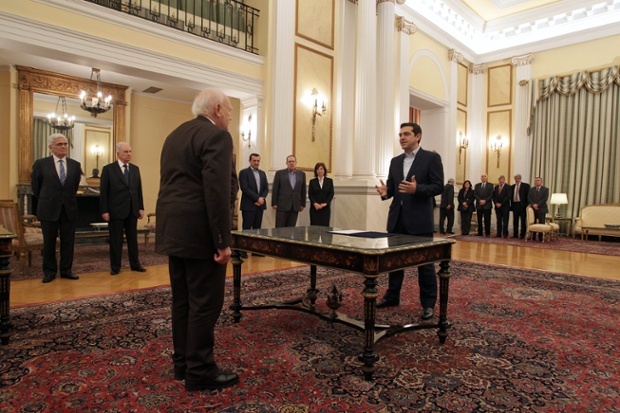
He was sworn-in in a civil ceremony without the Church or any clergy present.  I’m still unsure about this guy — as happy as I am about a SYRIZA victory — but this was a cool and definitive statement.  The Church of Greece needs to know its place — in church.

Tsipras11da7554-d82b-4bc1-a62e-ec2febfd5ced-620x413 Alexis Tsipras is sworn-in. Photograph: Simela Pantzartzi/EPA (click)

GREECE_2290790fPhoto: Alexis Tsipras (r) shakes hands with Greek president Karolos Papoulias during his swearing-in ceremony (Reuters: Yannis Behrakis)

Hands6047626-3x2-940x627Don’t understand the need to form a coalition with a member of a far-right, anti-immigrant party to gain majority in parliament.  Wasn’t there some docile old communist they could’ve taken out of the moth-balls?  But I guess strange bed-fellows is something we have to live with.

Comment: nikobakos@gmail.com

“Χριστός Ανέστη” — Christ Has Risen — and I’m so damn PROUD…

25 Jan

I swear to God those were the first words — the two most totemic in the Greek language — that instinctively leapt out of my mouth when a very loved cousin of mine in Athens answered her mobile today.

Anastasis_fresco_(Chora_Church)The Resurrection fresco in the church of the Chora in Constantinople (click)

I don’t know what will happen.  Tomorrow, me…and Greeks all over the world will wake up sober — or hungover — and have to figure out how this thing is actually going to work.

But one thing all of us need to understand is the power of language and discourse.  By “discourse” I mean the idea and interpretations that people give and ascribe to the phenomena in the world around them; that discourse is “poetic” and a process of “poiesis”— not poetic like Byron or Baudelaire — but poetic in the original Greek sense of “making” or “creating.”  What that means is that DISCOURSE: what people say about things, how people talk about and interpret reality, the opinions and analyses of that reality, are not an either accurate or inaccurate view of that reality but a code and a language that create that reality.  This is simple stuff.  Intro to Deconstruction.  Foucault 101.  And nowhere is it truer than in the “game of chicken” played in the arena of political economics.

So, like I said in GREEK ELECTIONS,” if a critical mass believes a hypothesis is true — or just possible — then it becomes true; then actions and gestures on the ground, and praxeis in the “real,” physical world will create that reality, poetically.  And if we continue to bolster — worse, think we deserve — the Troika’s Neo-Liberal discourse of exploitation, then it will continue.  If we support a discourse, if we believe that an alternative to that reality is possible, then it will emerge.  It only took some workers in a Gdańsk shipyard to say: “I’m not gonna pretend that I believe this shit anymore”; it only took a heroic Gorbachev to say: “This isn’t working”, for the most horrific political economic system that has ever been inflicted on humanity, and that seemed as eternal and as immoveable as Everest, to come crashing down like a house of cards from one day to the next.

This will work, if we let it.  They’ll feed us a language of fear, which if we swallow, will ruin us.  If we simply keep in mind: “That’s what you think — and want us to think — but we won’t,” change will come.

ALSO, we, as ROMANS, should be immensely proud that so many other left-leaning, anti-austerity parties from the rest of the European periphery: Spain, Portugal — and even from Prussia itself and other parts of Merkelstan — came to be part of these elections.  If it gives them only a tiny drop of optimism, if it makes them feel like: “Yes, we can say ‘No!’ too”, it will be a by far greater gift to them than anything else we supposedly gave the West in the past.

YESSSSSSSSSSSS!!!!!!!!!!!!!!!!!!!!

greece_2243418c

Comment: nikobakos@gmail.com


Photo: “Greece…Fuck Yeah!!!”

25 Jan

No further comment from me right now other than what I wrote in GREEK ELECTIONS: “Greek voters may be about to plunge the European Union into a full-fledged economic and political crisis“, which you might want to re-read because I’ve re-edited it some.

Screen Shot 2015-01-25 at 1.39.54 PM

(click)

The Guardian has great updates: 

Comment: nikobakos@gmail.com


-_-(