Balkans, Anatolia, Caucasus, Levant and other Middle East, Iran, Afghanistan, South Asia, occasional forays into southern Italy, Spain or eastern Europe, minorities, the nation-state and nationalism — and whatever other quirks or obsessions lurk inside my head.
Two of the richest regions in northern Italy are heading to the polls to demand greater autonomy from the central government in Rome.
Around 11 million voters in Lombardy and Veneto, nearly a quarter of Italy’s population, are casting their ballots on Sunday in a non-binding referendum approved by the constitutional court.
Voters will decide whether they want their regional governments to claim more control from Rome over tax revenues, immigration and education systems.
A resounding “yes” vote will give the neighbouring regions political leverage in negotiations with Rome.
A turnout of more than 50 percent of the eligible voters is required in Veneto for the referendum to hold. There is no quorum for Lombardy voters.
The two regions account for 30 percent of Italy’s GDP, but many taxpayers in the north resent susbsiding the relatively poor south of Italy.
Italy’s twin referendums come on the back of the vote on independence in Catalonia. Tensions have been high in neighbouring Spain after an overwhelming 90 percent voted in favour of secession.
Al Jazeera’s Hoda Abdel Hamid, reporting from Veneto’s capital, Venice, said: “The Lombardy and Veneto referendums are yet another signal of European separatists movements picking up steam again.”
An approval of the parliament will be required to allow regional autonomy.
Meanwhile, some are also in favour of independence.
“Everyone has the right to decide its own administration,” Franco Tonello, independence campaigner, told Al Jazeera.
“Our culture has been forgotten. Our children are not taught the history of the Republic of Venice but a history that was never ours.”
…released as Head-On in English and Gegen Die Wand in German (“Against the Wall”, which is the direct from-Turkish translation), makes me cry every time I see it.
Why, with all the super, violent emotion that German-Turk Fatih Akin‘s brilliant film packs, is it this one that moves me?
Partly because it’s a time-out from the film’s relentless intensity and melancholy — though the sound-track of this particular scene only underlines a very Turkish sense of melancholy.
Partly because it’s so familiar: how many times did I watch my mother — and now myself — doing exactly what Sibel Kekilli is doing?
Partly it’s because food is and always has been something that Turks and Greeks are able to bond around, and I’m desperately looking for ways to feel positive about Turkey and Turks right now.
But mostly it’s the depiction of the nirvana-like state that shopping and cooking for someone you love puts you in. By the time the rakı gets cloudy in their glasses I’m usually bawling.
“You may have already heard plenty about Call Me By Your Name, the upcoming Luca Guadagnino film. There’s original music by Sufjan Stevens, Oscar buzz, and even some (misplaced) controversy. But you may have missed that this film is not only a queer coming-of-age romance— it’s a Jewish one.
“Call Me By Your Name is based on a 2007 novel of the same name by André Aciman about Elio, a teenager in Italy in the 1980s who falls for Oliver, a young academic who comes to stay with his family over the summer. Both the family and guest are Jews, a minority in a very Catholic country.
“This shared bond is one of the things that brings Elio and Oliver together; Elio is enchanted by how Oliver wears his Jewishness on his sleeve (or literally, on his chest, in the form of a Magen David), and he tries to emulate him, despite the fact that his family describes themselves as “Jews of discretion.” Elio even wears his own Star of David (“My Star of David, his Star of David, our two necks like one, two cut Jewish men joined together from time immemorial,” writes Aciman in the original novel). In the novel, at least, this has a mixed effect for Elio:
Judaism never troubled [Oliver] the way it troubled me, nor was it the subject of an abiding, metaphysical discomfort with himself and the world. It did not even harbor the mystical, unspoken promise of redemptive brotherhood. And perhaps this was why he wasn’t ill at ease with being Jewish and didn’t constantly have to pick at it, the way children pick at scabs they wish would go away. He was okay with being Jewish.
“In the novel, despite his secularity, Elio understands his own sexuality through the lens of Jewishness:
I remembered the scene in the Bible when Jacob asks Rachel for water and on hearing her speak the words that were prophesied for him, throws up his hands to heaven and kisses the ground by the well. Me Jewish, Clean Jewish, Oliver Jewish— we were in a half ghetto, half oasis, in an otherwise cruel and unflinching world where fuddling around strangers suddenly stops, where we misread no one and no one misjudges us, where one person simply knows the other and knows him so thoroughly that to be taken away from such intimacy is galut, the Hebrew word for exile and dispersal. [my emphasis]
“How Aciman writes Jewish characters is reminiscent of his personal essays about Jewishness; he treats the subjects with ambivalence and great poignancy. Aciman was born to a Jewish Egyptian family, living as a tiny minority until the family was forced to leave when the writer was a teenager.
“As far as the film is concerned, much of the cast is Jewish as well. Armie Hammer, of Jewish descent, plays Oliver, and Jewish-American newcomer Timothée Chalamet plays Elio. Elio’s father is played by Michael Stuhlbarg of A Serious Man.
“It’s exciting that an Oscar film for this season is also a Jewish queer one. The movie doesn’t come out in wide release till November, but you can enjoy the decadently Sufjan Stevens-laden trailer in the meantime (see if you can spot the Jewish star necklace)…”
If you haven’t, homework for Jadde readers is Aciman’s first novel, Out of Egypt. It’s one of the best — and earliest — English-language novels of the ‘Destruction-of-eastern-Mediterranean-cosmopolitanism’ genre.
Not reposting this picture to make some sort of historic-cultural point. But just because its eye for the architectural angle and ensemble is sharp and because it’s beautiful.
“An etrog after Sukkos” is an old Yiddish metaphor meaning something or someone useless.
Don’t throw away yours. Greeks make jam or preserves out of the peel. Find a recipe on-line. It’s really delicious with a sharper sheep’s milk cheese like graviera or manchego.
A welcoming sign of the expanding culinary borders of Neo-Greeks are the fruit preserves promoted at cheese counters of upscale supermarkets with suggested fruit-cheese pairings. Perhaps one of the more annoying ticks of Greek gastronomic provincialism, the nausea-inducing response to sweet-savory combos — watch someone enragingly picking the currants out of your carefully prepared dolma — is passing away.
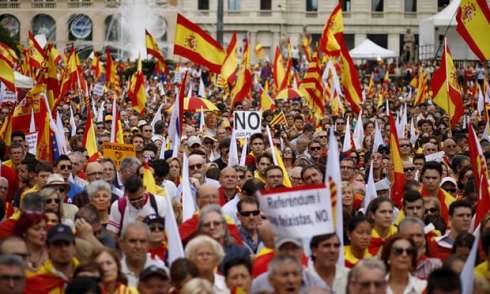
I couldn’t think of a better catch-all phrase for the cocoons identity politics create. See whole article on the bubble created by all-Catalan media in Guardian.
Demonstration supporting Spanish unity in Barcelona. Photograph: Anadolu Agency/Getty Images
“…Lilla is onto something, in two respects. First, he is right that over the past half-century progressive priorities drifted too far from power politics, with too little investment by activists and intellectuals in the sort of organizing and messaging that swings state legislatures and influences congressional redistricting. Obama, let it be said, also deserves a goodly portion of blame: by building his campaigns largely outside the Democratic Party organization and neglecting party-building as president, he weakened the party’s institutional capacity and denuded its bench. A stronger party organization probably could have pulled Hillary Clinton across the finish line.
“Second, Lilla is correct to regard the academic wing of progressivism as neurotic and out of touch, and consequentially so. He is a creature of the academy and perhaps exaggerates its influence. Still, his claim that universities encourage students to think dogmatically and naively about social reform—thus handicapping them when they move out of school and into politics—seems plausible.”
I owe my marriage to identity politics. In 1960, I was born into a world where openly homosexual Americans were legally banned from federal employment, informally banned from much private employment, terrorized on the streets, persecuted by police, pathologized by psychiatrists, reviled from the pulpit, and made to live a lie. Fifty years later, in 2010, I married a man. In order for me to stop being a criminal, a sinner, and mentally ill—and in order for same-sex marriage even to be conceivable—homosexuality first had to become an identity.
If you were asked to name twentieth-century America’s single most powerful force for social improvement, identity politics would be a good choice. Its success in transforming American society for the better has been breathtaking. In that respect, now seems an odd moment to launch a polemic against identity politics, as Mark Lilla has done, and to ask American liberals to move on to “after” it.
A reckoning with the politics of identity, however, seems inevitable. For all their social triumphs, liberals are in the political wilderness. Over the eight years of Barack Obama’s presidency, Democrats lost, on net, more than one thousand elected offices, including thirteen Senate seats, sixty-nine House seats, twelve governorships, and more than nine hundred state legislature seats. Republicans dominate Congress and state governments, and Donald Trump is president. The left’s embrace of identity politics is receiving some of the blame. Steve Bannon, Trump’s arch-nationalist former chief strategist, recently said of the Democrats (in an interview with The American Prospect, a liberal journal) that “the longer they talk about identity politics, I got ’em. I want them to talk about racism every day. If the left is focused on race and identity, and we go with economic nationalism, we can crush the Democrats.”
Although Lilla, a self-described liberal Democrat, may cringe to receive support from such a quarter, he thinks Bannon is basically right on this point. Lilla’s new book, The Once and Future Liberal: After Identity Politics, is an expansion of a widely noticed New York Times opinion piece published shortly after the election. The book is very short, very sharp, and, at least on the left, very controversial. (A New York Times reviewer called it “trolling disguised as erudition.”) Nonetheless, progressives would make a mistake in waving aside its two core arguments, which are challenging and powerful.
“Identity politics” is a hard term to pin down, but a reasonable working definition would be: political mobilization organized around group characteristics such as race, gender, and sexuality, as opposed to party, ideology, or pecuniary interest. In America, this sort of mobilization is not new, unusual, un-American, illegitimate, nefarious, or particularly left-wing. My parents’ and grandparents’ generations took it for granted. My mother used to reminisce about watching the St. Patrick’s Day parade in New York with her schoolgirl friends in the 1940s. From a safe distance on the sidelines, they would adopt exaggerated brogues and sing a ditty whose lyric began: “O! the Irish are the bravest/When the Jews are not around!”
Lilla, a historian and professor of humanities at Columbia University, acknowledges that identity-based social movements “have made this country a more tolerant, more just, and more inclusive place than it was fifty years ago.” His complaint is with two aspects of the way many left-of-center activists and intellectuals practice identity politics today. First, he argues, they define identity in a way that drives away support. Second, too often they don’t really do politics at all.
As Lilla tells the story, progressive social reformers, battered by the conservative counterrevolutions of Ronald Reagan and Newt Gingrich and disappointed by the cautious centrism of Jimmy Carter and Bill Clinton, grew discouraged with electoral politics and turned to the courts and regulatory agencies to bring about social change. They won battles there, but as they came to rely more on lawyers and bureaucrats and less on political organizing, they lost touch with the blue-collar workers and white populists of their original New Deal base.
Meanwhile the New Left, with its sharper-edged style and more radical ideology, fixed upon universities as platforms for activism. As early as 1962, Students for a Democratic Society, in its landmark Port Huron statement, criticized unions as too “quiescent” and civil rights groups as “too poor and socially slighted” to carry forward a radical agenda. Instead, the statement identified the university as a “permanent position of social influence” and a place where “an alliance of students and faculty…must wrest control of the educational process from the administrative bureaucracy” and “consciously build a base for their assault upon the loci of power.” Over time, the left won the battle for the soul of the university—but again, at a cost, Lilla argues: entrenched behind ivy-covered walls, “the retreating New Left turned the university into a pseudo-political theater for the staging of operas and melodramas.”
Lilla’s brisk account leaves out a lot of nuance, but the endpoint is right: liberals lost their common touch. What had been a problem became a crisis in 2016, when Republicans commandingly added working-class whites to their coalition. According to tabulations by the Pew Research Center, Trump won whites by almost exactly the same margin as Mitt Romney won them in 2012. He did about as well among women as Romney did, and he improved among men, but only by five percentage points. In other words, not much changed in the racial and gender composition of the vote. What won the election for Trump was an earthquake among voters without four-year college degrees: a twelve-point net increase in the Republicans’ margin among all non-college-educated voters compared with 2012, and an increase of fifteen points, no less, in the Republican margin among non-college-educated whites. “Trump’s [thirty-nine-point] margin among whites without a college degree is the largest among any candidate in exit polls since 1980,” Pew reported.
Many liberals hope to win blue-collar and middle-class support with jobs programs and skills training and health insurance and child care. They argue that there is no need to downplay the concerns of minorities in order to appeal to whites without college degrees. Lilla’s rejoinder is bold: today’s version of identity politics is framed in a way that inherently restricts its appeal and marginalizes its influence. Adding more programs and policies to the dozens, even hundreds, proffered in 2016 by Hillary Clinton may be good policy, but it cannot by itself repair the Democratic Party’s shattered credibility among working-class whites.
Politics in America is about storytelling more than policy, and the narratives that tend to be the most politically attractive—Roosevelt’s Four Freedoms, for instance—tell stories about making Americans better off individually and nationally. The benefits of the New Deal may not have been extended equally to all Americans, but the liberal rhetoric of that period spoke of the national good and the need to build broad electoral coalitions. In their campus redoubts, Lilla argues, liberals forgot how to talk that talk. They began to conceive of and practice politics not as a common struggle for national improvement but as a diverse set of quite distinct struggles against specific forms of oppression.
Writing last year for a Nation magazine symposium on identity politics, Walter Benn Michaels remarked, “The defensible heart of identity politics is its commitment to opposing forms of discrimination like racism, sexism, and homophobia.” Discrimination is of course a good thing to be against; but what is identity politics for? Programs and policies like affirmative action and equal pay and police reform and humane immigration rules, yes; but what it hasn’t yet arrived at, Lilla argues, “is an image of what our shared way of life might be.”
Here, I think, Lilla has a point. On campuses especially, today identity groups are more often invoked to divide people from one another than to unite them around a shared cause. When I give talks on college campuses about free speech, the question students most commonly ask is how to cope with the “check your privilege” mic drop: the claim that color or class or some other personal characteristic disqualifies them from discourse. Behind this claim is the belief that viewpoints judged offensive or intolerant shouldn’t even be heard. In a statement published this past spring, students at Middlebury College argued that they “mustn’t be required to ‘hear both sides’ when one side seeks to undermine the core values of a free, democratic society.”
Shutting down conversation across lines of color or gender or class builds moats, not bridges. “Over the past decade,” Lilla writes, “a new, and very revealing, locution has drifted from our universities into the media mainstream: Speaking as an X…” That formulation, he cautions, is not “anodyne.” On campus, “it sets up a wall against questions, which by definition come from a non-X perspective.” By constantly reminding ourselves and others of the constraints of our viewpoints, we are, in a sense, constantly declaring our inability to empathize with anyone outside of them. “I am not a black male motorist and never will be,” Lilla writes. “All the more reason, then, that I need some way to identify with one if I am going to be affected by his experience. And citizenship is the only thing I know we share. The more the differences between us are emphasized, the less likely I will be to feel outrage at his mistreatment.”
Mainstream liberals, including Hillary Clinton, have expended no little effort searching for a persuasive story about national betterment. If Lilla is right, however, no amount of effort will suffice until liberals remove the identitarian blinders that impede their vision. Similarly, progressives can offer job training and day care and health insurance, but until they frame their calls for minority rights and social justice within a story of common uplift, they will fail to fire moral imaginations in ways that consistently win elections. That failure is costly not only politically but also substantively, for if ever there were a time when progressives had reason to make common cause with less-educated white men, that time is now.
Women have entered the workforce in large numbers since the 1970s, but for reasons that are unclear, working-class men have exhibited a very different trend: they have dropped out of the labor market in unprecedented and alarming numbers. In the 1970s, 90 percent or more of men aged twenty-five to sixty-four were working, regardless of their education level. In 2011, 90 percent of men with college diplomas were still working—but almost a quarter of men with only high school diplomas had dropped out of the workforce, as had a third of men without high school diplomas. That may be partly because wages for less-skilled men plummeted: the inflation-adjusted earnings of men with only high school degrees fell by about a fourth, and men who didn’t finish high school fared even worse. Education is today’s great divide between haves and have-nots, and it is widening rapidly.
That is not to say that women and black Americans don’t still fare worse economically than men and whites, on average. The median income of black Americans in 2016 was 40 percent lower than whites’, and less than half of Asians’. But liberals’ preoccupation with the historically marginalized has desensitized too many of them to the plight of many of the currently marginalized.
Lilla’s second complaint is his deepest and strongest, I think. The biggest problem for movement liberalism, he believes, is not that it has embraced identity but that it has eschewed politics. The political machines of yore in New York City (Irish), Providence and New Haven (Italian), the District of Columbia (African-American), and others like them were steeped in identity politics and did not shrink from ethnic favoritism. Lilla’s critics are right to point out that identity politics is something whites have practiced since the dawn of the republic, invariably to their own advantage.
Lilla responds by making a distinction. The identity politics of urban machines and ethnic blocs was concerned with competition for influence in politics. It was about power. In Lilla’s view, liberal intellectuals and activists, as they retreated to universities, lost touch with power politics. They decided, he writes, “that if you want to be a political person you should begin, not by joining a party, but by searching for a movement that has some deep political meaning for you.” As the 1970s flowed into the 1980s and beyond,
movement politics began to be seen by many liberals as an alternative rather than a supplement to institutional politics, and by some as being more legitimate. That’s when what we now call the social justice warrior was born, a social type with quixotic features whose self-image depends on being unstained by compromise and above trafficking in mere interests.
In Lilla’s view, the most serious damage done during this period was not to liberals’ conception of justice but to their conception of politics. “The sixties generation,” he writes, “passed on to students a particular conception of what politics is, based on its own idiosyncratic historical experience” (his italics). Instead of preparing students to concentrate on winning elections and governing, the academic left “trained students to be spelunkers of their personal identities and left them incurious about the world outside their heads.”
Richard A. DuCree
Black Lives Matter supporters at the Macy’s Thanksgiving Day Parade, New York City, November 2014
Conservatives, in contrast, made a priority of taking over the Republican Party. An example that Lilla does not use, but might have, is the difference between Occupy Wall Street, an ephemeral protest movement that captured headlines but had no decisive effect on electoral politics, and the Tea Party, which held its share of rallies but also concentrated, very effectively, on challenging Republican moderates in primaries and establishing an influential presence (the Freedom Caucus) in Congress. Or consider an example Lilla does use, Black Lives Matter. Its cause—fairer policing and an end to police brutality toward black Americans—is morally unimpeachable and by rights should be widely appealing, but the movement’s accusatory rhetoric alienates moderates who are sympathetic to cops as well as to the victims of police brutality.
“We need no more marchers,” Lilla concludes. “We need more mayors.” The only way, he argues, that liberals can effectively improve the situation of marginalized groups—whether by passing criminal justice reform or preserving voting rights or welcoming immigrants—is to gain political representation. The obvious rejoinder, not missed by Lilla’s critics, is that the left needs more marchers and more mayors. Lilla, however, wants to force the issue. He wants movement liberals to rebalance their priorities, and he believes their conception of politics prevents them from doing that. “The paradox of identity liberalism is that it paralyzes the capacity to think and act in a way that would actually accomplish the things it professes to want.”
The argument here is, again, bold: that the outward-looking, compromise-seeking perspective that brokers multifaction deals in Congress and swings crucial congressional districts in the Midwest and South is incompatible with the kind of thinking behind much of the current discourse over race, class, gender, and sexuality on the left. Liberals won’t win suburban swing voters by seeming anti-cop, and (here is the nub of Lilla’s argument) they must choose. Movement liberals’ way of thinking, he argues, is more sacramental than political. He concludes: “Identity liberalism has ceased being a political project and has morphed into an evangelical one. The difference is this: evangelism is about speaking truth to power. Politics is about seizing power to defend the truth.”
What to make of this audacious critique? As a generalization about all of liberalism, or even about all of identity liberalism, it fails. The dominant figures in the Democratic Party, from Nancy Pelosi and Chuck Schumer and Tom Perez on down, think intensely about how to win swing districts. The party’s presidential nominees for four decades, from Jimmy Carter to Hillary Clinton, have been consensus-seeking pragmatists. Liberal interest groups like the Human Rights Campaign and EMILY’s List count votes for a living, and do it shrewdly. Barack Obama, well aware of the dangers of sectarianism, devoted his acceptance speech at the 2012 Democratic convention to the theme of citizenship, sounding exactly the way Lilla wants liberals to sound. The most galvanizing voice in the Democratic Party today, Senator Elizabeth Warren of Massachusetts, talks about corporations and monopolies and economic fairness in ways that would quicken the heart of any New Dealer. Even Bernie Sanders, an ideologue and outsider, has a populist message, not an identitarian one.
Still, Lilla is onto something, in two respects. First, he is right that over the past half-century progressive priorities drifted too far from power politics, with too little investment by activists and intellectuals in the sort of organizing and messaging that swings state legislatures and influences congressional redistricting. Obama, let it be said, also deserves a goodly portion of blame: by building his campaigns largely outside the Democratic Party organization and neglecting party-building as president, he weakened the party’s institutional capacity and denuded its bench. A stronger party organization probably could have pulled Hillary Clinton across the finish line.
Second, Lilla is correct to regard the academic wing of progressivism as neurotic and out of touch, and consequentially so. He is a creature of the academy and perhaps exaggerates its influence. Still, his claim that universities encourage students to think dogmatically and naively about social reform—thus handicapping them when they move out of school and into politics—seems plausible.
The academic left has also powerfully shaped the way the culture perceives liberalism. Headlines about censorious students and radical professors suggest to millions of centrist and conservative Americans that liberalism is hostile to their values and perhaps to their liberty. Most liberals who read the newspapers acknowledge that backlash against political correctness had an important part in propelling Trump from preposterous to president. Something Lilla implies, without quite saying, is probably true: to regain relevance and credibility the Democratic Party will have to reform, repudiate, or at least distance itself from its campus wing.
From the perspective of today’s left, our previous two Democratic presidents had checkered records. In the early 1990s, Bill Clinton promised to “end welfare as we know it” and placed crime fighting at the center of his domestic policy, and the Democratic Leadership Council (which he chaired in 1990 and 1991) repudiated minimum-wage increases in favor of tax credits for low-wage workers. Obama marginalized the identitarian left: he promised to transcend party and ideology by finding and implementing the best ideas of both sides. But critics of Clinton’s crime policies and Obama’s health care compromises should not forget that Clinton delivered not only the presidency but also income gains for lower-income and middle-class Americans (median income rose 17 percent under Clinton, the fastest rate since the 1960s, and income in the bottom quintile rose even more), and Obama delivered not only the presidency but also health coverage to twenty million additional people.
Liberals surely made more gains under Obama than they will under Trump, or for that matter than they would have under President Romney. Lilla is asking them to change their strategy and rhetoric, yes; but more importantly, he also wants them to change their style of thinking. He wants them to integrate practical politics into their conception of social justice, rather than treating politics as a distraction or an afterthought.
To a remarkable degree, in just the brief time between the November 2016 publication of Lilla’s New York Times article and the August 2017 publication of his book, progressives have reengaged with practical politics. For the left, Trump’s election was a wakeup call. Liberals have responded as never before in my adult lifetime: not just with rallies (though there have been big ones), but with organizing. After the election, when EMILY’s List put out a call for pro-choice women to run for office, an astonishing 17,000 women responded. As of August 2017, Indivisible, a progressive startup that did not even exist in 2016, boasted more than 6,100 local affiliates, an average of fourteen in every congressional district. Equally impressive, it was organizing in deep-red areas, not just in comfortably blue ones. I could cite many more examples.
When I asked Ezra Levin, an Indivisible cofounder still in his early thirties, what accounted for the explosion of local activism, he said: “This has spread not because it’s easy but because it’s hard. I’m absolutely amazed by the leadership being demonstrated by these groups, and what they’re building, and how dedicated they are. And they’re motivated by all the right reasons. They want to take control of their country on their home turf and be good citizens.”
Though diverse in their aims and strategies, and in many cases quite ideological, progressivism’s emerging organizers have in common their implicit recognition that principles count for little if you can’t win an election. That is good news for the likes of Mark Lilla. It is also good news for conservatives, or at least for conservatism. Although I am not a progressive, I’m thrilled to see the left reengage with workaday politics. The left’s impotence has cleared the way for some of the worst people in America to take over the Republican Party and vandalize the conservative movement. In safe Republican districts and states across the country, liberals cannot compete, and so they effectively cede the election to any right-wing extremist who manages to win a Republican primary. The best hope of restoring sanity to the right is by restoring competitiveness to the left.
Critics who charge Lilla with analytical imprecision, programmatic thinness, or overgeneralizing are not wrong, but his book is by design a polemic, not a sociological study or a comprehensive history or a policy brief. Its slap-in-the-face approach should be judged by the standards of, say, a behavioral intervention rather than academic scholarship. By that measure, Lilla could not have chosen a better moment or a more usefully provocative message. Thankfully, the fever he diagnoses may already be breaking.
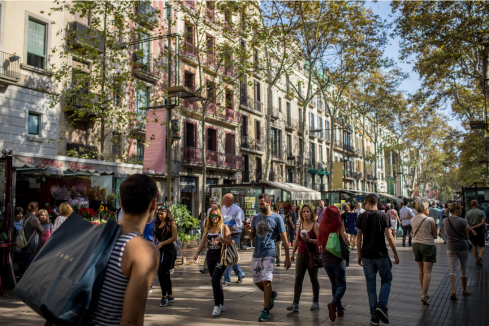
Ada Colau, Barcelona’s leftist mayor, opposed to Catalan independence, understands and argues that an urban-based cosmopolitanism is the future of human political organization, not what I call the EBNS, the ethnicity-based nation-state.
Perfect that the more leftist your political leanings, if one listens to the debate in Catalonia, the more anti-independence you tend to be. Certainly shows up Catalan nationalism as a force more reactionary rather than liberating, as many tend to think (see my take on Vargas Llosa’s piece on Catalonia).
Why, as the nation-state eclipses, are we forming new ones? Is this the last orgiastic swan song of that ideological structure?
HOW CAN THE POINTLESSNESS OF YUGOSLAVIA’S DESTRUCTION NOT BE ENOUGH??!! A city, Barcelona, and a region, Catalonia, that prides itself on its supposed openness as opposed to the inward-looking casticismo of Spain, opting to separate and isolate itself: is the oxymoron and moronic paradox here not evident to all?
Las Ramblas, a popular boulevard in the heart of Barcelona. The city is far more diverse than other parts of Catalonia.Credit Chris McGrath/Getty Images
It’s incredible. In Brussels tonight, this tactless, inept, humiliated prime minister will be the only thing keeping this nation on the plank it is walking
Theresa May in Brussels for the EU summit: ‘tea, sympathy and counselling’. Photograph: Geert Vanden Wijngaert/AP
Another Brussels dinner tonight, another impasse. Yet Theresa May will face 27 people more enviably united round the dinner table than any group of 27 people she could assemble from within her own cabinet or party.
So mad is the Tory box of frogs that she has had to withdraw the EU withdrawal bill for the second time, with its hundreds of amendments. This bill Dominic Grieve calls “an astonishing monstrosity” is paralysed by its writhing contradictions, destined to lose vote after vote with 12 Tories already signed up to rebel.
Her party’s no-dealers are daily ramping up the rhetoric; Owen Paterson told her this morning: “Walk away!” The sheer philosophical impossibility of their position makes your head ache. Which is the wrong box, the one marked “bad deal” or the one marked “no deal”? The bad deal, by definition, sounds worse.
But when Alice looks inside the no deal box she finds World Trade Organisation rules imposing 45% tariffs on her cheese, 37% on meat, 10% on clothing and footwear, and 10% on cars – while inflation caused by the Brexit plunge in the pound already runs at 3%, with earnings squeezed to less that they were in 2006.
Yet still the bullfrogs bellowing “No deal!” grow louder and madder by the day, clueless on the phantom “frictionless” Northern Ireland border, or how to stop 10,000 lorries parked all the way up the M2 from Dover.
May brings to the dinner a crumpled letter addressed to the 3.2 million EU citizens living among us, but it looks as if it got stuck in last year’s Christmas post. Far too late, far too little, it doesn’t allow a French scientist to bring in a new French partner, or a Polish doctor to bring in her husband.
No wonder the NHS is paying the price, with a 96% drop in EU nurses willing to come here. These were our poker chips and hostages. Goodbye fruit pickers, construction workers, restaurant staff, financiers, entrepreneurs, scientists, medics, teachers: far too late now for this letter to trumpet a message of welcome that should have resounded the day after the Brexit vote.
They will talk of “transition” tonight, after she has left the room. Remainers cling to a long “transition” in the hope something will turn up. But listen to business begging for more time and they only want the extra time to move companies across the Channel. Transition is just a longer plank, but we still walk off it in the end.
As her Boris bananas brigade ups its daily rhetoric, observers note an embarrassing change of tone towards Theresa May in Brussels. What’s that sound? Good grief, it’s pity! Brexiteer battlers want the UK at war, not the humiliation of tea, sympathy and counselling.
Hopelessly inept at every turn – viz her impossible immigration target – she is tin-eared to all tact and finesse, but the embarrassing truth is that she is our country’s best hope. She may be overthrown by Christmas, some observers warn, but the Tories will never call an election, letting Labour grown-ups take over negotiations.
The EU knows it; we know it; the polls show it – the Tories would choose someone worse. I can remember no worse time in politics, left praying that this dumbly clumsy woman clings on, just to hold off her no-deal headbangers.
Balkans, Anatolia, Caucasus, Levant and rest of ME, Iran, South Asia
Me, I'm Nicholas Bakos, a.k.a. "NikoBako." I'm Greek (Roman really, but when I say that in English some five people in the world today understand what I'm talking about, so I use "Greek" for shorthand). I'm from New York. I live all over the place these days. The rest should become obvious from the blog.




 Demonstration supporting Spanish unity in Barcelona. Photograph: Anadolu Agency/Getty Images




 Jadde: from Bosnia to Bengal