Tag Archives: Pera

Memo to: a certain generation of “progressive” Turks

4 Aug

From: NikoBakos

Re: the final and total castration of the Turkish military

Date: August 2017

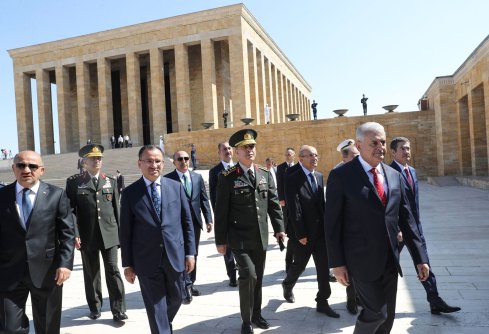
Ataturk Mausoleum Yildirim Chiefs of staffPrime Minister Binali Yildirim of Turkey, front right, and the chief of staff, Gen. Hulusi Akar, third from left, visit the Mustafa Kemal Ataturk Mausoleum before the Turkish Supreme Military Council meeting in Ankara on Wednesday. Credit Adem Altan/Agence France-Presse — Getty Images

ARE YOU HAPPY NOW???

I have two groups of friends in Constantinople:* one a group of mostly Alevi**, first-generation urbanites (from Dersim and Antiocheia); another of at least several urban generations, who are pure “White” Turks in every way.

A sub-category of this second group of friends (who are fast becoming ex-friends) are/were or considered themselves to be “leftists” (“I should cough” as one of the characters in Hester Street says).  These were always violently allergic to anything that had to do with the military, Turkish or otherwise.

Peaceniks, of course, our rift began when it proved completely in their interest to paint me as a super-American hawk during the Iraq war, even if I’m deeply un-American in my self-identification and was never a supporter of Bush’s adventure.  I simply did not know what to think about the idea of invading Iraq and toppling Saddam Hussein and took issue with their knee-jerk, anti-American attitude, with their facile certainty they knew what to think.  In the end I just decided that anybody who was automatically against the completely justified invasion of Afghanistan and the removal of the Taliban — and if that’s a tragically uncompleted project, that doesn’t mean the initial result or victory was not worthwhile…ASK ANY AFGHAN — was going to be a robot-thinker about any kind of American intervention or just about war of any kind, so I couldn’t be bothered.

Of course, these types DON’T KNOW ANY AFGHANS to ask, because they’re shameless hypocrites living in their pleasant, sheltered suburbs in C-Town, who know our Cyclades better then they know the rest of their own country — certainly better than I do — and wouldn’t dare head out to Afghanistan, even on a dare.  Why do they irritate me so much?  It’s simple.

If the original sin of the Right is selfishness, the original sin of the Left is self-righteousness, by which I mean the need to see one’s self as morally correct no matter what, even if this means a breezy indifference to the realpolitik or the reality of what’s really happening on the ground.***

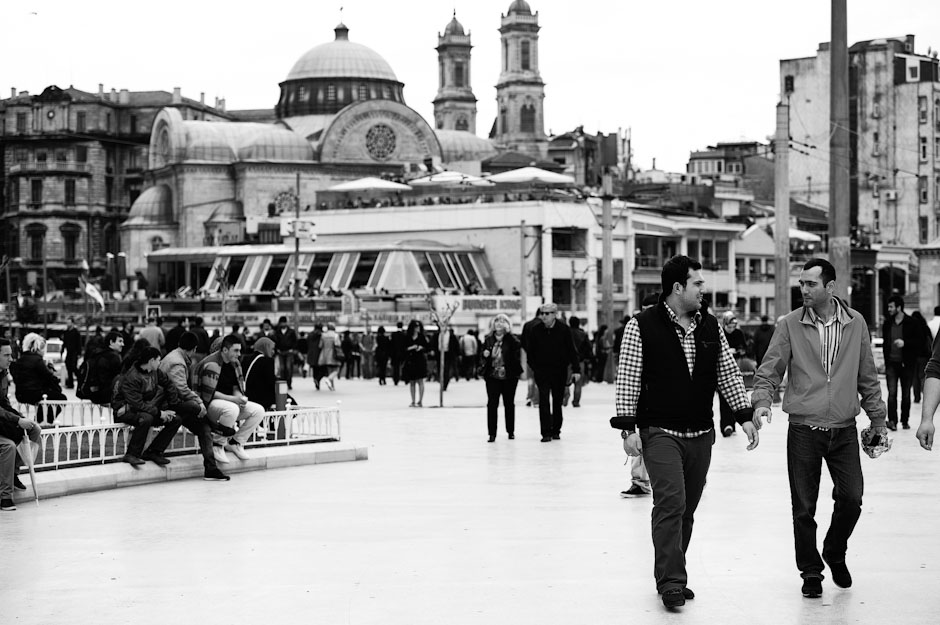
Of course, they were steadfast in their belief that the Turkish military was an institution of bastardized Kemalism that was the greatest anti-democratic force in their society.  This was their justification for eventually rejecting their parents’ admittedly corrupt CHP as well, Turkey’s Kemalist Republican party.  And yet it’s ironic that the Turkish military’s “anti-democratic” orientation has repeatedly prevented the complete descent of that society into chaos.  One of these types has a whole sob story she used to recite to me about how, as a young girl in the 70s, she was terrified every day when her father left the house that he wouldn’t come home because of the terrible and constant terrorist violence that was then occurring on the streets of Constantinople.  But it was the military that put an end to that violence in 1980, like it was the military who got rid of Menderes, architect of the 1955 anti-Greek pogrom, in 1960.  And as soon as Erbakan started exceeding his limits (btw, he was the first who tried talking about limiting alcohol consumption and tables on the street in Pera and Galata), the military got rid of him too in 1997 — not exactly cause and effect there.

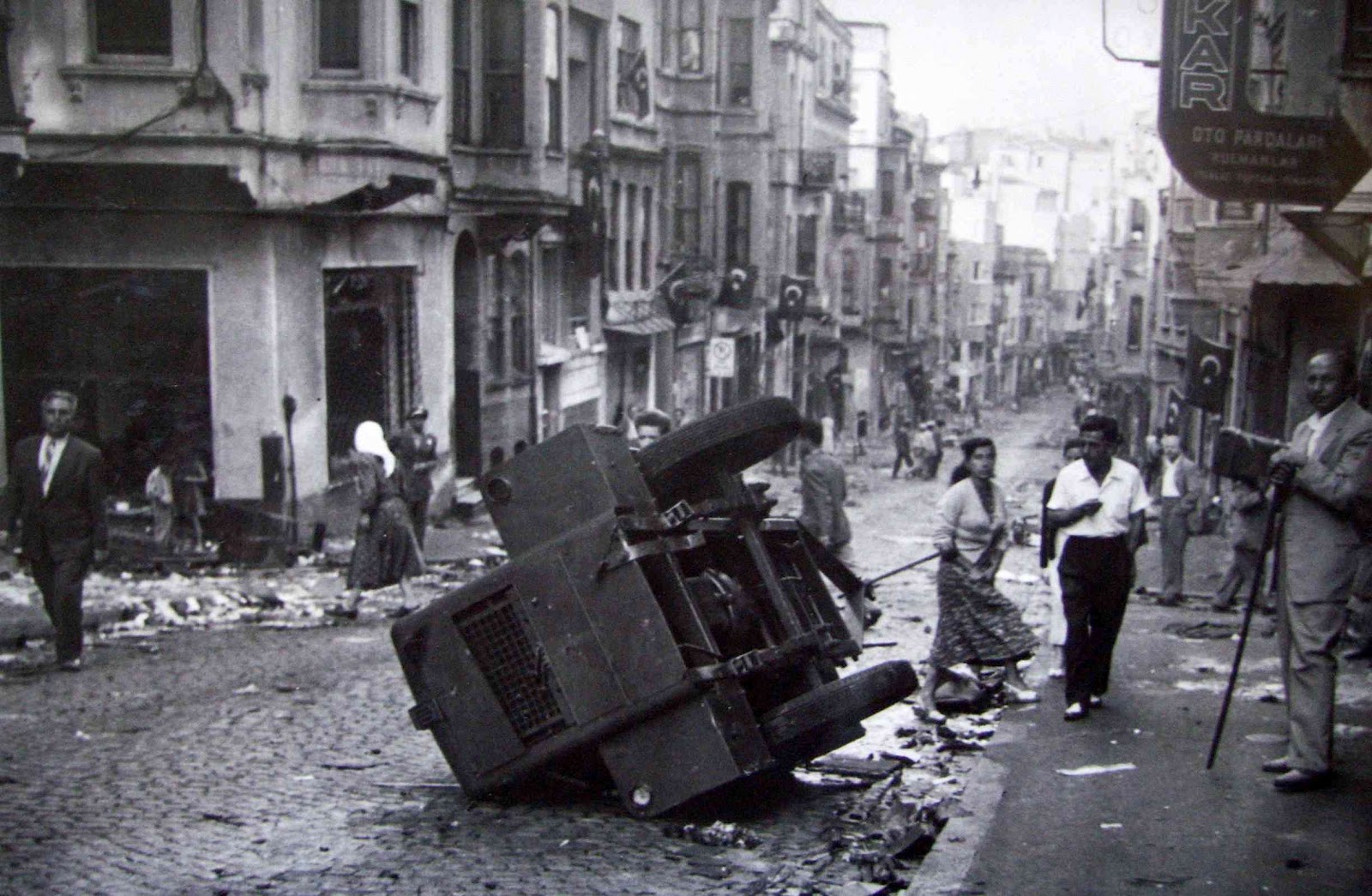
As a Greek, there’s obviously little love lost on my part for the Turkish military.  I just feel that if Turkey’s twentieth-century history, culminating in the Erdoğan phenomenon, has proven the country to be incapable of forming a democratic civil society that doesn’t spin out of control into violence, corruption and chaos, then you just don’t have the luxury of being anti-military.  Furthermore, from our perspective, Erdoğan’s pre- and post-“coup” military is a far more threatening force than it was previously.  Violations of Greek air space have increased exponentially under Erdoğan’s tenure, as has his, and formerly Davutoğlu’s, irresponsibly imperialist Neo-Ottoman language.  And just like it wasn’t a military junta that organized the pogrom of 1955, it wasn’t a military government that invaded Cyprus in 1974, ethnically cleansing and occupying 40% of the island to protect a Turkish minority that is only 18% of the island’s population.

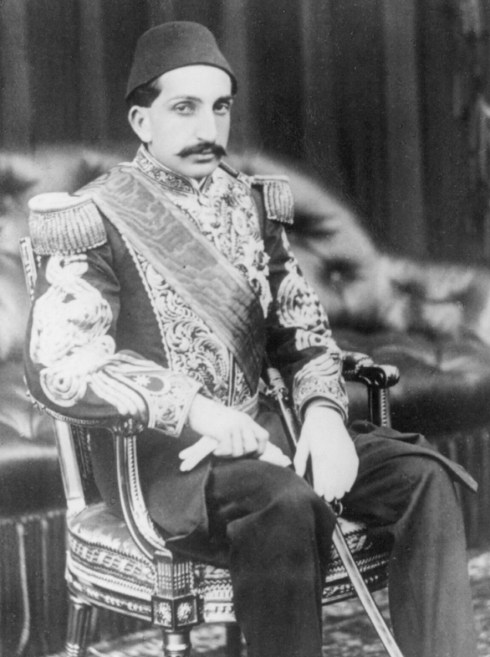
Lately there had been a weird shift in their attitudes though, as it has slowly sunk in that they had supported (“I voted for him!  My God!!”) the most un-democratic, anti-consitutional, religiously retrograde, paranoid, chip-on-the-shoulder lunatic to rule Turkey since Abdülhamid (photo below).  After the takeover and purging of the daily Zaman in March of 2016, I ran the idea past a few of them: “do you think it’d be a good idea for the military to step in? …they already have more unconstitutional dirt on him than on most Turkish heads of state.”  And even the Teşvikiye girl who had worried so much about her father, didn’t get apoplectic on me like she would’ve done in the past; she simply mumbled passively, in the static cadences of Turkish passivity: “I don’t even think they’re in a position to do anything at this point.”****

AbdülhamidAbdülhamid

Worse was one who said to me: “What Turkey needs now is unity.”  Well, your compatriots have actually shown a quite impressive amount of unity in the face of the Erdoğan challenge.  Every time he has engineered some sort of spectacular violence to terrify them over the past almost three years, they have unitedly come back, in elections and referenda and the mob-mobilization they have always been so good at, to give this “most un-democratic, anti-consitutional, religiously retrograde, paranoid, chip-on-the-shoulder lunatic to rule Turkey since Abdülhamid…” an even greater mandate on power than he had before: Daddy please save us!

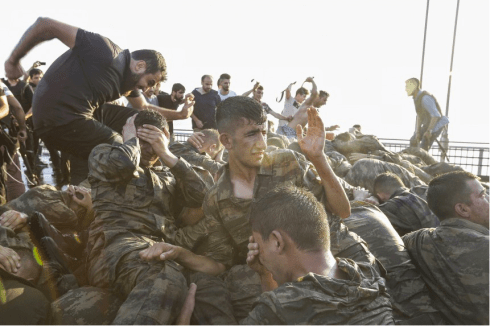
Infantile beyond belief.  Is that the “unity” you wanted?  There was great unity in the mob hysteria that this supposed coup was met with (no, I don’t believe it was Gülen; no, I don’t think it was the army, unless it was army that already knew it was going to be sacked; no, I don’t think he didn’t know; I’d probably refuse to believe that Erdoğan wasn’t the architect of the whole thing — see the New Yorker‘s great Dexter Fillins’ “Turkey’s Thirty-Year Coup”).  They displayed impressive unity lynching poor little Mehmetçiks just following orders on the Bosporus Bridge (scenes guaranteed to make the hair of Greeks and Armenians stand on end), impressive unity in the Nazi-style rallies the Great Leader has convened, impressive unity in heckling men from the army and journalists and writers being led into a show trial that can quite possibly end in their execution or certainly life sentence (see “Inside Erdoğan’s Prisons” in the Times) and with the kerchiefed teyzes screaming for blood outside the courthouse in Ankara — and I’m sure they’ll show impressive unity in supporting the reinstating of capital punishment if that goes up for a referendum soon.

Turkish thugs and soldiersTurks beating up young conscripts on the Bosporus Bridge, defending their democratic right to elect a dictator who has abolished Turkish democracy for the most part and soon will have the power to go after whatever’s left…Turkish “unity” in action.

IS THAT THE UNITY YOU WANTED?  The unity of Kristallnacht? (or the “Septembriana” — same difference.)  The unity of Nüremberg?  The unity that comes with thinking that you can enfranchise the newly rich, provincial pious, those with absolutely no democratic education — or education of any kind — and that they won’t turn on you like swine before which pearls have been cast?  (Plato said that the “demos” — the people — shouldn’t have the right to vote because they’ll always vote for the tyrant — τυραννόφρων; Dostoevsky’s Grand Inquisitor says precisely the same thing.)  Did you want the unity of the Italians and the Germans who respectively put Mussolini and Hitler in power with their vote?  Or the Americans who voted for Trump?  Or the Russians who voted and will again vote for Putin?

Tabrik migam, then.  You got it.

And this is the cherry on your birthday cake: Erdoğan replaces the military chiefs of staff with his own men.  Good luck ever getting rid of him now.  He’s now in a position of total control, with no challenges whatsoever.  You’re stuck for life.

*************************************************************************************

* The days when in the p.c. stupidity of the metapoliteuse we used to refer to Constantinople as “Istanbul” — I mean when speaking Greek…airport announcements and newspaper by-lines used “Ιστανμπούλ“…in Greek…are over.  I’ve now taken to calling it Constantinople in English as well, as Turks are free to call Salonica Selanik or Bulgarians and Macedonians Solun and I have no problem.  I’m not going to tell others what to call cities historically important to them; it actually makes me happy.  For more on this see my: Names: “Istanbul (not Constantinople)”…and Bombay! and keep an eye out for my “Boycott ‘Mumbai” campaign” post.  In general except an upswing in South Asian posts as we approach the seventy-year anniversary of Partition.

** My friends bear out the truth that Turkey’s Kurdish-Zaza Alevis and Syria and Lebanon’s Alawites are religiously the same branch of semi-Shia Islam.  The ones from Dersim have recognized that Syrian Alawites are also Alevi like them, even if that hasn’t made them Assad supporters; and the ones from Antiocheia (Antakya in Turkish or Hatay province in the logic of Turkish science fiction nationalist narrative) are just plain Alawite Arabs, who have understood that if there’s anything separating them from Syrian or Lebanese Alawites, it’s only the Turkification campaign they were subjected to when Turkey annexed that part of then-French-mandate Syria in the 1930s.  If papers like the Times feel the need to add the caveat that they’re different in every article they publish on the subject, it’s because they’re ignorant, the Turkish Press Office has made a fuss every time they don’t add that caveat, and it’s easy to think that people separated into difference by the ethnic nation state aren’t religiously brothers.  I’ve written extensively on this in a Twitter dialogue I had with a Turk who thought everybody should fight “lies and defamation” against their country when they appear in the media:

Syrian Alawites and Turkish Alevis: closer than I thought

Turkish Alevis and Syrian (or Lebanese…or Turkish?) Alawites — a Twitter exchange

Alevis and Alawites addendum: a “p.s.” from Teomete

More on Alevis and Alawites…or Alevis and Kurds…or Iraqi Kurds…or…Christian Kurds…or Assyrians…or…

Look out for Alevis in the current struggle in Turkey.  Whereas Kurds proper are not trusted by the political establishment or most Turks because they’re convinced they’ll never give up their separatist aspirations, Alevis, who suffered terribly under the Ottomans and the early republic and still do on some level, are still loyal to the Turkish Republic and Turkey itself.  This puts them in the position to become the secular backbone of all democratic impulses that still exist in that country, something like African-Americans in the United States were in the mid-twentieth century, since their form of Islam does not aspire to becoming the State itself, as all forms of conventional Sunni Islam do.  They were a disproportionate share of the casualties and deaths that occurred during the crackdown of the 2013 protests, not because they were targetted specifically, but simply because they were already a disproportionately large percentage of the protesters.

*** It may seem irrelevant, but this type always reminds of a passage in Chesterton’s Orthodoxy in which he trashes this kind of moral correctness by trashing the New Agers of his time:

“Only the other day I saw in an excellent weekly paper
of Puritan tone this remark, that Christianity when stripped of its
armour of dogma (as who should speak of a man stripped of his armour of
bones), turned out to be nothing but the Quaker doctrine of the Inner
Light. Now, if I were to say that Christianity came into the world
specially to destroy the doctrine of the Inner Light, that would be an
exaggeration. But it would be very much nearer to the truth. The last
Stoics, like Marcus Aurelius, were exactly the people who did believe in
the Inner Light. Their dignity, their weariness, their sad external care
for others, their incurable internal care for themselves, were all due
to the Inner Light, and existed only by that dismal illumination. Notice that Marcus Aurelius insists, as such introspective moralists always do,
upon small things done or undone; it is because he has not hate or love
enough to make a moral revolution. He gets up early in the morning, just
as our own aristocrats living the Simple Life get up early in the
morning; because such altruism is much easier than stopping the games of
the amphitheatre or giving the English people back their land. Marcus
Aurelius is the most intolerable of human types. He is an unselfish
egoist. An unselfish egoist is a man who has pride without the excuse of
passion. Of all conceivable forms of enlightenment the worst is what
these people call the Inner Light. Of all horrible religions the most
horrible is the worship of the god within. Any one who knows any body
knows how it would work; any one who knows any one from the Higher
Thought Centre knows how it does work. That Jones shall worship the god
within him turns out ultimately to mean that Jones shall worship Jones.
Let Jones worship the sun or moon, anything rather than the Inner Light;
let Jones worship cats or crocodiles, if he can find any in his street,
but not the god within. Christianity came into the world firstly in
order to assert with violence that a man had not only to look inwards,
but to look outwards, to behold with astonishment and enthusiasm a
divine company and a divine captain. The only fun of being a Christian
was that a man was not left alone with the Inner Light, but definitely
recognised an outer light, fair as the sun, clear as the moon, terrible
as an army with banners.”  [All bold emphases mine.]

**** “yanlış oldu” — See Loxandra‘s amazing “duck with bamya” chapter; I never tire of recommending it.

Comment: nikobakos@gmail.com

Photo: Sarajevo gastra and börek…or Börek I

24 Aug

Börek gastra Sarajevo

(click)

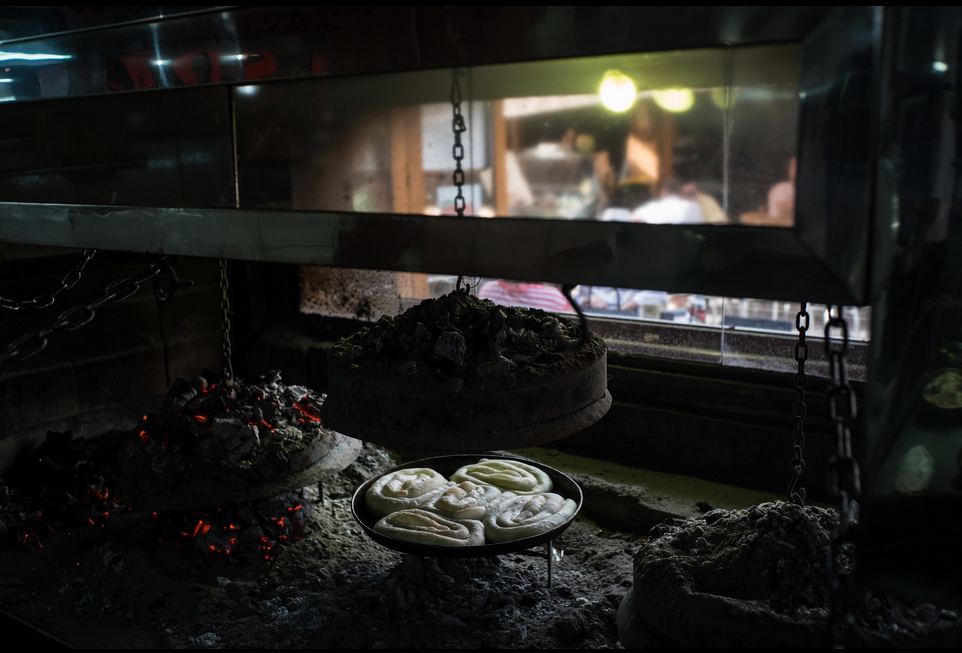
These are börek in Sarajevo being baked in a gastra, a strange piece of High Ottoman technology that is still used in much of northern Greece, especially Epiros and the rest of the Balkans, particularly the western parts: Albania, Montenegro (where uniquely in the Serb-speaking world, they call börek pitta like in Greek), Kosovo and southern Serbia — regions, interestingly enough, where börek is a particularly strong regional identity marker and the object of a powerful cult of affection and snobbery.  Every and each börek in these parts is subjected to intense scrutiny; is there too much filling (major demerit points because you’re obviously trying to make up for the poor quality of your phyllo/yufka); is each layer fine enough, but able to both absorb serious quantities of butter and not get soggy, like a good croissant or a good paratha.  Finally, that you use real — and good — butter, which makes almost all commercially sold varieties not worth trying, since using good butter on a commercial scale would make a börek that is prohibitively expensive, and especially in a country of culinary philistines like Greece, store-bought versions are almost inedible, as is most product in Turkey these days too, Turkish street food having suffered a marked decline in quality even as the tourist literature on the country continues to rave about it.  But I have had good börek in Macedonia, in Mavrovo, and in Montenegro, in Žabljak, where the hotel made us a great cheese and a great cabbage one for a hike we went on.  And in a high-end restaurant in Jiannena too; but next to me was an Albanian woman, who first smelled it, pricked at it with her fork, counting the layers of pastry, and then after a few minutes of just staring at it, pushed it away in disgust.  Like I said, it’s an object of great snobbery.  And forget Old Greece.  It’s a standard rule of thumb that the further away in place and time a region of Greece is from the Ottoman experience, the exponentially worse the food gets.  No one south of Larissa can bake a pitta to save their lives, or make a decent plate of pilav for that matter.  Epiros is probably the only place you can still get a nice buttery mound of pilav — like the kind Turks make — with good yogurt.  Southern Greeks seem allergic to rice, and have friggin’ potatoes with almost every meal.  Maybe It’s a Bavarian thing — I dunno.

some really good borek

Reaaally good stuff, in Mavrovo, Macedonia (click)  (See post: Macedonia: Mavrovo, Dimitri and the Two Falcons)

But everything baked tastes better in a gastra, the same root as the word for “womb” in Greek (or “gastritis”): rice and lamb, even zeytinyağlı vegetable dishes.  It’s just incredibly tedious — and dangerous if you don’t know what you’re doing — to use.  It’s a cast-iron dome, suspended with a very complicated chain mechanism over a stone platform.  You first lift the dome and light your charcoal fire underneath it on the stone platform.  When the fire has been reduced to hot embers, and the cast-iron dome has also gotten nice and hot, you brush the embers aside, position your tepsi of food, lower the hot cast-iron dome, and then pile the still glowing embers on top of the dome.  Usually when they’ve cooled down completely the dish is done.  The picture above shows gastras at all steps in the process.

I dunno really.  Does it make that much of a difference?  Everything is better when it tastes slightly smokey or when a little bit of ash has fallen into it — like Turkish coffee made in hot ashes.  But it’s a ton of work and really impractical.  If, for example, the embers go out completely and you raise the dome and the food isn’t done yet, you have to start the whole process from the beginning.  Arthur Schwatrz, in his ever-best cookbook on Neapolitan food, Naples at Table: Cooking in Campania — which, like most good cookbooks these days, is as fantastic a source of history, anthropology and ethnography as it is of good recipes — says that a lot of foods legendary for how long you had to cook them for them to be the “real” article, like a Neapolitan ragù (pronounce with a double “r” and a “g” that sounds like a light Greek “gamma” – “γ”) that should take at least half a day to simmer or no self-respecting Neapolitan would eat it, were never really cooked that long.  Rather, they were cooked on wood fires and braziers, which were constantly going out, had to be relit, while the sauce cooled off and took time to reheat, etc.  Of course, for certain sauces and stews, and the fatty, sinewy cuts of meat we like in “our parts,” this kind of cooking is ideal.  And not just the slow, long heat, but the cooling off and reheating especially.

Naples at Table

Ottoman mangal

(click)

It’s like that other piece of Ottoman high-tech (I don’t mean to make fun, but it wasn’t exactly their strong suit), the mangal home-heater or charcoal brazier. (above)  You’d pile charcoal into it; leave it out in the street until the carbon monoxide burned off, then cover the embers with the lid and bring the whole incredibly dangerous, glowing — and often very large — brass behemoth inside to warm the house, or one hermetically sealed room really.  Then, as my mother used to describe it, you’d get under the blankets or flokates, facing the mangal, so your face would turn all red and sweaty while your back was freezing, and hope you had fallen asleep before it started cooling off or that you had generated enough body heat under the blankets to last till morning.  There were countless stories about families being found dead in the morning, because in the rush to bring this silly contraption into the freezing house, the carbon monoxide often hadn’t burnt off entirely and people would die from poisoning in their sleep.  I can only imagine that their use was required because it was probably tricky to build chimneys in mostly wooden Ottoman urban housing — my mother only remembered them from Jiannena; in her village where the house was stone, there were regular stone fireplaces where you could keep adding wood because the chimney would let the smoke and gas escape — and I’m sure that many of the massive fires that consumed whole mahallades of Ottoman cities over the centuries and killed thousands on certain occasions, were probably caused by one accidentally knocked over mangal somewhere.

And whole neighborhoods would burn down and then be rebuilt in wood again, something I comment on in another post — Macedonia: Sveti Jovan Bigorski“:

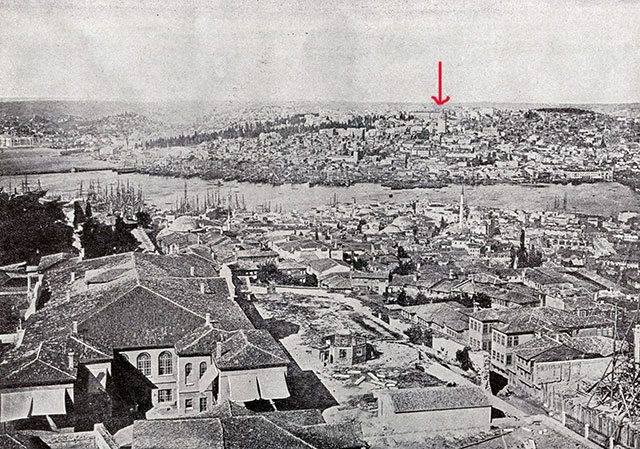
This is a kind of Ottoman tradition: build in wood, suffer repeated fires like the kind that wiped out whole districts of Istanbul throughout its history and killed tens of thousands.  Then rebuild in wood again.  It’s not known who said that the definition of neurosis is repeating the same action over and over and expecting a different result, but it also might be the definition of stupidity.  Only after a fire destroyed two thirds of Pera in 1870 in just six hours did people in those predominantly Christian and Jewish areas start building in masonry, which is why those neighborhoods are architecturally far older today than those of the now ugly two-thousand-year-old city on the original peninsula, where there is almost no old domestic architecture left (except, again, in former minority neighborhoods, for some reason, like Fanari or Balata or Samatya).

More on the symbolics of börek and the break-up of Yugoslavia in the next post.

Comment: nikobakos@gmail.com

“Might they open the doors of the wine shops And loosen their hold on our knotted lives? If shut to satisfy the ego of the puritan Take heart, for they will reopen to satisfy God.” — Hafez

3 Nov

WineryimageFrom Pulse News: Beer, wine flow in West Bank Christian hamlet”  by TIA GOLDENBERG | November 3, 2014

TAYBEH, West Bank (AP) — A tiny Christian enclave in the overwhelmingly Muslim West Bank has for years crafted the only Palestinian beer and brought thousands of visitors flocking to its annual beer fest. Now, it is adding wine to its list of libations, hoping a boutique winery will be another tourist draw and contribute to keeping the small village afloat.

While Christians around the Middle East have seen their numbers dwindle due to conflict and the lure of better economic opportunities abroad, Taybeh has remained an exclusively Christian village, the last in the West Bank.

The family behind the wine and beer says they are carrying out “peaceful resistance” by investing in their homeland and staying put.

“This is how we believe the state of Palestine can be built: by people like us to invest in the country and encourage other Palestinians to come and invest in their country,” said Nadim Khoury, who founded the brewery and winery.

I’ve always been fascinated by the association, in so much Persian(ate) poetry, of alcohol with non-Muslims — and by extension, licentiousness, sexual desire, subversiveness, sin, etc.  There’s probably a dissertation out there somewhere that I should try looking for.  I thought about it a lot in my rant on the Gezi Park protests and the symbolic importance of Pera in the İstanbul imaginary that I wrote from Kabul last November.  In fact, it was pretty much the thesis of the piece:

“And here we run into our first paradox, or the origins of a chain of paradox: that this now central “heart” of Istanbul began as a space of marginality.  The Byzantines originally put some of their unwanted Catholics there: Galata’s mother city is actually Genoa.  In Ottoman times, Christians and Jews lived there and made wine and everybody else came there to drink it.  While not an exclusionary, extramural ghetto of any sort – to their credit the Ottomans didn’t often do that kind of thing – it was sort of the wrong side of the tracks: the Ottoman equivalent of the suburbs or the across-the-river Zoroastrian neighborhoods in Iran where Hafez and company went to drink the infidel’s wine and torment themselves with the beauty of the innkeeper’s son: the other side of town, the refuge of disbelief and transgression, of unorthodoxy and the unorthodox in every sense.  The alcohol…”

…….

If 2013’s protests then – at least Istanbul’s –were at their core about protecting aspects of the essential urbanity of Istanbul, and Greeks played such a large role in shaping that urbanity, shouldn’t that be acknowledged?  If Turkish society is playing out – again, at least in Istanbul – its most intense culture wars on a ghost blueprint of vanished minorities, then wouldn’t making that a more explicit part of the contest be immensely productive – all around.

See it all:Nobody really cares about Gezi Park: Greek thoughts on the protests of 2013


image007

Comment: nikobakos@gmail.com

The adventures of me and my nephew Vangeli in C-town

2 Jun

IMG_0779

(click)

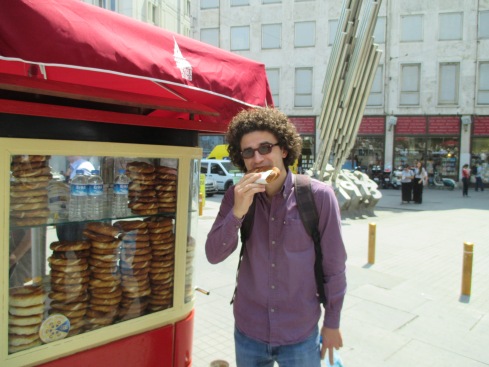
This is my nephew Vangeli from Tirana, who came and spent an extended weekend with me in Istanbul last week, eating a simit in the Staurodromi.  When I started this blog I said to myself I wasn’t going to include personal names.  When you represent something ideologically problematic for me, you’ll usually be described by a repeated sociological profile: “the Athenian thirty-something” or you’ll get a moniker all your own; in any event, if you read regularly, you’ll know who you are.  But the warmth of certain experiences I had with my family in my village this past spring has made me want to “call their names,” both because these are people I learned to love a great deal in a very short amount of time and to do them the honor, even if these experiences are not that interesting for the objective reader.  It’s obvious that it’s for them.

Vangeli is my second cousin Calliope’s eldest son. (See Easter Eggs… because, believe me, you don’t want me to run through all the lineages each time and I can’t do it either.)  When I first went to Derviçani in 1992, after Albania had safely opened up for good, Calliope was already living in Jiannena and we met there first, so we could get to know each other before going into Albania together.  When we arrived in the village for the first time, hers was the face I was constantly looking for as a reference point among the throngs of relatives who were constantly surrounding me.  It was her and my cousin Panto, Pantele, who is still my official bodyguard everywhere I go in the village, telling me who’s who since I can’t keep track, taking me everywhere I want to go, counting the tsipoura (raki) I have at every visit, so they don’t add up to too many in one afternoon, etc.  His mother, my Kako Poly (Polyxene), is a saintly woman who made great sacrifices caring for my grandmother in her final years under conditions of great material deprivation for all.  In video we have of my grandmother, taken by complete fluke by a cousin of my mother’s who went to Albania in 1988, a year before my grandmother died, as part of a Greek commercial exchange delegation — these groups were always taken to Derviçani as it was the showcase Greek minority village in communist times — my grandmother says: Να, αυτή είναι η Πόλυ, μ’έχει επάνω της… — “Here, this is Poly, she (lit.) carries me.”
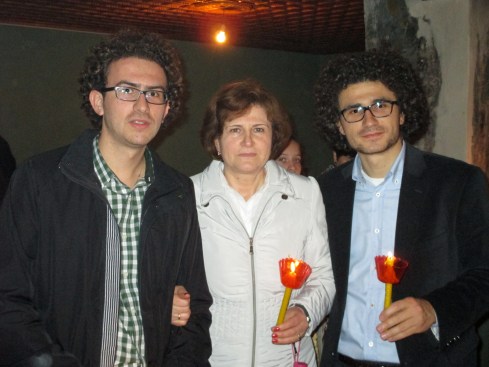
IMG_0050This is Calliope, with her two sons Vasili (left) and Vangeli (right) on Easter night in church (click).  She’s an extraordinary and extraordinarily loveable woman: a great housewife, a competent businesswoman, funny, generous, always smiling, as flirtatious and open as a teenage girl — she’s one of my great relative-loves.  Here she is below at the Monastery on Easter Monday, having just deposited a huge piece of lamb shoulder — no, actually, a lamb shoulder — on a paper towel in front of me, cold and glistening with shiny white fat like some Homeric offering.  My father always loved cold lamb, and would never let my mother reheat it, because it reminded him of the Easter dance at the Monastery.  This is a typical pose to catch her in below, because her innate generosity is always giving something to someone.  (Click)
IMG_0119I hadn’t met Vangeli before, and if I had he would’ve been a baby.  But in church that night, when we were introduced, he said to me, in his classic Aries way — breezy and confident: “Actually, I don’t know you, but Christos Aneste!”  And my Aries replied: “I don’t know you either, but Alethos Aneste!” and I knew right then we’d hit it off.  We talked the next day at the dance; I invested some of the best days of this trip visiting them in Tirana on my way back from Montenegro, and of all the people who said they would come to Istanbul to see me while I was here, I knew he was the only one who would actually do it.  We locked horns on titles or terms of address for a while; I am literally twice his age, fifty and twenty-five, but we hang out like cousins and that’s what he used to call me, whereas I want to be called “uncle.”  He wasn’t having it.  (I have a similar problem with some nephews in New York on my mother’s side.)  For a while we agreed on “şoku,” which is “buddy” in Albanian but also meant “comrade” in communist times, so that didn’t last very long, nor did the Russian “tovarishch” which means the same thing.  Finally, when he got to Istanbul, he heard some guy addressing another as “abi” — big brother, technically, but often just “mate” — which they use in Albanian as well, so it’s been “abi” since then and that pretty much describes how we relate to each other. 

I’m an only child.  Calliope is like the big sister I never had and it’d be hard to imagine a more loving one.  But my parents also had a first son that died when he was a baby, so, even more deeply, I’ve always felt literally haunted by a living presence and desperate absence at once, and by an entirely metaphysical need for a being that I feel is out there to incarnate itself again as an older brother.  But being an older brother to someone else is just as gratifying, especially to a kid like Vangeli.

Because he’s good at his role and he did me super-proud here.  He studied computer engineering in Birmingham and speaks flawless English, dresses impeccably, works for a company that sends him to Italy on a regular basis, so he speaks some passable Italian as well.  (Some fashion-victim friend of mine from New York saw him dancing in the second video here and wrote to ask me who the funky kid with the curly hair and the Prada glasses was — she had recognized the Prada frames from five-thousand miles away…)  We went out for a classic Istanbul fish-and-rakı dinner at a really good place in Cankurtaran in the old city; he immediately recognized that this was not just any meal, but that he was in the presence of a certain ritual to be respected, like Japanese kaiseki, and he acted accordingly.  He was put off by the anise in the rakı at first — we drink ours unflavoured in Epiros — but then realized that Turkish rakı is not the cough-syrup by-product that Greek ouzo is and enjoyed it thoroughly.  He had no negative preconceptions of Turks and Turkey and he never, never — not once — tried to insert one of those slimey negative innuendos about Turkey into the conversation that almost every Greek tries to do when he’s with Turks.  He just listened to the two female friends we went out with, asked questions, tried to learn, gave his opinion, talked to them about Albania and Argyrocastro and Tirana and our families and Britain and anything else you could imagine, and charmed the skirts off of both of them.

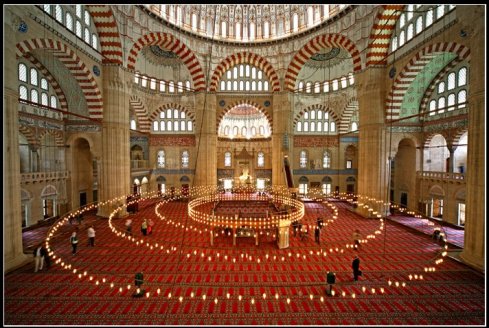
He wanted to see everything.  I hate going into the old city.  I find it depressing, crowded.  I love the mosques, but the Byzantine monuments discourage and sadden and, sometimes, anger me, and I prefer to not be confronted with the interface between the two and just stay here in Pera, expelled from the walls in my gavuriko varoşi.  Also, getting there is alright, but getting back means trudging up and down and then up and down again some incredibly pedestrian-unfriendly streets and intersections and underpasses, unless you take some sleazy Sultan Ahmet cabdriver whose meter suddenly races to 100 lira by the time you get from Hagia Sophia to Pera.*  But for Vangeli I went.  And we saw everything there was to see.  We even stumbled upon the Rüstem Paşa mosque, which if you ever asked me to find, I never could.  We sat in the Süleymaniye for an hour and he listened to me talk about why I like sitting in mosques and watching Muslim prayer — Istanbul was the first time he had been inside one — and find them so calming and peaceful.
Rustem pasa tiles

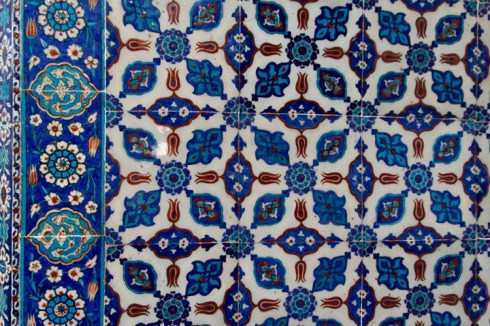
Suleymaniyeimg_redirect.phpThe tiles of Rüstem Paşa above and the interior of the Süleymaniye (click)

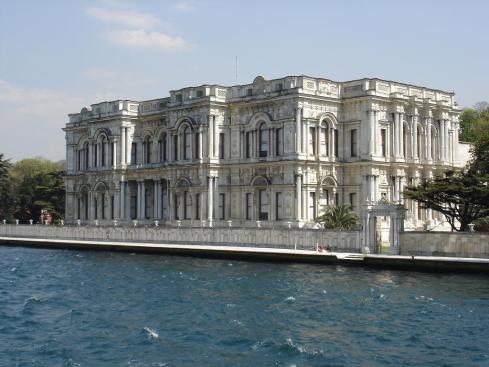
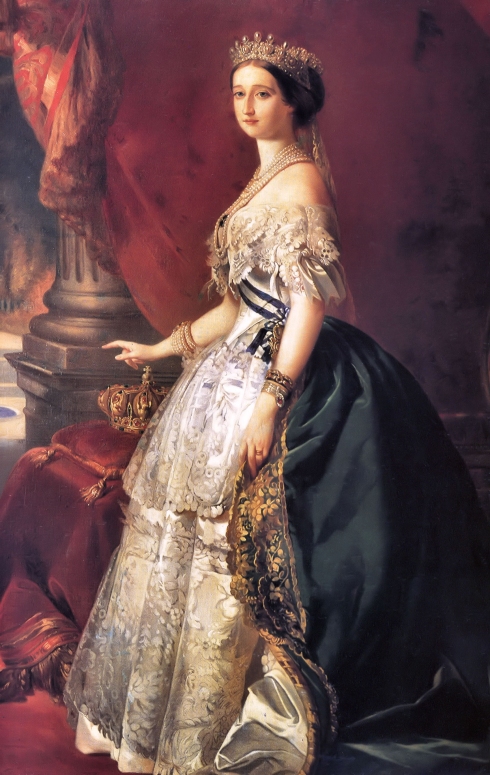
We covered every inch of Topkapı, where I hadn’t been in years and where I was re-dazzled by that Ottoman sense of elegance and comfort that Rebecca West speaks of so often.  He was interested in the oddest things.  His favorite palace was Beylerbeyi, as it is mine, but he was fascinated by the story of the French empress Eugénie, born Eugenia de Montijo of the highest Andalusian aristocracy, who extended her state visit there for so long that it began to turn into a diplomatic scandal in Europe: he wanted to know how beautiful she was; he wanted to know whether Abdülaziz was such a stud that he was actually shagging her and how Napoléon III could have been such a nebech that he didn’t come grab her by the hair and drag her back to Paris.  “Άμ,’ ήθελες γυναίκα Ισπανίδα…” he decided, after much pondering — “that’s what you get for wanting  a Spanish wife.”  And an Andalusian one at that.  But once you’ve seen Beylerberyi, where she was put up on her visit, which is like a gigantic Turco-Venetian palazzo opening up onto the fresh, cool waters of the Bosphorus and not some smelly canal, you realize that once anchored there, leaving would be hard even if you weren’t getting any from the Sultan.

Beylerbeyi Palace (click)
beylerbeyi_palace_by_shidikujThe Empress Eugénie of France, née Eugenia de Montijo of Granada; the Jackie Kennedy fashion plate of mid-nineteenth century Europe and considered one of the most beautiful women in the world at the time (click), subject of the copla by Rafael de León and Manuel Quiroga, made famous in Concha Piquer’s incomparable rendition.
Eugénie;_keizerin_der_Fransen_(2)

The last day I was exhausted but he wanted to go look around Turkish supermarkets for yufka to compare the quality and price to what his family’s company makes; this is my Uncle Vangeli’s business; they make yufka and tel kadayif and sell it throughout Albania.  The name of the company is Demetra, like the ancient goddess of agriculture and cereals.  We went to a couple of Carrefour and he wasn’t impressed.  We went to some small bakalika and they didn’t have any at all.  And, very cutely, he made the assumption, in those hushed tones of respect that the Ottoman culinary tradition still carries with it in the Balkans, especially in the western Balkans from Epiros to Bosnia, where börek is an institution and a strong regional identity marker: “They probably open up [that’s the term we use] their own phyllo at home still.”  I didn’t want to pop his bubble.  Then he wanted to go to Dolmabahçe too — the energy of youth — but it was already too late in the day.  As compensation we went to dinner at the Çırağan, the hotel that’s now in the palace most similar to Beylerbeyi.

What I most admire about Vangeli is that he’s smart, sophisticated, has a C.V. that could take him anywhere in the world that he might want, but he wants to stay in Tirana, not just because he wants to help the family business, but because he actually wants to stay in Albania and build a program design business of his own, in the country he grew up in and lived his entire life in, and that that doesn’t get all mixed up with dumb ethnicity issues.  I didn’t ask him; he probably doesn’t “love” Albania any more than I “love” the United States.  He probably doesn’t have an answer.  But where he lives — what state he lives in, in particular — doesn’t have any bearing on who he is.  Like me.  He’s Vangjel Stavro; he’s a computer engineer; he’s Greek and he lives in Albania.  Period.  He may be the New Balkans.  In fact, soon all of the Balkans might be the New Balkans except for us, who will still be left blinkered, frozen like a deer in the headlights, wondering why the “Europe thang” didn’t go as we planned.

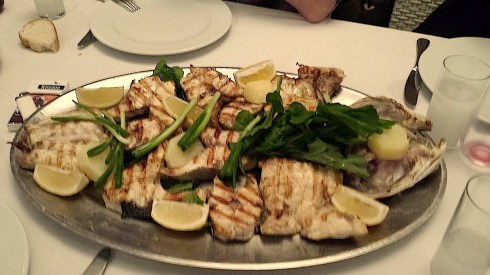
There are a couple of inside jokes to the photo at top where’s he’s eating a simit at the Staurodromi.**  One is that we both felt like hell that morning, which is why I’m not in the picture, not that I like being in pictures anyway.  Two nights before we had had that splendid fish dinner in the old city and had put down a fair amount of rakı, but it was with food — basically, after a few rounds of great meze, this beautiful lithrini (lüfer):
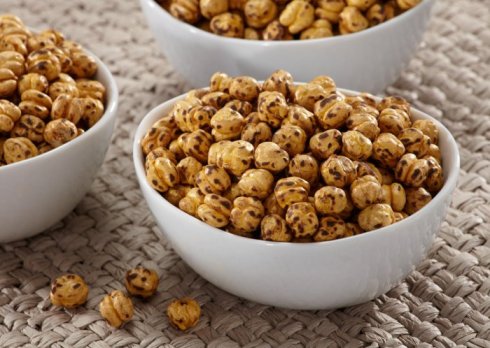
Fish20140522_214540(click)

But the night before the simit photo, I had wanted to take him to the bar on the rooftop of the Marmara Pera hotel, so he could see the places we had visited in the old city that day from across the water at night and illuminated, and then we were planning to go hear some Greek guys who play rebetika at a very cool, shabby old meyhane near Taksim.  But we spent too much time at the Marmara and by the time we got to the rebetiko place all the food was gone and all that was left were stragalia/leblebi.  Now I don’t know exactly how leblebi are made — I think they’re dry-roasted chickpeas — but I detest them as much as I love cooked chickpeas/rebythia/nohut.  Something happens to the dense, almost meaty, velvety texture of chickpeas when they’re made into leblebi that produces something that tastes like a highly compacted nugget of sand, or like taking a teaspoon of raw flour and popping it into your mouth.  I think the only reason they’re considered a drinking snack is because you’ll choke on them if you don’t have anything to wash them down with.  Vangeli hates stragalia too, but I tried to encourage him: “Come on man, this is the exclusive diet of the Great Father; this is how he defeated Turkey’s enemies and brought his country glory, with a pocket full of leblebi and a flask of rakı!”
Lebpic1340611232r779452Leblebi

So we ate as many as we could, starving as we were, and had way too much to drink in too short a time on top of it.  We then went outside when the performance was over, and suffering from the drunk munchies on which rests the drunkard’s philosophy that if you pile more crap into your stomach on top of too much booze it’ll make you feel better, we had two plates each of chicken-and-pilav from the street vendors (one of the most delicious things you can possibly eat in Istanbul — Turks are magicians with rice), and then on my corner we found Orhan, my favorite Kurdish midye kid, and I think closed down his shop that night as well; we must have had about twenty mussels each.  So we were not very happy the next morning.

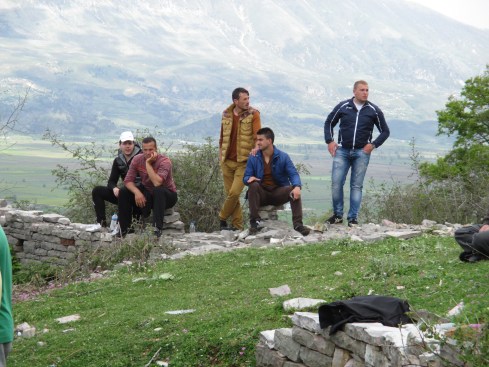
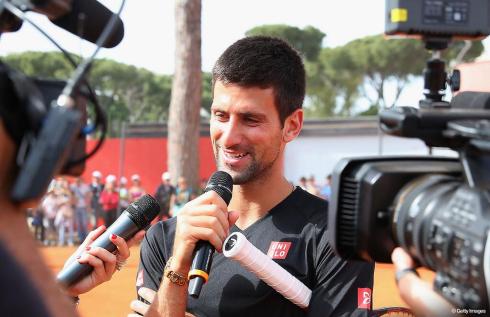
The second insider joke is actually one me and Vangeli share with Epirotes down the centuries.  Legend has it that Epirotissa mothers would slap their sons on top of the heads to flatten them from the moment they were born and say: “Και σιμιτζής στην Πόλη” — “And may you become a simit vendor in the City” and that this explains the idiosyncratic beer-can shaped heads that a lot of Albanians and Epirotes have, like some of my chorianoi:
IMG_0148or a guy as seriously Kosovar-looking as Novak Djoković:
DjokBearCanBnhbw7ZCYAAgVoE.jpg_largeor me:

nikostautoteta23

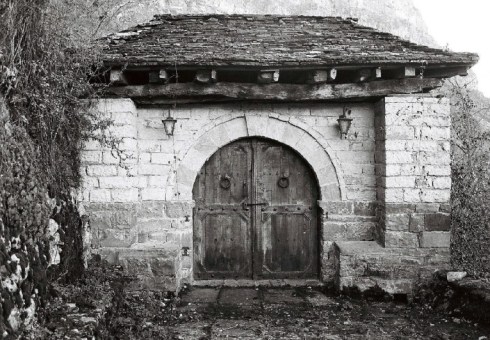
The point is that the flat top would make it easier to balance a tray of simit on your head.  Of course the joke is based on false modesty, because Epirotes did not come to Istanbul, or go to Roumania, or Odessa, or Alexandria, or the United States or anywhere else in the world to become simitçides.  They went to make money and, some of them, fabulous amounts of it.  This is why you can be driving through Epiros, through empty, lunar karst limestone landscapes where you wonder if you could even herd goats, much less sheep, much less plant anything edible, and then suddenly come upon villages with massive two or three-story stone mansions, and equally impressive churches and schools.  And this is why Epirotes contributed so greatly to the Greek Enlightenment, to the creation of the Greek state’s institutions and educational establishments, and generally had an exceptionally high standard of living and literacy — even for womenfor rural Greece, until the whole exclusively male emigration structure collapsed and was followed by a massive exodus to the cities after WWII.  Like certain islands of the Aegean or the Saronic, it was the very barrenness and lack of resources that the land could not provide that drove the movement, ingenuity and creativity of traditional Epirote culture and that allowed them to make such lives for themselves at home (at least for their families, because they themselves were gone most of the time) and make such important contributions to the wider Greek world.***  Of course, it was also the institution of emigration that led to the endemic, marrow-deep sadness of the culture as well.

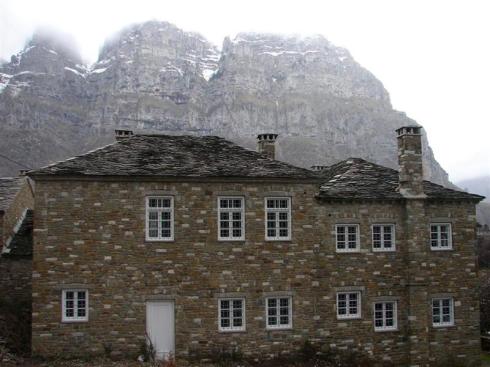
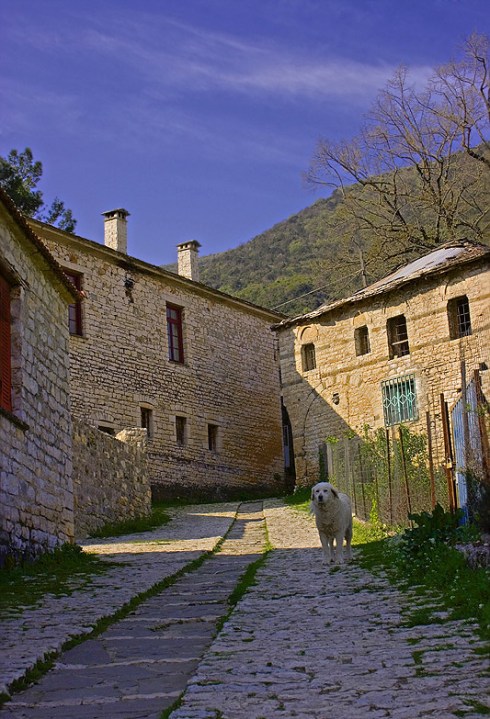
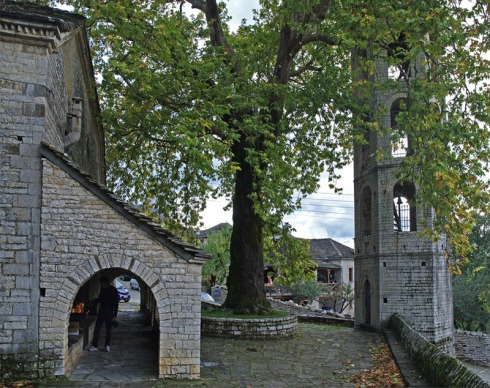
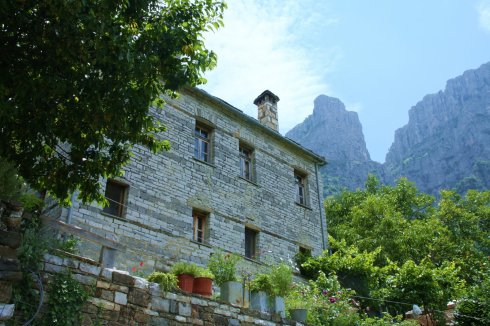
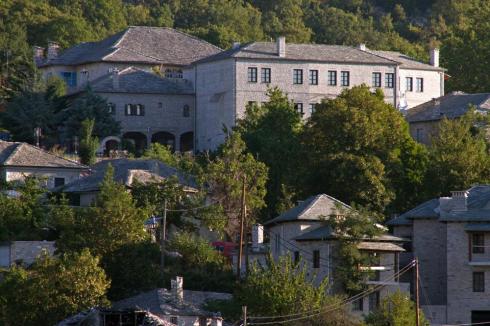
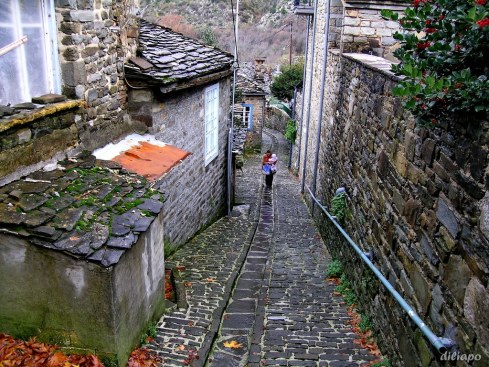
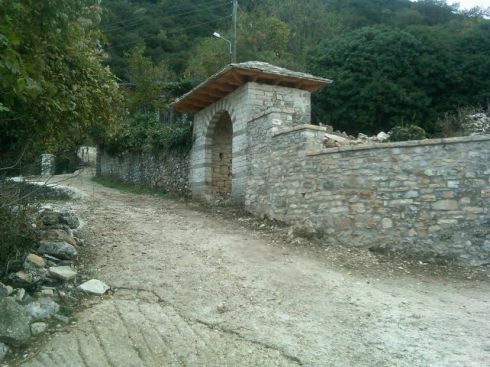
Traditional Epirotiko village architecture from various parts of the region, obviously not the communities of poverty-stricken hillbillies, built with money made abroad by emigrants; the final picture at he very bottom is the front gate to my mother’s patriko, the house where she was born.  Her family made their money through three generations of baking businesses in Bucharest. (click)
000116

papingo

1704170417041704_12

Papingodsc_0416

PapingoIMG_4952

Monodendri-Hotel-22

Tsepelovo59399932

Giotopoulos gateunnamed

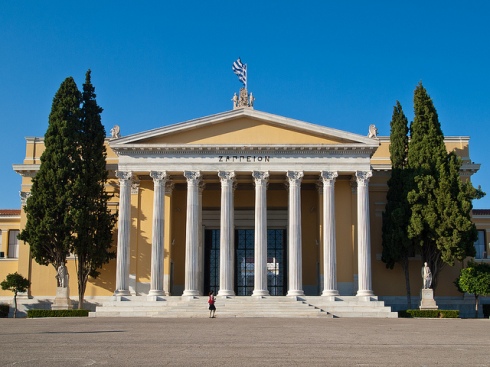
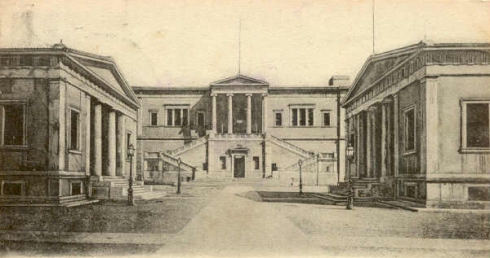
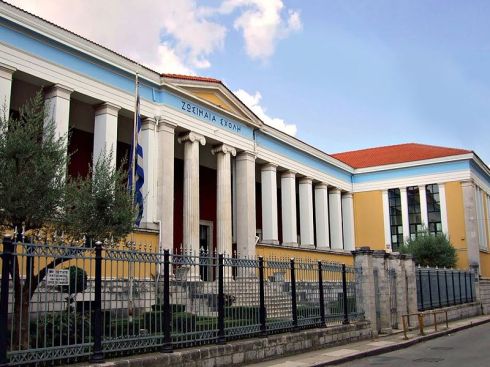
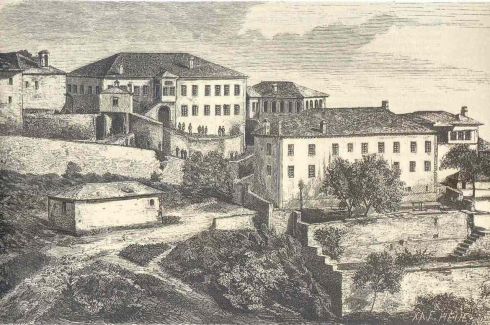
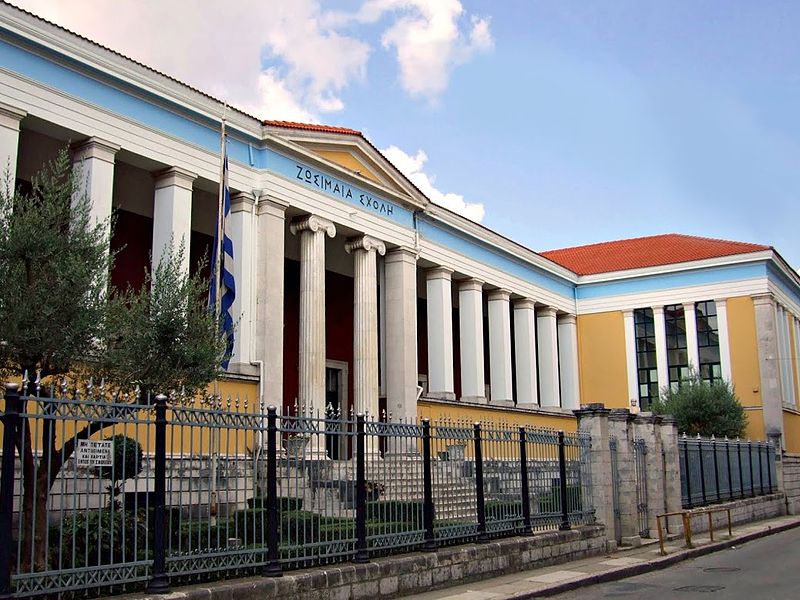
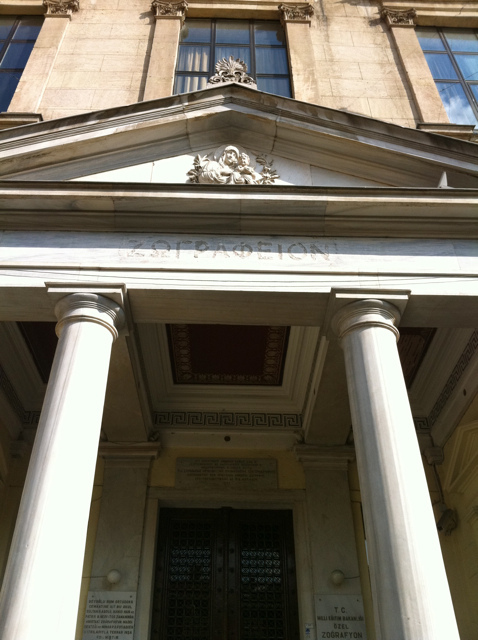
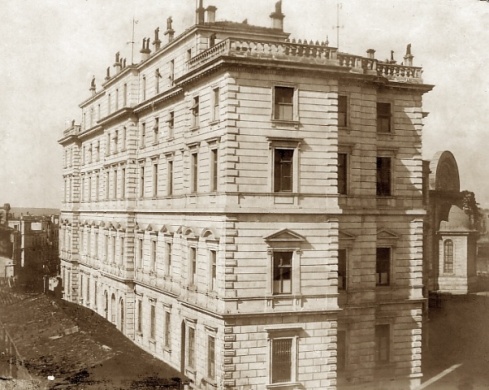
And below — in order — the Zografeion and Zappeion Lycées in Istanbul, the Zappeion exhibition hall and gardens in Athens, the National Polytechnic School in Athens, the Zosimaia in Jiannena, and the Zografeion college of Kestorati, all just a few of the institutions funded and built completely by Epirotes (click).
5694293094_8d58ab27da_z

zappeion

OLYMPUS DIGITAL CAMERA

polytechneioPatision_Complex

ZosimaiaΓυμνάσιο_Ιωαννίνων_3

ZographeionCol

I have a friend in Greece who’s from a part of Greek Macedonia that, before the refugee tents went up there in the 1920s, was inhabited exclusively by mosquitoes.  We were good friends but we had more than our share of tensions because he was an insufferable kind of arrogant Eurocrat that Greece used to produce at the time and had some supposedly hot-shot job with one of the sleazier Russian-type Greek communications moguls to appear in the nineties — μιλάμε principles yok.  And for some reason, he had this implacably neurotic competitive impulse that he would always unleash on me any time I spoke about Epiros, especially if it was with any amount of pride.  “It eez the poooorest proveens in Euuurope…Galicia in Spain and Epiros…are the pooorest proveeenses in Europe…” he would say to me constantly, like a Brussels parrot.  And after WWII, the practice of leaving families behind and going off to work abroad and returning only occasionally became untenable, and most of Epiros did become tragically depopulated.  But it was poor because it was depopulated and the only permanent inhabitants of many communities were pensioners, not because it was a region that traditionally suffered from desperate poverty.****  The hot-shot job and the whole Euro-thing has collapsed since then, along with the whole balloon in which it existed, of course, and he’s a significantly humbler person today.  But it was just so infuriatingly ignorant and anistoreto on his part to see Epiros as some Greek Appalachia and his motivations for harping on that distorted image escape me to this day.

Anyway, that morning I wanted to buy five or six simitia and pile them on Vangeli’s head as a reference to this simitçi tradition, but I could see he wasn’t having it, so I didn’t even try.  He insisted it was the anise in the rakı that made him sick and has sworn that from now on it’s only “real” raki for him — straight and Albanian — with no sissy Politiko flavorings to eff him up.

*************************************************************************************************************************************************************************************************************

* Turks are among the most honest people I have ever come across in all my travels, and not because of modern efficiency like in Europe, but out of traditional philotimo or honor.  I’ve had a Turk from a Taksim pilav stand recognize me as I walked by, and come up to me to give me one lira change he owed me because three days earlier I had eaten there and he was short.  I’ve had to fight with a Turkish simitçi because he wouldn’t sell me a simit because it was late in the day and they were stale, begging him, eventually giving up because he simply refused — the famous Turkish “yok”; when you hear it give up immediately.  I’ve had Turks — this happened to me in Afghanistan once too — run down the street after me to give me a Bic pen I had forgotten on their restaurant table.  But something happens to a Turkish cabdriver when he’s in the Sultanahmet area and he becomes the biggest sleazebag in the world.  I think that now that tourists have discovered the Beyoğlu side of the city and generally prefer to stay there, there’s greater tourist traffic between Pera and the important monuments of the old city, and these jerks take advantage of it.  But be tough with them; simply refuse to pay more than 20 or 25 lira — no matter what his rigged meter says — and walk away and tell them you’ll call the police if they don’t like it and, being cowards, like most frauds and liars, they’ll immediately back down.

The route from Şişhane or the Galata Tower, across the Galata bridge to Hagia Sophia has to be — and always has been — one of the most important pedestrian traffic axes in the city.  And instead, both Karaköy and Eminönü — the two districts and “squares” that face each other across the Horn and are like the two ventricles of the historic heart-like link of the City — are hideous, dirty, badly designed nightmares to walk through.  Instead of worrying about Taksim so much, Erdoğan might want to put some effort into redesigning this essential, central binder of the two Istanbuls.  But that would be a massive project that would involve levelling almost everything that’s been built there in the past forty years and starting with a clean slate.  Plus, you don’t want to give him too many ideas because he’s perfectly capable of building something as ridiculous as a ski-lift from Şişhane to the Hippodrome to assist tourists in their sight-seeing.

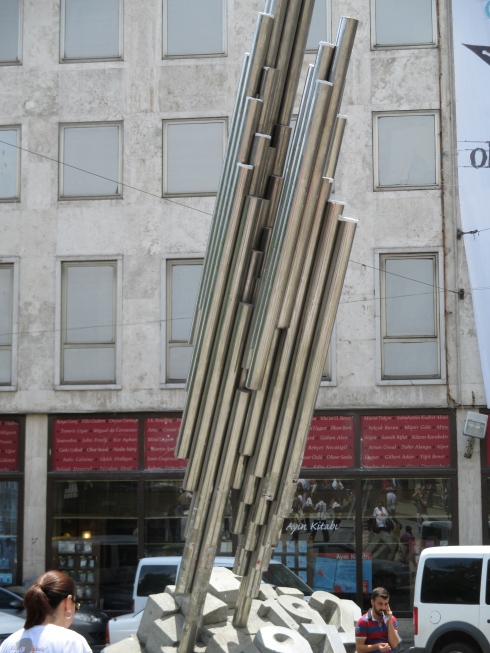
** The Staurodromi is one of the nicest spaces in Pera.  The gates of Galatasaray are beautiful, the other corners have their original turn-of-the-century buildings intact and there’s one modern, kind of semi-Brutalist building in travertine that I really like, that houses a bank and a bookstore and that you can see in the picture above behind Vangeli and in this one below.  The only thing that mars the whole space is this ugly sculpture:
Uranium piles

Does anybody know what it’s supposed to be?  Missiles of some kind?  I don’t know what enriched uranium piles look like, but during Fukushima and every time someone talks about Iran or North Korea and uranium piles, my imagination immediately conjures up this horrible sculpture.

*** This was all part of what I can only generally call the “Great Mobilization” of the Greek world that began in the early eighteenth century.  The confluence of factors that caused this are so intricate that they’re hard to summarize: the primary spark was perhaps the massive wealth accumulated by the Phanariotes — Greek aristocratic families in Constantinople prominent at the Patriarchate and, by extension, at the Porte — who had used their influence in imperial circles to turn most of what is now Romania (Moldavia and Wallachia) into their own autonomous Greek kingdoms, which they sucked dry, and how that wealth was poured into Greek institutions and trickled down into Greek hands generally; the concurrent spread of Greek educational and commercial networks in the Balkans and Eastern Europe and later in the Near East, in the rapidly modernizing economy of post-Mehmet Ali Egypt especially; the way the so-called Greek Enlightenment worked through both these kinds of networks.  The increased mobility that the nineteenth century made possible; most people, for example, don’t know this, but the Greeks of the Anatolian Aegean coast and the Marmara were almost exclusively migrants from the islands and mainland Greece — and even later the Kingdom of Greece itself, Greece basically having been an economic basket-case since the get-go — that started settling there in large numbers in the later eighteenth century and not, as we romantically like to believe, descendants of Byyzantine Hellenism; the only remnants of Byzantine Hellenism in Asia Minor were the Greeks of Pontus and Cappadocia, of course, and small pockets near Konya and Kula and Isparta and that lake region, all of whom, except for Pontioi, were Turkish-speaking until some of the men started learning Greek in the nineteenth century.  (In isolated areas of Cappadocia, a dialect of obvious Greek origin had also survived into the nineteenth century but was already dying out by then, and was so heavily Turkish in vocabulary and had even developed extensive agglutinative structures like Turkish that it’s almost impossible to call it Greek, any more than you can call Vlach Roumanian.)  Then there were the colonialist economic incursions into the Ottoman Empire and its reduction to a European debt-slave (much like “Memoranda” Greece today) that together with the privileges for Christians that the Great Powers forced the Ottomans to grant, created a space for growing Greek and Armenian prosperity from which Muslims (and Jews, for that matter) were excluded, and that produced exclusively Christian micro-economies within the Empire in which Greek rural migrants could find work and prosper.  All this had an enormous effect on Greek life everywhere.  You can see it in the village architecture of certain regions of the Greek world.  And you can see it in traditional dress of Greek rural women.

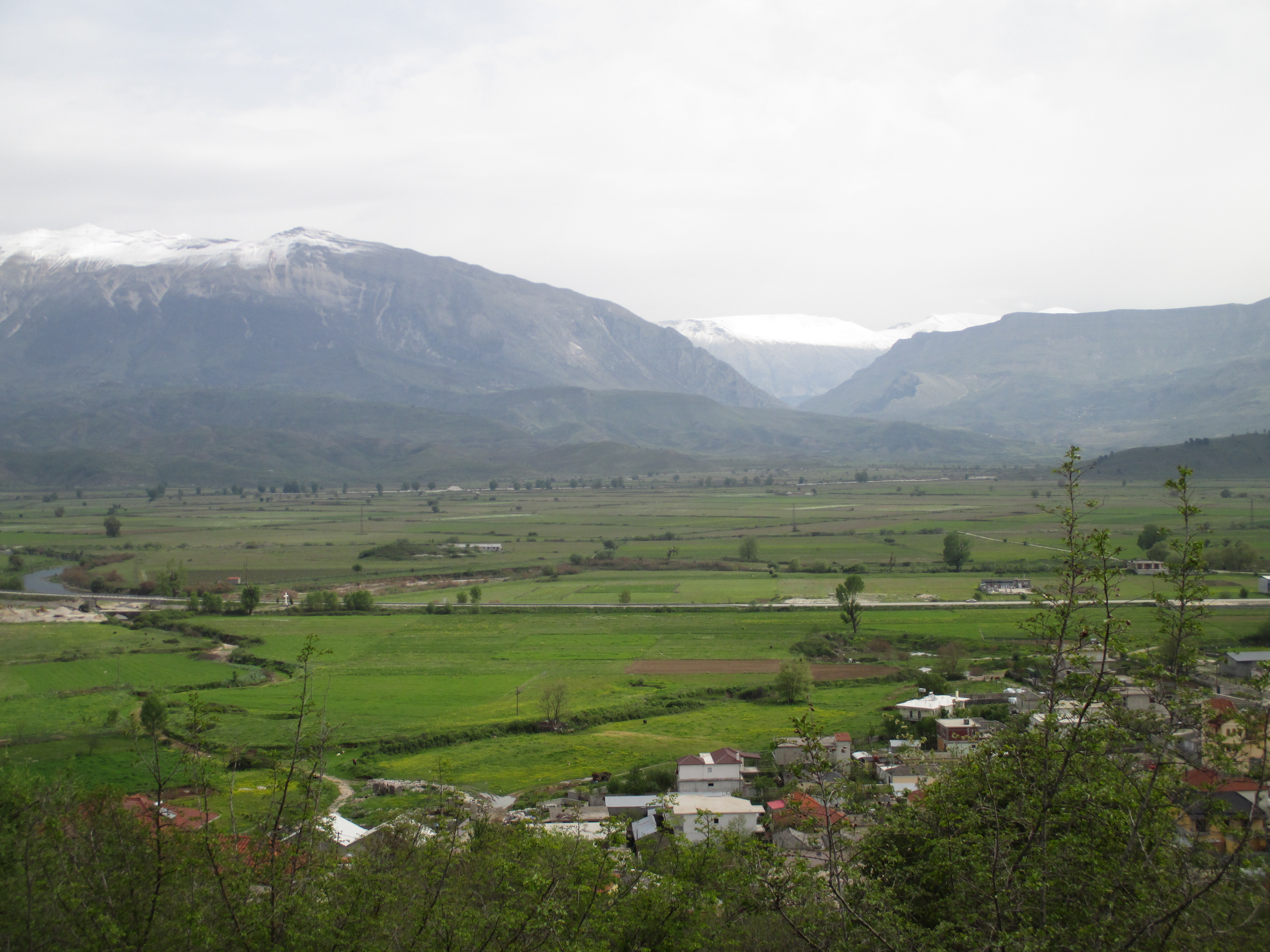
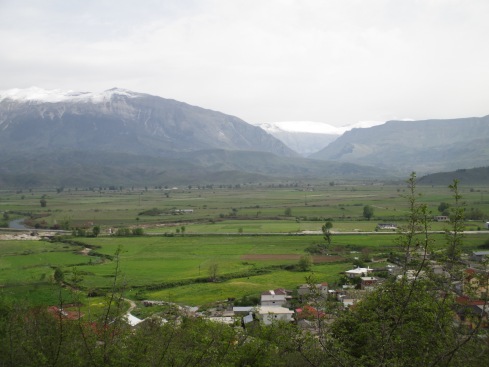
My father’s villages in the valley of Dropoli are situated in one of the few extensive, arable parts of Epiros, the fields you see in the pictures taken from atop the village itself (click):
IMG_0075

Paradoxically, it was this theoretical asset that kept our villages relatively poor until the mid-nineteenth century, because these fields were all çiftlikia of Muslim landowners (“fiefs” I guess; don’t ask me to explain Ottoman land tenure to you, or tell you the difference betweeen a çiftlik or a timar or anything else, because every time I try and read about it I fall asleep and don’t remember anything I’ve read when I wake up) and we were essentially sharecroppers for them.  Only with the exponential growth of emigration in the nineteenth century did any kind of considerable prosperity come to our villages and many were even able to buy their village lands from the increasingly impoverished ağadhes themselves.  Like I said, this was markedly obvious in the changes in female costume and the complete switch of male dress to frangika, Western clothes; traditional male outfit of the region would have looked something like this, the characteristic white felt pants called poutouria (this photo is from southern Serbia actually, but was the nearest approximation I could find) and not the fustanella kilts that folklore groups in the village like to use today indiscriminately and inaccurately:
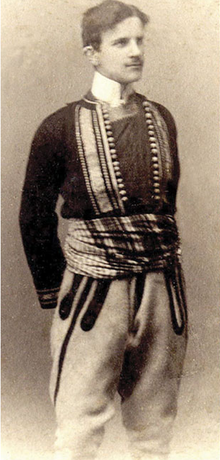
Poutouria220px-Teslacirca1880(2)

While, with the women, in extremely old photos from Derviçani, you can see that almost all the articles of the costume were home-made by the women themselves, with growing wealth you see the gradual addition of articles of clothing that had to be made by professionals.  My grandmother’s outfit here, for example, especially the vest and apron:
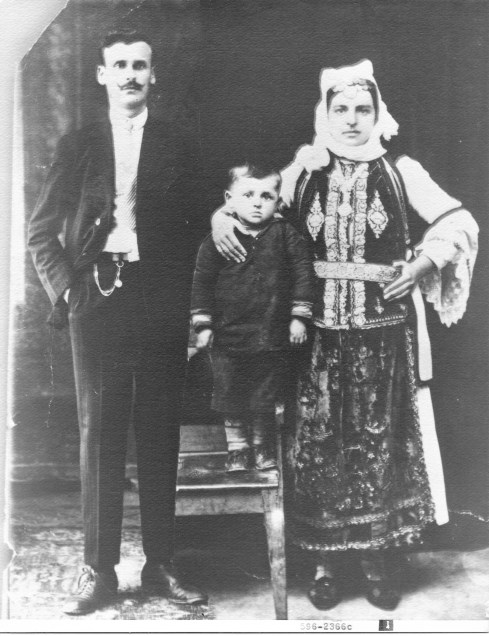
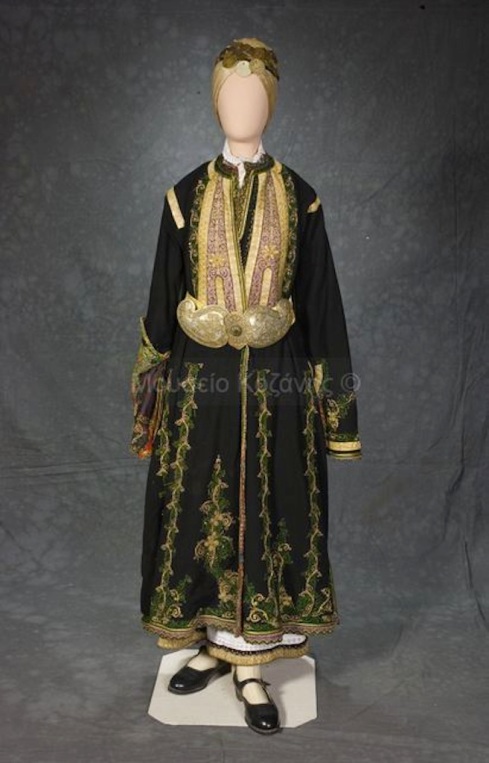
Family…obviously had to be made by a professional sirmakeşi — an embroiderer of gold thread — in Jiannena or Argyrocastro, and the dress of some particularly wealthy villages, like those of Lunxhi, behind the mountains to the left across the valley in the photo (Albanian-speaking Christians with whom we intermarried extensively and still do, the homeland of Zappas and Zographos, the benefactors mentioned above) had, by the end of the nineteenth century, simply become regional variations of Ottoman urban dress, like in this photo, which the museum of Kozani (why it ended up in Kozani?) felt it had to put its water stamp on, like someone was going to sell the design to YSL or something:
VI2M8774.TIF

**** Despite my friend’s condescension, regional funding initiatives for these “poorest provinces in Europe” have greatly expanded the university in Jiannena and developed an extensive and prestigious medical research center there, an information technologies industrial park, renovated (sometimes over-renovated) large parts of the old Ottoman city and created a general climate of growth and prosperity seemingly unaffected by the problems of the Greek economy.  Epiros has become a little bit like a Greek Bavaria or the French south-west: a traditional, somewhat backwards area that made the leap over the ugly stages of modernization to post-modern comfort and prosperity.  Half-ruined villages have been renovated, largely through the skills of Albanian craftsmen, who still were trained in the traditional building skills necessary to preserve the region’s distinctive architecture.  There’s good traditional and contemporary food in Jiannena and in some of the newly developed tourist towns.  There’s skiing in the winter; there’s hiking and mountain-climbing in the summer and gorgeous beaches only an hour-and-a-half away from each other on the new highways.  And it’s generally agreed that Jiannena is one of the most pleasantly liveable of Greek provincial cities and Epiros one of Greece’s most beautiful and pleasantly liveable provinces.

Comment: nikobakos@gmail.com

My Circassians

25 May

AdygeaReaders might remember I’ve had a long-term interest in Circassians since high school.  Of all the peoples collectively known in Turkey as muhacir, the Ottoman Muslims who took refuge in the Anatolian heartland of the Empire as it shrank, probably none had a more torturously, circuitous odyssey to ultimate safety in Turkey than the Circassians.  Here’s a selection about them from a post I wrote in February about why I was boycotting the Sochi Olympics; it wasn’t just for Putin and his filthy, murderous personage, but because the games were being held on land an admirable and honorable people had fought long and hard to keep and had been brutally thrown out of by Imperial Russia:

“And then there are the Circassians.  I became obsessed with Circassians in high school because I had to know who these people were, so physically beautiful apparently, that they held the entire Near East in thrall for centuries.  Circassians were the first reason I ever went into the New York Public Library, because the library at Stuyvesant didn’t have anything on them.  This is also around the time, as a nerdy sixteen-year-old, that I started developing the totally adolescent, romantic fascination I still suffer from, for honor-obsessed, heavily-armed highlanders — Montenegrins, northern Albanians, Pashtuns — who don’t easily let themselves get pushed around by outsiders.   It fed a lonely teenager’s fantasies of empowerment then.  Now, I couldn’t tell you.  Probably still.

“The Circassians lived in a huge swath of plain, foothill and high mountain country in the northern Caucasus.  Most of the sites of the this month’s games are being held on formerly Circassian territory.  This is a map of their general distribution in the eighteenth century, right before Russian expansion southwards began:

Circassia_in_1750

(click)

“For more than a century they fought a brutal tooth-and-nail war against the Russians and their Cossacks.  When they finally capitulated in 1864 it was in Sochi.  The majority, which would not agree to an oath of loyalty to Russia were deported, in what was probably the first campaign of ethnic cleansing of such dimensions in modern history.  For months, the beach at Sochi was a Dunkerque-like humanitarian disaster zone, with tens of thousands of shelterless, starving and diseased Circassians waiting for Ottoman ships to take them to safety in Anatolia or the still-Turkish Balkans or dying on the spot.

Expulsion_map_of_the_Circassians_in_19th_century“It certainly represented the largest civilian death toll of any war up to its time and today, ninety percent of people of Circassian descent live outside their original homeland, mostly Turkey, but also Syria, Jordan and Lebanon.”

(To read the whole post: Ignoring Sochi.“)

And as with Native Americans in North America, as their government was massacring and expelling them, Russian poets and writers like Lermontov, Pushkin and Tolstoy were romanticizing them, sympathizing with them and entering in a love affair with all the peoples of the Caucasus that literary Russia still has not recovered from.  Someone, everywhere, at all times, has a heart and a soul — for whatever good it does.

I had assumed muhacir is constructed from the Arabic “mu = doer of something” plus the roots ‘h’ + ‘j’ + ‘j’ (?) which almost sounds more like “pilgrim” –  as in “Hajj.”  But “mu” turns out to be a passive participle marker of someone who is made to do something, in this case not as in “Hajj, pilgrimage, but  ‘h’ + ‘j’ + ‘r’ as in “Hejira?” which would mean “fleer,” as in those who fled with Muhammad to Medina from Mecca in 622.  That would make more sense than traveller, which would be the “mu-sa-fir” recognizable to any Greeks as an old-fashioned word for “guest,” except to those Neo-Greeks that are so Post-Ottoman that they’re Post-Culture-of-Any-Kind and most certainly Post-Hospitality.  The Muslims that left India after Partition in 1947 to go to the land of Islamic Purity are also known as muhajir in South Asia.  I say that the Circassians’ route was particularly circuitous because many of them were first settled by the Ottoman government in the Balkans — especially Bulgaria and Kosovo (where there’s still a tiny community), where they were used to demographically offset the Christian population and because their warrior reputation would come in handy against Christian rebellions and Russian invasions.  (Though there is one wild episode of the Greco-Turkish War where a band of Circassian çeteler [çetes] in western Anatolia actually aided the invading Greek army.  Go figure.  Any-thing is possible in our part of the world.)  Needless to say with the coming of independence for the nations of the Balkans, they were uprooted again to Anatolia and other parts of the still Ottoman Arab world.

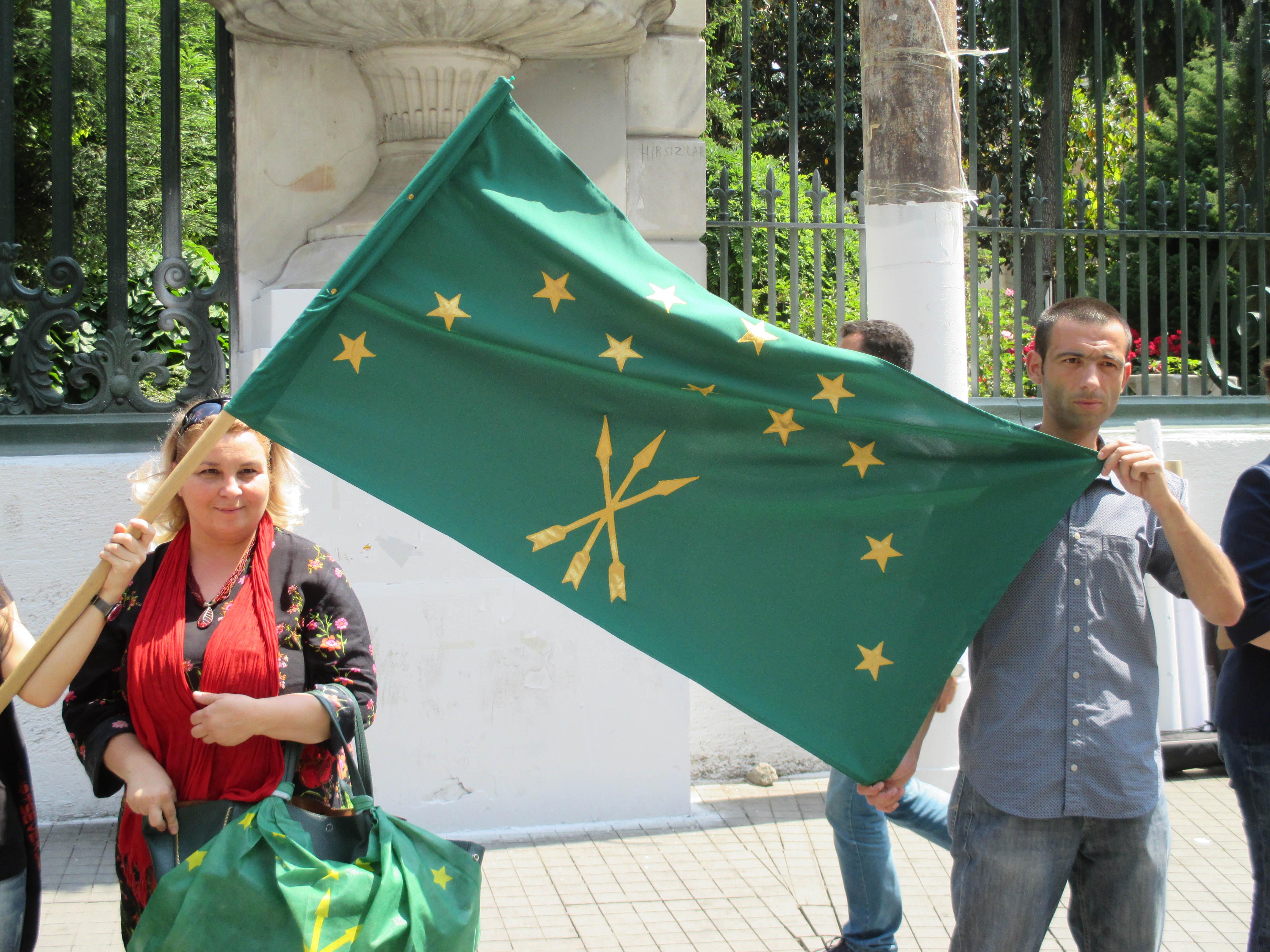
This year is the 150-year anniversary of the final, catastrophic expulsion from their Caucasian homeland and local Circassians (“Çerkes” in Turkish) have been holding demonstrations in front of the Russian Consulate down here on the Jadde (I wouldn’t even lower myself to asking for Putin’s ear) and then closer here to my place in front of Galatasarary.  (Click)

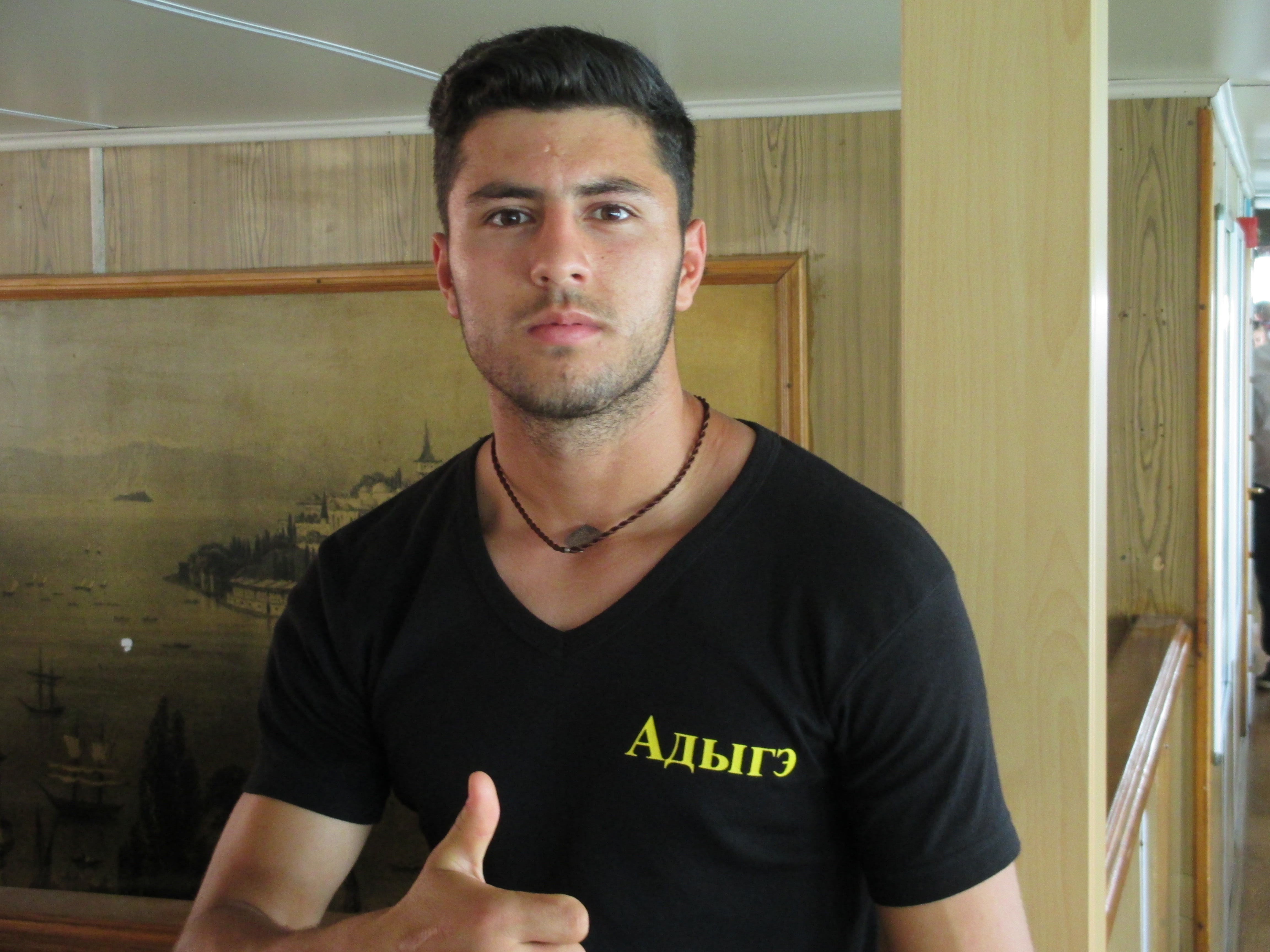
IMG_0777IMG_0775But I was kind of disappointed because I couldn’t get any really good pictures except some like these above.  Then I get on the ferry from Beşiktaş to go to Kadiköy with my cousin, Vangeli, to feed him at the spectacular Çiya restaurant there and visit Beylerbeyi, my favorite Ottoman palace, and by blogger-photographer’s luck right across from me is sitting this handsome Circassian kid from central casting (click):

IMG_0780 He was surprised I knew that his t-shirt said “Адыгэ” – “Adyghe,” which is what Circasians call themselves, written in the Cyrillic script they now use.  I asked him if he spoke the language and he said no, but some other Circassians I found the next day in Pera said that due to a concerted effort on the Turkey-wide community’s part — language classes, theater workshops, radio programs — more Circassians in Turkey of this kid’s age speak more of at least a little bit of the language than their parents do and that interest is increasing.  Insha’allah.  Cool.  So if you don’t respect these people for their legendary beauty, their ferocious warrior rep, the fact that they managed to stave off the forces of Imperial Russia for two centuries, that as the Mamluk military elite they effectively ran Egypt for five-hundred years till Mehmet Ali the Albanian massacred them in a totally, shitty, un-Albanian, pabesiko (“pa” = no + BESA), dishonorable, ambush — see  (“BESA: A Code of Honour,“) — then just admire them for sticking together as a cohesive and living identity after being scattered across the world for a century and a half now.

The suffering of Circassians and all the other Muslim peoples of the Caucasus are laid out in a bit of an uneven but heartfelt and informative book by Oliver Bullough called Let Our Fame Be Great: Journeys Among the Defiant People of the Caucasus — here’s his website too (check out some interesting pics): Oliver Bullough: Let Our Fame Be Great.

lofbg-usa-cover-300wUnfortunately, I don’t know if there’s a Turkish translation (or Arabic: Jordan, where Circassians still make up the King’s Royal Guard, Syria and, some extent Israel, is where most Circassians outside of Turkey now live) for young Circassians today to read.

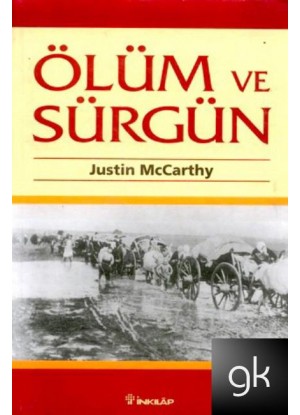
Another book that I do know there’s a Turkish translation of, and is probably the only monograph to deal with the step by step expulsion and ethnic cleansing of Ottoman Muslims through the nineteenth and and early twentieth centuries, but tracing roots of the process back to even the century before is Justin McCarthy’s Death and Exile: The Ethnic Cleansing of Ottoman Muslims, 1821-1922Not polemic, not propagandistic, just the facts and figures that speak for themselves.  It should be required reading for every Christian in the former Ottoman sphere.  It’s not exclusively about the Circassian tragedy but there is, as you can imagine, a great deal of material on their experiences.

51qnwpuNCVL._SY344_BO1,204,203,200_Turkish-speaking Circassians should definitely check this book out that’s available everywhere in İstanbul; they’ll learn a lot.  I really hope they get a chance to.  Share this post with friends if you found it interesting.  Feel free to write me with any comments.  And keep the memory alive!.  NB

55696-olum-ve-surgun-death-and-exile-justin-mccarthy

Comment: nikobakos@gmail.com

Welcome to C-town: Tear gas in the Staurodromi…and a dedication: “In Spite of You…”

14 May

Galatasaray Lisesi gatesGalatasaray Lycée gates

Today, I had my first experience of tear gas.  A demonstration that, like most, was perfectly peaceful, started, like most, in the center of Pera, where the Jadde meets the Yeni Çarşı Caddesi and the Meşrutiyet Caddesi to the form the crossroads that the local Greeks used to call just that — το Σταυροδρόμι — the “Crossroads.”  If Pera was/is the center of the city, this was/is, despite everything, the center of Pera.  Here’s an old pic, the gates of the Lycée on the right:

Stabrodromi

PeraSevgen_Map

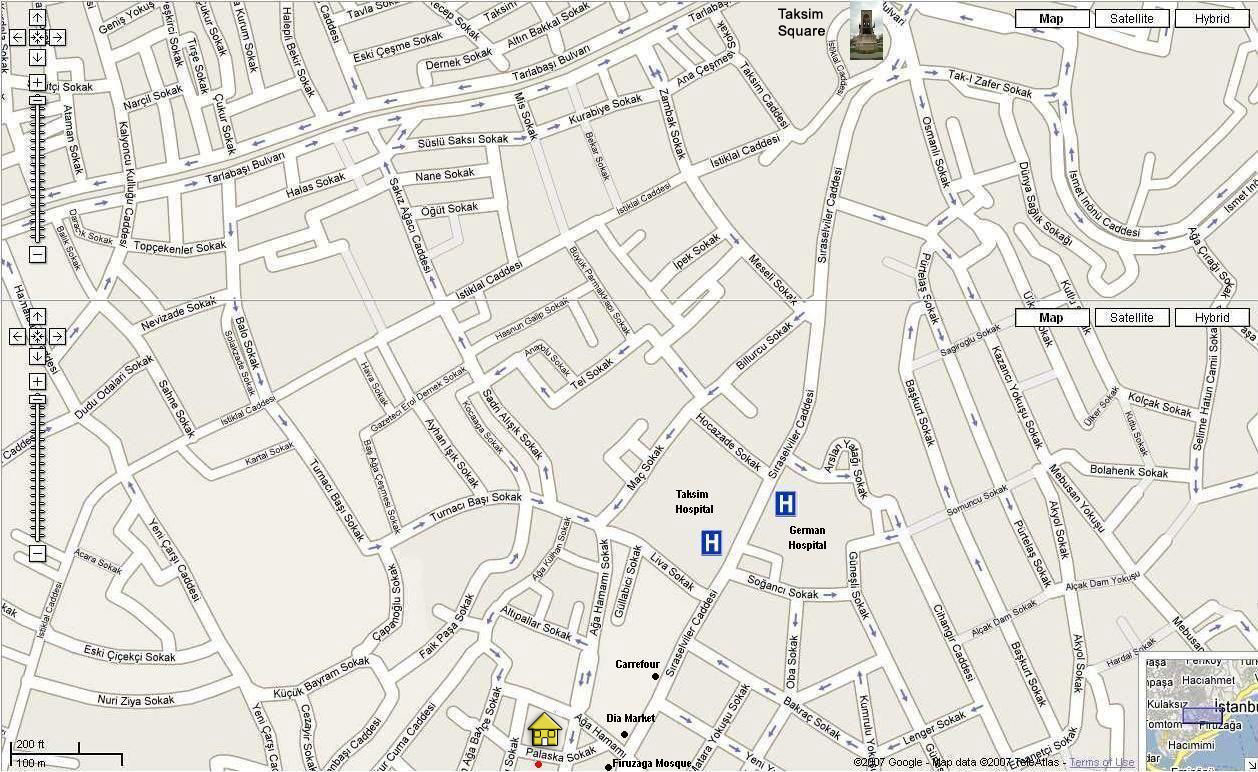
Pera: the large lot at the corner of the İstikal Caddesi and the Yeni Çarşı Caddesi in the lower-left-hand quadrant of the map, just before the İstikal bends a little to the south, is the beautiful Galatasaray campus at the “Crossroads.” (click)

This started out as a quiet sit-down demonstration about the tragic mining accident: “245 Dead and 200 Missing in Turkish Mine Disaster “(NYTimes, May 2014).  I’m in no position to tell whether the accident was the government’s fault or its response criminally ineffective as most people here seem to think, but it does kind of sound like one of those acts of God that a people angry at their government are just looking for as a club to use against an unpopular regime.  If the mining accident wasn’t in any way the government’s fault though, what’s now become the conventional way to break up these demonstrations was: setting up a cordon of armored vehicles around some quiet twenty-somethings and then finally disbanding them with tear gas and water-hoses and helicopters — for pure intimidation’s sake: “shock and awe” — just, stupidly, gives the demonstrators exactly what they want.  It’s inexcusable.  The demonstrations seem to have become weekly events (below) and Erdoğan seems to think he’s showing us all his magandalık by acting like he doesn’t care or dismissing them as works of subversives trying to make Turkey look bad.  (See his comments in The New Yorker article by Jenna Krajeski, “Turkey’s Coal Problem.”)  I’ve never seen a bunch of kids who seem to love their country more.

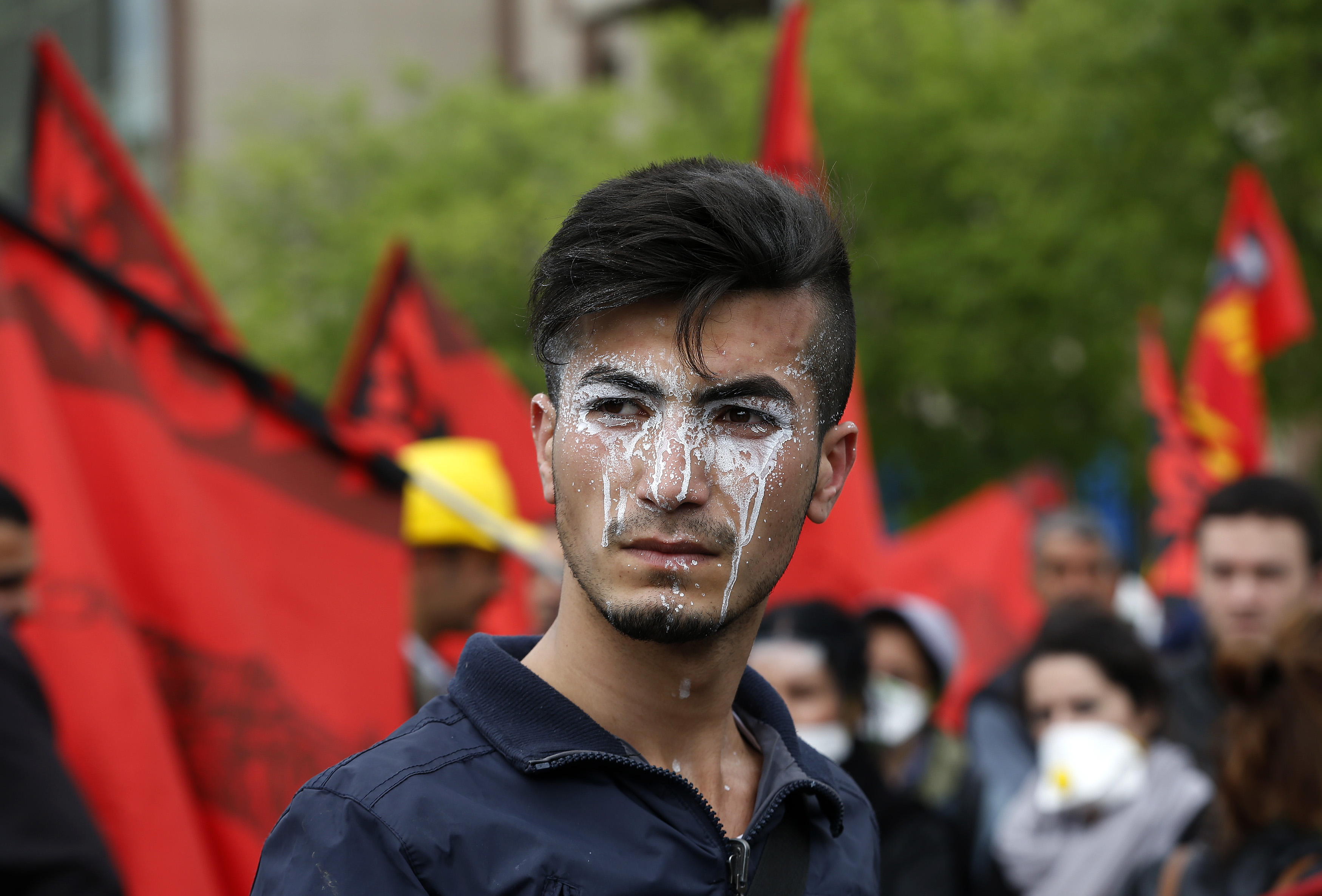
Protester, with cream applied to his face to protect against tear gas, reacts during a May Day demonstration in Istanbul A protester, with cream applied to his face to protect against tear gas, reacts during a May Day demonstration in Istanbul May 1, 2014. (Ümit Bektaş/Reuters)

Here I was all happy on this trip that I had found a place to rent literally fifty meters from the Staurodromi, and instead getting home tonight involved passing through the thick of the left-over tear gas cloud and tires burning outside the door.  The tear gas was, not so much a more painful, but much more panic-inducing a feeling than I had imagined it could be.

Here’s a dedication I want to make to Tayyip Bey, Brazilian cultural super-hero Chico Buarque’s 1970 “A pesar de você” — “in spite of you.”  The story of the song, from Lyrical Brazil:

“After spending approximately a year in Italy in exile from Brazil’s military dictatorship,  Chico Buarque returned to Brazil in 1970 and met with a rigid censorship machine — a result of Ato Institucional V, which institutionalized the pre-release censorship process.

“In an interview in September 1971, Chico lamented, “Of every three songs I write, two are censored. After being censored so much, something troubling is happening with me: I’m beginning to self-censor, and that is terrible.”

“The censors had grown particularly harsh with Chico after their inadvertent release of his thinly veiled protest anthem “Apesar de você.”

“Chico wrote and released “Apesar de você” as a single in 1970. The censors initially approved the song and it became a quick hit on the radio. As the song became popular, rumors spread that it was dedicated specifically to general Médici, who served as president from 1969 – 1974.(Chico says the “you” in the song actually referred to the entire system.) To the censors, Chico argued that he had written the song for a rooster that mistakenly believed that the day only broke as a result of his song, until one night when the rooster lost track of time and realized that day broke in spite of him. Unconvinced, the censors banned the song and punished those who had let it through.

“After the song was banned, Chico says he received the treatment of a traitor who had attempted to dupe the censors.  As a result, he faced even more stringent censorship. “Apesar de você” was re-approved and re-released on the album Chico Buarque (Samambaia) in 1978, as the government began a gradual political liberalization process during Ernesto Geisel’s presidency.”

The clenched-teeth rage of this song — “you’ll pay me back with interest” — behind the sweet samba beat and Buarque’s soft Rio accent always moved me enormously.  And the image of the rooster who thinks the day breaks because of his crowing is beautifully Erdoğan-ish.

And here’s a “non”-video version with much better sound:


********

The lyrics:

Tomorrow will be another day…

Today, you’re the one who calls the shots
I said it, it’s been said,
There’s no talking about it, nope.
My people walk around today
Speaking to the side and looking down at the ground

You, who invented this State,
Invented by inventing
All this darkness
You who invented this sin
You’ve forgotten to invent forgiveness

In spite of you
Tomorrow will be another day
Where are you going to hide
From the great euphoria?
How will you prohibit it,
If the rooster insists on crowing?
New water bursting forth,
And our people loving one another, without stopping

When the moment arrives
This suffering of mine
I’m going to charge you for with interest, I swear
All this repressed love,
This scream contained
This samba in the dark.

You who invented this sadness
Now be so kind as to “disinvent” it
You’re going to pay – and doubled
Every tear that rolled
In this anguish of mine

In spite of you
Tomorrow will be another day
I will pay to see
The garden that you tried to stop from blooming.

You’ll end up choked in bitterness
Seeing the day break
Without asking your permission.
And I’m going to die of laughter
And that day is bound to come
Sooner than you think
In spite of you

In spite of you
Tomorrow will be another day
You will have to see
The morning reborn
Gushing poetry

How will you explain to yourself
Seeing the sky clear, without your permisson, suddenly
and with impunity?

How are you going to stifle
Our chorus singing
Right in front of you
In spite of you

In spite of you
Tomorrow is going to be another day
You’re going to to be out of luck
Etcetera and so on
La la-ya, la la-ya, la….


Hoje você é quem manda
Falou, tá falado
Não tem discussão
A minha gente hoje anda
Falando de lado
E olhando pro chão, viuVocê que inventou esse estado
E inventou de inventar
Toda a escuridão
Você que inventou o pecado
Esqueceu-se de inventar
O perdãoApesar de você
Amanhã há de ser
Outro dia
Eu pergunto a você
Onde vai se esconder
Da enorme euforia
Como vai proibir
Quando o galo insistir
Em cantar
Água nova brotando
E a gente se amando
Sem pararQuando chegar o momento
Esse meu sofrimento
Vou cobrar com juros, juro
Todo esse amor reprimido
Esse grito contido
Este samba no escuroVocê que inventou a tristeza
Ora, tenha a fineza
De desinventar
Você vai pagar e é dobrado
Cada lágrima rolada
Nesse meu penarApesar de você
Amanhã há de ser
Outro dia
Inda pago pra ver
O jardim florescer
Qual você não queria
Você vai se amargar
Vendo o dia raiar
Sem lhe pedir licença
E eu vou morrer de rir
Que esse dia há de vir
Antes do que você pensaApesar de você
Amanhã há de ser
Outro dia
Você vai ter que ver
A manhã renascer
E esbanjar poesia
Como vai se explicar
Vendo o céu clarear
De repente, impunemente
Como vai abafar
Nosso coro a cantar
Na sua frenteApesar de você
Amanhã há de ser
Outro dia
Você vai se dar mal
Etc. e tal
Lá lá lá lá lai-
Will be back for more post-Balkans trip coverage soon.  NB.

Nobody really cares about Gezi Park: Greek thoughts on the protests of 2013

1 Nov

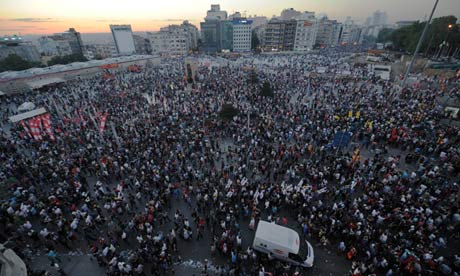
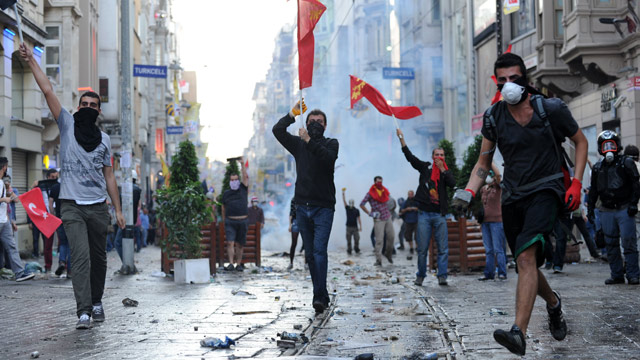
Taksim Square protest

“Oh, is that what it’s called?” I remember saying to myself when last summer’s protests erupted, and I suspect I was joined by quite a few lovers of İstanbul and even natives when they found out that the scruffy, forlorn lot north of Taksim and behind the Arab nargile places along the Cumhurriyet actually had a name.  I may have spent about four or five accumulated months of my life in İstanbul over the years and I think I’ve been inside this park once; one look is enough — and the much bandied-about slogan about “saving the last green space in central Istanbul” becomes comical.  A sudden nostalgia for the place sprang up at the time; everyone suddenly had memories of playing there as a child, but they didn’t seem very convincing.  Nobody cares about Gezi park.  Or did last summer.

What young Turks cared about was Taksim, but even more the string of neighborhoods south of Taksim to Karaköy and their enormous importance in the life of İstanbul.  Proof enough – and weighty proof at that – is that serious civil disobedience began in the area back in the spring, not when the government tried to start construction in Gezi, but when it tried to impose limitations on alcohol consumption in the neighborhood.  Remember the alcohol – it’s a central part of our story, enough for us to maybe have called the whole upheaval the Rakı Revolution and not the Taksim/Gezi protests.  But somehow the press and the people itself forgot that.  Somehow that got lost as the movement morphed into a catch-all protest with a not particularly convincing “green” bayraki propped up as its mascot in a shabby, dirty park.

Unclear?  Yes.  It is to me too and I’m sorting it out as I write.

It goes like this: Pera and Galata — because those are the core areas of the municipality of Beyoğlu that really concern us (Taralabaşı too but as a side show, another story) — were, until the middle of the previous century, heavily Greek.  And Armenian and Jewish, but Greek enough so that pidgin Greek was the quarter’s common means of communication till the early nineteen-hundreds. Pera and Galata were centers of non-Muslim life in İstanbul and Pera and Galata were where you went to drink.  Not a coincidence obviously.  And Pera and Galata are still where you go to drink and party – in fact even more than ever.  And that’s why the fact that attempted restrictions of alcohol consumption set off the civil disobedience of 2013 is so important.

The tourist literature and the press never tire of calling this the center of contemporary Istanbul and tourists who used to stay in Sultanahmet and wonder at the eerie emptiness of the old city’s streets at night have finally started to discover the area – the “Old New Town” as Alexandros Massavetas calls it in his loving, lyrical Going Back to Constantinople: a City of Absences.  And truly, as I’ve written before, these neighborhoods dominate the contemporary social and cultural life of İstanbul in a way that’s not comparable to any other major metropolis I’m familiar with.

A060512g

Buyuk_Beyoglu_Haritasi

The neighborhoods we’re talking about, Beyoğlu, with Pera (“over there” in Greek, meaning from the old Byzantine/Ottoman city) at its center. (click)

And here we run into our first paradox, or the origins of a chain of paradox: that this now central “heart” of İstanbul began as a space of marginality.  The Byzantines originally put some of their unwanted Catholics there: Galata’s mother city is actually Genoa.  In Ottoman times, Christians and Jews lived there and made wine and everybody else came there to drink it.  While not an exclusionary, extramural ghetto of any sort – to their credit the Ottomans didn’t often do that kind of thing – it was sort of the wrong side of the tracks: the Ottoman equivalent of the suburbs or the across-the-river Zoroastrian neighborhoods in Iran where Hafez and company went to drink the infidel’s wine and torment themselves with the beauty of the innkeeper’s son: the other side of town, the refuge of disbelief and transgression, of unorthodoxy and the unorthodox in every sense.  The alcohol…

The nineteenth century marked Pera and Galata’s – Pera’s especially — transformation into uprent enclaves: gentrification avant-la-lettre in effect.  The Christian-ness of the area only attracted more of them, then foreign Europeans; the influx of non-Muslims from the rest of the city concentrated its gavur character even more deeply.  There were foreign embassies.  Foreign embassy cultural activities followed.  Cafés.  Theaters.  Neoclassical Row houses and apartment buildings in an eclectic mix of local versions of the Neoclassical or Art Nouveau.  All the apparatus of contemporary European urbanity developed: a place of often obscene display of non-Muslim privilege that reminds one of Durrell’s Alexandria or descriptions of the foreign concessions in Shanghai before the revolution, and increasingly alienating to the average un-Westernized Muslim.  But a city.  One as we mean it.  In the Benjaminian sense.  With everything that the modern city at the time implied and still does: socializing and the public space, boulevard culture, entertainment, exteriority…  WOMEN…  Alcohol, of course…  And with Kyr Panos’ taverna and Monsieur Avram’s textile shop still flourishing alongside.

Az081210mnisuaz

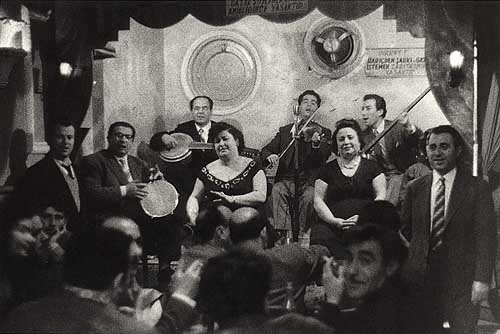
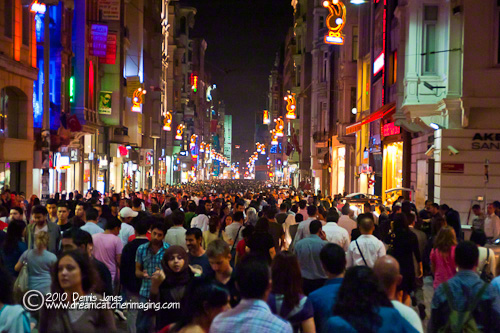
The Jadde at its height, probably early Republican times, by the gates of Galatasaray Lycée (above).  This was the neighborhood known as the Staurodromi by Greeks, the “crossroads” because it’s where the Grande Rue meets Yeni Çarşı Caddesi (the New Market — not sure what that referred to — food market around Balık Pazarı?)  (Click)  Bottom photo is by Ara Guler*

And then all the Kyr Panoses and the Monsieur Avrams went away, for reasons readers know and this blog touches on often and will inevitably look back at again.  And this “center of the city” sat in a kind of rancid aspic for a few decades until a young and dynamic and sophisticated Turkish society reclaims it.  And it comes alive again.  And yet the paradox still stands, now sharper than ever (though how conscious and to whom is very much up for debate and may be my real question): that this is the cosmopolitan center of İstanbul; but what made it cosmopolitan were populations that don’t live there any more, but whose legacy is in both the air and breath of the place and in its physical matter itself.  And what we, Turks today, do about that – how we reconfigure a center of our city so laden with the presence and absence of others in order to suit our contemporary needs – is, to a great extent, what progressive Turks and Erdoğan were fighting about last summer.  Not Gezi park.

Some of Erdoğan’s ideas don’t seem so bad to me; a tunnel for one (already built?), that as I gather goes under in Dolapdere and emerges somewhere in Kabataş I think, that would finally free Taksim, never an aesthetically promising piece of real estate, from having to be a major traffic circle,  though Harvard’s Hashim Sarkis’ idea that: “We know from the 1960s that pedestrianizing everything doesn’t work…Managing the balance is better…” makes sense, and I often wonder about the wisdom of having pedestrianized the İstiklal itself.  The (now aborted?) reconstruction of the Ottoman barracks may turn out to be a piece a kitsch, but you never know.  In Moscow, for example, much that was destroyed by Stalin has been carefully reconstructed and it’s lovely; and some of the rest unnecessary, and garish – and often silly.  Either way, I wouldn’t miss the park.

The true big elephant in the Taksim room is a big old elephant of a Greek church that lords over the whole space.  The church of the Hagia Triadha is one of the post-reform churches of İstanbul, churches that were built during the Tanzimat, when traditional restrictions that imposed visual discretion and inconspicuousness on non-Muslim places of worship were lifted and Greeks in İstanbul built some very conspicuous –and often conspicuously ugly — churches.  The Hagia Triadha is actually one of the lovelier of them – it reminds me of the Balyan mosques a little – and gives you a real sense of just how confident Greeks in the City felt in the late nineteenth century.  But its presence is almost impudent; I can only imagine how more traditional Ottoman Muslims must have felt as they saw these giants go up after the 1850s, and to be honest as I’ve walked by at times even I’ve found myself overtaken by what I can only describe as a mild shtetl-anxiety and thinking: “But so big?  And right here?  Can this be good for the Jews?”  So you can imagine that to Erdoğan and the Turkish Islamist mind its bulk must be doubly provocative, and presents a problem that needs to be solved.  The “central square” of the “modern center” of İstanbul just can’t be left looking so…well…so Christian.

Agia_Triada_Greek_Orthodox_Church,_İstanbul

dsc3663

The church of the Hagia Triadha alone and surrounded by its kebab shops.  (Click on both)

0053 - Istanbul - Taksim Square - Hagia Triada - Orthodox Church

15fk7xv

And another aerial view of the church, the school and surrounding area that gives a clearer idea of layout (click)

So Erdoğan is going to make good on a long-term promise/threat to build a large mosque there to balance out the religious character of the space.  First, he’s going to tear down the circle of döner and kokoreç stands that surround the Hagia Triadha and the neighboring Zappeion, once İstanbul’s most elite Greek school for girls, which is a shame because a circle of smoking lamb fat wafting around the billowing clouds of a church’s incense was always a beautiful olfactory image to me – this is what the Temple must’ve smelled like – and because neighborhood partiers will be deprived of much-needed early morning sustenance.  But philistines like Erdoğan don’t like the smell of lamb fat – probably too familiar — or as Auntie Mame might have said, when you’re from Kasımpaşa you have to do something, so the döner stands will have to go.  And I originally had no sources for this other than my own suspicions, but I was wondering if the döner stands aren’t part of the church’s vakoufia (religious trust properties) and that removing them is another act of expropriation of Greek community real estate that has been going on steadily for decades now; and the Greek community is indeed split into warring camps already about whether taking down the stands is expropriation of parish property or is a good thing; only Greeks can be reduced to a community of about a thousand people, mostly over seventy, and still find energy to bicker about everything; but then there are two Jews left here in Kabul — two –and they’re not speaking to each other over some maintenance issue concerning their one synagogue.  Anyway, the official claim, however, is that the food stands will have to go – get this — in order to make the church more visible so that it and its new neighboring mosque can clearly stand side by side as confessional brothers in the new, beautified Taksim.  Turkey has tried desperately over the past few decades to gain political and cultural capital through gross multicultural gestures of this sort.  This has to be the most nauseating example to date.**

The English-language coverage of the protests paid only the scantest attention to issues of this sort.  Even this piece from the New York Times by Michael Kimmelman: “In Istanbul’s Heart, Leader’s Obsession, Perhaps Achilles’ Heel,” about the reconstruction of Taksim managed to not include a single photograph of the Hagia Triadha, which is quite hard to do actually and, were I a bit more of a conspiracy theorist, would think might be intentional.  As to the former ethnic composition of the area, all reference to the area’s former cultural and linguistic character is colored by the inability of Western — whether American or European — thinkers, to think about multiethnic societies outside of the immigrant societies they know.  In this piece also from the Times that prompted my Tarlabaşı series, “Poor but Proud Istanbul Neighborhood Faces Gentrification,” Jessica Burque says: “Migrant workers have a long history of living in Tarlabaşı, dating from the early 1900s when Greek, Jewish and Armenian craftsmen lived in the area” — no sense that they had belonged to the city for generations, centuries before 1900.  And the above referenced article by Kimmelman refers to Beyoğlu as an area where: “poor European immigrants settled during the 19th century.” — no sense that these people were natives of the city, often of communities that predated the Ottomans, or that they were essential component parts of Ottoman society, from other parts of the empire perhaps, but not outsiders or “immigrants.”  There’s often some vague reference to the buzzwords “diversity” and “cosmopolitan” and no serious mention of what drove the “cosmopolitans” and “migrant workers” away; again a perception that seems informed by seeing this all through the prism of the American immigration experience: as if Pera were a neighborhood on the 7 train, let’s say, and its Dominicans have now moved on to the greener suburban pastures of Bayside.

Unfortunately I don’t know if the Turkish press made any reference to the area’s former social composition when covering the protests or if any Turks did at all.  The closing of İnci, the patisserie, is what most brought this all home to me: “the closing of the historic Emek cinema and a much-loved pastry shop…”  There was quite a fuss about İnci apparently, but was any mention made at the time that this had been one of the last Greek businesses in the neighborhood?  There are two more left in all of Beyoğlu I think, İmroz, the restaurant on Nevizade and, perhaps the only growth industry in Greek İstanbul, a coffin-maker’s near the Panayia in Stavrodromi.  Inci had been there since 1947.  I leaf through Speros Vryonis’ massive “The Mechanism of Catastrophe”*** to the pages containing K. Ioannides’, a journalist from the Salonica-based Macedonia newspaper, cataloguing of ransacked Greek businesses in the area, which means all of them, without exception.  On just the İstiklal Caddesi, Meşrutiyet Caddesi, Pasaj Evropa, Yüksek Kaldırım and Perşembe Pazarı there is a list of three-hundred and twenty-nine businesses.  And you really have to marvel and wonder at whether the Greek “daemon” is more than a myth.****  After the financial decimation of the community by the Varlık Vergisi, the “estate tax” of the 1940’s, when discriminatory taxation against minority groups had wiped out many, and sent many of those who couldn’t pay to forced labor camps, Greeks had bounced back to dominating the retail business of these central neighborhoods in less than a decade – only, of course, to have it all definitively trashed a few years later.  And, sure enough, there it was, at number 27 on the list: “Pastry shop İnci of Loukas and Lefteres.”  When people mourned the loss of İnci last summer, was there any sense that something more than a charming old patisserie was disappearing?  Or that this was a place that had bounced back from total loss in one Istanbul tragedy and then went on to continue serving the city for more than fifty years?
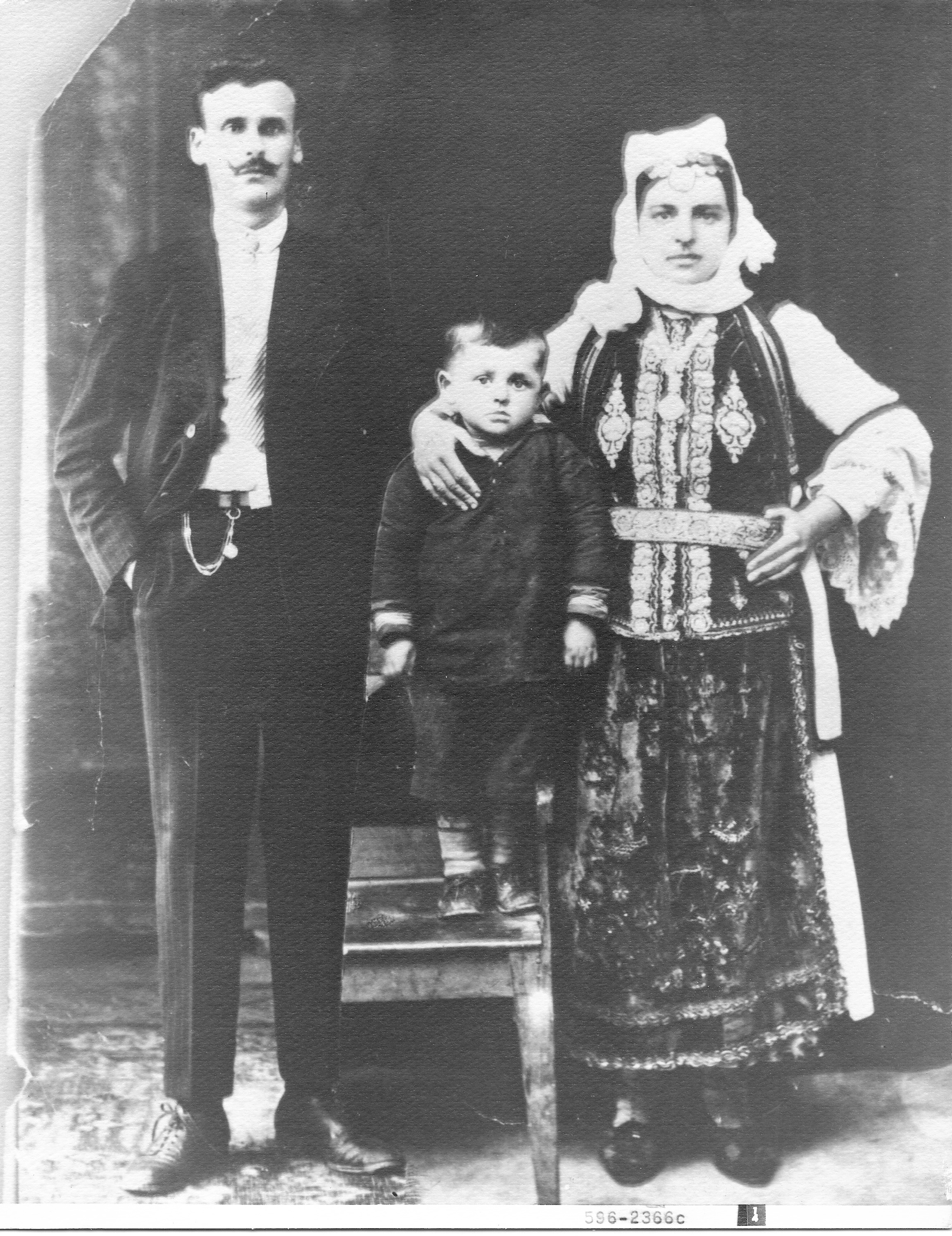
İnci, before and during protests, after closure.

inci-pastanesi-kapatildi

inci-pastanesi_110960868246

inci (5)

inci-pastanesi_443808

inci1-F0BA-2415-C212

What do I want exactly?

All – I thought a lot about whether I should use “almost all” in this sentence and decided against it –because all the hippest, funkiest, most attractive, gentrified neighborhoods in the historic parts of İstanbul are neighborhoods that were significantly, if not largely, minority-inhabited until well into the twentieth century: not just Pera and Galata, but Cihangir and Tarlabaşı, and even Kurtuluş — of course — and up and down the western shores of the Bosphorus and much of its eastern towns too, and central Kadiköy and Moda and the Islands.  (And if serious gentrifying ever begins in the old city it’ll be in Samatya and Kumkapı and Fener and Balat; I wouldn’t put any big money into Aksaray or Çarşamba just yet.)  If young Turks are fighting to preserve the cosmopolitan character of areas made cosmopolitan by a Greek presence, among others, is it a recognition of that presence, however vestigial, that I want?  Yes.  Is it because some recognition might assuage some of the bitterness of the displacement?  Perhaps.  Is the feeling proprietary then?  Does the particular “cool” quality of these neighborhoods that protesters have been fighting to protect register for me as a form of appropriated “coolness?”  I’m afraid that yes, sometimes it does.  In darker moments this spring and summer, these Occupy Gezi kids annoyed me: “What’s wrong mes p’tits?  The Big Daddy State threatening to break up your funky Beyoğlu party?  Do you know the Big Daddy State made life so intolerable for the dudes who made Beyoğlu funky that they not only had to break the party up, but shut down shop altogether and set up elsewhere?  That your own daddies and granddaddies probably stood by and watched, approved even?  Do you know that now?  Do you care?”

taksim4Cleaning up in a Greek neighborhood after the pogrom of 6-7 September 1955.  I’ve spared readers and myself more and worse photos. (Click)

No one in New York would think of talking about the Lower East Side, for example, or the Bronx, without due respect to the Jewish role in the formation of those areas and, by extension, every aspect of New York culture.  You mourn the passing of every Ratner’s and Second Avenue Deli even if you aren’t Jewish and even if five of them take their place in Kew Gardens or Borough Park.  Or to use a significantly more heated example: if the young white professionals now moving in large numbers into Harlem refused to acknowledge that Harlem’s atmosphere, style, musicality — that the whole Harlem phenomenon — were  largely African-American contributions to the city’s life, wouldn’t any culturally or historically conscious New Yorker find that problematic or reprehensible; not to mention how the neighborhoods Blacks would feel (and do…)  And Jews and Blacks were never driven out of New York by a systematic campaign of violence, harassment, confiscation and forced expulsion.
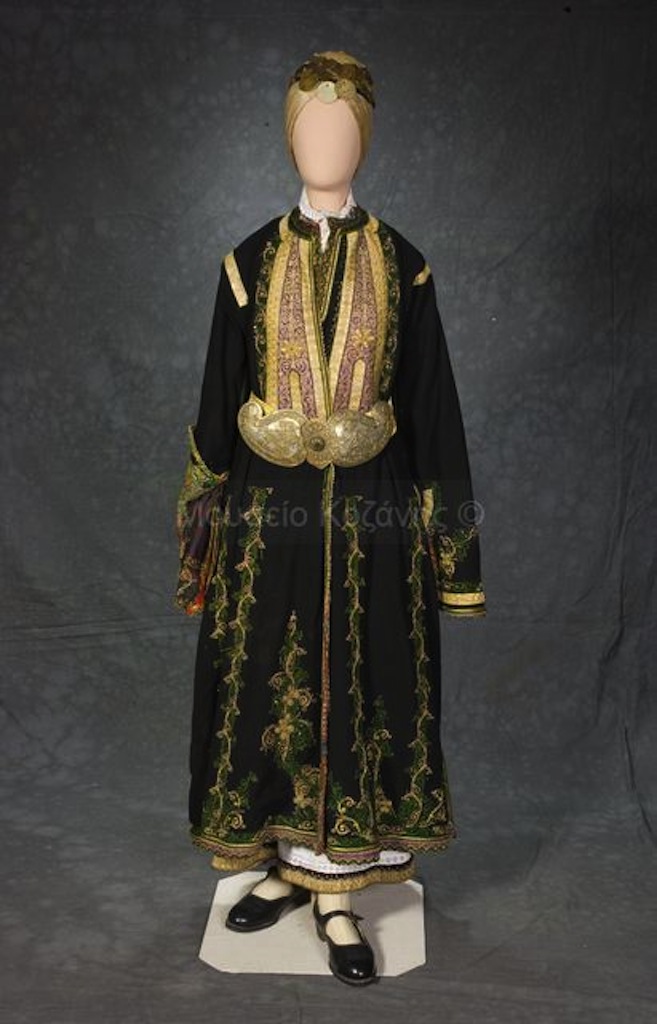
Therefore: If 2013’s protests then – at least İstanbul’s –were at their core about protecting aspects of the essential urbanity of İstanbul, and Greeks played such a large role in shaping that urbanity, shouldn’t that be acknowledged?  If Turkish society is playing out – again, at least in İstanbul – its most intense culture wars on a ghost blueprint of vanished minorities, then wouldn’t making that a more explicit part of the contest be immensely productive – all around?

But these grudges are usually not this deep and usually don’t last long.  Partly because I’m always on the side of the partiers – any partiers.  Partly because I trust the growing consciousness and honesty of most young Turks.  The protesters as a rule behaved so civilly and politely, their chants and slogans so witty and intelligent for the most part, that you couldn’t help but be impressed.  As opposed to Erdoğan and his party’s grand Haussmanian plans, I think they didn’t really want much: Gezi was just a convenient object.  I think they want the area neither Islamized and Neo-Ottomanized or “re-Republicanized” as it were.  I think they’re tired of those two poles, and as a close friend of mine said, they want another option.  I think they wanted the neighborhood to stay as it is and always has been: a place of pleasure and freedom and difference, of uncomfortable, musty cinemas that offer something more interesting than the suburban multiplexes, of Art Nouveau cafes, no matter how garishly over-renovated or turned into fast-food lunch shops, of badly lit meyhanes that you have to know to find, a couple of gay bars, of mini-skirts and transvestites – both separately and together — everything that the strange sensuality of Istanbul offers and the freedom to not be told how and when to enjoy it.  Every man’s inalienable right to want a sweaty glass of rakı and some leblebi or a good mojito when he wants it.

Protesters in Istanbul

And they’ll win too.  Just as Hafez says:

Might they open the doors of the wine shops

And loosen their hold on our knotted lives?

If shut to satisfy the ego of the puritan

Take heart, for they will reopen to satisfy God.

image007

                                                                                                                                                                                                                                                — Kabul, November 2013

*********************************************************************************************************************************************************************************************************************************************************

* Two more of Güler’s most famous photographs:

Guler1

D-amp-K-PASAJ-KAHVESI-BEYOGLU-ISTANBUL-ARA-GULER__51726491_0

While there’s no documentation that the subjects of these photos are Greek, the period, the neighborhood they were taken in and — well — just their look, seem to say so.  Ara Güler was a prolific photographer whose work has been sadly overexposed by excessive postcard-ization.  He once famously said: “Today, 13 million people live here. We have been overrun by villagers from Anatolia who don’t understand the poetry or the romance of Istanbul. They don’t even know the great pleasures of civilization, like how to eat well. They came, and the Greeks, Armenians and Jews, who became rich here and made this city so wonderful, left for various reasons. This is how we lost what we had for 400 years.”
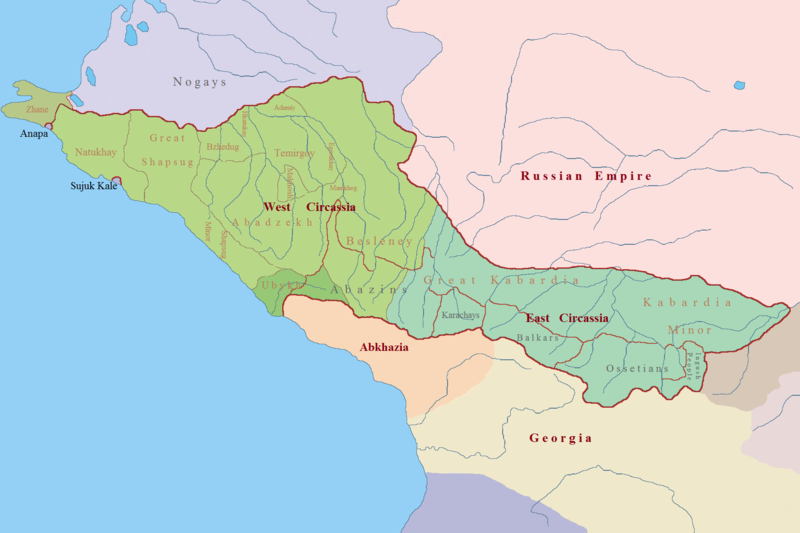
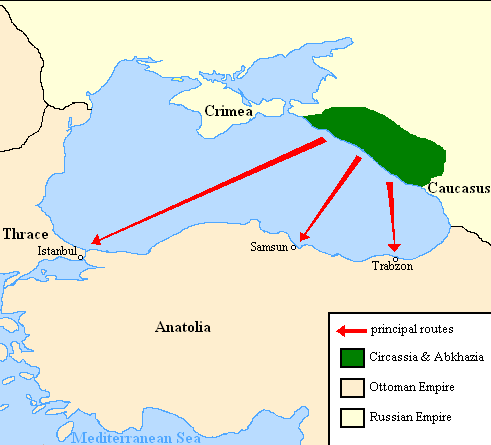
He was called a racist by many leftists for that comment.  But who pays them any heed?  His website: Ara Güler: Official Website

** For more of my thoughts on the hypocrisies of multi-culti İstanbul nostalgia see my early piece The Name of this Blog, and my series Tarlabaşı I, Tarlabaşı II, and Tarlabaşı III .  Especially see Amy Mills’ Streets of Memory: Landscape, Tolerance, and National Identity in Istanbul  based on her research in the Bosporus suburb of Kuzguncuk, where she argues that nostalgia for the cosmopolitan actually serves to erase minorities and discrimination against them from public memory and reinforce Turkish Republican ethnic homogeneity.  I think that’s exactly what’s happening in Beyoğlu.

*** Speros Vryonis The Mechanism of Catastrophe: The Turkish Pogrom Of September 6 – 7, 1955, And The Destruction Of The Greek Community Of Istanbul is a magisterial life’s work and piece of historical journalism that covers the one night of September 6-7, 1955 in which a pogrom organized by Adnan Menderes’ Demokrat Parti destroyed practically the entire commercial, financial, ecclesiastic, educational and domestic infrastructure of the City’s Greek community.  I had put off reading it for quite a while — because the subject matter is upsetting and it’s long and detailled — but I was really impressed when I finally did.  I hadn’t realized the exact extent of the damage: 4,500 Greek homes, 3,500 shops and businesses (nearly all), 90 churches and monasteries (nearly all), and 36 schools destroyed and 3 cemeteries desecrated.  I hadn’t known that so many homes had been destroyed, leaving a large part of the community of then 80 or 90,000 or so homeless and destitute and that, as opposed to the traditional account of one old monk being burned alive, some 30 people were actually killed and many raped.

A1iZR7nssVL._SL1500_

The Menderes government initially, and stupidly, tried to portray this as a spontaneous outbreak of nationalist fervor against Greeks over growing Cyprus tensions, but it was actually an extremely well-planned and executed military manoeuvre (every Turk, after all, is a soldier born) carried out and directed by local cadres of the Demokrat Parti who knew their neighborhoods and its Greek properties and institutions well and through the use of Anatolians brought in from the provinces; I guess they were afraid that local İstanbullus, who knew and lived with these Greeks, would not be as easily destructive, though the record of how the city’s Turks did act during the riots is hardly edifying.  As all products of the nationalist-militarist mind, the plan was an extremely stupid move as well.  It brought the economy of Turkey’s largest city to a virtual standstill, at a time when the country was in deep economic doldrums to begin with, by ripping out its retail heart, so much of it being in the hands of Greeks and other minority groups, and in the immediate aftermath there were chronic shortages of basic supplies in the city because distribution networks had been completely severed and even bread — so many bakeries being Greek and Epirote, especially, owned — was hard to find.  It temporarily made Turkey an international pariah (though in that Cold War climate that didn’t last too long) and eventually played a role in bringing the Menderes government down and costing him his life — thought that all is well beyond the scope of this post, this blog and my knowledge.  Vryonis’ analysis is brilliant if you’re interested.

It’s become axiomatic that the riots were the beginning of the end of Greek Constantinople; the community struggled and tried, but this time things were shattered — physically and psychologically — beyond repair.

**** The Greek Daemon, “daemon” in the Roman sense of the word of animating genius — “To daimonio tes fyles” — is the idea that Greeks are resourceful enough to prosper anywhere and under any conditions — Patrick Leigh Fermor’s belief in their ability to “spin gold out of air” — and the repeated tragic setbacks and almost immediate comeback of the Greek community of İstanbul after nearly every catastrophe to befall it in the twentieth century tempts one to believe in its truth.  Thus, one of the most poignant elements in the Constantinopolitan story is their almost masochistic refusal to leave — what it took to finally make the vast majority abandon the city they loved so much was just too overwhelming in the end however.

There is one important corollary to the “Greek Daemon” myth, however: it only operates for Greeks outside of the Greek state itself, and unfortunately history seems to continue to bear this out.

Comment: nikobakos@gmail.com

The name of this blog

6 Apr

The name of this blog is the old Ottoman name for the main street of the new, ‘European’ side of Istanbul, the part of the City that grew and developed on the northern side of the Golden Horn beginning more or less in the late eighteenth or early nineteenth century, the neighborhood known as Pera or Beyoglu, the Greek Pera reappearing in more and more contexts lately as nostalgia about the city has become a minor industry and cultural phenomenon (Robinson Crusoe, easily one of the coolest bookstores in the world, now refers to itself as a “bookstore in Pera”).  Originally, I was going to confine this blog to Greek and Turkish issues and though that’s changed, I’ve kept the name because it’s the main drag of what – as far as I’m concerned – is still the zone’s keystone city.  I had thought of the street as an appropriately symbolic piece of territory where Greek and Turkish interaction was for a time at its most intense, most claustrophobic, even risky.  But even more, I thought of it as a space that best represents our mutual delusions, lies and hypocrisies.

Greeks think of the Jadde as the Main Street of Greek Istanbul, but neither the neighborhood nor Istanbul itself was ever as demographically Greek as the fantasy has it.  Further, the obvious wealth to which the street’s architecture bears witness always smelled a bit too much to me of nineteenth-century minority pretensions, by which I mean those six or seven post-Tanzimat* decades during which we enjoyed unprecedented access to the Empire’s wealth and financial resources without paying any of the obligations of being part of it; it’s apparently where Greek crowds had become so brazen that they gathered to yell: “Zwa! Zwa!”…”Animals!” at Turkish troops during the Balkan War as they left for the front and the mind-boggling casualties they were to experience there.  It’s also when, as soon as traditional restrictions on church construction were lifted, our new confidence raised up the three ugliest Greek churches ever built in the entire history of Constantinople – quite a feat.  And the palatial embassies of the Great Powers that breathed down the neck of the Ottomans for two hundred years and made those idyllic conditions possible for us still line the street.

Turks in the past couple of decades have spent considerable resources ‘restoring’ the area: the street was pedestrianized at some point in the late eighties I think; they set up a cute retro trolley car that runs down the middle and seems to serve no purpose but to annoy the crowds that have to constantly get out of its way; they’ve put some money into remodeling some buildings.  All of this has come hand in hand with a subtle psychological process running in many urbanized Turks’ minds that has gradually made of the neighborhood a symbol of Istanbul’s historically multi-cultural essence, which in many and moving ways it is.

It’s also where hundreds of  Armenians were murdered in a shockingly urban episode of the Hamidian massacres of 1896**, right there in the middle of all the Belle Epoque elegance and the cafes and the hotels, an event so brilliantly handled in the ‘duck with bamya’ (bamiyeh, bhindi, okra) chapter of Loksandra, and where, in one night of September 1955, every single Greek business on the street (marked beforehand in a perverse, inverted Passover), from Taksim to Tunel, down the Yuksek Kaldirim to Karakoy, along with almost every Greek church and cemetery in the rest of the city, were vandalized or completely destroyed in what turned out, after much bogus blaming and bullshitting, to have been nothing less than a government organized pogrom — pure and simple.  The event was later cynically used as one of the lesser charges brought against Adnan Menderes, the first ever democratically elected Prime Minister of Turkey, who had been in power at the time (‘55), by the military junta that removed him in 1960 and then hanged him and several other members of his government in 1961.  That doesn’t mean he wasn’t guilty of his part in organizing the riots — this, thefirst ever democratically elected Prime Minister of Turkey – he was; that’s just not why the Turkish military hanged him.  He was later exonerated, in fact, and has been semi-canonized since.  The Greek community got bubkes in compensation.  The riots were the beginning of the end, a shocking wake-up call to the complacent sense of security the City’s Greeks had started to feel in Turkey again after the fear and discrimination of the WWII years had passed, and they produced a massive exodus, exacerbated by other measures taken against them in the early sixties, as tensions over Cyprus and the usual tit-for-tat stupidities between the two countries grew.  (One will often hear Greek Polites*** bitterly blame Greek Cypriots for the progressive dissolution of their world, in the sad tones of one irrationally seeking a reason for an unassimilable loss.)  By the late seventies, their numbers had dropped below that point of critical mass that makes the sustaining of a meaningful community life possible: old people waiting to die, young people waiting to move to Greece.  I’m sure Thracian Turks in Greece can identify.

All this unpleasantness is usually excised from the contemporary Turkish nostalgia phenom’.  I remember on my first trips to Turkey as a teenager in the eighties even, often finding myself in the confusing position of being told: “Oh, lots of Greeks used to live around here,” in a smiling and totally sincere attempt at bonding and with a totally blissful indifference or maybe ignorance as to why they didn’t anymore, leaving me feeling both touched and irritated.  Granted, people have become markedly more sophisticated since then.

Anyway…  I could have called this blog the Istiklal Caddesi, which has been the street’s name since the nineteen-twenties and which I’m usually forced to use as well so people know where I’m talking about or don’t think I’m some freaky history nerd, but that would’ve been — no offense — too Republican.  I could have called it He Megale Hodos, but nobody ever really called it that except in the most official contexts (Greeks just called it the Straight Street, ‘Ho Isios Dromos’).  The a la Franca pretensions of la Grande Rue are just as self-evident.  So the old Perso-Ottoman “Great Way,” Jadde-ye Kabir, most fit my gousta and purposes.  Jadde means “street” in Farsi (and in modern Turkish and Arabic too; they’re originally Arabic — both words) but I like “way” because I liked the sort of ironic counterpoint between the great ceremonial routes of the old Imperial city on the other side with this thoroughly bourgeois little avenue.  The “path” too, says my Farsi dictionary, which also had a nice Zen ring.

Istanbul has twice septupled in size since the middle of the last century and Greek life there has faded away into nothing: the City has turned into a gigantic, intractable monstropolis like so many others.  Almost no one in Istanbul is from Istanbul anymore.  Yet this relatively small stretch of one small street still attracts massive daily and nightly crowds.  After a couple of depressed decades caused by the minority exodus, some criminally abusive urban planning projects and the criminal neglect of its architectural heritage, the street and the whole neighborhood have come back into their own again, and then some, in a way that frankly makes me so giddily proud and happy whenever I’m in C-town that any of the past’s bitterness just vanishes — it’s ok it’s not “ours” anymore; it’s still mine.  It’s perhaps the most instant snapshot one can get of Turkey’s current cultural dynamism, sophistication, prosperity, and growing freedom – in however tricky a state that freedom still may be.  Despite the clubs and malls of the northern or Asian suburbs, and despite the even more endless suburbs beyond them, inhabited by Anatolian migrants who may have never even seen it, the Jadde still gives the impression of being the default destination of any Istanbullu who’s meeting friends, looking to consume an urban pleasure of some kind, or just has nowhere else to go or anything else to do.  It’s a delicious, overwhelming mix of commercial crassness, elegance, sexiness, good music, cool bookstores, garbage and great food: an Eastern flaneur’s paradise.  In fact, aside from the Nevsky in Petersburg, I can think of no one street in which one can read so much of a great metropolis’ experience of modern urbanity as the Jadde.  It’s one of my favorite places on earth.

— For C., Istanbul, 2010

*Tanzimat: the “reforms” I think…or the “new order” maybe.  I don’t know if it refers to the actual beginning or the whole long nineteenth-century process; the response to the barrage of external and internal problems faced by the Ottoman Empire starting in the late eighteenth century: the interference of Western power interests and extortion; the loss of Balkan and Black Sea territories and the non-stop influx of refugees from those areas; the rise of local warlords (like Ali Pasha of Jiannena) who controlled large fiefdoms that were practically independent of Constantinople; an attempt to modernize the army in an attempt to recentralize things; the attempt to enfranchise the non-Muslim minorities (who didn’t, however, give up their nationalist aspirations in return) without totally freaking out the Muslim clerical establishment; a new constitution at some point, which was then suspended by Abdul Hamid, etc., etc.  Here, read about it yourselves: Tanzimat  The politics of the period are so torturously complex that no matter how much I read, I still can’t grasp the entire process.  I can’t remember which Sultan was pro-reform and which anti and which tried to take a middle path, except for A.H., who was eventually proven to be fairly undemocratic and a bit of a paranoid nut but was responsible for some impressive modernization projects anyway.  I don’t know when or how the Young Ottomans morphed into the Young Turks or who belonged to which group.

I know that it was all a titanic, often heroic, struggle to turn the Empire into a modern state.  I know there was a half-sincere, but belated and pathetic attempt to create a sense of “Ottomaness” among all its subjects/citizens; I won’t be the first one to make the comparison to Hapsburg Austria.  I know that when the constitution was restored in 1908, a year before Abdul Hamid was finally deposed,  there are stories — way too many, frankly, to be believable – of men of all ethnicities and imams and priests embracing in the streets of cities throughout the Empire in the spirit of their new found Ottoman brotherhood.  Then just five years later, in 1912, Greece, Bulgaria and Serbia joined forces and effectively ended what was left of the Ottoman presence in the Balkans and the Turks decided: “Well, fuck this…” and started concentrating on building a modern Turkish nation-state for Turks just like everyone else was doing for themselves.  And the rest, as they say…

It’s an important period for Greeks to know about because it puts into perspective the fact that our influence and wealth in nineteenth-century Turkey was not just due to our diligence and ingenuity and brilliance — to daimonio tes fyles — but also because we were operating in a host body weakened by daunting, almost insurmountable challenges, both internal and external.

** In August of 1896, a group of Dashnaks, an Armenian independence group, took hostages at the Ottoman Bank in Karakoy – I can’t remember what their demands were — and I think set off some grenades or something.  The Pera murders were a response to this, though violence against Armenians and inter-communal violence between Armenians and Muslims, especially in the southeast, had been growing exponentially in the months and years beforehand, all during the reign of Abdul Hamid (“Ho adikiorismenos,” as Loksandra would call him), hence “Hamidian.”

*** Greeks will often refer to Constantinople as “The City” “He Pole” – since it goes without saying which city one means.  “Polites” then are Greeks from The City.

Comment: nikobakos@gmail.com