Balkans, Anatolia, Caucasus, Levant and other Middle East, Iran, Afghanistan, South Asia, occasional forays into southern Italy, Spain or eastern Europe, minorities, the nation-state and nationalism — and whatever other quirks or obsessions lurk inside my head.
Thank you Kamyar for your posting.
Your comments however are somewhat incomplete.
Sayat Nova, born name “Harutyun Sayatyan” would have been a perfect peace ambassador in today’s Caucaus region. As far as I know, only Armenians have honored his true work for people. He was a true peoples’ singer, musician besides being accepted in Georgian court. It is sad that Azeri’s don’t appreciate the work of a genius.
He became a monk in an Armenian monestery (Haghpat) after he was expelled from Georgian court. Because he refused to convert his religion to Islam, he was killed and beheaded by the order of Persian king Agha Mohammad Khan of Ghajar during his invasion to Caucasus…
Sorry. Kind of a moral mission on my part: can’t let celebration of cosmopolitan, tolerant Islam (or any monotheism) get away with exaggerations.
A tableau/scene — the still, fabulous compositions of Paradzhanov’s style, that make so much of his work “our parts” pornography, in essence — from Color of Pomegranates:
Beyond Ajam, Kamyar Jarahzadeh is currently working as a refugee rights professional. Born to Dezfuli and Ahvazi parents, Kamyar has supplanted the everyday cosmopolitanism of his southern Iranian roots and has instead chosen to descend into full-blown cultural chaos. His penchant for languages incidentally helped him complete his undergraduate degree at UC Berkeley, where he focused on migration and forced migration of Afghan refugees in Turkey. He also completed the MSc in Migration Studies at the University of Oxford. In his free time, he draws on his Californian and Iranian heritage to present his spin on Iranian roots music (www.soundcloud.com/yavaran).
A popular rendering of Sayat Nova.
For those unfamiliar with his legacy, Sayat Nova’s story can seem like the stuff of myth. His life is fascinating even in broad strokes: he was an ethnic Armenian musician and Orthodox Christian who lived in the Caucasus in the 18th century. He created a unique style of music, and wrote hundreds of songs in Armenian, Azeri, and Georgian. His talent was so great that even though he was born in a humble background, he rose to become the court musician of a Georgian king and founded his own school of musicians.
Sayat Nova was part of a tradition of bards known in Armenian as ashough — synonymous with the Turkish aşiq or Persian ashegh, terms used to refer to travelling musicians but literally meaning lover. Such bards worked across a vast cultural landscape that included the territory of modern Turkey, Iran, Georgia and Azerbaijan, and similarly transgressed the Persianate, Armenian, Azeri and Georgian speaking cultural worlds.
Just like other artisans, during this era being an ashough was like joining a class of professionals. But Sayat Nova’s style of music was unusual, he created new musical forms and compositions in all three languages.
Despite the formidable and cosmopolitan legacy of this bard, his appreciation has largely been confined to the domain of Armenian cultural heritage. Sayat Nova is mostly associated with and remembered for his works in Armenian. The reasons for this are largely due to what history has passed down to us (or failed to preserve), but that still begs the question: what more could we understand about Sayat Nova, if we were to further explore his story and music beyond his Armenian identity?
A Sayat Nova composition being performed by a modern ensemble.
To understand how an 18th century bard could create such a corpus of work, it helps to start with the basics of the musician’s biography. Although there is contention over the details of his life, Sayat Nova was likely born in the northwest of modern-day Armenia. Supposedly, he was to become a trained weaver only to instead travel to India and fight in one of Nadir Shah’s invasions of the Mughal Empire. He eventually returned to enter the ashough guild and officially gained the moniker Sayat Nova, from the Persian sayyad-i nava, or “hunter of songs.”
As he rose to fame for his musical ability, he became the court musician of King Heracle II of Georgia in Tiflis (modern-day Tblisi). He composed and performed his famous repertoire of work during this period, until legend has it he was kicked out of the court for falling in love with the King’s sister. He lived out his final years as a monk.
A map of the Afsharid dynasty detailing their campaigns against the Mughals in modern-day India. Sayat Nova is claimed to have participated in these battles.
In the 17th and 18th century, despite conflict between empires of different ethnolinguistic makeup and demographics, linguistic and cultural cosmopolitanism was the norm in royal courts. Sayat Nova was particularly valued in the Georgian Court for his ability to contribute Persianate culture and Persian-style music (although the music he performed in the court was almost exclusively in Georgian, Armenian, and Azeri).
Fortuitous timing also gave Sayat Nova the space to create his particular repertoire and be appreciated. In the 17th century, Western and Eastern Armenia had been split by the Ottoman and Safavid Empires, respectively. The Safavid Empire fell to Afghan invaders in 1722 who were then overthrown by Nader Shah and his Afsharid dynasty — the rulers of the empire during the century between the Safavids and the Qajars.
The multiple transfers of power allowed the Kingdom of Georgia a chance to shake off years of Persian meddling, tribute taking, and general interference. While the Afsharids were occupied fighting against the Mughals in the East, Georgia had a chance to cultivate its own court culture — enter Sayat Nova.
A Sayat Nova composition in Georgian from a film biopic about his life. The Armenian version is titled “Dun el Glkhen.”
Many parts of Sayat Nova’s musical legacy survive to this day. His songs are still widely performed in Armenia, with countless recordings available in a variety of formats. But the nature of his enduring legacy doesn’t match the transcultural life and music of Sayat Nova: most of the available recordings of his music are exclusively in Armenian.
The significant cultural projects that attempt to continue his legacy are tied to the Armenian community and diaspora, including the upcoming Sayat Nova festival that will be held in Yerevan. While there are Sayat Nova monuments in Armenia and Georgia, there is no monument to Sayat Nova in Azerbaijan, even though the majority of his surviving poems are in the Azeri language. Most of his Azeri and Georgian poems, in their original language, are out of print or nearly-impossible to find.
Part of this is due to the difficulties of historical preservation. We have many of Sayat Nova’s lyrics in all languages thanks to his biographers and the documents gathered by his son, but his melodies are less well-preserved. Musical notation was not common in Sayat Nova’s time and milieu, so the Armenian melodies that survived were passed down orally for 150 years until they were finally notated. The projects to track down these melodies (that continues to this day) were mostly Armenian initiatives. While it is likely that Georgian and Azeri melodies of his still survive and are being performed, they are not as widely available as his Armenian repertoire.
It seems unfitting that Sayat Nova is solely remembered through the lens of Armenian culture. Of his surviving works, scholars have located 117 Azeri poems, 72 Armenian poems, 32 Georgian poems and six Russian poems. It is this cosmopolitan legacy that arguably makes Sayat Nova unique.
Sayat Nova compositions notably used Persian and Arabic poetic meters with Armenian melodic structures. With these techniques, Sayat Nova founded the Tbilisi “school” of ashough, a tradition that was notable at the time for performing Georgian music in the Persian style. Even people unfamiliar with these languages, when listening to a Sayat Nova composition, will notice that the final couplet of his ghazals often refer to Sayat Nova in the third person — a trademark of the ghazal form that many associate with Persianate poets such as Hafez and Rumi.
At the end of this song, Sayat Nova refers to himself in the final couplet. This is very common in the ghazal form in other languages as well, such as Persian, Arabic, Turkish and Urdu.
A bialphabetical Sayat Nova manuscript from his notebook. The text is one composition written in both the Armenian and Georgian scripts.
Sayat Nova was unable to read the Perso-Arabic script, but his Armenian poems often blended Persian words with the language. This speaks to the role Persian played as a language of high culture: it was a language of literacy in the Caucasus that transcended ethnic boundaries.
In his handwritten manuscripts Sayat Nova would even switch between scripts mid-poem. Picture this: his Azeri poems are written in a mix of Georgian and Armenian scripts, and his Armenian poems are often written in both Armenian and Georgian scripts. His songs in colloquial Tbilisi Armenian were written in the Georgian script, and the Armenian script was reserved only for the classical Armenian language — widely considered “sacred” by devout Armenian Christians.
Why then, are the cross-cultural celebrations of Sayat Nova so few and far between? Azeris and Georgians have just as much to celebrate in Sayat Nova as the Armenian cultural mainstream.
Unfortunately a more pancultural perspective of Sayat Nova is not just difficult due to the historical record, but politically fraught. This video of an Azeri version of Sayat Nova’s song “Kamanche” highlights the vehemence of the arguments that often accompany celebrations of Sayat Nova.
An example of a Sayat Nova composition adapted into Azeri Turkish, framed by the uploader as an example of “plagiarism.”
The video shows clips of the song being used to celebrate Azerbaijan and Turkey’s form of pan-Turkic ideology that arose in the 20th century — an incarnation with anti-Armenian ideology — while criticizing Azerbaijan for cultural theft.
This is doubly confusing: Azerbaijani nationalists using Sayat Nova for pan-Turkic goals, while Armenian reactionaries respond by disavowing the fact that this bard actually had strong ties to Azeri culture. Comments on a video of a Georgian translation of an Armenian Sayat Nova song meanwhile try to excuse or explain his non-Armenian works, rather than acknowledge that they are a significant part of his canon.
This is a tragedy, as some of the most integral parts of Sayat Nova’s identity were linked to his non-Armenian cultural capital. For example, 19th century Sayat Nova biographer and documenter Akhverdian recorded a story in which the ashough, as a retired monk, hides his identity in order to meet a young new ashough visiting the city in search of the infamous Sayat Nova.
When the youngster meets a disguised Sayat Nova and asks where to find the renowned bard, Sayat Nova’s answers are a series of Azeri plays on words: bilmanam, tanimanam, and gormanam, Which could either be translated as “I don’t know,” “I don’t recognize him,” and I “have not seen him,” or, “know, I am him,” “recognize, I am him,” and “see, I am him.” The beauty of this word play brings the young bard to surrender his instrument to Sayat Nova, to show that he has been humbled in the face of the master.
These sides of Sayat Nova’s legacy are often forgotten or glossed over. It appears that Sayat Nova’s Georgian and Azeri sides have been both lost on accident and forgotten on purpose over the course of time.
The Sayat Nova Project, now renamed Mountains of Tongues, seeks to document and explore musicological phenomena in the Caucasus beyond a nationalist lens.
There is great interest in reviving a multicultural Sayat Nova. Mountains of Tongues (formerly known as the Sayat Nova project), is a multicultural ethnomusicological research project that attempts to document the region’s musical heritage while breaking free of nationalist tropes. But that work has unfortunately become politically tenuous. The borders of Armenia and Azerbaijan remain closed in the face of the ongoing Nagorno-Karabakh conflict. Funding for Caucasus-based musical research is often tied to a single culture and involves the explicit practice of nation and identity building. If Sayat Nova was alive today, far-right nationalists from all three communities in the Caucasus would likely denounce him for daring to perform in the languages of the “others,” whoever they may be.
But just as a modern Sayat Nova would be denounced, there would perhaps be those awaiting his return. Could there be a radical, transformative potential in remembering the multicultural Sayat Nova? Over three centuries on, the natural cosmopolitanism that Sayat Nova embodied seems lost to us. In the face of ethnic homogenization and conflict in the Caucasus, there are no easy answers. The clichés of past cultural fusions are no panacea for the contemporary political problems that the region faces. Cultural dialogue and civil society is important in such a situation, but it is important not to overemphasize the role of shared cultural heritage in examining contemporary political problems.
But at the very least, the very work of filling out our collective image of Sayat Nova could bolster a longstanding cultural unity in the region. The mix of knowledges it takes to appreciate Sayat Nova’s oeuvre is no longer easily found: people knowing Georgian, Armenian, Azeri, Persian and Russian is no longer as common as it once was. Perhaps filling our mutual gaps of knowledge could bring fans of this famous ashough together to at least remember what once was, and dream of what again could be. Until then, the very least that fans of Sayat Nova can do is heed his own hand-written introduction to his second written song:
“This divani (type of song) is very good
If you learn it, pray for my soul.”
And here is the poem he was humbly boasting about:
Special thanks to Hasmig Injejikian’s dissertation on Sayat Nova. Please refer to her publication for more specific information on Sayat Nova’s life and the academic discourse surrounding his biography, works, and legacy.
Odd that this piece left out two masterpieces of Georgian-Armenian Soviet director Sergei Paradzhanov; one: Aşık Kerib, that tells the story, in Azeri, of exactly the kind of bard-troubadour-“lover” Sayat Nova was:
He directed the Armenian-language stunner,The Color of Pomegranates, which was a highly abstract biography of Sayat Nova (below):
“According to ancient Greek folklore, Crypteia was a group of men in Sparta who acted as a band of secret police, terrorising lower classes and slaves, then known as the helots. The gang’s modern reincarnation marks the emergence of the first band of far-right extremists in Greece after decades of far-left terror activity.”
Exaggerated comparison. “…far-left terror activity” in Greece never targeted innocent civilians, immigrant or non.
Intelligence experts contacted by The Times suspect Crypteia could be a violent offshoot of the neo-Nazi Golden Dawn party, aboveGiorgos Georgiou/NurPhoto/Getty
“One radical solution, of course, is for members of the academy to…eliminate masculine and feminine forms altogether. “
Oh, ok…
It’s amazing — and quasi-Orwellian, the way much stupid p.c. thought is — that the Académie is here shown up as exercising its oppressive patriarchal authority prerogatives, while the hideous gender-free plurals these dudes are asking for actually represent a much more totalitarian exercise in social engineering.
Should France embrace gender-neutral words? Bien sur!
The French Academy is railing against moves towards a gender-neutral style, but language always blends and changes without any loss of expressive power
The French Academy, Paris: charged with the mission to keep the language ‘pure’. Photograph: Alamy Stock Photo
Forget Brexit. Europe is facing an even more fundamental crisis: one of its major languages is en péril mortel (“in mortal danger”). If you take the French Academy at its word, within a few years 70 million EU citizens will be communicating using only grunts – or grognements, as they will no longer be able to say.
The cause? Political correctness gone mad, as usual. The academy, which is charged with the Canute-like task of preventing the French language from changing very much, is furious at the use of “inclusive language”, which attempts to get around the assumption of male superiority baked into French grammar. Because French, like many other languages, requires nouns referring to people to have masculine or feminine endings, if you’re describing a mixed-gender group, you’re forced to pick one. By convention, it’s the masculine. So a group of, say, six MPs – one man and five women – would be called députés, not députées. One way to deal with this is to have an alternative form that covers everyone: député-e-s.
That’s what the academy is railing against. But the idea that it places French in “mortal danger”, as its statement argues? Have these people gone complètement fou? It’s an optional shorthand, used only in print. It may be relevant at this point to raise the fact that, of the 34 academicians, 30 are male.
Apart from the gender imbalance, there’s the academy’s mission according to its 17th-century statutes: to make the language “pure”. Talk about setting yourself up to fail – or at least to get angry about things that you can’t change. Languages are always impure: they borrow, blend and innovate, without any loss of expressive power.
One radical solution, of course, is for members of the academy to become reformers rather than reactionaries, and eliminate masculine and feminine forms altogether. Plenty of languages, including English, Turkish or Thai, get along perfectly well without them. And the French have done radical things with language before, such as scrapping the names of days of the week during the revolution. People of France, you have nothing to lose but your gender markings!
French language watchdogs say ‘non’ to gender-neutral style
The Académie Française, France’s ultimate authority on the language, sparks national row after describing inclusive writing as an ‘aberration’
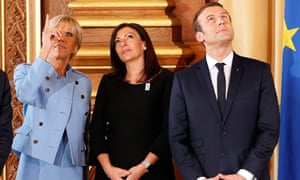
Paris mayor Anne Hidalgo flanked by France’s president, Emmanuel Macron, and his wife. Hidalgo insists on being called Madame la Maire over the masculine version of the title. Photograph: Charles Platiau/AFP/Getty Images
The Académie Française, France’s ultimate authority on the French language, is under fierce attack for describing gender-neutral text as an “aberration” that puts the language in “mortal danger”.
The “Immortals”, as the 40 academy members – only five of whom are women – are known, have sparked a national row after declaring that “inclusive writing” has no place in the country’s grammar books, or anywhere else for that matter.
In a statement full of hyperbole, the academy condemned the increasing use of new spellings aimed at making written French less masculine, arguing that it could not see the “desired objective” of the changes.
French grammatical rules give the masculine form of a noun precedence over the female. Women on an all-female board of company directors are called directrices; if one man joins the board, they are referred to collectively as directeurs. Inclusive writing has them written as directeur.trice.s or directeur-trice-s – admittedly more clumsy but representing both forms of the word. The word students becomes étudiant.e.s; a gender-mixed group of actors would be written acteur.trice.s.
For years, French presidents have addressed citizens as les Français et les Françaises instead of the strictly correct les Français, but the recent row was sparked by a new textbook aimed at primary school children that employs the inclusive style, and came into use for the first time this year.
After a vote last month, the Académie Française issued a unanimous “non” to the new style, deeming it far too complicated.
“Faced with the aberration of ‘inclusive writing’, the French language finds itself in mortal danger,” its statement read.
“We find it hard to identify the desired objective and how to overcome the practical obstacles of writing and reading – both visually and out loud – and pronunciation. This will increase the burden for teachers and even more so for readers.”
Supporters of inclusive writing say the new forms are aimed at use in written communication, not speech or literature. They also point out the Académie is hardly a model of gender equality.
Established by Louis XIII’s chief minister Cardinal Richelieu in 1635, outlawed after the French Revolution and restored by Napoleon Bonaparte in 1803, there have been a total of 726 members, only eight of whom have been women. The first, Belgian-born novelist Marguerite Yourcenar, was elected in 1980.
In 2014, the academy opposed the feminisation of job titles, making Paris mayor Anne Hidalgo’s subsequent insistence on being called Madame la Maire (and not Madame le Maire) grammatically incorrect.
Eliane Viennot, professor of literature at Jean-Monnet University in St-Étienne and author of the book Non le masculin ne l’emporte pas sur le féminin! (No the masculine does not take precedence over the feminine!), said: “They [the academy] are extremely conservative.”
“If you ask people to list their favourite écrivains (writers) they will only mention male authors,” Viennot told France24 television. “It’s not until you ask them to list their favourite écrivains and écrivaines that they think of women.”
In an opinion piece in Libération, she called for France to “pull the plug” on the academy.
“For 30 years they have never stopped trying to torpedo any evolution of the French language towards equality,” Viennot wrote.
Last month the education minister, Jean-Michel Blanquer, who described himself as a “feminist man”, opposed the use of the new style and said the row over it was “useless”.
“We must return to the basics of vocabulary and grammar and this just adds an unnecessary complication,” Blanquer told BFMTV.
In 2015, France’s High Council for Equality between Women and Men, published a guide encouraging public officials to adopt forms of communication “without sexual stereotypes”.
“Roland Barthes famously described language as essentially “fascist”, not because it censors but, on the contrary, because it forces us to think and say certain things. The idea that we are spoken by language as much as we speak through it is, I think, an important one here: French offers a different world view from English. [my emphases] Today, the symbol of British sovereignty is an independent currency. In France, it is an independent language, and that is indeed something to be cherished.”
That every language offers a world view — not just semantically — but through its very structure, is a crucial observation I think. The malleability of English is something I always tried to make my students understand and take advantage of (“Well, that’s not really right…but you could probably use it that way and if you were a native speaker no one would think twice about it…”). The classicism and rigor of French is something entirely different, and there’s no indication it stifles expression in written or spoken discourse, like we like to think — erroneously, or at least simplistically — that Atticizing classicism stifled Byzantine literary culture; I know one grad student, now professor of mediaeval Greek literature who thinks Anna Comnene‘s 11th century Alexiad is written in a “stunningly beautiful” Atticized Greek.
My real issue with this nonsense is not just that “directeur.trice.s or directeur-trice-s” or “étudiant.e.s” are abominably ugly; or that they’re just clumsy: I had colleagues in ESL who used to force students to use “He or she” or “his or her” or the hideous “S/he” when referring to a hypothetical ungendered individual — these p.c. pedants actually used to mark a plain “he” as incorrect! (One Polish student said to me once: “Can we just use ‘it’?”)
My problem is that, like all identity politics, it’s politically useless. Run for office; collect signatures; root out and muckrack corruption journalistically when you can, or real injustice, or real inequality; join a union; join a street mob, for fuck’s sake, and throw some Molotovs. Do anything but sit around discussing this kind of narishkeit.
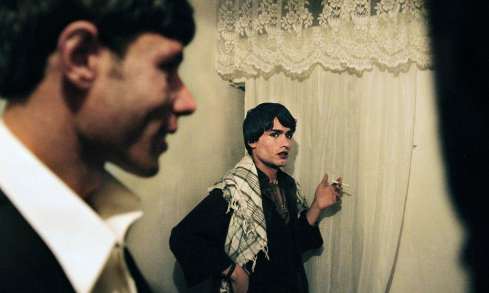
“Elyas Alavi’s performance piece at a Tehran exhibition showcasing contemporary Afghan artists invites participants to give blood. Samples are taken by a professional nurse and splashed on the wall next to each other.”
That “self-determination” is just nationalism — and often a fiery, violent kind — writ small and wanting to be bigger, may be one of the most important issues we need to face in the 21st century.
Maybe the most frustrating, teeth-gritting moment of news coverage — in terms of the selective blessing of nationalisms and self-determinations — I’ve ever experienced was a BBC report, which unfortunately I haven’t been able to find and post, that aired on the July anniversary of the Srebrenica massacre the summer of 2016.
At the end of it the BBC reporter was interviewing a Bosnian man, in his forties maybe, selected for his Bosnian-ness — tall and handsome — whose father had been killed by a Serbian sniper in Sarajevo in the 90s. In their interview on a bridge over the lovely, gurgling Miljacka, he talked about how he was happier that he was the child of that sniper victim and didn’t have to live with the conscience of being the child of that sniper instead.
He then pulled out a photo of his high school class:
“See…
“This guy was Serbian. This guy was Croatian. This guy was Croatian. This guy was Bosnian. This guy was Serbian… That’s how it was then.”
“So,” says the dull-tool BBC reporter:
“This was Bosnia before the war?”
“Yes,”
says the Bosnian, shaking his head sadly with the weary, self-righteous pride of the victim,
“This was Bosnia before the war.”
No, buddy. That wasn’t BOSNIA before the war. That was YUGOSLAVIA before the war. AND YOU DIDN’T WANT TO PART OF IT ANYMORE…
So, to paraphrase the identity-politics, American new “left” cliché: “Check your victimhood!”
Old feuds are rekindled and jealousies revived. Hypocritical Britain cannot talk. It long opposed Irish separatism and denied devolution to Scotland and Wales, while it sent soldiers to aid the break-up of Yugoslavia. [my emphasis]
My hope is that there will be new de-villainizing discussions of certain past, led by a new review of Serbian actions in a dissolving Yugoslavia, or even early twentieth-century Ottomans/Turkey (might want to see my ““Screamers:” Genocide: what is it and why do we need the term?“)
While we’re adjusting our moral compasses about whose self-determination is “cool” and whose isn’t, we might want to look at the role the public relations industry plays in so manipulating the image of political conflicts throughout the world. And I don’t mean that as a metaphor: both Croatia and then Bosnia hired American public relations firms to push their cause during the Yugoslav War; this is covered extensively by Diana Johnstone in her “Fools’ Crusade: Yugoslavia, Nato and Western Delusions“. Unfortunately, since Johnstone’s thesis is that NATO aided and abetted the break-up of Yugoslavia as part of its plan to weaken a Serb-hegemonied Yugoslavia, which wouldn’t play along with NATO, the European Union or the post-communist, Neo-Liberal, New World Order; that is, that these forces wouldn’t tolerate, just like Stalin couldn’t, Yugoslavia’s fairly benign and most successful of communist states’ strength, and the power a post-communist, unified Yugoslavia would still hold — she’s dismissed as a conspiracy theorist or a crackpot. Her argument, however, is perfectly documented and argued.
But even a good friend of mine who’s incredibly smart about and immersed in things Yugo said to me: “Really, Nick? I dunno… Diana John-stone…”
Yeah. Diana John-stone. Read it.
And next time you go back to your fun and Euro-spring-break memories of unbearably hip Barcelona, thing of how advertising and public relations got you to spend your tourist dollars there — and how that indirectly funded, both in terms of real and symbolic capital, the current crisis in Spain.
Balkans, Anatolia, Caucasus, Levant and rest of ME, Iran, South Asia
Me, I'm Nicholas Bakos, a.k.a. "NikoBako." I'm Greek (Roman really, but when I say that in English some five people in the world today understand what I'm talking about, so I use "Greek" for shorthand). I'm from New York. I live all over the place these days. The rest should become obvious from the blog.

 (unknown provenance)






 Jadde: from Bosnia to Bengal
Sorry. Kind of a moral mission on my part: can’t let celebration of cosmopolitan, tolerant Islam (or any monotheism) get away with exaggerations.
A tableau/scene — the still, fabulous compositions of Paradzhanov’s style, that make so much of his work “our parts” pornography, in essence — from Color of Pomegranates:
–
Comment: nikobakos@gmail.com
–