Tag Archives: Indian Islam

The Pakistani cab-drivers and Hanuman

15 Oct

Taxi-cabs-New-York-0986

I had a seriously annoying Pakistani cab-driver a few days before I left New York in September.

He saw my “Jai Bajrang Bali” tattoo to Hanuman (for those who don’t know: Hanuman) and he said:

“What that say on your arm?”

I said: “It says ‘Jai Bajrang Bali’”, which is a praise-phrase for Hanuman that I think roughly means: ‘Hail, strong one’ (He’s the patron deity of wrestlers and strength athletes generally and I got it in prep for going back to judo.)

“You know about Hanuman?  You read about him?”

“Yeah…” seeing where this was going.

“You Hindu?”

“No”

“So why you Hindu on your arm?”

“Because Hanuman is important to me.”

“So why don’t you become Hindu?”

“Well,” I said kind of testily, “you can’t become Hindu.  You can observe Hindu practices or show some reverence for Hindu deities, but you’re born Hindu, with a very specific place in the cosmic order, with a varna and a caste and a gotra and its particular deity/deities that you’re devoted to and very particular and varied rites or ritual obligations that you’re subject too.  You can’t really convert to Hinduism…in my opinion, at least, despite lots of white people who think they can.”

Silence.

A little bit out of his depth at this point.

“You Jewish?”

(Of course, right?)

“No, I’m Christian technically, Greek Orthodox.”

“If you Christian, how come you have Hindu on your arm?”

“Well,” I said, “that’s probably a little hard for a Muslim to understand.”

And that ended the conversation.

But I shit y’all not, two days later I had the same conversation with another one.  This one ended more abruptly.  When we got to the part about how one can’t “become” Hindu, he started telling me that Islam is very simple and that to become a Muslim is very simple.  “You want to become Muslim, it’s very simple.”

But instead of saying…

“Yes, I imagine the appeal of all totalizing and authoritarian ideologies has always been their ‘simplicity.’  ‘Come with us — it’s simple…’”

…I just said: “Oh, well then maybe I’ll think about it.”

I don’t think he knew what to make of that one.

*************************************************************************

See also: “For Hanuman-ji and the Pakistani cab-drivers: Aditya Kapoor’s beautiful photo essay of a wrestling akhara in Benares

Comment: nikobakos@gmail.com

Börek II — or Burek and the end of Yugoslavia

26 Aug

Börek Nein Danke

(click)

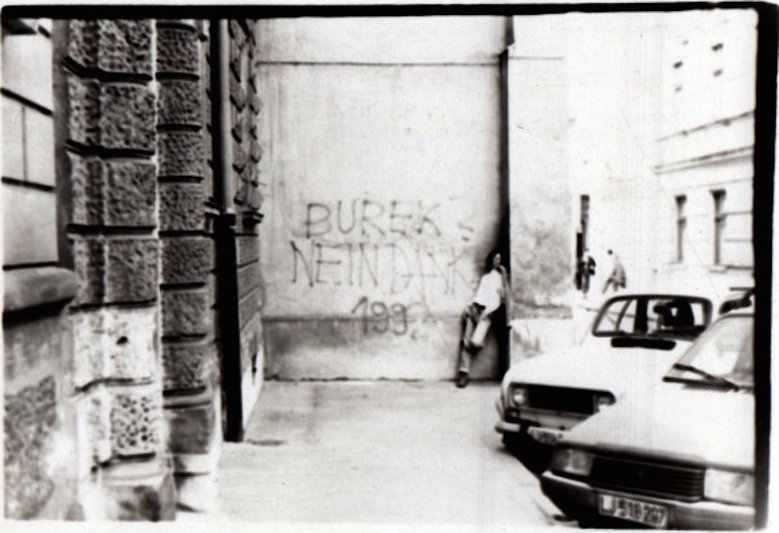
This is a piece of graffiti that appeared in the Slovenian capital city of Ljubljana in 1992, at the beginning of the worst period in the Yugoslav wars and after Slovenia had become independent. “Burek [‘börek’ in Turkish, pronounced exactly like an umlauted German ‘ö’]? Nein Danke.” Burek? Nein Danke. “Burek? No Thank You.” What a silly slogan, ja? How innocuous. What could it possibly mean? Who cares? And how can NikoBako maintain the bizarre proposition that a piece of graffiti in a rather pretentious black-and-white photograph is an important piece, in its ugly, dangerous racism, of the break-up of Yugoslavia.

Back up then. There are certain — usually material — aspects or elements of Ottoman life in the Balkans, which, even for Christians in the region, despite the centuries of unfortunate hate and reciprocal bloodletting (and no, I don’t think pretending that wasn’t true or that “it wasn’t that bad” is the key to improving relations between us all now; I think the truth is the key), remain objects of a strange nostalgia and affection. They linger on — even if unconsciously, or even as they’re simultaneously an object of self-deprecating humour or considered homely backwardness – as evidence that Ottoman life had a certain refinement and elegance that these societies have now lost. You sense this often intangible and not explicitly acknowledged feeling in many ways. Folks from my father’s village, Derviçani, for example, now go to Prizren in Kosovo to order certain articles of the village’s bridal costume because they can no longer find the craftsmen to make them in Jiannena or Argyrocastro, and they’re conscious of going to a traditional center of Ottoman luxury goods manufacture. You feel it in what’s now the self-conscious or almost apologetic serving of traditional candied fruits or lokum to guests. Or still calling it Turkish coffee. Or in Jiannena when I was a kid, when people still had low divans along the walls of the kitchen where they were much more comfortable than in their “a la franca” sitting rooms. 1* Perhaps the sharpest comparison is the way the word “Mughlai” in India still carries implications of the most sophisticated achievements of classical North Indian…Muslim…culture, even to the most rabid BJP nationalist. 2**
49614968

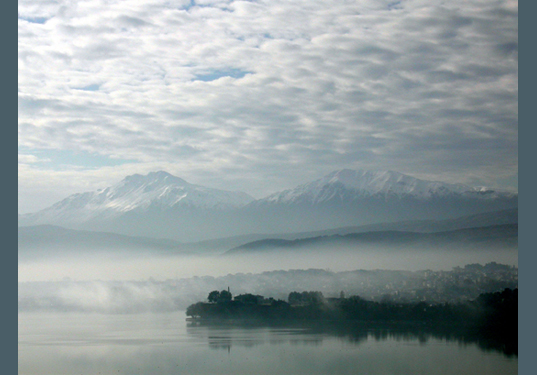
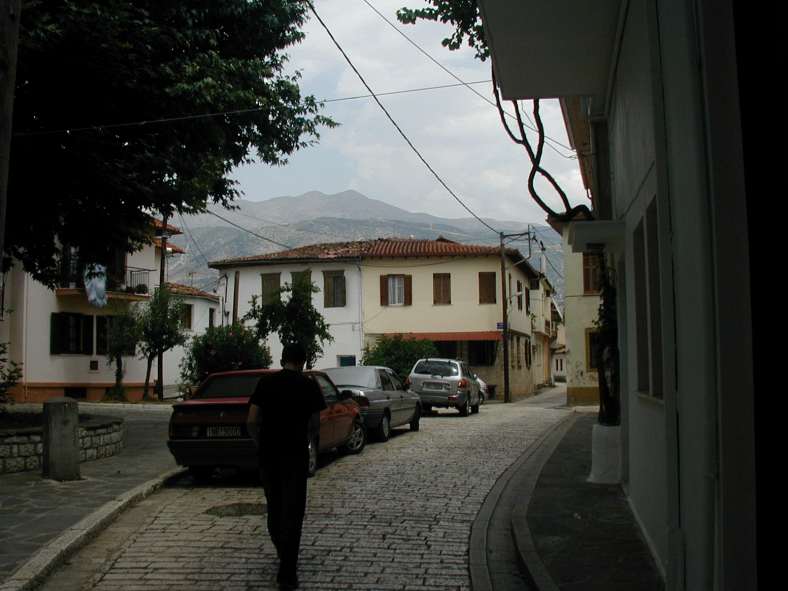
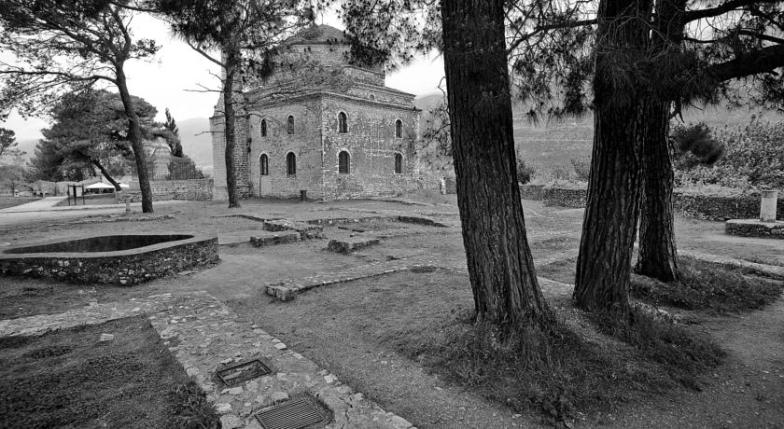
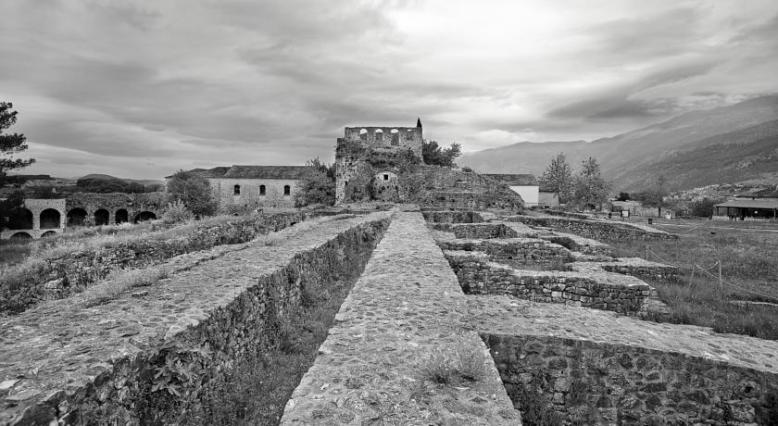
There are some places where this tendency is stronger than in others. Sarajevo and Bosnia are obvious; they still have large Muslim populations though and, after the 90s, Muslim majorities. But Jiannena – which I’ll call Yanya in Turkish for the purposes of this post, the capital city of Epiros and one often compared to Sarajevo: “a tiny Alpine Istanbul” – is also one such place. Readers will have heard me call it the Greek city most “in touch with its Ottoman side…” on several occasions. You can see why when you visit or if you know a bit of the other’s past: or maybe have some of that empathy for the other that’s more important than knowledge.
49611950

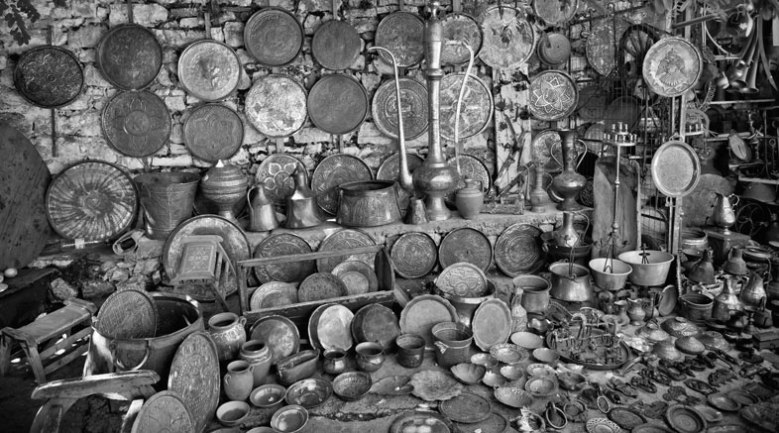
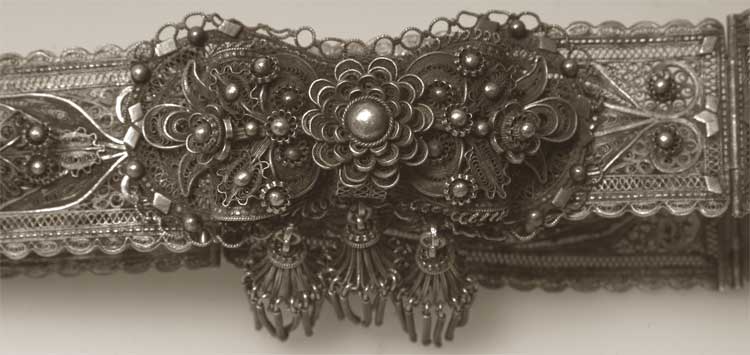
About half Greek-speaking Turks before the Population Exchange, Yanya was a city the Ottomans loved dearly and whose loss grieved them more than that of most places in the Balkans. It’s misty and melancholy and romantic. It has giant plane trees and had running waters and abundant springs in all its neighbourhoods, along with a blue-green lake surrounded by mountains snow-capped for a good five or so months of the year. It experienced a period of great prosperity in the eighteenth and especially nineteenth century, when it was not only a rich Ottoman commercial city but also a center of Greek education: “Yanya, first in arms, gold and letters…” – and, especially under the despotic yet in certain ways weirdly progressive Ali Paşa, was the site of a court independent enough to conduct foreign policy practically free of the Porte and fabulous enough to attract the likes of Pouqueville and Byron, the latter who never tired of commenting on the beauty of the boys and girls Ali had gathered among his courtiers, as Ali himself commented profusely on Byron’s own. All the tradition of luxury goods associated with the time and the city: jewelry, silver and brassware, brocade and gold-thread-embroidered velvet, sweets and pastries – and börek – still survive, but are mostly crap today, even the börek for which the city used to be particularly famous, and your best luck with the other stuff is in the city’s numberless antique shops.
ioannina-epirus-greece-the-antiqe-market-hip

identical to yiayia's belt

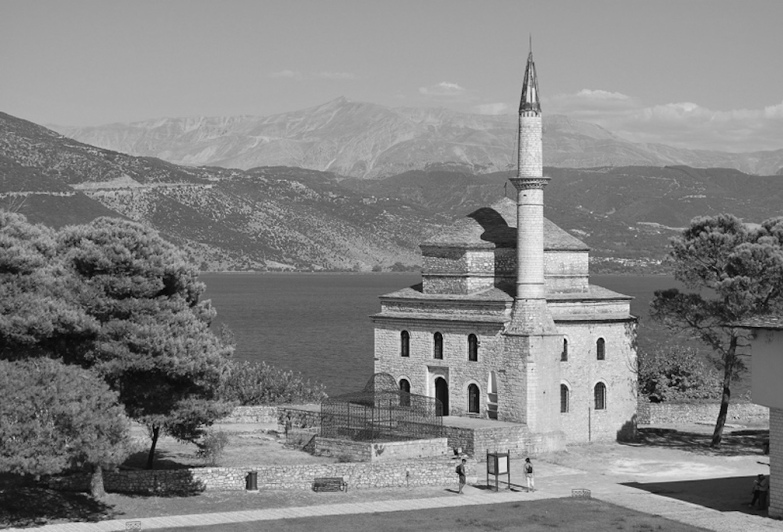
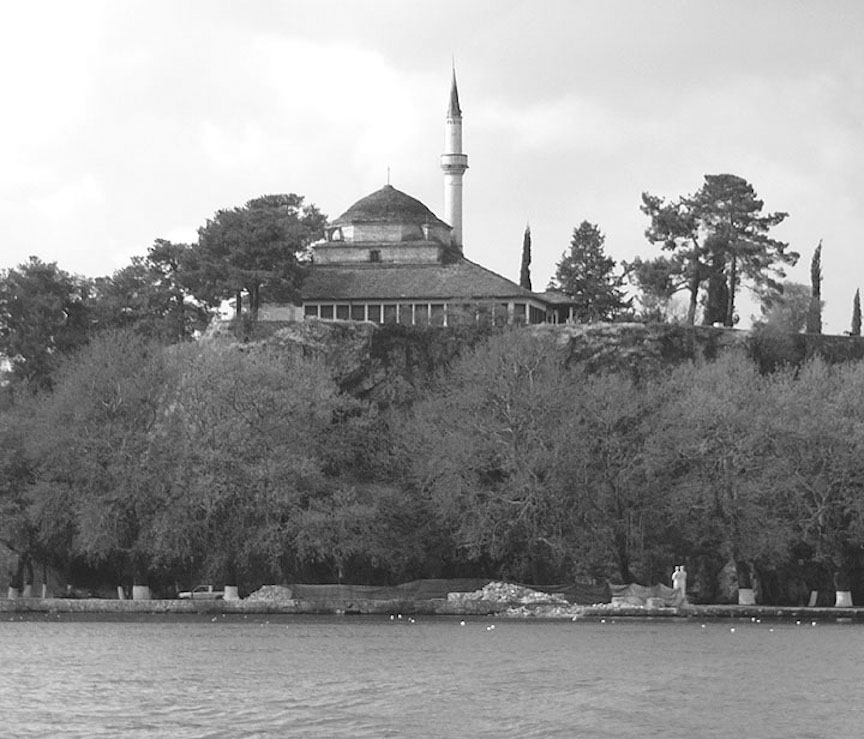
It also, unusually, and which I like to ascribe to Yanyalıs’ good taste and gentlenesss, has preserved four of its mosques, the two most beautiful in good condition even, and on the most prominent point of the city’s skyline.  It would be nice if they were opened to prayer for what must be a sizable contingent of Muslim Albanian immigrants now living there — who are practically invisible because they usually hide behind assumed Christian names — but that’s not going to happen in a hundred years, not even in Yanya.  Maybe after that…we’ll have all grown up a little.
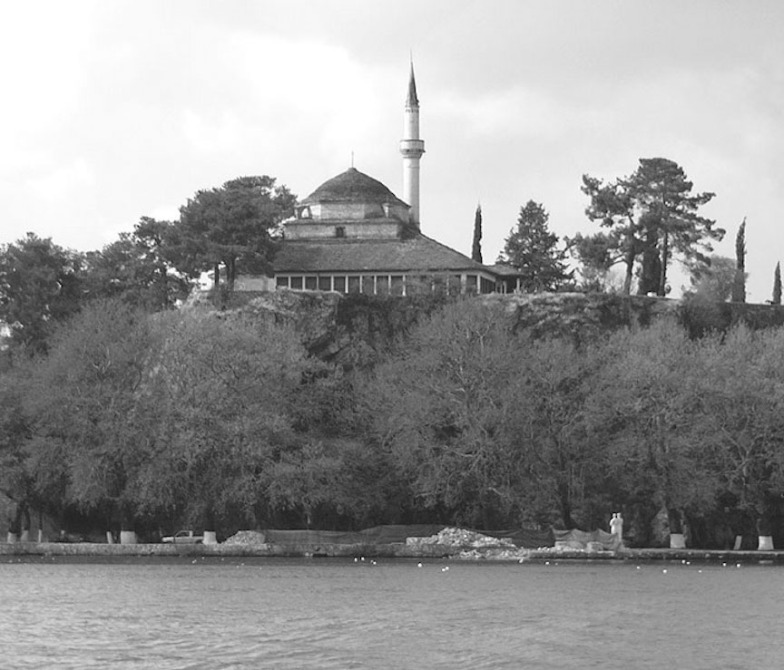
ioannina165

janina

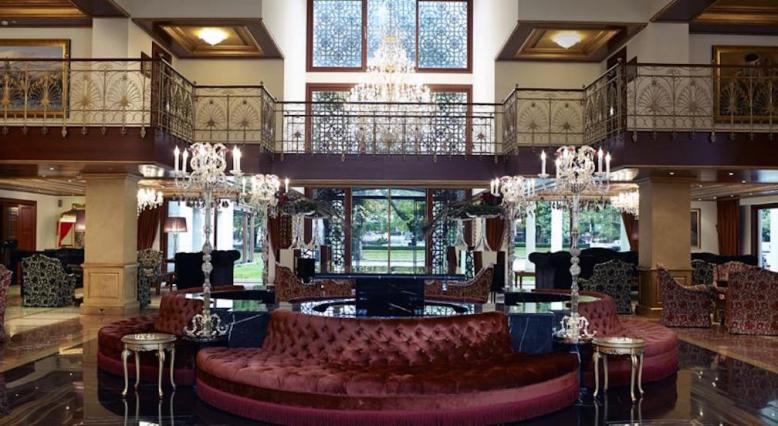
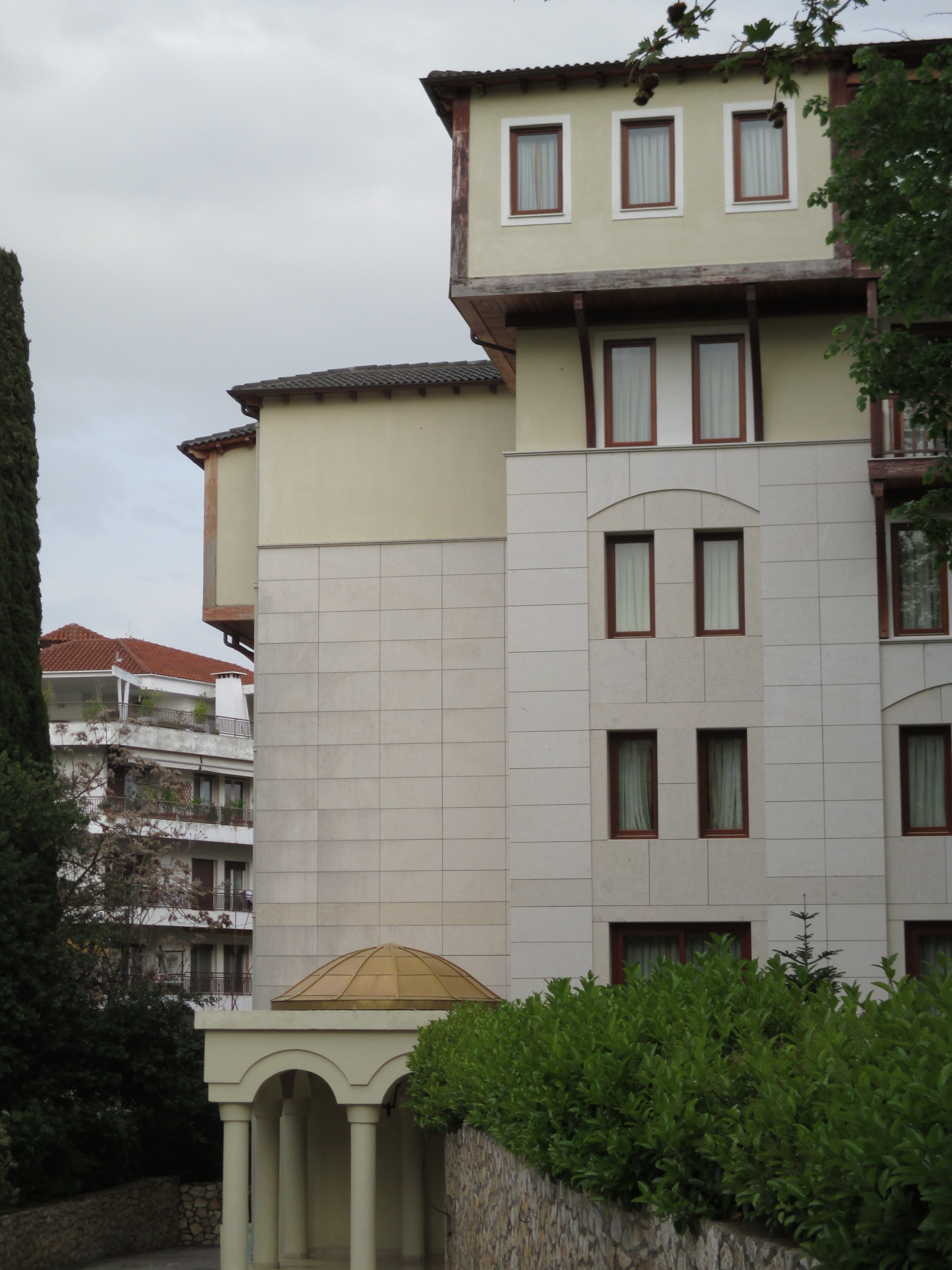
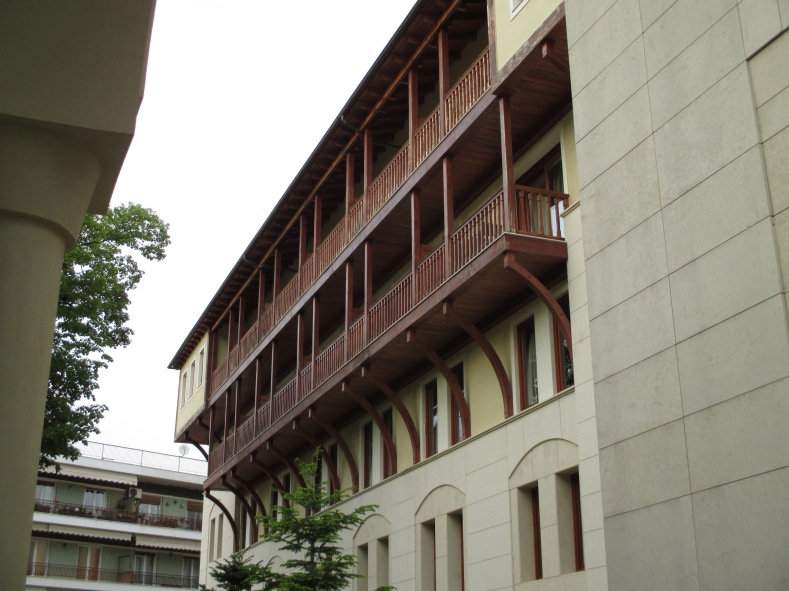
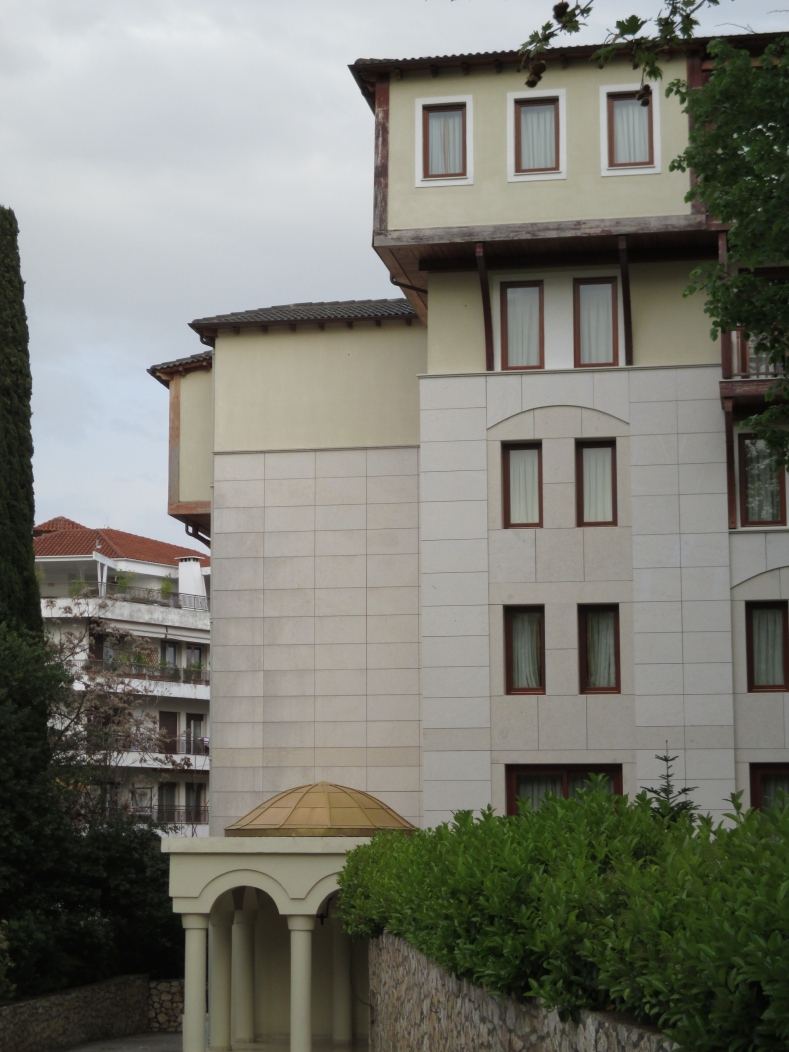
And, alone perhaps among Greek cities, only in Yanya can one open a super-luxury hotel that looks like this, with an interior décor that I’d describe as Dolmabahçe-Lite, call it the Gran Serail, and get away with it. 3***
IMG_0213

IMG_0215

44471198

Digression Bakos. What’s the point? What does this have to do with Yugoslavia? I’m not digressing. I’m giving a prelude. “People don’t have the patience for this kind of length on internet posts.” I don’t post. I write, however scatterbrainedly. And not for scanners of posts. For readers. However few have the patience.

So. Croatians don’t eat börek. The prelude should have been enough for me not to have to write anything else and for the reader to be able to intuit the rest. But for those who can’t…

The graffiti on the wall in the photo at top is dated 1992, but I think it had appeared as a slogan as early as the late 80s when Slovenes and Croats started airing their completely imaginary grievances against Serbian domination of Yugoslavia and making secessionary noises. What it meant is that we, Hapsburg South Slavs, were never part of the Ottoman Empire and therefore never were subject to the barbaric and development-stunting influences of said Empire that Serbs and whoever those others that live south of them were, and therefore have the right to be free of the intolerable yoke of Serbdom. We don’t eat burek. Not only do we not eat burek, but you offer it to us and we’ll refuse in German – “Nein Danke” – just to prove how much a part of the civilized Teutonic world of Mitteleuropa we are. 4*** (I think it was Kundera who wrote about the geographical ballooning of “Central Europe” after the fall of communism, till “Eastern Europe” finally came to mean only Russia itself. ‘Cause as we now see, even Ukraine is part of Central Europe.)

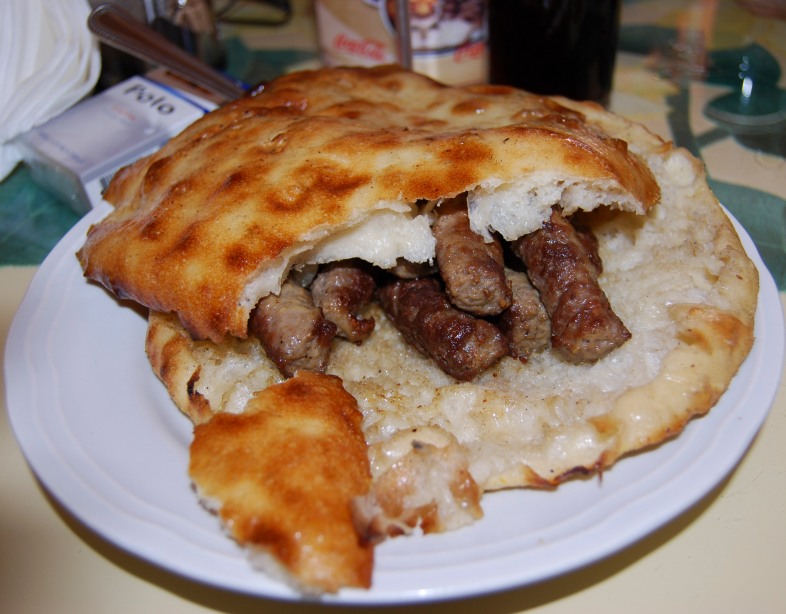
Why this yummy pastry dish was singled out as a sign of Ottoman backwardness and not, say, ćevapi or sarma, I can’t say.
Cevapi54

Ćevapi — köfte, essentially — (above) and sarma (stuffed cabbage) below.
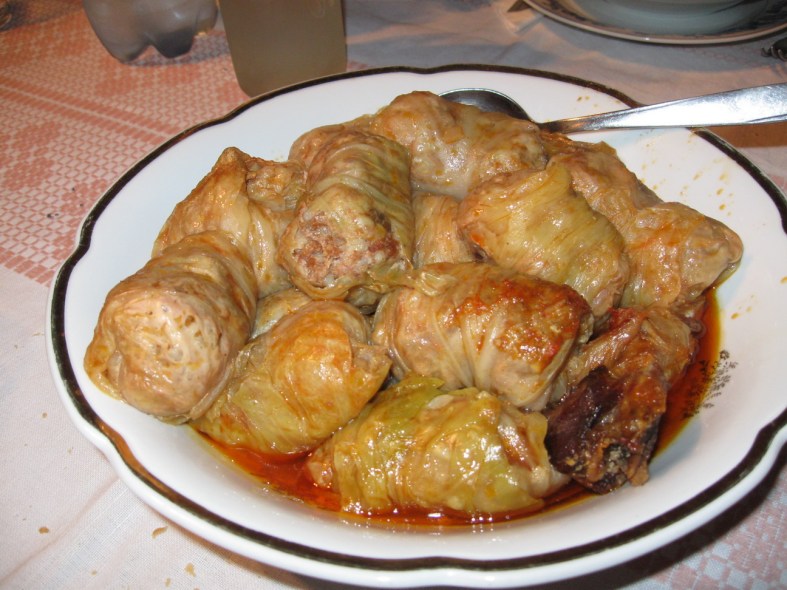
sarma raspakovana

And when I talk about Hapsburg South Slavs I’m obviously talking about Croats, because, let’s face it, who cares about Slovenes? And there may be very few, if any, compelling historical or cultural reasons of interest to care about Croatians either, except, that as most readers must know by now, I consider them the people most singularly responsible for the Yugoslav tragedy. And this post is my chance to come clear about why I feel that way. There may be lots of interpretations of what the “Illyrianist” intellectuals of Vienna and Novi Sad and Zagreb had in mind when they started spouting theories of South Slav unity in the nineteenth century; countless theories about how Yugoslavia or the original Kingdom of the Serbs, Croats and Slovenes was formed; many analyses of what happened in Paris in 1919 and what kind of negotiations led to the Corfu Declaration; and reams of revisionist stuff written about exactly what Croatia wanted out of this union. But, for me, one basic fact is clear: that Croatians were always part of Yugoslavia in bad faith; that they wanted something out of the Serb efforts and Serbian blood that was decisive in defeating Austria in WWI, but that that something was independence, or greater autonomy within an Austria that they probably never expected to be dismembered the way it was – anything but what they felt was being subjected to Belgrade. And that became immediately clear upon the formation of the state when they – being, as Dame Rebecca calls them, good “lawyers” – began sabotaging the normal functioning of the Yugoslav government in any way they could, no matter how more democratic the Serbs tried to make an admittedly not perfect democracy, no matter how many concessions of autonomy Belgrade made to them. If there were any doubt as to the above, even when Radić and his Croatian People’s Peasant Party had turned the Skupština into a dysfunctional mirror image of today’s American Congress, even when a Macedonian IMRO activist working in tandem with Croatian fascists assassinated Serb King Aleksandr in Marseille in 1934, it was subsequently made brutally clear by the vicious death-spree Croatian, Nazi-collaborating fascism unleashed on Serbs during WWII, a true attempt at ethnic cleansing that dwarfs anything the Serbs may have done during the 90s — which is dwarfed again by what Croatians themselves did in the 90s again: the most heinous Nazi regime, “more royalist than the king,” as the French say — more Nazi than the Nazis — to appear in Eastern Europe during WWII.  And they have not been even remotely, adequately,  held to account by the world for any for any of the above; all this ignored, even as the West maintains a long list of mea-culpas it expects Serbs to keep reciting forever.
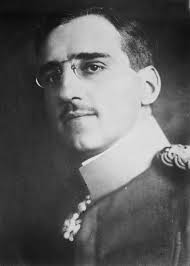
Alexander

King Aleksandr of Yugoslavia (click)

And so, when they got their chance in the 90s, with the backing of a newly united, muscle-flexing Germany, Croatians abruptly and unilaterally and illegally declared their long-wished for (but never fought-for) independence. And so did Slovenia; but again, who cares about Slovenia? It was a prosperous northern republic that may have held the same Northern-League- or-Catalan-type resentments against a parasitic south that was draining its wealth, but it was ethnically homogeneous and its departure left no resentful, or rightfully fearful, minorities behind. But Croatia knew, when it declared its independence – as did, I’m sure, their German buddies – that they were pulling a string out of a much more complex tapestry. And did it anyway. And we all saw the results. 5*****

So when a Croat says “Nein Danke” to an offer of burek, without even the slightest concern about his past reputation and avoiding any German associations, it is for me a chillingly racist and concise summation of Saidian Orientalism, a slogan that sums up not only the whole ugliness of the tragic, and tragically unnecessary, break-up of Yugoslavia, but the mind-set of all peoples afflicted with a sense of their being inadequately Western, and the venom that sense of inadequacy spreads to everything and everyone it comes in contact with. I’ve written in a previous post about Catalan nationalism:

All of us on the periphery, and yes you can include Spain, struggle to define ourselves and maintain an identity against the enormous centripetal power of the center.  So when one of us — Catalans, Croatians, Neo-Greeks — latches onto something — usually some totally imaginary construct — that they think puts them a notch above their neighbors on the periphery and will get them a privileged relationship to the center, I find it pandering and irritating and in many cases, “racist pure and simple.”  It’s a kind of Uncle-Tom-ism that damages the rest of us: damages our chances to define ourselves independent of the center, and damages a healthy, balanced understanding of ourselves, culturally and historically and ideologically and spiritually.  I find it sickening.

(see also: “Catalonia: ‘Nationalism effaces the individual…'” )

We’re signifying animals. And our tiniest decisions — perhaps our tiniest most of all – the symbolic value we attribute to the smallest detail of our lives, often bear the greatest meaning: of love; of the sacred; of a sense of the transcendent in the physical; of our self-worth as humans and what worth and value we ascribe to others; of hate and loathing and vicious revulsion. Nothing is an innocently ironic piece of graffiti – irony especially is never innocent, precisely because it pretends to be so.

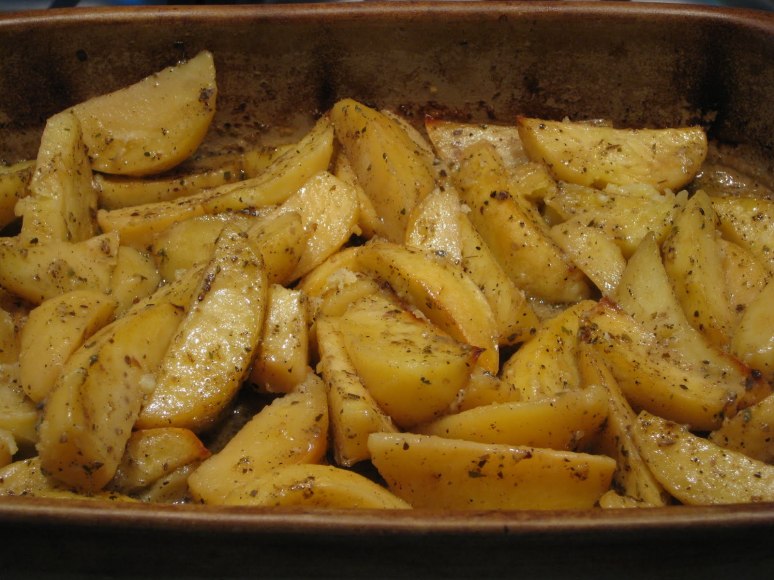
And so I find anti-börekism offensive. Because a piece of my Theia Vantho or my Theia Arete’s börek is like a Proustian madeleine for me. Because I’m not embarrassed by it because it may be of Turkish origin. Because I think such embarrassment is dangerous – often murderously so, even. And because I think of eating börek — as I do of eating rice baked with my side of lamb and good yoghurt as opposed to the abysmally soggy, over-lemoned potatoes Old Greeks eat – as an act of culinary patriotism. 6****** And a recognition that my Ottoman habits, culinary and otherwise, are as much a part of my cultural make-up as my Byzantine or even Classical heritage are. Because just like Yugoslavia, you can’t snip out one segment of the woop and warf and expect the whole weave to hold together.
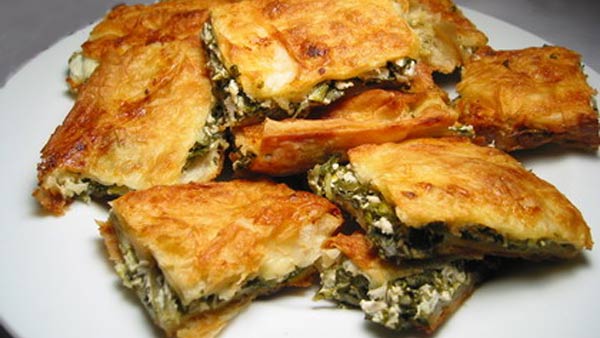
spinach-burek

******************************************************************************************************************************************************************

*1  One thing judo taught me — or rather what I learned from how long it took me, when I started, to learn to sit on my knees and flat feet — is how orthopedically horrible for our bodies upright, Western chairs and tables and couches are.  (By couch here I don’t mean the sink-in American TV couch, which you sink into until you’re too fat to get out of — that’s another kind of damage.)  Knee and lower back problems at earlier ages are far more prevalent in the Western world precisely because of these contraptions that artificially support and distort our body weight in destructive ways.  I remember older aunts in Epiros, in both Jiannena and the village, being able to sit on a low divan on the floor and pull their legs up under their hips with complete ease — women in their eighties and nineties and often portly at that — because their bodies had learned to sit on the floor or low cushions all their long and very mobile lives; they looked like they didn’t know what to do with themselves when you put them in a chair.  I’m reminded of them when I see Indian women their age at mandirs, sitting cross-legged, or with legs tucked under as described, through hours-long rituals, rising to prostrate themselves and then going down again, and then finally just getting up at the end with no pain and no numbness and no oyyy-ings.

**2  The two masterpieces of this point: the celebration of the sophistication and sensuality of the Ottoman sensibility and a trashing of Neo-Greek aesthetics — and by extension, philisitinism, racism and Western delusions — are Elias Petropoulos’ two books: Ο Τουρκικός Καφές εν Ελλάδι“Turkish Coffee in Greece,” and Tο Άγιο Χασισάκι “My Holy Hash.”  Part tongue-in-cheek, part deadly serious, both books are both hilarious and devastating.

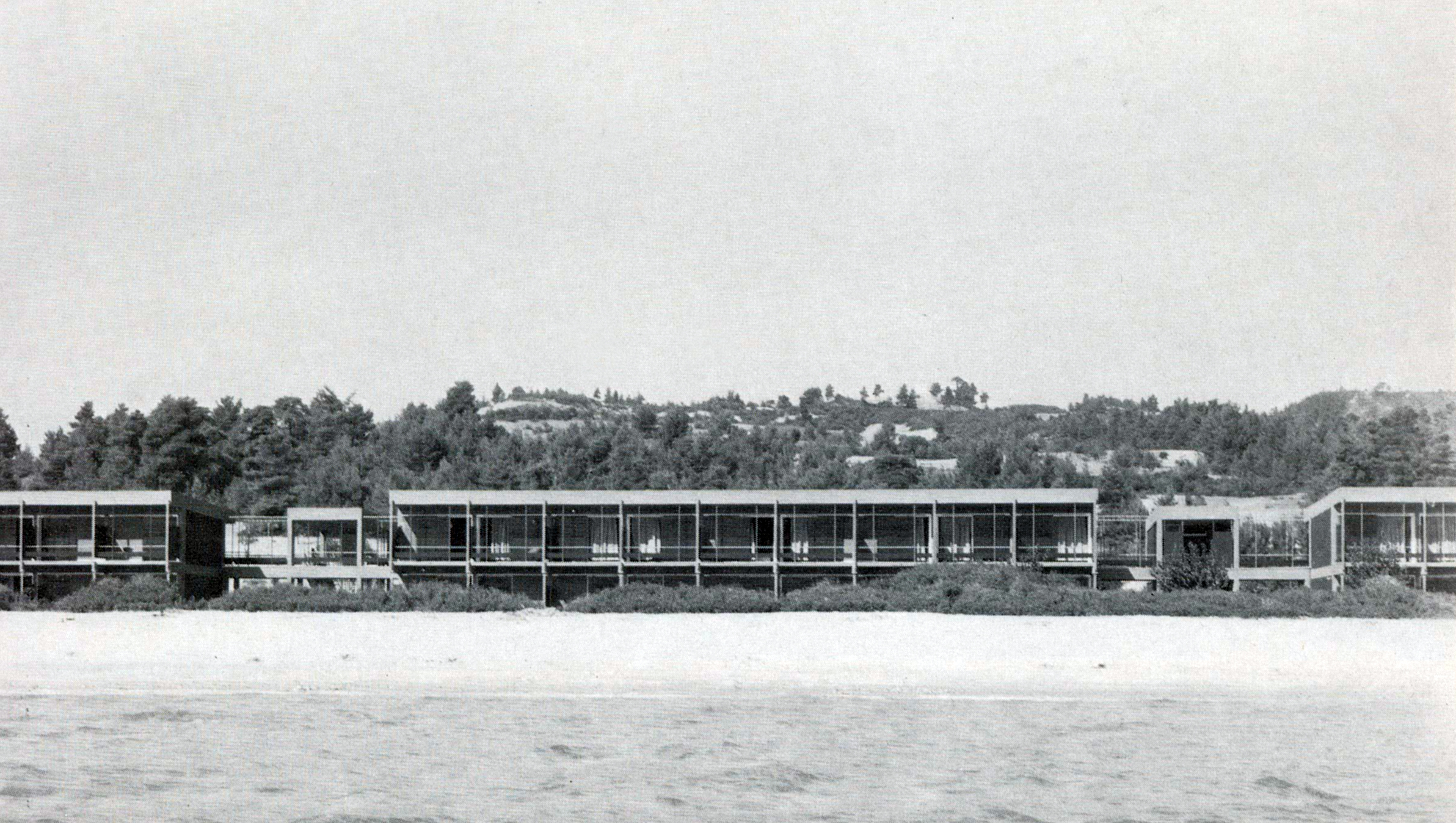
***3  Unfortunately, to build this palace of Neo-Ottoman kitsch that would make Davutoğlu proud, one of Greece’s classic old Xenia hotels, masterpieces of post-war Greek Modernism and most designed by architect Aris Konstantinidis, was torn down, and most of these hotels have suffered similar fates throughout the country, as the nationally run State Tourist Organization was forced to sell off its assets by the privatization forced on Greece then and to this day.
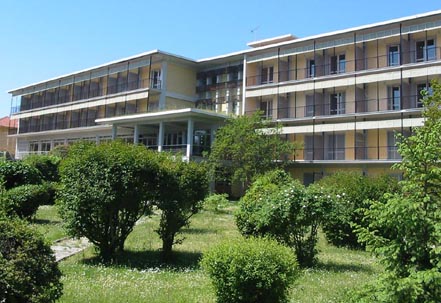
Xenia Jiannena

The Jiannena Xenia, above, built in the old wooded grove of Guraba, just above the center of town, and, below, perhaps Konstantinidis’ masterpiece, the Xenia at Paliouri in Chalkidike. (click)
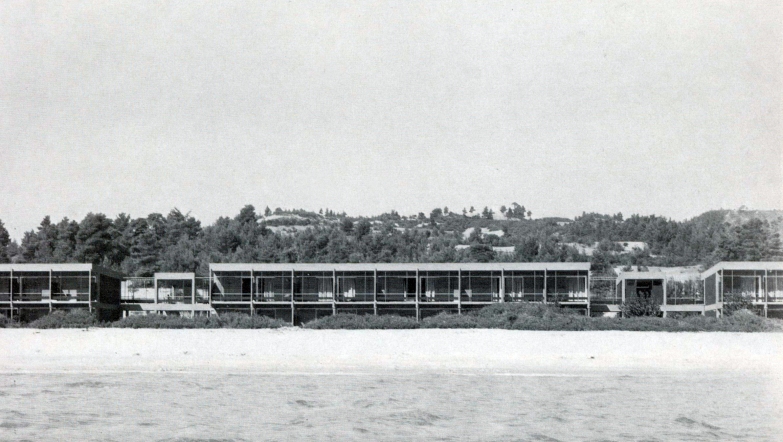
Eot-paliouri-1962-2

Fortunately, Jiannena preserves one of Konstantinidis’ other masterpieces, its archaeological museum, below. (click)
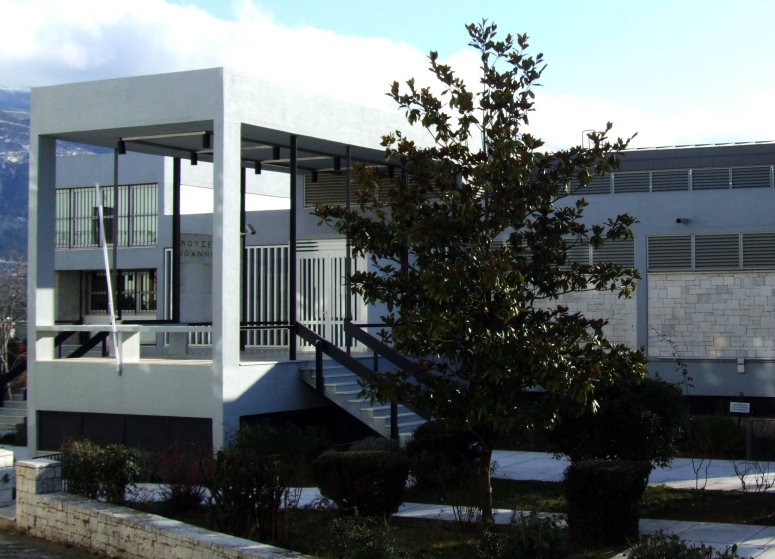
100_6975_-_Kons.Ioan1

****4  Ironically, the strudel that Croats and Slovenes imagine themselves eating in their Viennese wet dreams is probably a descendant of börek; and take it a step further: let’s not forget that croissants and all danish-type puff pastry items are known generically as viennoiserie in French.  So the ancestor of some of the highest creations of Parisian/French/European baking arts is something that a Slovene says “nein danke” to in order to prove how European he is.  Talk about the farcicalness of “nesting orientalisms.”
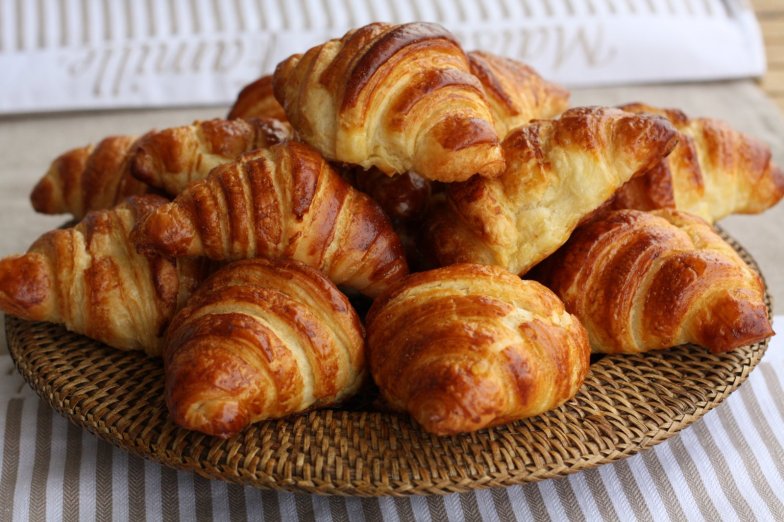
croissant

*****5  Of course, in every case, this assumption-cum-accusation, about the parasitic South draining the North of its resources, is patent bullshit.  Southern Italy, the southern Republics of Yugoslavia, Castille, Galicia, Andalusia, and the southern tier of the European Union today, may get disproportionately more in the allotment of certain bureaucratic funds compared to the tangible wealth they produce.  But they also provide the North, in every single one of these cases, with resources, labor and markets on which that North gets rich to a far more disproportionate degree and stunts the South’s growth in the process.  So haydi kai…

It’s become a common-place — and not inaccurate — observation that the catastrophic economic pressure Germany is today exercising on the nations of Southern Europe for the sake of making some sick moral point is the fourth time it’s wrecked Europe in less than a centurythe third time being when it decided, immediately upon reunification, to show the continent it was a political player again by practically single-handedly instigating the destruction of Yugoslavia.

******6
patattes

Over-oreganoed and over-lemoned — like much of Greek food — and overdone, over-salted and over-oiled, perhaps the only thing more repulsive than the soggy potatoes Old Greeks bake with lamb or chicken (though one horrible restaurant — which New Yorkers are for some reason crazy about: I mean like “take-the-N-train-out-to-Astoria-and-wait-for-a-table-for-an-hour” crazy — criminally serves them with grilled fish) is the serving of stewed meat with french fries.  You’ve hit the rock bottom of Neo-Greek cuisine when you’ve had a dry, stringy “reddened” veal or lamb dish accompanied by what would otherwise be good, often hand-cut french fries, sitting limply on the side and sadly drowning in the red oil.

Comment: nikobakos@gmail.com

A Reader Writes: Agha Shaid Ali

19 May

Dear Nicholas Bakos,

Its a lovely article on an unknown personality in his own native place where he as a child grow up with his lovely family and I also belong to Kashmir ; no one was aware that Ali is a American -Kashmiri poet till he got expired in 2001 , I remember clearly I was 17 and my brother told me that lets attend the funeral , although he was buried in Northampton near the Emily Dickinson I noticed that day people were talking about his generosity and his liberal views about life.

Thanking you for writing a beautiful article!

Cheers!

Syed Mudasir Ali

Thank you Syed.  What news from Kashmir can you bring us?.  it’s been so absent in the news lately?  How do people see Modi’s election?

NB

Below: the entire post

*************************************************************************************************************************************************************************************************************

Talk of poetry, the Delhi Wallah and Kashmir (May 10, “Favorite Blogs: The Delhi Wallah”) made me think of one of my favorite poets of the past few years, the Kashmiri-American — I guess one would call him — Agha Shahid Ali, a prolific poet who wrote about the ghazal, edited a book of ghazals in English: Ravishing DisUnities: Real Ghazals in English and wrote a collection of his own ghazals in English: Call Me Ishmael Tonight a tiny volume that obsessed me for months the first time I got my hands on it.  That one of the most beautiful men I’ve ever known — a friend and the saqi at a bar in Astoria I used to go to — introduced me to it didn’t hurt either.  “Strange and beautiful” he called them, and I still do, and often think that the one must always by necessity partake of the other to some extent: in poetry, in religion, in the physical beauty of a man or woman, in an idea…

Here’s part of Ali’s description of the genre:

“The ghazal is made up of couplets, each autonomous, thematically and emotionally complete in itself… once a poet establishes the scheme—with total freedom, I might add—she or he becomes its slave. What results in the rest of the poem is the alluring tension of a slave trying to master the master.”

In Arabic

A language of loss? I have some business in Arabic.
Love letters: a calligraphy pitiless in Arabic.

At an exhibit of miniatures, what Kashmiri hairs!
Each paisley inked into a golden tress in Arabic.

This much fuss about a language I don’t know? So one day
perfume from a dress may let you digress in Arabic.

A “Guide for the Perplexed” was written–believe me–
by Cordoba’s Jew–Maimonides–in Arabic.

Majnoon, by stopped caravans, rips his collars, cries “Laila!”
Pain translated is O! much more–not less–in Arabic.

Writes Shammas: Memory, no longer confused, now is a homeland–
his two languages a Hebrew caress in Arabic.

When Lorca died, they left the balconies open and saw:
On the seat his qasidas stitched seamless in Arabic.

Ah, bisexual Heaven: wide-eyed houris and immortal youths!
To your each desire they say Yes! O Yes! in Arabic.

For that excess of sibilance, the last Apocalypse,
so pressing those three forms of S in Arabic.

I too, O Amichai, saw everything, just like you did–
In Death. In Hebrew. And (please let me stress) in Arabic.

They ask me to tell them what Shahid means: Listen, listen:
It means “The Beloved” in Persian, “witness” in Arabic.

Agha Shahid Ali (1949-2001)

More here: Poetry Foundation

Some more mundane info on the ghazal: Ghazal

“In Arabic” “Reprinted from The Veiled Suite: The Collected Poems by Agha Shahid Ali. English translation copyright © 2009 by Daniel Hall. With the permission of the publisher, W.W. Norton & Company, Inc.”


Comment: nikobakos@gmail.com

Eid on Steinway Street, Astoria, 1433 (2012)

22 Aug

The few blocks of Steinway Street just south of the Grand Central in Astoria have become the center drag for Queens’ Egygptian and other Arab community in the past two decades or so.  Steinway is lined, literally one next to the other, with narghile (hooka, shishsa) shops, clubs, pastry shops and coffeehouses, largely Egyptian-owned, some Lebanese, some Yemeni.  What I hadn’t realized till a couple of years ago is that those blocks of Steinway Street were a major hang out for South Asian kids from around the neighbourhood and from all over Queens.  At least the first night of Eid.  I asked more than a few of these kids why they didn’t go to Jackson Height, the densest and most varied of Queens’ South Asian neighborhoods, on a night like this, and all of them said: “There’s nothing there at night!”  It really got me thinking about why this sort of cafe culture would exist in the Muslim world’s Mediterranean countries and not in South Asia.  There’s the tea-house in Central Asia, but there seems to be nothing in lowland Pakistan, India or Bangladesh that’s comparable.  Or is there and I don’t know about it?  Any ideas?

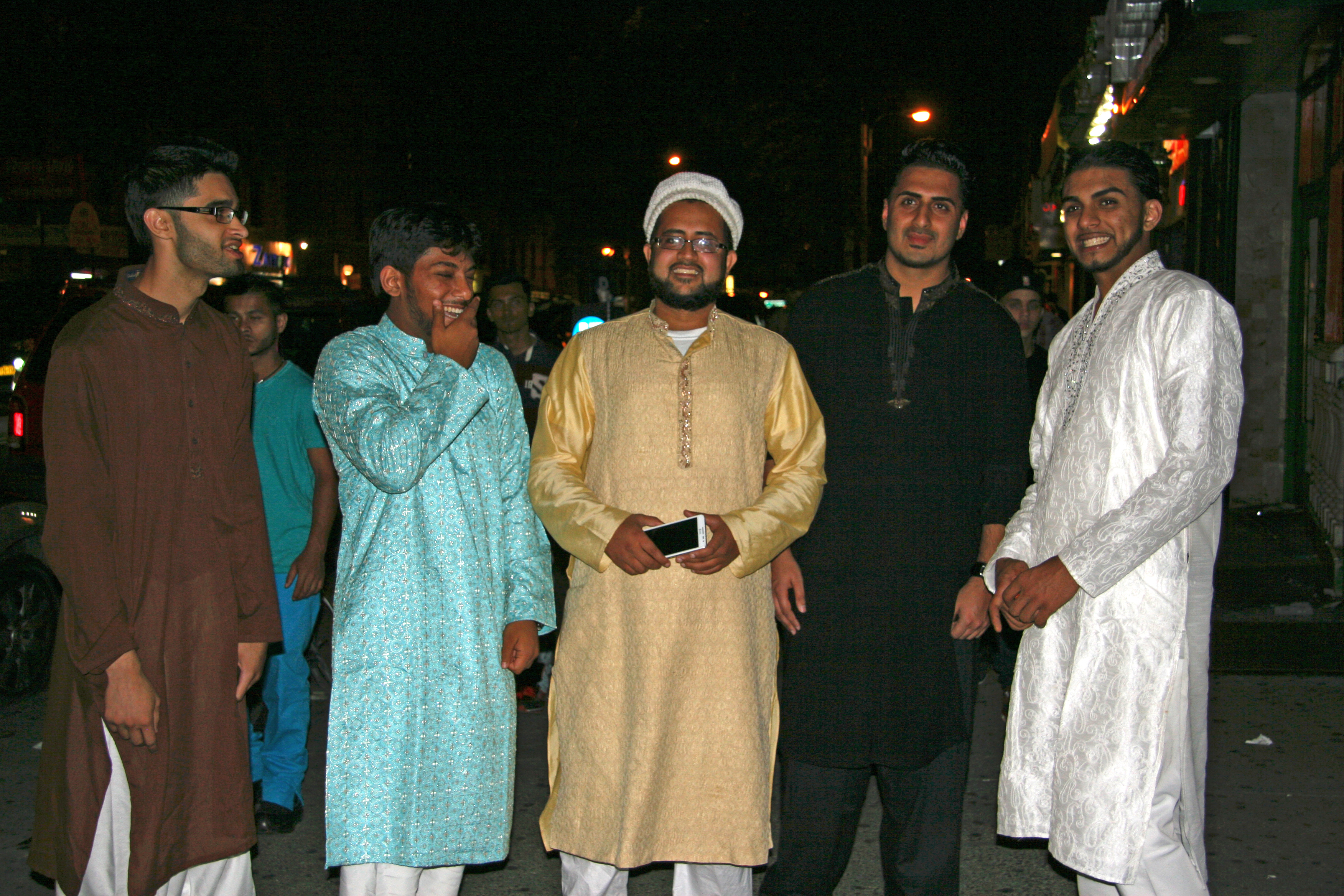
In any event on Eid (as soon they as they can escape their families?) these kids swamp and totally overwhelm Steinway with color and beauty.  It’s really an amazing sight.

(Click — and for textile, ornament and beautiful face detailsdouble-click on ALL photos; they’re big files.)

The gorgeous silk kurta, the traditional sequinned (double-click) shoes and the jeans in between (above).  Can anybody tell me what the beautiful article of clothing his friend is wearing is called?

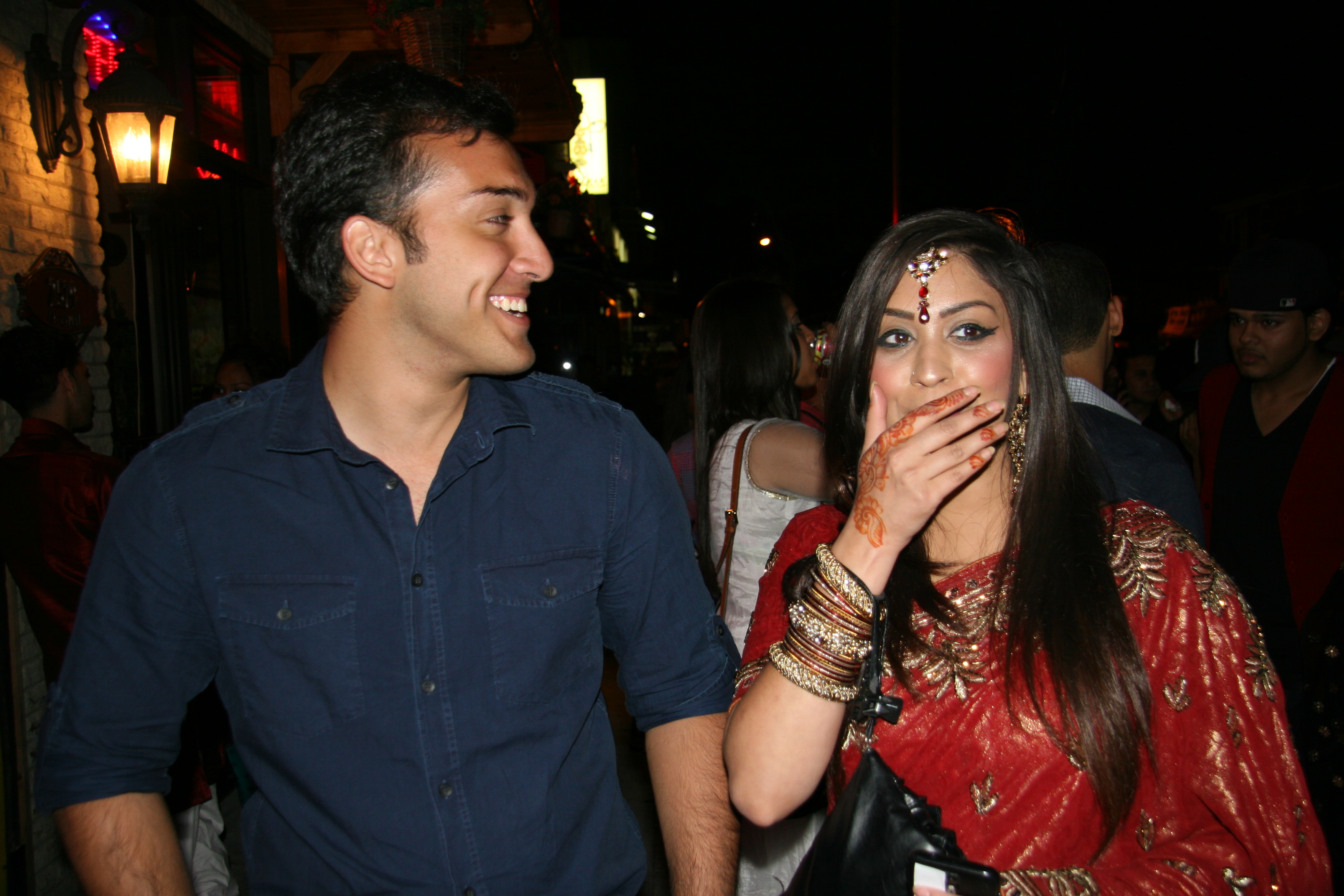
Hennaed hands.

Only one of these guys was unsuccessful in suppressing the giggles.

My funky glasses and my yaar: “Eid Mubarak!”

And a beautiful friend and guest of the above two.  It’s New York, right?  They musta had a piss taking her shopping.

And some Egyptians…   The best Adana-like kebab in the city (above), what’s called lyulya kebab in Russia and Central Asia.  I don’t know what Arabs call it.  Too bad for the plastic, germophobic gloves; I can guarantee you, from experience, that an evening’s accumulation of grease and sweat off his palms makes it taste so much better.

And (below) an Egyptian couple who now happily have nothing more to say to each other.  Is there a way to fast-forward a marriage to that point?

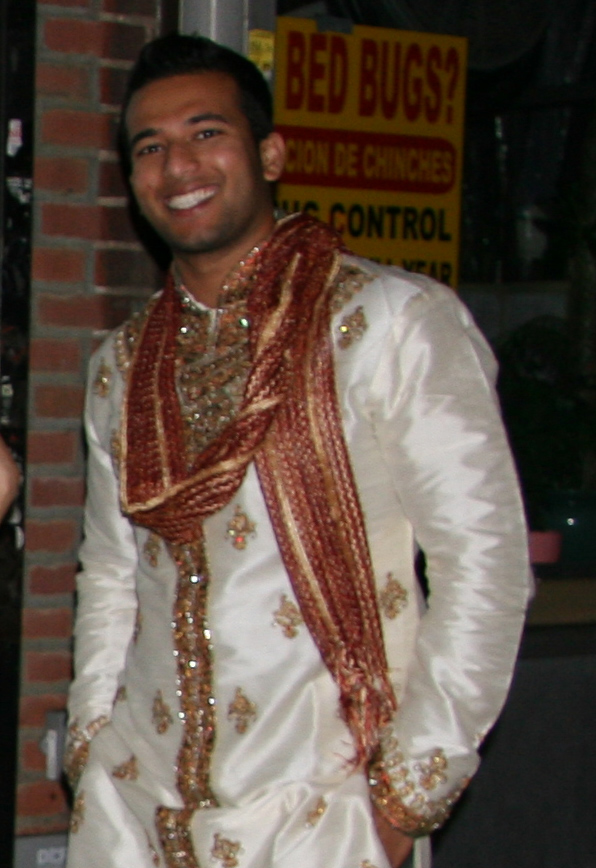
The photo below turned out to be badly focussed– very unfortunately — because this guy was easily the king of the Steinway St. runway that night in a white satin, red-and-gold sequinned sherwani and red, gold-threaded dupatta.  I said to him: “That’s what you wear for Eid, buddy?  What are you gonna wear for your wedding?”  He smiled and said: “I’m married…”

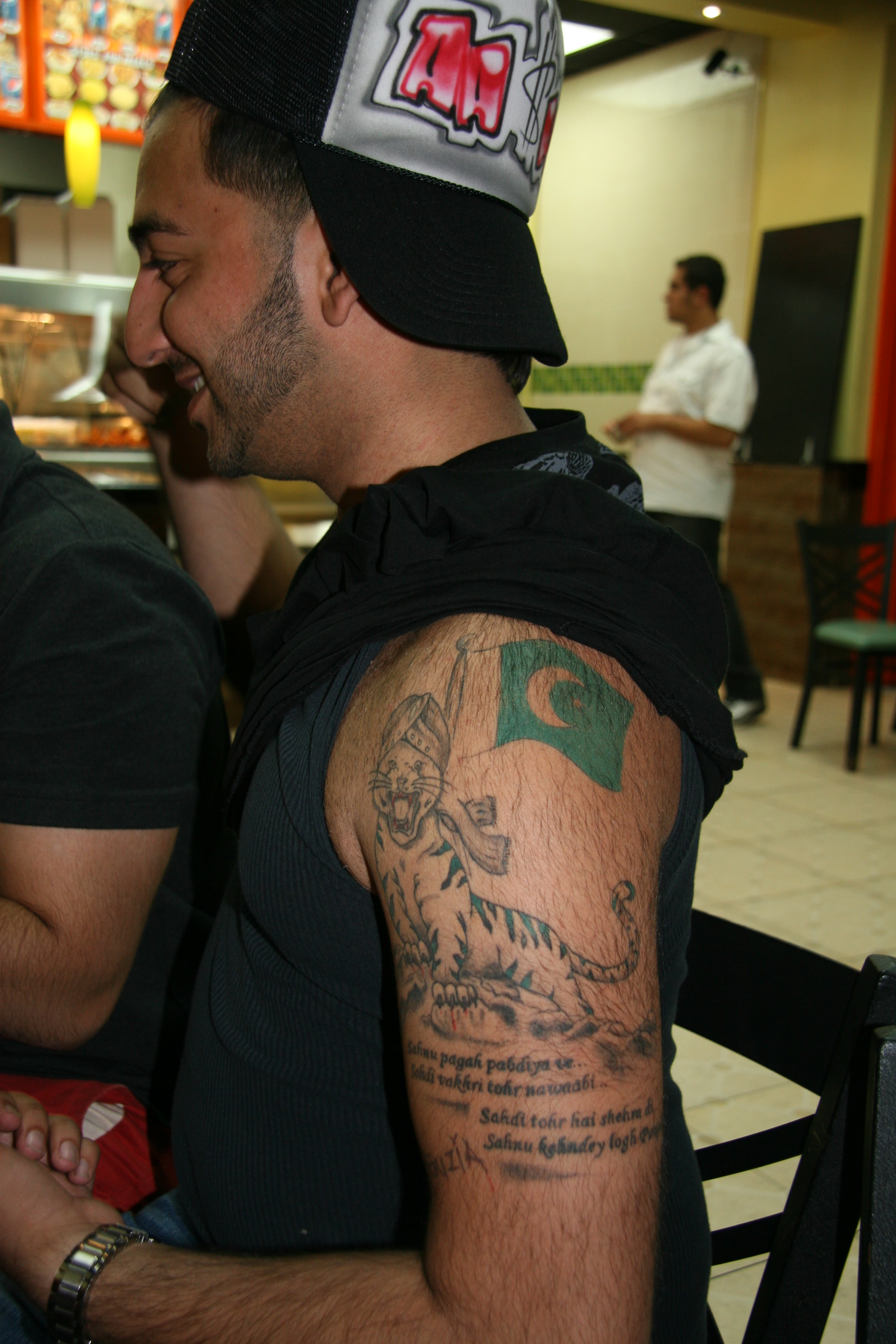
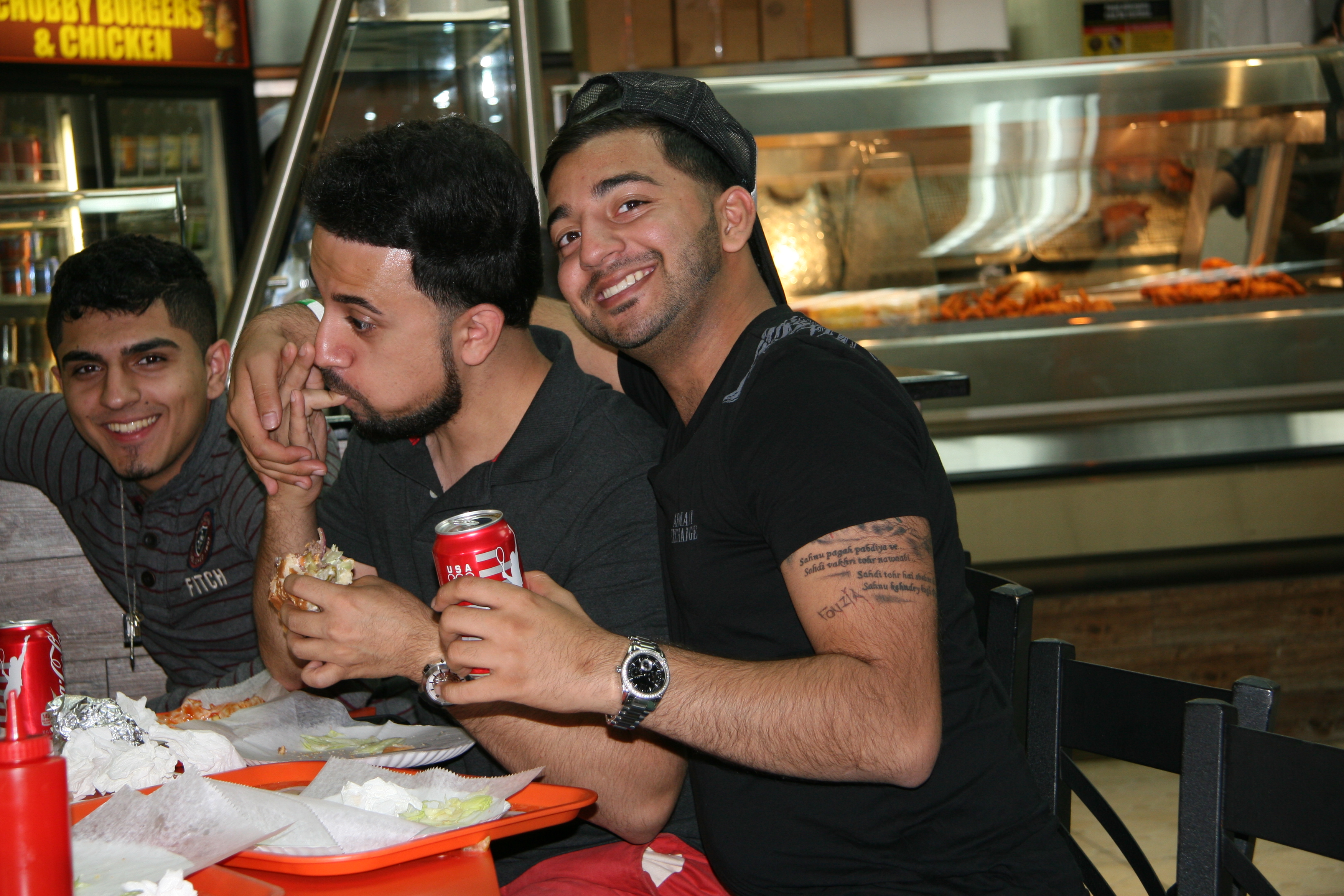
Then there’s these guys below, who are cool enough to just show up in their tats.

“Askeri” — soldier

And a more hardcore tattoo below (though, actually, just “askeri” is probably more Spartanly hardcore).  It had something in transliterated Urdu or Punjabi underneath the lion but things were too frantic for me to get it down.

And scarfing with his friends.

Below, a real knock-out.  Full holiday dress-kit for Bangladeshi women usually means a sari and not fancy salwar-kameez like for Indo-Pako-Muslim or Sikh women.  But you can’t really draw hard lines like that ’cause you never know; it’s India and this is New York.  (“India” is meant here historically, as the whole subcontinent guys, ok?  Don’t bow up on me please.)

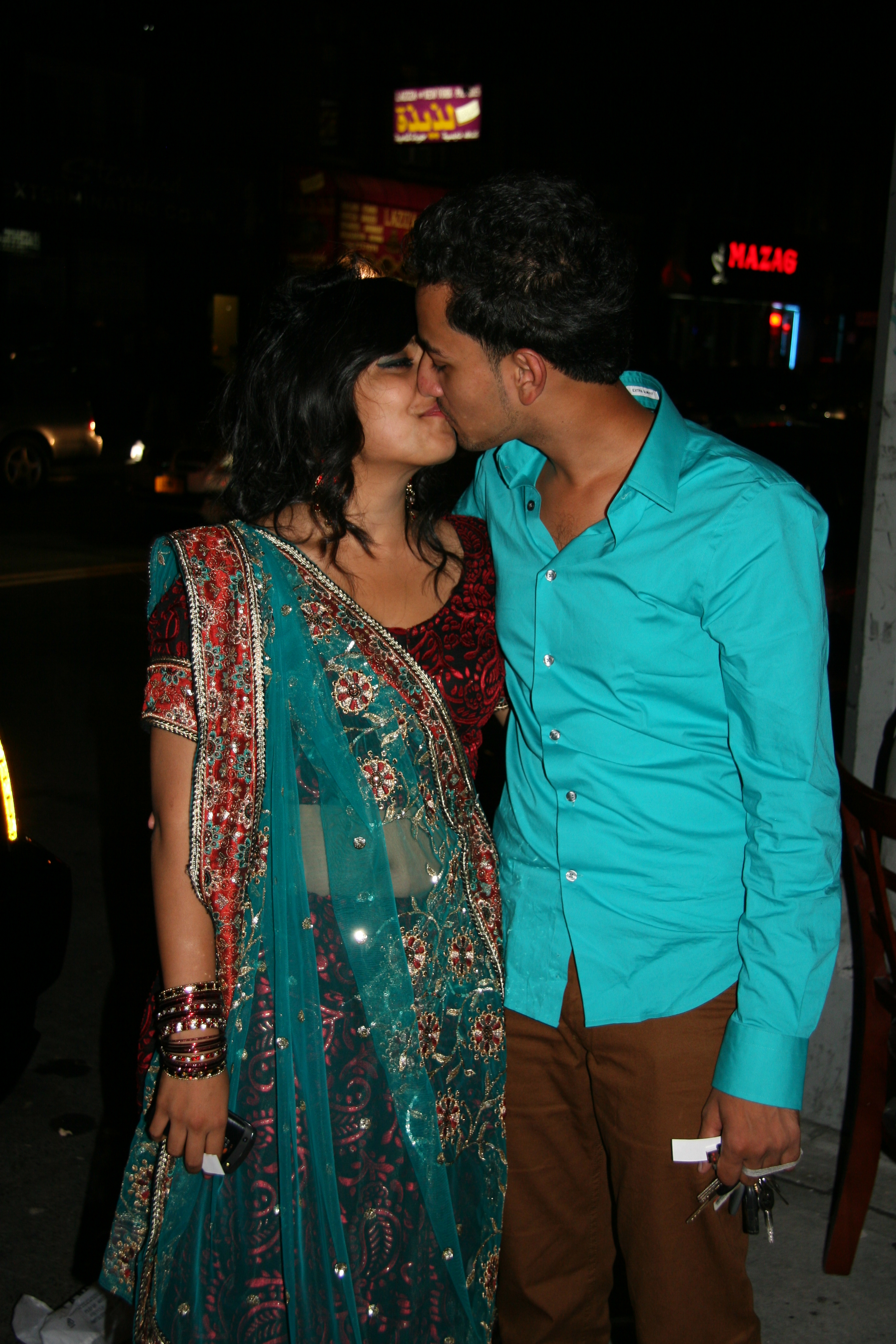
A kiss away from the folks.

Down Steinway.

One particularly heartening part of going out on this shoot…

Muslims in America have been the object of illegal surveillance and harassment, infiltration of their communities, unfair detention, vandalism and just plain annoying and irritating disrespect and meddling for a long time now.  I’ve been on the secondary receiving end of the anger and suspicion that’s all caused — though hardly a victim of it — under a variety of circumstances, some unpleasant, some funny.

Now, for a variety of physical, age, accent and attitude reasons I guess I could pass for a New York cop.  I also wear my cross on an employee i.d., dogtag-type chain and that probably doesn’t help.  Nobody in Afghanistan, expat or Afghan, believed I wasn’t a contractor without lengthy explanation and convincing on my part and that’s really not a perception you want to be the object of when in Afghanistan.  When I came back, the passport guy at JFK saw my Afghan visa and said: “Contractor?” and I said “NO! ENGLISH TEACHER!”  I was once thrown out of a mosque in Elmhurst (off-prayer time) by the custodian and his broom, one of those old Peshawari guys with the orange beards, yelling: “Go out! Go out!”  And an exchange with two Afghan butchers who I had gone to for my lamb one Easter because I was having halal-observant friends over was completely friendly and animated till I started throwing around some of my recently learned Farsi.  That was followed by a complete silence through which they kept busily hacking away without even looking at me.  And when two Pashtun guys with meat cleavers make it clear they don’t want to talk to you, it’s best to shut up.  They didn’t even speak the price to me at the end; just physically showed me the receipt.  I payed, took my animal and slunk out.

But I only put two and two together when I went into another halal butcher in Jackson Heights to get some chickens for something I was going to make for a party we were having with my students, many of them also halal-observant.  I walked in; said “Salaam,” even did my little “adab” forehead gesture and everybody just stared at me.  Then a very energetic, smiling young Pakistani guy came out of the back and with arms wide-open says: “Officer, what I can give you?!”  After a “what-do-I-say” second, I told him what I needed.  “Ok, officer!”  He started skinning and chopping at the chickens.  “So, barbecue time, officer?”  It was right before Memorial Day.  I said, “No, I’m actually gonna make a korma with that chicken; that’s why I’m asking you to take the skin off…”  “Wow, nice.”  Silence.  “You know, I’m not a cop.”  “Ok, officer, no problem,” smilingly.  “I have students who only eat halal meat, we’re having a party….” I continue trying to explain.  “Ohhhhh, that’s very nice, officer, you’re good guy.”  “And I’m learning Farsi because…”  Then I just gave up; put my arm up on the counter, leaning up against the glass, just watching him — him with the chickens, as he kept grinning and occasionally mumbling to himself: “Ok, officer…yeaaaaaaaa, chicken….no problem, officer…ok, officer…”  He was getting to the last of the chickens and he looked up at me and we stared at one another for a moment, full eye contact, like three feet away from each other…and we both fell into a giggling fit.

I never did figure out whether he believed me, didn’t believe me, was pulling my leg and shittin’ with me the whole time — I don’t know.  They all replied “Khuda Hafez” to mine as I left.  I did my little forehead gesture.  The older men returned it.  Who knows.  I don’t know.  Once on the street I thought to myself: “Can they really think that any American ‘inteligence’ organization — FBI, NYPD — can be that stupid that they think they’re going to teach a big white guy some half-assed words of Farsi-Urdu, and send him in to….” and then said, yeah, they have every reason to think they can be “that stupid” because they probably are.

Back to Steinway Street.  The night we went on this shoot I was doing my introductory spiel to every group of kids we would walk up to: “These are just for a blog I write…I’ll take them down if you don’t like them..” and, to several more hesitant looking groups of guys: “…I’m not a cop or anything,” to which they replied, to the man, and in stereo: “I wouldn’t give a shit if you were.”

Aferin!  That’s the spirit, brothers.  Stay strong and keep it up.

Thanks to all of you guys for your smiling, cooperative, welcoming participation in this little project.  I can’t express my appreciation enough.  All the best to you, your friends and your families.

And for the rest of us, trapped in the aesthetics of nineteenth-century, false bourgeois humility and, now, its descendant, the fake hipness of charcoal and black, PLEASE keep wearing those clothes, and be enormously proud of them.

Many, many thanks to Johana Ramirez, who took the photos and accompanied me on this adventure.

Again, if you want any of these taken down, you know where to find me.  Any of those who didn’t make it, sorry; it was only a matter of space.  I’m putting up a Flickr page as soon as I can where all the photos taken that night will be posted, so you’ll be able to find them there.

And again, thank you.  Peace.

Nick Bakos

Comment: nikobakos@gmail.com

“India’s Blood-Stained Democracy” by Mirza Waheed

7 Jul

Kashmiri women attend a protest organized by the Association of Parents of Disappeared Persons in Srinagar in November 2010.  (Rouf Bhat/Agence France-Presse — Getty Images)


from The New York Times, July 6th

India’s Blood-Stained Democracy, by Mirza Waheed

“LAST September, a lawmaker in Indian-controlled Kashmir stood up in the state’s legislative assembly and spoke of a valley filled with human carcasses near his home constituency in the mountains: “In our area, there are big gorges, where there are the bones of several hundred people who were eaten by crows.”

“I read about this in faraway London and was filled with a chill — I had written of a similar valley, a fictional one, in my novel about the lost boys of Kashmir. The assembly was debating a report on the uncovering of more than 2,000 unmarked and mass graves not far from the Line of Control that divides Indian- and Pakistani-controlled Kashmir. The report, by India’s government-appointed State Human Rights Commission, marked the first official acknowledgment of the presence of mass graves. More significantly, the report found that civilians, potentially the victims of extrajudicial killings, may be buried at some of the sites.

“Corpses were brought in by the truckload and buried on an industrial scale. The report cataloged 2,156 bullet-riddled bodies found in mountain graves and called for an inquiry to identify them. Many were men described as “unidentified militants” killed in fighting with soldiers during the armed rebellion against Indian rule during the 1990s, but according to the report, more than 500 were local residents. “There is every probability,” the report concluded, that the graves might “contain the dead bodies of enforced disappearances,” a euphemism for people who have been detained, abducted, taken away by armed forces or the police, often without charge or conviction, and never seen again.

“Had the graves been found under Col. Muammar el-Qaddafi’s compound in Libya or in the rubble of Homs in Syria, there surely would have been an uproar. But when over 2,000 skeletons appear in the conflict-ridden backyard of the world’s largest democracy, no one bats an eye. While the West proselytizes democracy and respect for human rights, sometimes going so far as to cheerlead cavalier military interventions to remove repressive regimes, how can it reconcile its humanitarianism with such brazen disregard for the right to life in Kashmir? Have we come to accept that there are different benchmarks for justice in democracies and autocracies? Are mass graves unearthed in democratic India somehow less offensive?”


I See Kashmir from New Delhi at Midnight

                              Now and in time to be,

                             Wherever green is worn…

                             A terrible beauty is born.

                                              — W. B. Yeats

1

One must wear jeweled ice in dry plains

to will the distant mountains to glass.

The city from where no news can come

Is now so visible in its curfewed nights

that the worst is precise:

                                        From Zero Bridge

a shadow chased by searchlights is running

away to find its body. On the edge

of the Cantonment, where Gupkar Road ends,

it shrinks almost into nothing, is


nothing by Interrogation gates

so it can slip, unseen, into the cells:

Drippings from a suspended burning tire

Are falling on the back of a prisoner,

the naked boy screaming, “I know nothing.”

2

The shadow slips out, beckons Console Me,

and somehow there, across five hundred miles,

I’m sheened in moonlight, in emptied Srinagar,

but without any assurance for him.


On Residency Road, by Mir Pan House,

unheard we speak: “I know those words by heart

(you once said them by chance): In autumn

when the wind blows sheer ice, the chinar leaves

fall in clusters –

                                 one by one, otherwise.”

“Rizwan, it’s you, Rizwan, it’s you,” I cry out

as he steps closer, the sleeves of his phiren torn.

“Each night put Kashmir in your dreams,” he says,

then touches me, his hands crusted with snow,

whispers, “I have been cold a long, long time.”


3

“Don’t tell my father I have died,” he says,

and I follow him through blood on the road

and hundreds of pairs of shoes the mourners

left behind, as they ran from the funeral,

victims of the firing. From windows we hear

grieving mothers, and snow begins to fall

on us, like ash. Black on edges of flames,

it cannot extinguish the neighborhoods,

the homes set ablaze by midnight soldiers.

Kashmir is burning:


                                   By that dazzling light

we see men removing statues from temples.

We beg them, “Who will protect us if you leave?”

They don’t answer, they just disappear

on the roads to the plains, clutching the gods.


4

I won’t tell your father you have died, Rizwan,

but where has your shadow fallen, like cloth

on the tomb of which saint, or the body

of which unburied boy in the mountains,

bullet-torn, like you, his blood sheer rubies

on Himalayan snow?


I’ve tied a knot

with green thread at Shah Hamdan, to be

untied only when the atrocities

are stunned by your jeweled return, but no news

escapes the curfew, nothing of your shadow,

and I’m back, five hundred miles, taking off

my ice, the mountains granite again as I see

men coming from those Abodes of Snow

with gods asleep like children in their arms.


                                      (for Molvi Abdul Hai)


*******************************************************************************************************************************************************************************   

*  “Don’t tell my mother / my beloved brother / my sister….I’m dead” is also a common stock phrase in Balkan epic poetry of guerrilla fighters, kleftes, haiduci.

*  “By that dazzling light we see men removing statues from temples”…”Who will protect us if you leave?”…”men coming from those Abodes of Snow with gods asleep like children in their arms.”

Shahid Ali’s universalist soul was as hurt by the exodus of Kashmiri Hindus (Pandits) from the region as he was by the brutality of the Indian Army against its innocent Muslim majority.  I can only assume that the men with the gods asleep in their arms is a reference to this exodus.  Shahid suffered from a recurrent nightmare, in fact, that the last Hindu had left Kashmir, and he fought that haunting image through the curious fashion of reproducing their distinctive cuisine as meticulously and often as possible — he was an excellent cook; there are now hardly any Hindus left in the tormented region.  “Who will protect us if you leave?,” directed to the departing Hindu gods, is a line that always breaks my heart, and could only come from a poet of as sophisticated a background and from as beautifully Sufi-syncretic a region as Kashmir.

“I See Kashmir from New Delhi at Night” reprinted from The Veiled Suite: The Collected Poems by Agha Shahid Ali. English translation copyright © 2009 by Daniel Hall. With the permission of the publisher, W.W. Norton & Company, Inc.


The Destruction of Delhi — Dalrymple (final)

3 Jul

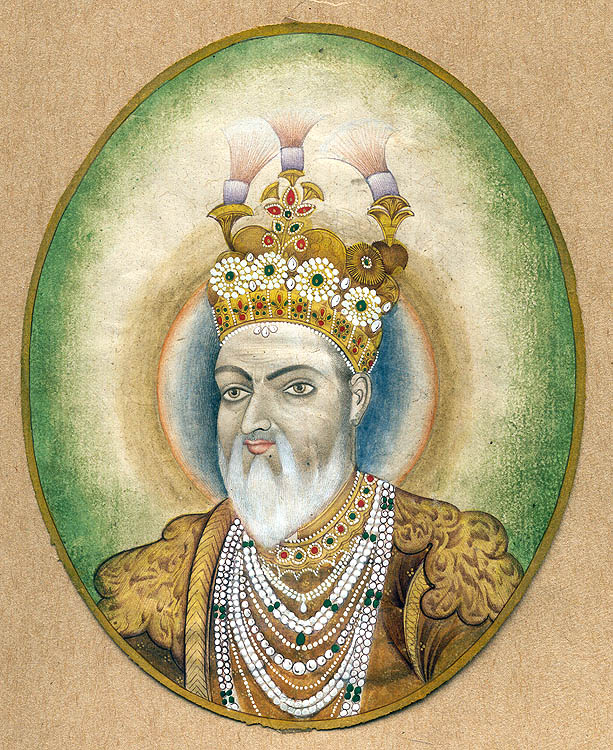
Bahadur Shah Zafar enthroned

Bahadur Shah Zafar ended up being the last of the Mughal emperors.  Already along in years when the Uprising began, he became, due to the enormous symbolic power the Mughal Shahenshah still commanded, the reluctant leader of a revolution that, for even a younger and seasoned warrior – of whom he was neither – would have been a daunting force to control, command and direct.  The original rebelling Hindu and Muslim sipahis (sepoys) had gravitated towards Delhi as the symbolic center of northern India.  They were soon joined by random teams of jihadis, groups of what Dalrymple calls “Wahabbis,” though always in quotes so I don’t know quite know who he means, and the usual motley crew of Pashtuns down from Afghanistan that never miss a good fight if word of one reaches them.  This alienated many Hindu factions in no good time and, bent as many of these groups were on plunder as much as Holy War, they ended up being as great a curse on the poor, long-suffering Delhiwallahs as any of the other players involved.

Zafar lived to see most of his family murdered.  Of his, I believe, thirty-one sons – who participated in the uprising from roles of active leadership to not at all – only two survived: three teenagers were shot in the heart at point blank range; two of the more ’implicated’ sons of similar age were put before a firing squad ordered to fire low in the guts for maximum pain; the rest hanged – along with all the other male notables of his court, including Hindus.  Certain amuck British officers seem to have spent days running around the ruins of the city, shooting anyone that looked even remotely “mirza”-like, or even Muslim, or just once rich.  The hangings seem to have lasted for weeks, with a cessating intervention finally coming from London itself.  Zafar was exiled first to the Andaman Islands and then to Burma, where he died in 1862.

It was the effective end of the Mughal aristocracy and the complete wiping out of an historic dynasty; a twentieth-century style liquidation of a social class; given the comparative dimensions of the societies involved, it was surely a purge of Bolshevik proportions and equally paranoid and crazy.  Dalrymple artfully carries the consequences of these events into modernity for us.

******************************************************************************************

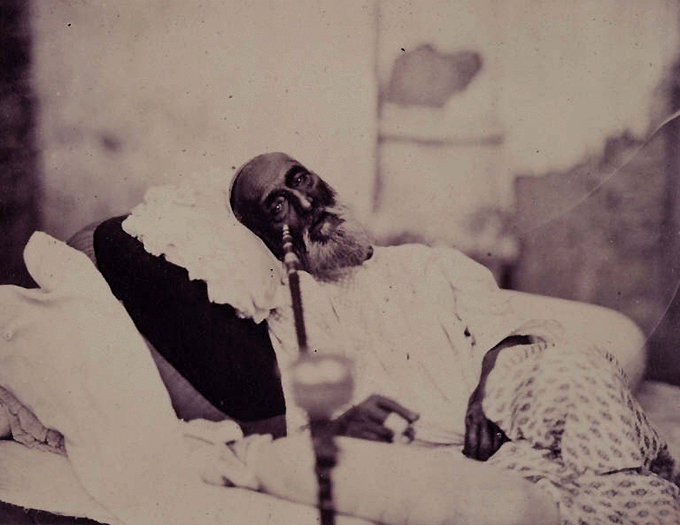
Zafar (below)

Dalrymple:

But while Zafar was certainly never cut out to be a heroic or revolutionary leader, he remains, like his ancestor the Emperor Akbar, an attractive symbol of Islamic civilization at its most tolerant and pluralistic.  He himself was a notable poet and calligrapher; his court contained some of the most talented artistic and literary figures in modern South Asian history; and the Delhi he presided over was undergoing one of its great periods of learning, self-confidence, communal amity and prosperity.  He is certainly a strikingly liberal and likeable figure when compared to the Victorian Evangelicals whose insensitivity, arrogance and blindness did much to bring the Uprising of 1857 down upon both their own heads and those of the people and court of Delhi, engulfing all of northern India in a religious war of terrible violence.

Above all, Zafar always put huge emphasis on his role as a protector of Hindus and the moderator of Muslim demands.  He never forgot the central importance of preserving the bond between his Hindu and Muslim subjects, which he always recognized was the central stitching that held his city together.  Throughout the Uprising, his refusal to alienate his Hindu subjects by subscribing to the demands of the jihadis was probably his single most consistent policy.

There was nothing inevitable about the demise and extinction of the Mughals, as the sepoys’ dramatic surge towards the court of Delhi showed.  But in the years to come, as Muslim prestige and learning sank, and Hindu confidence, wealth, education and power increased, Hindus and Muslims would increasingly grow apart, as British policies of divide and rule found willing collaborationists among the chauvinists of both faiths.  The rip in the closely woven fabric of Delhi’s composite culture, slowly widened into a great gash, and at Partition in 1947 finally broke in two.  As the Indian Muslim elite emigrated en masse to Pakistan, the time would soon come when it would be almost impossible to imagine that Hindu sepoys could ever have rallied to the Red Fort and the standard of a Muslim emperor, joining with their Muslim brothers in an attempt to revive the Mughal Empire.

Following the crushing of the Uprising, and the uprooting and slaughter of the Delhi court, the Indian Muslims themselves also divided into two opposing paths: one, championed by the great Anglophile Sir Sayyid Ahmad Khan, looked to West, and believed that Indian Muslims could revive their fortunes only by embracing Western learning.  With this in mind, Sir Sayyid founded his Aligarh Mohamedan Anglo-Oriental College (later Aligarh Muslim University) and tied to recreate Oxbridge in the plains of Hndustan.

The other approach, taken by survivors of the old Madrasa i-Rahimiyya, was to reject the West in toto and to attempt to return to what they regarded as pure Islamic roots.  For this reason, disillusioned pupils of the school of Shah Waliullah, such as Maulana Muhammad Qasim Nanautawi – who in 1857 had briefly established an independent Islamic state north of Meerut at Shamli, in the Doab – founded an influential but depressingly narrow-minded Wahhabi-like madrasa at Deoband, one-hundred miles north of the former Mughal capital.  With their backs to the wall, they reacted against what the founders saw as the degenerate and rotten ways of the old Mughal elite.  The Deoband madrasa therefore went back to Koranic basics and rigorously stripped out anything Hindu or European from the curriculum.*

*(It was by no means a total divide: religious education at Aligarh, for example, was in the hands of the Deobandis.)

One hundred and forty years later, it was out of Deobandi madrasas in Pakistan and Afghanistan that the Taliban emerged to create the most retrograde Islamic regime in modern history, a regime that in turn provided the crucible from which emerged al-Qaeda, and the most radical and powerful fundamentalist Islamic counter-attack the modern West has yet encountered.

Today, West and East again face each other uneasily across a divide that many see as religious war.  Jihadis again fight what they regard as a defensive action against their Christian enemies, and again innocent women, children and civilians are slaughtered.  As before, Western Evangelical politicians are apt to cast their opponents and enemies as the role of “incarnate fiends” and conflate armed resistance to invasion and occupation with “pure evil.”  Again, Western countries, blind to the effect their foreign policies have on the wilder world, feel aggrieved to be attacked – as they interpret it – by mindless fanatics.

Against this bleak dualism, there is much to value in Zafar’s peaceful and tolerant attitude to life; and there is also much to regret in the way that the British swept away and rooted out the late Mughal’s pluralistic and philosophically composite civilization.

As we have seen in our own time, nothing threatens the liberal and moderate aspect of Islam so much as aggressive Western intrusion and interference in the East, just as nothing so radicalizes the ordinary Muslim and feeds the power of the extremists: the histories of Islamic fundamentalism and Western imperialism have, after all, often been closely, and dangerously, intertwined.  There are clear lessons here.  For, in the celebrated words of Edmund Burke, himself a fierce critic of Western aggression in India, those who fail to learn from history are always destined to repeat it.

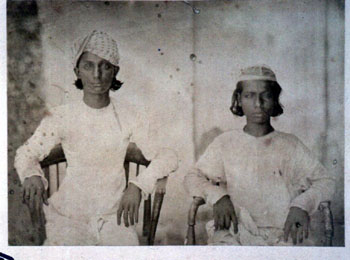
Zafar’s two surviving sons, who shared his Burmese exile with him.

****************************************************************************************************************************************************************************

Agha Shahid Ali: “After Seeing Kozintsev’s King Lear in Delhi”

Lear cries out “You are men of stones”

as Cordelia hangs from a broken wall.


I step into Chandni Chowk, a street once

strewn with jasmine flowers

for the Empress and the royal women

who bought perfumes from Isfahan,

fabrics from Dacca, essence from Kabul,

glass bangles from Agra.


Beggars now live here in tombs

of unknown nobles and forgotten saints

while hawkers sell combs and mirrors

outside a Sikh temple.  Across the street,

a theater is showing a Bombay spectacular.


I think of Zafar, poet and Emperor,

being led through this street

by British soldiers, his feet in chains,

to watch his sons hanged.


In exile he wrote:

“Unfortunate Zafar

spent half his life in hope,

the other half waiting.

He begs for two yards of Delhi for burial.”


He was exiled to Burma, buried in Rangoon.  


Last known photograph of Bahadur Shah Zafar

**********************************************************************************************************************************

I’d like to heartily and gratefully thank Mr. Dalrymple (below) for his permission to reproduce such an extensive piece of his work.  Usually permission is hard to obtain or you get no answer at all.  When I wrote Mr. Dalrymple, however, he shot an email back at me within minutes saying nothing but: “Go for it.”  Shukriya, kheyli moteshakeram, teshekur, and thanks again.

 “After Seeing Kozintsev’s King Lear in Delhi” reprinted from The Veiled Suite: The Collected Poems by Agha Shahid Ali. English translation copyright © 2009 by Daniel Hall. With the permission of the publisher, W.W. Norton & Company, Inc.

Watercolor of the Jama Masjid and old Delhi from 1852


The Destruction of Delhi — Dalrymple (ctd.)

2 Jul

Another selection from Walter Dalrymple’s The Last Mughal: The Fall of a Dynasty: Delhi, 1857, this one dealing more specifically with the Uprising’s effect on Delhi’s Muslims and Urdu-language culture, told mostly through the accounts of the Urdu poet Ghalib who, though born in Agra, was a consummate Delhiwallah and lived through all the events of the Uprising and its aftermath in the city itself.  Ghalib or Mirza Ghalib or Mirza Asadullah Beg Khan (Ghalib was his pen name), is, I think it’s safe to say and by common consensus, the greatest classical poet of Urdu literature, the Dante or Pushkin of Muslim India, the poet every literate Indian or Pakistani can quote, the way Iranians do Hafez or Russians Pushkin.  If it’s odd that such a crucial figure in Urdu culture came so late in the history of Indian Islam, we need to remember that India was later to throw off the weight of Persian as a literary language than the Ottomans were (Ghalib and even the much later Iqbal still wrote in Persian as well), through a continued influx of Iranian literati until very late, attracted to the still healthy patronage possibilities available in the various Muslim courts of India, not just Delhi. 

Begum is a lady of the court, the female form of “beg,” or “bey;” like “hanim” in Turkish, or “khanum” in Farsi, or “hatun” in several languages, is the female form of “khan;” all (along with “aga”) of Turkic origin, which gives you a really good idea of the division of labor in the Turko-Iranian world.  (Only “mirza” is a contraction of the Arabic “‘amr,” commander, and the Farsi lineage-son-of suffix “-zade.”)  It was impossible to be part of the north Indian Muslim aristocracy without a claim to some Turkic or Mongol lineage, (and I guess in Iran too, from the Seljuks on?) however bogus I imagine some of those might have been.

A late photo of Mirza Ghalib

*********************************************************************************************************************************

Dalrymple:

While all this was going on, throughout 1858, Hindus were slowly being readmitted to the city, but Muslims remained almost entirely banned from within the walls.  As Ghalib wrote in Dastanbuy [his journal of the events, though I don’t know if the word itself means “journal.”]

“In the entire city of Delhi it is impossible to find one thousand Muslims; and I am one of these.  Some have gone so far from the city it seems as if they were never residents of Delhi.  Many very important men are living outside the city, on ridges and under thatched roofs, in ditches and mud huts.  Among those people living in the wilderness are many who are anxious to return to Delhi, relatives of the imprisoned, and those living on alms.”

A passing traveller in 1860 was horrified by “the old withered Musulmanis and gypsy-like Mughals [still] camping out at the qutb.”  Even the imperious Matilda Saunders was aware that “numbers of people are daily dying of starvation and want of shelter.”

In December of 1859 the Muslims of Delhi petitioned the government to be allowed to return to their houses.  They wrote to Queen Victoria praying (according to the translation commissioned by Charles Saunders)

“that they may be permitted to return to their houses in the city of Delhi.  They are in the greatest distress, excluded rigorously from the town, they can obtain neither shelter nor means of subsistence.  The cold weather is now at hand and they beg that they may not be exposed to its severity in their present state of destitution and misery.  They trust that Her Majesty following the example of other magnanimous sovereigns, would pardon their misdeeds and permit them to reinhabit their old houses – otherwise they see nothing but beggary before them.”

Even when their plea was granted and they began to be given permission to return in 1860, many Muslims who could not prove their loyalty found that their houses had been confiscated.  Things got so bad that even some of the British papers in India began to feel sympathy with the Delhi Muslims: “When will agitation of European nerves subside?” asked the Mofussilite in June 1860.  “There is no reason for it…”

“The people are abject because they are starved out, banished and plundered.  Thousands of Muslims are wandering houseless and homeless; the Hindus, pluming themselves on their loyalty, strut about the streets giving themselves airs.  Let not the public think that Delhi has not been punished.  Wend through the empty grass-grown streets, mark the uprooted houses, and shot-riddled palaces.”

Most of the confiscated Muslim properties put up for auction by the British were bought en masse by the Hindu khatri (clerical castes) and Jain bankers of the city, such as Chhunna Mal and Ramji Das.  They were the only Delhiwallahs who still had access to liquid cash, their man centre of Nil ka Katra having bought immunity from the depredations of the Prize Agents on the payment of a large sum soon after the fall of the city.  Hindu traders and bankers even bought up two of the city’s most famous mosques: Chhunna Mal bought up the Fatehpuri Masjid, while a Hindu baker bought the Zinat ul-Masjid, one of the main jihadi centers throughout the Uprising.*

All this exacerbated the sudden shift of power from the Muslim elite, who had dominated the city before the Uprising, to the Hindu bankers, who were its most wealthy citizens afterwards.  “The capital is in the hands of one or two men like Chhunna Mal and Mahesh Das,” wrote Edward Campbell in 1858.  What remained of the court circle and the Mughal aristocracy were by and large left penniless.  A few survived on a pittance as schoolteachers and tutors.  For many, such as Maulvi Zaka’ullah, the shock of the utter devastation of their world was “beyond all bearing,” and Zaka’ullah later admitted that for a time he had succumbed to “a melancholy that bordered on blank despair.”

“Alas my dear boy,” wrote Ghalib to a friend in January 1862.  “This is not the Delhi in which you were born, not the Delhi in which you got your schooling, not the Delhi in which you used to come to your lessons with me, not the Delhi in which I have passed fifty-one years of my life.”

“It is a camp.  The only Muslims here are artisans and servants of the British authorities.  All the rest are Hindus.  The male descendants of the deposed King – such as survived the sword – draw allowances of five rupees a month.  The female descendants, if old, are bawds; if young, are prostitutes…”

What Ghalib did not say was that many of the Delhi begums were set on the path to prostitution by the mass rapes that followed the fall of the city.  Believing that the British women in Delhi had been sexually assaulted at the outbreak – a rumour that subsequently proved quite false, as a full inquiry by Saunders later proved – British officers did little to stop their men from raping the women of Delhi.  At the same time as Saunders’ inquiry completely exonerated the rebels of any single instance of rape, another inquiry found that perhaps as many as three hundred begums of the royal house – not including former concubines in the Palace – had been “taken away by our troops after the fall of Delhi,” and that many of those who had not been abducted were now making their living as courtesans.  The fate of the women of the royal family was clearly something that deeply shocked Ghalib, and he returns to it again and again in his letters.  “Had you been here,” he told his friend Mirza Tafta, “you would have seen the ladies of the Fort moving about the city, their faces as fair as the moon and their clothes dirty, their paijama legs torn, and their slippers falling to pieces.  This is no exaggeration…”

With the loss of the Mughal court went much of the city’s reputation as a centre of culture and learning.  Its libraries had been looted, its precious manuscripts lost.  The madrasas were almost all closed, and their buildings were again mostly bought up – and in time demolished – by Hindu moneylenders.  The most prestigious of all, the Madrasa i-Rahimiyya, was auctioned off to one of the leading baniyas, Ramji Das, who used it as a store.

By 1859 Ghalib was complaining that he could not even find a single bookseller, binder, or calligrapher in this once most bookish of cities.  Still less were there any poets: “Where is Mamnun?  Where is Zauq?  And where is Momin Khan?  Two poets survive.  One, Azurda – and he is silent: the other Ghalib, and he is lost in himself, in a stupor.  None to write poetry, and none to judge its worth.”  To make matters worse for Ghalib, much of his own verse – his life’s great achievement – had been lost: he had never kept copies of his ghazals and the two private libraries in which his friends had stored his poetry had both been sacked and destroyed by the British.  “A few days ago a faqir who has a good voice and sings well discovered a ghazal of mine somewhere and got it written down,” he wrote in one letter.  “When he showed it to me, I tell you truly, tears came to my eyes.”

“This whole city has become a desert,” wrote a melancholy Ghalib to a friend in 1861.  “Delhi people still pride themselves on Delhi language!  What pathetic faith!  My dear man, when the Urdu Bazaar is no more, where is Urdu?  By God, Delhi is no more a city, but a camp, a cantonment.  No Fort, no bazaars, no watercourses…”  “Four things kept Delhi alive,” he wrote to another friend who enquired what Delhi was like these days.  “The Fort, the daily crowds at the Jama Masjid, the weekly walk to the Yamuna Bridge, and the yearly fair of the flower-men.  None of these survives, so how could Delhi survive?  Yes, there once was a city of that name in the realm of India.”

In such a situation Ghalib often wondered what the point of carrying on was when everything he had lived for was finished.  “A man cannot quench his thirst with tears,” he wrote.  “You know that when despair reaches its lowest depths, there is nothing left but to resign oneself to God’s will.  What lower depths can there be than this: that it is the hope of death that keeps me alive.”  “My soul,” he wrote in June 1862, “dwells in my body these days as restless as a bird in a cage.”

Without the Delhi College and the great madrasas, without the printing presses and the Urdu newspapers, and without the Mughal court – whose immense cultural prestige always compensated for the monetary constrictions on its actual power of patronage – and most of all without the Emperor there to act as a focus and, to some extent, catalyst, the driving force behind Delhi’s renaissance and artistic flourishing was gone.  The beating heat of Indo-Islamic civilization had been ripped out and could not be replaced.  As Ghalib wrote as he neared death: “All these things lasted only so long as the King reigned.”

*Neither was returned to the Delhi Muslims until many years later — the Fatehpuri Masjid in 1875 and the Zinat ul-Masajid by Lord Curzon in the early years of the twentieth century.  Sikh troops remained occupying the Jama Masjid until it was returned in 1862.  See S. M. Ikram, Muslim Rule in India and Pakistan, Lahore, 1966, p. 462

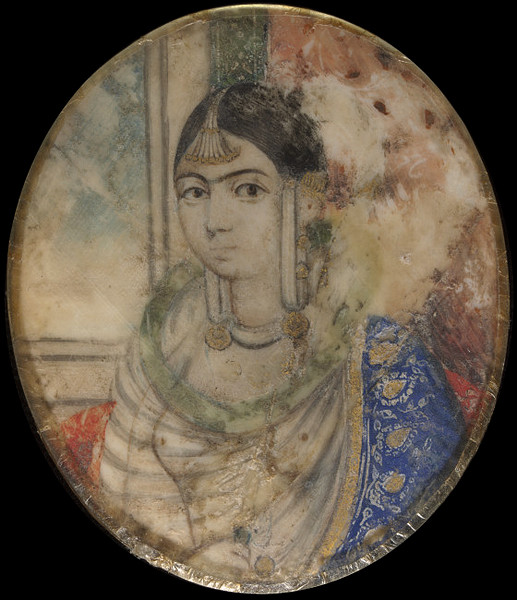
Below: “Oval Portraits of Mughal Ladies,” 1860-1870 in the Victoria and Albert Museum, London


The Destruction of Delhi — Dalrymple

29 Jun

The following is reproduced by permission and with the generosity of the author from William Dalrymple’s The Last Mughal: The Fall of a Dynasty: Delhi, 1857.  I’ve mentioned this brilliant book in a previous post: Favorite Blogs: The Delhi Wallah.  These are from the gripping few pages where Dalrymple describes the irrational and totally vengeful destruction of much of Delhi by the British after the Uprising of 1857 had been suppressed.

The entrance to the Jama Masjid

*******************************************************************************************************************************************

Canning had already given orders to destroy the Delhi walls and defences, but Lawrence managed to get the orders rescinded, arguing that there was insufficient gunpowder in Delhi to blow up several miles of walls.  By the end of 1859, Canning had agreed to his plan only to demolish what was needed to make the fort and city more defensible.  By 1863, the planned demolition of the eastern half of Chandni Chowk down to the Dariba had also been stopped.  Even so, great swathes of the city – especially around the Red Fort – were still cleared away, as Ghalib recorded in a series of sad letters to his correspondents across Hindustan: “The area between Raj Ghat [on the city’s eastern edge, facing the Yamuna] and the Jama Masjid is without exaggeration a great mound of bricks.”

“The Raj Ghat Gate has been filled in.  Only the niched battlements of the walls is apparent.  The rest has been filled up with debris.  For the preparation of the metalled road, a wide open ground has been made between Calcutta Gate and the Kabul Gate.  Punjabi Katra, Dhobiwara, Ramji Ganj, Sadat Khan ka Katra, the Haveli [palace, mansion, konak] of Mubarak Begum [Ochterlony’s widow], the Haveli of Sahib Ram and his garden – all have been destroyed beyond recognition.”

What had been the neighborhood around the Jama Masjid (above).  The Kashmiri Gate (below).

Other letters of Ghalib’s mourned the destruction of some of the city’s finest mosques, such as the Akbarabadi Masjid and the great Masjid Kashmiri Katra [I haven’t been able to find any photos of these, but the Akbarabadi Masjid was considered a sort of twin to the Jama Masjid — my comment]; great Sufi shrines such as that of Sheikh Kalimullah Jahanabadi;* the imambara+ built by Maulvi Muhannad Baqar; and the establishment of a cleared open space 70 yards wide around the Jama Masjid.  Four of Delhi’s most magnificent palaces were also completely destroyed; the havelis of the recently hanged nawabs of Jhajjar, Bahadurgarh and Farrucknagar, as well as that of the Raja of Ballabargh.  The great caravanserai of Shah Jahan’s daughter Jahanara was demolished and replaced by a new town hall.  Shalimar Bagh, where Aurangzeb had been crowned, was sold off for agricultural use.  Even where old Mughal structures were allowed to continue, they were often renamed: Begum Bagh, for example, became the Queen’s Gardens.

Tragically the Red Fort was another area where Lawrence intervened too late to stop the wholesale destruction.  He managed to save both the Jama Masjid and the Palace walls, but 80 per cent of the rest of the Fort was leveled.  Harriet Tyler, who was living in an apartment above the Diwan i-Am at this time, was horrified by the decision and decided to paint a panorama of the city before it disappeared.  It confirmed her in her disgust of the way the British had behaved in Delhi since the assault began on 14 September.  “Delhi was now truly a city of the dead,” she wrote in her memoirs.  “The death-like silence of that Delhi was appalling.  All you could see were empty houses… The utter stillness…[was] indescribably sad.  It seemed as if something had gone out of our lives.”

[These are some drawings I’ve been able to find of the palace and palace grounds but, though beautiful, they don’t give you much of a sense of what was destroyed — my comment]:

(the above appears in Dalrymple’s book)

The demolitions started at the Queen’s Baths in November 1857, and continued through most of the Palace, destroying an area “twice the area of the Escorial,” as the horrified historian James Ferguson pointed out twenty years later.  “The whole of the area between the central range of the buildings south and eastwards from the bazaar, measuring about 1000 feet each way, was occupied by the harem apartments – twice the area of any Palace in Europe.”

“According to the native plan I possess, which I see no reason for distrusting, it contained three garden courts, and some thirteen or fourteen other courts, arranged some for state, some for convenience; but what they were like we have no means of knowing.  Not one vestige of them now remains…  The whole of the harem courts of the palace were swept off the face of the earth to make way for a hideous British barrack, without those who carried out this fearful piece of vandalism, thinking it even worthwhile to make a plan of what they were destroying or preserving any record of the most splendid palace in the world.”

As late as March 1859 George Wagentrieber was please to record in the Delhi Gazette that “a good deal of blowing up” was still going on in the Palace.  Some of the finest buildings were the first to go, such as the Chhota Rang Mahal.  Even the Fort’s glorious gardens – notably Hayat Bakhsh Bagh and Mehtab Bagh – were swept away.  All that was left by the end of the year was about one-fifth of the original fabric – principally a few scattered, isolated marble buildings strung out along the Yamuna waterfront.  These were saved owing largely to the fact that they were in use as offices and messes by the British occupation troops, but their architectural logic was completely lost once they were shorn of the courtyards of which they were originally a part.


(click on this photo)

All the gilded domes and most of the detachable marble fittings were stripped and sold off by the Prize agents.  As Fergusson noted,

“when we took possession of the palace, everyone seems to have looted after the most independent fashion.  Among others, a Captain (afterwards Sir) John Jones [who had blown in the Lahore Gate during the capture of the Fort] tore up a great part, but had the happy idea to get his loot in marble as table tops.  Two of these he brought home and sold to the Government for 500 pounds, and were placed in the India Museum.”

These fragments included the rightly celebrated “Orpheus panel” of pietra dura inlay which Shah Jahan had placed behind his Peacock Throne.

Meanwhile, what remained of the Mughal’s Red Fort became a grey British barracks.  The Naqqar Khana, where drums and trumpets had once announced the arrival of ambassadors from Isfahan and Constantinople, became the quarters of a British staff sergeant.  The Diwan i-Am became a became a lounge for officers, the Emperor’s private entrance a canteen, and the Rang Mahal was turned into a military prison.  The magnificent Lahore Darwaza was renamed the Victoria Gate and became “a bazaar for the benefit of the Fort’s European soldiers.”  Zafar’s contribution to the Palace architecture – the Zafar Mahal, a delicate floating pavilion in a large red sandstone tank – became the centerpiece of a swimming pool for officers, while the surviving pavilions of Hayat Bakhsh Bagh were turned into urinals.

* A modest tomb of the saint is, however, still extant in the Pigeon-seller’s Bazaar in Old Delhi

+ Shia religious hall used to hold mourning ceremonies during Muharram

******************************************************************************************************************************************

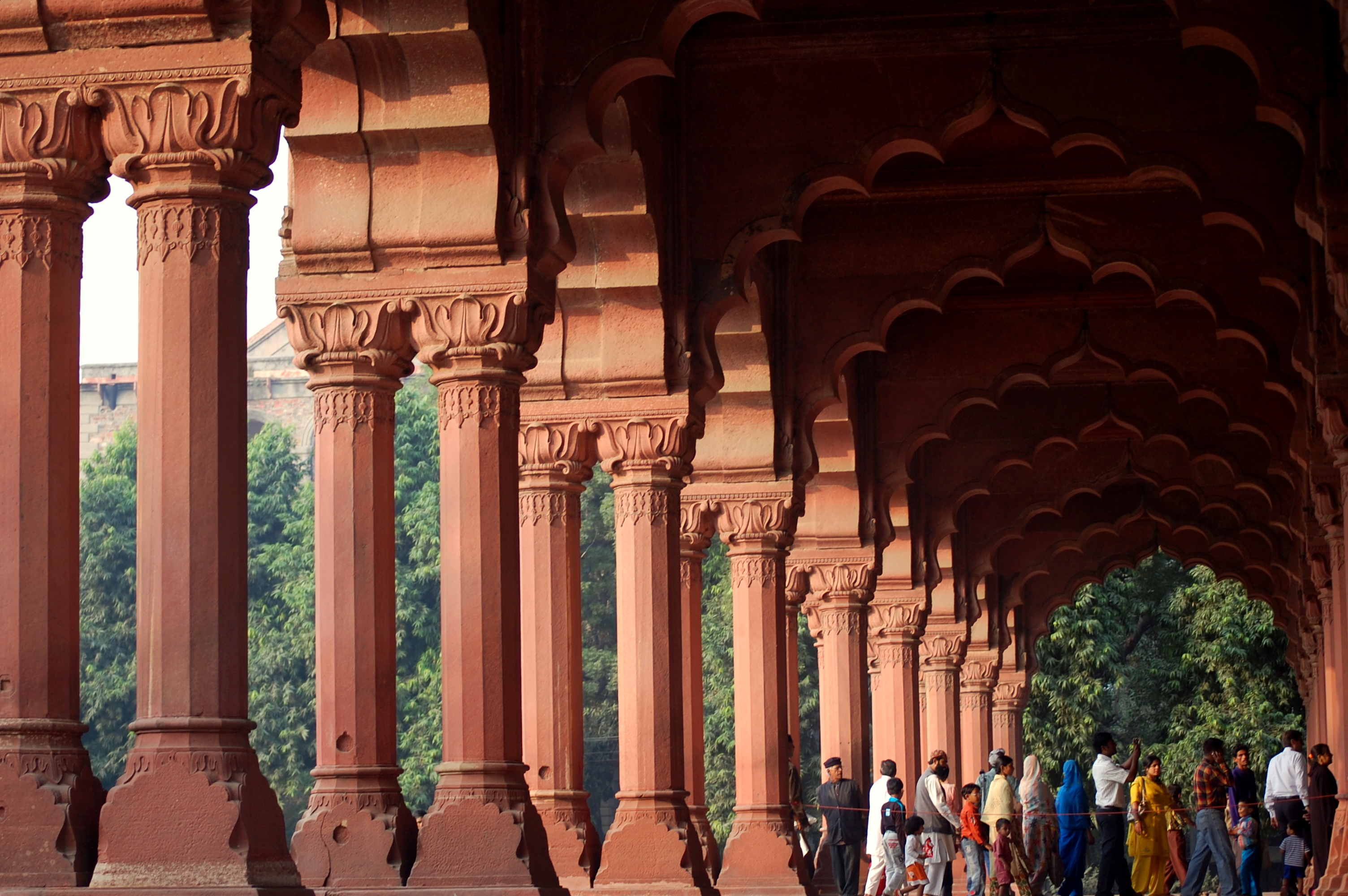
Below, I’m just posting whatever photos I can find of what’s left of the palace, without specific naming of each building, but hoping that readers constantly keep in mind that all this gorgeousness — and seen here damaged and stripped of its jewelled furnishings, gold, carpets, silken hangings, “Dacca gauzes,” running waters and the exquisitely dressed men and women of the court — is only the twenty percent of the original that survived Some photos may be clickable:

The famous Persian couplet by Amir Khosrow: “Agar Firdaus bar-ruhe-e-zamin ast, haminast o haminast o hamin ast.”  “If there is a heaven on earth, it is here, it is here, it is here.”

Photo: Kashmir

26 Jun

Grief. Red. Ruby. Blood. Velvet. Agha Shahid Ali. His mother. The Virgin. The clean, empty comfort of a Muslim home. The great disgrace of the “world’s largest democracy.”

Parveena Ahangar has not seen her son since three officers took him away in 1990, she said. The officers have not been punished.  (The New York Times)

“In Kashmir, Killing Ebbs, but Killers Roam Free”


Comment: nikobakos@gmail.com

Names: “Istanbul (not Constantinople)”…and Bombay!

21 Jun

I reckon I’ve now received enough emails complaining about my use of “Constantinople” that it’s time to address the issue.

Constantinople – Kwnstantinoupoles — is Istanbul in Greek.  It’s the Greek word for Istanbul.  Istanbul comes from the word Constantinople.  It’s that simple.  The way Moscow is the English word for Moskva.  The way Parigi is the Italian word for Paris.  Constantinople is the Greek word for Istanbul.  It’s that simple.

That the Republic chose to change its official name to the time-honored Turkish name of Istanbul in the 1920’s does not obligate speakers of other languages to call it that, especially not those with as heavy an emotional, historical and spiritual investment in their own name for it as we have.  Just like the world will hopefully never be obligated to call Greece “Hellas” by the idiots who are attempting to do so.  Where Istanbul is concerned, the Ottomans themselves were content, at least for official purposes, with using the Arabic Costantiniyye until very late – till the very end, 1923, if I’m not mistaken.  And it took the rest of the world several more decades, as well, to abandon “Constantinople” and conform to the Turkish Republic’s new orders — for those who thought the name just disappeared in 1453.

What exactly is the problem?  If readers think I have some nationalist, much less irredentist, reasons for referring to the city as Constantinople, then they haven’t read anything else on this blog, and know nothing about me.  If there even is any discernible pattern in my switching back and forth between the two names, it’s not easy to identify.  I mostly refer to the city’s Greek community as Constantinopolitan Greeks, usually when I’m talking about a time when there was a community.  When the present is involved I usually say something like “Istanbul Greeks.”  I call Greeks from Istanbul “Polites” and will often say “Pole,” or even “the City” in English to evoke some sense of its importance to Greeks – and to me.  And all sorts of various combinations of the above.

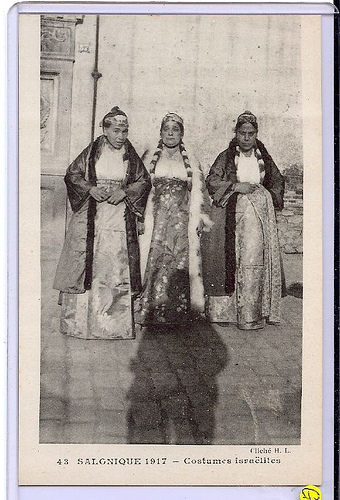
In both print and speech I never hear Turks call Salonica “Thessalonike” but Selanik – except for the occasional overly p.c. Turk who thinks that “Thessalonike” is what I want to hear.  And not only does Selanik not annoy me, not only do I not take issue with it or get offended by it, but it moves me.  Obviously, when a Turk calls Jiannena — one of my many hometowns – Yanya, it moves me even more.  A Turk who says Yanya is asserting his connection to that city, and that assertion becomes an immediate bond between me and him: a bond we both share to its streets, its lake and its mists, its mosques, its churches, its synagogues, its borek, the mahallades my mother used to tell me were Turkish before the twenties, including the one where she grew up, the parks she used to tell me were paved over Muslim cemeteries, that used to scare her as a girl when the region’s interminable rains would expose bones and skulls in their mud — all told with her peculiar sensitivity and strange sadness that would make you think these things were all her own; I never heard a word of ethnic animosity or hatred for anybody out of her mouth — not ethnic or any other kind — and not from my father either.

Yanya: the lake, mosques, the beautiful gate of the Ic Kale, streets, the front gate and interior of the Old Synagogue, 18th c. (The New Synagogue, 19th c., outside the city walls, was blown up by the Nazis.)

And when a Turk says Selanik, he’s asserting his deep historical connection to that city; whether he’s from there or not, he’s using a name which carries all his historical references to that place, which I’m nothing but happy to grant him.  I don’t even call it Thessalonike, but ‘Salonike.  When I think of Byzantine Thessalonike, of Selanik, Salonico, Salonica, they all evoke for me a great and ancient Mediterranean city; for a long time, the second city of the Byzantines, of St. Gregory Palamas and Nicholas Kabasilas; Salonico makes me think of the heir to the philosophical and poetic heritage of Jewish Spain; the great center of Sephardic learning, both rabbinical and the deep Kabbalistic learning that Jews brought with them from their previous homeland; I think of a Turkish city that was a flourishing center of a variety of Ottoman Sufi orders; the city where so much of Turkey’s new Republican bourgeoisie came from, just as ours came from the other direction.

Frontispiece of a Salonican Zohar, a seminal Kabbalah text, originally written in Leon, Spain.

Salonican Jews

Great caption; “the fanatical sect of Islam” being referred to are the Mevlevis!!!

 When I think of modern Thessalonike, on the other hand, I think of an unattractive, humid Balkan town with a serious second-city complex. 

But I’m a “manic lover” of St. Demetrius, its patron, so I have to visit every now and then.

Mosaic of St. Demetrius, originally from the church of St. Sophia in Kiev (or is it Kyiv?), currently in the Hermitage Museum, St. Petersburg (or is it Leningrad? or Petrograd? or just the name that everyone who knows her and truly loves her calls her, Peter…)

Funny that it took me so long but I recently realized why I dislike both Salonica and Izmir so much; despite their history, despite Salonica’s plethora of classical and Byzantine monuments even, neither of them — for reasons we all know — feel like organically old cities, the way even Athens does, though in its modern incarnation it’s far newer.  They both feel like one city was removed from that location and another one hastily put in its place.  Remade.  They don’t feel grounded.  What you feel in both of them mostly is the absence of history.*

Can you even tell which is which? — except for a few giveaway signs…

With all that said, therefore, I think we have to be very careful about whether it’s the renaming of places or persevering in the old name that represents the more nationalist impulse.  I recently confirmed for an Indian friend that, yes, Greeks still refer to Istanbul as “the City,” and he shook his head and mumbled something about the “narcissism of nationalism.”  But an increasingly fundamentalist and nationalist India may be the perfect example to start with.  Granted, Calcutta was always Kolkata in Bengali.  But what was wrong with Madras?  And what nationalist Tamil mythology does Chennai justify?  The BJP (fundamentalist Hinduism.…you’d think it’d be an oxymoron) in fact, has a list for changing the names of almost all the cities of India to more appropriately Hindu ones, not just obvious targets like Allahabad, but Delhi itself and others: see the list if you’re interested.  Aung San Suu Kyi calls her country by its perfectly legitimate name of Burma, yet for a couple of decades we were content to use the name imposed on it by its military dictatorship, Myanmar, and never asked why or by whom it had been changed.  The State is not to be questioned.  If you said “Burma,” people looked at you like you were uninformed.

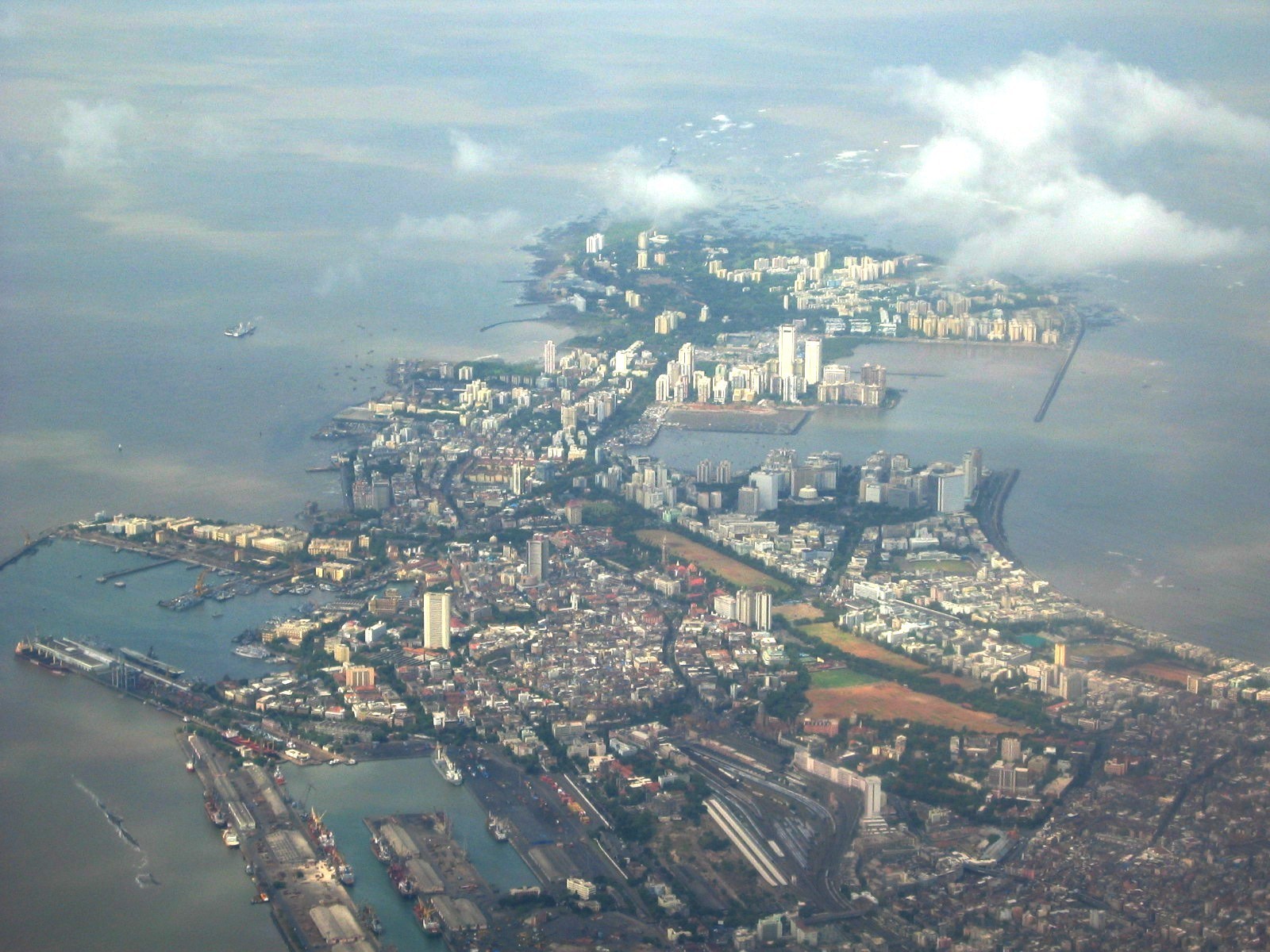
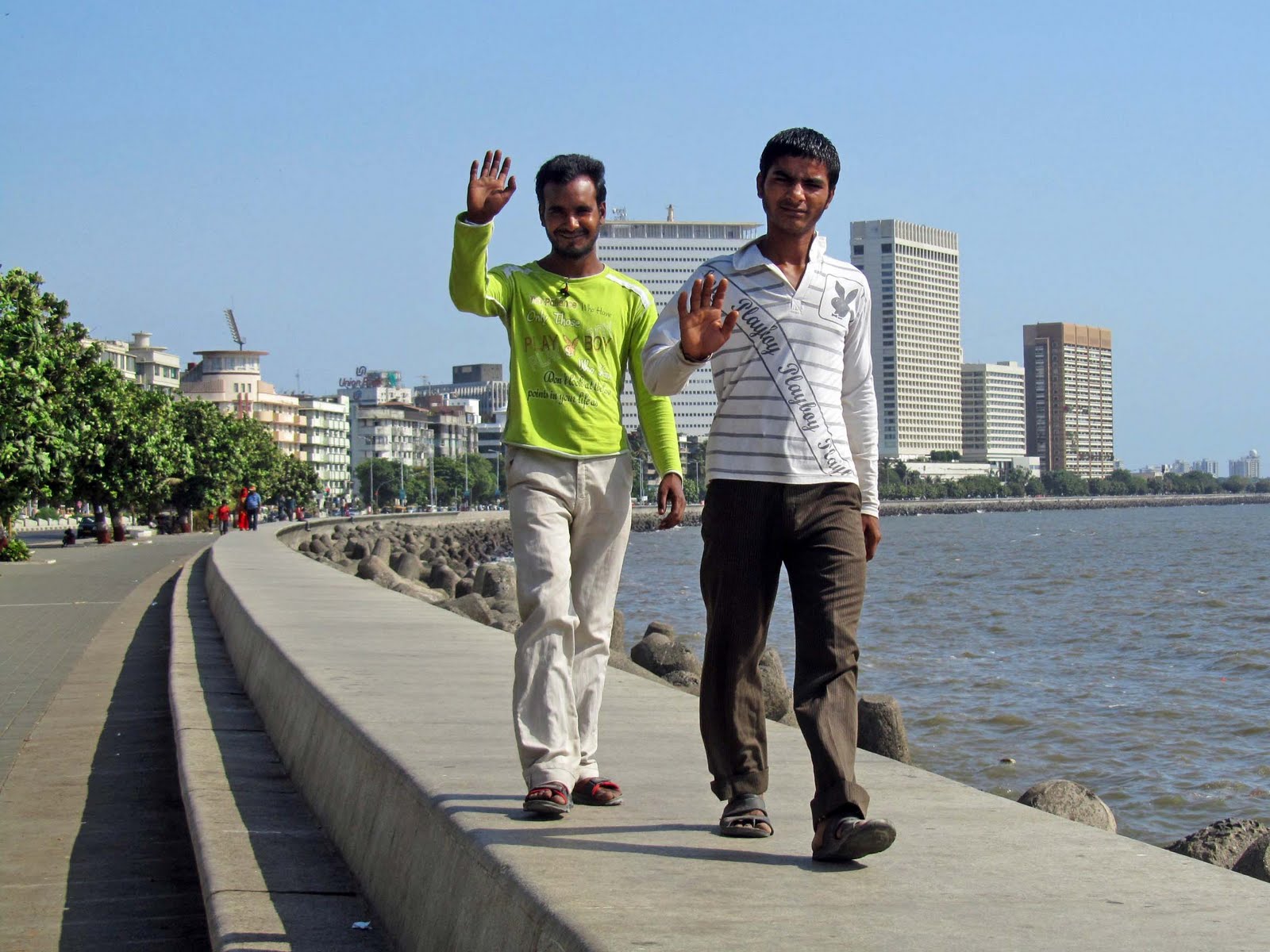
The most unfortunate and vulgar change of all is “Mumbai,” but almost no one knows or cares about how that change happened.  It was once generally accepted that Bombay comes from the Portuguese “bom bahim,” or good little harbour, just north as it is from Portugal’s long-time colony of Goa.  But even if that etymology is bogus, it was under the name Bombay that it flourished and grew under the British into the most important and cosmopolitan city in South Asia.

Bombay (gotta click on this one)

But in 1995, the Shiv Sena party (the Army of Shiva…) won control of the state government of Maharashtra, of which Bombay is a part, though it’s so different in social and ethnic make-up from the rest of that state that it deserves a separate federal district type status like Delhi has, or Mexico City, or D.C.  Shiv Sena, being a party whose power base is rural Maharashtra and poor migrant Marathis who feel they deserve more power in the city, is actively hostile to Bombay’s dizzying diversity and especially its large Muslim population.  It’s essentially a Marathi branch of the BJP, only worse (and they haven’t been getting along lately): a virulently Hindutva bunch that have not only been found to be involved in Bombay’s drug, prostitution and extortion circles, but ordered and even carried out much of the more vicious anti-Muslim attacks during the Bombay riots of 1992-93: the kerosene-dousing and burning of individuals and the burning tire around the victims’s neck were a couple of their trademarks.

When, despite all that, Shiv Sena were voted into state office in Maharashtra, their response to the poverty, massive infrastructural challenges, crime and destitution of this barely manageable city of more than twenty million was to change its name to Mumbai.  This was based on the supposed fact that there was (or is, or if there hadn’t been, I’m sure there now is) a temple of a Marathi goddess of that name on the site before the colonial city rose up, which may or may not be true, but, given the fact that every square yard of India contains at least one shrine or temple to someone or something, doesn’t mean very much.

And yet the whole world fell in line.  Thinking that, like Myanmar, if it’s coming from there it must have some sort of indigenous, authentic root, filled with post-colonial guilt and worried about offending what we thought were Indian sensibilities, we all dutifully started calling it Mumbai.  Fearing that using the old name would immediately make others imagine us to be jodhpur-clad gin-swillers, we let a bunch of criminal thugs and violent nationalists change the name Bombay — the name by which this great, open-to-the-sea-and-the-world, mercantile, diverse, cosmopolitan, sexy metropolis, a microcosm of India itself and its modern face to the world, was known for almost three centuries – and nobody asked why or breathed a word of resistance.

Bombay — Marine Drive — Queen’s Necklace

So as for C-town, you choose which is more “nationalist.”  Calling the city the name by which it was known to most of humanity for more than sixteen centuries?  Calling it an also venerable name that the nationalist, anti-cosmopolitan, Turkification project of a military dictatorship whose attitude to the City, its legacy, history and population was actually hostile for much of the time decided the world should call it?  Or just calling it both?

Or how ‘bout who cares?  As long as we know which city we’re talking about.

* See next post


Comment: nikobakos@gmail.com