Tag Archives: Turks

From the Guardian: Turkey could cut off Islamic State’s supply lines. So why doesn’t it? David Graeber

19 Nov

Turkey — or rather, Turks — could do a lot of things.  Why they don’t is a psychological issue, perhaps, more than anything else.  My take on the infuriating mood in post-elections Istanbul will come soon.  Meanwhile, great article from the Guardian, which, as usual, is not afraid to shove uncomfortable questions — and accusations — in our faces.

2835

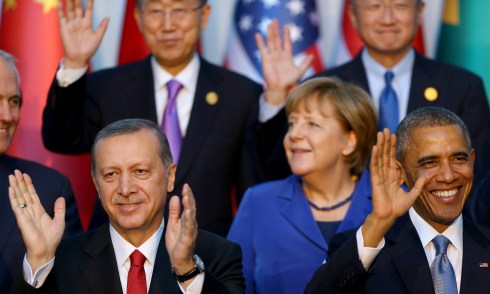
G20 leaders with Recep Tayyip Erdoğan in Antalaya on 15 November. ‘It may seem outrageous to suggest that a Nato member would in any way support an organisation that murders western citizens in cold blood.’ Photograph: Anadolu Agency/Getty Images

Some quotes:

“In the wake of the murderous attacks in Paris, we can expect western heads of state to do what they always do in such circumstances: declare total and unremitting war on those who brought it about. They don’t actually mean it. They’ve had the means to uproot and destroy Islamic State within their hands for over a year now. They’ve simply refused to make use of it. In fact, as the world watched leaders making statements of implacable resolve at the G20 summit in Antalaya, these same leaders are hobnobbing with Turkey’s president Recep Tayyip Erdoğan, a man whose tacit political, economic, and even military support contributed to Isis’s ability to perpetrate the atrocities in Paris, not to mention an endless stream of atrocities inside the Middle East….”

“How has Erdoğan got away with this? Mainly by claiming those fighting Isis are “terrorists” themselves. It is true that the PKK did fight a sometimes ugly guerilla war with Turkey in the 1990s, which resulted in it being placed on the international terror list. For the last 10 years, however, it has completely shifted strategy, renouncing separatism and adopting a strict policy of never harming civilians. The PKK was responsible for rescuing thousands of Yazidi civilians threatened with genocide by Isis in 2014, and its sister organisation, the YPG, of protecting Christian communities in Syria as well. Their strategy focuses on pursuing peace talks with the government, while encouraging local democratic autonomy in Kurdish areas under the aegis of the HDP, originally a nationalist political party, which has reinvented itself as a voice of a pan-Turkish democratic left…

4000.jpg

‘Bloody terrorist bombings inside Turkey seemed to target civilian activists associated with the HDP. Victims have repeatedly reported police preventing ambulances evacuating the wounded, or even opening fire on survivors with tear gas .’ Photograph: Murat Bay/AFP/Getty

“…In June, HDP success at the polls denied Erdoğan his parliamentary majority. Erdoğan’s response was ingenious. He called for new elections, declared he was “going to war” with Isis, made one token symbolic attack on them and then proceeded to unleash the full force of his military against PKK forces in Turkey and Iraq, while denouncing the HDP as “terrorist supporters” for their association with them.

There followed a series of increasingly bloody terrorist bombings inside Turkey – in the cities of Diyarbakir, Suruc, and, finally, Ankara – attacks attributed to Isis but which, for some mysterious reason, only ever seemed to target civilian activists associated with the HDP….”

“The exact relationship between Erdoğan’s government and Isis may be subject to debate; but of some things we can be relatively certain. Had Turkey placed the same kind of absolute blockade on Isis territories as they did on Kurdish-held parts of Syria, let alone shown the same sort of “benign neglect” towards the PKK and YPG that they have been offering to Isis, that blood-stained “caliphate” would long since have collapsed – and arguably, the Paris attacks may never have happened. And if Turkey were to do the same today, Isis would probably collapse in a matter of months. Yet, has a single western leader called on Erdoğan to do this? [my emphases]

The next time you hear one of those politicians declaring the need to crack down on civil liberties or immigrant rights because of the need for absolute “war” against terrorism bear all this in mind. Their resolve is exactly as “absolute” as it is politically convenient. Turkey, after all, is a “strategic ally”. So after their declaration, they are likely to head off to share a friendly cup of tea with the very man who makes it possible for Isis to continue to exist.”

Comment: nikobakos@gmail.com


Photo: Sarajevo gastra and börek…or Börek I

24 Aug

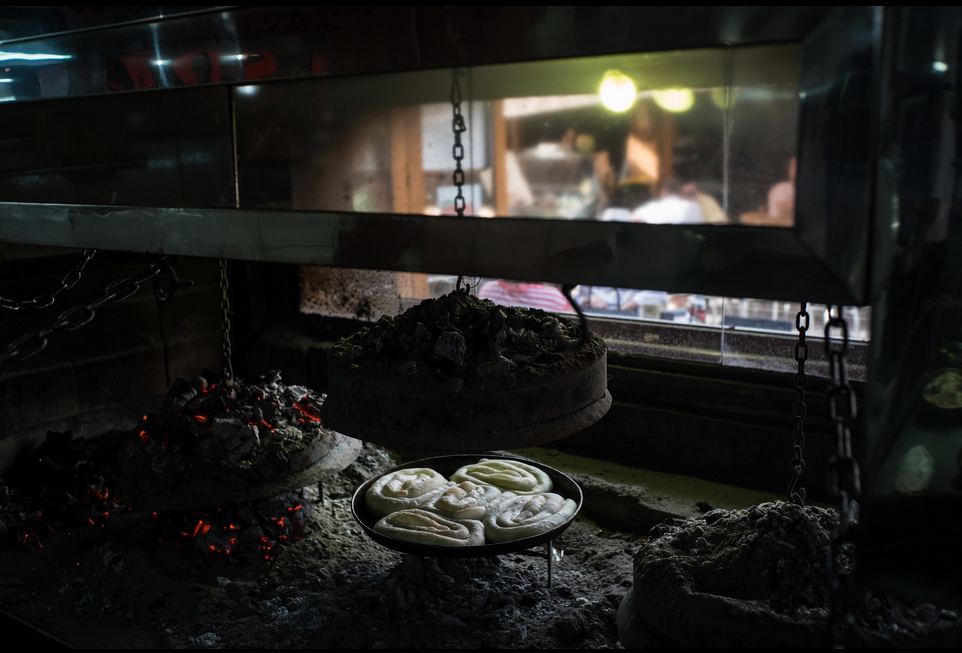
Börek gastra Sarajevo

(click)

These are börek in Sarajevo being baked in a gastra, a strange piece of High Ottoman technology that is still used in much of northern Greece, especially Epiros and the rest of the Balkans, particularly the western parts: Albania, Montenegro (where uniquely in the Serb-speaking world, they call börek pitta like in Greek), Kosovo and southern Serbia — regions, interestingly enough, where börek is a particularly strong regional identity marker and the object of a powerful cult of affection and snobbery.  Every and each börek in these parts is subjected to intense scrutiny; is there too much filling (major demerit points because you’re obviously trying to make up for the poor quality of your phyllo/yufka); is each layer fine enough, but able to both absorb serious quantities of butter and not get soggy, like a good croissant or a good paratha.  Finally, that you use real — and good — butter, which makes almost all commercially sold varieties not worth trying, since using good butter on a commercial scale would make a börek that is prohibitively expensive, and especially in a country of culinary philistines like Greece, store-bought versions are almost inedible, as is most product in Turkey these days too, Turkish street food having suffered a marked decline in quality even as the tourist literature on the country continues to rave about it.  But I have had good börek in Macedonia, in Mavrovo, and in Montenegro, in Žabljak, where the hotel made us a great cheese and a great cabbage one for a hike we went on.  And in a high-end restaurant in Jiannena too; but next to me was an Albanian woman, who first smelled it, pricked at it with her fork, counting the layers of pastry, and then after a few minutes of just staring at it, pushed it away in disgust.  Like I said, it’s an object of great snobbery.  And forget Old Greece.  It’s a standard rule of thumb that the further away in place and time a region of Greece is from the Ottoman experience, the exponentially worse the food gets.  No one south of Larissa can bake a pitta to save their lives, or make a decent plate of pilav for that matter.  Epiros is probably the only place you can still get a nice buttery mound of pilav — like the kind Turks make — with good yogurt.  Southern Greeks seem allergic to rice, and have friggin’ potatoes with almost every meal.  Maybe It’s a Bavarian thing — I dunno.

some really good borek

Reaaally good stuff, in Mavrovo, Macedonia (click)  (See post: Macedonia: Mavrovo, Dimitri and the Two Falcons)

But everything baked tastes better in a gastra, the same root as the word for “womb” in Greek (or “gastritis”): rice and lamb, even zeytinyağlı vegetable dishes.  It’s just incredibly tedious — and dangerous if you don’t know what you’re doing — to use.  It’s a cast-iron dome, suspended with a very complicated chain mechanism over a stone platform.  You first lift the dome and light your charcoal fire underneath it on the stone platform.  When the fire has been reduced to hot embers, and the cast-iron dome has also gotten nice and hot, you brush the embers aside, position your tepsi of food, lower the hot cast-iron dome, and then pile the still glowing embers on top of the dome.  Usually when they’ve cooled down completely the dish is done.  The picture above shows gastras at all steps in the process.

I dunno really.  Does it make that much of a difference?  Everything is better when it tastes slightly smokey or when a little bit of ash has fallen into it — like Turkish coffee made in hot ashes.  But it’s a ton of work and really impractical.  If, for example, the embers go out completely and you raise the dome and the food isn’t done yet, you have to start the whole process from the beginning.  Arthur Schwatrz, in his ever-best cookbook on Neapolitan food, Naples at Table: Cooking in Campania — which, like most good cookbooks these days, is as fantastic a source of history, anthropology and ethnography as it is of good recipes — says that a lot of foods legendary for how long you had to cook them for them to be the “real” article, like a Neapolitan ragù (pronounce with a double “r” and a “g” that sounds like a light Greek “gamma” – “γ”) that should take at least half a day to simmer or no self-respecting Neapolitan would eat it, were never really cooked that long.  Rather, they were cooked on wood fires and braziers, which were constantly going out, had to be relit, while the sauce cooled off and took time to reheat, etc.  Of course, for certain sauces and stews, and the fatty, sinewy cuts of meat we like in “our parts,” this kind of cooking is ideal.  And not just the slow, long heat, but the cooling off and reheating especially.

Naples at Table

Ottoman mangal

(click)

It’s like that other piece of Ottoman high-tech (I don’t mean to make fun, but it wasn’t exactly their strong suit), the mangal home-heater or charcoal brazier. (above)  You’d pile charcoal into it; leave it out in the street until the carbon monoxide burned off, then cover the embers with the lid and bring the whole incredibly dangerous, glowing — and often very large — brass behemoth inside to warm the house, or one hermetically sealed room really.  Then, as my mother used to describe it, you’d get under the blankets or flokates, facing the mangal, so your face would turn all red and sweaty while your back was freezing, and hope you had fallen asleep before it started cooling off or that you had generated enough body heat under the blankets to last till morning.  There were countless stories about families being found dead in the morning, because in the rush to bring this silly contraption into the freezing house, the carbon monoxide often hadn’t burnt off entirely and people would die from poisoning in their sleep.  I can only imagine that their use was required because it was probably tricky to build chimneys in mostly wooden Ottoman urban housing — my mother only remembered them from Jiannena; in her village where the house was stone, there were regular stone fireplaces where you could keep adding wood because the chimney would let the smoke and gas escape — and I’m sure that many of the massive fires that consumed whole mahallades of Ottoman cities over the centuries and killed thousands on certain occasions, were probably caused by one accidentally knocked over mangal somewhere.

And whole neighborhoods would burn down and then be rebuilt in wood again, something I comment on in another post — Macedonia: Sveti Jovan Bigorski“:

This is a kind of Ottoman tradition: build in wood, suffer repeated fires like the kind that wiped out whole districts of Istanbul throughout its history and killed tens of thousands.  Then rebuild in wood again.  It’s not known who said that the definition of neurosis is repeating the same action over and over and expecting a different result, but it also might be the definition of stupidity.  Only after a fire destroyed two thirds of Pera in 1870 in just six hours did people in those predominantly Christian and Jewish areas start building in masonry, which is why those neighborhoods are architecturally far older today than those of the now ugly two-thousand-year-old city on the original peninsula, where there is almost no old domestic architecture left (except, again, in former minority neighborhoods, for some reason, like Fanari or Balata or Samatya).

More on the symbolics of börek and the break-up of Yugoslavia in the next post.

Comment: nikobakos@gmail.com

Photo: Turkish Schadenfreude at Istanbul Airport

1 Aug

TurkishSchadenfreude

Sorry for the poor quality of this photo, but I just had to post this.  An ad all over Istanbul’s airport: “Going to Greece.  Talk to us today for suggestions on how much to take.  Make sure you have enough Euros for your stay.”

At the height of the Greek economic crisis and in the middle of the most bitter negotiations between the Greek government and the European Union over the extortionist measures of the promised bailout, this appears in Turkish airports.  This is a pure, lying attempt at sabotage of Greek tourism.  The dreaded “capital controls” that limited Greeks to taking 60 Euros a day out of ATMs to prevent a run on closed banks never applied to foreigners; i.e., you weren’t going to put your Dutch bank card into a Greek ATM to withdraw money from an account in Rotterdam and be limited to just 60 Euros.  This was really shitty and beneath Turks’ dignity.  But the truth is that I can’t really understand what’s going on in that country psychologically, so I’ll chalk it up to what seems to be a temporary suspension there of all rational discourse.

I’ve just invested so much in defending them (yeah, yeah…think you don’t need my defending? think again…) that I hate when they embarrass me with this kind of nastiness.

Comment: nikobakos@gmail.com

“Atatürk in the Nazi Imagination” by Stefan Ihrig

30 Mar

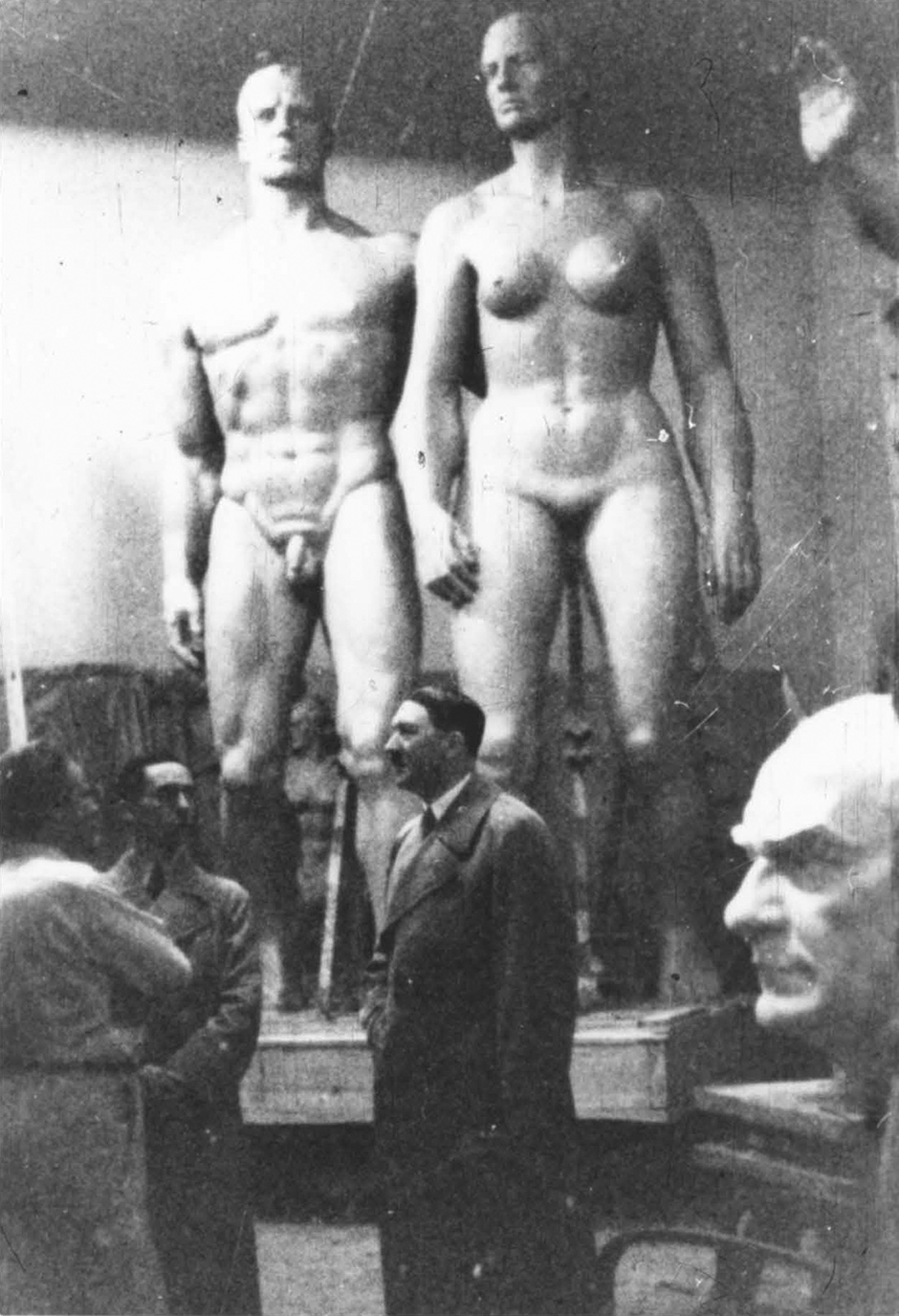
Adolf Hitler in the workshop of the sculptor Josef Thorak, with Thorak’s bust of Atatürk behind him, Munich, February 1937Adolf Hitler in the workshop of the sculptor Josef Thorak, with Thorak’s bust of Atatürk behind him, Munich, February 1937 (click)

From The New York Review of Book.  See whole article: Hitler & the Muslims by Steve Coll in April 2, 2015 volume.

Money quote (at least for our purposes):

“The aim of Atatürk in the Nazi Imagination is to document that the founder of modern Turkey deserves to be remembered as a figure equal to Mussolini in Hitler’s early political imagination. Mustafa Kemal Pasha, later glorified as Atatürk, had a record of military action that included cleansing what Hitler believed to be the inherently sapping multiethnicity of the expired Ottoman Empire.

“Indeed, in Ihrig’s account, apart from Atatürk’s personal inspiration, the organized mass killing of Armenians by Turks during World War I—the events now recognized as the Armenian Genocide—explicitly influenced Hitler’s thinking about the extermination of Jews as early as the 1920s. Ihrig quotes a multipart essay published in Heimatland, an influential Nazi periodical, by Hans Tröbst, who had fought with the Kemalists during what Turks knew as the War of Independence:

‘The bloodsuckers and parasites on the Turkish national body were Greeks and Armenians. They had to be eradicated and rendered harmless; otherwise the whole struggle for freedom would have been put in jeopardy. Gentle measures—that history has always shown—will not do in such cases…. Almost all of those of foreign background in the area of combat had to die; their number is not put too low with 500,000. [emphasis in original]’

“In incipient Nazi historiography, Ihrig writes, “the ‘fact’ that the New Turkey was a real and pure völkisch state, because no more Greeks or Armenians were left in Anatolia, was stressed time and again, in hundreds of articles, texts, and speeches.” Of course, the Nazi Holocaust was constructed in its own setting, from its own sources; one should not overemphasize the Armenian precedent, and Ihrig does not. Yet here is a documented example from the early industrialization of ethnic murder in which one campaign of genocide influenced another.

And a key point:

“Politically, Atatürk’s success offered a model of how to overcome the humiliation and prostration imposed on World War I’s losers at Versailles. Atatürk not only seized power through bold action in the name of the Turkish nation, he also forced European capitals to renegotiate the terms of the treaty they had imposed…”

Comment: nikobakos@gmail.com

To the Messenger and Co. — An Isaac Bashevis Singer story…

5 Jan

…full of the pain they don’t know and the humor they’re lacking…
DAB1975002W0000X-XXC.jpg

The New Yorker last week published a story of Isaac Bashevis Singer’s: “Job–to anyone who wants to read it because they haven’t hidden it from non-subscribers.  Mostly I want to dedicate it to the Messenger and his parea.  It’s a tale told to Singer by someone — I dunno if it’s a fictive character or not — in the 1970s.  It was written by Singer at the time, but was not translated from Yiddish to English until March-July, 2012 by David Stromberg.  Much like Vassily Grossman’s Life and Fate (which I touch on briefly here), it deals with the suffering of a twentieth-century Jewish everyman, sandwiched between the nightmare of Nazism and Stalinism, with bitter, caustic humor completely intact (which Grossman couldn’t really do).

Why do I dedicate this to the Messenger?

Because I remember distinctly in one late-night email battle-session, when he wrote me: “And why is it so wrong for bourgeois guys — like the both of us [his emphasis] — to have an ideology or an ideological schema?”  It’s a slightly tricky question to be asked in Greek and to have to answer from a Greek-speaker but native English-speaker’s perspective, because the word “αστικό” in Greek means urban and urbane and bourgeois, in its socio-political sense, all at once, so it’s difficult to separate.  But I quickly clarified the difference between my ethnic-American, working-class New York borough background and his petit bourgeois Athenian upbringing.  And yet I couldn’t put into words — or rather — couldn’t, at the time, find an example or definition to support the difference I was trying to establish.

But we can sort of close in on what I meant…  Someone — Simone Weil, Kafka, Solzhenitsyn, Rebecca West, Walter Benjamin, the great Hitchens, historian Timothy Snyder…I’m embarrassed that I can’t remember — said: “The twentieth century is when ordinary people realized that bookish young men who read big books full of big ideas could have a total and devastating effect on their lives.”

Or in the words of Singer’s Job: “Our young little Stalinists, the onetime yeshiva boys and simple idlers, hounded me to the point that I started longing to go back to Russia.”

And that’s where it lays.  It’s Singer’s Job that makes the knock-out realization:

“I’ve realized one thing: the worst people are those who want to save the world. Among simple folk—merchants, skilled workers, the so-called little man—one can still find decent people. But among those who want to bring about the coming of the Red Messiah there is no truth, no compassion. What’s easier than torturing in the name of an ideal?”

Of course your messianic vision doesn’t have to be Red; the Messenger’s is vehemently non-Red.  But that’s one thing that he never understood.  That that hue doesn’t matter.  That after a certain point he — he and his nationalism and his cronies’ nationalism — became the enemy for me.  The “worst people” are the ideologues.  After liberating him from the petit bourgeois prejudices he had been raised with, and becoming a model of “Roman-ness” for him, I didn’t realize that I had created a Frankenstein.  And he has never realized that he’s the enemy to me.  The people who tortured innocent women in our family like our aunt A. and killed heroic young men like our uncle S. and others, who looted and burnt down my mother’s paternal home, who imprisoned and persecuted and exiled my maternal uncle L. for decades, the people who tormented my father and his family and his extended clan for decades, who threw my grandfather into a prison camp in Albania and then into a mass grave somewhere, who isolated my grandmother in one room of the house her husband had built for her, who separated her forever from her only child, who created the pall of depression and unspoken sadness that hung over my family all my life…  Those people weren’t Albanians to me.  Or Muslims or communists or fascists or Turks or anything else or anyone else that the Messenger loves to hate.  They were petty little ideologues like him: bookish nerds who feel empowered by imposing their ideological hard-ons on innocent people, and making them suffer intolerable suffering in the name of their grand ideological vision.  “What’s easier than torturing in the name of an ideal?”  He’s the enemy.  But he doesn’t get it.  Y de allí his shock when I lay into him.

The other money quote from the Singer story:

“…I’d arrived at a certain philosophy: We can’t live openly in this world. We have to smuggle ourselves through. People, like animals, must constantly hide themselves. If the enemy’s on the right, you go left. It goes left, you crawl right. This very philosophy—you can call it cowardice, it doesn’t bother me—has helped me. I knew where the informers were and I avoided them. A lot of leftists—half-leftists and converted leftists, so to speak—went to Vilna or Kovno, but I went on to Russia, not to the big cities but to little towns, villages, collective farms. There I found a different kind of Russian: generous, ready to help. There they laughed at communism.”

Laugh at these people.  Russians’ and especially Jews’ saving strength.  That’s all there is to do.  Until they knock on your door.

Comment: nikobakos@gmail.com

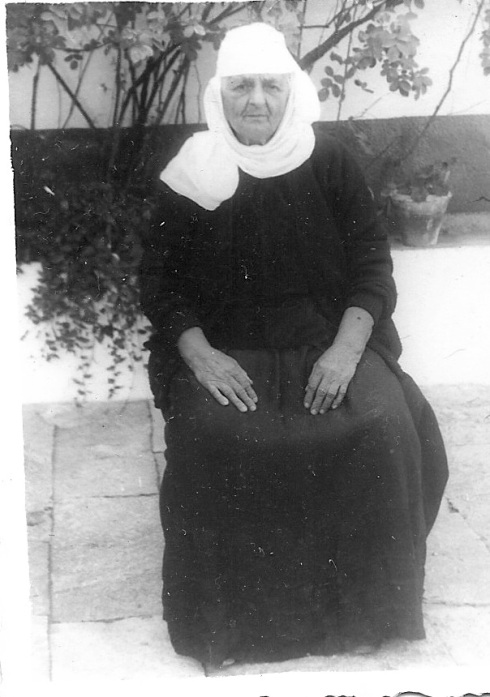
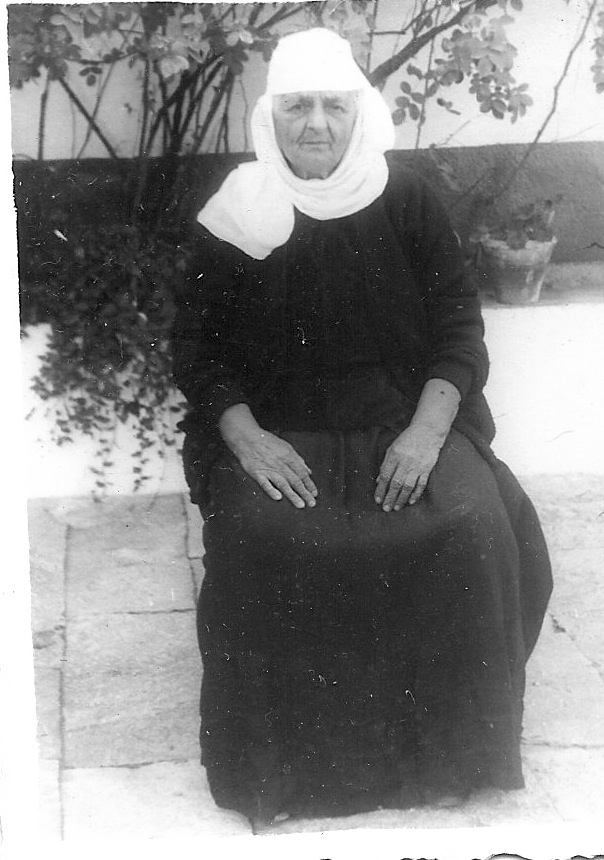
giagoulaMy grandmother (click)


And the whole article, since The New Yorker is being so unusually generous about it:

August 13, 2012
Job
By Isaac Bashevis Singer

Translated by David Stromberg

Editors’ Note: This story, by Isaac Bashevis Singer (1902-1991), was first published in Yiddish in 1970, and is appearing here in English translation for the first time. (See the translator’s note below about how it came to light.) Singer published more than sixty stories in The New Yorker, beginning in 1967; we’re grateful for this chance to present his work once again.

****

Being a writer for a Yiddish newspaper means wasting half the workday on people who come to request advice or simply to argue. The manager, Mr. Raskin, tried several times to bring this custom to an end but failed repeatedly. Readers had each time broken in by force. Others warned that they would picket the editorial office. Hundreds of protest letters arrived in the mail.

In one case, the person in question didn’t even knock. He threw open the door and before me I saw a tiny man wearing a black coat that was too long and too wide, a pair of loose-hanging gray pants that seemed ready to fall off at any moment, a shirt with an open collar and no tie, and a small black spot-stained hat poised high over his brow. Patches of black and white hair sprouted over his sunken cheeks, crawling all the way down to the bottom of his neck. His protruding eyes—a mixture of brown and yellow—looked at me with open mockery. He spoke with the singsong of Torah study:

“Just like this? Without a beard? With bared head? Considering your scribbling, I thought that you sit here covered in prayer shawl and phylacteries like the Vilna Gaon—forgive the comparison—and that between each sentence you immerse yourself in a ritual bath. Oh, I know, I know, for you little writers religion is just a fashion. One has to give the ignorant readers what they truly desire.”

A wise guy, I thought. Aloud I said, “Please, sit down.”

“And what good will it do me to sit? Let me first get a good look at you. Right here is where you write? Right here, next to this little table, is where the goods are fabricated? This is where your holy spirit, so to speak, makes its appearance? Well, it is what it is. And, anyway, how do people write all these lies? With simple pen and ink. Paper is patient. You can even write that there’s a festival in Heaven.”

“What’s your name?” I asked.

“My name is Koppel Stein, but you can call me Job, because I’ve suffered as much as Job, and possibly even a little more. Job had three friends who came to console him, and in the end God took it upon Himself to offer a word of comfort. Then He repaid him twice over: more donkeys, prettier daughters, and who knows what else. I haven’t been comforted by anyone, and the Almighty remains silent, as if nothing had happened. I’m Job squared, if one can put it this way. Do you have a match? I’ve forgotten my matches.”

I went out and brought him matches. He lit a cigarette and blew the smoke right in my face.

“Forgive me for speaking to you this way,” he continued. “As they say, it’s my troubles speaking. You know it down to the last letter: ‘blame not a man in his hour of sorrow.’ The other day you complained in your write-up about a reader who’d held you up for six straight hours. I’ll keep it short, though how can one shorten a story that’s already lasted more than forty years? I’ll give you just the bare facts and if you’re no fool it’ll be as they say: ‘a word to the wise is enough.’ I’m one of those crazy people—this, it seems, is what you called them—who want to save the world, to institute justice, and other things of that kind.

“With me it started when I was still a little kid. Our neighbor Tevel the Shoemaker worked straight from the first rays of the sun until late into the night. In the winter I heard him banging on nails when it was still dark outside. He lived in a tiny room. He had everything there: the kitchen, the bedroom, the workshop. That was where his wife, Necha, gave birth every nine or ten months, and there the infants died. My father wasn’t much richer. He was a teacher. We also lived in a single room and had so little to eat that we might as well have deposited our teeth in the bank.

“Early on I began to ask: how is this possible? My father answered that this was God’s will. And I came to despise—with a thorough hate—the very same God Almighty who sat eternally in his seventh heaven, showered with respect and greatness, while his creatures suffered and died. I won’t get into details—I know from your work that you’re familiar with these details and even with the so-called psychology of such things.

“In short, I was about fifteen when I went astray. We had a political group in town where we read Karl Marx and Karl Kautsky and even got our hands on a brochure by Lenin—in Russian, not in Yiddish. In 1917, when the Revolution broke out, I was a Russian conscript. I managed to catch some lead near Przemysl and was laid up in a military hospital. What I went through in the barracks and on the front you probably know yourself. No, you know nothing, because my greatest sorrows came from my own mouth. I told everyone the truth. I spoke against the officers. To this day I don’t understand why they didn’t have me court-martialled and shot. They must have needed cannon fodder.

“Kerensky called for further fighting and I became a Bolshevik. I ended up in Poltava, and there we went through the October Revolution. Mobs set upon us and we were chased away. Who wasn’t there? Denikin, Petliura, others. I was eventually wounded and discharged from the Red Army. I got stuck in a little town where there was a pogrom against the Jews. With my own eyes I saw how they slaughtered children. I lay in the hospital and got gangrene in one foot. I’ll never understand why, out of everyone, I came out alive. Around me people died from typhoid fever and all kinds of other diseases. For me, death was an everyday thing. But despite all this my faith in man’s progress became stronger, not weaker. Who started wars? Capitalists. Who incited pogroms? Also they. I’d seen plenty of wickedness, stupidity, and pettiness among my own comrades, but I answered myself ten times a day with the same refrain: we are products of the capitalist system. Socialism will produce a new man—and so on and so forth. Meanwhile, my parents died in Poland, my father from hunger and my mother from typhoid fever. Though possibly also from hunger.

“After the mobs were driven out and things subsided into some kind of order, so to speak, I decided to become a laborer, despite the fact that I could have taken a government post or even become a commissar. By that time I was already in Moscow. I’d studied carpentry in our little town, so I entered a furniture factory. Lenin was still alive. For the masses, the big holiday still held sway. Even the New Economic Policy didn’t disappoint us. How do the Hassidim put it? ‘Descent for the sake of ascent.’ To stand and hear Lenin speak was a compensation for all the suffering and humiliation. Yes, suffering and humiliation. Because in the factory where I worked they cursed me and called me a ‘dirty Yid’ and mocked me no less than they had in the barracks.

“I was constantly hounded—and by whom? Party members, fellow-workers, Communists. They took every chance to tell me to go to Palestine. Of course, I could have complained. You heard of cases in which workers were put behind bars for anti-Semitic acts. But I soon realized that these were not isolated incidents. The entire factory was saturated with hatred for Jews—and not only Jews. A Tartar was no less inferior than a Jew, and when the Russians felt like it they made mincemeat of Ukrainians, Belarusians, Poles. Try sweeping away a trash can. I saw with sorrow that the Revolution had not changed all the drunkenness, debauchery, intrigues, theft, sabotage. A doubt stole into my heart, but I kept it silent with all my powers. After all, this was still just the beginning.

“I promised you to be short and this is what I’ll do. Lenin died. Stalin took over. Then came the plot against Trotsky—who for me was a god. Suddenly I heard he was nothing but a spy, a lackey of Pilsudski’s, Leon Blum’s, McDonald’s, Rockefeller’s. There are hearts that burst from the least worries, and there are also hearts as solid as a rock. It seems I have a stone there on my left side. What I’ve put up with, I only wish upon Hitler, if it’s true that he’s still alive somewhere, and that someone is hiding him in Spain or Argentina. I shared a room—actually a cell—with two other workers: drunks and scoundrels. The language they used—the smut! They stole from my pockets. At the factory, they called me Trotsky more than once and pronounced the ‘r’ with a Yiddish accent. Then came the arrests and the purges. People I knew—idealists—were taken away to prison and either got sent off to Siberia or rotted in jail. I began to realize, to my horror, that Trotsky was right: the Revolution had been betrayed.

“But what is a person to do concretely? Could Russia endure a new revolution, or even a permanent revolution? Can a sick body stand one operation after another? As my mother, peace be upon her, used to say: If a dog licked my blood, it would poison itself….

“So the years passed. Permanent revolution is impossible, but there is such a thing as permanent despair. I went to sleep in despair and awoke in despair. I was drained of all hope. Yet Trotskyist circles sprang up regardless of the persecution. The old conspiracies from the Tsarist times repeated themselves. The Revolution had fallen with a thud, but humankind doesn’t resign itself. This is its misfortune.”

II

“In 1928, I came back to Poland. So to speak. I smuggled myself across the border, helped by my fellow-Trotskyists. Each step involved the worst of dangers. I forgot to tell you that while still in Russia I’d been held at Lubyanka for seven months precisely under the suspicion that I was a Trotskyist. There wasn’t a single night in which I wasn’t beaten. Do you see this crippled fingernail? This is where a Chekist stuck a glowing rod into me. I had my teeth knocked out and those who did it were my fellow-proletarians, a curse upon humankind. What was done in prison can’t be put into words. People were physically and spiritually degraded. The stench of piss pots made you crazy. In a prison you can find all sorts of people. There was homosexuality as well as outright rape. Yes, be that all as it may, I smuggled myself into Poland and came to Nieswiez—perhaps you’ve heard of this little town? As soon as I crossed the border, the Poles arrested me. They later let me out, but then I was put behind bars again.

“This was in 1930. I’d been given a contact among the Trotskyists in Warsaw, but they ended up being just a few poor youths, workers. The Stalinists considered it a good deed to denounce Trotskyists to the authorities, and most of them were imprisoned in Pawiak or Wronki—a terrible prison. In Warsaw, I tried to tell them about what was going on in Russia, and don’t ask what I had to put up with! Our young little Stalinists, the onetime yeshiva boys and simple idlers, hounded me to the point that I started longing to go back to Russia. I was beaten, spat on, and called nothing but a renegade, fascist, traitor. A few times I tried to speak to an audience, but thugs from Krochmalna Street and Smocza Street came to shut me up. Once, I was stabbed with a knife. There is no worse lowlife than a Jewish Chekist, Yevsektsia member, or plain Communist. They spit on the truth. They’re ready to kill and torture over the least suspicion. I already understood that there was no difference between Communists and Nazis, but I still believed that Trotskyism was better. Something had to be good! Not everyone could be evil.

“Up until now I haven’t mentioned my personal life, because in Russia I hadn’t had any personal life. Even if I could have sinned, there was nowhere it could be done. With several men living in a single room, you’d have to be an exhibitionist. I witnessed both sexes in their utmost shame and misery, and I, as they say, lost my appetite. Hundreds of thousands of illegitimate children were brought forth—the homeless—who in turn became Russia’s curse and peril. When a woman went to buy bread, they fell upon her and stole it from her. Very often they raped her too. There was no lack of downright thieves, murderers, drunks. The Revolution should’ve brought an end to prostitution, but whores loitered all around the very Kremlin. In Warsaw, I met a Trotskyist woman. She was hunchbacked, but for me a physical defect was no defect at all. She was clever, intelligent, idealistic. She had a pair of black eyes and from them all the sadness and wisdom of the world peered out—though where in the world is there wisdom? We became close. Neither of us thought much of the idea of going to a rabbi. We rented an attic room on Smocza Street, where we started living together. That’s also where we had our daughter, Rosa—naturally, after Rosa Luxemburg.

“My wife, Sonia, was a nurse by trade—a medic and a compassionate caregiver. She spent her nights with the ill. We seldom had a night together. I couldn’t find any work in the Polish factories and earned a little by repairing poor people’s furniture—a closet, a table, a bed. I earned peanuts. As long as there wasn’t any child, it was still bearable. But when Sonia was in her later months it became difficult. In the middle of all this I was arrested. I’d been denounced by my Jewish and proletarian brothers, who’d invented a false accusation against me and actually planted illicit literature. What do you know about what people are capable of doing? Some of them later fell in Spain—they were killed by their own comrades. Others perished in the purges or simply in Comrade Stalin’s labor camps.

“The entire trial against me was a wild invention. Everyone knew this: the investigator, the prosecutor, the judge. They put me together with people whose faces I’d never seen and said that we’d planned a conspiracy against the Polish Republic. The policemen—guardians of the law —gave false testimony and swore to lies. In prison, the Stalinists hounded me so much that each day was hell. They didn’t take me into their circle. Among the civilians there were rich people, especially women, who brought political prisoners food, cigarettes, other such things. They even provided lawyers free of charge. But since I didn’t believe in Comrade Stalin, I was as good as excommunicated. They played dirty tricks on me. They tore my books, threw dirt into my food, they literally spat on me a hundred times a day.

“I stopped talking altogether and went silent. It got to the point that I became like a mute. In order not to hear their abuse and curses, I used to stuff my ears with soft bread or cotton from my coat. They even persecuted me at night, all in the name of Socialism: a bright future, a better tomorrow, and all their other slogans. The tortured themselves became torturers. Don’t think that I have any illusions about the Trotskyists. I’ve realized one thing: the worst people are those who want to save the world. Among simple folk—merchants, skilled workers, the so-called little man—one can still find decent people. But among those who want to bring about the coming of the Red Messiah there is no truth, no compassion. What’s easier than torturing in the name of an ideal?

“It got to the point that the Polish prison guards began to stand up for me and demanded that I be left alone. I started asking them to put me among the criminal offenders, and when they at last obliged me the comrades exploited it and organized a protest demonstration opposing a political prisoner being put among criminals. In other words, they wanted me nearby to torture. This is how they behaved—those who ostensibly sat in jail for the sake of justice.

“Sitting among the thieves, pimps, and murderers was hardly a delight. They eyed me with suspicion. There prevailed an old hatred between the underworld and the politicals—ever since the times of 1905. But, compared with what I endured from the Stalinists, this was paradise. They stole my cigarettes and made off with portions of the packages that Sonia sent me, but they let me read my books in peace. Instead of ‘fascist,’ they called me ‘idiot’ and ‘good-for-nothing,’ which did less damage. It even happened sometimes that a thief or a pimp would pass me a piece of sausage or a cigarette from his own stash. What was there to do in the cell? Either you play cards—a marked and greasy pack—or you talk. From the stories I heard there, one could write ten books. And their Yiddish! The politicals babbled in the Yiddish of their pamphlets. It was not a language but some kind of jargon. The thieves spoke the real mother tongue. I heard them use words that astounded me. It’s a shame I didn’t write them down. And their thoughts about the world! They have a whole philosophy. At the time I went to prison, I still believed in revolution, in Karl Marx. I had all kinds of political illusions. Back outside I was completely cured.

“While I sat in jail, there developed in Poland a growing disappointment in Stalin. It swelled to the point that the Polish Communist Party was thrown out of the Comintern. Many of my persecutors had taken off for the ‘land of socialism’—where they were liquidated. I was told about one sucker who, having crossed the border, threw himself down and started kissing the ground of the Soviet Union, as Jews of yore used to do when arriving in the Land of Israel. Just as he lay down and kissed the red mud, two border guards approached and arrested him. They sent him to dig for gold in the north, where the strongest of men didn’t last more than a year. This was how the Communist Party treated those who had sacrificed themselves on its behalf.

“Then a new curse wriggled its way in: Nazism. It was Communism’s rightful heir. Hitler had learned everything from the Reds: the concentration camps, the liquidations, the mass murders. When I got out of jail, in 1934, and told Sonia what I thought about our little world and those who wanted to save it, she attacked me like the worst of them. The fact is that while I sat behind bars I’d become a kind of martyr or hero for the Trotskyists. I could have played the role of a great leader. But I told them: dear children, there is no cure for the human race. It was not the ‘system’ that was guilty but Homo sapiens itself, in the flesh. When they heard such heresy, they shivered with rage. Sonia informed me that she couldn’t live with a renegade. I’d had the luck of becoming a renegade twice over. It was a separate issue that, while I sat behind bars, she had lived with someone else. Hunchbacks are hot-blooded. There’s always a volunteer handy. He was a simple youth from the provinces, I think he was a barber. Little Rosa called him Daddy…”

III

“Don’t look so afraid! I won’t keep you here until tomorrow. You went away to America in 1935, if I’m not mistaken, and you know nothing about what happened later in Poland. What took place was an absolute breakdown. Stalinists became Trotskyists, while Trotskyists went into the Polish Socialist Party or the Bund. Others became Zionists. I myself tried to turn to religion. I went to a study house and sat myself down to learn the gemara, but for this one must have faith. Otherwise it’s just nostalgia.

“The anarchists raised their heads again—some of them still stood by Kropotkin, others became Stirnerists. We had guests in Poland. Ridz-Szmigli had invited the Nazis to hunt in the Białowieza Forest. Then came the Stalin-Hitler pact and the war. When they started to bomb Warsaw, those who were strong enough ran over the Praga Bridge and set out for Russia. Some had illusions, but I knew where I was going. Yet staying among the Nazis was not an option for me. I came to say goodbye to Sonia and found her in bed with the barber. Little Rosa started crying, ‘Papa, take me with you!’ These same cries follow me still. They torment me at night. They all perished. No one remained.

“I was in Bialystok when a number of Yiddish writers from Poland all at once became ardent Stalinists. Some lost no time and began denouncing their colleagues. People knew me as a Trotskyist and I was heading for certain death, but by then I’d arrived at a certain philosophy: We can’t live openly in this world. We have to smuggle ourselves through. People, like animals, must constantly hide themselves. If the enemy’s on the right, you go left. It goes left, you crawl right. This very philosophy—you can call it cowardice, it doesn’t bother me—has helped me. I knew where the informers were and I avoided them. A lot of leftists—half-leftists and converted leftists, so to speak—went to Vilna or Kovno, but I went on to Russia, not to the big cities but to little towns, villages, collective farms. There I found a different kind of Russian: generous, ready to help. There they laughed at communism.

“Until 1941, people got by somehow. When the war arrived, a famine broke out. Refugees on foot arrived by the millions. Others were brought in freight trains. Millions of Russians went to the front. I starved, slept in train stations, passed through all seven circles of Hell, but I avoided one thing: prison. I kept my mouth shut and played the role of a simple person, someone half-illiterate. I worked wherever possible. On collective farms and in factories I witnessed the thing called the communist economy. They simply destroyed the machinery. They ruined raw materials. It couldn’t even be called sabotage. It was a simple beastly indifference to anything that didn’t directly relate to them. The whole system was such that either you stole or you were dead. I entered a factory and the accountant, a fellow from Warsaw, conducted his accounting on books by Chekhov, Gogol, Tolstoy. He scribbled his numbers—obviously false—on the margins and above the printed type. You couldn’t get any blank paper there. People lived on stolen goods sold on the black market. You can’t grasp it unless you’ve seen it with your own eyes. If not for America—and had the Nazis not been such ferocious murderers—Hitler would have got as far as Vladivostok.

“I didn’t live—I smuggled myself through life. I became a worm that crawled from here to there. As long as it wasn’t trampled, it crept on. I was astonished to realize that the whole country was like this. We became like the lice that infested us. Until I arrived in Russia for the second time, I’d still had something in me that could be called romanticism or sexual morality. But with time I lost this, too. Millions of men lay scattered on the fronts and millions of wives lived with anyone who would take them. I slept with women whose names I didn’t even know. In the night I had females whose faces I hadn’t seen. I once lay with a woman on a bale of hay. She gave herself over to me and cried. I asked her, ‘Why are you crying?’ And she wailed, ‘If Grishenka only knew! Where is he, my little eagle? What have I made of him!’ Then she nestled up to me, crying. She professed, ‘To me you’re not a man but a candle for masturbation.’ She suddenly took to kissing me and wetting me with her tears. ‘What do I have against you? You’ve probably also left someone behind. A curse on fascism!…’

“In Tashkent, I got typhoid fever, which was later complicated by pneumonia. I lay in the hospital and around me people were constantly dying. Some Pole spoke to me and started telling me about all his plans. All at once he went silent. I answered him and he didn’t respond. The nurse came in and it turned out that he’d died. Just like that, in the middle of speaking. He suffered from scurvy or beriberi, and with these diseases people died, so to speak, without a preface. I became indifferent to death. I never believed this would be possible.

“You shouldn’t think that I came here just to get into your hair and tell you my life story. The fact is that I’m here and this means that I smuggled myself through everything—hunger, epidemics, murder, destruction, borders. Now I’m in your United States. I already have my papers. I’ve already been mugged in your America, and have already had a revolver held to my heart, too. A survivor with whom I crossed here on the ship has already worked his way up and owns hotels in New York. He took straight to business, forgot all the dead, all the killing. I recently found him in a cafeteria and he complained to me about his falling stocks. He married a woman who’d lost her husband and children, but she already has new children with him. I talk about smuggling myself and he’s a born smuggler. He’d already started smuggling in the German DP camps, where he waited for an American visa.… Yes, why did I come to you? I came with an idea. I beg you, don’t laugh at me.”

“What’s this idea?”

He waited a moment and lit another cigarette.

“You’ll think I’m crazy,” he said. “The idea is for all decent people to commit suicide.”

“Is that so!”

“You laugh, eh? It’s no laughing matter. I’m not the only one disappointed in the human race. There are millions of others like me. As soon as there is no longer any hope—what’s the point of hanging around to suffer fruitlessly and in vain? I read your writing back in Warsaw. I read you here. You are, as far as I know, the only writer who has absolutely no hope for mankind. You’ve lately taken to praising religion, but your religion is a religion of despair. You reduce everything to one point: this is God’s will. Perhaps God wants humankind to put an end to itself? I beg you, don’t interrupt me! There are scores of movements, who knows how many religions and sects—why shouldn’t there be a movement that preaches suicide? How long can you smuggle yourself only to be crushed in the end? My feeling is that millions of people are ready to end it all, but they lack the courage—the last push, so to speak. If millions of idiots are ready to die for Hitler and Stalin and all kinds of other scourges, why shouldn’t people want to perish as a protest? We should frankly throw back at God this gift of His: this despicable struggle for existence, which in any case ends in defeat. First of all, people must stop having children, bringing into the world new victims. Let the scumbags hope, let them fight for bread, sex, prestige, for the fatherland, for Communism, and for all kinds of other isms. If there remains among the human race a remnant of common sense, it should come to the conclusion that all this filth isn’t worthwhile.”

“My dear friend,” I said, “suicide can never be a mass movement.”

“How can you be so sure? What was the Battle of Verdun if not mass suicide?”

“People there hoped for victory.”

“What victory? They stationed a hundred thousand men and were left with sixty thousand graves.”

“Some survived. Some received medals.”

“Perhaps we should create a suicide medal?”

“You’ve remained a world-saver,” I said. “Suicide is committed alone, not with partners.”

“I read somewhere that in America there are suicide clubs.”

“For the rich, not for the poor.”

He laughed and exposed a toothless grin. He spat out his cigarette butt and stepped on it.

“So what should I do?” he asked. “Become rich? Perhaps I should. It would, actually, be like Job.”

****

Translator’s note:

Beginning in his early years in the United States, Isaac Bashevis Singer earned his living churning out texts for the Yiddish-language daily Forverts—an assortment of fiction, essays, journalism, advice, and memoir, often published in a hurry, under several pseudonyms. Later in his writing life, Singer worked on translating into English those stories he considered worthy of republication, editing and correcting them in the process.

When, in the course of my doctoral research, I came across the story “Job” (“Iyov”)—first published in Forverts in 1970, and later included by the late scholar Khone Shmeruk in a Yiddish collection titled “Der Shpigl” (“The Mirror”; Hebrew University, 1975)—I was convinced I’d find the story in English translation. Its themes of political disillusionment coupled with an inextinguishable search for salvation were tied to Singer’s larger body of work, and the story’s artistic accomplishment was confirmed by its inclusion in the Yiddish collection. The biblical title also indicated its potential significance. But I found nothing: not in any of Singer’s English-language collections, not among his uncollected or posthumously published stories, and not in the Isaac Bashevis Singer papers at the Ransom Center in Austin, Texas. It seemed I’d have to read “Job” in the original.

I’d studied Yiddish, but my vocabulary was still relatively limited. To understand anything beyond the main premise, I had to look up words in the dictionary. As I began writing them down, I realized I was on my way to translating the story. I shared my translation of “Job” with a few colleagues in Jerusalem, and reviewed it with Eliezer Niborski, a young Yiddish teacher and native speaker. We were all struck by the story—especially its sharp yet compassionate final exchange—and surprised that it had yet to be published in English.

I decided to take another look at the list of the Singer papers in Texas. Knowing now what the story was about, I noticed a folder entry among Singer’s unidentified works that caught my eye. I ordered a facsimile of this typescript fragment and, as I suspected, found that Singer, together with Dorothea Straus, had indeed translated “Job”—but that the translation was not complete. The fragment of Singer’s translation attested to his distinct and idiosyncratic mastery of English, which I felt compelled to acknowledge in my rendition of the story. I ultimately decided to introduce the author’s hand by incorporating some of Singer’s own word choices—while also aiming to avoid mimicking or impersonating his singular English style.

Arrangements were made to publish my translation of the story. I showed it to Robert Lescher, the literary agent for Singer’s estate, who gave me some insight into Singer’s publication process. Mr. Lescher said that, after they’d begun working together, in 1970, Singer would bring his stories into the office. Mr. Lescher would comment on them, sometimes Singer would make changes, and only then would they be submitted to various editors for publication. At The New Yorker, Singer worked with the fiction editor Rachel MacKenzie to get a story into its final shape.

Mr. Lescher had minor reservations about a few lines in my translation where he felt the language didn’t flow. Based on his suggestions, I made a handful of adjustments that required my straying very slightly from the literal text. We were wary of editing a great writer who was no longer with us, but felt we could fine-tune the translation: ultimately, the responsibility falls to the translator to make decisions based on the original Yiddish text, whose publication Singer had approved.

A couple of days before the story was set to appear, I found myself again working with the folder list of the Singer papers at the Ransom Center. Looking for something else altogether, I came upon yet another entry among the unidentified works that caught my attention. I realized that it contained more, though still not all, of Singer’s translation of “Job.” The rest of the manuscript had apparently not been lost—it had merely been separated from the other parts and stuffed into a different slot.

The publication of “Job” had turned into a literary experience reminiscent of a chaotic Singerian universe—where coveted objects are misplaced, or purposely hidden by imps, only to reappear just before it’s too late. I used the additional pages to reconstruct some of my initial translation solutions—though again avoiding the temptation to replicate Singer’s signature linguistic choices in English. With the help of Arcadia Falcone of the Ransom Center, I am working to locate and reunite the missing pages of Singer’s translation of “Job.” And as in a Singer story, the story of this translation is yet to be continued…

— David Stromberg, Jerusalem, March-July, 2012

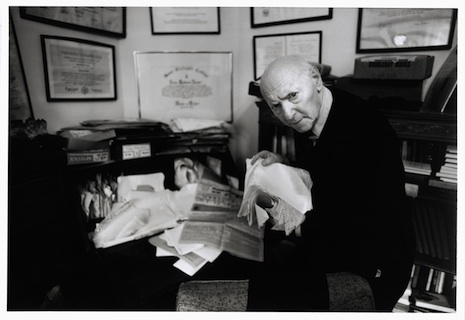
Photograph of Isaac Bashevis Singer by Bruce Davidson/Magnum.

The Classical Liberals: “On the Balkans, the Former Yugoslavia, and the Unity of Spaces”

4 Jan

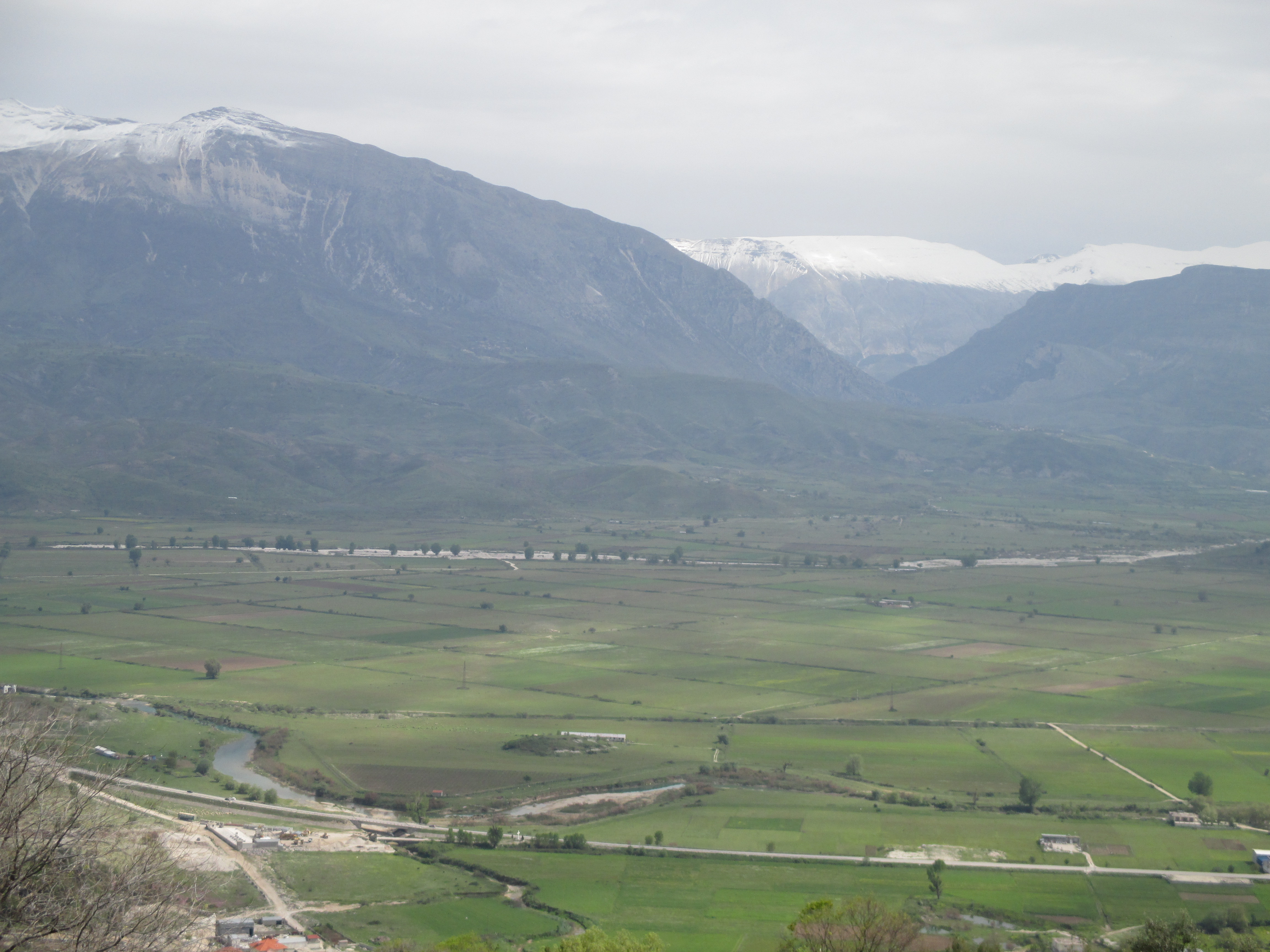
dropoliThe Valley of Dropoli, the pass up to the Pogoni plateau near Libochovo, and in the distance, the snowcapped peaks of Nemerčka, from the Monastery of the Taxiarches in my father’s village of Derviçani, Easter 2014 (click)

I’m honored by the fact that this really intelligent blog quotes extensively from the Jadde’s mission statement in a recent post: Jadde — Starting off — the Mission.

Check them out: The Classical Liberals: At least, most of the time  Smart, perceptive, interesting stuff.

The author of the post below and the person I suspect is largely behind the editing of the blog is one Eoin Power, not just a fellow Balkan-freak along the lines of me or Rebecca West, but also a fellow Epirote.  He demurs a bit — though not very convincingly — at being called an Epirote, because his lineage is multiple and complicated and the connection to Epiros is fairly distant historically.  But he’s from one of the most archetypically and ancient Epirotiko villages — where they still own their patriko — in one of the most archetypically Epirotiko regions of Epiros and he carries himself with the requisite Epirotiko dignity and soft-spokeness and if I, NikoBakos, have conferred the title on you, it’s ’cause you deserve it.

***************************************************************************************************************************************************************************

On the Balkans, the Former Yugoslavia, and the Unity of Spaces

The other day, as she is wont to do, my mother sent me a link to something on the Internet; this time it was to Nicholas Bakos’ blog, which you can find here. If you’re reading this blog, we’re probably friends in real life (thanks for reading!), and so it’s probably obvious why something like that would be of interest to the both of us. I have admittedly only skimmed sections of his posting so far, but in his introductory one, it was especially gratifying to read this:

This blog is about “our parts.”  It’s about that zone, from Bosnia to Bengal that, whatever its cultural complexity and variety, constitutes an undeniable unit for me.  Now, I understand how the reader in Bihać, other than the resident Muslim fundamentalists, would be perplexed by someone asserting his connection to Bengal.  I can also hear the offended screeching of the Neo-Greek in Athens, who, despite the experiences of the past few years, or the past two centuries, not only still feels he’s unproblematically a part of Europe, but still doesn’t understand why everyone else doesn’t see that he’s the gurgling fount of origin and center of Europe.

But set aside for one moment Freud’s “narcissism of petty differences,” if we have the generosity and strength to, and take this step by step.  Granted there’s a dividing line running through the Balkans between the meze-and-rakia culture and the beer-and-sausage culture (hats off to S.B. for that one), but I think there’s no controversy in treating them as a unit for most purposes; outsiders certainly have and almost without exception negatively.  And the Balkans, like it or not, include Greece.  And Greece, even more inextricably, means Turkey, the two being, as they are, ‘veined with one another,’ to paraphrase the beautiful words of Patricia Storace.  Heading south into the Levant and Egypt, we move into the Arab heartland that shares with us the same Greek, Roman-Byzantine, Ottoman experiences, and was always a part of the same cultural and commercial networks as the rest of us.  East out of Anatolia or up out of Mesopotamia I challenge anyone to tell me where the exact dividing line between the Turkic and Iranian worlds are, from the Caucasus, clear across the Iranian Plateau into Afghanistan and Central Asia.

Bakos suggests that for people of “those parts” displaced to another environment (e.g. grad school in the West), this kind of geographical unity came, at least in a social context, fairly naturally, so perhaps I shouldn’t be all that surprised and delighted at seeing it reconstituted in blog form. But in fact I think the basic unity of the geographical zone outlined here often gets lost in the way these places are understood by outsiders and, ironically enough, in no small part due to the vehement insistence from each of the zone’s component peoples that they could not possibly be compared with those uncultured idiots with whom they share a border.*

Explaining the rationale for delineating “his parts” the way he does, Bakos writes:

But to step into Buddhist Burma is somehow truly a leap for me, which maybe I would take if I knew more. And in the other direction, I stop in Bosnia only because for the moment I’d like to leave Croatia to Europe – mit schlag – if only out of respect for the, er, vehemence with which it has always insisted that it belongs there.  Yes, I guess this is Hodgson’s “Islamicate” world, since one unifying element is the experience of Islam in one form or another, but I think it’s most essential connections pre-date the advent of Islam.  I’ll also probably be accused, among other things, of Huntingtonian border drawing, but I think those borders were always meant to be heuristic in function and not as hard-drawn as his critics used to accuse him of, and that’s the case here as well.

Ultimately what unites us more singularly than anything else, and more than any other one part of the world, is that the Western idea of the ethnic nation-state took a hold of our imaginations – or crushed them – when we all still lived in complex, multi-ethnic states.  What binds us most tightly is the bloody stupidity of chilling words like Population Exchange, Partition, Ethnic Cleansing – the idea that political units cannot function till all their peoples are given a rigid identity first (a crucial reification process without which the operation can’t continue), then separated into little boxes like forks after Easter when you’ve had to use both sets – and the horrendous violence and destruction that idea caused, causes and may still do in “our parts” in the future.

Having not, at least north of the equator, yet made it further east than Istanbul, I am in no position to question Bakos’ perception of the fundamental apartness of Buddhist Burma. But the loose border he posits to the north and west is one I’ve crossed many times, and it’s one that is both deeply present and functionally invisible.**

At the very least it is present in people’s minds; I can vouch for the vehemence (to use Bakos’ word again) with which Slovenes and Croats will insist that their countries are European, and not Balkan. It’s also pretty visually observable – you could mistake Zagreb or Ljubljana for a city in Austria or Germany in a way you simply can’t for, say, Sarajevo or Belgrade. And on one frantic trip from Dubrovnik back to Ljubljana (the ferry which I’d intended to take from Dubrovnik to Ancona decided not to arrive from Split, leaving me nothing to do but beat a hasty retreat back north) you could, if you were looking for it, see an actual tangible difference in the way things were done in the world – bus tickets in Mostar and train tickets in Sarajevo had to be paid in cash and a conductor on the train north from Sarajevo let me pay in a mix of Croatian kuna, Bosnian marks,  and euros. In Zagreb I could pay with a credit card, the train station had working and appealing amenities, and you couldn’t smoke in the train. This is a terribly squishy thing to write, but it did feel more “European-y”.

On the other hand, if the relatively old Huntingtonian dividing line between formerly Orthodox and Ottoman lands to the south, and formerly Catholic Hapsburg lands to the north is visually (and, at least in terms of credit card viability in 2009, functionally) discernible, the comparatively recent unifying experience of Yugoslavia is also unavoidable. Here, too, the first signs are in architecture and appearance; Soviet-style architecture and the legacy of 1950s industrialization has left the same physical scars on cities from Nova Gorica to Skopje. But they run deeper than that – the protestations of linguistic nationalists notwithstanding, Slovene, Bosnian, Croatian, Serbian, Montenegrin, Macedonian (hell, even Bulgarian a bit) all exist along a spectrum of of mutual intelligibility; state apparatuses, all having those of the former Yugoslavia as their common predecessors, share similar characteristics. Indeed, to me as a foreigner, the similarities often seem more salient than the differences.

Just on the basis of whether or not there “is” a usefully differentiating border to be drawn where Croatia meets Bosnia, it seems you can argue fairly fruitfully either way, depending on whether your sympathies lie with a sort of longue duree emphasis on deep civilizational splits or a faith in the primacy of modern political experiences. But by Bakos’ own ultimate criteria, it seems a bit odd to leave the northernmost bits of the former Yugoslavia out of things (though there is a nice alliterative symmetry to covering “from Bosnia to Bengal”) . If you’re going on the basis of, “the bloody stupidity of chilling words like Population Exchange, Partition, Ethnic Cleansing,” surely things like Jasenovac or the Istrian exodus argue for the inclusion of all of the former Yugoslavia?

Of course, any exercise in boundary-izing is a bit arbitrary, and in this case there are good reasons to put one in between Croatia and Bosnia and not, say, in between Slovenia and Austria (two countries for which there also exist plenty of historical reasons to consider them as part of a unified space). So if all of this does anything, it is perhaps to show how much more liminal are most places than we or their inhabitants often care to admit; whether or not you see a border somewhere often depends as much on your level of zoom as anything else.

*Or at least their nationalist politicians – many average people (whatever that means) in Bosnia and Serbia, for example, will quickly stress to you the fundamental similarities between the two countries and their inhabitants
**People sometimes marvel at my overstuffed passport but really something like 40% of the stamps come from the Dobova and Dobrljin border posts.

**************************************************************************************************************************************************************************

Again, check these guys out; you won’t regret it: The Classical Liberals

Comment: nikobakos@gmail.com

“Turkey Must Save the Kurds” — Aslı Aydıntaşbaş

3 Oct

A surprisingly strong-worded opinion piece from Milliyet’s Aslı Aydıntaşbaş in today’s Times:

Turkey Kurds03edaydintasbasart-superJumbo Turkish soldiers helping Kurdish families fleeing the fighting in Syria. Credit Bülent Kılıç/Associated Press (Click)

I was moved immensely by the courage shown in the closing paragraphs of the piece as well; it illustrated for me the kind of political maturity — something I can only call a “politics of compassion” — that so many parties or sectors of Turkish society, Turks and Kurds, religious and secular, have been moving towards in the past few decades, and on so many levels and issues and despite the inevitable set-backs.  But then, it’s only a mature soul that feels compassion, isn’t it?

“Doing so will require a huge paradigm shift for Turkey: It must abandon its nationalist legacy and reimagine itself as a joint Turkish-Kurdish entity. [Who in Turkey says these things?!] Turkish Kurds represent about 25 percent of the population, and the government has wisely been pursuing a peace process with the P.K.K. There are ups and downs in the talks between Turkish intelligence and the imprisoned P.K.K. leader, Abdullah Ocalan. But at the end of the day, both sides need each other.

It is therefore a mistake to assume that a weakened Kurdish presence means a stronger Turkey or that Turkey’s own peace process is disconnected from the fate of Kurds outside our borders. The Turkish government cannot sit on the sidelines because it fears an autonomous, P.K.K.-controlled Kurdish zone on the border more than the Islamic State’s gains. When I asked one government official why Turkey was not helping the Kurdish forces in Syria, he replied, “Why must we choose between the P.K.K. and ISIS?”

But we must. We must choose because the Kurds are our only reasonable allies in a region of turmoil. Embracing them — our fellow citizens — would also help to heal our own fractured souls.[My emphases]

Comment: nikobakos@gmail.com

The model for the new democratic moderate Islam: “ISIS Draws Steady Stream of Recruits From Turkey”

16 Sep

16TURKEY-superJumbo

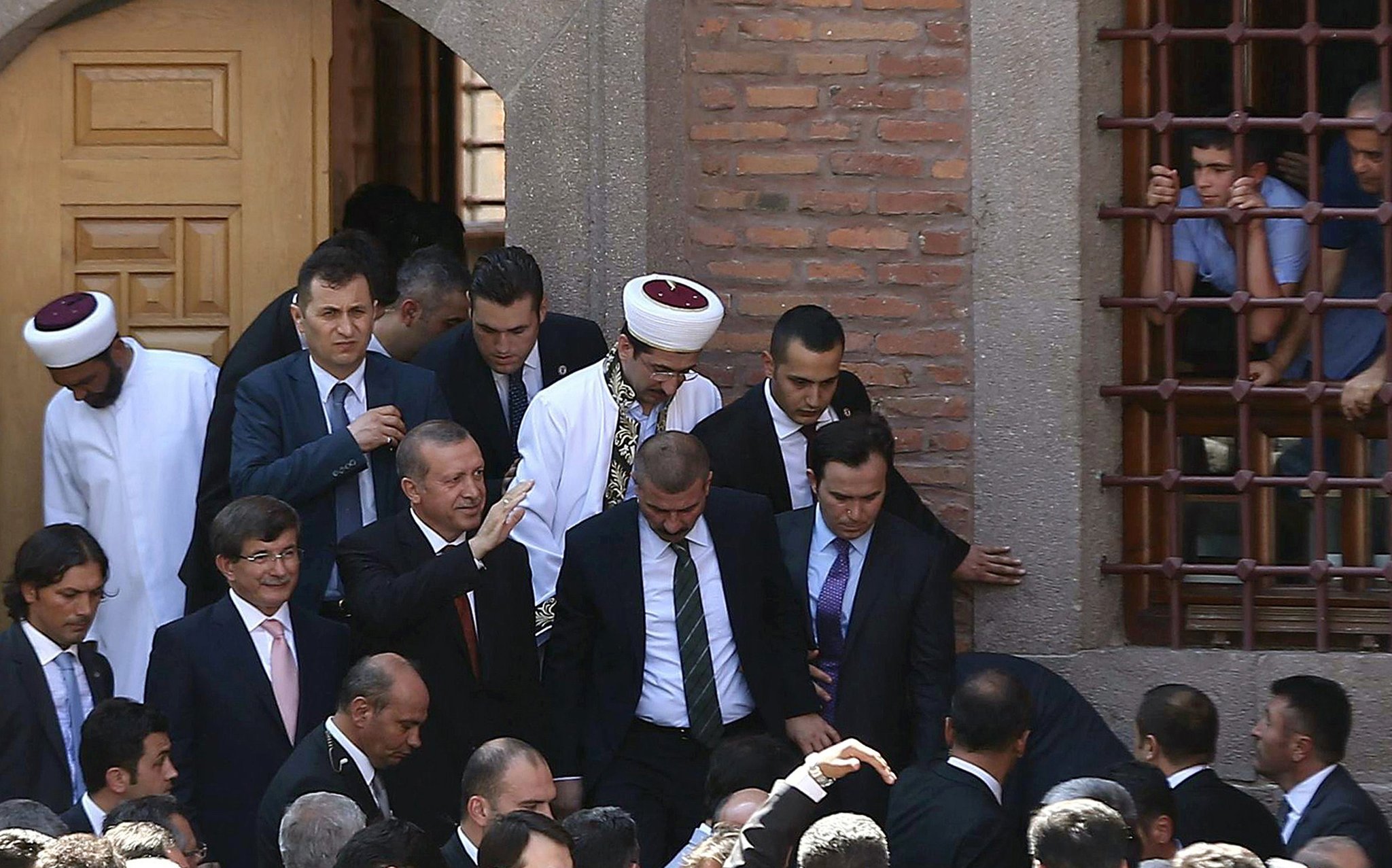
President Recep Tayyip Erdogan of Turkey, hand raised, and Prime Minister Ahmet Davutoglu, to his right, in August, leaving the Haci Bayram Veli Mosque in Ankara, the capital, where the Islamic State in Iraq and Syria is known to recruit new members. Adem Altan/Agence France-Presse — Getty Images (click)

From The New York TimesISIS Draws Steady Stream of Recruits From Turkey

Selections:

“Hundreds of foreign fighters, including some from Europe and the United States, have joined the ranks of ISIS in its self-proclaimed caliphate that sweeps over vast territories of Iraq and Syria. But one of the biggest source of recruits is neighboring Turkey, a NATO member with an undercurrent of Islamist discontent.”

“As many as 1,000 Turks have joined ISIS, according to Turkish news media reports and government officials here. Recruits cite the group’s ideological appeal to disaffected youths as well as the money it pays fighters from its flush coffers.”

“There are clearly recruitment centers being set up in Ankara and elsewhere in Turkey, but the government doesn’t seem to care,” said Aaron Stein, a fellow at the Royal United Services Institute, a London-based think tank. “It seems their hatred for Bashar al-Assad and their overly nuanced view of what radical Islam is has led to a very short- and narrow-sighted policy that has serious implications.”

The Interior Ministry and National Police Department did not respond to requests for comment.

On a recent afternoon in Ankara, Mr. Erdogan and Mr. Davutoglu came to pray at the historic Haci Bayram Veli Mosque, just over 100 yards away from an underground mosque used by a radical Salafi sect known to oversee ISIS recruits.

When news of their visit reached the neighborhood, several residents scurried down the steep hill hoping to catch an opportunity to raise the issue.

At the same time, a 10-year-old boy lingered in his family’s shop, laughing at the crowd rushing to get a glimpse of the two leaders. He had just listened to a long lecture from his father celebrating ISIS’ recent beheading of James Foley, an American journalist. “He was an agent and deserved to die,” the man told his son, half-smirking through his thick beard.

To which the boy replied, “Journalists, infidels of this country; we’ll kill them all.”

Well, ain’t that just a kick?  Wonder what all the Stephen Kinzers and Christopher de Bellaigues who have been crowing about the new Turkey for 20 years are now going to have to say — maybe have been saying.

Comment: nikobakos@gmail.com

Upon escaping from Greece…

7 Sep

cp-cavafy2

How do you go through the work of the poet whose opus consists of the sharpest and most accurate analysis of Modern Greek identity, and find the poem that displays perhaps the most razor-sharp understanding of all of them? I’ve always known that poet was Cavafy, but I wasn’t looking for that one poem or anything, when, just leafing through his stuff a few days before I left Greece this past July, I came upon one of my favorites, the following. Please have a look first:

Going Back Home from Greece (an unbelievably clumsy translation of the Greek title)

Well, we’re nearly there, Hermippos.
Day after tomorrow, it seems—that’s what the captain said.
At least we’re sailing our seas,
the waters of Cyprus, Syria, and Egypt,
the beloved waters of our home countries.
Why so silent? Ask your heart:
didn’t you too feel happier
the farther we got from Greece?
What’s the point of fooling ourselves?
That would hardly be properly Greek. 
 
It’s time we admitted the truth:
we are Greeks also—what else are we?—
but with Asiatic affections and feelings,
affections and feelings
sometimes alien to Hellenism. 
 
It isn’t right, Hermippos, for us philosophers
to be like some of our petty kings
(remember how we laughed at them
when they used to come to our lectures?)
who through their showy Hellenified exteriors,
Macedonian exteriors (naturally),
let a bit of Arabia peep out now and then,
a bit of Media they can’t keep back.
And to what laughable lengths the fools went
trying to cover it up! 
 
No, that’s not at all right for us.
For Greeks like us that kind of pettiness won’t do.
We must not be ashamed
of the Syrian and Egyptian blood in our veins;
we should really honor it, take pride in it.

— Translated by Edmund Keeley/Philip Sherrard

Επάνοδος από την Ελλάδα

Ώστε κοντεύουμε να φθάσουμ’, Έρμιππε.
Μεθαύριο, θαρρώ· έτσ’ είπε ο πλοίαρχος.
Τουλάχιστον στην θάλασσά μας πλέουμε·
νερά της Κύπρου, της Συρίας, και της Aιγύπτου,
αγαπημένα των πατρίδων μας νερά.
Γιατί έτσι σιωπηλός; Pώτησε την καρδιά σου,
όσο που απ’ την Ελλάδα μακρυνόμεθαν
δεν χαίροσουν και συ; Aξίζει να γελιούμαστε; —
αυτό δεν θα ’ταν βέβαια ελληνοπρεπές. Aς την παραδεχθούμε την αλήθεια πια·
είμεθα Έλληνες κ’ εμείς — τι άλλο είμεθα; —
αλλά με αγάπες και με συγκινήσεις της Aσίας,
αλλά με αγάπες και με συγκινήσεις
που κάποτε ξενίζουν τον Ελληνισμό. Δεν μας ταιριάζει, Έρμιππε, εμάς τους φιλοσόφους
να μοιάζουμε σαν κάτι μικροβασιλείς μας
(θυμάσαι πώς γελούσαμε με δαύτους
σαν επισκέπτονταν τα σπουδαστήριά μας)
που κάτω απ’ το εξωτερικό τους το επιδεικτικά
ελληνοποιημένο, και (τι λόγος!) μακεδονικό,
καμιά Aραβία ξεμυτίζει κάθε τόσο
καμιά Μηδία που δεν περιμαζεύεται,
και με τι κωμικά τεχνάσματα οι καημένοι
πασχίζουν να μη παρατηρηθεί. A όχι δεν ταιριάζουνε σ’ εμάς αυτά.
Σ’ Έλληνας σαν κ’ εμάς δεν κάνουν τέτοιες μικροπρέπειες.
Το αίμα της Συρίας και της Aιγύπτου
που ρέει μες στες φλέβες μας να μη ντραπούμε,
να το τιμήσουμε και να το καυχηθούμε.

What gives this poem such pride of place as an analysis of Greek identity? For me, it starts with the simple joy both passengers feel as they’re arriving home – not approaching Greece, but leaving it. “Upon Escaping from Greece” would be my choice for the title’s English translation, because it’s clearly an experience of suffocation that the two friends have experienced that has started to lighten up for them as they cruise east through the breezy waters of the Mediterranean.

Cavafy has become an object of a resurgent cult in Greece, partly due to last year’s 150-year celebration (he was born in 1863), that’s a kind of an “emperor’s-new-clothes” phenomenon for me; not because his new clothes aren’t real, but I feel that few Greeks actually know what it is they’re suppose to be liking so much. I much prefer people who just say up front that they don’t like him. He’s “childish” they say, in response to his prose-like, early modernist experiments. These are the people who like their poetry with a capital “P”; they want it to rhyme: “φεγγαράκι μου λαμπρό…” and they want it to have epic scale heroics and ‘the thousands dead under the axles’ and ‘the living giving their blood’ in the heroic deed of ‘making the sun turn,’ along with some myrtle and oleander and jasmine thrown in for Aegean effect. (What if you’re from Epiros and you don’t know from oleander and jasmine, just tsouknida and pournari?) Others only like a very emphatically stressed “some” of his poems: these are the ones turned off by his sexuality, but who feel they can’t say so openly in 2014 – or to me. (And the degree to which that whole part of his work, a good half, was ignored by the official festivities – they wanted only “Ithaka” or “Waiting for the Barbarians” or “The City” — was amazing.*) The Messenger for example, found a publisher for his paternal grandfather’s, my great-grand-uncle on my mother’s side, fascinating memoirs, which span the whole period from the late nineteenth century and the end of Ottoman rule to WWII. Except his grandfather met a Jewish guy who screwed him over when he was a young immigrant in New York in the 20s and he included the unfortunate phrase: “Hitler was right for doing what he did to them.”**  The publisher thought maybe that line should be cut. But the Messenger stuck to his cast-iron principles and insisted it be left as is, because it would be “censorship” to remove it.  Hardly an upholder of the most liberal sentiments on issues of that kind, I have a feeling that if the comment hadn’t been about Jews, he wouldn’t have minded the censorship so much. Just a few months earlier, for example, he hadn’t thought it was “censorship” to cut a slightly too homoerotic line from a Cavafy poem he read at his father’s funeral, for fear that our landsmen, our chorianoi, would be scandalized.

These elements and others: that Cavafy preferred the tragic dénouement to the epic climax; the unconsummated to the fulfilled; that he preferred the coded to the open and disclosed, and not out of choice; but learning to love what fate had made him, he learned to love the beauty of code – its poetry — the furtive touch over some cheap handkerchiefs; that he loved the ethnically and culturally and religiously mixed margins of Greek history and the poignancy of characters who had to straddle those margins and did not write a single poem about its Attic glory days (who are all these half-breed Egyptians and Parthians and Jews and other exotic anatolites he’s always making us read about anyway? Where’s Pericles and Aristotle?); that he understood life and humanity as fundamentally amoral, and morality as a convenient weapon to be used against the unfortunate few or often just a bad joke. All this did not do much to endear him to his contemporaries, along with the fact that he famously disliked Greece and especially Athens (the latter kind of unfair in my opinion: Athens at that time must’ve been at its most beautiful and charming), and the straight, homophobic white boys of the Generation of the ‘30s in particular, despite Seferis’ famous eulogy, had no time for him. The most vehement, Theotokas (unfortunately, one of my favorite Greek writers otherwise) scathingly declared Cavafy, in his Free Spirit, a “dead end” (a common trope, whether conscious or not: the gay man begets no issue and is thus fundamentally allied with death); that his modernism was an experiment that had been taken to its logical conclusion and that the Alexandrian was now a decadent (same difference), a point of departure for what Greek letters should move on from next and not a road open for them to continue down.

That right there is the grand and egregious error. Because Greek culture and identity – in a way that makes any sense to who we are today – simply didn’t exist until the Hellenistic (and then Roman/Byzantine) periods that Cavafy chose, almost exclusively, to write about in his historical poems. The conglomeration of Indo-European tribal units who all spoke dialects of similar languages and had started coalescing into larger city-state forms of political organization by the mid-first millennium B.C. have nothing to do with us. They may have started calling themselves “Hellenes,” but let’s not forget that the Iliad does not contain one, single, blessed mention of that holy word, and was compiled only a century-and-a- half or so before the Golden Periclean Age we’re so obsessed with.

It was because he was fascinated with the true origins of Greek identity, the cauldron of cultural mixture that Alexander created that later became condensed into a more distilled Greek-speaking, Orthodox idea, that Cavafy wrote about those periods so widely and studied them so deeply. And being from such deep aristocratic Constantinopolitan roots and an Alexandrian, how could he not have felt that basic idea on a gut level.

This is another reason the mention of the words “Macedonia” and “Alexander” makes my hair stand on end. The Macedonians (by which I mean Slav Macedonians) are ridiculous in their attempt to appropriate Alexander as a phenomenon of their own culture, though many observers have written about how this conscious policy of “antikvatsiya” (“antiquization”) on the Macedonian government’s part is, partly, a response to Greek intransigence on every other grounds. But you can see from how Greeks respond to Macedonian moves that Greeks don’t get Alexander either. Alexander is not a culminating point of Hellenic history, where the great hero brought Hellenic civilization to the “borders of India.” Alexander is not even a Greek herohe very early in his career quickly became déraciné, as Mary Renault keenly observed. Alexander is where Greek history starts. It’s all really the other way around. Alexander is what brought the East, and its incomparably greater and older civilizational achievements, to us. He drove us deep into contact with that wider world, cementing what had always been our bonds to those lands and those peoples he grew to love so much, and giving us as much in return, actually more, than what we gave them. He created the great creolized cultural space that a universal, cosmopolitan Greek identity was first born in and that later – when the name for “universal, cosmopolitan identity” changed, due to political circumstances, from “Greek” to “Roman,” – changed along with it, but which left the Helladic peninsula — or “the Hellenic” generally — behind permanently as a focus of any kind. Until the twentieth century.

Alexander Renault

Hermippos and his friend, Greeks going home to Antioch in Syria or Seleucia in Mesopotamia, can’t be Greek in Greece. It suffocates them. They don’t fit into that nonsense, antiquarian straightjacket. It’s “beneath” them, as Greeks, to reject the wider world that they’ve long been an intimate and inseparable part of. Greek means cosmopolitan to them and they can’t be Greeks without that quality. It would be the most provincial thing for them to do, to act like provincials who try to hide their “easterness”:

“…like some of our petty kings
(remember how we laughed at them
when they used to come to our lectures?)
who through their showy Hellenified exteriors,
Macedonian exteriors (naturally),
let a bit of Arabia peep out now and then,
a bit of Media they can’t keep back.
And to what laughable lengths the fools went
trying to cover it up!”

Eastern Mediterranean(click)

The nation-state is bound up inseparably with provincialness. And narrowed tribalism. And provincials hide. Not true Greek men. Cavafy’s “petty kings” are the Neo-Greek bourgeoisie, from the statelet’s origins down to our day, with their still immovable disdain for the East, who don their ancient fineries and try to make the world call them Hellenes and have no clue how ridiculous they’re being. Provincials dissimulate – not true Greek men — and that dissimulation has been the main thread of Neo-Greek culture since the late eighteenth century, so much so that all perspective has been lost. Hermippos and his buddy aren’t provincials. They’re Greek alright – from some of the richest, most sophisticated and Greekest cities in the world; but they understand the larger cultural context they’re a part of, and they’re too supremely secure in their Greekness to put down the Egypt and Syria that ‘flow in their veins.’ Greece tries to take that away from them. I imagine the Athens they had to go study at as a kind of tired old Cambridge, MA, still resting on its now dried-up laurels. But they’re too Greek to let Greece do that to them. Sorry to get repetitive. It’s an attempt to make the paradox – a wholly healthy and natural one – sink in.

Greece still tries to do that to you. And in the crisis mode it’s in today, it tries even harder because its sad inhabitants’ perspectives have become narrower and narrower to the point where they see nothing of the rest of the world and there’s simply very little language left you can share with them. “Η φτώχεια φέρνει γκρίνια,” the Greek says – “poverty makes for kvetching” — and though many people I know have faced the current crisis with the best kind of Greek dignity and humor in the face of adversity, too many others have lapsed back into ideological craziness, or just a frustrated lashing-out bitterness, or were always there but kept it hidden and now think that it’s more okay to express things openly; it’s hard to tell which.

One friend or relative has become a Golden Dawn apologist if not supporter: “What’s a young man who loves his country supposed to do?” I dunno; but half of Dostoevsky is about what to do with the unguided idealism of strong young men and phenomena like Golden Dawn wasn’t one of his answers; he strictly warned us against them, in fact. Another wants to take a DNA test to make sure he has no Albanian genes: actually believes such a thing exists – a chromosome for Albanian-ness and a test that will detect it. And this is one of those uncomfortable situations we’ve all been in where this is coming from the spouse of a good friend, so you have to keep your silence and you can’t just say: “That’s nice _______, Hitler and the Nazis were into that kind of thing too.” If I could I would’ve also asked if he wanted to see my DNA chart too, which is probably chock full of “Albanian-ness” and if he would then feel the need to maybe keep me away from his daughters. Another is still obsessing, as we go on twenty-five years since the break-up of Yugoslavia, on the “Macedonian issue.”*** And after hours of mind-bogglingly pointless conversation – “It is useless to attempt to reason a man out of a thing he was never reasoned into,” said Jonathan Swift — you take a step back and realize that that’s all that’s ever mattered to this guy. The hundreds of thousands dead produced by the Yugoslav disaster, the millions displaced, the destruction of the last part of the former Ottoman sphere where there was still some hope of survival for a multi-ethnic society, the greatest bloodletting in Europe since WWII, right on our doorstep…  He doesn’t give two shits, nor has he let one blessed thought or idea on that series of calamities occupy even one of his brain cells for a second. All he cares about is the “Macedonian Issue.” Twenty-five f*cking years later. And he doesn’t find such narcissism the least bit obscene.  “The world is burning, και το μ**νί της Χάιδως χτενίζεται.”  I won’t translate.

Whether or not they’re becoming more extreme or just showing their true colors more, it’s certain that I’ve become more radical – not in my ideological positions, which are what they always were – but in my inability to tolerate their stupidity and growing narrow-mindedness. I’m always ready to leave Greece when the time comes, but this time it had become truly unbearable. There were just too many people that it had become too uncomfortable to even be around. And stumbling on this half-forgotten Cavafy poem was no accident I feel.

And so I took that great big breath of relief that Hermippos and his friend took on the deck of their boat as the shores of Cyprus came into view when I myself left for Serbia back in July. I had to get out of this place – and disassociate myself from it and its inhabitants — if the fact that I’m Greek was going to continue to be to at all tolerable to me. I’ll always love arriving; with the new flight path south over the Attic midlands passing right over the town and beach — over the very apartment building — where I spent my childhood summers, I’ll always choke up a little at the sight of the brown hills of Attica. But when I’m ready to leave, I gotta go – and fast – and this year more urgently than any other.

And I can see myself spending more and more of my future time in “Greece” in Albania with my relatives – “deep” Greeks who don’t have the ball-and-chain of a nation-state tied around their ankles; in Istanbul – with smart young Greek and Turkish kids who are trying to do something intelligent and productive about our relationship; maybe in Cyprus – which Kosmas Polites called the last surviving remnant of his beloved lost Ionia and where I have friends to whom I owe long over-due visits; or just here in Queens — where every block and street corner and subway stop and church bears a piece of my Roman-ness.

Because Greece, man… Greece just cramps my Greekness.

Egypte, Alexandrie, le front de merAlexandria (click)

******************************************************************************************************************************************************************************************************************

* And the thing is, if you ignore his erotic poems, I find it hard to believe that most people can even understand, much less really appreciate, the rest — the historical poems.  Who understands the religious and cultural sociology of fourth-century Alexandria enough to have the proper context to apprehend all of “Myres: Alexandria, AD 340”?  Who the hell knows where Commagene is?  Or who Alexander Jannaios was?  Or what a handsome Jewish prince is doing with the name Aristovoulos?  Or why he was murdered and “those sluts Kypros and Salome” are now gloating in private?

** It’s amazing.  And disturbing.  Anti-semitism and the extent of its popularization and the accessibility of its language.  Not only can one accusation of unethicalness — and from a Greek at that! — be used to tar a whole people, but Jews are the only people with whom that one charge leads straight to the gas chambers so easily, in people’s minds and on people’s tongues.  Not “what a sleazebag.”  Or “what a nation of sleazebags.”  But straight to “Hitler was right…”

*** Yes.  Believe it or not.  The “Macedonian” “issue.”  More on that to come.

Comment: nikobakos@gmail.com

Erik

24 Jun

IMG_0803

(click)

These are “erik,” plums, or “can erik,” as some people call them (“life” or “soul” plums?).  They’re not a particular type of green plum.  They are just completely unripe, green ones and for a couple of weeks in June Turks go mad for them.  They must be the small fruit culled off the trees so that the more promising ones can grow to full ripeness and size.  I think they’re probably the kind of plum that the Japanese pickle and are so delicious with saké.  You don’t wait for them to ripen or anything.  You eat them in all their incredible, sour, mouth-puckering glory.  They remind me of the unripe krana we used to eat in my village.

Every time I’m here I discover some new quirk in the sophistication of Turks’ aesthetic sensibility that surprises me and fills me with wonder.

I was at the bar at the Hilton the other night.  Full confession: I love the Istanbul Hilton; of all the hotels built on that ridge and gulley between Ayaz Paşa and Maçka — one of the most abused pieces of Istanbul real estate — it’s the only one that respects the terrain; it’s a modernist classic; the engagement party scene from The Museum of Innocence segment that takes place there ranks right up there for me with most the brilliant ballroom/party scenes in War and Peace and Lampedusa’s The Leopard; and I have very emotional memories of staying there with my father once in 1983.

I was sitting there at the bar one night and the bartender brought a middle-aged British couple sitting next to me a bowl of these plums.  They each bit into one and looked at each other with their faces twisted into shock at the sheer unexpected sourness of them.  The woman said: “This can’t be right; they don’t really eat these, do they?”  I looked over and nodded.  “What? You mean, like this,” she said to me, “Completely raw and unripe?”  I nodded. They actually each gave them a few more tries and then gave up.  “Interesting…”she said to me and smiled.  I nodded.

Apparently for Queens readers, they’re available in Sunnyside markets these days too.

ISTANBUL-HILTON-OTELI-FOTOGRAF-KABI__18292863_0

Vintage photo of the Istanbul Hilton.  Just once glance over to the Asian side.  Now nearly impossible to believe the City actually ever looked like this.