Giritimu

4 Jun

IMG_0783

Of all the victims of the Population Exchange, and among all descendants of muhacir groups in Turkey generally, probably few are as fanatical in the maintenance of their collective identity or memory of their homeland than Turkish Cretans — which only proves that they’re as Cretan as any Greek Cretans are.  And which my saying probably enrages certain nationalist “intellectuals” in Athens I know more than it does Cretans themselves.

IMG_0785

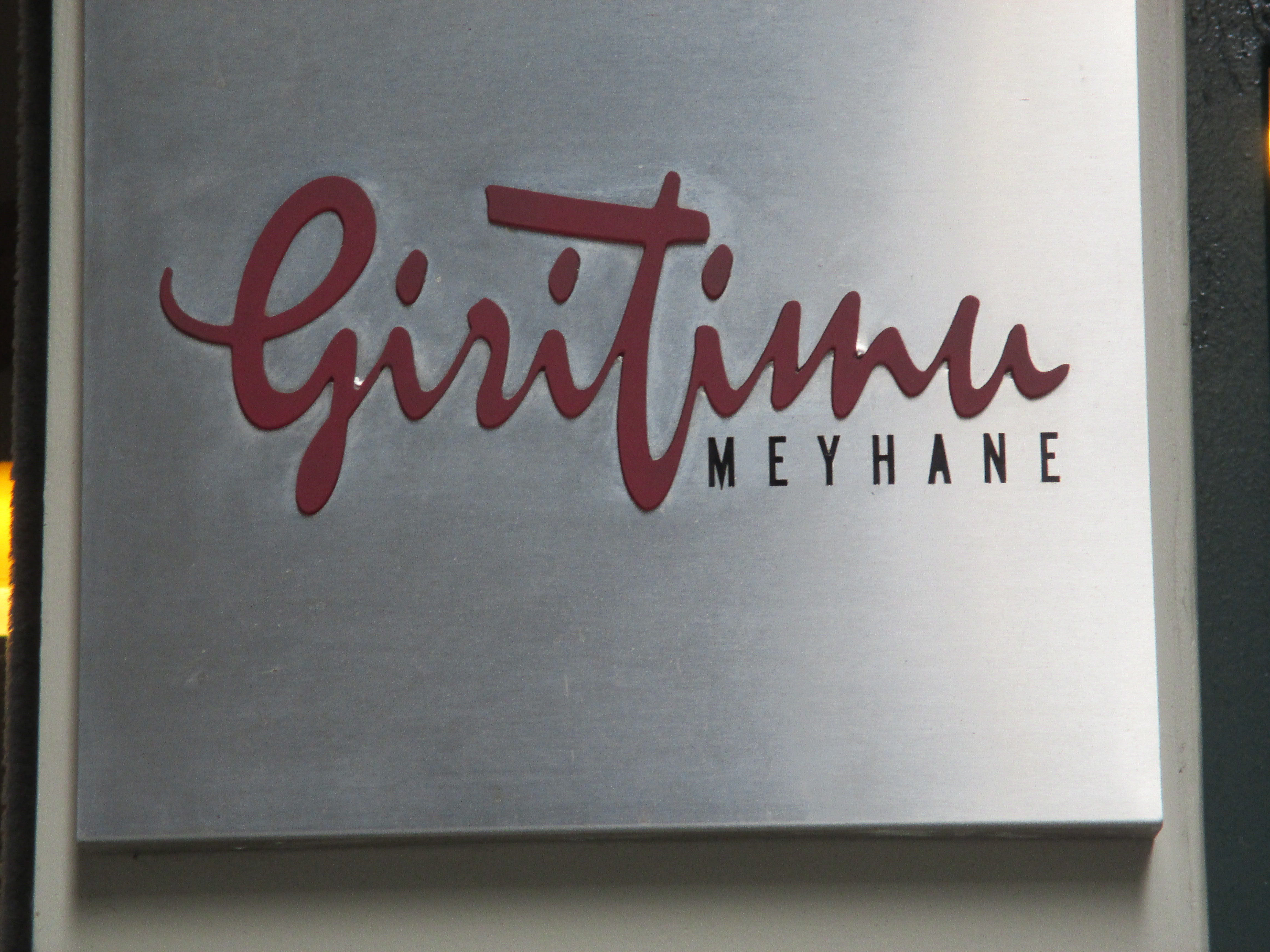
Around the corner from my apartment, there’s a taverna owned, obviously, by a Turkish Cretan, which he’s named “Giritimu.”  This is a combination of “My Crete” in Turkish: “Giritim” — and Greek: “Κρήτη μου,” “Crete mou” — which is what the Greek-speaking Turks of the island, who constituted a third of its population until the twentieth century, would have used anyway — into one odd, bilingual, double possessive.  And it’s corny, but half the times I walk by I tear up at the sight of it anyway.

A thousand curses on the kathikia who thought they could treat people like cattle this way.  But you know what?  A thousand more on the heads of those peoples themselves, who gave the kathikia politicians and diplomats the raison for doing it, by not being able to live together without being at each others throats for an eternity, and now cry for their lost homelands and are all mushy-gushy love for their lost “brothers.”  Whenever a Turk tells me “we’re  brothers,” half the time I want to cry and hug him and half the time punch him.  (See: “After the Floods, Unity and Compassion”  for what’s become a growing sentiment on my part recently.)

One night I’ll stop by and eat there, just to honor the memory.

Comment: nikobakos@gmail.com

A Bit of Greek History in Serbia

3 Jun

Buljkes

A discovery by Professor Vladimir Bosković of Harvard which he thought might be of interest to members of the MGSA, the Modern Greek Studies Association:

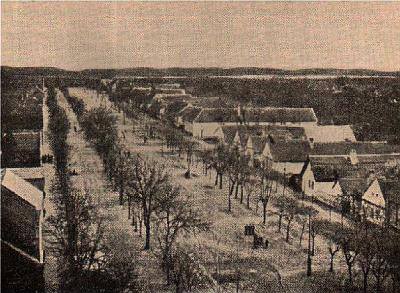
“MAY 1945 (image). The Bulkes (now Maglić) was a small town in northwestern Serbia, in the bend of the Danube in Vojvodina. Almost all the inhabitants were German colonizers. The city was given to the Greek political refugees, around 5000-6000 souls, with their families. After the December defeat, thousands of ELAS fighters went to Yugoslavia and settled in Bulkes. In May 1945, with a permission of the Communist Party of Yugoslavia, 4,650 members of ELAS settled in the abandoned village houses. Until 1949 Bulkes was treated as an extraterritorial Greek municipality on the territory of Yugoslavia, governed by Greek laws and using special Greek banknotes.”

Bulkes Greek Dinars (1945 – 1949), In: Greek Banknotes, <http://www.greekbanknotes.com/greek-banknotes/bulkes/> (20. V 2014). 

Milan Ristović, ”The Buljkes Experiment “Greek Republic” in Yugoslavia 1945-1949”, In: Annual for Social History, year IV, no. 2-3, Belgrade, 1997, <http://www.udi.rs/articles/The_Buljkes.doc> (20. V 2014).

Best,
Vladimir Boskovic
And a member asks:
Dear Mr. Boskovic
Since in Jugoslavia was already existing a “People’s Republic of Macedonia” (1944) , what was the reason of moving the Greek political refugees as well as the ELAS fighters (with their families and the kidnapped or not kidnapped children), most of which were “Macedonians” all the way to Voivodina ?
Why create a “Macedonian Diaspora” ?
Why not place the Greek political refugees and the “Macedonians” of ELAS in the newly formed “People’s Republic of Macedonia” in order to make it more “Macedonian” than ever?
Any reply would be appreciated.
 
Thank you
George Tsapanos
That’s not such a difficult question to answer, in my humble opinion.  First, it’s very ideologically questionable to assume that all ELAS fighters or members were Macedonians, or since you put it in quotes, let’s call them Slav-speakers of Greek Macedonia, though I don’t agree that their identity should continue to be qualified by quotes.  But this was a basic tenet or, rather, ideological ploy, of the Greek right during WWII and the Civil War: an attempt to conflate all Greek communists with Slav-Macedonians, thus killing two birds with one stone in essence, or marking them as double traitors; since they’re communists they must be Slavs and since they’re Slavs they must be communists.  So I would be very careful about falling into that trap.  Communism is not something inherently Slavic — which I’m sure you don’t believe — the way Greek nationalist propaganda tried to portray it on and off during the post-war years.  Ask the hundreds of millions of Slavic peoples who suffered most from that ideological experiment and they’ll tell you.
So we don’t have any real information on who these ELAS-ites who were settled in Bulkes in Vojvodina were ethnically or linguistically, at least not from the article that Professor Bosković sent out.
Then, the news item is a little problematically worded.  The German inhabitants of Vojvodina were not “colonizers.”  They had lived there for centuries because as you must know Vojvodina had been part of the Hapsburg Empire since Hungary was conquered back from the Ottomans in the seventeenth century.  They may have even arrived in the area at the same time that Serb colonists did from the south, or Old Serbia, during the so-called “Great Migration,”or may have even pre-dated them.  Germans were present even in the mediaeval Serbian kingdoms — Saši or Saxons — especially working in the silver mines of Novo Brdo in Kosovo and other locales that the pre-Ottoman Serbian kingdoms drew so much of their wealth from.  And I think that at the beginning of WWII, they were the second largest ethnic group in the region, after Serbs — or third, with Hungarians the second.
Linguistic_map_of_Vojvodina,_Serbia_(based_on_1910_census)
The other fact the article doesn’t mention is that all these Germans were expelled from the region and that many of Vojvodina’s Hungarians left, as well, after the war.  We don’t hear much about it but I believe that the numbers of Germans expelled from Eastern Europe after the war not only dwarfed the numbers of our tragic population exchange with Turkey in the twenties, but may have been even greater than the fourteen million  people who were dislocated as a result of the partition of India.  We’re just still a little uneasy talking about Germans as victims.
So that, as opposed to a poor region like Macedonia with a fairly dense population and an already slightly volatile Kosovo-like ethnic climate, Vojvodina was rich, fertile and had huge tracts that had been left empty by the departure of these Germans, and it probably made much more sense to settle these Greek communists there than anywhere in southern Yugoslavia.  Serb and Montenegrin settlers were also encouraged to come fill these now empty spaces of Vojvodina at the same time. 
And finally, Yugoslav ideology did not encourage the spirit of ethnic particularism, quite the opposite, so they would never have settled “Macedonians” in Macedonia in order to make it more Macedonian.
Does that help?
Nicholas Bakos

Comment: nikobakos@gmail.com

The adventures of me and my nephew Vangeli in C-town

2 Jun

IMG_0779

(click)

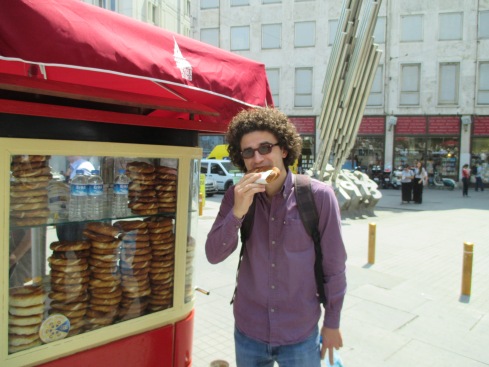
This is my nephew Vangeli from Tirana, who came and spent an extended weekend with me in Istanbul last week, eating a simit in the Staurodromi.  When I started this blog I said to myself I wasn’t going to include personal names.  When you represent something ideologically problematic for me, you’ll usually be described by a repeated sociological profile: “the Athenian thirty-something” or you’ll get a moniker all your own; in any event, if you read regularly, you’ll know who you are.  But the warmth of certain experiences I had with my family in my village this past spring has made me want to “call their names,” both because these are people I learned to love a great deal in a very short amount of time and to do them the honor, even if these experiences are not that interesting for the objective reader.  It’s obvious that it’s for them.

Vangeli is my second cousin Calliope’s eldest son. (See Easter Eggs… because, believe me, you don’t want me to run through all the lineages each time and I can’t do it either.)  When I first went to Derviçani in 1992, after Albania had safely opened up for good, Calliope was already living in Jiannena and we met there first, so we could get to know each other before going into Albania together.  When we arrived in the village for the first time, hers was the face I was constantly looking for as a reference point among the throngs of relatives who were constantly surrounding me.  It was her and my cousin Panto, Pantele, who is still my official bodyguard everywhere I go in the village, telling me who’s who since I can’t keep track, taking me everywhere I want to go, counting the tsipoura (raki) I have at every visit, so they don’t add up to too many in one afternoon, etc.  His mother, my Kako Poly (Polyxene), is a saintly woman who made great sacrifices caring for my grandmother in her final years under conditions of great material deprivation for all.  In video we have of my grandmother, taken by complete fluke by a cousin of my mother’s who went to Albania in 1988, a year before my grandmother died, as part of a Greek commercial exchange delegation — these groups were always taken to Derviçani as it was the showcase Greek minority village in communist times — my grandmother says: Να, αυτή είναι η Πόλυ, μ’έχει επάνω της… — “Here, this is Poly, she (lit.) carries me.”
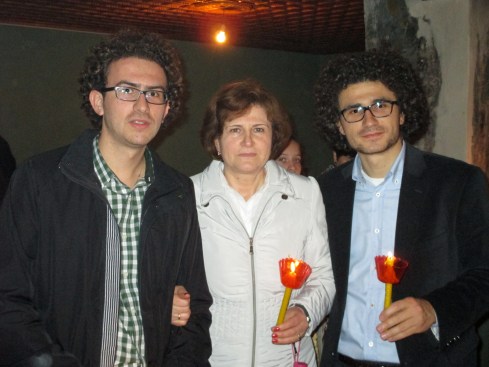
IMG_0050This is Calliope, with her two sons Vasili (left) and Vangeli (right) on Easter night in church (click).  She’s an extraordinary and extraordinarily loveable woman: a great housewife, a competent businesswoman, funny, generous, always smiling, as flirtatious and open as a teenage girl — she’s one of my great relative-loves.  Here she is below at the Monastery on Easter Monday, having just deposited a huge piece of lamb shoulder — no, actually, a lamb shoulder — on a paper towel in front of me, cold and glistening with shiny white fat like some Homeric offering.  My father always loved cold lamb, and would never let my mother reheat it, because it reminded him of the Easter dance at the Monastery.  This is a typical pose to catch her in below, because her innate generosity is always giving something to someone.  (Click)
IMG_0119I hadn’t met Vangeli before, and if I had he would’ve been a baby.  But in church that night, when we were introduced, he said to me, in his classic Aries way — breezy and confident: “Actually, I don’t know you, but Christos Aneste!”  And my Aries replied: “I don’t know you either, but Alethos Aneste!” and I knew right then we’d hit it off.  We talked the next day at the dance; I invested some of the best days of this trip visiting them in Tirana on my way back from Montenegro, and of all the people who said they would come to Istanbul to see me while I was here, I knew he was the only one who would actually do it.  We locked horns on titles or terms of address for a while; I am literally twice his age, fifty and twenty-five, but we hang out like cousins and that’s what he used to call me, whereas I want to be called “uncle.”  He wasn’t having it.  (I have a similar problem with some nephews in New York on my mother’s side.)  For a while we agreed on “şoku,” which is “buddy” in Albanian but also meant “comrade” in communist times, so that didn’t last very long, nor did the Russian “tovarishch” which means the same thing.  Finally, when he got to Istanbul, he heard some guy addressing another as “abi” — big brother, technically, but often just “mate” — which they use in Albanian as well, so it’s been “abi” since then and that pretty much describes how we relate to each other. 

I’m an only child.  Calliope is like the big sister I never had and it’d be hard to imagine a more loving one.  But my parents also had a first son that died when he was a baby, so, even more deeply, I’ve always felt literally haunted by a living presence and desperate absence at once, and by an entirely metaphysical need for a being that I feel is out there to incarnate itself again as an older brother.  But being an older brother to someone else is just as gratifying, especially to a kid like Vangeli.

Because he’s good at his role and he did me super-proud here.  He studied computer engineering in Birmingham and speaks flawless English, dresses impeccably, works for a company that sends him to Italy on a regular basis, so he speaks some passable Italian as well.  (Some fashion-victim friend of mine from New York saw him dancing in the second video here and wrote to ask me who the funky kid with the curly hair and the Prada glasses was — she had recognized the Prada frames from five-thousand miles away…)  We went out for a classic Istanbul fish-and-rakı dinner at a really good place in Cankurtaran in the old city; he immediately recognized that this was not just any meal, but that he was in the presence of a certain ritual to be respected, like Japanese kaiseki, and he acted accordingly.  He was put off by the anise in the rakı at first — we drink ours unflavoured in Epiros — but then realized that Turkish rakı is not the cough-syrup by-product that Greek ouzo is and enjoyed it thoroughly.  He had no negative preconceptions of Turks and Turkey and he never, never — not once — tried to insert one of those slimey negative innuendos about Turkey into the conversation that almost every Greek tries to do when he’s with Turks.  He just listened to the two female friends we went out with, asked questions, tried to learn, gave his opinion, talked to them about Albania and Argyrocastro and Tirana and our families and Britain and anything else you could imagine, and charmed the skirts off of both of them.

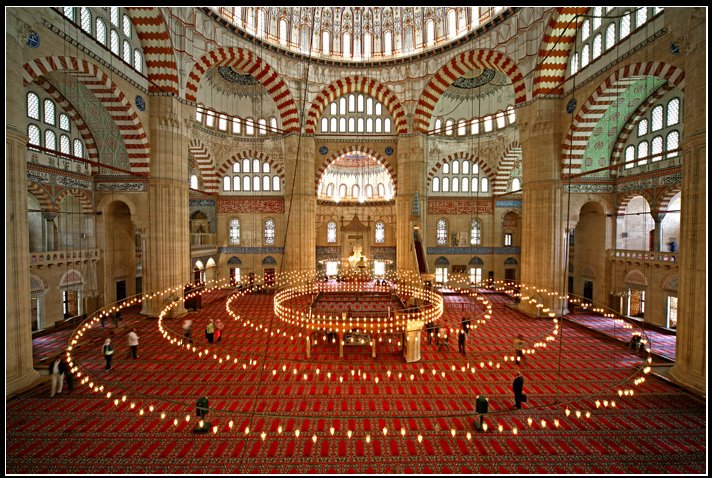
He wanted to see everything.  I hate going into the old city.  I find it depressing, crowded.  I love the mosques, but the Byzantine monuments discourage and sadden and, sometimes, anger me, and I prefer to not be confronted with the interface between the two and just stay here in Pera, expelled from the walls in my gavuriko varoşi.  Also, getting there is alright, but getting back means trudging up and down and then up and down again some incredibly pedestrian-unfriendly streets and intersections and underpasses, unless you take some sleazy Sultan Ahmet cabdriver whose meter suddenly races to 100 lira by the time you get from Hagia Sophia to Pera.*  But for Vangeli I went.  And we saw everything there was to see.  We even stumbled upon the Rüstem Paşa mosque, which if you ever asked me to find, I never could.  We sat in the Süleymaniye for an hour and he listened to me talk about why I like sitting in mosques and watching Muslim prayer — Istanbul was the first time he had been inside one — and find them so calming and peaceful.
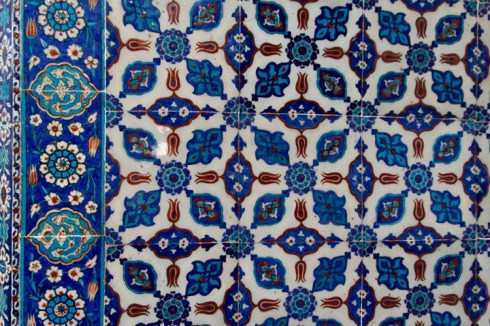
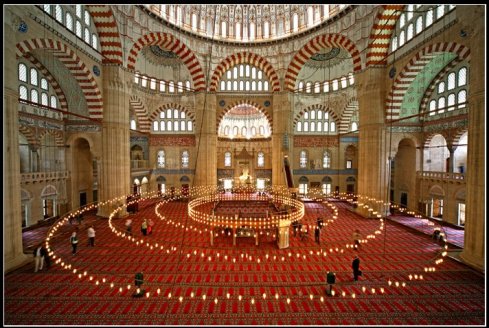
Rustem pasa tiles

Suleymaniyeimg_redirect.phpThe tiles of Rüstem Paşa above and the interior of the Süleymaniye (click)

We covered every inch of Topkapı, where I hadn’t been in years and where I was re-dazzled by that Ottoman sense of elegance and comfort that Rebecca West speaks of so often.  He was interested in the oddest things.  His favorite palace was Beylerbeyi, as it is mine, but he was fascinated by the story of the French empress Eugénie, born Eugenia de Montijo of the highest Andalusian aristocracy, who extended her state visit there for so long that it began to turn into a diplomatic scandal in Europe: he wanted to know how beautiful she was; he wanted to know whether Abdülaziz was such a stud that he was actually shagging her and how Napoléon III could have been such a nebech that he didn’t come grab her by the hair and drag her back to Paris.  “Άμ,’ ήθελες γυναίκα Ισπανίδα…” he decided, after much pondering — “that’s what you get for wanting  a Spanish wife.”  And an Andalusian one at that.  But once you’ve seen Beylerberyi, where she was put up on her visit, which is like a gigantic Turco-Venetian palazzo opening up onto the fresh, cool waters of the Bosphorus and not some smelly canal, you realize that once anchored there, leaving would be hard even if you weren’t getting any from the Sultan.

Beylerbeyi Palace (click)
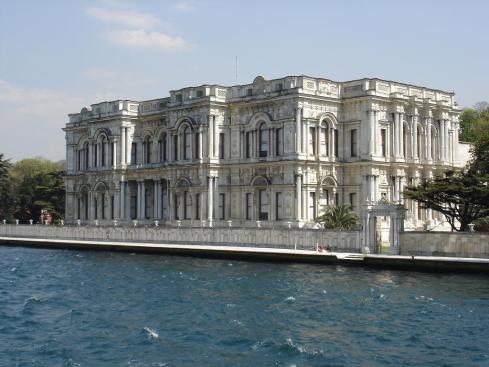
beylerbeyi_palace_by_shidikujThe Empress Eugénie of France, née Eugenia de Montijo of Granada; the Jackie Kennedy fashion plate of mid-nineteenth century Europe and considered one of the most beautiful women in the world at the time (click), subject of the copla by Rafael de León and Manuel Quiroga, made famous in Concha Piquer’s incomparable rendition.
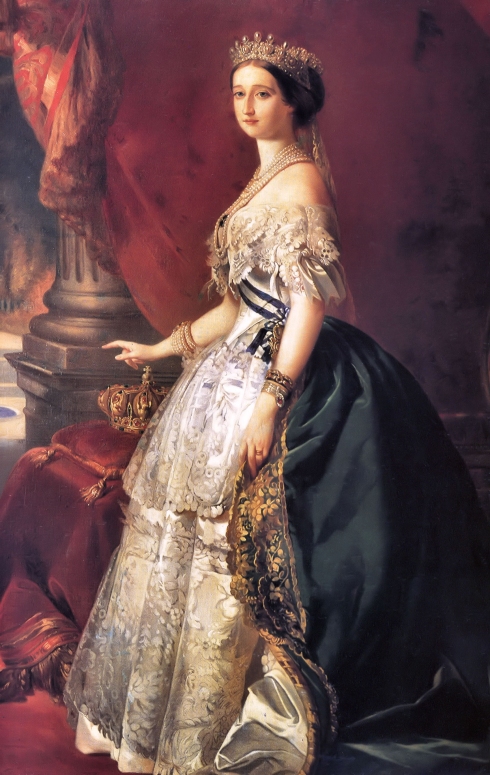
Eugénie;_keizerin_der_Fransen_(2)

The last day I was exhausted but he wanted to go look around Turkish supermarkets for yufka to compare the quality and price to what his family’s company makes; this is my Uncle Vangeli’s business; they make yufka and tel kadayif and sell it throughout Albania.  The name of the company is Demetra, like the ancient goddess of agriculture and cereals.  We went to a couple of Carrefour and he wasn’t impressed.  We went to some small bakalika and they didn’t have any at all.  And, very cutely, he made the assumption, in those hushed tones of respect that the Ottoman culinary tradition still carries with it in the Balkans, especially in the western Balkans from Epiros to Bosnia, where börek is an institution and a strong regional identity marker: “They probably open up [that’s the term we use] their own phyllo at home still.”  I didn’t want to pop his bubble.  Then he wanted to go to Dolmabahçe too — the energy of youth — but it was already too late in the day.  As compensation we went to dinner at the Çırağan, the hotel that’s now in the palace most similar to Beylerbeyi.

What I most admire about Vangeli is that he’s smart, sophisticated, has a C.V. that could take him anywhere in the world that he might want, but he wants to stay in Tirana, not just because he wants to help the family business, but because he actually wants to stay in Albania and build a program design business of his own, in the country he grew up in and lived his entire life in, and that that doesn’t get all mixed up with dumb ethnicity issues.  I didn’t ask him; he probably doesn’t “love” Albania any more than I “love” the United States.  He probably doesn’t have an answer.  But where he lives — what state he lives in, in particular — doesn’t have any bearing on who he is.  Like me.  He’s Vangjel Stavro; he’s a computer engineer; he’s Greek and he lives in Albania.  Period.  He may be the New Balkans.  In fact, soon all of the Balkans might be the New Balkans except for us, who will still be left blinkered, frozen like a deer in the headlights, wondering why the “Europe thang” didn’t go as we planned.

There are a couple of inside jokes to the photo at top where’s he’s eating a simit at the Staurodromi.**  One is that we both felt like hell that morning, which is why I’m not in the picture, not that I like being in pictures anyway.  Two nights before we had had that splendid fish dinner in the old city and had put down a fair amount of rakı, but it was with food — basically, after a few rounds of great meze, this beautiful lithrini (lüfer):
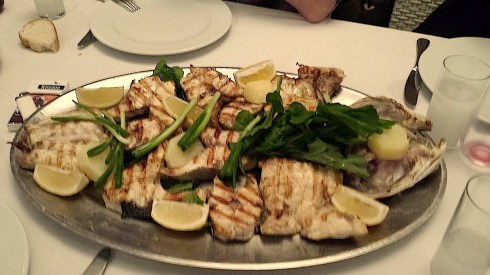
Fish20140522_214540(click)

But the night before the simit photo, I had wanted to take him to the bar on the rooftop of the Marmara Pera hotel, so he could see the places we had visited in the old city that day from across the water at night and illuminated, and then we were planning to go hear some Greek guys who play rebetika at a very cool, shabby old meyhane near Taksim.  But we spent too much time at the Marmara and by the time we got to the rebetiko place all the food was gone and all that was left were stragalia/leblebi.  Now I don’t know exactly how leblebi are made — I think they’re dry-roasted chickpeas — but I detest them as much as I love cooked chickpeas/rebythia/nohut.  Something happens to the dense, almost meaty, velvety texture of chickpeas when they’re made into leblebi that produces something that tastes like a highly compacted nugget of sand, or like taking a teaspoon of raw flour and popping it into your mouth.  I think the only reason they’re considered a drinking snack is because you’ll choke on them if you don’t have anything to wash them down with.  Vangeli hates stragalia too, but I tried to encourage him: “Come on man, this is the exclusive diet of the Great Father; this is how he defeated Turkey’s enemies and brought his country glory, with a pocket full of leblebi and a flask of rakı!”
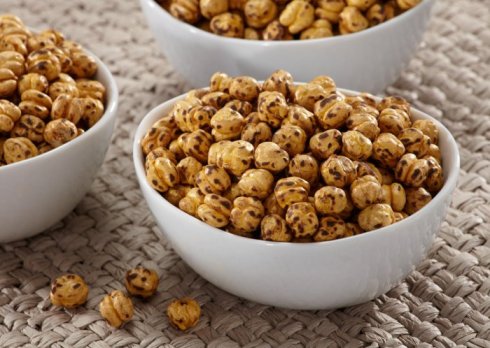
Lebpic1340611232r779452Leblebi

So we ate as many as we could, starving as we were, and had way too much to drink in too short a time on top of it.  We then went outside when the performance was over, and suffering from the drunk munchies on which rests the drunkard’s philosophy that if you pile more crap into your stomach on top of too much booze it’ll make you feel better, we had two plates each of chicken-and-pilav from the street vendors (one of the most delicious things you can possibly eat in Istanbul — Turks are magicians with rice), and then on my corner we found Orhan, my favorite Kurdish midye kid, and I think closed down his shop that night as well; we must have had about twenty mussels each.  So we were not very happy the next morning.

The second insider joke is actually one me and Vangeli share with Epirotes down the centuries.  Legend has it that Epirotissa mothers would slap their sons on top of the heads to flatten them from the moment they were born and say: “Και σιμιτζής στην Πόλη” — “And may you become a simit vendor in the City” and that this explains the idiosyncratic beer-can shaped heads that a lot of Albanians and Epirotes have, like some of my chorianoi:
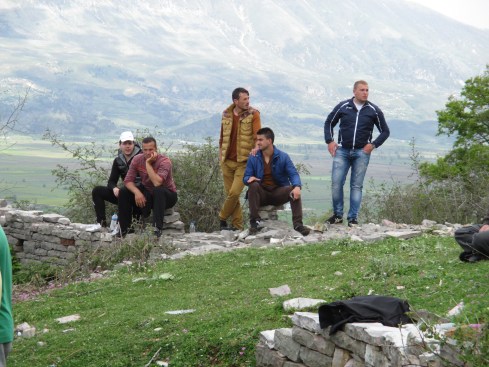
IMG_0148or a guy as seriously Kosovar-looking as Novak Djoković:
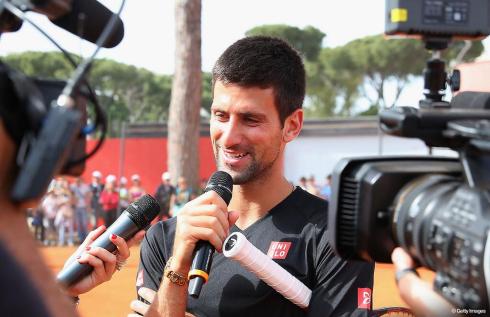
DjokBearCanBnhbw7ZCYAAgVoE.jpg_largeor me:

nikostautoteta23

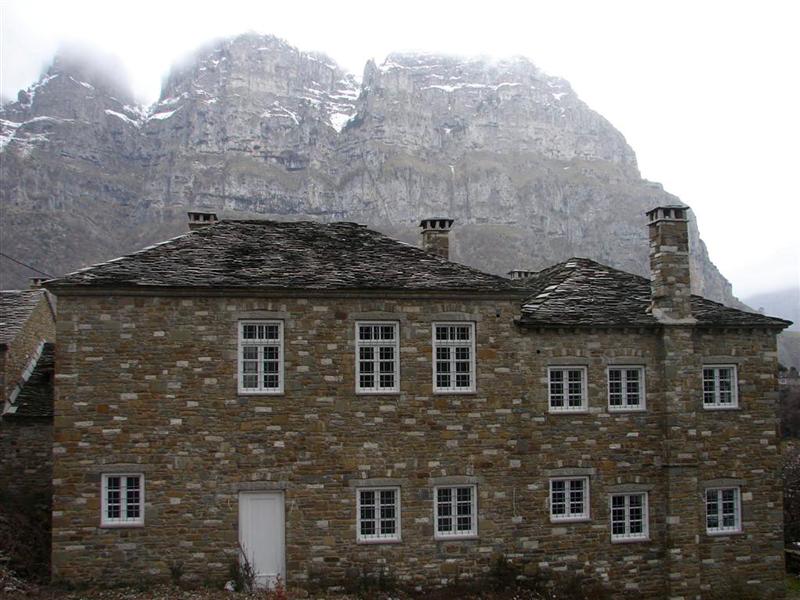
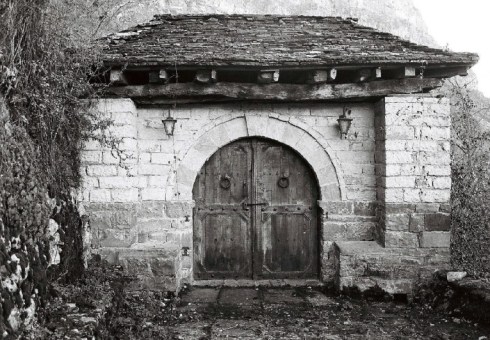
The point is that the flat top would make it easier to balance a tray of simit on your head.  Of course the joke is based on false modesty, because Epirotes did not come to Istanbul, or go to Roumania, or Odessa, or Alexandria, or the United States or anywhere else in the world to become simitçides.  They went to make money and, some of them, fabulous amounts of it.  This is why you can be driving through Epiros, through empty, lunar karst limestone landscapes where you wonder if you could even herd goats, much less sheep, much less plant anything edible, and then suddenly come upon villages with massive two or three-story stone mansions, and equally impressive churches and schools.  And this is why Epirotes contributed so greatly to the Greek Enlightenment, to the creation of the Greek state’s institutions and educational establishments, and generally had an exceptionally high standard of living and literacy — even for womenfor rural Greece, until the whole exclusively male emigration structure collapsed and was followed by a massive exodus to the cities after WWII.  Like certain islands of the Aegean or the Saronic, it was the very barrenness and lack of resources that the land could not provide that drove the movement, ingenuity and creativity of traditional Epirote culture and that allowed them to make such lives for themselves at home (at least for their families, because they themselves were gone most of the time) and make such important contributions to the wider Greek world.***  Of course, it was also the institution of emigration that led to the endemic, marrow-deep sadness of the culture as well.

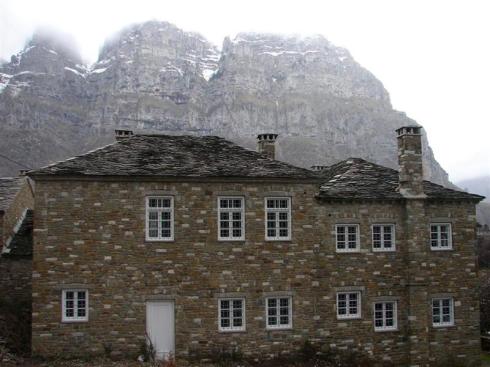
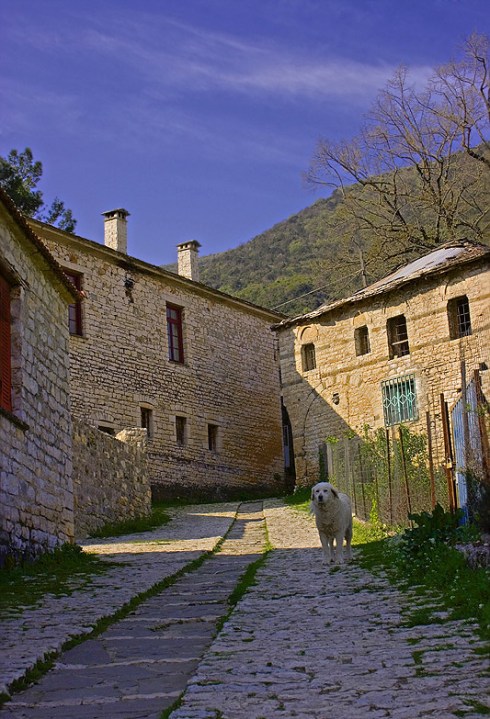
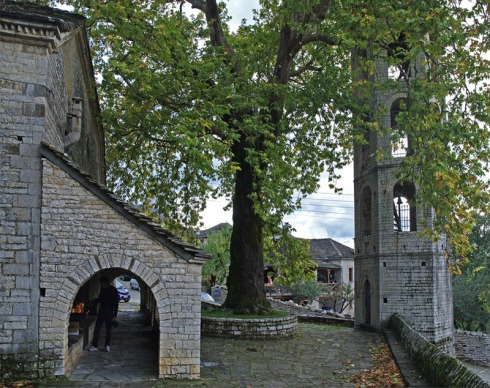
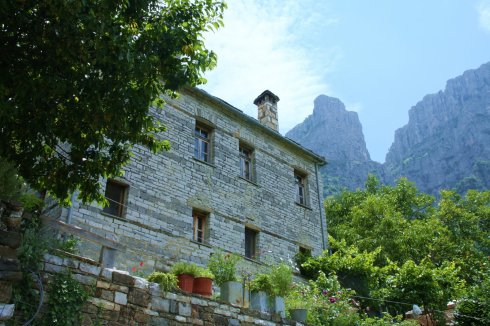
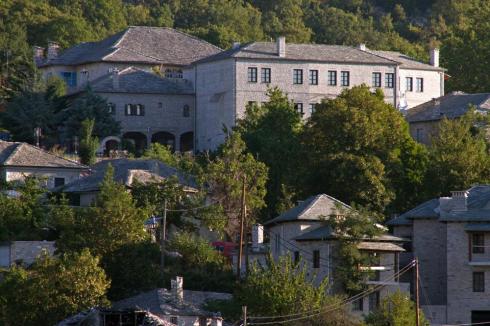
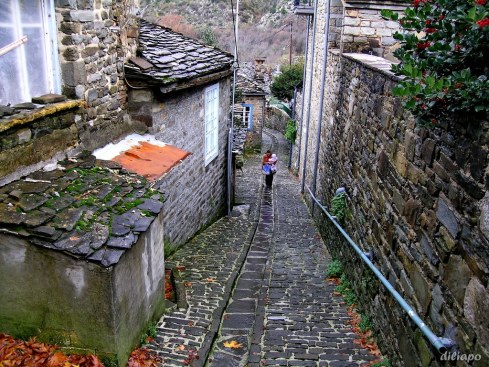
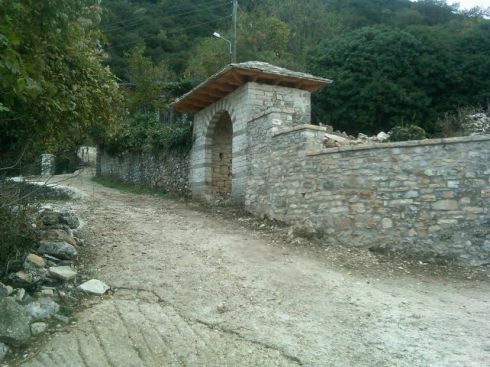
Traditional Epirotiko village architecture from various parts of the region, obviously not the communities of poverty-stricken hillbillies, built with money made abroad by emigrants; the final picture at he very bottom is the front gate to my mother’s patriko, the house where she was born.  Her family made their money through three generations of baking businesses in Bucharest. (click)
000116

papingo

1704170417041704_12

Papingodsc_0416

PapingoIMG_4952

Monodendri-Hotel-22

Tsepelovo59399932

Giotopoulos gateunnamed

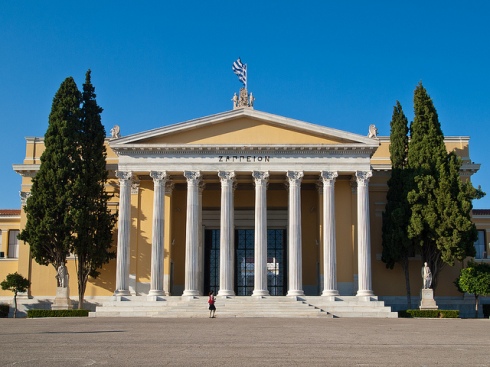
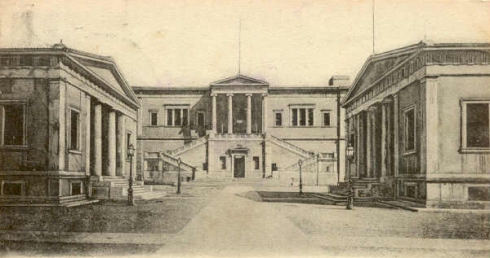
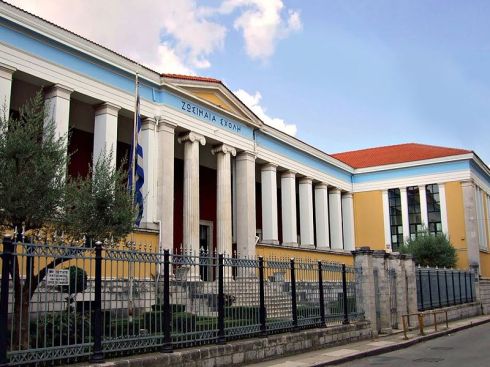
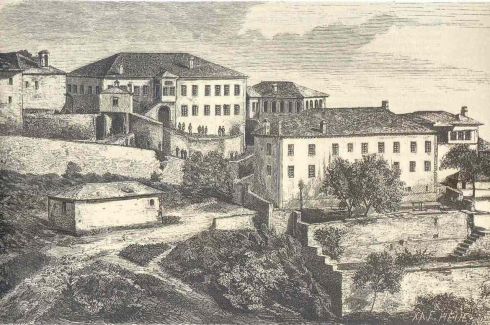
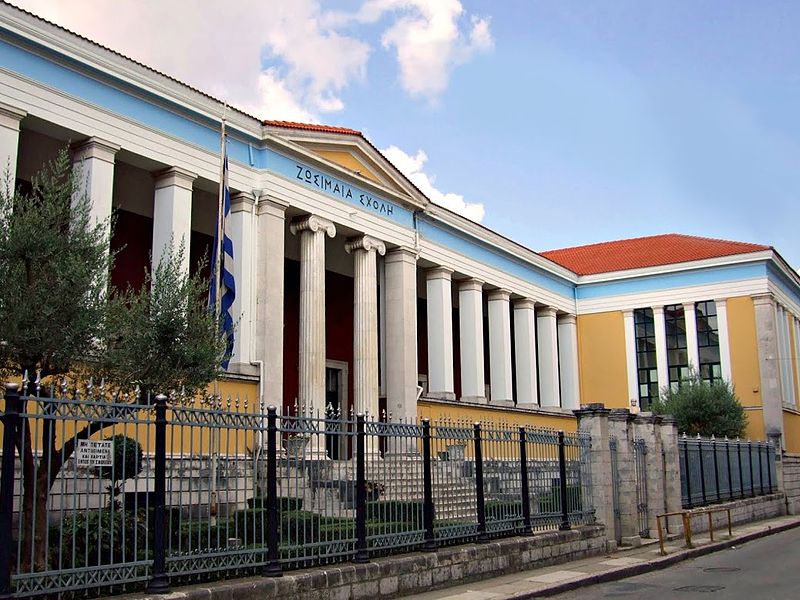
And below — in order — the Zografeion and Zappeion Lycées in Istanbul, the Zappeion exhibition hall and gardens in Athens, the National Polytechnic School in Athens, the Zosimaia in Jiannena, and the Zografeion college of Kestorati, all just a few of the institutions funded and built completely by Epirotes (click).
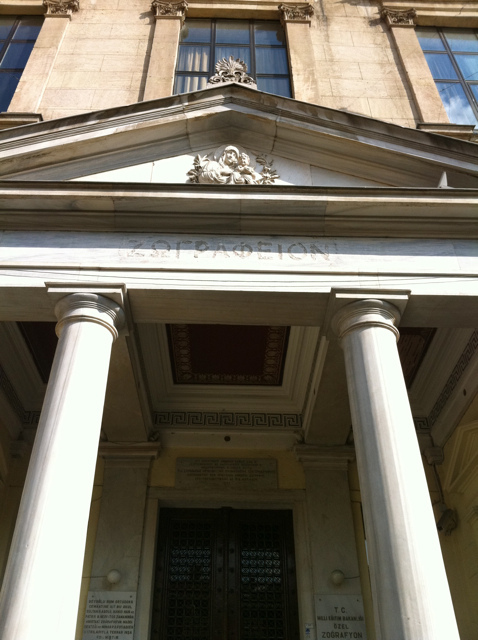
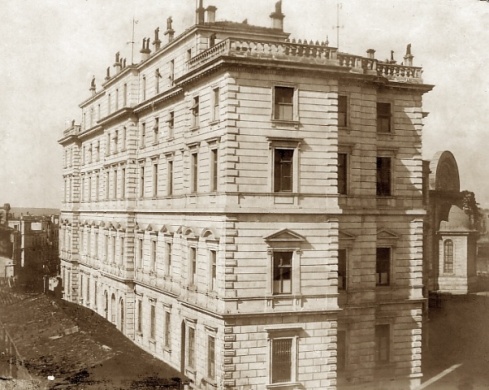
5694293094_8d58ab27da_z

zappeion

OLYMPUS DIGITAL CAMERA

polytechneioPatision_Complex

ZosimaiaΓυμνάσιο_Ιωαννίνων_3

ZographeionCol

I have a friend in Greece who’s from a part of Greek Macedonia that, before the refugee tents went up there in the 1920s, was inhabited exclusively by mosquitoes.  We were good friends but we had more than our share of tensions because he was an insufferable kind of arrogant Eurocrat that Greece used to produce at the time and had some supposedly hot-shot job with one of the sleazier Russian-type Greek communications moguls to appear in the nineties — μιλάμε principles yok.  And for some reason, he had this implacably neurotic competitive impulse that he would always unleash on me any time I spoke about Epiros, especially if it was with any amount of pride.  “It eez the poooorest proveens in Euuurope…Galicia in Spain and Epiros…are the pooorest proveeenses in Europe…” he would say to me constantly, like a Brussels parrot.  And after WWII, the practice of leaving families behind and going off to work abroad and returning only occasionally became untenable, and most of Epiros did become tragically depopulated.  But it was poor because it was depopulated and the only permanent inhabitants of many communities were pensioners, not because it was a region that traditionally suffered from desperate poverty.****  The hot-shot job and the whole Euro-thing has collapsed since then, along with the whole balloon in which it existed, of course, and he’s a significantly humbler person today.  But it was just so infuriatingly ignorant and anistoreto on his part to see Epiros as some Greek Appalachia and his motivations for harping on that distorted image escape me to this day.

Anyway, that morning I wanted to buy five or six simitia and pile them on Vangeli’s head as a reference to this simitçi tradition, but I could see he wasn’t having it, so I didn’t even try.  He insisted it was the anise in the rakı that made him sick and has sworn that from now on it’s only “real” raki for him — straight and Albanian — with no sissy Politiko flavorings to eff him up.

*************************************************************************************************************************************************************************************************************

* Turks are among the most honest people I have ever come across in all my travels, and not because of modern efficiency like in Europe, but out of traditional philotimo or honor.  I’ve had a Turk from a Taksim pilav stand recognize me as I walked by, and come up to me to give me one lira change he owed me because three days earlier I had eaten there and he was short.  I’ve had to fight with a Turkish simitçi because he wouldn’t sell me a simit because it was late in the day and they were stale, begging him, eventually giving up because he simply refused — the famous Turkish “yok”; when you hear it give up immediately.  I’ve had Turks — this happened to me in Afghanistan once too — run down the street after me to give me a Bic pen I had forgotten on their restaurant table.  But something happens to a Turkish cabdriver when he’s in the Sultanahmet area and he becomes the biggest sleazebag in the world.  I think that now that tourists have discovered the Beyoğlu side of the city and generally prefer to stay there, there’s greater tourist traffic between Pera and the important monuments of the old city, and these jerks take advantage of it.  But be tough with them; simply refuse to pay more than 20 or 25 lira — no matter what his rigged meter says — and walk away and tell them you’ll call the police if they don’t like it and, being cowards, like most frauds and liars, they’ll immediately back down.

The route from Şişhane or the Galata Tower, across the Galata bridge to Hagia Sophia has to be — and always has been — one of the most important pedestrian traffic axes in the city.  And instead, both Karaköy and Eminönü — the two districts and “squares” that face each other across the Horn and are like the two ventricles of the historic heart-like link of the City — are hideous, dirty, badly designed nightmares to walk through.  Instead of worrying about Taksim so much, Erdoğan might want to put some effort into redesigning this essential, central binder of the two Istanbuls.  But that would be a massive project that would involve levelling almost everything that’s been built there in the past forty years and starting with a clean slate.  Plus, you don’t want to give him too many ideas because he’s perfectly capable of building something as ridiculous as a ski-lift from Şişhane to the Hippodrome to assist tourists in their sight-seeing.

** The Staurodromi is one of the nicest spaces in Pera.  The gates of Galatasaray are beautiful, the other corners have their original turn-of-the-century buildings intact and there’s one modern, kind of semi-Brutalist building in travertine that I really like, that houses a bank and a bookstore and that you can see in the picture above behind Vangeli and in this one below.  The only thing that mars the whole space is this ugly sculpture:
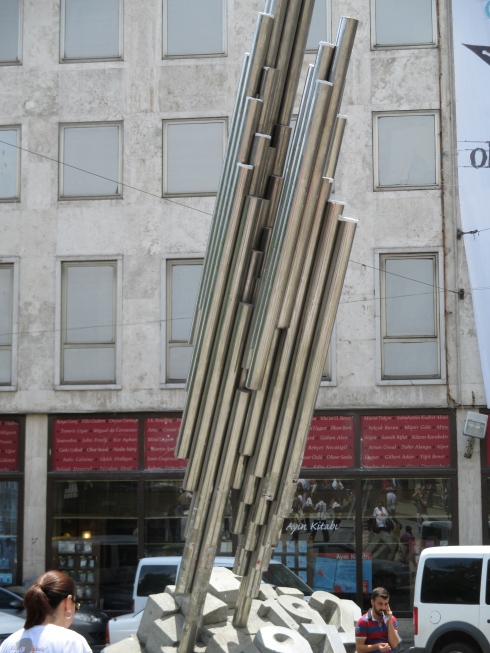
Uranium piles

Does anybody know what it’s supposed to be?  Missiles of some kind?  I don’t know what enriched uranium piles look like, but during Fukushima and every time someone talks about Iran or North Korea and uranium piles, my imagination immediately conjures up this horrible sculpture.

*** This was all part of what I can only generally call the “Great Mobilization” of the Greek world that began in the early eighteenth century.  The confluence of factors that caused this are so intricate that they’re hard to summarize: the primary spark was perhaps the massive wealth accumulated by the Phanariotes — Greek aristocratic families in Constantinople prominent at the Patriarchate and, by extension, at the Porte — who had used their influence in imperial circles to turn most of what is now Romania (Moldavia and Wallachia) into their own autonomous Greek kingdoms, which they sucked dry, and how that wealth was poured into Greek institutions and trickled down into Greek hands generally; the concurrent spread of Greek educational and commercial networks in the Balkans and Eastern Europe and later in the Near East, in the rapidly modernizing economy of post-Mehmet Ali Egypt especially; the way the so-called Greek Enlightenment worked through both these kinds of networks.  The increased mobility that the nineteenth century made possible; most people, for example, don’t know this, but the Greeks of the Anatolian Aegean coast and the Marmara were almost exclusively migrants from the islands and mainland Greece — and even later the Kingdom of Greece itself, Greece basically having been an economic basket-case since the get-go — that started settling there in large numbers in the later eighteenth century and not, as we romantically like to believe, descendants of Byyzantine Hellenism; the only remnants of Byzantine Hellenism in Asia Minor were the Greeks of Pontus and Cappadocia, of course, and small pockets near Konya and Kula and Isparta and that lake region, all of whom, except for Pontioi, were Turkish-speaking until some of the men started learning Greek in the nineteenth century.  (In isolated areas of Cappadocia, a dialect of obvious Greek origin had also survived into the nineteenth century but was already dying out by then, and was so heavily Turkish in vocabulary and had even developed extensive agglutinative structures like Turkish that it’s almost impossible to call it Greek, any more than you can call Vlach Roumanian.)  Then there were the colonialist economic incursions into the Ottoman Empire and its reduction to a European debt-slave (much like “Memoranda” Greece today) that together with the privileges for Christians that the Great Powers forced the Ottomans to grant, created a space for growing Greek and Armenian prosperity from which Muslims (and Jews, for that matter) were excluded, and that produced exclusively Christian micro-economies within the Empire in which Greek rural migrants could find work and prosper.  All this had an enormous effect on Greek life everywhere.  You can see it in the village architecture of certain regions of the Greek world.  And you can see it in traditional dress of Greek rural women.

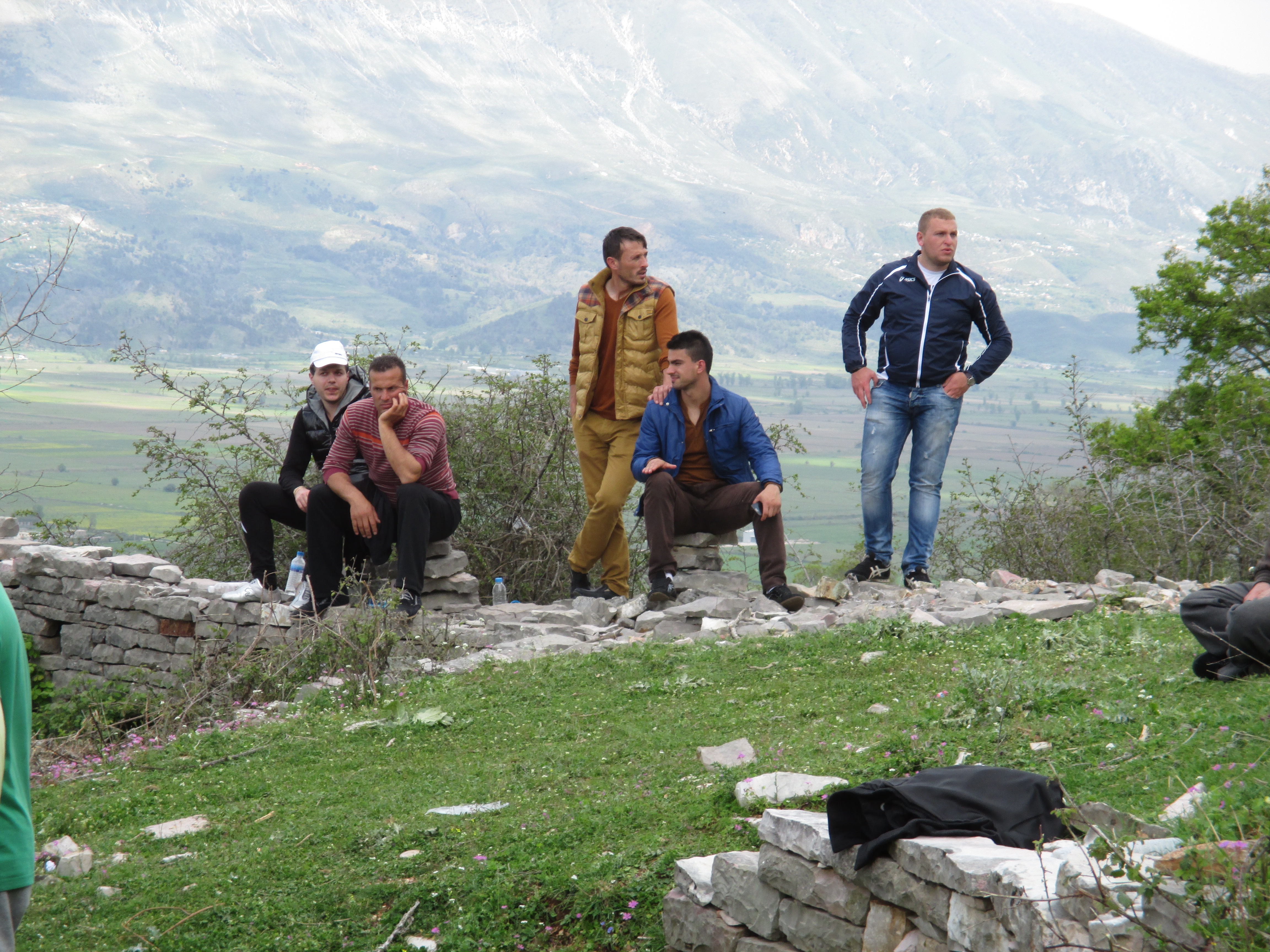
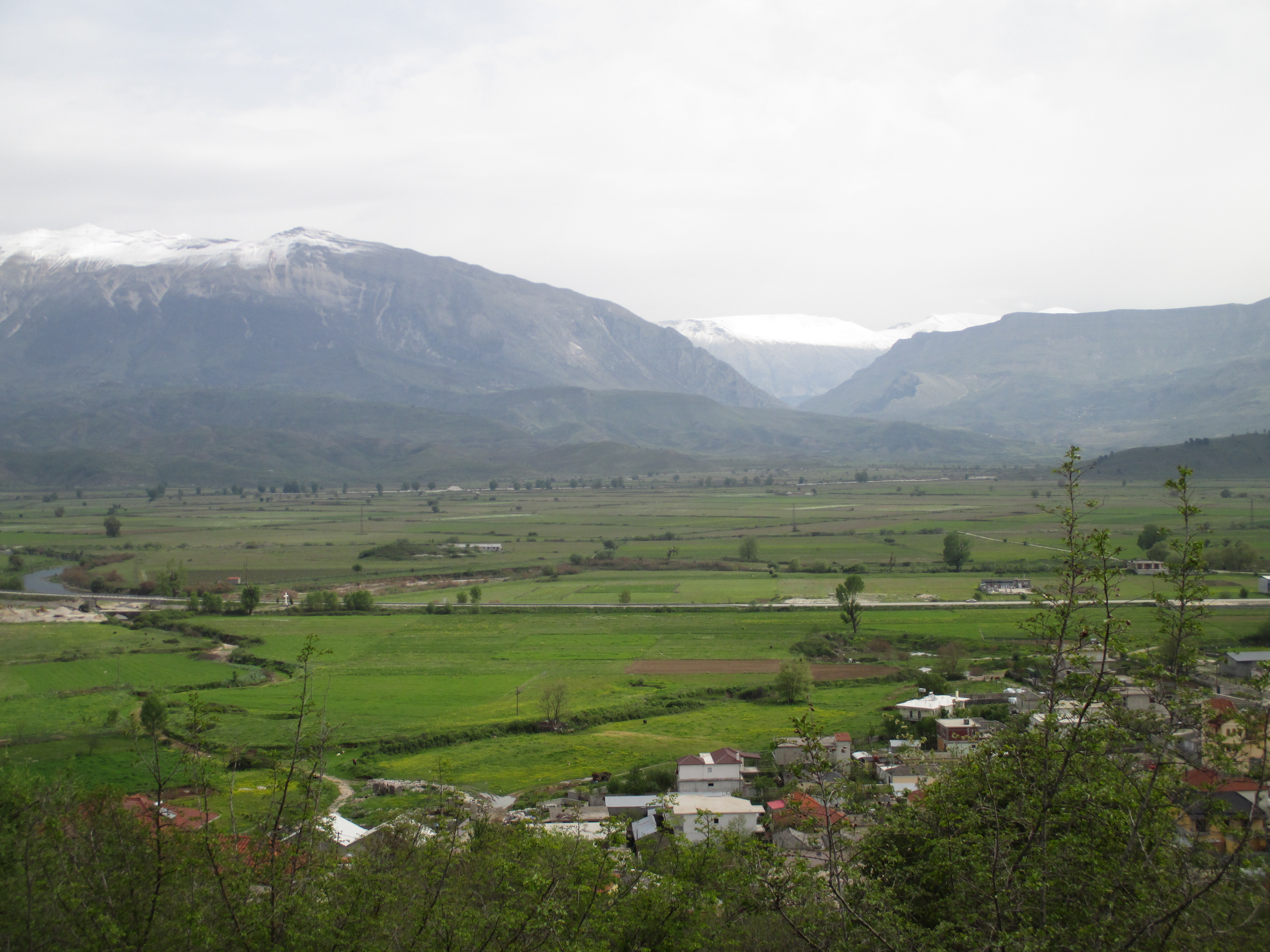
My father’s villages in the valley of Dropoli are situated in one of the few extensive, arable parts of Epiros, the fields you see in the pictures taken from atop the village itself (click):
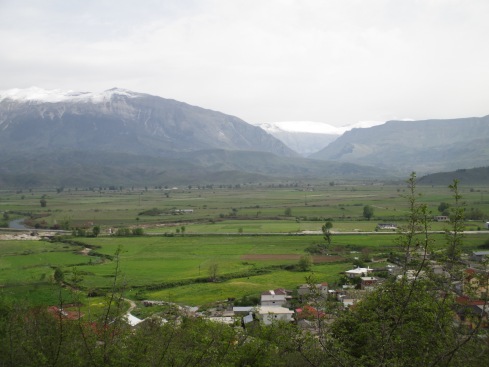
IMG_0075

Paradoxically, it was this theoretical asset that kept our villages relatively poor until the mid-nineteenth century, because these fields were all çiftlikia of Muslim landowners (“fiefs” I guess; don’t ask me to explain Ottoman land tenure to you, or tell you the difference betweeen a çiftlik or a timar or anything else, because every time I try and read about it I fall asleep and don’t remember anything I’ve read when I wake up) and we were essentially sharecroppers for them.  Only with the exponential growth of emigration in the nineteenth century did any kind of considerable prosperity come to our villages and many were even able to buy their village lands from the increasingly impoverished ağadhes themselves.  Like I said, this was markedly obvious in the changes in female costume and the complete switch of male dress to frangika, Western clothes; traditional male outfit of the region would have looked something like this, the characteristic white felt pants called poutouria (this photo is from southern Serbia actually, but was the nearest approximation I could find) and not the fustanella kilts that folklore groups in the village like to use today indiscriminately and inaccurately:
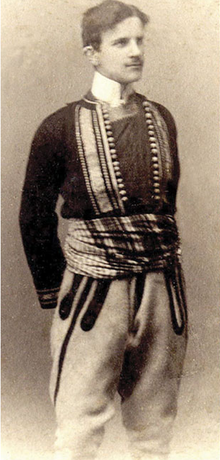
Poutouria220px-Teslacirca1880(2)

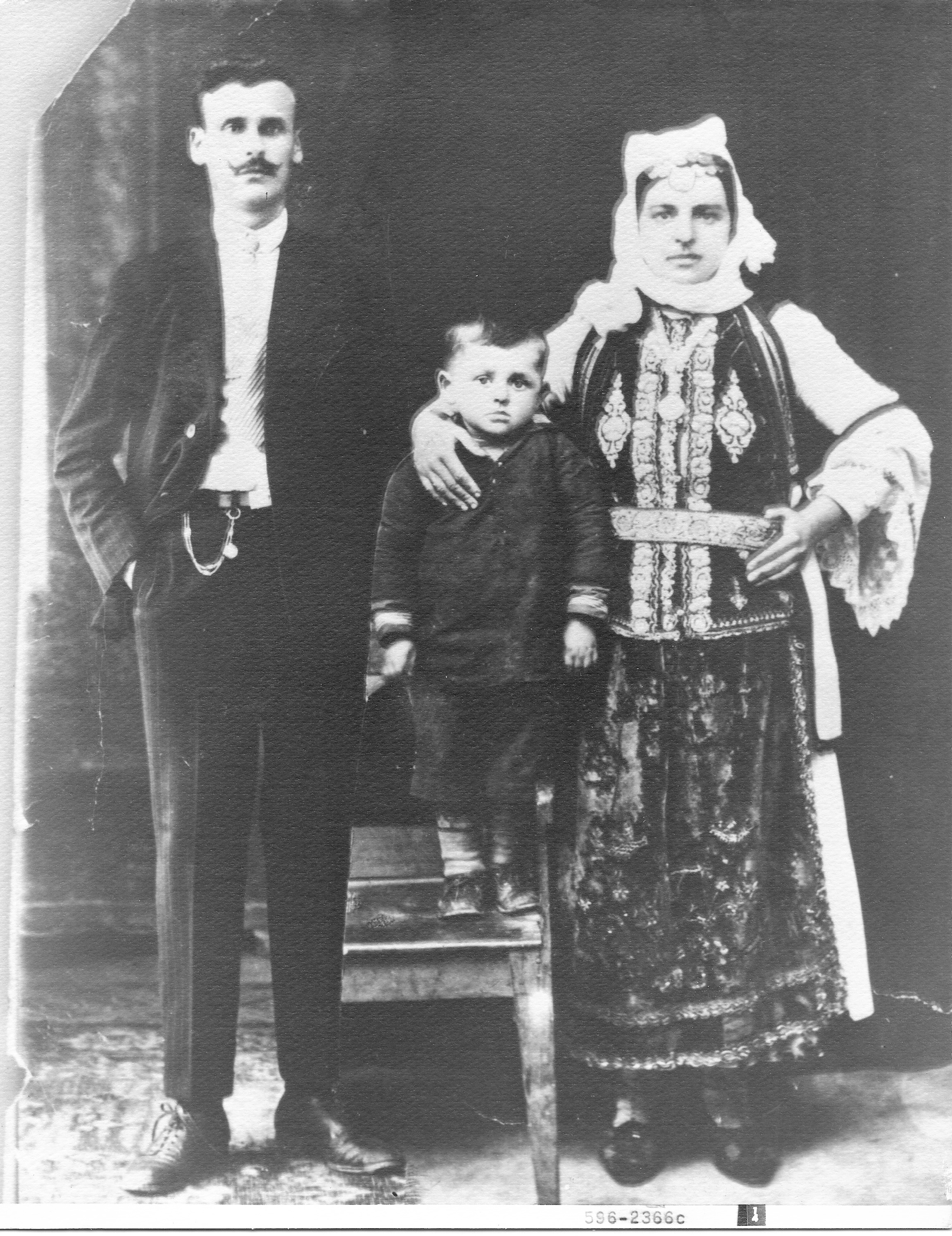
While, with the women, in extremely old photos from Derviçani, you can see that almost all the articles of the costume were home-made by the women themselves, with growing wealth you see the gradual addition of articles of clothing that had to be made by professionals.  My grandmother’s outfit here, for example, especially the vest and apron:
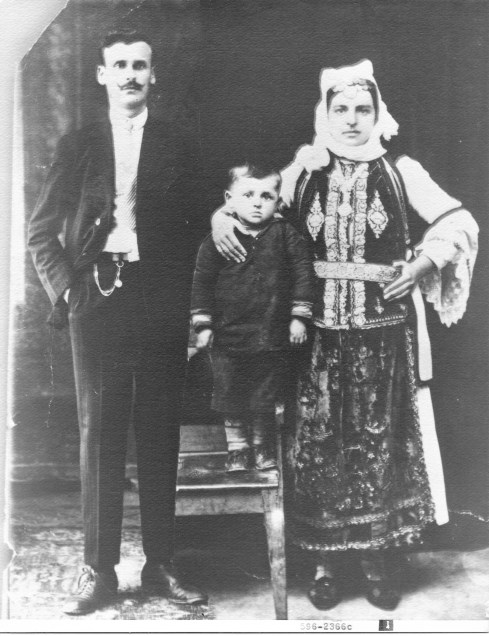
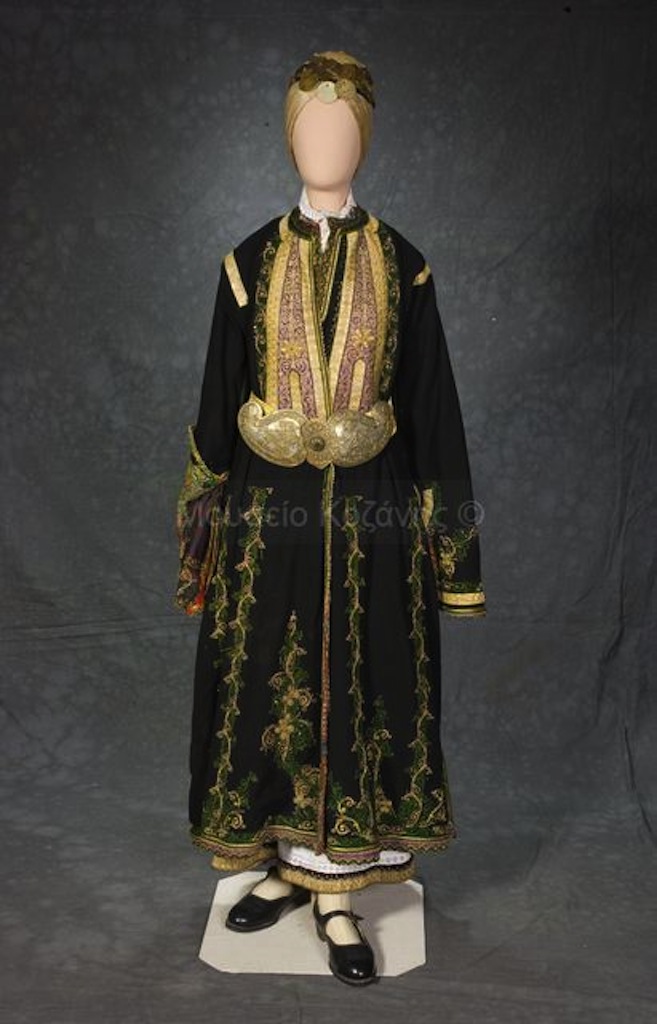
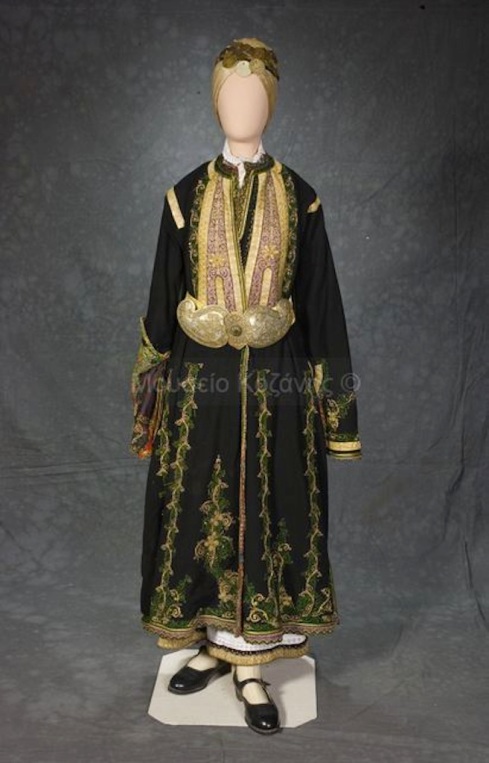
Family…obviously had to be made by a professional sirmakeşi — an embroiderer of gold thread — in Jiannena or Argyrocastro, and the dress of some particularly wealthy villages, like those of Lunxhi, behind the mountains to the left across the valley in the photo (Albanian-speaking Christians with whom we intermarried extensively and still do, the homeland of Zappas and Zographos, the benefactors mentioned above) had, by the end of the nineteenth century, simply become regional variations of Ottoman urban dress, like in this photo, which the museum of Kozani (why it ended up in Kozani?) felt it had to put its water stamp on, like someone was going to sell the design to YSL or something:
VI2M8774.TIF

**** Despite my friend’s condescension, regional funding initiatives for these “poorest provinces in Europe” have greatly expanded the university in Jiannena and developed an extensive and prestigious medical research center there, an information technologies industrial park, renovated (sometimes over-renovated) large parts of the old Ottoman city and created a general climate of growth and prosperity seemingly unaffected by the problems of the Greek economy.  Epiros has become a little bit like a Greek Bavaria or the French south-west: a traditional, somewhat backwards area that made the leap over the ugly stages of modernization to post-modern comfort and prosperity.  Half-ruined villages have been renovated, largely through the skills of Albanian craftsmen, who still were trained in the traditional building skills necessary to preserve the region’s distinctive architecture.  There’s good traditional and contemporary food in Jiannena and in some of the newly developed tourist towns.  There’s skiing in the winter; there’s hiking and mountain-climbing in the summer and gorgeous beaches only an hour-and-a-half away from each other on the new highways.  And it’s generally agreed that Jiannena is one of the most pleasantly liveable of Greek provincial cities and Epiros one of Greece’s most beautiful and pleasantly liveable provinces.

Comment: nikobakos@gmail.com

“Too often we enjoy the comfort of opinion without the discomfort of thought.” — John F. Kennedy

30 May

Or just basic facts.  Or as Guatemalan singer Ricardo Arjona says: “Le sobran opiniones y le faltan argumentos.”  “He suffers from an excess of opinions and a lack of arguments.”  Which Greeks might want to put on their flag in gold embroidery across one of the horizontal white bars.

I write on May 19th: “…how I’ve been wasting my time engaged in a running war with everyone in Athens to prove basic things like the fact that Albanians are a tall, extremely attractive people.”

And a reader writes back:

“I know, why is that?  I had the same experience in Greece.  I worked for an NGO in Kosovo for a year and then hitchhiked through Albania to Greece and found Albanians in both places to be very good-looking I thought.  When I would say that in Greece people would laugh at me.  I guess politics just gets in the way.”

No, they’re just idiots.

And I have to apologize to readers if this blog has taken on an increasingly polemic or nasty tone in regards to certain issues.  But I wrote in an early post: “In the 1990′s, when Albanians flooded Greece and Greeks were faced with the horrifying realization that their northern border hadn’t really been with Austria all that time, many of them predictably behaved like racist jerks…” and nothing has changed, that’s all, and my trip to several Balkan countries has opened this toxic can of worms from all sides that I should probably just ignore, but can’t.  Whenever almost anyone has asked me where I’ve been — if they know enough to ask about these places, their neighbors — the question always has that snickering Athenian sub-tone, that smart-ass “ξέρω εγώ…” half-grin that expects tales of backwardsness or καφροσίνη or just unspoken baseline disbelief that I went and that I found it fascinating and I can’t abide it.  Others are just angry.  Because…like…why should you go there?  Aren’t they the enemy?

It’s not politics.  If anything it’s purer socio-economics and what that does to perceptions of the Other in a monocultural world, or rather one where the Other is just invisible.  And I mean social economics on two levels: one, where you really don’t see, because you’re not trained to see or to care, the real effects that economic conditions have on the physical body of a human being — Hoxha’s Albania was the only country in late twentieth-century Europe, where, like the Kims’ North Korea till this day, people suffered from literal, physical, stunting malnutriton — and two, that once that perception or non-perception is established, it becomes frozen.

kitchen-doors

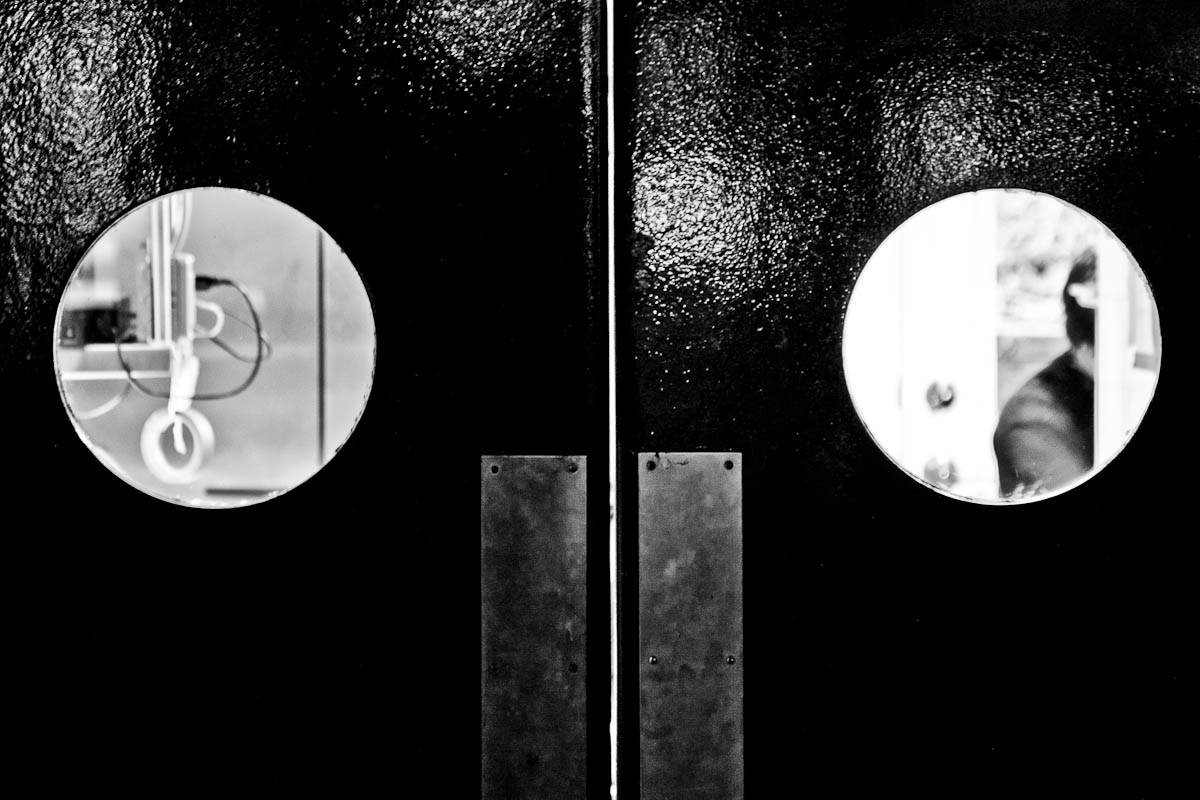
How many people in New York, especially people like me who have worked in the restaurant industry a lot and get chummy with owners and managers, have not had this experience?  You’re sitting at the bar and through the kitchen door you can see a young Mexican kid who’s just started.  And the poor kid looks like hell.  He’s probably new here, so he’s probably just risked his life several times to get to New York in ways in which we would not consider risking ours even once.  He works at least six days a week for probably over twelve hours and for shit money.  He lives in a studio that’s an hour-and-a-half subway ride from where he works, with three or four other guys like him, and to escape both the claustrophobia and loneliness of his life he probably goes out a few nights a week and, with whatever money he doesn’t send home to his family, gets drunk, so lots of days he comes in hungover.  But he always does his job anyway, not only diligently and efficiently, but with a certain perverse pride that he probably needs to maintain to keep himself from feeling like an animal.  He rarely speaks and if for any reason he needs to it’s always with unfailing courtesy and politeness.

“Γλυκοχαράζουν τα βουνά, και οι όμορφες κοιμούνται, τα παλληκάρια τα καλά στα ξένα τυρανιούντε.  Tους τρώει η λέρα το κορμί και η ψείρα το κεφάλι. Ανάθεμά σε ξενιτιά, κ’εσύ και τα καλά σου.”

“Dawn breaks along the peaks, with the young beauties still asleep, and our best boys are off suffering in a stranger’s land.  Their bodies covered in filth, their heads full of lice.  May you be damned foreign lands, you and all your riches.”

an Epirotiko folk song

But he’s smart, this Mexican kid, like our grandparents were before him.  And he watches and he asks questions and he learns about the restaurant’s wines and foods and about New Yorkers and their often insufferable particularities, and what they like and what they don’t like.  And the owner notices and makes him a busboy, and then a runner, and then a waiter.  And he gets a few days off.  AND HE GETS TO SLEEP.  And he’s making a little bit more money, so he buys himself some clothes and can afford to take a girl out on his night off.  And he’s completely transformed.  And one night you say to the owner: “Who’s that hot Mexican kid you put out on the floor?”

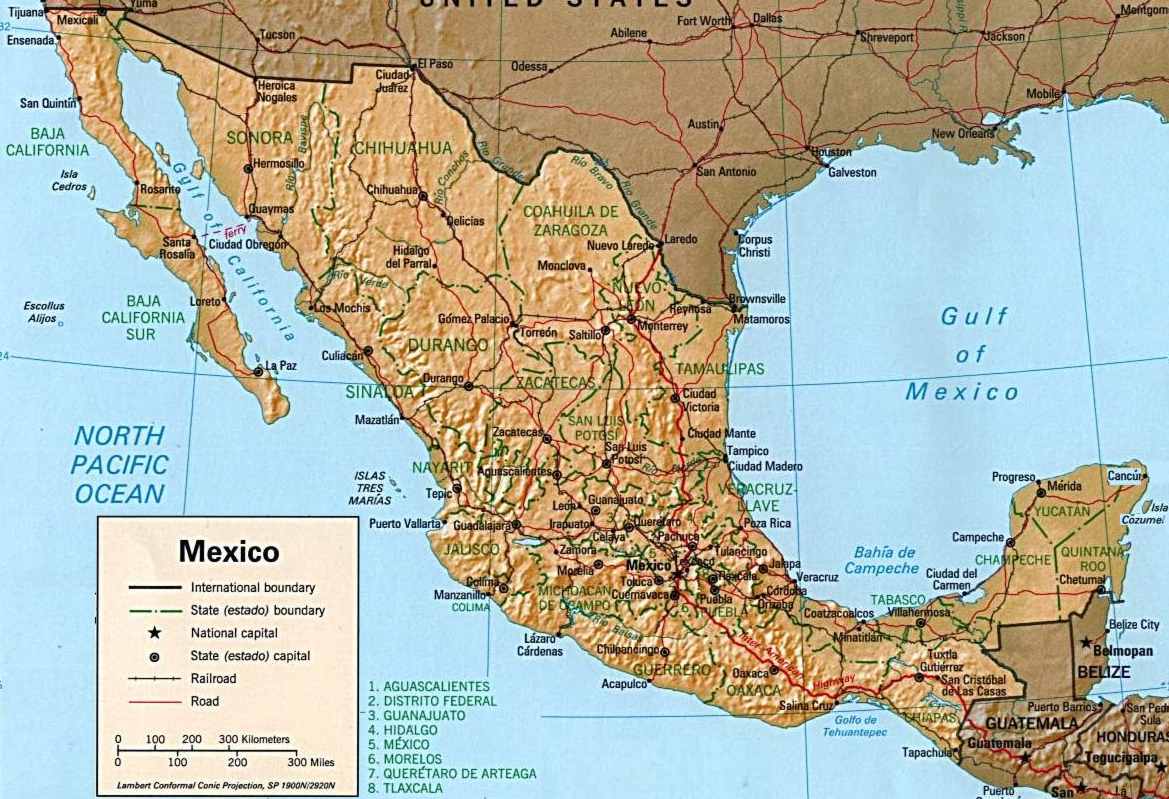
Κι’έτσι προκόβουν τα ‘παλληκάρια τα καλά’ της Πουέμπλας και της Çoλούλας…

mexico_rilievi97

This is not a possible scenario in Greece.  Or one that the average Athenian is capable of noticing.  For one, Greeks have forgotten that just until two generations ago hundreds of thousands of their own went off to live initially hellish lives in other parts of the world like this Mexican kid does — or the Albanian migrant worker anywhere in Europe today does.  Two, the Greek is not trained to watch others or care, the way every New Yorker is an amateur anthropologist.  So the change occurs right before his eyes and he doesn’t even see it.  Because other than the parts of the world that can confer some kind of ersatz glamour on him — Europe or certain  limited aspects and places of the United States — the rest of the planet is just not on the average Neo-Greek’s radar.  I can’t put it any clearer than that.  To know the reputation that we, Greeks, have as an ethnic group in New York: that we’re open, friendly, curious, eager to learn about others and their countries, learn at least some pidgin form of others’ languages faster than they can learn English, are willing to try any food or any drink, will invite their Mexican waiter to their kids’ christenings — and then to come to Greece and see this completely shut-off from the world society, is startling.

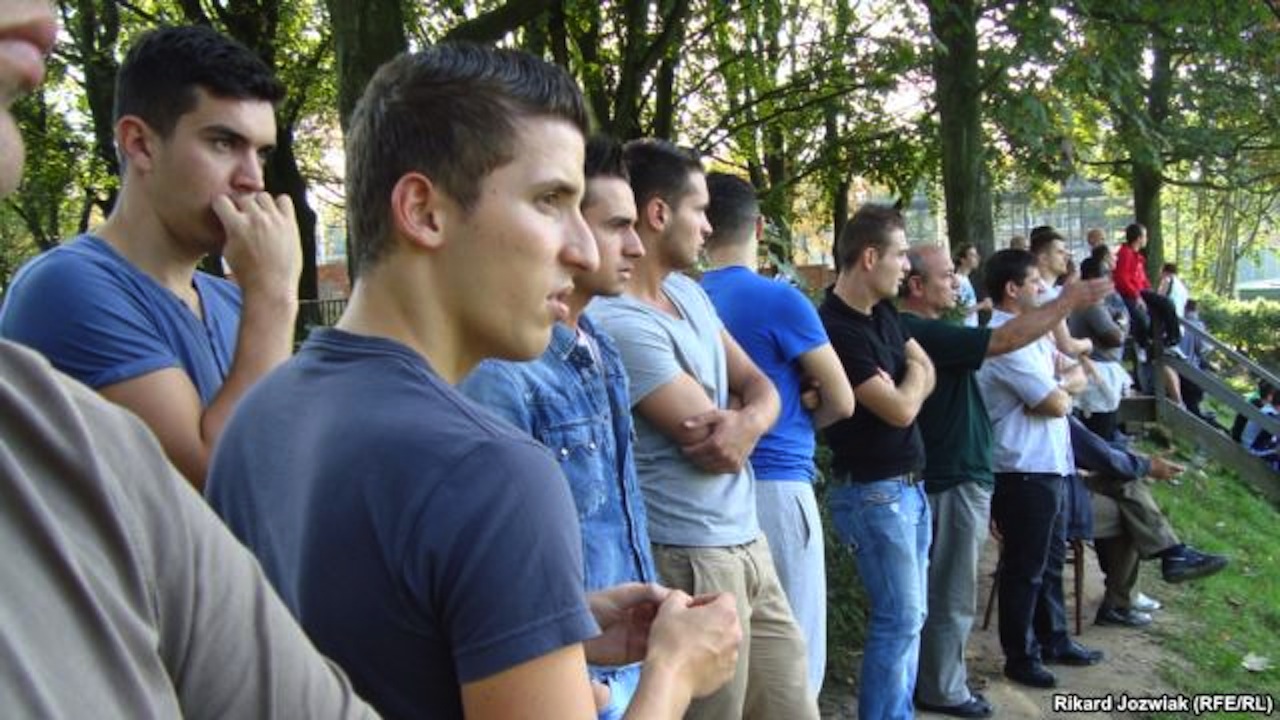
When I came to Greece in 2010 I hadn’t been there in eight years and the gruff middle-aged waiters or relatives of the owners that served in most restaurants and tavernas had been replaced by these nice-looking polite kids and I asked who they were, since it seemed strange to me that usually cossetted Athenians kids had suddenly condescended to wait tables.  And I was told: “Oh, they’re Albanians.”  These same people now laugh if I say anything positive about those same Albanians.  Even my own people, relatives, Greeks in Albania, said to me on several occasions: Όχι, είναι ωραίος λαός…   “They’re a good-looking people.”  Like, let’s tell the truth where we should.  And then come to Athens and have people stare at you incredulously…

I don’t know why this particular issue has ticked me off so badly.

A lot of Americans once thought that all Blacks were ugly too.  I guess I’ll leave it at that.

AlbaniansOutsideAlbania

And Philopomeon adds:

“We always need to put ourselves in a status-race with others… we can’t be as good as the Frangoi, but surely we are more advanced/richer/better looking/more cultured than the Alvanoi.

“To add to that, as you know, the Albanians were noted as “poor dressers” when they crossed the border in the 90’s. They had to take hand-me downs from charity, hence the Greek insult to a poor dresser ” You look Albanian.”

“But I agree, in general, Albanians are good-looking folk. Especially Kosovar girls.. hehe.”


Kosovaroi — of both genders — were real stunners, P., you’re right.  They have even gently nudged Afghans out of their first place position for me — no mean accomplishment.  I really couldn’t believe it when I was there; you didn’t know where to proto-look. (click)

Kosovo6970F0EF-C07B-4081-AB8D-B389D162E9DC_w640_r1_s

besa_luci_main1

MINOLTA DIGITAL CAMERA

And what I should’ve done from the beginning is put these pictures together with all the pictures of the young Derviçiotes I have in photos and videos and asked a random group of thirty-something  Athenian Concrete-Cave-dwellers to tell me which ones are the Greeks and which the “ugly” Albanians.  And see the results…

Comment: nikobakos@gmail.com

Philopomeon writes: “Easter in Derviçani”

30 May

To this April 25th’s post on Easter in my village,  Easter in Derviçani,” Philopomeon writes:

“Beautiful. It’s rare that we get a look of what is going on among Greeks in Albania without having to hear about ‘Vorio Ipiros’ and ‘Chameria’ back and forth.”

Yeah P., except for a few real old die-hards, that stuff is pretty much over, and most people, young and old, have very maturely and intelligently, gone on with their lives and accepted things as are.  The most striking example of that is that there are youth associations from each of the Greek villages in the region, with members in Jiannena or Athens or all over the rest of Greece or Albania or the States or Australia, but the old pan-Voreio-Epirotiko associations like MABH, with their irredentist discourses have pretty much dissolved.  The hate is gone too, which was the most heartening thing to feel: the on-going, still often fatal feud with the neighboring Albanian Muslim village of Lezarates is mostly personal at this point and not an issue of religion or ethnicity.  I know more infantile little fascistakia in Athens, with no relation whatsoever to our villages, who are more preoccupied with those old causes — and feel like they have a right to shoot their mouths off about them as well — than anybody in Derviçani is today and who probably are greatly disheartened by our indifference to our “national issues.”  You’ve never wanted to lose it on someone so bad as I do when your family has been through what mine has (see: Easter Eggs…”) and then have some snot-nosed Kollegiopaido  think he can lecture you on how you don’t live up to them and lack their “national feelings” and other such bull-shit.

The young people of my village, particularly, are a marvel, a youth that any society would — or should — pray to have.  They are fanatically in love with their village; they return every chance they get — dozens come from Jiannena on just a regular weekend.  They’ve organized a new panegyri (village festival on the village saint’s day) on August 15th, when the village’s population is the highest.  This has happened all over Greece; since most people go on vacation in August, depopulated villages that only fill up with returnees at that time often organize a second “unofficial” panegyri in August, along with the traditional one which could be at any time of year, to take advantage of the greater presence of chorianoiDerviçani, however, has never really had this problem, because this is a village with such a gigantic ego that no mere saint would serve; its traditional panegyri was Easter itself! culminating on Easter Friday — της Ζωοδόχου Πηγής — and always packed, then and now…   But, what can I say, it’s a party town.  The youth association pays for this summer festival out of its own pocket; they’ve put a stop to the stupid drunken brawling that used to go on, even though they themselves can pack it away for sure.  They do tons of volunteer work for the village: roads, squares, little beautification projects, football fields and basketball courts.  Natally bilingual, interacting with the “other” and crossing borders both figurative and literal all their lives, they have that innate cosmopolitanism and perceptiveness of the wider world that can’t be learned in any school and that no Northern Suburb çoğlani could buy himself with all the millions in the world or a thousand trips to Europe or New York.  They’re strong, attractive, smart, open, friendly, generous and whether they’re busting their backs at the hardest manual work in Greece or other parts of Albania, or acing it at universities in Greece or in Europe, they’ve built active, productive lives for themselves out of nothing.  I’m not ashamed to say they put me to shame in almost every way.

The most satisfying feeling and identification I shared with them though was the sense that they knew who they were: Derviçiotes, Dropolites, Epirotes, and Greeks  — and that they have absolutely no need for the Neo-Greek nation-state as a reference point to bolster those identities.  Greece never did anything for them anyway except make their lives difficult when they got there in the nineties or provide leftist intellectuals to tell them that life in communist Albania wasn’t that bad or little Athenian pricks to mock them as “Albanians.”  (As opposed to the Church of Greece, however, which I’ve always found to be an abominably reactionary institution, but has really helped a lot of Greek kids from our parts find their way in life and adjust: learn trades, increase their Greek literacy skills, get them into universities, etc. — recognition should be granted when it’s due.)  They get tired of explaining to Neo-Greeks that they’re not Albanian, but ultimately they don’t give too much of a shit: one, because they don’t think being Albanian is an insult and, two, they know they’re Greek — in fact, they know they’re Greeker.  Their generational cohort in Greece would not want to hear their opinion of most of them.

They love their Church, they love their music and they love their dancing.  Here are two videos of the early twenty-somethings, “Manastiri 1” and “Manastiri 2” (age groups and families take their turns) dancing up at the Monastery over the village on Easter Monday. My camera work on my brand-new little pocket Cannon is atrocious, but their spirit will come through.  I was astonished by how down-packed and completely internalized they had the traditional gestures and body language of the regional dance tradition — though I think dancing with open beer bottles is a new innovation and by the second video you can see they’re getting kind of sloppy.  There’s this one kid, FotoDretso, with the cartoon cowboy t-shirt, at the head of the line in the first video with the beautiful statuesque girl in the white sweater that no one can identify (“maybe she’s from another village…” the phantom beauty who showed up at our panegyri…), who is the son of GianneDretso, a village character out of Djilas’ Land Without Justice  with a fearsome reputation for leaping across borders and mountain tops like some cougar — a good rep to have around there.  Foto is also shown turning his spitted lamb in the Easter in Derviçani” post.  He seems to be something of a village youth leader, but the reason I couldn’t get enough video of him that day is, not just that he has my father’s name, but he dances exactly like my father did.  At times it was chilling.  Watch in that first video at around 1:35 when he takes lead of the dance.

IMG_0093FotoDretso, buddy and animal at the Monastery, Easter Monday 2014 (click)

In one of Misha Glenny’s books on Kosovo, Glenny asks a female Albanian politician in Tetovo, the unoffical capital of Macedonia’s some twenty to twenty-five percent Albanian minority: “Do you still dream of a Greater Albania? Where all Albanians can live in one state?”  And he got nearly the identical answer from her that I got from an Albanian guy I was talking to in the restaurant of our hotel in Tetovo: “Well…of course.  I guess we all do.  But those years are over.  The point now is not changing borders.  The point is making the borders not count.”

This is what most of my chorianoi — my “landsmen,” for New Yorkers, the rest of you can use your context clues, as we used to say in ESL — young and old seem to feel these days.  They live productive, happy as possible lives, where the border is practically a technicality and only promises to become more so as the years go on and the general integration of the region continues — a process that I see being halted only by those ideologues who get hard-ons at the thoughts of borders and nation-states and playing with little tin soldiers and tanks to defend them with.  But they’re a dying breed, unlikely to ever again reach a critical mass with which they could make a difference, whether they know or like it or not.  And the sooner the better.  So we can all get on with our lives.

Below are the kids dancing from my crappy footage.  But I have FINALLY found THE documentary video that captures the ethos of the whole music and dance tradition of Epiros as perfectly and deeply as possible but I’m thinking of the right way to set it up for readers.  In the meantime, enjoy.

This third video, ΔΕΡΒΙΤΣΑΝΗ 2013 ΧΟΡΟΣ Ι.ΜΠΑΡΟΥΤΑ,” is taken at the August dance, all generations participating.  The woman dancing at the head, Agathe Baruta — what relation to my Barutaioi I don’t know — is a stunning dancer (and a beautiful woman), and displays the precise, stylized seriousness that’s considered both beautiful dancing and proper elegant comportment for a woman.  (The kerchief is a remnant from a time when a man and a woman never touched publicly, even if related; the tall, handsome man she’s dancing with is her husband and is a member of the Greek Presidential Guard.  But some things are traditional formalities while the realities, obviously, change; one song from the new repertoire says: “Join the dance later and hand me a note with your cell number on it.”)  You’ll get a better sense of the communal joy this simple to-and-fro incites in people from this video because it’s more ordered than the kids’ dances above.  What you see here goes on, literally, for hours, till it induces an almost trance-like state; it starts at around eight in the evening and goes till dawn — for three nights in a row.  Unfortunately, I wasn’t able to capture in my videos above — nor is there a point here — a moment where the musicians slow down the tempo and the dancers get even more excited.  (At the end you get a fast number that really reminds you of how Balkan and Klezmer traditions are often connected.)  If you can, give it some time, because it needs time to build, time that we all have so little of; this whole tradition is the antithesis of the quick high and fake fun that characterizes our civilization: “Play it sweetly boys, sweet and slow, to heal the sickness I have in my heart”:

IMG_0182Meanwhile, back at Easter, some of the adolescents, watching the dance respectfully till it’s their turn.  (click)

IMG_0185The older guys, below, on dance break (click).

IMG_0196

IMG_0198

Some nephews of mine being bozos; every time I lifted the camera at them they would put their hunk of meat down and pose, so I asked them to be natural and this is what I got. (click)

IMG_0112

Comment: nikobakos@gmail.com

From the New York Times: “And Novak all fired up now goes, ‘Serbia! Serbia!’ ”

27 May
DjokParisCITY-CLAREY-superJumboDjokovic defeated Joao Sousa in straight sets Monday, 6-1, 6-2, 6-4. Credit Gonzalo Fuentes/Reuters (click)


Djokovic’s Greatest Motivation Isn’t on Court By CHRISTOPHER CLAREY    MAY 26, 2014

PARIS — Novak Djokovic was safe and dry after his first-round victory at the French Open on Monday, and it was noted that he often seems to play his best when he is playing for a cause higher than tennis.

“You’re right; you’re right,” he said. “It’s an interesting observation. I did also feel this at times when I had the last couple of years certain kinds of situations in life, good and bad, that were a lesson in a way for me. I noticed that I found that extra motivation to perform well on the court and to go far.”

But can he go all the way here over the next two weeks and join an exclusive seven-member men’s club by winning the only Grand Slam singles title he is missing?
Playing for Serbia has been a powerful motor for Djokovic. An emotional run to the 2010 Davis Cup title, Serbia’s first, helped him make the leap from serial Grand Slam contender to serial Grand Slam winner in 2011.
Wojtek Fibak, the former Polish star who advised Djokovic at last year’s United States Open, said he used that for fuel again when Djokovic was upset after his semifinal with Stan Wawrinka was scheduled first during the day after he had played primarily night matches.

Fibak said Djokovic had “the worst warm-up” and was in “a horrible mood” so he tried his best to get him back to the essential. “I said, ‘Remember your parents, remember your father had to sell his car for you to play tennis,’ ” Fibak said. “I kept bringing it up, and Novak’s eyes were big, and I said: ‘Do you know why they did it? So you could play the U.S. Open, and now you are in the semis of the U.S. Open and you don’t want to fight and you’re not happy just because of the time? I said do it for your father, your mother, for Serbia.’ And Novak all fired up now goes, ‘Serbia! Serbia!’ ”

He went on to beat Wawrinka in five sets before losing to Nadal in the final.

Now, as he returns to the tournament he wants to win more than any other, Serbia is again at the forefront of his thoughts. He has been seriously involved in raising money and awareness for relief efforts after this month’s floods in southeastern Europe, primarily in Serbia and Bosnia and Herzegovina, that killed dozens and forced hundreds of thousands from their homes.
Djokovic has donated his prize money — listed at 549,000 euros, or $750,000 — from winning the Masters 1000 event in Rome.

“I’ve seen the images and followed the news every single day, and it was something I’ve done because I felt like that was the right thing, and that’s it,” Djokovic said. “The second thing I thought about was that it was going to attract more of the donors from the international world to see that the situation is as serious as the prize money I donated. We’re talking about billions of dollars needed.”
Several players from the region took part with Djokovic in an on-court show of solidarity during an exhibition day at Roland Garros before the tournament. It was a small yet deeply symbolic gesture. Croatia, Serbia and Bosnia were all part of Yugoslavia before war broke the country apart in the 1990s. But Djokovic said that if there were any upside to this, it would be that former antagonists were now cooperating.

“To be honest there is something that I did not predict, did not expect,” Djokovic said. “And that is the solidarity of the people of the three countries that were in conflict only 15 years ago. That’s something that was incredibly moving and very encouraging for the relationship for the future of these people, because maybe we cannot be the same country again. Maybe people are thinking that’s not a good idea, but there is definitely a lot more room for improvement of the respect and solidarity between the people.”

When he is serious, Djokovic speaks in long paragraphs. He makes less eye contact than in his earlier days, but what remains remarkable is his ability to shift tone in a hurry. On Monday, marooned on a bench on a changeover during a second-set rain delay at Roland Garros, he invited the ball boy holding his umbrella to join him on the bench for a chat. He then finished off Joao Sousa, 6-1, 6-2, 6-4.
In a news conference, he doubled over with laughter and put his head on the desk when an Italian journalist asked Djokovic, who eats a gluten-free diet, if adopting the same regimen would help him improve his writing.  Moments later he was discussing the floods again and then, moments after that, answering a query about Boris Becker, the former champion who is coaching Djokovic this year along with his longtime coach Marian Vajda.

Becker won every Grand Slam tournament except the French Open and never won a professional clay-court title, which makes him an intriguing choice of mentor. What kind of advice might Becker be giving him for the French Open?

“He doesn’t tell me to serve and volley, that’s for sure,” Djokovic cracked. “But you know on a serious note, he is still one of the most successful players to play the game even though he hasn’t won Roland Garros.”  For Djokovic, Becker’s experience in big matches and big events is precious cargo even if he failed to win the Australian Open with him in his camp and has had most of his big victories this year with only Vajda in attendance. But the whole team was together in Rome.

“I feel that we understand each other much better already since Rome,” Djokovic said of Becker.

For now, Djokovic remains, with Becker, one of the best men’s players never to win the French Open, a list that includes John Newcombe, Jimmy Connors, John McEnroe, Stefan Edberg and Pete Sampras. But in light of Djokovic’s excellence on the surface, he may now be the best men’s clay-court player in the Open era never to win it.

Djokovic has won Rome three times and Monte Carlo and Madrid once. At Roland Garros, it took Roger Federer in full flight to stop Djokovic in the semifinals in 2011. It took Nadal in full fight to stop him in a rain-interrupted final in 2012 and then again in last year’s classic five-set semifinal.

Beating Nadal at Roland Garros remains the toughest task in tennis, and Djokovic said that the death of his grandfather inspired him in 2012, just as the death of his childhood coach Jelena Gencic in the midst of last year’s tournament inspired him before he fell just short, losing by 9-7 in the fifth.

“I cannot say that the images and memories of these people were not in my head while I was playing but I tried to channel this energy and information in the positive direction,” he said. “And I knew both of these people who were very supportive of my career would like me to play and win for them, so that’s
something I had in the back of my mind.” There is much more for the back of the mind this year. There are Serbia and
its neighbors. There is his coming marriage to Jelena Ristic and the birth of their first child later this year.

“It’s true; I have plenty of causes right now,” he said with the second round on the horizon.

Comment: nikobakos@gmail.com

My Circassians

25 May

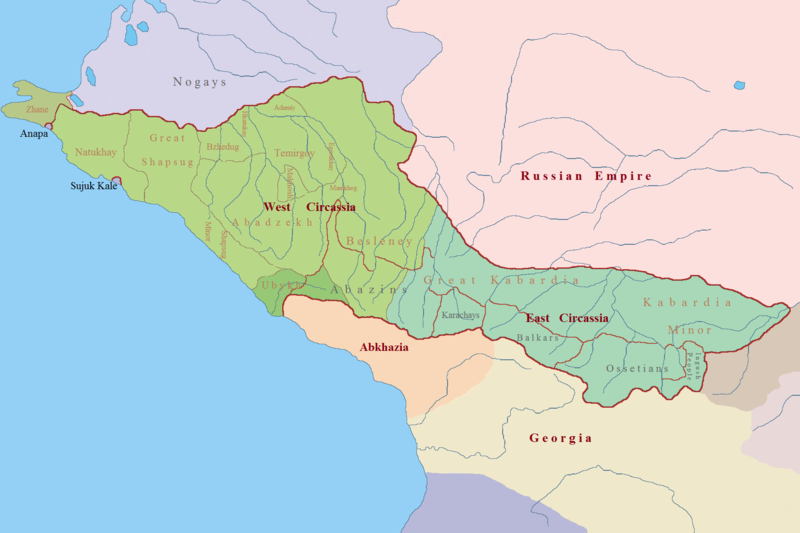
AdygeaReaders might remember I’ve had a long-term interest in Circassians since high school.  Of all the peoples collectively known in Turkey as muhacir, the Ottoman Muslims who took refuge in the Anatolian heartland of the Empire as it shrank, probably none had a more torturously, circuitous odyssey to ultimate safety in Turkey than the Circassians.  Here’s a selection about them from a post I wrote in February about why I was boycotting the Sochi Olympics; it wasn’t just for Putin and his filthy, murderous personage, but because the games were being held on land an admirable and honorable people had fought long and hard to keep and had been brutally thrown out of by Imperial Russia:

“And then there are the Circassians.  I became obsessed with Circassians in high school because I had to know who these people were, so physically beautiful apparently, that they held the entire Near East in thrall for centuries.  Circassians were the first reason I ever went into the New York Public Library, because the library at Stuyvesant didn’t have anything on them.  This is also around the time, as a nerdy sixteen-year-old, that I started developing the totally adolescent, romantic fascination I still suffer from, for honor-obsessed, heavily-armed highlanders — Montenegrins, northern Albanians, Pashtuns — who don’t easily let themselves get pushed around by outsiders.   It fed a lonely teenager’s fantasies of empowerment then.  Now, I couldn’t tell you.  Probably still.

“The Circassians lived in a huge swath of plain, foothill and high mountain country in the northern Caucasus.  Most of the sites of the this month’s games are being held on formerly Circassian territory.  This is a map of their general distribution in the eighteenth century, right before Russian expansion southwards began:

Circassia_in_1750

(click)

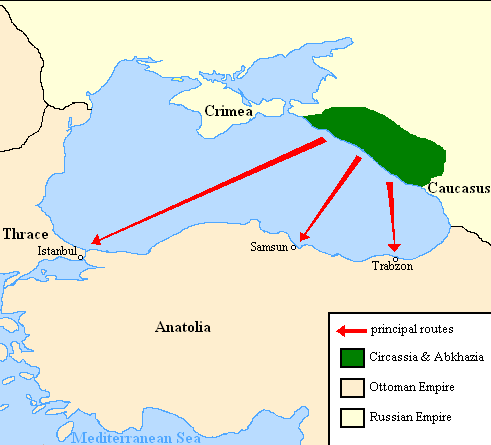
“For more than a century they fought a brutal tooth-and-nail war against the Russians and their Cossacks.  When they finally capitulated in 1864 it was in Sochi.  The majority, which would not agree to an oath of loyalty to Russia were deported, in what was probably the first campaign of ethnic cleansing of such dimensions in modern history.  For months, the beach at Sochi was a Dunkerque-like humanitarian disaster zone, with tens of thousands of shelterless, starving and diseased Circassians waiting for Ottoman ships to take them to safety in Anatolia or the still-Turkish Balkans or dying on the spot.

Expulsion_map_of_the_Circassians_in_19th_century“It certainly represented the largest civilian death toll of any war up to its time and today, ninety percent of people of Circassian descent live outside their original homeland, mostly Turkey, but also Syria, Jordan and Lebanon.”

(To read the whole post: Ignoring Sochi.“)

And as with Native Americans in North America, as their government was massacring and expelling them, Russian poets and writers like Lermontov, Pushkin and Tolstoy were romanticizing them, sympathizing with them and entering in a love affair with all the peoples of the Caucasus that literary Russia still has not recovered from.  Someone, everywhere, at all times, has a heart and a soul — for whatever good it does.

I had assumed muhacir is constructed from the Arabic “mu = doer of something” plus the roots ‘h’ + ‘j’ + ‘j’ (?) which almost sounds more like “pilgrim” –  as in “Hajj.”  But “mu” turns out to be a passive participle marker of someone who is made to do something, in this case not as in “Hajj, pilgrimage, but  ‘h’ + ‘j’ + ‘r’ as in “Hejira?” which would mean “fleer,” as in those who fled with Muhammad to Medina from Mecca in 622.  That would make more sense than traveller, which would be the “mu-sa-fir” recognizable to any Greeks as an old-fashioned word for “guest,” except to those Neo-Greeks that are so Post-Ottoman that they’re Post-Culture-of-Any-Kind and most certainly Post-Hospitality.  The Muslims that left India after Partition in 1947 to go to the land of Islamic Purity are also known as muhajir in South Asia.  I say that the Circassians’ route was particularly circuitous because many of them were first settled by the Ottoman government in the Balkans — especially Bulgaria and Kosovo (where there’s still a tiny community), where they were used to demographically offset the Christian population and because their warrior reputation would come in handy against Christian rebellions and Russian invasions.  (Though there is one wild episode of the Greco-Turkish War where a band of Circassian çeteler [çetes] in western Anatolia actually aided the invading Greek army.  Go figure.  Any-thing is possible in our part of the world.)  Needless to say with the coming of independence for the nations of the Balkans, they were uprooted again to Anatolia and other parts of the still Ottoman Arab world.

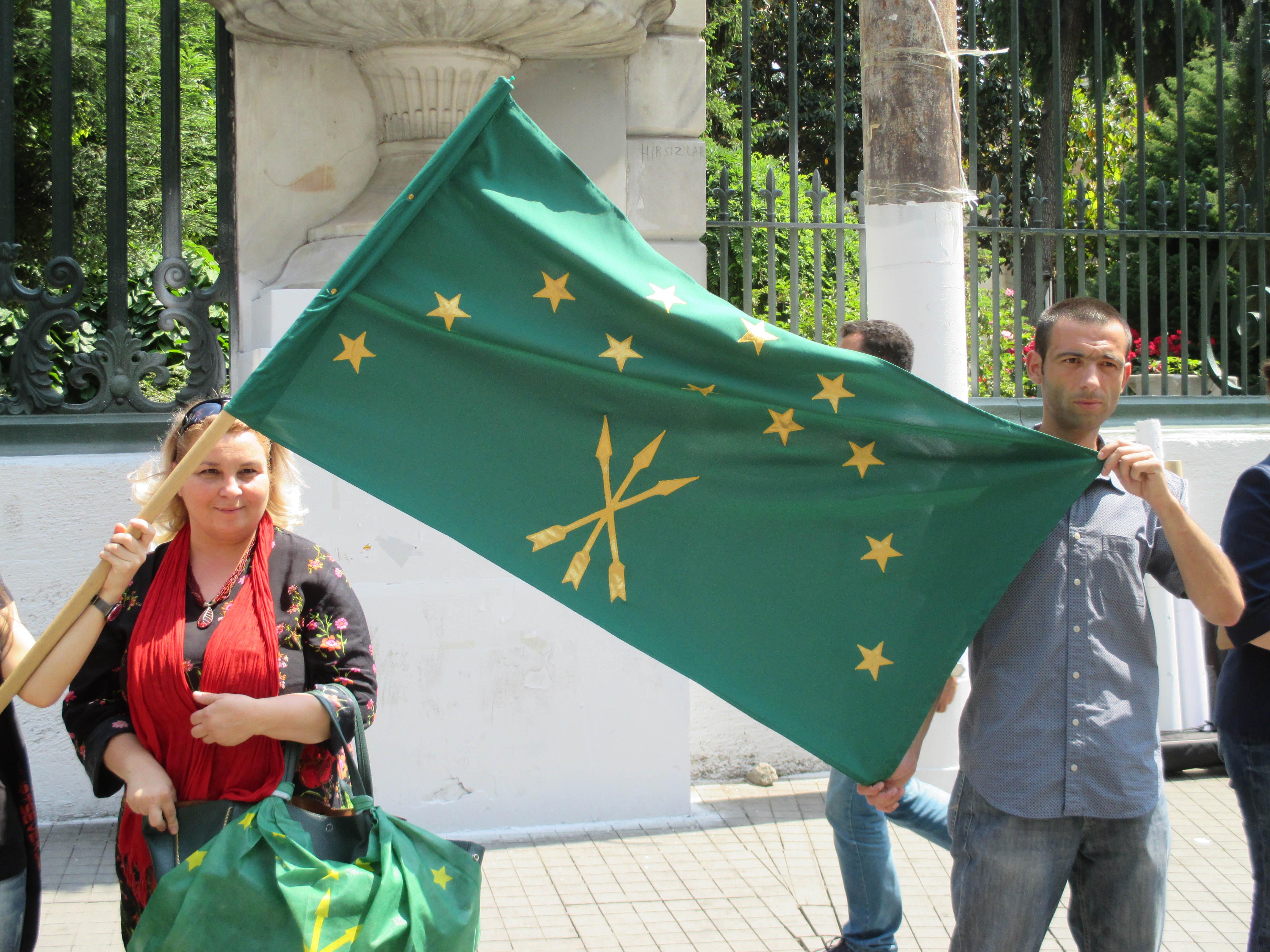
This year is the 150-year anniversary of the final, catastrophic expulsion from their Caucasian homeland and local Circassians (“Çerkes” in Turkish) have been holding demonstrations in front of the Russian Consulate down here on the Jadde (I wouldn’t even lower myself to asking for Putin’s ear) and then closer here to my place in front of Galatasarary.  (Click)

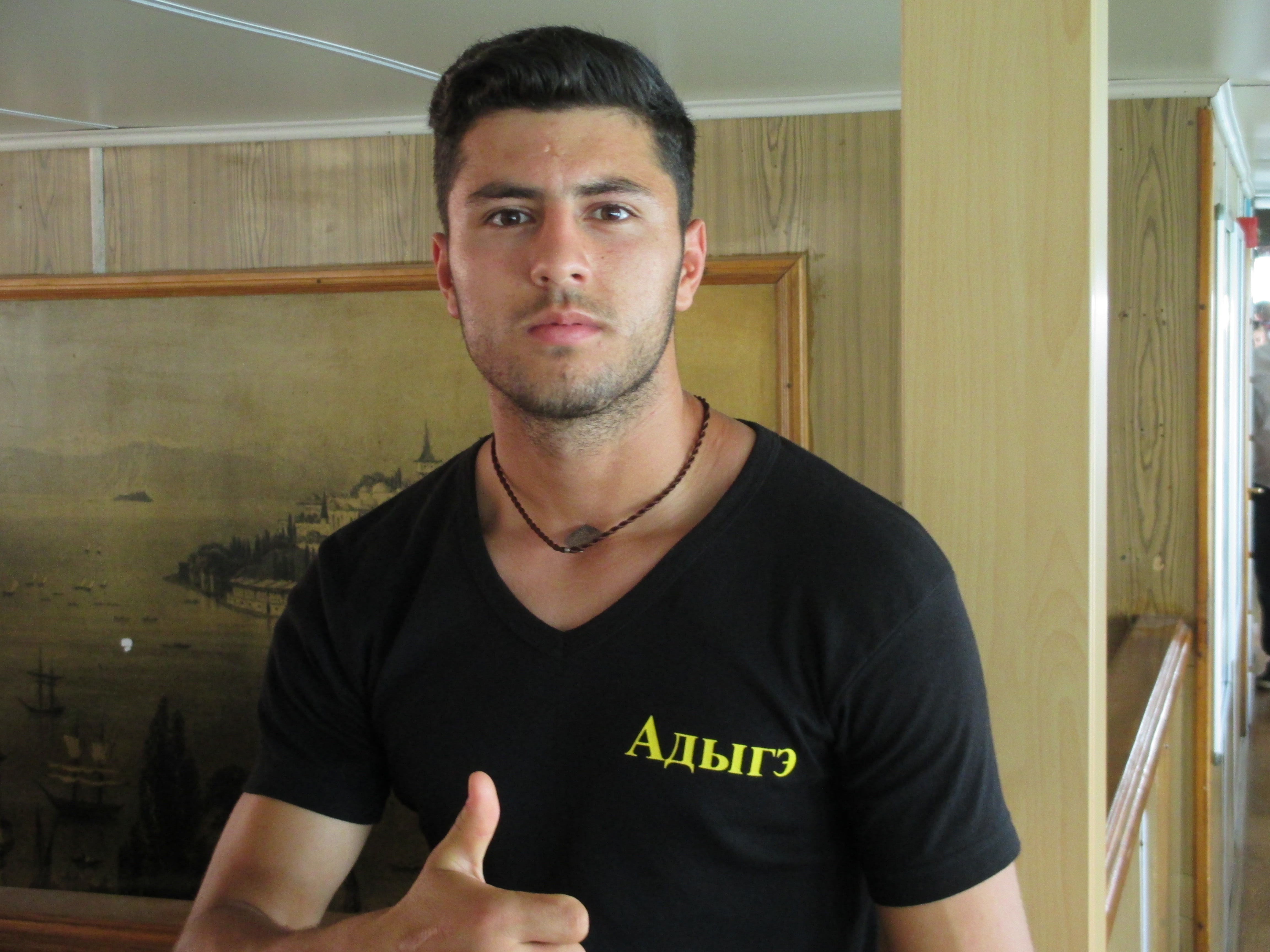
IMG_0777IMG_0775But I was kind of disappointed because I couldn’t get any really good pictures except some like these above.  Then I get on the ferry from Beşiktaş to go to Kadiköy with my cousin, Vangeli, to feed him at the spectacular Çiya restaurant there and visit Beylerbeyi, my favorite Ottoman palace, and by blogger-photographer’s luck right across from me is sitting this handsome Circassian kid from central casting (click):

IMG_0780 He was surprised I knew that his t-shirt said “Адыгэ” – “Adyghe,” which is what Circasians call themselves, written in the Cyrillic script they now use.  I asked him if he spoke the language and he said no, but some other Circassians I found the next day in Pera said that due to a concerted effort on the Turkey-wide community’s part — language classes, theater workshops, radio programs — more Circassians in Turkey of this kid’s age speak more of at least a little bit of the language than their parents do and that interest is increasing.  Insha’allah.  Cool.  So if you don’t respect these people for their legendary beauty, their ferocious warrior rep, the fact that they managed to stave off the forces of Imperial Russia for two centuries, that as the Mamluk military elite they effectively ran Egypt for five-hundred years till Mehmet Ali the Albanian massacred them in a totally, shitty, un-Albanian, pabesiko (“pa” = no + BESA), dishonorable, ambush — see  (“BESA: A Code of Honour,“) — then just admire them for sticking together as a cohesive and living identity after being scattered across the world for a century and a half now.

The suffering of Circassians and all the other Muslim peoples of the Caucasus are laid out in a bit of an uneven but heartfelt and informative book by Oliver Bullough called Let Our Fame Be Great: Journeys Among the Defiant People of the Caucasus — here’s his website too (check out some interesting pics): Oliver Bullough: Let Our Fame Be Great.

lofbg-usa-cover-300wUnfortunately, I don’t know if there’s a Turkish translation (or Arabic: Jordan, where Circassians still make up the King’s Royal Guard, Syria and, some extent Israel, is where most Circassians outside of Turkey now live) for young Circassians today to read.

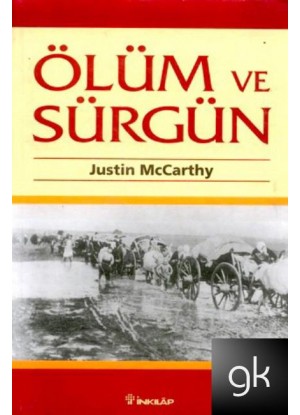
Another book that I do know there’s a Turkish translation of, and is probably the only monograph to deal with the step by step expulsion and ethnic cleansing of Ottoman Muslims through the nineteenth and and early twentieth centuries, but tracing roots of the process back to even the century before is Justin McCarthy’s Death and Exile: The Ethnic Cleansing of Ottoman Muslims, 1821-1922Not polemic, not propagandistic, just the facts and figures that speak for themselves.  It should be required reading for every Christian in the former Ottoman sphere.  It’s not exclusively about the Circassian tragedy but there is, as you can imagine, a great deal of material on their experiences.

51qnwpuNCVL._SY344_BO1,204,203,200_Turkish-speaking Circassians should definitely check this book out that’s available everywhere in İstanbul; they’ll learn a lot.  I really hope they get a chance to.  Share this post with friends if you found it interesting.  Feel free to write me with any comments.  And keep the memory alive!.  NB

55696-olum-ve-surgun-death-and-exile-justin-mccarthy

Comment: nikobakos@gmail.com

A Reader Writes: “Athens = homogenity? = racist? = just boring?” — “…this is the state of Neo-Greek cultural awareness…”

23 May

Philopomeon writes: in response to Athens = homogenity? = racist? = just boring?

“I’ll never forget getting my cousin to concede trying a Syrian/Lebanese restaurant in Panourmou. His shock when he realized 75% of the menu was identical to taverna food. He had no idea– this is the state of Neo-Greek cultural awareness- to eat souvlaki and mezzes with tzaziki or yemista is somehow “Italian” (???).

The Chinese restaurants in Athens seem to do alright though. Everytime I go to a Bengali place in Omonia, I am definitely the only non-immigrant there.”

Yeah, if you can call that stuff Chinese food.

And WHERE is there a Bengali place in Omonoia???  Don’t think you’re keeping that a secret from me now!


Bengali foodoie_1321512gelpx9Z

Comment: nikobakos@gmail.com

Even if he’s a Serb…

23 May

…is the subtext of this article from AP and Canadian Press about Djokovic donating his full check from the Rome Masters to relief aid for Serbia and Bosnia  A nice guy, even though…

Nolegb148-512-2013-162604-high-jpg(AP Photo / Gregorio Borgia — click)

Novak Djokovic unites old enemies for flood relief effort

Serbian brings together former Balkan wartime foes

After winning the Masters tournament in Rome on May 18, tennis player Novak Djokovic donated all the prize money, about $500,000 US, to the flood victims in Serbia, Bosnia and Croatia.

Novak Djokovic has served many match-winning aces on the tennis court, but now he has fired a major one in the flood-hit Balkans.

The world’s No. 2 tennis player has achieved what no politician has managed since the bloody Balkan wars in the 1990s: to at least temporarily reunite former bitter wartime foes as they jointly struggle against the region’s worst flooding in more than a century.

Djokovic has sparked worldwide financial and media support for victims of the massive river water surge that has killed at least 45 people and left hundreds of thousands homeless in Serbia, Bosnia and Croatia.

The Serb has in the past triggered fury in the other former Yugoslav republics for what people considered nationalistic gestures, such as celebrating his victories with a three-finger victory sign that was used by Serb soldiers during their wartime campaigns in Croatia and Bosnia.

‘My heart is breaking when I see that so many people were evacuated and endangered in Bosnia. … Help will come from the world.’– Tweet from Serbian tennis star Novak Djokovic

What has set Djokovic’s flood salvage campaign apart is that he didn’t just seek international support for Serbia. He also did it for Bosnia and Croatia which were at war with Serbia. All three states are still harbouring a deep mutual hatred and distrust, 20 years after the wars ended and the former Yugoslavia split up into seven different countries.

“My heart is breaking when I see that so many people were evacuated and endangered in Bosnia! More than 950,000!!! Hold on brothers … help will come from the world,” Djokovic wrote on Twitter. “I also see that the east of Croatia is hit by floods … I sincerely hope that it will not hit you like Serbia and Bosnia. Keep safe.”

“Long live the people of former Yugoslavia. Let God be with you,” he wrote, adding a map of the former Yugoslavia with the flags of now different countries.

The floods have triggered unprecedented regional solidarity in the Balkans, with the former Yugoslav countries sending rescue teams and humanitarian aid to each other over their borders.

$500,000 US donation

After beating top-ranked Rafael Nadal in the final of the Masters tournament in Rome on Sunday, Djokovic donated all the prize money — about $500,000 — to the flood victims. His charity foundation collected another $600,000.

“There have not been floods like this in the existence of our people,” Djokovic said. “It is a total catastrophe of biblical proportions. I don’t really know how to describe it.”

Djokovic’s gestures triggered mostly positive public support in both Croatia and Bosnia.

“I’m not Djokovic’s supporter or like tennis,” said Davor Buric, a university student in Zagreb, Croatian capital. “It is nice that he mentioned not only Serbia, but also Croatia and Bosnia. Djokovic has nothing to do with the war, and I have never heard him saying anything against other nationalities.”

In Bosnia, national football team coach Safet Susic said Djokovic had won “the support of the whole of Bosnia” with his campaign, and promised to support him in the upcoming Grand Slam tournaments — the French Open and Wimbledon. Djokovic replied by saying he will support Bosnia at the World Cup in Brazil.

Such sentiments in Bosnia and Croatia have prompted some commentators to nickname him “Marshal Djokovic” after Marshal Josip Broz Tito, the post World War II Yugoslav communist leader who managed to keep Yugoslavia united with iron fist. With his death in 1980, the country started unraveling along ethnic lines.

“This water … has destroyed what we have been building for the past 20 years,” wrote prominent Croatian columnist and writer Vedrana Rudan in an ironic commentary on her web page.

“Djokovic has sketched the map of Yugoslavia, he greets both our and his people … the slaughter has separated us, the drowning has reunited us.”

© The Canadian Press, 2014

*************************************************************************************************************************************************************************************************************

This is the three-finger gesture they’re talking about, along with a temporary tattoo Djokovic got at some point of the Serbian national crest (with “Born in Serbia and ‘something’ in Monaco” added), and generally looking a little bit like a Belgrade club bouncer:

djokovic-tattoo-novak-djokovic-15906276-500-735

But it’s not a nationalist victory gesture “used by Serb soldiers during their wartime campaigns in Croatia and Bosnia.”  Those are the three fingers Orthodox Christians make the sign of the cross with and, according to my sources (granted, all Serbian), did not become a Serbian symbol or gesture of any kind until WWII, when members of the Nazi-collaborationist Ustaša regime of Croatia and those Bosnian Muslims who worked with them (for reasons I’ve never understood) made a habit of cutting those fingers off both corpses and the living.  It then became a symbol of resistance.  The Ustaša’s plan for the Serbs that fell under their control during the war was the “thirds” plan: kill one third, expel one third, convert the last third to Catholicism (good luck with that last one…)  See my post on genocide from last November.  Also yesterday’s After the Flood, Unity and Compasion…yeah.

You wanna casually throw some history around in lazy, half-informed North American style, at least look back a little further than twenty years.

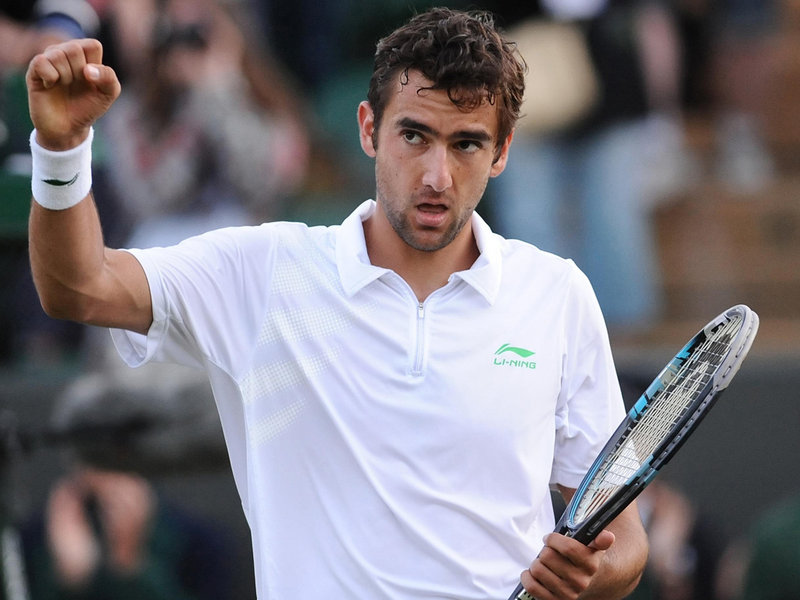
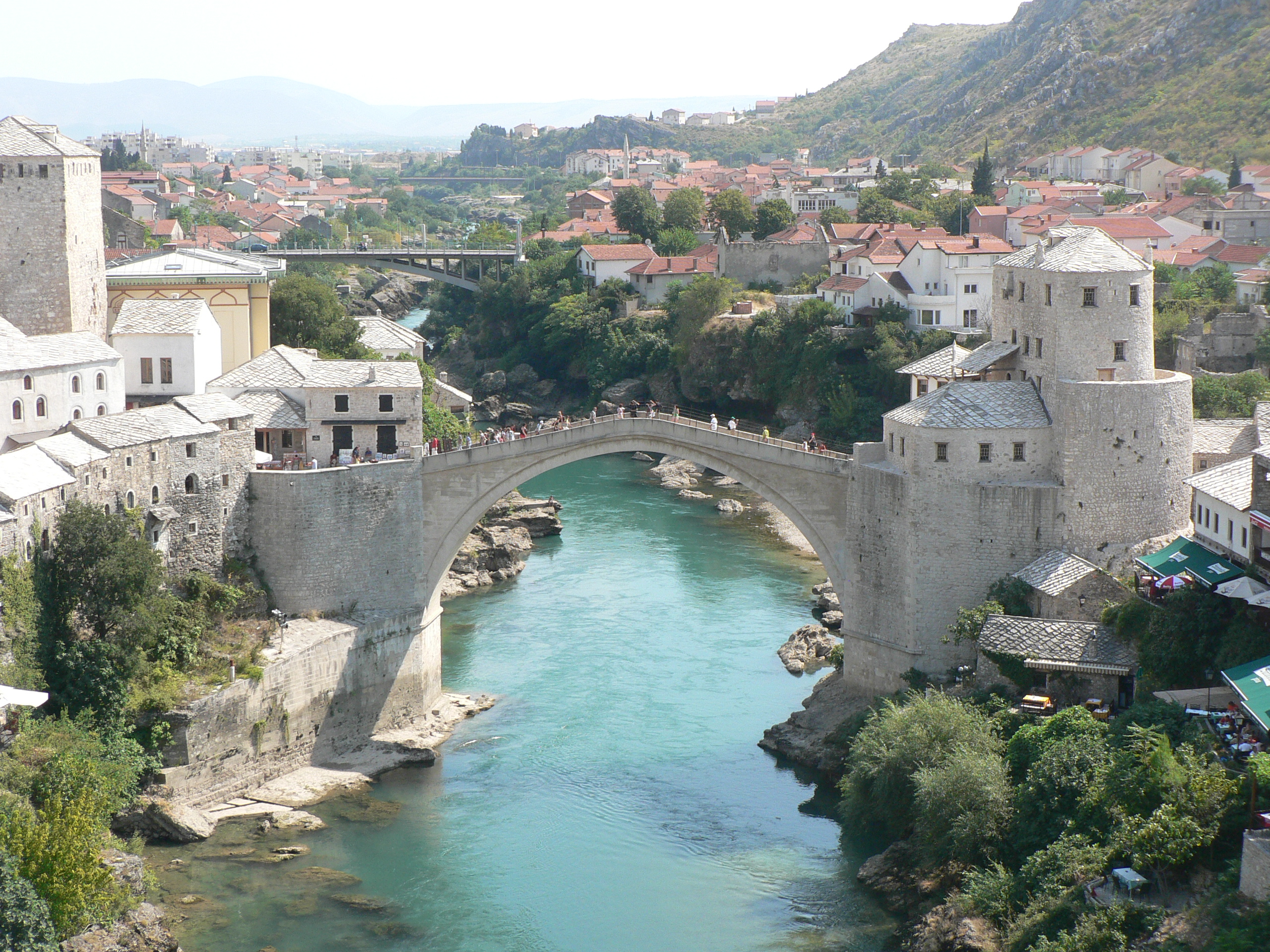
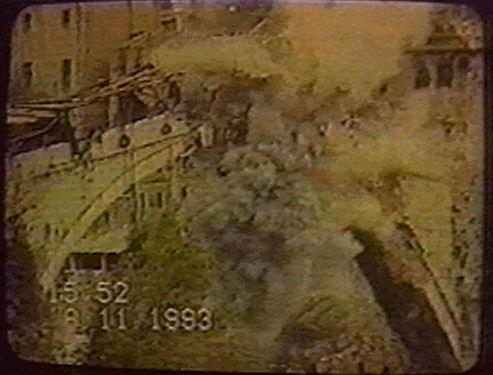
Marin Čilić is never ‘the tennis player from the country that created one of the ugliest, most homicidal Fascist regimes of twentieth-century Europe,’ is he?  Or ‘from the country that committed as many if not more atrocities in Bosnia during the wars of the nineties, and ethnically cleansed larger parts of the areas under its control of both Muslims and Serbs, and more thoroughly as well’ is he?  Or that ‘still holds on to a huge part of occupied Bosnia where Muslims suffer worse than they do in the Serb-held parts,’ is he?  Or, ‘that blew up the famous Ottoman bridge of Mostar?’ is he?   Nor should he be…considered anything other than an exceptional tennis player and a great athlete.

Marin-Cilic-celeb_2788159

Marin Čilić (click)

Yet Nole is constantly having to prove he’s not the “ugly Serb.”  Why can’t this just be the story of a deeply Christian kid, which is essentially what Novak is — and very genuinely so — who wants to help his neighbors?  Why is he held responsible for “fixing” damage he didn’t do?  And his people still responsible for a war they didn’t start?

He’s certainly far more  above all of it than I am, and God bless him.

Comment: nikobakos@gmail.com

2-jpg

 The Bridge of Mostar, now rebuilt (click)mostar

mostar5a(click)

(AP Photo/Gregorio Borgia)

Serbia and Bosnia still need help — and will for a long time

21 May

The Novak Djokovic Foundation 

and

Screen-Shot-2014-05-19-at-11.38.29


are the main and most reliable sources.  Nole’s site has particular info for Bosnia as well.  And the parts of Croatia affected as well — though one would think they’d get their aid from the European Union now, no?.