Tag Archives: Armenians

Jadde’s homepage photo: Sergei Paradzhanov

12 Nov

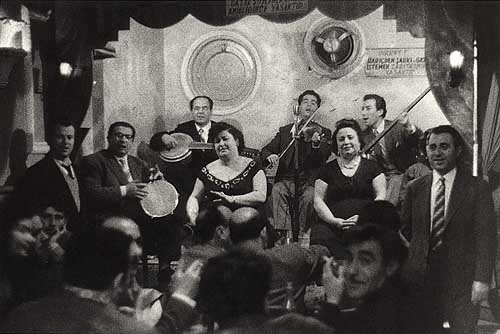
I had thought that maybe I would permanently keep the photographs that I first posted on the blog’s homepage when I started it (Turkish refugees from Rumeli in turn of the century Istanbul and adorable kids in Samarina in 1983), as sort of a trademark, or what obnoxious “Ok, millenials” call a “meme” — which is just a mystified/jargonized term for what used to simply be called an “image”.  But when you don’t have any new ideas, you make up fake new words to cover for the fact.

Then I saw footage from a Paradzhanov film that I love, and remembered that he’s among my two or three favorite directors.  It’s strange that I hadn’t thought of him before, because he was essentially obsessed — possessed would not be an exaggeration — with the visual beauty of our parts, of the Jadde world.  He was almost an our parts pornographer, in the most beautiful sense of the word, fixated on the image of our cultures’ physical (and I mean that sexually) and material beauty, more interested in the fetishized gaze and tableaux than in editing or the syntax of cinema.  In our world today, where cinematic and video language has been so perverted and debased that the average viewing time between editing cuts is less than three seconds — we’re kept watching by the fact that we’re not allowed to actually look at anything — Paradzhanov granted us the delicious luxury of lingering over every beautiful detail his cinematic mind generated.

So, I decided that every month I’m going to change the homepage pic with one from his various films.  This one is from his 1969 The Color of Pomegranates, widely considered his masterpiece, though it’s not my favorite.  That would be his 1965 Shadows of Our Forgotten Ancestors, though Pomegranates is without a doubt a beauty.

Hope you enjoy them as much as I like to watch them and post the stills.  Unfortunately, the crappy Soviet color film stock they were shot in and the abysmal curatorial conditions these films were kept under for so many decades means that some of the stills will be soft or just not of optimal quality.  But I hope you enjoy them anyway and look out for opportunities to see them, and hopefully on a real screen and not your Mac…

Color of Pomegranates 2_DxO

Comment: nikobakos@gmail.com

P.S. Armenians & Kurds — “Atoning for a Genocide”

30 Oct

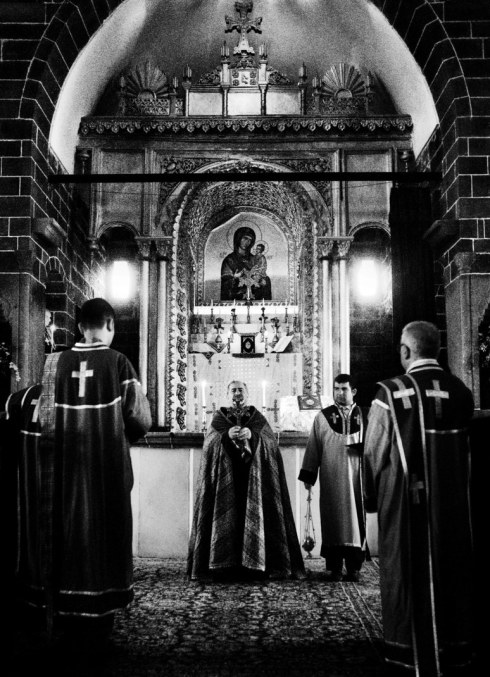
150105_r25970 armenian churchEaster Mass in Sourp Giragos in Diyarbakır, 2014. Because the church still has no priest assigned to it, a priest flies in from Istanbul. Pari Dukovic

From A Century of Silence: A family survives the Armenian genocide and its long aftermath.:

“As the villagers fled to Diyarbakir from the surrounding areas, it became a Kurdish city. In time, the Diyarbakir Kurds began to recognize that their role in the genocide was a kind of original sin in their modern political history. “I remember this one Armenian priest,” Demirbaş told me. “A Kurd was insulting him, and this priest told him, ‘We were the breakfast for them, you will be the lunch. Don’t forget.’ And that was important for me.'””  [My emphasis]

While we’re on Armenians, at a time when Syria plunges more deeply into hell than we had ever thought possible, when the West abandons the Kurds to Erdoğan and Assad, proving again that the U.S. is Turkey’s hamali, or that Turkey’s tail wags the dog, if you prefer, a historical reality check might be called for.

The American and almost every other media might be too superficial or too impatient to dig so deep historically because they’d lose their audience, but there is one, and one big thing that disproves Donald Trump’s assertion that Turks and Kurds have been fighting each other for centuries and are “natural enemies (see video below).  And that is the fact that perhaps the greater portion of the massacres of Armenians and other Christians in eastern Anatolia during the last decades of the 19th c. and first two and a half decades of the 20th c. were conducted by Kurds.* Not by the Ottoman military, but by Kurdish para/irregular forces or just Kurdish tribal chieftains craving more land and authority and wealth, and conducting/justifying their campaigns of mass murder with the rippling green banner of Islam, under which Turks and Kurds were just brothers in defense of the faith.  Only when the forces of modern nationalism started displacing the older bonds of religion and empire, did Kurds arguably start to feel themselves a separate entity from Turkish Muslims, and did the power of clan loyalties shift from semi-feudal to Kurdish nationalist ones; it’s even arguable that Republican Turkey’s anti-ağa, anti-religious and Turkification campaigns stoked the fires of the new Kurdish nationalism more than anything else.  (Somewhat of a similar process occurs between the Ottomans and Muslim Albanians in the early 20th c., and Orthodox Greeks and Orthodox non-Greeks: Bulgarians, Macedonians, Vlachs, Albanian Christians — as the latter groups discovered/invented new identities to replace the old religious-institutional bonds.)

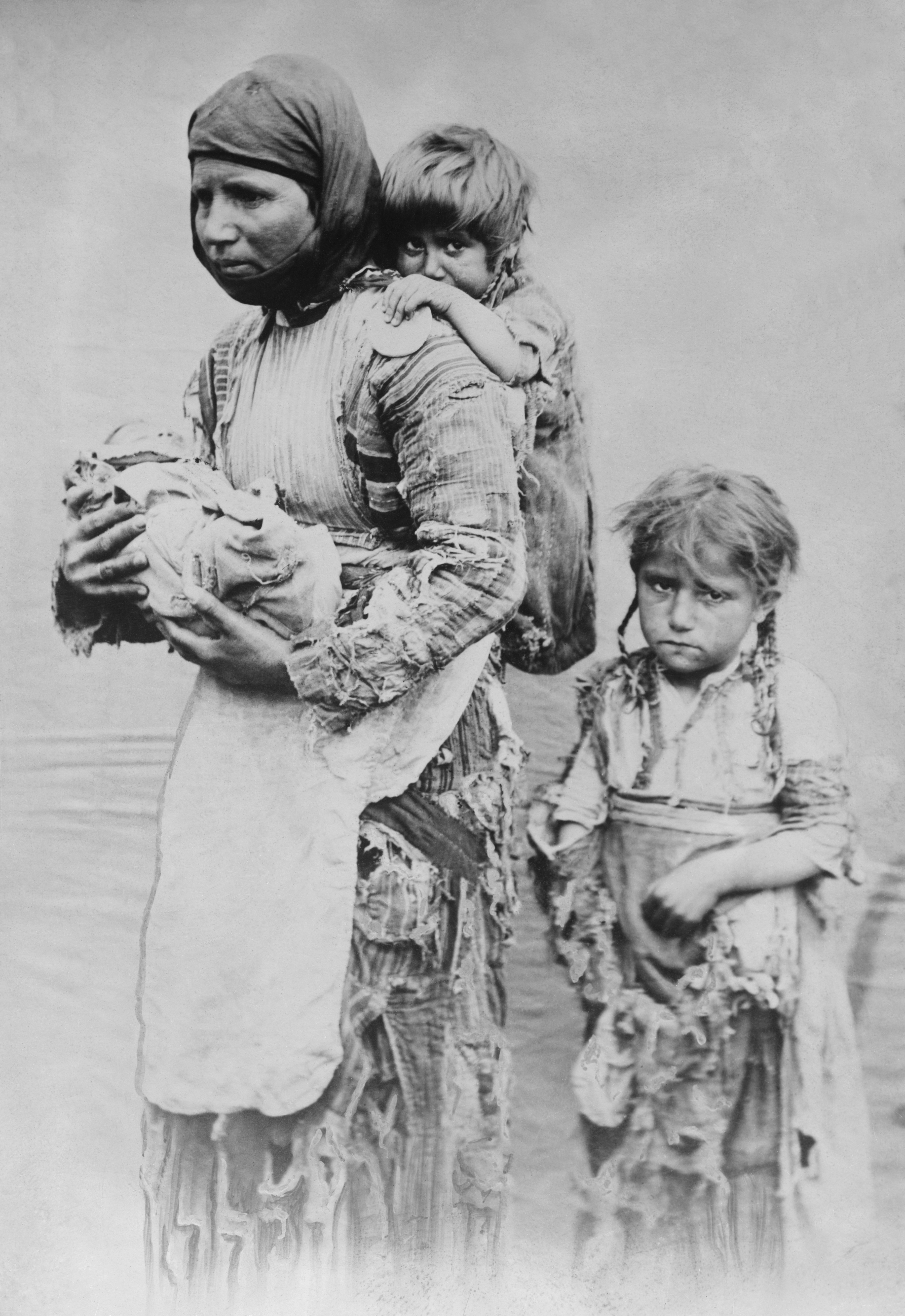
Armenian_woman_and_her_children_from_Geghi,_1899_(edit).jpgAn Armenian woman and her children who were refugees of the massacres and sought help from missionaries by walking far distances.  Photo unknown provenance.

So I’m sorry that couldn’t counter Trump’s claims of eternal Turkish-Kurdish enmity with something pretty about how — on the contrary — eternally well they have gotten along but rather by implicating both parties in coordinated mass murder.  And forgive me the occasional snicker at Greek pro-Kurdish poses and the general sanctification of Kurds that we’ve witnessed in the past couple of decades.

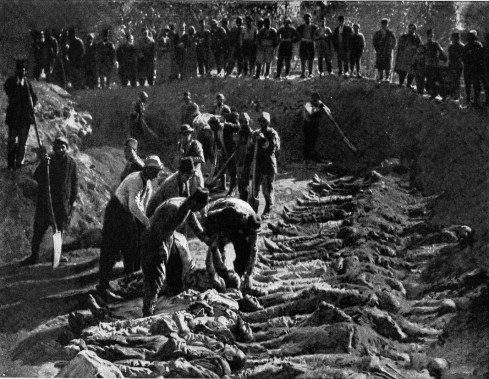
Armenia22hamidianArmenian victims of the massacres being buried in a mass grave at Erzerum cemetery.  Photo unknown provenance.

* From Wiki:

(“In 1890-91, at a time when the empire was either too weak and disorganized or reluctant to halt them, Sultan Abdul Hamid gave semi-official status to the Kurdish bandits. Made up mainly of Kurdish tribes, but also of Turks, Yöruk, Arabs, Turkmens and Circassians, and armed by the state, they came to be called the Hamidiye Alaylari (“Hamidian Regiments“).[16] The Hamidiye and Kurdish brigands were given free rein to attack Armenians, confiscating stores of grain, foodstuffs, and driving off livestock, and confident of escaping punishment as they were subjects of military courts only.) [my emphasis]

And not just eastern Anatolia.  Istanbul’s Kurdish population played a major role in the 1896 Hamidian Armenian massacres in the City, where hundreds were killed right there in Pera, in ab-fab Beyoğlu, in the middle of the elegant, Beaux Arts, now garish and overlit Istiklâl.  Referred to this before and to how brilliantly these events are handled in the “Duck with Okra” chapter in Maria Iordanidou’s Loxandra.

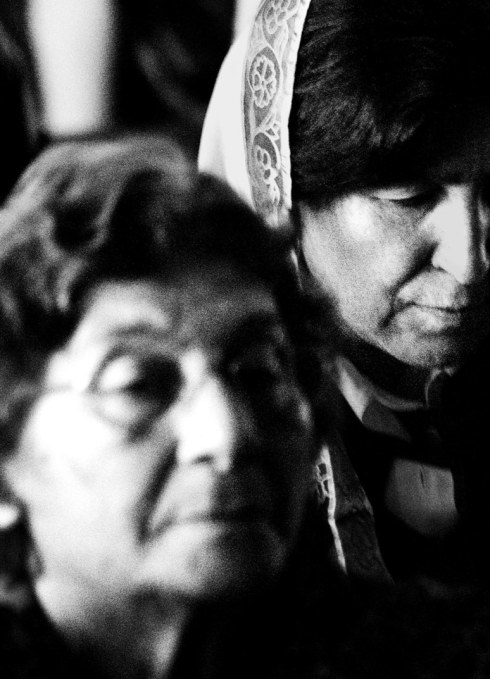
Only fair, however, that I include a reference to this 2015 article from The New YorkerA Century of Silence: A family survives the Armenian genocide and its long aftermath. by Raffi Khatchadourian, in which the then mayors of Diyarbakır and the separate municipality of the Old City, Osman Baydemir and Abdullah Demirbaş respectively, apologize for the Kurdish role in the Armenian massacres and rebuild and restore the city’s main Armenian church, Sourp Giragos (Hagios Kyriakos in Greek) and allow it to function (see photo above) for the handful of Armenians left in the city.   Khatchadourian‘s article has some beautiful photos too by Pari Dukovic.

“We Kurds, in the name of our ancestors, apologize for the massacres and deportations of the Armenians and Assyrians in 1915. We will continue our struggle to secure atonement and compensation for them.”

150105_r25971

Comment: nikobakos@gmail.com

NYT: Armenian Genocide — “For too long, Turkey bullied America into silence. Not anymore.” — Samantha Power

30 Oct

Not 100% sure how I feel about this; see “Screamers: Genocide: what is it and why do we need the term?.  I voice my major apprehensions there.

But “bully” is such an apt term for the Turkish Republic and the Turkish body politic (“thug” also comes to mind), that I think anything that puts Turkey in its place is a positive development.

29Power-sub-superJumboCredit…Mario Tama/Getty Images

Power’s money quotes:

Although Turkish officials may see the vote as retaliation for Turkey’s recent forced displacement of Syrian Kurds, that operation — as well as President Recep Tayyip Erdogan’s sweeping human rights crackdown in Turkey and his purchase (over American and NATO protests) of a Russian air defense system — simply reduced the impact of Turkish blackmail.

……..

First, as a baseline rule, for the sake of overall American credibility and for that of our diplomats, Washington officials must be empowered to tell the truth.

Over many years, because of the fear of alienating Turkey, diplomats have been told to avoid mentioning the well-documented genocide. In 2005, when John Evans, the American ambassador to Armenia, said that “the Armenian genocide was the first genocide of the 20th century,” he was recalled and forced into early retirement. Stating the truth was seen as an act of subordination.

When I became ambassador to the United Nations in 2013, I worried that I would be asked about the Armenian genocide and that when I affirmed the historical facts, I could cause a diplomatic rupture.

Second, when bullies feel their tactics are working, they generally bully more — a lesson worth bearing in mind in responding to threats from China and Saudi Arabia. The Turkish government devotes millions of dollars annually to lobbying American officials and lawmakers: more than $12 million during the Obama administration, and almost as much during the first two years of the Trump presidency. Turkish officials have threatened to respond to genocide recognition by suspending lucrative financial ties with American companies, reducing security cooperation and even preventing resupply of our troops in Iraq.

On Friday, the Turkish ambassador warned that passage of the “biased” House resolution would “poison” American-Turkish relations, and implied that it would jeopardize Turkish investment in the United States which provides jobs for a “considerable number of American citizens.”

It is easy to understand why any commander in chief would be leery of damaging ties with Turkey, an important ally in a turbulent neighborhood. But Turkey has far more to lose than the United States in the relationship. The United States helped build up Turkey’s military, brought it into NATO and led the coalition that defeated the Islamic State, which carried out dozens of attacks on Turkish soil. Over the past five years, American companies have invested some $20 billion in Turkey.

If Mr. Erdogan turns further away from a relationship that has been immensely beneficial for Turkey in favor of deepening ties with Russia or China, it will not be because the House voted to recognize the Armenian genocide. It will be because his own repressive tactics are coming to resemble those of the Russian and Chinese leaders. [my emphases]

Comment: nikobakos@gmail.com

Ara Güler photo exhibit opens in New York — (Thanks to S. for the tip!)

2 Oct

5d89beff18c7731aa4a2059c

If you’re even remotely interested in C-Town or the Jadde world generally: DO NOT MISS THIS EXHIBIT.

Güler shows up in a post of mine: Nobody really cares about Gezi Park: Greek thoughts on the protests of 2013 :

* Two more of Güler’s most famous photographs:

Guler1

D-amp-K-PASAJ-KAHVESI-BEYOGLU-ISTANBUL-ARA-GULER__51726491_0

While there’s no documentation that the subjects of these photos are Greek, the period, the neighborhood they were taken in and — well — just their look, seem to say so.  Ara Güler was a prolific photographer whose work has been sadly overexposed by excessive postcard-ization.  He once famously said: “Today, 13 million people live here. We have been overrun by villagers from Anatolia who don’t understand the poetry or the romance of Istanbul. They don’t even know the great pleasures of civilization, like how to eat well. They came, and the Greeks, Armenians and Jews, who became rich here and made this city so wonderful, left for various reasons. This is how we lost what we had for 400 years.” [my emphases].

Yes, “…left for various reasons.”

He was called a racist by many leftists for that comment.  But who pays them any heed?  His website: Ara Güler: Official Website.

Too bad Erdoğan, who babbles on throughout the review of the exhibit, doesn’t believe anything Güler did.  In fact, he’s set the final seal on the destruction of the Istanbul that Güler documented and lamented.

Comment: nikobakos@gmail.com

Time Out’s cities: Astoria! and…Kypsele? No Pera propaganda, brother Turks of mine :( — and Belgrade…

29 Sep

Ok!

Time Out has come out with the fifty coolest neighborhoods in the world, and two — arguably three — of them are Greek; one in Athens, Kypsele, and another in the capital of the Greek diaspora, New York: Astoria.  (Yeah, Melbourne…ok…chill).  Now there are only what, 14 or 15 million of us in the whole world, and we corner 8th and 16th outta 50.  Not just not bad, but figures that make it clear there’s a connection between Greek-ness and urbanity — even Greek villages are really just tiny Greek cities — the polis and everything political life implies, that runs deep.

Ditmars

AstoriaAstoria

KypseleKypsele

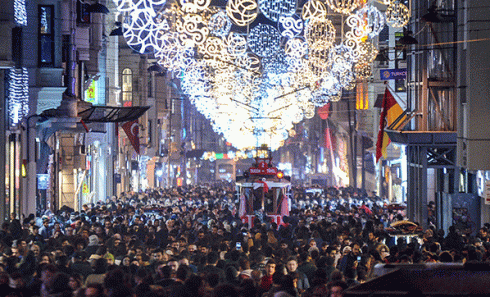
What if you have no Greeks (or worse, no Jews).  Well, brother Turk, take a walk, or a nerve-wracking tourist shove, down what you’ve turned yourİstiklâl” into: its new garish, overlit, Gap-outlet, Gulfie, Saudi hideousness…  And weep.  That we left.

Oh, and what’s arguably the “third” Greek neighborhood…  Ok, I scrolled down the list, nervously expecting to find Pera (Beyoğlu) there, the formerly, largely Greek mahalla — the formerly Greek, Jewish and Armenian heart of the City actuallybecause Turkey’s American public relations firms deserve every dollar they get from the Turkey accounts and they manage to shove a fictitious Turkish tolerant multiculturalism in our face whenever they get the chance, and Pera has, for about the past 15 years, taken pride of place in this masquerade of Istanbul hipness and Turkish cosmopolitanism — quite an accomplishment since the Midnight Express days. (Too bad Turkey itself reverts back to Midnight a little bit more every day.)  And Pera wasn’t there, not on the list!

istiklal-caddesi-nde-insan-seli-3273337

The old Grande Rue — Pera

And…  Well, and…a few years back I wrote a post here called: Nobody really cares about Gezi Park: Greek thoughts on the protests of 2013.  And perhaps the biggest stinger in the article was:

“All – I thought a lot about whether I should use “almost all” in this sentence and decided against it –because all the hippest, funkiest, most attractive, gentrified neighborhoods in the historic parts of İstanbul are neighborhoods that were significantly, if not largely, minority-inhabited until well into the twentieth century: not just Pera and Galata, but Cihangir and Tarlabaşı, and Kurtuluş — of course — and up and down the western shores of the Bosphorus and much of its eastern towns too, and central Kadiköy and Moda and the Islands.  (And if serious gentrifying ever begins in the old city it’ll be in Samatya and Kumkapı and Fener and Balat; I wouldn’t put any big money into Çarşamba just yet.)”

And so, happily, I didn’t find Pera being prostituted again by Turkey as a symbol of a multiculturalism that the Turkish Republic eradicated, exterminated, expelled and that no longer exists.  But I scrolled a bit further down…and there was Kadiköy and Moda, #42, also, until well into the 60s, heavily Greek and Armenian.  More sweet justification!

(I’ll take Egyptians on for the empty, dingy Alexandria they got stuck with after our good-bye party in another post.)

KadikoyKadiköy

Finally, came the sweetest of all, my beloved Dorćol in my beloved Belgrade.  50th on the list of 50.  You have to be pretty attuned to the Serbian soul to know what coming in 50th out of 50 means.  It doesn’t mean being last.  It means: “You think we’re cool?  Who asked you?”

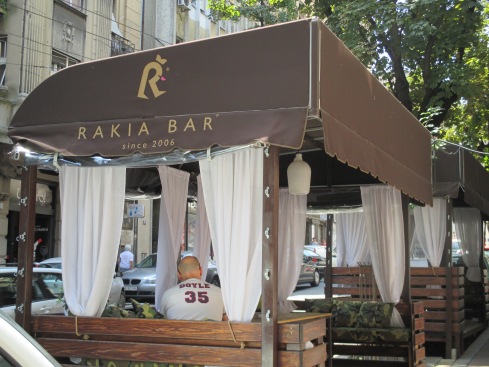
img_0828.jpgThe Rakia Bar in Dorćol

Plus, Belgrade comes in in way first place over all of these cities in one important way: the guys.  No joke.

Some restaurant notes:

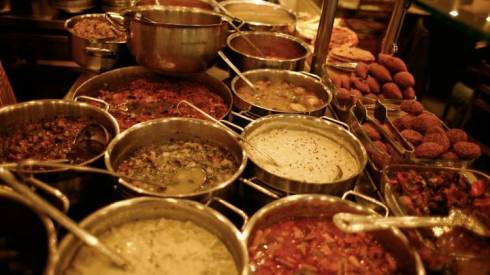
Don’t go to Çiya in Kadiköy.  Unfortunately, the food is spectacular, and I’m a sadist for posting this picture:

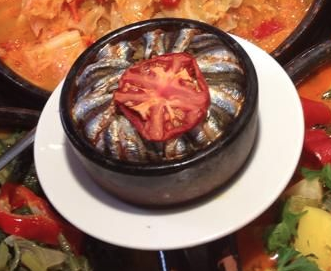
CiyaBut the unfortunate part is that Çiya is owned by a sociological type: the newly comfortable, if not rich, provincial, pious middle-class; that’s the AKP’s and Erdoğan‘s political power base.  What that means on the ground is that your great food is prepared by puritans who won’t serve you alcohol, so you can’t have a leisurely rakı or beer dinner, but have to scarf it all down and leave, paying with dough that might indirectly end up in the AK’s coffers or ballot boxes.  The same goes with the otherwise excellent Hayvore in Pera.  Amazing Black Sea dishes but no booze.  Go ahead if you want.  You can go to Saudi too if you want.  I refuse to.  Even if I didn’t want to drink: just on principle.  And they — Hayvore — make one of my absolute favorite dishes which I can’t find anywhere else: an anchovy pilav.  But I’ll live without.  Or make it myself.

.Screen Shot 2019-09-29 at 9.33.28 PM

And then, a little less geopolitically charged, there’s the completely baffling phenomenon of Cyclades in Astoria.  I can’t argue with the fish.  And if fish is their mission statement then fine, because it’s always fresh and expertly cooked — even if the owners are Albanian and hadn’t seen the sea till they were sixteen.  But you do want to eat something along with the fish and everything else is awful.  The cacık and eggplant salad is made inedible by that crazed Greek overuse of raw garlic, so that all you have is the bitterness of the bulb and not even the taste or aroma.  The zucchini and eggplant are fried in old oil.  The raw oil served for greens or salad is horrible — cheap, and I’m not even sure it’s 100% olive.  And in a Greek fish meal, where almost everything is dressed with raw oil, it really needs to be the best quality or everything else is shot.  The bread — and one thing we do well, γαμώτομου, is bread — is nasty and old.  This place reminds me of food in tourist traps in the old days before the foodie revolution in Greece in the 00s.

And they commit one incomprehensible abomination.  They serve oven-baked potatoes — with lemon, fine… But. With. The. Fish.  These are potatoes, that according to the taxonomy and order of Greek food, if such a primitive cuisine can be said to have such order, are baked in the oven with meat in a composite dish or casserole.  It’s a sin of commission to serve them with fish, with which they haven’t even been cooked, unless you’re going for plaki which means tomatoes and a whole different palate.  And they taste as if they’ve been soaked overnight in lemon.  And I dunno, but the yellow color is so suspiciously bright that it looks like yellow dye #2.  Investigate them; I’m sure I’m right.  And, of course, everything comes garnished with piles of more lemon wedges, to satisfy that deep Greek urge to obliterate the taste of everything else on the table.

And people — Manhattan people — come out to Queens and wait, for over an hour, malaka, to get a table at this Soviet cafeteria (the lighting is awful; the music is deafening).  They’ll often go cross the street to wait to be called, to get a drink at Michael PsilakisMP Taverna, where the food is phenomenal.  It’s only slightly reinterpreted Greek — it’s deeply faithful to the roots but Psilakis — I dunno — freshens things, and combines traditional ingredients in ways that make you wonder why no one else had ever tried this.  It’s generally full and has a great and friendly bar that looks out on the bustle of Ditmars Boulevard.  But it should be a destination spot and it’s not.  And Cyclades is.  It makes me think that white people will eat bad food if they think it gives them woke and authenticity street cred.  And convince themselves it’s good.

He dicho.

comment: nikobakos@gmail.com

P.S. on Kamyar Jarahzadeh’s piece on Sayat Nova

9 Nov

Thank you Kamyar for your posting.
Your comments however are somewhat incomplete.
Sayat Nova, born name “Harutyun Sayatyan” would have been a perfect peace ambassador in today’s Caucaus region. As far as I know, only Armenians have honored his true work for people. He was a true peoples’ singer, musician besides being accepted in Georgian court. It is sad that Azeri’s don’t appreciate the work of a genius.
He became a monk in an Armenian monestery (Haghpat) after he was expelled from Georgian court. Because he refused to convert his religion to Islam, he was killed and beheaded by the order of Persian king Agha Mohammad Khan of Ghajar during his invasion to Caucasus…

Sorry.  Kind of a moral mission on my part: can’t let celebration of cosmopolitan, tolerant Islam (or any monotheism) get away with exaggerations.

A tableau/scene — the still, fabulous compositions of Paradzhanov’s style, that make so much of his work “our parts” pornography, in essence — from Color of Pomegranates:

sayat-nova,jpg

Comment: nikobakos@gmail.com


From the Ajam Media Collective: Sayat Nova by Kamyar Jarahzadeh

9 Nov

Screen Shot 2017-11-09 at 5.18.09 PM

The Bard of the Caucasus” by  

A popular rendering of Sayat Nova.

For those unfamiliar with his legacy, Sayat Nova’s story can seem like the stuff of myth. His life is fascinating even in broad strokes: he was an ethnic Armenian musician and Orthodox Christian who lived in the Caucasus in the 18th century. He created a unique style of music, and wrote hundreds of songs in Armenian, Azeri, and Georgian. His talent was so great that even though he was born in a humble background, he rose to become the court musician of a Georgian king and founded his own school of musicians.

Sayat Nova was part of a tradition of bards known in Armenian as ashough — synonymous with the Turkish aşiq or Persian ashegh, terms used to refer to travelling musicians but literally meaning lover. Such bards worked across a vast cultural landscape that included the territory of modern Turkey, Iran, Georgia and Azerbaijan, and similarly transgressed the Persianate, Armenian, Azeri and Georgian speaking cultural worlds.

Just like other artisans, during this era being an ashough was like joining a class of professionals. But Sayat Nova’s style of music was unusual, he created new musical forms and compositions in all three languages.

Despite the formidable and cosmopolitan legacy of this bard, his appreciation has largely been confined to the domain of Armenian cultural heritage. Sayat Nova is mostly associated with and remembered for his works in Armenian. The reasons for this are largely due to what history has passed down to us (or failed to preserve), but that still begs the question: what more could we understand about Sayat Nova, if we were to further explore his story and music beyond his Armenian identity?

A Sayat Nova composition being performed by a modern ensemble.
To understand how an 18th century bard could create such a corpus of work, it helps to start with the basics of the musician’s biography. Although there is contention over the details of his life, Sayat Nova was likely born in the northwest of modern-day Armenia. Supposedly, he was to become a trained weaver only to instead travel to India and fight in one of Nadir Shah’s invasions of the Mughal Empire. He eventually returned to enter the ashough guild and officially gained the moniker Sayat Nova, from the Persian sayyad-i nava, or “hunter of songs.”

As he rose to fame for his musical ability, he became the court musician of King Heracle II of Georgia in Tiflis (modern-day Tblisi). He composed and performed his famous repertoire of work during this period, until legend has it he was kicked out of the court for falling in love with the King’s sister. He lived out his final years as a monk.

A map of the Afsharid dynasty detailing their campaigns against the Mughals in modern-day India. Sayat Nova is claimed to have participated in these battles.

In the 17th and 18th century, despite conflict between empires of different ethnolinguistic makeup and demographics, linguistic and cultural cosmopolitanism was the norm in royal courts. Sayat Nova was particularly valued in the Georgian Court for his ability to contribute Persianate culture and Persian-style music (although the music he performed in the court was almost exclusively in Georgian, Armenian, and Azeri).

Fortuitous timing also gave Sayat Nova the space to create his particular repertoire and be appreciated. In the 17th century, Western and Eastern Armenia had been split by the Ottoman and Safavid Empires, respectively. The Safavid Empire fell to Afghan invaders in 1722 who were then overthrown by Nader Shah and his Afsharid dynasty — the rulers of the empire during the century between the Safavids and the Qajars.

The multiple transfers of power allowed the Kingdom of Georgia a chance to shake off years of Persian meddling, tribute taking, and general interference. While the Afsharids were occupied fighting against the Mughals in the East, Georgia had a chance to cultivate its own court culture — enter Sayat Nova.

A Sayat Nova composition in Georgian from a film biopic about his life. The Armenian version is titled “Dun el Glkhen.”
Many parts of Sayat Nova’s musical legacy survive to this day. His songs are still widely performed in Armenia, with countless recordings available in a variety of formats. But the nature of his enduring legacy doesn’t match the transcultural life and music of Sayat Nova: most of the available recordings of his music are exclusively in Armenian.

The significant cultural projects that attempt to continue his legacy are tied to the Armenian community and diaspora, including the upcoming Sayat Nova festival that will be held in Yerevan. While there are Sayat Nova monuments in Armenia and Georgia, there is no monument to Sayat Nova in Azerbaijan, even though the majority of his surviving poems are in the Azeri language. Most of his Azeri and Georgian poems, in their original language, are out of print or nearly-impossible to find.

Part of this is due to the difficulties of historical preservation. We have many of Sayat Nova’s lyrics in all languages thanks to his biographers and the documents gathered by his son, but his melodies are less well-preserved. Musical notation was not common in Sayat Nova’s time and milieu, so the Armenian melodies that survived were passed down orally for 150 years until they were finally notated. The projects to track down these melodies (that continues to this day) were mostly Armenian initiatives. While it is likely that Georgian and Azeri melodies of his still survive and are being performed, they are not as widely available as his Armenian repertoire.

It seems unfitting that Sayat Nova is solely remembered through the lens of Armenian culture. Of his surviving works, scholars have located 117 Azeri poems, 72 Armenian poems, 32 Georgian poems and six Russian poems. It is this cosmopolitan legacy that arguably makes Sayat Nova unique.

Sayat Nova compositions notably used Persian and Arabic poetic meters with Armenian melodic structures. With these techniques, Sayat Nova founded the Tbilisi “school” of ashough, a tradition that was notable at the time for performing Georgian music in the Persian style. Even people unfamiliar with these languages, when listening to a Sayat Nova composition, will notice that the final couplet of his ghazals often refer to Sayat Nova in the third person — a trademark of the ghazal form that many associate with Persianate poets such as Hafez and Rumi.

At the end of this song, Sayat Nova refers to himself in the final couplet. This is very common in the ghazal form in other languages as well, such as Persian, Arabic, Turkish and Urdu.


A bialphabetical Sayat Nova manuscript from his notebook. The text is one composition written in both the Armenian and Georgian scripts.

Sayat Nova was unable to read the Perso-Arabic script, but his Armenian poems often blended Persian words with the language. This speaks to the role Persian played as a language of high culture: it was a language of literacy in the Caucasus that transcended ethnic boundaries.

In his handwritten manuscripts Sayat Nova would even switch between scripts mid-poem. Picture this: his Azeri poems are written in a mix of Georgian and Armenian scripts, and his Armenian poems are often written in both Armenian and Georgian scripts. His songs in colloquial Tbilisi Armenian were written in the Georgian script, and the Armenian script was reserved only for the classical Armenian language — widely considered “sacred” by devout Armenian Christians.

Why then, are the cross-cultural celebrations of Sayat Nova so few and far between? Azeris and Georgians have just as much to celebrate in Sayat Nova as the Armenian cultural mainstream.

Unfortunately a more pancultural perspective of Sayat Nova is not just difficult due to the historical record, but politically fraught. This video of an Azeri version of Sayat Nova’s song “Kamanche” highlights the vehemence of the arguments that often accompany celebrations of Sayat Nova.

An example of a Sayat Nova composition adapted into Azeri Turkish, framed by the uploader as an example of “plagiarism.”
The video shows clips of the song being used to celebrate Azerbaijan and Turkey’s form of pan-Turkic ideology that arose in the 20th century  — an incarnation with anti-Armenian ideology — while criticizing Azerbaijan for cultural theft.

This is doubly confusing: Azerbaijani nationalists using Sayat Nova for pan-Turkic goals, while Armenian reactionaries respond by disavowing the fact that this bard actually had strong ties to Azeri culture. Comments on a video of a Georgian translation of an Armenian Sayat Nova song meanwhile try to excuse or explain his non-Armenian works, rather than acknowledge that they are a significant part of his canon.

This is a tragedy, as some of the most integral parts of Sayat Nova’s identity were linked to his non-Armenian cultural capital. For example, 19th century Sayat Nova biographer and documenter Akhverdian recorded a story in which the ashough, as a retired monk, hides his identity in order to meet a young new ashough visiting the city in search of the infamous Sayat Nova.

When the youngster meets a disguised Sayat Nova and asks where to find the renowned bard, Sayat Nova’s answers are a series of Azeri plays on words: bilmanam, tanimanam, and gormanam, Which could either be translated as “I don’t know,” “I don’t recognize him,” and I “have not seen him,” or, “know, I am him,” “recognize, I am him,” and “see, I am him.” The beauty of this word play brings the young bard to surrender his instrument to Sayat Nova, to show that he has been humbled in the face of the master.

These sides of Sayat Nova’s legacy are often forgotten or glossed over. It appears that Sayat Nova’s Georgian and Azeri sides have been both lost on accident and forgotten on purpose over the course of time.

The Sayat Nova Project, now renamed Mountains of Tongues, seeks to document and explore musicological phenomena in the Caucasus beyond a nationalist lens.

There is great interest in reviving a multicultural Sayat Nova. Mountains of Tongues (formerly known as the Sayat Nova project), is a multicultural ethnomusicological research project that attempts to document the region’s musical heritage while breaking free of nationalist tropes. But that work has unfortunately become politically tenuous. The borders of Armenia and Azerbaijan remain closed in the face of the ongoing Nagorno-Karabakh conflict. Funding for Caucasus-based musical research is often tied to a single culture and involves the explicit practice of nation and identity building. If Sayat Nova was alive today, far-right nationalists from all three communities in the Caucasus would likely denounce him for daring to perform in the languages of the “others,” whoever they may be.

But just as a modern Sayat Nova would be denounced, there would perhaps be those awaiting his return. Could there be a radical, transformative potential in remembering the multicultural Sayat Nova? Over three centuries on, the natural cosmopolitanism that Sayat Nova embodied seems lost to us. In the face of ethnic homogenization and conflict in the Caucasus, there are no easy answers. The clichés of past cultural fusions are no panacea for the contemporary political problems that the region faces. Cultural dialogue and civil society is important in such a situation, but it is important not to overemphasize the role of shared cultural heritage in examining contemporary political problems.

But at the very least, the very work of filling out our collective image of Sayat Nova could bolster a longstanding cultural unity in the region. The mix of knowledges it takes to appreciate Sayat Nova’s oeuvre is no longer easily found: people knowing Georgian, Armenian, Azeri, Persian and Russian is no longer as common as it once was. Perhaps filling our mutual gaps of knowledge could bring fans of this famous ashough together to at least remember what once was, and dream of what again could be. Until then, the very least that fans of Sayat Nova can do is heed his own hand-written introduction to his second written song:

“This divani (type of song) is very good

If you learn it, pray for my soul.”

And here is the poem he was humbly boasting about:

Special thanks to Hasmig Injejikian’s dissertation on Sayat Nova. Please refer to her publication for more specific information on Sayat Nova’s life and the academic discourse surrounding his biography, works, and legacy.

***************************************************************************************

Odd that this piece left out two masterpieces of Georgian-Armenian Soviet director Sergei Paradzhanov; one: Aşık Kerib, that tells the story, in Azeri, of exactly the kind of bard-troubadour-“lover” Sayat Nova was:

He directed the Armenian-language stunner, The Color of Pomegranates, which was a highly abstract biography of Sayat Nova (below):

Comment: nikobakos@gmail.com

Diyarbakır

24 Sep

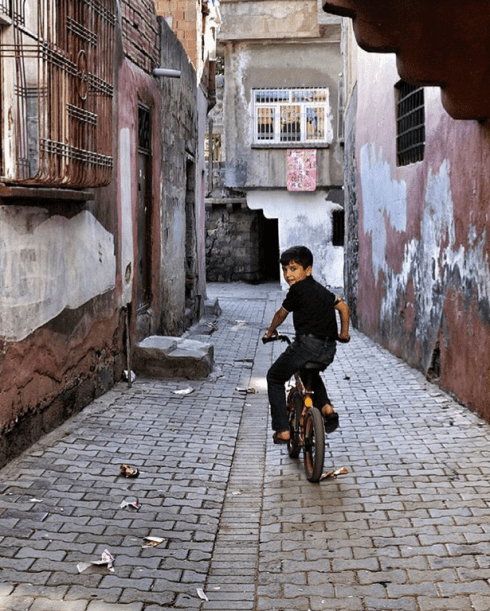
A cool Twitter account with photos of Diyarbakır, the capital of Turkish Kurdistan.  Slight weakness for the super wide angle, the last refuge of those with no compositional ideas, but interesting nonetheless.  Plus, who knows when we’ll once again be able to travel there freely.

Diyarbakir 5

Diyarbakir 3

Diyarbakir 2

Diyarbakir 4

Diyarbakir 1

Comment: nikobakos@gmail.com


“When in the Course of human events it becomes necessary for one people to dissolve the political bands which have connected them with another…”

22 Sep

“…and to assume among the powers of the earth, the separate and equal station to which the Laws of Nature and of Nature’s God entitle them, a decent respect to the opinions of mankind requires that they should declare the causes which impel them to the separation.”

  • Are Catalan nationalists like Carles Puigdemont Founding Fathers or Confederate separatists?
  • I’m not convinced by the “causes which impel” Catalans to separation.  Are you?
  • I’m hoping Catalans don’t goad Madrid and Rajoy into doing something stupid.
  • Read .  But especially scroll through the comments; the scariest ones that should give you more pause and where the dangers of Catalan separatism become clearest should jump out at you.  There you’ll see the racist self-righteousness of “little nation” nationalism in all its smug, bourgeois glory.
  • Whenever a Catalan uses or writes “Castille” that means reactionary, Catholic, Black Legend Spain where — as one comment gallingly states — “things haven’t changed much since Franco.”  Andalucía is cool and Moorish.  The Basque Country is wealthy, enterprising and progressive like us, even if they’re a little too Catholic for our tastes.  Galicia is the sweet, melancholy home of Celtic troubadours.  It’s Castille and Aragon — oh, and Asturias, which gave birth to the ugly ideology of the Reconquista — the kingdoms of the barbarous “Reyes Católicos”, that are oppressing us.
  • Substitute “Serbia” for “Castille” and you’ll get an amazing repro of Croatian gripes.  We’re European and forward-looking — even if kinna the kings of post-Hapsburg noxious fascism; don’t leave us to the mercy of obscurantist, Orthodox, Serb savages.
  • Read Vasily Grossman in …the nationalism of little nations on Armenians and what the nationalist is really about.
  • Read Vargas Llosa about how …Nationalism effaces the individual…“.
  • Where’s Almodóvar, the face of the Madrileña “movida” from La Mancha, where “nothing has changed much since Franco” to give us his opinion?  I’m sure he has one.

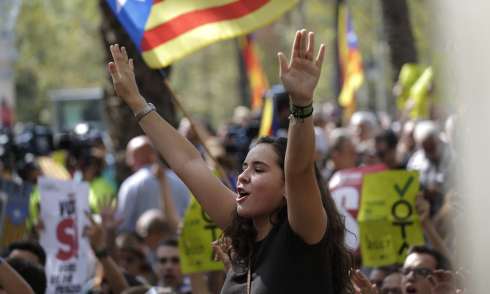
Catalan independence protestor

Comment: nikobakos@gmail.com

Memo to: a certain generation of “progressive” Turks

4 Aug

From: NikoBakos

Re: the final and total castration of the Turkish military

Date: August 2017
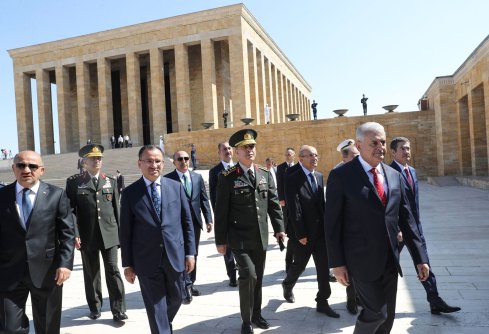
Ataturk Mausoleum Yildirim Chiefs of staffPrime Minister Binali Yildirim of Turkey, front right, and the chief of staff, Gen. Hulusi Akar, third from left, visit the Mustafa Kemal Ataturk Mausoleum before the Turkish Supreme Military Council meeting in Ankara on Wednesday. Credit Adem Altan/Agence France-Presse — Getty Images

ARE YOU HAPPY NOW???

I have two groups of friends in Constantinople:* one a group of mostly Alevi**, first-generation urbanites (from Dersim and Antiocheia); another of at least several urban generations, who are pure “White” Turks in every way.

A sub-category of this second group of friends (who are fast becoming ex-friends) are/were or considered themselves to be “leftists” (“I should cough” as one of the characters in Hester Street says).  These were always violently allergic to anything that had to do with the military, Turkish or otherwise.

Peaceniks, of course, our rift began when it proved completely in their interest to paint me as a super-American hawk during the Iraq war, even if I’m deeply un-American in my self-identification and was never a supporter of Bush’s adventure.  I simply did not know what to think about the idea of invading Iraq and toppling Saddam Hussein and took issue with their knee-jerk, anti-American attitude, with their facile certainty they knew what to think.  In the end I just decided that anybody who was automatically against the completely justified invasion of Afghanistan and the removal of the Taliban — and if that’s a tragically uncompleted project, that doesn’t mean the initial result or victory was not worthwhile…ASK ANY AFGHAN — was going to be a robot-thinker about any kind of American intervention or just about war of any kind, so I couldn’t be bothered.

Of course, these types DON’T KNOW ANY AFGHANS to ask, because they’re shameless hypocrites living in their pleasant, sheltered suburbs in C-Town, who know our Cyclades better then they know the rest of their own country — certainly better than I do — and wouldn’t dare head out to Afghanistan, even on a dare.  Why do they irritate me so much?  It’s simple.

If the original sin of the Right is selfishness, the original sin of the Left is self-righteousness, by which I mean the need to see one’s self as morally correct no matter what, even if this means a breezy indifference to the realpolitik or the reality of what’s really happening on the ground.***

Of course, they were steadfast in their belief that the Turkish military was an institution of bastardized Kemalism that was the greatest anti-democratic force in their society.  This was their justification for eventually rejecting their parents’ admittedly corrupt CHP as well, Turkey’s Kemalist Republican party.  And yet it’s ironic that the Turkish military’s “anti-democratic” orientation has repeatedly prevented the complete descent of that society into chaos.  One of these types has a whole sob story she used to recite to me about how, as a young girl in the 70s, she was terrified every day when her father left the house that he wouldn’t come home because of the terrible and constant terrorist violence that was then occurring on the streets of Constantinople.  But it was the military that put an end to that violence in 1980, like it was the military who got rid of Menderes, architect of the 1955 anti-Greek pogrom, in 1960.  And as soon as Erbakan started exceeding his limits (btw, he was the first who tried talking about limiting alcohol consumption and tables on the street in Pera and Galata), the military got rid of him too in 1997 — not exactly cause and effect there.

As a Greek, there’s obviously little love lost on my part for the Turkish military.  I just feel that if Turkey’s twentieth-century history, culminating in the Erdoğan phenomenon, has proven the country to be incapable of forming a democratic civil society that doesn’t spin out of control into violence, corruption and chaos, then you just don’t have the luxury of being anti-military.  Furthermore, from our perspective, Erdoğan’s pre- and post-“coup” military is a far more threatening force than it was previously.  Violations of Greek air space have increased exponentially under Erdoğan’s tenure, as has his, and formerly Davutoğlu’s, irresponsibly imperialist Neo-Ottoman language.  And just like it wasn’t a military junta that organized the pogrom of 1955, it wasn’t a military government that invaded Cyprus in 1974, ethnically cleansing and occupying 40% of the island to protect a Turkish minority that is only 18% of the island’s population.

Lately there had been a weird shift in their attitudes though, as it has slowly sunk in that they had supported (“I voted for him!  My God!!”) the most un-democratic, anti-consitutional, religiously retrograde, paranoid, chip-on-the-shoulder lunatic to rule Turkey since Abdülhamid (photo below).  After the takeover and purging of the daily Zaman in March of 2016, I ran the idea past a few of them: “do you think it’d be a good idea for the military to step in? …they already have more unconstitutional dirt on him than on most Turkish heads of state.”  And even the Teşvikiye girl who had worried so much about her father, didn’t get apoplectic on me like she would’ve done in the past; she simply mumbled passively, in the static cadences of Turkish passivity: “I don’t even think they’re in a position to do anything at this point.”****
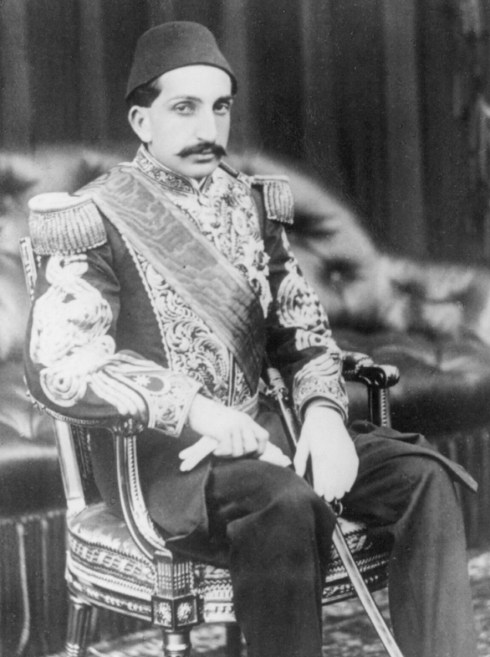
AbdülhamidAbdülhamid

Worse was one who said to me: “What Turkey needs now is unity.”  Well, your compatriots have actually shown a quite impressive amount of unity in the face of the Erdoğan challenge.  Every time he has engineered some sort of spectacular violence to terrify them over the past almost three years, they have unitedly come back, in elections and referenda and the mob-mobilization they have always been so good at, to give this “most un-democratic, anti-consitutional, religiously retrograde, paranoid, chip-on-the-shoulder lunatic to rule Turkey since Abdülhamid…” an even greater mandate on power than he had before: Daddy please save us!

Infantile beyond belief.  Is that the “unity” you wanted?  There was great unity in the mob hysteria that this supposed coup was met with (no, I don’t believe it was Gülen; no, I don’t think it was the army, unless it was army that already knew it was going to be sacked; no, I don’t think he didn’t know; I’d probably refuse to believe that Erdoğan wasn’t the architect of the whole thing — see the New Yorker‘s great Dexter Fillins’ “Turkey’s Thirty-Year Coup”).  They displayed impressive unity lynching poor little Mehmetçiks just following orders on the Bosporus Bridge (scenes guaranteed to make the hair of Greeks and Armenians stand on end), impressive unity in the Nazi-style rallies the Great Leader has convened, impressive unity in heckling men from the army and journalists and writers being led into a show trial that can quite possibly end in their execution or certainly life sentence (see “Inside Erdoğan’s Prisons” in the Times) and with the kerchiefed teyzes screaming for blood outside the courthouse in Ankara — and I’m sure they’ll show impressive unity in supporting the reinstating of capital punishment if that goes up for a referendum soon.
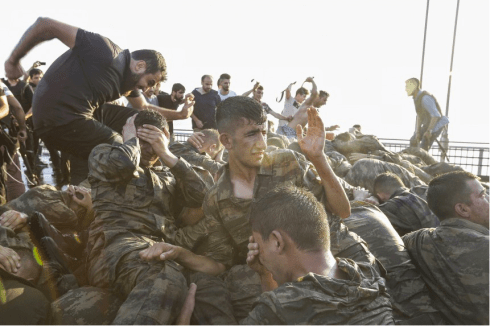
Turkish thugs and soldiersTurks beating up young conscripts on the Bosporus Bridge, defending their democratic right to elect a dictator who has abolished Turkish democracy for the most part and soon will have the power to go after whatever’s left…Turkish “unity” in action.

IS THAT THE UNITY YOU WANTED?  The unity of Kristallnacht? (or the “Septembriana” — same difference.)  The unity of Nüremberg?  The unity that comes with thinking that you can enfranchise the newly rich, provincial pious, those with absolutely no democratic education — or education of any kind — and that they won’t turn on you like swine before which pearls have been cast?  (Plato said that the “demos” — the people — shouldn’t have the right to vote because they’ll always vote for the tyrant — τυραννόφρων; Dostoevsky’s Grand Inquisitor says precisely the same thing.)  Did you want the unity of the Italians and the Germans who respectively put Mussolini and Hitler in power with their vote?  Or the Americans who voted for Trump?  Or the Russians who voted and will again vote for Putin?

Tabrik migam, then.  You got it.

And this is the cherry on your birthday cake: Erdoğan replaces the military chiefs of staff with his own men.  Good luck ever getting rid of him now.  He’s now in a position of total control, with no challenges whatsoever.  You’re stuck for life.

*************************************************************************************

* The days when in the p.c. stupidity of the metapoliteuse we used to refer to Constantinople as “Istanbul” — I mean when speaking Greek…airport announcements and newspaper by-lines used “Ιστανμπούλ“…in Greek…are over.  I’ve now taken to calling it Constantinople in English as well, as Turks are free to call Salonica Selanik or Bulgarians and Macedonians Solun and I have no problem.  I’m not going to tell others what to call cities historically important to them; it actually makes me happy.  For more on this see my: Names: “Istanbul (not Constantinople)”…and Bombay! and keep an eye out for my “Boycott ‘Mumbai” campaign” post.  In general except an upswing in South Asian posts as we approach the seventy-year anniversary of Partition.

** My friends bear out the truth that Turkey’s Kurdish-Zaza Alevis and Syria and Lebanon’s Alawites are religiously the same branch of semi-Shia Islam.  The ones from Dersim have recognized that Syrian Alawites are also Alevi like them, even if that hasn’t made them Assad supporters; and the ones from Antiocheia (Antakya in Turkish or Hatay province in the logic of Turkish science fiction nationalist narrative) are just plain Alawite Arabs, who have understood that if there’s anything separating them from Syrian or Lebanese Alawites, it’s only the Turkification campaign they were subjected to when Turkey annexed that part of then-French-mandate Syria in the 1930s.  If papers like the Times feel the need to add the caveat that they’re different in every article they publish on the subject, it’s because they’re ignorant, the Turkish Press Office has made a fuss every time they don’t add that caveat, and it’s easy to think that people separated into difference by the ethnic nation state aren’t religiously brothers.  I’ve written extensively on this in a Twitter dialogue I had with a Turk who thought everybody should fight “lies and defamation” against their country when they appear in the media:

Syrian Alawites and Turkish Alevis: closer than I thought

Turkish Alevis and Syrian (or Lebanese…or Turkish?) Alawites — a Twitter exchange

Alevis and Alawites addendum: a “p.s.” from Teomete

More on Alevis and Alawites…or Alevis and Kurds…or Iraqi Kurds…or…Christian Kurds…or Assyrians…or…

Look out for Alevis in the current struggle in Turkey.  Whereas Kurds proper are not trusted by the political establishment or most Turks because they’re convinced they’ll never give up their separatist aspirations, Alevis, who suffered terribly under the Ottomans and the early republic and still do on some level, are still loyal to the Turkish Republic and Turkey itself.  This puts them in the position to become the secular backbone of all democratic impulses that still exist in that country, something like African-Americans in the United States were in the mid-twentieth century, since their form of Islam does not aspire to becoming the State itself, as all forms of conventional Sunni Islam do.  They were a disproportionate share of the casualties and deaths that occurred during the crackdown of the 2013 protests, not because they were targetted specifically, but simply because they were already a disproportionately large percentage of the protesters.

*** It may seem irrelevant, but this type always reminds of a passage in Chesterton’s Orthodoxy in which he trashes this kind of moral correctness by trashing the New Agers of his time:

“Only the other day I saw in an excellent weekly paper
of Puritan tone this remark, that Christianity when stripped of its
armour of dogma (as who should speak of a man stripped of his armour of
bones), turned out to be nothing but the Quaker doctrine of the Inner
Light. Now, if I were to say that Christianity came into the world
specially to destroy the doctrine of the Inner Light, that would be an
exaggeration. But it would be very much nearer to the truth. The last
Stoics, like Marcus Aurelius, were exactly the people who did believe in
the Inner Light. Their dignity, their weariness, their sad external care
for others, their incurable internal care for themselves, were all due
to the Inner Light, and existed only by that dismal illumination. Notice that Marcus Aurelius insists, as such introspective moralists always do,
upon small things done or undone; it is because he has not hate or love
enough to make a moral revolution. He gets up early in the morning, just
as our own aristocrats living the Simple Life get up early in the
morning; because such altruism is much easier than stopping the games of
the amphitheatre or giving the English people back their land. Marcus
Aurelius is the most intolerable of human types. He is an unselfish
egoist. An unselfish egoist is a man who has pride without the excuse of
passion. Of all conceivable forms of enlightenment the worst is what
these people call the Inner Light. Of all horrible religions the most
horrible is the worship of the god within. Any one who knows any body
knows how it would work; any one who knows any one from the Higher
Thought Centre knows how it does work. That Jones shall worship the god
within him turns out ultimately to mean that Jones shall worship Jones.
Let Jones worship the sun or moon, anything rather than the Inner Light;
let Jones worship cats or crocodiles, if he can find any in his street,
but not the god within. Christianity came into the world firstly in
order to assert with violence that a man had not only to look inwards,
but to look outwards, to behold with astonishment and enthusiasm a
divine company and a divine captain. The only fun of being a Christian
was that a man was not left alone with the Inner Light, but definitely
recognised an outer light, fair as the sun, clear as the moon, terrible
as an army with banners.”  [All bold emphases mine.]

**** “yanlış oldu” — See Loxandra‘s amazing “duck with bamya” chapter; I never tire of recommending it.

Comment: nikobakos@gmail.com