Tag Archives: Bosnia

My buddy M. from Novi Sad writes: “You clueless Frangoi with your Pierre-Loti infatuation with Istanbul…”

12 Nov

“I would love to see these people try and live somewhere like Pendik or Küçükçekmece, and commute to work for 4 hours total/per day in crowded public transport for 3,000 TL/month… like most of Istanbul… and then see what they have to say.

“At least these people aren’t as terrible as the (appallingly numerous) Westerners who think Dubai is a lovely holiday destination.”

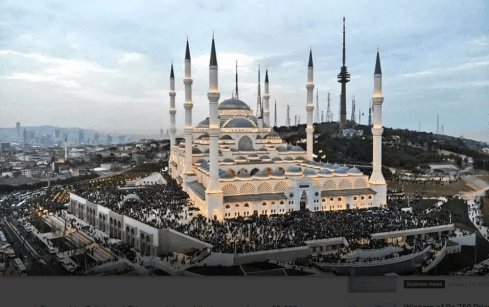
Dubai?  Who needs Dubai when Erdoğan builds hideous and hubristically six-minaretted mosque monstrosities like this:

Çamlica mosqueScreen Shot 2019-11-12 at 1.18.37 AM

For 2,676 years, the Megaran Greeks who founded the city, the Romans, meaning the  the Italian ones and us, and the Ottomans only built things that added to the beauty of Istanbul.  Only Erdoğan had the arrogance to build something so hideous on a site so conspicuous that it mars the entire sea-landscape, horizon and view of the City.

Comment: nikobakos@gmail.com

You clueless Frangoi with your Pierre-Loti infatuation with Istanbul…

10 Nov

…are so blissfully ignorant of how much ugliness and violence went into creating the questionably “beautiful” city you see today.  Your type probably wept in the 90s (if you’re even that old), along with Susan Sontag and Angelina Jolie, for the violent segregation and ethnic cleansing that evil Serbs inflicted on poor Sarajevo.  But there’s apparently a statute of limitations on such crimes where Istanbul is concerned.  And if, like most ex-pats, your existence is pretty much limited to the axis between Karaköy to Bebek — maybe some 0.5% of the territory of the city — with an occasional foray to the islands or to Kadıköy to go eat at AKP Çiya, and you’ve ingested enough Turkish tourist propaganda, then you’ll believe anything.

You know nothing about Istanbul.  You know nothing of the violence, massacre, pogroms, property destruction and confiscation, discriminatory taxation and imprisonment, expulsions and deportations that created the wonderful East-West playground you love so much.  You know nothing of the genuine Mediterranean worldliness that’s been displaced by rural Anatolian puritanism.  You know nothing of the last muhallebici in Pera that’s been replaced by another kitschy restaurant with women in salwar and headscarves kneading flatbreads in the window.  You know nothing of the subtlety and sophistication of the City’s cuisine that’s been totally replaced by the monotony of kebab/köfte joints that you think are authentic and cool.

Yes, it still has a modicum of its old charms.  And it’s hard to beat its stunning physical location, though the Padishah’s monster kitschario-mosque has managed to mar even that.  But mostly, Istanbul today is a Baudrillardian simulacrum of the city that it was for centuries.  And you buy it up.  It’s a massive — and aside from the axis mentioned above — hideous monstropolis of 15 million, 99.9% of whom are Turkish or Kurdish Muslims, and yet still manages to sell itself as multicultural.

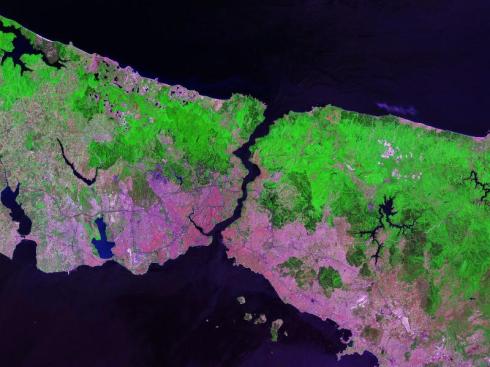
Look at what a tiny bit of the actual city you really have any relation to:

bosphorus-satelitte

And how ignorant you are of even the neighborhoods that you do move about in.   How clueless you are about who used to live there. (see below)*  About who was displaced to house you and your Turkish yuppy friends.  The zoning corruption that’s destroyed neighborhood after neighborhood and the woodlands and wetlands of the City’s environs and replaced them with massive high-rise developments that make the Queensbridge Houses in New York look like the Place des Vosges.  The megalomaniacal mega-mosques disfiguring Taksim or Çamlica, that are more Riyadh or Dubai than Istanbul. The cheezy, glitzy Gulfie shopping malls…

And now the new zoning law that will take the Bosporus away from the authority of the Istanbul municipality and give imperial rights to development there directly to Erdoğan and his Divan — punishment because Istanbul (and Ankara) booted him and the AKP in one election and then a recount…double slap in the face.  So they’ll be able to build Allah-knows what kind of monstrosities along what remains of that waterway’s beauty.

Plus, how glibly non-concerned you seem to be about political developments…Islamist dictatorship…more imprisoned journalists than any other country in the world…whatever..  It’s exhausting to even talk to you.

This “DAMN” city is right.

Enjoy your Turkish Life.

Screen Shot 2019-11-11 at 1.19.00 AM

Oh, that’s the Sülemaniye on the right, isn’t it?  and the Yeni Camii in the distant left?

**************************************************************************************

* From my 2013 Nobody really cares about Gezi Park: Greek thoughts on the protests of 2013:

“All – I thought a lot about whether I should use “almost all” in this sentence and decided against it –because all the hippest, funkiest, most attractive, gentrified neighborhoods in the historic parts of İstanbul are neighborhoods that were significantly, if not largely, minority-inhabited until well into the twentieth century: not just Pera and Galata, but Cihangir and Tarlabaşı, and even Kurtuluş — of course — and up and down the western shores of the Bosphorus and much of its eastern towns too, and central Kadiköy and Moda and the Islands.  (And if serious gentrifying ever begins in the old city it’ll be in Samatya and Kumkapı and Fener and Balat; I wouldn’t put any big money into Çarşamba just yet.)  If young Turks are fighting to preserve the cosmopolitan character of areas made cosmopolitan by a Greek presence, among others, is it a recognition of that presence, however vestigial, that I want?  Yes.  Is it because some recognition might assuage some of the bitterness of the displacement?  Perhaps.  Is the feeling proprietary then?  Does the particular “cool” quality of these neighborhoods that protesters have been fighting to protect register for me as a form of appropriated “coolness?”  I’m afraid that yes, sometimes it does.  In darker moments this spring and summer, these Occupy Gezi kids annoyed me: “What’s wrong mes p’tits?  The Big Daddy State threatening to break up your funky Beyoğlu party?  Do you know the Big Daddy State made life so intolerable for the dudes who made Beyoğlu funky that they not only had to break the party up, but shut down shop altogether and set up elsewhere?  That your own daddies and granddaddies probably stood by and watched, approved even?  Do you know that now?  Do you care?”

Some pics: The morning of September 7, 1955. a bad Beyoğlu hangover

COJ55JkUkAAwrda

COJ53hDUsAIZxc8

Devastation-Pogrom-1955-568x420

Septembriana_1955-1-790x400

istanbul-1


Comment: nikobakos@gmail.com

Image

Rezili — Greek volunteer thugs in 1990s Bosnia

10 Nov

A stain on the Greek conscience, an obscene manipulation of Orthodox identity and brotherhood, an affront to the suicidal bravery of Greek and Serbian resistance against Nazism during WWII (in its German, Hungarian and especially its Croatian variants), and a gross mockery on what for me is the still moving idea of a long, historical Greco-Serbian bromance.

Screen Shot 2019-11-10 at 6.49.51 PM

What did you 380 morons about this tweet?

Comment: nikobakos@gmail.com

NYT: Armenian Genocide — “For too long, Turkey bullied America into silence. Not anymore.” — Samantha Power

30 Oct

Not 100% sure how I feel about this; see “Screamers: Genocide: what is it and why do we need the term?.  I voice my major apprehensions there.

But “bully” is such an apt term for the Turkish Republic and the Turkish body politic (“thug” also comes to mind), that I think anything that puts Turkey in its place is a positive development.

29Power-sub-superJumboCredit…Mario Tama/Getty Images

Power’s money quotes:

Although Turkish officials may see the vote as retaliation for Turkey’s recent forced displacement of Syrian Kurds, that operation — as well as President Recep Tayyip Erdogan’s sweeping human rights crackdown in Turkey and his purchase (over American and NATO protests) of a Russian air defense system — simply reduced the impact of Turkish blackmail.

……..

First, as a baseline rule, for the sake of overall American credibility and for that of our diplomats, Washington officials must be empowered to tell the truth.

Over many years, because of the fear of alienating Turkey, diplomats have been told to avoid mentioning the well-documented genocide. In 2005, when John Evans, the American ambassador to Armenia, said that “the Armenian genocide was the first genocide of the 20th century,” he was recalled and forced into early retirement. Stating the truth was seen as an act of subordination.

When I became ambassador to the United Nations in 2013, I worried that I would be asked about the Armenian genocide and that when I affirmed the historical facts, I could cause a diplomatic rupture.

Second, when bullies feel their tactics are working, they generally bully more — a lesson worth bearing in mind in responding to threats from China and Saudi Arabia. The Turkish government devotes millions of dollars annually to lobbying American officials and lawmakers: more than $12 million during the Obama administration, and almost as much during the first two years of the Trump presidency. Turkish officials have threatened to respond to genocide recognition by suspending lucrative financial ties with American companies, reducing security cooperation and even preventing resupply of our troops in Iraq.

On Friday, the Turkish ambassador warned that passage of the “biased” House resolution would “poison” American-Turkish relations, and implied that it would jeopardize Turkish investment in the United States which provides jobs for a “considerable number of American citizens.”

It is easy to understand why any commander in chief would be leery of damaging ties with Turkey, an important ally in a turbulent neighborhood. But Turkey has far more to lose than the United States in the relationship. The United States helped build up Turkey’s military, brought it into NATO and led the coalition that defeated the Islamic State, which carried out dozens of attacks on Turkish soil. Over the past five years, American companies have invested some $20 billion in Turkey.

If Mr. Erdogan turns further away from a relationship that has been immensely beneficial for Turkey in favor of deepening ties with Russia or China, it will not be because the House voted to recognize the Armenian genocide. It will be because his own repressive tactics are coming to resemble those of the Russian and Chinese leaders. [my emphases]

Comment: nikobakos@gmail.com

“The Balkans in Rightwing Mythology” — Read the article (past the touching Srebrenica graphic); it’s not about the “Balkans” in Rightwing Mythology; it’s — AGAIN — only about SERBIA in rightwing mythology

4 Oct

You’d think that just to cammo their biased asses, these people might occasionally write about someone else, to then make it easier to go back to blaming Serbs again.  Here’s some suggestions:

* Croatia: Are there any people on the planet, not just Europe, who have gone more scot-free of being confronted and taken to task for their more-Nazi-than-the-Nazis, vicious, genocidal, more-of-their-population–slated-for-elimination-than-any-other-Nazi-collaborating state, Vatican-blessed murderous project than Croatians and the Ustaše?

* Has anybody written a biography whose title might be: “Subtle Brother: The Rise and Fall of Alija Izetbegović and his plan for a Muslim Bosnia.”?  Maybe Mr. Delalić could include a foreword or afterword there about Bosnian Muslim collaboration with the Ustaše.

or:

* “Kosovo: an Experiment in Mafia Statehood”

or

* “Operation Storm: The Story Behind NATO-armed Croatia and the Yugoslav Wars’ Single Greatest Episode of Ethnic Cleansing.”

or on a lighter note:

* “Buenos Aires: Here We Come!  How the Papacy Spirited Away the Leaders of Fascist Croatia to Latin America So They Could — and Did — All Avoid War Crimes Prosecution.”

You can squeeze stuff that inspires contemporary nut-cases out of the noxious right-wing ideology contained in each of those I think.  Just to distract people so that you can then return to your usual agenda — Serbia.  Particularly rich, of course, to have this all come from Germans, who don’t seem to realize that their hyper-earnest, Mea Culpa Show is getting really boring, but has also hypocritically and ironically made them the self-appointed, moralizing arbiters of the rest of humanity’s behavior: like, in some perverse way, ‘they should know’ — know it when they see it.

And almost all the murderous right-wing psychos, that think Karadžić is a hero and that they list in the article, are Germans or Teutons of some sort.  So maybe the fault, dear Germans, lies not in Greater Serbian Nationalism but in yourselves.

Ah, then one last idea: how about “Instant Independence: Slovenia, Croatia and How Germany led Europe into Mass Death and Destruction for the Third Time in One Century.” ?

4dFreEA_

The Balkans in Rightwing Mythology
by Adnan Delalić and Patricia Zhubi for Die Wochenzeitung (Switzerland)
11 April 2019 (original post in German)

Racist memes, nationalist myths, and crude conspiracy theories: within the ideology of the New Right, southeastern Europe appears as a transitional space where the future of the West is being decided.

Investigations into the 15 March 2019 Christchurch attack took on an international dimension ten days later when federal security and intelligence agents searched Martin Sellner’s apartment in Austria under orders from the prosecutor’s office there. Sellner is a leading functionary of the Austrian Identitarian Movement (Identitäre Bewegung Österreich, or IBÖ). He came under the authorities’ scrutiny because of a €1,500 donation he had received from the Christchurch shooter in January 2018.

After the search, Sellner portrayed himself on YouTube as a victim of state repression. While politicians and commentators argue about the nature of the IBÖ, its members organize demonstrations and solidarity actions and drum up social media and financial support from around the world. A donation does not make Sellner an accomplice to a massacre—but there are ideological bridges that connect the Identitarian Movement (also known as Generation Identity) as well as other extreme rightwing groups to the Christchurch mass-murderer.

Undesirable Foreign Foods

Attempts to distinguish the IBÖ from “ordinary” rightwing radicalism are specious not only because Sellner, according to media reports, used to paste swastikas on synagogues in his youth; beyond that, he belonged to the social circle around Austrian Holocaust denier Gottfried Küssel, whose blog Alpen-Donau.info was removed from the internet by the Austrian interior ministry in 2011. This kind of increased legal and police pressure led to the founding of the IBÖ a year later, which attempts (in the tradition of Alain de Benoist, an early progenitor of the New Right) to replace völkisch-nationalist vocabulary with terms carrying less historical baggage—terms like “identity.”

In a YouTube vlog from early 2015, Sellner posed—with hipster glasses and a sharp part in his hair—in front of a food stand menu offering burgers, hotdogs, and Bosna sausages. His goal: to educate his viewers about Austrian cuisine and undesirable foreign foods. Austrians! Do not eat at McDonald’s—and certainly not at kebab stands, the epitome of “multicultural capitalist mania”! In this online broadcast, Sellner sells the message additionally with his choice of t-shirt (available at his online store…). Upon it are the words “Restore Europe, Remove Kebab, Restore Empire.” Precisely this reference, “Kebab Remover”—a racist internet meme endorsing the genocide of Bosnian Muslims—was on display both on the Christchurch terrorist’s weapon as well as in his manifesto. Sellner has also cracked wise on Twitter about being in “Remove Kebab Mode.”

The Christchurch shooter referred to the Balkans in other ways as well. On the way to committing his act of terror, he listened to a song honoring the Serbian war criminal Radovan Karadžić, who would only a few days later be sentenced to life in prison at the Hague. In addition, the shooter is alleged to have traveled to several countries in the Balkan region in order to visit the sites of historic battles. The engravings on his weapons with the names of figures from Serbian, Montenegrin, Polish, and Spanish history also point to a deep fascination with struggles against the Ottoman empire. Southeastern Europe, in the imagination of the New Right, is a kind of transitional space where Christianity and Islam clash.

This motif is not new, and has many variants, alternately glorifying the Spanish Reconquista, the defense of Vienna, or the Russian-Ottoman wars. Karadžić referred to the genocide at Srebrenica as “just and holy”—in his view, his troops had prevented the establishment of an Islamist caliphate. The Norwegian rightwing terrorist Anders Breivik, in turn, called Karadžić an “honourable Crusader and a European war hero.” Occasionally, the motif appears in reference to a supposed transnational Muslim conspiracy against the Christian West, in which Serbia is presented as the bulwark against a neo-Ottoman invasion of Europe. The Christchurch shooter referred to Kosovar Albanians as “Islamic occupiers.”

An Appealing Trope

There are other points of contact. The Christchurch shooter’s manifesto was titled “The Great Replacement”—clearly named after the racist conspiracy theory popularized by Renaud Camus, an ideological godfather of the New Right in France. In his imagination, Europe’s white, Christian population is being systematically replaced by predominantly Muslim “invaders” from Africa and the Middle East. There are many variations on this demographic panic. It is the glue that holds the Fascist International together.

It can be observed as a central motif in the Greater Serbia ideology of Radovan Karadžić, which purports that Bosnian and Kosovar Muslims are secretly pursuing a “demographic jihad.” In the SANU [Serbian Academy of Science and Arts] Memorandum of 1986, a milestone of Serbian nationalism, it is claimed that the high birthrate of (predominantly Muslim) Kosovar Albanians is a central component of their drive for an ethnically pure Kosovo. The former Bosnian-Serb general Ratko Mladić justified war crimes against Bosnian Muslims with the claim that the Islamic world possesses, if not an atomic bomb, then a “demographic bomb.” Breivik, for his part, refers to this as an “indirect genocide.”

The obsession with birthrates and these paranoid theories of intentional displacement and replacement do not necessarily lead to violence—but they do mentally prepare their proponents for it.

The Islamophobia inherent to the ideology of Greater Serbia, in which traditional and contemporary motifs are bound together, is emerging in the globalized context as an appealing trope for the Fascist International. The specter of multiculturalism can only be overcome with a fundamental reordering of space along ethnic dividing lines that faded out of relevance long ago. The aim of this “racism without races” is the establishment of ethnically homogeneous societies, side by side but separate.

In September 2018, Sellner took part in a torchlight march “in honor of the heroes and saints of 1683.” In this case, Vienna symbolized the bulwark against past and future Islamic invasions. “I don’t get how there can be people from the Balkans who spit in the faces of their forefathers and their defensive struggle against the Ottomans,” tweeted Sellner in June 2017. So Islam must be fought and defended against—but without violence, apparently: “Rightwing terrorism is, like all other kinds of terrorism, to be morally rejected,” announced the leading identitarian figure immediately after the Christchurch attack. How this is supposed to work, when—judging from slogans like “Stop the Great Replacement!”—the Ottoman army is already pounding at the gates, is unclear. War symbolism and fear-mongering only fit into the self-conception of the “moderate migration critic” when rhetorical fear-mongering can be cleanly separated from real terrorism.

No matter how much Renaud Camus and Martin Sellner try to distance themselves from the terror attack in Christchurch, the insistence of the IBÖ that it is not a radical rightwing movement is simply untenable. The fight against this ostensible “replacement” and the IBÖ’s concomitant declaration of war on multicultural society are not “moderate” positions. The claim that coexistence is impossible is not meant merely as a description of conditions but rather as a goal. For Karadžić it was not only about the fight against Islam. Tolerance and the multicultural character of Bosnia were also to be erased and made impossible for generations to come.

Ideological Cocktail

The ideas that became socially acceptable with the rise of Serbian nationalism in the 1980s soon found their concrete political implementation. What emerged was an ideological cocktail of racism, demographic panic, conspiratorial paranoia, and revanchism that ultimately proposed an urgent need for action against an allegedly existential threat. The destruction of the Other became necessary to ensure Our survival. Karadžić still argues to this day that he was acting defensively against a “toxic, all-destructive Islamic octopus.”

It is not particularly surprising that paranoia about demographic “invaders” also takes an antisemitic shape. The Serbian nationalist cult director Emir Kusturica, for example, is among those who pin the blame for the “refugee crisis” on the Jewish American billionaire George Soros. According to social theorist Moishe Postone, modern antisemitism is not merely a form of racism, but at the same time a way of explaining the world which promises mistaken paths out of one’s misfortune. We can understand conspiracy theories like “the great replacement,” which declare as enemies both the weakest among us as well as global elites, in a similar manner. Islam and Judaism overlap as bogeymen, as both sublate the particularity of individual nationalisms. Unity is imperative in fighting the great enemy.

Karadžić’s ideology is neither unique to the Balkans nor the result of “centuries-old blood feuds.” It also is not a genuinely Serbian phenomenon. Rightwing radicalism does not have a country of origin; it derives inspiration from everywhere. The ideological store of the Fascist International feeds on various traditions and regions. What has evolved is a globally available repertoire of nationalist myths, symbols, and tactics to choose from. Events in Bosnia and Kosovo show what kinds of consequences such ideas can bring—and not just there.

Berlin historian Patricia Zhubi studies the past and present of antisemitism and the transnational structures of the radical right. Bosnian-German sociologist Adnan Delalić does research on Islamophobia and genocide, among other things.

Translated by Antidote and printed with the kind permission and help of the authors.

Featured image: artwork by Bosnian-American Samir Biscevic displayed at a ten-year commemoration of Srebrenica at UN headquarters in New York in 2005.

Bosnian Woods: Edelman and the 90s in Bosnia

3 Oct

Screen Shot 2019-10-03 at 2.05.55 PM

What happened in Bosnia in the 90s was “a posthumous triumph” for the vicious fascism of the Croatian Ustaše, and Bosnians’ gleeful collaboration with them on both occasions.

Honestly…if anybody can explain to me because I find it baffling.  What was in it for Bosnians to collaborate with Croats during both WWII and the wars of the 90s?  What could possibly have been of more benefit for them to work together with the Ustaše instead of joining Serbian partisan resistance or just sitting out the conflict?  Wasn’t the virulent Catholicism of the Ustaše enough to put them off?  Did they just figure that Serbs were the previously and potentially again most hegemonic people in the state so they sought help from another little brother?  Did they really think that after accomplishing their stated aims of cleansing the NDH of Serbs, Jews and Gypsies, that Croat fascists wouldn’t come after Bosnian Muslims next?  Like Martin Niemöller’s poem: “Then they came for me.”  And Bosnian’s chumming up with them in the 90s: how’s that worked out for you, guys?

Comment: nikobakos@gmail.com

Ndh_1941

Yugo p.s. “So, this was Bosnia before the war?” Er…no.

3 Nov

That “self-determination” is just nationalism — and often a fiery, violent kind — writ small and wanting to be bigger, may be one of the most important issues we need to face in the 21st century.

Maybe the most frustrating, teeth-gritting moment of news coverage — in terms of the selective blessing of nationalisms and self-determinations — I’ve ever experienced was a BBC report, which unfortunately I haven’t been able to find and post, that aired on the July anniversary of the Srebrenica massacre the summer of 2016.

At the end of it the BBC reporter was interviewing a Bosnian man, in his forties maybe, selected for his Bosnian-ness — tall and handsome — whose father had been killed by a Serbian sniper in Sarajevo in the 90s.  In their interview on a bridge over the lovely, gurgling Miljacka, he talked about how he was happier that he was the child of that sniper victim and didn’t have to live with the conscience of being the child of that sniper instead.

He then pulled out a photo of his high school class:

“See…

“This guy was Serbian.  This guy was Croatian.  This guy was Croatian.  This guy was Bosnian.  This guy was Serbian…  That’s how it was then.”

“So,” says the dull-tool BBC reporter:

“This was Bosnia before the war?”

“Yes,”

says the Bosnian, shaking his head sadly with the weary, self-righteous pride of the victim,

“This was Bosnia before the war.”

No, buddy.  That wasn’t BOSNIA before the war.  That was YUGOSLAVIA before the war.  AND YOU DIDN’T WANT TO PART OF IT ANYMORE…

So, to paraphrase the identity-politics, American new “left” cliché: “Check your victimhood!”

Yugo ethnic breakdown

Comment: nikobakos@gmail.com

More indication that Catalonia is bringing YUGOSLAVIA up again as an object of moral reflection

3 Nov

Just one line in Guardian article Catalonia isn’t just Spain’s nightmare – it is Europe’s:

Old feuds are rekindled and jealousies revived. Hypocritical Britain cannot talk. It long opposed Irish separatism and denied devolution to Scotland and Wales, while it sent soldiers to aid the break-up of Yugoslavia. [my emphasis]

My hope is that there will be new de-villainizing discussions of certain past, led by a new review of Serbian actions in a dissolving Yugoslavia, or even early twentieth-century Ottomans/Turkey (might want to see my “Screamers:” Genocide: what is it and why do we need the term?“)

While we’re adjusting our moral compasses about whose self-determination is “cool” and whose isn’t, we might want to look at the role the public relations industry plays in so manipulating the image of political conflicts throughout the world.  And I don’t mean that as a metaphor: both Croatia and then Bosnia hired American public relations firms to push their cause during the Yugoslav War; this is covered extensively by Diana Johnstone in her Fools’ Crusade: Yugoslavia, Nato and Western Delusions.  Unfortunately, since Johnstone’s thesis is that NATO aided and abetted the break-up of Yugoslavia as part of its plan to weaken a Serb-hegemonied Yugoslavia, which wouldn’t play along with NATO, the European Union or the post-communist, Neo-Liberal, New World Order; that is, that these forces wouldn’t tolerate, just like Stalin couldn’t, Yugoslavia’s fairly benign and most successful of communist states’ strength, and the power a post-communist, unified Yugoslavia would still hold — she’s dismissed as a conspiracy theorist or a crackpot.  Her argument, however, is perfectly documented and argued.

But even a good friend of mine who’s incredibly smart about and immersed in things Yugo said to me: “Really, Nick?  I dunno…  Diana John-stone…”

fool's

Yeah.  Diana John-stone.  Read it.

And next time you go back to your fun and Euro-spring-break memories of unbearably hip Barcelona, thing of how advertising and public relations got you to spend your tourist dollars there — and how that indirectly funded, both in terms of real and symbolic capital, the current crisis in Spain.

Comment: nikobakos@gmail.com

Damir Imamović explains what traditional Bosnian music ‘Sevdah’ is

16 Sep

Thanks to Adnan Delalić for tweeting this video.

A Colombian friend says to me: “That you can all [my blog’s world, Bosnians to Bengalis] listen to what to me sounds like exactly the same music and not get each other on everything else…I don’t understand.”

Me neither.

Börek II — or Burek and the end of Yugoslavia

26 Aug

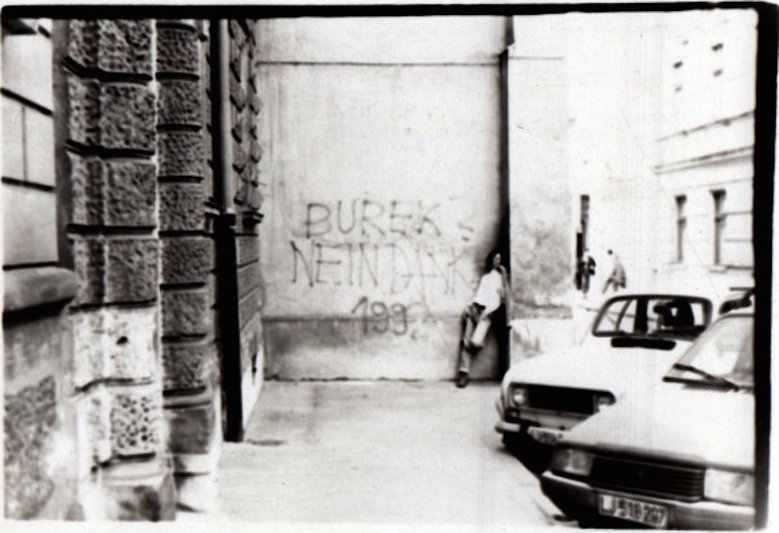
Börek Nein Danke

(click)

This is a piece of graffiti that appeared in the Slovenian capital city of Ljubljana in 1992, at the beginning of the worst period in the Yugoslav wars and after Slovenia had become independent. “Burek [‘börek’ in Turkish, pronounced exactly like an umlauted German ‘ö’]? Nein Danke.” Burek? Nein Danke. “Burek? No Thank You.” What a silly slogan, ja? How innocuous. What could it possibly mean? Who cares? And how can NikoBako maintain the bizarre proposition that a piece of graffiti in a rather pretentious black-and-white photograph is an important piece, in its ugly, dangerous racism, of the break-up of Yugoslavia.

Back up then. There are certain — usually material — aspects or elements of Ottoman life in the Balkans, which, even for Christians in the region, despite the centuries of unfortunate hate and reciprocal bloodletting (and no, I don’t think pretending that wasn’t true or that “it wasn’t that bad” is the key to improving relations between us all now; I think the truth is the key), remain objects of a strange nostalgia and affection. They linger on — even if unconsciously, or even as they’re simultaneously an object of self-deprecating humour or considered homely backwardness – as evidence that Ottoman life had a certain refinement and elegance that these societies have now lost. You sense this often intangible and not explicitly acknowledged feeling in many ways. Folks from my father’s village, Derviçani, for example, now go to Prizren in Kosovo to order certain articles of the village’s bridal costume because they can no longer find the craftsmen to make them in Jiannena or Argyrocastro, and they’re conscious of going to a traditional center of Ottoman luxury goods manufacture. You feel it in what’s now the self-conscious or almost apologetic serving of traditional candied fruits or lokum to guests. Or still calling it Turkish coffee. Or in Jiannena when I was a kid, when people still had low divans along the walls of the kitchen where they were much more comfortable than in their “a la franca” sitting rooms. 1* Perhaps the sharpest comparison is the way the word “Mughlai” in India still carries implications of the most sophisticated achievements of classical North Indian…Muslim…culture, even to the most rabid BJP nationalist. 2**
49614968

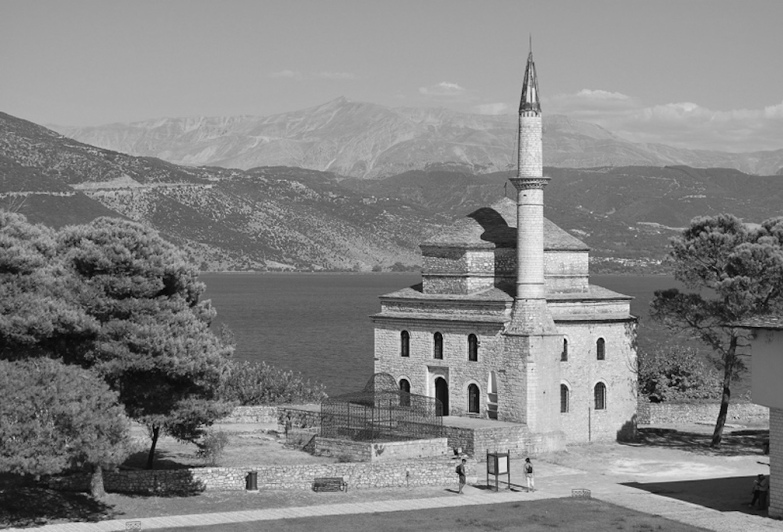
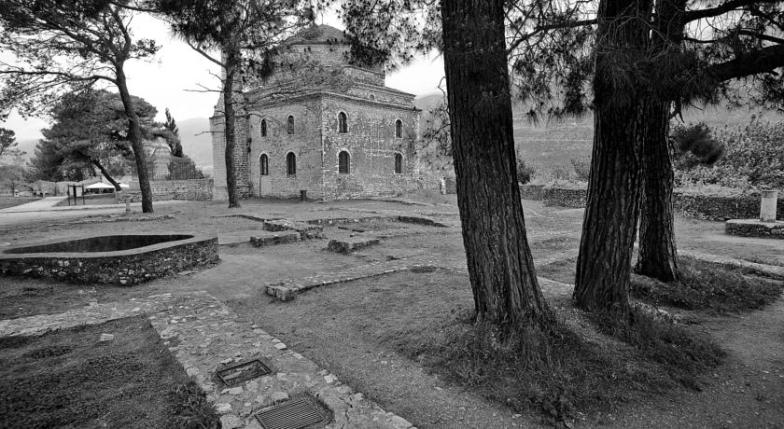
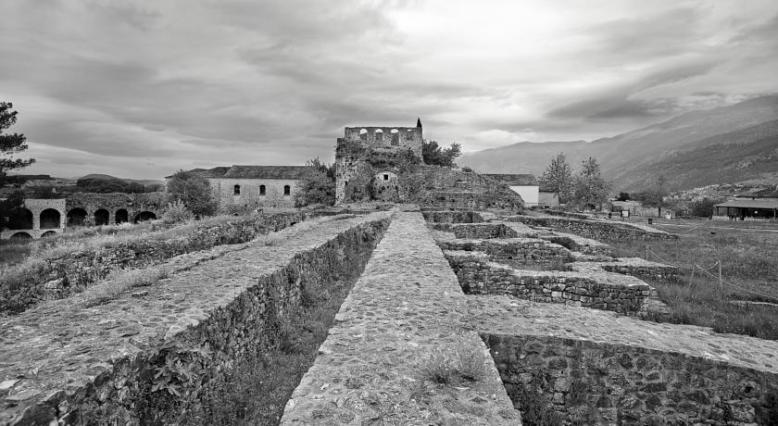
There are some places where this tendency is stronger than in others. Sarajevo and Bosnia are obvious; they still have large Muslim populations though and, after the 90s, Muslim majorities. But Jiannena – which I’ll call Yanya in Turkish for the purposes of this post, the capital city of Epiros and one often compared to Sarajevo: “a tiny Alpine Istanbul” – is also one such place. Readers will have heard me call it the Greek city most “in touch with its Ottoman side…” on several occasions. You can see why when you visit or if you know a bit of the other’s past: or maybe have some of that empathy for the other that’s more important than knowledge.
49611950

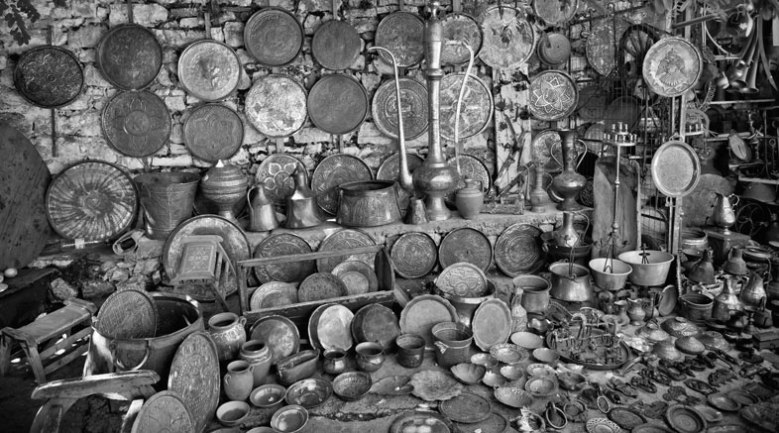
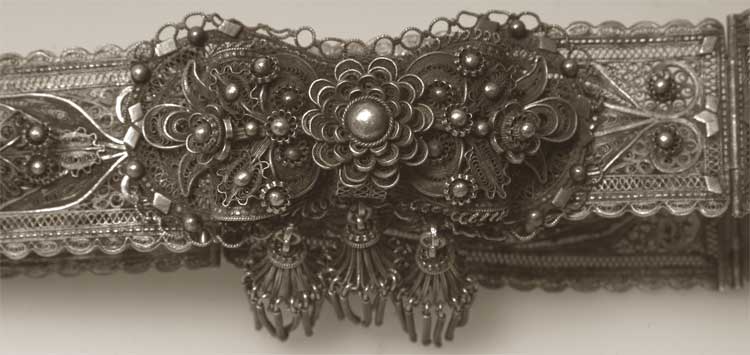
About half Greek-speaking Turks before the Population Exchange, Yanya was a city the Ottomans loved dearly and whose loss grieved them more than that of most places in the Balkans. It’s misty and melancholy and romantic. It has giant plane trees and had running waters and abundant springs in all its neighbourhoods, along with a blue-green lake surrounded by mountains snow-capped for a good five or so months of the year. It experienced a period of great prosperity in the eighteenth and especially nineteenth century, when it was not only a rich Ottoman commercial city but also a center of Greek education: “Yanya, first in arms, gold and letters…” – and, especially under the despotic yet in certain ways weirdly progressive Ali Paşa, was the site of a court independent enough to conduct foreign policy practically free of the Porte and fabulous enough to attract the likes of Pouqueville and Byron, the latter who never tired of commenting on the beauty of the boys and girls Ali had gathered among his courtiers, as Ali himself commented profusely on Byron’s own. All the tradition of luxury goods associated with the time and the city: jewelry, silver and brassware, brocade and gold-thread-embroidered velvet, sweets and pastries – and börek – still survive, but are mostly crap today, even the börek for which the city used to be particularly famous, and your best luck with the other stuff is in the city’s numberless antique shops.
ioannina-epirus-greece-the-antiqe-market-hip

identical to yiayia's belt

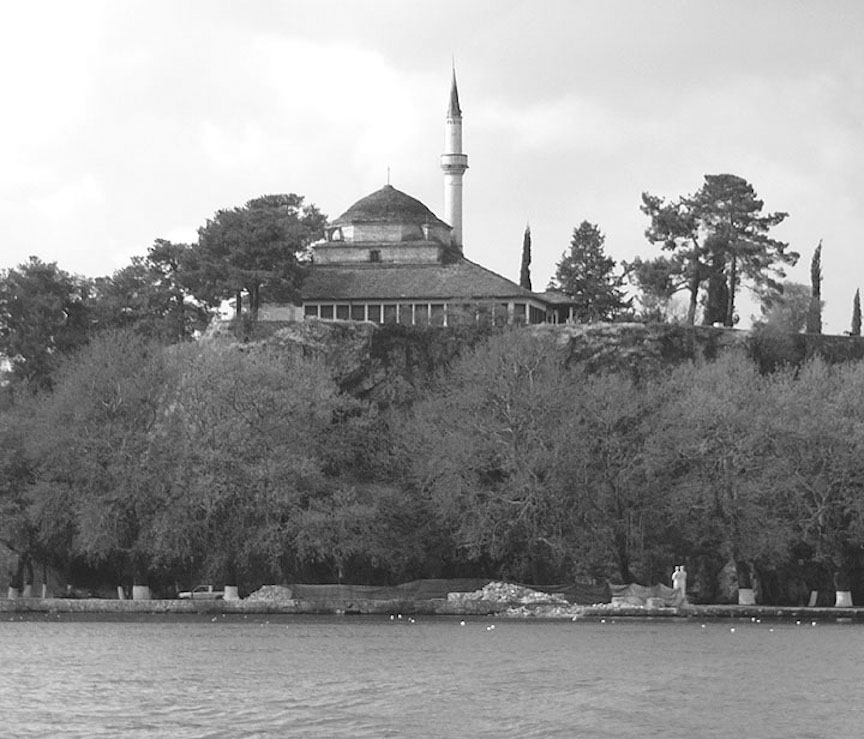
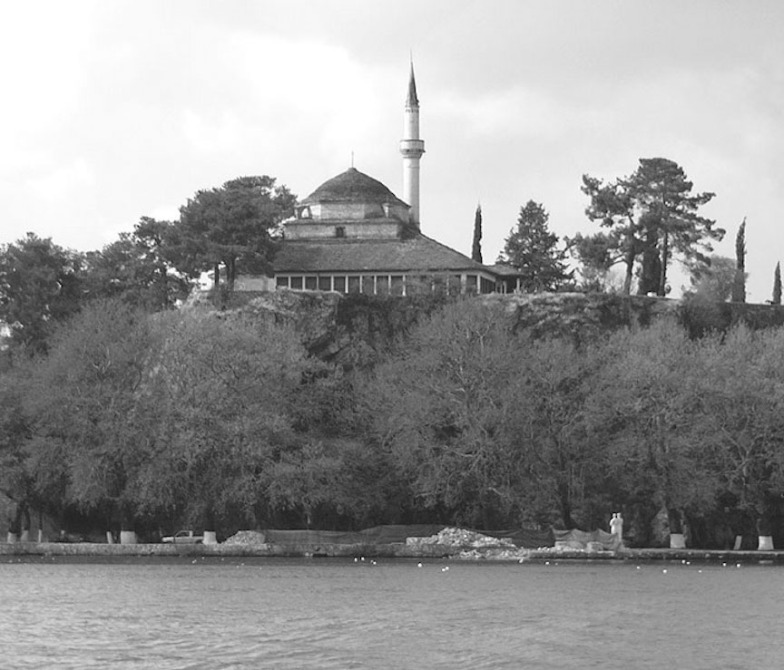
It also, unusually, and which I like to ascribe to Yanyalıs’ good taste and gentlenesss, has preserved four of its mosques, the two most beautiful in good condition even, and on the most prominent point of the city’s skyline.  It would be nice if they were opened to prayer for what must be a sizable contingent of Muslim Albanian immigrants now living there — who are practically invisible because they usually hide behind assumed Christian names — but that’s not going to happen in a hundred years, not even in Yanya.  Maybe after that…we’ll have all grown up a little.
ioannina165

janina

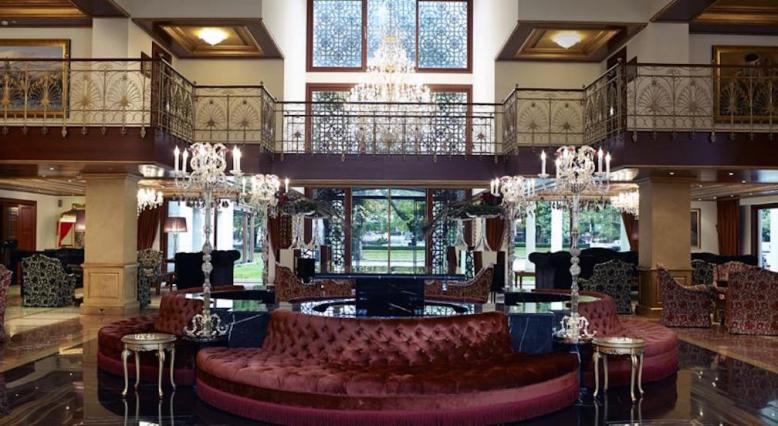
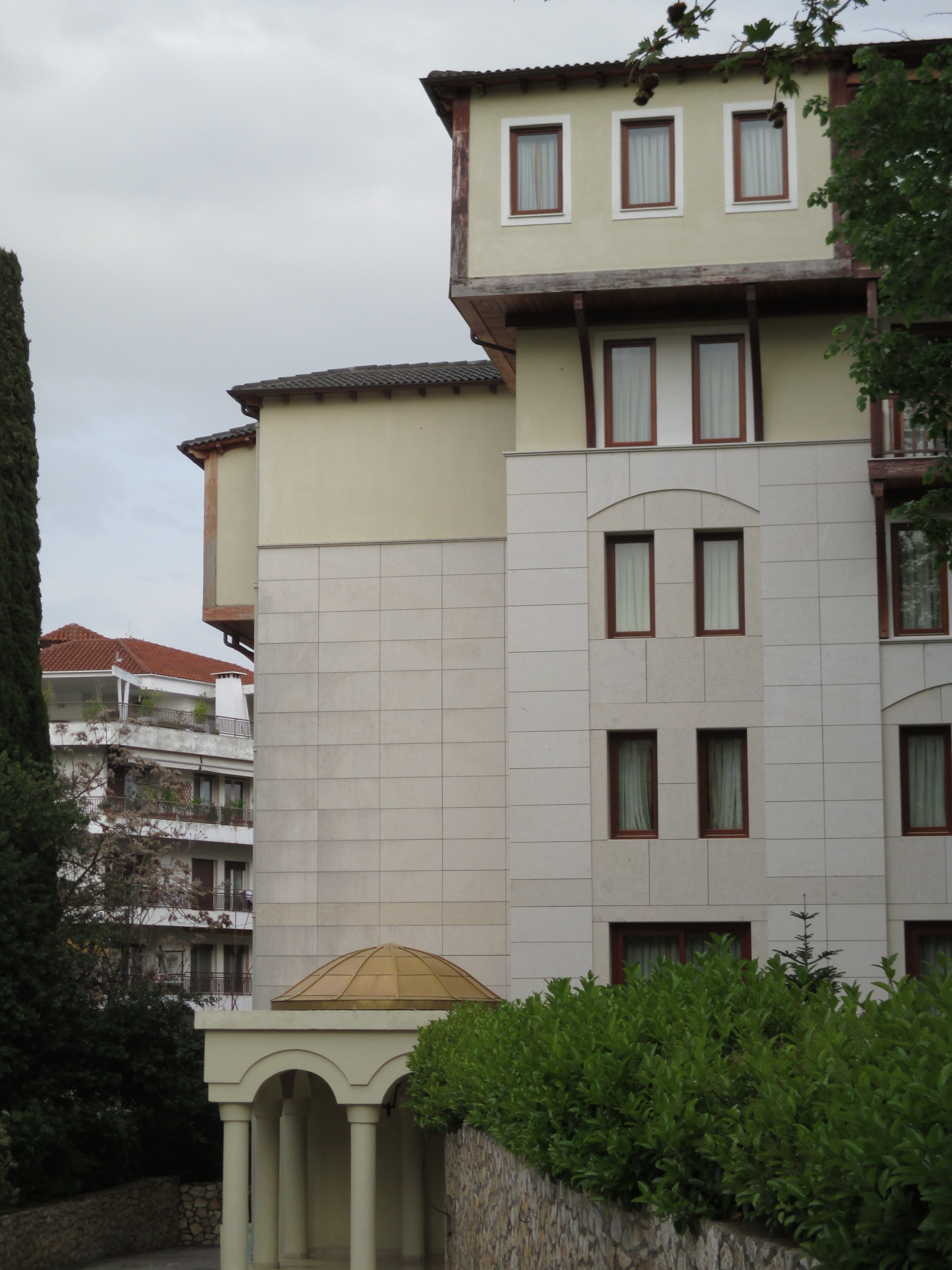
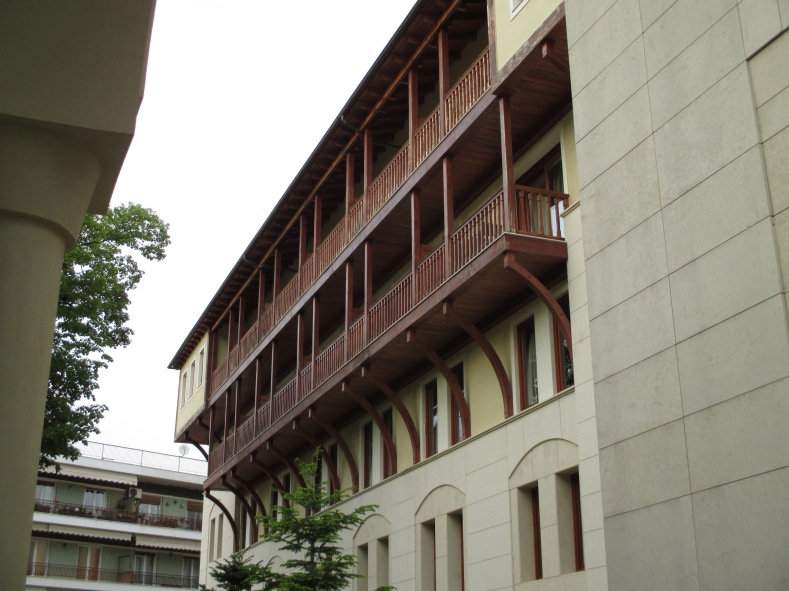
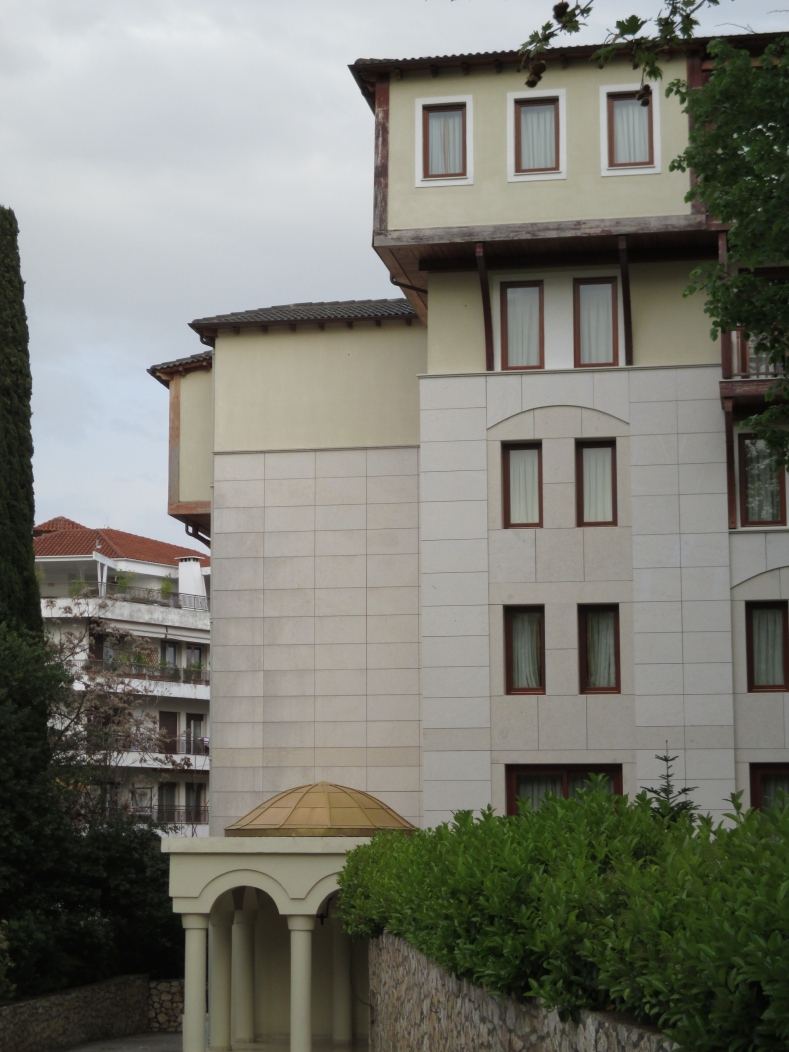
And, alone perhaps among Greek cities, only in Yanya can one open a super-luxury hotel that looks like this, with an interior décor that I’d describe as Dolmabahçe-Lite, call it the Gran Serail, and get away with it. 3***
IMG_0213

IMG_0215

44471198

Digression Bakos. What’s the point? What does this have to do with Yugoslavia? I’m not digressing. I’m giving a prelude. “People don’t have the patience for this kind of length on internet posts.” I don’t post. I write, however scatterbrainedly. And not for scanners of posts. For readers. However few have the patience.

So. Croatians don’t eat börek. The prelude should have been enough for me not to have to write anything else and for the reader to be able to intuit the rest. But for those who can’t…

The graffiti on the wall in the photo at top is dated 1992, but I think it had appeared as a slogan as early as the late 80s when Slovenes and Croats started airing their completely imaginary grievances against Serbian domination of Yugoslavia and making secessionary noises. What it meant is that we, Hapsburg South Slavs, were never part of the Ottoman Empire and therefore never were subject to the barbaric and development-stunting influences of said Empire that Serbs and whoever those others that live south of them were, and therefore have the right to be free of the intolerable yoke of Serbdom. We don’t eat burek. Not only do we not eat burek, but you offer it to us and we’ll refuse in German – “Nein Danke” – just to prove how much a part of the civilized Teutonic world of Mitteleuropa we are. 4*** (I think it was Kundera who wrote about the geographical ballooning of “Central Europe” after the fall of communism, till “Eastern Europe” finally came to mean only Russia itself. ‘Cause as we now see, even Ukraine is part of Central Europe.)

Why this yummy pastry dish was singled out as a sign of Ottoman backwardness and not, say, ćevapi or sarma, I can’t say.
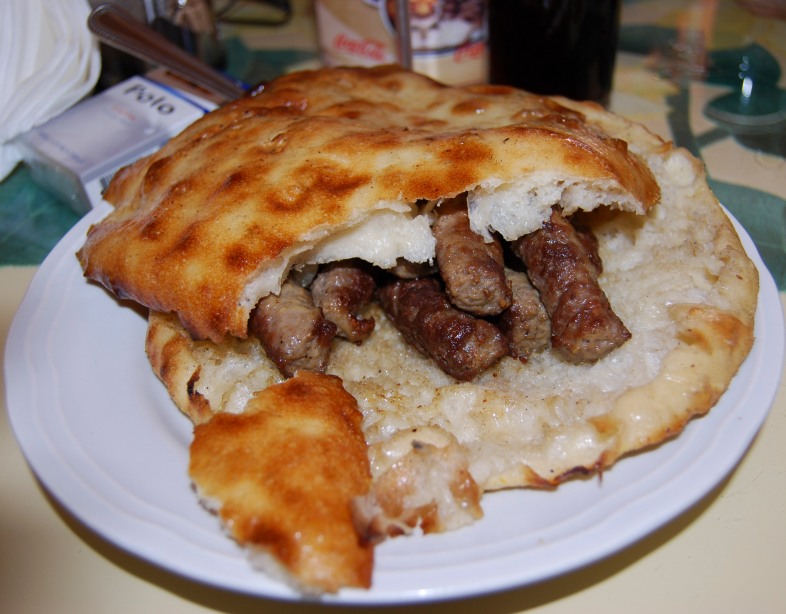
Cevapi54

Ćevapi — köfte, essentially — (above) and sarma (stuffed cabbage) below.
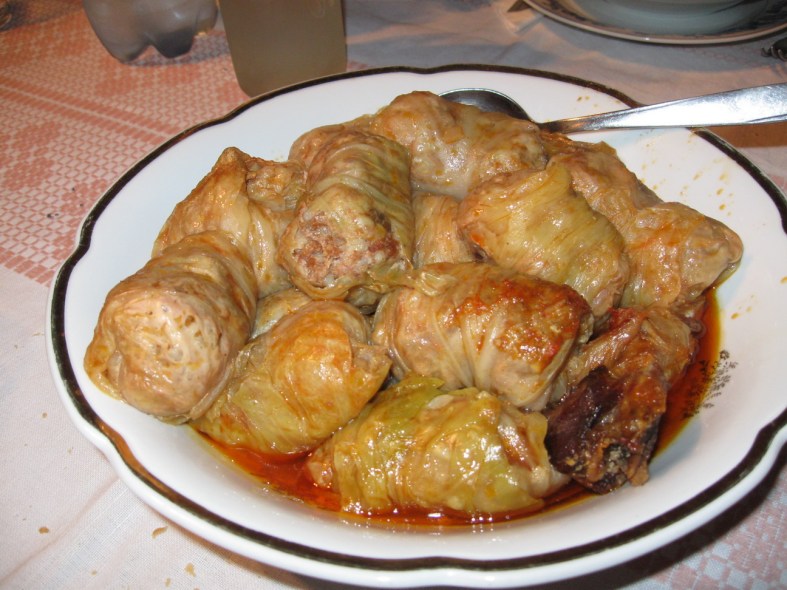
sarma raspakovana

And when I talk about Hapsburg South Slavs I’m obviously talking about Croats, because, let’s face it, who cares about Slovenes? And there may be very few, if any, compelling historical or cultural reasons of interest to care about Croatians either, except, that as most readers must know by now, I consider them the people most singularly responsible for the Yugoslav tragedy. And this post is my chance to come clear about why I feel that way. There may be lots of interpretations of what the “Illyrianist” intellectuals of Vienna and Novi Sad and Zagreb had in mind when they started spouting theories of South Slav unity in the nineteenth century; countless theories about how Yugoslavia or the original Kingdom of the Serbs, Croats and Slovenes was formed; many analyses of what happened in Paris in 1919 and what kind of negotiations led to the Corfu Declaration; and reams of revisionist stuff written about exactly what Croatia wanted out of this union. But, for me, one basic fact is clear: that Croatians were always part of Yugoslavia in bad faith; that they wanted something out of the Serb efforts and Serbian blood that was decisive in defeating Austria in WWI, but that that something was independence, or greater autonomy within an Austria that they probably never expected to be dismembered the way it was – anything but what they felt was being subjected to Belgrade. And that became immediately clear upon the formation of the state when they – being, as Dame Rebecca calls them, good “lawyers” – began sabotaging the normal functioning of the Yugoslav government in any way they could, no matter how more democratic the Serbs tried to make an admittedly not perfect democracy, no matter how many concessions of autonomy Belgrade made to them. If there were any doubt as to the above, even when Radić and his Croatian People’s Peasant Party had turned the Skupština into a dysfunctional mirror image of today’s American Congress, even when a Macedonian IMRO activist working in tandem with Croatian fascists assassinated Serb King Aleksandr in Marseille in 1934, it was subsequently made brutally clear by the vicious death-spree Croatian, Nazi-collaborating fascism unleashed on Serbs during WWII, a true attempt at ethnic cleansing that dwarfs anything the Serbs may have done during the 90s — which is dwarfed again by what Croatians themselves did in the 90s again: the most heinous Nazi regime, “more royalist than the king,” as the French say — more Nazi than the Nazis — to appear in Eastern Europe during WWII.  And they have not been even remotely, adequately,  held to account by the world for any for any of the above; all this ignored, even as the West maintains a long list of mea-culpas it expects Serbs to keep reciting forever.
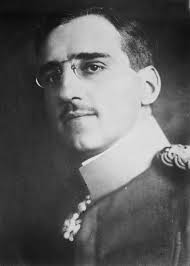
Alexander

King Aleksandr of Yugoslavia (click)

And so, when they got their chance in the 90s, with the backing of a newly united, muscle-flexing Germany, Croatians abruptly and unilaterally and illegally declared their long-wished for (but never fought-for) independence. And so did Slovenia; but again, who cares about Slovenia? It was a prosperous northern republic that may have held the same Northern-League- or-Catalan-type resentments against a parasitic south that was draining its wealth, but it was ethnically homogeneous and its departure left no resentful, or rightfully fearful, minorities behind. But Croatia knew, when it declared its independence – as did, I’m sure, their German buddies – that they were pulling a string out of a much more complex tapestry. And did it anyway. And we all saw the results. 5*****

So when a Croat says “Nein Danke” to an offer of burek, without even the slightest concern about his past reputation and avoiding any German associations, it is for me a chillingly racist and concise summation of Saidian Orientalism, a slogan that sums up not only the whole ugliness of the tragic, and tragically unnecessary, break-up of Yugoslavia, but the mind-set of all peoples afflicted with a sense of their being inadequately Western, and the venom that sense of inadequacy spreads to everything and everyone it comes in contact with. I’ve written in a previous post about Catalan nationalism:

All of us on the periphery, and yes you can include Spain, struggle to define ourselves and maintain an identity against the enormous centripetal power of the center.  So when one of us — Catalans, Croatians, Neo-Greeks — latches onto something — usually some totally imaginary construct — that they think puts them a notch above their neighbors on the periphery and will get them a privileged relationship to the center, I find it pandering and irritating and in many cases, “racist pure and simple.”  It’s a kind of Uncle-Tom-ism that damages the rest of us: damages our chances to define ourselves independent of the center, and damages a healthy, balanced understanding of ourselves, culturally and historically and ideologically and spiritually.  I find it sickening.

(see also: “Catalonia: ‘Nationalism effaces the individual…'” )

We’re signifying animals. And our tiniest decisions — perhaps our tiniest most of all – the symbolic value we attribute to the smallest detail of our lives, often bear the greatest meaning: of love; of the sacred; of a sense of the transcendent in the physical; of our self-worth as humans and what worth and value we ascribe to others; of hate and loathing and vicious revulsion. Nothing is an innocently ironic piece of graffiti – irony especially is never innocent, precisely because it pretends to be so.

And so I find anti-börekism offensive. Because a piece of my Theia Vantho or my Theia Arete’s börek is like a Proustian madeleine for me. Because I’m not embarrassed by it because it may be of Turkish origin. Because I think such embarrassment is dangerous – often murderously so, even. And because I think of eating börek — as I do of eating rice baked with my side of lamb and good yoghurt as opposed to the abysmally soggy, over-lemoned potatoes Old Greeks eat – as an act of culinary patriotism. 6****** And a recognition that my Ottoman habits, culinary and otherwise, are as much a part of my cultural make-up as my Byzantine or even Classical heritage are. Because just like Yugoslavia, you can’t snip out one segment of the woop and warf and expect the whole weave to hold together.
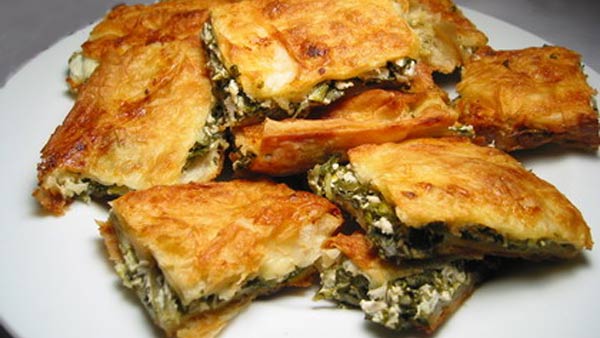
spinach-burek

******************************************************************************************************************************************************************

*1  One thing judo taught me — or rather what I learned from how long it took me, when I started, to learn to sit on my knees and flat feet — is how orthopedically horrible for our bodies upright, Western chairs and tables and couches are.  (By couch here I don’t mean the sink-in American TV couch, which you sink into until you’re too fat to get out of — that’s another kind of damage.)  Knee and lower back problems at earlier ages are far more prevalent in the Western world precisely because of these contraptions that artificially support and distort our body weight in destructive ways.  I remember older aunts in Epiros, in both Jiannena and the village, being able to sit on a low divan on the floor and pull their legs up under their hips with complete ease — women in their eighties and nineties and often portly at that — because their bodies had learned to sit on the floor or low cushions all their long and very mobile lives; they looked like they didn’t know what to do with themselves when you put them in a chair.  I’m reminded of them when I see Indian women their age at mandirs, sitting cross-legged, or with legs tucked under as described, through hours-long rituals, rising to prostrate themselves and then going down again, and then finally just getting up at the end with no pain and no numbness and no oyyy-ings.

**2  The two masterpieces of this point: the celebration of the sophistication and sensuality of the Ottoman sensibility and a trashing of Neo-Greek aesthetics — and by extension, philisitinism, racism and Western delusions — are Elias Petropoulos’ two books: Ο Τουρκικός Καφές εν Ελλάδι“Turkish Coffee in Greece,” and Tο Άγιο Χασισάκι “My Holy Hash.”  Part tongue-in-cheek, part deadly serious, both books are both hilarious and devastating.

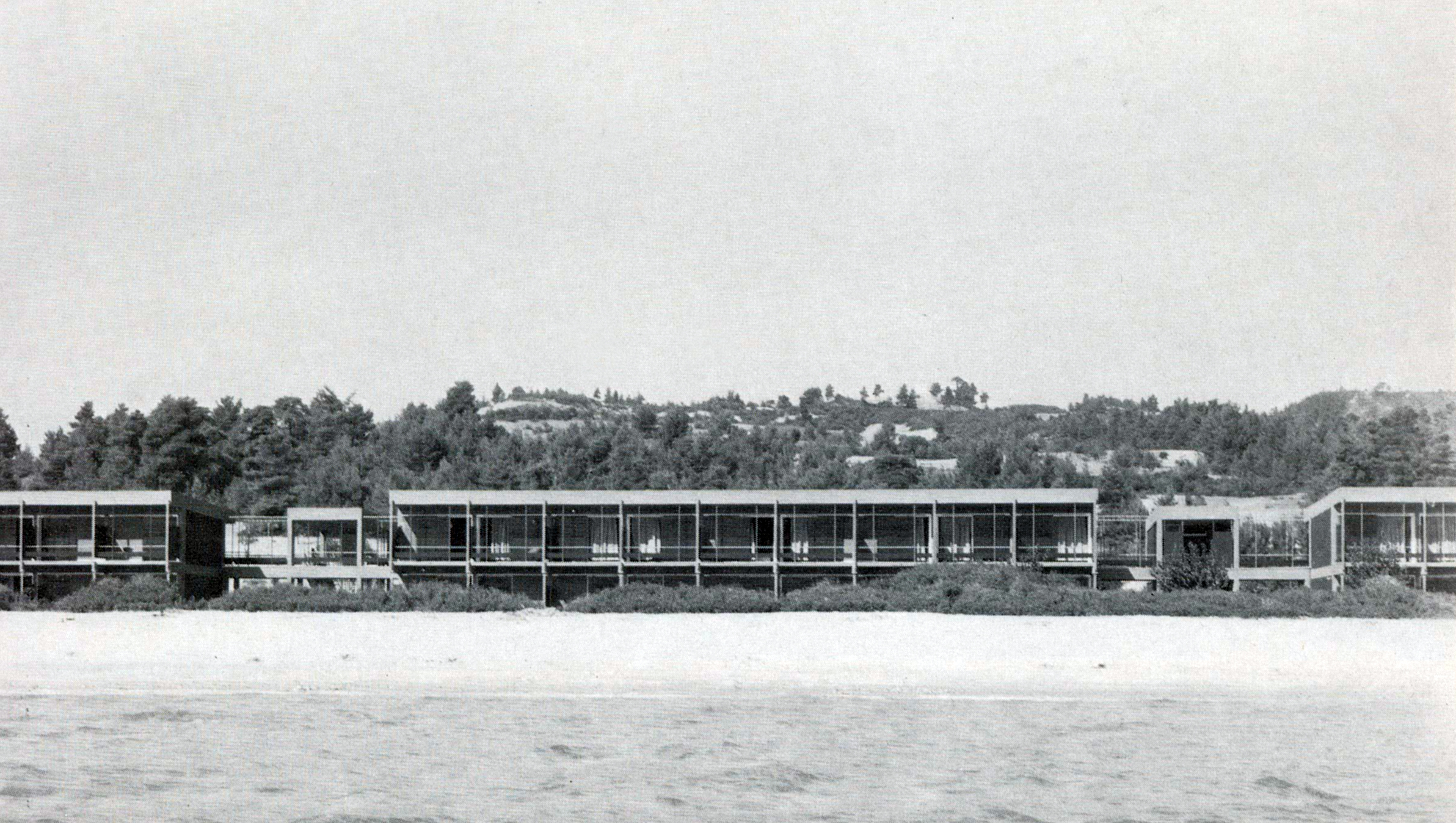
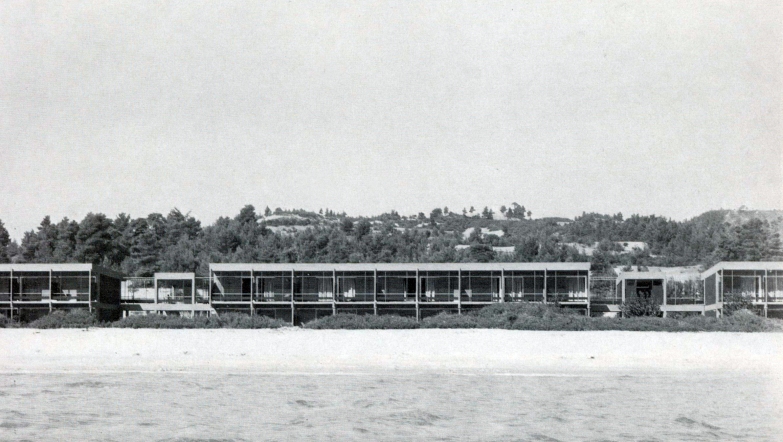
***3  Unfortunately, to build this palace of Neo-Ottoman kitsch that would make Davutoğlu proud, one of Greece’s classic old Xenia hotels, masterpieces of post-war Greek Modernism and most designed by architect Aris Konstantinidis, was torn down, and most of these hotels have suffered similar fates throughout the country, as the nationally run State Tourist Organization was forced to sell off its assets by the privatization forced on Greece then and to this day.
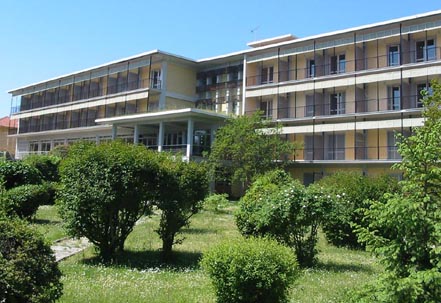
Xenia Jiannena

The Jiannena Xenia, above, built in the old wooded grove of Guraba, just above the center of town, and, below, perhaps Konstantinidis’ masterpiece, the Xenia at Paliouri in Chalkidike. (click)
Eot-paliouri-1962-2

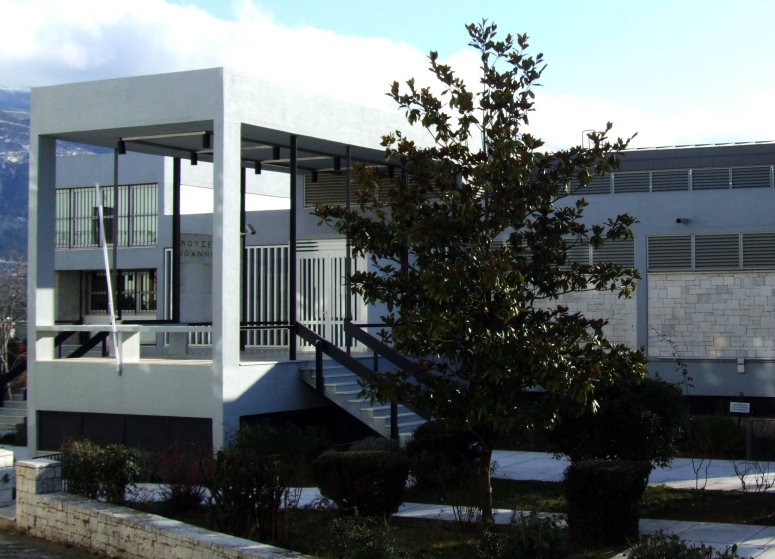
Fortunately, Jiannena preserves one of Konstantinidis’ other masterpieces, its archaeological museum, below. (click)
100_6975_-_Kons.Ioan1

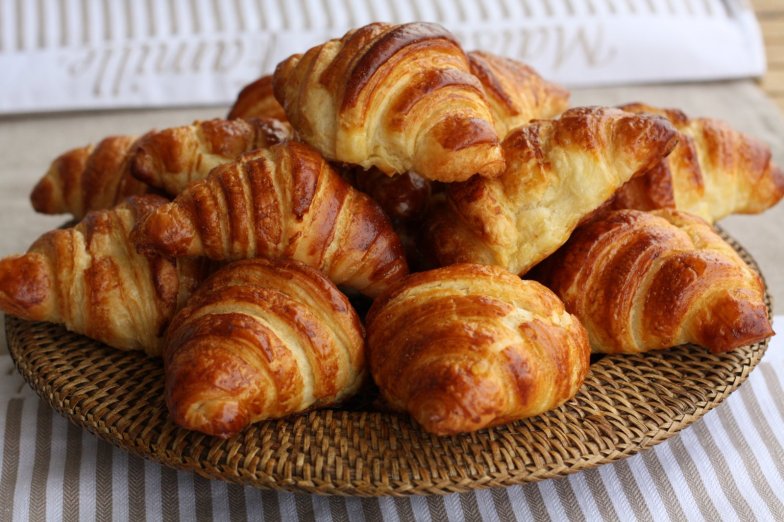
****4  Ironically, the strudel that Croats and Slovenes imagine themselves eating in their Viennese wet dreams is probably a descendant of börek; and take it a step further: let’s not forget that croissants and all danish-type puff pastry items are known generically as viennoiserie in French.  So the ancestor of some of the highest creations of Parisian/French/European baking arts is something that a Slovene says “nein danke” to in order to prove how European he is.  Talk about the farcicalness of “nesting orientalisms.”
croissant

*****5  Of course, in every case, this assumption-cum-accusation, about the parasitic South draining the North of its resources, is patent bullshit.  Southern Italy, the southern Republics of Yugoslavia, Castille, Galicia, Andalusia, and the southern tier of the European Union today, may get disproportionately more in the allotment of certain bureaucratic funds compared to the tangible wealth they produce.  But they also provide the North, in every single one of these cases, with resources, labor and markets on which that North gets rich to a far more disproportionate degree and stunts the South’s growth in the process.  So haydi kai…

It’s become a common-place — and not inaccurate — observation that the catastrophic economic pressure Germany is today exercising on the nations of Southern Europe for the sake of making some sick moral point is the fourth time it’s wrecked Europe in less than a centurythe third time being when it decided, immediately upon reunification, to show the continent it was a political player again by practically single-handedly instigating the destruction of Yugoslavia.

******6
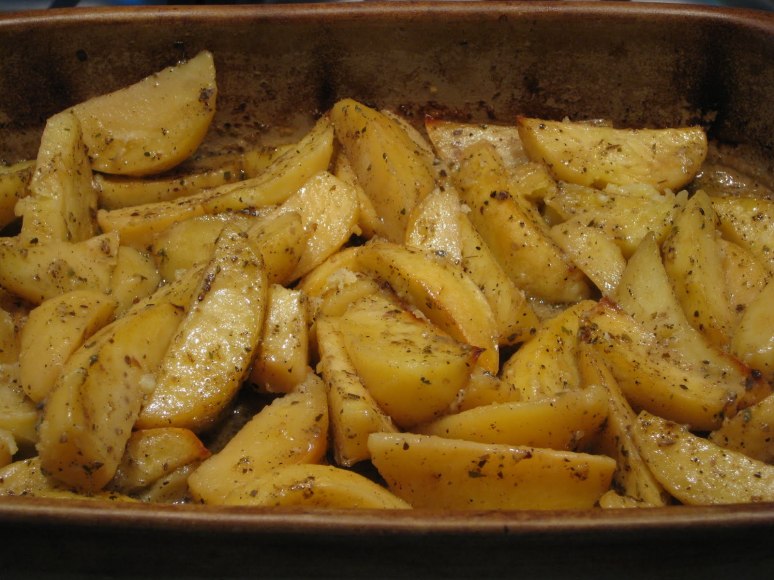
patattes

Over-oreganoed and over-lemoned — like much of Greek food — and overdone, over-salted and over-oiled, perhaps the only thing more repulsive than the soggy potatoes Old Greeks bake with lamb or chicken (though one horrible restaurant — which New Yorkers are for some reason crazy about: I mean like “take-the-N-train-out-to-Astoria-and-wait-for-a-table-for-an-hour” crazy — criminally serves them with grilled fish) is the serving of stewed meat with french fries.  You’ve hit the rock bottom of Neo-Greek cuisine when you’ve had a dry, stringy “reddened” veal or lamb dish accompanied by what would otherwise be good, often hand-cut french fries, sitting limply on the side and sadly drowning in the red oil.

Comment: nikobakos@gmail.com