Tag Archives: Epiros

Maps

24 Jan

Balkans-ethnic_(1861)

Ethnic_map_of_Balkans_-_russian_1867(click)

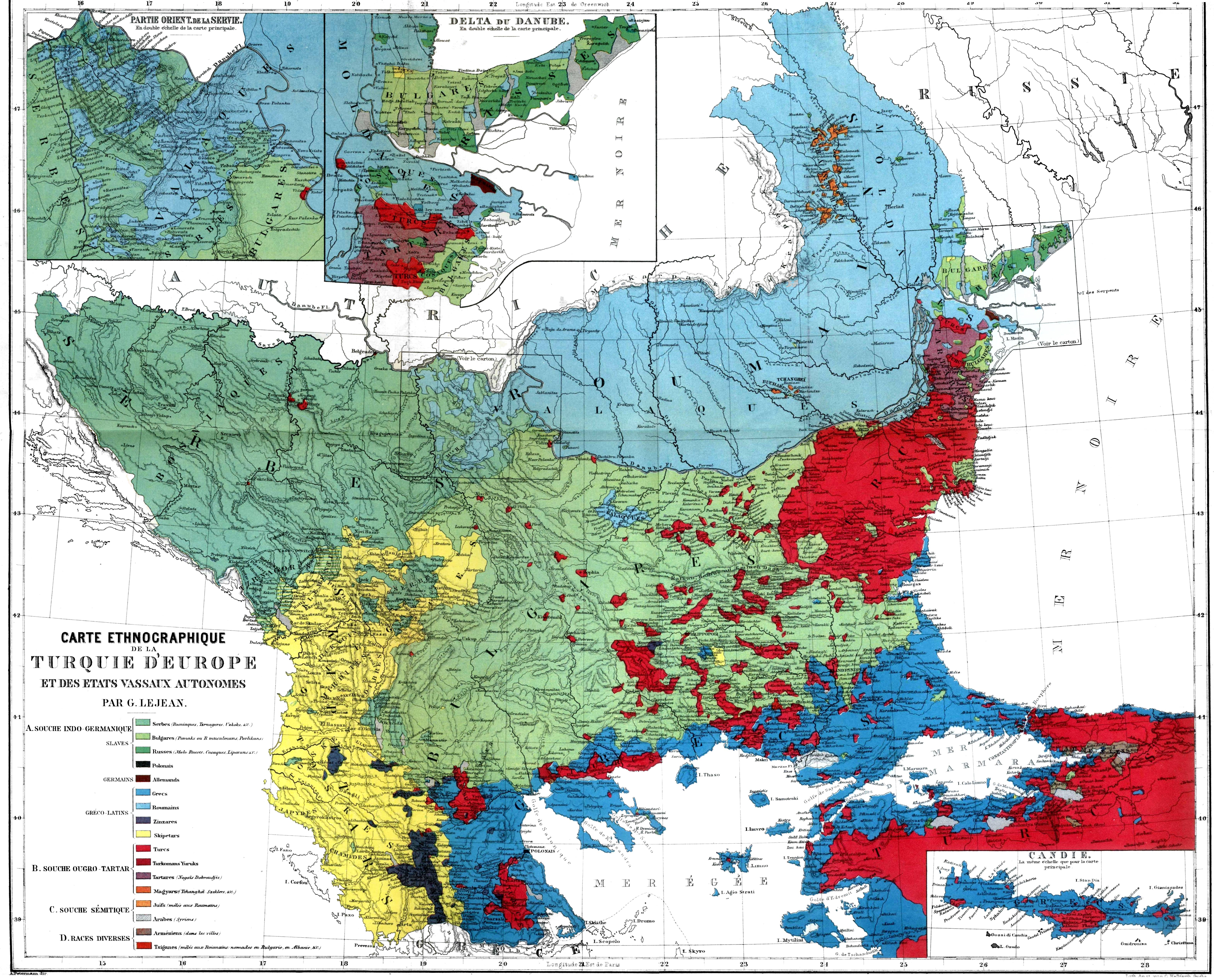
Yes, of course, the maps I posted here, in “The Invasion of America” and have reposted above, unleashed a torrent of nationalist, hysterical emails and comments from Greeks — and only Greeks — that I have to address.

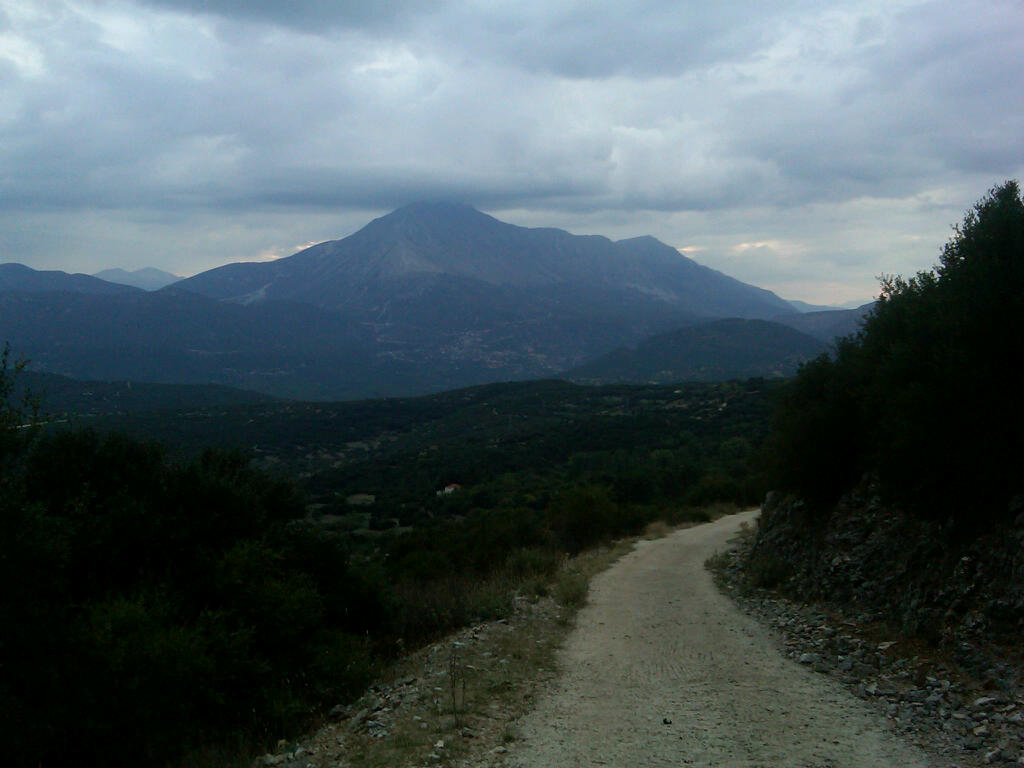
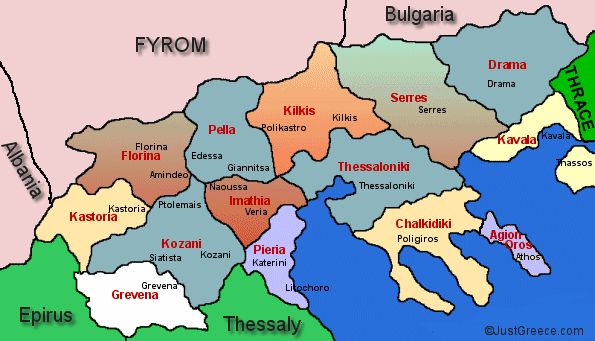
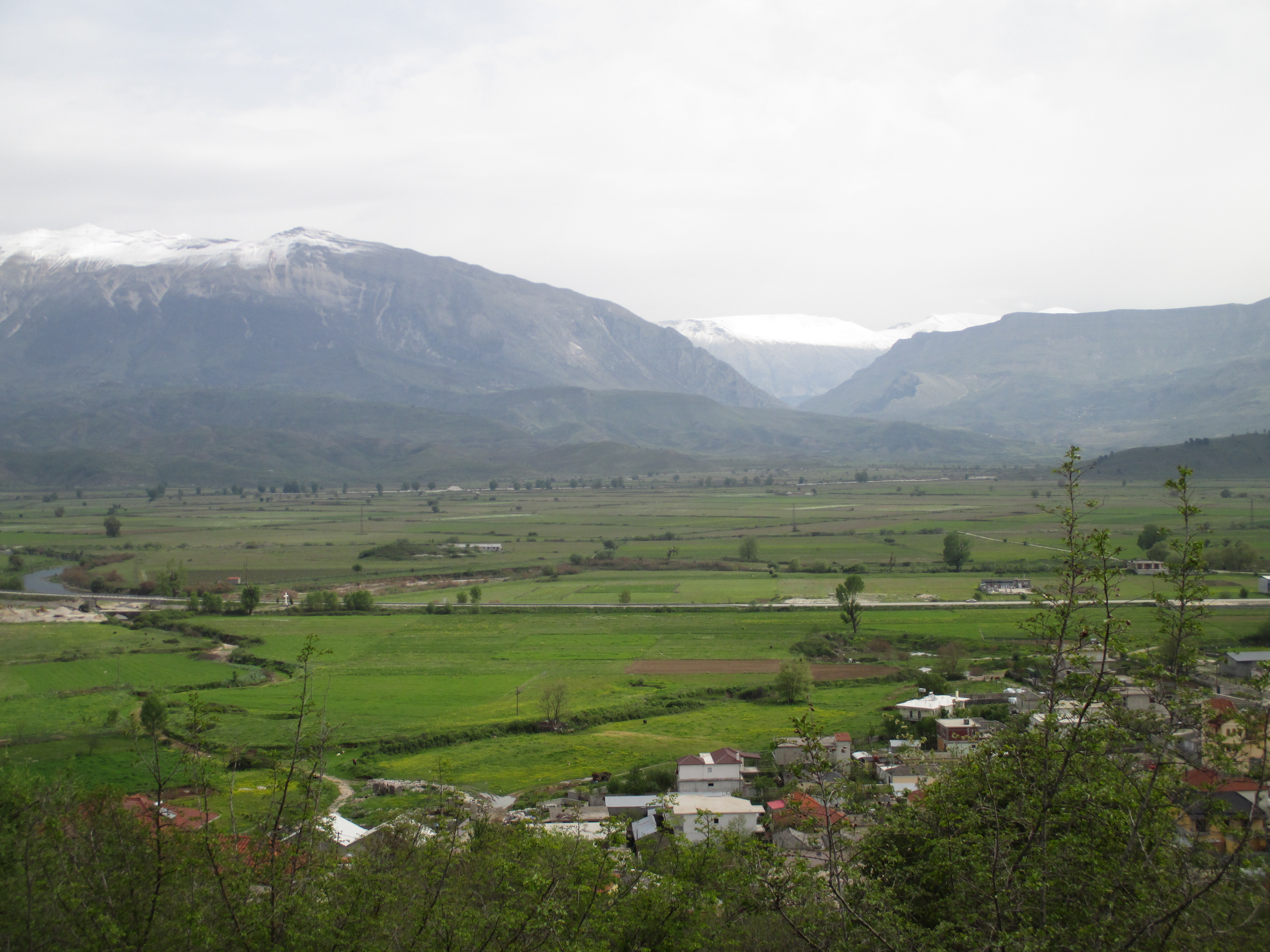
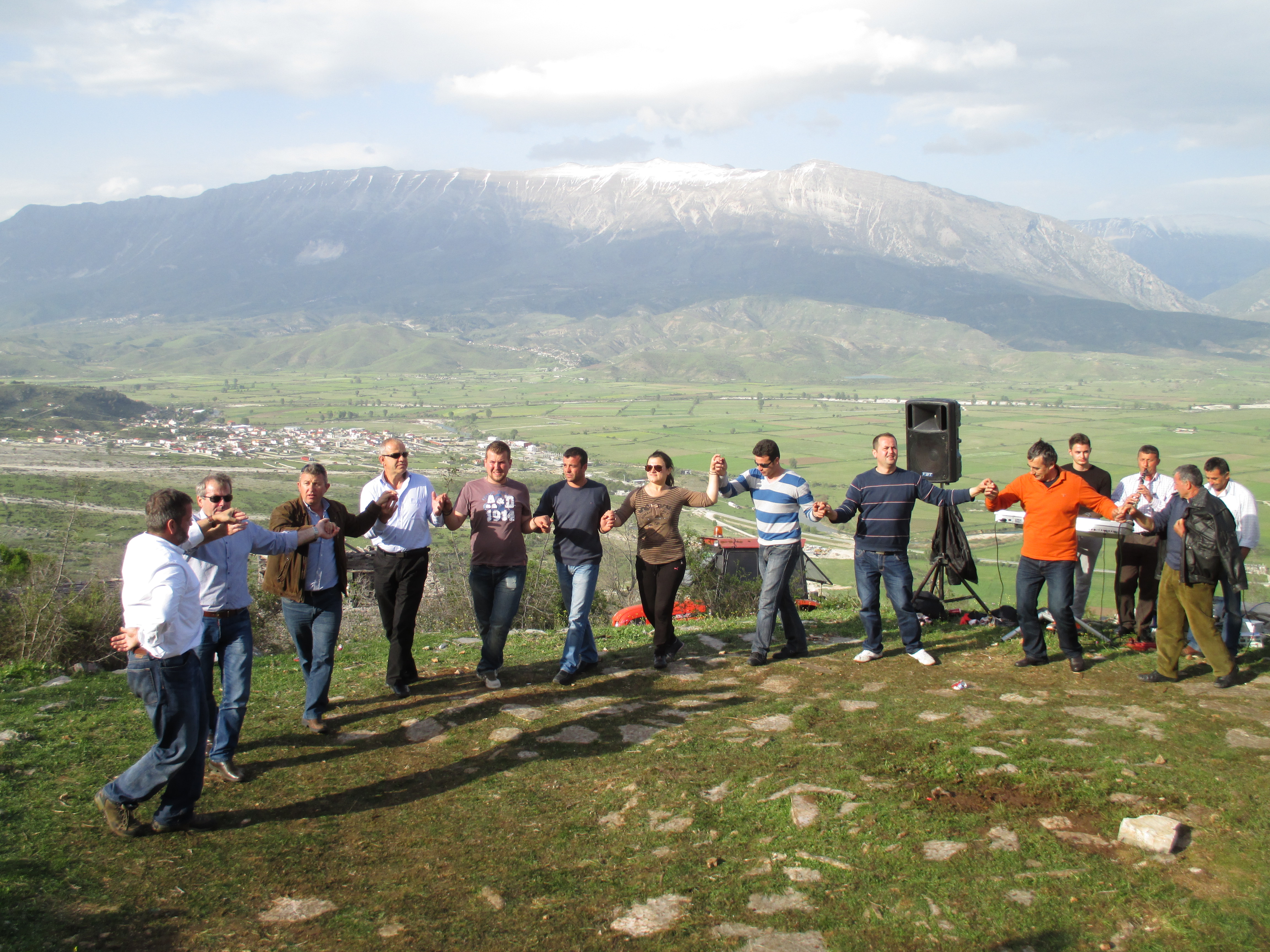
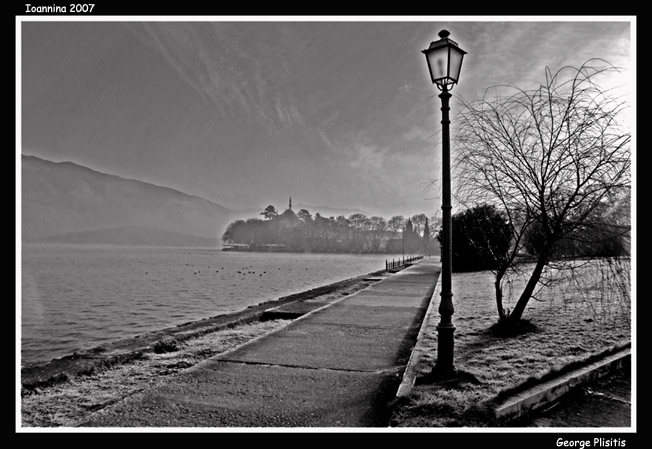
Yes, the maps are clearly inaccurate in certain respects, particularly with the territory indicated as inhabited primarily by Albanians.  That an Albanian majority lived, or that Albanian was spoken in such a solid block, as far south as the Ambrakikos Gulf (down to Preveza) in the first map, and clear down to the Gulf of Corinth on the second map, is ridiculous and is probably the result of dumb speculation on the map-makers’ part and not motivated by some nationalist agenda.  And yet, let’s not forget those periods in history when Greek Epiros was much more Albanian than it is today.  Until the early nineteenth century, the region of Souli, right behind these mountains (below) seen from my mother’s village Pesta in south-central Epiros and just north of the border with the prefecture (I guess?) of Preveza, was inhabited largely by Albanian-speaking Christians, when they were expelled and dispersed by Ali Paşa.  Just north, lowland parts along the coast of what’s now Thesprotia around the coastal city of Igoumenitsa (see map below) were primarily inhabited by Albanian Muslims (known as Çamedes and the region as Çamëria) until they were massacred and expelled by Greek Nationalist resistance forces during WWII.  And, to jump back in time, one of the splinter states that emerged from the complicated history of the Despotate of Epiros, was ruled by Albanian clans with their capital in Arta and did extend as far south as Naupaktos and the Gulf of Corinth.  Oddly enough, the second map, which ridiculously shows all of Aetolo-Acharnania as Albanian, fails to indicate the large Albanian-speaking regions of the Peloponnese. 

pestaaithanase(click)

Map EpirosEpiros

But the second of the two maps at top is also ridiculous in that the Aegean coast of Anatolia was never so solidly Greek so deeply inland.  Greeks were not a majority anywhere in the region (as Metaxas pointed out in his warning to the egomaniacal Venizelos just before he embarked on his insane campaign), and if the region had been so Greek, there wouldn’t have been any Turkish villages for the Greek army to commit its atrocities against soon after landing in Smyrna in 1919.

Of course, no Greek readers complained about that.

I found the fact that Dobruja, the Danube delta region of what’s now northeastern Bulgaria, was so solidly Muslim to be interesting — again, if the map is accurate.

Finally, what both maps do make abundantly clear, and should be abundantly true to anyone with any kind of historical integrity, is that the majority ethnic group in what’s now Greek Macedonia were once Bulgaro-Macedonians.  (I’ve been told to go fuck myself by numerous Greeks whenever I say this. And in those exact words.  And in the middle of perfectly civil conversations.  That’s the degree of infantile, paranoid anger Neo-Greeks feel about the issue.  And it’s totally obvious that that comes from semi-consciously knowing that Macedonia’s Greekness is problematic and much more historically complicated and heterogeneous than they would like it to be.)  Obviously that’s not the case today, due to their expulsion throughout the decade of the 1910s and the Balkan and Second World Wars, a population exchange with post-war Bulgaria, the massive influx of Greeks from Turkey in the ’20s, and that the fact that those Macedonian-speakers who remained and still form a most cohesive ethnic block in the northwest corner provinces of Kostur and Lerin, (see map below) are still too terrorized to speak their identity out loud, or, even more tragically, have been so brainwashed that if you even suggest that they speak some form of Bulgaro-Macedonian, they become enraged.  More Royalist than the King.  More on Macedonia in future posts.  But let’s just say that the one thing the maps show definitively is that, of all the countries to come out of the collapse of Ottoman power in the Balkans — and given the real demographics on the ground — it’s safe to say that Bulgaria came out the most short-changed and screwed.

 Two maps below: one showing the regions of Kostur (Kastoria) and Lerin (Florina) in the northwest corner of Greek Macedonia. And beneath, a map of the same regions where you can see the fake new names given to many towns and villages in the region to replace the old Slavic ones.  This did not just happen in Macedonia, but throughout Greece.  But since Macedonia was the least Greek region of twentieth-century Greece, it was imperative that this Hellenization process and obscene distortion of history be applied there most widely.  The thing is that the names of these villages are so patently fake-sounding and made up — Cold Spring, Two Rivers, Deer Hill, etc. — that they sound like American suburban developments.  Most were just completely fabricated…a village next to my mother’s called by the not particularly lyrical — yet not particularly or dangerously Slavic-sounding — name of Moulies was changed to Perdika Partridge.  No reason.  Or, they were excavated classical names based on ancient Macedonian personages, like Amyntaio, previously Sorović, or Ptolemaida, formerly Kaylar, and inhabited exclusively by Greek-speaking Turks and Yörük-type nomads settled there from Anatolia, who had preserved their nomadic lifestyle and pure Turko-Asiatic physical characteristics until the twentieth century. Then there’s the stunningly pretentious Argos Orestikon,* whose historic name was Hrupišta.  (All these can be found on the bottom map.) Or the renaming took its cue from the slightest possibility that in Classical times a settlement by that name may have existed within a hundred-kilometer radius of the present-day town — i.e. Vodena changed “back,” supposedly, to Edessa.  On top of it all, most of the real Slavic names were so much more beautiful and appropriate: Vodena or Voden (Edessa) is a pleasant little city full of babbling brooks and waterfalls and comes, precisely, from the Slavic word for water, “voda,” while the new name for the beautiful village of Neveska, shown in the second map, is simply a translation from the Slavic — Nymphaio — and means the same thing: “bridal.”  Don’t know why the village would’ve been called that.

Finally, these paranoid, nationalist name changes happened throughout the Balkans and Turkey, so you can’t just criticize the Greek state for it.

map-of-macedonia

florina-map

Comment: nikobakos@gmail.com

**************************************************************************************************************************************************************************

*  Don’t ask me what this ugly little town near Kastoria has to do with Argos in the Peloponesse, or with Orestes, the mythological scion of the cursed Atreid family, who, almost Christ-like, took his family’s curse upon him and eventually was absolved of it.  If any one has any clue, please let me know.

The Classical Liberals: “On the Balkans, the Former Yugoslavia, and the Unity of Spaces”

4 Jan

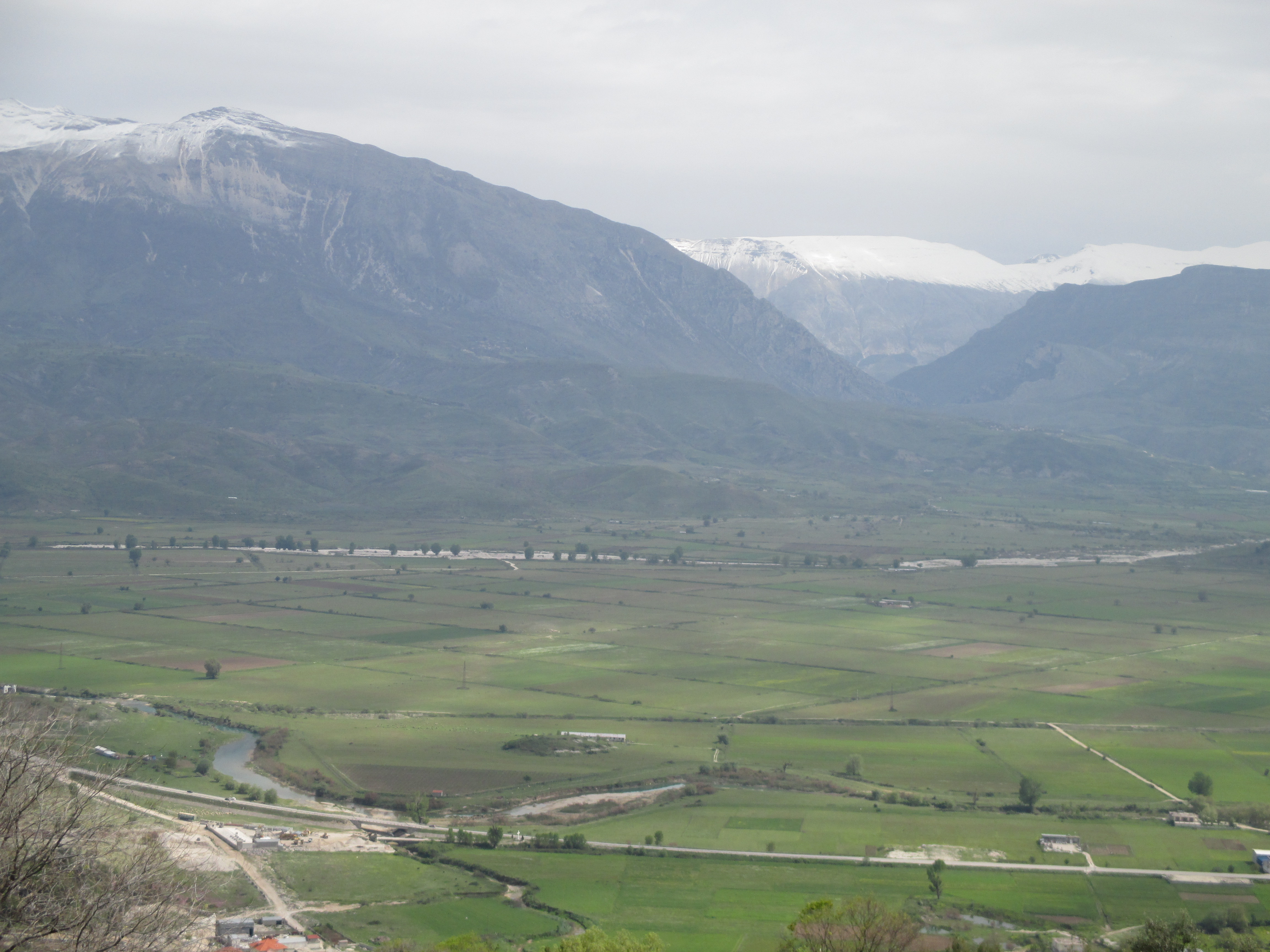
dropoliThe Valley of Dropoli, the pass up to the Pogoni plateau near Libochovo, and in the distance, the snowcapped peaks of Nemerčka, from the Monastery of the Taxiarches in my father’s village of Derviçani, Easter 2014 (click)

I’m honored by the fact that this really intelligent blog quotes extensively from the Jadde’s mission statement in a recent post: Jadde — Starting off — the Mission.

Check them out: The Classical Liberals: At least, most of the time  Smart, perceptive, interesting stuff.

The author of the post below and the person I suspect is largely behind the editing of the blog is one Eoin Power, not just a fellow Balkan-freak along the lines of me or Rebecca West, but also a fellow Epirote.  He demurs a bit — though not very convincingly — at being called an Epirote, because his lineage is multiple and complicated and the connection to Epiros is fairly distant historically.  But he’s from one of the most archetypically and ancient Epirotiko villages — where they still own their patriko — in one of the most archetypically Epirotiko regions of Epiros and he carries himself with the requisite Epirotiko dignity and soft-spokeness and if I, NikoBakos, have conferred the title on you, it’s ’cause you deserve it.

***************************************************************************************************************************************************************************

On the Balkans, the Former Yugoslavia, and the Unity of Spaces

The other day, as she is wont to do, my mother sent me a link to something on the Internet; this time it was to Nicholas Bakos’ blog, which you can find here. If you’re reading this blog, we’re probably friends in real life (thanks for reading!), and so it’s probably obvious why something like that would be of interest to the both of us. I have admittedly only skimmed sections of his posting so far, but in his introductory one, it was especially gratifying to read this:

This blog is about “our parts.”  It’s about that zone, from Bosnia to Bengal that, whatever its cultural complexity and variety, constitutes an undeniable unit for me.  Now, I understand how the reader in Bihać, other than the resident Muslim fundamentalists, would be perplexed by someone asserting his connection to Bengal.  I can also hear the offended screeching of the Neo-Greek in Athens, who, despite the experiences of the past few years, or the past two centuries, not only still feels he’s unproblematically a part of Europe, but still doesn’t understand why everyone else doesn’t see that he’s the gurgling fount of origin and center of Europe.

But set aside for one moment Freud’s “narcissism of petty differences,” if we have the generosity and strength to, and take this step by step.  Granted there’s a dividing line running through the Balkans between the meze-and-rakia culture and the beer-and-sausage culture (hats off to S.B. for that one), but I think there’s no controversy in treating them as a unit for most purposes; outsiders certainly have and almost without exception negatively.  And the Balkans, like it or not, include Greece.  And Greece, even more inextricably, means Turkey, the two being, as they are, ‘veined with one another,’ to paraphrase the beautiful words of Patricia Storace.  Heading south into the Levant and Egypt, we move into the Arab heartland that shares with us the same Greek, Roman-Byzantine, Ottoman experiences, and was always a part of the same cultural and commercial networks as the rest of us.  East out of Anatolia or up out of Mesopotamia I challenge anyone to tell me where the exact dividing line between the Turkic and Iranian worlds are, from the Caucasus, clear across the Iranian Plateau into Afghanistan and Central Asia.

Bakos suggests that for people of “those parts” displaced to another environment (e.g. grad school in the West), this kind of geographical unity came, at least in a social context, fairly naturally, so perhaps I shouldn’t be all that surprised and delighted at seeing it reconstituted in blog form. But in fact I think the basic unity of the geographical zone outlined here often gets lost in the way these places are understood by outsiders and, ironically enough, in no small part due to the vehement insistence from each of the zone’s component peoples that they could not possibly be compared with those uncultured idiots with whom they share a border.*

Explaining the rationale for delineating “his parts” the way he does, Bakos writes:

But to step into Buddhist Burma is somehow truly a leap for me, which maybe I would take if I knew more. And in the other direction, I stop in Bosnia only because for the moment I’d like to leave Croatia to Europe – mit schlag – if only out of respect for the, er, vehemence with which it has always insisted that it belongs there.  Yes, I guess this is Hodgson’s “Islamicate” world, since one unifying element is the experience of Islam in one form or another, but I think it’s most essential connections pre-date the advent of Islam.  I’ll also probably be accused, among other things, of Huntingtonian border drawing, but I think those borders were always meant to be heuristic in function and not as hard-drawn as his critics used to accuse him of, and that’s the case here as well.

Ultimately what unites us more singularly than anything else, and more than any other one part of the world, is that the Western idea of the ethnic nation-state took a hold of our imaginations – or crushed them – when we all still lived in complex, multi-ethnic states.  What binds us most tightly is the bloody stupidity of chilling words like Population Exchange, Partition, Ethnic Cleansing – the idea that political units cannot function till all their peoples are given a rigid identity first (a crucial reification process without which the operation can’t continue), then separated into little boxes like forks after Easter when you’ve had to use both sets – and the horrendous violence and destruction that idea caused, causes and may still do in “our parts” in the future.

Having not, at least north of the equator, yet made it further east than Istanbul, I am in no position to question Bakos’ perception of the fundamental apartness of Buddhist Burma. But the loose border he posits to the north and west is one I’ve crossed many times, and it’s one that is both deeply present and functionally invisible.**

At the very least it is present in people’s minds; I can vouch for the vehemence (to use Bakos’ word again) with which Slovenes and Croats will insist that their countries are European, and not Balkan. It’s also pretty visually observable – you could mistake Zagreb or Ljubljana for a city in Austria or Germany in a way you simply can’t for, say, Sarajevo or Belgrade. And on one frantic trip from Dubrovnik back to Ljubljana (the ferry which I’d intended to take from Dubrovnik to Ancona decided not to arrive from Split, leaving me nothing to do but beat a hasty retreat back north) you could, if you were looking for it, see an actual tangible difference in the way things were done in the world – bus tickets in Mostar and train tickets in Sarajevo had to be paid in cash and a conductor on the train north from Sarajevo let me pay in a mix of Croatian kuna, Bosnian marks,  and euros. In Zagreb I could pay with a credit card, the train station had working and appealing amenities, and you couldn’t smoke in the train. This is a terribly squishy thing to write, but it did feel more “European-y”.

On the other hand, if the relatively old Huntingtonian dividing line between formerly Orthodox and Ottoman lands to the south, and formerly Catholic Hapsburg lands to the north is visually (and, at least in terms of credit card viability in 2009, functionally) discernible, the comparatively recent unifying experience of Yugoslavia is also unavoidable. Here, too, the first signs are in architecture and appearance; Soviet-style architecture and the legacy of 1950s industrialization has left the same physical scars on cities from Nova Gorica to Skopje. But they run deeper than that – the protestations of linguistic nationalists notwithstanding, Slovene, Bosnian, Croatian, Serbian, Montenegrin, Macedonian (hell, even Bulgarian a bit) all exist along a spectrum of of mutual intelligibility; state apparatuses, all having those of the former Yugoslavia as their common predecessors, share similar characteristics. Indeed, to me as a foreigner, the similarities often seem more salient than the differences.

Just on the basis of whether or not there “is” a usefully differentiating border to be drawn where Croatia meets Bosnia, it seems you can argue fairly fruitfully either way, depending on whether your sympathies lie with a sort of longue duree emphasis on deep civilizational splits or a faith in the primacy of modern political experiences. But by Bakos’ own ultimate criteria, it seems a bit odd to leave the northernmost bits of the former Yugoslavia out of things (though there is a nice alliterative symmetry to covering “from Bosnia to Bengal”) . If you’re going on the basis of, “the bloody stupidity of chilling words like Population Exchange, Partition, Ethnic Cleansing,” surely things like Jasenovac or the Istrian exodus argue for the inclusion of all of the former Yugoslavia?

Of course, any exercise in boundary-izing is a bit arbitrary, and in this case there are good reasons to put one in between Croatia and Bosnia and not, say, in between Slovenia and Austria (two countries for which there also exist plenty of historical reasons to consider them as part of a unified space). So if all of this does anything, it is perhaps to show how much more liminal are most places than we or their inhabitants often care to admit; whether or not you see a border somewhere often depends as much on your level of zoom as anything else.

*Or at least their nationalist politicians – many average people (whatever that means) in Bosnia and Serbia, for example, will quickly stress to you the fundamental similarities between the two countries and their inhabitants
**People sometimes marvel at my overstuffed passport but really something like 40% of the stamps come from the Dobova and Dobrljin border posts.

**************************************************************************************************************************************************************************

Again, check these guys out; you won’t regret it: The Classical Liberals

Comment: nikobakos@gmail.com

The adventures of me and my nephew Vangeli in C-town

2 Jun

IMG_0779

(click)

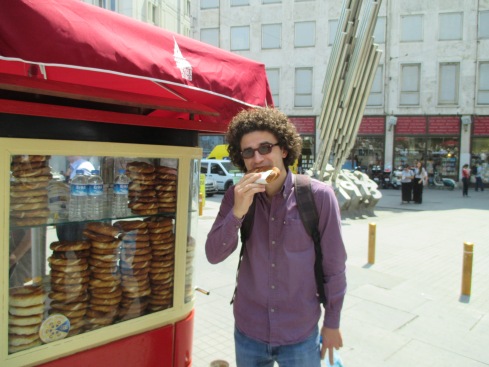
This is my nephew Vangeli from Tirana, who came and spent an extended weekend with me in Istanbul last week, eating a simit in the Staurodromi.  When I started this blog I said to myself I wasn’t going to include personal names.  When you represent something ideologically problematic for me, you’ll usually be described by a repeated sociological profile: “the Athenian thirty-something” or you’ll get a moniker all your own; in any event, if you read regularly, you’ll know who you are.  But the warmth of certain experiences I had with my family in my village this past spring has made me want to “call their names,” both because these are people I learned to love a great deal in a very short amount of time and to do them the honor, even if these experiences are not that interesting for the objective reader.  It’s obvious that it’s for them.

Vangeli is my second cousin Calliope’s eldest son. (See Easter Eggs… because, believe me, you don’t want me to run through all the lineages each time and I can’t do it either.)  When I first went to Derviçani in 1992, after Albania had safely opened up for good, Calliope was already living in Jiannena and we met there first, so we could get to know each other before going into Albania together.  When we arrived in the village for the first time, hers was the face I was constantly looking for as a reference point among the throngs of relatives who were constantly surrounding me.  It was her and my cousin Panto, Pantele, who is still my official bodyguard everywhere I go in the village, telling me who’s who since I can’t keep track, taking me everywhere I want to go, counting the tsipoura (raki) I have at every visit, so they don’t add up to too many in one afternoon, etc.  His mother, my Kako Poly (Polyxene), is a saintly woman who made great sacrifices caring for my grandmother in her final years under conditions of great material deprivation for all.  In video we have of my grandmother, taken by complete fluke by a cousin of my mother’s who went to Albania in 1988, a year before my grandmother died, as part of a Greek commercial exchange delegation — these groups were always taken to Derviçani as it was the showcase Greek minority village in communist times — my grandmother says: Να, αυτή είναι η Πόλυ, μ’έχει επάνω της… — “Here, this is Poly, she (lit.) carries me.”
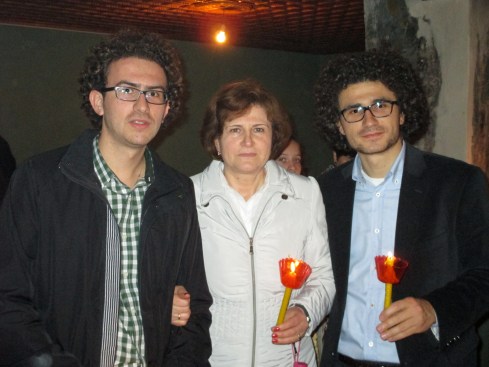
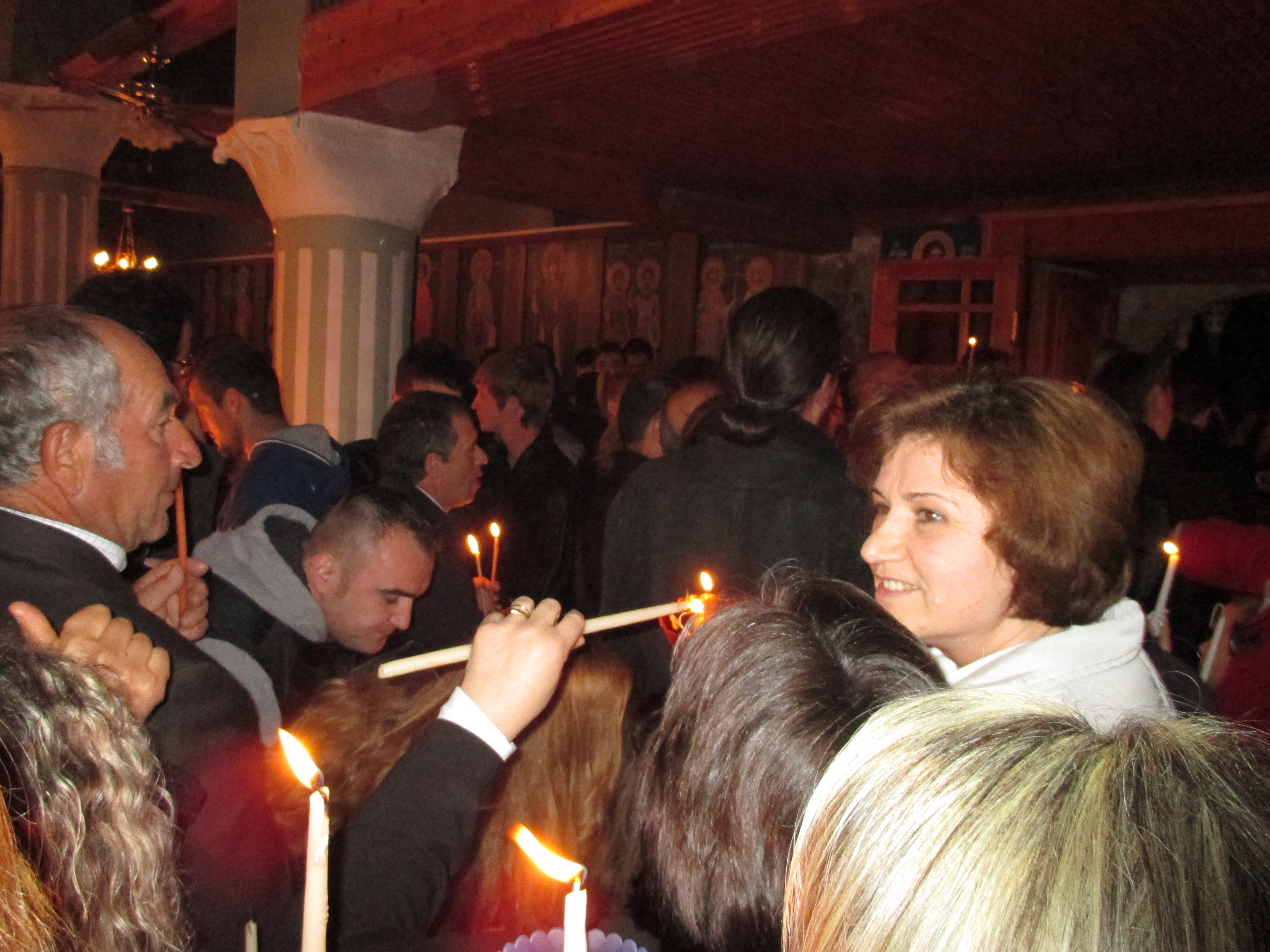
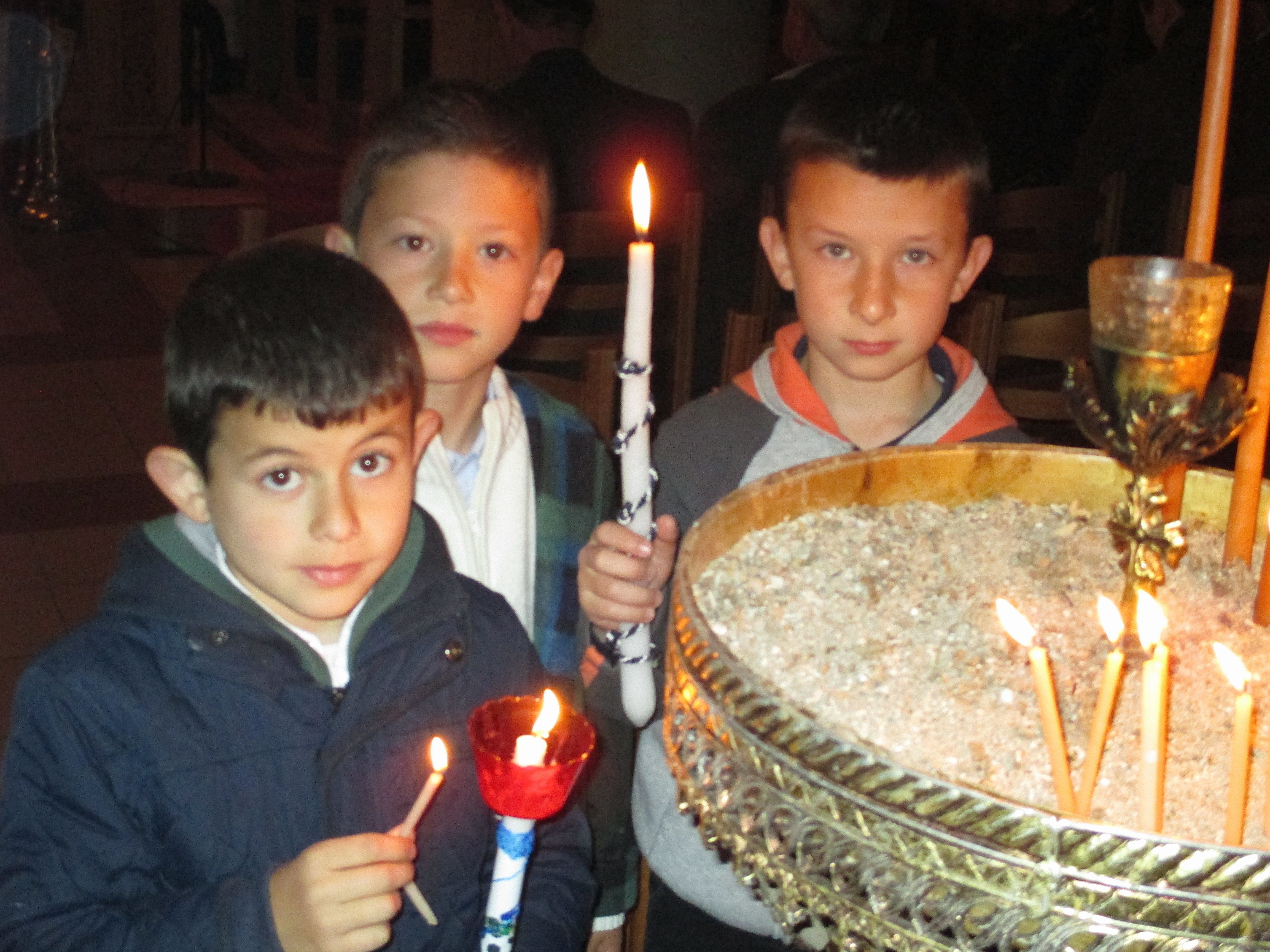
IMG_0050This is Calliope, with her two sons Vasili (left) and Vangeli (right) on Easter night in church (click).  She’s an extraordinary and extraordinarily loveable woman: a great housewife, a competent businesswoman, funny, generous, always smiling, as flirtatious and open as a teenage girl — she’s one of my great relative-loves.  Here she is below at the Monastery on Easter Monday, having just deposited a huge piece of lamb shoulder — no, actually, a lamb shoulder — on a paper towel in front of me, cold and glistening with shiny white fat like some Homeric offering.  My father always loved cold lamb, and would never let my mother reheat it, because it reminded him of the Easter dance at the Monastery.  This is a typical pose to catch her in below, because her innate generosity is always giving something to someone.  (Click)
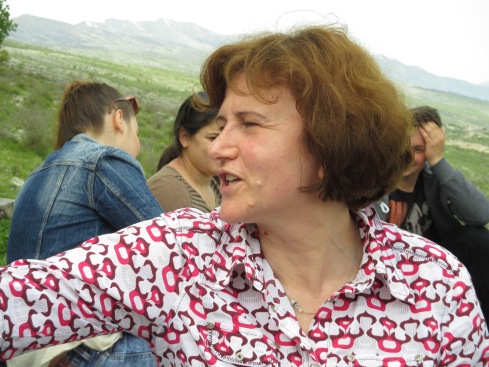
IMG_0119I hadn’t met Vangeli before, and if I had he would’ve been a baby.  But in church that night, when we were introduced, he said to me, in his classic Aries way — breezy and confident: “Actually, I don’t know you, but Christos Aneste!”  And my Aries replied: “I don’t know you either, but Alethos Aneste!” and I knew right then we’d hit it off.  We talked the next day at the dance; I invested some of the best days of this trip visiting them in Tirana on my way back from Montenegro, and of all the people who said they would come to Istanbul to see me while I was here, I knew he was the only one who would actually do it.  We locked horns on titles or terms of address for a while; I am literally twice his age, fifty and twenty-five, but we hang out like cousins and that’s what he used to call me, whereas I want to be called “uncle.”  He wasn’t having it.  (I have a similar problem with some nephews in New York on my mother’s side.)  For a while we agreed on “şoku,” which is “buddy” in Albanian but also meant “comrade” in communist times, so that didn’t last very long, nor did the Russian “tovarishch” which means the same thing.  Finally, when he got to Istanbul, he heard some guy addressing another as “abi” — big brother, technically, but often just “mate” — which they use in Albanian as well, so it’s been “abi” since then and that pretty much describes how we relate to each other. 

I’m an only child.  Calliope is like the big sister I never had and it’d be hard to imagine a more loving one.  But my parents also had a first son that died when he was a baby, so, even more deeply, I’ve always felt literally haunted by a living presence and desperate absence at once, and by an entirely metaphysical need for a being that I feel is out there to incarnate itself again as an older brother.  But being an older brother to someone else is just as gratifying, especially to a kid like Vangeli.

Because he’s good at his role and he did me super-proud here.  He studied computer engineering in Birmingham and speaks flawless English, dresses impeccably, works for a company that sends him to Italy on a regular basis, so he speaks some passable Italian as well.  (Some fashion-victim friend of mine from New York saw him dancing in the second video here and wrote to ask me who the funky kid with the curly hair and the Prada glasses was — she had recognized the Prada frames from five-thousand miles away…)  We went out for a classic Istanbul fish-and-rakı dinner at a really good place in Cankurtaran in the old city; he immediately recognized that this was not just any meal, but that he was in the presence of a certain ritual to be respected, like Japanese kaiseki, and he acted accordingly.  He was put off by the anise in the rakı at first — we drink ours unflavoured in Epiros — but then realized that Turkish rakı is not the cough-syrup by-product that Greek ouzo is and enjoyed it thoroughly.  He had no negative preconceptions of Turks and Turkey and he never, never — not once — tried to insert one of those slimey negative innuendos about Turkey into the conversation that almost every Greek tries to do when he’s with Turks.  He just listened to the two female friends we went out with, asked questions, tried to learn, gave his opinion, talked to them about Albania and Argyrocastro and Tirana and our families and Britain and anything else you could imagine, and charmed the skirts off of both of them.

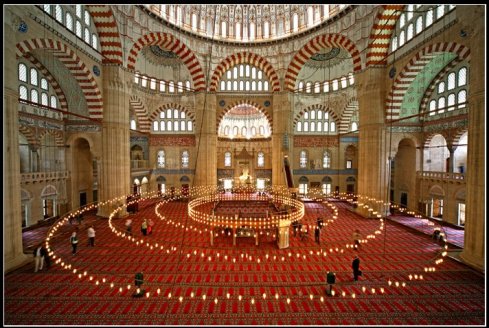
He wanted to see everything.  I hate going into the old city.  I find it depressing, crowded.  I love the mosques, but the Byzantine monuments discourage and sadden and, sometimes, anger me, and I prefer to not be confronted with the interface between the two and just stay here in Pera, expelled from the walls in my gavuriko varoşi.  Also, getting there is alright, but getting back means trudging up and down and then up and down again some incredibly pedestrian-unfriendly streets and intersections and underpasses, unless you take some sleazy Sultan Ahmet cabdriver whose meter suddenly races to 100 lira by the time you get from Hagia Sophia to Pera.*  But for Vangeli I went.  And we saw everything there was to see.  We even stumbled upon the Rüstem Paşa mosque, which if you ever asked me to find, I never could.  We sat in the Süleymaniye for an hour and he listened to me talk about why I like sitting in mosques and watching Muslim prayer — Istanbul was the first time he had been inside one — and find them so calming and peaceful.
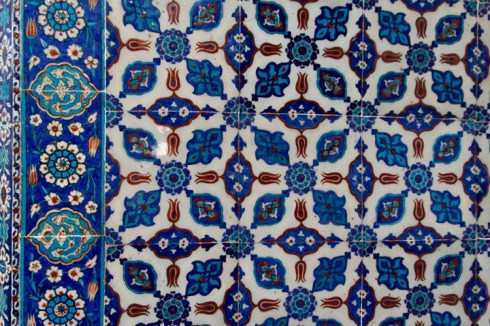
Rustem pasa tiles

Suleymaniyeimg_redirect.phpThe tiles of Rüstem Paşa above and the interior of the Süleymaniye (click)

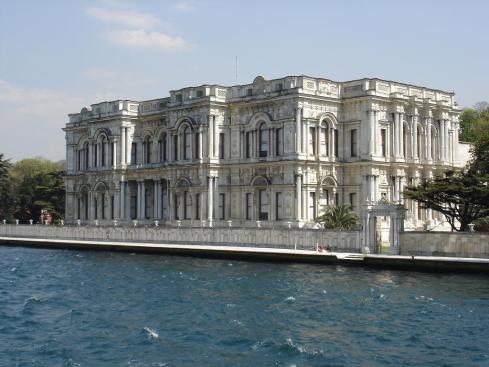
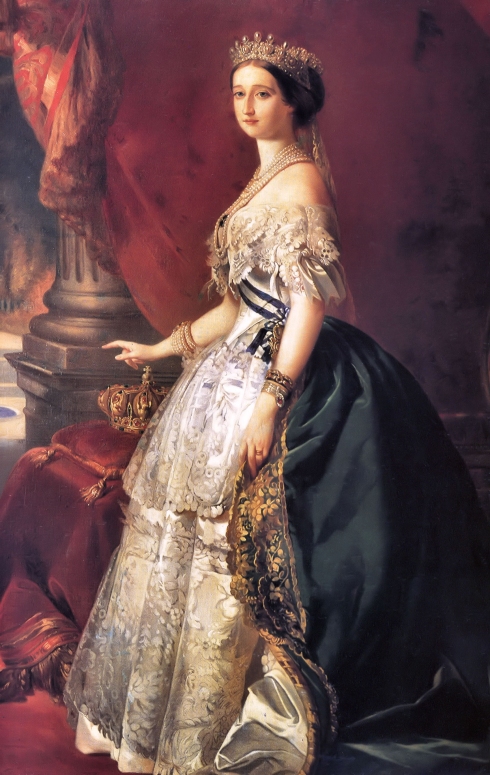
We covered every inch of Topkapı, where I hadn’t been in years and where I was re-dazzled by that Ottoman sense of elegance and comfort that Rebecca West speaks of so often.  He was interested in the oddest things.  His favorite palace was Beylerbeyi, as it is mine, but he was fascinated by the story of the French empress Eugénie, born Eugenia de Montijo of the highest Andalusian aristocracy, who extended her state visit there for so long that it began to turn into a diplomatic scandal in Europe: he wanted to know how beautiful she was; he wanted to know whether Abdülaziz was such a stud that he was actually shagging her and how Napoléon III could have been such a nebech that he didn’t come grab her by the hair and drag her back to Paris.  “Άμ,’ ήθελες γυναίκα Ισπανίδα…” he decided, after much pondering — “that’s what you get for wanting  a Spanish wife.”  And an Andalusian one at that.  But once you’ve seen Beylerberyi, where she was put up on her visit, which is like a gigantic Turco-Venetian palazzo opening up onto the fresh, cool waters of the Bosphorus and not some smelly canal, you realize that once anchored there, leaving would be hard even if you weren’t getting any from the Sultan.

Beylerbeyi Palace (click)
beylerbeyi_palace_by_shidikujThe Empress Eugénie of France, née Eugenia de Montijo of Granada; the Jackie Kennedy fashion plate of mid-nineteenth century Europe and considered one of the most beautiful women in the world at the time (click), subject of the copla by Rafael de León and Manuel Quiroga, made famous in Concha Piquer’s incomparable rendition.
Eugénie;_keizerin_der_Fransen_(2)

The last day I was exhausted but he wanted to go look around Turkish supermarkets for yufka to compare the quality and price to what his family’s company makes; this is my Uncle Vangeli’s business; they make yufka and tel kadayif and sell it throughout Albania.  The name of the company is Demetra, like the ancient goddess of agriculture and cereals.  We went to a couple of Carrefour and he wasn’t impressed.  We went to some small bakalika and they didn’t have any at all.  And, very cutely, he made the assumption, in those hushed tones of respect that the Ottoman culinary tradition still carries with it in the Balkans, especially in the western Balkans from Epiros to Bosnia, where börek is an institution and a strong regional identity marker: “They probably open up [that’s the term we use] their own phyllo at home still.”  I didn’t want to pop his bubble.  Then he wanted to go to Dolmabahçe too — the energy of youth — but it was already too late in the day.  As compensation we went to dinner at the Çırağan, the hotel that’s now in the palace most similar to Beylerbeyi.

What I most admire about Vangeli is that he’s smart, sophisticated, has a C.V. that could take him anywhere in the world that he might want, but he wants to stay in Tirana, not just because he wants to help the family business, but because he actually wants to stay in Albania and build a program design business of his own, in the country he grew up in and lived his entire life in, and that that doesn’t get all mixed up with dumb ethnicity issues.  I didn’t ask him; he probably doesn’t “love” Albania any more than I “love” the United States.  He probably doesn’t have an answer.  But where he lives — what state he lives in, in particular — doesn’t have any bearing on who he is.  Like me.  He’s Vangjel Stavro; he’s a computer engineer; he’s Greek and he lives in Albania.  Period.  He may be the New Balkans.  In fact, soon all of the Balkans might be the New Balkans except for us, who will still be left blinkered, frozen like a deer in the headlights, wondering why the “Europe thang” didn’t go as we planned.

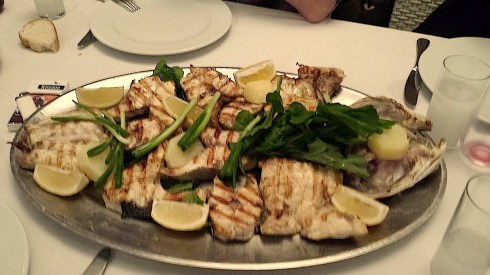
There are a couple of inside jokes to the photo at top where’s he’s eating a simit at the Staurodromi.**  One is that we both felt like hell that morning, which is why I’m not in the picture, not that I like being in pictures anyway.  Two nights before we had had that splendid fish dinner in the old city and had put down a fair amount of rakı, but it was with food — basically, after a few rounds of great meze, this beautiful lithrini (lüfer):
Fish20140522_214540(click)

But the night before the simit photo, I had wanted to take him to the bar on the rooftop of the Marmara Pera hotel, so he could see the places we had visited in the old city that day from across the water at night and illuminated, and then we were planning to go hear some Greek guys who play rebetika at a very cool, shabby old meyhane near Taksim.  But we spent too much time at the Marmara and by the time we got to the rebetiko place all the food was gone and all that was left were stragalia/leblebi.  Now I don’t know exactly how leblebi are made — I think they’re dry-roasted chickpeas — but I detest them as much as I love cooked chickpeas/rebythia/nohut.  Something happens to the dense, almost meaty, velvety texture of chickpeas when they’re made into leblebi that produces something that tastes like a highly compacted nugget of sand, or like taking a teaspoon of raw flour and popping it into your mouth.  I think the only reason they’re considered a drinking snack is because you’ll choke on them if you don’t have anything to wash them down with.  Vangeli hates stragalia too, but I tried to encourage him: “Come on man, this is the exclusive diet of the Great Father; this is how he defeated Turkey’s enemies and brought his country glory, with a pocket full of leblebi and a flask of rakı!”

Lebpic1340611232r779452Leblebi

So we ate as many as we could, starving as we were, and had way too much to drink in too short a time on top of it.  We then went outside when the performance was over, and suffering from the drunk munchies on which rests the drunkard’s philosophy that if you pile more crap into your stomach on top of too much booze it’ll make you feel better, we had two plates each of chicken-and-pilav from the street vendors (one of the most delicious things you can possibly eat in Istanbul — Turks are magicians with rice), and then on my corner we found Orhan, my favorite Kurdish midye kid, and I think closed down his shop that night as well; we must have had about twenty mussels each.  So we were not very happy the next morning.

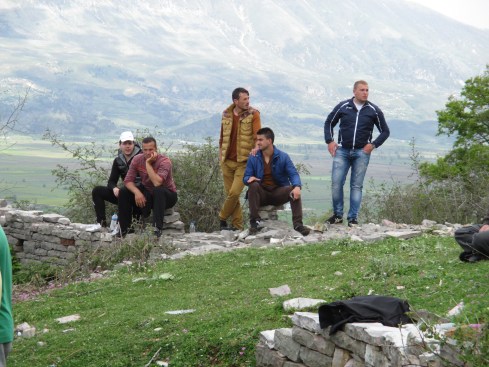
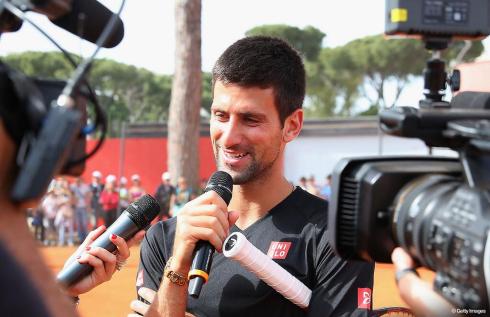
The second insider joke is actually one me and Vangeli share with Epirotes down the centuries.  Legend has it that Epirotissa mothers would slap their sons on top of the heads to flatten them from the moment they were born and say: “Και σιμιτζής στην Πόλη” — “And may you become a simit vendor in the City” and that this explains the idiosyncratic beer-can shaped heads that a lot of Albanians and Epirotes have, like some of my chorianoi:
IMG_0148or a guy as seriously Kosovar-looking as Novak Djoković:
DjokBearCanBnhbw7ZCYAAgVoE.jpg_largeor me:

nikostautoteta23

The point is that the flat top would make it easier to balance a tray of simit on your head.  Of course the joke is based on false modesty, because Epirotes did not come to Istanbul, or go to Roumania, or Odessa, or Alexandria, or the United States or anywhere else in the world to become simitçides.  They went to make money and, some of them, fabulous amounts of it.  This is why you can be driving through Epiros, through empty, lunar karst limestone landscapes where you wonder if you could even herd goats, much less sheep, much less plant anything edible, and then suddenly come upon villages with massive two or three-story stone mansions, and equally impressive churches and schools.  And this is why Epirotes contributed so greatly to the Greek Enlightenment, to the creation of the Greek state’s institutions and educational establishments, and generally had an exceptionally high standard of living and literacy — even for womenfor rural Greece, until the whole exclusively male emigration structure collapsed and was followed by a massive exodus to the cities after WWII.  Like certain islands of the Aegean or the Saronic, it was the very barrenness and lack of resources that the land could not provide that drove the movement, ingenuity and creativity of traditional Epirote culture and that allowed them to make such lives for themselves at home (at least for their families, because they themselves were gone most of the time) and make such important contributions to the wider Greek world.***  Of course, it was also the institution of emigration that led to the endemic, marrow-deep sadness of the culture as well.

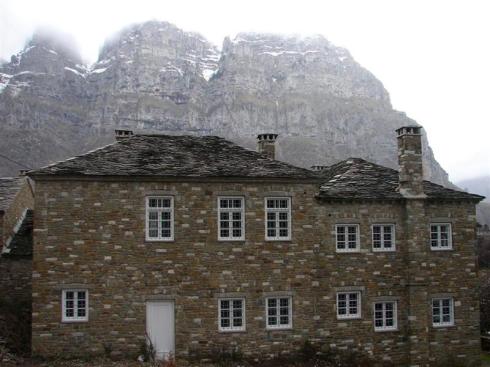
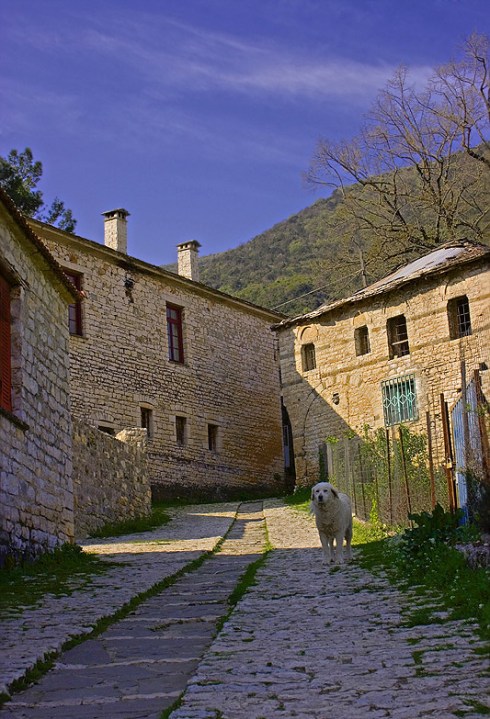
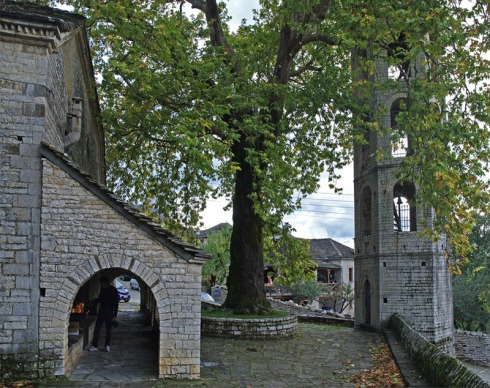
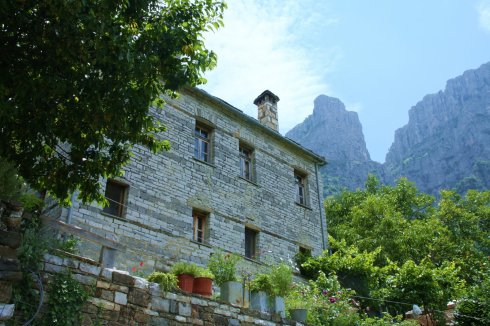
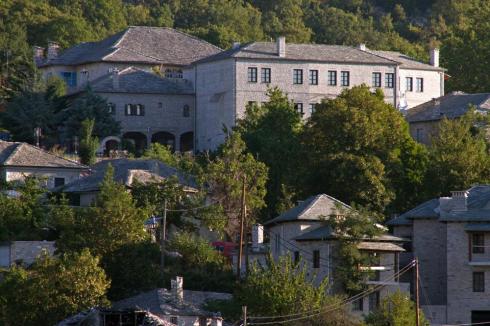
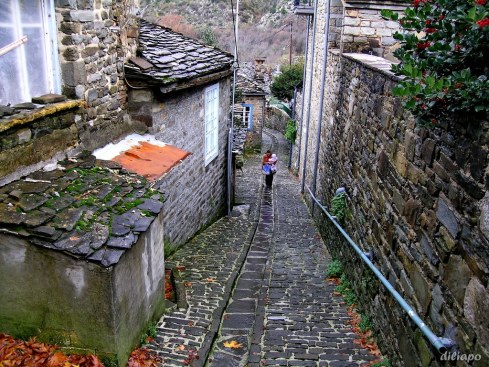
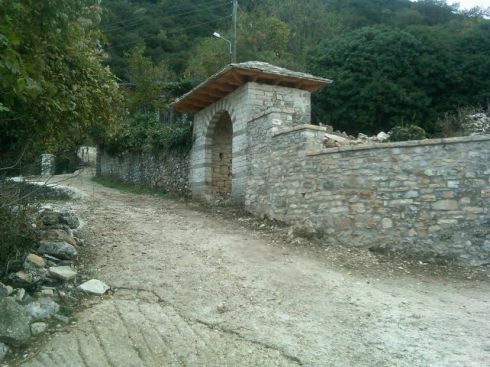
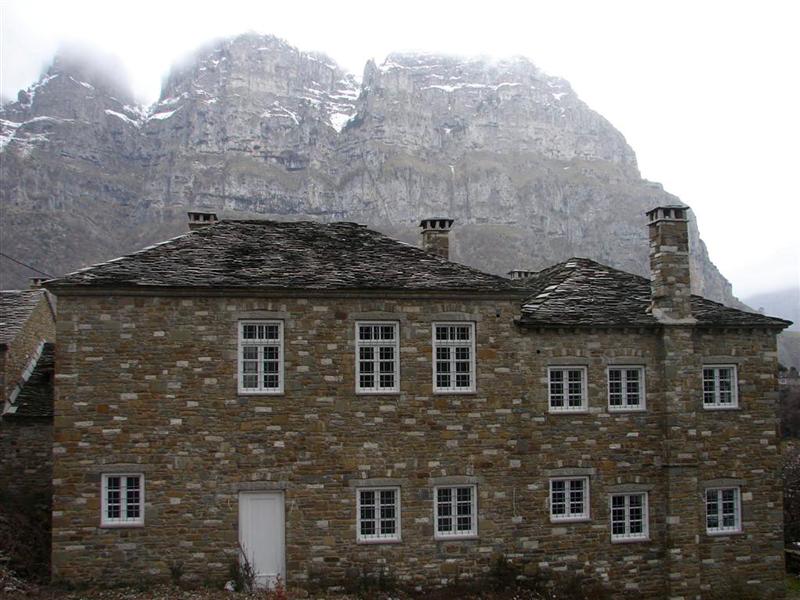
Traditional Epirotiko village architecture from various parts of the region, obviously not the communities of poverty-stricken hillbillies, built with money made abroad by emigrants; the final picture at he very bottom is the front gate to my mother’s patriko, the house where she was born.  Her family made their money through three generations of baking businesses in Bucharest. (click)
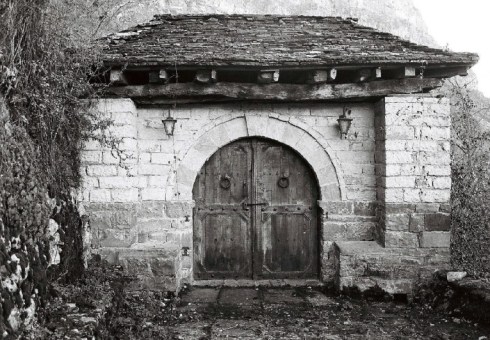
000116

papingo

1704170417041704_12

Papingodsc_0416

PapingoIMG_4952

Monodendri-Hotel-22

Tsepelovo59399932

Giotopoulos gateunnamed

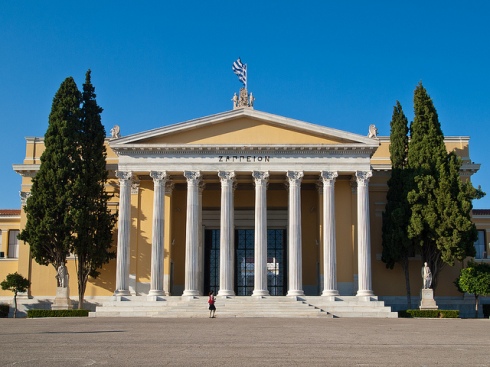
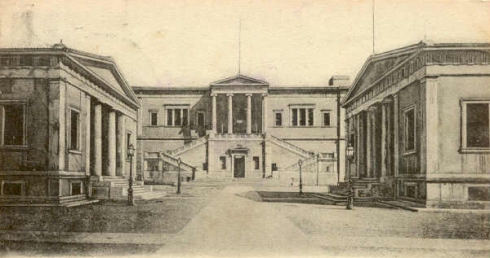
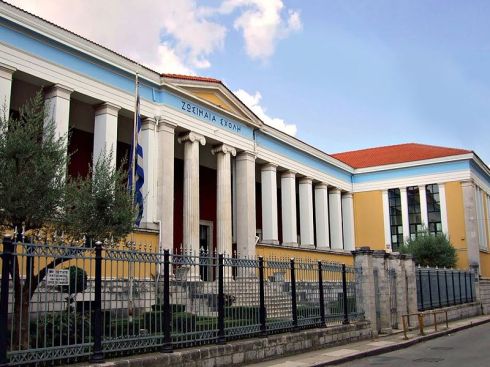
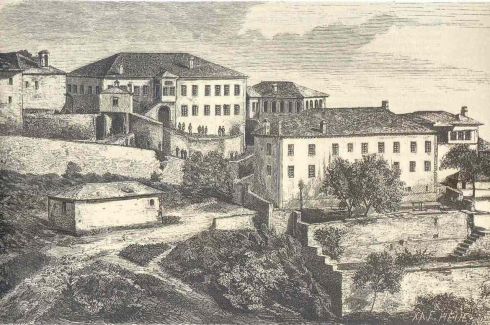
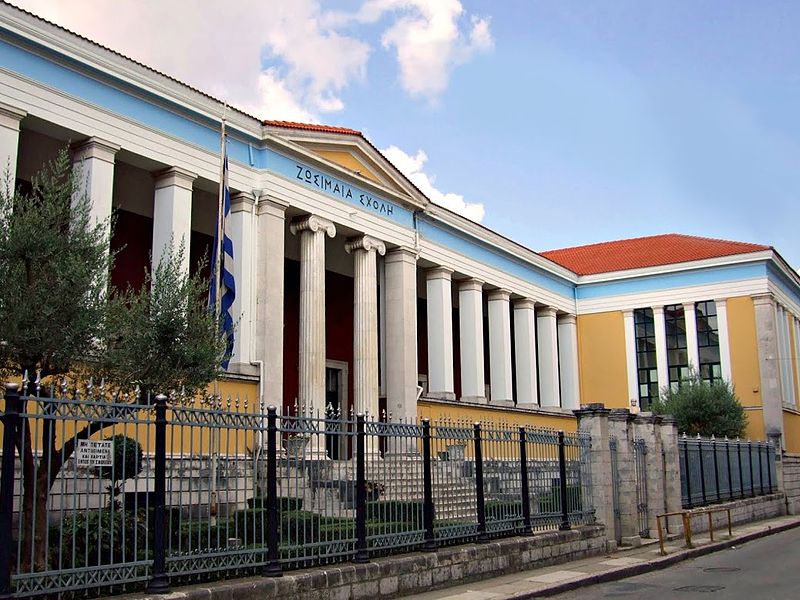
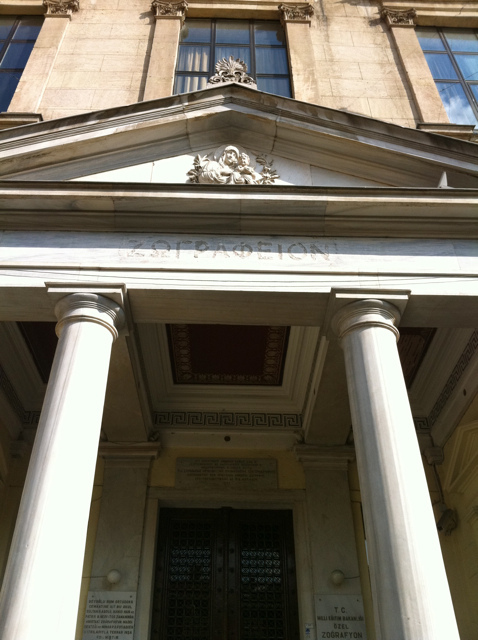
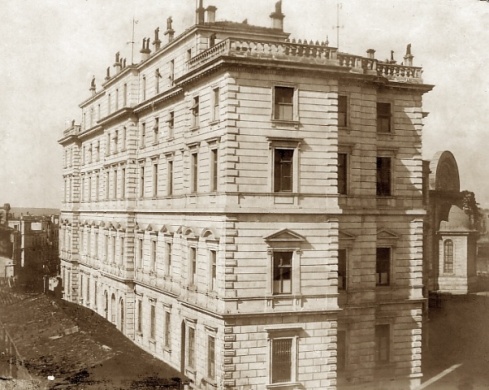
And below — in order — the Zografeion and Zappeion Lycées in Istanbul, the Zappeion exhibition hall and gardens in Athens, the National Polytechnic School in Athens, the Zosimaia in Jiannena, and the Zografeion college of Kestorati, all just a few of the institutions funded and built completely by Epirotes (click).
5694293094_8d58ab27da_z

zappeion

OLYMPUS DIGITAL CAMERA

polytechneioPatision_Complex

ZosimaiaΓυμνάσιο_Ιωαννίνων_3

ZographeionCol

I have a friend in Greece who’s from a part of Greek Macedonia that, before the refugee tents went up there in the 1920s, was inhabited exclusively by mosquitoes.  We were good friends but we had more than our share of tensions because he was an insufferable kind of arrogant Eurocrat that Greece used to produce at the time and had some supposedly hot-shot job with one of the sleazier Russian-type Greek communications moguls to appear in the nineties — μιλάμε principles yok.  And for some reason, he had this implacably neurotic competitive impulse that he would always unleash on me any time I spoke about Epiros, especially if it was with any amount of pride.  “It eez the poooorest proveens in Euuurope…Galicia in Spain and Epiros…are the pooorest proveeenses in Europe…” he would say to me constantly, like a Brussels parrot.  And after WWII, the practice of leaving families behind and going off to work abroad and returning only occasionally became untenable, and most of Epiros did become tragically depopulated.  But it was poor because it was depopulated and the only permanent inhabitants of many communities were pensioners, not because it was a region that traditionally suffered from desperate poverty.****  The hot-shot job and the whole Euro-thing has collapsed since then, along with the whole balloon in which it existed, of course, and he’s a significantly humbler person today.  But it was just so infuriatingly ignorant and anistoreto on his part to see Epiros as some Greek Appalachia and his motivations for harping on that distorted image escape me to this day.

Anyway, that morning I wanted to buy five or six simitia and pile them on Vangeli’s head as a reference to this simitçi tradition, but I could see he wasn’t having it, so I didn’t even try.  He insisted it was the anise in the rakı that made him sick and has sworn that from now on it’s only “real” raki for him — straight and Albanian — with no sissy Politiko flavorings to eff him up.

*************************************************************************************************************************************************************************************************************

* Turks are among the most honest people I have ever come across in all my travels, and not because of modern efficiency like in Europe, but out of traditional philotimo or honor.  I’ve had a Turk from a Taksim pilav stand recognize me as I walked by, and come up to me to give me one lira change he owed me because three days earlier I had eaten there and he was short.  I’ve had to fight with a Turkish simitçi because he wouldn’t sell me a simit because it was late in the day and they were stale, begging him, eventually giving up because he simply refused — the famous Turkish “yok”; when you hear it give up immediately.  I’ve had Turks — this happened to me in Afghanistan once too — run down the street after me to give me a Bic pen I had forgotten on their restaurant table.  But something happens to a Turkish cabdriver when he’s in the Sultanahmet area and he becomes the biggest sleazebag in the world.  I think that now that tourists have discovered the Beyoğlu side of the city and generally prefer to stay there, there’s greater tourist traffic between Pera and the important monuments of the old city, and these jerks take advantage of it.  But be tough with them; simply refuse to pay more than 20 or 25 lira — no matter what his rigged meter says — and walk away and tell them you’ll call the police if they don’t like it and, being cowards, like most frauds and liars, they’ll immediately back down.

The route from Şişhane or the Galata Tower, across the Galata bridge to Hagia Sophia has to be — and always has been — one of the most important pedestrian traffic axes in the city.  And instead, both Karaköy and Eminönü — the two districts and “squares” that face each other across the Horn and are like the two ventricles of the historic heart-like link of the City — are hideous, dirty, badly designed nightmares to walk through.  Instead of worrying about Taksim so much, Erdoğan might want to put some effort into redesigning this essential, central binder of the two Istanbuls.  But that would be a massive project that would involve levelling almost everything that’s been built there in the past forty years and starting with a clean slate.  Plus, you don’t want to give him too many ideas because he’s perfectly capable of building something as ridiculous as a ski-lift from Şişhane to the Hippodrome to assist tourists in their sight-seeing.

** The Staurodromi is one of the nicest spaces in Pera.  The gates of Galatasaray are beautiful, the other corners have their original turn-of-the-century buildings intact and there’s one modern, kind of semi-Brutalist building in travertine that I really like, that houses a bank and a bookstore and that you can see in the picture above behind Vangeli and in this one below.  The only thing that mars the whole space is this ugly sculpture:
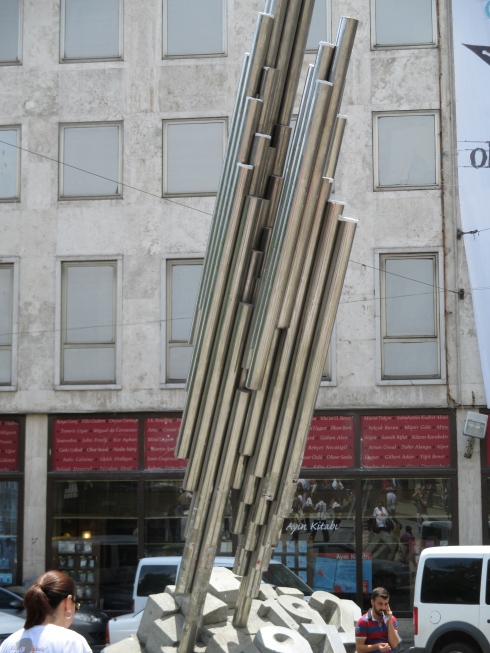
Uranium piles

Does anybody know what it’s supposed to be?  Missiles of some kind?  I don’t know what enriched uranium piles look like, but during Fukushima and every time someone talks about Iran or North Korea and uranium piles, my imagination immediately conjures up this horrible sculpture.

*** This was all part of what I can only generally call the “Great Mobilization” of the Greek world that began in the early eighteenth century.  The confluence of factors that caused this are so intricate that they’re hard to summarize: the primary spark was perhaps the massive wealth accumulated by the Phanariotes — Greek aristocratic families in Constantinople prominent at the Patriarchate and, by extension, at the Porte — who had used their influence in imperial circles to turn most of what is now Romania (Moldavia and Wallachia) into their own autonomous Greek kingdoms, which they sucked dry, and how that wealth was poured into Greek institutions and trickled down into Greek hands generally; the concurrent spread of Greek educational and commercial networks in the Balkans and Eastern Europe and later in the Near East, in the rapidly modernizing economy of post-Mehmet Ali Egypt especially; the way the so-called Greek Enlightenment worked through both these kinds of networks.  The increased mobility that the nineteenth century made possible; most people, for example, don’t know this, but the Greeks of the Anatolian Aegean coast and the Marmara were almost exclusively migrants from the islands and mainland Greece — and even later the Kingdom of Greece itself, Greece basically having been an economic basket-case since the get-go — that started settling there in large numbers in the later eighteenth century and not, as we romantically like to believe, descendants of Byyzantine Hellenism; the only remnants of Byzantine Hellenism in Asia Minor were the Greeks of Pontus and Cappadocia, of course, and small pockets near Konya and Kula and Isparta and that lake region, all of whom, except for Pontioi, were Turkish-speaking until some of the men started learning Greek in the nineteenth century.  (In isolated areas of Cappadocia, a dialect of obvious Greek origin had also survived into the nineteenth century but was already dying out by then, and was so heavily Turkish in vocabulary and had even developed extensive agglutinative structures like Turkish that it’s almost impossible to call it Greek, any more than you can call Vlach Roumanian.)  Then there were the colonialist economic incursions into the Ottoman Empire and its reduction to a European debt-slave (much like “Memoranda” Greece today) that together with the privileges for Christians that the Great Powers forced the Ottomans to grant, created a space for growing Greek and Armenian prosperity from which Muslims (and Jews, for that matter) were excluded, and that produced exclusively Christian micro-economies within the Empire in which Greek rural migrants could find work and prosper.  All this had an enormous effect on Greek life everywhere.  You can see it in the village architecture of certain regions of the Greek world.  And you can see it in traditional dress of Greek rural women.

My father’s villages in the valley of Dropoli are situated in one of the few extensive, arable parts of Epiros, the fields you see in the pictures taken from atop the village itself (click):
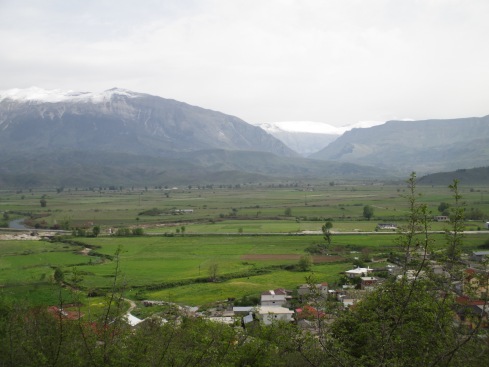
IMG_0075

Paradoxically, it was this theoretical asset that kept our villages relatively poor until the mid-nineteenth century, because these fields were all çiftlikia of Muslim landowners (“fiefs” I guess; don’t ask me to explain Ottoman land tenure to you, or tell you the difference betweeen a çiftlik or a timar or anything else, because every time I try and read about it I fall asleep and don’t remember anything I’ve read when I wake up) and we were essentially sharecroppers for them.  Only with the exponential growth of emigration in the nineteenth century did any kind of considerable prosperity come to our villages and many were even able to buy their village lands from the increasingly impoverished ağadhes themselves.  Like I said, this was markedly obvious in the changes in female costume and the complete switch of male dress to frangika, Western clothes; traditional male outfit of the region would have looked something like this, the characteristic white felt pants called poutouria (this photo is from southern Serbia actually, but was the nearest approximation I could find) and not the fustanella kilts that folklore groups in the village like to use today indiscriminately and inaccurately:
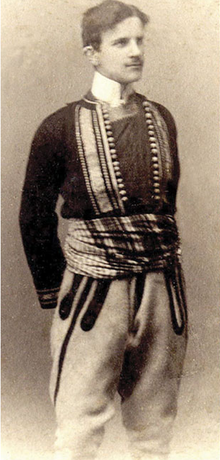
Poutouria220px-Teslacirca1880(2)

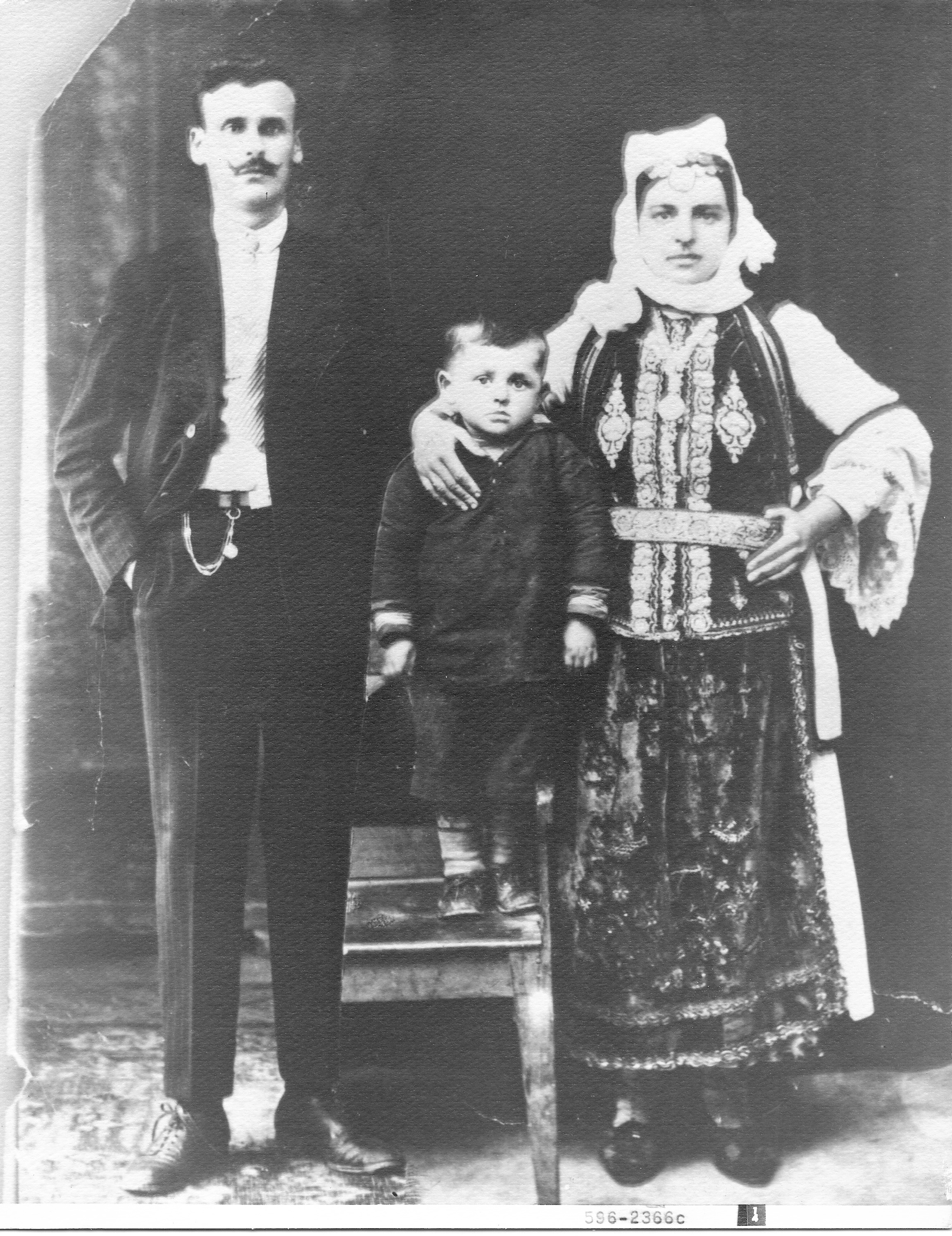
While, with the women, in extremely old photos from Derviçani, you can see that almost all the articles of the costume were home-made by the women themselves, with growing wealth you see the gradual addition of articles of clothing that had to be made by professionals.  My grandmother’s outfit here, for example, especially the vest and apron:
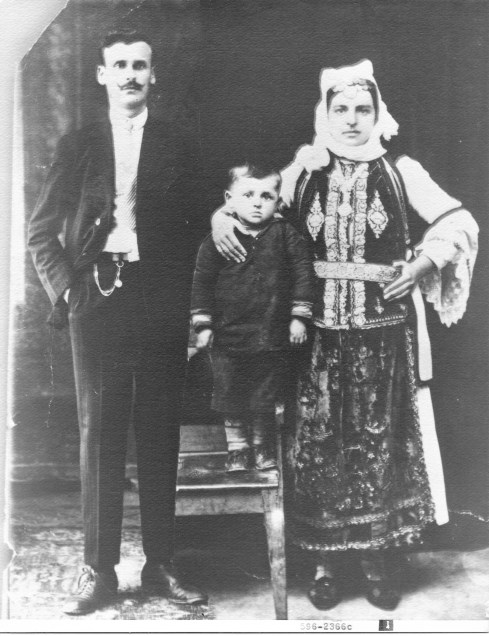
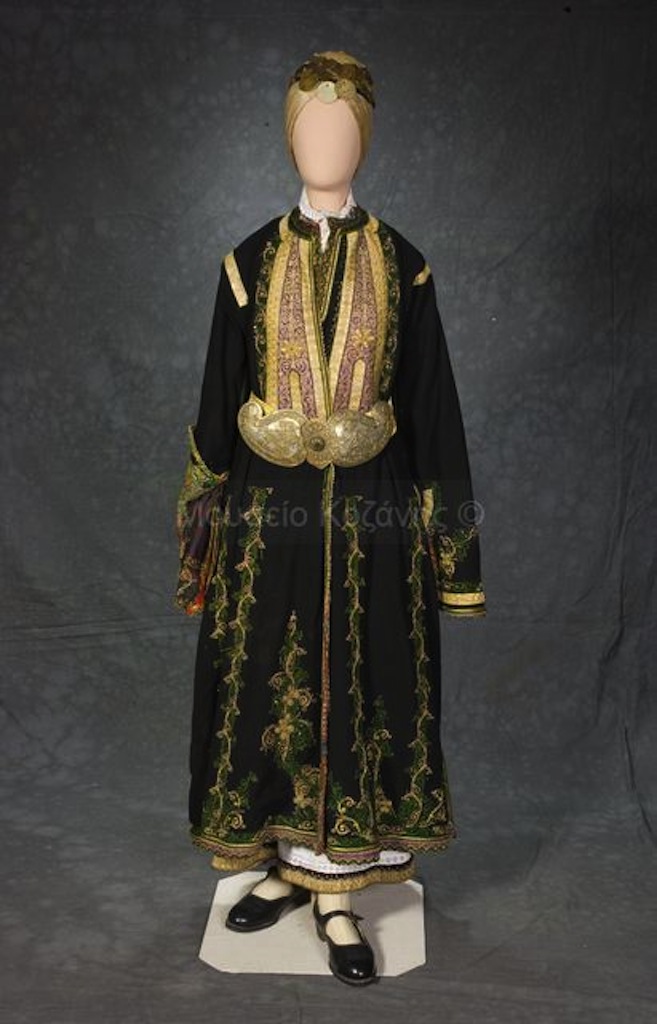
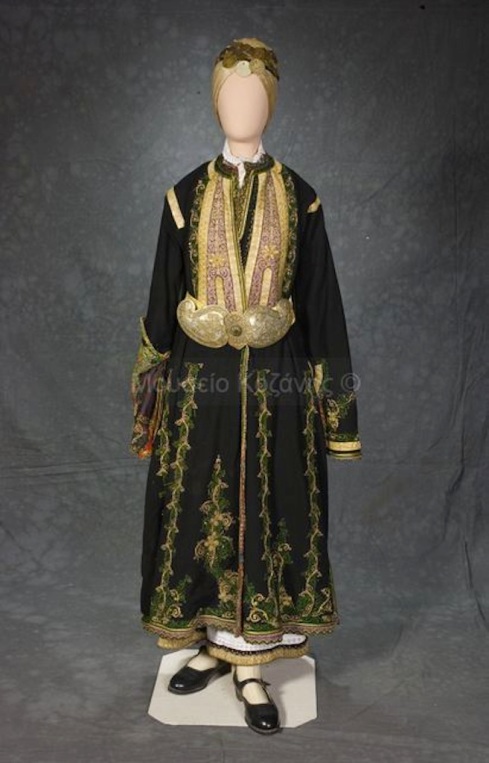
Family…obviously had to be made by a professional sirmakeşi — an embroiderer of gold thread — in Jiannena or Argyrocastro, and the dress of some particularly wealthy villages, like those of Lunxhi, behind the mountains to the left across the valley in the photo (Albanian-speaking Christians with whom we intermarried extensively and still do, the homeland of Zappas and Zographos, the benefactors mentioned above) had, by the end of the nineteenth century, simply become regional variations of Ottoman urban dress, like in this photo, which the museum of Kozani (why it ended up in Kozani?) felt it had to put its water stamp on, like someone was going to sell the design to YSL or something:
VI2M8774.TIF

**** Despite my friend’s condescension, regional funding initiatives for these “poorest provinces in Europe” have greatly expanded the university in Jiannena and developed an extensive and prestigious medical research center there, an information technologies industrial park, renovated (sometimes over-renovated) large parts of the old Ottoman city and created a general climate of growth and prosperity seemingly unaffected by the problems of the Greek economy.  Epiros has become a little bit like a Greek Bavaria or the French south-west: a traditional, somewhat backwards area that made the leap over the ugly stages of modernization to post-modern comfort and prosperity.  Half-ruined villages have been renovated, largely through the skills of Albanian craftsmen, who still were trained in the traditional building skills necessary to preserve the region’s distinctive architecture.  There’s good traditional and contemporary food in Jiannena and in some of the newly developed tourist towns.  There’s skiing in the winter; there’s hiking and mountain-climbing in the summer and gorgeous beaches only an hour-and-a-half away from each other on the new highways.  And it’s generally agreed that Jiannena is one of the most pleasantly liveable of Greek provincial cities and Epiros one of Greece’s most beautiful and pleasantly liveable provinces.

Comment: nikobakos@gmail.com

“Too often we enjoy the comfort of opinion without the discomfort of thought.” — John F. Kennedy

30 May

Or just basic facts.  Or as Guatemalan singer Ricardo Arjona says: “Le sobran opiniones y le faltan argumentos.”  “He suffers from an excess of opinions and a lack of arguments.”  Which Greeks might want to put on their flag in gold embroidery across one of the horizontal white bars.

I write on May 19th: “…how I’ve been wasting my time engaged in a running war with everyone in Athens to prove basic things like the fact that Albanians are a tall, extremely attractive people.”

And a reader writes back:

“I know, why is that?  I had the same experience in Greece.  I worked for an NGO in Kosovo for a year and then hitchhiked through Albania to Greece and found Albanians in both places to be very good-looking I thought.  When I would say that in Greece people would laugh at me.  I guess politics just gets in the way.”

No, they’re just idiots.

And I have to apologize to readers if this blog has taken on an increasingly polemic or nasty tone in regards to certain issues.  But I wrote in an early post: “In the 1990′s, when Albanians flooded Greece and Greeks were faced with the horrifying realization that their northern border hadn’t really been with Austria all that time, many of them predictably behaved like racist jerks…” and nothing has changed, that’s all, and my trip to several Balkan countries has opened this toxic can of worms from all sides that I should probably just ignore, but can’t.  Whenever almost anyone has asked me where I’ve been — if they know enough to ask about these places, their neighbors — the question always has that snickering Athenian sub-tone, that smart-ass “ξέρω εγώ…” half-grin that expects tales of backwardsness or καφροσίνη or just unspoken baseline disbelief that I went and that I found it fascinating and I can’t abide it.  Others are just angry.  Because…like…why should you go there?  Aren’t they the enemy?

It’s not politics.  If anything it’s purer socio-economics and what that does to perceptions of the Other in a monocultural world, or rather one where the Other is just invisible.  And I mean social economics on two levels: one, where you really don’t see, because you’re not trained to see or to care, the real effects that economic conditions have on the physical body of a human being — Hoxha’s Albania was the only country in late twentieth-century Europe, where, like the Kims’ North Korea till this day, people suffered from literal, physical, stunting malnutriton — and two, that once that perception or non-perception is established, it becomes frozen.

kitchen-doors

How many people in New York, especially people like me who have worked in the restaurant industry a lot and get chummy with owners and managers, have not had this experience?  You’re sitting at the bar and through the kitchen door you can see a young Mexican kid who’s just started.  And the poor kid looks like hell.  He’s probably new here, so he’s probably just risked his life several times to get to New York in ways in which we would not consider risking ours even once.  He works at least six days a week for probably over twelve hours and for shit money.  He lives in a studio that’s an hour-and-a-half subway ride from where he works, with three or four other guys like him, and to escape both the claustrophobia and loneliness of his life he probably goes out a few nights a week and, with whatever money he doesn’t send home to his family, gets drunk, so lots of days he comes in hungover.  But he always does his job anyway, not only diligently and efficiently, but with a certain perverse pride that he probably needs to maintain to keep himself from feeling like an animal.  He rarely speaks and if for any reason he needs to it’s always with unfailing courtesy and politeness.

“Γλυκοχαράζουν τα βουνά, και οι όμορφες κοιμούνται, τα παλληκάρια τα καλά στα ξένα τυρανιούντε.  Tους τρώει η λέρα το κορμί και η ψείρα το κεφάλι. Ανάθεμά σε ξενιτιά, κ’εσύ και τα καλά σου.”

“Dawn breaks along the peaks, with the young beauties still asleep, and our best boys are off suffering in a stranger’s land.  Their bodies covered in filth, their heads full of lice.  May you be damned foreign lands, you and all your riches.”

an Epirotiko folk song

But he’s smart, this Mexican kid, like our grandparents were before him.  And he watches and he asks questions and he learns about the restaurant’s wines and foods and about New Yorkers and their often insufferable particularities, and what they like and what they don’t like.  And the owner notices and makes him a busboy, and then a runner, and then a waiter.  And he gets a few days off.  AND HE GETS TO SLEEP.  And he’s making a little bit more money, so he buys himself some clothes and can afford to take a girl out on his night off.  And he’s completely transformed.  And one night you say to the owner: “Who’s that hot Mexican kid you put out on the floor?”

Κι’έτσι προκόβουν τα ‘παλληκάρια τα καλά’ της Πουέμπλας και της Çoλούλας…

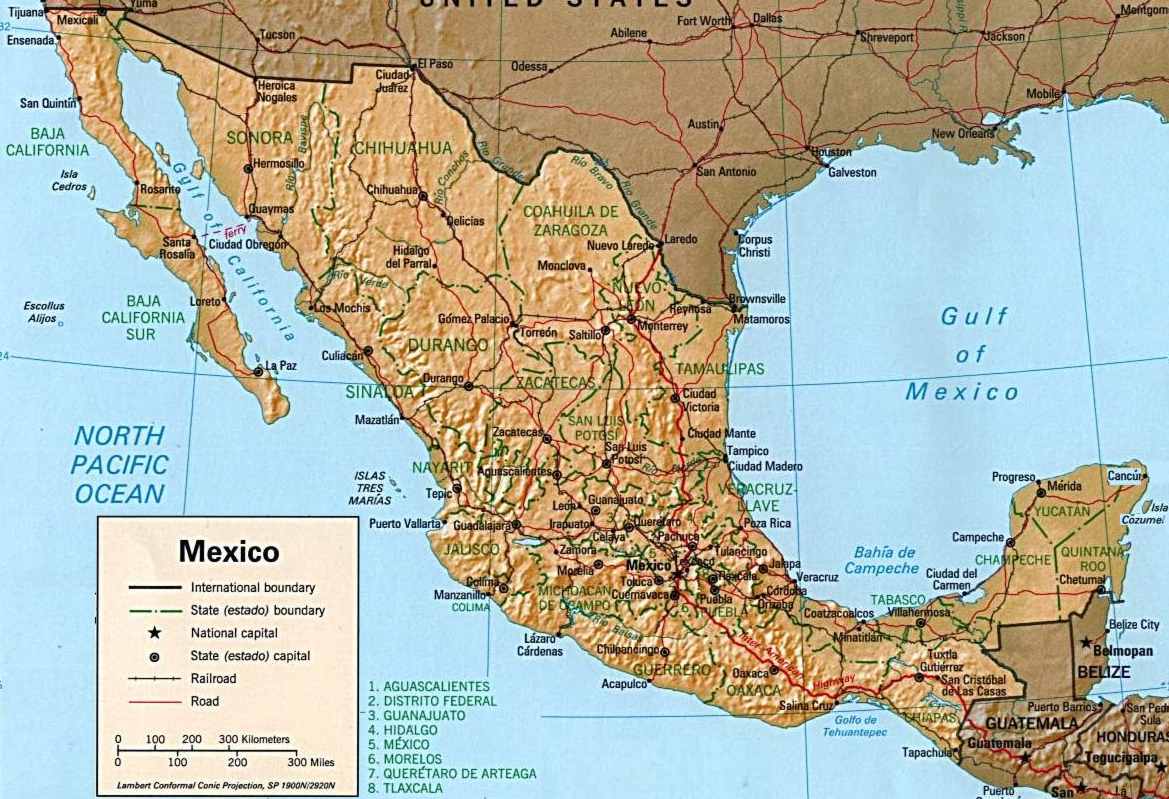
mexico_rilievi97

This is not a possible scenario in Greece.  Or one that the average Athenian is capable of noticing.  For one, Greeks have forgotten that just until two generations ago hundreds of thousands of their own went off to live initially hellish lives in other parts of the world like this Mexican kid does — or the Albanian migrant worker anywhere in Europe today does.  Two, the Greek is not trained to watch others or care, the way every New Yorker is an amateur anthropologist.  So the change occurs right before his eyes and he doesn’t even see it.  Because other than the parts of the world that can confer some kind of ersatz glamour on him — Europe or certain  limited aspects and places of the United States — the rest of the planet is just not on the average Neo-Greek’s radar.  I can’t put it any clearer than that.  To know the reputation that we, Greeks, have as an ethnic group in New York: that we’re open, friendly, curious, eager to learn about others and their countries, learn at least some pidgin form of others’ languages faster than they can learn English, are willing to try any food or any drink, will invite their Mexican waiter to their kids’ christenings — and then to come to Greece and see this completely shut-off from the world society, is startling.

When I came to Greece in 2010 I hadn’t been there in eight years and the gruff middle-aged waiters or relatives of the owners that served in most restaurants and tavernas had been replaced by these nice-looking polite kids and I asked who they were, since it seemed strange to me that usually cossetted Athenians kids had suddenly condescended to wait tables.  And I was told: “Oh, they’re Albanians.”  These same people now laugh if I say anything positive about those same Albanians.  Even my own people, relatives, Greeks in Albania, said to me on several occasions: Όχι, είναι ωραίος λαός…   “They’re a good-looking people.”  Like, let’s tell the truth where we should.  And then come to Athens and have people stare at you incredulously…

I don’t know why this particular issue has ticked me off so badly.

A lot of Americans once thought that all Blacks were ugly too.  I guess I’ll leave it at that.

AlbaniansOutsideAlbania

And Philopomeon adds:

“We always need to put ourselves in a status-race with others… we can’t be as good as the Frangoi, but surely we are more advanced/richer/better looking/more cultured than the Alvanoi.

“To add to that, as you know, the Albanians were noted as “poor dressers” when they crossed the border in the 90’s. They had to take hand-me downs from charity, hence the Greek insult to a poor dresser ” You look Albanian.”

“But I agree, in general, Albanians are good-looking folk. Especially Kosovar girls.. hehe.”


Kosovaroi — of both genders — were real stunners, P., you’re right.  They have even gently nudged Afghans out of their first place position for me — no mean accomplishment.  I really couldn’t believe it when I was there; you didn’t know where to proto-look. (click)

Kosovo6970F0EF-C07B-4081-AB8D-B389D162E9DC_w640_r1_s

besa_luci_main1

MINOLTA DIGITAL CAMERA

And what I should’ve done from the beginning is put these pictures together with all the pictures of the young Derviçiotes I have in photos and videos and asked a random group of thirty-something  Athenian Concrete-Cave-dwellers to tell me which ones are the Greeks and which the “ugly” Albanians.  And see the results…

Comment: nikobakos@gmail.com

Philopomeon writes: “Easter in Derviçani”

30 May

To this April 25th’s post on Easter in my village,  Easter in Derviçani,” Philopomeon writes:

“Beautiful. It’s rare that we get a look of what is going on among Greeks in Albania without having to hear about ‘Vorio Ipiros’ and ‘Chameria’ back and forth.”

Yeah P., except for a few real old die-hards, that stuff is pretty much over, and most people, young and old, have very maturely and intelligently, gone on with their lives and accepted things as are.  The most striking example of that is that there are youth associations from each of the Greek villages in the region, with members in Jiannena or Athens or all over the rest of Greece or Albania or the States or Australia, but the old pan-Voreio-Epirotiko associations like MABH, with their irredentist discourses have pretty much dissolved.  The hate is gone too, which was the most heartening thing to feel: the on-going, still often fatal feud with the neighboring Albanian Muslim village of Lezarates is mostly personal at this point and not an issue of religion or ethnicity.  I know more infantile little fascistakia in Athens, with no relation whatsoever to our villages, who are more preoccupied with those old causes — and feel like they have a right to shoot their mouths off about them as well — than anybody in Derviçani is today and who probably are greatly disheartened by our indifference to our “national issues.”  You’ve never wanted to lose it on someone so bad as I do when your family has been through what mine has (see: Easter Eggs…”) and then have some snot-nosed Kollegiopaido  think he can lecture you on how you don’t live up to them and lack their “national feelings” and other such bull-shit.

The young people of my village, particularly, are a marvel, a youth that any society would — or should — pray to have.  They are fanatically in love with their village; they return every chance they get — dozens come from Jiannena on just a regular weekend.  They’ve organized a new panegyri (village festival on the village saint’s day) on August 15th, when the village’s population is the highest.  This has happened all over Greece; since most people go on vacation in August, depopulated villages that only fill up with returnees at that time often organize a second “unofficial” panegyri in August, along with the traditional one which could be at any time of year, to take advantage of the greater presence of chorianoiDerviçani, however, has never really had this problem, because this is a village with such a gigantic ego that no mere saint would serve; its traditional panegyri was Easter itself! culminating on Easter Friday — της Ζωοδόχου Πηγής — and always packed, then and now…   But, what can I say, it’s a party town.  The youth association pays for this summer festival out of its own pocket; they’ve put a stop to the stupid drunken brawling that used to go on, even though they themselves can pack it away for sure.  They do tons of volunteer work for the village: roads, squares, little beautification projects, football fields and basketball courts.  Natally bilingual, interacting with the “other” and crossing borders both figurative and literal all their lives, they have that innate cosmopolitanism and perceptiveness of the wider world that can’t be learned in any school and that no Northern Suburb çoğlani could buy himself with all the millions in the world or a thousand trips to Europe or New York.  They’re strong, attractive, smart, open, friendly, generous and whether they’re busting their backs at the hardest manual work in Greece or other parts of Albania, or acing it at universities in Greece or in Europe, they’ve built active, productive lives for themselves out of nothing.  I’m not ashamed to say they put me to shame in almost every way.

The most satisfying feeling and identification I shared with them though was the sense that they knew who they were: Derviçiotes, Dropolites, Epirotes, and Greeks  — and that they have absolutely no need for the Neo-Greek nation-state as a reference point to bolster those identities.  Greece never did anything for them anyway except make their lives difficult when they got there in the nineties or provide leftist intellectuals to tell them that life in communist Albania wasn’t that bad or little Athenian pricks to mock them as “Albanians.”  (As opposed to the Church of Greece, however, which I’ve always found to be an abominably reactionary institution, but has really helped a lot of Greek kids from our parts find their way in life and adjust: learn trades, increase their Greek literacy skills, get them into universities, etc. — recognition should be granted when it’s due.)  They get tired of explaining to Neo-Greeks that they’re not Albanian, but ultimately they don’t give too much of a shit: one, because they don’t think being Albanian is an insult and, two, they know they’re Greek — in fact, they know they’re Greeker.  Their generational cohort in Greece would not want to hear their opinion of most of them.

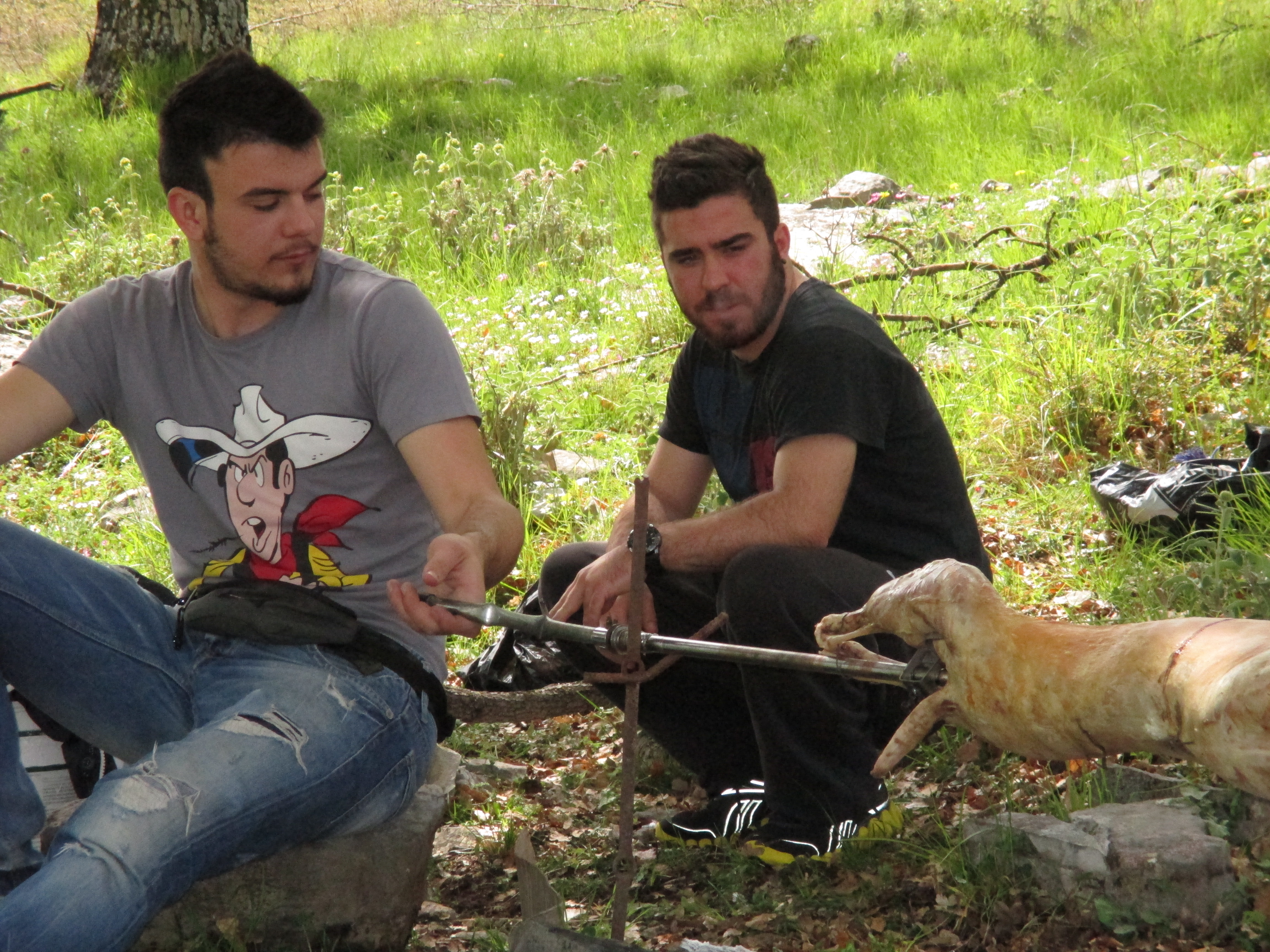
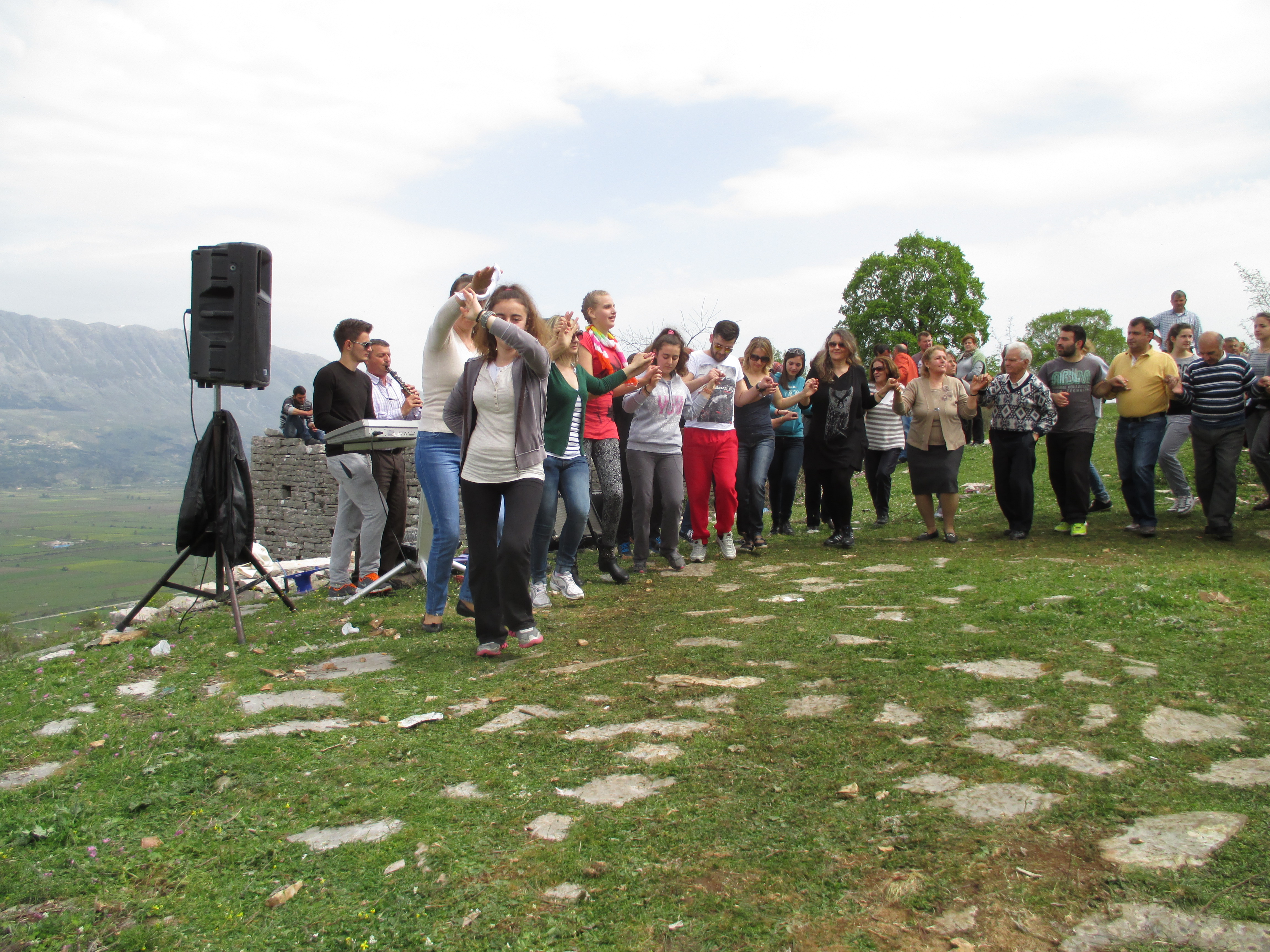
They love their Church, they love their music and they love their dancing.  Here are two videos of the early twenty-somethings, “Manastiri 1” and “Manastiri 2” (age groups and families take their turns) dancing up at the Monastery over the village on Easter Monday. My camera work on my brand-new little pocket Cannon is atrocious, but their spirit will come through.  I was astonished by how down-packed and completely internalized they had the traditional gestures and body language of the regional dance tradition — though I think dancing with open beer bottles is a new innovation and by the second video you can see they’re getting kind of sloppy.  There’s this one kid, FotoDretso, with the cartoon cowboy t-shirt, at the head of the line in the first video with the beautiful statuesque girl in the white sweater that no one can identify (“maybe she’s from another village…” the phantom beauty who showed up at our panegyri…), who is the son of GianneDretso, a village character out of Djilas’ Land Without Justice  with a fearsome reputation for leaping across borders and mountain tops like some cougar — a good rep to have around there.  Foto is also shown turning his spitted lamb in the Easter in Derviçani” post.  He seems to be something of a village youth leader, but the reason I couldn’t get enough video of him that day is, not just that he has my father’s name, but he dances exactly like my father did.  At times it was chilling.  Watch in that first video at around 1:35 when he takes lead of the dance.

IMG_0093FotoDretso, buddy and animal at the Monastery, Easter Monday 2014 (click)

In one of Misha Glenny’s books on Kosovo, Glenny asks a female Albanian politician in Tetovo, the unoffical capital of Macedonia’s some twenty to twenty-five percent Albanian minority: “Do you still dream of a Greater Albania? Where all Albanians can live in one state?”  And he got nearly the identical answer from her that I got from an Albanian guy I was talking to in the restaurant of our hotel in Tetovo: “Well…of course.  I guess we all do.  But those years are over.  The point now is not changing borders.  The point is making the borders not count.”

This is what most of my chorianoi — my “landsmen,” for New Yorkers, the rest of you can use your context clues, as we used to say in ESL — young and old seem to feel these days.  They live productive, happy as possible lives, where the border is practically a technicality and only promises to become more so as the years go on and the general integration of the region continues — a process that I see being halted only by those ideologues who get hard-ons at the thoughts of borders and nation-states and playing with little tin soldiers and tanks to defend them with.  But they’re a dying breed, unlikely to ever again reach a critical mass with which they could make a difference, whether they know or like it or not.  And the sooner the better.  So we can all get on with our lives.

Below are the kids dancing from my crappy footage.  But I have FINALLY found THE documentary video that captures the ethos of the whole music and dance tradition of Epiros as perfectly and deeply as possible but I’m thinking of the right way to set it up for readers.  In the meantime, enjoy.

This third video, ΔΕΡΒΙΤΣΑΝΗ 2013 ΧΟΡΟΣ Ι.ΜΠΑΡΟΥΤΑ,” is taken at the August dance, all generations participating.  The woman dancing at the head, Agathe Baruta — what relation to my Barutaioi I don’t know — is a stunning dancer (and a beautiful woman), and displays the precise, stylized seriousness that’s considered both beautiful dancing and proper elegant comportment for a woman.  (The kerchief is a remnant from a time when a man and a woman never touched publicly, even if related; the tall, handsome man she’s dancing with is her husband and is a member of the Greek Presidential Guard.  But some things are traditional formalities while the realities, obviously, change; one song from the new repertoire says: “Join the dance later and hand me a note with your cell number on it.”)  You’ll get a better sense of the communal joy this simple to-and-fro incites in people from this video because it’s more ordered than the kids’ dances above.  What you see here goes on, literally, for hours, till it induces an almost trance-like state; it starts at around eight in the evening and goes till dawn — for three nights in a row.  Unfortunately, I wasn’t able to capture in my videos above — nor is there a point here — a moment where the musicians slow down the tempo and the dancers get even more excited.  (At the end you get a fast number that really reminds you of how Balkan and Klezmer traditions are often connected.)  If you can, give it some time, because it needs time to build, time that we all have so little of; this whole tradition is the antithesis of the quick high and fake fun that characterizes our civilization: “Play it sweetly boys, sweet and slow, to heal the sickness I have in my heart”:

IMG_0182Meanwhile, back at Easter, some of the adolescents, watching the dance respectfully till it’s their turn.  (click)

IMG_0185The older guys, below, on dance break (click).

IMG_0196

IMG_0198

Some nephews of mine being bozos; every time I lifted the camera at them they would put their hunk of meat down and pose, so I asked them to be natural and this is what I got. (click)

IMG_0112

Comment: nikobakos@gmail.com

Arshile Gorky

19 May

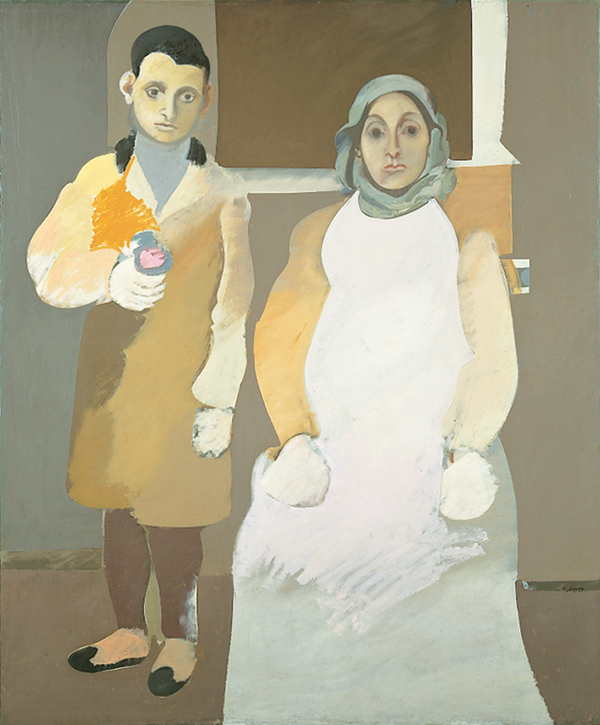
A best friend of mine said the first photo on my grandmother post, reminds her of this work of the Armenian-American painter Arshile Gorky.  It’s always made me think of my father and grandmother too.

gorky_imageprimacy_600Arshile Gorky’s The Artist and His Mother (ca. 1926–1936), Whitney Museum of American Art, New York City.  Gorky’s mother died of starvation in Yerevan during the Armenian Massacres, after reaching that city from their village, Khorgom on the shores of Lake Van.

Mana kai babas mikros(See:”Easter eggs: a grandmother and a grandfather)

Comment: nikobakos@gmail.com

Easter eggs: a grandmother and a grandfather

17 May

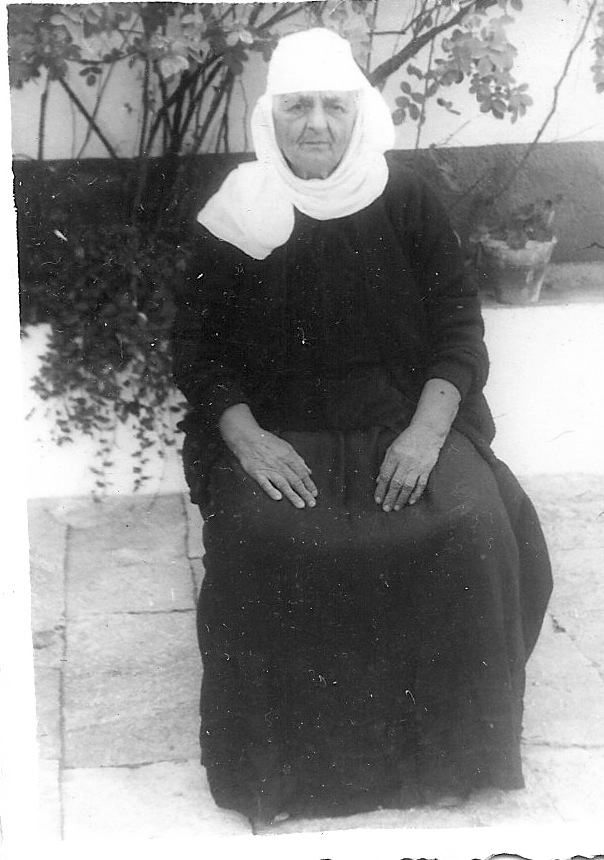
Mana kai babas mikrosThe most recent picture of my grandmother to resurface, with my father as a baby, she in somewhat less then the full-out finery of the photo at bottom with my grandfather included, but with her good sash and her mecidiyia around her neck and forehead in any case.

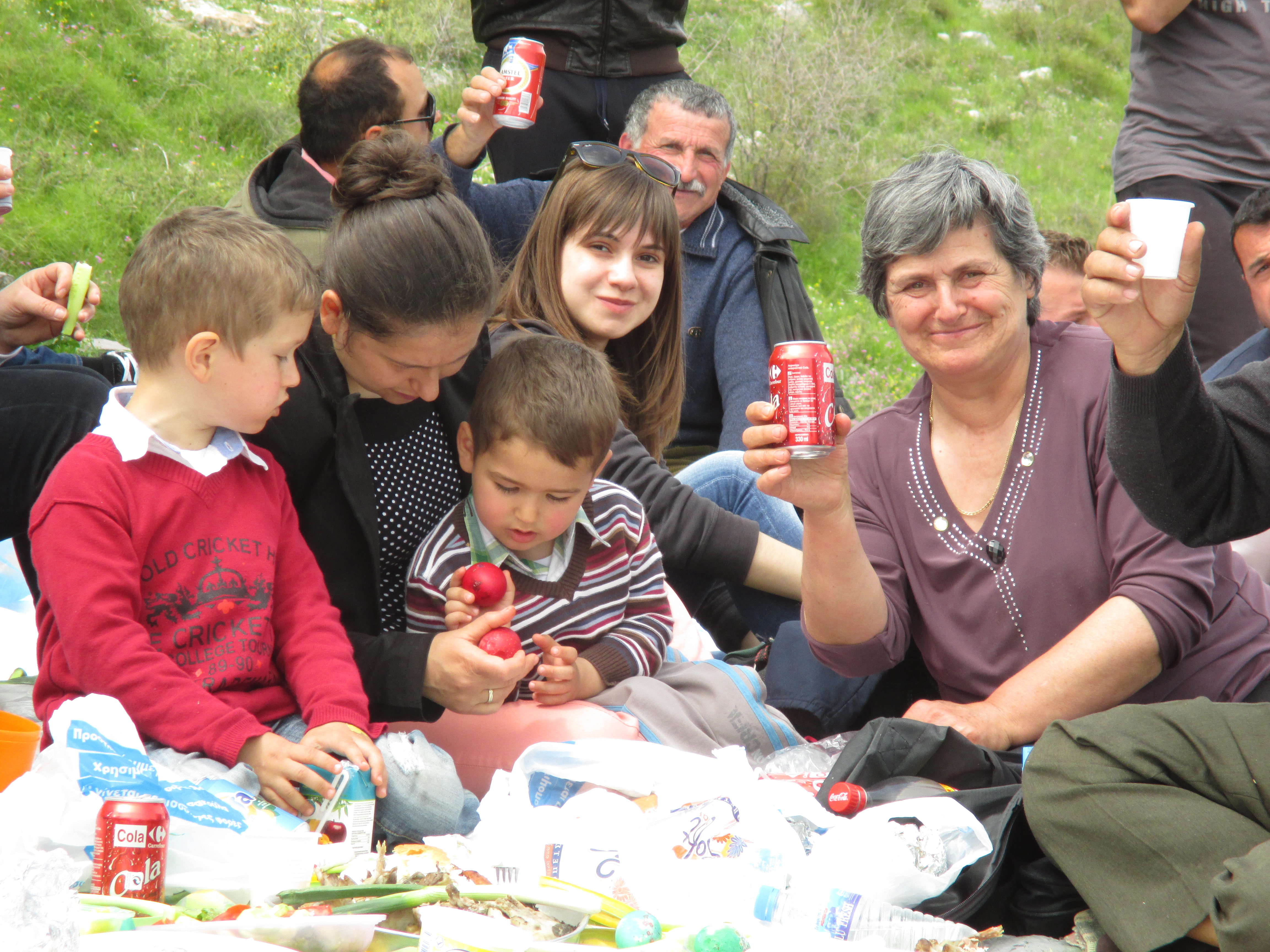
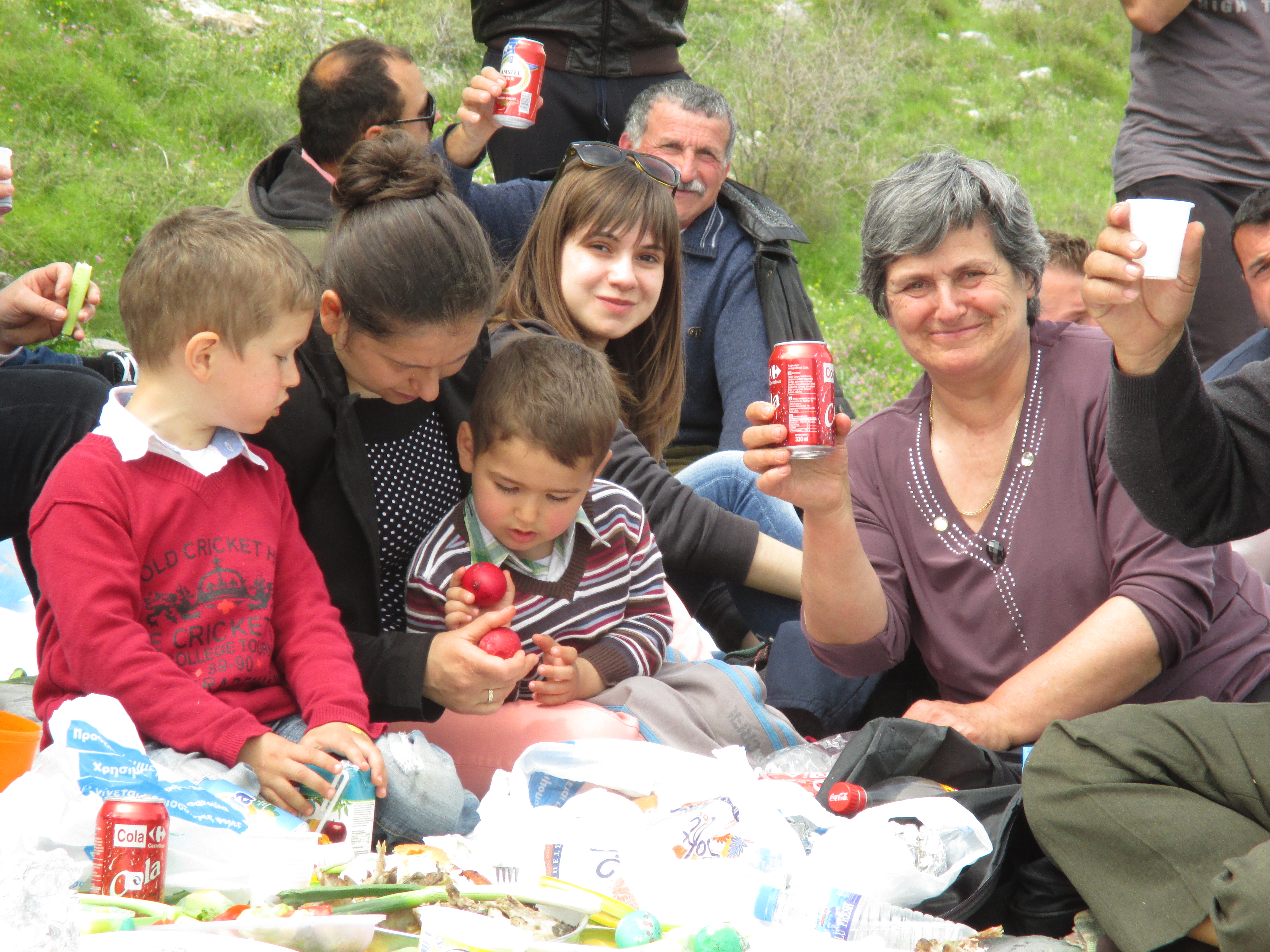
Probably the saddest of all the stories I got bombarded with while in Derviçani this time was one told to me by my cousin Chrysanthe, shown here in this picture with the Coke can (below) with her daughter Amalia and her two grandsons, cracking Easter eggs at the Monastery above the village on Easter Monday where the dancing takes place.  (See Easter in Derviçani” — the stunning young girl behind them is my niece Marina — click)  

Augaimg_0102As our house was pretty much just off the village’s main square, most of the afternoons my grandmother could be found sitting on the stone bench in front of the house watching people. Try to imagine her about forty years after the above photo was taken, but not quite as old yet as this last one we have of her. (click)

giagoula

Spiti DervitsianiOur house today (click).  Built by my grandfather with blood and sweat shed in the slaughterhouses of Buenos Aires.  The village collective confiscated it and allowed my grandmother to live in only one room, keeping hay and seed and agricultural implements in the other three odas.  It’s lain abandoned since her death.  But someone always burns a cross on the top of the doorway at Easter.  This year I got to do it myself.

My grandfather dead in some prison camp in central Albania, my father, the only child, in America, letters getting through the censors only every so often, she was lonely, despite the hordes of family she had to take care of her. People say she would beg to hold any baby that someone brought by: “I just want a baby to wet me,” she would say, “and let it be someone else’s.”

But around Easter my cousin Chrysanthe says: “She would tell us quietly to come inside, and she would open up a little sentouki [chest] she had with a pile of bright red Easter eggs inside.” This was in the mid-sixties, when Albania, recently aligned with a China in the midst of its brilliant Cultural Revolution, had prohibited any form of religion whatsoever and dyeing Easter eggs could land you in jail, even the parents of the child, in this case, if they knew and hadn’t reported it. “And I would say, ‘oooooyyyyyy Kako [auntie]*, can I take one?’ and she’d say, ‘No canım, we’re just going to keep them here and you’ll come and we’ll look at them and we’ll play with them and have fun and then we’ll put them back in the sentouki and you won’t tell anyone, ok?’”

This is what those systems wasted their energies on, in case you’re wondering how it is that they collapsed like a house of cards from one day to the next after destroying the lives of millions: forcing old women to dye eggs in secret. No one ever knew where she got the dye from or how she even got so many eggs together at one time. She probably denied herself the product of the chickens she was allowed to keep to have enough eggs for Easter. Soon after, they prohibited private poultry and confiscated bostania too (kitchen gardens), even if they were part of your house’s immediate property, and all food items had to be gotten from the village collective, but I think some local Party member with half a soul let her and a few other old people keep theirs.

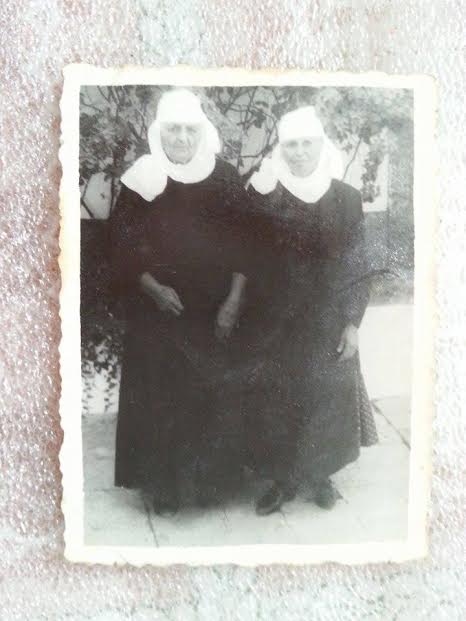
There’s a partly satisfying coda to this story though. Below is my grandmother, Martha (Mantho) with her favorite sister Alexandra (Leço).

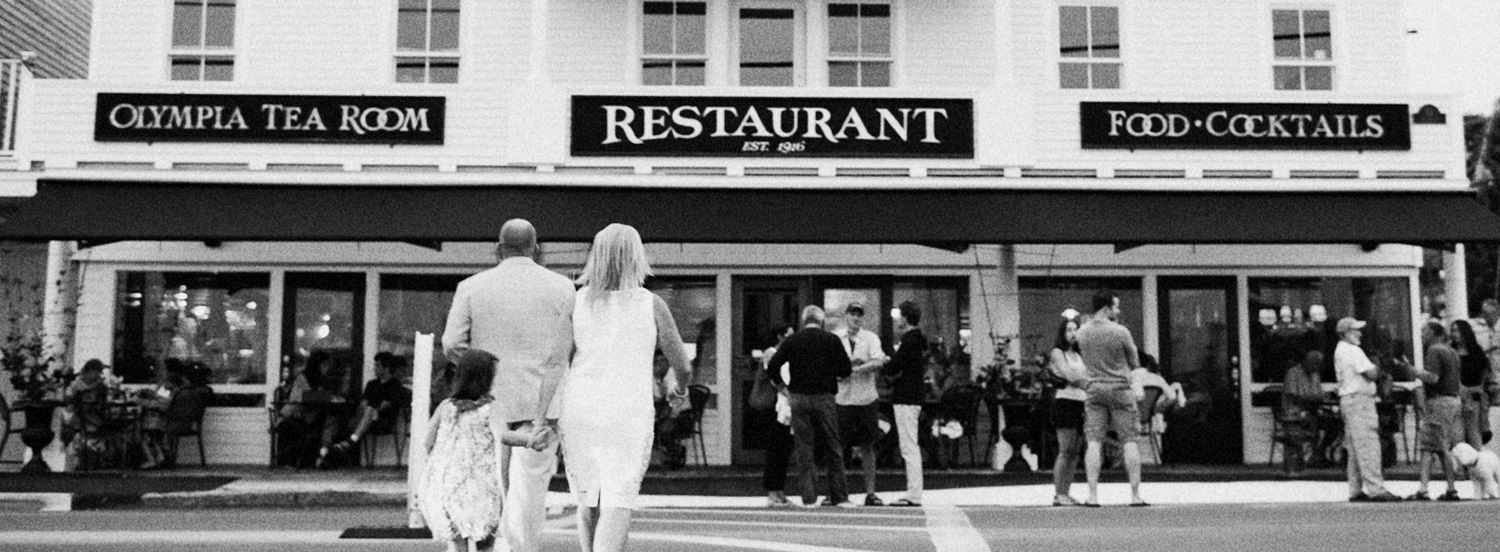
ManthaLechoTheir maiden name was Çames — and you can deduce for yourself what it might mean that Çam is also one of the major tribal sub-groups of southern Albanians, the ones who lived in what’s now Greek Epiros and who were violently driven out by Greek nationalist forces during WWII for supposedly collaborating with the Germans. Their father, my great-grandfather GianneÇames** came to the United States in 1895 and opened a fruit store in Mystic, Connecticut (the willingness of these men to just up and go off to places that must have been to them the equivalent of Zambia to us has always astounded me). A few years later, he brought three of his sons over, my grandmother’s brothers, and during the summers he used to send them down to Watch Hill, Rhode Island, a very understated, high-WASP resort on the far western shore of the state, to sell popcorn and cotton candy on the beach. But from these modest beginnings they eventually opened the Olympia Tea Room in 1916, which is still there and was quite the poshest place to eat in town for decades — and has suddenly become re-hip again. For better or worse, you know I’ve taken you seriously as a friend when I’ve dragged you down to Watch Hill to make you pay homage, as if it were my village; for my father, cut off from his own for most of his life, it was.  So the Çamedes ended up being people of some consequence in Derviçani; to have been given a Massios daughter as a bride, my great-grandmother Kostando (those who know will know what I mean), you have to have been, and their house was not just a prosperous one, but one always open to all, the “peliauri” – courtyard – where my father grew up, always swarming with women and children and guests and the whole mahalla coming in and out all day.

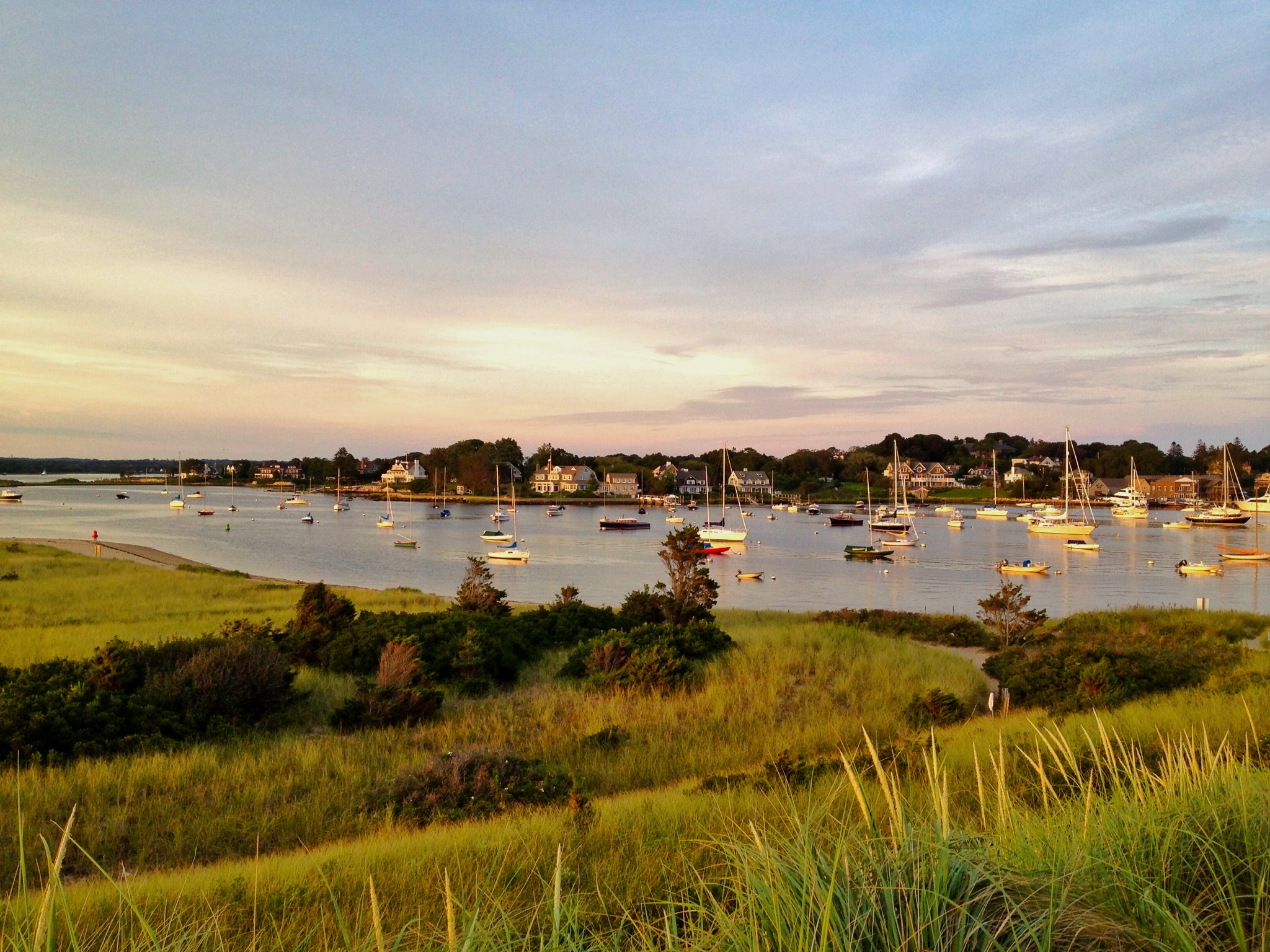
OlympiafrontThe Olympia Tea Room, “est. 1916,” Watch Hill, Rhode Island and general view of the town’s harbor below (click on both — I don’t know who took this Olympia photo but it’s great — thank you).

Watch_Hill_HarborYet my great-grandfather Gianne married off his two favorite daughters to two men without much wealth or property, my grandfather NikoBakos and my great-uncle MihoBarutas (Michales). And I think it was on their sheer reputation as outspoken men to be respected and feared – and in our parts, even today, you still have to be both – or, as men period, that he did so; my grandfather was tall and handsome but not to be messed with – “his word was law through all the villages of Dropoli” – I was told on this trip,*** and the Barutaioi are proverbially unafraid of anyone or anything.  Ex-Ottomans will know that the name itself means “gunpowder,” and that’s all you need to know.

KakoLechoLaloMihoBarutasMy great-aunt, Kako Leço (above) and my great-uncle Lalo Miho Barutas.  I wish we had a picture of them younger but no one can seem to locate one. (click)

Family(My grandparents and my father in what I suppose must have been around 1931 or ’32.  If you look carefully you can see that the photo is a Photoshop job of its day; my grandfather was photographed in Buenos Aires and the photograph later attached in Albania; it’s always been a metaphor of an inheritance of absent fathers for me.  My grandfather was known as Djoumerka, a high mountain range in southern Epiros because he was so tall (but see more on that below).  My grandmother’s outfit in this picture — all made possible by rich WASPs in Watch Hill, Rhode Island, early globalisation — was described to me once by a woman, my Theia Vantho, whose memory I would never dare to doubt: the vest and sash were a maroon-purplish velvet embroidered with gold thread, which would have looked most like this kind of work, but with a deepr, more puplish hue:

Screen Shot 2015-08-07 at 6.57.57 PM

(click)

The apron, green silk with heavy multi-coloured embroidery, the outer, mid-hip length vest, what was known as the “şita,” barely visible at the sides and mostly decorated to be seen from behind, was white woolen felt, trimmed in red and black.  The medallions embroidered on either side of the vest were not traditional and generally it was seen at the time as hubristically opulent, so much so that the kind of mean tongues that flourish in small communities like this attributed the misfortunes of her later life to her excessive pride as a young woman. Click, double if you wanna see the details.)

Of course these are not qualities that get you far in a totalitarian regime like Hoxha’s Albania, except blacklisted, sent to jail or into internal exile or killed. And that’s what happened to them. Both branches of the family and by association the whole network of related clans suffered greatly during communist rule and yet held together. The Çames gene is a strong one, and anyone who is from a big family knows how certain emotional “affinities” – in this case the love between the two sisters – end up being transmitted down specific threads through generational lines: my Kako Leço’s son, Vangeli, a first cousin of my father’s who my father barely knew, is my favorite uncle in the village: the Baruta patriarch now, he’s also a man to be respected and feared, who started from less than zero when the communist regime fell apart and is now a highly successful entrepreneur with a business that reaches Albania-wide markets. His daughters — especially one in Tirane, Calliope (she’s shown in the passing of the Light photo in “Easter in Derviçani,“) — are my favorite cousins, and one of Calliope’s sons, also Vangeli, named after his grandfather, and destined to be an equally formidable personality, is my favorite nephew.

My Uncle Vangeli spoke his mind as much as one could all during communist times and how he escaped harsher punishment during those decades is a miracle of sorts. But underneath the fear of the Party, older fears and structures of respect were still operating, I think, and that’s what saved them. One of the village informers, the usual squirrels in those systems who will tell on others for an extra ration of food — what in the Soviet Union was known as a stukach in Russian, a “knocker,” i.e., someone who comes and knocks at night to tell his superiors the information they want to know, or a sapo, a toad, in Latin America, another continent blessed with the necessary abundance of totalitarian experiences to develop such terminologies – had the misfortune of living next door to my uncle, and he would try to threaten them occasionally, but my uncle was unafraid of even getting into fistfights with him when necessary, so nothing ever came of it.

And back to Easter eggs. By ’88 or ’89 things had started, like all over Eastern Europe, not so much to relax, but to show such obvious signs of cracking apart that, as my relatives put it, “the fear started lifting.”  The Barutaioi started dyeing their own eggs during Holy Week, though there was still no functioning church or any open observation or acknowledgment of the holiday.  But on Easter night, after the Resurrection, when they had cracked and eaten their eggs, they would take the shells and throw them over the wall into the Party snitch’s front courtyard…  Forget empty tombs and angels in white and “Τι ζητείτε;”****  How’s that for some “good news” on Easter morning? And being a Jungian believer that no symbolism is accidental, I can see the cracked red shells in my mind, like splatters of the blood this guy had on his hands — though this is a person obviously too much of a hayvani to have been affected much I imagine. For to be a Christian in a village like Derviçani, and have people throw Easter egg shells at you on Easter Sunday, and not immediately find a bridge to jump off of, or a quiet corner to blow your brains out, you have to have a fairly huge hole where your conscience or any sense of shame should be. He’s still around. They’re still neighbors. And my Uncle Vangeli smiles and greets him courteously on the evening passegiata in the village square.

And my grandmother’s hidden eggs have been vindicated.

IMG_0069

*************************************************************************************************************************************************************************************************************

*”Kako”– aunt, and “Lalo” — uncle, are two of some of the Albanian words we use in our villages, though most people today just say “theia” or “theio” in Greek.  I’m the only one who still says Kako and Lalo and they all get a big kick out of it.  Ismail Kadare has a hilarious character named Kako Pino in his book about his native Gjirokaster, Chronicle in Stoneso I don’t know if it’s maybe a local usage only, or only a Tosk word (the southern ethnic/linguistic division of Albanians) because my nephew Vangeli in Tirane uses the Turkish “teyze” when he talks to his aunts.

** This is how we say (or again, said…) our names in the region: the first name, undeclined, attached as a prefix to the family name.  This is probably a left over from the day when there were no family names and only Muslim-type patronymics were used: your name and your father’s attached after.  So instead of “NikoBakos” I would have been “NikoFotos.”  Thus the oldest historical ancestor in my mother’s family, the Giotopoulos, was GioteStauros — his father Stauros is almost a sort of mythical character lost in time — and after GioteStauros, the family started calling themselves Giotopoulos, “son of Giotes.”  Women in this heavily gendered world were never known by their first names outside their immediate households, but by their husband’s name with a female suffix attached; thus my grandmother was “NikoBakaina” or even the more Slavic “NikoBakova.”

***My grandfather, it’s turned out, was quite the guy.  Absolutely fearless in a way hard for us to comprehend, he was a kind of village rowdy as a kid (the guys of Derviçani are known as such even today and their arrival in the cafés of neighboring villages in the evenings is said to be slightly unwelcome because it often means trouble; apparently they drink a hefty amount so they spend a lot of money and that’s good, but the local girls like them and that combination doesn’t always end well.)  And he would even engage in some occasional sheep rustling with a buddy of his — not for the material gain, but because it was a kind of male rite of passage in the region, as it was till recently in parts of Crete (see Michael Herzfeld’s The Poetics of Manhood: Contest and Identity in a Cretan Mountain Village” — below; let’s not mistake this with resistance to Ottoman or Muslim hegemony, as people love to do with the banditry traditions of the Balkans; it was pure thievery).  But if there were some lira to be made in the process, that was no problem either.  His nickname Djumerka, may not have come from just how tall he was, but from the fact that under the hire of a certian Ismail Ağa from Argyrocastro (Gjirokaster), he and a buddy of his (this buddy’s grandson remembered the ağa‘s name) went down to the Djumerka mountains when they were teens and stole the flocks of another rich Turk, an enemy of Ismail’s, from those parts and brought them back to Gjirokaster for him.  Given the chaos of late Ottoman times in the Balkans, this is not entirely the superhuman feat we may imagine it to be, not in terms of law enforcement at least, but we’re talking a great distance of extremely rough, high terrain and it was impressive enough to have entered the village’s legend canon.  Then he up and went to Buenos Aires in his early twenties and worked in the slaughterhouses there; Argentina is on my list of “to go” places partly or mainly because of that; I would give anything to find out even the tiniest detail of what his life there was like.  And then when he came back, with no more than an elementary school education, I think, and his pure charisma, he was important among the leaders of the the delegation from the Greek-speaking villages of Dropoli to the King, Zog, in Tirane, to protest the closing of their Greek-language schools.  The campaign was successful.  Elementary school education in Greek resumed and he soon after went to jail for the first of many times.

In the late 1950’s is when he went to jail for good and never came out and all we know is that he was buried in a mass grave somewhere in central Albania.  People in the village talk a lot about who snitched under custody on those occasions; neighbors and relatives were often taken together, so everyone would eventually find out.  If you could live with yourself afterwards, you could give false testimony about someone else and get off easier or be released or maybe just get the beatings to stop.  I turned it into a ritual questioning this time when I was there, of anyone I could, because I had to know: “Lalo, my grandfather never gave false witness against anybody to save his hide, did he? No.  Lalo, my grandfather never…? No.  Lalo…? No.”  When I got the third “No” from my Uncle Vangeli this time I was satisfied.

This is all hard stuff to live up to.  When they’re thrilled to have NikoBako come to Derviçani, I’m actually ashamed, because they really see him.  I’m just a cipher — a proud one, yes, but just a representative of someone I could never be.  Half of the time, with all my family on both sides, I’m living off of credit from my mother’s kindnesss and generosity and half the time off of my grandfather’s toughness and bravery and my father’s stoic bearing of the torch.  If you think it’s great to come from this kind of stock and have these kinds of tales to tell, think again.

**** “Τι ζητείται τον ζώντα μετά των νεκρών;  Τι θρηνείτε τον άφθαρτον ως εν φθορά;” — “Why do you seek the Living among the dead? Why do you lament the Incorruptible amidst the rot?” the angel asks the women who come to the grave on the day of the Resurrection, is my favorite verse of the Easter Canon.

Note: For those of you who made it this far with me on this post, thank you.  I hope it wasn’t boring or embarrassingly personal.  I thought a lot about whether I would ever get so deep into this stuff on this blog and decided to just go ahead.

Addendum: For the person who asked how my father can have been an only child and I can have all these hundreds of aunts and uncles and cousins and nieces and nephews, that’s because in Greek every indirect relative of an older generation is my aunt or uncle (even if he’s not my parent’s sibling but third or fourth cousin), and anyone of my generation laterally is a cousin and any children of those cousins, who may be third or fourth or fifth cousins, who are of a younger cohort, are my nieces and nephews.  My father was an only child; but my grandmother one of eight.  So out of those eight branches come this plethora of kin.

Herzfeld713qtIkpdbL

Comment: nikobakos@gmail.com

Easter in Derviçani

25 Apr

Dropoli

Easter in my fa… — in my — village has left behind such a mountain of tangled emotions and thoughts and joy and sadness that it’ll take me weeks, months…maybe never, to sort it all out and write anything coherent about it.  Almost feel like I don’t want to.  But here are some teaser pics in the meantime. (double-click on all)

IMG_0029 IMG_0058

IMG_0048

IMG_0094

IMG_0102

IMG_0129

IMG_0162

IMG_0146IMG_0125

IMG_0131

IMG_0149

IMG_0207

Jiannena

16 Apr

fanari

Christ.  Especially at certain times of the year, this can be among the most melancholy places on earth — beautiful, the mountains around still snow-capped, but not for the suicidally inclined poet or the sensitive generally.  After the exuberant spring of Attica especially…  It’s in the low 50s at most, 40s at night and there’s this constant, what I can only call British drizzle falling all the time, like somebody with a spray can standing next to you every time you venture out and continuously coating you with a fine mist.

I’m here to go into Albania on Friday (everyone still says “into”), to be the first member of my family to celebrate Easter in our village in sixty years.  And I’m staying at a hotel that has this glorious turquoise pool in the central courtyard, but it’s not open for swimming, and I like cold water and cold weather swimming, but, according to the receptionists: “δεν είναι ο καιρός κατάλληλος,” the weather is not appropriate.  And I looked at them with a straight face and said: “Guys, I’m an Epirote too, ok, and even in August the weather is exactly like this.”  They just stared at me, with that soft smile…  People here are so odd.  So tough, in the middle of all this wildness, and yet so sweet and soft-spoken — like Native Americans sometimes, they remind me.  My father was like that.

(For other Greeks, we’re just a little too “heavy” — which, given where it comes from I consider a compliment.)

One of the most beautiful evocations of the melancholy — of the melancholy and stoic — ethos of Jiannena and Epiros generally is the this poem by Michales Ganas, Γυάλινα Γιάννινα, “Jiannena of Glass,” with a video put together by Vassilike Besiou.  Her choice of musical accompaniment — the keening, rocking back-and-forth melody typical of the region (all Epirotiko music sometimes seems to have grown out of funeral dirges) and simple polyphony or second voice drone — is perfect for her purposes.  Under the video are the verses of the poem itself, in English, Greek and in a probably amateurish Spanish translation I did for a friend of mine — a “this is where I’m from” gesture… ” on my part.  The poem is odd both thematically and structurally in Greek even; excuse the clumsiness of the English translation as well.

“What snow these shoulders had born, no one ever knew.  No one ever knew.  No one.”


Jiannena of Glass

On a night like this, many years earlier,

Someone walked alone,

I know not how many muddy miles.

He walked alone,

a dark and cloudy night without stars.

Walked on and on.

At dawn, he reached Jiannena.

At the first inn, he ate and slept,

three days and three nights.

He was woken up by the snow, falling softly.

He stood in the window and listened to the clarinets.

He listened to the clarinets,

blurry one moment, at his side the next,

distant and blurry one moment, the next right at his side,

as the wind carried them.

And he heard that crystal-clear voice.

From somewhere close.

A cry, like she was being killed.

But no other noise, nothing else.

It was snowing.  All that night it snowed in Jiannena.

At dawn he paid what he owed and returned to his village.

He must have been around fifty, with grey hair,

and three unmarried daughters.

A widow of four years.  Around fifty.

A widow of four years, with his black cape around his shoulders.

Ah, what snow they had born,

What snow these shoulders had born, no one ever knew.

No one ever knew.

No one.

Γυάλινα Γιάννινα
Μια τέτοια νύχτα πριν από χρόνια
Κάποιος περπάτησε μόνος
Δεν ξέρω πόσα λασπωμένα χιλιόμετρα
Κάποιος περπάτησε μόνος

Νύχτα και συννεφιά, χωρίς άστρα
Πήγαινε το δρόμο δρόμο

Ξημερώματα, μπήκε στα Γιάννενα
Στο πρώτο χάνι έφαγε και κοιμήθηκε τρία μερόνυχτα
Ξύπνησε απ’ το χιόνι που έπαιφτε μαλακά
Στάθηκε στο παράθυρο και άκουγε τα κλαρίνα
Και άκουγε τα κλαρίνα
Πότε θαμπά και πότε δίπλα του
Πότε θαμπά
Και πότε δίπλα του
Όπως τα ‘φερνε ο άνεμος

Αχ…
Και άκουσε μετά τη φωνή πεντακάθαρη
Από κάπου κοντά την άκουσε
Σαν αλύχτημα και σαν να την έσφαζαν τη γυναίκα
Κι ούτε καυγάς, ούτε τίποτα άλλο
Χιόνιζε
Όλη νύχτα στα Γιάννενα χιόνιζε

Ξημερώματα, πλήρωσε ότι χρωστούσε και γύριζε στο χωριό του
Στα πενήντα του θα ‘τανε
Με γκρίζα μαλλιά και τρεις θυγατέρες, ανύπαντρες
Χήρος τέσσερα χρόνια
Στα πενήντα του θα ‘τανε

Χήρος τέσσερα χρόνια
Με τη μαύρη κάπα στις πλάτες
Αχ, το τι χιόνι σήκωσαν
Τι χιόνι σήκωσαν τούτες οι πλάτες
Κανένας δε το ‘μαθε…
Κανένας!

Jiannena de vidrio

Una noche como esta hace ya muchos anos,

Alguien camino solo, ni se cuantas leguas fangosas,

Noche nublada, sin estrellas,

andaba camino camino.

Al amanecer, entro en Yianena.

En la primera posada, comio y durmio

tres dias, tres noches,

Lo desperto la nieve, que caia ligera,

Se paro en la ventana

y escuchaba los clarinetes.

Y escuchaba los clarinetes,

un momento lejanos y mudos,

y despues cercanos.

En un momento lejanos y mudos,

y en otros cercanos, a su lado,

segun los traia el viento.

Ay…

Y escucho despues la voz cristalina,

de una parte cerca,

como gemido, como si la estuvieran matando.

Sin lucha ni pelea, sin nada.

Nevaba.  Toda la noche en Yianena nevaba.

Al amanecer pago lo que debia

y regreso a su pueblo.

Debia tener como cincuenta anos,

canoso ya, y con tres hijas, solteras.

Viudo hace cuatro anos,

a los cincuenta,

Viudo de cuatros anos,

con la capa negra en los hombros.

Ay, cuanta nieve han portado…

Cuanta nieve portaron esos hombros,

esas espaldas, nadie lo supo nunca.

Nadie supo nunca.

Nadie.

anexartisias

Comment: nikobakos@gmail.com


It’s Purim tonight! — something like a letter to my mother…

15 Mar

Nicolas_Poussin_E_before_Assuerus_c.1640Esther before Assuereus, Nicolas Poussin, circa 1640 (click)

For Purim this year I’m posting this poem by Greek Jewish poet Joseph Eliya, who was from my mother’s hometown of Jiannena in the northwestern Greek region of Epiros.  (See the tab box on the right for the hundred references to Jiannena and Epiros on the Jadde).

The Jews of Jiannena were Greek-speaking Romaniotes, descendants of the Jewish communities of Greece, the Balkans and Asia Minor that existed since Hellenistic times and that held out culturally against the flood of Spanish-speaking Sephardim that found refuge in the Ottoman Empire after their expulsion from Spain in 1492.  They were called Romaniotes because Romania (the kingdom of the Romans) was what the Byzantines called their polity and what we too – till the early twentieth century – also called ourselves: “Romans” – which it always aggravates me to have to explain.  But it is one of the rich ironies of history that the only inhabitants of Greek lands that stayed faithful to their true name for themselves were Jews, while we sold our souls to the West for the promises and prestige we thought the re-excavated neologism “Hellene” would curry us from the Frangoi.

So Eliya’s native language was Greek, and though he wrote some of the most beautiful translations of Jewish Biblical texts into Modern Greek, particularly one of the Song of Songs and a series of love poems to Rebecca, in a rich, florid, archaic idiom, he also wrote homelier poems in a folksier Jianniotiko style like this one, “something like a letter to his mother” on the occasion of the feast of Purim.

For those who don’t know, Purim is the day that Esther, the Queen Consort to the Persian King Ahasureus, and her uncle Mordechai, foiled the plans of the king’s evil minister Haman, to have the Jews of the kingdom massacred.  It’s generally celebrated by listening to the book of Esther in synagogue, the Megilla, sending food and giving charity to the poor and dressing up in costume, an aspect of the celebration that may be an interborrowing due to the fact that it tends to fall around Christian Carnival.

Eliya was a poor schoolteacher who died at the young age of thirty, and I believe this poem was written when he was away from his beloved Jiannena, and his beloved mother, on a teaching post in the Macedonian city of Kolkush.  It’s a sad, therefore — and very Epirotiko in that sense and in tone — poem, that’s in sharp contrast to the happiness of the holiday.

This poem also has an added emotional subtext for me.  My mother’s best friend when she was in elementary school was a Jewish girl, Esther — Esther Cohen.  “Astro” they called her, in the Epirotiko diminutive; “Tero” is also another form for the same name.   And as a little girl from a peasant family recently moved to Jiannena from their village in the mountains just to the south, I could tell that her stories about her friendship with Astro were her first lessons in tolerance and difference, whether she would’ve called them that or not (we certainly wouldn’t in our day…I’ll leave them for another post).  And she may have known it even less, but her friendship with Astro may have prepared her for life in New York in ways she was probably never conscious of.  And what she may have been even less conscious of — though maybe I should give her some credit: I do know for sure that my mother’s stories of her friendship with Astro served as my first lessons in decency and openness to those different from you.  Of that there’s no doubt.  So this post is something like a letter to my mother too.

Always they ended in a kind of distracted silence, for she never knew what had happened to her friend during the war: “Τι νά’χει γίνει η Άστρω;” she would mumble.  “What can have happened to Astro?”  And what was strange was that she could’ve found out; there were surviving Jews in Jiannena that she knew and there were even Jewish Jianniotes in New York she could have asked.  But it was like she didn’t want to know.  Even odder, I’ve had several opportunities to find out as well; Kehila Kedosha Jiannena, the Jianniotiko shul in New York on Broome Street has records on the whole community.  But it’s been almost as if I don’t want to know either.

Here is Eliya’s original Greek, with my free verse translation below.

Purim

Purim

(Something like a letter to my mother)

It’s Purim tonight!  The thrill and joy of the great feast!

Light in our souls, and a smile on the lips of all.

And I, my orphaned mother, the refuse of exile*

Waste away in a chill joyless corner.

It’s Purim tonight!  And the synagogues open their arms wide to the faithful children of my ancient people.

And they read again with wonder, from the white parchment, the triumphs of Mordechai and Esther through the ages.

It’s Purim tonight!  Young and old gather at home, at hearth, to hear the Megilla’s** tale.

And I mother – with the burning lament of exile – tearily thumb through my Bible in a lonely corner.

Your son won’t be bringing you candles or flowers from shul*** tonight, mother.  And if your crying is bitter, don’t lament too deeply.  My Fate has been decided, and poverty — poverty, mammele**** – has no feel for sympathy.

**********************************************************************************************************************************************************************************************

Notes on my translation:

*”Exile” here does not imply political banishment or anything of the sort.  It’s the word “ξενητιά” as Eliya spells it, that’s so central to understanding the Greek and — it probably goes without saying — the Jewish soul, but is so devilishly difficult to translate precisely.  It means absence — absence from the place where one should be, from one’s heart’s homeland.  Through and because of emigration and poverty most often but not always; it’s often something one feels without having had to leave.  The Turkish “kurbet” is the word closest in meaning that I know from another language.

**Not to be disrespectful, but the Megilla, the Book of Esther, is quite long, and is proverbial, in at least Ashkenazi humor, for being tedious and monotonous to listen to — but one bears it.  It’s exactly the same as the Greek term “εξάψαλμος,” the Hexapsalm, a selection of six psalms that is always read at the beginning of Matins and I’m not sure if during other offices, and would be beautiful if correctly and carefully recited according to the rules of Orthodox recitation.  Unfortunately, it’s usually read in an incomprehensible blur of mumbled boredom by the lector or cantor, which actually makes it even more tedious and irritating to sit through.  It’s usually a good time to go out for a cigarette.  I just always thought the similarity was funny.  “Ωχ, τώρα θα’κούσουμε τον εξάψαλμο,” a Greek will say with dread when faced with a berating lecture or kvetch session or someone’s tiring complaint that’s so repetitive you just tune it out, just like a Jewish New Yorker will say: “I really can’t listen to his whole Megilla right now…”

***In the second verse, Eliya uses the Greek word for synagogues and I translated it as such.  In this last verse, he uses a homier, Epirotiko form whose intimacy I felt was better conveyed by “shul.”

****And last but not least, we run into the painful translation issues that are generated by the fact that English is almost completely lacking in a system of diminutive terms of affection, especially compared with the highly elaborate diminutive terminologies of Slavic languages or Yiddish (or I assume Ladino) or even Greek.  At no point in the poem does Eliya refer to his mother as “mother” but rather “my little mother” — “μανούλα’μ” — “manoula’m.”  This is a term of affection used often by Greeks and especially Epirotes to refer to anyone, not just one’s mother, not even necessarily a female (Athenian idiots making fun will darken or double up the “l” to make it sound more northern and Slavic and hickish; for me it’s just more beautiful…); one will say to a young boy or even a friend: “Come here, manoula mou… What’s wrong, manoula mou?”  Just like “mammele” is used in Yiddish.  But I felt that using “mammele” throughout would have sounded too Yiddishy and cute, and so I saved it for that last, most intimate verse, and used mother elsewhere.  After all, this is a poem that above all is an expression of the most Jewish kind of mother-son bond.  But Yiddish and its many beauties is cursed now, by its sudden, dramatic extinction in Europe, and its shadow survival only in American entertainment, with the danger of always lapsing into a default comic tone.  It’s sad.  The translation from the Greek of the last line of the poem, for example: “poverty has no feel for sympathy…” would literally be: “…but poverty doesn’t know from sympathy.”  But then I’d be writing Larry David dialogue.

**********************************************************************************************************************************************************************************************

FINALLY, I’d like to thank Marcia Haddad Ikonomopoulos for the scan of the Greek text of the poem.  I’m in Athens now, away from my library and couldn’t find it anywhere online.  I wrote to her and within five minutes she had written back to me with both “Purim” and “Esther,” another of Eliya’s poems about the biblical heroine.  She suggested that “Esther” is a poem more appropriate to the happiness of Purim than the melancholy of “Purim.”  Unfortunately, it’s written in a much more difficult, semi-biblical, archaic language that I didn’t have the time to translate.  I promise her however, that as soon as I get a chance I will work on it and post it on the Jadde — out of gratitude to her helping me out for this, and out of gratitude to the one-woman pillar of the Kehila Kadosha Janina community that she is.  I’d also like to thank the whole congregation there for always making me feel so welcome when I attend on Erev Simchas Torah; the rabbi and his stentorian voice, the three young men who lead prayer and are perhaps the community’s most precious resource — let’s see if I remember correctly: Seth, the rabbi’s son, and the brothers Andrew and Ethan, who though they’re from a Sephardic family from Berroia, devote their shabbes and yontif time to energizing this tiny community in need of outside help.  The warmth of the community has always moved me and I’m grateful for both the odd need for Jewishness in my life and the link to my mother and her childhood that they unknowingly provide.  Thank you.

Comment: nikobakos@gmail.com

fog_in_my_hometown

Jiannena