Tag Archives: Neo-Greeks

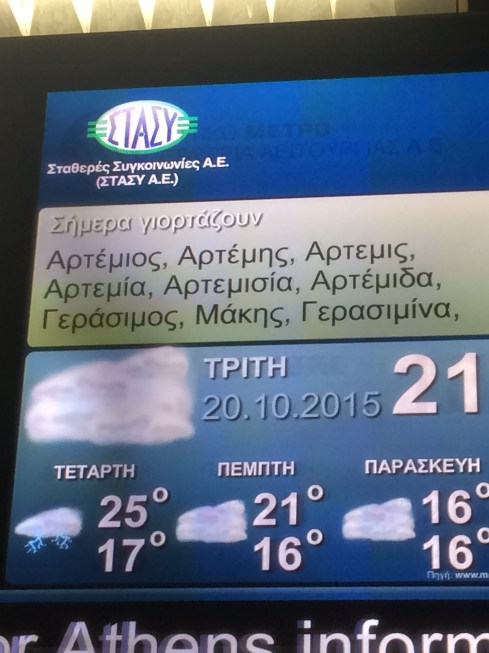
Photo: Athens metro — “Today is the nameday of…”

3 Dec

IMG_0833In recent years — I don’t know how long — the Athens metro system has began to add a list of daily namedays to the signs on platforms that give passengers the date, time and weather — so they don’t forget to at least call or text and well-wish their friends and relatives.  A nameday, for those who could possibly still not know, is the feast day of the saint you were named after.  Above the weather, the sign in the photo, which I took back on October 21st, says: “Today is the nameday of: Artemios, Artemes, Artemis, Artemisia, Artemida, Gerasimos, Makes, Gerasimina, etc.”  It’s really different versions of two names — Artemis and, the most popular among them, the male Gerasimos, the patron saint of the Ionian island of Cephalonia — but the Orthodox calendar usually celebrates more than one saint on each day of the year, since it didn’t go through their files the way the Catholic Church did after Vatican II and remove from the calendar those saints whose miracles didn’t have the requisite scientific backing (……)

Saints’ days and namedays have come up on several occasions on this blog, probably the most detailled exposition of the tradition on my part is this post from last December: Today is my nameday,” from which there’s a money quote below in case you don’t want to wade through the whole text.

This is all a part of a very tender traditionalism that has taken hold of a segment of the Greek soul since the current economic and social crisis began, the kind of refuge a society is wont to take in comforting old forms of social behavior and interaction under such circumstances, but had begun before things hit rock bottom the way they have now; it had actually started to lift as soon the the heavy malakia of metapoliteuse thinking had started to wear off as early as the 90s: this term — metapoliteuse – is defined briefly in the first footnote of this post: “Careful what you wish for…Erdoğan and Ottoman Turkish” — but culturally included a rejection of all things Church-and-Orthodoxy-related as part of the reaction against the right-wing, the monarchy and the Church of Greece’s unforgivable support in the 60s and 70s for the junta that tormented Greece with its idiocy until it fell in 1974  (See much of Pamuk’s commentary on the much more radical spiritual vacuum in which the Turkish Republic’s anti-clericism left his own class in Turkey and that may be part of the state that society finds itself in today.)  I owe readers a post that will be called “The Perfect Metapoliteuse Idiot” to borrow the term and subject matter from Mario Vargas Llosa‘s book “Guide to the Perfect Latin American Idiot” which describes a sociological phenomenon and type startlingly similar to its Neo-Greek counterpart.

manual-del-perfecto-idiota-latinoamericano-de-atlantida-4387-MLA3538134950_122012-F

And so the nameday makes a comeback.  Not that the Western birthday celebration and its obnoxious gimme-gimme narcissism has not also taken root here; it has.  (And like everywhere else, no one thinks about what a baby learns about the world when a glowing piece of confectionery is shoved in front of his face and all the big, powerful adults in his life chant to him like he’s the emperor.)  But the nameday celebration, in which you give and, generally, don’t expect to receive, is still going strong.

(Let me make just one note here: the “traditionalism” of which I’m speaking has nothing to do with the invented, racist, cruel Neo-Traditionalism of Golden Dawn and its supporters; theirs is the obnoxious militaristic “tradition” — including its revolting Spartan/Leonidan warrior pretenses that has nothing to do with any real past — of a reborn Greek fascism.)

Music, food, a renewed interest in agricultural life and processes — often as a form of survival — tiny gracious gestures of etiquette — all of these are parts of this renewal.  But what surprises me the most are the ones that concern religious observations.  Often these are performed in recognition of their cultural beauty and not necessarily as expressions of any deep spiritual impulse.  Still.  All the more, in fact.  I, for example, had always been terrified of having to spend what I thought would be a barren, empty Easter in modern Greece, which I had never had to in my life; when I finally did last year (see: “Σήμερον κρεμάται επί ξύλου…“) I was pleasantly surprised at how immersed the society was in the observation of this central, defining pole of our identity.

And now we’re in the middle of the Christmas fast, which began forty days before Christmas, on November 15th.  This is the period known as Advent in the West, for those who still remember, and as the word implies, indicates that Christmas, like Easter, was once an anticipatory holiday, with a forty-day period of fasting and relative sobriety preceding it, like Easter still is and has in the East.  Christmas was not the consumption orgy that now starts in late October and a tree that goes up on Thanksgiving and gets thrown out before New Year’s even.  Christians waited for Christmas: and it began on Christmas Eve — with the setting up of the decorated evergeen in the northern European tradition, as the West’s entire literary tradition has it, and then the celebration of the “twelve days” that ended on January 6th.  But all that was scrapped because it doesn’t fit in with distinct shopping-spree periods or quarterly earnings reports and didn’t allow enough time for too many exhausting, gluttonous “holiday” parties with people you don’t want to be with and for buying plastic crap to hang on your door.

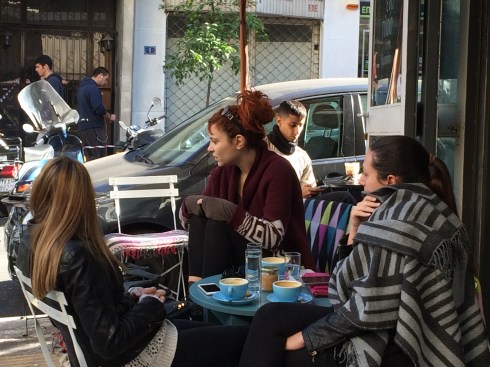
So that bright Sunday Attic afternoon, the first day of the Christmas fast, I was sitting here (below) in a very, sehr cool little cafe-bar in Pagkrati (a very cool little neighborhood), when a pretty, elegant twenty-something girl suddenly said to her boyfriend in a testily audible voice: “Σου είπα ότι είναι νηστεία σήμερα και δεν αρταίνομαι ” — “I told you it’s the start of the fast today and I don’t partake” — using an archaic form for “partake”“αρταίνομαι” — that I can’t find the etymological root of.  I nearly fell off my chair.

Plastera Cafe 1Plastera Cafe 3

Plastera Cafe 4Plastera Cafe 2

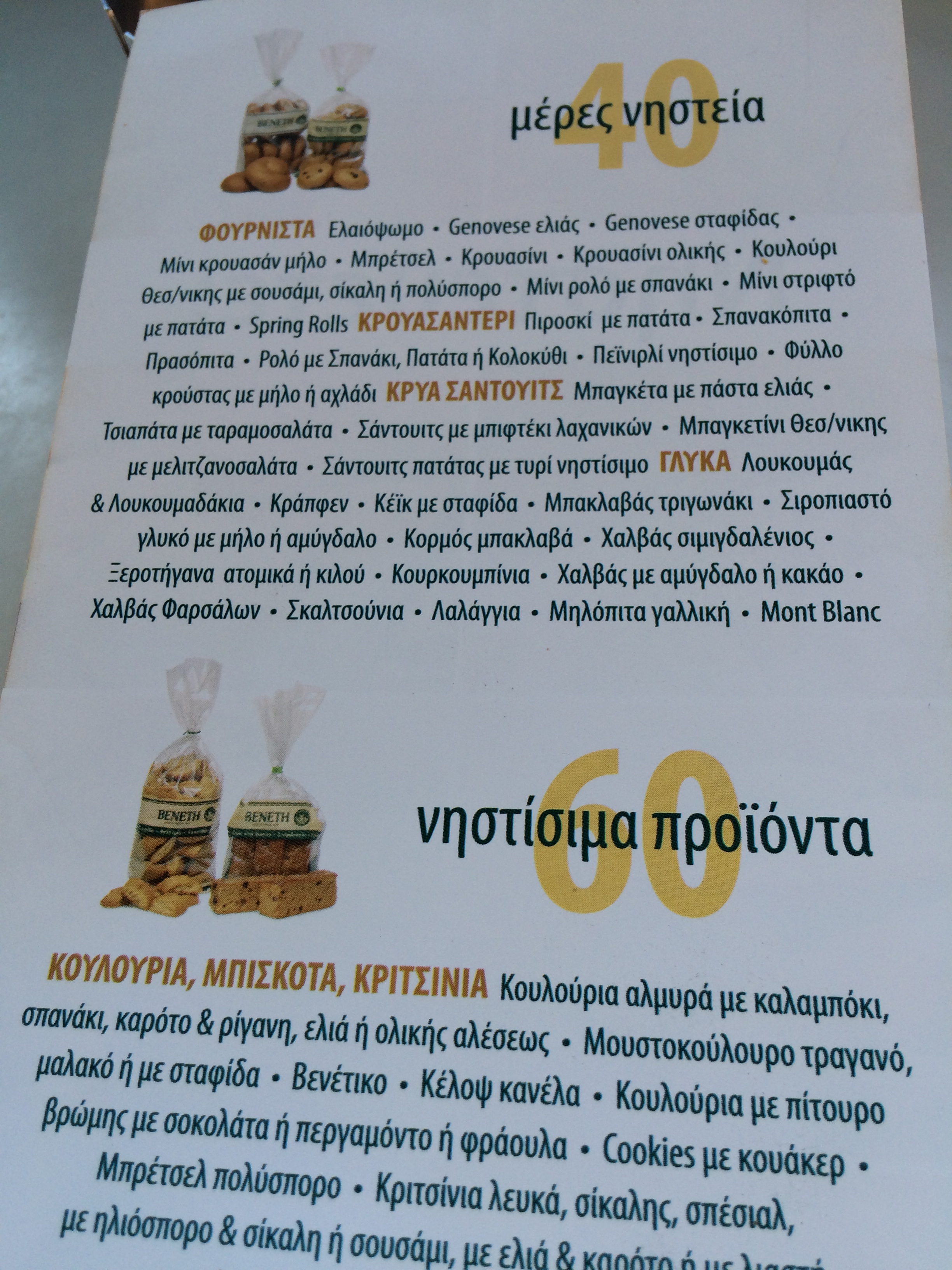
And then Venetis, a large bakery-patisserie-café chain here — which actually has some pretty good stuff — has this notice on its tables: “Νηστεύετε;” – “Are you fasting?”  And on the back: “40 μέρες νηστεία…60 νηστίσιμα προϊόντα.” — “40 Days of Lent…60 Lenten Products.”  

IMG_1162

IMG_1168.JPG

Commercial.  But a commercial use of something latched onto in the zeitgeist air.  Un-heard of…laughing-stock corny…less than even a decade ago.

Quote from “Today’s my nameday” that I mention at top:

“What I most love is that, among Greeks, your nameday is a day critical to your honor and reputation…

“…It’s a day when it’s your obligation to give and serve and prove your noblesse and not, as Western birthdays have become, a day when you sit around waiting for others to do for you or give you gifts.  Western, American, birthdays are only slightly less gross to me than the totally American ugliness of wedding and baby showers: “I’m getting married and/or I’m pregnant; so I’m having a party where you have to bring me things.”  And don’t even start me on bridal registries, where you tell people, not just that they have to bring you something, but what they have to bring you.”

Comment: nikobakos@gmail.com

Börek II — or Burek and the end of Yugoslavia

26 Aug

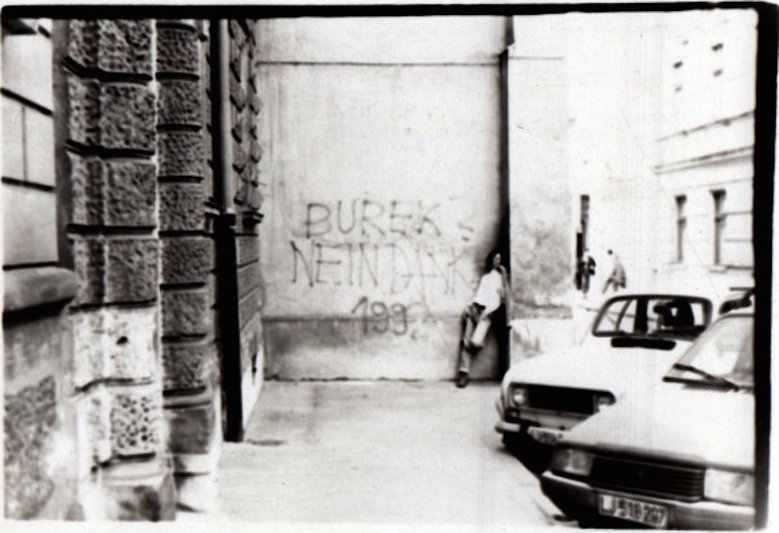
Börek Nein Danke

(click)

This is a piece of graffiti that appeared in the Slovenian capital city of Ljubljana in 1992, at the beginning of the worst period in the Yugoslav wars and after Slovenia had become independent. “Burek [‘börek’ in Turkish, pronounced exactly like an umlauted German ‘ö’]? Nein Danke.” Burek? Nein Danke. “Burek? No Thank You.” What a silly slogan, ja? How innocuous. What could it possibly mean? Who cares? And how can NikoBako maintain the bizarre proposition that a piece of graffiti in a rather pretentious black-and-white photograph is an important piece, in its ugly, dangerous racism, of the break-up of Yugoslavia.

Back up then. There are certain — usually material — aspects or elements of Ottoman life in the Balkans, which, even for Christians in the region, despite the centuries of unfortunate hate and reciprocal bloodletting (and no, I don’t think pretending that wasn’t true or that “it wasn’t that bad” is the key to improving relations between us all now; I think the truth is the key), remain objects of a strange nostalgia and affection. They linger on — even if unconsciously, or even as they’re simultaneously an object of self-deprecating humour or considered homely backwardness – as evidence that Ottoman life had a certain refinement and elegance that these societies have now lost. You sense this often intangible and not explicitly acknowledged feeling in many ways. Folks from my father’s village, Derviçani, for example, now go to Prizren in Kosovo to order certain articles of the village’s bridal costume because they can no longer find the craftsmen to make them in Jiannena or Argyrocastro, and they’re conscious of going to a traditional center of Ottoman luxury goods manufacture. You feel it in what’s now the self-conscious or almost apologetic serving of traditional candied fruits or lokum to guests. Or still calling it Turkish coffee. Or in Jiannena when I was a kid, when people still had low divans along the walls of the kitchen where they were much more comfortable than in their “a la franca” sitting rooms. 1* Perhaps the sharpest comparison is the way the word “Mughlai” in India still carries implications of the most sophisticated achievements of classical North Indian…Muslim…culture, even to the most rabid BJP nationalist. 2**
49614968

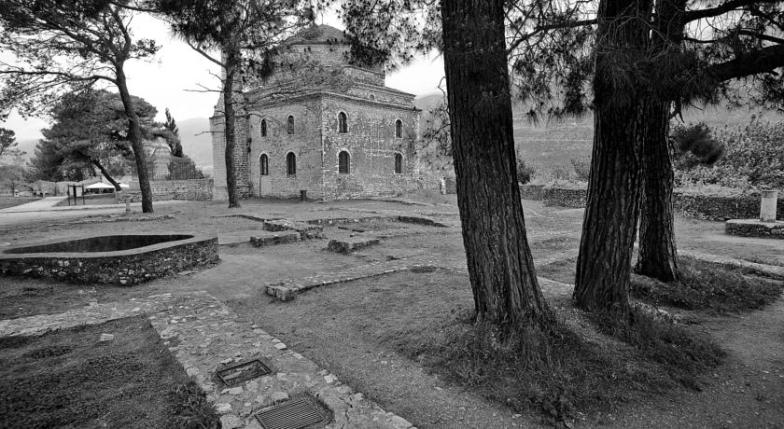
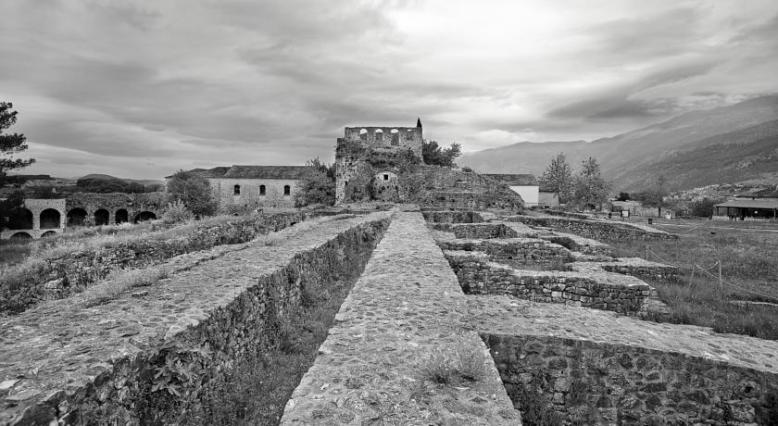
There are some places where this tendency is stronger than in others. Sarajevo and Bosnia are obvious; they still have large Muslim populations though and, after the 90s, Muslim majorities. But Jiannena – which I’ll call Yanya in Turkish for the purposes of this post, the capital city of Epiros and one often compared to Sarajevo: “a tiny Alpine Istanbul” – is also one such place. Readers will have heard me call it the Greek city most “in touch with its Ottoman side…” on several occasions. You can see why when you visit or if you know a bit of the other’s past: or maybe have some of that empathy for the other that’s more important than knowledge.
49611950

About half Greek-speaking Turks before the Population Exchange, Yanya was a city the Ottomans loved dearly and whose loss grieved them more than that of most places in the Balkans. It’s misty and melancholy and romantic. It has giant plane trees and had running waters and abundant springs in all its neighbourhoods, along with a blue-green lake surrounded by mountains snow-capped for a good five or so months of the year. It experienced a period of great prosperity in the eighteenth and especially nineteenth century, when it was not only a rich Ottoman commercial city but also a center of Greek education: “Yanya, first in arms, gold and letters…” – and, especially under the despotic yet in certain ways weirdly progressive Ali Paşa, was the site of a court independent enough to conduct foreign policy practically free of the Porte and fabulous enough to attract the likes of Pouqueville and Byron, the latter who never tired of commenting on the beauty of the boys and girls Ali had gathered among his courtiers, as Ali himself commented profusely on Byron’s own. All the tradition of luxury goods associated with the time and the city: jewelry, silver and brassware, brocade and gold-thread-embroidered velvet, sweets and pastries – and börek – still survive, but are mostly crap today, even the börek for which the city used to be particularly famous, and your best luck with the other stuff is in the city’s numberless antique shops.
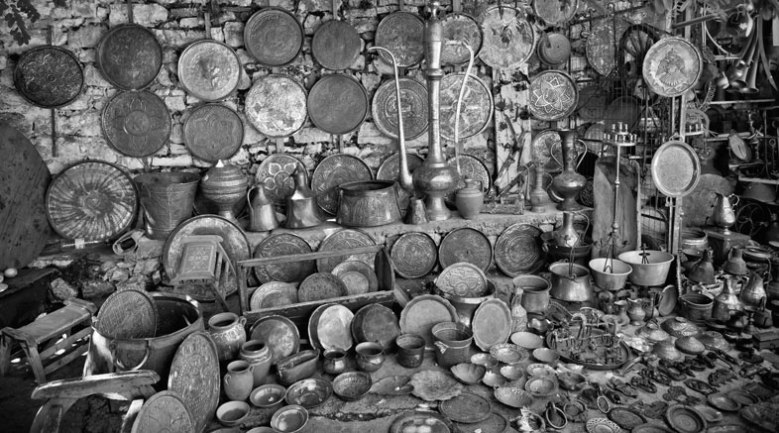
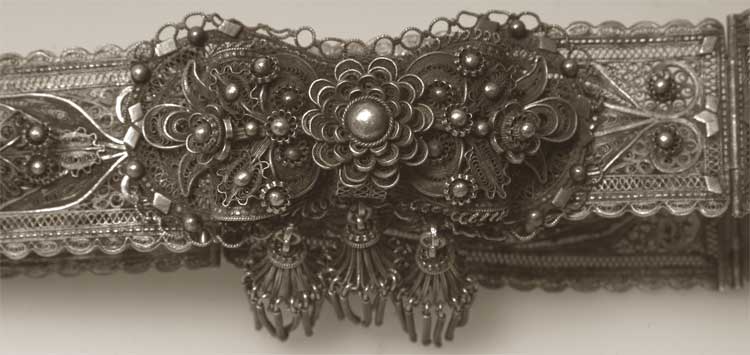
ioannina-epirus-greece-the-antiqe-market-hip

identical to yiayia's belt

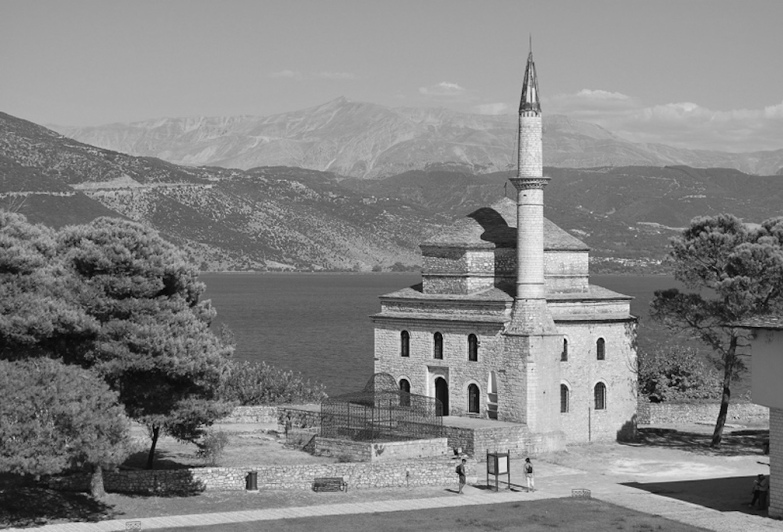
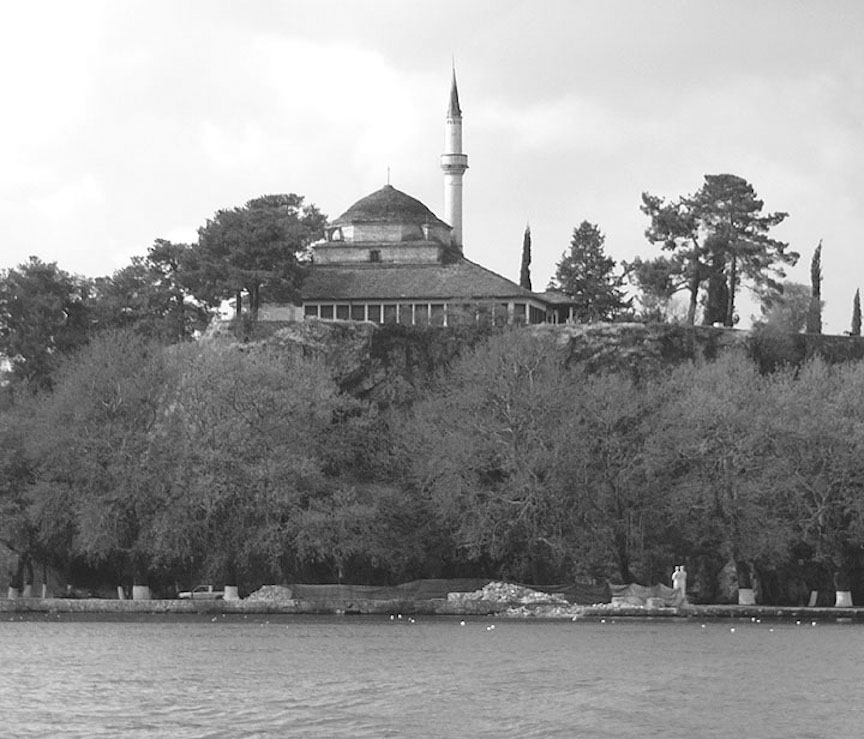
It also, unusually, and which I like to ascribe to Yanyalıs’ good taste and gentlenesss, has preserved four of its mosques, the two most beautiful in good condition even, and on the most prominent point of the city’s skyline.  It would be nice if they were opened to prayer for what must be a sizable contingent of Muslim Albanian immigrants now living there — who are practically invisible because they usually hide behind assumed Christian names — but that’s not going to happen in a hundred years, not even in Yanya.  Maybe after that…we’ll have all grown up a little.
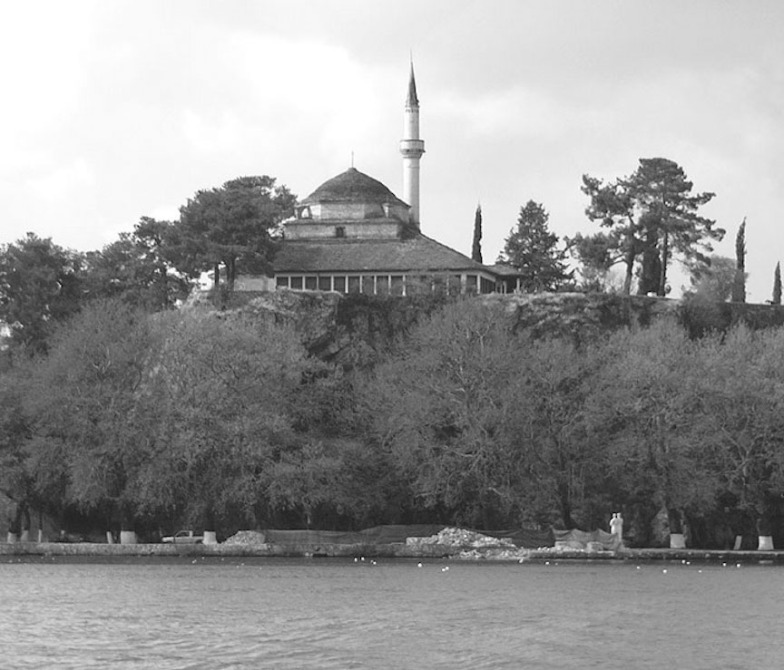
ioannina165

janina

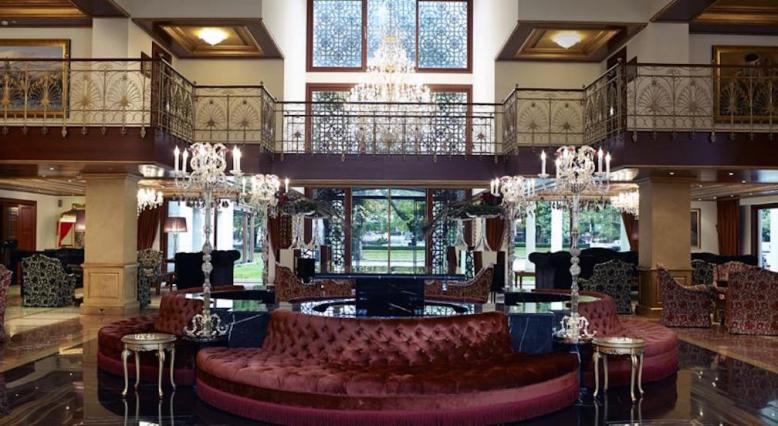
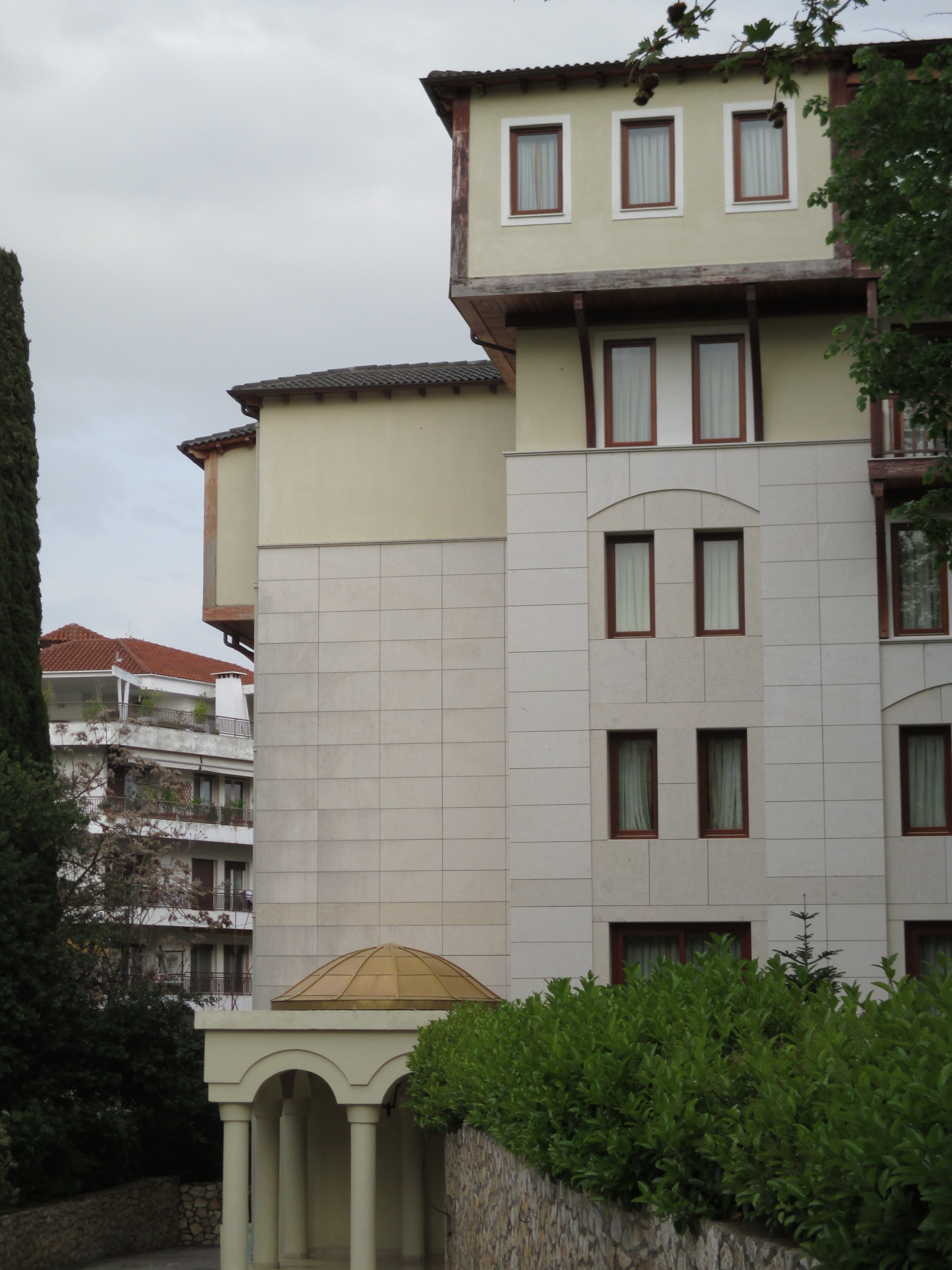
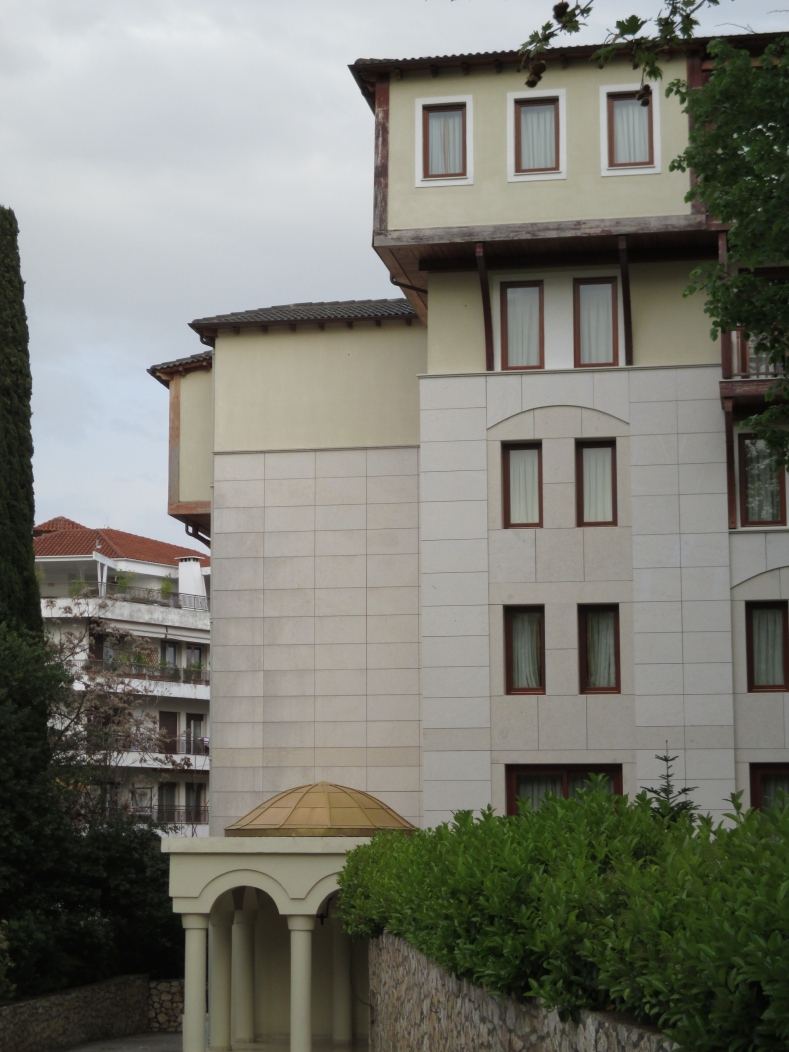
And, alone perhaps among Greek cities, only in Yanya can one open a super-luxury hotel that looks like this, with an interior décor that I’d describe as Dolmabahçe-Lite, call it the Gran Serail, and get away with it. 3***
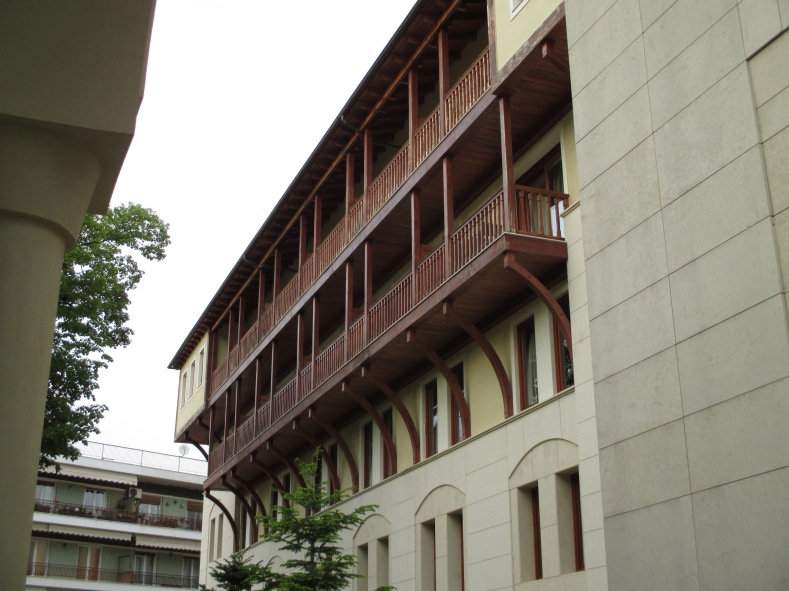
IMG_0213

IMG_0215

44471198

Digression Bakos. What’s the point? What does this have to do with Yugoslavia? I’m not digressing. I’m giving a prelude. “People don’t have the patience for this kind of length on internet posts.” I don’t post. I write, however scatterbrainedly. And not for scanners of posts. For readers. However few have the patience.

So. Croatians don’t eat börek. The prelude should have been enough for me not to have to write anything else and for the reader to be able to intuit the rest. But for those who can’t…

The graffiti on the wall in the photo at top is dated 1992, but I think it had appeared as a slogan as early as the late 80s when Slovenes and Croats started airing their completely imaginary grievances against Serbian domination of Yugoslavia and making secessionary noises. What it meant is that we, Hapsburg South Slavs, were never part of the Ottoman Empire and therefore never were subject to the barbaric and development-stunting influences of said Empire that Serbs and whoever those others that live south of them were, and therefore have the right to be free of the intolerable yoke of Serbdom. We don’t eat burek. Not only do we not eat burek, but you offer it to us and we’ll refuse in German – “Nein Danke” – just to prove how much a part of the civilized Teutonic world of Mitteleuropa we are. 4*** (I think it was Kundera who wrote about the geographical ballooning of “Central Europe” after the fall of communism, till “Eastern Europe” finally came to mean only Russia itself. ‘Cause as we now see, even Ukraine is part of Central Europe.)

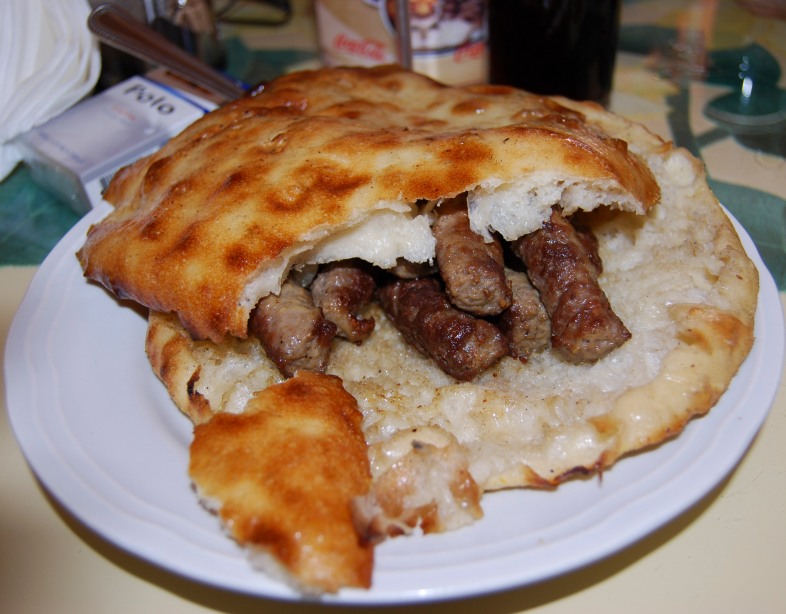
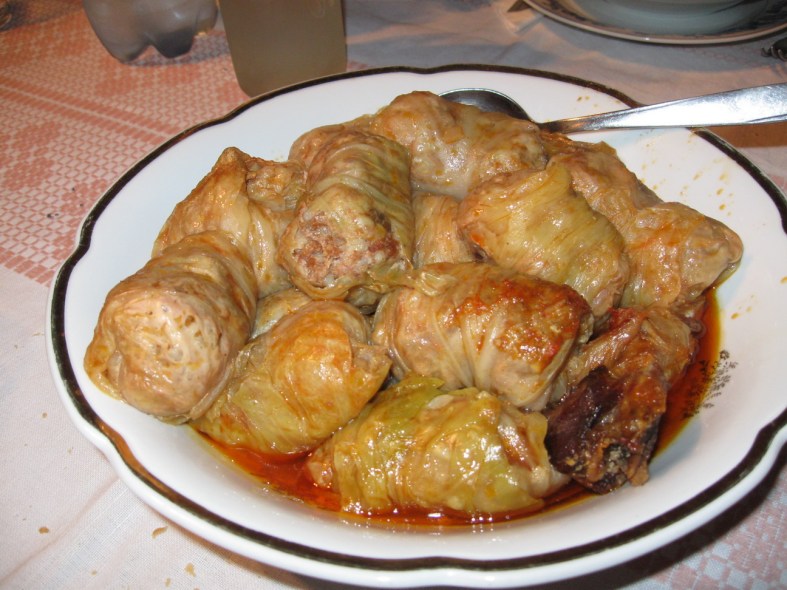
Why this yummy pastry dish was singled out as a sign of Ottoman backwardness and not, say, ćevapi or sarma, I can’t say.
Cevapi54

Ćevapi — köfte, essentially — (above) and sarma (stuffed cabbage) below.
sarma raspakovana

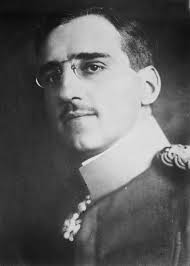
And when I talk about Hapsburg South Slavs I’m obviously talking about Croats, because, let’s face it, who cares about Slovenes? And there may be very few, if any, compelling historical or cultural reasons of interest to care about Croatians either, except, that as most readers must know by now, I consider them the people most singularly responsible for the Yugoslav tragedy. And this post is my chance to come clear about why I feel that way. There may be lots of interpretations of what the “Illyrianist” intellectuals of Vienna and Novi Sad and Zagreb had in mind when they started spouting theories of South Slav unity in the nineteenth century; countless theories about how Yugoslavia or the original Kingdom of the Serbs, Croats and Slovenes was formed; many analyses of what happened in Paris in 1919 and what kind of negotiations led to the Corfu Declaration; and reams of revisionist stuff written about exactly what Croatia wanted out of this union. But, for me, one basic fact is clear: that Croatians were always part of Yugoslavia in bad faith; that they wanted something out of the Serb efforts and Serbian blood that was decisive in defeating Austria in WWI, but that that something was independence, or greater autonomy within an Austria that they probably never expected to be dismembered the way it was – anything but what they felt was being subjected to Belgrade. And that became immediately clear upon the formation of the state when they – being, as Dame Rebecca calls them, good “lawyers” – began sabotaging the normal functioning of the Yugoslav government in any way they could, no matter how more democratic the Serbs tried to make an admittedly not perfect democracy, no matter how many concessions of autonomy Belgrade made to them. If there were any doubt as to the above, even when Radić and his Croatian People’s Peasant Party had turned the Skupština into a dysfunctional mirror image of today’s American Congress, even when a Macedonian IMRO activist working in tandem with Croatian fascists assassinated Serb King Aleksandr in Marseille in 1934, it was subsequently made brutally clear by the vicious death-spree Croatian, Nazi-collaborating fascism unleashed on Serbs during WWII, a true attempt at ethnic cleansing that dwarfs anything the Serbs may have done during the 90s — which is dwarfed again by what Croatians themselves did in the 90s again: the most heinous Nazi regime, “more royalist than the king,” as the French say — more Nazi than the Nazis — to appear in Eastern Europe during WWII.  And they have not been even remotely, adequately,  held to account by the world for any for any of the above; all this ignored, even as the West maintains a long list of mea-culpas it expects Serbs to keep reciting forever.
Alexander

King Aleksandr of Yugoslavia (click)

And so, when they got their chance in the 90s, with the backing of a newly united, muscle-flexing Germany, Croatians abruptly and unilaterally and illegally declared their long-wished for (but never fought-for) independence. And so did Slovenia; but again, who cares about Slovenia? It was a prosperous northern republic that may have held the same Northern-League- or-Catalan-type resentments against a parasitic south that was draining its wealth, but it was ethnically homogeneous and its departure left no resentful, or rightfully fearful, minorities behind. But Croatia knew, when it declared its independence – as did, I’m sure, their German buddies – that they were pulling a string out of a much more complex tapestry. And did it anyway. And we all saw the results. 5*****

So when a Croat says “Nein Danke” to an offer of burek, without even the slightest concern about his past reputation and avoiding any German associations, it is for me a chillingly racist and concise summation of Saidian Orientalism, a slogan that sums up not only the whole ugliness of the tragic, and tragically unnecessary, break-up of Yugoslavia, but the mind-set of all peoples afflicted with a sense of their being inadequately Western, and the venom that sense of inadequacy spreads to everything and everyone it comes in contact with. I’ve written in a previous post about Catalan nationalism:

All of us on the periphery, and yes you can include Spain, struggle to define ourselves and maintain an identity against the enormous centripetal power of the center.  So when one of us — Catalans, Croatians, Neo-Greeks — latches onto something — usually some totally imaginary construct — that they think puts them a notch above their neighbors on the periphery and will get them a privileged relationship to the center, I find it pandering and irritating and in many cases, “racist pure and simple.”  It’s a kind of Uncle-Tom-ism that damages the rest of us: damages our chances to define ourselves independent of the center, and damages a healthy, balanced understanding of ourselves, culturally and historically and ideologically and spiritually.  I find it sickening.

(see also: “Catalonia: ‘Nationalism effaces the individual…'” )

We’re signifying animals. And our tiniest decisions — perhaps our tiniest most of all – the symbolic value we attribute to the smallest detail of our lives, often bear the greatest meaning: of love; of the sacred; of a sense of the transcendent in the physical; of our self-worth as humans and what worth and value we ascribe to others; of hate and loathing and vicious revulsion. Nothing is an innocently ironic piece of graffiti – irony especially is never innocent, precisely because it pretends to be so.

And so I find anti-börekism offensive. Because a piece of my Theia Vantho or my Theia Arete’s börek is like a Proustian madeleine for me. Because I’m not embarrassed by it because it may be of Turkish origin. Because I think such embarrassment is dangerous – often murderously so, even. And because I think of eating börek — as I do of eating rice baked with my side of lamb and good yoghurt as opposed to the abysmally soggy, over-lemoned potatoes Old Greeks eat – as an act of culinary patriotism. 6****** And a recognition that my Ottoman habits, culinary and otherwise, are as much a part of my cultural make-up as my Byzantine or even Classical heritage are. Because just like Yugoslavia, you can’t snip out one segment of the woop and warf and expect the whole weave to hold together.
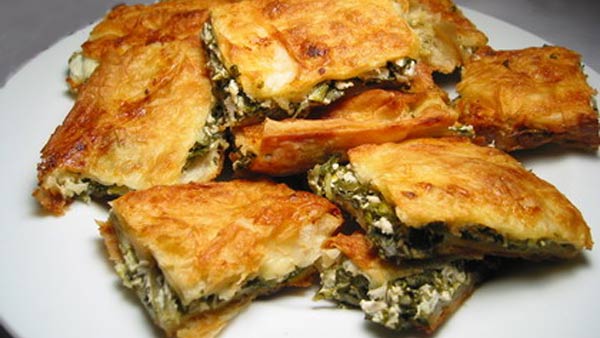
spinach-burek

******************************************************************************************************************************************************************

*1  One thing judo taught me — or rather what I learned from how long it took me, when I started, to learn to sit on my knees and flat feet — is how orthopedically horrible for our bodies upright, Western chairs and tables and couches are.  (By couch here I don’t mean the sink-in American TV couch, which you sink into until you’re too fat to get out of — that’s another kind of damage.)  Knee and lower back problems at earlier ages are far more prevalent in the Western world precisely because of these contraptions that artificially support and distort our body weight in destructive ways.  I remember older aunts in Epiros, in both Jiannena and the village, being able to sit on a low divan on the floor and pull their legs up under their hips with complete ease — women in their eighties and nineties and often portly at that — because their bodies had learned to sit on the floor or low cushions all their long and very mobile lives; they looked like they didn’t know what to do with themselves when you put them in a chair.  I’m reminded of them when I see Indian women their age at mandirs, sitting cross-legged, or with legs tucked under as described, through hours-long rituals, rising to prostrate themselves and then going down again, and then finally just getting up at the end with no pain and no numbness and no oyyy-ings.

**2  The two masterpieces of this point: the celebration of the sophistication and sensuality of the Ottoman sensibility and a trashing of Neo-Greek aesthetics — and by extension, philisitinism, racism and Western delusions — are Elias Petropoulos’ two books: Ο Τουρκικός Καφές εν Ελλάδι“Turkish Coffee in Greece,” and Tο Άγιο Χασισάκι “My Holy Hash.”  Part tongue-in-cheek, part deadly serious, both books are both hilarious and devastating.

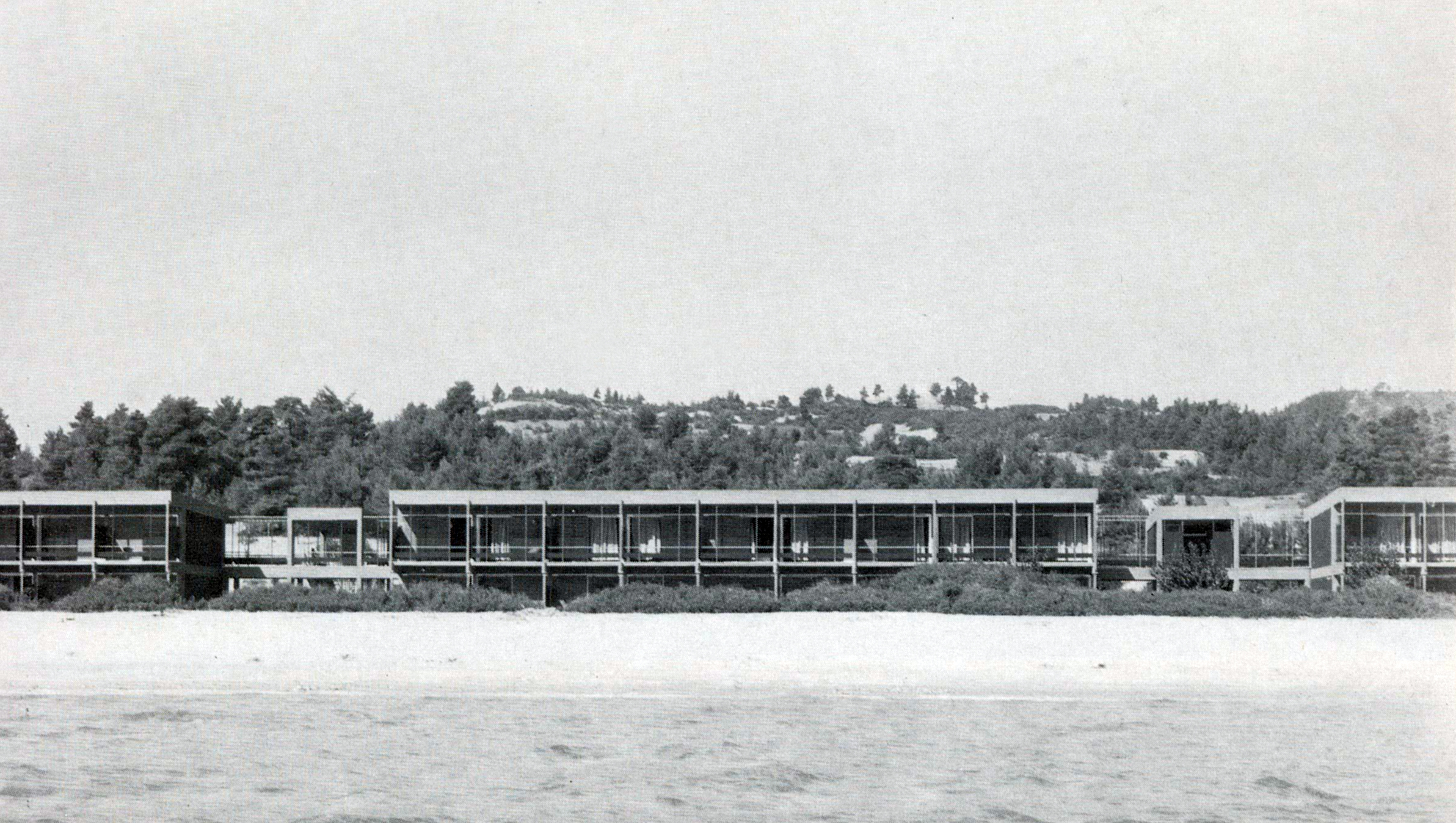
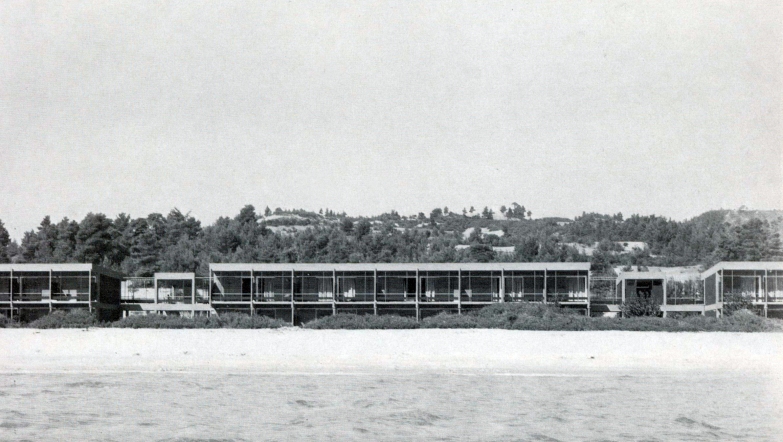
***3  Unfortunately, to build this palace of Neo-Ottoman kitsch that would make Davutoğlu proud, one of Greece’s classic old Xenia hotels, masterpieces of post-war Greek Modernism and most designed by architect Aris Konstantinidis, was torn down, and most of these hotels have suffered similar fates throughout the country, as the nationally run State Tourist Organization was forced to sell off its assets by the privatization forced on Greece then and to this day.
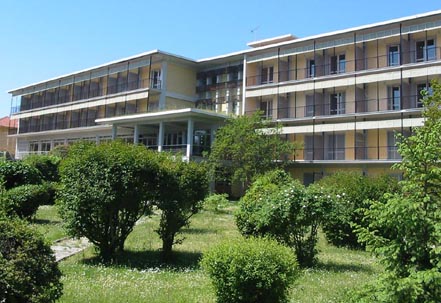
Xenia Jiannena

The Jiannena Xenia, above, built in the old wooded grove of Guraba, just above the center of town, and, below, perhaps Konstantinidis’ masterpiece, the Xenia at Paliouri in Chalkidike. (click)
Eot-paliouri-1962-2

Fortunately, Jiannena preserves one of Konstantinidis’ other masterpieces, its archaeological museum, below. (click)
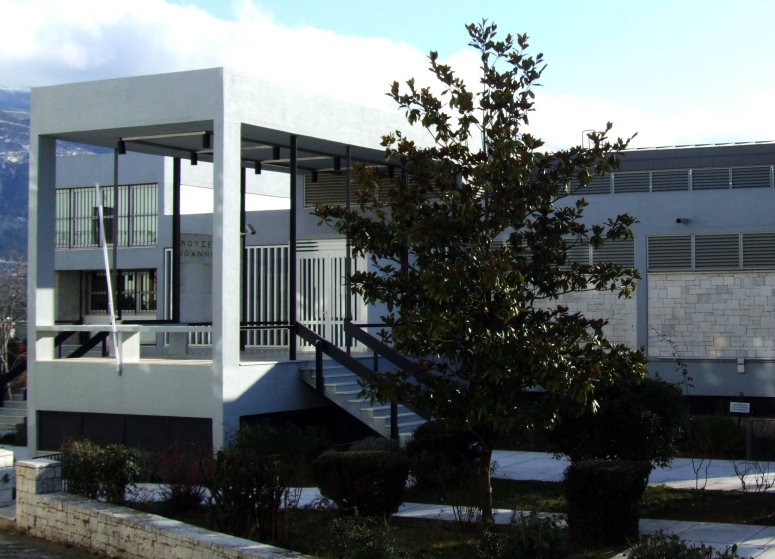
100_6975_-_Kons.Ioan1

****4  Ironically, the strudel that Croats and Slovenes imagine themselves eating in their Viennese wet dreams is probably a descendant of börek; and take it a step further: let’s not forget that croissants and all danish-type puff pastry items are known generically as viennoiserie in French.  So the ancestor of some of the highest creations of Parisian/French/European baking arts is something that a Slovene says “nein danke” to in order to prove how European he is.  Talk about the farcicalness of “nesting orientalisms.”
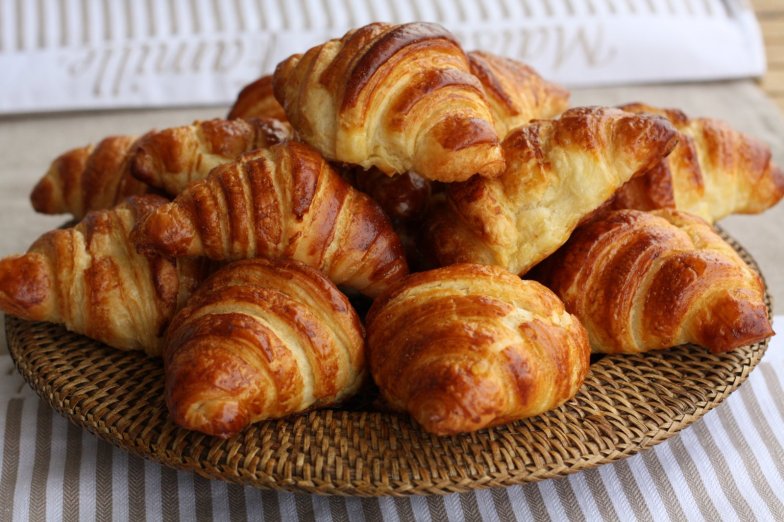
croissant

*****5  Of course, in every case, this assumption-cum-accusation, about the parasitic South draining the North of its resources, is patent bullshit.  Southern Italy, the southern Republics of Yugoslavia, Castille, Galicia, Andalusia, and the southern tier of the European Union today, may get disproportionately more in the allotment of certain bureaucratic funds compared to the tangible wealth they produce.  But they also provide the North, in every single one of these cases, with resources, labor and markets on which that North gets rich to a far more disproportionate degree and stunts the South’s growth in the process.  So haydi kai…

It’s become a common-place — and not inaccurate — observation that the catastrophic economic pressure Germany is today exercising on the nations of Southern Europe for the sake of making some sick moral point is the fourth time it’s wrecked Europe in less than a centurythe third time being when it decided, immediately upon reunification, to show the continent it was a political player again by practically single-handedly instigating the destruction of Yugoslavia.

******6
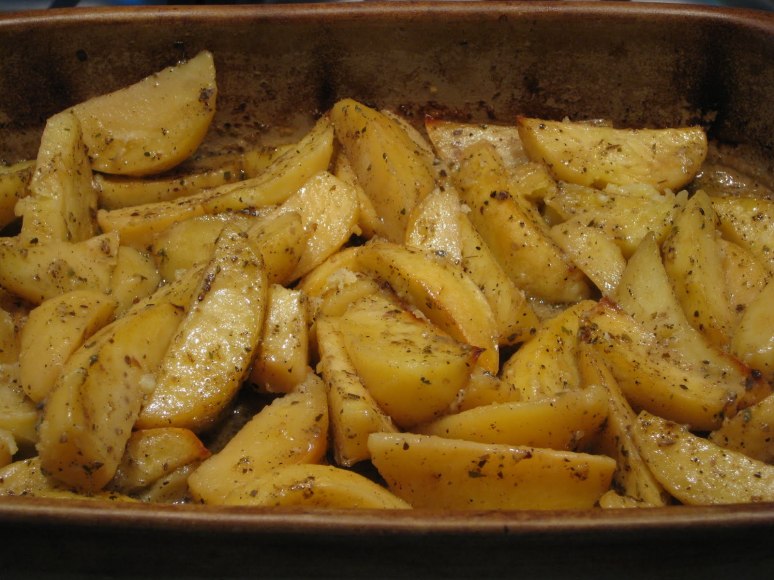
patattes

Over-oreganoed and over-lemoned — like much of Greek food — and overdone, over-salted and over-oiled, perhaps the only thing more repulsive than the soggy potatoes Old Greeks bake with lamb or chicken (though one horrible restaurant — which New Yorkers are for some reason crazy about: I mean like “take-the-N-train-out-to-Astoria-and-wait-for-a-table-for-an-hour” crazy — criminally serves them with grilled fish) is the serving of stewed meat with french fries.  You’ve hit the rock bottom of Neo-Greek cuisine when you’ve had a dry, stringy “reddened” veal or lamb dish accompanied by what would otherwise be good, often hand-cut french fries, sitting limply on the side and sadly drowning in the red oil.
Comment: nikobakos@gmail.com

Συγχαρητήρια! Congratulations! for trumpetting Al Jazeera headline: “Greece, a front line for state-sponsored racism in Europe”

29 Sep

“…a front line for state-sponsored racism in Europe.”

Are you proud of yourselves?  Και εις ανώτερα!

immigrants-19-banners-athens.si(Reuters/Yorgos Karahalis)

“Once the cradle of European civilization, Athens is now the center of a continental decivilizing process.”  See whole article .

And I want to make sure you all know my heartfelt congratulations go out to all and every one of you, every inhabitant of the statelet that’s sat by silently doing and saying nothing all these years as this ugliness built up its now seemingly unstoppable momentum.  And instead are worried about whether Albanian genes will show up on your DNA chart

Comment: nikobakos@gmail.com


“A Greek Politician Willing to Face the People”

27 Sep

An amazingly flattering article on Rena Dourou, MP of Syriza, from the Times:

DOUROU-superJumbo “People were amazed to see me. They had never met a politician. They were touching me, saying, ‘You are Rena Dourou?’” Credit Lynsey Addario for The New York Times (click: great pic and great Greek female face — not conventionally beautiful, but sexy in our sharp and edgy and smart and witty way.)

Not in a position to judge Syriza, Dourou’s slightly left of center party; people whose opinions I respect think the party’s leader, Alexis Tsipras (see Nicholas Gage’s assessment here and and my response here) is a not-to-be-taken-seriously posturer and brat; and the truth is he reminds me and others a little too much of a young Papandreou — and smells a little like too many Athens College graduates I know, though I don’t actually know where he went to high school.  But the portrait of Dourou is convincing enough.  Just the way she’s apparently dealt with the sexism of the Greek political establishment, at least, seems something to commend her for.

Money quotes:

Easy to mock as cheap and populist:

…for the time being, Ms. Dourou’s election as prefect, the rough equivalent of the governor of New York, represents the party’s biggest victory so far.

Petite and blond, Ms. Dourou ran an American-style campaign, going door to door, something most Greek politicians avoid out of fear of being assaulted by angry citizens. [My emphasis — only ’cause I thought it was really funny] On her office wall, she kept a map of the region with dozens of pins indicating where she had traveled. Few opinion polls correctly predicted her victory.

But she brought her handshakes and her motto — “if you feel you have the life you deserve, don’t do anything and vote for the same old people” — all over the city, even to areas considered bastions of the right-wing Golden Dawn party.

“I don’t know whether it got me any votes,” she said. “But people were amazed to see me. They had never met a politician. They were touching me, saying, ‘You are Rena Dourou?’ ”

And a perfect little detail with which you can paint the Greek political establishment’s level of professionalism, and Neo-Greek spoiled loser pettiness:

But for the time being, she remains an official with few allies in office and little experience. A few months after winning and before taking office, she sent a formal letter to her predecessor asking to be briefed on the “loose ends” and “current issues” in the region. In his response, he told her the information was on “corresponding websites.”

And this is the kind of stuff for which Syriza gets my ambivalent respect:

NONETHELESS, she has already made headlines for a public brawl with the central government over the future of thousands of municipal workers in her region. The central government wants to review their credentials and evaluate their performance. But Ms. Dourou sees this as a thinly veiled starting point for cutting workers and pleasing Greece’s creditors, and she is refusing to hand over their files.

Dealing with Neo-Greek male garden slugs:

STILL, politics in patriarchal Greece can be tough on women. Last year, the vice president of the government, Evangelos Venizelos, told a female member of Parliament that “she should be pregnant.”

As Ms. Dourou was campaigning for office, a former deputy prime minister from the socialist Pasok Party, Theodoros Pangalos, said in a radio interview that he could not stand seeing posters of Ms. Dourou’s “filthy face” all over Athens. He added that he would “like to see her campaign complete with a full-body picture of her with a bikini.”

Dunno…  We’ll have to see.

Comment: nikobakos@gmail.com

Life as an Illegal Immigrant in Greece — from VICE

16 Sep

Or what the Messenger would call my “aiding and abetting the enemies of our Fatherland.”

A great video piece done this past spring by that increasingly brilliant outlet, Vice.

Felt proud, though, at the number of intelligent, articulate, compassionate Greeks who appear in the video taking a stand against this deplorable situation and not indulging in the usual apologetics that have unfortunately become the Neo-Greek man-on-the-street’s default discourse: “We can’t afford to have these people here …Golden Dawn helps the people, etc.”  Or this one from the Messenger: “If that percentage of immigrants had descended on the United States all of a sudden, wouldn’t the Ku Klux Klan be voted into office the next day?”  Errr…no.  It wouldn’t.  A classic piece of simplistic knee-jerk anti-Americanism touched with his own brand of fascism-lite.

 “Greece has always been a gateway for immigrants searching for what they assumed would be a better life in Europe. But many of those who have crossed illegally into Greece have found that they have traded one bad situation for another. Refugees from war-torn countries like Syria and Afghanistan are finding themselves stuck in a country that is not only battling an economic crisis but is witnessing a rise in anti-immigrant violence—exemplified by the a nationalist political party known as the Golden Dawn.

VICE News’ Alex Miller travelled from Athens to the western port of Patras to find out what it is like to be trapped in a country you never wanted to be in in the first place.”

Comment: nikobakos@gmail.com

Upon escaping from Greece…

7 Sep

cp-cavafy2

How do you go through the work of the poet whose opus consists of the sharpest and most accurate analysis of Modern Greek identity, and find the poem that displays perhaps the most razor-sharp understanding of all of them? I’ve always known that poet was Cavafy, but I wasn’t looking for that one poem or anything, when, just leafing through his stuff a few days before I left Greece this past July, I came upon one of my favorites, the following. Please have a look first:

Going Back Home from Greece (an unbelievably clumsy translation of the Greek title)

Well, we’re nearly there, Hermippos.
Day after tomorrow, it seems—that’s what the captain said.
At least we’re sailing our seas,
the waters of Cyprus, Syria, and Egypt,
the beloved waters of our home countries.
Why so silent? Ask your heart:
didn’t you too feel happier
the farther we got from Greece?
What’s the point of fooling ourselves?
That would hardly be properly Greek. 
 
It’s time we admitted the truth:
we are Greeks also—what else are we?—
but with Asiatic affections and feelings,
affections and feelings
sometimes alien to Hellenism. 
 
It isn’t right, Hermippos, for us philosophers
to be like some of our petty kings
(remember how we laughed at them
when they used to come to our lectures?)
who through their showy Hellenified exteriors,
Macedonian exteriors (naturally),
let a bit of Arabia peep out now and then,
a bit of Media they can’t keep back.
And to what laughable lengths the fools went
trying to cover it up! 
 
No, that’s not at all right for us.
For Greeks like us that kind of pettiness won’t do.
We must not be ashamed
of the Syrian and Egyptian blood in our veins;
we should really honor it, take pride in it.

— Translated by Edmund Keeley/Philip Sherrard

Επάνοδος από την Ελλάδα

Ώστε κοντεύουμε να φθάσουμ’, Έρμιππε.
Μεθαύριο, θαρρώ· έτσ’ είπε ο πλοίαρχος.
Τουλάχιστον στην θάλασσά μας πλέουμε·
νερά της Κύπρου, της Συρίας, και της Aιγύπτου,
αγαπημένα των πατρίδων μας νερά.
Γιατί έτσι σιωπηλός; Pώτησε την καρδιά σου,
όσο που απ’ την Ελλάδα μακρυνόμεθαν
δεν χαίροσουν και συ; Aξίζει να γελιούμαστε; —
αυτό δεν θα ’ταν βέβαια ελληνοπρεπές. Aς την παραδεχθούμε την αλήθεια πια·
είμεθα Έλληνες κ’ εμείς — τι άλλο είμεθα; —
αλλά με αγάπες και με συγκινήσεις της Aσίας,
αλλά με αγάπες και με συγκινήσεις
που κάποτε ξενίζουν τον Ελληνισμό. Δεν μας ταιριάζει, Έρμιππε, εμάς τους φιλοσόφους
να μοιάζουμε σαν κάτι μικροβασιλείς μας
(θυμάσαι πώς γελούσαμε με δαύτους
σαν επισκέπτονταν τα σπουδαστήριά μας)
που κάτω απ’ το εξωτερικό τους το επιδεικτικά
ελληνοποιημένο, και (τι λόγος!) μακεδονικό,
καμιά Aραβία ξεμυτίζει κάθε τόσο
καμιά Μηδία που δεν περιμαζεύεται,
και με τι κωμικά τεχνάσματα οι καημένοι
πασχίζουν να μη παρατηρηθεί. A όχι δεν ταιριάζουνε σ’ εμάς αυτά.
Σ’ Έλληνας σαν κ’ εμάς δεν κάνουν τέτοιες μικροπρέπειες.
Το αίμα της Συρίας και της Aιγύπτου
που ρέει μες στες φλέβες μας να μη ντραπούμε,
να το τιμήσουμε και να το καυχηθούμε.

What gives this poem such pride of place as an analysis of Greek identity? For me, it starts with the simple joy both passengers feel as they’re arriving home – not approaching Greece, but leaving it. “Upon Escaping from Greece” would be my choice for the title’s English translation, because it’s clearly an experience of suffocation that the two friends have experienced that has started to lighten up for them as they cruise east through the breezy waters of the Mediterranean.

Cavafy has become an object of a resurgent cult in Greece, partly due to last year’s 150-year celebration (he was born in 1863), that’s a kind of an “emperor’s-new-clothes” phenomenon for me; not because his new clothes aren’t real, but I feel that few Greeks actually know what it is they’re suppose to be liking so much. I much prefer people who just say up front that they don’t like him. He’s “childish” they say, in response to his prose-like, early modernist experiments. These are the people who like their poetry with a capital “P”; they want it to rhyme: “φεγγαράκι μου λαμπρό…” and they want it to have epic scale heroics and ‘the thousands dead under the axles’ and ‘the living giving their blood’ in the heroic deed of ‘making the sun turn,’ along with some myrtle and oleander and jasmine thrown in for Aegean effect. (What if you’re from Epiros and you don’t know from oleander and jasmine, just tsouknida and pournari?) Others only like a very emphatically stressed “some” of his poems: these are the ones turned off by his sexuality, but who feel they can’t say so openly in 2014 – or to me. (And the degree to which that whole part of his work, a good half, was ignored by the official festivities – they wanted only “Ithaka” or “Waiting for the Barbarians” or “The City” — was amazing.*) The Messenger for example, found a publisher for his paternal grandfather’s, my great-grand-uncle on my mother’s side, fascinating memoirs, which span the whole period from the late nineteenth century and the end of Ottoman rule to WWII. Except his grandfather met a Jewish guy who screwed him over when he was a young immigrant in New York in the 20s and he included the unfortunate phrase: “Hitler was right for doing what he did to them.”**  The publisher thought maybe that line should be cut. But the Messenger stuck to his cast-iron principles and insisted it be left as is, because it would be “censorship” to remove it.  Hardly an upholder of the most liberal sentiments on issues of that kind, I have a feeling that if the comment hadn’t been about Jews, he wouldn’t have minded the censorship so much. Just a few months earlier, for example, he hadn’t thought it was “censorship” to cut a slightly too homoerotic line from a Cavafy poem he read at his father’s funeral, for fear that our landsmen, our chorianoi, would be scandalized.

These elements and others: that Cavafy preferred the tragic dénouement to the epic climax; the unconsummated to the fulfilled; that he preferred the coded to the open and disclosed, and not out of choice; but learning to love what fate had made him, he learned to love the beauty of code – its poetry — the furtive touch over some cheap handkerchiefs; that he loved the ethnically and culturally and religiously mixed margins of Greek history and the poignancy of characters who had to straddle those margins and did not write a single poem about its Attic glory days (who are all these half-breed Egyptians and Parthians and Jews and other exotic anatolites he’s always making us read about anyway? Where’s Pericles and Aristotle?); that he understood life and humanity as fundamentally amoral, and morality as a convenient weapon to be used against the unfortunate few or often just a bad joke. All this did not do much to endear him to his contemporaries, along with the fact that he famously disliked Greece and especially Athens (the latter kind of unfair in my opinion: Athens at that time must’ve been at its most beautiful and charming), and the straight, homophobic white boys of the Generation of the ‘30s in particular, despite Seferis’ famous eulogy, had no time for him. The most vehement, Theotokas (unfortunately, one of my favorite Greek writers otherwise) scathingly declared Cavafy, in his Free Spirit, a “dead end” (a common trope, whether conscious or not: the gay man begets no issue and is thus fundamentally allied with death); that his modernism was an experiment that had been taken to its logical conclusion and that the Alexandrian was now a decadent (same difference), a point of departure for what Greek letters should move on from next and not a road open for them to continue down.

That right there is the grand and egregious error. Because Greek culture and identity – in a way that makes any sense to who we are today – simply didn’t exist until the Hellenistic (and then Roman/Byzantine) periods that Cavafy chose, almost exclusively, to write about in his historical poems. The conglomeration of Indo-European tribal units who all spoke dialects of similar languages and had started coalescing into larger city-state forms of political organization by the mid-first millennium B.C. have nothing to do with us. They may have started calling themselves “Hellenes,” but let’s not forget that the Iliad does not contain one, single, blessed mention of that holy word, and was compiled only a century-and-a- half or so before the Golden Periclean Age we’re so obsessed with.

It was because he was fascinated with the true origins of Greek identity, the cauldron of cultural mixture that Alexander created that later became condensed into a more distilled Greek-speaking, Orthodox idea, that Cavafy wrote about those periods so widely and studied them so deeply. And being from such deep aristocratic Constantinopolitan roots and an Alexandrian, how could he not have felt that basic idea on a gut level.

This is another reason the mention of the words “Macedonia” and “Alexander” makes my hair stand on end. The Macedonians (by which I mean Slav Macedonians) are ridiculous in their attempt to appropriate Alexander as a phenomenon of their own culture, though many observers have written about how this conscious policy of “antikvatsiya” (“antiquization”) on the Macedonian government’s part is, partly, a response to Greek intransigence on every other grounds. But you can see from how Greeks respond to Macedonian moves that Greeks don’t get Alexander either. Alexander is not a culminating point of Hellenic history, where the great hero brought Hellenic civilization to the “borders of India.” Alexander is not even a Greek herohe very early in his career quickly became déraciné, as Mary Renault keenly observed. Alexander is where Greek history starts. It’s all really the other way around. Alexander is what brought the East, and its incomparably greater and older civilizational achievements, to us. He drove us deep into contact with that wider world, cementing what had always been our bonds to those lands and those peoples he grew to love so much, and giving us as much in return, actually more, than what we gave them. He created the great creolized cultural space that a universal, cosmopolitan Greek identity was first born in and that later – when the name for “universal, cosmopolitan identity” changed, due to political circumstances, from “Greek” to “Roman,” – changed along with it, but which left the Helladic peninsula — or “the Hellenic” generally — behind permanently as a focus of any kind. Until the twentieth century.

Alexander Renault

Hermippos and his friend, Greeks going home to Antioch in Syria or Seleucia in Mesopotamia, can’t be Greek in Greece. It suffocates them. They don’t fit into that nonsense, antiquarian straightjacket. It’s “beneath” them, as Greeks, to reject the wider world that they’ve long been an intimate and inseparable part of. Greek means cosmopolitan to them and they can’t be Greeks without that quality. It would be the most provincial thing for them to do, to act like provincials who try to hide their “easterness”:

“…like some of our petty kings
(remember how we laughed at them
when they used to come to our lectures?)
who through their showy Hellenified exteriors,
Macedonian exteriors (naturally),
let a bit of Arabia peep out now and then,
a bit of Media they can’t keep back.
And to what laughable lengths the fools went
trying to cover it up!”

Eastern Mediterranean(click)

The nation-state is bound up inseparably with provincialness. And narrowed tribalism. And provincials hide. Not true Greek men. Cavafy’s “petty kings” are the Neo-Greek bourgeoisie, from the statelet’s origins down to our day, with their still immovable disdain for the East, who don their ancient fineries and try to make the world call them Hellenes and have no clue how ridiculous they’re being. Provincials dissimulate – not true Greek men — and that dissimulation has been the main thread of Neo-Greek culture since the late eighteenth century, so much so that all perspective has been lost. Hermippos and his buddy aren’t provincials. They’re Greek alright – from some of the richest, most sophisticated and Greekest cities in the world; but they understand the larger cultural context they’re a part of, and they’re too supremely secure in their Greekness to put down the Egypt and Syria that ‘flow in their veins.’ Greece tries to take that away from them. I imagine the Athens they had to go study at as a kind of tired old Cambridge, MA, still resting on its now dried-up laurels. But they’re too Greek to let Greece do that to them. Sorry to get repetitive. It’s an attempt to make the paradox – a wholly healthy and natural one – sink in.

Greece still tries to do that to you. And in the crisis mode it’s in today, it tries even harder because its sad inhabitants’ perspectives have become narrower and narrower to the point where they see nothing of the rest of the world and there’s simply very little language left you can share with them. “Η φτώχεια φέρνει γκρίνια,” the Greek says – “poverty makes for kvetching” — and though many people I know have faced the current crisis with the best kind of Greek dignity and humor in the face of adversity, too many others have lapsed back into ideological craziness, or just a frustrated lashing-out bitterness, or were always there but kept it hidden and now think that it’s more okay to express things openly; it’s hard to tell which.

One friend or relative has become a Golden Dawn apologist if not supporter: “What’s a young man who loves his country supposed to do?” I dunno; but half of Dostoevsky is about what to do with the unguided idealism of strong young men and phenomena like Golden Dawn wasn’t one of his answers; he strictly warned us against them, in fact. Another wants to take a DNA test to make sure he has no Albanian genes: actually believes such a thing exists – a chromosome for Albanian-ness and a test that will detect it. And this is one of those uncomfortable situations we’ve all been in where this is coming from the spouse of a good friend, so you have to keep your silence and you can’t just say: “That’s nice _______, Hitler and the Nazis were into that kind of thing too.” If I could I would’ve also asked if he wanted to see my DNA chart too, which is probably chock full of “Albanian-ness” and if he would then feel the need to maybe keep me away from his daughters. Another is still obsessing, as we go on twenty-five years since the break-up of Yugoslavia, on the “Macedonian issue.”*** And after hours of mind-bogglingly pointless conversation – “It is useless to attempt to reason a man out of a thing he was never reasoned into,” said Jonathan Swift — you take a step back and realize that that’s all that’s ever mattered to this guy. The hundreds of thousands dead produced by the Yugoslav disaster, the millions displaced, the destruction of the last part of the former Ottoman sphere where there was still some hope of survival for a multi-ethnic society, the greatest bloodletting in Europe since WWII, right on our doorstep…  He doesn’t give two shits, nor has he let one blessed thought or idea on that series of calamities occupy even one of his brain cells for a second. All he cares about is the “Macedonian Issue.” Twenty-five f*cking years later. And he doesn’t find such narcissism the least bit obscene.  “The world is burning, και το μ**νί της Χάιδως χτενίζεται.”  I won’t translate.

Whether or not they’re becoming more extreme or just showing their true colors more, it’s certain that I’ve become more radical – not in my ideological positions, which are what they always were – but in my inability to tolerate their stupidity and growing narrow-mindedness. I’m always ready to leave Greece when the time comes, but this time it had become truly unbearable. There were just too many people that it had become too uncomfortable to even be around. And stumbling on this half-forgotten Cavafy poem was no accident I feel.

And so I took that great big breath of relief that Hermippos and his friend took on the deck of their boat as the shores of Cyprus came into view when I myself left for Serbia back in July. I had to get out of this place – and disassociate myself from it and its inhabitants — if the fact that I’m Greek was going to continue to be to at all tolerable to me. I’ll always love arriving; with the new flight path south over the Attic midlands passing right over the town and beach — over the very apartment building — where I spent my childhood summers, I’ll always choke up a little at the sight of the brown hills of Attica. But when I’m ready to leave, I gotta go – and fast – and this year more urgently than any other.

And I can see myself spending more and more of my future time in “Greece” in Albania with my relatives – “deep” Greeks who don’t have the ball-and-chain of a nation-state tied around their ankles; in Istanbul – with smart young Greek and Turkish kids who are trying to do something intelligent and productive about our relationship; maybe in Cyprus – which Kosmas Polites called the last surviving remnant of his beloved lost Ionia and where I have friends to whom I owe long over-due visits; or just here in Queens — where every block and street corner and subway stop and church bears a piece of my Roman-ness.

Because Greece, man… Greece just cramps my Greekness.

Egypte, Alexandrie, le front de merAlexandria (click)

******************************************************************************************************************************************************************************************************************

* And the thing is, if you ignore his erotic poems, I find it hard to believe that most people can even understand, much less really appreciate, the rest — the historical poems.  Who understands the religious and cultural sociology of fourth-century Alexandria enough to have the proper context to apprehend all of “Myres: Alexandria, AD 340”?  Who the hell knows where Commagene is?  Or who Alexander Jannaios was?  Or what a handsome Jewish prince is doing with the name Aristovoulos?  Or why he was murdered and “those sluts Kypros and Salome” are now gloating in private?

** It’s amazing.  And disturbing.  Anti-semitism and the extent of its popularization and the accessibility of its language.  Not only can one accusation of unethicalness — and from a Greek at that! — be used to tar a whole people, but Jews are the only people with whom that one charge leads straight to the gas chambers so easily, in people’s minds and on people’s tongues.  Not “what a sleazebag.”  Or “what a nation of sleazebags.”  But straight to “Hitler was right…”

*** Yes.  Believe it or not.  The “Macedonian” “issue.”  More on that to come.

Comment: nikobakos@gmail.com

“Too often we enjoy the comfort of opinion without the discomfort of thought.” — John F. Kennedy

30 May

Or just basic facts.  Or as Guatemalan singer Ricardo Arjona says: “Le sobran opiniones y le faltan argumentos.”  “He suffers from an excess of opinions and a lack of arguments.”  Which Greeks might want to put on their flag in gold embroidery across one of the horizontal white bars.

I write on May 19th: “…how I’ve been wasting my time engaged in a running war with everyone in Athens to prove basic things like the fact that Albanians are a tall, extremely attractive people.”

And a reader writes back:

“I know, why is that?  I had the same experience in Greece.  I worked for an NGO in Kosovo for a year and then hitchhiked through Albania to Greece and found Albanians in both places to be very good-looking I thought.  When I would say that in Greece people would laugh at me.  I guess politics just gets in the way.”

No, they’re just idiots.

And I have to apologize to readers if this blog has taken on an increasingly polemic or nasty tone in regards to certain issues.  But I wrote in an early post: “In the 1990′s, when Albanians flooded Greece and Greeks were faced with the horrifying realization that their northern border hadn’t really been with Austria all that time, many of them predictably behaved like racist jerks…” and nothing has changed, that’s all, and my trip to several Balkan countries has opened this toxic can of worms from all sides that I should probably just ignore, but can’t.  Whenever almost anyone has asked me where I’ve been — if they know enough to ask about these places, their neighbors — the question always has that snickering Athenian sub-tone, that smart-ass “ξέρω εγώ…” half-grin that expects tales of backwardsness or καφροσίνη or just unspoken baseline disbelief that I went and that I found it fascinating and I can’t abide it.  Others are just angry.  Because…like…why should you go there?  Aren’t they the enemy?

It’s not politics.  If anything it’s purer socio-economics and what that does to perceptions of the Other in a monocultural world, or rather one where the Other is just invisible.  And I mean social economics on two levels: one, where you really don’t see, because you’re not trained to see or to care, the real effects that economic conditions have on the physical body of a human being — Hoxha’s Albania was the only country in late twentieth-century Europe, where, like the Kims’ North Korea till this day, people suffered from literal, physical, stunting malnutriton — and two, that once that perception or non-perception is established, it becomes frozen.

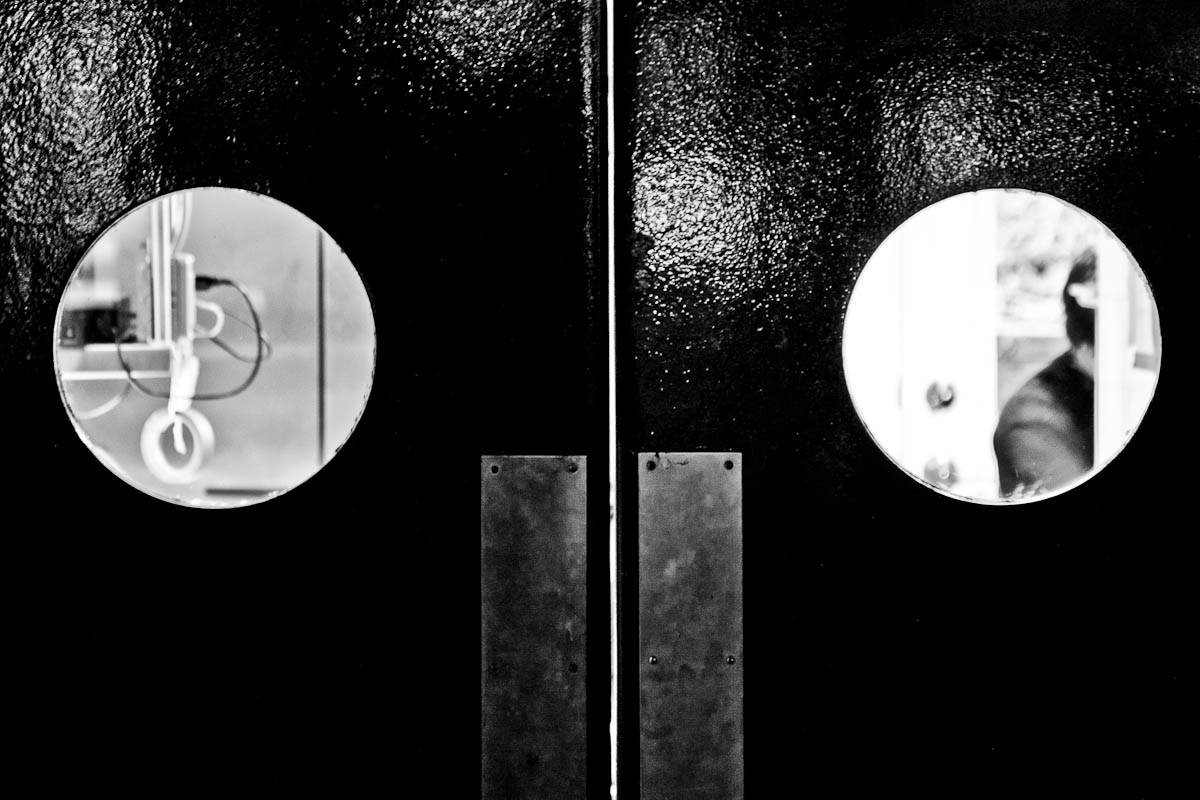
kitchen-doors

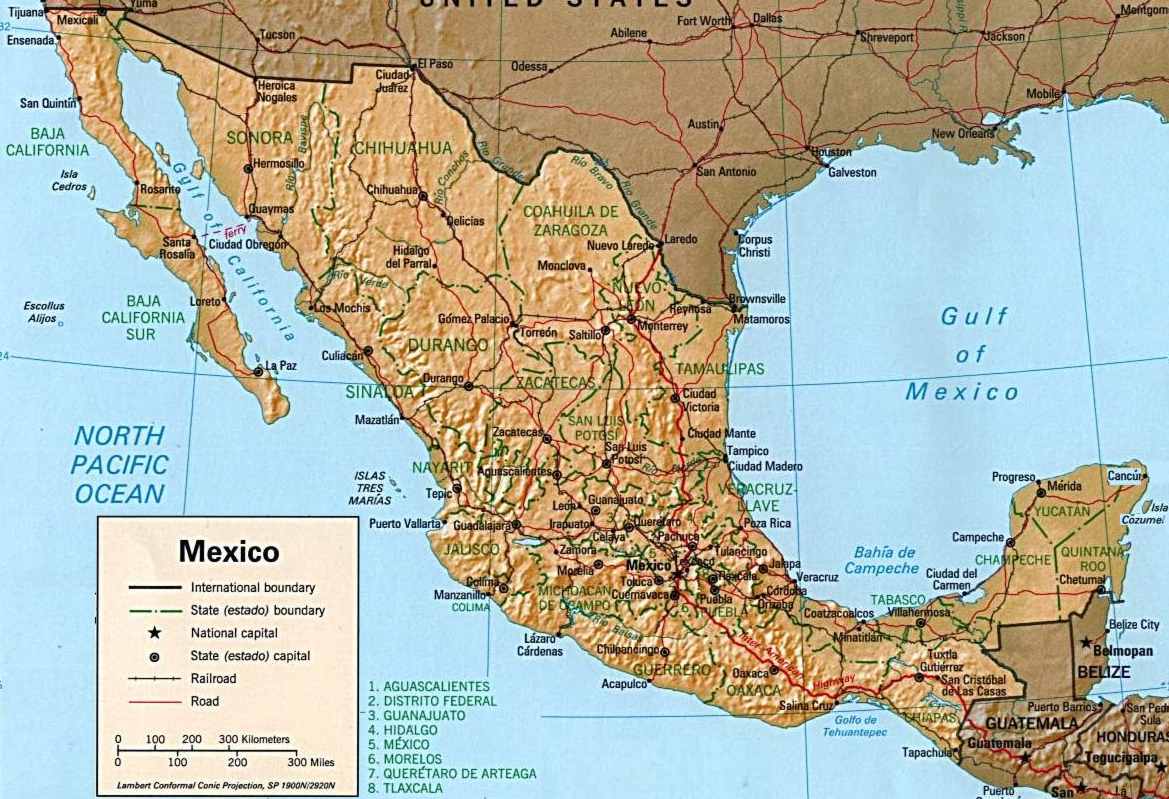
How many people in New York, especially people like me who have worked in the restaurant industry a lot and get chummy with owners and managers, have not had this experience?  You’re sitting at the bar and through the kitchen door you can see a young Mexican kid who’s just started.  And the poor kid looks like hell.  He’s probably new here, so he’s probably just risked his life several times to get to New York in ways in which we would not consider risking ours even once.  He works at least six days a week for probably over twelve hours and for shit money.  He lives in a studio that’s an hour-and-a-half subway ride from where he works, with three or four other guys like him, and to escape both the claustrophobia and loneliness of his life he probably goes out a few nights a week and, with whatever money he doesn’t send home to his family, gets drunk, so lots of days he comes in hungover.  But he always does his job anyway, not only diligently and efficiently, but with a certain perverse pride that he probably needs to maintain to keep himself from feeling like an animal.  He rarely speaks and if for any reason he needs to it’s always with unfailing courtesy and politeness.

“Γλυκοχαράζουν τα βουνά, και οι όμορφες κοιμούνται, τα παλληκάρια τα καλά στα ξένα τυρανιούντε.  Tους τρώει η λέρα το κορμί και η ψείρα το κεφάλι. Ανάθεμά σε ξενιτιά, κ’εσύ και τα καλά σου.”

“Dawn breaks along the peaks, with the young beauties still asleep, and our best boys are off suffering in a stranger’s land.  Their bodies covered in filth, their heads full of lice.  May you be damned foreign lands, you and all your riches.”

an Epirotiko folk song

But he’s smart, this Mexican kid, like our grandparents were before him.  And he watches and he asks questions and he learns about the restaurant’s wines and foods and about New Yorkers and their often insufferable particularities, and what they like and what they don’t like.  And the owner notices and makes him a busboy, and then a runner, and then a waiter.  And he gets a few days off.  AND HE GETS TO SLEEP.  And he’s making a little bit more money, so he buys himself some clothes and can afford to take a girl out on his night off.  And he’s completely transformed.  And one night you say to the owner: “Who’s that hot Mexican kid you put out on the floor?”

Κι’έτσι προκόβουν τα ‘παλληκάρια τα καλά’ της Πουέμπλας και της Çoλούλας…

mexico_rilievi97

This is not a possible scenario in Greece.  Or one that the average Athenian is capable of noticing.  For one, Greeks have forgotten that just until two generations ago hundreds of thousands of their own went off to live initially hellish lives in other parts of the world like this Mexican kid does — or the Albanian migrant worker anywhere in Europe today does.  Two, the Greek is not trained to watch others or care, the way every New Yorker is an amateur anthropologist.  So the change occurs right before his eyes and he doesn’t even see it.  Because other than the parts of the world that can confer some kind of ersatz glamour on him — Europe or certain  limited aspects and places of the United States — the rest of the planet is just not on the average Neo-Greek’s radar.  I can’t put it any clearer than that.  To know the reputation that we, Greeks, have as an ethnic group in New York: that we’re open, friendly, curious, eager to learn about others and their countries, learn at least some pidgin form of others’ languages faster than they can learn English, are willing to try any food or any drink, will invite their Mexican waiter to their kids’ christenings — and then to come to Greece and see this completely shut-off from the world society, is startling.

When I came to Greece in 2010 I hadn’t been there in eight years and the gruff middle-aged waiters or relatives of the owners that served in most restaurants and tavernas had been replaced by these nice-looking polite kids and I asked who they were, since it seemed strange to me that usually cossetted Athenians kids had suddenly condescended to wait tables.  And I was told: “Oh, they’re Albanians.”  These same people now laugh if I say anything positive about those same Albanians.  Even my own people, relatives, Greeks in Albania, said to me on several occasions: Όχι, είναι ωραίος λαός…   “They’re a good-looking people.”  Like, let’s tell the truth where we should.  And then come to Athens and have people stare at you incredulously…

I don’t know why this particular issue has ticked me off so badly.

A lot of Americans once thought that all Blacks were ugly too.  I guess I’ll leave it at that.

AlbaniansOutsideAlbania

And Philopomeon adds:

“We always need to put ourselves in a status-race with others… we can’t be as good as the Frangoi, but surely we are more advanced/richer/better looking/more cultured than the Alvanoi.

“To add to that, as you know, the Albanians were noted as “poor dressers” when they crossed the border in the 90’s. They had to take hand-me downs from charity, hence the Greek insult to a poor dresser ” You look Albanian.”

“But I agree, in general, Albanians are good-looking folk. Especially Kosovar girls.. hehe.”


Kosovaroi — of both genders — were real stunners, P., you’re right.  They have even gently nudged Afghans out of their first place position for me — no mean accomplishment.  I really couldn’t believe it when I was there; you didn’t know where to proto-look. (click)

Kosovo6970F0EF-C07B-4081-AB8D-B389D162E9DC_w640_r1_s

besa_luci_main1

MINOLTA DIGITAL CAMERA

And what I should’ve done from the beginning is put these pictures together with all the pictures of the young Derviçiotes I have in photos and videos and asked a random group of thirty-something  Athenian Concrete-Cave-dwellers to tell me which ones are the Greeks and which the “ugly” Albanians.  And see the results…

Comment: nikobakos@gmail.com

My Circassians

25 May

AdygeaReaders might remember I’ve had a long-term interest in Circassians since high school.  Of all the peoples collectively known in Turkey as muhacir, the Ottoman Muslims who took refuge in the Anatolian heartland of the Empire as it shrank, probably none had a more torturously, circuitous odyssey to ultimate safety in Turkey than the Circassians.  Here’s a selection about them from a post I wrote in February about why I was boycotting the Sochi Olympics; it wasn’t just for Putin and his filthy, murderous personage, but because the games were being held on land an admirable and honorable people had fought long and hard to keep and had been brutally thrown out of by Imperial Russia:

“And then there are the Circassians.  I became obsessed with Circassians in high school because I had to know who these people were, so physically beautiful apparently, that they held the entire Near East in thrall for centuries.  Circassians were the first reason I ever went into the New York Public Library, because the library at Stuyvesant didn’t have anything on them.  This is also around the time, as a nerdy sixteen-year-old, that I started developing the totally adolescent, romantic fascination I still suffer from, for honor-obsessed, heavily-armed highlanders — Montenegrins, northern Albanians, Pashtuns — who don’t easily let themselves get pushed around by outsiders.   It fed a lonely teenager’s fantasies of empowerment then.  Now, I couldn’t tell you.  Probably still.

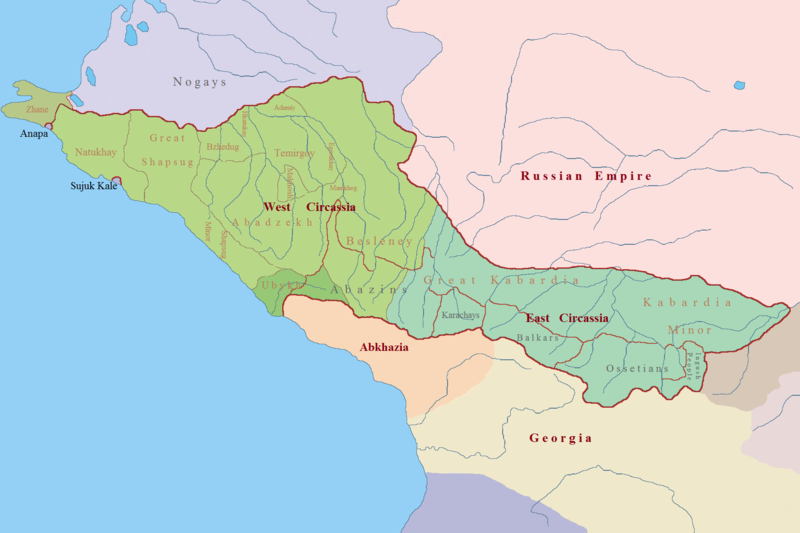
“The Circassians lived in a huge swath of plain, foothill and high mountain country in the northern Caucasus.  Most of the sites of the this month’s games are being held on formerly Circassian territory.  This is a map of their general distribution in the eighteenth century, right before Russian expansion southwards began:

Circassia_in_1750

(click)

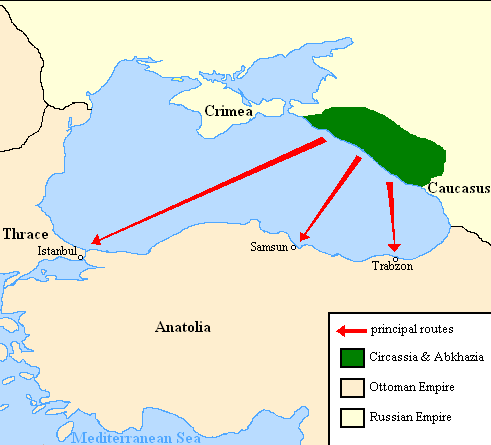
“For more than a century they fought a brutal tooth-and-nail war against the Russians and their Cossacks.  When they finally capitulated in 1864 it was in Sochi.  The majority, which would not agree to an oath of loyalty to Russia were deported, in what was probably the first campaign of ethnic cleansing of such dimensions in modern history.  For months, the beach at Sochi was a Dunkerque-like humanitarian disaster zone, with tens of thousands of shelterless, starving and diseased Circassians waiting for Ottoman ships to take them to safety in Anatolia or the still-Turkish Balkans or dying on the spot.

Expulsion_map_of_the_Circassians_in_19th_century“It certainly represented the largest civilian death toll of any war up to its time and today, ninety percent of people of Circassian descent live outside their original homeland, mostly Turkey, but also Syria, Jordan and Lebanon.”

(To read the whole post: Ignoring Sochi.“)

And as with Native Americans in North America, as their government was massacring and expelling them, Russian poets and writers like Lermontov, Pushkin and Tolstoy were romanticizing them, sympathizing with them and entering in a love affair with all the peoples of the Caucasus that literary Russia still has not recovered from.  Someone, everywhere, at all times, has a heart and a soul — for whatever good it does.

I had assumed muhacir is constructed from the Arabic “mu = doer of something” plus the roots ‘h’ + ‘j’ + ‘j’ (?) which almost sounds more like “pilgrim” –  as in “Hajj.”  But “mu” turns out to be a passive participle marker of someone who is made to do something, in this case not as in “Hajj, pilgrimage, but  ‘h’ + ‘j’ + ‘r’ as in “Hejira?” which would mean “fleer,” as in those who fled with Muhammad to Medina from Mecca in 622.  That would make more sense than traveller, which would be the “mu-sa-fir” recognizable to any Greeks as an old-fashioned word for “guest,” except to those Neo-Greeks that are so Post-Ottoman that they’re Post-Culture-of-Any-Kind and most certainly Post-Hospitality.  The Muslims that left India after Partition in 1947 to go to the land of Islamic Purity are also known as muhajir in South Asia.  I say that the Circassians’ route was particularly circuitous because many of them were first settled by the Ottoman government in the Balkans — especially Bulgaria and Kosovo (where there’s still a tiny community), where they were used to demographically offset the Christian population and because their warrior reputation would come in handy against Christian rebellions and Russian invasions.  (Though there is one wild episode of the Greco-Turkish War where a band of Circassian çeteler [çetes] in western Anatolia actually aided the invading Greek army.  Go figure.  Any-thing is possible in our part of the world.)  Needless to say with the coming of independence for the nations of the Balkans, they were uprooted again to Anatolia and other parts of the still Ottoman Arab world.

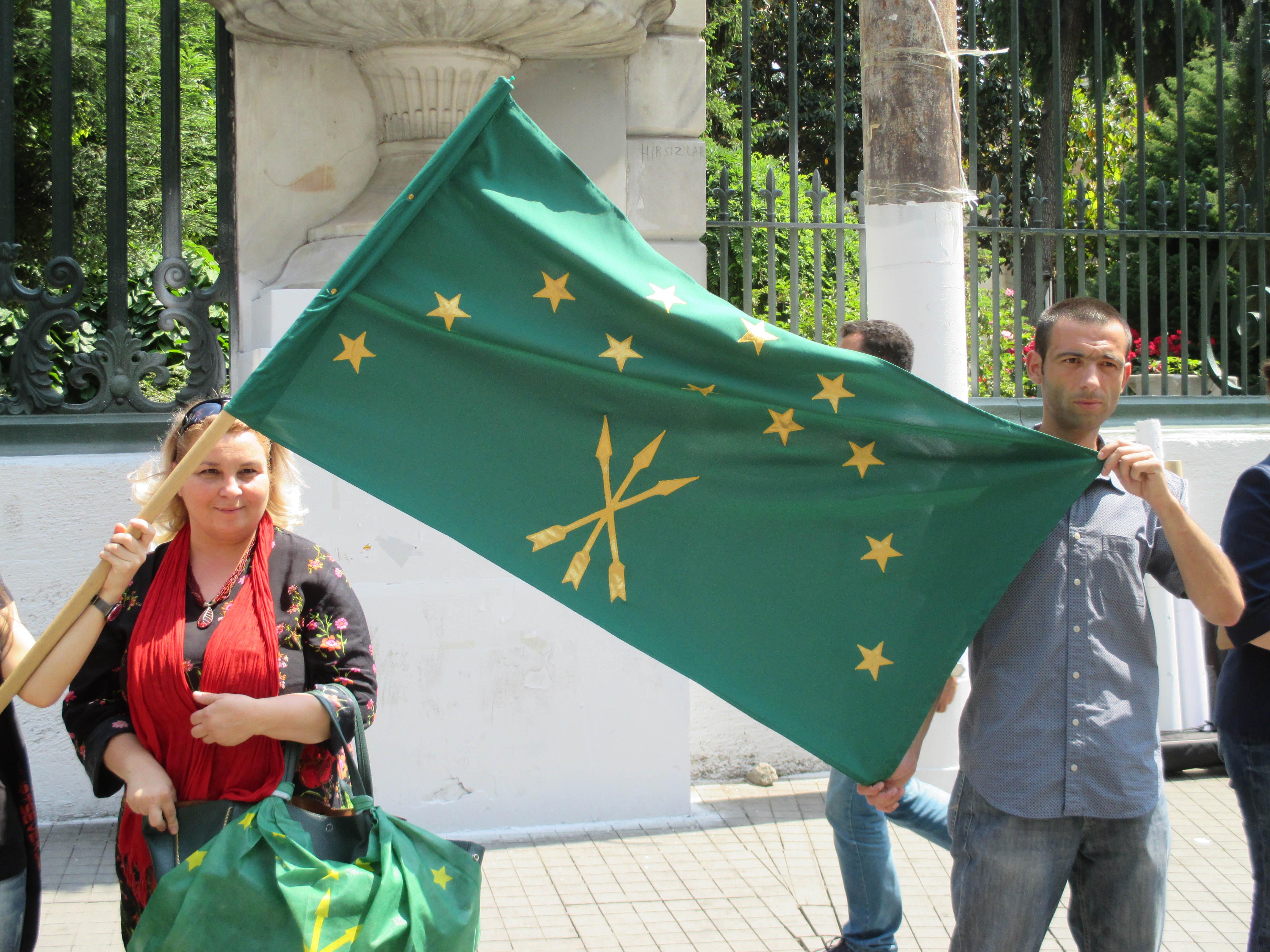
This year is the 150-year anniversary of the final, catastrophic expulsion from their Caucasian homeland and local Circassians (“Çerkes” in Turkish) have been holding demonstrations in front of the Russian Consulate down here on the Jadde (I wouldn’t even lower myself to asking for Putin’s ear) and then closer here to my place in front of Galatasarary.  (Click)

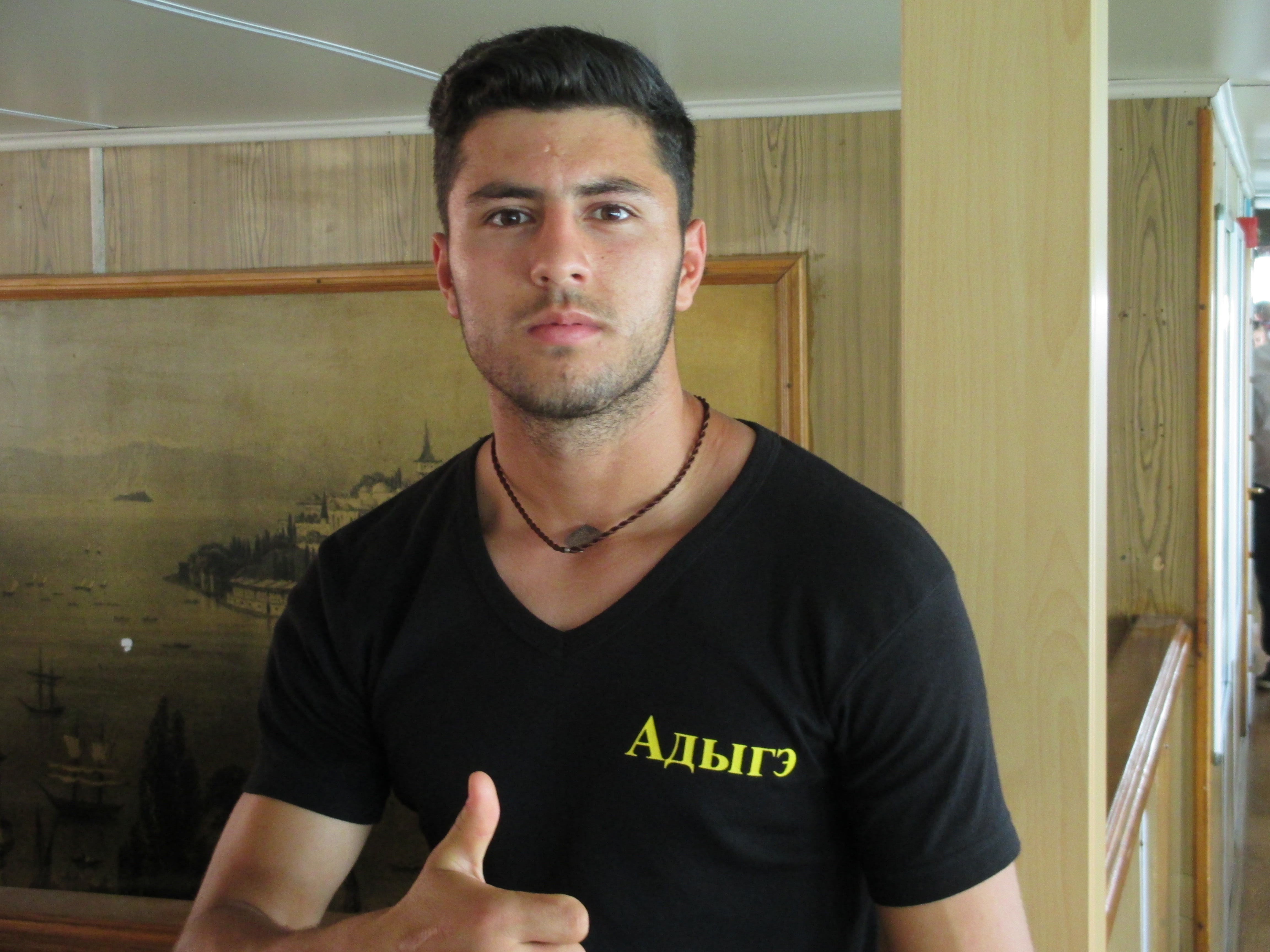
IMG_0777IMG_0775But I was kind of disappointed because I couldn’t get any really good pictures except some like these above.  Then I get on the ferry from Beşiktaş to go to Kadiköy with my cousin, Vangeli, to feed him at the spectacular Çiya restaurant there and visit Beylerbeyi, my favorite Ottoman palace, and by blogger-photographer’s luck right across from me is sitting this handsome Circassian kid from central casting (click):

IMG_0780 He was surprised I knew that his t-shirt said “Адыгэ” – “Adyghe,” which is what Circasians call themselves, written in the Cyrillic script they now use.  I asked him if he spoke the language and he said no, but some other Circassians I found the next day in Pera said that due to a concerted effort on the Turkey-wide community’s part — language classes, theater workshops, radio programs — more Circassians in Turkey of this kid’s age speak more of at least a little bit of the language than their parents do and that interest is increasing.  Insha’allah.  Cool.  So if you don’t respect these people for their legendary beauty, their ferocious warrior rep, the fact that they managed to stave off the forces of Imperial Russia for two centuries, that as the Mamluk military elite they effectively ran Egypt for five-hundred years till Mehmet Ali the Albanian massacred them in a totally, shitty, un-Albanian, pabesiko (“pa” = no + BESA), dishonorable, ambush — see  (“BESA: A Code of Honour,“) — then just admire them for sticking together as a cohesive and living identity after being scattered across the world for a century and a half now.

The suffering of Circassians and all the other Muslim peoples of the Caucasus are laid out in a bit of an uneven but heartfelt and informative book by Oliver Bullough called Let Our Fame Be Great: Journeys Among the Defiant People of the Caucasus — here’s his website too (check out some interesting pics): Oliver Bullough: Let Our Fame Be Great.

lofbg-usa-cover-300wUnfortunately, I don’t know if there’s a Turkish translation (or Arabic: Jordan, where Circassians still make up the King’s Royal Guard, Syria and, some extent Israel, is where most Circassians outside of Turkey now live) for young Circassians today to read.

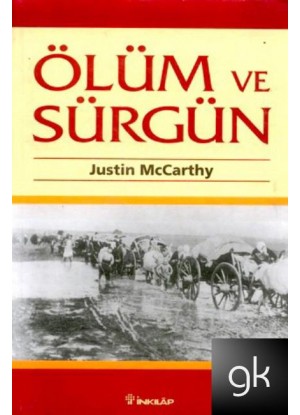
Another book that I do know there’s a Turkish translation of, and is probably the only monograph to deal with the step by step expulsion and ethnic cleansing of Ottoman Muslims through the nineteenth and and early twentieth centuries, but tracing roots of the process back to even the century before is Justin McCarthy’s Death and Exile: The Ethnic Cleansing of Ottoman Muslims, 1821-1922Not polemic, not propagandistic, just the facts and figures that speak for themselves.  It should be required reading for every Christian in the former Ottoman sphere.  It’s not exclusively about the Circassian tragedy but there is, as you can imagine, a great deal of material on their experiences.

51qnwpuNCVL._SY344_BO1,204,203,200_Turkish-speaking Circassians should definitely check this book out that’s available everywhere in İstanbul; they’ll learn a lot.  I really hope they get a chance to.  Share this post with friends if you found it interesting.  Feel free to write me with any comments.  And keep the memory alive!.  NB

55696-olum-ve-surgun-death-and-exile-justin-mccarthy

Comment: nikobakos@gmail.com

Athens = homogeneity? = racist? = just boring…?

19 May

OLYMPUS DIGITAL CAMERAHere she is, the gigantic poured-grey-cement Balkan village of five million people: who all think alike, look alike, act alike, talk alike and can’t agree on anything.  Απολαύστε την.  (Double-click to take in all the rich architectural detail.)

Sorry, I was just thinking to myself about what parts of my Balkan trip I needed to post next; people who kindly gave me interviews or let me photograph them and how I have to get on it…  And, how I’ve been wasting my time engaged in a running war with everyone in Athens to prove basic things like the fact that Albanians are a tall, extremely attractive people.  People in mono-cultural societies say the most deafeningly racist crap — you can’t imagine.  If one more person smirked at me when I said: “You know, Tirane is actually kind of a nice city…” things would’ve ended badly.  If it weren’t so offensive, it’d be fun to hear ignorance trumpetted with such certainty.  But it is.  Good timing to head to Istanbul.  Where I can’t understand the racist crap people are probably saying.

And I thought to myself, what? is it going on twenty-five years now that Athenians have been freaking out about immigration?  And it doesn’t seem to have crossed the brain of even the most intelligent or open-minded Athenian’s to make that an asset for the city and not a “scary” liability.  Where is this immigrant Athens?  In all these years, malaka, not one person has said to me: “Yo, Niko, there’s apparently this great Pakistani place in Patissia; you wanna go check it out?”  Everyone knows I’m into South Asia.  “Wanna go to the laike (market) on Saturday in Kypsele and see the stuff the Afghans sell?”

Or, all these tens of thousands of single, alone and lonely Albanian men…  There must me some woman somewhere they hire to make them börek or baklavadhes for bayramia and namedays and things.  Like the Mexican women who make tamales for parties in New York.  Where is she?  Where are they?  In New York she’d have a full front-page spread on the “Metro” or the “Food and Wine” sections of the Times and she’d be taking orders from Upper East Side ladies by now and have her own thriving business.

All the cement-cave-dwellers have had sushi though — without exception mediocre and psychotically over-priced…

Provincials, vlachadera, isolationists…μικροαστά, petit bourgeois συχαşιάρεδες…

Taco stand on Roosevelt Avenue in Corona, Queens, about five blocks from where I grew up, where for three to five dollars you can have a full meal of some of the freshest, most complex tastes of any of the world’s cuisines.  I know Athenians who have been coming to New York for years and who I haven’t been able to convince to try one of these places even once.taco-cart-99th-and-roosevelt

Actually, what I’d really love to do is bring a Kurdish kid home to New York with me from Istanbul with a big tepsi of stuffed mussels and watch him become a millionaire.  I don’t know where I’d set him up first though: Astoria? Sunnyside? or straight to Manhattan? or Long Beach or somewhere?  Or get him a booth at the Italian summer festival circuit…

Midye1625x833xtlbsptyp.jpg.pagespeed.ic.sQpGbKsyQV

Midye2Smstuffedmussel0001

Comment: nikobakos@gmail.com

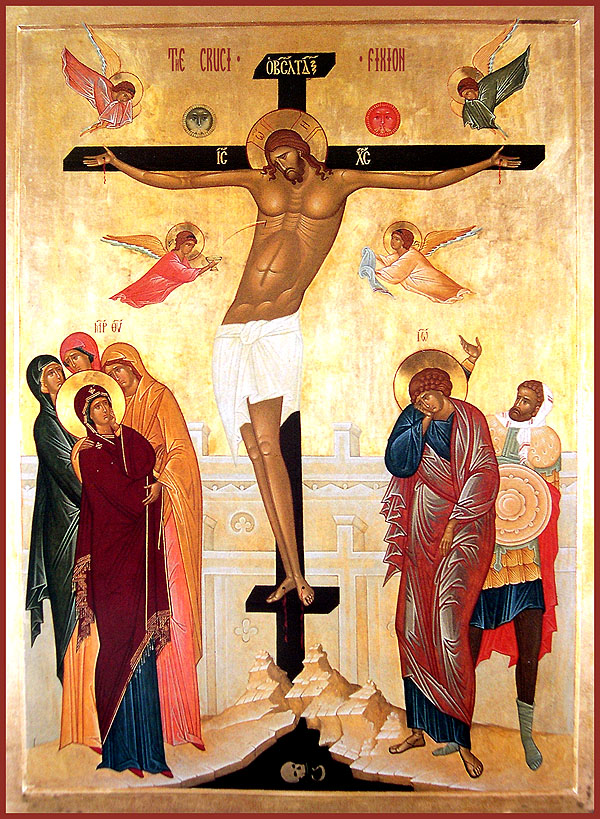
Σήμερον κρεμάται επί ξύλου…

17 Apr

crucifixion2

(click)

“Today hangs suspended from a piece of wood, the One who suspended the earth amidst the waters…” begins the main hymn of tonight’s service in the Orthodox Church.  It’s matins for Good Friday, sung the night before; it corresponds to the Oficio de Tinieblas in the Catholic Church, or the Via Crucis, or Stations of the Cross.  Except it’s not the forty-five minutes Cliff notes version.  It’s a four — with Russians, five plus — hour, perfectly paced and structured, oratorio that uses twelve gospel selections (it’s colloquially known as the “Twelve Gospels” among both Greeks and Russians and I imagine other Orthodox peoples), and a surfeit of beautiful and psychologically astute poetry and music to tell the story of the Last Supper, and Christ’s arrest, judgement, crucifixion, death and burial.  It’s my favorite Holy Week service.  Because it’s a masterpiece.  It doesn’t draw any of its power from made-up, sadistic Mel Gibson details that aren’t even in the gospels: like how many times Christ fell, or where they whipped Him, or where and when they spat on Him, or where He scraped his knees, or any of the bloody kitsch and sensationalism and fabricated detail so physical that it’s disrespectful and that the Catholic Church allows and encourages; one speaks of the body of Christ with a certain laconic awe I would think, no matter what it was put through.  Its power comes from the perfection of its theater and its theology and — if anything — from the spareness of the story it tells.

Background to this post…  For years, whenever I heard that relatives or friends from Greece, especially under a certain age and especially from Athens, were coming to New York to visit for Easter, my guts would get twisted up in knots of anxiety in anticipation because I just could not endure having them around at that time of year.  Anticipation of what?  Well, there came a time, for me a crucial turning point in post-1974 Neo-Greek culture — it was around the early-eighties — when Greeks started asking each other: “Where are you going for Easter?”  And I couldn’t imagine what I would answer if asked.  Where am I going for Easter?  I dunno…  I’m going to be home.  I’m going to my village.  It’s Easter.  Where should I be going?  This is because there came a point, when, for the demographic I’m talking about, Holy Week and Easter had become the equivalent of Spring Break, some free days to go off on a vacation somewhere.

So I could anticipate their attitude.  I knew they wouldn’t appreciate the subtle shift in the pace of life that occurs in a Greek neighborhood like Astoria when Palm Sunday dawns.  The sobriety mixed with the rush of preparation and excitement.  I would anticipate instead the surprise, at best, but mostly the grinning condescension, with which they’d react to how seriously diaspora Greeks still took this time of the year, how backwards and un-hip and un-Euro it was of us.  I’d know they’d want to go out to a cool baraki on Good Friday night.  I’d know they’d ask to be taken shopping on Holy Saturday, in the middle of the cooking and cleaning: there were some shoes they had seen on sale at Macy’s.  I had two Turkish roommates for a while once: totally secular, modern Istanbullu girls; they just didn’t eat pork.  And out of respect, or just to prevent possible squeamishness on their part — they had never even said anything to me — I would keep salami and pancetta and other pork products in the basement refrigerator that they never used.  On the other hand, I once had to have a screeching match with a Athenian guest about not having meat in the house on Good Friday — I ended up feeling like a friggin’ Talib — because she needed her protein and fasting reminded her of how oppressive her mother was during her childhood.  Just a couple of years ago, a cousin saw me go off to the first Nymphio on Palm Sunday evening and said to me: “You mean…like…you’re going to go be going to church…like…every night this week?  In Greece nobody goes.  That’s something left over in the diaspora…” she had the archidia to say to me.  It was never something they had lost; it was always something “left over” among us.  I said nothing.  But, as you can imagine — as opposed to the sentiment of “Next year in Jerusalem” — the idea of being stuck in Greece for Easter had always been my nightmare.  I only came this year because it was going to be one of the rare years professionally when I could go to my father’s village in Albania for what I knew would be a traditional Easter that wouldn’t infuriate me.

And instead I’ve been amazingly and pleasantly surprised.  I don’t know what Greece it is that this cousin of mine lives in where nobody goes to church, but all through Lent and especially this week, every church I’ve been in has been packed.  Tonight was the most moving “Twelve Gospels” I’ve ever attended.  The massive (as massive as a pre-Tanzimat church could be) eighteenth-century, stone cathedral of Jiannena was filled to the rafters — literally; it has a two-floor gallery where the women used to traditionally stand and even both of them were full.  The cantors were perfect.  The procession of the Cross immaculately pulled off.  I felt like Vladimir’s envoys in Hagia Sophia.

But what most moved me most was the breadth of age and sex of the crowd.  If anything, there were even more young people than there would be in New York — young guys, parea — following the text from the little black book carefully, people with that relaxed reverence that the best Greek — knowing how to be respectful, but comfortable in his father’s house — displays when in church.  Almost everyone stayed to the very end.  I really felt in my heart and gut what Yosef Eliya felt in his Purim poem when he writes: “Tonight the synagogues open their arms wide to the faithful children of my ancient people…”

Tomorrow it’s off to Albania.

Kale Anastase and Happy Easter…my ancient people.

Comment: nikobakos@gmail.com