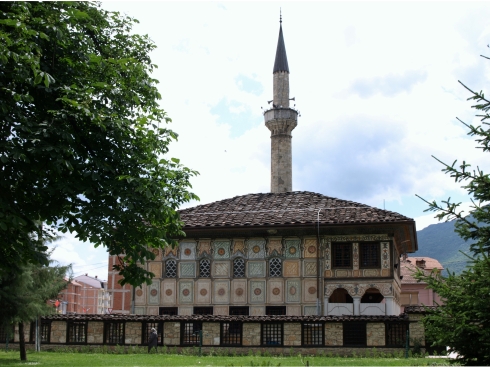
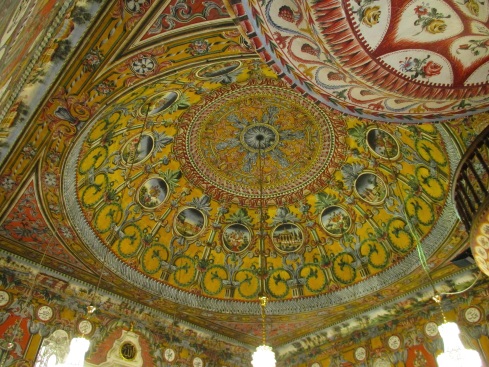
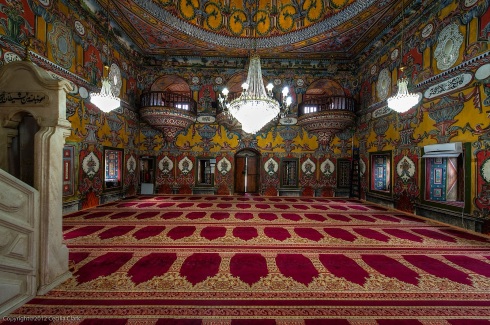
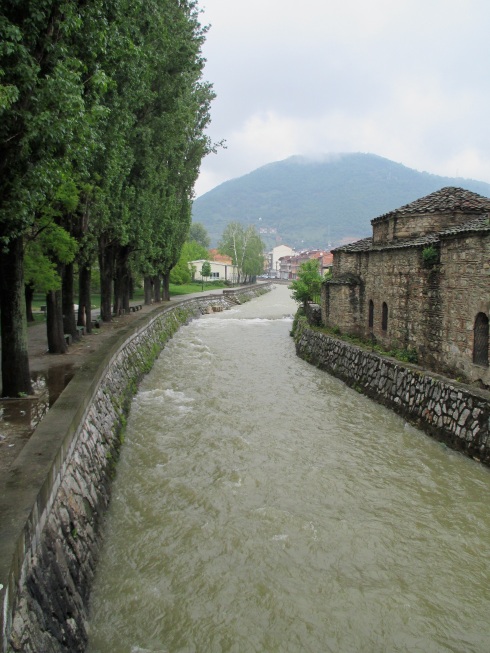
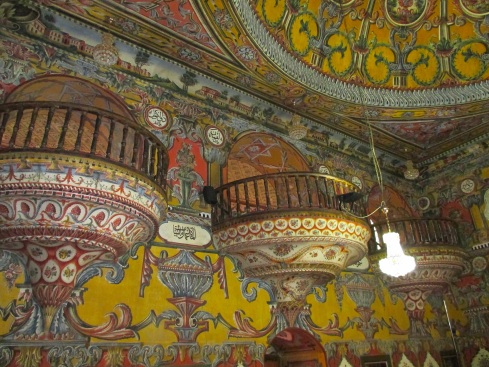
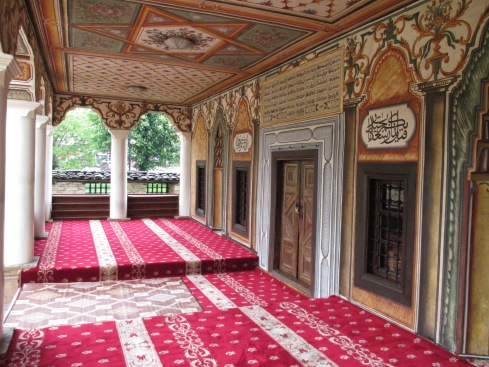
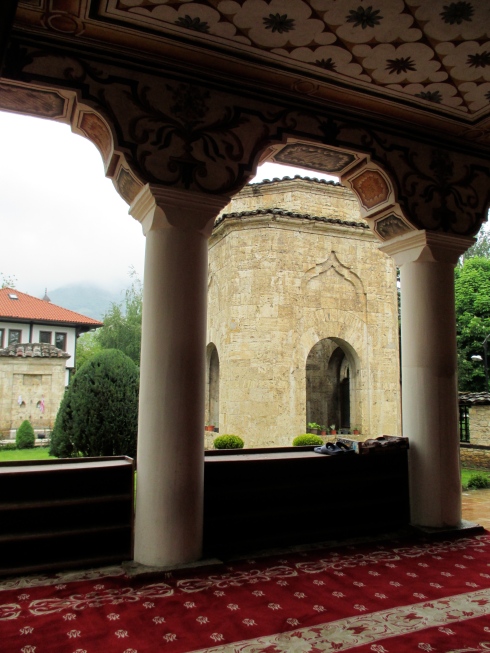
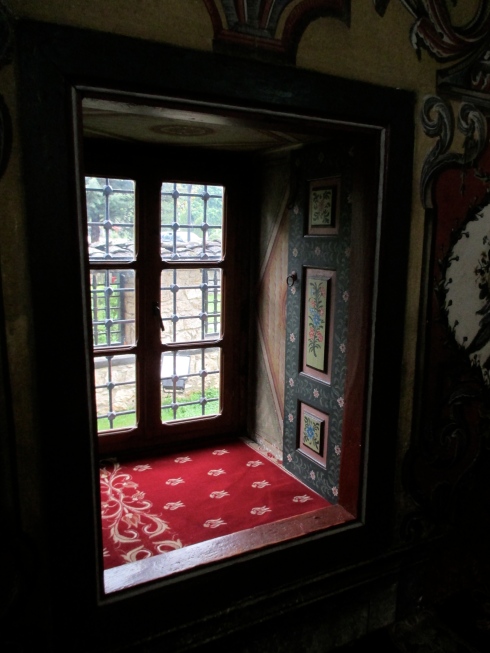
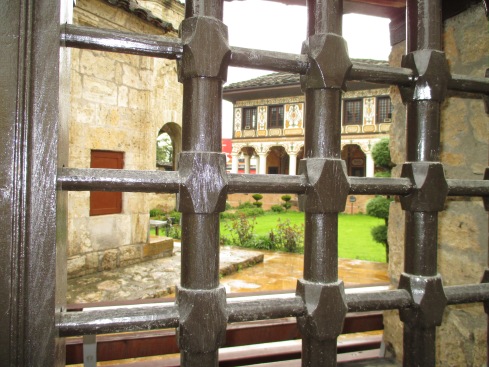
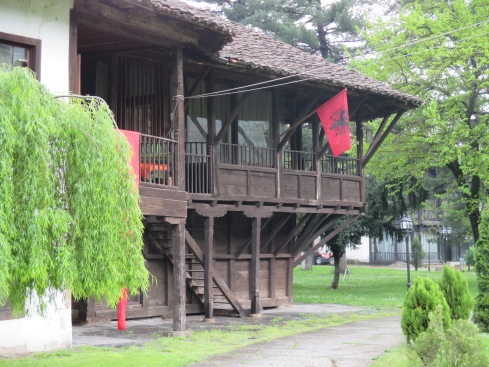
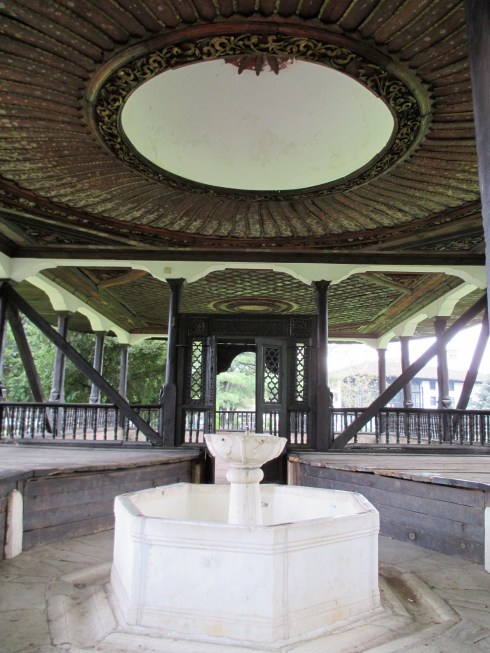
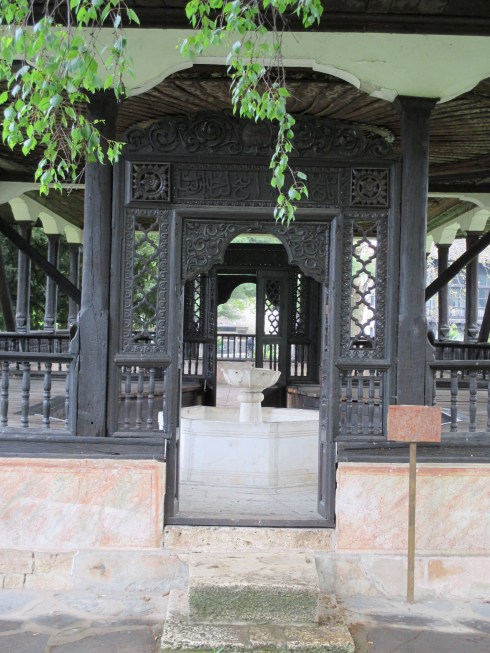
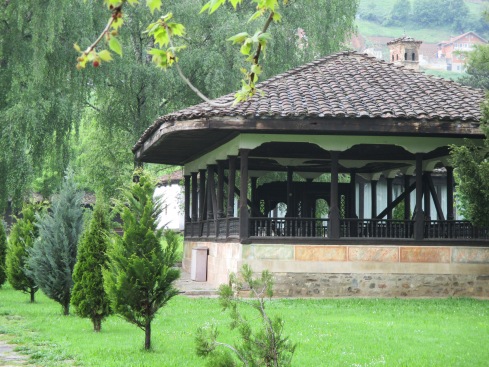
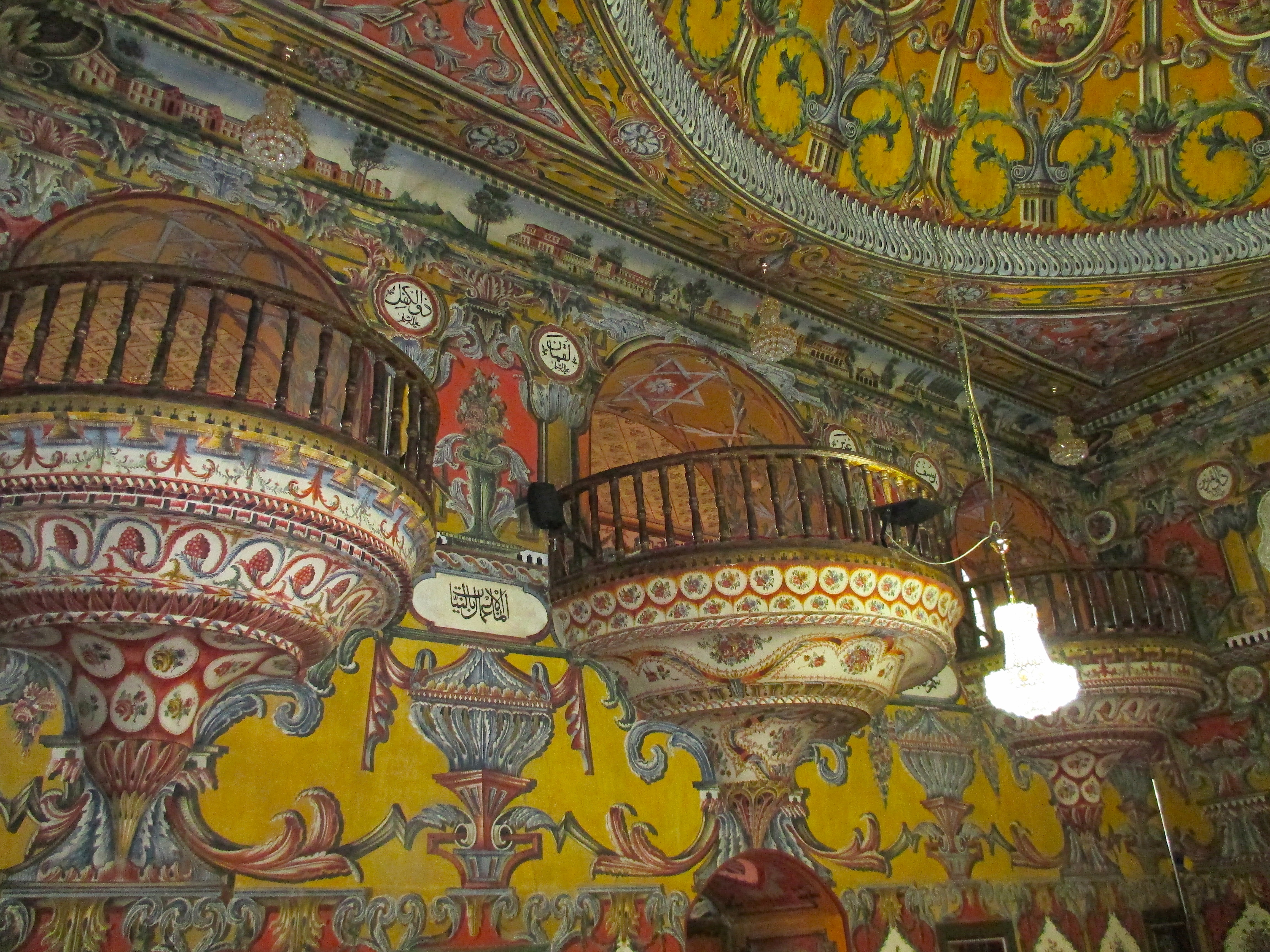
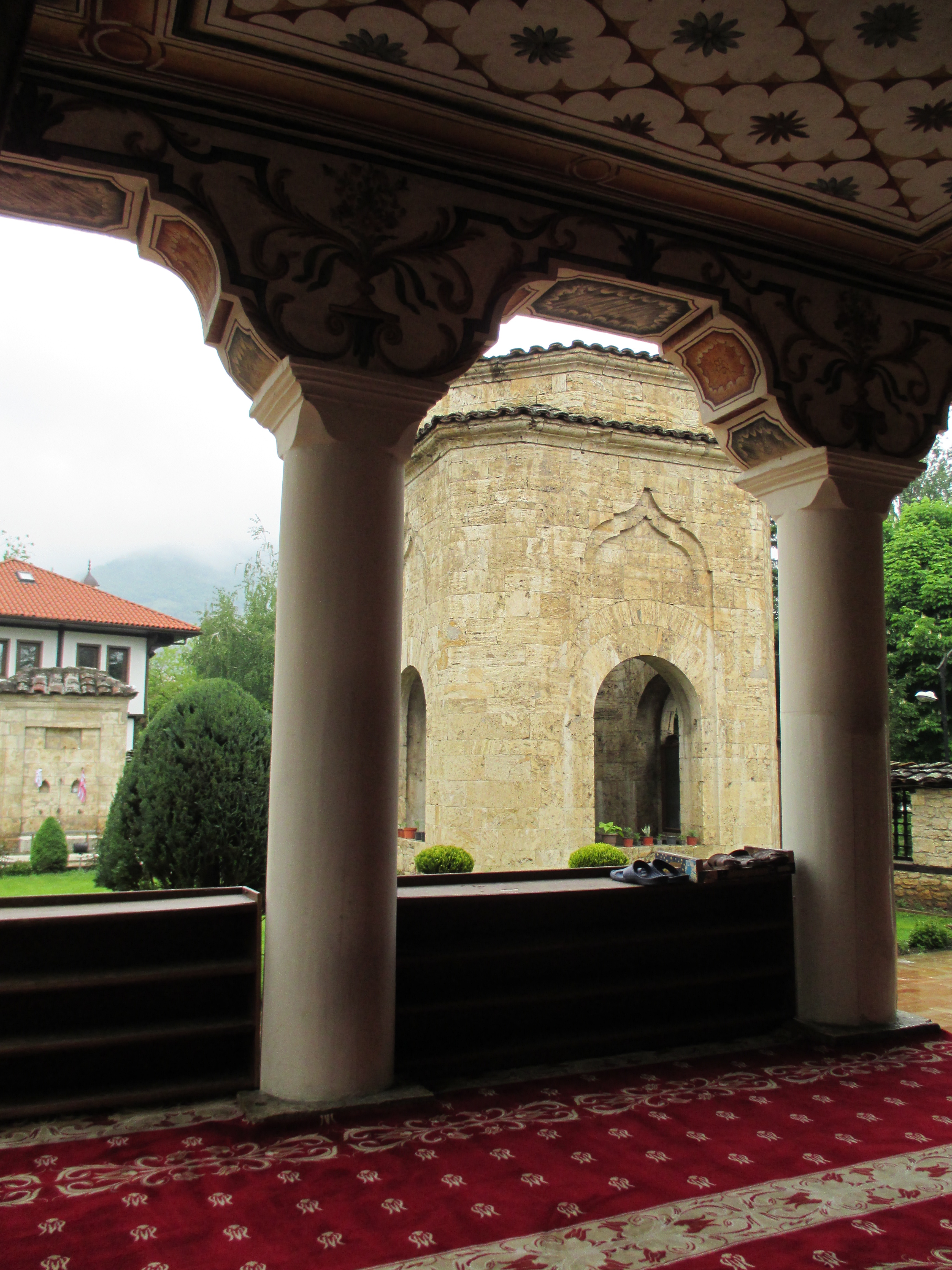
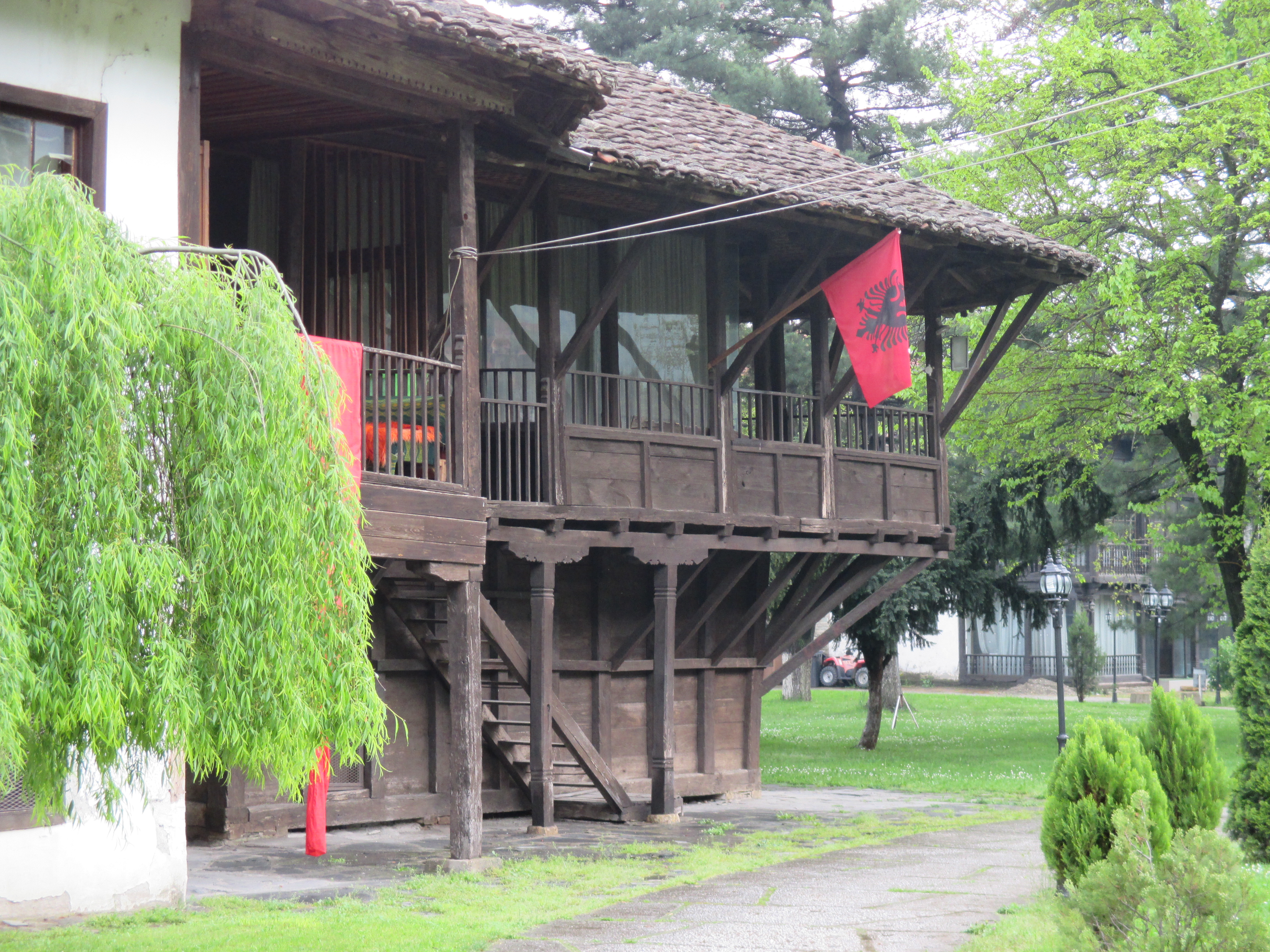
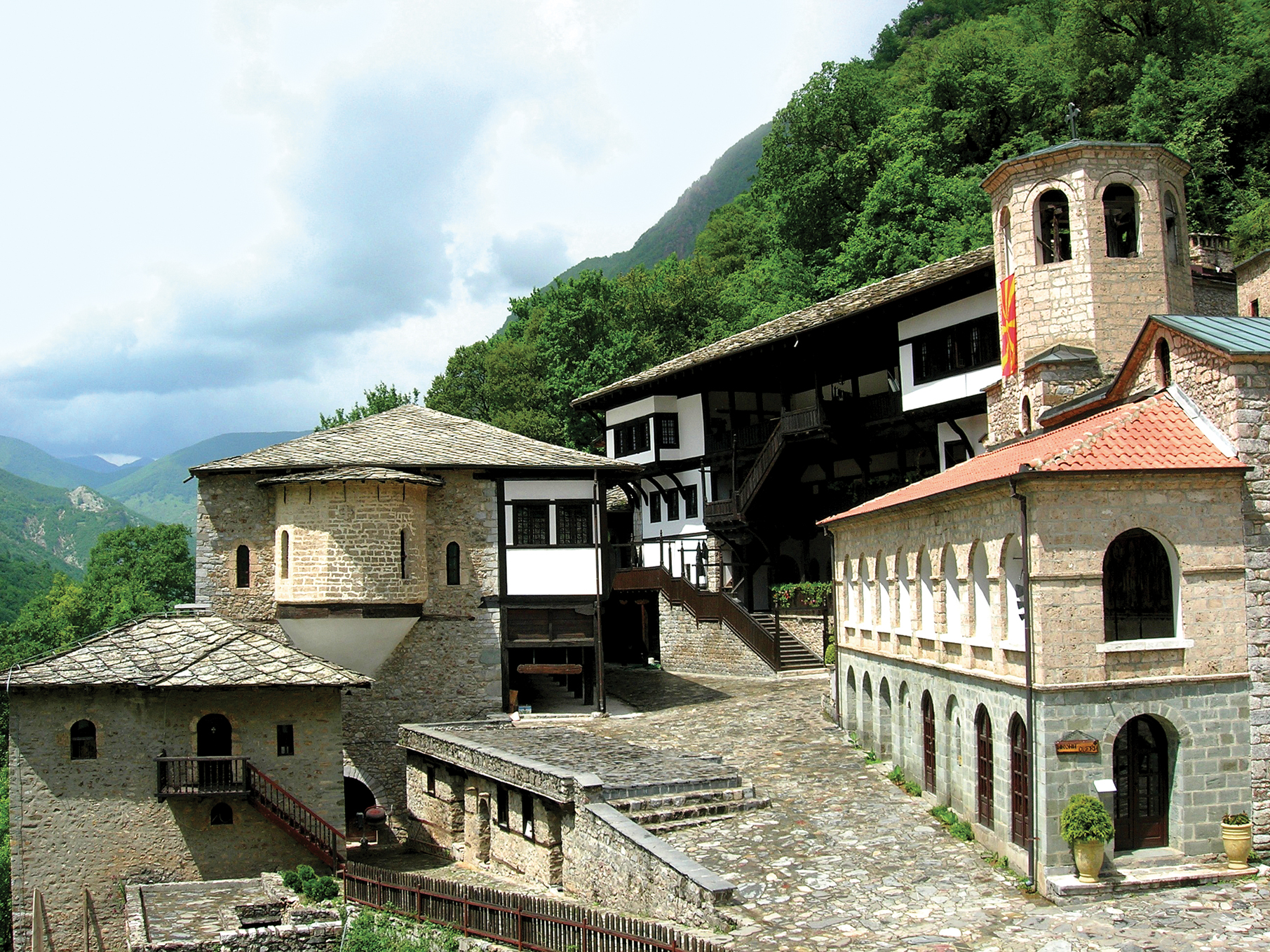
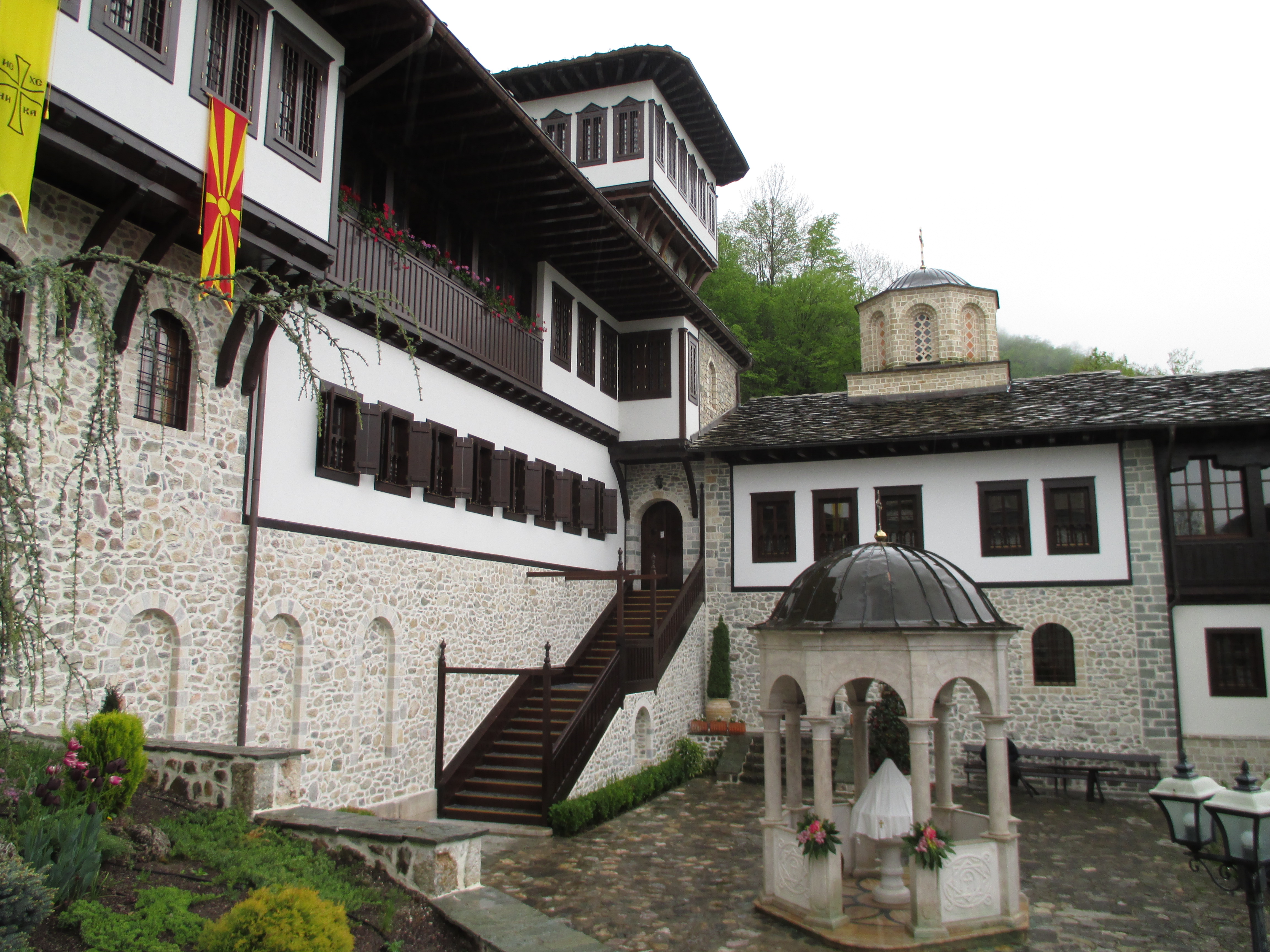
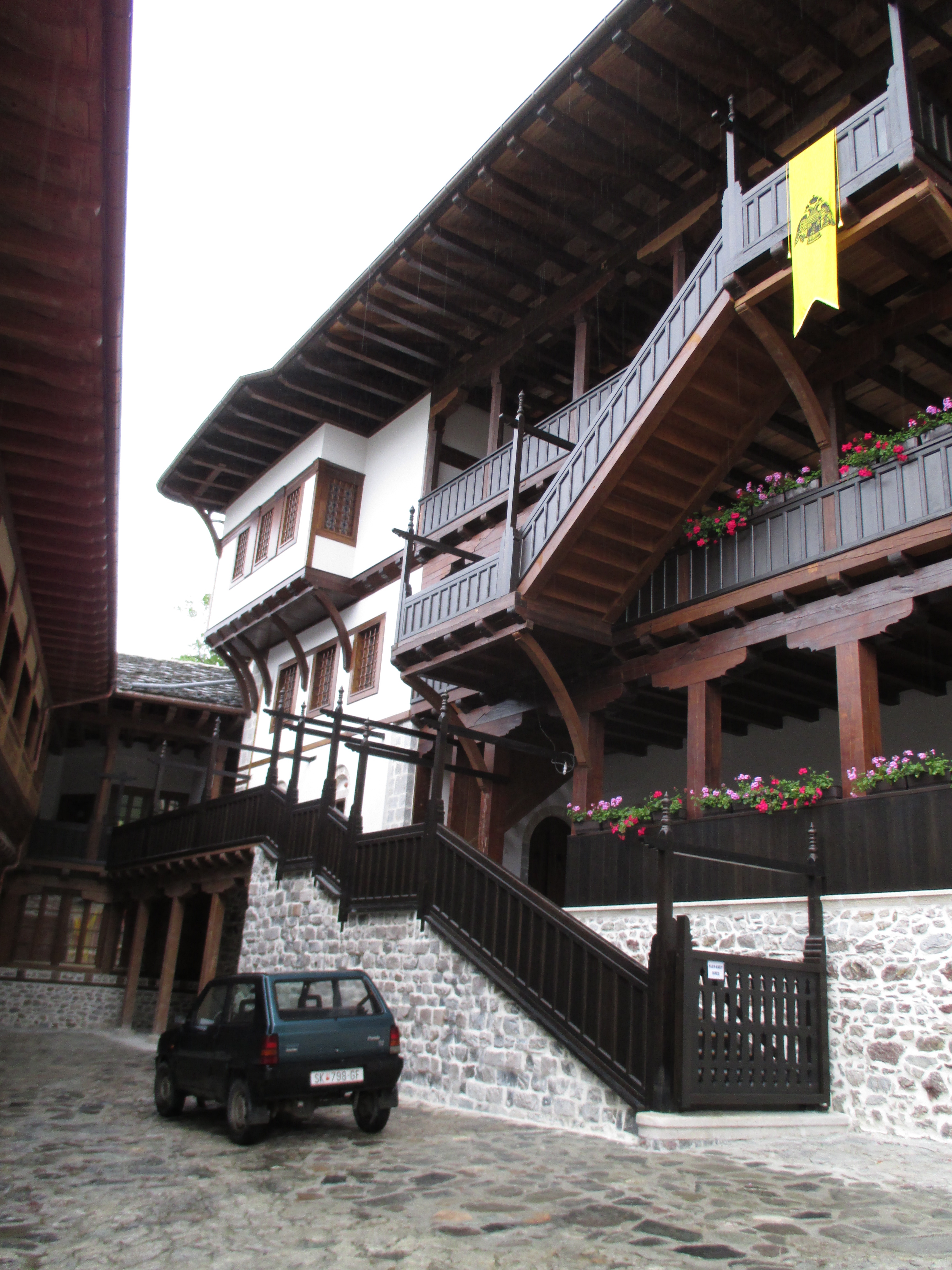
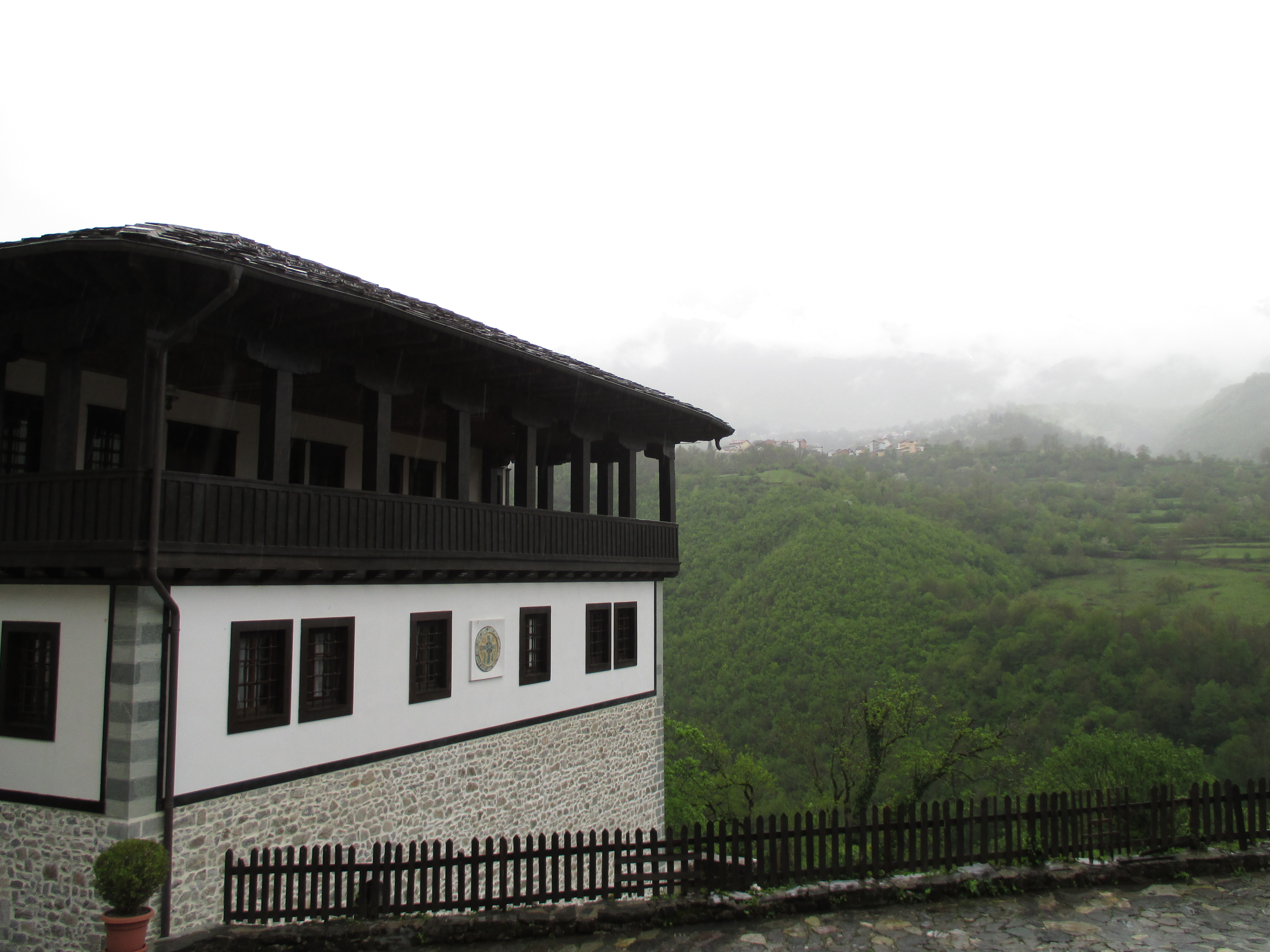
 (The photo above and all photos in the main body of this post, are of the Šarena Džamija in Macedonian, or Alaca Cami in Turkish, which means “The Decorated Mosque,” an eighteenth-century masterpiece of Ottoman Folk Baroque in Tetovo, Macedonia. The photos interspersed between the footnotes are of the Bektaşi Harabati Baba Teke on the outskirts of Tetovo — two of the loveliest places I visitted on this trip. Click on all.)
From Rebecca West’s Black Lamb, Grey Falcon:
“It is impossible to have visited Sarajevo or Manastir or Bitolj or even Skopje, without learning that the Turks were in a real sense magnificent, that there was much of that in them which brings a man off his four feet into erectness, that they knew well that running waters, the shade of trees, a white minaret the more in a town, brocade and fine manners, have a usefulness greater than use, even to the most soldierly of men.”
Yes, again… West is prompted to make this comment in I can’t remember what city in Macedonia because the book is huge. Always super-astute, she identifies something really profound about Turks: essentially, what’s known in classical Japanese aesthetics as “bushi-no-nasaké” – “the tenderness of the warrior.” I don’t think that needs to be explained any further. Afghans have this quality, and the autobiography of Babur, the founder of the Mughal dynasty, his Baburnama, where he talks about the blood and fear of war with true horror in one passage and the sweetness of his beloved Kabul’s melons, its ice-cold waters and the handsomeness of its young men in the immediately following, is probably the most striking literary example of this aesthetic strength outside of anything written in Japanese I would imagine. (Complicated: the fact that it’s a quality most highly present in strongly homoerotic environments or cultures.) I remember sending West’s passage to one of my best friends in Istanbul when I read it and she wrote back and said: “I wish there were even a trace of that sensibility left here.” And I think she was being a little unfair and also suffered from the near-sightedness we all do when we’re immersed in an environment and really can’t see it objectively. To begin with, at least as far as C-town is concerned, it’s hard to build a city for fifteen million in fifteen years and maintain any kind of sensibility at all, so something has inevitably been lost in the dizzying pace of progress in contemporary Turkey. But it isn’t hard to see if you just look a little: a sensuality, an alertness to beauty and material comfort of all kinds, despite some overdone glitz, that comes at you from nowhere often – of course from Turkish women, some of the world’s most impressive for me, but even from the most macho (and some of the world’s most impressive) guys, which is when it’s really beautiful and almost disconcertingly lovely: an aesthete’s attention to detail; a sudden, completely unsolicited, solicitous gesture of smiling generosity; a strange soft politeness and sensitivity, which the sound of the language, especially in the City’s accent, only adds to… A “tenderness.” That of a complete man. Which is what the Japanese meant.
But my reasons for posting it now have nothing to do with my friend or with Turks really. I had been looking for an opportunity to post this passage at some point because it’s essentially the seed of this blog. I thought maybe on some anniversary in April, but Easter posts always get in the way then. What gave me the impetus to post it now is finding the beautiful “Painted Mosque” in Tetovo in Macedonia and the Bektashi Harabati Tekke on the outskirts of the same city, because both structures or compounds are the purest embodiment of the observation West had made of Turks some eighty years before.
Why did the Jadde grow out of this particular quote? I’ll start from the beginning.
Four, five, maybe even six years ago – I think it was 2008 – a group of Turkish historians of Ottoman art and architecture completed a massive and what sounds like a seriously respect-worthy encyclopaedia of all the Ottoman monuments of the Balkans. I heard about this from Greece, however, in an email from a fairly out-there nationalist who has since grown exponentially deranged, that went out to friends, and friends of friends, and acquaintances, and acquaintances of acquaintances, with the pompous subject line: “The Falsification of History!” No explanation of why the work of serious Turkish scholars was false or a process of falsification. No explanation at all; and, really, I can’t even remember what the tirade in the rest of the email went on about. I wrote back (“Reply all”) and said: “Good for them. Why don’t we do it too?” And then I remembered the above passage about “Turkish magnificence” that West had written while in Macedonia and I sent that out right after.
The response blew my mind. Dostoevsky said that hysteria was God’s gift to women. But watch certain kinds of sports fans or listen to a certain kind of nationalist and you’ll see that maybe it’s the y-chromosome which carries this gift of the Lord’s. Or maybe Samuel Johnson was wrong in calling “patriotism the last refuge of scoundrels” and should have dubbed it the “last refuge of hysterics.” I was called a traitor. I was called an idiot. One person wrote to tell me that he might agree with some of what I said (I hadn’t really said anything – Rebecca West had) but that I was so aggressive that he wasn’t going to stoop to my level. One guy wrote me an email most of which sounded like it was lifted out of the literature and billboards of Samaras’ (now Prime Minister) simultaneous Macedonia/Elgin Marbles campaign that made an international rezili of us in the nineties when he was Foreign Minister (*1), telling me to “read some history” and “that if you don’t know your history you’re nobody; you’re pathetic my friend — you and your ‘magnificent Turks.’” Now, when a Neo-Greek tells me that I don’t know my history, the hair on the back of my neck stands on end, because even when they come out of the country’s best schools (”…oy, I should cough…” as a certain old Jewish lady I knew liked to say), like this guy has, the “history” they know – or choose to know — are just the national mythologies. I actually really felt sorry for him to be honest, not even insulted, because, like I said, this was a circle of friends of friends and there was a good chance that he would eventually get to know more about me some day and then he would feel r-e-a-l-l-y dumb for doubting either my historical knowledge or my sense of cultural consciousness. I hear he’s a nice guy. He later apologized for calling me “pathetic” but insisted that we still disagreed completely – “diagonally” was the term he used in Greek. I didn’t bother to ask what it was we still disagreed about exactly. And I also won’t tell you who most of these people are professionally because it’ll send chills down your spine.
There were no explanations coming anyway. What was “false” about this project? Were these academics impostors or clowns? Why was I “pathetic?” What was it that I didn’t know supposedly? What was the “diagonal” disagreement about? that the Ottoman was a civilization? What? Explain. Just like I never got an explanation for why my Genocide post was “enraging”…. εξοργιστικό…. other than that it takes away someone’s claim to victim status, nothing was clarified here either, except that one shouldn’t stand anybody saying anything positive about Turks.
Eventually an attempt at explanation (talk about “pathetic”) came from the original sender, who we’ll call “The Messenger” from now on. “Of course, I support the preservation of art” – he wrote: the classic, vapid introductory caveat of every ideologue; Hitler loved art too; that’s why he bombed the shit out of Piraeus but didn’t touch Athens – “but I can’t tolerate the turning of every little stone into an Ottoman ‘monument.’” Had he seen this encyclopaedic project first-hand? Did he know that any of the entries were just “little stones?” I doubt it. But then came the real point, the following completely strained and muddled analogy: “And when it comes down to it, the preservation of the art of the burglar must take second place to the art of the owners of the home that was burglarized.”
Got it, right? The burglars are the Turks. Understood? Even if we overlook the fact that the primary genetic material of modern Turks is made up of the converted and Turkified peoples that already inhabited the Balkans and Anatolia (2**) — they’re us and we’re them essentially, on some deep level there’s no “they” there; does that not create even the tiniest bit of empathy and identification? — the Turks, and Islam, have been in the Balkan peninsula for six centuries. They’ve been in Anatolia for nine. But for the Messenger, they’re still burglars. They first appeared on the record in the history of southwestern Asia as military slaves, I think, in when? the 7th century? If we count Turkic peoples like the Bulgars, Cumans and Pechenegs, they’ve even been in the Balkans since the 6th century. When do they get their green card?
So this is the essential irrationality of these people’s thought pattern and it’s what makes their arguments descend into crazed incoherence so dramatically fast. They’re not angry at a policy or an act or a group, really, or even a politician or another nation even. They’re angry at gigantic, abstract historical phenomena: the spread of Islam; the westward movement of nomadic tribes from East Asia in the first millennium – shit like that. Which are phenomena that, admittedly, we may have been on the uncomfortable receiving edge of, and — you know what? — yes, cause me occasional sorrow too: the loss was great. (Though we maybe were given much through these processes, also, if you’re willing to see.) But, “ὅτε γέγονα ἀνήρ, κατήργηκα τὰ τοῦ νηπίου” – “when I became a man I put away childish ways” (that’s Paul, I Corinthians, 13:11, since none of these types will know where the quote is from or even if it’s from the Bible very likely) and started looking for ways to handle that sorrow more productively instead of angry — which I had never felt — ranting — which I had never done anyway. But when you listen to these guys you get the distinct impression that you’re watching someone whipping air, or digging a hole in the water as the Greek has it. Because you’re listening to the rant of someone stuck on what he thinks is the losing side of history, and who insists on continuing to act like a loser – and thereby remaining one — by whining and hating. And if you confront them too intensely, they just get nasty because they hit a wall almost immediately; they have nowhere to go rhetorically. I was in a comfortable living room in Athens last month, having drinks and a perfectly civilized – I thought, at least — conversation and listening, I think, to Hadjidakis or even Chet Baker. And I said, for some reason – I can’t remember the context: “Obviously the single largest ethnic group, if not the majority, of the population of Greek Macedonia were Slav-speakers until the beginning of the 20th century, until they were chased out or massacred or exchanged and the considerable remnant terrorized into being afraid of speaking their language or even of openly being who they were.” And I immediately got a traditional warm Balkan reply from this τάχα sophisticated Athenian and Kollegiopaido: “Bre haydi, go fuck yourself, malaka!” Not because this person doesn’t know that what I said was true, but because I had dared to say it so bluntly. And instead of getting up and leaving, or staying and breaking some teeth for being spoken to that way, I was silent. “We were persecuted and thrown out of so many places too!” And then you realize you’re talking to someone who has descended to the level of a fourth-grader and that it would be child abuse to continue.
So rather than waste too much more time in exchanges or situations like that, I finally got my act together a couple of years later and started this blog. I wasn’t going to continue writing or responding to these people individually: narrow-minded and locked in their ideological boxes and — most irritatingly — profoundly provincial and ignorant of certain things and yet simultaneously convinced of their status as the crème de la crème of their segment of Athenian society. (They’re big fish in a little pond and when they get thrown into the ocean they don’t even realize it.) I was just going to put my ideas out there and anybody who wanted to could do what they felt about them.
There are two basic components on which these individuals’ thought worlds rest and are designed and constructed. One is their complete lack of empathy, or even the capacity for the slightest identification, with those different from them. I understand not everyone can be from New York, where you’re not only confronted – in the flesh – with the entire rest of the world from the moment you’re conscious of your environment, but confronted as well with the stories of loss and tragedy and deprivation or just frustration and lack of opportunity –again, in the flesh – that brought both you and all these others together here in this city. And you don’t have to be as peculiarly sensitive to these issues as I am. But unless you have an anvil for a head, or no heart at all, it’s impossible to be a New Yorker and not recognize that, though your story may be distinct, it can’t be privileged in as facile a manner as it can when you’re home locked up in your little mono-cultural society. (3***)
And the “in the flesh” part is what’s crucial. People like the Messenger, or Mr. “Pathetic,” feel an instinctive, knee-jerk negativity towards Turks – or anybody else — because….
…they’ve never LIVED them, or VISCERALLY lived ANY kind of DIFFERENCE, at ALL, in ANY REAL way. (4****)
I’ve already written extensively about how the young people of my village, with one-fifth the education of these cosseted bureaucrats (much less a kid like my nephew Vangeli), are more cosmopolitan and open about the world because they’ve lived bi-cultural existences in Albania since their first breath, even if it’s with people they may not particularly like. If anything, the kids of Derviçani would silently ignore The Messenger and his preachings. And if The Messenger dared to get angry and nasty and foul-mouthed with them because his prophecies weren’t being heeded, as he always does with everyone who doesn’t fall at his feet when he speaks, he would be roughly escorted out of the café or bar they would happen to be in, in New York Irish pub style, by a couple of big Derviçiotika djovoria (5*****) — believe me, they’re good stand-ins for Irish pub bouncers, take a good look at some of them in my photos — and quite possibly at knife point just to make sure the message got through. They don’t take kindly, as I don’t, to being told what to feel or think by Athenian amateur “intellectuals” or what they more frequently refer to as “butterboys.” But there are even more dramatic examples I know, intimately, of people having lived amidst ethnic conflict from birth and then — as per Paul in Corinthians – having grown up.
My father grew up in that same village under much worse conditions: conditions of almost constant, chronic – and fatal — communal violence between his communities and the surrounding Muslim villages. During periods of extreme tension, for months or years at a time, a man didn’t leave his village’s boundaries without a rifle visibly slung over his shoulder and cartridge belt across his chest and the women never left at all. And this is the 1920s and 30s we’re talking about, not the eighteenth century. My father could easily have interpreted everything he and his family suffered then, and later under Albanian communism ( see: “Easter Eggs…” ) as something inflicted on him by Albanians or Muslims. But he never did. One of his best friends in New York was a man I used to call Kyr’ Meto (Mehmet), not only an Albanian Muslim but a Çam, in fact, from the Albanian tribal group that were driven out of Greece and massacred by our righteous, right-wing resistance during WWII. They would tease each other, even, in a kind of morbid tragic-comic way of dealing with their shared painful past. My father always greeted Turkish or Albanian Muslim or any Muslim friend in my house with almost more warmth than he did others, as if slightly overcompensating with them were a balm for the pain or the fear of the past — or as if he felt the backwardsness of the old hatreds and they were now more a source of embarrassment than anything else — and with a genuine amused affection and nostalgia and interest in interaction with them, visitors from what was now a lost world. I remember him tearing up once (only on the side and with me, of course, not in front of anyone else) because a Turkish friend of mine had baked a spinach börek for him. They may have been the enemy once; but even as the enemy, they were real people to him, that on some perverse level he “missed,” and now the “enemy” part didn’t even count any more.
My godfather was from a much more privileged, cosmopolitan environment. His family was from a village near Isparta in western Anatolia. But the son of an Ottoman military doctor (which probably would make him a traitor in The Messenger’s eyes), he grew up in Konya and Aleppo and Beirut and finally Smyrna, where he lived a charmed life – the son of a rich Greek doctor in 1910s Smyrna and a promising violin student at the city’s conservatory. All this came to a nightmarish end with his father and brother-in-law hanged from the balcony of his house, the inferno and horrors of the Smyrna waterfront and refugee destitution in Athens. Yet it was the politicians who “never really hurt for the land and its people” — the Greek politicians — and had brought such total, scorched-earth disaster down upon their heads that he would constantly curse. Not Turks. He would kill for any opportunity to speak Turkish. He practically swallowed whole a Turkish friend of mine once, whom I had brought to meet him in Greece (admittedly a very beautiful one – the one who had made the börek for my father) and she in turn was dazzled by his strange, now slightly warped Ottoman Turkish. As conservative an old man as he was, he was, in fact, so old that he was still pre-nationalist in many ways and had no patience for what he felt was the ridiculousness of Greek nationalism. He would often say to Greeks – (slightly in a spirit of provocation and infected with that condescension that certain old Anatolian refugees or Polites – or even Cypriots today — feel for what they consider the backwards, ignorant inhabitants of the Greek state: “We taught them how to dress; we taught them how to conduct business; we taught them how to eat; we taught them how to wash themselves…”) – that he wasn’t sure whether he should consider himself a Greek at all, but maybe should just call himself a Turkish Christian. There were no smiles all around when he’d say things like that, but he got a kind of malicious, gleeful satisfaction from it.
Reflex hatred, despite their experiences, was just not part of their composition, like it is for The Messenger and his ilk. And needless to say, they would both have found it laughable that someone had freaked out — και τάχα μωρφομένα παιδιά — because eighty years ago a middle-aged English woman had written that Turks had good taste.
The second, and I’m not sure I would call it a basic building block but it’s certainly a primary characteristic of these people, is related to what Benedict Anderson once wrote in his groundbreaking Imagined Communities: Reflections on the Origin and Spread of Nationalism (6******), and that is that (I’m paraphrasing here): “The nation-state pretends to be the guardian of your culture and traditions whereas, in reality, it’s the enemy of the old ways.” I’ve always thought this the key to the strange contentlessness of nation-state nationalism. All these people who wrote me — the Messenger and his crowd — are, as is usual in these cases, from the more déracinées middling-bourgeois classes of their society and, other than a certain requisite amount of feta that gets put away in each household, there’s a certain indifference to and ignorance of any form of Greek tradition or life at all, and there exists only that same locally inflected form of post-bourgeois, consumer lifestyle that one finds among this class everywhere in the world, including both the tragic and comic consequences of their somehow thinking that their lifestyle puts them on a par with comparable classes in Paris or London or New York.
This was the class of young Athenians who mocked us relentlessly as Greek-American teenagers in the 70s, because we both knew and liked the dances and musical traditions of our parents’ regions and because we both knew and enjoyed the light Greek popular music of the time, which was, in fact, in its Golden Age during that period. I think we forget the degree to which Greek music of any sorts had come very close to dying out completely among these social strata until the rebetiko revival, which started in the 1980’s — and just refuses to die — because rebetiko was a tradition that was perfect material for middle-class white-boy appropriation (like jazz, the blues, and later rap and hip-hop in the United States): it provided all the discourse and attitude of subversiveness and marginality without any of its risky realities. Later, when by the nineties, the little girls of this class could be found dancing çiftetelia on the tops of bars in Mykonos (badly, of course; the thread had been cut by then and there was no regrafting the branch back onto the trunk of tradition), it was hard for me/us to contain our laughter or control the reactions of our stomachs.
Then there’s their complete indifference to the Church. And I’m not talking spiritually; I could give a shit about them spiritually or about the state of my or their or anybody else’s souls. Or religiously, a word whose meaning I don’t even understand. I’m talking about the Church as a cultural institution, of which one cannot remain so profoundly ignorant and consider himself Greek. Period. That’s an unalterable, non-negotiable secular article of faith for me. Sometimes I don’t like it either; but whether we like it or not, this institution: its philosophy, art, architecture, music, poetry and theater, were what the Greek world poured the by far greatest parts of its cultural energies into for close to two millenia. I know it’s a difficult leap to make from that; Holy Mother Russia for example, had the time and luxury and power to remain deeply Orthodox and yet take from the Western world the forms and genres she needed to make them her own and create the dazzlingly rich literary and musical culture she did for herself. I wish we had had a Dante or a Chaucer or a Boccaccio or a Lermontov or Pushkin to set us on the road to a modern literary culture, but we didn’t; we had to wait till the Generation of the 30s to produce anything even resembling a coherent modern prose and poetry tradition. We had to make the jump from the essentially mediaeval mind-set of late Ottoman Hellenism directly to modernity and in trying to make it were tripped up, on top of it, by the Classicism forced down our throats by the West. As a result, the average member of The Messenger’s class is profoundly ignorant of any aspect of Church tradition, but will, in ways which make you cringe in embarrassment, take great pride in pointing out to Americans that the columns on a Greek Revival home in Princeton, New Jersey, for example, are “Greek” columns of the “Ionian order,” like the father in “My Big Fat Greek Wedding.” The Messenger himself spent this past Holy Week sending out YouTube videos of Greek Air Force flight formations as a form of holiday greetings. I responded that I didn’t know what these could possibly have to do with this time of the year and asked why he was sending them to me and he got angry and sarcastically replied: “Ok, I’ll only send you ecclesiastic hymns from now on.” This is obviously a sarcastic reference to my supposed “religiosity” – which he probably considers a combination of passé Greek diaspora churchiness with a healthy dose of American “Jesus-Loves-Me” thrown in. I wrote back that I had never posted a single ecclesiastic hymn on my blog and that whenever I did post on a particular religious holiday it was to place it in a wider context of the myriad connections it usually has to other civilizations more than anything else. In fact, almost all the religious music on my blog is Black American Gospel or R&B. And if The Messenger or Mr. “Pathetic” or any of their buddies do know any ecclesiastic hymns, other than the first bar of “Christos Aneste,” which they’ve heard on those three and only three minutes, when, at midnight on Easter, they even set foot near a church, they’re welcome to send them to me.
I talk earlier about certain historic processes, great losses of ours, causing me sorrow too. And, in response I’ve spent the greater part of my adult emotional and intellectual energies trying to build some sort of rickety bridge to those lost places – even if the only thing I have to show for it is this amateurish blog — and to the peoples with whom we lived in those spaces and with whom, over these spaces, literal and symbolic, we slaughtered each other in such staggering numbers for so numbingly long a time. But The Messenger and Mr. “Pathetic” don’t give a flying shit. A lost Byzantine world or even the lost world of Anatolian Hellenism mean nothing to them, other that just a reason for Turk-hatred and nothing else –read on if you can.
Because THERE…is that deeper indifference that stuns me often; and that’s not just an indifference to a certain body of cultural tradition, but to the bearers, the people themselves, of those traditions. This, again, is the natural outcome of being obsessed with the state of the State, while being almost completely indifferent to the cultural content – which is its people — of the State. The Messenger is obsessed with what’s good for the State, but is almost completely stumped if you ask him what his vision is for the Hellenism that this State is supposed to contain and defend. I remember a characteristic attack of hysteria on his part in which he was screeching: “And I don’t give a shit about Anatolian Hellenism or Politikes Kouzines or Loxandres!!! (7*******) I care about what’s good for Greece!!!” And this was always clear: that, taking this particular case, if the completely moronic plan for the 1919 invasion of Anatolia had worked, it would’ve been good; if not, as it wasn’t, then fuck the lot of them; bring them all to Greece and start again. The Fatherland is what counts. These are exactly the thought processes of Venizelos himself, without a doubt one of the slimiest dressings-up of two-penny Cretan machismo into a frangiko tuxedo that ever left its trail of slug-juice across the international stage: “Let’s try this insane idea and if it brings me greater glory and only then Greece, ok. (I mean, damn, I even had to suck off Lloyd George in Paris to support me on it.) If not, we’ll figure something else out, like up-rooting one-third of the Greek world – the most dynamic and productive part — from their aeons-old ancestral hearths and destroying forever the civilization and culture they had built in those places.” “In place of that civilization,” which is not reconstructable in another place – places, lands, cities, forgive the New-Agey tone, have an energy, an identity, that don’t allow you to just put them together again somewhere else – “I’ll have myself a homogeneous and distinctly more governable Greece,” thinks the Great Cretan Father “and I’ll deal with the Jews of Salonica my way (politically disenfranchising them and allowing a series of vicious pogroms against them which would release the frustrated energies of the Anatolian refugees I was responsible for creating); I’ll conduct some completely gratuitous political purges and brutal Third-World-style monkey trials and executions so that I can blame the failed vainglory of my plan on the Monarchists, thereby perpetuating into the late twentieth century the polarization of Greek politics that I’ve been the primary creator of…those pesky Slavs in Macedonia will probably have to be taken care of by another generation… But I’ve certainly done my part in bringing myse…errr…the Fatherland peace and glory and order and progress and – just watch and see — they’ll even name a big airport and a big ole boulevard in Belgrade after me when I’m gone.” And there is a big ole boulevard in Belgrade named after the Cretan manga, which is quite apposite actually, because stirring up dangerous passions and delusions among his people and then abandoning them to ruin does make Venizelos very close to a Greek Milošević; they might want to think of a Milošević Boulevard in Athens too, or a Karadžić Avenue, just in honor of the spirit of Greco-Serbian friendship. And if you wanna go beyond Greek-Serbian palishness and broaden things up ideologically, a Tudjman Street would not be such a bad idea either.
Likewise The Messenger. All during the nineties, after the terrors of communism had passed the inhabitants of my father’s villages spent years of anxiety caused by a new fear: that the Albanian government would take advantage of the general chaos in the Balkans at the time and expel them from their villages into Greece – one fear replaced by a new anxiety. Only after 1997, when the Albanian state collapsed on all imaginable levels, and then things slowly stabilized, did this new fear subside, partly because the Albanian military itself had collapsed as well and all its weaponry, down to tanks, were completely looted from one day to the next. This flood of weapons is what caused the radical escalation of the Albanian KLA’s (Kosovo Liberation Army) violence in Kosovo, but in a land where a man’s rifle was “better than his wife” as an Albanian song puts it, it may have been the reason for the final coming of some sort of stability, for reasons that would make an NRA member’s heart sing: if there were any ideas about expelling Greeks from their villages, the knowledge that they, like almost everyone else in the country, now had a couple of Kalashnikovs along with their old hunting rifles buried under their houses’ floorboards definitely put a halt to any such radical plans.
But even despite this second wave of terror my people experienced, The Messenger stands at my side, about ten kilometers from Derviçani, where my ancestors held on tooth and nail to their land, their religion, their language, for centuries – as every other people have the right to — looks out over the valley of Dropoli and thinks out loud: “These borders could have been drawn to better advantage for us. All that was necessary would’ve been a few key population exchanges…”
He. They. Simply. Just. Don’t. Care. They care abut the Fatherland (or in The Messenger’s case, calling it the Vaterland at this point might be more apposite) and that it comes out on top. What it does to the civilization it’s supposed to defend, what the content of that civilization even is, what it does to the souls of its inhabitants, don’t matter. Das Vaterland über Alles. Nation-States, sadly, as in the analogy I made at the top of this post, are a whole lot like professional athletic teams. “Why do you love this team? It’s from my city. And? Your city has two or three of these same teams; why do you love this one? Everybody in my neighborhood does. So? Because my father did. And? Well, just because…ok… χέσε με τώρα… Fuck off now…what are these questions about anyway?” You ask for meaning — like in the living room where I was told to go fuck myself — from something meaningless, and ultimately, the only response you’ll get is rage. The rage of the mute.
Again, I said I wasn’t going to tell you who these people are professionally, but those who know me already know and the rest can probably take a not so wild guess. Let’s just say, as I must have made obvious, that they consider themselves the defenders of the Fatherland’s interests abroad. So for them to have something to defend, the Fatherland must have some enemies — or just not very cooperative neighbors — because if not, what would they be defending? Nothing. And then they’d just be living the life of a glorified bureaucrat. And where’s the glamour in that?
Or as the poet said: “Οι άνθρωποι αυτοί ήσαν μια κάποια λύσις.” “Those people were a solution of some kind.”
–
— The Staurodromi, Pera, June 2014
–
*************************************************************************************************************************************************************************************************************
1 * In the nineties, Antones Samaras, now Prime Minister, was Foreign Minister and he put all of his energies into preventing the recognition of Macedonia as an independent state by that name, and forcing the issue of the return of the Elgin Marbles to Greece; this is when plans for the new museum of the Acropolis were set in motion, which I just won’t go into, despite the fact that I admit it’s an impressive building. It has a hall of models of the Elgin marbles, that’s waiting there, for the return of the real ones, like Miss Havisham and her moldy wedding cake, spitefully waiting with her clocks stopped in her the fading beige wedding dress, for the bridegroom who, believe me guys, the Brits are never going to let come. And good for them and rightly so.
We never had a defensible point about Macedonians’ use of the name Macedonia for themselves. We may have had a point about Macedonians appropriating the completely Greek cultural phenomenon of Alexander the Great as their own – despite the cosmopolitan he, Alexander, later, clearly became, when he recognized the beauty and superiority of the cultures of the East he had conquered (but of course, we ignore that part of his story). Where we may have really had a point is that all this indicated irredentist intentions on the part of the new Macedonian state, on lands which may have been ethnically Slav-Macedonian until recently but now were clearly not. But we didn’t emphasize that or put it at the forefront of our argument. Instead, as if it were still 1810 and some crazy Philhellene Wittelsbach were king of Bavaria, we tried to play the “The Ancients” card with the rest of the world. Instead of taking the lead, at a time of horrendous instability and bloodletting in the Balkans, and attempting to be arbiters of some kind of peace, as the most stable state in the region at the time (can you imagine?) we “donned our ancient fineries” as the Xarhakos song from Rebetiko has it, which only left the rest of the world, as Misha Glenny says: “confused and bored.”
This imbecilic persistence in the idea that claiming Greek antiquity as our own is going to gain us prestige and preferential political treatment from the West is beyond just neurotic; it’s pathological. And yet no Neo-Greek can seem to understand how pathetic and comical it seems from an outsider’s perspective.
2 ** A lot of Turks don’t like this argument either, because they think you’re calling them gavur tohumu or something. Official early Turkish Republican historiography had Turks arriving, as they now are, and gloriously conquering Anatolia and the Balkans, though there was never any explanation as to why Turks here – especially the Great Father himself – didn’t look anything like the Turks who lived in the places where they had come from (though the answer could probably be found if you got deep into Sun People/Sun Language theory and historiography, which, if you’d you’d like to do, be my guest). Of course, nobody really believes this any more; when you have Bosnian restaurants and Kosovar Albanian fraternal organizations, or Circassian youth groups, you have a society that’s admitted that it comes from diverse sources in a manner much more mature than that of Greece – and that that’s no shame. But I can understand Turks getting defensive about it; Greeks have started saying this about Turks a lot lately and mostly it’s in a negative spirit, as a way to delegitimize them as some sort of mongrel race, or the: “See, Sinan was really Greek” argument. But it’s an odd and very stupid argument for Greeks to make, since we, as a former “absorbing,” Imperial people ourselves, are also a very complicated ‘mongrel’ mix, as the huge variety of our own physiognomies proves: “See, Basil I was really Armenian, and the Comnenoi were really Vlachs,” for example. But there’s no talking logic to things as rootedly irrational as racism and nationalism.
3 *** I wrote once in an old post about Greek racism, when Golden Dawn violence was at its height, that:
“I’m from a city where you stop being a stranger the second you arrive, maybe, as many say, because nobody can really be bothered to give you a second thought. “We may not be very nice, or smile, or say ‘Good Morning’,” wrote Pete Hamill, “but there’s always room.” But I don’t believe that New York is tolerant just because everybody’s too busy to be intolerant. I believe there’s a sadness behind New York cynicism and irony and supposed “world-weary stoicism” that few people really understand, but if you feel the city in your gut and it’s not just a cool glamour-spot for you, then you know. You can hear it in people’s voices, in the accent, in their body language and facial expressions, and in the kindness and blunt bursts of warmth you’ll suddenly get from where you least expect it. It’s the sorrow of exile — and the wisdom it forces on you. He may not know a word of whatever it was his great-grandparents spoke or seen even a picture of the land they came from, but every New Yorker carries a bit of that sense of loss in him and an innate knowledge of what drove him and his away and brought them here: the destitution of Ireland, the grinding poverty of Sicily, the fear of just being Jewish in Russia, the terror of being Black in Georgia, the violence of Colombia… You think it’s romantic; it’s not. (In fact, there’s lots of research out there now suggesting that repeated external experience can and does become codified as genetic information that is then transmitted from one generation to the other.) Every New Yorker just knows it’s the human condition. So when the next stranger comes along, he nods, says hi, and goes about his business. Maybe takes a curious interest in where the new guy is from and learns a little something about the world; maybe helps him out if he can. Of course, it’s now a cliché to say that New York isn’t America; but it’s just as true that it couldn’t exist in any other country.
“How Greeks forgot the “sorrow of exile” is beyond me.”
4 **** You feel this innate inability to experience the Other in the gut in this entire class of Athenians or urban Greeks generally, because the complex they’re burdened with, like the middle-classes of all semi-developed countries, is that they’re always looking for petit bourgeois status points in everything they do and the rest falls outside their blinkers. They’ve been everywhere and have seen everything it seems, but have felt nothing. The great test for me, of course, is New York. Now, if you don’t understand that the great glory of New York is the dialectic between its glamorous, high-fashion, high-finance, high-cool end, and its popular, working–class, thriving immigrant metropolis end – neither of the two poles on their own, but the incredibly fecund dialectic between the two — then you’ve understood nothing about New York and might as well, as Nasredddin Hoca says, “go home.” And it’s so obvious that the great majority of Neo-Greeks who visit are so completely interested in just one end of that polarity that they’re not even worth considering as people who have truly appreciated the city. Colombian and Mexican friends who live here and have visitors come tell me the same thing: “They only wanna see what’s cool, so they can talk about it when they get home.” In other words, middle-class white boys from underdeveloped countries are all the same. It’s always the odd German or the curious French or Japanese couple — or two Turks once on 74th Street! — who have taken the subway out to Jackson Heights or Flushing and are prowling around for good Mexican or Indian or Chinese food or just the feeling of coming out of a subway stop and being in a completely different country. Neo-Greeks visitors, in fact, are so clueless about New York City, that they don’t even see that New Yorkers themselves now consider Astoria one of the city’s hippest neighborhoods, and instead they’re embarrassed by its old-fashioned immigrant Greekness; they can usually be found in a tourist trap neighborhood like Greene or Mercer Streets somewhere…looking for shoes.
As for The Messenger, he has a job that many would kill for, that posts him in various interesting cities around the world. Maybe not Paris or London or New York or Berlin, but cities and countries interesting enough that most of us would jump at the opportunity to go work there for a while. He hates all of them. Within two weeks of arriving he’s come up with his own elaborate, and always scarily racist anthropology of the country: why the city is boring and disgusting; why the food is disgusting; why the people are inherently, genetically morons and fools. He lives in each for up to two years at a time and hasn’t made a single friend in any of them. They’re all too boorish for him.
His criterion for loving a city is that he can get köfte and french fries at four in the morning. The only city worth living in for him is Athens. Now Athens is not an immediately loveable city by any means. It’s an acquired, and not easily acquired, taste and I for one happen to genuinely love it. But it’s the ugliest city on the European continent that doesn’t have war or a megalomaniacal communist dictator to blame for its hideousness and, as I’ve said before: “It probably takes first place among Europe’s cities in imagining itself as far more sophisticated than it truly is.” I love it…but can we get a reality check here, please?
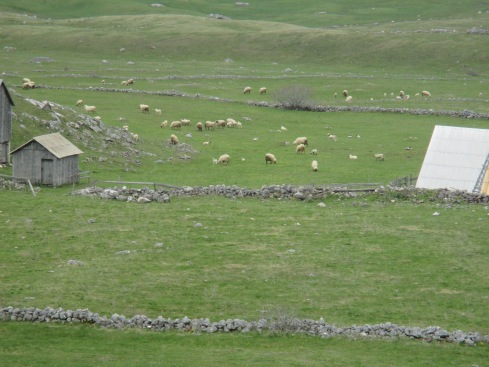
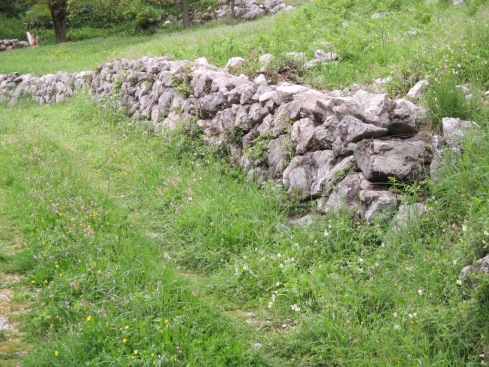
5 ***** These low stone walls here (shown above), boundary markers between individual properties, are called “djovoria” in Dropoli, the region where my father’s village is; I’ve never heard the term used in other parts of Epiros. The men of Derviçani are also known as “djovoria” or “a Derviçiotiko djovori.” The meaning of this moniker is probably clear. It implies thickness and strength and stubborn immobility, a dude who’s probably not too bright, but who, like a genetically gifted wrestler or judoka, has a low center of gravity that’s hard to knock down and take to the mat. “Άντρα άπ’τη Δερβιτσιάνη, κοπέλα από τη Γοραντζή, γαϊδούρι άπ’το Τεριαχάτι κι άπ’το Λεζαράτ’ σκυλί.” “A man from Derviçani, a girl from Gorandji (the neighboring village which is considered not only far more elegant and sophisticated than Derviçani, but also to have the prettiest girls in the region), a donkey from Teriahati (because it’s inhabitants were considered docile and somewhat dumb) and a dog from Lezarati (long story: this is the neighboring village and competitor in the ongoing, still violent feud…because they’re considered turncoats, having converted to Islam in recent memory, which in these parts means the eighteenth century). And this is a saying that’s not from Derviçani, but from the other villages of the region. In fact, almost all the other villages of Dropoli consider themselves culturally superior to the brutish brawlers of Derviçani, but because it’s the biggest and northernmost Greek village, they’re considered the frontline, dumb grunt infantrymen of Christian Dropoli, and are granted grudging admiration for that – if nothing else.
6 ****** Types like “Mr. “Pathetic” are always telling you to read history, yet outside of standard Greek sources, they have read nothing…by which I mean nothing. They know none of the literature of modern nationalism, like Anderson or Hobsbawm or or Gellner or Ignatieff; they’ve never read any of the writers on Balkan nationalism in particular, Glenny or Judah or Todorova. And they haven’t even read the works of scholars that have dealt with Modern Greek nationalism almost exclusively in their work, like Michael Herzfeld or Anastasia Karakasidou, a Greek anthropologist who studied in the United States and who was physically threatened and practically had to go into hiding after her dissertation was published in the late 1980s, because it dealt with the continued presence of Slav-speakers in Greek Macedonia; even the informants in her research who had told her they still speak Bulgarian better than Greek came out and officially denied her and the information they had given.
What’s the history I’m supposed to know again, Mr. “Pathetic”? Let me know.
And what have you read lately? Tell me. Nα μαθαίνω κι εγώ…
(Those scholars’ names are linked to their Amazon pages btw; don’t be scared…try…there’s nothing to be afraid of…)
The Messenger, of course, reads nothing but military history.
7 ******* Politike Kouzina I’ve never seen, but it’s a film that I’ll admit sounds like the kind of sappy, faux-nostalgia, Greek-Turkish “brotherhood” corniness that makes me ill. Maria Iordanidou’s novel Loxandra, however, is a masterpiece. It’s often — and very mistakenly — taken lightly because it’s a glimpse of life in late nineteenth-century Constantinople as seen through the eyes of a middle-aged Greek housewife, whose primary daily preoccupation is whether she should buy small mussels for lunch and fry them or big mussels and stuff them, or whether the eggplants in market are of the right fleshiness to make a decent hünkar beğendi yet. Yet through her daily preoccupations, deeply intelligent observations are made about nationalism, about ethnicity, about co-existence and inter-ethnic relations and about the compromises we make – often in the face of terrifying violence – to go on, not only living with others, but to continue seeing them as human. Together with Polites’ Stou Hadjifrangou, and to some extent, Theotokas’ Leones, it’s far smarter on all those counts than anything by Benezes or Sotiriou or any other book of the “Anatolian martyr” genre that usually fills about one-third of the average Greek bookstore. And in the best Greek Constantinopolitan tradition, huge sections of it are hilariously funny as well.
Of course, since it has no bearing on the good of the State, The Messenger doesn’t give a damn about any of this, or everything that was lost in the destruction of that world. He’s angry at the destruction because his animosity can feed off of it. But what it was that was actually destroyed, he is completely indifferent to.
Κι’αυτά. Bu kadar, as they say.
–
Comment: nikobakos@gmail.com
–
Tags: "My Big Fat Greek Wedding", "patriotism the last refuge of scoundrels", Afghans, Alaca Cami, Aleppo, an old post about Greek racism, Anastasia Karakasidou, Anatolia, Anatolians, Antones Samara, Armenians, Astoria, Athens, “ὅτε γέγονα ἀνήρ κατήργηκα τὰ τοῦ νηπίου”, “bushi-no-nasaké”, “donned our ancient fineries”, “Οι άνθρωποι αυτοί ήσαν μια κάποια λύσις.”, “the tenderness of the warrior”, “Those people were a solution of some kind.”, Çam, çiftetelia, Babur, Baburnama, Balkans, Basil I, Beirut, Bektaşi Harabati Baba Teke, Benedict Anderson, Bitolj, Black American Gospel, Boccaccio, bombing of Piraeus, Bulgars, Chaucer, Christos Aneste, Comnenoi, Cumans, Cypriots, Dante, Derviçani, Derviçiotika djovoria, Dido Sotiriou, djovoria, Dostoevsky, dumb grunt infantrymen of Christian Dropoli, Easter, Easter eggs, Elgin Marbles, Elias Benezes, Encyclopaedia of Ottoman Monuments of the Balkans, Ernst Gellner, Flushing, gavur tohumu, Genocide, Giorgos Theotokas' Leones, Golden Dawn, Gorandji, Greek diaspora, Greek Orthodox Church, Greek Revival architecture, Grey Falcon, Hadjidakis, Hitler, hysteria, Imagined Communities: Reflections on the Origin and Spread of Nationalism, Irish pub bouncers, Isparta, Jackson Heights, Kabul, Karadžić, Konya, Kosovo, Kosovo Liberation Army, Lermontov, Lezarati, London, Ludwig of Bavaria, Macedonian, Manastir, Maria Iordanidou's Loxandra, Maria Todorova, Melina Mercouri, Michael Herzfeld, Michael Ignatieff, middle-class white-boy appropriation, Milošević, Misha Glenny, Miss Havisham, Mughal dynasty, my father, my godfather, Mykonos, Nasredddin Hoca, New York, NRA, Paris, Paul I Corinthians 13:11, Pechenegs, Polites, Politike Kouzina, Politis' Stou Hadjifrangou, Pushkin, R&B, Rebecca West’s Black Lamb, rebetiko, Rebetiko:the film, Russia, Samaras, Samuel Johnson, Sinan, Skopje, Smyrna, spinach börek, Teriahati, Tetovo, the frontline, the jump from the essentially mediaeval mind-set of late Ottoman Hellenism to modernity, Tim Judah, Tudjman, Turkish Christian, Venizelos, Vlachs, Xarhakos, Šarena Džamija

 Interior of Sultan Ahmet mosque. (click)























 Jadde: from Bosnia to Bengal