Tag Archives: Kosovo

Strange Border Kidnappings of Serbs in Kosovo — and some thoughts of mine

17 Jun

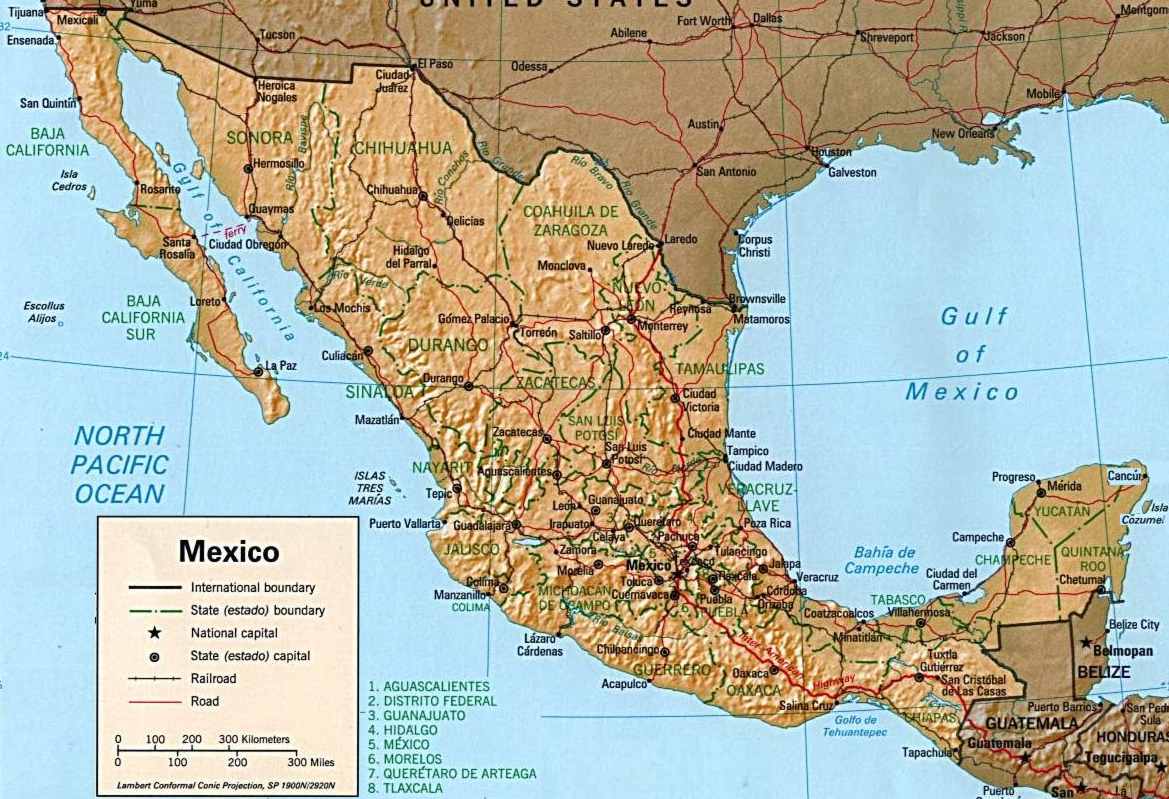
Kosovo_map

I haven’t written much, or anything really, about Kosovo, because of all the places I visited on this Balkans trip it was, despite its frantic, chaotic energy, not only a place that still felt deeply scarred itself, but also the place that left its deepest marks on me as well.  It’s a place that hurt me.  And it’s been hard for me to know where to begin to write about it.  An innate warmth and sympathy I feel for Serbs generally left me terribly depressed at the sad state of what’s left of Serbian life in Kosovo.  And yet, simultaneously, l was left overwhelmed and trembling at the mountain of atonement Serbs will have to seek out for themselves for the horrendous crimes they committed there, not just in the 1990s, but throughout the twentieth century, before they can really face a future with a clear conscience.

And then, I found almost all Kosovar Albanians deeply likeable.  I wouldn’t call them friendly exactly — Albanians don’t really do “friendly” — but they were…dashing, shall we say, in a particularly Balkan way that was immensely attractive and were always helpful with directions or anything else we needed while on our journey.  I’m also a sucker for physical beauty and I will swear to any God in the universe that I have never been in a country with such a rich embarrassment of gorgeous people of both genders in my entire life.

But whatever I may have felt about Kosovars, I will believe the most nightmarish things possible about the KLA (Kosovo Liberation Army), a collection of Berlin club bouncers, heroin smugglers, white slave traders and mob hitmen to whom the world granted the government of an independent country on a silver platter — simply because, as is usually the case in the Balkans, the West had no idea what it was doing and just wanted the whole crazy place and its people out of its hair — while they, the KLA, continue to operate as a semi-incognito organization only slightly less criminal and murderous (and I’m not even sure about the “slightly”) than the drug cartels of Colombia or Mexico.

This story of KLA members abducting Kosovo Serbs, killing them and then selling their organs — especially kidneys — on the black market has been around for a while.  The New Yorker did a story on it back in May of 2013 (posted in full below) that seemed kind of sceptical, but this reportage (video below) by Vice News, an independent news outlet originally from Montreal now based in Brooklyn — and a serious media source we should really look out for in the future; they do great work (see 2013 article about them from The Guardian) — claims that the allegations are now being taken seriously by the Hague and the European Union.

What concerns me is why the story had been forgotten for so long and I think the answer is present and not so subtly coded in The New Yorker article itself.  For about the first, I’d say, two-thirds of the piece, the allegations against the KLA are treated as completely believable.  Then, based on the evidence of one single individual, whom the KLA claims is a Serbian plant meant to discredit it, and the incoherence of his testimony, the article does a complete one-hundred-and-eighty degree turn and suddenly all kinds of doubts are cast on the potential truth behind these KLA crimes.  And then the clear and constant bias of the Western media can be heard loud and clear: the Serb can never just be the victim.  And the not so subtle suggestion is made that these allegations against the KLA might just be another example of Serbs’ supposed pathological propensity for creating nationalist mythologies and martyrdom narratives for themselves and nothing else.

Kudos to Vice News for bringing the story to the forefront again and shame on a publication with the reputation of The New Yorker  for pandering to its readership’s expectations of who the bad guys in the movie always are.

From Vice News:

“In the wake of the war in Kosovo, investigative journalist Michael Montgomery traveled to the Balkans to investigate the mysterious disappearance of Serbs. His scrutiny brought to light evidence that suggested links between a black-market crime syndicate and the upper echelon of the Kosovo Liberation Army—indicating that the end of war doesn’t necessarily mean the end of war crimes.”

 and:

The New Yorker story:

A Reporter at Large

Bring Up the Bodies

Kosovo’s leaders have been accused of grotesque war crimes. But can anyone prove it?

by May 6, 2013

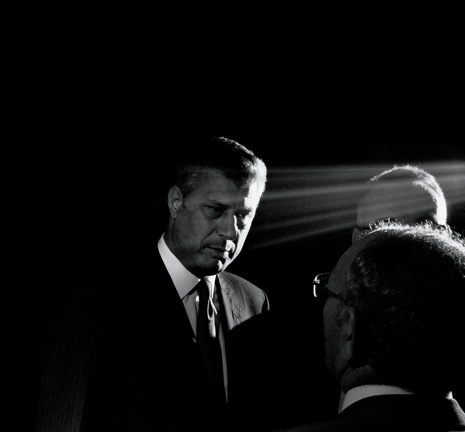
Haci Thami130506_r23468_p465Hashim Thaci, the Prime Minister, helped lead the Kosovo Liberation Army during the war. He says, “The K.L.A. was big, and you always have abusers in such organizations.” Photograph by Alex Majoli.

After the conflict in Kosovo ended, in June, 1999, a tribunal in The Hague set out to punish the perpetrators of atrocities. Louise Arbour, the lead prosecutor, described Kosovo—a former province of the Federal Republic of Yugoslavia—as “one vast crime scene.” Her investigators’ primary target was Slobodan Milosevic, the Serb who led Yugoslavia. Milosevic had claimed that Kosovo’s majority group, ethnic Albanians, treated ethnic Serbs like slaves, and armed forces under his control had waged a campaign of mass murder there, slaughtering more than ten thousand Kosovars. NATO, relying heavily on American forces, launched air strikes to stop Milosevic, and received crucial assistance from the Kosovo Liberation Army, the main rebel force in the region. K.L.A. scouts relayed Serbian tank coördinates to Green Berets, who passed on the information to American fighter jets. Three months after the air strikes began, Serbia surrendered. Milosevic was eventually arrested and sent to The Hague, where he died in prison, of a heart attack.

In Kosovo, meanwhile, the K.L.A. officially disbanded, but many of its members joined political parties. A party led by Hashim Thaci, the K.L.A.’s political chief, rose to power. In 2008, Thaci became the first Prime Minister of an independent Kosovo. Two years later, Vice-President Joe Biden hailed him as “the George Washington of Kosovo.”

Today, nearly two thousand people remain missing in Kosovo, a country that José Pablo Baraybar, a Peruvian who headed the U.N.’s Office on Missing Persons and Forensics, described to me as “one of the most exhumed places on earth.” DNA technology has helped investigators identify hundreds of bodies, many of them buried in mass graves. But, even in an era of sophisticated forensic science, definitive evidence can be elusive: in one case, the Serbs burned hundreds of corpses in a lead smelter.

Dozens of Serbs have been convicted of war crimes since the fighting stopped, but they were not the only ones responsible for violence. In Pristina, the capital of Kosovo, rumors circulated that, in the summer of 1999, K.L.A. paramilitaries had trucked prisoners across the border to secret detention camps in Albania, where they were tortured and, sometimes, killed. But, in public, Kosovars embraced a “silence taboo,” in the words of Vehbi Kajtazi, a journalist in Pristina. The men who led the K.L.A. remained a fearsome presence in the country, posing a threat to anyone who spoke out, and ethnic Serbs were a powerless bloc, falling to less than two per cent of the population. Unlike Argentina, South Africa, and Sierra Leone, Kosovo failed to establish its own truth-and-reconciliation commission.

The task of accounting for the missing was left largely to outsiders. One of them was Michael Montgomery, an American radio journalist who had helped expose the massacre of forty-one Kosovar Albanians by Serbian forces in the village of Qyshk, on May 14, 1999. He began amassing troubling stories involving the K.L.A. Multiple sources told him that, in the days after Milosevic’s defeat, the K.L.A. had shipped accused traitors to camps in Albania. A former K.L.A. member recalled guarding seven prisoners in the back of a van, their mouths taped and their hands cuffed, as they crossed the border. A K.L.A. driver said that he had been given orders not to hurt anyone; once his captives were in Albania, they were taken to a house where doctors were present. The driver heard that the doctors sampled the prisoners’ blood and assessed their health. Several sources implied that this caretaking had a sinister purpose: the K.L.A. was harvesting the prisoners’ organs and selling them on the black market.

Montgomery was concerned that these stories might be propaganda planted by the Serbian government, so he tracked down additional sources. Three people recalled taking prisoners to a yellow house outside the Albanian town of Burrel. Another K.L.A. driver told Montgomery that there were only two places where he “brought people but never picked anyone up”: the yellow house and a cream-colored farmhouse near the airport in Tirana, Albania’s capital. The farmhouse, he noted, had a “very strong smell of medicine.” The driver added that he sometimes heard other drivers talking about “organs, kidneys, and trips from the house to the airport.” Since the late nineteen-nineties, Istanbul—a short flight from Tirana—has been a destination for transplant tourism.

In late 2002, a K.L.A. member told Montgomery that the group had made “a fortune” by trafficking body parts, primarily kidneys. C., as Montgomery called the source, claimed that the K.L.A. received about forty-five thousand dollars per body. Most shipments involved body parts from “two or three Serbs,” though C. knew of an instance when the K.L.A. “did five Serbs together.”

In late 2002 and early 2003, Montgomery travelled with a colleague to Albania, carrying a map drawn by his informants. It directed them to the yellow house and to the farmhouse near the airport. But they didn’t knock on the doors. Montgomery thought that they needed stronger evidence before confronting the occupants. “The only way we felt we could report this was if bodies were recovered and matched with missing people,” he told me.

Montgomery decided to put his investigations aside, but he didn’t let the matter go entirely. He sent a memo to the U.N.’s missing-persons office in Kosovo, asserting that, in 1999 and 2000, between one hundred and three hundred prisoners were taken to Albania, where some were dispatched to a “makeshift clinic” that extracted “body organs from the captives.” The U.N. forwarded the memo to the International Criminal Tribunal for the former Yugoslavia, or I.C.T.Y. The tribunal, established in The Hague in 1993, was designed to bring a measure of justice to those who had suffered horrors in the Balkans. The Serbs did not see the tribunal as impartial, and they have remained hostile to it. Tomislav Nikolic, Serbia’s current President, said recently that the tribunal “was founded to try the Serbian people.” In fact, most of the convictions in I.C.T.Y. courtrooms have been of ethnic Serbs, in part because the Milosevic regime made little effort to conceal its crimes. In Qyshk, Serbian militia members responsible for the massacre left behind photographs of themselves posing with machine guns; the images were later used to identify some of the culprits.

The lead prosecutor at the I.C.T.Y. was Carla Del Ponte, an indefatigable fifty-six-year-old lawyer from the Italian-speaking region of Switzerland. She had joined the tribunal in September, 1999, and she had tried dozens of Serbs for crimes against humanity. The K.L.A., she suspected, had committed significantly fewer war crimes, but scale is not exculpatory.

Del Ponte received Montgomery’s memo as she was preparing to indict Ramush Haradinaj, a former bouncer who joined the K.L.A., rose to commander, and then went on to become the Prime Minister of U.N.-administered Kosovo. She intended to charge Haradinaj with “planning, instigating, ordering, committing, or otherwise aiding and abetting” the abuse of dozens of prisoners. The indictment also accused him of participating in “the abduction of persons who were later found murdered.” In documents sent to Del Ponte, Montgomery quoted his source C. saying that Haradinaj “must have known” about organ trafficking, in part because his brother Daut was close to someone “heavily involved” in the trade. (In 2002, a U.N. court convicted Daut, a former K.L.A. member, of involvement in the murder of four political rivals.)

Del Ponte was not alone in her dim view of the K.L.A. President Bill Clinton’s Balkan envoy, Robert Gelbard, had called the K.L.A. a “terrorist group,” and the organization had regularly been accused of gangsterism. In the late nineties, Italian police had arrested an Albanian for trafficking women and marijuana across the Adriatic Sea by speedboat; the suspect confessed to brokering drugs-for-guns deals between the K.L.A. and the Mafia. An Interpol representative, appearing before Congress in 2000, testified that the K.L.A. had “helped transport two billion dollars’ worth of drugs annually into Western Europe.” After the war, critics have alleged, many former K.L.A. members continued to nurture strong ties with the underworld.

Del Ponte knew that securing a war-crimes conviction against Haradinaj would not be easy. Insurgencies tend to be improvised affairs, without battle orders or formal communiqués. The K.L.A. prized secrecy and stealth. Looking to buttress the case, Del Ponte authorized Michael Montgomery to escort a U.N. team to the mysterious yellow house. One morning in 2004, under a low, granite sky, Montgomery, Baraybar—the Peruvian U.N. official—and half a dozen U.N. and I.C.T.Y. personnel travelled, in a convoy of S.U.V.s, down a dirt road outside Burrel. Following protocol, they brought along Arben Dyla, an Albanian prosecutor, who mocked their “silly” expedition. “There are no Serbs here,” he told the group. “But, if anyone did bring Serbs here and killed them, that would have been a good thing.” (Dyla denies making this remark.)

They arrived at the yellow house that Montgomery had seen a year earlier—only now it was white. Baraybar got close enough to determine that, beneath a thin coat of fresh paint, “the thing was yellow.”

The owner reluctantly let them inside. Baraybar, who was trained in forensic science, pulled on a white Tyvek suit and walked around the place. It smelled stale and sour. He sprayed Luminol—a chemical that causes traces of blood to glow—and identified a stain on the living-room floor. The owner explained to a translator who was part of the U.N. contingent that his wife had given birth at home; later, he said that the blood had come from a slaughtered animal. “Do you slaughter chickens in your living room?” Baraybar asked me. “It was quite bizarre.” Moreover, the stain had a square edge, as if blood had dripped off the corner of a table. “Is that proof of anything?” Baraybar said. “No, it isn’t. But it’s a clue.”

At one point, Baraybar went into the back yard, and noticed a pile of trash inside a thicket of brush. He dug past food scraps and plastic and retrieved gauze, syringes, drip bags, vials, an empty bottle of Tranxene, and an empty foil packet of Buscopan. He called a doctor at the U.N., who told him that Tranxene was an anti-anxiety drug and Buscopan a muscle relaxer and anti-spasmodic; both could be used to sedate patients. Baraybar asked the owner about the pharmaceuticals. He said that a nurse visited the house “on occasion” and doled out pills and medical supplies. Baraybar found the explanation “incoherent.” He placed the items in Ziploc bags, along with a fragment of cloth that he deemed “consistent with surgical overalls.”

There was a cemetery near the property, and when Baraybar walked over to it locals confronted him and told him to leave. The U.N. investigators decided to return to Pristina. Baraybar shipped the Ziploc bags to The Hague, and Del Ponte’s team inspected the material. Though suspicious, it wasn’t strong enough to anchor a case, and it couldn’t be connected to Haradinaj. Archivists at the I.C.T.Y. filed the objects away. Eventually, someone threw them out.

Del Ponte pressed ahead with prosecutions, but she discovered that it was extremely difficult to secure witnesses. A Kosovar who had testified in the murder trial of Haradinaj’s brother Daut was gunned down; an internal U.N. document noted that the Kosovar had been expected to deliver “vital” testimony in “other war-crimes cases.” Another witness told the court that “there were persons . . . whose names don’t even appear on witness lists, because they have been killed.” The I.C.T.Y. had a witness-protection program, but it was largely ineffective. Although public transcripts protected witnesses by using pseudonyms, defendants learned their identities before trials, and, during proceedings, sat only a few feet away from them. “Who were we protected from?” one witness told me. “Everyone in the court knew me.” In April, 2008, judges in The Hague acquitted Haradinaj, but they noted their “strong impression that the trial was being held in an atmosphere where witnesses felt unsafe.” (No evidence has come to light connecting Haradinaj to organ trafficking. His lawyer denied that his client had committed or sanctioned any crimes, and said that it was “false and defamatory” to suggest that Haradinaj’s acquittal was “tainted by intimidation.”)

The prosecution of Fatmir Limaj—a former K.L.A. leader and a close confidant of Prime Minister Thaci—had unravelled in similar fashion. In February, 2003, Limaj surrendered at a ski resort in Slovenia, where he was vacationing with Thaci. Limaj was accused of overseeing a detention camp, in Llapushnik, Kosovo, where prisoners were subjected to beatings, starvation, and torture. Two of his deputies were also indicted.

Del Ponte wouldn’t need to prove that Limaj wielded an axe or fired a pistol—only that he knew about atrocities and did not stop them. Her prosecution was guided by the legal theory of “command responsibility,” which dates to the fifteenth century, when Peter von Hagenbach, a governor under the Duke of Burgundy, was tried, convicted, and beheaded for presiding over the brutal occupation of a town in the Upper Rhine. “Not only was this the first recorded international war-crimes trial; it was the first recorded trial in which a commander was held responsible for crimes by his subordinates,” David Luban, an expert on war crimes at Georgetown University, told me. After the Second World War, tribunals vigorously applied the doctrine of command responsibility to Japanese and Nazi officers.

According to an internal I.C.T.Y. document from 2004, Limaj’s relatives and associates launched a campaign of “serious intimidation of and interference with potential witnesses.” Two men showed up at the house of one witness and warned him not to testify, adding, “If you make the mistake of going there, you will be dead.” Someone called the wife of a second witness and threatened, “You will be liquidated.” A third witness withdrew after a relative overheard a group of men, at a café in Pristina, saying of any people who testified against Limaj, “We will burn them, their families, and their houses.” A fourth witness refused to meet an I.C.T.Y. investigator, explaining that he “did not want to die.” Nazim Bllaca, a former K.L.A. member, told me, “This is how the Limaj case ended.” On November 30, 2005, the tribunal acquitted Limaj, though the judges observed that a “context of fear, in particular with respect to witnesses living in Kosovo, was very perceptible throughout the trial.” (A relative of one of Limaj’s indicted deputies was convicted of contempt, because he “knowingly interfered with” a witness.)

Bllaca says that he participated in more than a dozen violent acts on behalf of former K.L.A. members, including murder, kidnapping, and witness intimidation. Now under witness protection, he has testified in two cases, both of which have led to convictions. “It was very simple,” he told me. “We worked in three lanes. Kill collaborators, kill Hague witnesses, and kill L.D.K. people”—members of the Democratic League of Kosovo, the chief rival of the party led by Thaci and Limaj. In the months after the war, many L.D.K. members were murdered; one was killed at home on his couch, and another was assassinated on a street in Pristina, in the middle of the day.

In a leaked 2005 memo, Germany’s foreign spy service asserted that Haradinaj and other Kosovar leaders had inoculated themselves against criminal investigations by leveraging their connections in Kosovo’s military and intelligence agencies, and throughout the Balkan underworld. Kosovar leaders had avoided “getting their hands dirty” even as their henchmen engaged in tactics such as contract killings and bribing officials.

Last year, I met with Limaj in Pristina. He denied any responsibility for prisoner abuse. When I asked him whether he had directed his subordinates to frighten witnesses into recanting testimony, he said, with a pinched smile, “I was in The Hague. If someone here did something which was wrong, this person has to respond.” After Limaj was released from detention, Kosovars celebrated in the streets of Pristina.

In December, 2007, Del Ponte stepped down as the lead prosecutor, saying that it was “time to return to normal life.” She soon published a memoir, “Madame Prosecutor,” in which she recounted her successes in chasing Italian mobsters, Rwandan genocidaires, and Serbian generals. But she fumed about her inability to make charges stick against the K.L.A. The Limaj and Haradinaj investigations were “the most frustrating” part of her time in The Hague—and proof that “impunity shrouds powerful political and military figures” in Kosovo. She voiced her suspicion that the K.L.A. had trafficked the organs of prisoners, and offered an account of her team’s visit to the yellow house.

Del Ponte told me that “the international community” had shown a “fear-driven reluctance to apply the law” in Kosovo, adding that the United States had displayed “no political will to find out the real truths.” The K.L.A. had been a reliable ally of the Americans during the war, but it struck Del Ponte as hypocritical for the U.S. to ignore possible crimes by the group’s leaders, given the U.S. condemnation of Serbian misconduct. She also felt that allowing alleged perpetrators of war crimes to achieve leadership positions in Kosovo undermined the country’s prospects for stability.

After the publication of Del Ponte’s book, the Council of Europe decided to look deeper into the matter of organ trafficking. It assigned the task to Dick Marty, a senator from Switzerland who represented his country at the council, and who had looked into alleged human-rights abuses across the continent. His team had located C.I.A. “black sites” in Poland and Romania, and had exposed the murder of political opponents in Chechnya. Marty sent several investigators into the field. Experts in the region told him to expect a challenge, noting that the criminal networks in Albania and Kosovo were “probably more difficult to penetrate than the Cosa Nostra.”

Just as Marty’s team was getting to work, Hashim Thaci became the Prime Minister of Kosovo. In February, 2008, a month after taking office, he declared Kosovo’s independence. Joyous crowds in Pristina launched fireworks, and a giant yellow sculpture, forming the word “newborn,” in English, was installed in a plaza. Thaci stood before Kosovo’s parliament and declared, “From this day onward, Kosovo is proud, independent, and free.”

Not everyone saw Thaci in heroic terms. The 2005 German intelligence document claimed that, after the war, Thaci presided over an organized-crime empire whose leaders came from the Drenica Valley, in central Kosovo. The Drenica group allegedly coördinated its activities with Albanian gangsters throughout Europe, engaging in money laundering and maintaining links to arms and drug smugglers. According to the German report, the group kept a “professional killer” in its employ.

Not long after Thaci became Prime Minister, Lutfi Dervishi, a urologist in Pristina, began pushing to open a transplant clinic. In Kosovo, doctors need official approval to perform such operations, so Dervishi turned to a former associate, Shaip Muja, a surgeon who was working as Thaci’s health adviser. Muja made several inquiries, and in March, 2008, Dervishi opened a clinic. During the next eight months, two dozen organ transplants took place there.

That October, a young Turkish man, who had agreed to accept twenty thousand dollars for one of his kidneys, arrived at the clinic in Pristina. The kidney was removed and placed inside a seventy-four-year-old Israeli man, who had paid ninety thousand euros for it. The operations were performed by Dervishi and by a Turkish surgeon, Yusuf Sonmez, who is known in the Turkish press as Dr. Frankenstein, for his prominent role in the black-market organ trade. (Buying organs from volunteers is outlawed everywhere in the world except Iran; Luc Noël, a doctor at the World Health Organization, told me, “Human bodies should not be the source of financial gain.”)

The Turkish donor was released from the hospital while he was still woozy, and, when he got to the airport, police officers began questioning him. He said that he had donated a kidney, but the officers were suspicious and raced to the clinic, where they arrested Dervishi and his son. (Sonmez had fled.) The clinic was shut down, and Dervishi, his son, and three others (including Sonmez, who remains a fugitive) were charged with human trafficking and organized crime by the European Union Rule of Law Mission in Kosovo. The trial is currently under way, and a verdict is expected soon. According to the indictment, high-ranking Kosovars were complicit in the clinic’s activities and encouraged health officials to grant a bogus license.

Two days after prosecutors released the indictment, Dick Marty, the Swiss senator, published the results of his investigation. Marty claimed that Thaci and the Drenica group, which included Fatmir Limaj, had built a “formidable power base in the organized criminal enterprises” in the late nineties, and had exerted “violent control” over the heroin trade in the region. During and after the war, Marty wrote, Thaci was the “boss” of a “network of unlawful activity”—one that included a constellation of detention camps in Albania, where some prisoners were subjected to abuse, including torture, murder, and organ harvesting. One of the “leading co-conspirators,” Marty suggested, was Shaip Muja, the surgeon who became Thaci’s health adviser. Marty identified four sites, among them the yellow house outside Burrel, that had served as “way stations” in an organ-trafficking trade. At the farmhouse near the Tirana airport, prisoners were killed, “usually by a gunshot to the head,” before “being operated on.”

The sale of organs at Dervishi’s clinic, Marty wrote, indicated that Kosovars had continued organ trafficking after the war, “albeit in other forms.” He concluded, “Signs of collusion between the criminal class and high political and institutional office bearers are too numerous and too serious to be ignored.” He acknowledged that Serbia’s campaign of ethnic cleansing in Kosovo had been “appalling,” but insisted that the dynamic of violence was “more complex” than many had assumed: “There cannot and must not be one justice for the winners and another for the losers.”

His accusations had an explosive effect in Kosovo. Thaci called Marty’s report “an attack” on “Kosovo, the Albanian people, and me, but also against the U.S., the U.N., and NATO.” Thaci appeared on an Albanian television program and threatened to expose every Kosovar and Albanian who had assisted Marty, saying, “These individuals will be disgraced.”

In private, Thaci spoke with less bravado. He fretted to friends about whether he could still look his eleven-year-old son in the face. He summoned the American, French, German, Italian, and British envoys. “He was rocked,” Jean-François Fitou, the French Ambassador to Kosovo at the time, recalled. Thaci offered to resign if they considered him a diplomatic liability. They discussed Marty’s report. Although it was based on a sustained investigation, it did not provide conclusive details of any single crime, nor did it name sources, other than identifying them as “distinct and independent” K.L.A. insiders. Moreover, Marty’s findings carried no judicial weight. The ambassadors told Thaci that, unless hard evidence emerged, he could count on their support.

Last spring, I flew to the Balkans and visited Serbia’s Office of the War Crimes Prosecutor, in Belgrade. I traded my passport for a security badge, and was escorted upstairs to see Bruno Vekaric, a deputy prosecutor. Vekaric, a Serb who started his job in 2003, has helped secure the convictions of dozens of people for war crimes—nearly all of them Serbs. He has pursued the organ-trafficking allegations as intensely as anyone. His goal, he has said, is to find out “who committed those monstrous crimes, who was capturing and killing people for trafficking in their organs.” He is not the only Serbian government official who speaks as if it were an established fact that the K.L.A. trafficked organs. Such officials contend that the problems with securing witnesses at the Limaj and the Haradinaj trials, coupled with the discarded evidence from the yellow house, strongly suggest a coverup. Recently, Serbia’s minister of justice said that the I.C.T.Y. had “spat in the face of Serbian victims.”

Vekaric, who had invited me to visit, excitedly led me into a boardroom, its windows obscured by venetian blinds. At the end of a table sat a man wearing a black baseball cap that shaded his eyes. Vekaric introduced him and offered to let me conduct an interview, provided that I used a pseudonym for the man, who was in Serbia’s witness-protection program.

He was thirty-nine years old, with a mustache and a broken nose, and asked that I call him Adrian. Half Albanian, he grew up in Switzerland, where he became part of a community of Albanian expatriates. In 1997, he joined the K.L.A. Upon enlistment, he said, he went off to train with the French Foreign Legion. Then he travelled to Albania. Once there, he said, he headed toward the border with Kosovo, stopping at a camp near Kukes. Michael Montgomery and Dick Marty have both identified Kukes as the site of an abandoned factory that the K.L.A. transformed into a weapons depot, a barracks, and a jail.

“I met some doctors and started training with them,” Adrian said. “They told me how to take organs out, how to put them aside, and how to transport them.” One of the doctors, he noted, was Lutfi Dervishi—the urologist from the transplant clinic in Pristina.

One day in the spring of 1998, Adrian’s commander stepped on a land mine while on patrol in Kosovo, suffering grave injuries. Adrian and five others carried him, on a stretcher, to the Albanian border, but he died along the way. A van arrived at the border to pick up the commander’s body. Adrian accepted a ride, and was dropped off near the village of Helshan, where another K.L.A. camp had been established—a few tents and a converted schoolhouse. Adrian noticed that two senior K.L.A. leaders were present: Jakup Krasniqi and Sabit Geci. Krasniqi was then the spokesman for the K.L.A., and is now the president of Kosovo’s parliament. Geci headed the K.L.A.’s military police.

This was a crucial turn in Adrian’s story. In July, 2011, a European Union court found Geci guilty of war crimes, based on evidence of prisoner abuse at Kukes and another camp, Cahan. Former K.L.A. officials had long denied the existence of detention camps in Albania, but the Geci trial proved otherwise, and marked one of the most prominent convictions to date of a K.L.A. leader. The judges rendered their verdict after sixteen witnesses, most of them former captives, testified to scenes of depravity.

A Kosovar Albanian I’ll call Enver testified about being detained in Kukes, along with his brother. They had been accused of being spies—charges that they denied. One night, the guards took Enver and his brother into an interrogation room. Enver said that Geci watched as guards beat another prisoner, clubbed him with a rubber-wrapped baseball bat, and rubbed salt into his wounds. Geci himself beat the prisoner with a crutch. He pistol-whipped Enver, and told his men to beat him with metal bars; Enver repeatedly lost consciousness, and they tortured him further by dunking his head in water. On another occasion, the guards at Kukes fitted him and his brother into bulletproof jackets and fired Kalashnikovs at their stomachs until they collapsed. Later, a guard shot Enver’s brother in the knee. Enver begged for help, but his brother bled all night and died the next day.

After saluting Geci and Krasniqi at the camp in Helshan, Adrian told me, he was summoned to the converted schoolhouse. The K.L.A. officers there knew him, and were aware of his medical training. “There were school desks, three in a row, that formed a table,” he said. Three doctors, including Dervishi, stood around the table. K.L.A. guards dragged in a young man—“nineteen or twenty years old”—and lifted him onto the desks. “I didn’t know who he was or his nationality at the time,” Adrian said. The young man’s face was covered with fresh-looking bruises.

Someone tore off the young man’s shirt and splashed rubbing alcohol over his chest. Guards grabbed his wrists and ankles. Adrian suddenly realized what was happening: the prisoner’s organs were to be harvested. He gripped a scalpel and “started cutting” into the young man’s chest. Adrian recalled hearing him scream, in Serbian, “Bože pomozi mi! Nemojte to da mi radite!” (“God help me! Please don’t do this to me!”)

“That was when I figured out that he wasn’t an Albanian,” Adrian told me. Next, he sawed through the rib cage with a bayonet. While two doctors, standing across the table, lifted the prisoner’s ribs, he carved out the heart as it was still pulsing. The young Serb died.

Adrian said that he placed the heart in a box filled with preserving liquids. He put the box in a small cooler and carried it outside to an idling green Volvo 704 sedan. He fitted the cooler into the trunk’s spare-tire cavity. The entire procedure took about forty-five minutes, though to Adrian it “felt like an eternity.” Before he left the camp, Geci congratulated him and slapped him on the back.

Six months later, Adrian said, he received orders to collect a cooler from a house outside Burrel—the notorious yellow house. Adrian said that a doctor, in scrubs, met him at the door and handed him the cooler. Adrian drove to a military airport near Tirana, where a guard opened a gate to a runway. “Then we saw a private jet,” Adrian said. “It had a Turkish flag on the back of the plane.” I now grasped why Vekaric had been so eager for me to meet Adrian: his eyewitness account filled gaps that had stymied prosecutors and investigators for years.

When I asked Adrian if these episodes had darkened his view of the K.L.A., he said that he had “made a wall” in his mind and continued fighting for the group, and for another separatist movement. But in 2002, he said, “I had a problem with my conscience.” He renounced both groups but stayed in Kosovo. Not long afterward, he said, a former K.L.A. commander retaliated by kidnapping him, beating him, and administering electric shocks. He complained to a U.N. police officer; the assailant was eventually convicted of battery. Soon afterward, Adrian said, someone tossed a grenade at his home. He went into hiding, in various Balkan countries, before finally heading to Belgrade and seeking protection from the Serbian authorities.

I asked him if he felt like a traitor.

“I’m not speaking against the Albanian people,” Adrian said. “I’m speaking against people who committed crimes. I gave up everything I had in Switzerland to fight for the K.L.A., so I am not a traitor or a spy. I’m just trying to become a good person. It’s been enough for me to hide all these things in my life. I cannot do it anymore.”

He admitted, though, that he still had some secrets. “There are too many things, too many stories, too many murders that no one has ever heard about,” he said. “Many people saw things. If all of them speak as I speak, these cases would be resolved.”

Adrian’s testimony was striking, but it also seemed to connect one too many dots. By his account, he had participated in the barbaric murder of a Serb, received praise from a notorious war criminal, taken a suspicious package from a doctor at the yellow house, and delivered this parcel to a plane bound for Turkey. And his description of the surgery seemed bizarre: why, for example, had the Serb not been fully sedated?

I decided to see how much of Adrian’s story checked out. The K.L.A. had indeed encamped in Helshan, and in 2004 prosecutors presented in court the testimony of someone who claimed that a K.L.A. veteran had beaten him and administered electric shocks; the initials of the accuser matched those of Adrian’s real name. That same year, the BBC reported that a grenade had been lobbed at the house of someone sharing Adrian’s real name. But most of the story was difficult to authenticate. Dervishi, who was under indictment, and Geci, who was imprisoned, refused to talk. Krasniqi denied ever visiting Helshan in 1998 and told me that the episode Adrian described “could only be constructed in legends and films.”

Prem Shekar, a cardiac-transplant surgeon at Harvard Medical School, told me that Adrian’s tale was medically implausible, starting with the rubbing-alcohol detail. A heart transplant requires a truly sterile environment, he said: “If you take a heart that is harvested in a contaminated scenario, the recipient will get a terrible infection.” He disparaged the notion of removing a warm, pulsing heart. Typically, the heart is injected with a cardioplegia solution while it is still inside the donor, paralyzing the organ. “Only once the heart has cooled and stopped can you take it out,” he told me. Shekar also doubted Adrian’s claim that he had sawed through the Serb’s ribs. In hospitals, Shekar said, hearts are harvested through a “midline split”; a sternal saw is used to crack the breastplate in half. Moreover, a heart can last only four to six hours outside a body. There was simply no way you could transport a heart from a remote camp in Albania to a hospital in Turkey, and then complete a lengthy operation, without the heart failing first. The surgery that Adrian described, Shekar said, would suffice only as “an extremely primitive form of torture.”

I did find Adrian’s supposed commander—the one who had allegedly stepped on a land mine—on a list of K.L.A. martyrs. But the official date of death was May, 1999, a year later than Adrian had indicated. Then I scanned the roster of K.L.A. veterans, but Adrian’s name was not on it. He told me that authorities in Kosovo were “doing their best” to erase his memory from the archives.

I interviewed Adrian four times—twice in person and twice over Skype—and the disparities piled up. Even after I notified him that the commander’s date of death was 1999, he insisted that the Helshan episode had taken place in 1998. “I saw a lot of dead people,” he replied, opening the possibility that he had mistaken the commander for someone else. Originally, he claimed that he hadn’t seen Lutfi Dervishi, the urologist, since that day in Helshan; a month afterward, he said that he had seen Dervishi “later on, way after the war,” at a reception in Kosovo.

He told me that he now lived with his wife in Belgrade; his ex-wife was in Kosovo, and was related to a “very high-level, V.I.P. person.” I tracked down one of Adrian’s relatives in Europe and called her to ask about these purported family connections. (Adrian refused to tell me his ex-wife’s name, or the names of any former K.L.A. fighters who could corroborate his story.) The woman laughed, dismissing Adrian as a pathological liar who had never belonged to the K.L.A. but had served time in Germany for dealing drugs. I discovered that Adrian also had a police record in Serbia, which included vehicle theft, threatening an official with an axe, and lying to police.

Meanwhile, Adrian, under the auspices of Serbia’s Office of the War Crimes Prosecutor, was sharing his tale with others. He got a very receptive hearing from Serbian state television, which, on September 10th last year, broadcast a ninety-minute documentary, “Anatomy of a Crime.” The opening twenty minutes featured Adrian—his face obscured and his voice distorted—describing how he cut out the heart of the young Serb. Vekaric, the deputy prosecutor, also appeared, telling the host, “We absolutely are convinced that he did what he says he did.”

The program’s message was clear: just as Serbian leaders had been held accountable for war crimes, Kosovar leaders needed to be held accountable for the kinds of acts described by Adrian. Within days, Adrian’s story was disseminated around the world, as the A.P., the Telegraph, and other media outlets published summaries of the program. An Agence France Presse report, which quoted Adrian describing how “the blood started pouring” as he made incisions in the rib cage, bore the headline “GRUESOME DETAILS ON WARTIME KOSOVO ORGAN HARVESTING.”

In July, 2010, an appeals court in The Hague granted prosecutors another opportunity to try Ramush Haradinaj, the former K.L.A. commander. (The tribunal does not prohibit double jeopardy.) Not long afterward, the Office of the War Crimes Prosecutor in Belgrade notified prosecutors in The Hague that it had found a witness—one of Haradinaj’s subordinates in the K.L.A.—who had firsthand knowledge of Haradinaj’s misdeeds. That November, a prosecutor from The Hague, Paul Rogers, flew to Belgrade to meet the prospective witness.

Rogers approached the meeting with caution: it seemed unusual for a crucial witness to emerge five years after the indictment. He was also concerned about the possible bias of the Serbian government. But he assigned the witness a number, Eighty-one, and heard him out. In the summer of 1998, Eighty-one said, three men—one Serb and two Roma—were arrested by the K.L.A., accused of collaborating with Serbia, and thrown into a basement near the village of Jabllanice, in southern Kosovo. Haradinaj came to check on the captives. For the inspection, the three prisoners were taken into a courtyard. A Haradinaj lieutenant, nicknamed Toger, sliced off one of the Serb’s ears, while another lieutenant, nicknamed Maxhup, beat the Roma men with a baseball bat. Later, Eighty-one said, Toger cut out one of the Serb’s eyeballs with a knife.

Rogers noticed some inconsistencies in Eighty-one’s narrative, but people often waver when relating disturbing memories. Certainly, the account conformed to suspicions that prosecutors in The Hague had long held about K.L.A. leaders. And so, in November, 2011, Eighty-one flew to The Hague to testify, and underwent ten hours of direct examination in the courtroom.

Haradinaj’s lawyer, an Englishman named Ben Emmerson, leafed through a stack of Eighty-one’s previous statements. “The first account you gave to the prosecution was that only one of the boys’ ears was cut off and that it was cut off by Maxhup and that it was the Roma’s ear,” Emmerson said. “The second account you gave was that only one of the boys’ ears was cut off, but that it was cut off by Toger and that it was the Serb boy’s ear. . . . Now you’re saying two ears were cut off—one of a Roma and one of the Serb.” Emmerson also said, “I appreciate that it’s difficult for you to keep up with the various versions that you’ve given—but that’s because you’re making them up.”

At one point, Eighty-one blamed poor translation for the confusion. Emmerson produced a copy of a document that Eighty-one had signed earlier, attesting to the accuracy of the translations. “This is theatre!” Emmerson said. “The reason why you can’t keep them straight is because they’re all inventions.”

During closing arguments, Rogers conceded that Eighty-one’s testimony had been a disaster, and requested that the judges “ignore that evidence” while contemplating their verdict. Emmerson, in turn, said that Eighty-one was “so slippery with the slime of dishonesty that one felt the need to wash one’s hands.”

A few days later, Emmerson told me he was certain that Eighty-one had been “actively tutored” by Serbia’s intelligence agencies. Last November, Haradinaj was acquitted a second time; the judges cited Eighty-one’s “unreliable” statements as a factor.

Reading the transcripts of Eighty-one’s testimony, I noticed several similarities between him and Adrian. Both had offered unusually detailed accounts of K.L.A. savagery. Both had spent considerable time in the company of Serbian officials. Both had grown up in Switzerland. Both had a rap sheet in Serbia. In their testimony, both emphasized the importance of rank and mentioned saluting K.L.A. leaders—observations that could help prosecutors make a “command responsibility” argument.

I also learned something about the 2004 case in which Adrian had apparently testified to being kidnapped and abused by the former K.L.A. soldier. In March, 2007, the Supreme Court of Kosovo had ordered a retrial, arguing that the accusations were not “in any way corroborated by evidence.” Three years later, the prosecution withdrew its charges. At the time, the case had seemed another example of K.L.A. fighters evading accountability. Now it seemed one more instance of fabulation by Adrian.

Many questions remained. Had the Serbian government, frustrated with its inability to find conclusive evidence of Kosovar organ trafficking, deliberately planted a false story? When, and why, had Adrian begun working for Belgrade? Had his criminal record made him vulnerable to exploitation by the Serbian government? And why, if he was a trained Serbian asset, was he so incompetent?

Then, there was the role of Bruno Vekaric, the prosecutor in the Belgrade office. In his country, he told me, he had been criticized for prosecuting mainly Serbs and for his coöperation with The Hague. Was Vekaric hoping to demonstrate his patriotic credentials by advancing Adrian’s story? When I asked Vekaric if he had been duped by Adrian or was complicit in his fiction, Vekaric responded, “Maybe he is a liar. But in this organ-trafficking story I am sure he is right.”

When I last spoke with Adrian, over Skype, I asked him to confirm that he was also known as Eighty-one. He put on a blue baseball cap and tugged it over his eyes. Pushing himself away from the table, he mumbled something, in Serbian, to a female handler off-screen. She appeared in the frame and said, “He does not want to speak anymore.”

Forensic police procedurals like “C.S.I.” are predicated on the idea that every murder leaves behind a trail of evidence, however faint. In reality, some crimes prove impossible to trace. Conspiracies are hatched in dark rooms; corpses are dissolved in acid; witnesses take secrets to their graves.

Several K.L.A. leaders have survived repeated prosecution. After Fatmir Limaj, Thaci’s confidant, was acquitted in The Hague, the European Union Rule of Law Mission in Kosovo charged him with torture and prisoner abuse at a second camp. Prosecutors had persuaded a former guard, Agim Zogaj, to talk. At the camp, Zogaj had kept a diary that contained the names of prisoners. According to a report in Koha Ditore, a Kosovo daily, a “plus” or a “minus” sign beside the name signalled whether the prisoner had been freed or executed—in some cases, on Limaj’s orders. But in September, 2011, a month before Limaj’s trial began, Zogaj was found hanged in a park in Duisburg, Germany—an apparent suicide. The judges declared the diary inadmissible and acquitted Limaj. In November, 2012, however, the judges reversed their decision on the diary, and a retrial is expected to begin soon. Limaj is currently under house arrest in Pristina. A spokesman for the E.U. justified Limaj’s detention by citing the risk that he might tamper with evidence.

A senior E.U. war-crimes investigator told me he was certain that “criminality in Kosovo has not been accounted for.” Yet Serbia’s efforts to promote Adrian’s story had clearly backfired: such tactics only made it easier for the lawyers representing K.L.A. leaders to protest that their clients were victims of slander. Michael Montgomery said that Bruno Vekaric’s office in Belgrade had, in its investigation of organ trafficking, “gone out of its way to screw up everything.”

Nevertheless, the E.U. investigator told me, “With the appropriate degree of rigor, I remain convinced, it is possible to account for the most severe crimes in Kosovar Albanian factions, the K.L.A., and their affiliates, even the most complex criminal conspiracies to traffic human beings for organ extraction.” In August, 2011, the E.U. formed a “special investigative task force” to sort out the organ-trafficking saga once and for all—including the possible role of Kosovo’s leaders.

The E.U. has put an American prosecutor, Clint Williamson, in charge of this effort. Before taking the job, Williamson, a former United States Ambassador-at-Large for War Crimes Issues, examined the material gathered by Dick Marty’s team, and concluded that a full-scale investigation was merited. Williamson, an experienced diplomat, knows Kosovo well, and a decade earlier he had worked in The Hague, helping to draft the indictment against Milosevic. It would be hard to depict him as inexperienced or partisan.

Williamson set up his office in Brussels, in a nondescript E.U. government building that is protected by twenty-four-hour surveillance and a secure communications network. He told me that the failure to have a proper reckoning in Kosovo had left a “dark cloud” over the Balkans. He plans to finish his probe in 2014.

Court records pointed to glaring oversights in some previous prosecutions of K.L.A. leaders. For example, a witness in the trial against Sabit Geci—the military-police chief convicted of abuses at Kukes and Cahan—testified that one of Thaci’s top advisers had driven him to Kukes, but the judge dismissed the comment, saying that the adviser was “not a defendant in this trial.” Why hadn’t the prosecutor pursued this potential link between Thaci and Kukes?

There were other possible leads. A former detainee in the Cahan camp has said that guards there “put guns at our heads and made us beat, shoot, even sodomize other prisoners.” He noted, “Our torturers were our fellow-Albanians, the K.L.A., who were supposed to be fighting for our freedom.” The detainee, who remembered Limaj giving orders, said that, at one point, Thaci came in, looked at the prisoners, and “saw that we were tied up, injured, and in such a dirty place.” Thaci and Limaj “knew exactly what they were doing to us.” Parts of the detainee’s story eventually appeared in Le Monde, but prosecutors have not picked up the thread. (At least one other witness has placed Thaci at a detention camp: Enver, the prisoner accused of spying, recalled seeing Thaci at Kukes, wearing civilian clothes.)

In 2011 and 2012, Williamson travelled to Albania. He told me that he considered Albania, not Kosovo, the “single most important operational zone” for the K.L.A.’s alleged crimes. One place of particular interest is the farmhouse by the airport—the spot where, according to Marty, kidneys were removed from prisoners who had been shot in the head. (The owner of the farmhouse, which is in the village of Fushe-Kruje, denies any wrongdoing; he filed a claim to sue Marty for defamation, but the claim was thrown out.)

Williamson admits that the chances of finding a “smoking gun” are slim, since so much time has passed since crimes allegedly occurred. If corpses had to be moved, or videotape destroyed, it was probably done years ago. Without physical evidence, Williamson will have to rely almost entirely on testimony. He noted, “It’s one thing for people to talk to Marty or talk to a journalist. It’s quite another to participate in a criminal investigation where you ultimately have to go into a courtroom and point your finger at very powerful people.” That said, Williamson spent several years working in the Justice Department’s organized-crime-and-racketeering section, and he had found that, with the right combination of incentives, protective measures, and appeals to conscience, “even the most intractable insiders will turn witness.”

Last year, I met Prime Minister Thaci in his office, on the second floor of a drab fourteen-story tower in central Pristina. Jean-François Fitou, the French Ambassador to Kosovo, had told me that Thaci was “the Mick Jagger of the K.L.A.,” and Thaci is indeed dashing, with a clean smile, carefully groomed hair, and a buttery complexion.

Within the K.L.A., Thaci had been known as the Snake—a reference to his slippery evasion of Serbian authorities. The nickname, it seemed, was still appropriate. “Until the war broke out, the Serbs wanted to imprison me,” he said. “In wartime, they tried to kill me. After the war, they tried to compromise me, to destroy my reputation.” Thaci denies having ever been connected to a criminal syndicate and says that he was unaware of any prisoner abuse.

At one point, the conversation turned to Sabit Geci. Germany’s spy agency reported that Thaci had maintained “very good contacts” with him, but Thaci disputed this, saying, “To be frank, he was not my friend.” As we talked about Geci’s crimes, Thaci’s face turned the color of gravel and his smile contorted, as if he could taste his reputation souring on his tongue. “The K.L.A. was big, and you always have abusers in such organizations,” he said. It was almost five o’clock, and many of his aides and assistants had gone home for the day. He sank into a black leather chair and unfastened the top button on his shirt.

If Williamson found conclusive evidence that the K.L.A. had trafficked the organs of prisoners, Thaci said, “that would leave the worst legacy for Kosovo and our people.” But “never did something like this happen” with his knowledge. “That’s why I gave my full support to the task force,” he said. “In order to have the truth prevail.”

The late-afternoon sun slanted across the room. “I give my full support to justice,” he added. “I will be on the side of justice, no matter who is on the other side.”

Regaining his color, Thaci said, with a grin, “The only laws I have violated were Milosevic’s laws. And I feel very proud of that.”

PHOTOGRAPH: Magnum

Comment: nikobakos@gmail.com

“Magnificent Turks” and the origins of this blog

11 Jun

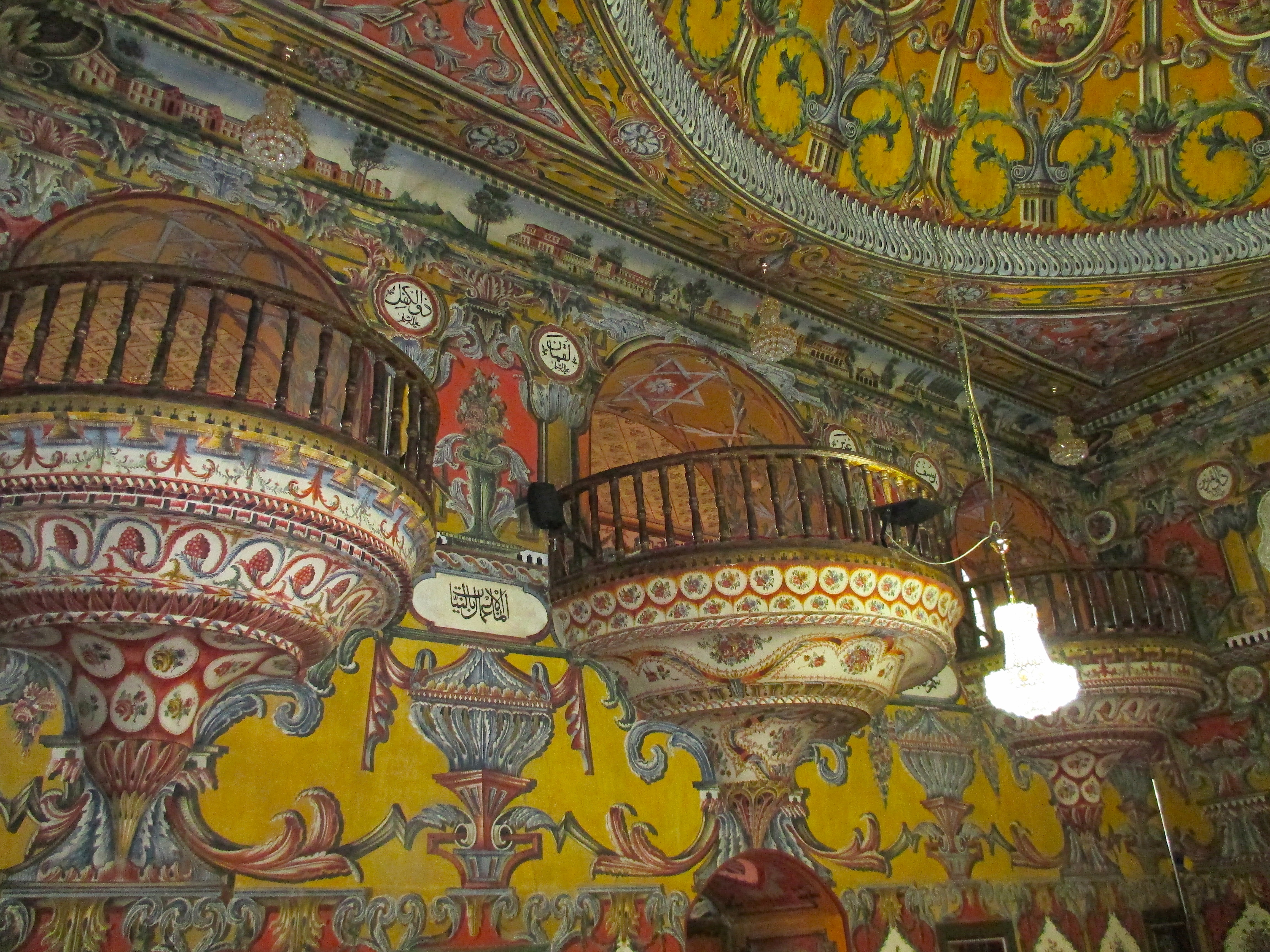
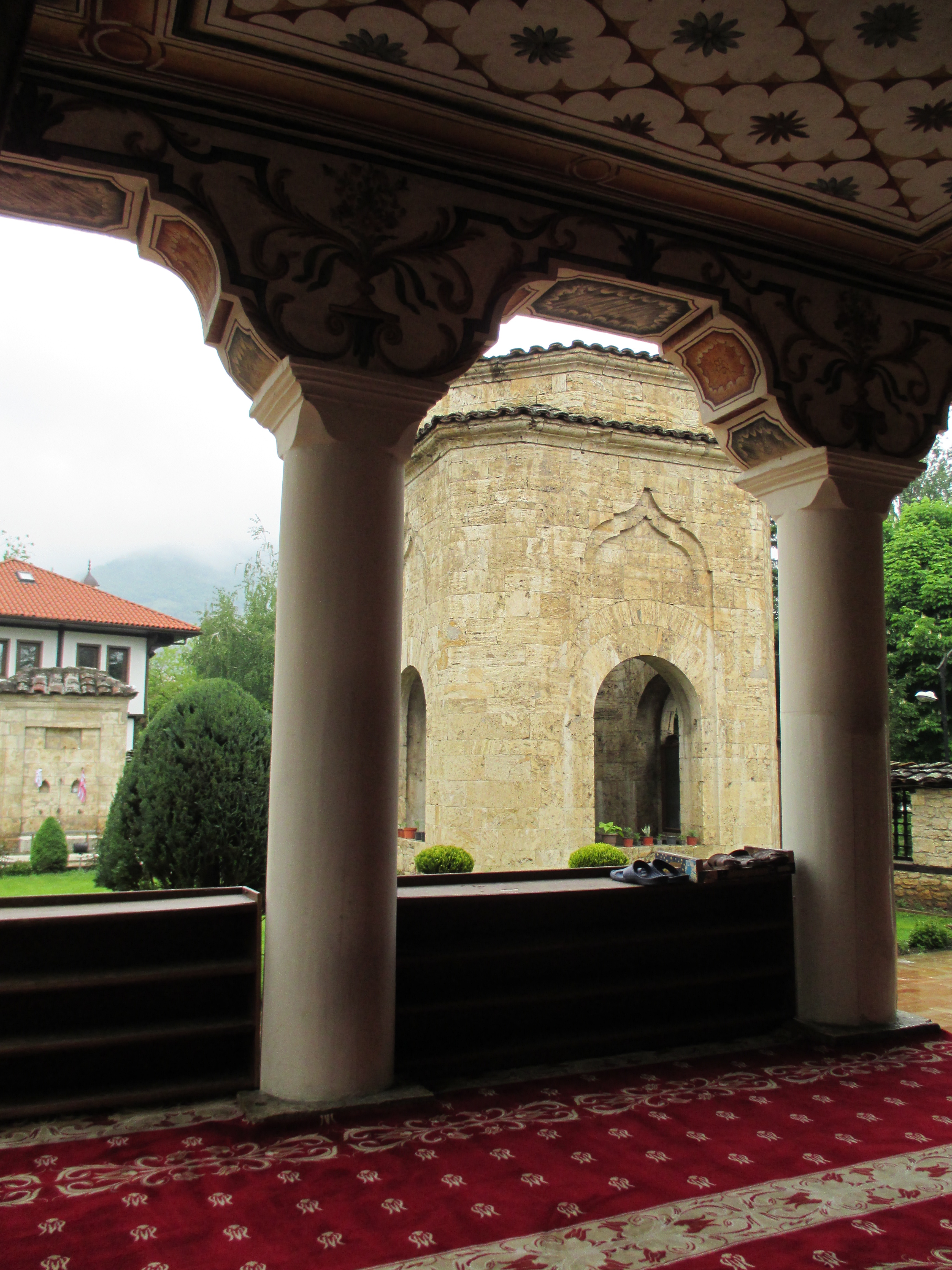
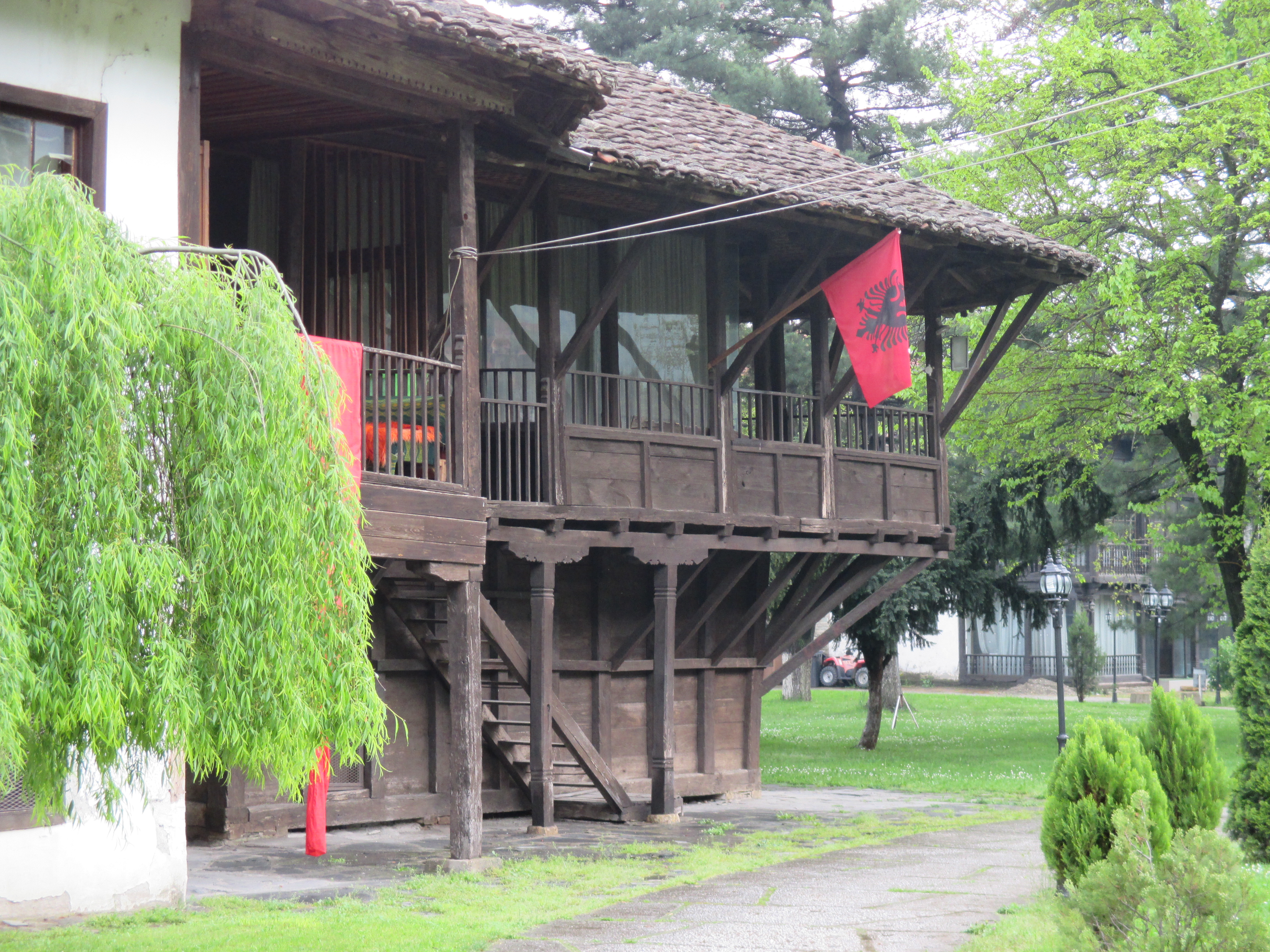
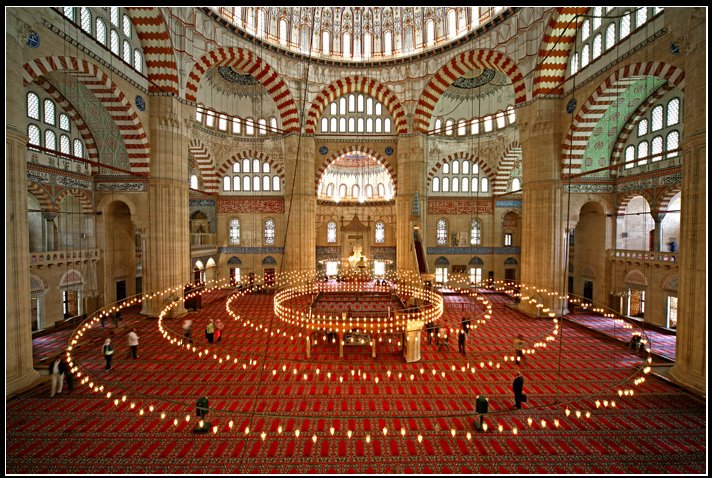
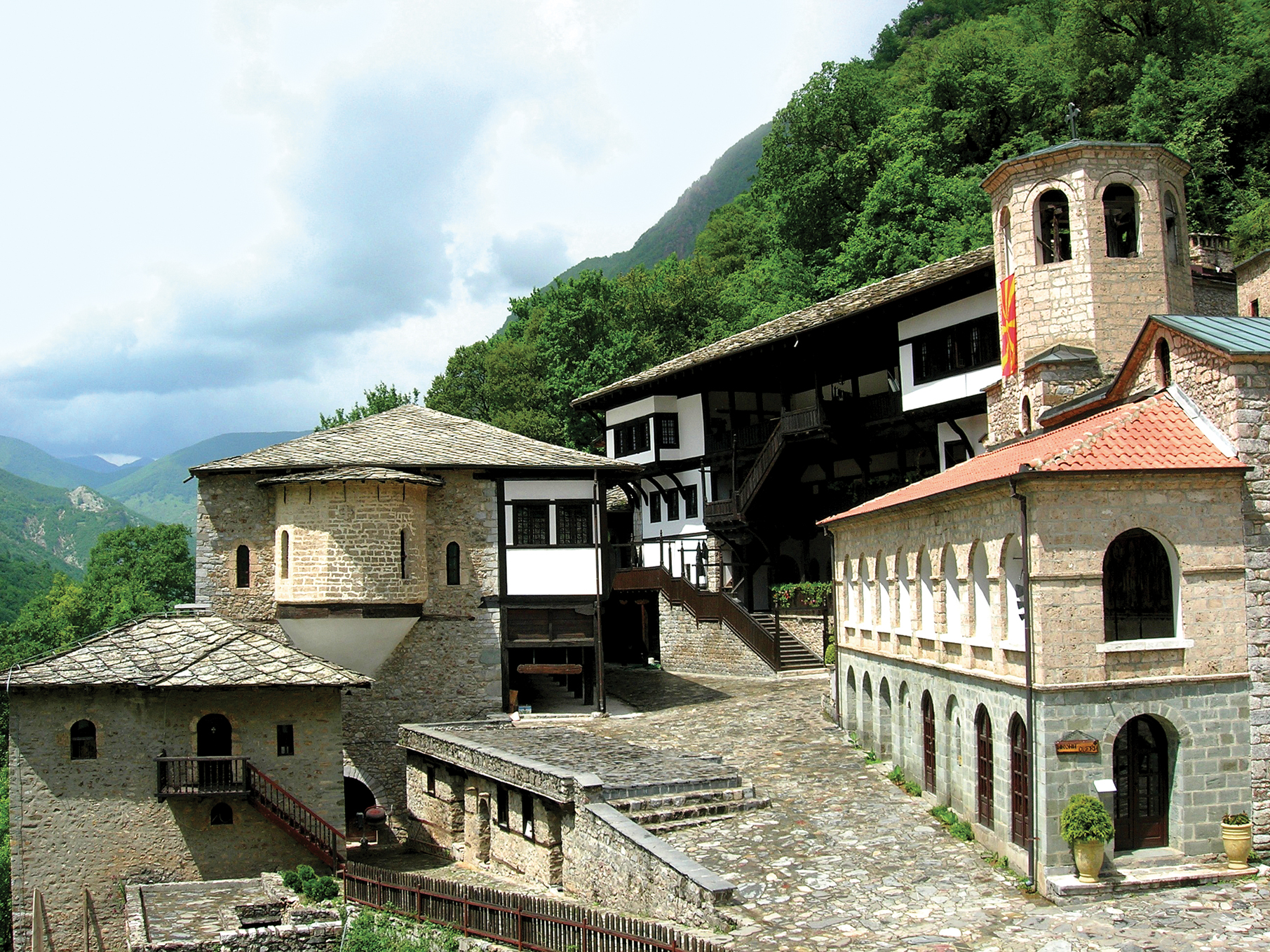
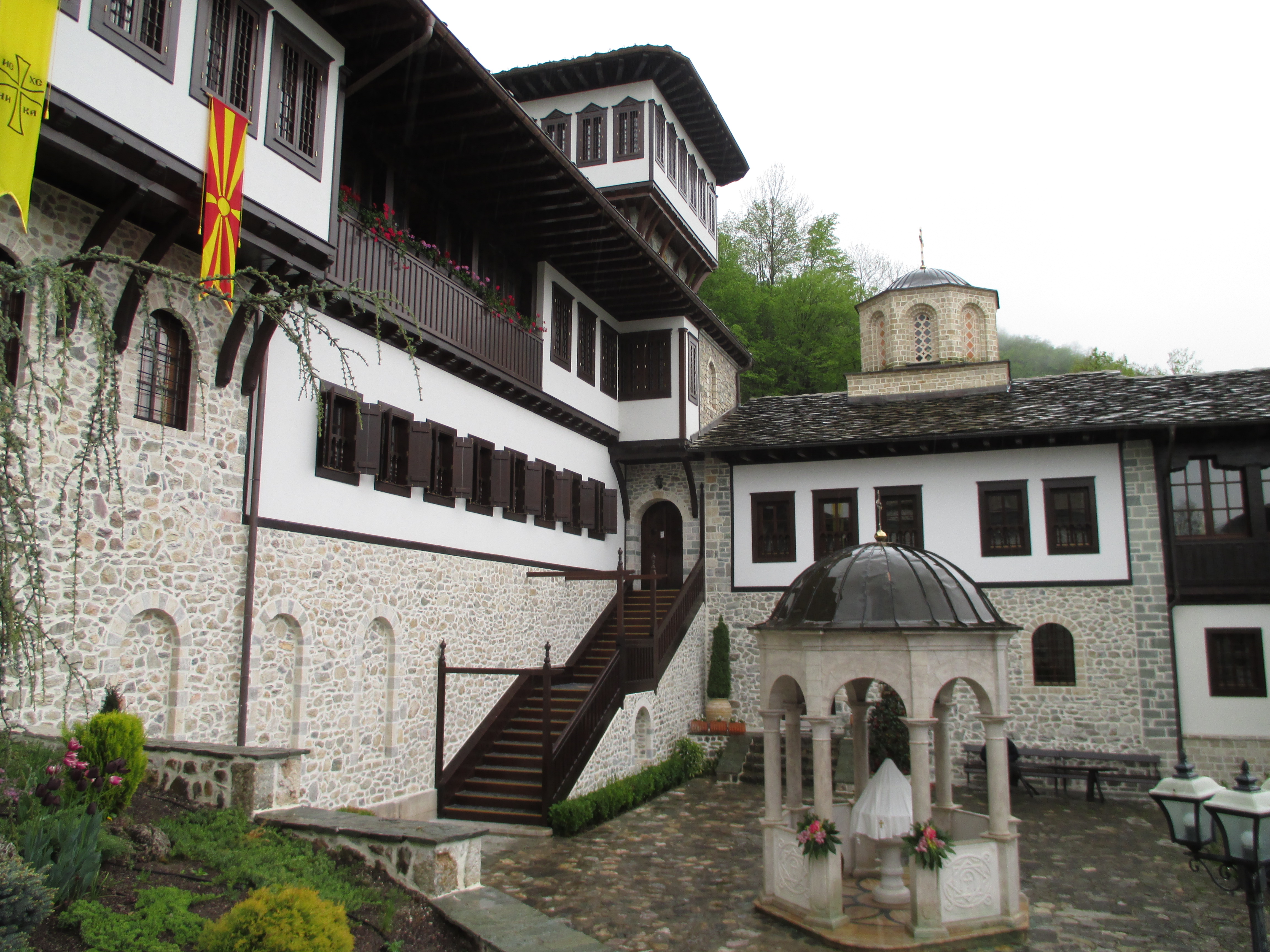
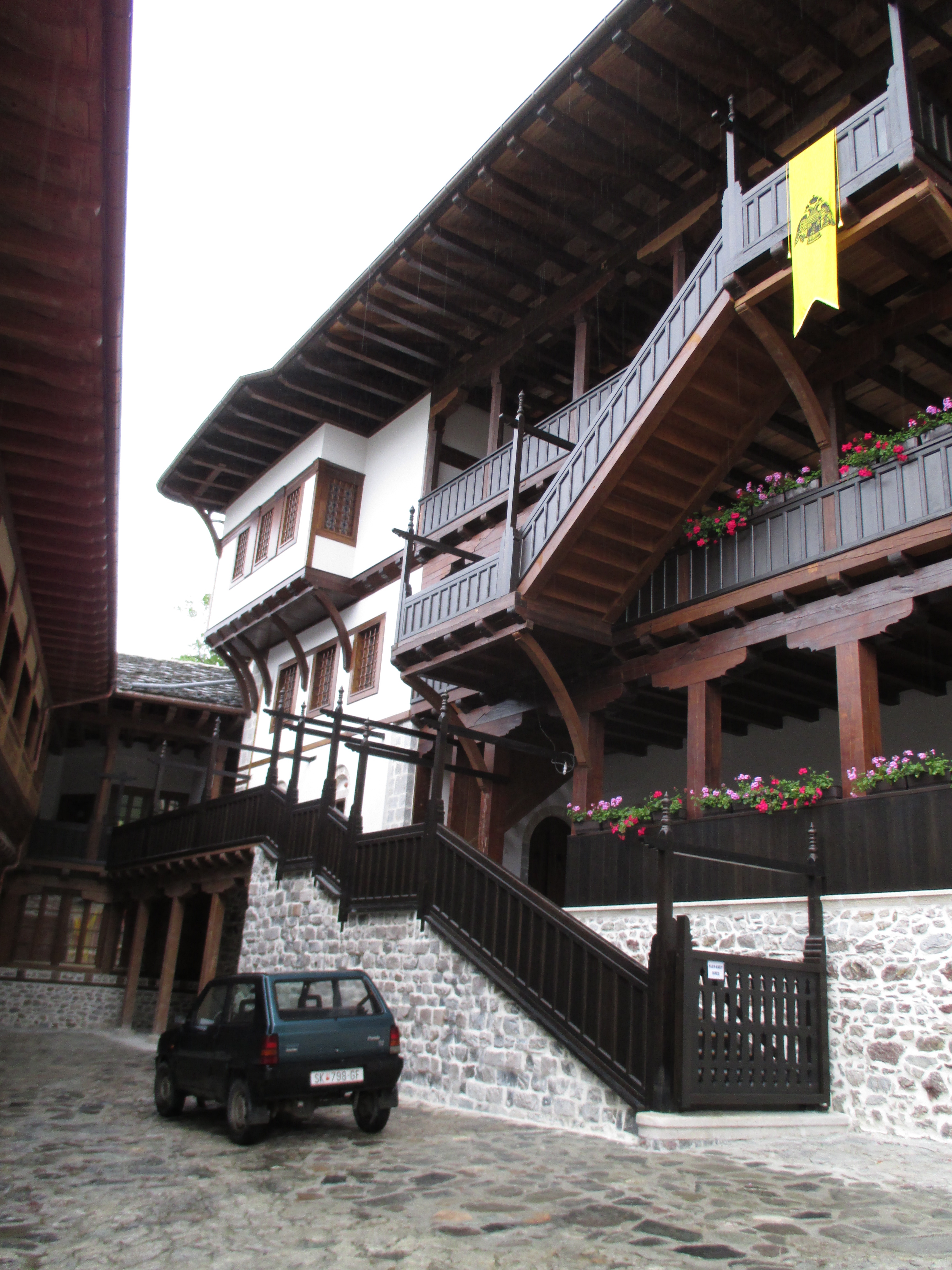
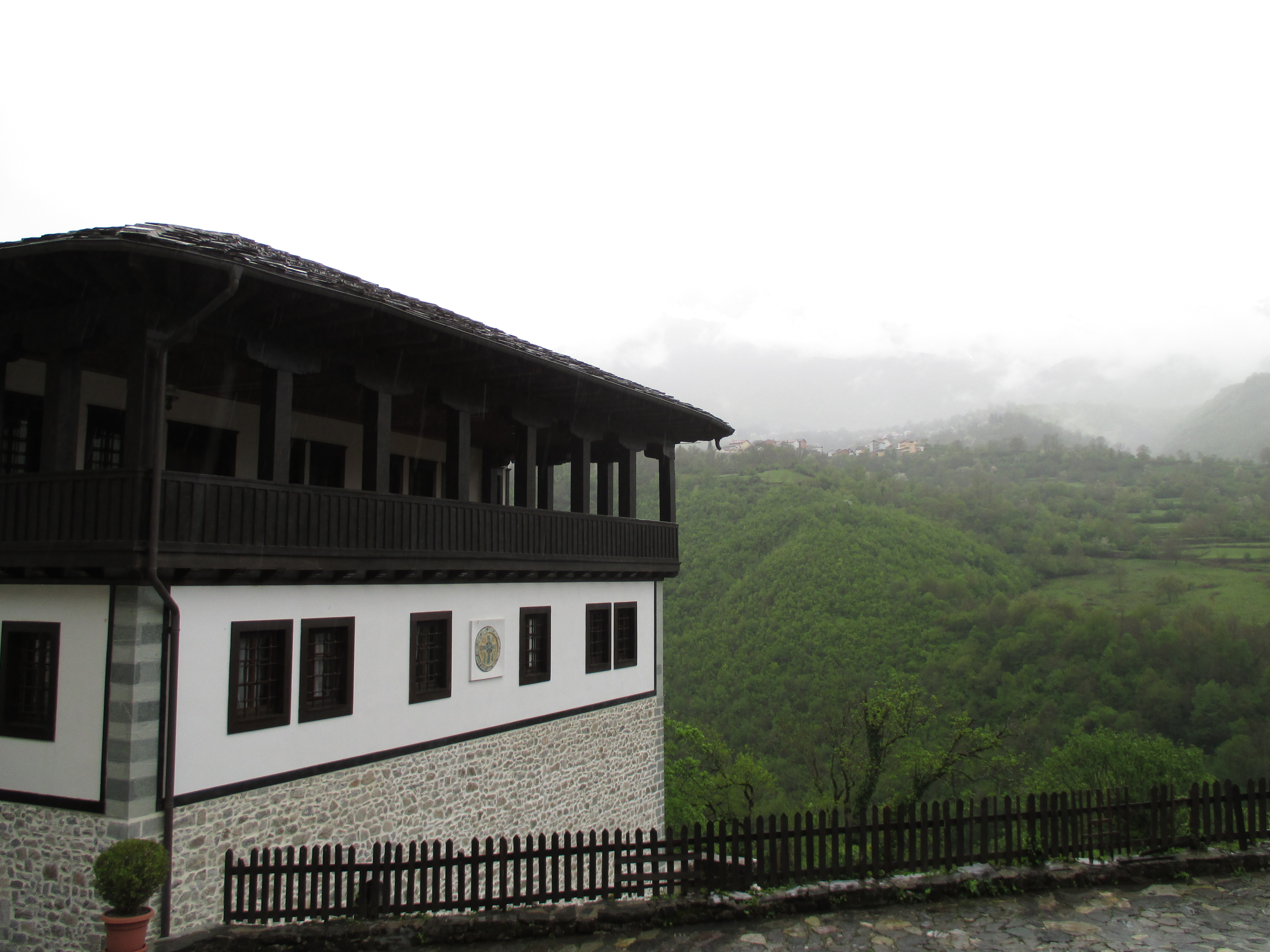
OLYMPUS DIGITAL CAMERA(The photo above and all photos in the main body of this post, are of the Šarena Džamija in Macedonian, or Alaca Cami in Turkish, which means “The Decorated Mosque,” an eighteenth-century masterpiece of Ottoman Folk Baroque in Tetovo, Macedonia.  The photos interspersed between the footnotes are of the Bektaşi Harabati Baba Teke on the outskirts of Tetovo — two of the loveliest places I visitted on this trip.  Click on all.)

From Rebecca West’s Black Lamb, Grey Falcon:

“It is impossible to have visited Sarajevo or Manastir or Bitolj or even Skopje, without learning that the Turks were in a real sense magnificent, that there was much of that in them which brings a man off his four feet into erectness, that they knew well that running waters, the shade of trees, a white minaret the more in a town, brocade and fine manners, have a usefulness greater than use, even to the most soldierly of men.”

Yes, again…  West is prompted to make this comment in I can’t remember what city in Macedonia because the book is huge. Always super-astute, she identifies something really profound about Turks: essentially, what’s known in classical Japanese aesthetics as “bushi-no-nasaké” – “the tenderness of the warrior.” I don’t think that needs to be explained any further. Afghans have this quality, and the autobiography of Babur, the founder of the Mughal dynasty, his Baburnama, where he talks about the blood and fear of war with true horror in one passage and the sweetness of his beloved Kabul’s melons, its ice-cold waters and the handsomeness of its young men in the immediately following, is probably the most striking literary example of this aesthetic strength outside of anything written in Japanese I would imagine. (Complicated: the fact that it’s a quality most highly present in strongly homoerotic environments or cultures.) I remember sending West’s passage to one of my best friends in Istanbul when I read it and she wrote back and said: “I wish there were even a trace of that sensibility left here.” And I think she was being a little unfair and also suffered from the near-sightedness we all do when we’re immersed in an environment and really can’t see it objectively. To begin with, at least as far as C-town is concerned, it’s hard to build a city for fifteen million in fifteen years and maintain any kind of sensibility at all, so something has inevitably been lost in the dizzying pace of progress in contemporary Turkey. But it isn’t hard to see if you just look a little: a sensuality, an alertness to beauty and material comfort of all kinds, despite some overdone glitz, that comes at you from nowhere often – of course from Turkish women, some of the world’s most impressive for me, but even from the most macho (and some of the world’s most impressive) guys, which is when it’s really beautiful and almost disconcertingly lovely: an aesthete’s attention to detail; a sudden, completely unsolicited, solicitous gesture of smiling generosity; a strange soft politeness and sensitivity, which the sound of the language, especially in the City’s accent, only adds to… A “tenderness.” That of a complete man. Which is what the Japanese meant.

But my reasons for posting it now have nothing to do with my friend or with Turks really. I had been looking for an opportunity to post this passage at some point because it’s essentially the seed of this blog. I thought maybe on some anniversary in April, but Easter posts always get in the way then. What gave me the impetus to post it now is finding the beautiful “Painted Mosque” in Tetovo in Macedonia and the Bektashi Harabati Tekke on the outskirts of the same city, because both structures or compounds are the purest embodiment of the observation West had made of Turks some eighty years before.

IMG_0256

Why did the Jadde grow out of this particular quote? I’ll start from the beginning.

Four, five, maybe even six years ago – I think it was 2008 – a group of Turkish historians of Ottoman art and architecture completed a massive and what sounds like a seriously respect-worthy encyclopaedia of all the Ottoman monuments of the Balkans. I heard about this from Greece, however, in an email from a fairly out-there nationalist who has since grown exponentially deranged, that went out to friends, and friends of friends, and acquaintances, and acquaintances of acquaintances, with the pompous subject line: “The Falsification of History!” No explanation of why the work of serious Turkish scholars was false or a process of falsification. No explanation at all; and, really, I can’t even remember what the tirade in the rest of the email went on about. I wrote back (“Reply all”) and said: “Good for them. Why don’t we do it too?” And then I remembered the above passage about “Turkish magnificence” that West had written while in Macedonia and I sent that out right after.

MosqueTetovo

The response blew my mind. Dostoevsky said that hysteria was God’s gift to women. But watch certain kinds of sports fans or listen to a certain kind of nationalist and you’ll see that maybe it’s the y-chromosome which carries this gift of the Lord’s. Or maybe Samuel Johnson was wrong in calling “patriotism the last refuge of scoundrels” and should have dubbed it the “last refuge of hysterics.” I was called a traitor. I was called an idiot. One person wrote to tell me that he might agree with some of what I said (I hadn’t really said anything – Rebecca West had) but that I was so aggressive that he wasn’t going to stoop to my level. One guy wrote me an email most of which sounded like it was lifted out of the literature and billboards of Samaras’ (now Prime Minister) simultaneous Macedonia/Elgin Marbles campaign that made an international rezili of us in the nineties when he was Foreign Minister (*1), telling me to “read some history” and “that if you don’t know your history you’re nobody; you’re pathetic my friend — you and your ‘magnificent Turks.’” Now, when a Neo-Greek tells me that I don’t know my history, the hair on the back of my neck stands on end, because even when they come out of the country’s best schools (”…oy, I should cough…” as a certain old Jewish lady I knew liked to say), like this guy has, the “history” they know – or choose to know — are just the national mythologies. I actually really felt sorry for him to be honest, not even insulted, because, like I said, this was a circle of friends of friends and there was a good chance that he would eventually get to know more about me some day and then he would feel r-e-a-l-l-y dumb for doubting either my historical knowledge or my sense of cultural consciousness. I hear he’s a nice guy. He later apologized for calling me “pathetic” but insisted that we still disagreed completely – “diagonally” was the term he used in Greek. I didn’t bother to ask what it was we still disagreed about exactly. And I also won’t tell you who most of these people are professionally because it’ll send chills down your spine.

There were no explanations coming anyway. What was “false” about this project? Were these academics impostors or clowns? Why was I “pathetic?” What was it that I didn’t know supposedly? What was the “diagonal” disagreement about? that the Ottoman was a civilization? What? Explain. Just like I never got an explanation for why my Genocide post was “enraging”…. εξοργιστικό…. other than that it takes away someone’s claim to victim status, nothing was clarified here either, except that one shouldn’t stand anybody saying anything positive about Turks.

IMG_0263

Eventually an attempt at explanation (talk about “pathetic”) came from the original sender, who we’ll call “The Messenger” from now on. “Of course, I support the preservation of art” – he wrote: the classic, vapid introductory caveat of every ideologue; Hitler loved art too; that’s why he bombed the shit out of Piraeus but didn’t touch Athens – “but I can’t tolerate the turning of every little stone into an Ottoman ‘monument.’” Had he seen this encyclopaedic project first-hand? Did he know that any of the entries were just “little stones?” I doubt it. But then came the real point, the following completely strained and muddled analogy: “And when it comes down to it, the preservation of the art of the burglar must take second place to the art of the owners of the home that was burglarized.”

Got it, right? The burglars are the Turks. Understood? Even if we overlook the fact that the primary genetic material of modern Turks is made up of the converted and Turkified peoples that already inhabited the Balkans and Anatolia (2**) — they’re us and we’re them essentially, on some deep level there’s no “they” there; does that not create even the tiniest bit of empathy and identification? — the Turks, and Islam, have been in the Balkan peninsula for six centuries. They’ve been in Anatolia for nine. But for the Messenger, they’re still burglars. They first appeared on the record in the history of southwestern Asia as military slaves, I think, in when? the 7th century? If we count Turkic peoples like the Bulgars, Cumans and Pechenegs, they’ve even been in the Balkans since the 6th century. When do they get their green card?

So this is the essential irrationality of these people’s thought pattern and it’s what makes their arguments descend into crazed incoherence so dramatically fast. They’re not angry at a policy or an act or a group, really, or even a politician or another nation even. They’re angry at gigantic, abstract historical phenomena: the spread of Islam; the westward movement of nomadic tribes from East Asia in the first millennium – shit like that. Which are phenomena that, admittedly, we may have been on the uncomfortable receiving edge of, and — you know what? — yes, cause me occasional sorrow too: the loss was great. (Though we maybe were given much through these processes, also, if you’re willing to see.) But, “ὅτε γέγονα ἀνήρ, κατήργηκα τὰ τοῦ νηπίου” – “when I became a man I put away childish ways” (that’s Paul, I Corinthians, 13:11, since none of these types will know where the quote is from or even if it’s from the Bible very likely) and started looking for ways to handle that sorrow more productively instead of angry — which I had never felt — ranting — which I had never done anyway. But when you listen to these guys you get the distinct impression that you’re watching someone whipping air, or digging a hole in the water as the Greek has it. Because you’re listening to the rant of someone stuck on what he thinks is the losing side of history, and who insists on continuing to act like a loser – and thereby remaining one — by whining and hating. And if you confront them too intensely, they just get nasty because they hit a wall almost immediately; they have nowhere to go rhetorically. I was in a comfortable living room in Athens last month, having drinks and a perfectly civilized – I thought, at least — conversation and listening, I think, to Hadjidakis or even Chet Baker. And I said, for some reason – I can’t remember the context: “Obviously the single largest ethnic group, if not the majority, of the population of Greek Macedonia were Slav-speakers until the beginning of the 20th century, until they were chased out or massacred or exchanged and the considerable remnant terrorized into being afraid of speaking their language or even of openly being who they were.” And I immediately got a traditional warm Balkan reply from this τάχα sophisticated Athenian and Kollegiopaido: “Bre haydi, go fuck yourself, malaka!” Not because this person doesn’t know that what I said was true, but because I had dared to say it so bluntly. And instead of getting up and leaving, or staying and breaking some teeth for being spoken to that way, I was silent. “We were persecuted and thrown out of so many places too!” And then you realize you’re talking to someone who has descended to the level of a fourth-grader and that it would be child abuse to continue.

So rather than waste too much more time in exchanges or situations like that, I finally got my act together a couple of years later and started this blog. I wasn’t going to continue writing or responding to these people individually: narrow-minded and locked in their ideological boxes and — most irritatingly — profoundly provincial and ignorant of certain things and yet simultaneously convinced of their status as the crème de la crème of their segment of Athenian society. (They’re big fish in a little pond and when they get thrown into the ocean they don’t even realize it.)  I was just going to put my ideas out there and anybody who wanted to could do what they felt about them.

IMG_0259

There are two basic components on which these individuals’ thought worlds rest and are designed and constructed. One is their complete lack of empathy, or even the capacity for the slightest identification, with those different from them. I understand not everyone can be from New York, where you’re not only confronted – in the flesh – with the entire rest of the world from the moment you’re conscious of your environment, but confronted as well with the stories of loss and tragedy and deprivation or just frustration and lack of opportunity –again, in the flesh – that brought both you and all these others together here in this city. And you don’t have to be as peculiarly sensitive to these issues as I am. But unless you have an anvil for a head, or no heart at all, it’s impossible to be a New Yorker and not recognize that, though your story may be distinct, it can’t be privileged in as facile a manner as it can when you’re home locked up in your little mono-cultural society. (3***)

And the “in the flesh” part is what’s crucial. People like the Messenger, or Mr. “Pathetic,” feel an instinctive, knee-jerk negativity towards Turks – or anybody else — because….

they’ve never LIVED them, or VISCERALLY lived ANY kind of DIFFERENCE, at ALL, in ANY  REAL way. (4****)

I’ve already written extensively about how the young people of my village, with one-fifth the education of these cosseted bureaucrats (much less a kid like my nephew Vangeli), are more cosmopolitan and open about the world because they’ve lived bi-cultural existences in Albania since their first breath, even if it’s with people they may not particularly like. If anything, the kids of Derviçani would silently ignore The Messenger and his preachings. And if The Messenger dared to get angry and nasty and foul-mouthed with them because his prophecies weren’t being heeded, as he always does with everyone who doesn’t fall at his feet when he speaks, he would be roughly escorted out of the café or bar they would happen to be in, in New York Irish pub style, by a couple of big Derviçiotika djovoria (5*****) — believe me, they’re good stand-ins for Irish pub bouncers, take a good look at some of them in my photos — and quite possibly at knife point just to make sure the message got through. They don’t take kindly, as I don’t, to being told what to feel or think by Athenian amateur “intellectuals” or what they more frequently refer to as “butterboys.” But there are even more dramatic examples I know, intimately, of people having lived amidst ethnic conflict from birth and then — as per Paul in Corinthians – having grown up.

My father grew up in that same village under much worse conditions: conditions of almost constant, chronic – and fatal — communal violence between his communities and the surrounding Muslim villages. During periods of extreme tension, for months or years at a time, a man didn’t leave his village’s boundaries without a rifle visibly slung over his shoulder and cartridge belt across his chest and the women never left at all. And this is the 1920s and 30s we’re talking about, not the eighteenth century. My father could easily have interpreted everything he and his family suffered then, and later under Albanian communism ( see: Easter Eggs…) as something inflicted on him by Albanians or Muslims. But he never did. One of his best friends in New York was a man I used to call Kyr’ Meto (Mehmet), not only an Albanian Muslim but a Çam, in fact, from the Albanian tribal group that were driven out of Greece and massacred by our righteous, right-wing resistance during WWII. They would tease each other, even, in a kind of morbid tragic-comic way of dealing with their shared painful past. My father always greeted Turkish or Albanian Muslim or any Muslim friend in my house with almost more warmth than he did others, as if slightly overcompensating with them were a balm for the pain or the fear of the past — or as if he felt the backwardsness of the old hatreds and they were now more a source of embarrassment than anything else — and with a genuine amused affection and nostalgia and interest in interaction with them, visitors from what was now a lost world. I remember him tearing up once (only on the side and with me, of course, not in front of anyone else) because a Turkish friend of mine had baked a spinach börek for him. They may have been the enemy once; but even as the enemy, they were real people to him, that on some perverse level he “missed,” and now the “enemy” part didn’t even count any more.

IMG_0251

My godfather was from a much more privileged, cosmopolitan environment.  His family was from a village near Isparta in western Anatolia. But the son of an Ottoman military doctor (which probably would make him a traitor in The Messenger’s eyes), he grew up in Konya and Aleppo and Beirut and finally Smyrna, where he lived a charmed life – the son of a rich Greek doctor in 1910s Smyrna and a promising violin student at the city’s conservatory. All this came to a nightmarish end with his father and brother-in-law hanged from the balcony of his house, the inferno and horrors of the Smyrna waterfront and refugee destitution in Athens. Yet it was the politicians who “never really hurt for the land and its people” — the Greek politicians — and had brought such total, scorched-earth disaster down upon their heads that he would constantly curse. Not Turks. He would kill for any opportunity to speak Turkish. He practically swallowed whole a Turkish friend of mine once, whom I had brought to meet him in Greece (admittedly a very beautiful one – the one who had made the börek for my father) and she in turn was dazzled by his strange, now slightly warped Ottoman Turkish. As conservative an old man as he was, he was, in fact, so old that he was still pre-nationalist in many ways and had no patience for what he felt was the ridiculousness of Greek nationalism. He would often say to Greeks – (slightly in a spirit of provocation and infected with that condescension that certain old Anatolian refugees or Polites – or even Cypriots today — feel for what they consider the backwards, ignorant inhabitants of the Greek state: “We taught them how to dress; we taught them how to conduct business; we taught them how to eat; we taught them how to wash themselves…”) – that he wasn’t sure whether he should consider himself a Greek at all, but maybe should just call himself a Turkish Christian. There were no smiles all around when he’d say things like that, but he got a kind of malicious, gleeful satisfaction from it.

Reflex hatred, despite their experiences, was just not part of their composition, like it is for The Messenger and his ilk. And needless to say, they would both have found it laughable that someone had freaked out — και τάχα μωρφομένα παιδιά — because eighty years ago a middle-aged English woman had written that Turks had good taste.

IMG_0253

The second, and I’m not sure I would call it a basic building block but it’s certainly a primary characteristic of these people, is related to what Benedict Anderson once wrote in his groundbreaking Imagined Communities: Reflections on the Origin and Spread of Nationalism (6******), and that is that (I’m paraphrasing here): “The nation-state pretends to be the guardian of your culture and traditions whereas, in reality, it’s the enemy of the old ways.” I’ve always thought this the key to the strange contentlessness of nation-state nationalism. All these people who wrote me — the Messenger and his crowd — are, as is usual in these cases, from the more déracinées middling-bourgeois classes of their society and, other than a certain requisite amount of feta that gets put away in each household, there’s a certain indifference to and ignorance of any form of Greek tradition or life at all, and there exists only that same locally inflected form of post-bourgeois, consumer lifestyle that one finds among this class everywhere in the world, including both the tragic and comic consequences of their somehow thinking that their lifestyle puts them on a par with comparable classes in Paris or London or New York.

This was the class of young Athenians who mocked us relentlessly as Greek-American teenagers in the 70s, because we both knew and liked the dances and musical traditions of our parents’ regions and because we both knew and enjoyed the light Greek popular music of the time, which was, in fact, in its Golden Age during that period. I think we forget the degree to which Greek music of any sorts had come very close to dying out completely among these social strata until the rebetiko revival, which started in the 1980’s — and just refuses to die — because rebetiko was a tradition that was perfect material for middle-class white-boy appropriation (like jazz, the blues, and later rap and hip-hop in the United States): it provided all the discourse and attitude of subversiveness and marginality without any of its risky realities. Later, when by the nineties, the little girls of this class could be found dancing çiftetelia on the tops of bars in Mykonos (badly, of course; the thread had been cut by then and there was no regrafting the branch back onto the trunk of tradition), it was hard for me/us to contain our laughter or control the reactions of our stomachs.

Then there’s their complete indifference to the Church. And I’m not talking spiritually; I could give a shit about them spiritually or about the state of my or their or anybody else’s souls. Or religiously, a word whose meaning I don’t even understand.  I’m talking about the Church as a cultural institution, of which one cannot remain so profoundly ignorant and consider himself Greek. Period. That’s an unalterable, non-negotiable secular article of faith for me.  Sometimes I don’t like it either; but whether we like it or not, this institution: its philosophy, art, architecture, music, poetry and theater, were what the Greek world poured the by far greatest parts of its cultural energies into for close to two millenia. I know it’s a difficult leap to make from that; Holy Mother Russia for example, had the time and luxury and power to remain deeply Orthodox and yet take from the Western world the forms and genres she needed to make them her own and create the dazzlingly rich literary and musical culture she did for herself. I wish we had had a Dante or a Chaucer or a Boccaccio or a Lermontov or Pushkin to set us on the road to a modern literary culture, but we didn’t; we had to wait till the Generation of the 30s to produce anything even resembling a coherent modern prose and poetry tradition. We had to make the jump from the essentially mediaeval mind-set of late Ottoman Hellenism directly to modernity and in trying to make it were tripped up, on top of it, by the Classicism forced down our throats by the West.  As a result, the average member of The Messenger’s class is profoundly ignorant of any aspect of Church tradition, but will, in ways which make you cringe in embarrassment, take great pride in pointing out to Americans that the columns on a Greek Revival home in Princeton, New Jersey, for example, are “Greek” columns of the “Ionian order,” like the father in “My Big Fat Greek Wedding.”  The Messenger himself spent this past Holy Week sending out YouTube videos of Greek Air Force flight formations as a form of holiday greetings. I responded that I didn’t know what these could possibly have to do with this time of the year and asked why he was sending them to me and he got angry and sarcastically replied: “Ok, I’ll only send you ecclesiastic hymns from now on.” This is obviously a sarcastic reference to my supposed “religiosity” – which he probably considers a combination of passé Greek diaspora churchiness with a healthy dose of American “Jesus-Loves-Me” thrown in. I wrote back that I had never posted a single ecclesiastic hymn on my blog and that whenever I did post on a particular religious holiday it was to place it in a wider context of the myriad connections it usually has to other civilizations more than anything else. In fact, almost all the religious music on my blog is Black American Gospel or R&B. And if The Messenger or Mr. “Pathetic” or any of their buddies do know any ecclesiastic hymns, other than the first bar of “Christos Aneste,” which they’ve heard on those three and only three minutes, when, at midnight on Easter, they even set foot near a church, they’re welcome to send them to me.

IMG_0257

I talk earlier about certain historic processes, great losses of ours, causing me sorrow too. And, in response I’ve spent the greater part of my adult emotional and intellectual energies trying to build some sort of rickety bridge to those lost places – even if the only thing I have to show for it is this amateurish blog — and to the peoples with whom we lived in those spaces and with whom, over these spaces, literal and symbolic, we slaughtered each other in such staggering numbers for so numbingly long a time. But The Messenger and Mr. “Pathetic” don’t give a flying shit. A lost Byzantine world or even the lost world of Anatolian Hellenism mean nothing to them, other that just a reason for Turk-hatred and nothing else –read on if you can.

Because THERE…is that deeper indifference that stuns me often; and that’s not just an indifference to a certain body of cultural tradition, but to the bearers, the people themselves, of those traditions. This, again, is the natural outcome of being obsessed with the state of the State, while being almost completely indifferent to the cultural content – which is its people — of the State. The Messenger is obsessed with what’s good for the State, but is almost completely stumped if you ask him what his vision is for the Hellenism that this State is supposed to contain and defend.  I remember a characteristic attack of hysteria on his part in which he was screeching: “And I don’t give a shit about Anatolian Hellenism or Politikes Kouzines or Loxandres!!! (7*******) I care about what’s good for Greece!!!”   And this was always clear: that, taking this particular case, if the completely moronic plan for the 1919 invasion of Anatolia had worked, it would’ve been good; if not, as it wasn’t, then fuck the lot of them; bring them all to Greece and start again. The Fatherland is what counts. These are exactly the thought processes of Venizelos himself, without a doubt one of the slimiest dressings-up of two-penny Cretan machismo into a frangiko tuxedo that ever left its trail of slug-juice across the international stage: “Let’s try this insane idea and if it brings me greater glory and only then Greece, ok.  (I mean, damn, I even had to suck off Lloyd George in Paris to support me on it.)  If not, we’ll figure something else out, like up-rooting one-third of the Greek world – the most dynamic and productive part — from their aeons-old ancestral hearths and destroying forever the civilization and culture they had built in those places.”  “In place of that civilization,” which is not reconstructable in another place – places, lands, cities, forgive the New-Agey tone, have an energy, an identity, that don’t allow you to just put them together again somewhere else – “I’ll have myself a homogeneous and distinctly more governable Greece,” thinks the Great Cretan Father “and I’ll deal with the Jews of Salonica my way (politically disenfranchising them and allowing a series of vicious pogroms against them which would release the frustrated energies of the Anatolian refugees I was responsible for creating); I’ll conduct some completely gratuitous political purges and brutal Third-World-style monkey trials and executions so that I can blame the failed vainglory of my plan on the Monarchists, thereby perpetuating into the late twentieth century the polarization of Greek politics that I’ve been the primary creator of…those pesky Slavs in Macedonia will probably have to be taken care of by another generation… But I’ve certainly done my part in bringing myse…errr…the Fatherland peace and glory and order and progress and – just watch and see — they’ll even name a big airport and a big ole boulevard in Belgrade after me when I’m gone.” And there is a big ole boulevard in Belgrade named after the Cretan manga, which is quite apposite actually, because stirring up dangerous passions and delusions among his people and then abandoning them to ruin does make Venizelos very close to a Greek Milošević; they might want to think of a Milošević Boulevard in Athens too, or a Karadžić Avenue, just in honor of the spirit of Greco-Serbian friendship. And if you wanna go beyond Greek-Serbian palishness and broaden things up ideologically, a Tudjman Street would not be such a bad idea either.

Likewise The Messenger. All during the nineties, after the terrors of communism had passed the inhabitants of my father’s villages spent years of anxiety caused by a new fear: that the Albanian government would take advantage of the general chaos in the Balkans at the time and expel them from their villages into Greece – one fear replaced by a new anxiety. Only after 1997, when the Albanian state collapsed on all imaginable levels, and then things slowly stabilized, did this new fear subside, partly because the Albanian military itself had collapsed as well and all its weaponry, down to tanks, were completely looted from one day to the next. This flood of weapons is what caused the radical escalation of the Albanian KLA’s (Kosovo Liberation Army) violence in Kosovo, but in a land where a man’s rifle was “better than his wife” as an Albanian song puts it, it may have been the reason for the final coming of some sort of stability, for reasons that would make an NRA member’s heart sing: if there were any ideas about expelling Greeks from their villages, the knowledge that they, like almost everyone else in the country, now had a couple of Kalashnikovs along with their old hunting rifles buried under their houses’ floorboards definitely put a halt to any such radical plans.

But even despite this second wave of terror my people experienced, The Messenger stands at my side, about ten kilometers from Derviçani, where my ancestors held on tooth and nail to their land, their religion, their language, for centuries – as every other people have the right to — looks out over the valley of Dropoli and thinks out loud: “These borders could have been drawn to better advantage for us. All that was necessary would’ve been a few key population exchanges…”

He. They. Simply. Just. Don’t. Care. They care abut the Fatherland (or in The Messenger’s case, calling it the Vaterland at this point might be more apposite) and that it comes out on top. What it does to the civilization it’s supposed to defend, what the content of that civilization even is, what it does to the souls of its inhabitants, don’t matter. Das Vaterland über Alles. Nation-States, sadly, as in the analogy I made at the top of this post, are a whole lot like professional athletic teams. “Why do you love this team? It’s from my city. And? Your city has two or three of these same teams; why do you love this one? Everybody in my neighborhood does.  So?  Because my father did. And? Well, just because…ok… χέσε με τώρα… Fuck off now…what are these questions about anyway?”  You ask for meaning — like in the living room where I was told to go fuck myself — from something meaningless, and ultimately, the only response you’ll get is rage. The rage of the mute.

Again, I said I wasn’t going to tell you who these people are professionally, but those who know me already know and the rest can probably take a not so wild guess. Let’s just say, as I must have made obvious, that they consider themselves the defenders of the Fatherland’s interests abroad. So for them to have something to defend, the Fatherland must have some enemies — or just not very cooperative neighbors — because if not, what would they be defending? Nothing. And then they’d just be living the life of a glorified bureaucrat. And where’s the glamour in that?

Or as the poet said: “Οι άνθρωποι αυτοί ήσαν μια κάποια λύσις.” “Those people were a solution of some kind.”

The Staurodromi, Pera, June 2014

IMG_0250

 *************************************************************************************************************************************************************************************************************

1 * In the nineties, Antones Samaras, now Prime Minister, was Foreign Minister and he put all of his energies into preventing the recognition of Macedonia as an independent state by that name, and forcing the issue of the return of the Elgin Marbles to Greece; this is when plans for the new museum of the Acropolis were set in motion, which I just won’t go into, despite the fact that I admit it’s an impressive building. It has a hall of models of the Elgin marbles, that’s waiting there, for the return of the real ones, like Miss Havisham and her moldy wedding cake, spitefully waiting with her clocks stopped in her the fading beige wedding dress, for the bridegroom who, believe me guys, the Brits are never going to let come. And good for them and rightly so.

We never had a defensible point about Macedonians’ use of the name Macedonia for themselves. We may have had a point about Macedonians appropriating the completely Greek cultural phenomenon of Alexander the Great as their own – despite the cosmopolitan he, Alexander, later, clearly became, when he recognized the beauty and superiority of the cultures of the East he had conquered (but of course, we ignore that part of his story). Where we may have really had a point is that all this indicated irredentist intentions on the part of the new Macedonian state, on lands which may have been ethnically Slav-Macedonian until recently but now were clearly not. But we didn’t emphasize that or put it at the forefront of our argument.  Instead, as if it were still 1810 and some crazy Philhellene Wittelsbach were king of Bavaria, we tried to play the “The Ancients” card with the rest of the world. Instead of taking the lead, at a time of horrendous instability and bloodletting in the Balkans, and attempting to be arbiters of some kind of peace, as the most stable state in the region at the time (can you imagine?) we “donned our ancient fineries” as the Xarhakos song from Rebetiko has it, which only left the rest of the world, as Misha Glenny says: “confused and bored.”

This imbecilic persistence in the idea that claiming Greek antiquity as our own is going to gain us prestige and preferential political treatment from the West is beyond just neurotic; it’s pathological.  And yet no Neo-Greek can seem to understand how pathetic and comical it seems from an outsider’s perspective.

IMG_0270

2 ** A lot of Turks don’t like this argument either, because they think you’re calling them gavur tohumu or something. Official early Turkish Republican historiography had Turks arriving, as they now are, and gloriously conquering Anatolia and the Balkans, though there was never any explanation as to why Turks here – especially the Great Father himself – didn’t look anything like the Turks who lived in the places where they had come from (though the answer could probably be found if you got deep into Sun People/Sun Language theory and historiography, which, if you’d you’d like to do, be my guest).  Of course, nobody really believes this any more; when you have Bosnian restaurants and Kosovar Albanian fraternal organizations, or Circassian youth groups, you have a society that’s admitted that it comes from diverse sources in a manner much more mature than that of Greece – and that that’s no shame. But I can understand Turks getting defensive about it; Greeks have started saying this about Turks a lot lately and mostly it’s in a negative spirit, as a way to delegitimize them as some sort of mongrel race, or the: “See, Sinan was really Greek” argument. But it’s an odd and very stupid argument for Greeks to make, since we, as a former “absorbing,” Imperial people ourselves, are also a very complicated ‘mongrel’ mix, as the huge variety of our own physiognomies proves: “See, Basil I was really Armenian, and the Comnenoi were really Vlachs,” for example.  But there’s no talking logic to things as rootedly irrational as racism and nationalism.

3 *** I wrote once in an old post about Greek racism, when Golden Dawn violence was at its height, that:

“I’m from a city where you stop being a stranger the second you arrive, maybe, as many say, because nobody can really be bothered to give you a second thought.  “We may not be very nice, or smile, or say ‘Good Morning’,” wrote Pete Hamill, “but there’s always room.”  But I don’t believe that New York is tolerant just because everybody’s too busy to be intolerant.  I believe there’s a sadness behind New York cynicism and irony and supposed “world-weary stoicism” that few people really understand, but if you feel the city in your gut and it’s not just a cool glamour-spot for you, then you know.  You can hear it in people’s voices, in the accent, in their body language and facial expressions, and in the kindness and blunt bursts of warmth you’ll suddenly get from where you least expect it.  It’s the sorrow of exile — and the wisdom it forces on you.  He may not know a word of whatever it was his great-grandparents spoke or seen even a picture of the land they came from, but every New Yorker carries a bit of that sense of loss in him and an innate knowledge of what drove him and his away and brought them here: the destitution of Ireland, the grinding poverty of Sicily, the fear of just being Jewish in Russia, the terror of being Black in Georgia, the violence of Colombia…  You think it’s romantic; it’s not.  (In fact, there’s lots of research out there now suggesting that repeated external experience can and does become codified as genetic information that is then transmitted from one generation to the other.)  Every New Yorker just knows it’s the human condition.  So when the next stranger comes along, he nods, says hi, and goes about his business.  Maybe takes a curious interest in where the new guy is from and learns a little something about the world; maybe helps him out if he can.  Of course, it’s now a cliché to say that New York isn’t America; but it’s just as true that it couldn’t exist in any other country.

“How Greeks forgot the “sorrow of exile” is beyond me.”

IMG_0274

4 **** You feel this innate inability to experience the Other in the gut in this entire class of Athenians or urban Greeks generally, because the complex they’re burdened with, like the middle-classes of all semi-developed countries,  is that they’re always looking for petit bourgeois status points in everything they do and the rest falls outside their blinkers. They’ve been everywhere and have seen everything it seems, but have felt nothing. The great test for me, of course, is New York. Now, if you don’t understand that the great glory of New York is the dialectic between its glamorous, high-fashion, high-finance, high-cool end, and its popular, working–class, thriving immigrant metropolis end – neither of the two poles on their own, but the incredibly fecund dialectic between the two — then you’ve understood nothing about New York and might as well, as Nasredddin Hoca says, “go home.” And it’s so obvious that the great majority of Neo-Greeks who visit are so completely interested in just one end of that polarity that they’re not even worth considering as people who have truly appreciated the city. Colombian and Mexican friends who live here and have visitors come tell me the same thing: “They only wanna see what’s cool, so they can talk about it when they get home.” In other words, middle-class white boys from underdeveloped countries are all the same. It’s always the odd German or the curious French or Japanese couple — or two Turks once on 74th Street! — who have taken the subway out to Jackson Heights or Flushing and are prowling around for good Mexican or Indian or Chinese food or just the feeling of coming out of a subway stop and being in a completely different country. Neo-Greeks visitors, in fact, are so clueless about New York City, that they don’t even see that New Yorkers themselves now consider Astoria one of the city’s hippest neighborhoods, and instead they’re embarrassed by its old-fashioned immigrant Greekness; they can usually be found in a tourist trap neighborhood like Greene or Mercer Streets somewhere…looking for shoes.

As for The Messenger, he has a job that many would kill for, that posts him in various interesting cities around the world. Maybe not Paris or London or New York or Berlin, but cities and countries interesting enough that most of us would jump at the opportunity to go work there for a while. He hates all of them. Within two weeks of arriving he’s come up with his own elaborate, and always scarily racist anthropology of the country: why the city is boring and disgusting; why the food is disgusting; why the people are inherently, genetically morons and fools. He lives in each for up to two years at a time and hasn’t made a single friend in any of them. They’re all too boorish for him.

His criterion for loving a city is that he can get köfte and french fries at four in the morning. The only city worth living in for him is Athens. Now Athens is not an immediately loveable city by any means. It’s an acquired, and not easily acquired, taste and I for one happen to genuinely love it. But it’s the ugliest city on the European continent that doesn’t have war or a megalomaniacal communist dictator to blame for its hideousness and, as I’ve said before: “It probably takes first place among Europe’s cities in imagining itself as far more sophisticated than it truly is.” I love it…but can we get a reality check here, please?

IMG_0530

IMG_0531

5 ***** These low stone walls here (shown above), boundary markers between individual properties, are called “djovoria” in Dropoli, the region where my father’s village is; I’ve never heard the term used in other parts of Epiros. The men of Derviçani are also known as “djovoria” or “a Derviçiotiko djovori.” The meaning of this moniker is probably clear. It implies thickness and strength and stubborn immobility, a dude who’s probably not too bright, but who, like a genetically gifted wrestler or judoka, has a low center of gravity that’s hard to knock down and take to the mat. “Άντρα άπ’τη Δερβιτσιάνη, κοπέλα από τη Γοραντζή, γαϊδούρι άπ’το Τεριαχάτι κι άπ’το Λεζαράτ’ σκυλί.” “A man from Derviçani, a girl from Gorandji (the neighboring village which is considered not only far more elegant and sophisticated than Derviçani, but also to have the prettiest girls in the region), a donkey from Teriahati (because it’s inhabitants were considered docile and somewhat dumb) and a dog from Lezarati (long story: this is the neighboring village and competitor in the ongoing, still violent feud…because they’re considered turncoats, having converted to Islam in recent memory, which in these parts means the eighteenth century). And this is a saying that’s not from Derviçani, but from the other villages of the region. In fact, almost all the other villages of Dropoli consider themselves culturally superior to the brutish brawlers of Derviçani, but because it’s the biggest and northernmost Greek village, they’re considered the frontline, dumb grunt infantrymen of Christian Dropoli, and are granted grudging admiration for that – if nothing else.

6 ****** Types like “Mr. “Pathetic” are always telling you to read history, yet outside of standard Greek sources, they have read nothing…by which I mean nothing. They know none of the literature of modern nationalism, like Anderson or Hobsbawm  or or Gellner or Ignatieff; they’ve never read any of the writers on Balkan nationalism in particular, Glenny or Judah or Todorova. And they haven’t even read the works of scholars that have dealt with Modern Greek nationalism almost exclusively in their work, like Michael Herzfeld or Anastasia Karakasidou, a Greek anthropologist who studied in the United States and who was physically threatened and practically had to go into hiding after her dissertation was published in the late 1980s, because it dealt with the continued presence of Slav-speakers in Greek Macedonia; even the informants in her research who had told her they still speak Bulgarian better than Greek came out and officially denied her and the information they had given.

What’s the history I’m supposed to know again, Mr. “Pathetic”?  Let me know.

And what have you read lately?  Tell me.  Nα μαθαίνω κι εγώ…  

(Those scholars’ names are linked to their Amazon pages btw; don’t be scared…try…there’s nothing to be afraid of…)

The Messenger, of course, reads nothing but military history.

IMG_0275

7 ******* Politike Kouzina I’ve never seen, but it’s a film that I’ll admit sounds like the kind of sappy, faux-nostalgia, Greek-Turkish “brotherhood” corniness that makes me ill.  Maria Iordanidou’s novel Loxandra, however, is a masterpiece.  It’s often — and very  mistakenly — taken lightly because it’s a glimpse of life in late nineteenth-century Constantinople as seen through the eyes of a middle-aged Greek housewife, whose primary daily preoccupation is whether she should buy small mussels for lunch and fry them or big mussels and stuff them, or whether the eggplants in market are of the right fleshiness to make a decent hünkar beğendi yet. Yet through her daily preoccupations, deeply intelligent observations are made about nationalism, about ethnicity, about co-existence and inter-ethnic relations and about the compromises we make – often in the face of terrifying violence – to go on, not only living with others, but to continue seeing them as human. Together with Polites’ Stou Hadjifrangou, and to some extent, Theotokas’ Leones, it’s far smarter on all those counts than anything by Benezes or Sotiriou or any other book of the “Anatolian martyr” genre that usually fills about one-third of the average Greek bookstore. And in the best Greek Constantinopolitan tradition, huge sections of it are hilariously funny as well.

Of course, since it has no bearing on the good of the State, The Messenger doesn’t give a damn about any of this, or everything that was lost in the destruction of that world.  He’s angry at the destruction because his animosity can feed off of it.  But what it was that was actually destroyed, he is completely indifferent to.

Κι’αυτά.  Bu kadar, as they say.

IMG_0267

Comment: nikobakos@gmail.com

Montenegro: Land Without Justice

7 Jun

MontenegroAIMG_0346(click)

Montenegro was originally the ultimate destination of this trip, with a quick drive-through of Macedonia, Kosovo to visit the Serbian monasteries and ultimate destination Durmitor national park and the town of Žabljak.  But I’m skipping over Kosovo for now because it was the country that left the deepest, and actually most painful, marks on me and after that Montenegro was simply this placid paradise.

MontenegroE(click)

Because Montenegro is paradise, at least for someone as in love with high country as I am.  Gorgeous mountains, sparkling cold rivers and lakes, deep forests, great meat and dairy products — Switzerland without the Swiss essentially.  So instead of chilly neat-freaks, you find this land of towering mountains inhabited by this race of smiling Slavic giants…who are so gentle and polite that one finds it almost impossible to reconcile them with the Montenegrins of only a century ago that Djilas describes in his book with such emotional complexity and depth.  One can still imagine certain scenes of  Land Without Justice having occurred in the past in Albania or Kosovo or even Macedonia — of course Afghanistan — but not in Montenegro as you experience it today.  It was, paradoxically, of all the countries I visited, the one most lacking in Balkan male posturing and the weird edgy tenseness it brings.  It was very odd.

MontenegroD(click)

I’ve talked about this book a lot because it’s — if not just a literary — a psychological masterpiece.  It describes a society of incredible cruelty and desperation and weaves the simultaneous threads of warmth and pride and love through it so that by the time you’re just one fifth into the book you find that, without realizing it, you’ve suspended all moral judgement of these people and feel only incredible empathy for them, as beings inhabiting not just high altitudes, but the highest, most pathos-soaked peaks of the human condition.  The men are beautiful paragons of manliness and courage and treacherous killers; the women are cruel shrews and sudden swamps of love and tenderness; kin betray kin; a brother stabs his brother in the thigh for the humiliation of being constantly teased by him, so that the bright red blood spurts across the Christmas dinner table, and though they continue to love each other so powerfully they would easily give up their lives for the other, they never speak again; the assertion that the love of a Montenegrin sister for her brothers is above any mother’s is actually an assertion that convinces you; and everyone pursuing with manic drive the one highest emotional satisfaction they know: vengeance.

MonteDur(click)

Below are some selections from the early portions of the novel, when the Djilas clan is establishing a name for itself, while Montenegro is coalescing into something like a modern state and, like everywhere in the Balkans after the Ottomans’ departure, the new governments were exploiting and manipulating the traditions of clan warfare to bring some kind of order to the new society.

Here Djilas writes about his great uncle Marko, an “outlaw,” because they were used to the violent free-for-all that characterized the last few disordered decades of nineteenth-century life in the Ottoman Balkans and were just not used to the authority being imposed by the newly Balkan states’ “governments,” an authority that, as in this case, was often just a settling of old scores by men of the same ilk as the “outlaws.” Here, he describes Marko’s “unmanly” killing – ordered by then Prince Danilo of Montenegro — and how it was avenged by his nephew Aleksa, Djilas’ own grandfather:

“One morning when Marko was awakened, his cave was surrounded. He was lured out by a pledge of truce and met a volley of rifles. The attackers were led by the famous hero and new district captain of the mighty Čorović clan, Alica Čorović. Dying, Marko moved his lips to speak – to curse the treachery or to leave a message – but Akica rammed a rifle butt into his teeth and stopped his last words…

“There was nobody to avenge the dead outlaw… The blood that had been shed might have subsided and been forgotten had not Akica boasted that his cruel deed had been not only official but also an act of personal whim and passion. This has always been possible where authorities are inhuman, and especially so in my country. Then there rose among the Djilas kin a will more savage and indomitable than Akica’s, that of my uncle Marinko’s son Aleksa, my grandfather.

“Two, if not three, years had gone by since the death of Marko, whose personality had caused a new name and new clan to blaze up from the ashes of the humble living and peaceful dying of former serfs. It was spring and Aleksa was plowing the field. His father, Marinko, was tending the flocks in the mountain. Captain Akica Čorović, accompanied by two soldiers, came riding by the field. He stopped his horse and called out a greeting to the lad. Aleksa replied with a murky silence, the only fitting tribute to a murderer. Akica shot back, “Dog, why don’t you respond to my greeting? For I could lay you out to dry as I did your uncle!” The lad left his plowing, hurried back to his mother, and tricked her into believing that his father had sent an urgent demand for his rifle to fight attacking wolves. His mother gave him a blunderbuss from the locked chest. Aleksa intercepted Akica, fired a shattering volley into his chest, and them, with a dagger, carved out pieces of his heart.”

MonteDurmitorIMG_0373(click)

Aleksa then goes on the run too – somehow managing to have a family in the meantime — but eventually is lured into an ambush, equally unheroic and “pabesiko” (Besa-less), by others recruited by the government again:

“Aleksa’s own godfather [they were all soy and koumbaroi too] invited him to a celebration prepared secretly for his death. There, at his godfather’s board, a guest hit Aleksa on the head with a wooden mallet. If they had killed him in a manly way, with a gun and out of doors, there would have been less hatred to remember! But they felled him like an ox. And they threw his body in the middle of the field.

“The authorities in Cetinje had directed the murder; for them not even spiritual kinship was sacred. Many others were tricked in this same manner. Prince-Bishop Njegos had frequently broken his word, though never willingly, but he, at least, had never forced Montenegrins to trample on their most sacred customs. Prince Danilo did not balk at this, and Prince Nikola dispatched his opponents even more silently and without notice. It could not always be so.

“In Montenegro of that time it was not unusual for whole families to be wiped out, down to the last seed. Thus it was decided to destroy the rebellious house of Aleksa Djilas. The murderers of Aleksa set out to kill off all the males in his family. They surrounded his house and called out Aleksa’s younger brother Veljko, who was brave and fast with a gun, and therefore they feared him. Veljko, unsuspecting, came out and was met with a volley of rifle shots. Though wounded, he slipped away in the dark through the bullets and the kives. Aleksa’s oldest son, Mirko, a lad of twelve, fled through the window. The middle son, Lazar, lay hidden by his mother in the manger hay. Aleksa’s father, Marinko, bent and deaf from old age, was innocently warming himself by the fireplace when the murderers broke in and killed him by the hearth. His blood fed the flames and his body was burned. My father, then a year and a half old, was in the cradle. As a murderer swung his knife, one of my grandmother’s kin, who was among the attackers, caught his arm. “It would be a sin – a babe in the cradle!” [That was a sin; and like I said, they were all soy and koumbaroi] And so my father lived. No one touched Stanojka, the oldest child, who was fifteen and had just come into maidenhood; it was not the custom of Montenegrins to take up arms against women.

“The house and the cattle were plundered. The family was left on the bare bloody rock.

“Aleksa’s head had to be rescued, for according to beliefs of that time, a retrieved and preserved head was like the retrieving of one’s honor and pride, almost as though a man had not been slain. None dared except Aleksa’s daughter Stanojka to go and bring the head, to keep it at least from being gnawed by the dogs or dishonored by enemies…

“This land was never one to reward virtue, but it has always been strong on taking revenge and punishing evil. Revenge is the greatest delight and glory. Is it possible that the human heart can find peace and pleasure only in returning evil for evil?”

MontenegroBIMG_0344 2(click)

And Stanojka is only one of the many women who display not only more physical courage than some of the men in the novel, but greater ethical courage as well.  The following passage occurs during WWI and the Austrian invasion of Serbia and Montenegro, when the Montenegrins ripped the invading Austrian army to shreds, just before doing the same to the retreating Serbian army the next year; Montenegro’s “now-I-love-you-now-I-don’t” relationship to Serbia is a difficult and complicated one for me to comprehend and — I admit, as a Serbophile — one that makes me kind of angry.  I was surprised by the passions it still generated there — that, yes.

“As in every criminal deed and dishonor, there sounded out deep from the masses a humane voice, alone among the thousands, but noble and unforgettable. There was a woman, a Montenegrin, who had no more pity for the Austrian army than the rest, but who sorrowed at the human suffering of soldiers in a strange land. She drove her husband, who had taken some soldier’s boots away from him, to find the poor man and restore them to his bare and bleeding feet. She said she did not want the curse of a martyred soldier’s mother to overtake her children. Spare and bony, all bent and sucked dry, she stood before her country and her people, great and pure. Human conscience and compassion are never stilled anywhere, not even in Montenegro in moments of drunkenness from holy hatred and righteous revenge.”

MontenegroC

(click)

Comment: nikobakos@gmail.com


A Bit of Greek History in Serbia

3 Jun

Buljkes

A discovery by Professor Vladimir Bosković of Harvard which he thought might be of interest to members of the MGSA, the Modern Greek Studies Association:

“MAY 1945 (image). The Bulkes (now Maglić) was a small town in northwestern Serbia, in the bend of the Danube in Vojvodina. Almost all the inhabitants were German colonizers. The city was given to the Greek political refugees, around 5000-6000 souls, with their families. After the December defeat, thousands of ELAS fighters went to Yugoslavia and settled in Bulkes. In May 1945, with a permission of the Communist Party of Yugoslavia, 4,650 members of ELAS settled in the abandoned village houses. Until 1949 Bulkes was treated as an extraterritorial Greek municipality on the territory of Yugoslavia, governed by Greek laws and using special Greek banknotes.”

Bulkes Greek Dinars (1945 – 1949), In: Greek Banknotes, <http://www.greekbanknotes.com/greek-banknotes/bulkes/> (20. V 2014). 

Milan Ristović, ”The Buljkes Experiment “Greek Republic” in Yugoslavia 1945-1949”, In: Annual for Social History, year IV, no. 2-3, Belgrade, 1997, <http://www.udi.rs/articles/The_Buljkes.doc> (20. V 2014).

Best,
Vladimir Boskovic
And a member asks:
Dear Mr. Boskovic
Since in Jugoslavia was already existing a “People’s Republic of Macedonia” (1944) , what was the reason of moving the Greek political refugees as well as the ELAS fighters (with their families and the kidnapped or not kidnapped children), most of which were “Macedonians” all the way to Voivodina ?
Why create a “Macedonian Diaspora” ?
Why not place the Greek political refugees and the “Macedonians” of ELAS in the newly formed “People’s Republic of Macedonia” in order to make it more “Macedonian” than ever?
Any reply would be appreciated.
 
Thank you
George Tsapanos
That’s not such a difficult question to answer, in my humble opinion.  First, it’s very ideologically questionable to assume that all ELAS fighters or members were Macedonians, or since you put it in quotes, let’s call them Slav-speakers of Greek Macedonia, though I don’t agree that their identity should continue to be qualified by quotes.  But this was a basic tenet or, rather, ideological ploy, of the Greek right during WWII and the Civil War: an attempt to conflate all Greek communists with Slav-Macedonians, thus killing two birds with one stone in essence, or marking them as double traitors; since they’re communists they must be Slavs and since they’re Slavs they must be communists.  So I would be very careful about falling into that trap.  Communism is not something inherently Slavic — which I’m sure you don’t believe — the way Greek nationalist propaganda tried to portray it on and off during the post-war years.  Ask the hundreds of millions of Slavic peoples who suffered most from that ideological experiment and they’ll tell you.
So we don’t have any real information on who these ELAS-ites who were settled in Bulkes in Vojvodina were ethnically or linguistically, at least not from the article that Professor Bosković sent out.
Then, the news item is a little problematically worded.  The German inhabitants of Vojvodina were not “colonizers.”  They had lived there for centuries because as you must know Vojvodina had been part of the Hapsburg Empire since Hungary was conquered back from the Ottomans in the seventeenth century.  They may have even arrived in the area at the same time that Serb colonists did from the south, or Old Serbia, during the so-called “Great Migration,”or may have even pre-dated them.  Germans were present even in the mediaeval Serbian kingdoms — Saši or Saxons — especially working in the silver mines of Novo Brdo in Kosovo and other locales that the pre-Ottoman Serbian kingdoms drew so much of their wealth from.  And I think that at the beginning of WWII, they were the second largest ethnic group in the region, after Serbs — or third, with Hungarians the second.
Linguistic_map_of_Vojvodina,_Serbia_(based_on_1910_census)
The other fact the article doesn’t mention is that all these Germans were expelled from the region and that many of Vojvodina’s Hungarians left, as well, after the war.  We don’t hear much about it but I believe that the numbers of Germans expelled from Eastern Europe after the war not only dwarfed the numbers of our tragic population exchange with Turkey in the twenties, but may have been even greater than the fourteen million  people who were dislocated as a result of the partition of India.  We’re just still a little uneasy talking about Germans as victims.
So that, as opposed to a poor region like Macedonia with a fairly dense population and an already slightly volatile Kosovo-like ethnic climate, Vojvodina was rich, fertile and had huge tracts that had been left empty by the departure of these Germans, and it probably made much more sense to settle these Greek communists there than anywhere in southern Yugoslavia.  Serb and Montenegrin settlers were also encouraged to come fill these now empty spaces of Vojvodina at the same time. 
And finally, Yugoslav ideology did not encourage the spirit of ethnic particularism, quite the opposite, so they would never have settled “Macedonians” in Macedonia in order to make it more Macedonian.
Does that help?
Nicholas Bakos

Comment: nikobakos@gmail.com

The adventures of me and my nephew Vangeli in C-town

2 Jun

IMG_0779

(click)

This is my nephew Vangeli from Tirana, who came and spent an extended weekend with me in Istanbul last week, eating a simit in the Staurodromi.  When I started this blog I said to myself I wasn’t going to include personal names.  When you represent something ideologically problematic for me, you’ll usually be described by a repeated sociological profile: “the Athenian thirty-something” or you’ll get a moniker all your own; in any event, if you read regularly, you’ll know who you are.  But the warmth of certain experiences I had with my family in my village this past spring has made me want to “call their names,” both because these are people I learned to love a great deal in a very short amount of time and to do them the honor, even if these experiences are not that interesting for the objective reader.  It’s obvious that it’s for them.

Vangeli is my second cousin Calliope’s eldest son. (See Easter Eggs… because, believe me, you don’t want me to run through all the lineages each time and I can’t do it either.)  When I first went to Derviçani in 1992, after Albania had safely opened up for good, Calliope was already living in Jiannena and we met there first, so we could get to know each other before going into Albania together.  When we arrived in the village for the first time, hers was the face I was constantly looking for as a reference point among the throngs of relatives who were constantly surrounding me.  It was her and my cousin Panto, Pantele, who is still my official bodyguard everywhere I go in the village, telling me who’s who since I can’t keep track, taking me everywhere I want to go, counting the tsipoura (raki) I have at every visit, so they don’t add up to too many in one afternoon, etc.  His mother, my Kako Poly (Polyxene), is a saintly woman who made great sacrifices caring for my grandmother in her final years under conditions of great material deprivation for all.  In video we have of my grandmother, taken by complete fluke by a cousin of my mother’s who went to Albania in 1988, a year before my grandmother died, as part of a Greek commercial exchange delegation — these groups were always taken to Derviçani as it was the showcase Greek minority village in communist times — my grandmother says: Να, αυτή είναι η Πόλυ, μ’έχει επάνω της… — “Here, this is Poly, she (lit.) carries me.”

IMG_0050This is Calliope, with her two sons Vasili (left) and Vangeli (right) on Easter night in church (click).  She’s an extraordinary and extraordinarily loveable woman: a great housewife, a competent businesswoman, funny, generous, always smiling, as flirtatious and open as a teenage girl — she’s one of my great relative-loves.  Here she is below at the Monastery on Easter Monday, having just deposited a huge piece of lamb shoulder — no, actually, a lamb shoulder — on a paper towel in front of me, cold and glistening with shiny white fat like some Homeric offering.  My father always loved cold lamb, and would never let my mother reheat it, because it reminded him of the Easter dance at the Monastery.  This is a typical pose to catch her in below, because her innate generosity is always giving something to someone.  (Click)

IMG_0119I hadn’t met Vangeli before, and if I had he would’ve been a baby.  But in church that night, when we were introduced, he said to me, in his classic Aries way — breezy and confident: “Actually, I don’t know you, but Christos Aneste!”  And my Aries replied: “I don’t know you either, but Alethos Aneste!” and I knew right then we’d hit it off.  We talked the next day at the dance; I invested some of the best days of this trip visiting them in Tirana on my way back from Montenegro, and of all the people who said they would come to Istanbul to see me while I was here, I knew he was the only one who would actually do it.  We locked horns on titles or terms of address for a while; I am literally twice his age, fifty and twenty-five, but we hang out like cousins and that’s what he used to call me, whereas I want to be called “uncle.”  He wasn’t having it.  (I have a similar problem with some nephews in New York on my mother’s side.)  For a while we agreed on “şoku,” which is “buddy” in Albanian but also meant “comrade” in communist times, so that didn’t last very long, nor did the Russian “tovarishch” which means the same thing.  Finally, when he got to Istanbul, he heard some guy addressing another as “abi” — big brother, technically, but often just “mate” — which they use in Albanian as well, so it’s been “abi” since then and that pretty much describes how we relate to each other. 

I’m an only child.  Calliope is like the big sister I never had and it’d be hard to imagine a more loving one.  But my parents also had a first son that died when he was a baby, so, even more deeply, I’ve always felt literally haunted by a living presence and desperate absence at once, and by an entirely metaphysical need for a being that I feel is out there to incarnate itself again as an older brother.  But being an older brother to someone else is just as gratifying, especially to a kid like Vangeli.

Because he’s good at his role and he did me super-proud here.  He studied computer engineering in Birmingham and speaks flawless English, dresses impeccably, works for a company that sends him to Italy on a regular basis, so he speaks some passable Italian as well.  (Some fashion-victim friend of mine from New York saw him dancing in the second video here and wrote to ask me who the funky kid with the curly hair and the Prada glasses was — she had recognized the Prada frames from five-thousand miles away…)  We went out for a classic Istanbul fish-and-rakı dinner at a really good place in Cankurtaran in the old city; he immediately recognized that this was not just any meal, but that he was in the presence of a certain ritual to be respected, like Japanese kaiseki, and he acted accordingly.  He was put off by the anise in the rakı at first — we drink ours unflavoured in Epiros — but then realized that Turkish rakı is not the cough-syrup by-product that Greek ouzo is and enjoyed it thoroughly.  He had no negative preconceptions of Turks and Turkey and he never, never — not once — tried to insert one of those slimey negative innuendos about Turkey into the conversation that almost every Greek tries to do when he’s with Turks.  He just listened to the two female friends we went out with, asked questions, tried to learn, gave his opinion, talked to them about Albania and Argyrocastro and Tirana and our families and Britain and anything else you could imagine, and charmed the skirts off of both of them.

He wanted to see everything.  I hate going into the old city.  I find it depressing, crowded.  I love the mosques, but the Byzantine monuments discourage and sadden and, sometimes, anger me, and I prefer to not be confronted with the interface between the two and just stay here in Pera, expelled from the walls in my gavuriko varoşi.  Also, getting there is alright, but getting back means trudging up and down and then up and down again some incredibly pedestrian-unfriendly streets and intersections and underpasses, unless you take some sleazy Sultan Ahmet cabdriver whose meter suddenly races to 100 lira by the time you get from Hagia Sophia to Pera.*  But for Vangeli I went.  And we saw everything there was to see.  We even stumbled upon the Rüstem Paşa mosque, which if you ever asked me to find, I never could.  We sat in the Süleymaniye for an hour and he listened to me talk about why I like sitting in mosques and watching Muslim prayer — Istanbul was the first time he had been inside one — and find them so calming and peaceful.

Rustem pasa tiles

Suleymaniyeimg_redirect.phpThe tiles of Rüstem Paşa above and the interior of the Süleymaniye (click)

We covered every inch of Topkapı, where I hadn’t been in years and where I was re-dazzled by that Ottoman sense of elegance and comfort that Rebecca West speaks of so often.  He was interested in the oddest things.  His favorite palace was Beylerbeyi, as it is mine, but he was fascinated by the story of the French empress Eugénie, born Eugenia de Montijo of the highest Andalusian aristocracy, who extended her state visit there for so long that it began to turn into a diplomatic scandal in Europe: he wanted to know how beautiful she was; he wanted to know whether Abdülaziz was such a stud that he was actually shagging her and how Napoléon III could have been such a nebech that he didn’t come grab her by the hair and drag her back to Paris.  “Άμ,’ ήθελες γυναίκα Ισπανίδα…” he decided, after much pondering — “that’s what you get for wanting  a Spanish wife.”  And an Andalusian one at that.  But once you’ve seen Beylerberyi, where she was put up on her visit, which is like a gigantic Turco-Venetian palazzo opening up onto the fresh, cool waters of the Bosphorus and not some smelly canal, you realize that once anchored there, leaving would be hard even if you weren’t getting any from the Sultan.

Beylerbeyi Palace (click)

beylerbeyi_palace_by_shidikujThe Empress Eugénie of France, née Eugenia de Montijo of Granada; the Jackie Kennedy fashion plate of mid-nineteenth century Europe and considered one of the most beautiful women in the world at the time (click), subject of the copla by Rafael de León and Manuel Quiroga, made famous in Concha Piquer’s incomparable rendition.

Eugénie;_keizerin_der_Fransen_(2)

The last day I was exhausted but he wanted to go look around Turkish supermarkets for yufka to compare the quality and price to what his family’s company makes; this is my Uncle Vangeli’s business; they make yufka and tel kadayif and sell it throughout Albania.  The name of the company is Demetra, like the ancient goddess of agriculture and cereals.  We went to a couple of Carrefour and he wasn’t impressed.  We went to some small bakalika and they didn’t have any at all.  And, very cutely, he made the assumption, in those hushed tones of respect that the Ottoman culinary tradition still carries with it in the Balkans, especially in the western Balkans from Epiros to Bosnia, where börek is an institution and a strong regional identity marker: “They probably open up [that’s the term we use] their own phyllo at home still.”  I didn’t want to pop his bubble.  Then he wanted to go to Dolmabahçe too — the energy of youth — but it was already too late in the day.  As compensation we went to dinner at the Çırağan, the hotel that’s now in the palace most similar to Beylerbeyi.

What I most admire about Vangeli is that he’s smart, sophisticated, has a C.V. that could take him anywhere in the world that he might want, but he wants to stay in Tirana, not just because he wants to help the family business, but because he actually wants to stay in Albania and build a program design business of his own, in the country he grew up in and lived his entire life in, and that that doesn’t get all mixed up with dumb ethnicity issues.  I didn’t ask him; he probably doesn’t “love” Albania any more than I “love” the United States.  He probably doesn’t have an answer.  But where he lives — what state he lives in, in particular — doesn’t have any bearing on who he is.  Like me.  He’s Vangjel Stavro; he’s a computer engineer; he’s Greek and he lives in Albania.  Period.  He may be the New Balkans.  In fact, soon all of the Balkans might be the New Balkans except for us, who will still be left blinkered, frozen like a deer in the headlights, wondering why the “Europe thang” didn’t go as we planned.

There are a couple of inside jokes to the photo at top where’s he’s eating a simit at the Staurodromi.**  One is that we both felt like hell that morning, which is why I’m not in the picture, not that I like being in pictures anyway.  Two nights before we had had that splendid fish dinner in the old city and had put down a fair amount of rakı, but it was with food — basically, after a few rounds of great meze, this beautiful lithrini (lüfer):

Fish20140522_214540(click)

But the night before the simit photo, I had wanted to take him to the bar on the rooftop of the Marmara Pera hotel, so he could see the places we had visited in the old city that day from across the water at night and illuminated, and then we were planning to go hear some Greek guys who play rebetika at a very cool, shabby old meyhane near Taksim.  But we spent too much time at the Marmara and by the time we got to the rebetiko place all the food was gone and all that was left were stragalia/leblebi.  Now I don’t know exactly how leblebi are made — I think they’re dry-roasted chickpeas — but I detest them as much as I love cooked chickpeas/rebythia/nohut.  Something happens to the dense, almost meaty, velvety texture of chickpeas when they’re made into leblebi that produces something that tastes like a highly compacted nugget of sand, or like taking a teaspoon of raw flour and popping it into your mouth.  I think the only reason they’re considered a drinking snack is because you’ll choke on them if you don’t have anything to wash them down with.  Vangeli hates stragalia too, but I tried to encourage him: “Come on man, this is the exclusive diet of the Great Father; this is how he defeated Turkey’s enemies and brought his country glory, with a pocket full of leblebi and a flask of rakı!”

Lebpic1340611232r779452Leblebi

So we ate as many as we could, starving as we were, and had way too much to drink in too short a time on top of it.  We then went outside when the performance was over, and suffering from the drunk munchies on which rests the drunkard’s philosophy that if you pile more crap into your stomach on top of too much booze it’ll make you feel better, we had two plates each of chicken-and-pilav from the street vendors (one of the most delicious things you can possibly eat in Istanbul — Turks are magicians with rice), and then on my corner we found Orhan, my favorite Kurdish midye kid, and I think closed down his shop that night as well; we must have had about twenty mussels each.  So we were not very happy the next morning.

The second insider joke is actually one me and Vangeli share with Epirotes down the centuries.  Legend has it that Epirotissa mothers would slap their sons on top of the heads to flatten them from the moment they were born and say: “Και σιμιτζής στην Πόλη” — “And may you become a simit vendor in the City” and that this explains the idiosyncratic beer-can shaped heads that a lot of Albanians and Epirotes have, like some of my chorianoi:
IMG_0148or a guy as seriously Kosovar-looking as Novak Djoković:

DjokBearCanBnhbw7ZCYAAgVoE.jpg_largeor me:

nikostautoteta23

The point is that the flat top would make it easier to balance a tray of simit on your head.  Of course the joke is based on false modesty, because Epirotes did not come to Istanbul, or go to Roumania, or Odessa, or Alexandria, or the United States or anywhere else in the world to become simitçides.  They went to make money and, some of them, fabulous amounts of it.  This is why you can be driving through Epiros, through empty, lunar karst limestone landscapes where you wonder if you could even herd goats, much less sheep, much less plant anything edible, and then suddenly come upon villages with massive two or three-story stone mansions, and equally impressive churches and schools.  And this is why Epirotes contributed so greatly to the Greek Enlightenment, to the creation of the Greek state’s institutions and educational establishments, and generally had an exceptionally high standard of living and literacy — even for womenfor rural Greece, until the whole exclusively male emigration structure collapsed and was followed by a massive exodus to the cities after WWII.  Like certain islands of the Aegean or the Saronic, it was the very barrenness and lack of resources that the land could not provide that drove the movement, ingenuity and creativity of traditional Epirote culture and that allowed them to make such lives for themselves at home (at least for their families, because they themselves were gone most of the time) and make such important contributions to the wider Greek world.***  Of course, it was also the institution of emigration that led to the endemic, marrow-deep sadness of the culture as well.

Traditional Epirotiko village architecture from various parts of the region, obviously not the communities of poverty-stricken hillbillies, built with money made abroad by emigrants; the final picture at he very bottom is the front gate to my mother’s patriko, the house where she was born.  Her family made their money through three generations of baking businesses in Bucharest. (click)

000116

papingo

1704170417041704_12

Papingodsc_0416

PapingoIMG_4952

Monodendri-Hotel-22

Tsepelovo59399932

Giotopoulos gateunnamed

And below — in order — the Zografeion and Zappeion Lycées in Istanbul, the Zappeion exhibition hall and gardens in Athens, the National Polytechnic School in Athens, the Zosimaia in Jiannena, and the Zografeion college of Kestorati, all just a few of the institutions funded and built completely by Epirotes (click).

5694293094_8d58ab27da_z

zappeion

OLYMPUS DIGITAL CAMERA

polytechneioPatision_Complex

ZosimaiaΓυμνάσιο_Ιωαννίνων_3

ZographeionCol

I have a friend in Greece who’s from a part of Greek Macedonia that, before the refugee tents went up there in the 1920s, was inhabited exclusively by mosquitoes.  We were good friends but we had more than our share of tensions because he was an insufferable kind of arrogant Eurocrat that Greece used to produce at the time and had some supposedly hot-shot job with one of the sleazier Russian-type Greek communications moguls to appear in the nineties — μιλάμε principles yok.  And for some reason, he had this implacably neurotic competitive impulse that he would always unleash on me any time I spoke about Epiros, especially if it was with any amount of pride.  “It eez the poooorest proveens in Euuurope…Galicia in Spain and Epiros…are the pooorest proveeenses in Europe…” he would say to me constantly, like a Brussels parrot.  And after WWII, the practice of leaving families behind and going off to work abroad and returning only occasionally became untenable, and most of Epiros did become tragically depopulated.  But it was poor because it was depopulated and the only permanent inhabitants of many communities were pensioners, not because it was a region that traditionally suffered from desperate poverty.****  The hot-shot job and the whole Euro-thing has collapsed since then, along with the whole balloon in which it existed, of course, and he’s a significantly humbler person today.  But it was just so infuriatingly ignorant and anistoreto on his part to see Epiros as some Greek Appalachia and his motivations for harping on that distorted image escape me to this day.

Anyway, that morning I wanted to buy five or six simitia and pile them on Vangeli’s head as a reference to this simitçi tradition, but I could see he wasn’t having it, so I didn’t even try.  He insisted it was the anise in the rakı that made him sick and has sworn that from now on it’s only “real” raki for him — straight and Albanian — with no sissy Politiko flavorings to eff him up.

*************************************************************************************************************************************************************************************************************

* Turks are among the most honest people I have ever come across in all my travels, and not because of modern efficiency like in Europe, but out of traditional philotimo or honor.  I’ve had a Turk from a Taksim pilav stand recognize me as I walked by, and come up to me to give me one lira change he owed me because three days earlier I had eaten there and he was short.  I’ve had to fight with a Turkish simitçi because he wouldn’t sell me a simit because it was late in the day and they were stale, begging him, eventually giving up because he simply refused — the famous Turkish “yok”; when you hear it give up immediately.  I’ve had Turks — this happened to me in Afghanistan once too — run down the street after me to give me a Bic pen I had forgotten on their restaurant table.  But something happens to a Turkish cabdriver when he’s in the Sultanahmet area and he becomes the biggest sleazebag in the world.  I think that now that tourists have discovered the Beyoğlu side of the city and generally prefer to stay there, there’s greater tourist traffic between Pera and the important monuments of the old city, and these jerks take advantage of it.  But be tough with them; simply refuse to pay more than 20 or 25 lira — no matter what his rigged meter says — and walk away and tell them you’ll call the police if they don’t like it and, being cowards, like most frauds and liars, they’ll immediately back down.

The route from Şişhane or the Galata Tower, across the Galata bridge to Hagia Sophia has to be — and always has been — one of the most important pedestrian traffic axes in the city.  And instead, both Karaköy and Eminönü — the two districts and “squares” that face each other across the Horn and are like the two ventricles of the historic heart-like link of the City — are hideous, dirty, badly designed nightmares to walk through.  Instead of worrying about Taksim so much, Erdoğan might want to put some effort into redesigning this essential, central binder of the two Istanbuls.  But that would be a massive project that would involve levelling almost everything that’s been built there in the past forty years and starting with a clean slate.  Plus, you don’t want to give him too many ideas because he’s perfectly capable of building something as ridiculous as a ski-lift from Şişhane to the Hippodrome to assist tourists in their sight-seeing.

** The Staurodromi is one of the nicest spaces in Pera.  The gates of Galatasaray are beautiful, the other corners have their original turn-of-the-century buildings intact and there’s one modern, kind of semi-Brutalist building in travertine that I really like, that houses a bank and a bookstore and that you can see in the picture above behind Vangeli and in this one below.  The only thing that mars the whole space is this ugly sculpture:

Uranium piles

Does anybody know what it’s supposed to be?  Missiles of some kind?  I don’t know what enriched uranium piles look like, but during Fukushima and every time someone talks about Iran or North Korea and uranium piles, my imagination immediately conjures up this horrible sculpture.

*** This was all part of what I can only generally call the “Great Mobilization” of the Greek world that began in the early eighteenth century.  The confluence of factors that caused this are so intricate that they’re hard to summarize: the primary spark was perhaps the massive wealth accumulated by the Phanariotes — Greek aristocratic families in Constantinople prominent at the Patriarchate and, by extension, at the Porte — who had used their influence in imperial circles to turn most of what is now Romania (Moldavia and Wallachia) into their own autonomous Greek kingdoms, which they sucked dry, and how that wealth was poured into Greek institutions and trickled down into Greek hands generally; the concurrent spread of Greek educational and commercial networks in the Balkans and Eastern Europe and later in the Near East, in the rapidly modernizing economy of post-Mehmet Ali Egypt especially; the way the so-called Greek Enlightenment worked through both these kinds of networks.  The increased mobility that the nineteenth century made possible; most people, for example, don’t know this, but the Greeks of the Anatolian Aegean coast and the Marmara were almost exclusively migrants from the islands and mainland Greece — and even later the Kingdom of Greece itself, Greece basically having been an economic basket-case since the get-go — that started settling there in large numbers in the later eighteenth century and not, as we romantically like to believe, descendants of Byyzantine Hellenism; the only remnants of Byzantine Hellenism in Asia Minor were the Greeks of Pontus and Cappadocia, of course, and small pockets near Konya and Kula and Isparta and that lake region, all of whom, except for Pontioi, were Turkish-speaking until some of the men started learning Greek in the nineteenth century.  (In isolated areas of Cappadocia, a dialect of obvious Greek origin had also survived into the nineteenth century but was already dying out by then, and was so heavily Turkish in vocabulary and had even developed extensive agglutinative structures like Turkish that it’s almost impossible to call it Greek, any more than you can call Vlach Roumanian.)  Then there were the colonialist economic incursions into the Ottoman Empire and its reduction to a European debt-slave (much like “Memoranda” Greece today) that together with the privileges for Christians that the Great Powers forced the Ottomans to grant, created a space for growing Greek and Armenian prosperity from which Muslims (and Jews, for that matter) were excluded, and that produced exclusively Christian micro-economies within the Empire in which Greek rural migrants could find work and prosper.  All this had an enormous effect on Greek life everywhere.  You can see it in the village architecture of certain regions of the Greek world.  And you can see it in traditional dress of Greek rural women.

My father’s villages in the valley of Dropoli are situated in one of the few extensive, arable parts of Epiros, the fields you see in the pictures taken from atop the village itself (click):

IMG_0075

Paradoxically, it was this theoretical asset that kept our villages relatively poor until the mid-nineteenth century, because these fields were all çiftlikia of Muslim landowners (“fiefs” I guess; don’t ask me to explain Ottoman land tenure to you, or tell you the difference betweeen a çiftlik or a timar or anything else, because every time I try and read about it I fall asleep and don’t remember anything I’ve read when I wake up) and we were essentially sharecroppers for them.  Only with the exponential growth of emigration in the nineteenth century did any kind of considerable prosperity come to our villages and many were even able to buy their village lands from the increasingly impoverished ağadhes themselves.  Like I said, this was markedly obvious in the changes in female costume and the complete switch of male dress to frangika, Western clothes; traditional male outfit of the region would have looked something like this, the characteristic white felt pants called poutouria (this photo is from southern Serbia actually, but was the nearest approximation I could find) and not the fustanella kilts that folklore groups in the village like to use today indiscriminately and inaccurately:

Poutouria220px-Teslacirca1880(2)

While, with the women, in extremely old photos from Derviçani, you can see that almost all the articles of the costume were home-made by the women themselves, with growing wealth you see the gradual addition of articles of clothing that had to be made by professionals.  My grandmother’s outfit here, for example, especially the vest and apron:

Family…obviously had to be made by a professional sirmakeşi — an embroiderer of gold thread — in Jiannena or Argyrocastro, and the dress of some particularly wealthy villages, like those of Lunxhi, behind the mountains to the left across the valley in the photo (Albanian-speaking Christians with whom we intermarried extensively and still do, the homeland of Zappas and Zographos, the benefactors mentioned above) had, by the end of the nineteenth century, simply become regional variations of Ottoman urban dress, like in this photo, which the museum of Kozani (why it ended up in Kozani?) felt it had to put its water stamp on, like someone was going to sell the design to YSL or something:

VI2M8774.TIF

**** Despite my friend’s condescension, regional funding initiatives for these “poorest provinces in Europe” have greatly expanded the university in Jiannena and developed an extensive and prestigious medical research center there, an information technologies industrial park, renovated (sometimes over-renovated) large parts of the old Ottoman city and created a general climate of growth and prosperity seemingly unaffected by the problems of the Greek economy.  Epiros has become a little bit like a Greek Bavaria or the French south-west: a traditional, somewhat backwards area that made the leap over the ugly stages of modernization to post-modern comfort and prosperity.  Half-ruined villages have been renovated, largely through the skills of Albanian craftsmen, who still were trained in the traditional building skills necessary to preserve the region’s distinctive architecture.  There’s good traditional and contemporary food in Jiannena and in some of the newly developed tourist towns.  There’s skiing in the winter; there’s hiking and mountain-climbing in the summer and gorgeous beaches only an hour-and-a-half away from each other on the new highways.  And it’s generally agreed that Jiannena is one of the most pleasantly liveable of Greek provincial cities and Epiros one of Greece’s most beautiful and pleasantly liveable provinces.

Comment: nikobakos@gmail.com

“Too often we enjoy the comfort of opinion without the discomfort of thought.” — John F. Kennedy

30 May

Or just basic facts.  Or as Guatemalan singer Ricardo Arjona says: “Le sobran opiniones y le faltan argumentos.”  “He suffers from an excess of opinions and a lack of arguments.”  Which Greeks might want to put on their flag in gold embroidery across one of the horizontal white bars.

I write on May 19th: “…how I’ve been wasting my time engaged in a running war with everyone in Athens to prove basic things like the fact that Albanians are a tall, extremely attractive people.”

And a reader writes back:

“I know, why is that?  I had the same experience in Greece.  I worked for an NGO in Kosovo for a year and then hitchhiked through Albania to Greece and found Albanians in both places to be very good-looking I thought.  When I would say that in Greece people would laugh at me.  I guess politics just gets in the way.”

No, they’re just idiots.

And I have to apologize to readers if this blog has taken on an increasingly polemic or nasty tone in regards to certain issues.  But I wrote in an early post: “In the 1990′s, when Albanians flooded Greece and Greeks were faced with the horrifying realization that their northern border hadn’t really been with Austria all that time, many of them predictably behaved like racist jerks…” and nothing has changed, that’s all, and my trip to several Balkan countries has opened this toxic can of worms from all sides that I should probably just ignore, but can’t.  Whenever almost anyone has asked me where I’ve been — if they know enough to ask about these places, their neighbors — the question always has that snickering Athenian sub-tone, that smart-ass “ξέρω εγώ…” half-grin that expects tales of backwardsness or καφροσίνη or just unspoken baseline disbelief that I went and that I found it fascinating and I can’t abide it.  Others are just angry.  Because…like…why should you go there?  Aren’t they the enemy?

It’s not politics.  If anything it’s purer socio-economics and what that does to perceptions of the Other in a monocultural world, or rather one where the Other is just invisible.  And I mean social economics on two levels: one, where you really don’t see, because you’re not trained to see or to care, the real effects that economic conditions have on the physical body of a human being — Hoxha’s Albania was the only country in late twentieth-century Europe, where, like the Kims’ North Korea till this day, people suffered from literal, physical, stunting malnutriton — and two, that once that perception or non-perception is established, it becomes frozen.

kitchen-doors

How many people in New York, especially people like me who have worked in the restaurant industry a lot and get chummy with owners and managers, have not had this experience?  You’re sitting at the bar and through the kitchen door you can see a young Mexican kid who’s just started.  And the poor kid looks like hell.  He’s probably new here, so he’s probably just risked his life several times to get to New York in ways in which we would not consider risking ours even once.  He works at least six days a week for probably over twelve hours and for shit money.  He lives in a studio that’s an hour-and-a-half subway ride from where he works, with three or four other guys like him, and to escape both the claustrophobia and loneliness of his life he probably goes out a few nights a week and, with whatever money he doesn’t send home to his family, gets drunk, so lots of days he comes in hungover.  But he always does his job anyway, not only diligently and efficiently, but with a certain perverse pride that he probably needs to maintain to keep himself from feeling like an animal.  He rarely speaks and if for any reason he needs to it’s always with unfailing courtesy and politeness.

“Γλυκοχαράζουν τα βουνά, και οι όμορφες κοιμούνται, τα παλληκάρια τα καλά στα ξένα τυρανιούντε.  Tους τρώει η λέρα το κορμί και η ψείρα το κεφάλι. Ανάθεμά σε ξενιτιά, κ’εσύ και τα καλά σου.”

“Dawn breaks along the peaks, with the young beauties still asleep, and our best boys are off suffering in a stranger’s land.  Their bodies covered in filth, their heads full of lice.  May you be damned foreign lands, you and all your riches.”

an Epirotiko folk song

But he’s smart, this Mexican kid, like our grandparents were before him.  And he watches and he asks questions and he learns about the restaurant’s wines and foods and about New Yorkers and their often insufferable particularities, and what they like and what they don’t like.  And the owner notices and makes him a busboy, and then a runner, and then a waiter.  And he gets a few days off.  AND HE GETS TO SLEEP.  And he’s making a little bit more money, so he buys himself some clothes and can afford to take a girl out on his night off.  And he’s completely transformed.  And one night you say to the owner: “Who’s that hot Mexican kid you put out on the floor?”

Κι’έτσι προκόβουν τα ‘παλληκάρια τα καλά’ της Πουέμπλας και της Çoλούλας…

mexico_rilievi97

This is not a possible scenario in Greece.  Or one that the average Athenian is capable of noticing.  For one, Greeks have forgotten that just until two generations ago hundreds of thousands of their own went off to live initially hellish lives in other parts of the world like this Mexican kid does — or the Albanian migrant worker anywhere in Europe today does.  Two, the Greek is not trained to watch others or care, the way every New Yorker is an amateur anthropologist.  So the change occurs right before his eyes and he doesn’t even see it.  Because other than the parts of the world that can confer some kind of ersatz glamour on him — Europe or certain  limited aspects and places of the United States — the rest of the planet is just not on the average Neo-Greek’s radar.  I can’t put it any clearer than that.  To know the reputation that we, Greeks, have as an ethnic group in New York: that we’re open, friendly, curious, eager to learn about others and their countries, learn at least some pidgin form of others’ languages faster than they can learn English, are willing to try any food or any drink, will invite their Mexican waiter to their kids’ christenings — and then to come to Greece and see this completely shut-off from the world society, is startling.

When I came to Greece in 2010 I hadn’t been there in eight years and the gruff middle-aged waiters or relatives of the owners that served in most restaurants and tavernas had been replaced by these nice-looking polite kids and I asked who they were, since it seemed strange to me that usually cossetted Athenians kids had suddenly condescended to wait tables.  And I was told: “Oh, they’re Albanians.”  These same people now laugh if I say anything positive about those same Albanians.  Even my own people, relatives, Greeks in Albania, said to me on several occasions: Όχι, είναι ωραίος λαός…   “They’re a good-looking people.”  Like, let’s tell the truth where we should.  And then come to Athens and have people stare at you incredulously…

I don’t know why this particular issue has ticked me off so badly.

A lot of Americans once thought that all Blacks were ugly too.  I guess I’ll leave it at that.

AlbaniansOutsideAlbania

And Philopomeon adds:

“We always need to put ourselves in a status-race with others… we can’t be as good as the Frangoi, but surely we are more advanced/richer/better looking/more cultured than the Alvanoi.

“To add to that, as you know, the Albanians were noted as “poor dressers” when they crossed the border in the 90’s. They had to take hand-me downs from charity, hence the Greek insult to a poor dresser ” You look Albanian.”

“But I agree, in general, Albanians are good-looking folk. Especially Kosovar girls.. hehe.”


Kosovaroi — of both genders — were real stunners, P., you’re right.  They have even gently nudged Afghans out of their first place position for me — no mean accomplishment.  I really couldn’t believe it when I was there; you didn’t know where to proto-look. (click)

Kosovo6970F0EF-C07B-4081-AB8D-B389D162E9DC_w640_r1_s

besa_luci_main1

MINOLTA DIGITAL CAMERA

And what I should’ve done from the beginning is put these pictures together with all the pictures of the young Derviçiotes I have in photos and videos and asked a random group of thirty-something  Athenian Concrete-Cave-dwellers to tell me which ones are the Greeks and which the “ugly” Albanians.  And see the results…

Comment: nikobakos@gmail.com

Philopomeon writes: “Easter in Derviçani”

30 May

To this April 25th’s post on Easter in my village,  Easter in Derviçani,” Philopomeon writes:

“Beautiful. It’s rare that we get a look of what is going on among Greeks in Albania without having to hear about ‘Vorio Ipiros’ and ‘Chameria’ back and forth.”

Yeah P., except for a few real old die-hards, that stuff is pretty much over, and most people, young and old, have very maturely and intelligently, gone on with their lives and accepted things as are.  The most striking example of that is that there are youth associations from each of the Greek villages in the region, with members in Jiannena or Athens or all over the rest of Greece or Albania or the States or Australia, but the old pan-Voreio-Epirotiko associations like MABH, with their irredentist discourses have pretty much dissolved.  The hate is gone too, which was the most heartening thing to feel: the on-going, still often fatal feud with the neighboring Albanian Muslim village of Lezarates is mostly personal at this point and not an issue of religion or ethnicity.  I know more infantile little fascistakia in Athens, with no relation whatsoever to our villages, who are more preoccupied with those old causes — and feel like they have a right to shoot their mouths off about them as well — than anybody in Derviçani is today and who probably are greatly disheartened by our indifference to our “national issues.”  You’ve never wanted to lose it on someone so bad as I do when your family has been through what mine has (see: Easter Eggs…”) and then have some snot-nosed Kollegiopaido  think he can lecture you on how you don’t live up to them and lack their “national feelings” and other such bull-shit.

The young people of my village, particularly, are a marvel, a youth that any society would — or should — pray to have.  They are fanatically in love with their village; they return every chance they get — dozens come from Jiannena on just a regular weekend.  They’ve organized a new panegyri (village festival on the village saint’s day) on August 15th, when the village’s population is the highest.  This has happened all over Greece; since most people go on vacation in August, depopulated villages that only fill up with returnees at that time often organize a second “unofficial” panegyri in August, along with the traditional one which could be at any time of year, to take advantage of the greater presence of chorianoiDerviçani, however, has never really had this problem, because this is a village with such a gigantic ego that no mere saint would serve; its traditional panegyri was Easter itself! culminating on Easter Friday — της Ζωοδόχου Πηγής — and always packed, then and now…   But, what can I say, it’s a party town.  The youth association pays for this summer festival out of its own pocket; they’ve put a stop to the stupid drunken brawling that used to go on, even though they themselves can pack it away for sure.  They do tons of volunteer work for the village: roads, squares, little beautification projects, football fields and basketball courts.  Natally bilingual, interacting with the “other” and crossing borders both figurative and literal all their lives, they have that innate cosmopolitanism and perceptiveness of the wider world that can’t be learned in any school and that no Northern Suburb çoğlani could buy himself with all the millions in the world or a thousand trips to Europe or New York.  They’re strong, attractive, smart, open, friendly, generous and whether they’re busting their backs at the hardest manual work in Greece or other parts of Albania, or acing it at universities in Greece or in Europe, they’ve built active, productive lives for themselves out of nothing.  I’m not ashamed to say they put me to shame in almost every way.

The most satisfying feeling and identification I shared with them though was the sense that they knew who they were: Derviçiotes, Dropolites, Epirotes, and Greeks  — and that they have absolutely no need for the Neo-Greek nation-state as a reference point to bolster those identities.  Greece never did anything for them anyway except make their lives difficult when they got there in the nineties or provide leftist intellectuals to tell them that life in communist Albania wasn’t that bad or little Athenian pricks to mock them as “Albanians.”  (As opposed to the Church of Greece, however, which I’ve always found to be an abominably reactionary institution, but has really helped a lot of Greek kids from our parts find their way in life and adjust: learn trades, increase their Greek literacy skills, get them into universities, etc. — recognition should be granted when it’s due.)  They get tired of explaining to Neo-Greeks that they’re not Albanian, but ultimately they don’t give too much of a shit: one, because they don’t think being Albanian is an insult and, two, they know they’re Greek — in fact, they know they’re Greeker.  Their generational cohort in Greece would not want to hear their opinion of most of them.

They love their Church, they love their music and they love their dancing.  Here are two videos of the early twenty-somethings, “Manastiri 1” and “Manastiri 2” (age groups and families take their turns) dancing up at the Monastery over the village on Easter Monday. My camera work on my brand-new little pocket Cannon is atrocious, but their spirit will come through.  I was astonished by how down-packed and completely internalized they had the traditional gestures and body language of the regional dance tradition — though I think dancing with open beer bottles is a new innovation and by the second video you can see they’re getting kind of sloppy.  There’s this one kid, FotoDretso, with the cartoon cowboy t-shirt, at the head of the line in the first video with the beautiful statuesque girl in the white sweater that no one can identify (“maybe she’s from another village…” the phantom beauty who showed up at our panegyri…), who is the son of GianneDretso, a village character out of Djilas’ Land Without Justice  with a fearsome reputation for leaping across borders and mountain tops like some cougar — a good rep to have around there.  Foto is also shown turning his spitted lamb in the Easter in Derviçani” post.  He seems to be something of a village youth leader, but the reason I couldn’t get enough video of him that day is, not just that he has my father’s name, but he dances exactly like my father did.  At times it was chilling.  Watch in that first video at around 1:35 when he takes lead of the dance.

IMG_0093FotoDretso, buddy and animal at the Monastery, Easter Monday 2014 (click)

In one of Misha Glenny’s books on Kosovo, Glenny asks a female Albanian politician in Tetovo, the unoffical capital of Macedonia’s some twenty to twenty-five percent Albanian minority: “Do you still dream of a Greater Albania? Where all Albanians can live in one state?”  And he got nearly the identical answer from her that I got from an Albanian guy I was talking to in the restaurant of our hotel in Tetovo: “Well…of course.  I guess we all do.  But those years are over.  The point now is not changing borders.  The point is making the borders not count.”

This is what most of my chorianoi — my “landsmen,” for New Yorkers, the rest of you can use your context clues, as we used to say in ESL — young and old seem to feel these days.  They live productive, happy as possible lives, where the border is practically a technicality and only promises to become more so as the years go on and the general integration of the region continues — a process that I see being halted only by those ideologues who get hard-ons at the thoughts of borders and nation-states and playing with little tin soldiers and tanks to defend them with.  But they’re a dying breed, unlikely to ever again reach a critical mass with which they could make a difference, whether they know or like it or not.  And the sooner the better.  So we can all get on with our lives.

Below are the kids dancing from my crappy footage.  But I have FINALLY found THE documentary video that captures the ethos of the whole music and dance tradition of Epiros as perfectly and deeply as possible but I’m thinking of the right way to set it up for readers.  In the meantime, enjoy.

This third video, ΔΕΡΒΙΤΣΑΝΗ 2013 ΧΟΡΟΣ Ι.ΜΠΑΡΟΥΤΑ,” is taken at the August dance, all generations participating.  The woman dancing at the head, Agathe Baruta — what relation to my Barutaioi I don’t know — is a stunning dancer (and a beautiful woman), and displays the precise, stylized seriousness that’s considered both beautiful dancing and proper elegant comportment for a woman.  (The kerchief is a remnant from a time when a man and a woman never touched publicly, even if related; the tall, handsome man she’s dancing with is her husband and is a member of the Greek Presidential Guard.  But some things are traditional formalities while the realities, obviously, change; one song from the new repertoire says: “Join the dance later and hand me a note with your cell number on it.”)  You’ll get a better sense of the communal joy this simple to-and-fro incites in people from this video because it’s more ordered than the kids’ dances above.  What you see here goes on, literally, for hours, till it induces an almost trance-like state; it starts at around eight in the evening and goes till dawn — for three nights in a row.  Unfortunately, I wasn’t able to capture in my videos above — nor is there a point here — a moment where the musicians slow down the tempo and the dancers get even more excited.  (At the end you get a fast number that really reminds you of how Balkan and Klezmer traditions are often connected.)  If you can, give it some time, because it needs time to build, time that we all have so little of; this whole tradition is the antithesis of the quick high and fake fun that characterizes our civilization: “Play it sweetly boys, sweet and slow, to heal the sickness I have in my heart”:

IMG_0182Meanwhile, back at Easter, some of the adolescents, watching the dance respectfully till it’s their turn.  (click)

IMG_0185The older guys, below, on dance break (click).

IMG_0196

IMG_0198

Some nephews of mine being bozos; every time I lifted the camera at them they would put their hunk of meat down and pose, so I asked them to be natural and this is what I got. (click)

IMG_0112

Comment: nikobakos@gmail.com

My Circassians

25 May

AdygeaReaders might remember I’ve had a long-term interest in Circassians since high school.  Of all the peoples collectively known in Turkey as muhacir, the Ottoman Muslims who took refuge in the Anatolian heartland of the Empire as it shrank, probably none had a more torturously, circuitous odyssey to ultimate safety in Turkey than the Circassians.  Here’s a selection about them from a post I wrote in February about why I was boycotting the Sochi Olympics; it wasn’t just for Putin and his filthy, murderous personage, but because the games were being held on land an admirable and honorable people had fought long and hard to keep and had been brutally thrown out of by Imperial Russia:

“And then there are the Circassians.  I became obsessed with Circassians in high school because I had to know who these people were, so physically beautiful apparently, that they held the entire Near East in thrall for centuries.  Circassians were the first reason I ever went into the New York Public Library, because the library at Stuyvesant didn’t have anything on them.  This is also around the time, as a nerdy sixteen-year-old, that I started developing the totally adolescent, romantic fascination I still suffer from, for honor-obsessed, heavily-armed highlanders — Montenegrins, northern Albanians, Pashtuns — who don’t easily let themselves get pushed around by outsiders.   It fed a lonely teenager’s fantasies of empowerment then.  Now, I couldn’t tell you.  Probably still.

“The Circassians lived in a huge swath of plain, foothill and high mountain country in the northern Caucasus.  Most of the sites of the this month’s games are being held on formerly Circassian territory.  This is a map of their general distribution in the eighteenth century, right before Russian expansion southwards began:

Circassia_in_1750

(click)

“For more than a century they fought a brutal tooth-and-nail war against the Russians and their Cossacks.  When they finally capitulated in 1864 it was in Sochi.  The majority, which would not agree to an oath of loyalty to Russia were deported, in what was probably the first campaign of ethnic cleansing of such dimensions in modern history.  For months, the beach at Sochi was a Dunkerque-like humanitarian disaster zone, with tens of thousands of shelterless, starving and diseased Circassians waiting for Ottoman ships to take them to safety in Anatolia or the still-Turkish Balkans or dying on the spot.

Expulsion_map_of_the_Circassians_in_19th_century“It certainly represented the largest civilian death toll of any war up to its time and today, ninety percent of people of Circassian descent live outside their original homeland, mostly Turkey, but also Syria, Jordan and Lebanon.”

(To read the whole post: Ignoring Sochi.“)

And as with Native Americans in North America, as their government was massacring and expelling them, Russian poets and writers like Lermontov, Pushkin and Tolstoy were romanticizing them, sympathizing with them and entering in a love affair with all the peoples of the Caucasus that literary Russia still has not recovered from.  Someone, everywhere, at all times, has a heart and a soul — for whatever good it does.

I had assumed muhacir is constructed from the Arabic “mu = doer of something” plus the roots ‘h’ + ‘j’ + ‘j’ (?) which almost sounds more like “pilgrim” –  as in “Hajj.”  But “mu” turns out to be a passive participle marker of someone who is made to do something, in this case not as in “Hajj, pilgrimage, but  ‘h’ + ‘j’ + ‘r’ as in “Hejira?” which would mean “fleer,” as in those who fled with Muhammad to Medina from Mecca in 622.  That would make more sense than traveller, which would be the “mu-sa-fir” recognizable to any Greeks as an old-fashioned word for “guest,” except to those Neo-Greeks that are so Post-Ottoman that they’re Post-Culture-of-Any-Kind and most certainly Post-Hospitality.  The Muslims that left India after Partition in 1947 to go to the land of Islamic Purity are also known as muhajir in South Asia.  I say that the Circassians’ route was particularly circuitous because many of them were first settled by the Ottoman government in the Balkans — especially Bulgaria and Kosovo (where there’s still a tiny community), where they were used to demographically offset the Christian population and because their warrior reputation would come in handy against Christian rebellions and Russian invasions.  (Though there is one wild episode of the Greco-Turkish War where a band of Circassian çeteler [çetes] in western Anatolia actually aided the invading Greek army.  Go figure.  Any-thing is possible in our part of the world.)  Needless to say with the coming of independence for the nations of the Balkans, they were uprooted again to Anatolia and other parts of the still Ottoman Arab world.

This year is the 150-year anniversary of the final, catastrophic expulsion from their Caucasian homeland and local Circassians (“Çerkes” in Turkish) have been holding demonstrations in front of the Russian Consulate down here on the Jadde (I wouldn’t even lower myself to asking for Putin’s ear) and then closer here to my place in front of Galatasarary.  (Click)

IMG_0777IMG_0775But I was kind of disappointed because I couldn’t get any really good pictures except some like these above.  Then I get on the ferry from Beşiktaş to go to Kadiköy with my cousin, Vangeli, to feed him at the spectacular Çiya restaurant there and visit Beylerbeyi, my favorite Ottoman palace, and by blogger-photographer’s luck right across from me is sitting this handsome Circassian kid from central casting (click):

IMG_0780 He was surprised I knew that his t-shirt said “Адыгэ” – “Adyghe,” which is what Circasians call themselves, written in the Cyrillic script they now use.  I asked him if he spoke the language and he said no, but some other Circassians I found the next day in Pera said that due to a concerted effort on the Turkey-wide community’s part — language classes, theater workshops, radio programs — more Circassians in Turkey of this kid’s age speak more of at least a little bit of the language than their parents do and that interest is increasing.  Insha’allah.  Cool.  So if you don’t respect these people for their legendary beauty, their ferocious warrior rep, the fact that they managed to stave off the forces of Imperial Russia for two centuries, that as the Mamluk military elite they effectively ran Egypt for five-hundred years till Mehmet Ali the Albanian massacred them in a totally, shitty, un-Albanian, pabesiko (“pa” = no + BESA), dishonorable, ambush — see  (“BESA: A Code of Honour,“) — then just admire them for sticking together as a cohesive and living identity after being scattered across the world for a century and a half now.

The suffering of Circassians and all the other Muslim peoples of the Caucasus are laid out in a bit of an uneven but heartfelt and informative book by Oliver Bullough called Let Our Fame Be Great: Journeys Among the Defiant People of the Caucasus — here’s his website too (check out some interesting pics): Oliver Bullough: Let Our Fame Be Great.

lofbg-usa-cover-300wUnfortunately, I don’t know if there’s a Turkish translation (or Arabic: Jordan, where Circassians still make up the King’s Royal Guard, Syria and, some extent Israel, is where most Circassians outside of Turkey now live) for young Circassians today to read.

Another book that I do know there’s a Turkish translation of, and is probably the only monograph to deal with the step by step expulsion and ethnic cleansing of Ottoman Muslims through the nineteenth and and early twentieth centuries, but tracing roots of the process back to even the century before is Justin McCarthy’s Death and Exile: The Ethnic Cleansing of Ottoman Muslims, 1821-1922Not polemic, not propagandistic, just the facts and figures that speak for themselves.  It should be required reading for every Christian in the former Ottoman sphere.  It’s not exclusively about the Circassian tragedy but there is, as you can imagine, a great deal of material on their experiences.

51qnwpuNCVL._SY344_BO1,204,203,200_Turkish-speaking Circassians should definitely check this book out that’s available everywhere in İstanbul; they’ll learn a lot.  I really hope they get a chance to.  Share this post with friends if you found it interesting.  Feel free to write me with any comments.  And keep the memory alive!.  NB

55696-olum-ve-surgun-death-and-exile-justin-mccarthy

Comment: nikobakos@gmail.com

Macedonia: Sveti Jovan Bigorski

4 May


Бигорский_монастырь

(click)

The Monastery of Sveti Jovan Bigorski, high up in a pass in the Šar Mountains that separate western Macedonia from Albania, was on our road from Ochrid to Tetovo in the northern plains of Macedonia.  This is really the way to drive through the country if you want mountain scenery as gorgeous as any in the Balkans, as opposed to down the central Vardar valley.  The monastery is dedicated to St. John the Baptist and though the Macedonian Orthodox Church is led by the Archbishop of the church-glutted lakeside town of Ochrid and has its seat in Skopje, this monastery is so important that it’s sort of the heart of Orthodox Macedonia.  Unfortunately, we arrived just as vespers were starting, so we couldn’t talk to anybody about the monastery, and our schedule didn’t allow us to stay through vespers, which is also unfortunate because the interior of the main church is stunning as well.  No pictures allowed though.

If looking at the pictures below, it appears that the monastery complex is in super good condition, that’s because it is.  Most of the complex, except for the church itself, burnt down in 2009 and has since been rebuilt (like the administrative buildings of the Patriarchate in Istanbul, which burnt down in the 40s and for which permission to rebuild was only granted by the Turkish Republic in the 1990s).  This is a kind of Ottoman tradition: build in wood, suffer repeated fires like the kind that wiped out whole districts of Istanbul throughout its history and killed tens of thousands.  Then rebuild in wood again.  It’s not known who said that the definition of neurosis is repeating the same action over and over and expecting a different result, but it also might be the definition of stupidity.  Only after a fire destroyed two thirds of Pera in 1870 in just six hours did people in those predominantly Christian and Jewish areas start building in masonry, which is why those neighborhoods are architecturally far older today than those of the now ugly two-thousand-year-old city on the original peninsula, where there is almost no old domestic architecture left (except, again, in former minority neighborhoods, for some reason, like Fanari or Balata or Samatya).  The fires also did create the famous Istanbul tradition of the tulumbacı (the “tube” or “hose” men? like the name of the dessert?) volunteer firefighters who were supposedly the great pallikaria of their mahallades, but just as often engaged in looting and robbing while doing their heroic duty.  NONE of this is a swipe at the Ottomans, Turks or Muslims.  Apparently the late Byzantines built domestic structures in wood as well — as did and do the Japanese, a culture I’d have no reason to mock.

And speaking of the Japanese…  The thought occurred to me at Sveti Jovan that just rebuilding things when they get too shabby or structurally rotted and dangerous is not such a bad thing.  The Japanese, for example, have a completely different concept of authenticity than we do.  If the Katsura, the Imperial Villa complex in Kyoto (below) seems to be in great shape even though it dates from the seventeenth century, it’s because, as with other ancient structures in Japan, the Japanese have no problem with just replacing old or rotting wooden structures with new ones piece by piece as necessary.  So the Katsura is — materially speaking or in our terms — really not that old at all; parts of it might be what we would consider brand new, in fact.

katsura_imperial_palace5katsura_imperial_palaceKatsuraShokin-teiKatsuradsc03371s(click on bottom two)

So what’s wrong with rebuilding the monastery structures of a complex like Sveti Jovan?  The stone is usually immune.  And if the rest is just wood and çatma and plaster anyway, why not replace it when it starts to go?

Back to Macedonia…  Sveti Jovan is the most impressive Orthodox monastery I’ve been in outside of Athos.  Nothing in Greece, Kosovo, or even Russia compares.  In fact, I would say that if any Orthodox — or any — woman wants to get an impression of what the great, sprawling monastic palace-fortresses of the Holy Mountain are like, then a visit to Sveti Jovan is mandatory.  Here are some pics; the last two of the church’s famous iconostasis were lifted from on-line.  (Click on all.)

IMG_0230IMG_0229IMG_0232IMG_0234IMG_0228Monastery_Sveti_Jovan_Bigorski,_Macedonia_(10)Monastery_Sveti_Jovan_Bigorski,_Macedonia_(9)

Comment: nikobakos@gmail.com


Maria Todorova and “A Falcon drinks water from the Vardar”

2 May

I wrote in “A Falcon drinks water from the Vardar”: Good-bye to Macedonia”  that:

“The six simple lines of this beautiful Macedonian song:

A falcon drinks water from the Vardar.
Oh Jana, white-throated Jana.
O falcon, hero’s bird, Have you not seen a hero go past?
A hero go past with nine heavy wounds?
Nine heavy wounds, all from bullets.
And a tenth wound, stabbed with a knife.

…encapsulate all you need to know about the Balkan cult of blood and tragic masculinity, which is the root of everything horrific you’ve read and heard about the region, yet, fortunately — or unfortunate, at least,  for those who, as they say, can’t hold two contradictory ideas in their heads at the same time — the foundation for everything so stunningly beautiful about it.”

imagining the balkans

Maria Todorova, the Bulgarian historian, writes in her Imagining the Balkans, a book which does for the Balkans what Said’s Orientalism  did for the Arab Middle East, that — I don’t have the book with me, this is a very rough summary and paraphrase — the West’s constantly describing the Balkans as “male” is one of the primary ways of exoticizing it and stigmatizing it as inherently violent and backwards.  She’s right.  I want to avoid that.  And yet, it’s hard.

(Click on all photos.)

Men in Montenegrin cafe, date unknown.

Montenegrin men in cafe

Traditional Montenegrin male costume, all red and gold braid — I’ll find a color one.IMG_0409Men in traditional costume in Cetinje, Montenegro’s old royal capital – date unknown — and traditional coffeehouse in Cetinje.IMG_0535

IMG_0537

Žablak, Montenegro, the town kafene today.

IMG_0419

FK Rudar Pljevlja won the first double in the four-season history of Montenegrin football, with their three trophies also making them the young nation’s most successful club.

1494731_w2


Serbia’s water polo team at London Olympics 2012.

3511340708_6831b076e3_o copyThe Montenegrin team.

London Olympics Water Polo Men

The cover of Said’s Orientalism contained a detail from the 19th-century painting The Snake Charmer, by Jean-Léon Gérôme (1824–1904) — painting used on first edition of Said’s book. (Click)

CLK339940

Comment: nikobakos@gmail.com