Tag Archives: Spain

“Leader of Catalonia Calls for Independence Vote”

27 Sep

From The New York Times:  Leader of Catalonia Calls for Independence Vote

Cataluña.svg(click)

Oh well, you know what?  Good riddance!

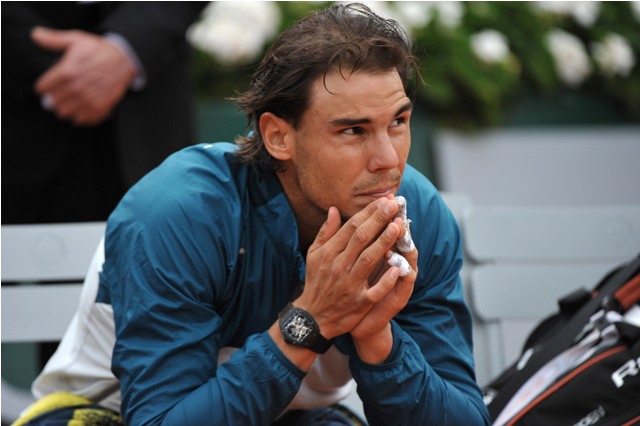
See my very personal and rather emotional feelings about Catalans in “Why I can’t stand watching Rafael Nadal win“:

I have a serious repellent reflex towards Catalans. This is largely because I love Spain so much, and their anti-Spanishness really gets my goat. I find their Gallic delusions that they’re so much more European and Mediterranean and civilized than the rest of Spain to be insufferable. (And some day I’ll get around to dismantling the cult of “Mediterranean-ness” itself that’s grown since the 1980s and that I find a completely false and fabricated pop-multi-culti identity that grew out of tourist literature, the public relations campaigns of olive oil companies and a popular sprinkling of Braudel, and nothing else. When even Turks start acting and feeling like they’re “Mediterraneans,” you know that a discourse is b.s. and needs to be taken apart; the extremeness of the hype surrounding Barcelona is part of this, and is why I love the gravitas and even crudeness of Madrid and Castille so much more deeply.)  I find Catalans’ ‘noli me tangere’ squeamishness about how they shouldn’t have to suffer by being a part of this barbaric country of monarcho-fascists and Catholics and gypsies and bull-torturers to be racist pure and simple. They’re Iberian Croatians, in short. There are plenty out there who will get the analogy, I believe.

That’s essentially what it comes down to…because I think I should finally get serious about this issue and not just joke around or make bitchy remarks about Nadal’s hair.  All of us on the periphery, and yes you can include Spain, struggle to define ourselves and maintain an identity against the enormous centripetal power of the center.  So when one of us — Catalans, Croatians, Neo-Greeks — latches onto something — usually some totally imaginary construct — that they think puts them a notch above their neighbors on the periphery and will get them a privileged relationship to the center, I find it pandering and irritating and in many cases, “racist pure and simple.”  It’s a kind of Uncle-Tom-ism that damages the rest of us: damages our chances to define ourselves independent of the center, and damages a healthy, balanced understanding of our self culturally and historically and ideologically and spiritually.  I find it sickening.

Spain — in part because it’s felt it had to compensate for the darker elements of its past — has transformed itself in just a few decades, and in a way I find extremely moving and mature, into perhaps one of the most progressive countries in Europe on a whole range of moral and social issues and especially in being open to regional autonomy and regional, cultural rights.  There is no way you can’t be happily and solidly Catalan, and maintain your culture and language to the fullest degree, within the Spanish state.  Objections are nonsense.

But they had already lost me when they banned bullfighting.

People have written to me that Catalonia leaving will hurt Spain economically.  Maybe.  But we’re not going to beg them either.  So good-bye.  And that’s my “Homage to Catalonia.”

(And then there are the Basques.  Do you know how many inhabitants of the Basque regions of Spain who identify as Basque actually speak the language?  Some 18%!  And yet, this practically identity-less identity has been the motivation for decades of violence and terror.  There’s no more twisted example of post-modern identity foolishness than I can think of.  A violent political struggle to save a museum culture.  When 50% of you have bothered to actually learn the devilishly difficult language you’re so proud of, then go ahead and engage in any kind of separatist resistance — violent or non — that you feel like.)

And I’m just sick to death, generally — in a globalizing world — of childish, whiny separatist movements among every two-bit tribe that thinks it’s special.  A waste of time, energy, often a cause for completely unnecessary violence and deafeningly narcissistic.

Comment: nikobakos@gmail.com

Why I can’t stand watching Rafael Nadal win

12 Jun

??????????????????????????????????????????????????????????????????????????????????????????????????????????????????????????????????????????

I’m just going to come out and say this stuff and I’m sure not a few readers will end up considering me a quack or some quasi-Nietzschean fascist aestheticizer of things and never log on again. But, hey, that’s the price…

I’ll start with the most petty and irrelevant reasons. I have a serious repellent reflex towards Catalans. This is largely because I love Spain so much, and their anti-Spanishness really gets my goat. I find their Gallic delusions that they’re so much more European and Mediterranean and civilized than the rest of Spain to be insufferable. (And some day I’ll get around to dismantling the cult of “Mediterranean-ness” itself that’s grown since the 1980s and that I find a completely false and fabricated pop-multi-culti identity that grew out of tourist literature, the public relations campaigns of olive oil companies and a popular sprinking of Braudel, and nothing else. When even Turks start acting and feeling like they’re “Mediterraneans,” you know that a discourse is b.s. and needs to be taken apart; the extremeness of the hype surrounding Barcelona is part of this, and is why I love the gravitas and even crudeness of Madrid and Castille so much more deeply.)  I find Catalans’ noli me tangere squeamishness about how they shouldn’t have to suffer by being a part of this barbaric country of monarcho-fascists and Catholics and gypsies and bull-torturers to be racist pure and simple. They’re Iberian Croatians, in short. There are plenty out there who will get the analogy, I believe.

But none of that has any real bearing here.  And poor Rafa shouldn’t have to be the object of my scorn just because he’s Catalan; Ferrer is too and I think he’s one of the most compelling and wonderful to watch tennis players out there.

I simply hate watching Rafael Nadal win because he’s ugly.

And by ugly I don’t mean short and mousey-looking or that his thinning hair is always already a greasy mess from before the match has even started. I mean ugly with a lack of that kind of inner force that manifests itself as a visible form of athletic charisma and magic.

Since the beginning of institutional athletics in human civilization, meaning the Greeks, of course, we’ve always expected our athletes to partake of “some part of beauty.” To have something that made us feel, even if just partly, that a god were being incarnated here in this man, in our presence. “En-thusiasm” in English comes from the Greek ενθούς, ‘possessed by a god, inspired.”  Whether it’s the gorgeous dance of a great basketball or tennis player, or the weightlessness and super-human strength of a gymnast, or the painful duet of two wrestlers or martial artists of any kind, or just the sublime bulk of a rugby player or Olympic weightlifter, or the highly choreographed beauty of a good American football game (yes, it’s a beautiful, highly choreographed, strategically intricate game, much more compelling than…wait…let me swallow first…soccer), we need to experience this glow, which is not a conventional handsomeness or prettiness that I’m talking about, but the need to sense this power and this powerful yearning for glory and victory emanating out of this being, who we want to feel is slightly more just-above-human than the rest of us are.

You never feel any of that glow emanating from Rafael Nadal. It’s just the same cold, technically precise game and the same cold, pissy look on his mug: the most emotion we’re treated to is if things start going a little badly and the pissy mug just gets a little pissier. After the match, if you mute your set and if the score box isn’t showing on the bottom, you almost can’t tell if he’s won or lost. Just the same cold shaking of hands and greasy slinking off of the court.

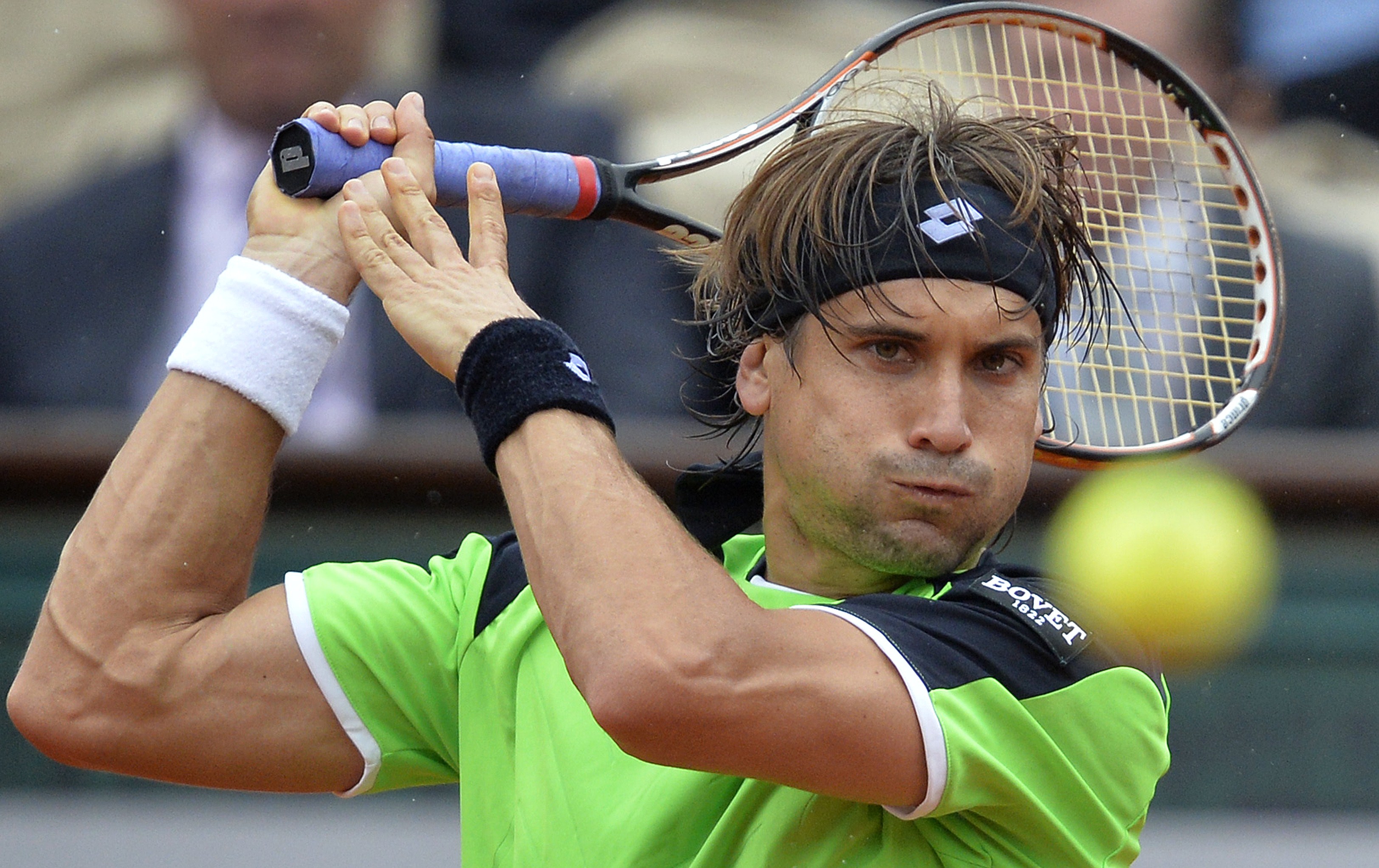
TOPSHOTS Spain's David Ferrer returns aDavid Ferrer – Picture: AFP/Getty – (click)

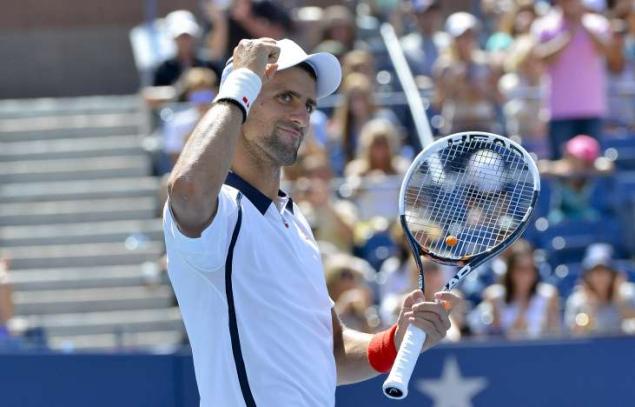
Compare this to the elegant gentlemanliness of a Federer. Or the brute, Rodrigo Díaz de Vivar, clanking mediaeval long-swords game of a Valencian muscle-brick like Ferrer (above).  Or the young, beautifully British, sportsmanly hunger of Murray. And then there’s my dear, sweet Nole, of course, who in every endearing way is still a teenager of sorts, and may have the purest soul of any professional athlete out there. (Talk about “the tenderness of the warrior.”)  No matter what his rank or seed are, or how well his season has been going, he’s as desperately trying to keep his nervousness under control before a match as a young volunteer going into combat for his first engagement, because I think that that’s what he genuinely feels in his heart each time. And when things go badly, and he tragically can’t stop them from going even more badly, because, like an adolescent, he beats up on himself mercilessly because he feels like he’s failed to prove himself, failed to earn his “red badge,” he inspires the purest Aristotelian feelings of pity in me.* And yet, his dignity in defeat is always impeccable. And his howling glory in victory is all his own too. Lots of people don’t like that or feel it unsportsman-like. Trust me, Olympia was a scene of howling winners just like him – and probably then some.  Finally, the spectacular grace of Nole’s feel for his own body is unmatched by anyone in the sport.  Almost like a bullfighter, you sometimes feel he’s risking an easy point just for the gracia and and pure elegance of a braver, more dramatic play.

(And Michael Phelps…let’s not even go there.  See his tag box for posts on him if you want.)

novak-djokovic-volley (Clive Brunskill/Getty Images)

You feel no sense of any of that pathos or agon in Nadal’s game. None. So when Djoković loses to a man like Federer, or Ferrer – which I don’t think he ever has – or even Murray, I say helal olsun,** να’ν καλά ο άνθρωπος, he deserved it. And I don’t walk around with this churning feeling in my stomach for days afterwards.

But when Nole loses to a Rafael Nadal – I can feel the gods of our ancestors looking down and saying: “What the hell? This can’t be right…”

At least a big, Russian kouklara like Sharapova won the women’s…

maria-sharapova-wallpapers-tennis-star-maria-sharapova-hd-wallpapers-widescreen-desktop

Maria Sharapova, Women’s Campion at Roland Garros 2014. (click)

See also July 3rd post: “Why I love watching Rafael Nadal lose.”

*************************************************************************************************************************************************************************************************************

* Aristotelian “Pity”In his Rhetoric, Aristotle defines “pity” thus: “Let pity, then, be a kind of pain in the case of an apparent destructive or painful harm of one not deserving to encounter it, which one might expect oneself, or one of one’s own, to suffer, and this when it seems near.”

Effing Greeks had said everything, hadn’t they?  Everything else is a footnote.

** “Helal olsun” means, roughly, “may it be blessed” in its mixed Arab-Turkish vocabulary.  This is where the Greek: “χαλάλι του” comes from, “it went to good cause, to deserving reason, good for him or her.”  The opposite is when somethings has gone “χαράμι” — haram — meaning gone to waste, not to blessed purpose, blown off into the wind, spent badly, made unusable by its having been defiled or tainted.  “Χαράμισα τα νιάτα μου” are lyrics you’ll hear in many Greek songs: “I made haram of my youth” — the implication usually being “with you.”

I was talking to a friend here about the term “Helal olsun” and she said that you could use it in Turkish the way you do in Greek, but also that at Muslim funerals the imam asks the gathered congregation if anyone has any outstanding grudges or feels he is owed something by the deceased, and the congregated reply — I don’t know if in unison or individually: “Helal olsun” — “No, may he be blessed,” (or maybe: “even if I do…helal olsun.”)  And I found that unbearably just and beautiful.  And something to remember when Christians feel we have a monopoly on mercy and forgiveness.  It’s the Quran that says that “Mercy is a greater virtue than justice.”

Comment: nikobakos@gmail.com

For I. and E., a copla: “Eugenia de Montijo”

7 Jun

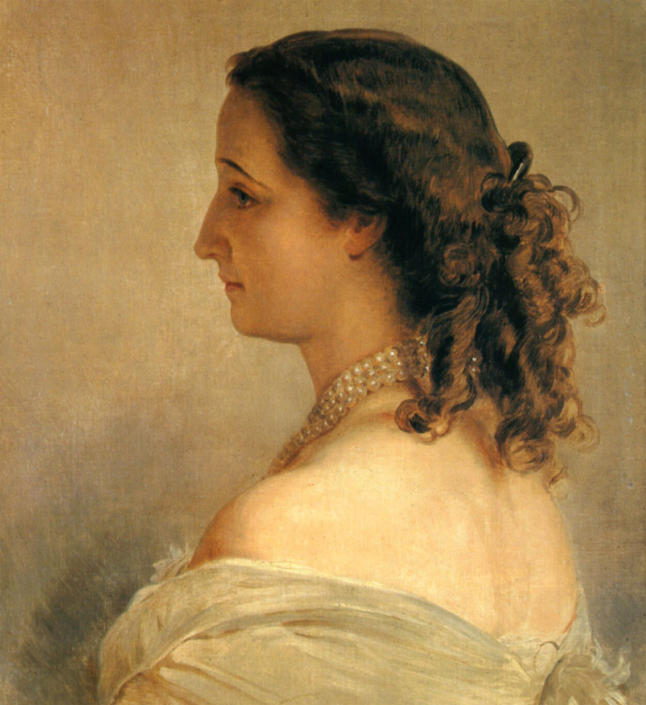
This is a copla, a sort of narrative ballad-song, a genre that flourished in early twentieth-century Spain, fell out of favor due to being cheaply painted by the post-Franco Spanish Left as politically reactionary, but has been rediscovered by young Spaniards as of late.  It’s about the Empress Eugénie of France, née Eugenia de Montijo of Granada, who married Napoléon III of France.  See: “The Adventures of me and my nephew Vangeli in C-town.”

It’s dedicated to I., who has been unfailing in his support for this blog and to my dear friend E., who introduced me to coplas and Doña Concha decades ago, on late nights in a pink room on East 86th Street.  Thank you to both.

The rest can look for the translation if they like.  Βαριέμαι τώρα.  Me da pereza.

Eugenias041pn01

Eugenia de Montijo, considered one of the most beautiful woman of nineteenth-century Europe. (click)  And below, Concha Piquer’s version, and underneath the lyrics.


Eugenia de Montijo

Doña María Manuela tiene dos hijas,
una se llama Eugenia y otra Francisca,
los majos de Granada las solicitan,
porque las dos son guapas y granadinas.

Pero mi señora María Manuela,
que en los casamientos tiene mucha escuela,
les dice a los majos con mucho primor,
mientras abre y cierra su abanico malva:
“Paca ha de llamarse Duquesa de Alba,
y Eugenia, señora de un emperador”.

A la cuesta de Gomérez,
que al río dormido baja,
flor y nata de donceles,
a Doña Manuela cantan:

Eugenia de Montijo,
que pena, pena,
que te vayas de España,
para ser reina.
Por las lises de Francia,
Granada dejas,
y las aguas del Darro,
por las del Sena.
Eugenia de Montijo,
que pena, pena.

Se salió con la suya María Manuela,
una reina es de Francia y otra es duquesa.
Pero Paca se muere bajo la niebla,
y Eugenia en el Versalles, se siente presa.

Y está mi señora María Manuela,
hecha una pasita junto a la candela,
en aquel palacio del viejo Madrid,
con su pobre vida rota en dos mitades,
París que la llena de fatalidades,
y Granada viva de luz del Genil.

Y a la cuesta de Gomérez,
que al río dormido baja,
torna sus miradas fieles,
mientras su vida se apaga.

Eugenia de Montijo,
que pena, pena,
que te vayas de España,
para ser reina.
Por las lises de Francia,
Granada dejas,
y las aguas del Darro,
por las del Sena.
Eugenia de Montijo,
que pena, pena.

Letra (por supuesto) de Rafael de León and Manuel Quiroga

Comment: nikobakos@gmail.com

The adventures of me and my nephew Vangeli in C-town

2 Jun

IMG_0779

(click)

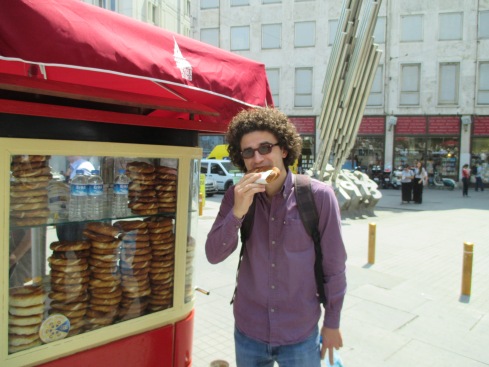
This is my nephew Vangeli from Tirana, who came and spent an extended weekend with me in Istanbul last week, eating a simit in the Staurodromi.  When I started this blog I said to myself I wasn’t going to include personal names.  When you represent something ideologically problematic for me, you’ll usually be described by a repeated sociological profile: “the Athenian thirty-something” or you’ll get a moniker all your own; in any event, if you read regularly, you’ll know who you are.  But the warmth of certain experiences I had with my family in my village this past spring has made me want to “call their names,” both because these are people I learned to love a great deal in a very short amount of time and to do them the honor, even if these experiences are not that interesting for the objective reader.  It’s obvious that it’s for them.

Vangeli is my second cousin Calliope’s eldest son. (See Easter Eggs… because, believe me, you don’t want me to run through all the lineages each time and I can’t do it either.)  When I first went to Derviçani in 1992, after Albania had safely opened up for good, Calliope was already living in Jiannena and we met there first, so we could get to know each other before going into Albania together.  When we arrived in the village for the first time, hers was the face I was constantly looking for as a reference point among the throngs of relatives who were constantly surrounding me.  It was her and my cousin Panto, Pantele, who is still my official bodyguard everywhere I go in the village, telling me who’s who since I can’t keep track, taking me everywhere I want to go, counting the tsipoura (raki) I have at every visit, so they don’t add up to too many in one afternoon, etc.  His mother, my Kako Poly (Polyxene), is a saintly woman who made great sacrifices caring for my grandmother in her final years under conditions of great material deprivation for all.  In video we have of my grandmother, taken by complete fluke by a cousin of my mother’s who went to Albania in 1988, a year before my grandmother died, as part of a Greek commercial exchange delegation — these groups were always taken to Derviçani as it was the showcase Greek minority village in communist times — my grandmother says: Να, αυτή είναι η Πόλυ, μ’έχει επάνω της… — “Here, this is Poly, she (lit.) carries me.”
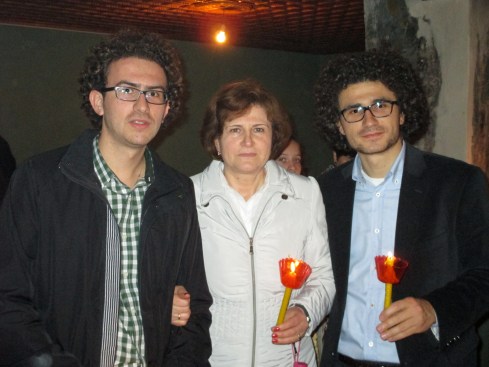
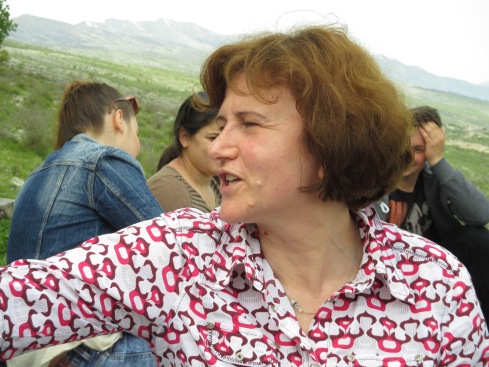
IMG_0050This is Calliope, with her two sons Vasili (left) and Vangeli (right) on Easter night in church (click).  She’s an extraordinary and extraordinarily loveable woman: a great housewife, a competent businesswoman, funny, generous, always smiling, as flirtatious and open as a teenage girl — she’s one of my great relative-loves.  Here she is below at the Monastery on Easter Monday, having just deposited a huge piece of lamb shoulder — no, actually, a lamb shoulder — on a paper towel in front of me, cold and glistening with shiny white fat like some Homeric offering.  My father always loved cold lamb, and would never let my mother reheat it, because it reminded him of the Easter dance at the Monastery.  This is a typical pose to catch her in below, because her innate generosity is always giving something to someone.  (Click)
IMG_0119I hadn’t met Vangeli before, and if I had he would’ve been a baby.  But in church that night, when we were introduced, he said to me, in his classic Aries way — breezy and confident: “Actually, I don’t know you, but Christos Aneste!”  And my Aries replied: “I don’t know you either, but Alethos Aneste!” and I knew right then we’d hit it off.  We talked the next day at the dance; I invested some of the best days of this trip visiting them in Tirana on my way back from Montenegro, and of all the people who said they would come to Istanbul to see me while I was here, I knew he was the only one who would actually do it.  We locked horns on titles or terms of address for a while; I am literally twice his age, fifty and twenty-five, but we hang out like cousins and that’s what he used to call me, whereas I want to be called “uncle.”  He wasn’t having it.  (I have a similar problem with some nephews in New York on my mother’s side.)  For a while we agreed on “şoku,” which is “buddy” in Albanian but also meant “comrade” in communist times, so that didn’t last very long, nor did the Russian “tovarishch” which means the same thing.  Finally, when he got to Istanbul, he heard some guy addressing another as “abi” — big brother, technically, but often just “mate” — which they use in Albanian as well, so it’s been “abi” since then and that pretty much describes how we relate to each other. 

I’m an only child.  Calliope is like the big sister I never had and it’d be hard to imagine a more loving one.  But my parents also had a first son that died when he was a baby, so, even more deeply, I’ve always felt literally haunted by a living presence and desperate absence at once, and by an entirely metaphysical need for a being that I feel is out there to incarnate itself again as an older brother.  But being an older brother to someone else is just as gratifying, especially to a kid like Vangeli.

Because he’s good at his role and he did me super-proud here.  He studied computer engineering in Birmingham and speaks flawless English, dresses impeccably, works for a company that sends him to Italy on a regular basis, so he speaks some passable Italian as well.  (Some fashion-victim friend of mine from New York saw him dancing in the second video here and wrote to ask me who the funky kid with the curly hair and the Prada glasses was — she had recognized the Prada frames from five-thousand miles away…)  We went out for a classic Istanbul fish-and-rakı dinner at a really good place in Cankurtaran in the old city; he immediately recognized that this was not just any meal, but that he was in the presence of a certain ritual to be respected, like Japanese kaiseki, and he acted accordingly.  He was put off by the anise in the rakı at first — we drink ours unflavoured in Epiros — but then realized that Turkish rakı is not the cough-syrup by-product that Greek ouzo is and enjoyed it thoroughly.  He had no negative preconceptions of Turks and Turkey and he never, never — not once — tried to insert one of those slimey negative innuendos about Turkey into the conversation that almost every Greek tries to do when he’s with Turks.  He just listened to the two female friends we went out with, asked questions, tried to learn, gave his opinion, talked to them about Albania and Argyrocastro and Tirana and our families and Britain and anything else you could imagine, and charmed the skirts off of both of them.

He wanted to see everything.  I hate going into the old city.  I find it depressing, crowded.  I love the mosques, but the Byzantine monuments discourage and sadden and, sometimes, anger me, and I prefer to not be confronted with the interface between the two and just stay here in Pera, expelled from the walls in my gavuriko varoşi.  Also, getting there is alright, but getting back means trudging up and down and then up and down again some incredibly pedestrian-unfriendly streets and intersections and underpasses, unless you take some sleazy Sultan Ahmet cabdriver whose meter suddenly races to 100 lira by the time you get from Hagia Sophia to Pera.*  But for Vangeli I went.  And we saw everything there was to see.  We even stumbled upon the Rüstem Paşa mosque, which if you ever asked me to find, I never could.  We sat in the Süleymaniye for an hour and he listened to me talk about why I like sitting in mosques and watching Muslim prayer — Istanbul was the first time he had been inside one — and find them so calming and peaceful.
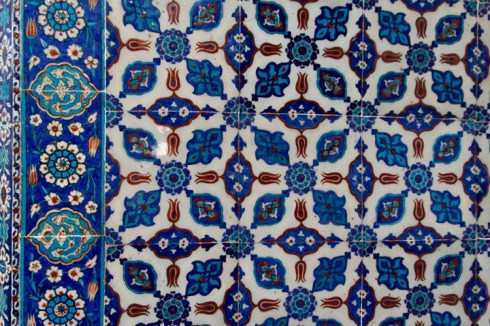
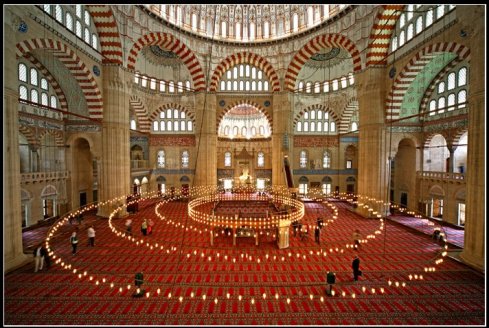
Rustem pasa tiles

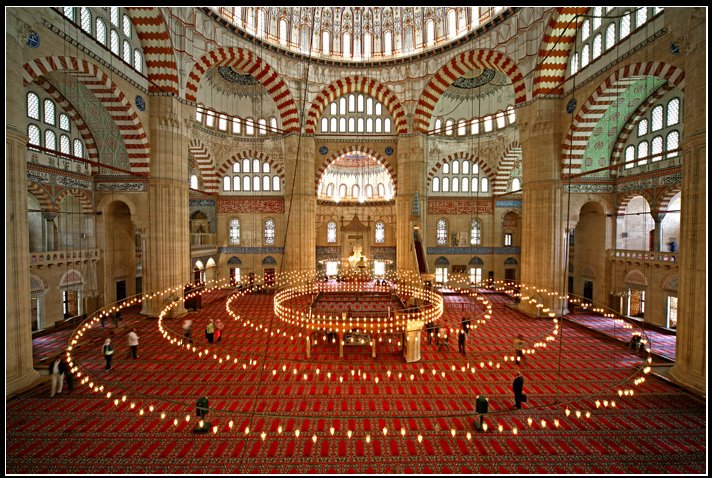
Suleymaniyeimg_redirect.phpThe tiles of Rüstem Paşa above and the interior of the Süleymaniye (click)

We covered every inch of Topkapı, where I hadn’t been in years and where I was re-dazzled by that Ottoman sense of elegance and comfort that Rebecca West speaks of so often.  He was interested in the oddest things.  His favorite palace was Beylerbeyi, as it is mine, but he was fascinated by the story of the French empress Eugénie, born Eugenia de Montijo of the highest Andalusian aristocracy, who extended her state visit there for so long that it began to turn into a diplomatic scandal in Europe: he wanted to know how beautiful she was; he wanted to know whether Abdülaziz was such a stud that he was actually shagging her and how Napoléon III could have been such a nebech that he didn’t come grab her by the hair and drag her back to Paris.  “Άμ,’ ήθελες γυναίκα Ισπανίδα…” he decided, after much pondering — “that’s what you get for wanting  a Spanish wife.”  And an Andalusian one at that.  But once you’ve seen Beylerberyi, where she was put up on her visit, which is like a gigantic Turco-Venetian palazzo opening up onto the fresh, cool waters of the Bosphorus and not some smelly canal, you realize that once anchored there, leaving would be hard even if you weren’t getting any from the Sultan.

Beylerbeyi Palace (click)
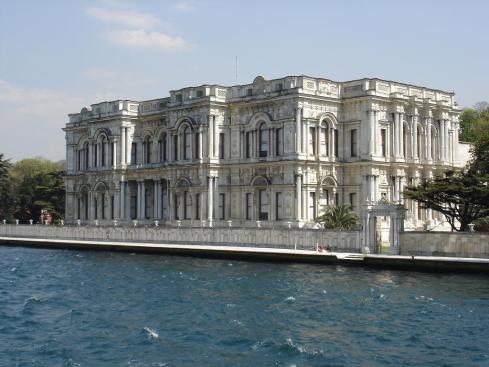
beylerbeyi_palace_by_shidikujThe Empress Eugénie of France, née Eugenia de Montijo of Granada; the Jackie Kennedy fashion plate of mid-nineteenth century Europe and considered one of the most beautiful women in the world at the time (click), subject of the copla by Rafael de León and Manuel Quiroga, made famous in Concha Piquer’s incomparable rendition.
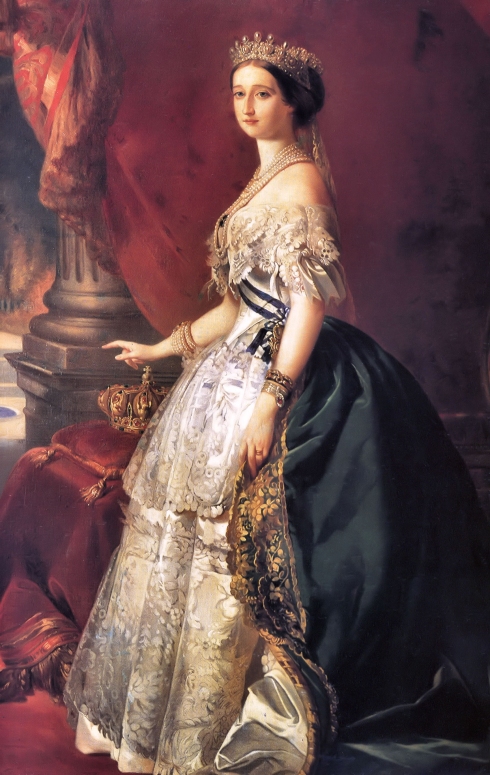
Eugénie;_keizerin_der_Fransen_(2)

The last day I was exhausted but he wanted to go look around Turkish supermarkets for yufka to compare the quality and price to what his family’s company makes; this is my Uncle Vangeli’s business; they make yufka and tel kadayif and sell it throughout Albania.  The name of the company is Demetra, like the ancient goddess of agriculture and cereals.  We went to a couple of Carrefour and he wasn’t impressed.  We went to some small bakalika and they didn’t have any at all.  And, very cutely, he made the assumption, in those hushed tones of respect that the Ottoman culinary tradition still carries with it in the Balkans, especially in the western Balkans from Epiros to Bosnia, where börek is an institution and a strong regional identity marker: “They probably open up [that’s the term we use] their own phyllo at home still.”  I didn’t want to pop his bubble.  Then he wanted to go to Dolmabahçe too — the energy of youth — but it was already too late in the day.  As compensation we went to dinner at the Çırağan, the hotel that’s now in the palace most similar to Beylerbeyi.

What I most admire about Vangeli is that he’s smart, sophisticated, has a C.V. that could take him anywhere in the world that he might want, but he wants to stay in Tirana, not just because he wants to help the family business, but because he actually wants to stay in Albania and build a program design business of his own, in the country he grew up in and lived his entire life in, and that that doesn’t get all mixed up with dumb ethnicity issues.  I didn’t ask him; he probably doesn’t “love” Albania any more than I “love” the United States.  He probably doesn’t have an answer.  But where he lives — what state he lives in, in particular — doesn’t have any bearing on who he is.  Like me.  He’s Vangjel Stavro; he’s a computer engineer; he’s Greek and he lives in Albania.  Period.  He may be the New Balkans.  In fact, soon all of the Balkans might be the New Balkans except for us, who will still be left blinkered, frozen like a deer in the headlights, wondering why the “Europe thang” didn’t go as we planned.

There are a couple of inside jokes to the photo at top where’s he’s eating a simit at the Staurodromi.**  One is that we both felt like hell that morning, which is why I’m not in the picture, not that I like being in pictures anyway.  Two nights before we had had that splendid fish dinner in the old city and had put down a fair amount of rakı, but it was with food — basically, after a few rounds of great meze, this beautiful lithrini (lüfer):
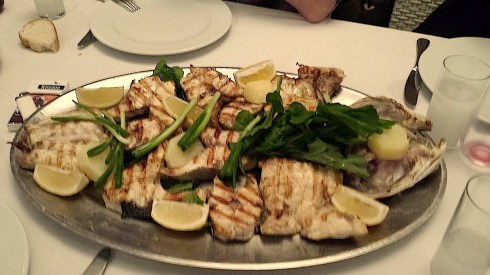
Fish20140522_214540(click)

But the night before the simit photo, I had wanted to take him to the bar on the rooftop of the Marmara Pera hotel, so he could see the places we had visited in the old city that day from across the water at night and illuminated, and then we were planning to go hear some Greek guys who play rebetika at a very cool, shabby old meyhane near Taksim.  But we spent too much time at the Marmara and by the time we got to the rebetiko place all the food was gone and all that was left were stragalia/leblebi.  Now I don’t know exactly how leblebi are made — I think they’re dry-roasted chickpeas — but I detest them as much as I love cooked chickpeas/rebythia/nohut.  Something happens to the dense, almost meaty, velvety texture of chickpeas when they’re made into leblebi that produces something that tastes like a highly compacted nugget of sand, or like taking a teaspoon of raw flour and popping it into your mouth.  I think the only reason they’re considered a drinking snack is because you’ll choke on them if you don’t have anything to wash them down with.  Vangeli hates stragalia too, but I tried to encourage him: “Come on man, this is the exclusive diet of the Great Father; this is how he defeated Turkey’s enemies and brought his country glory, with a pocket full of leblebi and a flask of rakı!”
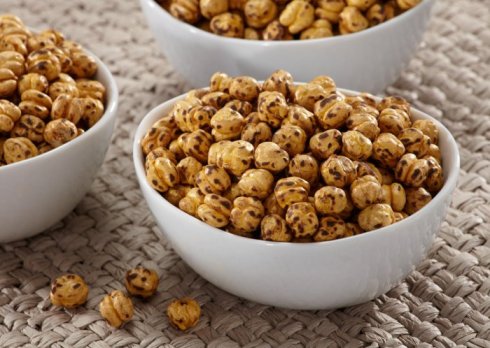
Lebpic1340611232r779452Leblebi

So we ate as many as we could, starving as we were, and had way too much to drink in too short a time on top of it.  We then went outside when the performance was over, and suffering from the drunk munchies on which rests the drunkard’s philosophy that if you pile more crap into your stomach on top of too much booze it’ll make you feel better, we had two plates each of chicken-and-pilav from the street vendors (one of the most delicious things you can possibly eat in Istanbul — Turks are magicians with rice), and then on my corner we found Orhan, my favorite Kurdish midye kid, and I think closed down his shop that night as well; we must have had about twenty mussels each.  So we were not very happy the next morning.

The second insider joke is actually one me and Vangeli share with Epirotes down the centuries.  Legend has it that Epirotissa mothers would slap their sons on top of the heads to flatten them from the moment they were born and say: “Και σιμιτζής στην Πόλη” — “And may you become a simit vendor in the City” and that this explains the idiosyncratic beer-can shaped heads that a lot of Albanians and Epirotes have, like some of my chorianoi:
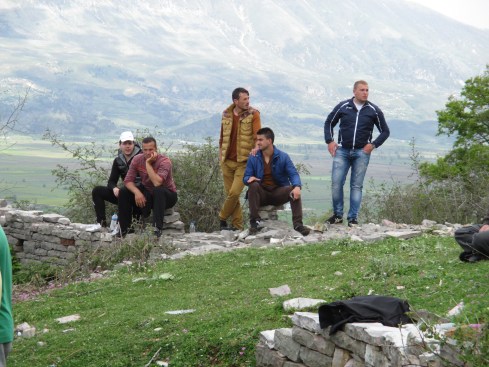
IMG_0148or a guy as seriously Kosovar-looking as Novak Djoković:
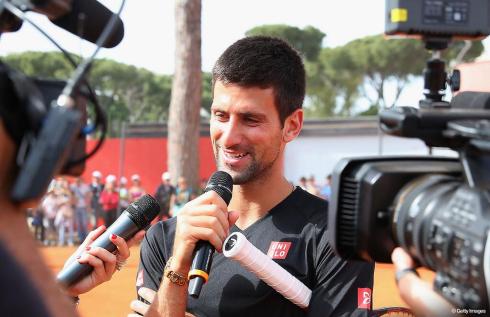
DjokBearCanBnhbw7ZCYAAgVoE.jpg_largeor me:

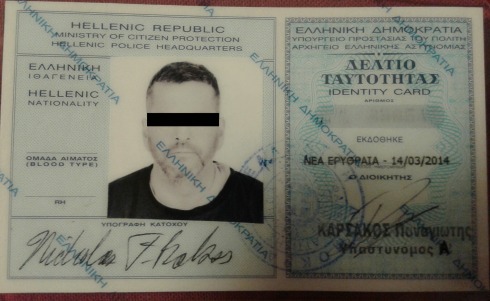
nikostautoteta23

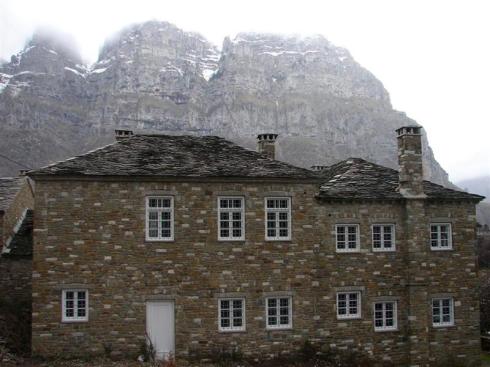
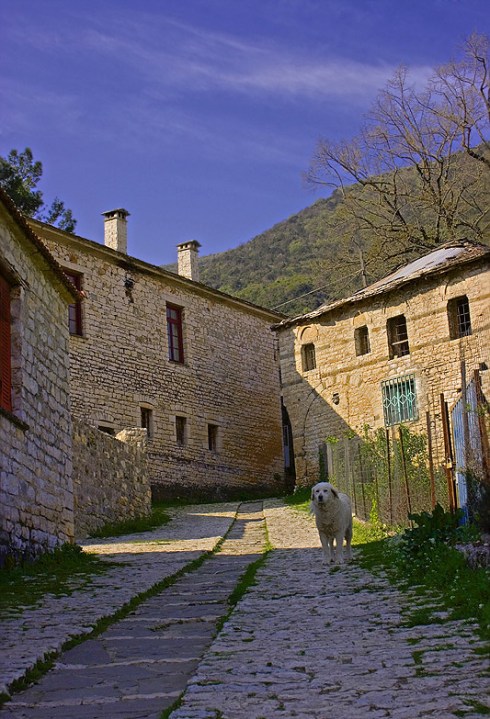
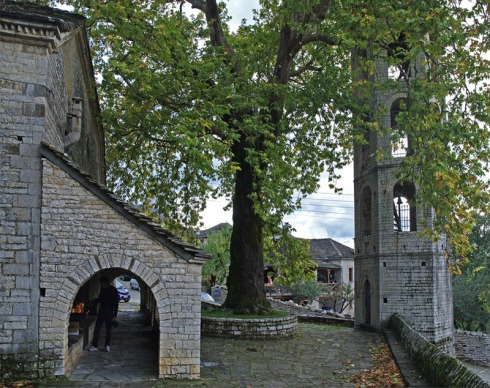
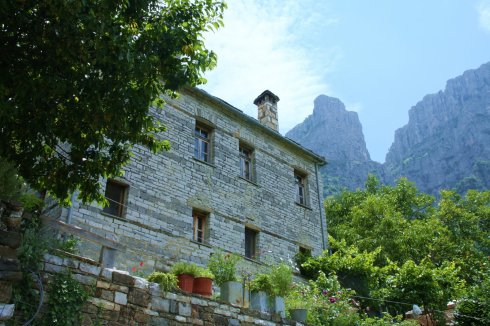
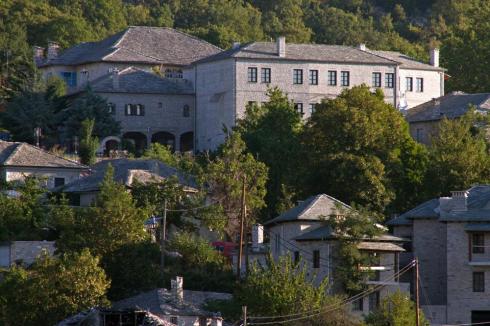
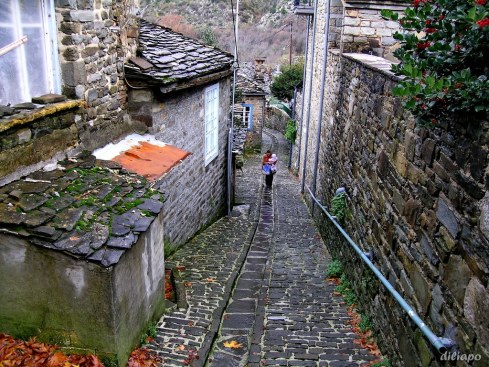
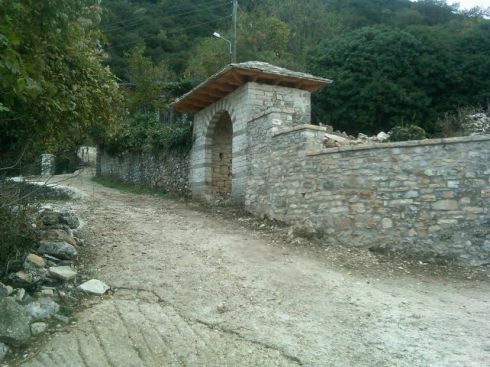
The point is that the flat top would make it easier to balance a tray of simit on your head.  Of course the joke is based on false modesty, because Epirotes did not come to Istanbul, or go to Roumania, or Odessa, or Alexandria, or the United States or anywhere else in the world to become simitçides.  They went to make money and, some of them, fabulous amounts of it.  This is why you can be driving through Epiros, through empty, lunar karst limestone landscapes where you wonder if you could even herd goats, much less sheep, much less plant anything edible, and then suddenly come upon villages with massive two or three-story stone mansions, and equally impressive churches and schools.  And this is why Epirotes contributed so greatly to the Greek Enlightenment, to the creation of the Greek state’s institutions and educational establishments, and generally had an exceptionally high standard of living and literacy — even for womenfor rural Greece, until the whole exclusively male emigration structure collapsed and was followed by a massive exodus to the cities after WWII.  Like certain islands of the Aegean or the Saronic, it was the very barrenness and lack of resources that the land could not provide that drove the movement, ingenuity and creativity of traditional Epirote culture and that allowed them to make such lives for themselves at home (at least for their families, because they themselves were gone most of the time) and make such important contributions to the wider Greek world.***  Of course, it was also the institution of emigration that led to the endemic, marrow-deep sadness of the culture as well.

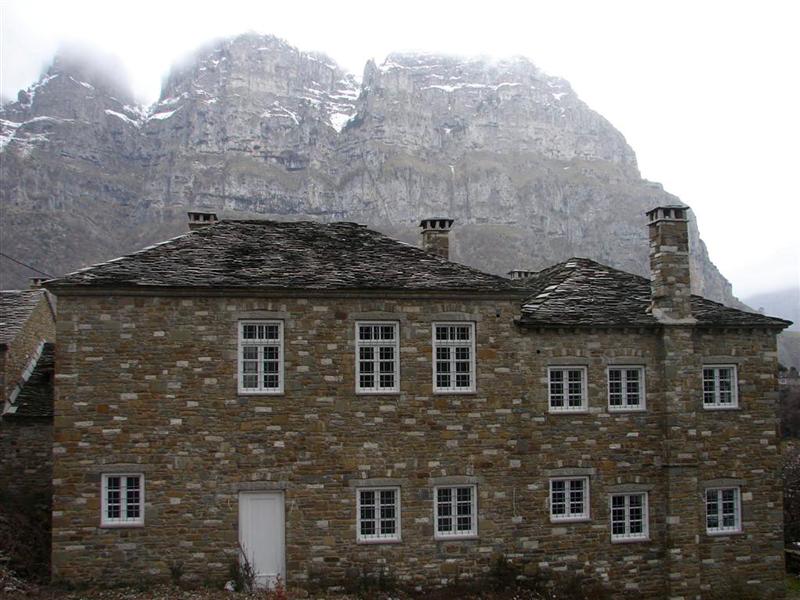
Traditional Epirotiko village architecture from various parts of the region, obviously not the communities of poverty-stricken hillbillies, built with money made abroad by emigrants; the final picture at he very bottom is the front gate to my mother’s patriko, the house where she was born.  Her family made their money through three generations of baking businesses in Bucharest. (click)
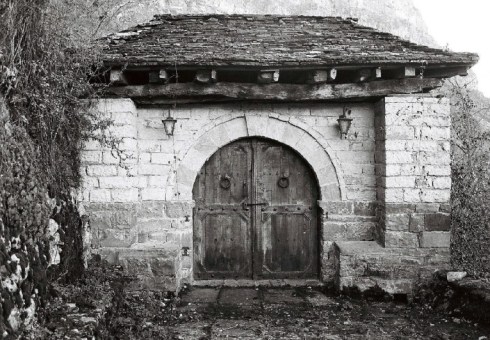
000116

papingo

1704170417041704_12

Papingodsc_0416

PapingoIMG_4952

Monodendri-Hotel-22

Tsepelovo59399932

Giotopoulos gateunnamed

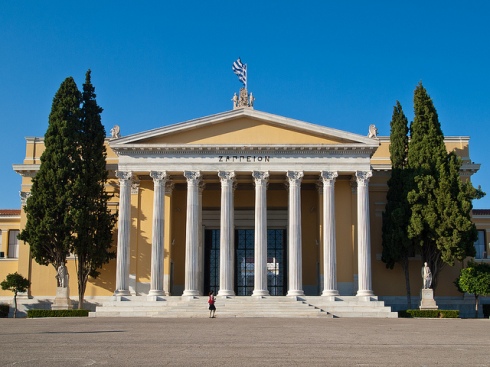
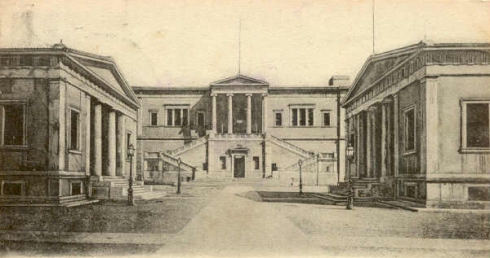
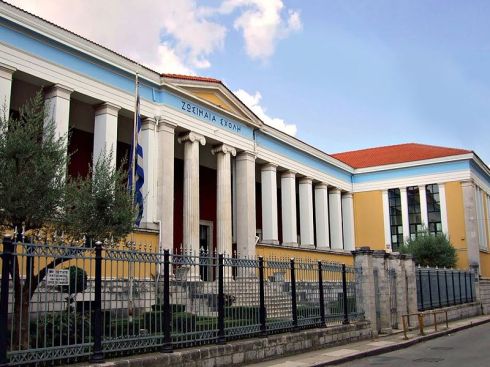
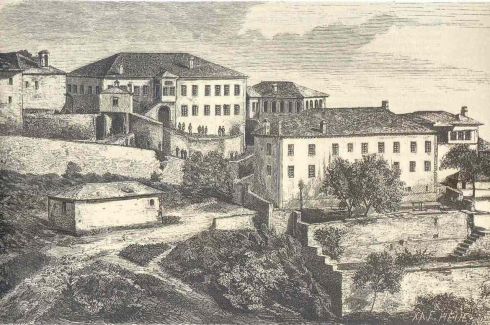
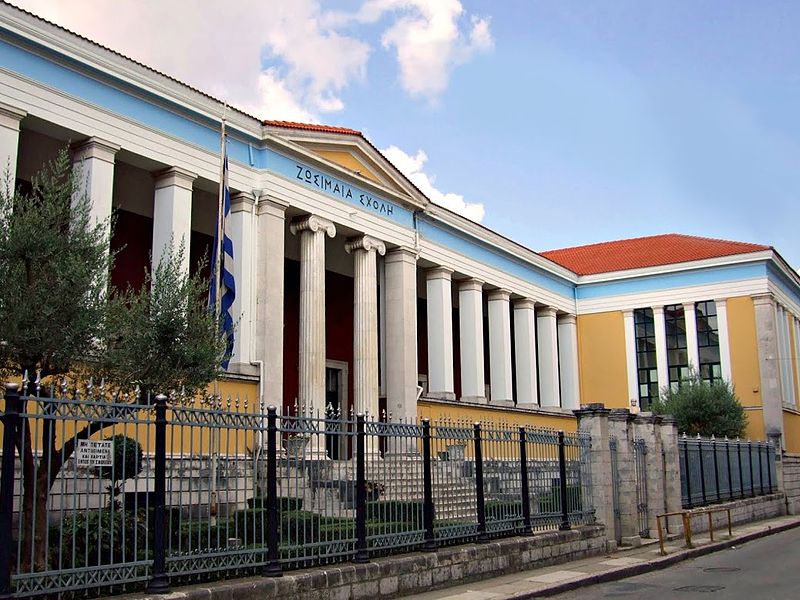
And below — in order — the Zografeion and Zappeion Lycées in Istanbul, the Zappeion exhibition hall and gardens in Athens, the National Polytechnic School in Athens, the Zosimaia in Jiannena, and the Zografeion college of Kestorati, all just a few of the institutions funded and built completely by Epirotes (click).
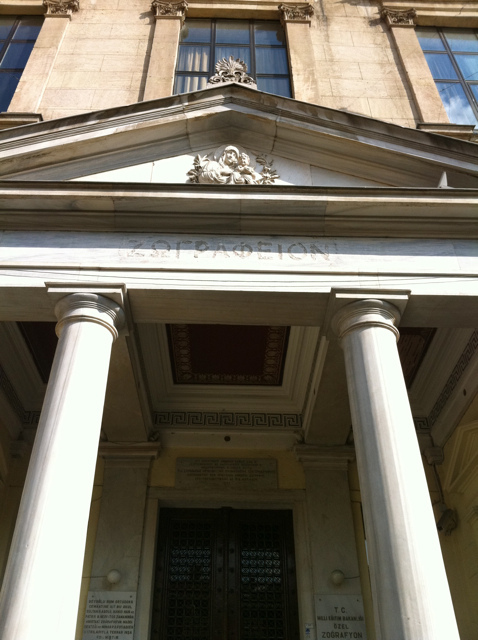
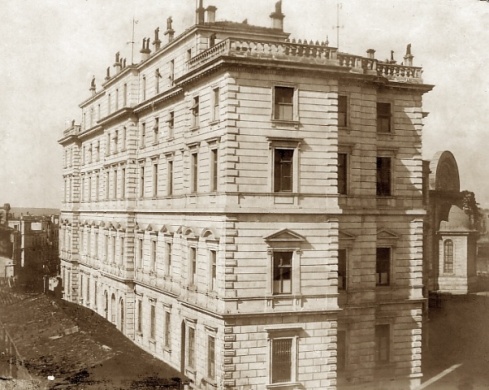
5694293094_8d58ab27da_z

zappeion

OLYMPUS DIGITAL CAMERA

polytechneioPatision_Complex

ZosimaiaΓυμνάσιο_Ιωαννίνων_3

ZographeionCol

I have a friend in Greece who’s from a part of Greek Macedonia that, before the refugee tents went up there in the 1920s, was inhabited exclusively by mosquitoes.  We were good friends but we had more than our share of tensions because he was an insufferable kind of arrogant Eurocrat that Greece used to produce at the time and had some supposedly hot-shot job with one of the sleazier Russian-type Greek communications moguls to appear in the nineties — μιλάμε principles yok.  And for some reason, he had this implacably neurotic competitive impulse that he would always unleash on me any time I spoke about Epiros, especially if it was with any amount of pride.  “It eez the poooorest proveens in Euuurope…Galicia in Spain and Epiros…are the pooorest proveeenses in Europe…” he would say to me constantly, like a Brussels parrot.  And after WWII, the practice of leaving families behind and going off to work abroad and returning only occasionally became untenable, and most of Epiros did become tragically depopulated.  But it was poor because it was depopulated and the only permanent inhabitants of many communities were pensioners, not because it was a region that traditionally suffered from desperate poverty.****  The hot-shot job and the whole Euro-thing has collapsed since then, along with the whole balloon in which it existed, of course, and he’s a significantly humbler person today.  But it was just so infuriatingly ignorant and anistoreto on his part to see Epiros as some Greek Appalachia and his motivations for harping on that distorted image escape me to this day.

Anyway, that morning I wanted to buy five or six simitia and pile them on Vangeli’s head as a reference to this simitçi tradition, but I could see he wasn’t having it, so I didn’t even try.  He insisted it was the anise in the rakı that made him sick and has sworn that from now on it’s only “real” raki for him — straight and Albanian — with no sissy Politiko flavorings to eff him up.

*************************************************************************************************************************************************************************************************************

* Turks are among the most honest people I have ever come across in all my travels, and not because of modern efficiency like in Europe, but out of traditional philotimo or honor.  I’ve had a Turk from a Taksim pilav stand recognize me as I walked by, and come up to me to give me one lira change he owed me because three days earlier I had eaten there and he was short.  I’ve had to fight with a Turkish simitçi because he wouldn’t sell me a simit because it was late in the day and they were stale, begging him, eventually giving up because he simply refused — the famous Turkish “yok”; when you hear it give up immediately.  I’ve had Turks — this happened to me in Afghanistan once too — run down the street after me to give me a Bic pen I had forgotten on their restaurant table.  But something happens to a Turkish cabdriver when he’s in the Sultanahmet area and he becomes the biggest sleazebag in the world.  I think that now that tourists have discovered the Beyoğlu side of the city and generally prefer to stay there, there’s greater tourist traffic between Pera and the important monuments of the old city, and these jerks take advantage of it.  But be tough with them; simply refuse to pay more than 20 or 25 lira — no matter what his rigged meter says — and walk away and tell them you’ll call the police if they don’t like it and, being cowards, like most frauds and liars, they’ll immediately back down.

The route from Şişhane or the Galata Tower, across the Galata bridge to Hagia Sophia has to be — and always has been — one of the most important pedestrian traffic axes in the city.  And instead, both Karaköy and Eminönü — the two districts and “squares” that face each other across the Horn and are like the two ventricles of the historic heart-like link of the City — are hideous, dirty, badly designed nightmares to walk through.  Instead of worrying about Taksim so much, Erdoğan might want to put some effort into redesigning this essential, central binder of the two Istanbuls.  But that would be a massive project that would involve levelling almost everything that’s been built there in the past forty years and starting with a clean slate.  Plus, you don’t want to give him too many ideas because he’s perfectly capable of building something as ridiculous as a ski-lift from Şişhane to the Hippodrome to assist tourists in their sight-seeing.

** The Staurodromi is one of the nicest spaces in Pera.  The gates of Galatasaray are beautiful, the other corners have their original turn-of-the-century buildings intact and there’s one modern, kind of semi-Brutalist building in travertine that I really like, that houses a bank and a bookstore and that you can see in the picture above behind Vangeli and in this one below.  The only thing that mars the whole space is this ugly sculpture:
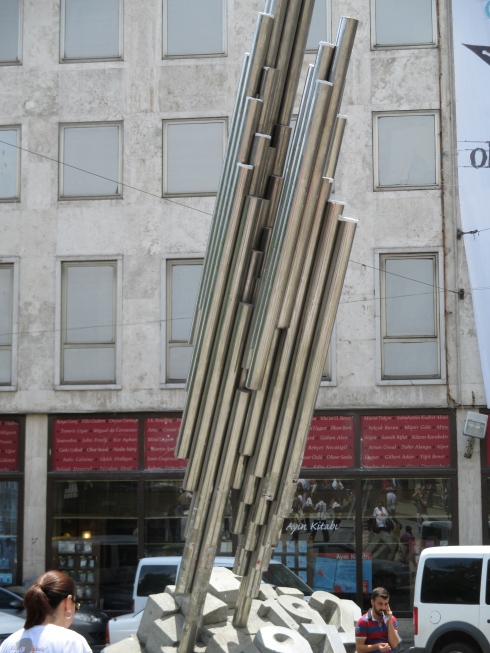
Uranium piles

Does anybody know what it’s supposed to be?  Missiles of some kind?  I don’t know what enriched uranium piles look like, but during Fukushima and every time someone talks about Iran or North Korea and uranium piles, my imagination immediately conjures up this horrible sculpture.

*** This was all part of what I can only generally call the “Great Mobilization” of the Greek world that began in the early eighteenth century.  The confluence of factors that caused this are so intricate that they’re hard to summarize: the primary spark was perhaps the massive wealth accumulated by the Phanariotes — Greek aristocratic families in Constantinople prominent at the Patriarchate and, by extension, at the Porte — who had used their influence in imperial circles to turn most of what is now Romania (Moldavia and Wallachia) into their own autonomous Greek kingdoms, which they sucked dry, and how that wealth was poured into Greek institutions and trickled down into Greek hands generally; the concurrent spread of Greek educational and commercial networks in the Balkans and Eastern Europe and later in the Near East, in the rapidly modernizing economy of post-Mehmet Ali Egypt especially; the way the so-called Greek Enlightenment worked through both these kinds of networks.  The increased mobility that the nineteenth century made possible; most people, for example, don’t know this, but the Greeks of the Anatolian Aegean coast and the Marmara were almost exclusively migrants from the islands and mainland Greece — and even later the Kingdom of Greece itself, Greece basically having been an economic basket-case since the get-go — that started settling there in large numbers in the later eighteenth century and not, as we romantically like to believe, descendants of Byyzantine Hellenism; the only remnants of Byzantine Hellenism in Asia Minor were the Greeks of Pontus and Cappadocia, of course, and small pockets near Konya and Kula and Isparta and that lake region, all of whom, except for Pontioi, were Turkish-speaking until some of the men started learning Greek in the nineteenth century.  (In isolated areas of Cappadocia, a dialect of obvious Greek origin had also survived into the nineteenth century but was already dying out by then, and was so heavily Turkish in vocabulary and had even developed extensive agglutinative structures like Turkish that it’s almost impossible to call it Greek, any more than you can call Vlach Roumanian.)  Then there were the colonialist economic incursions into the Ottoman Empire and its reduction to a European debt-slave (much like “Memoranda” Greece today) that together with the privileges for Christians that the Great Powers forced the Ottomans to grant, created a space for growing Greek and Armenian prosperity from which Muslims (and Jews, for that matter) were excluded, and that produced exclusively Christian micro-economies within the Empire in which Greek rural migrants could find work and prosper.  All this had an enormous effect on Greek life everywhere.  You can see it in the village architecture of certain regions of the Greek world.  And you can see it in traditional dress of Greek rural women.

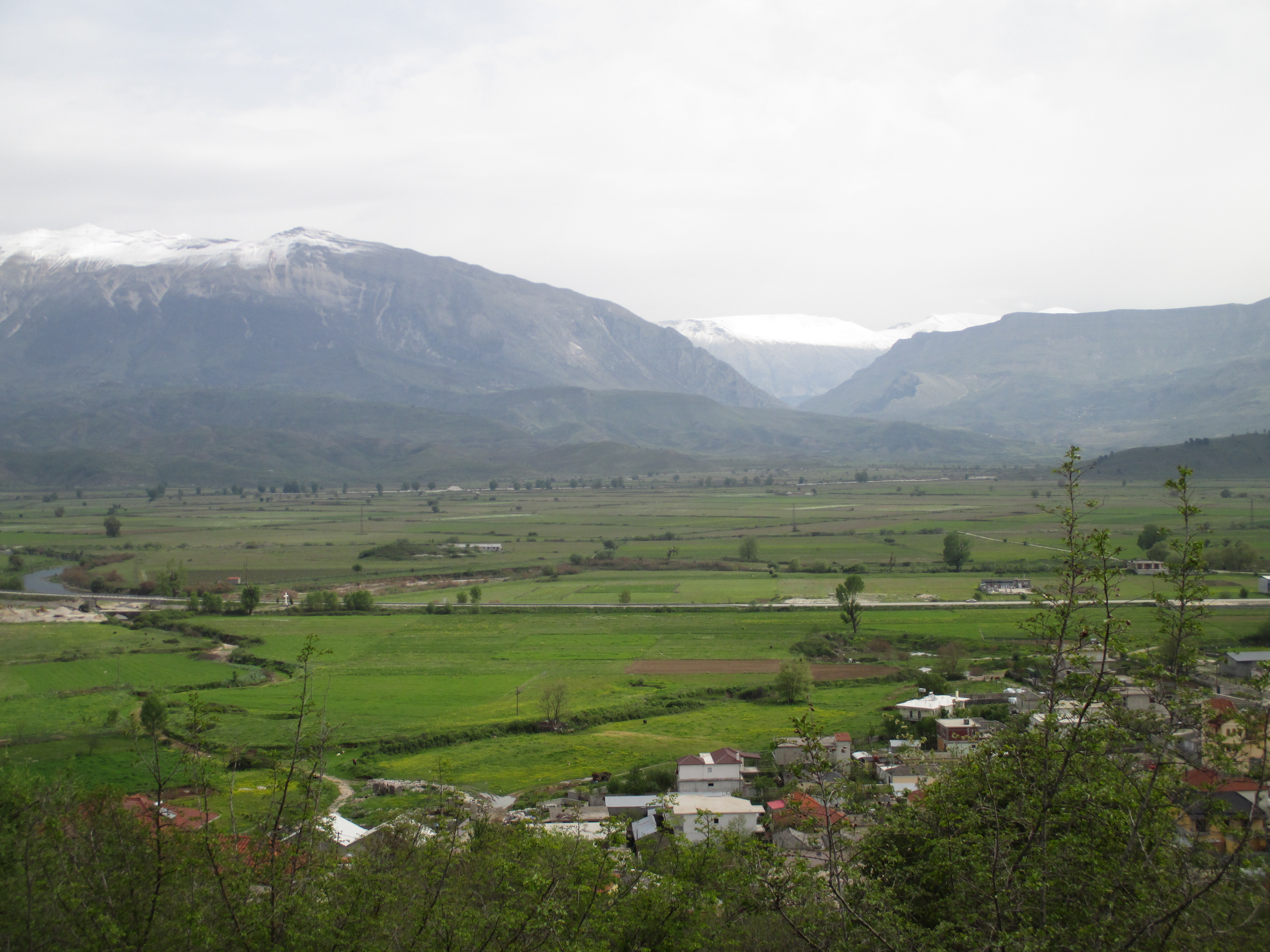
My father’s villages in the valley of Dropoli are situated in one of the few extensive, arable parts of Epiros, the fields you see in the pictures taken from atop the village itself (click):
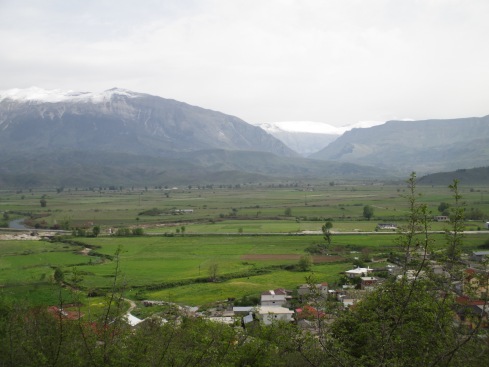
IMG_0075

Paradoxically, it was this theoretical asset that kept our villages relatively poor until the mid-nineteenth century, because these fields were all çiftlikia of Muslim landowners (“fiefs” I guess; don’t ask me to explain Ottoman land tenure to you, or tell you the difference betweeen a çiftlik or a timar or anything else, because every time I try and read about it I fall asleep and don’t remember anything I’ve read when I wake up) and we were essentially sharecroppers for them.  Only with the exponential growth of emigration in the nineteenth century did any kind of considerable prosperity come to our villages and many were even able to buy their village lands from the increasingly impoverished ağadhes themselves.  Like I said, this was markedly obvious in the changes in female costume and the complete switch of male dress to frangika, Western clothes; traditional male outfit of the region would have looked something like this, the characteristic white felt pants called poutouria (this photo is from southern Serbia actually, but was the nearest approximation I could find) and not the fustanella kilts that folklore groups in the village like to use today indiscriminately and inaccurately:
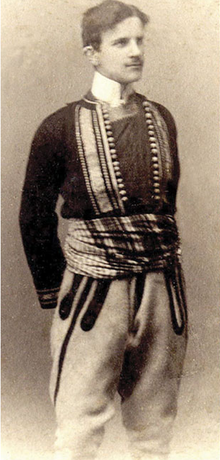
Poutouria220px-Teslacirca1880(2)

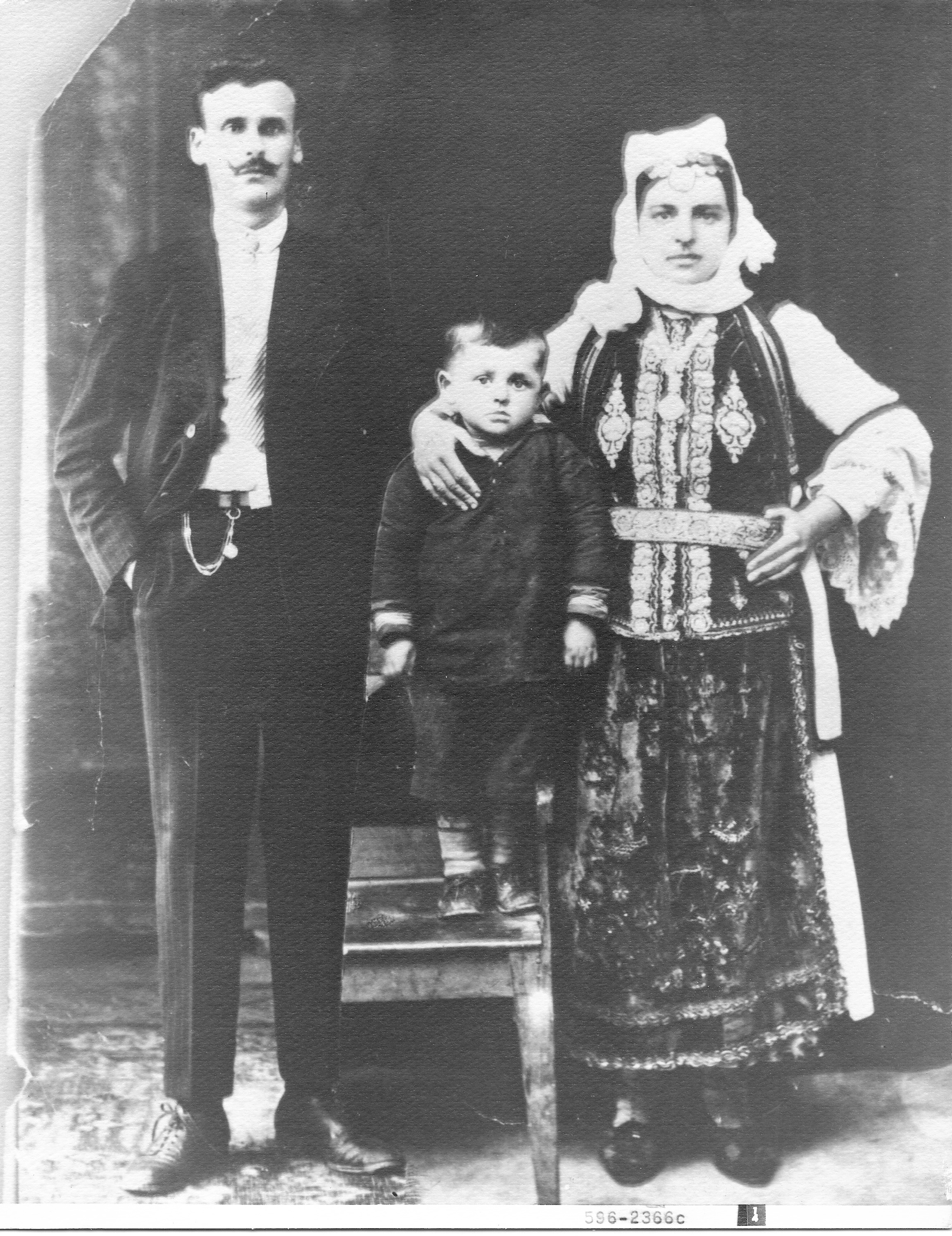
While, with the women, in extremely old photos from Derviçani, you can see that almost all the articles of the costume were home-made by the women themselves, with growing wealth you see the gradual addition of articles of clothing that had to be made by professionals.  My grandmother’s outfit here, for example, especially the vest and apron:
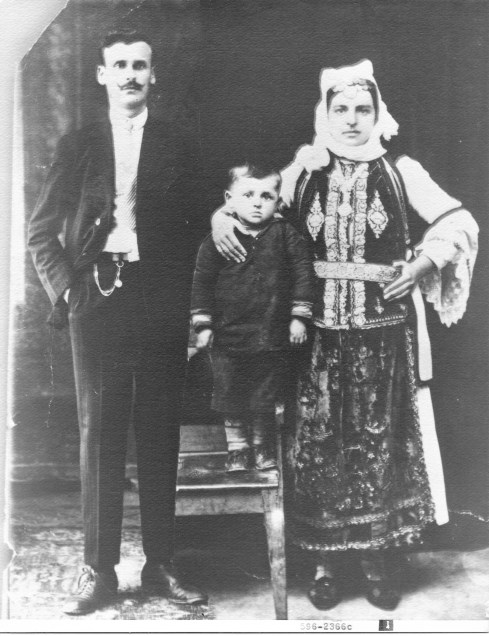
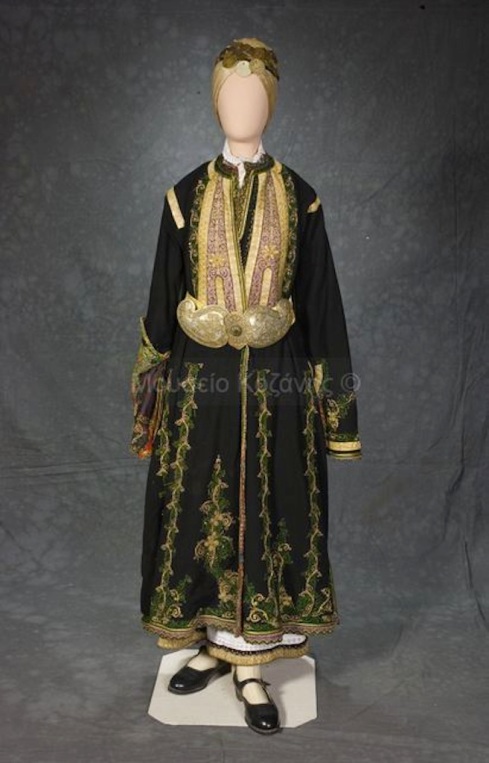
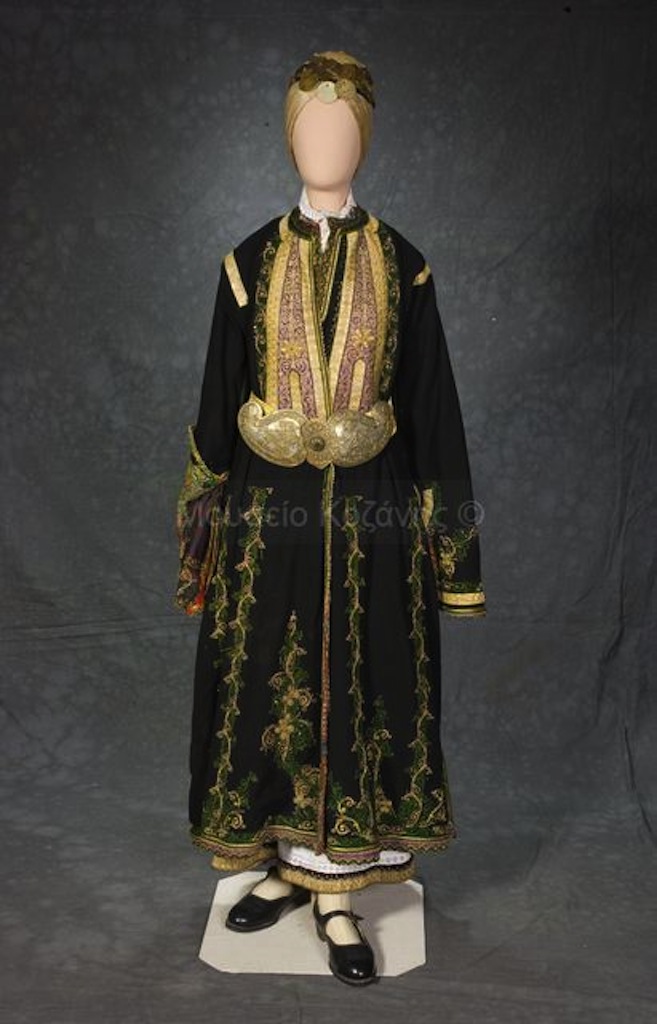
Family…obviously had to be made by a professional sirmakeşi — an embroiderer of gold thread — in Jiannena or Argyrocastro, and the dress of some particularly wealthy villages, like those of Lunxhi, behind the mountains to the left across the valley in the photo (Albanian-speaking Christians with whom we intermarried extensively and still do, the homeland of Zappas and Zographos, the benefactors mentioned above) had, by the end of the nineteenth century, simply become regional variations of Ottoman urban dress, like in this photo, which the museum of Kozani (why it ended up in Kozani?) felt it had to put its water stamp on, like someone was going to sell the design to YSL or something:
VI2M8774.TIF

**** Despite my friend’s condescension, regional funding initiatives for these “poorest provinces in Europe” have greatly expanded the university in Jiannena and developed an extensive and prestigious medical research center there, an information technologies industrial park, renovated (sometimes over-renovated) large parts of the old Ottoman city and created a general climate of growth and prosperity seemingly unaffected by the problems of the Greek economy.  Epiros has become a little bit like a Greek Bavaria or the French south-west: a traditional, somewhat backwards area that made the leap over the ugly stages of modernization to post-modern comfort and prosperity.  Half-ruined villages have been renovated, largely through the skills of Albanian craftsmen, who still were trained in the traditional building skills necessary to preserve the region’s distinctive architecture.  There’s good traditional and contemporary food in Jiannena and in some of the newly developed tourist towns.  There’s skiing in the winter; there’s hiking and mountain-climbing in the summer and gorgeous beaches only an hour-and-a-half away from each other on the new highways.  And it’s generally agreed that Jiannena is one of the most pleasantly liveable of Greek provincial cities and Epiros one of Greece’s most beautiful and pleasantly liveable provinces.

Comment: nikobakos@gmail.com

The Annunciation: “And I thank you for choosing me…”

25 Mar

AnnunciationSantaMariaMaggiore

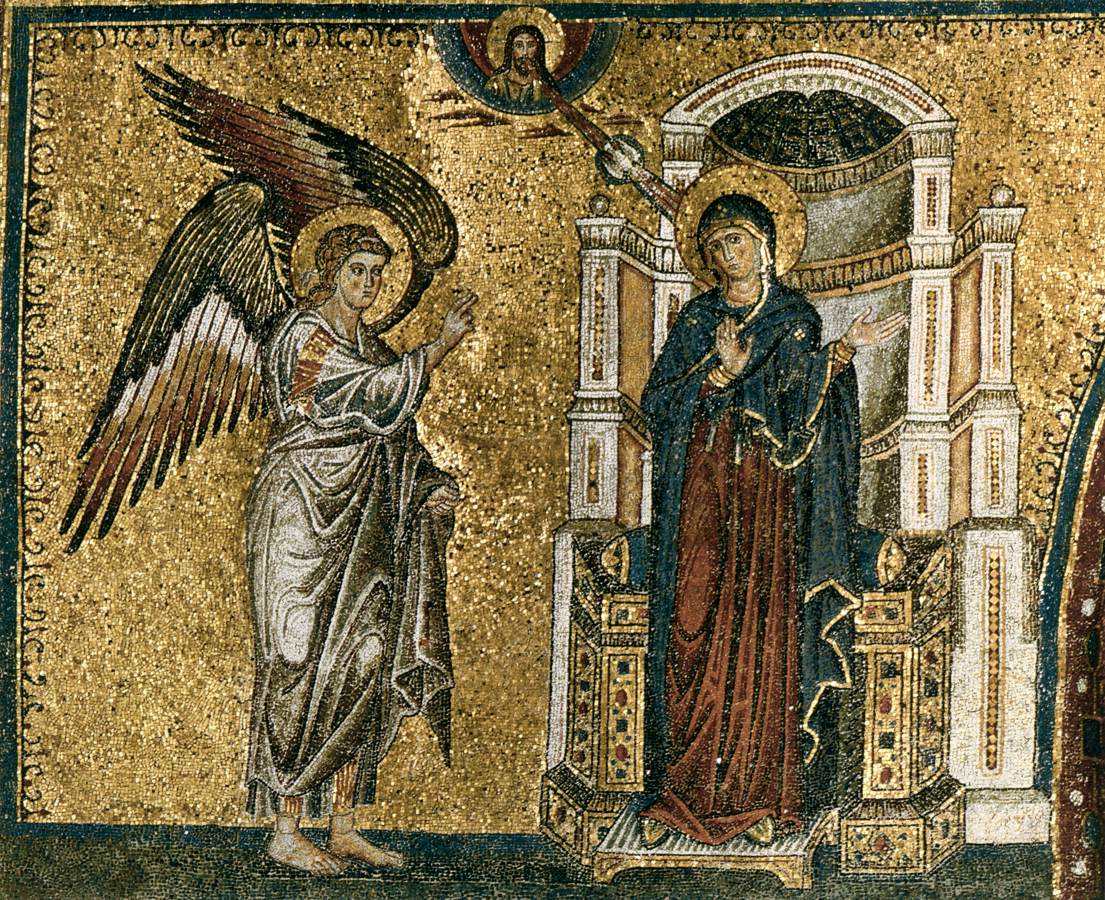
The Annunciation of the Virgin mosaic from Rome’s Santa Maria Maggiore (click)
Today is the Feast of the Annunciation, when the Archangel Gabriel appeared to a terrified, barely post-adolescent Jewish girl in a village in Galilee and told her that she was going to become God’s mother.  And in one of the greatest acts of moral bravery in history, this — what? fourteen-year-old? — Jewish girl said: “Yeah…ok.”

This is a “yes” which we should all pray to be given the opportunity to offer up to some one or to some greater thing, in even the tiniest of manners, at some one point in our lives.  It, oddly enough or not, always puts me in mind of the name “Reza,” which I’ve always loved on Persian men, since as far as I understand it, it means “willingness, acceptance, consent…” a saying-yes to Life or to the Divine Will.  (The other is “Peyman,” with its comparable sense of promise and commitment.)  Except in Mary’s case it’s a “saying-yes” that’s particularly female in its bravery, since she barely understands what’s being asked of her and she consents out of pure love, and most men find such consent difficult without first knowing what glory there is in it for them.  Instead Mary does the glorifying:

Μεγαλύνει ἡ ψυχή μου τὸν Κύριον καὶ ἠγαλλίασεν τὸ πνεῦμά μου ἐπὶ τῷ Θεῷ τῷ σωτῆρί μου,
ὅτι ἐπέβλεψεν ἐπὶ τὴν ταπείνωσιν τῆς δούλης αυτοῦ. ἰδοὺ γὰρ ἀπὸ τοῦ νῦν μακαριοῦσίν με πᾶσαι αἱ γενεαί,
ὅτι ἐποίησέν μοι μεγάλα ὁ δυνατός, καὶ ἅγιον τὸ ὄνομα αὐτοῦ, καὶ τὸ ἔλεος αὐτοῦ εἰς γενεὰς καὶ γενεὰς τοῖς φοβουμένοις αυτόν.
Ἐποίησεν κράτος ἐν βραχίονι αὐτοῦ, διεσκόρπισεν ὑπερηφάνους διανοίᾳ καρδίας αὐτῶν·
καθεῖλεν δυνάστας ἀπὸ θρόνων καὶ ὕψωσεν ταπεινούς, πεινῶντας ἐνέπλησεν ἀγαθῶν καὶ πλουτοῦντας ἐξαπέστειλεν κενούς.
ἀντελάβετο Ἰσραὴλ παιδὸς αὐτοῦ, μνησθῆναι ἐλέους, καθὼς ἐλάλησεν πρὸς τοὺς πατέρας ἡμῶν τῷ Αβραὰμ καὶ τῷ σπέρματι αὐτοῦ εἰς τὸν αἰῶνα.

46 And Mary said, My soul doth magnify the Lord,

47 And my spirit hath rejoiced in God my Saviour.

48 For he hath regarded the low estate of his handmaiden: for, behold, from henceforth all generations shall call me blessed.

49 For he that is mighty hath done to me great things; and holy is his name.

50 And his mercy is on them that fear him from generation to generation.

51 He hath shewed strength with his arm; he hath scattered the proud in the imagination of their hearts.

52 He hath put down the mighty from their seats, and exalted them of low degree.

53 He hath filled the hungry with good things; and the rich he hath sent empty away.

54 He hath helped his servant Israel, in remembrance of his mercy;

55 As he spake to our fathers, to Abraham, and to his seed for ever.

That’s March 25th: the Annunciation of the Virgin.  The rest — by which we mostly mean Greek Independence Day — is bullshit.  Nothing that led to the establishment of the first independent Kingdom of Greece happened on March 25th.  There were sporadic outbreaks of rebellion, some semi-coordinated, among Ottoman Greeks throughout the Empire in the early spring of 1821, but there was no raising of any standards, or launching of any campaigns or declarations of any kind made on March 25, 1821 as far as we know.  Except for sporadic massacring nothing much occurred at all that year until the fall, when, only with foreign help, the Greek rebels were able to finally take Tripolitsa in the Peloponnese and butcher the majority of its Muslim and Jewish — meaning practically its entire — population.  And eventually all that happened is that the Greek statelet slapped its observation of Independence Day onto the Annunciation in a conscious-or-not appropriation of the holiday’s already inherent meanings of conception, inception and beginning (I think that, the Julian Calendar still in operation at the time, March 25th was also Easter Sunday that year so, with the theme of Resurrection added, the temptation was irresistible) and so Althusser’s Ideological State Apparatus smothered one of the loveliest holidays of the Church with flags and parades and tanks and national anthem sap and all the other cheezy trappings of N/S patriotism.

But by the same token, the Annunciation itself was slapped by the Church onto the pre-existing observation of the Vernal Equinox (by a few days), the Persian Zoroastrian New Year, Nowruz, the first day of spring, the first day of the month of Aries — with its already inherent meanings of conception, inception and beginning.  And fast forward nine months, exactly (she was nothing if not on-time our Pantanassa*) and we have Christ born on (or near) another Zoroastrian holiday, Yalda, which marks the Winter Solstice and the beginning of the lengthened days and the Sun’s return to our lives.  The Winter Solstice, in more ancient Iranian religion, was the birth date of the deity Mithra, often associated with the Sun, and who — guess what? — was often said to be born in a cave, of a virgin mother, and who saved the world through the sacrifice of a bull along with a whole other complex of shifting tales and myths that I’m not an expert on.

But though Mithra seemed to fade into a secondary deity in classical Sassanian Zoroastrianism, he was accepted with great fervor and enthusiasm into the highly eclectic polytheism of the late Roman world, where he was especially popular in the Roman army.  Many of the latter emperors were devout followers and there are historians that believe — seems like a bit of an exaggeration to me — that the West came close to being a Mithraic civilization instead of a Christian one.  But the Church slapped Christ’s December 25th birthday onto Mithra’s (I’m simplifying some) and that was the end of Mithraism.  Which is a bummer, because by the Second Century A.D., Mithraism had evolved, in Roman hands, into a super-butch, male virility bull-cult for an initiated military elite, all wrapped-up in the full panoply of Hermetic-Alexandrian-Astrological wisdom, where Roman officers and soldiers gathered in caves and commemorated the sacrificed bull and honored its blood  (we don’t really know what occurred because it was only for the initiated but a sacrifice and subsequent shared meal of some kind was probably involved) and Christianity is kinda — well — is kind of lacking in those kinds of thrills.  One of my best beloved Roman ancestors, Julian the Apostate (the subject of four Cavafy poems), a fascinating figure, who was both a devotee of Mithra and an initiate into the Eleusinian mysteries, tried to reverse his uncle Constantine’s establishment of Christianity as the Roman state religion and give support to the traditional pagan cults, their rites, rituals and sacrifices, but it was already too late.  People just wanted their blood as metaphor by then, a shift in consciousness that has always been considered psychic or intellectual progress of some kind though — like the shift to monotheism itself — I could never quite understand why.  Those of us who still like reality better still have and have always had Spain though; that’s unless the European Union and PETA and the Catalans take their sanitary Handy-Wipes to the corrida too and that’ll be the real end.

Ah, but even then we’ll still have Mexico…

"Tauroctony" - Mithras slaying a bull

Mithra and the Bull, from the Vatican Museum (no other info) (click: it’s a huge and beautiful file)

What conclusions can we draw from all this?  One, is that humanity is not particularly imaginative and just kinda copies itself over and over ad infinitum.  Second, is the idea that often comes up when looking at our zone, thinking about “our parts,” more closely — and that’s the simple conclusion that everything is Persian.  Not just our food, our music or dance, our dress, our color palette, our poetic sensibility and ideas about love, but our common penchant for narrative cycles of martyrdom and rebirth (see: “Ashura 1435: a poem from Agha Shahid Ali”) and the deeper structures of our spiritual psyches.  It’s tempting; instead of the inane arguments about what’s Greek and what’s Arab and what’s Indian and what’s Turkish — everything is Persian, and be done with it.  Alexander seemed to have gotten it; shouldn’t be too hard for the rest of us.  But probably the truth lies and always will lie with Jung: and that is that all of the imaginary activity of the human unconscious operates on one, unified, symbolic grid of archetypes.

Chronia Polla to those whose namedays are today.  And signing off this post with R&B singer Lauryn Hill’s beautiful “To Zion” where the subtitle of this post comes from.  This was a song that came from her real-life experience of having to choose between having an unexpected baby and sticking with her career.  “One day…you gonna understand…”  Lyrics are below:

“To Zion”

Unsure of what the balance held
I touched my belly overwhelmed
By what I had been chosen to perform
But then an angel came one day
Told me to kneel down and pray
For unto me a man child would be born
Woe this crazy circumstance
I knew his life deserved a chance
But everybody told me to be smart
Look at your career they said,
“Lauryn, baby use your head”
But instead I chose to use my heart

Now the joy of my world is in Zion

How beautiful if nothing more
Than to wait at Zion’s door
I’ve never been in love like this before
Now let me pray to keep you from
The perils that will surely come
See life for you my prince has just begun
And I thank you for choosing me
To come through unto life to be
A beautiful reflection of His grace
See I know that a gift so great
Is only one God could create
And I’m reminded every time I see your face

That the joy of my world is in Zion
Now the joy of my world is in Zion

Marching, marching, marching to Zion
Marching, marching
Marching, marching, marching to Zion
Beautiful, beautiful Zion
[repeat to end of song]

*************************************************************************************************************************************************************************************************************

*”παντάνασσα,” pantanassa, is one of my favorite epithets for the Virgin, but whether it means “all-breathing, giver-of-breath, breath-granting” I can’t tell, nor can anybody else I know.

**Latest addendum note: Beloved dinosaur cousin — who is the always the one one should go to for these question, since he’s a monster of erudition in most fields, but especially Greek language, informs us that Pantanassa has nothing to do with breath or breathing, as many of us must assume, but: Η άνασσα είναι το θηλυκό του άνακτος (ονομαστική: άναξ), του βασιλέως (εξ ου και ανάκτορα).  “Anassa” is the feminine form of “Anax,” meaning king, same root as “Anaktora,” or palace.  So it simply means “Queen of Queens,” which is kind of disappointingly Catholic-sounding.  Speaks to a whole history of Greek and Latin vocabulary mixing itself up, replacing, re-replacing, disappearing and then appearing again, especially in titles of government or military due to initial composite character of Byzantine state structure.  I’m assuming, i.e., άνασσα was already an archaically Greek word at the time, for example, the Chairetismoi were written.

And a personal sensory note:  According to the guidelines of Orthodox fasting, which if observed carefully constitute the most elegantly designed spiritual economy of partaking and abstaining one can imagine (probably only Hinduism could produce a more intelligent  schema) — again, the guidelines, not the rules, meaning it doesn’t affect your G.P.A. at the end of term if you slip up, like if you’re Catholic — fish is considered meat, and is not eaten during Lent.  But there are festive days, essentially the Annunciation and Palm Sunday, which even in the sorrow of Lent, should be marked as Feasts, and then the eating of fish is practically obligatory.  Today in the streets of Greek neighborhoods, therefore, here in Athens or in Astoria, in apartment house corridors and restaurants, the smell of fried bacalao is all-pervasive.  One of my strongest sensory memories of Holy Week as a child is being taken to the matins for Holy Monday on Palm Sunday evening, the first of the so-called “Nymphios” or “Bridegroom” services (the reference being to Christ coming to Jerusalem for Passover and to meet his fate) and all the old women in church smelling like fish fritanga.

And a really interesting article from Wiki about “Tauroctony” or “Bull-slaying” if you’re interested in the phenomenon religio-anthropologically.  Again, the best book, that’s both an anthropology of Mediterranean bull cults and the best sociological history of Spanish bullfighting there is, is Timothy Mitchell’s “Blood Sport: A Social History of Spanish Bullfighting.”

Comment: nikobakos@gmail.com

“The Nasty Bits”

28 Feb

I guess I’ve already missed the end of pre-Lenten meat-eating by a week, but I thought, as my last day in Paris coincides with the last day of Apokries, I’d take the opportunity to volley a few more visual missiles at my Vegan-Anti-Offal enemies’ positions.

These are from my new favorite place in the city.  One very cool development in France lately has been the proliferation of almost Spanish-style tapas bars, where you can try lots of different dishes instead of having to sit through the traditional three-piece suite.  I hope that will always be available in all its ritualized confidence, but this meze phenomenon is a welcome break.  And except for the absence of ankle-deep garbage on the floor, this place is as chaotic as any place in Spain and makes me mindful of the French’s own anarchic impulses.  You only get half the things you ask for; you have to scream for them over a counter that’s packed three-people deep; the check is always wrong; people are eating out of your plates and vice-versa, but the flavors there are nothing short of miraculous.

My favorites:

kidneys

The kidneys in a quick onion and vinegar sautee

Boudin

Their boudin, (coagulated pig’s blood — just a reminder…) which they don’t put into a casing but make into a loaf, kind of like a Penn-Dutch scrapple if the analogy isn’t too weird, served with a very hot green pepper and roasted apples

IMG00408-20140227-1657

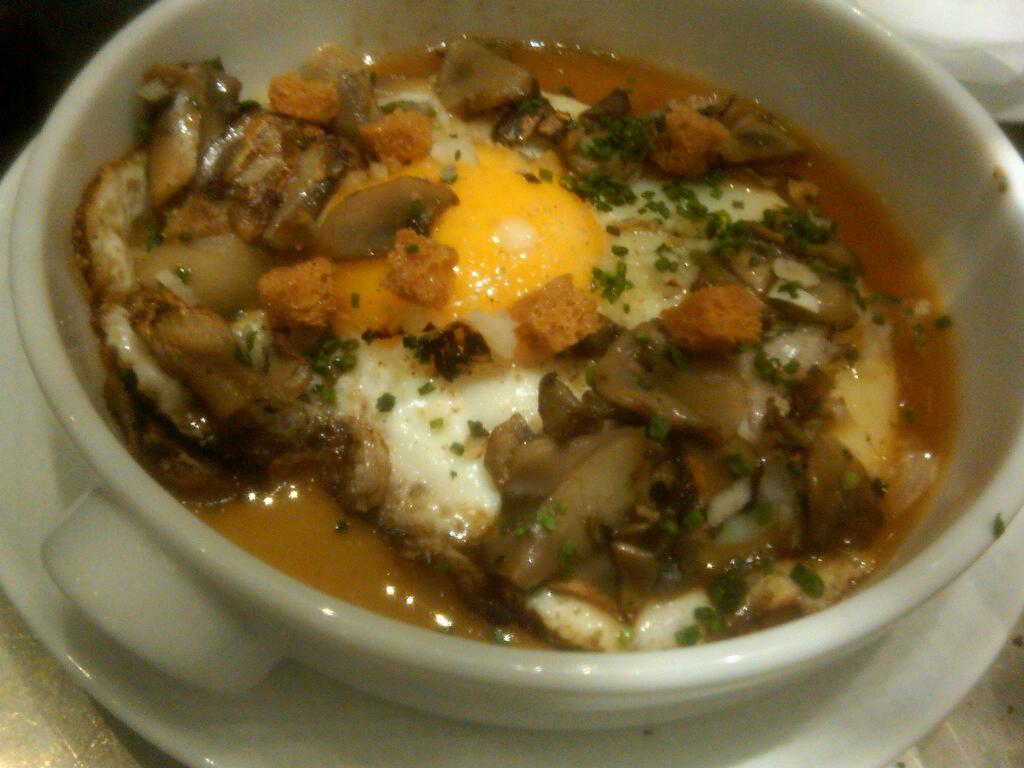
A soft-fried egg dish swimming in butter and buttery croutons that’s made with some mushroom that has all the foot-like smell of truffle but none of its subtlety; they wouldn’t tell me what it’s called: “Il n’y en a pas là-bas…”  (I think) “You don’t have them over there…” was all I managed to get from them, irrespective of where “over there” was.

Pig's ears

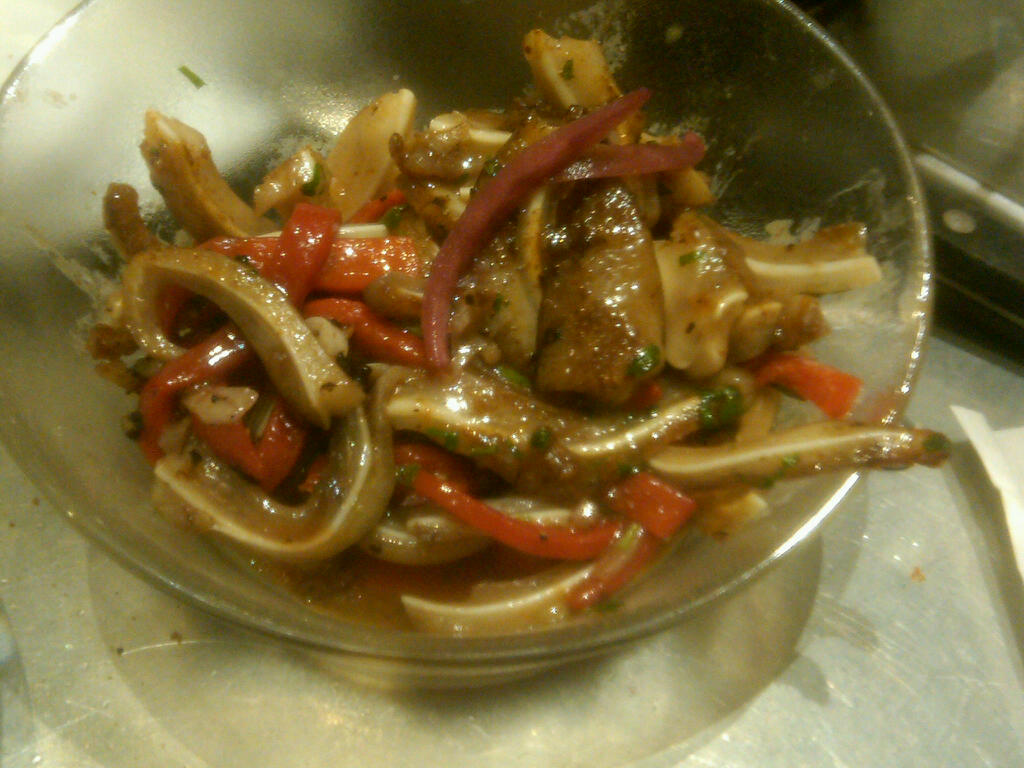
The pig’s ears, slimy and gummy on the outside with the cartilage-crunch core, sauteed in a Basque-like red pepper combo

butter

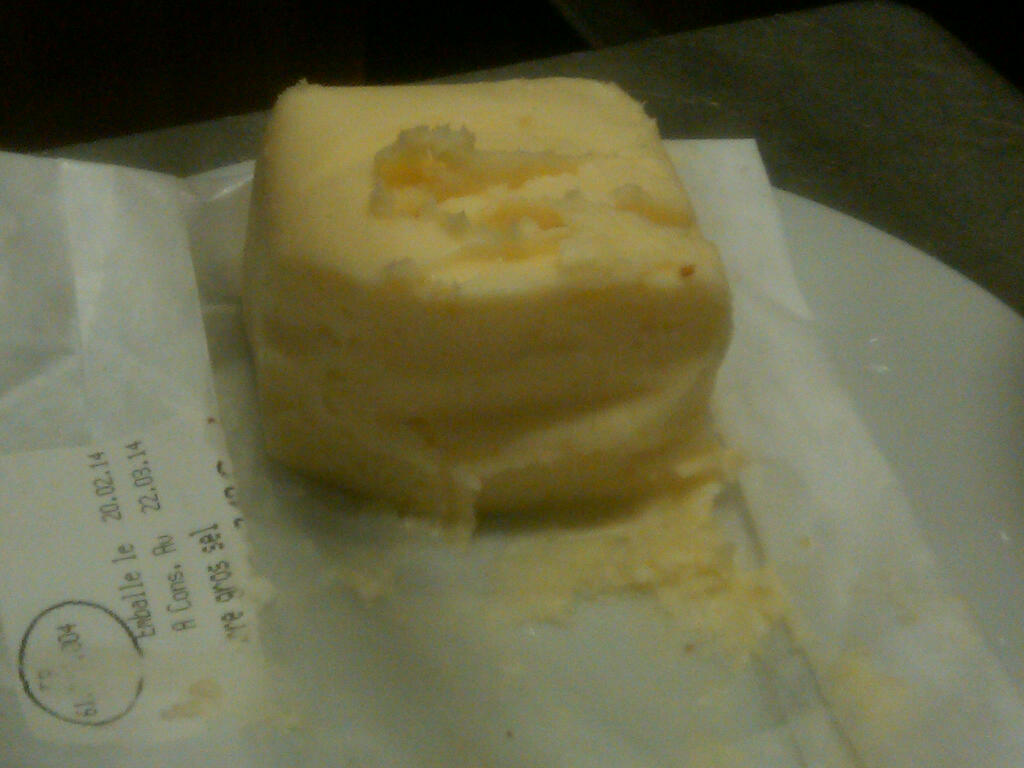
The most delicious cheesey, slightly sour butter on earth, always sitting on the counter sweating, with bits of other people’s food always stuck in it (“eeeeewww…” a definite “C” rating from Bloomberg) and served with bread that’s leagues beyond the Poilaine stuff that’s everywhere and is so not great that I’m beginning to think is a gigantic hoax.

Finally, the pig cheeks — yep, hog maw — (see: “Hog maw, cornbread and chitterlin” ) braised in lentils:

pig cheeks

…which really reminded me of how much great food, especially great French food is based on the slow, laborious breaking down of animal collagens, something I tried to capture in this second pic a little better (forgive the quality — yes, yes, I’ll buy an IPhone; click on these for a better view in the meantime); it’s the secret to the perfect texture of good mageiritsa too, though everyone thinks it’s the augolemono.

pig cheeks 2

Why such conspicuous animus to the anti-offalers?  επειδή μου σπαν’ τα νεύρα….  Because they irritate me.  And I wouldn’t be so irritated by just their bad taste and limited palates and squeamish, plasticked alienation from the realities and depth of good food, if they would just shut up about it: it’s what in one of this blog’s first posts — “Chitterlings…and mageiritsa” — (the Jadde started just before Easter 2011) I call their “anthropology tes poutsas” that drives me mad: the rationalization that poverty made people eat this food and that now we’re beyond that.  (See also:  “What I managed to put away in a day-and-a-half in Paris and some thoughts on the “crise;” or, “…the brevity of time and the immediacy of pleasure.” )  Believe me; none of the people who eat here are poor.  It’s not in an impoverished southern village: they don’t exist anymore, are either depopulated or bought up by ex-pat Brits; it’s not in a dying northern industrial city; it’s not in a destitute banlieue.  It’s dead in the center of chic-as-you-can-get St. Germain (there’s an argument to be made that this food’s appeal is about reverse snobbery — an argument I’ll listen to), right down the road from the Odeon and around the bend from the Luxembourg.  If you even hover around the edges of New York foodie-dom you’ve heard about this place, but, sorry, as a matter of blog policy, I don’t give out names.  You’ll have to dig up its delights yourself.

The rest of you can have the salmon.

Comment: nikobakos@gmail.com

Occitan and “endangered languages”

25 Jan

Romance_20c_en

(click)
If people here talk about the Albigensian Crusade like it happened last week, the more regionally nationalist talk about La Vergonha (the shaming) like it happened yesterday.  La Vergonha refers to the systematic process of imposing French on the Occitan-speaking peoples of the south (number 7 and 8 on the map and if you want to include Catalan in the same family, which many linguists do, number 6 too) when education became compulsory in the nineteenth century.  Reduced to a rural language (which has always come described in nationalist literature as “an unwritten dialect or patois”) after the Albigensian Crusade destroyed its high literary culture, the process involved not only the teaching of French but the systematic punishing of the speaking of Occitan, even outside of school, of the children of the region, and the conditioning of adults to feel embarrassed to speak it publicly as well.  The statistics are truly astounding — and sad: “In 1860, before schooling was made compulsory, native Occitan speakers represented more than 39%of the whole French population, as opposed to 52% of francophones proper; their share of the population declined to 26-36% in the 1920s,and then dropped to less than 7% by 1993.”  Despite strong pressure to do so, the French government still refuses to grant it official status as one of the nation’s official languages and frankly, with only 7% of the population actually fluent in it, why would they?  And this is France, the state that created hyper-centralized statism.  How Occitan nationalists think they’re going to obtain the recognition they want is beyond me.

SpeakFrenchBeClean

(click)
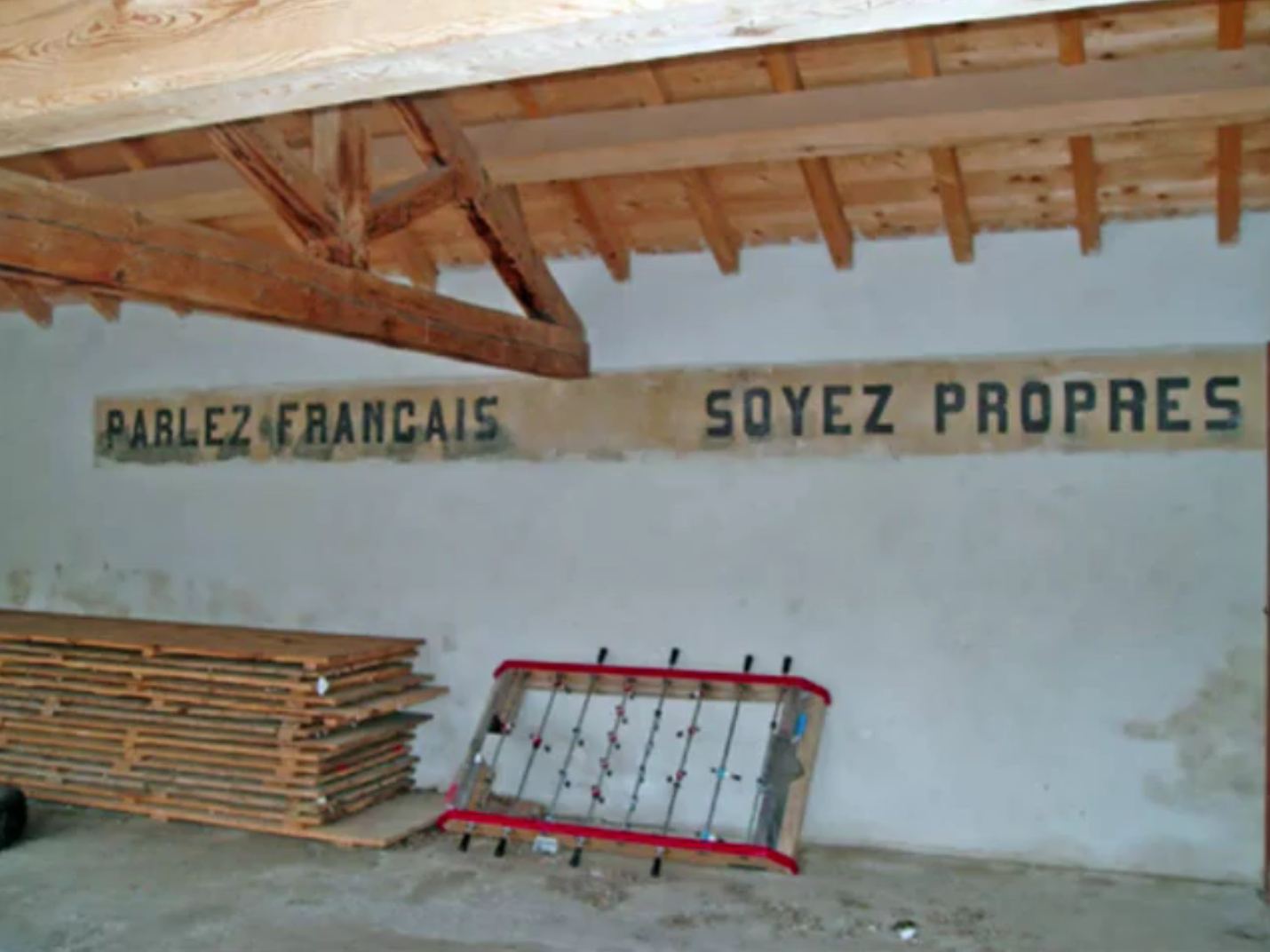
This happened during the formation of every modern nation-state.  A Greek Istanbullu of a certain age might find the sign above, from a French classroom, disturbingly familiar: “Citoyen, parle francais!”  In Greece, only one linguistic minority really bore the brunt of such oppressive language suppression: the Macedonian speakers of the northwest.  No Greek government would’ve ever dared trying to forbid the speaking of Turkish in the northeast; though actually calling yourself Turkish can still theoretically get you into certain kinds of trouble.*  The Albanian speakers of south and central Greece were really not a problem; not only was the language clearly dying out of its own by the early twentieth century, but Peloponesian Albanians were already Greeker than the Greeks in their ethnic consciousness and had proven it by essentially fighting our war of independence for us; it seems that, historically, you give Albanians — Christian or Muslim — an incentive to go to war and they’ll become more zealous crusaders of your cause than you are yourself.**  As for Vlachs, they were always chameleons, everywhere in the Balkans, mostly keeping their Vlachness to themselves and intelligent enough to let how they really felt remain a mystery to those around them; I recently came across a description of Vlachs as “the perfect Balkan citizens, because they are able to preserve their culture without resorting to war or politics, violence or dishonesty.”  (They’re the little mustard-coloured dots spread out over northern Greece and southern Albania and Macedonia in the map above.)

But are they preserving their culture?  That’s the question I get stuck on, no matter how much an enemy of forced nation-state homogenization I am.  Or more specifically, how much is something like Occitan language-nationalism sincere and how much is post-modern micro-identities coming alive for some reason I’m not able to explain really?  Is it just dilettantism?  You hear a lot about Occitan here in Toulouse, the dialect of which, in fact, is the basis for the language’s standard; what you don’t hear is any Occitan.  I live around the corner from an Occitan cultural center here in the Carmes quarter of the city and they have classes for kids and I hear them singing sometimes or reciting things.  And whenever I see their parents out front waiting for them and the kids are let out all anyone is speaking is French.  I don’t mind the EU spending money on bilingual signs — here, in Galicia, in Brittany, wherever — but those expressions of recognition actually seem more petty than anything else and some even seem disrespectful, almost a mockery: announcements in the Toulouse subway system are bilingual, for example.  Great.  So now the young descendants of the troubadours can proudly say: “Watch the closing doors.  The next stop is Esquirol” in the Occitan of their ancestors.

Occitan_and_French_language_signs_in_Toulouse

Bilingual street sign in Toulouse

Or even in Greece.  For the life of me I can’t imagine what “Arvanitika” organizations in Greece do: when nobody speaks the language, and they call themselves “Arvanites” and not “Albanoi” which would imply Albania, which is where their ancestors came from and that would be taboo.  Do they try to revive the language?  Not that I know of.  Do they do anything that the Albanian-speaking communities of Italy do?  Do they go on trips to Albania to get to know the land of their ancestors?  Of course not.  Do they set up aid organizations for recent Albanian immigrants to Greece in a spirit of fraternal support?  Even less.  They’re much more likely to have put them to work in their fields in Boeotia picking tomatoes for slave wages, or were until the new Albanians wised up.  Or Vlachs.  It seems that every year the number of Vlach cultural organizations and fraternal associations increases in inverse proportion to the number of true, living native speakers of the language that are still around.  The material or music and dance culture of Vlachs is not noticeably different than that of their neighbors; if they’re not learning Vlach, what are they doing?  Pane ekdromes?  They could do that as regular Greeks too.

There are more dangerous and toxic manifestations of that kind of localized-identity nationalism as well, most noticeably the Basques.  Less than 25% of the people who claim that they are Basques ethnically in Spain can actually speak the language at all — at all.  I once caught a hysterical comedy skit on Spanish television where a man in San Sebastian was trying to pull off a bank robbery in Basque — on principle.  And it wasn’t working because the teller couldn’t understand him.  Then the neighboring teller chimes in about the robber’s grammar and that it’s incorrect according to the teacher at the night-school Basque classes she goes to and the other customers on line start arguing with him and the tellers about noun declensions and whether his use of the subjunctive is correct or not.  And the robber starts to scream, frustrated: “I’m in Donostia (San Sebastian in Basque) goddammit!  Not Burgos!  And I can’t even hold up a bank in my own language!”  Finally, the cops arrive and instead of apprehending him, they get caught up in the one-upmanship of the group of barely Basque-speaking Basques’ grammar arguments and the robber, frustrated, makes his escape.  It was hilarious and it was on YouTube for a while but I haven’t been able to find it again.  But that’s not all a joke.  People killed each other in the hundreds for decades for a an identity with only the most fragile of real footing and a language that none of them spoke; and in post-Franco Spain, one of the most liberal, progressive on social issues nations in Europe, where you’re free to learn any language you want and maintain any kind of culture you like.  So, at the risk of sounding glib, make the effort to  learn the language first — BE a Basque first —  before you start killing people.

I guess I’m a supporter of American style laissez-faire policies culturally and linguistically.  No language should be prohibited; but none should necessarily receive state support either, especially for a language that actually has very little chance of survival.  Reviving it, maintaining it, disseminating it is the community’s choice; if they can do it, halali.  But a language or culture that’s strong enough or rich enough to survive will not need support of any kind, almost by definition.  In multilingual situations where practical problems are presented, like with the immense number of Spanish-speakers in the United States, I think it’s fair for the state to step in and offer services that facilitate bureaucratic operations.  But nothing more than that.

What’s irritating is the ethnicity-based nation state’s inability to believe that people can be successfully, functionally bilingual.  People have been so for centuries, especially in our part of the world, where, especially in the cities, being monolingual was the exception rather than the rule, and almost as much so in rural communities, at least among men who had more dealings with the outside world or had emmigrating experiences.  Puerto Ricans, both in New York and on the island, are going on their fourth generation of being successfully bilingual.  I understand that with the spread of literacy and compulsory schooling some kind of standard had to be established, but that standard doesn’t have to be the same for every community.  And ultimately, it’s not proper or efficient social functioning that the nation-state is looking for in imposing language uniformity (New York bureaucracies, where five or six or a dozen or more different languages are regularly used in the daily functioning of one office are much more efficient than, say, Greek bureaucracy); it’s ideological uniformity.  The fear is not that you won’t be able to function in the national language; the fear is that if you speak another one as your first language it’ll serve as a conduit for anti-national ideas.

And that’s what the Vergonha was all about.


Comment: nikobakos@gmail.com


**********************************************************************************************************************************************************************************************

* “The Greek government refers to the Turkish community as Greek Muslims or Hellenic Muslims, and does not recognise a Turkish minority in Western Thrace.[14] Greek courts have also outlawed the use of the word ‘Turkish’ to describe the Turkish community.[19][20] In 1988, the Greek High Court affirmed a 1986 decision of the Court of Appeals of Thrace in which the Union of Turkish Associations of Western Thrace was ordered closed. The court held that the use of the word ‘Turkish’ referred to citizens of Turkey, and could not be used to describe citizens of Greece; the use of the word ‘Turkish’ to describe ‘Greek Muslims’ was held to endanger public order.[20] Greece continued this stance in the beginning 21st century when Greek courts ruled to dissolve or prohibit formation of Turkish associations.[19][21][22]”

**More on Albanians in Greece in an upcoming post.

Unamuno: witty and human

23 Jan

Miguel_de_Unamuno_Meurisse_1925

Miguel de Unamuno (click)
“El hombre, dicen, es un animal racional. No sé por qué no se haya dicho que es un animal afectivo o sentimental. Y acaso lo que de los demás animales le diferencia sea más el sentimiento que no la razón. Más veces he visto razonar a un gato que no reír o llorar. Acaso llore o ría por dentro, pero por dentro acaso también el cangrejo resuelva ecuaciones de segundo grado.”

“Man is said to be a reasoning animal. I do not know why he has not been defined as an affective or feeling animal. Perhaps that which differentiates him from other animals is feeling rather than reason. More often I have seen a cat reason than laugh or weep. Perhaps it weeps or laughs inwardly — but then perhaps, also inwardly, crabs resolve equations of the second degree.”

See a beautiful full-length piece by Stefany Anne Golberg: The Philosophy of Death: Miguel de Unamuno was a man of contradictions. He saw tragedy and death in life, and that was why he loved it.


Comment: nikobakos@gmail.com


Toulouse: “Who ever lov’d who lov’d not at first sight?”

20 Jan

Toulouse Old_brick_wall

“Who ever lov’d who lov’d not at first sight?”  Those who know that line know it’s Shakespeare from “As You Like It” – but actually it’s Shakespeare quoting Marlowe, a little homage to his more accomplished contemporary; interesting, particularly, because in my opinion Marlowe was a keener analyst of desire than Shakespeare, though I have only instinct and no textual support to back that up.  The important thing is that it’s true.  There’s now even science to support it; in “Narcissism Guides Mate Selection,” published in Evolutionary Psychology 2 (2004) Liliana Alvarez and Klaus Jaffe (?) write:

“Research has shown two bases for love at first sight. The first is that the attractiveness of a person can be very quickly determined, with the average time in one study being 0.13 seconds. The second is that the first few minutes of a relationship have shown to be predictive of the relationship’s future success, more so than what two people have in common or whether they like each other.”

And so it was with me and Toulouse.  My first morning here I walked out onto the street at dawn, as the sun started coating the walls of the slightly pinkish brick that the whole city is built with and that was it.  I think it actually took 0.9 seconds in my case.  But I was finished.  It was all over.  I was lost, tumbling into that so familiar abyss.  I had never fallen for a city so hard and so fast in my entire life.

Why?  Well, “you can’t really say why you love somebody,” Stella says in Streetcar… but you try anyway, only because the temptations of let-me-count-the-ways and the attempt to grasp the ungraspable are so powerful.

To start with the most banal and obvious, it’s beautiful.  Not a stunner, a Paris or a Florence or a Venice, but even more loveable because it’s not so perfect.  Who wants every city to be Paris anyway?  The medieval quarters are amazingly well-preserved and in the nineteenth-century neighborhoods it’s interesting to see the classic Haussmanian idiom of French cities translated into the local brick.  But that’s not really it.

There’s the immediacy and availability of pleasure in all forms, somehow even slightly more than in the rest of France.  Here, I’m reminded of Istanbul actually, because I think Turks might also have that same keen sense of “the brevity of time and the immediacy of pleasure” as the French do and even in Istanbul’s current hali, you feel, like in France, that you’re in the presence of a very ancient tradition of the production and consumption of luxury.  New York tempts you at every turn as well, except New York makes you struggle so much to reach the promised gratification that it in the end it feels as if you’ve had it pulled through your nose, as the Greek expression has it. 

The food: though these things are eaten all over the country, this is the home turf of foie gras and pork belly and duck confit and restaurants that proudly assure their customers that their french fries are made in goose fat, the way McDonald’s promises you there are no trans-fats in anything.  The wines are thick and rough and tannic and delicious; the only place where there’s no need to worry about ordering: whatever house red comes by the carafe is always perfect.  The streets are filled with always-full bars and cafes and the disconcerting sound of talking, of discussion, I mean of people really conversing.  Then it’s a university town, so it’s full of beautiful young people trying to fix all of their above oral fixations: talking and drinking and smoking and making out in public all over the place just like they should be.  And it’s not just the young; that magical ability the French have to make it seem like they have more available leisure time than people in any other industrialized country is even more visible here than in Paris, to the point where even someone as anti-work as me sometimes wants to ask: “Does anybody here work?”  And it’s not Italy, where everything is so homebound — all so tied to mamma’s apron strings — that most life happens domestically and out of view.  Here, more like Spain, it’s out on the street, even in January; it’s public, like in the natural polis.  It makes all the difference.  You can feel people needing interaction hungrily, like Greece in better days, craving the stimulation of others.

(This is a characteristic of the French everywhere — this love, this need for language and the exchange of ideas, sometimes what seems like nothing but a deep gratifying pleasure taken in the sheer enunciating.  It’s why — if you don’t speak any French at all and have no clue what people are talking about — every conversation you hear seems to have this tone of desperate urgency about it.  That the French are rude or cold or unfriendly is patent bull-shit; they are absolutely none of those things — quite the opposite; but if interaction or closeness is sometimes a little difficult to achieve if your French isn’t at least very good, it’s the importance of language again that explains it.  Sorry — I think they feel — but life is too short and there’s too much to talk about for me to help you with your halting French right now.)

And then there’s St. Sernin, the spectacular Romanesque basilica named after the patron saint of the city, which has become a major obsession of mine and in which I’m finding myself unable to keep from spending at least an hour every day.  This may not be the most beautiful church in Europe but it’s certainly the most beautiful Romanesque church in Europe, and for me, therefore, the most beautiful, since I have what’s almost – no, what’s clearly — a powerful erotic attraction to the style.  Knowing the renovation history of European ecclesiastic architecture, its interior is almost suspiciously austere, so I’m pretty sure it was re-Romanesqued or de-Baroqued, or however you want to see it, at some point.  This happened a lot in the nineteenth century, when Romanticism made the mediaeval more attractive to people than anything that had to do with the seventeenth or eighteenth centuries: it generally involved stripping later decorative accretions from older churches and restoring their “purity.”  Especially in southern Italy one finds this having been done fairly often, with mixed results: some before and after images I’ve seen of Sicily’s Byzantine churches seem successful; with the famous convent church of song and legend, Santa Chiara in Naples, they didn’t have a choice, since the Baroque church had been bombed by the Allies into a burnt shell and they rebuilt according to the original Gothic plan; others, like the practically made-up design of that silly Moorish cathedral in Amalfi, are clearly failures.  But whatever distractions they removed from St. Sernin I’m all for: nothing should impede the soaring, muscled athleticism of this structure and the space it embraces so powerfully.  It has to be seen — and felt, like flesh — to be believed.

St. Sernin is god-like; the building itself overwhelming the idea of whatever deity is supposed to be honored there.  The city’s other churches are more human and all quirky in the extreme.  There’s the Jacobins, named after some father monastery dedicated to St. Jacques and not those Jacobins; but still kind of jarring — like Our Lady of the Bolsheviks or something.  Only in France.  This church is described as having two naves, but only has one nave really, with a towering row of palm-like columns running right down the dead center (?) like the rope at a Hasidic wedding, so that the view of the apse and altar are obstructed from almost everywhere, so much so that mass is said at an altar set up against one of the side walls because if you’re further than even ten feet from the real altar you can only see it by peeking from around these, granted, beautiful columns.  Then there’s the city’s cathedral church, St. Etienne.  This was begun as an unusually low-arced and unusually wide Romanesque church, but that idea was apparently scrapped as not grand enough, so they continued the rest of the church in a higher Gothic style.  The thing is it wasn’t continued on the same axis.  So you enter the older Romanesque part, which now almost feels like an exonarthex in an Orthodox church, then the building’s axis makes a left turn, for about 50 feet, then a sharp right, then continues down the central nave.  Later they pasted a Renaissance — but it being France, still slightly Gothicky — belfry onto the northwest corner of the façade, and at some point a shorter little clock tower in front of that, so that, as disconcerting as the interior is, the exterior looks like it was put together from leftover pieces of different Lego sets.  And yet it works.  Works the way that French girl in the bar can put on an orange sweater and purple scarf and make it work.  And, like her, St. Etienne is quite elegant and well-loved by all, in fact.  And almost every other church in the city is that kind of pastiche; they must’ve been some art historian, early post-modernist’s wet dream back in the eighties.

“History is a personal emotion for you” a good friend once told me, and all these buildings are obvious signs of a weighty, turbulent past.  Is that why I fall in love? Because someone has a complicated past?  What we used to call “baggage”?  You don’t have to be too long immersed in Toulouse’s diffuse and slightly transgressive air of sexiness (a national poll apparently voted the local accent the hottest in France), or venture too far out into the surrounding countryside, which even in the dead of winter looks so lush and cultivatable that you half expect figs and quinces or roasted partridges from somewhere to fall into your lap, to believe that what we recognize as Europe’s first love poetry and, in fact, the West’s entire concept of Romantic love, as perverse and ridiculous as it seems to the rest of the world (and is: “Wait, you mean you’re supposed to not get what you want?”  Yep. “And just pine and suffer forever?” Uh huh…)  all come from this little corner of southwestern France.*  In fact, so much of what’s considered quintessentially mediaeval in the popular mind took some consummate form in this region.  And that includes the fact that so many of the skylofrangoi Crusaders that effed us over in 1204 came from around here.  But that no longer matters, you see.  Because while the Pope’s apology for the sack of Constantinople in 2004 left me cold, Toulouse and love have taught me to forgive.

That brings us to the crusade which brought an end to all that love and poetry.  If they think you know no history, which the French automatically assume about anyone who speaks American English, people here will talk to you about the Albigensian Crusade like it happened last week.  The ostensible purpose of this “crusade” was to eliminate a group of heretics that were probably never such a large percentage of the population of southern France; I think a popular Dan-Brown-type interest in “alternative” Christianities has perhaps exaggerated the importance of the Cathars, who were actually weirder than any mediaeval Mormons one could imagine.  But it was the perfect excuse, with the blessing if not egging on of the Always and Eternally Holy See, for the kingdom of France and its northern dependents, to go on a conquering rampage throughout the independent duchies and counties of the south, decimating and depopulating whole swaths of the most urbanized, prosperous and sophisticated part of Europe and ending, as well, Europe’s first vernacular literature by destroying the court culture that supported it and reducing its language, Occitan or Provencal, to a despised folk dialect.  This strikes all the chords in my personality that are peculiarly sensitive to the marginalized, the subjected, the memory abandoned, the tradition vanished, the lost, the forgotten — “all those things you know and tell me of, things that are long dead,” as the lyrics of a favorite Greek song testify.

(It’s why I love the Italian South as well.  And it would maybe be why I’d love the American South too, if there weren’t so much else so ugly about it.)

So does that explain it?  I don’t know.  Who did you fall in love with Stella?  Obviously someone completely in love with himself.  That’s a powerful draw, isn’t it?  Self-confidence.  Probably goes for France as a whole.  We think they’re all that because they’re so obviously convinced of it themselves, and that’s fine with me: “Great souls are always loyally submissive,” Carlyle said, “reverent to what is over them: only small mean souls are otherwise.”  But even for France, I have never come across a city or a population so cocksure confident of their specialness than Toulouse and the Toulousains.  Remember, we’re not far from D’Artagnan’s hometown here, and actually, if there’s any truth in the exaggerated cliché that Toulouse is a little bit of Spain in France (when it’s really Barcelona that delusionally thinks it’s a little bit of France in Spain), it’s that people’s comportment here has a definite element of swaggering, almost Spanish majeza** to it; and add that to the already elaborate culture of French flirtiness and you get a heady mix for sure.  And it’s the only city in France where rugby is more wildly popular than soccer and that tells you something too.  St. Sernin, come to think of it, is built like a rugby player.

So is that it?  I dunno.  A mix of all that?  Self-confidence bordering on the sweetest kind of arrogance?  Sophistication with a definite rough edge?  A behind the scenes complexity you don’t see all of, not at first at least, if ever?  Something quirky and slightly off: “There is no excellent beauty that hath not some strangeness in the proportion” as another Brit said?  I don’t know.  And probably don’t really care.  I just know how it feels.  And for those of you who have made it this far, sorry, I have no images of the Beloved to share — just the bricks.  He’s all mine.

For G., Toulouse, January 2014

Comment: nikobakos@gmail.com

**********************************************************************************************************************************************************************************************

* The most powerful, searing contemporary treatment of Romantic or Courtly love in all its cancerous beauty is Kaija Saariaho’s 2002 opera, L’amour de loin (Love from Afar) with a libretto by Lebanese writer Amin Maalouf.  It’s based on the real, historical figure of Jaufre Rudel, a 12th century Aquitanian prince and poet who fell in love with a Toulousainne princess married to the Count of the Crusader state of Tripoli in Syria (makes Maalouf’s collaboration even more interesting) without having ever seen her.  The music and poetry are beautiful and the opera’s psychological insights are razor-sharp — disturbingly so.  The end leaves you in pieces on the floor — me at least.  You’ll never come closer to the soul of Majnun in the desert than this.

It’s a shame only one aria is in Occitan; it would’ve been a real coup and homage if the whole libretto were.  Get the DVD; Dawn Upshaw has to be seen and not just heard.

**Majeza,n., or majo, adj.: you can read the whole post where the meaning of this word appears previously: “Un Verano en Nueva York”, but if not, here’s the quote from it:

Majeza is a very Spanish term that encompasses such a complex of qualities that it’s difficult to explain, especially in English, which is tragically lacking in a comparable term, as its speakers (aside from the Irish) are in most of its qualities.  It means openness and frankness and humour and swagger; it means being hospitable without being in anyway servile; it means being able to put away copious amounts of wine and pig meat; being friendly and spirited and generous while always maintaining a kind of stylish dignity and flair; it partakes of some of the qualities of Greek and Turkish leventeia in that sense; in fact, it’s a word with a certain undoubtable Balkanness about it.  Soon after the term appeared in, I think, the late eighteenth-century, working-class barrios of Madrid, it almost immediately became associated during the Napoleonic Wars with the city’s street kids, who terrified the French with their suicidal bravery, so it probably originally implied a quickness to pull a knife too and no squeamishness about seeing a little bit of your own blood shed as well.  That doesn’t apply anymore, though the ferocity into which demonstrations in Madrid have descended these days makes you think twice about that; I’m proud of the angry tenacity of the Spanish protests; don’t know what they’ll accomplish but it’s good to know Spaniards can still be scary; that anger has become such a stigmatized, pathologized emotion in our civilization (“You know…I think you have a lot of anger…”) is partly what’s let banks and governments get away with what they have over the past few decades and generally has brought us to the civilizational crisis we find ourselves in.  No, it’s not the other way around.  In any event, courage is still certainly an implied element of being majo.  There’s a great, chapter-long analysis of majeza in Timothy Mitchell’s Blood Sport: A Social History of Spanish Bullfighting, if you’re interested and can get your hands on it.”

See…

10 Sep

This is what he does.  “Oh, it’s a nice day today.  I think I’ll play.”  And then takes a brute like Ferrer in a good match, but hardly an epic battle: 2-6 (yesterday’s set), 6-1, 6-4, 6-2 — and goes to the final tomorrow against Murray.

I gotta say one thing about my man Nole though, as petulant as he can be.  He’s the most gracious winner-or-loser, no matter what.  There’s always a sincere smile, an acknowledgement full of respect, and a warmth to his response to any match — the mark of a true athelete.  What he said about Ferrer today, before or after with the commentators, was such a (rightful) praise of Ferrer as a player that it left a lump in my throat.

Tomorrow is Murray, man.  I’ve made a solemn tama that I’ll have to fulfill if Djok wins.  Let’s see.

Comment: nikobakos@gmail.com