The Pakistani cab-drivers and Hanuman

15 Oct

Taxi-cabs-New-York-0986

I had a seriously annoying Pakistani cab-driver a few days before I left New York in September.

He saw my “Jai Bajrang Bali” tattoo to Hanuman (for those who don’t know: Hanuman) and he said:

“What that say on your arm?”

I said: “It says ‘Jai Bajrang Bali’”, which is a praise-phrase for Hanuman that I think roughly means: ‘Hail, strong one’ (He’s the patron deity of wrestlers and strength athletes generally and I got it in prep for going back to judo.)

“You know about Hanuman?  You read about him?”

“Yeah…” seeing where this was going.

“You Hindu?”

“No”

“So why you Hindu on your arm?”

“Because Hanuman is important to me.”

“So why don’t you become Hindu?”

“Well,” I said kind of testily, “you can’t become Hindu.  You can observe Hindu practices or show some reverence for Hindu deities, but you’re born Hindu, with a very specific place in the cosmic order, with a varna and a caste and a gotra and its particular deity/deities that you’re devoted to and very particular and varied rites or ritual obligations that you’re subject too.  You can’t really convert to Hinduism…in my opinion, at least, despite lots of white people who think they can.”

Silence.

A little bit out of his depth at this point.

“You Jewish?”

(Of course, right?)

“No, I’m Christian technically, Greek Orthodox.”

“If you Christian, how come you have Hindu on your arm?”

“Well,” I said, “that’s probably a little hard for a Muslim to understand.”

And that ended the conversation.

But I shit y’all not, two days later I had the same conversation with another one.  This one ended more abruptly.  When we got to the part about how one can’t “become” Hindu, he started telling me that Islam is very simple and that to become a Muslim is very simple.  “You want to become Muslim, it’s very simple.”

But instead of saying…

“Yes, I imagine the appeal of all totalizing and authoritarian ideologies has always been their ‘simplicity.’  ‘Come with us — it’s simple…’”

…I just said: “Oh, well then maybe I’ll think about it.”

I don’t think he knew what to make of that one.

*************************************************************************

See also: “For Hanuman-ji and the Pakistani cab-drivers: Aditya Kapoor’s beautiful photo essay of a wrestling akhara in Benares

Comment: nikobakos@gmail.com

Bulgaria: Why countries resist immigration…what are they afraid of? Well then, whither away in depopulated stagnation…

6 Oct

Despite Shrinking Populations, Eastern Europe Resists Accepting Migrants — The New York Times

Bulgarian kid zonar

Petrunka Yankova helping her grandson, Stoyan Dodrikov, into traditional Bulgarian dress.  (Dmitry Kostyukov for the New York Times)

“In the most recent World Population Prospects from the United Nations, the 10 countries in the world expected to lose the most population between now and 2050, per capita, are all in Central and Eastern Europe, with Bulgaria in first place.

“In 1990, just after the fall of Communism, Bulgaria had about nine million citizens, making it slightly bigger than Sweden and Austria. Today, the official population is 7.2 million, much smaller than Sweden or Austria, and projections are that it will lose 12 percent of its population by 2030 and 28 percent by 2050.

“Romania is not far behind, expected to lose 22 percent of its population by 2050, followed by Ukraine (down 22 percent), Moldova (20 percent), Bosnia and Herzegovina (19 percent), Latvia (19 percent), Lithuania (17 percent), Serbia (17 percent), Croatia (16 percent) and Hungary (16 percent).”

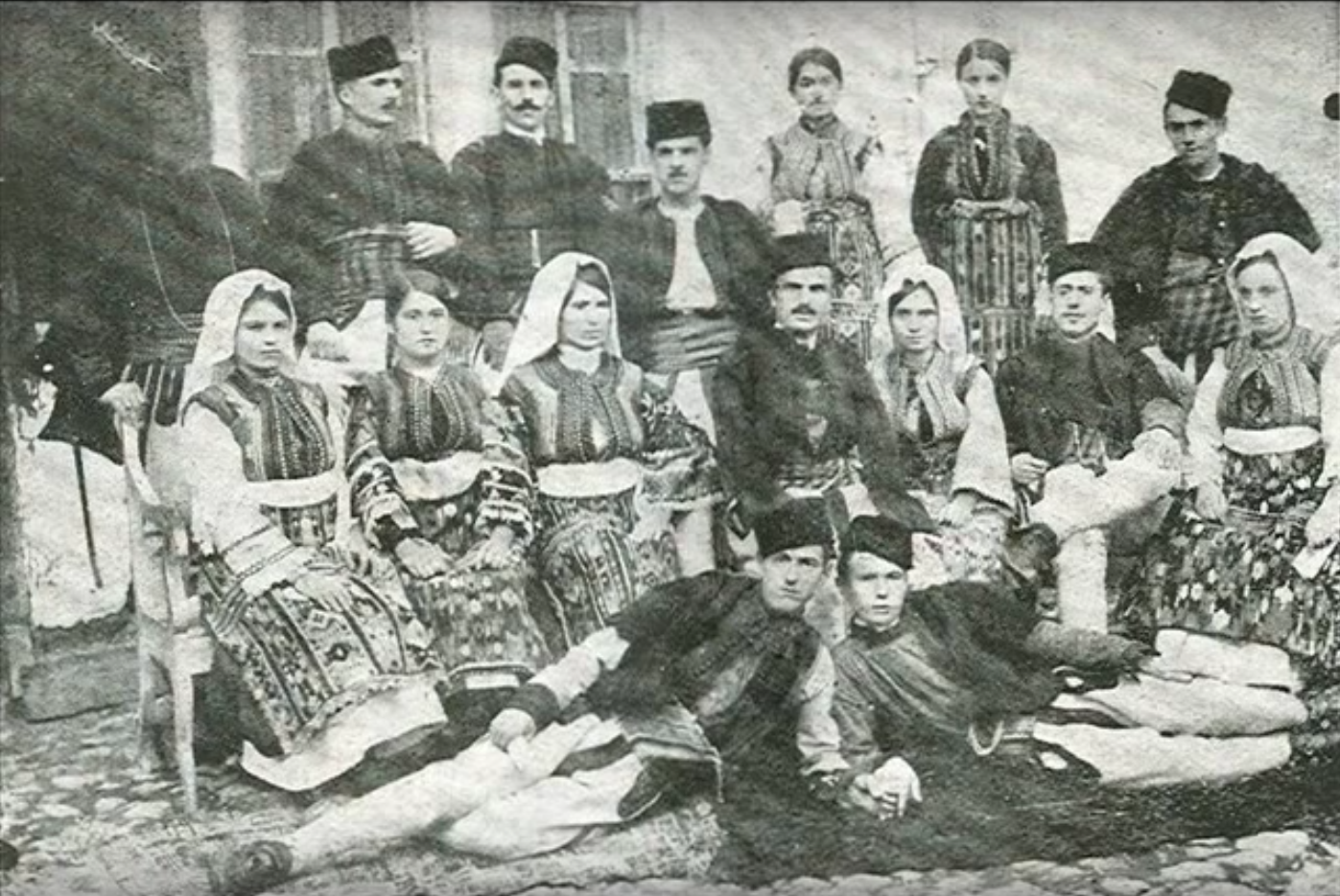
And yet people are against immigration.  What can I say.  You hear this less in Greece, but still.  It’s beyond my comprehension what people are afraid of.  “Losing their country” says the Prophet (formerly the Messenger).  Your country already belongs to Europe, America and, actually, international financial institutions.  Losing your culture?  Your culture is already long gone, a victim of modernity, globalization, vapid consumerism and the indifference of several generations of your own people, including your own, sacrificed on the altar of your own insecurity and internalized snobbery.  It’s a museum piece, like you sense in the picture above (click) without there being any real telling signals — except the suspicion that the a real Bulgarian pallikari, like the guys in the picture below, would never have traditionally put on such an ugly, cheap satin sash for anything in the world (just compare the obvious difference in material quality between the two, that comes through even the black and white of the bottom photo); he’s obviously dressing for some folklore ensemble performance or to receive a minister come visitting to their town.  Your Bulgarianness, your Polishness, your friggin’ fascist Hungarianness — were it still a dynamic living organism — would not be threatened by your country becoming 5 or 10 or 20% or even majority Syrian or Muslim.  It would survive as a thriving, blossoming minority — if it still had any life left in it.  But it doesn’t.

At no point in history did in-migration represent anything but a more dynamic, hard-working, creative population moving into a different region where there was an already pre-existing energy and dynamism gap — and no, not just in America Mr. Prophet: but Mexicans moving into the depressed American South and Southwest, where the native population, Black and White, has been dumbed to the point of idiocy and uselessness by its own government…or just the inevitable historical trajectory of things…is a great example  And you can stop that if you want by a sudden burst of spiritual fortitude (forgive me, for example, for my obvious affective bias, but I refuse to believe that Serbs will just shrink away into moronized proles), but not by building walls or hating.  That’ll only make you smaller.

And it’s only in Greece where I’ve heard from the most surprising quarters — not intellectuals, of course — but housewives and cab-drivers, that: “What the hell?  Let some of them stay.  It might do us good.”  Maybe they’re remembering what the infusion of Albanian blood into the country did in the 90s — nothing except what it’s always done through the centuries, but imbue us with greater energy and working and fighting spirit.  Or maybe they’re just smarter than their intellectuals and politicians.

Bulgarians

(click)

Comment: nikobakos@gmail.com

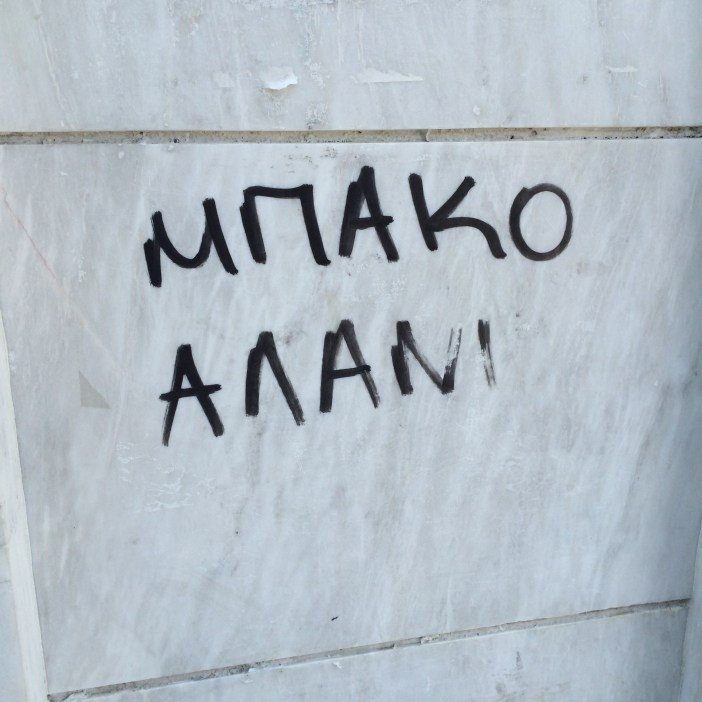
Photo: Jiannena graffitti: “Bako Alani”

4 Oct

IMG_0579

Haydi şindi and explain the word “alani.”  It means: street dude, night crawler, partier, good-for-nothing, ruffian, good ole boy — kind of all at once.  Kind of creepy because it’s not the first time I’ve been called this — just not anonymously on a wall of a Jiannena supermarket.

See also: “Photo: Μπάκο αλάνι…”Bako Alani” Redux

Comment: nikobakos@gmail.com

Maybe it’s time to make the Hajj a metaphor

1 Oct

Hajj Stampede Near Mecca Leaves Over 700 Dead from the NY Times

Hajj

You know, like that Harvard valedictorian who spoke on how “jihad” was really a metaphor for an inner spiritual struggle, and not something that involves violence of any sort.  Or at least make Umrah the spiritual equivalent so that everybody doesn’t have to go at the same time.  We’re not talking about one man, peace be upon him, his clan and their followers.  We’re talking about a billion and a half people in the age of reasonably affordable — at least once in a lifetime — air travel.

I don’t mean to be (too) disrespectful, but I’ve never met anyone who has been on hajj and, after the preliminary caveats about how it was the most spiritually edifying moment of his life, did not go on to describe a totally abysmal experience.  But then again every one I know who has been on hajj has been Afghan or South Asian and were made to feel by the Saudis and other peninisular/gulf Arabs like they should be cleaning the toilets and not praying.

I don’t know.  Just an idea.  I know I wouldn’t be caught dead near Jerusalem at Easter or Christmas on either calendar.  Or maybe ever.

Comment: nikobakos@gmail.com

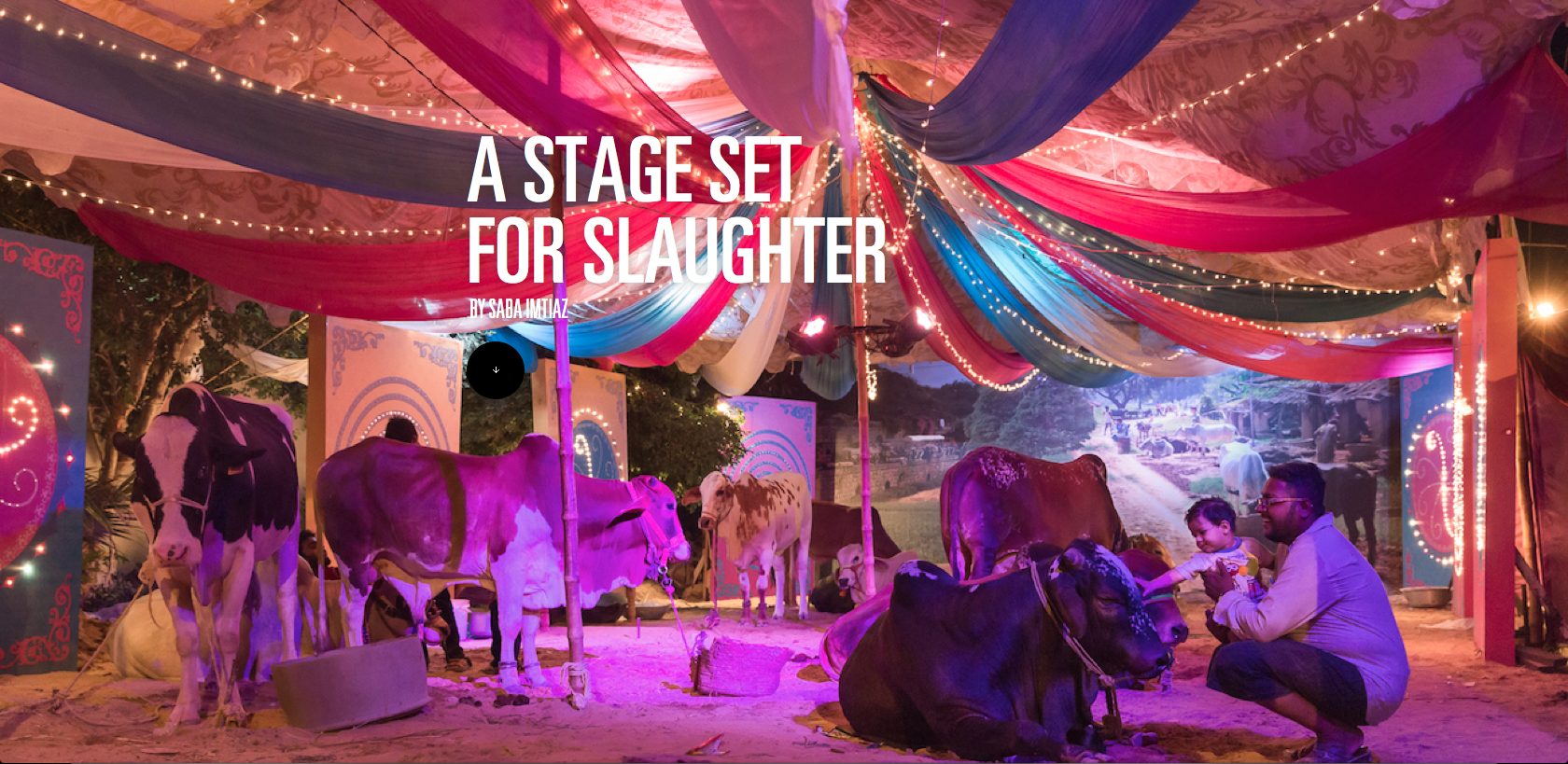
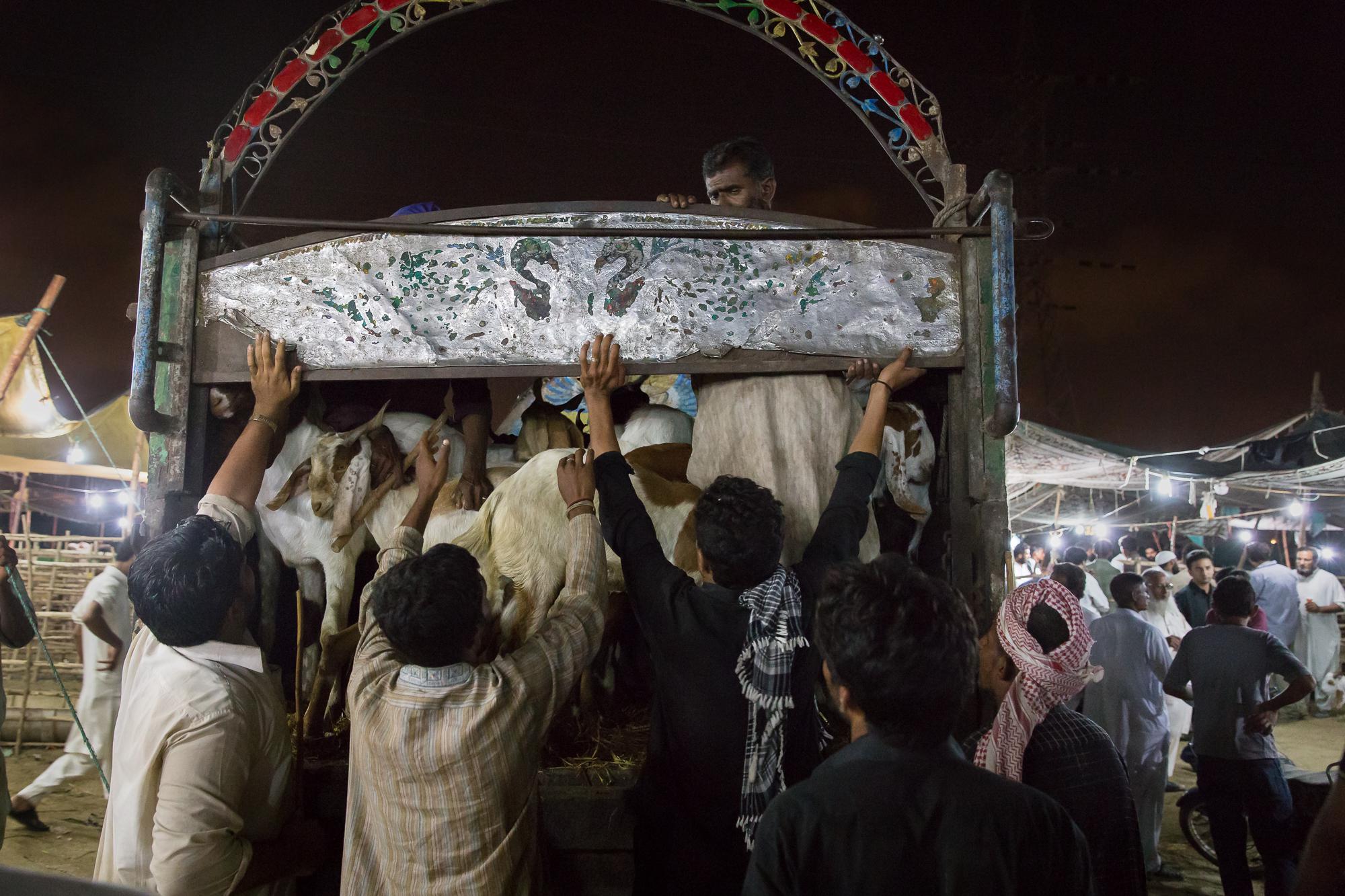
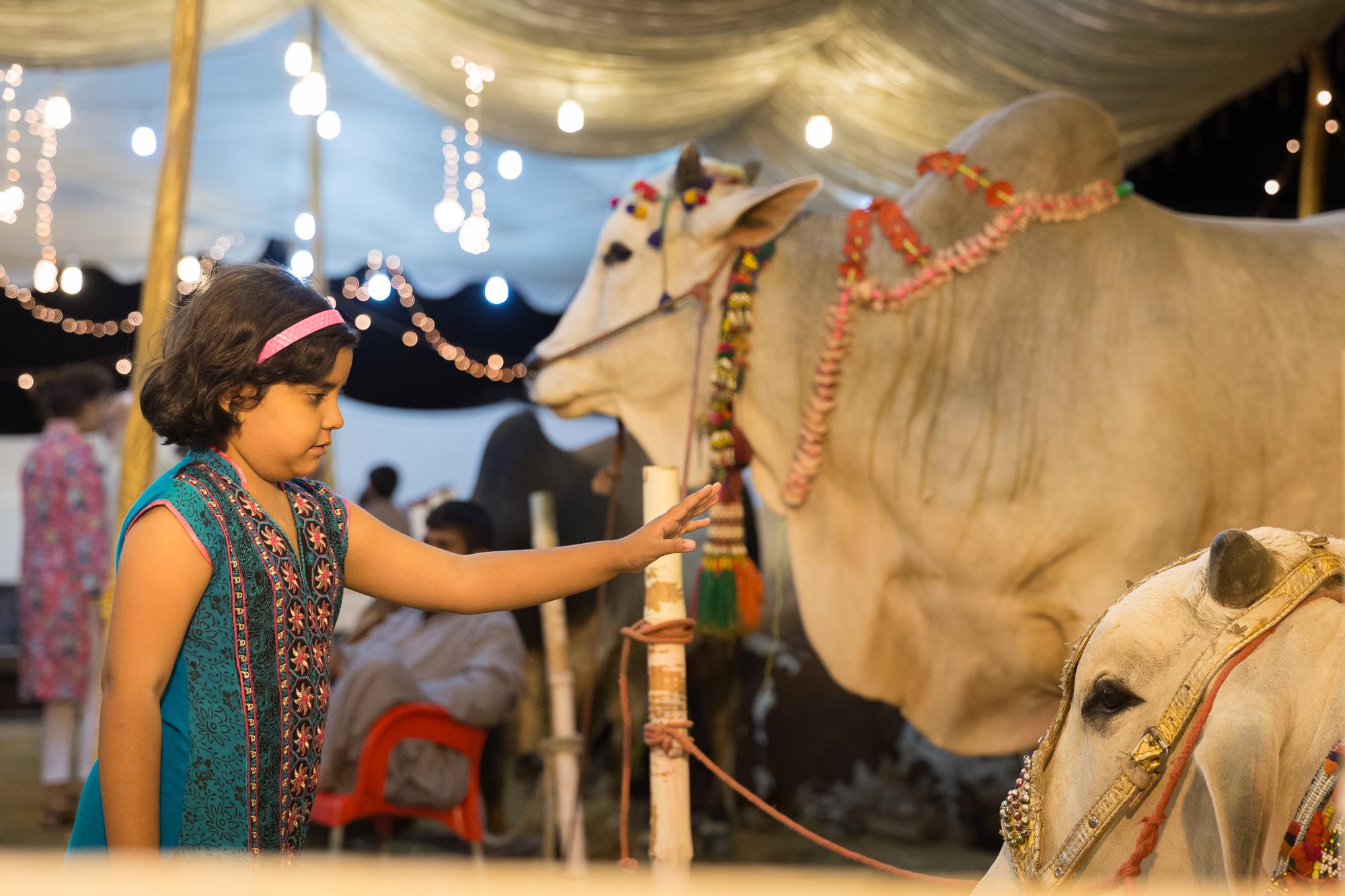
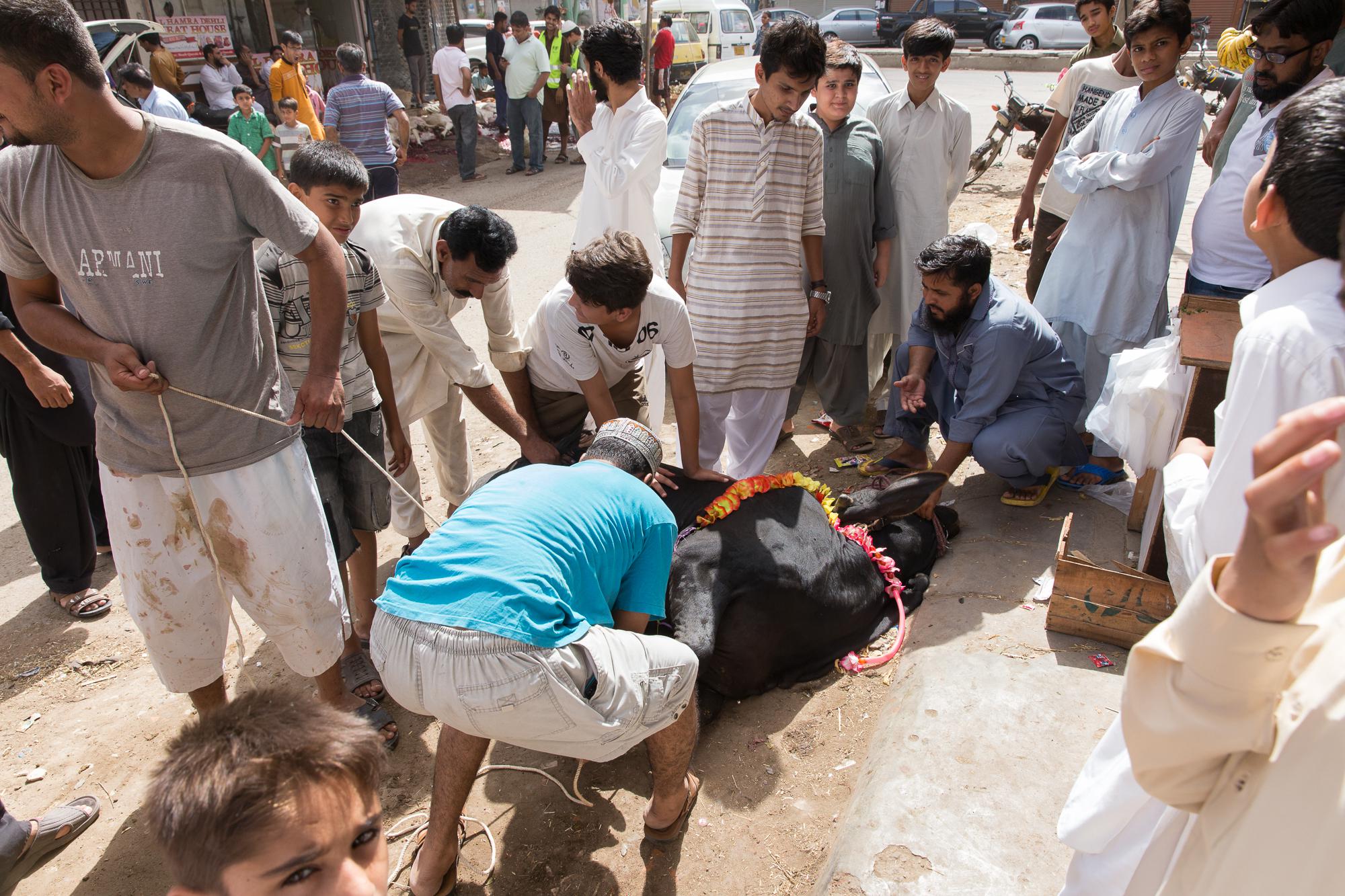
Stunner Eid-al-Adha photo essay from “Roads and Kingdoms” by SABA IMTIAZ

30 Sep

From a great site called “Roads & Kingdoms” edited — or “curated” — by my man and hero Anthony Bourdain among others.  An insult it call it either a travel, much less a “foodie,” site.  These photos of the Muslim feast commemorating Abraham’s willingness to sacrifice his son Isaac if it was God’s will are just stunners.  It comes at the beginning or end of Hajj; I can’t remember.  Forgive me Ms. Imtiaz for just blatantly ripping them off like this.  I couldn’t resist.*

Click on all of them.  The files are huge and they’re knock-outs.  Or just go to the original piece and see them in their full glory — “A Stage Set for Slaughter“, because her writing is impressive too — though not quite as celebratory as one — or NikoBako — might have wanted; she seems to have done the piece to get over her own vegetarian apprehensions — dunno.

“A butcher drags a white bull to one side and ties its front hooves together. Two men force the animal to lie down while another bull looks on unworriedly, perhaps not realizing it is next in line. The men hold the bull down firmly as the butcher says “Allah, Allah” and slices a knife across its throat. Bright red blood gushes out and pools onto the street.

“The cow thrashes once, twice, and then lies still.”

Adha 1

Adha 2

Adha 3

Adha 4

Adha 5

Adha 6

Adha 7

Adha 8

Adha 9

Adha 10

Adha 11

Adha 12

Adha 13

Adha 14

Adha 15

Adha 16

Saba Imtiaz is a freelance journalist in Karachi, Pakistan, and the author of Karachi, You’re Killing Me! Her work is available on sabaimtiaz.com and she can be contacted at saba.imtiaz@gmail.com.

******************************************************************************************************************************************************************

* I imagine it’s unethical, but since being forcibly expelled from journalism internment camp, I could kinda give a sh*t, unless Ms. Imtiaz has a problem, which I’m sure she’ll let me know as I’ve contacted her.  Meanwhile, I’ll consider it fair use which is all I remember from legal.

Comment: nikobakos@gmail.com

Börek II — or Burek and the end of Yugoslavia

26 Aug

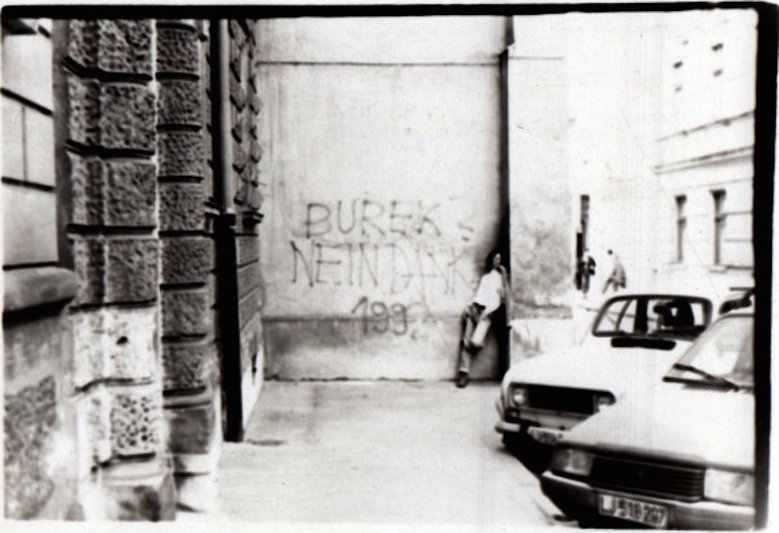
Börek Nein Danke

(click)

This is a piece of graffiti that appeared in the Slovenian capital city of Ljubljana in 1992, at the beginning of the worst period in the Yugoslav wars and after Slovenia had become independent. “Burek [‘börek’ in Turkish, pronounced exactly like an umlauted German ‘ö’]? Nein Danke.” Burek? Nein Danke. “Burek? No Thank You.” What a silly slogan, ja? How innocuous. What could it possibly mean? Who cares? And how can NikoBako maintain the bizarre proposition that a piece of graffiti in a rather pretentious black-and-white photograph is an important piece, in its ugly, dangerous racism, of the break-up of Yugoslavia.

Back up then. There are certain — usually material — aspects or elements of Ottoman life in the Balkans, which, even for Christians in the region, despite the centuries of unfortunate hate and reciprocal bloodletting (and no, I don’t think pretending that wasn’t true or that “it wasn’t that bad” is the key to improving relations between us all now; I think the truth is the key), remain objects of a strange nostalgia and affection. They linger on — even if unconsciously, or even as they’re simultaneously an object of self-deprecating humour or considered homely backwardness – as evidence that Ottoman life had a certain refinement and elegance that these societies have now lost. You sense this often intangible and not explicitly acknowledged feeling in many ways. Folks from my father’s village, Derviçani, for example, now go to Prizren in Kosovo to order certain articles of the village’s bridal costume because they can no longer find the craftsmen to make them in Jiannena or Argyrocastro, and they’re conscious of going to a traditional center of Ottoman luxury goods manufacture. You feel it in what’s now the self-conscious or almost apologetic serving of traditional candied fruits or lokum to guests. Or still calling it Turkish coffee. Or in Jiannena when I was a kid, when people still had low divans along the walls of the kitchen where they were much more comfortable than in their “a la franca” sitting rooms. 1* Perhaps the sharpest comparison is the way the word “Mughlai” in India still carries implications of the most sophisticated achievements of classical North Indian…Muslim…culture, even to the most rabid BJP nationalist. 2**
49614968

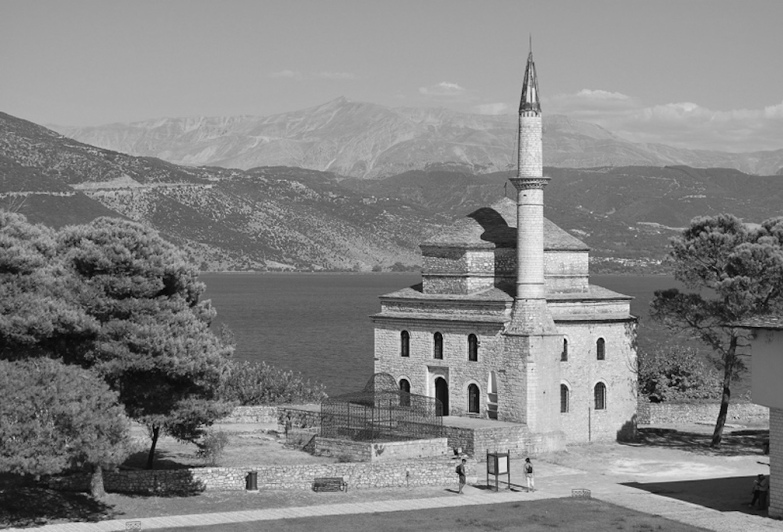
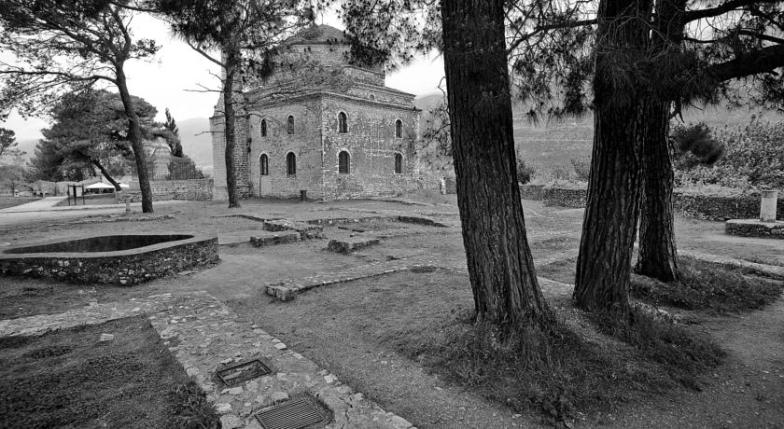
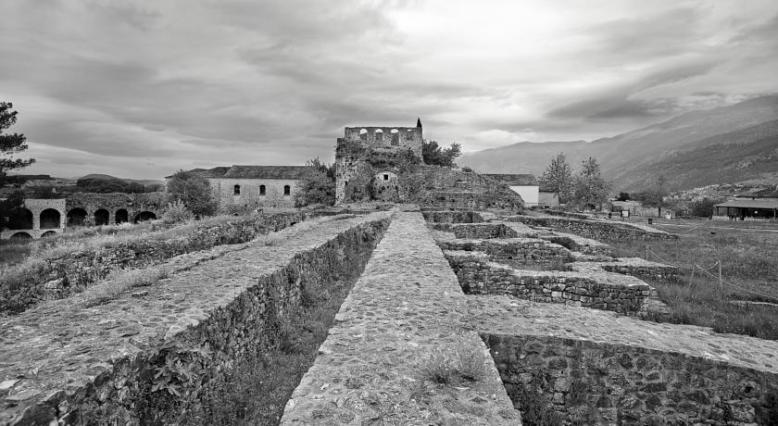
There are some places where this tendency is stronger than in others. Sarajevo and Bosnia are obvious; they still have large Muslim populations though and, after the 90s, Muslim majorities. But Jiannena – which I’ll call Yanya in Turkish for the purposes of this post, the capital city of Epiros and one often compared to Sarajevo: “a tiny Alpine Istanbul” – is also one such place. Readers will have heard me call it the Greek city most “in touch with its Ottoman side…” on several occasions. You can see why when you visit or if you know a bit of the other’s past: or maybe have some of that empathy for the other that’s more important than knowledge.
49611950

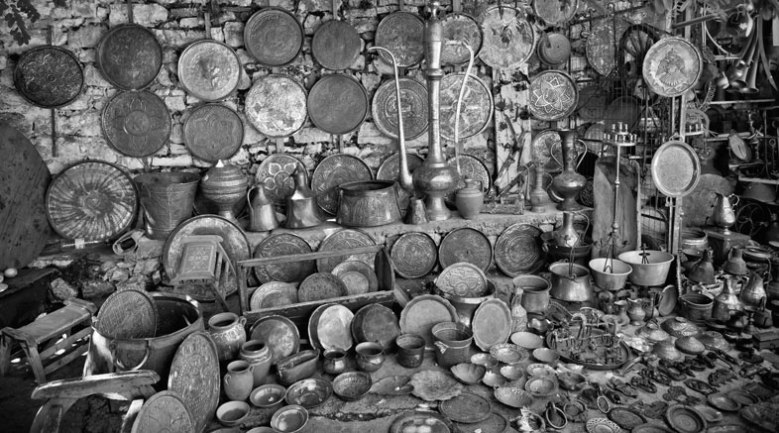
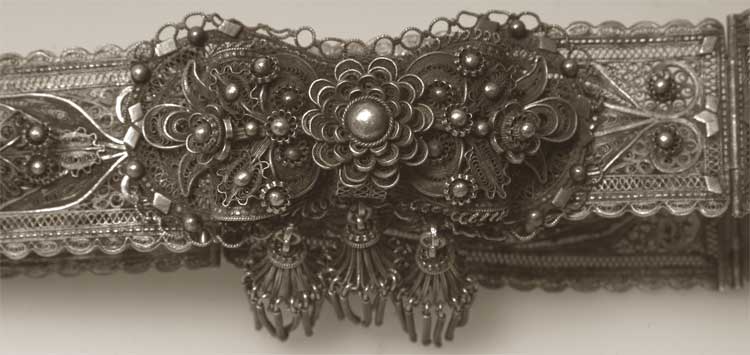
About half Greek-speaking Turks before the Population Exchange, Yanya was a city the Ottomans loved dearly and whose loss grieved them more than that of most places in the Balkans. It’s misty and melancholy and romantic. It has giant plane trees and had running waters and abundant springs in all its neighbourhoods, along with a blue-green lake surrounded by mountains snow-capped for a good five or so months of the year. It experienced a period of great prosperity in the eighteenth and especially nineteenth century, when it was not only a rich Ottoman commercial city but also a center of Greek education: “Yanya, first in arms, gold and letters…” – and, especially under the despotic yet in certain ways weirdly progressive Ali Paşa, was the site of a court independent enough to conduct foreign policy practically free of the Porte and fabulous enough to attract the likes of Pouqueville and Byron, the latter who never tired of commenting on the beauty of the boys and girls Ali had gathered among his courtiers, as Ali himself commented profusely on Byron’s own. All the tradition of luxury goods associated with the time and the city: jewelry, silver and brassware, brocade and gold-thread-embroidered velvet, sweets and pastries – and börek – still survive, but are mostly crap today, even the börek for which the city used to be particularly famous, and your best luck with the other stuff is in the city’s numberless antique shops.
ioannina-epirus-greece-the-antiqe-market-hip

identical to yiayia's belt

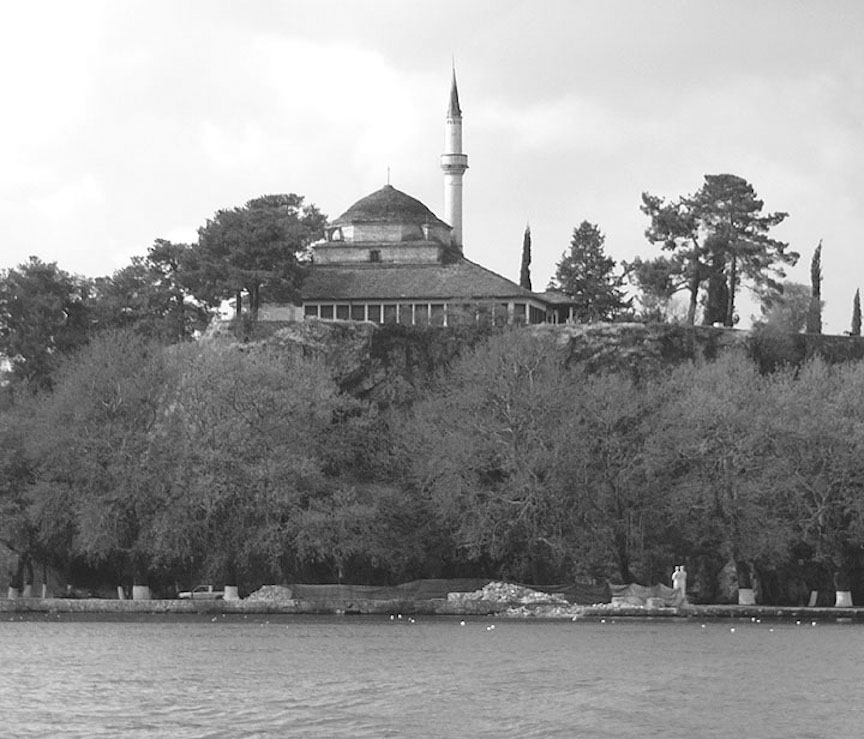
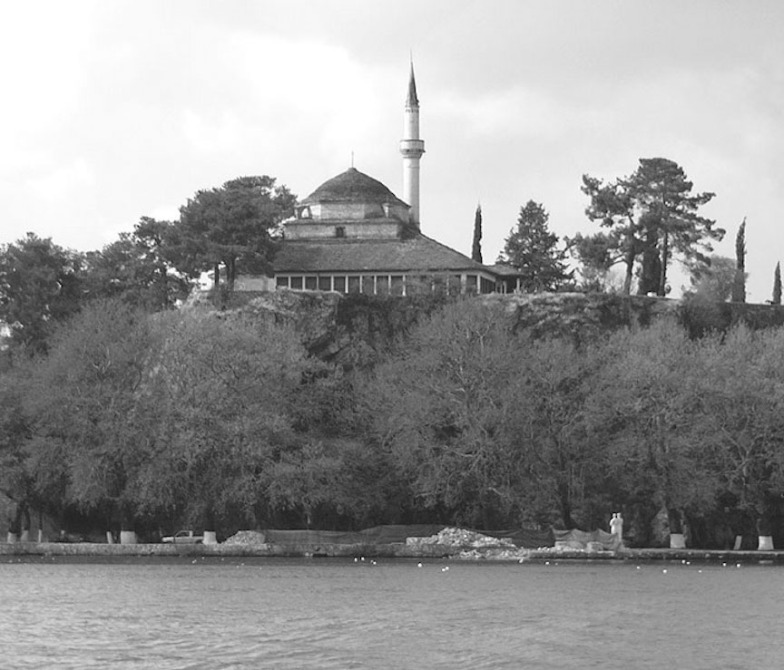
It also, unusually, and which I like to ascribe to Yanyalıs’ good taste and gentlenesss, has preserved four of its mosques, the two most beautiful in good condition even, and on the most prominent point of the city’s skyline.  It would be nice if they were opened to prayer for what must be a sizable contingent of Muslim Albanian immigrants now living there — who are practically invisible because they usually hide behind assumed Christian names — but that’s not going to happen in a hundred years, not even in Yanya.  Maybe after that…we’ll have all grown up a little.
ioannina165

janina

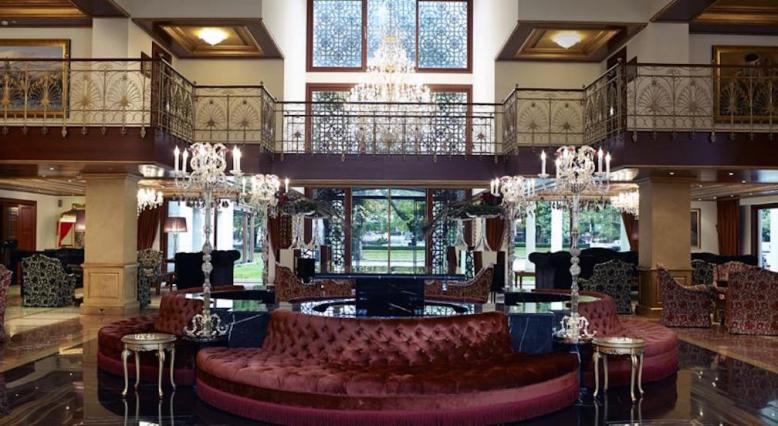
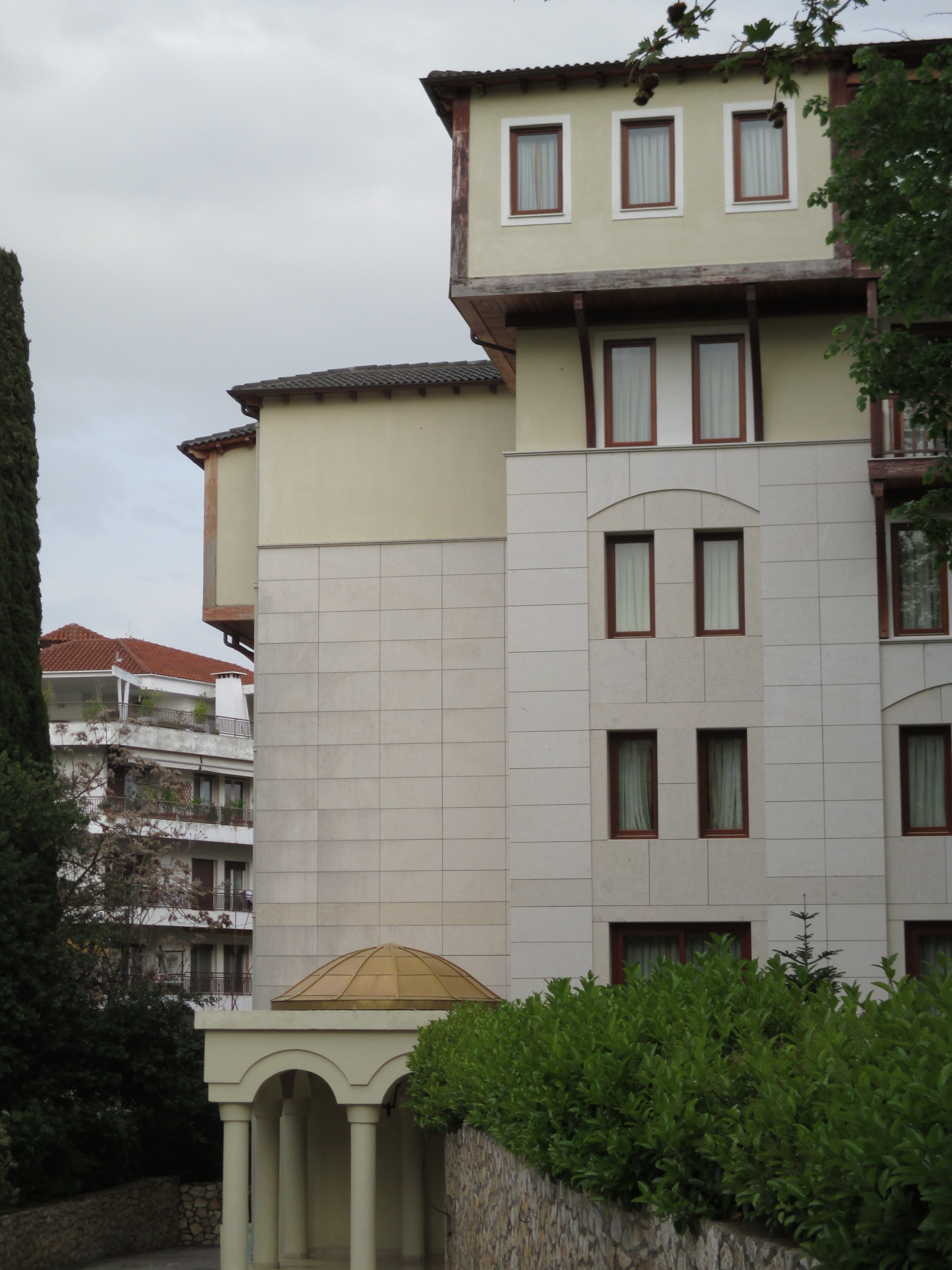
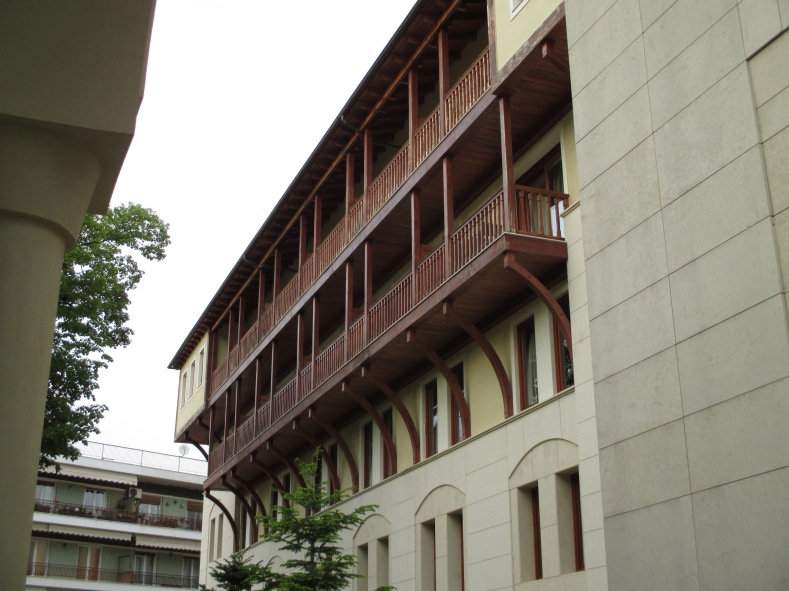
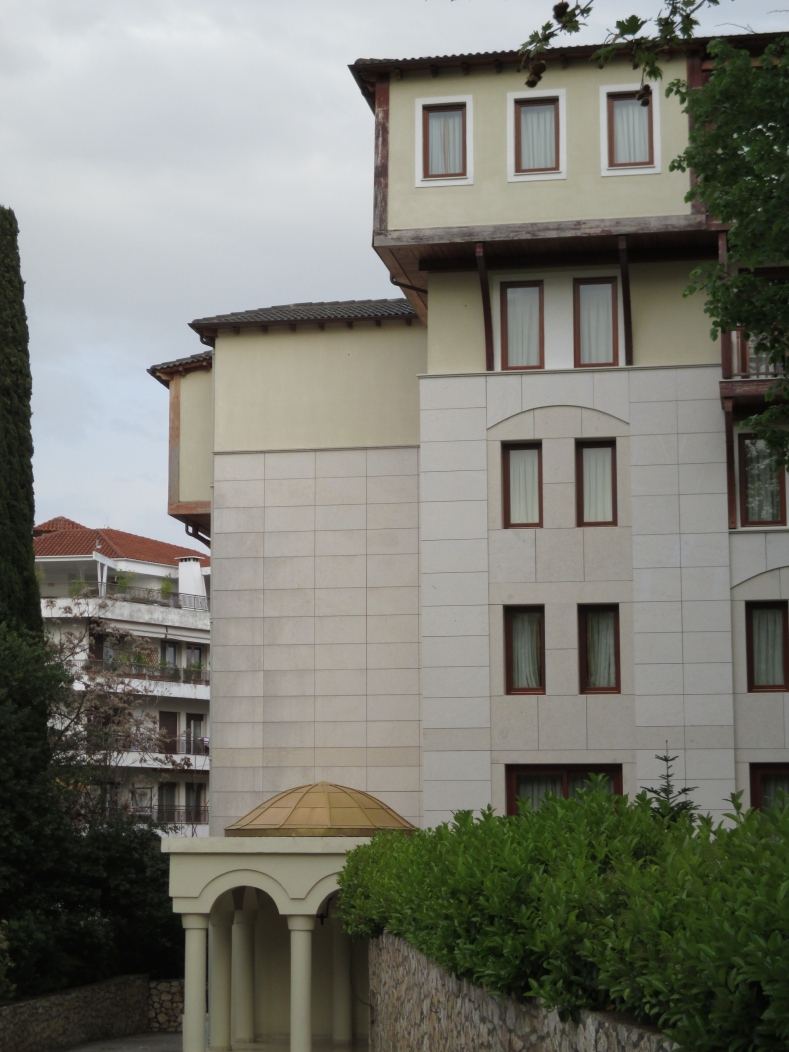
And, alone perhaps among Greek cities, only in Yanya can one open a super-luxury hotel that looks like this, with an interior décor that I’d describe as Dolmabahçe-Lite, call it the Gran Serail, and get away with it. 3***
IMG_0213

IMG_0215

44471198

Digression Bakos. What’s the point? What does this have to do with Yugoslavia? I’m not digressing. I’m giving a prelude. “People don’t have the patience for this kind of length on internet posts.” I don’t post. I write, however scatterbrainedly. And not for scanners of posts. For readers. However few have the patience.

So. Croatians don’t eat börek. The prelude should have been enough for me not to have to write anything else and for the reader to be able to intuit the rest. But for those who can’t…

The graffiti on the wall in the photo at top is dated 1992, but I think it had appeared as a slogan as early as the late 80s when Slovenes and Croats started airing their completely imaginary grievances against Serbian domination of Yugoslavia and making secessionary noises. What it meant is that we, Hapsburg South Slavs, were never part of the Ottoman Empire and therefore never were subject to the barbaric and development-stunting influences of said Empire that Serbs and whoever those others that live south of them were, and therefore have the right to be free of the intolerable yoke of Serbdom. We don’t eat burek. Not only do we not eat burek, but you offer it to us and we’ll refuse in German – “Nein Danke” – just to prove how much a part of the civilized Teutonic world of Mitteleuropa we are. 4*** (I think it was Kundera who wrote about the geographical ballooning of “Central Europe” after the fall of communism, till “Eastern Europe” finally came to mean only Russia itself. ‘Cause as we now see, even Ukraine is part of Central Europe.)

Why this yummy pastry dish was singled out as a sign of Ottoman backwardness and not, say, ćevapi or sarma, I can’t say.
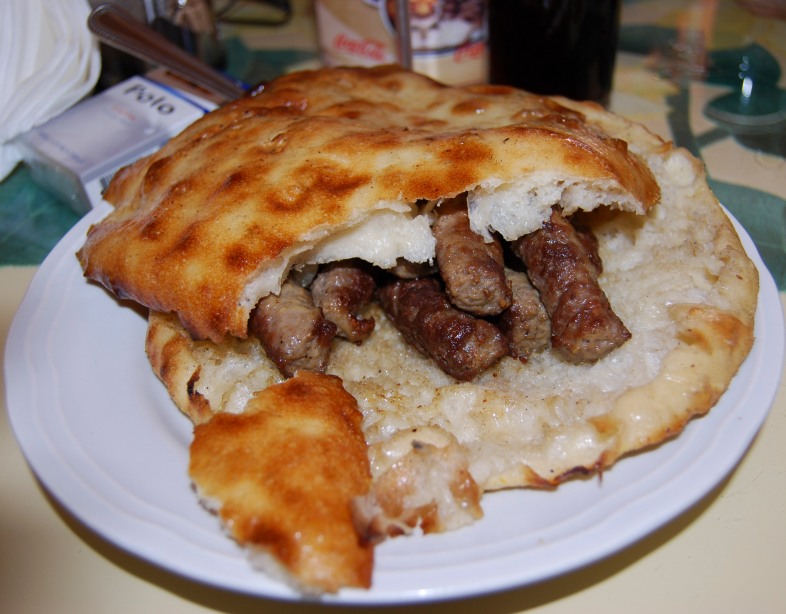
Cevapi54

Ćevapi — köfte, essentially — (above) and sarma (stuffed cabbage) below.
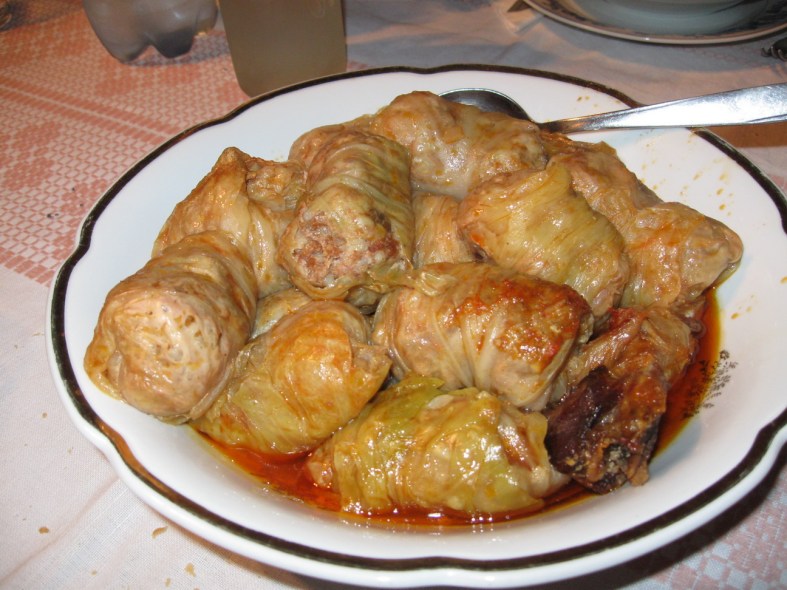
sarma raspakovana

And when I talk about Hapsburg South Slavs I’m obviously talking about Croats, because, let’s face it, who cares about Slovenes? And there may be very few, if any, compelling historical or cultural reasons of interest to care about Croatians either, except, that as most readers must know by now, I consider them the people most singularly responsible for the Yugoslav tragedy. And this post is my chance to come clear about why I feel that way. There may be lots of interpretations of what the “Illyrianist” intellectuals of Vienna and Novi Sad and Zagreb had in mind when they started spouting theories of South Slav unity in the nineteenth century; countless theories about how Yugoslavia or the original Kingdom of the Serbs, Croats and Slovenes was formed; many analyses of what happened in Paris in 1919 and what kind of negotiations led to the Corfu Declaration; and reams of revisionist stuff written about exactly what Croatia wanted out of this union. But, for me, one basic fact is clear: that Croatians were always part of Yugoslavia in bad faith; that they wanted something out of the Serb efforts and Serbian blood that was decisive in defeating Austria in WWI, but that that something was independence, or greater autonomy within an Austria that they probably never expected to be dismembered the way it was – anything but what they felt was being subjected to Belgrade. And that became immediately clear upon the formation of the state when they – being, as Dame Rebecca calls them, good “lawyers” – began sabotaging the normal functioning of the Yugoslav government in any way they could, no matter how more democratic the Serbs tried to make an admittedly not perfect democracy, no matter how many concessions of autonomy Belgrade made to them. If there were any doubt as to the above, even when Radić and his Croatian People’s Peasant Party had turned the Skupština into a dysfunctional mirror image of today’s American Congress, even when a Macedonian IMRO activist working in tandem with Croatian fascists assassinated Serb King Aleksandr in Marseille in 1934, it was subsequently made brutally clear by the vicious death-spree Croatian, Nazi-collaborating fascism unleashed on Serbs during WWII, a true attempt at ethnic cleansing that dwarfs anything the Serbs may have done during the 90s — which is dwarfed again by what Croatians themselves did in the 90s again: the most heinous Nazi regime, “more royalist than the king,” as the French say — more Nazi than the Nazis — to appear in Eastern Europe during WWII.  And they have not been even remotely, adequately,  held to account by the world for any for any of the above; all this ignored, even as the West maintains a long list of mea-culpas it expects Serbs to keep reciting forever.
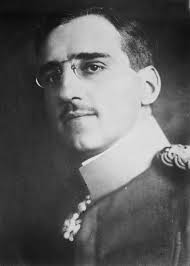
Alexander

King Aleksandr of Yugoslavia (click)

And so, when they got their chance in the 90s, with the backing of a newly united, muscle-flexing Germany, Croatians abruptly and unilaterally and illegally declared their long-wished for (but never fought-for) independence. And so did Slovenia; but again, who cares about Slovenia? It was a prosperous northern republic that may have held the same Northern-League- or-Catalan-type resentments against a parasitic south that was draining its wealth, but it was ethnically homogeneous and its departure left no resentful, or rightfully fearful, minorities behind. But Croatia knew, when it declared its independence – as did, I’m sure, their German buddies – that they were pulling a string out of a much more complex tapestry. And did it anyway. And we all saw the results. 5*****

So when a Croat says “Nein Danke” to an offer of burek, without even the slightest concern about his past reputation and avoiding any German associations, it is for me a chillingly racist and concise summation of Saidian Orientalism, a slogan that sums up not only the whole ugliness of the tragic, and tragically unnecessary, break-up of Yugoslavia, but the mind-set of all peoples afflicted with a sense of their being inadequately Western, and the venom that sense of inadequacy spreads to everything and everyone it comes in contact with. I’ve written in a previous post about Catalan nationalism:

All of us on the periphery, and yes you can include Spain, struggle to define ourselves and maintain an identity against the enormous centripetal power of the center.  So when one of us — Catalans, Croatians, Neo-Greeks — latches onto something — usually some totally imaginary construct — that they think puts them a notch above their neighbors on the periphery and will get them a privileged relationship to the center, I find it pandering and irritating and in many cases, “racist pure and simple.”  It’s a kind of Uncle-Tom-ism that damages the rest of us: damages our chances to define ourselves independent of the center, and damages a healthy, balanced understanding of ourselves, culturally and historically and ideologically and spiritually.  I find it sickening.

(see also: “Catalonia: ‘Nationalism effaces the individual…'” )

We’re signifying animals. And our tiniest decisions — perhaps our tiniest most of all – the symbolic value we attribute to the smallest detail of our lives, often bear the greatest meaning: of love; of the sacred; of a sense of the transcendent in the physical; of our self-worth as humans and what worth and value we ascribe to others; of hate and loathing and vicious revulsion. Nothing is an innocently ironic piece of graffiti – irony especially is never innocent, precisely because it pretends to be so.

And so I find anti-börekism offensive. Because a piece of my Theia Vantho or my Theia Arete’s börek is like a Proustian madeleine for me. Because I’m not embarrassed by it because it may be of Turkish origin. Because I think such embarrassment is dangerous – often murderously so, even. And because I think of eating börek — as I do of eating rice baked with my side of lamb and good yoghurt as opposed to the abysmally soggy, over-lemoned potatoes Old Greeks eat – as an act of culinary patriotism. 6****** And a recognition that my Ottoman habits, culinary and otherwise, are as much a part of my cultural make-up as my Byzantine or even Classical heritage are. Because just like Yugoslavia, you can’t snip out one segment of the woop and warf and expect the whole weave to hold together.
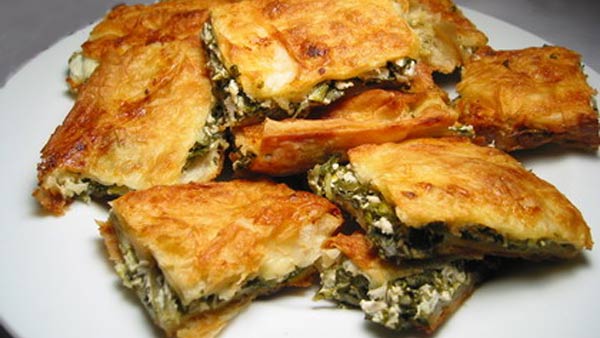
spinach-burek

******************************************************************************************************************************************************************

*1  One thing judo taught me — or rather what I learned from how long it took me, when I started, to learn to sit on my knees and flat feet — is how orthopedically horrible for our bodies upright, Western chairs and tables and couches are.  (By couch here I don’t mean the sink-in American TV couch, which you sink into until you’re too fat to get out of — that’s another kind of damage.)  Knee and lower back problems at earlier ages are far more prevalent in the Western world precisely because of these contraptions that artificially support and distort our body weight in destructive ways.  I remember older aunts in Epiros, in both Jiannena and the village, being able to sit on a low divan on the floor and pull their legs up under their hips with complete ease — women in their eighties and nineties and often portly at that — because their bodies had learned to sit on the floor or low cushions all their long and very mobile lives; they looked like they didn’t know what to do with themselves when you put them in a chair.  I’m reminded of them when I see Indian women their age at mandirs, sitting cross-legged, or with legs tucked under as described, through hours-long rituals, rising to prostrate themselves and then going down again, and then finally just getting up at the end with no pain and no numbness and no oyyy-ings.

**2  The two masterpieces of this point: the celebration of the sophistication and sensuality of the Ottoman sensibility and a trashing of Neo-Greek aesthetics — and by extension, philisitinism, racism and Western delusions — are Elias Petropoulos’ two books: Ο Τουρκικός Καφές εν Ελλάδι“Turkish Coffee in Greece,” and Tο Άγιο Χασισάκι “My Holy Hash.”  Part tongue-in-cheek, part deadly serious, both books are both hilarious and devastating.

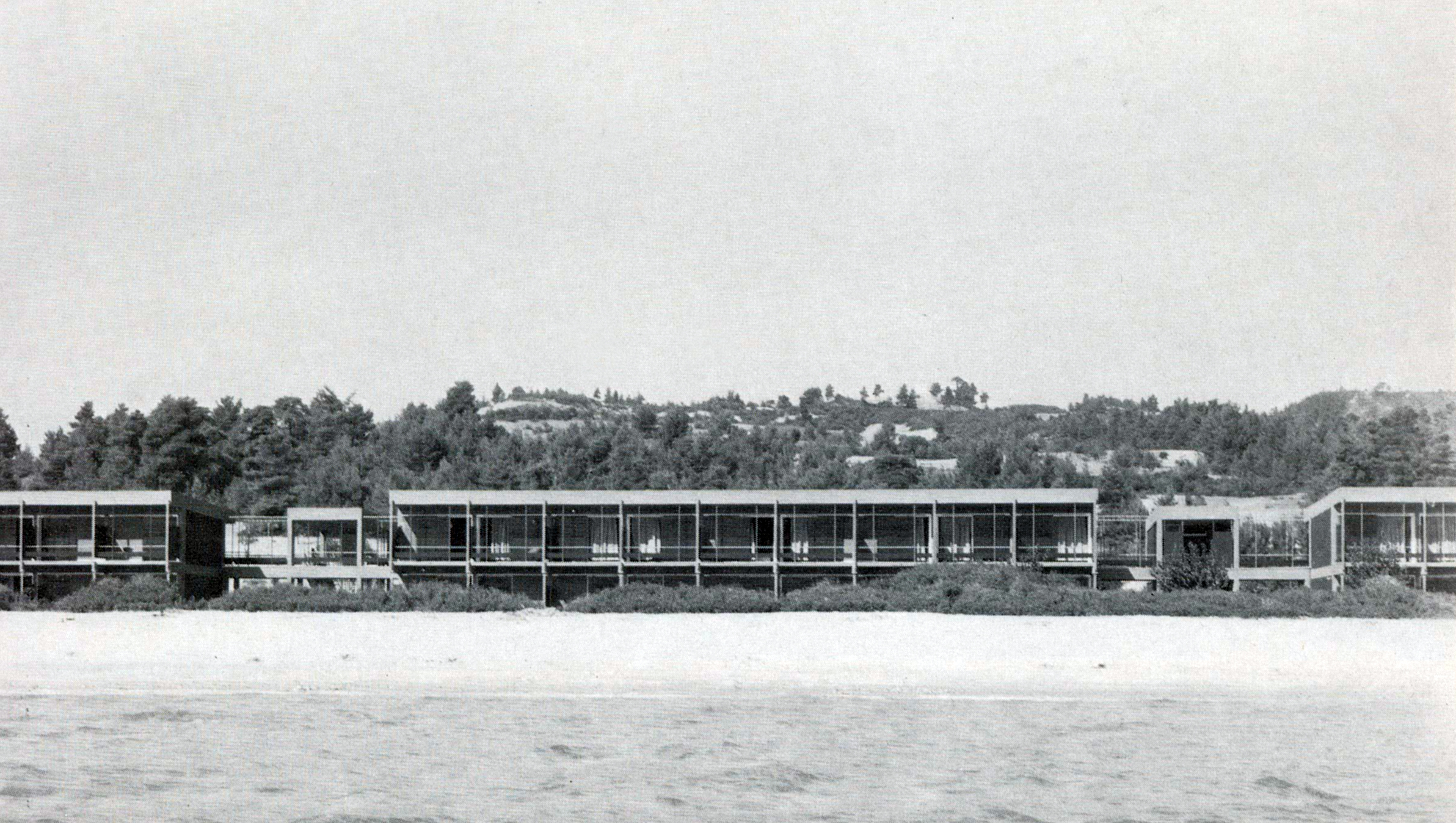
***3  Unfortunately, to build this palace of Neo-Ottoman kitsch that would make Davutoğlu proud, one of Greece’s classic old Xenia hotels, masterpieces of post-war Greek Modernism and most designed by architect Aris Konstantinidis, was torn down, and most of these hotels have suffered similar fates throughout the country, as the nationally run State Tourist Organization was forced to sell off its assets by the privatization forced on Greece then and to this day.
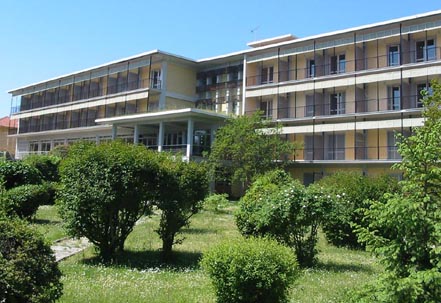
Xenia Jiannena

The Jiannena Xenia, above, built in the old wooded grove of Guraba, just above the center of town, and, below, perhaps Konstantinidis’ masterpiece, the Xenia at Paliouri in Chalkidike. (click)
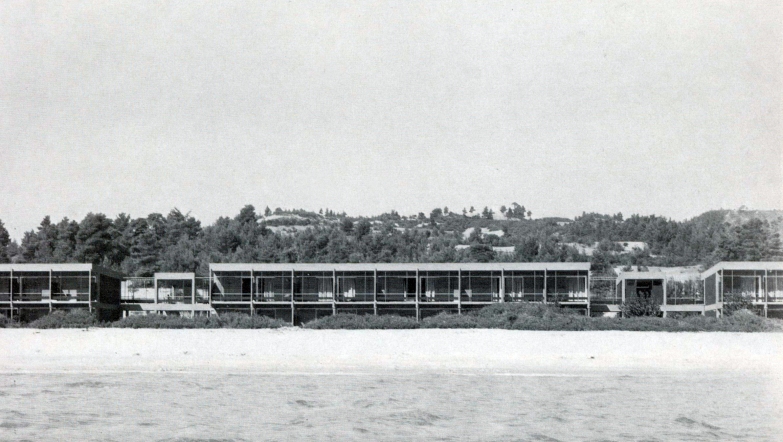
Eot-paliouri-1962-2

Fortunately, Jiannena preserves one of Konstantinidis’ other masterpieces, its archaeological museum, below. (click)
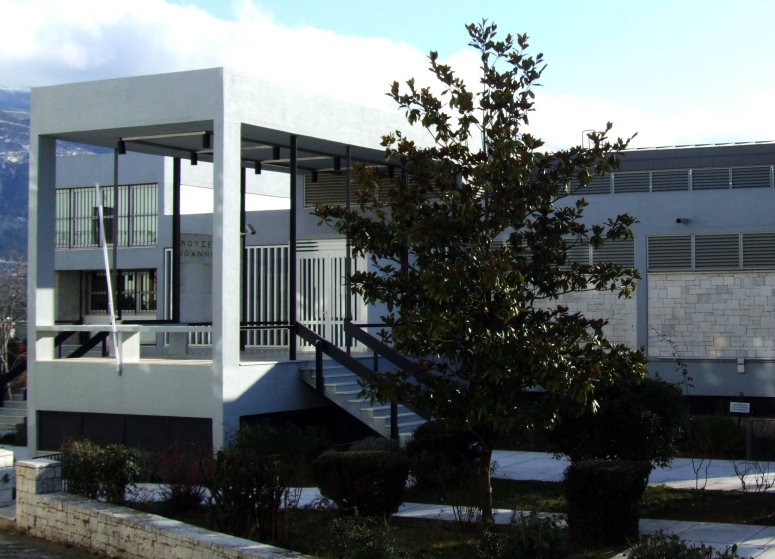
100_6975_-_Kons.Ioan1

****4  Ironically, the strudel that Croats and Slovenes imagine themselves eating in their Viennese wet dreams is probably a descendant of börek; and take it a step further: let’s not forget that croissants and all danish-type puff pastry items are known generically as viennoiserie in French.  So the ancestor of some of the highest creations of Parisian/French/European baking arts is something that a Slovene says “nein danke” to in order to prove how European he is.  Talk about the farcicalness of “nesting orientalisms.”
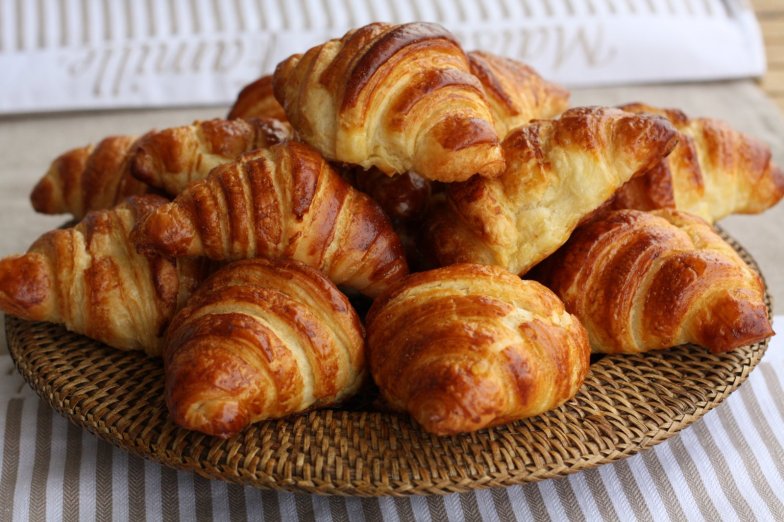
croissant

*****5  Of course, in every case, this assumption-cum-accusation, about the parasitic South draining the North of its resources, is patent bullshit.  Southern Italy, the southern Republics of Yugoslavia, Castille, Galicia, Andalusia, and the southern tier of the European Union today, may get disproportionately more in the allotment of certain bureaucratic funds compared to the tangible wealth they produce.  But they also provide the North, in every single one of these cases, with resources, labor and markets on which that North gets rich to a far more disproportionate degree and stunts the South’s growth in the process.  So haydi kai…

It’s become a common-place — and not inaccurate — observation that the catastrophic economic pressure Germany is today exercising on the nations of Southern Europe for the sake of making some sick moral point is the fourth time it’s wrecked Europe in less than a centurythe third time being when it decided, immediately upon reunification, to show the continent it was a political player again by practically single-handedly instigating the destruction of Yugoslavia.

******6
patattes

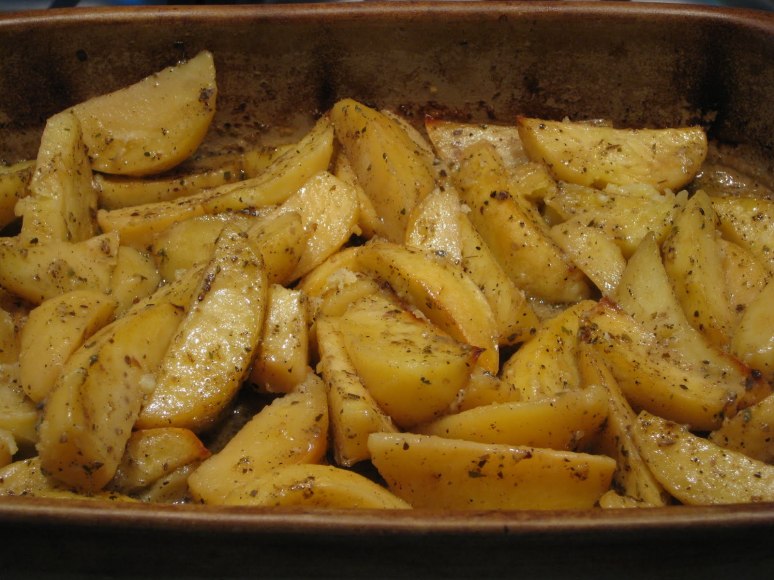
Over-oreganoed and over-lemoned — like much of Greek food — and overdone, over-salted and over-oiled, perhaps the only thing more repulsive than the soggy potatoes Old Greeks bake with lamb or chicken (though one horrible restaurant — which New Yorkers are for some reason crazy about: I mean like “take-the-N-train-out-to-Astoria-and-wait-for-a-table-for-an-hour” crazy — criminally serves them with grilled fish) is the serving of stewed meat with french fries.  You’ve hit the rock bottom of Neo-Greek cuisine when you’ve had a dry, stringy “reddened” veal or lamb dish accompanied by what would otherwise be good, often hand-cut french fries, sitting limply on the side and sadly drowning in the red oil.

Comment: nikobakos@gmail.com

Response to “Photo: Sarajevo gastra and börek”

26 Aug

Screen Shot 2015-11-04 at 3.08.02 PM

(click)

Philopomeon November 3, 2015 at 10:42 pm

“Philopomeon” is a guy, friend and regular reader and commentator that I should have introduced to other readers a long time ago.  We share a whole host of pet and not-so-pet grievances against Neo-Greek identity constructs, the effacement of our Romanness and the denial of the Ottoman that is a key component of that effacement.  As he mentions below: But their essentialist mind can’t grasp that food can have Byzantine or even ancient Hellenic influence and still be Ottoman!!”

He describes himself as “A diaspora Neo-Hellene, Post-Byzantine enthusiast of history and MA student in linguistics, currently residing in South Korea.”  Pretty cool.  Not sure about the “Hellene” part..

Screen Shot 2015-11-04 at 3.23.18 PM

(click)

But he writes this great blog: Gemisto’s Paradox that covers all kinds of similar and other issues as the Jadde.

Damn good write up, Nick. Oh god, I had some good arguments with the Neo-Greek Golden boys just a few days ago on the general topic of ” is Greece European ?”

So basically every time someone brought up burek/pita or baklava or souvlaki gyros kebab they mentioned how baklava ” isn’t really eaten anymore ” and that souvlaki is ” Ancient Greek” ( never mind that gyros is exactly doner kebab!!) Though I suppose the pita/Bougatsa stuff has a deep Romaic/Byzantine influence ( focaccia-Bougatsa). But their essentialist mind can’t grasp that food can have Byzantine or even ancient Hellenic influence and still be Ottoman!!

Oh, and one woman had the nerve to tell me ( in a public conversation to prove our europeaness!) that pita bread isn’t eaten by Greeks Oh my god- isn’t the word etymologically greek ?? These people are even willing to throw away what ancient Hellenic heritage we have just to join the White people club ( or maintain said membership). In the meantime they can eat processed pasta and pizza that is too salty ( una fascia, una razza, right?)

Though as a southern island boy, I’ve gotta say, potatoes go well with everything. Places like Naxos, Ikaria, Kalymnos- it was what kept us alive 1941-1948 more or less.

Check out his blog when you get a chance and see his own list of other interesting ones:

Screen Shot 2015-11-04 at 3.27.15 PM

In reference to his potatoes comment, my feelings about their ubiquity in southern Greece — that I almost find them an abomination — are closely related to the up-coming second part of my börek post: “The symbolics of börek and the break-up of Yugoslavia”

Comment: nikobakos@gmail.com

Photo: Sarajevo gastra and börek…or Börek I

24 Aug

Börek gastra Sarajevo

(click)

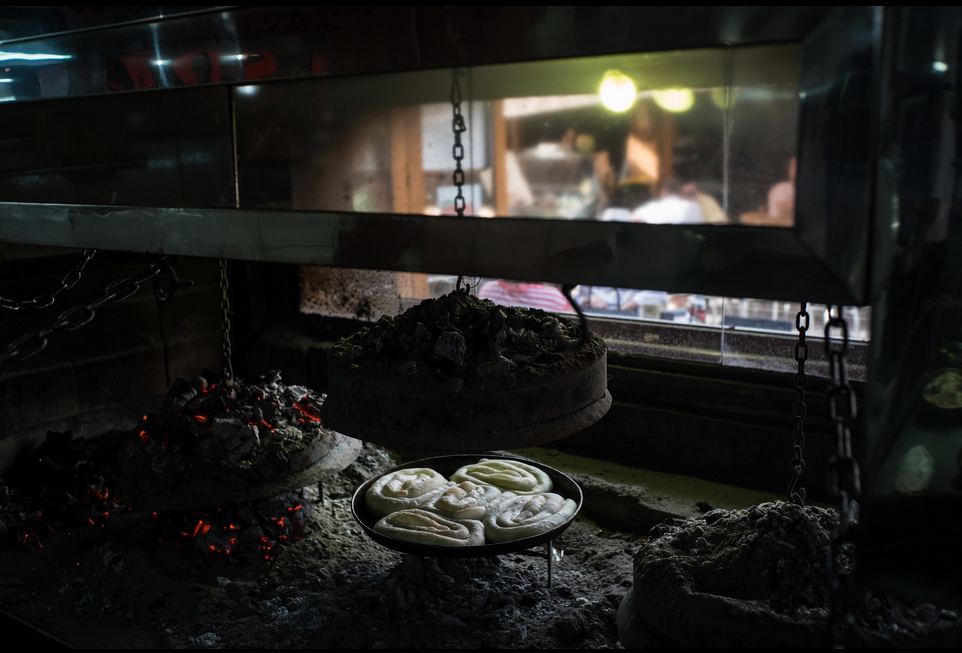
These are börek in Sarajevo being baked in a gastra, a strange piece of High Ottoman technology that is still used in much of northern Greece, especially Epiros and the rest of the Balkans, particularly the western parts: Albania, Montenegro (where uniquely in the Serb-speaking world, they call börek pitta like in Greek), Kosovo and southern Serbia — regions, interestingly enough, where börek is a particularly strong regional identity marker and the object of a powerful cult of affection and snobbery.  Every and each börek in these parts is subjected to intense scrutiny; is there too much filling (major demerit points because you’re obviously trying to make up for the poor quality of your phyllo/yufka); is each layer fine enough, but able to both absorb serious quantities of butter and not get soggy, like a good croissant or a good paratha.  Finally, that you use real — and good — butter, which makes almost all commercially sold varieties not worth trying, since using good butter on a commercial scale would make a börek that is prohibitively expensive, and especially in a country of culinary philistines like Greece, store-bought versions are almost inedible, as is most product in Turkey these days too, Turkish street food having suffered a marked decline in quality even as the tourist literature on the country continues to rave about it.  But I have had good börek in Macedonia, in Mavrovo, and in Montenegro, in Žabljak, where the hotel made us a great cheese and a great cabbage one for a hike we went on.  And in a high-end restaurant in Jiannena too; but next to me was an Albanian woman, who first smelled it, pricked at it with her fork, counting the layers of pastry, and then after a few minutes of just staring at it, pushed it away in disgust.  Like I said, it’s an object of great snobbery.  And forget Old Greece.  It’s a standard rule of thumb that the further away in place and time a region of Greece is from the Ottoman experience, the exponentially worse the food gets.  No one south of Larissa can bake a pitta to save their lives, or make a decent plate of pilav for that matter.  Epiros is probably the only place you can still get a nice buttery mound of pilav — like the kind Turks make — with good yogurt.  Southern Greeks seem allergic to rice, and have friggin’ potatoes with almost every meal.  Maybe It’s a Bavarian thing — I dunno.

some really good borek

Reaaally good stuff, in Mavrovo, Macedonia (click)  (See post: Macedonia: Mavrovo, Dimitri and the Two Falcons)

But everything baked tastes better in a gastra, the same root as the word for “womb” in Greek (or “gastritis”): rice and lamb, even zeytinyağlı vegetable dishes.  It’s just incredibly tedious — and dangerous if you don’t know what you’re doing — to use.  It’s a cast-iron dome, suspended with a very complicated chain mechanism over a stone platform.  You first lift the dome and light your charcoal fire underneath it on the stone platform.  When the fire has been reduced to hot embers, and the cast-iron dome has also gotten nice and hot, you brush the embers aside, position your tepsi of food, lower the hot cast-iron dome, and then pile the still glowing embers on top of the dome.  Usually when they’ve cooled down completely the dish is done.  The picture above shows gastras at all steps in the process.

I dunno really.  Does it make that much of a difference?  Everything is better when it tastes slightly smokey or when a little bit of ash has fallen into it — like Turkish coffee made in hot ashes.  But it’s a ton of work and really impractical.  If, for example, the embers go out completely and you raise the dome and the food isn’t done yet, you have to start the whole process from the beginning.  Arthur Schwatrz, in his ever-best cookbook on Neapolitan food, Naples at Table: Cooking in Campania — which, like most good cookbooks these days, is as fantastic a source of history, anthropology and ethnography as it is of good recipes — says that a lot of foods legendary for how long you had to cook them for them to be the “real” article, like a Neapolitan ragù (pronounce with a double “r” and a “g” that sounds like a light Greek “gamma” – “γ”) that should take at least half a day to simmer or no self-respecting Neapolitan would eat it, were never really cooked that long.  Rather, they were cooked on wood fires and braziers, which were constantly going out, had to be relit, while the sauce cooled off and took time to reheat, etc.  Of course, for certain sauces and stews, and the fatty, sinewy cuts of meat we like in “our parts,” this kind of cooking is ideal.  And not just the slow, long heat, but the cooling off and reheating especially.

Naples at Table

Ottoman mangal

(click)

It’s like that other piece of Ottoman high-tech (I don’t mean to make fun, but it wasn’t exactly their strong suit), the mangal home-heater or charcoal brazier. (above)  You’d pile charcoal into it; leave it out in the street until the carbon monoxide burned off, then cover the embers with the lid and bring the whole incredibly dangerous, glowing — and often very large — brass behemoth inside to warm the house, or one hermetically sealed room really.  Then, as my mother used to describe it, you’d get under the blankets or flokates, facing the mangal, so your face would turn all red and sweaty while your back was freezing, and hope you had fallen asleep before it started cooling off or that you had generated enough body heat under the blankets to last till morning.  There were countless stories about families being found dead in the morning, because in the rush to bring this silly contraption into the freezing house, the carbon monoxide often hadn’t burnt off entirely and people would die from poisoning in their sleep.  I can only imagine that their use was required because it was probably tricky to build chimneys in mostly wooden Ottoman urban housing — my mother only remembered them from Jiannena; in her village where the house was stone, there were regular stone fireplaces where you could keep adding wood because the chimney would let the smoke and gas escape — and I’m sure that many of the massive fires that consumed whole mahallades of Ottoman cities over the centuries and killed thousands on certain occasions, were probably caused by one accidentally knocked over mangal somewhere.

And whole neighborhoods would burn down and then be rebuilt in wood again, something I comment on in another post — Macedonia: Sveti Jovan Bigorski“:

This is a kind of Ottoman tradition: build in wood, suffer repeated fires like the kind that wiped out whole districts of Istanbul throughout its history and killed tens of thousands.  Then rebuild in wood again.  It’s not known who said that the definition of neurosis is repeating the same action over and over and expecting a different result, but it also might be the definition of stupidity.  Only after a fire destroyed two thirds of Pera in 1870 in just six hours did people in those predominantly Christian and Jewish areas start building in masonry, which is why those neighborhoods are architecturally far older today than those of the now ugly two-thousand-year-old city on the original peninsula, where there is almost no old domestic architecture left (except, again, in former minority neighborhoods, for some reason, like Fanari or Balata or Samatya).

More on the symbolics of börek and the break-up of Yugoslavia in the next post.

Comment: nikobakos@gmail.com

The Dormition — denim shorts at the analoi…

16 Aug

dormition-decani2

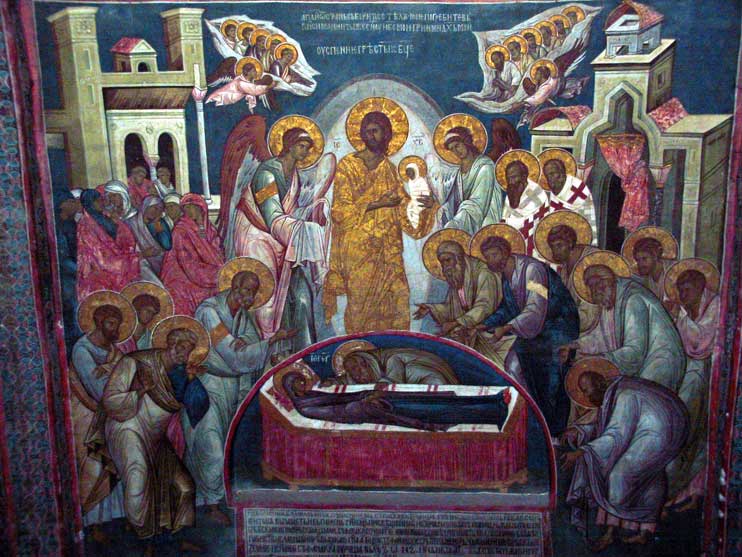
The Dormition fresco at the monastery of Gračanica in Kosovo. (click)

Rebecca West’s description of the fresco and the meaning of the event in the Orthodox Church (s opposed to the Catholic Assumption) is still the most moving and right-on that exists:

“Across one of the walls of Grachanitsa is shown the Falling Asleep of the Virgin Mary, the state which preceded her Assumption, a subject often treated by the Byzantines.  There is no man living today who, exploring his mind in the light of that idea, could draw out so much.

“In the foreground of the fresco is the Virgin lying on her bier.  By the lax yet immutable line is rendered the marvel of death, the death which is more than the mere perishing of consciousness, which can strike where there is no consciousness and annul a tree, a flower, an ear of corn.  Above her bier there shines a star of light; within it stands Christ, taking into his arms his mother’s soul in the likeness of a swaddled child.  Their haloes make a peaceful pattern, the stamp of a super-imperial power, within the angles of the star.  About them throngs a crowd of apostles and disciples, come hastily from the next world or from distant lands to attend the Virgin’s death, wearing their haloes as bubbling yet serene spheres.  On the edge of the crowd stand some bishops in their cross-covered mantles, rock-like with the endurance of the Church, which cannot be perturbed by the most lacerating grief, and still others, also in flowing garments but with bodies liquid with grief, and others, also in flowing garments but with bodies tautened by effort, low under the weight of the bier.  The background is full of angels as the Eastern Church loved to conceive them, ethereal messengers who are perpetually irradiated by the divine beauty and communicate its laws to flesh-bound man, a dream of perfect vision and unfrustrated will.

“The huge imaginative space occupied by this small fresco is washed by two swinging tides. There is a wave of such sincere and childish grief as children feel when their mothers die, that breaks and falls and ebbs; there is a rising sea of exaltation in the Son who can work all magic and cancel this death or any other, making glory and movement where stillness and the end seem to be ineluctable. The sides of the fresco are filled in with buildings, distorted with the most superb audacity in order to comply with the general pattern, yet solid and realistic in effect; we are amazed, as we all so often are during our lives, that our most prodigious experiences take place in the setting of the everyday world, that the same scenery should be used for the pantomine and the tragedy. Behind these buildings there is a firmament which evokes another recurrent amazement. It is the most astonishing of all the things which happen to us that anything should happen at all. It is incredible that there should be men and women, mothers and sons, biers and buildings, grief and joy; it would seem so much more probable that the universe should have as its sole packing empty nothingness. Existence in itself, taken at its least miraculous, is a miracle.”

*******************************************************************************************************************************************************************

Cute young cantor in t-shirt and denim shorts at the analoi at Hagia Eirene last night.  (???)   Fine by me.  Especially with the sweetest lyrical tenor.  The cantors at Hagia Eirene in Astoria have become the best without compare in all of New York, and if they’re the best in New York, they’re the best in the United States.  Though this is not the place to get into the pitiful state of ecclesiastic music in most of the Greek Church in America.

*******************************************************************************************************************************************************************

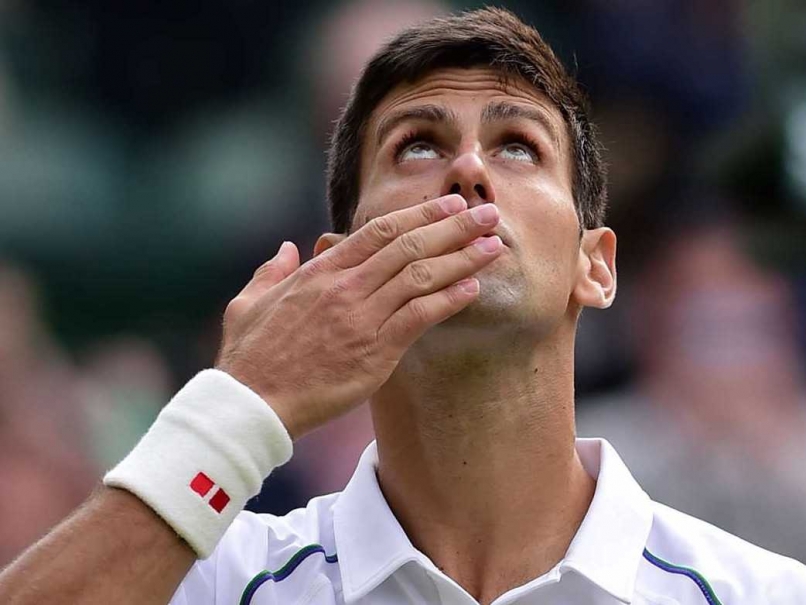
I’M SORRY FOR LONG ABSENCE.  THE JADDE WILL SOON BE BACK WITH MORE SERIOUS MATERIAL.  Personal issues and the overwhelming flood of international developments worldwide — especially Djok defending his Wimbledon title against Rolex Federer — left me drowned in more than I could intelligently comment on.  But will be back soon.

novak-djokovic-wimbledon-2015-quarters

(click)

Comment: nikobakos@gmail.com

Photo: Turkish Schadenfreude at Istanbul Airport

1 Aug

TurkishSchadenfreude

Sorry for the poor quality of this photo, but I just had to post this.  An ad all over Istanbul’s airport: “Going to Greece.  Talk to us today for suggestions on how much to take.  Make sure you have enough Euros for your stay.”

At the height of the Greek economic crisis and in the middle of the most bitter negotiations between the Greek government and the European Union over the extortionist measures of the promised bailout, this appears in Turkish airports.  This is a pure, lying attempt at sabotage of Greek tourism.  The dreaded “capital controls” that limited Greeks to taking 60 Euros a day out of ATMs to prevent a run on closed banks never applied to foreigners; i.e., you weren’t going to put your Dutch bank card into a Greek ATM to withdraw money from an account in Rotterdam and be limited to just 60 Euros.  This was really shitty and beneath Turks’ dignity.  But the truth is that I can’t really understand what’s going on in that country psychologically, so I’ll chalk it up to what seems to be a temporary suspension there of all rational discourse.

I’ve just invested so much in defending them (yeah, yeah…think you don’t need my defending? think again…) that I hate when they embarrass me with this kind of nastiness.

Comment: nikobakos@gmail.com