Balkans, Anatolia, Caucasus, Levant and other Middle East, Iran, Afghanistan, South Asia, occasional forays into southern Italy, Spain or eastern Europe, minorities, the nation-state and nationalism — and whatever other quirks or obsessions lurk inside my head.
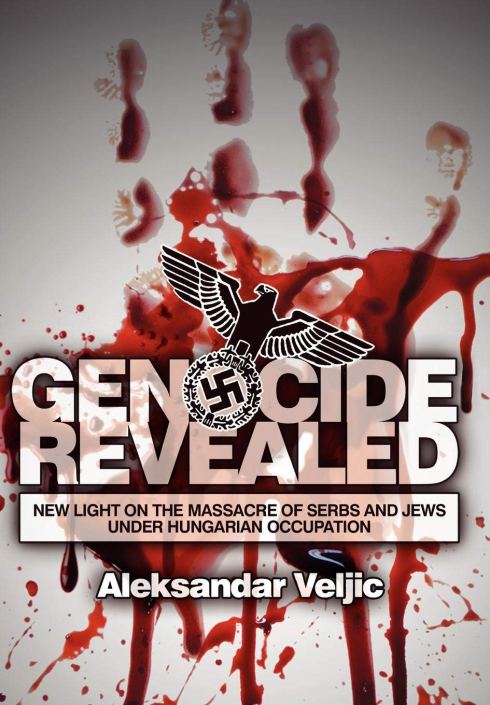
I think the key word is “antifascists.” Clearly Horthy couldn’t find any Croatians that qualified.
“The untold story of the massacre named “Razzia” (Raid) which took place in January 1942, committed by the Hungarian Nazi forces in an occupied part of northern Serbia – Backa. This book unveils the most important details of the massacre, implicating the Hungarian regent (governor) Miklos Horthy. Besides murdering Serbs, Jews and Roma, Horthy had also committed numerous crimes over Ukrainians, Romanians, Ruthenians, Slovaks, Russians and Hungarianantifascists. The book primarily deals with the genocide committed in January 1942, where at least 12,763 civillians had been tossed into icy rivers Tisa and Danube. One of the main perpetrators, Sandor Kepiro, was released in Budapest court on July 18, 2011. He died in Budapest in September 3 of the same year.”
You’d think that just to cammo their biased asses, these people might occasionally write about someone else, to then make it easier to go back to blaming Serbs again. Here’s some suggestions:
* Croatia: Are there any people on the planet, not just Europe, who have gone more scot-free of being confronted and taken to task for their more-Nazi-than-the-Nazis, vicious, genocidal, more-of-their-population–slated-for-elimination-than-any-other-Nazi-collaborating state, Vatican-blessed murderous project than Croatians and the Ustaše?
* Has anybody written a biography whose title might be: “Subtle Brother: The Rise and Fall of Alija Izetbegović and his plan for a Muslim Bosnia.”? Maybe Mr. Delalić could include a foreword or afterword there about Bosnian Muslim collaboration with the Ustaše.
or:
* “Kosovo: an Experiment in Mafia Statehood”
or
* “Operation Storm: The Story Behind NATO-armed Croatia and the Yugoslav Wars’ Single Greatest Episode of Ethnic Cleansing.”
or on a lighter note:
* “Buenos Aires: Here We Come! How the Papacy Spirited Away the Leaders of Fascist Croatia to Latin America So They Could — and Did — All Avoid War Crimes Prosecution.”
You can squeeze stuff that inspires contemporary nut-cases out of the noxious right-wing ideology contained in each of those I think. Just to distract people so that you can then return to your usual agenda — Serbia. Particularly rich, of course, to have this all come from Germans, who don’t seem to realize that their hyper-earnest, Mea Culpa Show is getting really boring, but has also hypocritically and ironically made them the self-appointed, moralizing arbiters of the rest of humanity’s behavior: like, in some perverse way, ‘they should know’ — know it when they see it.
And almost all the murderous right-wing psychos, that think Karadžić is a hero and that they list in the article, are Germans or Teutons of some sort. So maybe the fault, dear Germans, lies not in Greater Serbian Nationalism but in yourselves.
Ah, then one last idea: how about “Instant Independence: Slovenia, Croatia and How Germany led Europe into Mass Death and Destruction for the Third Time in One Century.” ?
Racist memes, nationalist myths, and crude conspiracy theories: within the ideology of the New Right, southeastern Europe appears as a transitional space where the future of the West is being decided.
Investigations into the 15 March 2019 Christchurch attack took on an international dimension ten days later when federal security and intelligence agents searched Martin Sellner’s apartment in Austria under orders from the prosecutor’s office there. Sellner is a leading functionary of the Austrian Identitarian Movement (Identitäre Bewegung Österreich, or IBÖ). He came under the authorities’ scrutiny because of a €1,500 donation he had received from the Christchurch shooter in January 2018.
After the search, Sellner portrayed himself on YouTube as a victim of state repression. While politicians and commentators argue about the nature of the IBÖ, its members organize demonstrations and solidarity actions and drum up social media and financial support from around the world. A donation does not make Sellner an accomplice to a massacre—but there are ideological bridges that connect the Identitarian Movement (also known as Generation Identity) as well as other extreme rightwing groups to the Christchurch mass-murderer.
Undesirable Foreign Foods
Attempts to distinguish the IBÖ from “ordinary” rightwing radicalism are specious not only because Sellner, according to media reports, used to paste swastikas on synagogues in his youth; beyond that, he belonged to the social circle around Austrian Holocaust denier Gottfried Küssel, whose blog Alpen-Donau.info was removed from the internet by the Austrian interior ministry in 2011. This kind of increased legal and police pressure led to the founding of the IBÖ a year later, which attempts (in the tradition of Alain de Benoist, an early progenitor of the New Right) to replace völkisch-nationalist vocabulary with terms carrying less historical baggage—terms like “identity.”
In a YouTube vlog from early 2015, Sellner posed—with hipster glasses and a sharp part in his hair—in front of a food stand menu offering burgers, hotdogs, and Bosna sausages. His goal: to educate his viewers about Austrian cuisine and undesirable foreign foods. Austrians! Do not eat at McDonald’s—and certainly not at kebab stands, the epitome of “multicultural capitalist mania”! In this online broadcast, Sellner sells the message additionally with his choice of t-shirt (available at his online store…). Upon it are the words “Restore Europe, Remove Kebab, Restore Empire.” Precisely this reference, “Kebab Remover”—a racist internet meme endorsing the genocide of Bosnian Muslims—was on display both on the Christchurch terrorist’s weapon as well as in his manifesto. Sellner has also cracked wise on Twitter about being in “Remove Kebab Mode.”
The Christchurch shooter referred to the Balkans in other ways as well. On the way to committing his act of terror, he listened to a song honoring the Serbian war criminal Radovan Karadžić, who would only a few days later be sentenced to life in prison at the Hague. In addition, the shooter is alleged to have traveled to several countries in the Balkan region in order to visit the sites of historic battles. The engravings on his weapons with the names of figures from Serbian, Montenegrin, Polish, and Spanish history also point to a deep fascination with struggles against the Ottoman empire. Southeastern Europe, in the imagination of the New Right, is a kind of transitional space where Christianity and Islam clash.
This motif is not new, and has many variants, alternately glorifying the Spanish Reconquista, the defense of Vienna, or the Russian-Ottoman wars. Karadžić referred to the genocide at Srebrenica as “just and holy”—in his view, his troops had prevented the establishment of an Islamist caliphate. The Norwegian rightwing terrorist Anders Breivik, in turn, called Karadžić an “honourable Crusader and a European war hero.” Occasionally, the motif appears in reference to a supposed transnational Muslim conspiracy against the Christian West, in which Serbia is presented as the bulwark against a neo-Ottoman invasion of Europe. The Christchurch shooter referred to Kosovar Albanians as “Islamic occupiers.”
An Appealing Trope
There are other points of contact. The Christchurch shooter’s manifesto was titled “The Great Replacement”—clearly named after the racist conspiracy theory popularized by Renaud Camus, an ideological godfather of the New Right in France. In his imagination, Europe’s white, Christian population is being systematically replaced by predominantly Muslim “invaders” from Africa and the Middle East. There are many variations on this demographic panic. It is the glue that holds the Fascist International together.
It can be observed as a central motif in the Greater Serbia ideology of Radovan Karadžić, which purports that Bosnian and Kosovar Muslims are secretly pursuing a “demographic jihad.” In the SANU [Serbian Academy of Science and Arts] Memorandum of 1986, a milestone of Serbian nationalism, it is claimed that the high birthrate of (predominantly Muslim) Kosovar Albanians is a central component of their drive for an ethnically pure Kosovo. The former Bosnian-Serb general Ratko Mladić justified war crimes against Bosnian Muslims with the claim that the Islamic world possesses, if not an atomic bomb, then a “demographic bomb.” Breivik, for his part, refers to this as an “indirect genocide.”
The obsession with birthrates and these paranoid theories of intentional displacement and replacement do not necessarily lead to violence—but they do mentally prepare their proponents for it.
The Islamophobia inherent to the ideology of Greater Serbia, in which traditional and contemporary motifs are bound together, is emerging in the globalized context as an appealing trope for the Fascist International. The specter of multiculturalism can only be overcome with a fundamental reordering of space along ethnic dividing lines that faded out of relevance long ago. The aim of this “racism without races” is the establishment of ethnically homogeneous societies, side by side but separate.
In September 2018, Sellner took part in a torchlight march “in honor of the heroes and saints of 1683.” In this case, Vienna symbolized the bulwark against past and future Islamic invasions. “I don’t get how there can be people from the Balkans who spit in the faces of their forefathers and their defensive struggle against the Ottomans,” tweeted Sellner in June 2017. So Islam must be fought and defended against—but without violence, apparently: “Rightwing terrorism is, like all other kinds of terrorism, to be morally rejected,” announced the leading identitarian figure immediately after the Christchurch attack. How this is supposed to work, when—judging from slogans like “Stop the Great Replacement!”—the Ottoman army is already pounding at the gates, is unclear. War symbolism and fear-mongering only fit into the self-conception of the “moderate migration critic” when rhetorical fear-mongering can be cleanly separated from real terrorism.
No matter how much Renaud Camus and Martin Sellner try to distance themselves from the terror attack in Christchurch, the insistence of the IBÖ that it is not a radical rightwing movement is simply untenable. The fight against this ostensible “replacement” and the IBÖ’s concomitant declaration of war on multicultural society are not “moderate” positions. The claim that coexistence is impossible is not meant merely as a description of conditions but rather as a goal. For Karadžić it was not only about the fight against Islam. Tolerance and the multicultural character of Bosnia were also to be erased and made impossible for generations to come.
Ideological Cocktail
The ideas that became socially acceptable with the rise of Serbian nationalism in the 1980s soon found their concrete political implementation. What emerged was an ideological cocktail of racism, demographic panic, conspiratorial paranoia, and revanchism that ultimately proposed an urgent need for action against an allegedly existential threat. The destruction of the Other became necessary to ensure Our survival. Karadžić still argues to this day that he was acting defensively against a “toxic, all-destructive Islamic octopus.”
It is not particularly surprising that paranoia about demographic “invaders” also takes an antisemitic shape. The Serbian nationalist cult director Emir Kusturica, for example, is among those who pin the blame for the “refugee crisis” on the Jewish American billionaire George Soros. According to social theorist Moishe Postone, modern antisemitism is not merely a form of racism, but at the same time a way of explaining the world which promises mistaken paths out of one’s misfortune. We can understand conspiracy theories like “the great replacement,” which declare as enemies both the weakest among us as well as global elites, in a similar manner. Islam and Judaism overlap as bogeymen, as both sublate the particularity of individual nationalisms. Unity is imperative in fighting the great enemy.
Karadžić’s ideology is neither unique to the Balkans nor the result of “centuries-old blood feuds.” It also is not a genuinely Serbian phenomenon. Rightwing radicalism does not have a country of origin; it derives inspiration from everywhere. The ideological store of the Fascist International feeds on various traditions and regions. What has evolved is a globally available repertoire of nationalist myths, symbols, and tactics to choose from. Events in Bosnia and Kosovo show what kinds of consequences such ideas can bring—and not just there.
Berlin historian Patricia Zhubi studies the past and present of antisemitism and the transnational structures of the radical right. Bosnian-German sociologist Adnan Delalić does research on Islamophobia and genocide, among other things.
Translated by Antidote and printed with the kind permission and help of the authors.
Featured image: artwork by Bosnian-American Samir Biscevic displayed at a ten-year commemoration of Srebrenica at UN headquarters in New York in 2005.
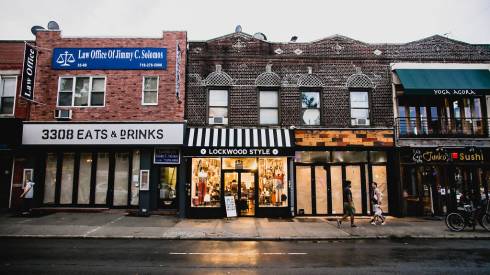
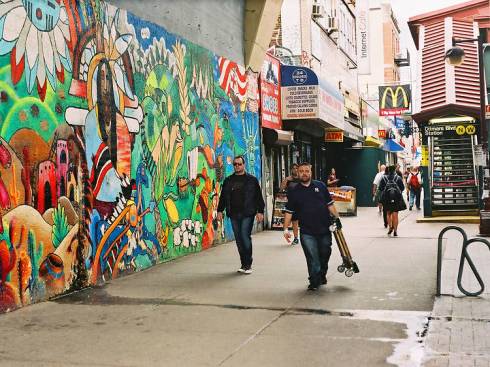
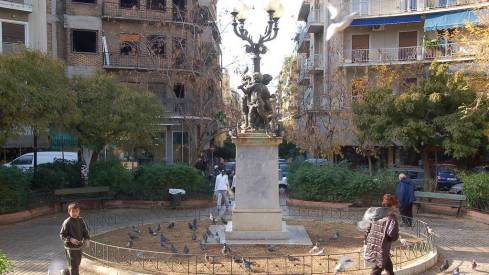
Time Out has come out with the fifty coolest neighborhoods in the world, and two — arguably three — of them are Greek; one in Athens, Kypsele, and another in the capital of the Greek diaspora, New York: Astoria. (Yeah, Melbourne…ok…chill). Now there are only what, 14 or 15 million of us in the whole world, and we corner 8th and 16th outta 50. Not just not bad, but figures that make it clear there’s a connection between Greek-ness and urbanity — even Greek villages are really just tiny Greek cities — the polis and everything political life implies, that runs deep.
Astoria
Kypsele
What if you have no Greeks (or worse, no Jews). Well, brother Turk, take a walk, or a nerve-wracking tourist shove, down what you’ve turned your “İstiklâl” into: its new garish, overlit, Gap-outlet, Gulfie, Saudi hideousness… And weep. That we left.
Oh, and what’s arguably the “third” Greek neighborhood… Ok, I scrolled down the list, nervously expecting to find Pera (Beyoğlu) there, the formerly, largely Greek mahalla — the formerly Greek, Jewish and Armenian heart of the City actually — because Turkey’s American public relations firms deserve every dollar they get from the Turkey accounts and they manage to shove a fictitious Turkish tolerant multiculturalism in our face whenever they get the chance, and Pera has, for about the past 15 years, taken pride of place in this masquerade of Istanbul hipness and Turkish cosmopolitanism — quite an accomplishment since the Midnight Express days. (Too bad Turkey itself reverts back to Midnight a little bit more every day.) And Pera wasn’t there, not on the list!
“All – I thought a lot about whether I should use “almost all” in this sentence and decided against it –because all the hippest, funkiest, most attractive, gentrified neighborhoods in the historic parts of İstanbul are neighborhoods that were significantly, if not largely, minority-inhabited until well into the twentieth century: not just Pera and Galata, but Cihangir and Tarlabaşı, and Kurtuluş — of course — and up and down the western shores of the Bosphorus and much of its eastern towns too, and central Kadiköy and Moda and the Islands. (And if serious gentrifying ever begins in the old city it’ll be in Samatya and Kumkapı and Fener and Balat; I wouldn’t put any big money into Çarşamba just yet.)”
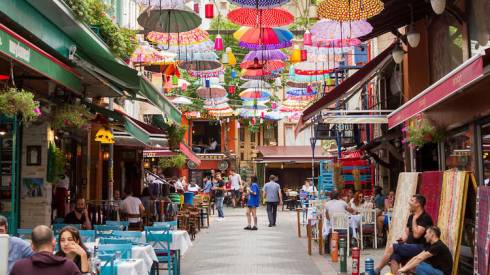
And so, happily, I didn’t find Pera being prostituted again by Turkey as a symbol of a multiculturalism that the Turkish Republic eradicated, exterminated, expelled and that no longer exists. But I scrolled a bit further down…and there was Kadiköy and Moda, #42, also, until well into the 60s, heavily Greek and Armenian. More sweet justification!
(I’ll take Egyptians on for the empty, dingy Alexandria they got stuck with after our good-bye party in another post.)
Kadiköy
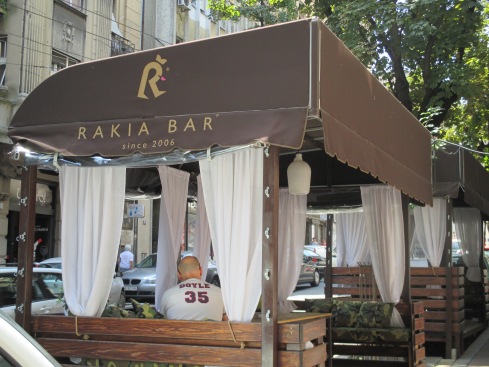
Finally, came the sweetest of all, my beloved Dorćol in my beloved Belgrade. 50th on the list of 50. You have to be pretty attuned to the Serbian soul to know what coming in 50th out of 50 means. It doesn’t mean being last. It means: “You think we’re cool? Who asked you?”
The Rakia Bar in Dorćol
Plus, Belgrade comes in in way first place over all of these cities in one important way: the guys. No joke.
Some restaurant notes:
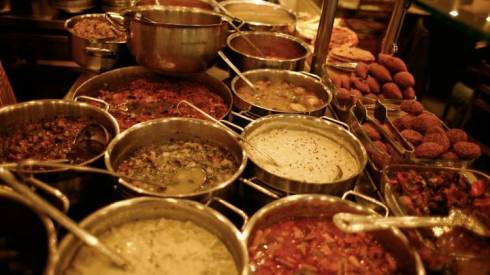
Don’t go to Çiya in Kadiköy. Unfortunately, the food is spectacular, and I’m a sadist for posting this picture:
But the unfortunate part is that Çiya is owned by a sociological type: the newly comfortable, if not rich, provincial, pious middle-class; that’s the AKP’s and Erdoğan‘s political power base. What that means on the ground is that your great food is prepared by puritans who won’t serve you alcohol, so you can’t have a leisurely rakı or beer dinner, but have to scarf it all down and leave, paying with dough that might indirectly end up in the AK’s coffers or ballot boxes. The same goes with the otherwise excellent Hayvore in Pera. Amazing Black Sea dishes but no booze. Go ahead if you want. You can go to Sauditoo if you want. I refuse to. Even if I didn’t want to drink: just on principle. And they — Hayvore — make one of my absolute favorite dishes which I can’t find anywhere else: an anchovy pilav. But I’ll live without. Or make it myself.
.
And then, a little less geopolitically charged, there’s the completely baffling phenomenon of Cyclades in Astoria. I can’t argue with the fish. And if fish is their mission statement then fine, because it’s always fresh and expertly cooked — even if the owners are Albanian and hadn’t seen the sea till they were sixteen. But you do want to eat something along with the fish and everything else is awful. The cacık and eggplant salad is made inedible by that crazed Greek overuse of raw garlic, so that all you have is the bitterness of the bulb and not even the taste or aroma. The zucchini and eggplant are fried in old oil. The raw oil served for greens or salad is horrible — cheap, and I’m not even sure it’s 100% olive. And in a Greek fish meal, where almost everything is dressed with raw oil, it really needs to be the best quality or everything else is shot. The bread — and one thing we do well, γαμώτομου, is bread — is nasty and old. This place reminds me of food in tourist traps in the old days before the foodie revolution in Greece in the 00s.
And they commit one incomprehensible abomination. They serve oven-baked potatoes — with lemon, fine… But. With. The. Fish. These are potatoes, that according to the taxonomy and order of Greek food, if such a primitive cuisine can be said to have such order, are baked in the oven with meat in a composite dish or casserole. It’s a sin of commission to serve them with fish, with which they haven’t even been cooked, unless you’re going for plaki which means tomatoes and a whole different palate. And they taste as if they’ve been soaked overnight in lemon. And I dunno, but the yellow color is so suspiciously bright that it looks like yellow dye #2. Investigate them; I’m sure I’m right. And, of course, everything comes garnished with piles of more lemon wedges, to satisfy that deep Greek urge to obliterate the taste of everything else on the table.
And people — Manhattan people — come out to Queens and wait, for over an hour, malaka, to get a table at this Soviet cafeteria (the lighting is awful; the music is deafening). They’ll often go cross the street to wait to be called, to get a drink at Michael Psilakis‘ MP Taverna, where the food is phenomenal. It’s only slightly reinterpreted Greek — it’s deeply faithful to the roots but Psilakis — I dunno — freshens things, and combines traditional ingredients in ways that make you wonder why no one else had ever tried this. It’s generally full and has a great and friendly bar that looks out on the bustle of Ditmars Boulevard. But it should be a destination spot and it’s not. And Cyclades is. It makes me think that white people will eat bad food if they think it gives them woke and authenticity street cred. And convince themselves it’s good.
Then came the counterattack. King Felipe VI led the charge. He stated that neither the government in Madrid nor the monarchy would negotiate with the pro-independence Catalan leaders.
But it was the joint offensive between the Spanish state and major Catalan corporations that really did the trick. On Oct. 4, the government issued a decree that would help businesses relocate from Catalonia to Spain. In the days after, the headquarters of the major Catalonian banks — Caixa and Sabadell — and the water and gas companies announced they would leave the region. Democracy also works this way: Millions of voters cast only one vote, while a few use their millions to weigh in as if they were millions…
The banks’ departure felt like a cold shower for independence supporters, willing to give it all for their motherland — except their savings accounts and their European lifestyles. For Mr. Puidgemont and his party, historically tied to those same banks, it was more like an ice-cold tsunami. [my emphasis].
It’s really tiring — and tiring, especially, is feeling the constant scathing condescension towards these idiots — to see what a playground for the puerile identity politics are. Caparrós continues:
With the economy in danger among the waving flags and patriotic chants, it became increasingly evident that independence was more a desire than a project. For years, there has been talk about creating a new country but little discussion of its economic and social structure, which is why it was never clear how much actual social energy — how much struggle, how much sacrifice — was necessary to achieve it.
Creating a country is a complex, expensive process: To take such a step you need a huge amount of support. Usually, independence is achieved after a long war, or the fall of a colonial power. At the least, it requires the gathering of an overwhelming majority. In Catalonia, I’m glad to say, the first two options seem impossible. The third one is not in place. To start as a new but divided country would be a recipe for disaster.
Like the make-you-wanna-pull-your-hair-out Brexit: it seems — what? — nobody thought of these things?
One important thing that may have come out of, as I wrote, rethinking Yugoslavia, and the thing that Catalans and Basques, Croatians and Slovenians, and Lombards and Romagnolos, and self-righteous Brits and Germans bitching about Greek irresponsibility, should really rethink is how their supposedly parasitic South is also their major market. See the dim shape Croatia seems to be unable to pull itself out of since independence, I’m happy to report with just a touch of schadenfreude; Croatia, which a New York Times editorial in 1992 gallingly called to be accepted “…into the West, in which it always belonged”, (see Bugarian historian Maria Todorova‘s enraged reaction in her Imagining the Balkans)…Croatia has now fallen behind the poorest countries in the EU, Romania and Bulgaria, on many indicators.
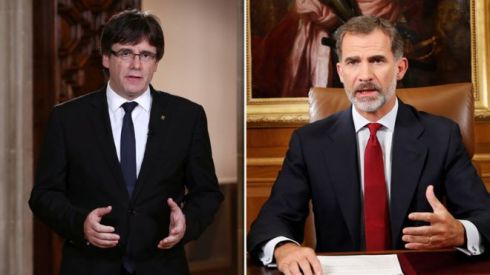
Puigdemont and Spanish King Felipe VI at recent press conferences.
Protesters hold a giant Spanish flag during a demonstration to support the unity of Spain on 8 October in Barcelona. Photograph: Lluis Gene/AFP/Getty Images
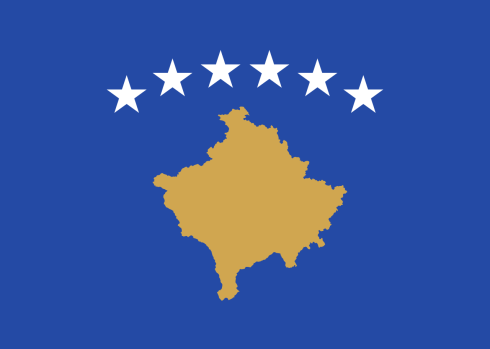
The Guardian has an interesting take on things in Spain: “A dangerous time for Catalonia, Spain and the rest of Europe“ that is original in that it brings together commentators from different parts of Europe who each have their own particular p.o.v. on what’s going on in terms of secession and identity politics. They’re each interesting in their way — though I expected Gerry Adams to have something more compelling to say and sort of can’t tell if he’s being ironic (David Cameron?). The most important one for me, though, is the comment on Kosovo (though it also angers you because it took so long for someone to say this):
•“Since Nato illegally bombed Serbia in 1999 to wrest control of Kosovo from the Balkan nation, we have witnessed a significant increase in the number of secessionist efforts around the world as borders have unravelled in Ukraine and elsewhere (Catalan president vows to press on with independence, 5 October). Western leaders should be ashamed at having encouraged the hopes of terrorists worldwide that borders can be changed and national sovereignty and international laws are meaningless if they can get Nato to support their cause. Get ready for a lot more trouble ahead.”
I was getting this knot in my stomach that this was going the way of Yugoslavia, but maybe Europe (or the Germans, at least, who are the most responsible for the Yugoslav disaster, but are still so focused on the other little misdemeanors in their history that they haven’t yet begun to face their complicity in the Balkans) has learned something.
A boy holding a European flag waits for the start of the Catalan Convergence and Unity party (CiU) rally marking the last day of the European Parliament elections campaign in Barcelona on May 23, 2014 | Josep Lago/AFP via Getty Images
Brussels says Catalan referendum was ‘not legal’
The EU repeats its position that Catalan independence is ‘an internal matter.’
Sunday’s Catalan independence referendum was “not legal,” European Commission chief spokesman Margaritis Schinas said Monday.
Schinas also repeated the EU’s line that if Catalonia does become independent, it will be “outside the European Union.”
Catalan regional President Carles Puigdemont appealed directly to the EU last night after the results of the disputed referendum, which were overwhelmingly in favor of independence. Puigdemont said the EU “can no longer continue looking the other way.” But Schinas stuck to the Commission’s line on the dispute, repeating that it was “an internal matter.”
The spokesman batted away criticism that the Commission responded to the issue too late, saying: “We react at the time when all the elements of the event are in place.”
Schinas also said that Spanish Prime Minister Mariano Rajoy is scheduled to speak with Commission President Jean-Claude Juncker on the phone later today.
Referring to the more than 800 civilians injured on Sunday, Schinas said “violence can never be an instrument in politics,” without attributing responsibility.
He also called on “all relevant players to now move very swiftly from confrontation to dialogue.”
Asked if the police actions were proportionate, Schinas declined to answer, repeating the line that “violence can never be an instrument of politics.”
On September 23rd, 1821, the city of Tripolica (Tripolitsa, modern Tripoli), the central administrative seat of Ottoman authority in southern Greece, fell to Christian rebels. Its Muslim and Jewish populations were then subjected to a hair-raising orgy of slaughter and torture that effectively ended their presence there. As similar massacres of non-Christians occurred throughout southern and central Greece, these regions were almost entirely cleansed of these populations.
That’s what happened, as someone once asked me, to the Turks of Old Greece (the Kingdom of Greece before 1913). They went the way of Turks throughout the Balkans as soon as peoples there gained their independence.
Reposting an old post on a Skai documentary on the Fall of Tripolica and other taboos of Neo-Greek nationalism. See “Diatribe’s” reposting of description of massacre and comments too. Interestin re: “genocide” and “ethnic cleansing”.
In my recent post Occitan and “endangered languages”, I wrote about the (mostly former) Albanian-speakers of central and southern Greece and how they had never posed an assimilation problem for the Greek state. Quite the contrary:
“…Peloponnesian Albanians were already Greeker than the Greeks in their ethnic consciousness and had proven it by essentially fighting our war of independence for us; it seems that, historically, you give Albanians — Christian or Muslim — an incentive to go to war and they’ll become more zealous crusaders of your cause than you are yourself.”
Elsewhere I’ve written about Greeks and Albanians as practically co-peoples, such has been the extent of migration and intermingling over the past millenium. This winter I read John V.A. Fine, Jr.’s six-hundred page The Late Medieval Balkans: A Critical Survey from the late Twelfth Century to the Ottoman Conquest, which I know sounds like a joke about dry academic reading, but it was actually fascinating. The chaos that followed the fall of Constantinople to the Franks in 1204 produced a bewildering number of Greek and Frankish successor states to the Byzantine Empire throughout the Greek peninsula, all constantly at war with each other and at a time when the Albanian highlands were suffering from demographic overload. Thus, whether as mercenaries in the hire of anyone who paid best, or as shepherding nomadic clans who took advantage of the extensive areas of the peninsula depopulated by constant war or epidemic diseases, Albanians in huge numbers were constantly on the move southwards for the next two centuries if not more. (I suspect that this is when their descent into Kosovo begins as well, filling in the gap as as the center of gravity of the Serbian nation moved northward.) Further waves came after the Ottoman conquest in response to Islamization campaigns in recently conquered Albania, but this time not just south to Greece but westwards to Italy and Sicily as well. And settling everywhere you could possibly imagine: Thessaly, southern Epiros, Roumeli (in the Greek meaning of the term), the Ionian islands, places as far flung and unexpected as the islands of Cythera or Ios! My point, without having any Fallmereyer-an agenda — not because I disagree with his basic theses but because I don’t thing “race” means anything — is that regions of Albanian settlement in the past were likely far larger than the regions where we find the language still spoken in the early twentieth century, shown on these maps:
Albanian-speaking areas in 1890 shown in pink above, green below (click)
This documentary that “shocked Greece” was produced by SKAI Television and called 1821 after the year the Greek revolution against Ottoman rule began and the reason it “shocked” is that it debunked long-held myths about the uprisings that eventually led to the establishment of the independent Kingdom of Greece; but really, that anybody was shocked at any of these revelations: for example, that the uprising was accompanied by the wholesale massacre of Muslims (and Jews) throughout the Peloponnese and central Greece;* that the Church anathematized it and did not support the movement (paid the price anyway with the execution of the Patriarch in Constantinople); that the “secret schools” where poor “enslaved” Greek youth were taught Greek in secret at night because the Turks had forbidden the teaching of Greek is a totally concocted fable (and such a projection of twentieth-century, nationalist, totalitarian policies back onto the Ottomans; there is practically not a single European observer of Ottoman life since at least the beginning of the eighteenth century that doesn’t comment on the quality and extent of Greek educational institutions in all Ottoman cities and even smaller towns and villages); that many if not most of the revolution’s “heroes” were Albanians, some who spoke no Greek at all; that the fustanella is originally an Albanian garment…and on and on — that any of these shocked Greeks in the early twenty-first century is just proof of how pathetically brainwashed and historically ignorant nationalism usually leaves a people. And this is the point where the documentary pulls a very cowardly copping out — by claiming that such is the price of building a new nation; it has to create new “myths” of its own. Why a nation — or a people preferably — is not stronger and better off if it knows the whole truth about its past is never delved into. But it’s worth watching, and it has English subtitles:
In any event, such was the Albanian contribution to the struggle that one wonders if the Porte let go of the Peloponnese, not because it was so far from the center of imperial authority, not because it had always been something of a provincial backwater, not because of foreign intervention, but because of some tough-*ss Albanian warriors that the Ottomans felt were no longer worth resisting. After all, they themselves knew the value of an Albanian fighter: favorite recruiting regions for the Janissaries in the classical Ottoman period had always been Albania and Serbia — not random choices.
There’s a beautiful song recorded in 1949 by Sophia Vembo, one of greatest Greek voices of the twentieth century, called “The Song of the Morea” (since at least early Byzantine times until the modern Greek state revived the clasical name, the Peloponnese was called the Morea) which is partly a homage to the role of the region in the struggle for Greek independence (ok, even as a New Territory Greek, I’ll grant them that.) And the refrain says:
“Hail and be well brother Moraites, and health to your women too; Greece owes its freedom to your manhood!”**
And I have a deeply-loved but eccentric cousin, highly intelligent but an unrehabilitated nationalist dinosaur unfortunately and to whom much of this blog is indirectly directed — or one might even say dedicated — who is so profoundly moved by the blood shed by Peloponnesian and Spetsiote and Hydriote Albanians for the cause of Greek independence, that he thinks the refrain should run:
“Hail and be well brother Arvanites (Albanians), and health to your women too; Greece owes its freedom to your manhood!”
Here it is; the music and Vembo’s voice are beautiful even if you don’t speak Greek:
The song has always provoked a strong reaction in me as well, a testimony to the power of patriotism if it can move someone who finds nationalism as repulsive as I usually do. But even that reaction is contradictory. The 1949 date of the song is not insignificant; it was recorded in the middle of the most brutal period of the Greek Civil War and was actually more a call to unity and an appeal to brotherhood than a commemoration of the revolution of 1821. Like many Greeks perhaps, my family suffered more losses in the civil war than they did in the Nazi occupation that had preceded it, and the opening lyrics of the second verse always make me tear up for a moment:
“Now that the earth sweats the blood of brothers, and Greece is drowning Greece in the hills..”
and then my heart goes cold again, because the next line is:
“Come out of your grave Thodoris Kolokotronis, and make all Greeks brothers again.”
…because it’s impossible for me to forget that Kolokotronis was the “hero” who boasted of riding his horse over Muslim corpses from the gates of Tripolitsa to its citadel, when that major city of the Morea fell to the rebels in September of 1821.
So I’d like to end this post with just a little bit of perspective, a reality check we all need every so often, because though the documentary mentions a lot of previously taboo subjects, it glosses over a few of them a little too quickly. The following is taken from the blog of a Greek-Australian, and apparently fellow Epirote (though he seems to have Samiote heritage as well), Diatribefrom a post called “Revolution Unblinkered.” It’s foreigners’ eye-witness accounts of the Massacre of Tripolitsa, interspersed with some of his own comments:
A month later, in September, a combined force led by Kolokotrones and Petrobey Mavromihalis captured Tripolitsa. Historian W Alison Philips tells a horrific tale of mutilation and slaughter “For three days the miserable inhabitants were given over to lust and cruelty of a mob of savages. Neither sex nor age was spared. Women and children were tortured before being put to death. So great was the slaughter that Kolokotronis himself says that, from the gate to the citadel his horse’s hoofs never touched the ground. His path of triumph was carpeted with corpses. At the end of two days, the wretched remnant of the Mussulmans were deliberately collected, to the number of some two thousand souls, of every age and sex, but principally women and children, were led out to a ravine in the neighboring mountains and there butchered like cattle.”
A Prussian officer described the incidents that took place after the capture of Tripolitsa by the rebels, as follows:
“A young Turkish girl, as beautiful as Helen, the queen of Troy, was shot and killed by the male cousin of Kolokotronis; a Turkish boy, with a noose around his neck, was paraded in the streets; was thrown into a ditch; was stoned, stabbed and then, while he was still alive, was tied to a wooden plank and burnt on fire; three Turkish children were slowly roasted on fire in front of the very eyes of their parents. While all these nasty incidents were taking place, the leader of the rebellion Ypsilantis remained as a spectator and tried to justify the actions of the rebels as,’we are at war; anything can happen’.”
Based on the accounts of one hundred European officers who were present at the scene, and did nothing to intervene, William St. Clair wrote:
–
“Upwards of ten thousand Turks were put to death. Prisoners who were suspected of having concealed their money were tortured. Their arms and legs were cut off and they were slowly roasted over fires. Pregnant women were cut open, their heads cut off, and dogs’ heads stuck between their legs. From Friday to Sunday the air was filled with the sound of screams… One Greek boasted that he personally killed ninety people. The Jewish colony was systematically tortured… For weeks afterwards starving Turkish children running helplessly about the ruins were being cut down and shot at by exultant Greeks… The wells were poisoned by the bodies that had been thrown in…”
–
Although the total estimates of the casualties vary, the Turkish, Muslim Albanian and Jewish population of the Peloponnese had ceased to exist as a settled community after the early massacres. Some estimates of the Turkish and Muslim Albanian civilian deaths by the rebels range from 15,000 out of 40,000 Muslim residents to 30,000 only in Tripolitsa. According to historians W Alison Phillips, George Finlay, William St. Clair and Barbara Jelavich, massacres of Turkish civilians started simultaneously with the outbreak of the revolt, while Harris J. Booras considers that the massacres followed the brutal hanging of Ecumenical Patriarch Gregory V of Constantinople. Finlay has claimed that the extermination of the Muslims in the rural districts was the result of a premeditated design and it proceeded more from the suggestions of men of letters, than from the revengeful feelings of the people. St. Clair wrote that: “The orgy of genocide exhausted itself in the Peloponnese only when there were no more Turks to kill.”*
–
There were also calculated massacres towards the Muslim inhabitants of the islands in the Aegean. This is because one of the aims of the Greek revolutionaries was to embroil as many Greek communities as possible in their struggle. By engineering some atrocity against the local Turkish population, diverse Greek communities would have to ally themselves with the revolutionaries fearing retaliation from the Ottomans. In one case, in March 1821, Greeks from Samos landed on Chios and attacked the Muslim population living in that island. Among the Samian belligerents was an ancestor of mine, Dimitrios Kalymnios.When the Samians withdrew to the safety of their island, the Ottomans descended upon defenceless Chios and carried out an atrocity that horrified the rest of the world: the massacre of Chios.
–
[my, N.B., emphases throughout this last paragraph — just so that nobody is allowed to take something like the the Massacre of Chios out of historic context again…]
–
The final word, if there is one, goes to Theodore Kolokotronis, who in his account of the fall of Tripolitsa, was unrepentant to the last: “When I entered Tripolitsa, they showed me a plane tree in the market-place where the Greeks had always been hung. “Alas!” I said, “how many of my own clan — of my own race — have been hung there!” And I ordered it to be cut down. I felt some consolation then from the slaughter of the Turks. …”
Wow. First thing I have to say is that if this guy is allowed to publish this kind of stuff in Melbourne’s “Neos Kosmos” English-language newspaper, then Greek Australia is eons ahead of Greek America in its sophistication on such issues. I can’t imagine a single effing channel or venue of the Greek media in New York where someone could get away with writing or saying things like this.
–
Then, the irony is that these revolutionaries, Greek or Albanian, were probably not fighting for a Greek state, but fighting a religious-cum-tribal war out of which they were hoping to carve out little fiefs and principalities of their own, no different than the Ottoman pashaliks that had preceded them and the internecine chaos that followed ‘liberation’ is proof of that — so let’s not over-romanticize their zeal for the “cause” or exaggerate the degree to which they were fighting for the “freedom” of the “Hellenic nation.” Finally, is the irony that many of the “Turks” these fighters were massacring in a place like Tripolitsa, were probably Albanians like themselves, only converts to Islam.
–
And one sad little detail I discovered somewhere else, though I can’t find the source for it:
–
“European officers, including Colonel Thomas Gordon, who happened to be at Tripolitsa during the massacre, witnessed the hair-raising incidents there, and some of them later recalled these events in all their ugliness. Colonel Gordon became so disgusted with the Greek barbarities that he resigned from the service of the Greeks. A young German philhellene doctor, Wilhelm Boldemann, who could not bear to witness these scenes, committed suicide by taking poison. Some of the other European philhellenes who were extremely disillusioned, followed suit.”
–
The poor, idealistic, Werther-like German Romantic, come to fight and liberate the sons of Pericles and Leonidas, kills himself out of disappointment…it just seemed to encapsulate the whole patheticness of a certain kind of European Helleno-latry.
Bad translation. “Pодные”…”rodnye” means intimate, familiar, related; by extension born-beloved, dear one, cared for, same root in Russian as parents, birth, homeland, Christmas…wouldn’t be surprised if it has the same Indo-European roots as “root”.
Vitaly Mansky‘s documentary is being screened this coming weekend and the next at the Museum of the Moving Image in Astoria, Queens. (See schedule. It’s two train stops into Queens, guys. Then you can have a nice dinner for half of what you pay in Manhttan at a good friend and koumbaro‘s place: Mar’s.)
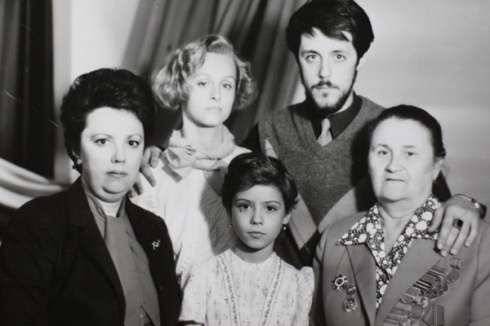
“In this follow-up to his award-winning documentary Under the Sun, filmmaker Vitaly Mansky examines Ukrainian society amidst the 2014 national election, a period rife with political chaos and growing uncertainty over national identity and integration. As both a Russian citizen and native Ukrainian, Mansky deftly underscores personal and political complexities as he visits with relatives living in Lvov, Odessa, the Crimean peninsula, and the Donbass region, and in the process discovers a wide and disorienting spectrum of outlooks and affiliations, including his own sense of ongoing exile and unease. Close Relations is at once an intimate family portrait and a graceful journalistic endeavor, a movie of the intense present that illuminates a place caught between a troubled past and an anxious future.”
Watch the trailer below.
Lots of moving, “disorienting” footage. Also, lots of humor, which reminds us that so much of a certain ironic, sardonic take on the world — a viewpoint “from a certain angle”, as E.M. Forster said of Cavafy — that we in the United States think is particularly Jewish, is really just a trait common to all eastern Europe, even Greece, or perhaps just a trait common to the powerless everywhere:
“Crimea was a pity, but the Donbass…they can have it.” *
But I think the most important moment in terms of geopolitics comes at 1:15:
“So Ukraine decided to join NATO. Isn’t that its own business?”
“Nyyyyyet!”
…comes the reply without a moment’s hesitation.
“Nyet” with its palatized “n” and final “t” is one of humanity’s great no-words. Like “yok” in Turkish, it literally means “there isn’t” or “Il n’y a pas”. But while “yok” has a kind of know-nothing passivity about it, “nyet” is an active “Halt! No way you’re going further down this road. There’s no access.” **
That moment in Mansky’s doc is why, despite widespread support for a Putin I find repulsive, I can’t get as angry at Russians as I get at Trump Americans and Türk-doğans; because Russians aren’t stupid. They’re not as smart as they used to be in the old days, при коммунизме, when everybody knew not to believe any-thing. They now believe all kinds of nonsense. And they went and got religion on me too, which is one of my life’s greatest watch-what-you-wish-fors. But they’re still pretty intelligent about the world.
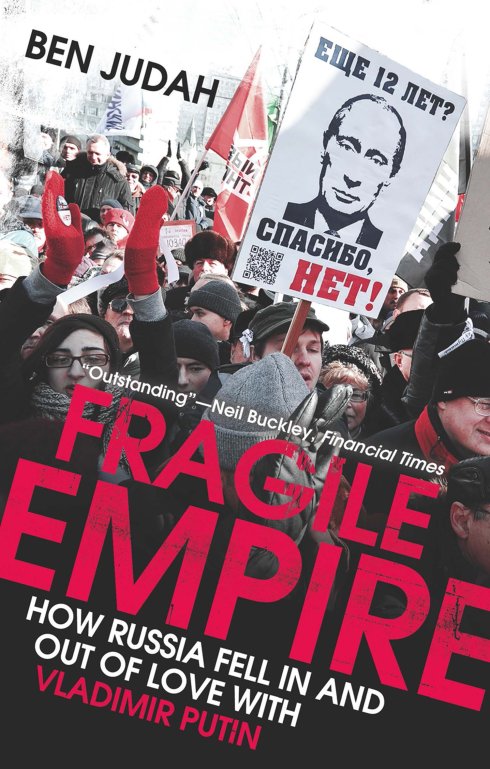
I can’t get inside Putin’s head, like Ben Judah convincingly does in what’s still the best book on the Путинщина, the “Putin-ness” or the “Putin thang.” Judah’s thesis is that Putin is really just a nebech apparatchik who others put in his place and who now — having trampled over so many people on his way up — is terrified of stepping down and that the macho persona he so tiringly projects masks mega insecurity. It almost makes you feel sorry for him.
But this relative of Mansky’s and her coldly realpolitik “nyet” tell you why he has so many Russians’ support. Because it means: nyet, you can’t tell me that the U.S. and NATO suddenly developed a major crush on Estonia and Georgia; nyet, you can’t suddenly tell me you’re interested in Ukraine too, because this was already starting to feel like a corporate raid on all the old girlfriends who dumped me, but Ukraine, especially, is like hitting on my sister; nyet, you can’t moan and groan about how we’re violating a basic credo of the European Union by changing borders, when neither Russia or Ukraine are part of the European Union and you wouldn’t even have considered Ukraine — with its resources, access to the Black Sea and huge Russian population — a candidate if it weren’t a way to totally encircle Russia; and, nyet, you can’t tell us that you’re not still treating us with a Cold War mentality that you inherited from an Anglo tradition of Great Game power struggle that doesn’t apply anymore and is now completely counter-productive.
At least talk some truth and maybe we can get somewhere. And then I’ll reconsider breaking up with Putin.
In the meantime, we can try to think of everyone as “close relations.”
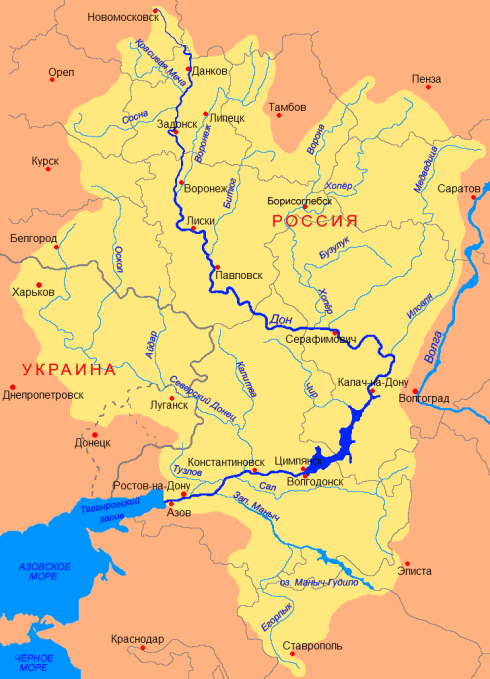
************************************************************************************* * The Donbass, the river Don basin is part of southeast Russia and the Russian-speaking parts of eastern Ukraine where the current conflict is centered. From “The first two of my cents on Ukraine and Russia“:
“Also, thence, a crucial point: that Ukraine wasn’t so much conquered, but settled by Russia…
“The independent “frontiersmen” mentality of the Russians of these areas, a sort of Russian Texas — among its ethnic Cossack peoples especially — should not be underestimated and should not be disregarded as a possible element in the current conflict. (See: And Quiet Flows the Don at Amazon and at Wiki.)”
“Новая Россия,” (Novaya Rossiya), New Russia, is not a Putinism. It’s a name for these lands that goes back to Catherine the Great and the first serious subduing of Cossack rebelliousness and settling of Russians in the region in the 18th century. It was part of the Russian empire’s most fertile grain-producing regions and then the scene of crazy industrialization under the Bolsheviks; maybe it was once a sort of “Russian Texas” but now it’s more like a sort of Russian Rust-Belt. Hence, the “they can have it” comment. The Soviet Army, decapitated by Stalin’s purges of its most talented and experienced, and ill-prepared and ill-equipped, only made the Nazi sweep through Ukraine grind to a halt once the Germans had made it this far east and after hundreds of thousands of Russian men had already been sent to a meaningless death and the Nazis had swept the old lands of the Pale clean of Jews through massive massacring and mass executions which were an integral part of the military strategy of the eastern front; many military historians believe that if the Nazi invasion of the Soviet Union hadn’t been slowed by German troops stopping every other community to round up and shoot its Jews (a method/process that killed more Jews than the gas chambers did), they might have been successful in beating the coming of winter and more successful in their campaign long-term. The region then became the scene of brutal attrition warfare, culminating in the siege of Stalingrad (now reverted back to its original name, Волгоград / Volgograd on map below). This left the region seriously trashed and so huge numbers of Russian workers were settled there post-WWII, Russianizing the Ukrainian far east even further and setting the stage for today’s conflict.
Map of the Don Basin. The grey line shows the border between Russia (РОССИЯ) and Ukraine (УКРАИНА) and the broken grey lines in Ukrainian east indicate the Lugansk (Луганск) and Donetsk (Донетск)
** “У меня денег нет” (“U menya deneg nyet”) in Russian is the same structure as the Turkish “Benim param yok” — “I don’t have any money.” Though Russian has a verb for “to have” like other Slavic languages, these structures both mean, literally: “By me there’s no money” or “My money isn’t there/isn’t by me.” Wondering whether it’s a construction Russian acquired through contact with Tatar. There is apparently a phenomenon where languages effect each other and transmit certain properties between them, though there’s no large bilingual population to bring them together and though they’re not genetically related, at least not closely. The absence of an infinitive, for example, in modern Greek, Albanian, Bulgarian and Romanian/Vlach, though each are from different Indo-European families and more closely related languages have an infinitive, is one good example. Also, Yiddish “by mir” (as in “By mir bist du shayn”) which is like the Russian по-моему (“according to me”) — for me, in my opinion. Though German uses “bei mir” also to mean same thing.
“…and to assume among the powers of the earth, the separate and equal station to which the Laws of Nature and of Nature’s God entitle them, a decent respect to the opinions of mankind requires that they should declare the causes which impel them to the separation.”
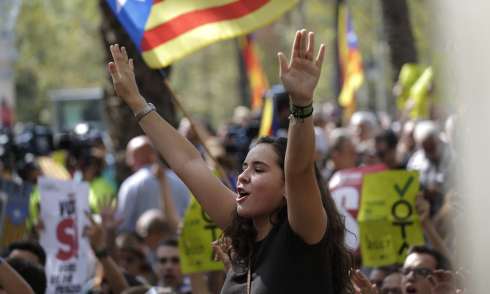
Are Catalan nationalists like Carles Puigdemont Founding Fathers or Confederate separatists?
I’m not convinced by the “causes which impel” Catalans to separation. Are you?
I’m hoping Catalans don’t goad Madrid and Rajoy into doing something stupid.
Read Puigdemont‘s irritating “Spain’s attempt to block Catalonia’s referendum is a violation of our basic rights“ in the Guardian. But especially scroll through the comments; the scariest ones that should give you more pause and where the dangers of Catalan separatism become clearest should jump out at you. There you’ll see the racist self-righteousness of “little nation” nationalism in all its smug, bourgeois glory.
Whenever a Catalan uses or writes “Castille” that means reactionary, Catholic, Black Legend Spain where — as one comment gallingly states — “things haven’t changed much since Franco.” Andalucía is cool and Moorish. The Basque Country is wealthy, enterprising and progressive like us, even if they’re a little too Catholic for our tastes. Galicia is the sweet, melancholy home of Celtic troubadours. It’s Castille and Aragon — oh, and Asturias, which gave birth to the ugly ideology of the Reconquista — the kingdoms of the barbarous “Reyes Católicos”, that are oppressing us.
Substitute “Serbia” for “Castille” and you’ll get an amazing repro of Croatian gripes. We’re European and forward-looking — even if kinna the kings of post-Hapsburg noxious fascism; don’t leave us to the mercy of obscurantist, Orthodox, Serb savages.
Where’s Almodóvar, the face of the Madrileña “movida” from La Mancha, where “nothing has changed much since Franco” to give us his opinion? I’m sure he has one.
Balkans, Anatolia, Caucasus, Levant and rest of ME, Iran, South Asia
Me, I'm Nicholas Bakos, a.k.a. "NikoBako." I'm Greek (Roman really, but when I say that in English some five people in the world today understand what I'm talking about, so I use "Greek" for shorthand). I'm from New York. I live all over the place these days. The rest should become obvious from the blog.


 Astoria
 Kypsele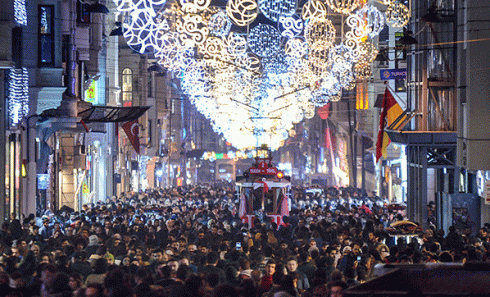
 Kadiköy
 The Rakia Bar in Dorćol
 But the unfortunate part is that Çiya is owned by a sociological type: the newly comfortable, if not rich, provincial, pious middle-class; that’s the AKP’s and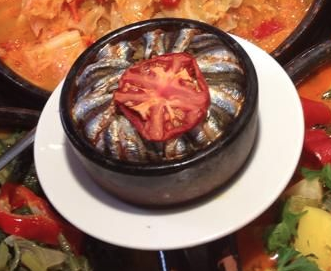


 Puigdemont and Spanish King Felipe VI at recent press conferences.
 Protesters hold a giant Spanish flag during a demonstration to support the unity of Spain on 8 October in Barcelona. Photograph: Lluis Gene/AFP/Getty Images
 –
– A boy holding a European flag waits for the start of the Catalan Convergence and Unity party (CiU) rally marking the last day of the European Parliament elections campaign in Barcelona on May 23, 2014 | Josep Lago/AFP via Getty Images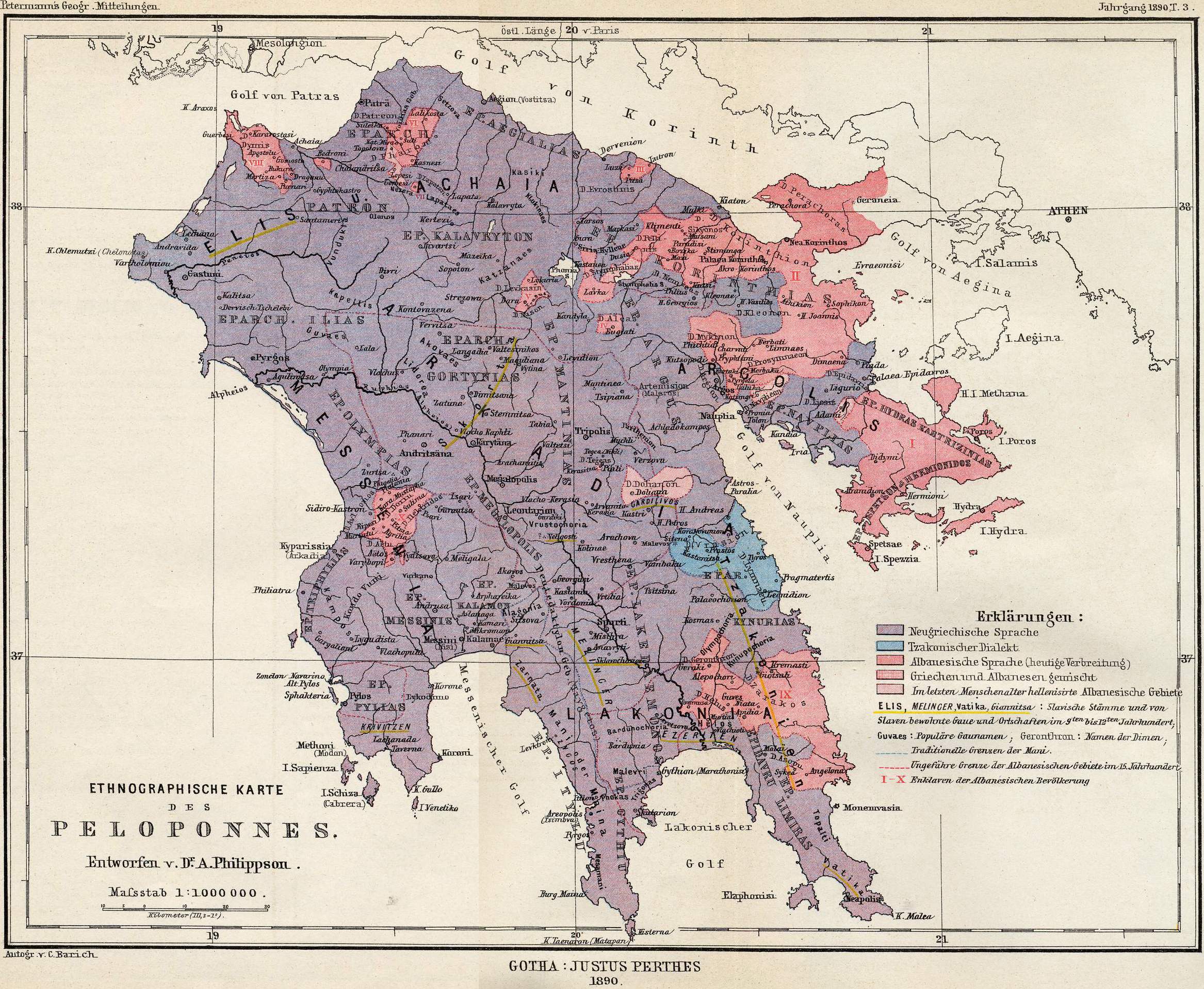

 Jadde: from Bosnia to Bengal