Tag Archives: Greeks

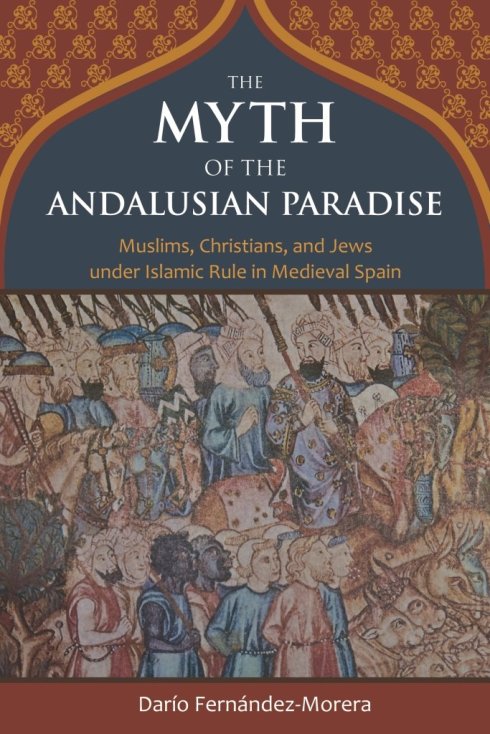
“The Myth of the Andalusian paradise…” — “…just modifying the history in a declared desire to extract a pre-established moral.”

7 Sep

71YwotMWVL

One reader’s comment that delves deeper into the book’s subject matter, repeats some of my thoughts and questions, especially that Spanish Christianity developed its militance and triumphalism in almost a millenium of constant warfare “in a society organized for war” against what for me is arguably a militant and triumphalist religion primarily organized for war, etc.; emphases are mine:

on April 16, 2016
Format: Hardcover
In ‘Al-Andalus au Miroir du Multiculturalisme; Le Mythe de la Convivencia dans quelques Essais Nord-Américains Récents’, the Arabist Bruna Soravia has reflected about the total absence of references to recent studies in books and articles published in the USA about Muslim Spain, including the important advances in essential fields such as archaeology, numismatic or epigraphy, as well as the lack of any work published in Spanish, French or Portuguese in the bibliographies of these American authors. Outside the United States, nobody doubts that the essential investigations in this subject are published in those languages, but the multiculturalism apologists obviously scorn any advance that proceed from their Spanish or French colleagues; they have paradoxically converted in a epitome and paradigm of intellectual endogamy.

The myth of that paradise of peaceful coexistence and cultural enlightenment had its origin in the long shadow that Américo Castro left in the United States (always copied, rarely cited), something obvious due the repetitive use of the Spanish word ‘convivencia’. A term created by Castro that gives the false impression that it was actually used in Spain during the Middle Ages. Today, there is no specialist who takes seriously the ideas of Castro, a Spanish scholar specialized in medieval literature that wasn’t actually a historian and openly admitted his lack of interest in the scientific methodology.

Darío Fernández-Morena not only demonstrates a remarkable knowledge about the modern European investigations in this subject but also a great knowledge of the primary sources. This is a well-written book that destroys, one by one, almost all the myths about al-Andalus repeated by those who pretend to refute the ideas of Samuel Huntington and his followers just modifying the history in a declared desire to extract a pre-established moral.

‘The Myth of the Andalusian Paradise’ follows the path of Serafín Fanjul’s works and present some similarities with ‘Al-Andalus y la Cruz’ by Rafael Sánchez Saus, also published this year, although independently. Both books reach the same conclusions, something that is not strange as both have the virtue of proving something that any Spanish historian has learnt in the first year at the university. I would say Fernández-Morera has done a better work, and his book has a great importance because it is an opportunity for the English readers to get the historical information that use to be conveniently omitted by the mainstream publications.

Fernández-Morena wrote a courageous introduction citing ‘political incorrect’ but true facts, as the financial dependence of many Western historians to foundations controlled by the governments of some Arab countries, the millionaire donations to American and British universities from Saudi and Muslim sources, the censorship that exists in the Muslim academic world and the risk that any investigator has to be labeled as ‘islamophobic’ if his publications refute the idyllic narrative about the medieval Islamic world. As happened with the academic lynching of Sylvain Gouguenheim, after the publication of his excellent ‘Aristote au Mont Saint-Michel’ in 2008.

Just to summarize, during the High Middle Ages the Iberian Peninsula was the most militarized territory of all Europe and the Islamic world, where it was actually known as Dar Djihad, ‘the house (land) of the jihad’. The Christian kingdoms were involved in an almost constant war with the emirs and caliphs of Córdoba, that organized annual military expeditions to the north to get prisoners and looting; something that Roger Collins has defined as ‘an economy based in institutionalized banditry’ (‘Caliphs and Kings: Spain, 796-1031’). Just during the government of Al-Mansur (977-1002), the hajib of the caliph Hisham II (controlled by him as a puppet ruler), were organized 56 military raids, and only in the campaign towards Barcelona of 985, according to the Arab sources, 75,000 prisoners were made, mainly women sold in Córdoba as sexual slaves.

Maybe Fernánez-Morera should focus this chapter in the socio-economical and institutional implications of this state of constant war that created, using the words of James F. Powers and Elena Laurie, ‘a society organized for war’. The records in the Muslim and Christian textual sources about the great amount of severed heads are true anyway. The first thing any traveler saw when he visited Córdoba crossing the Roman bridge was hundreds of severed heads decorating the Azuda gates of the alcázar, the fortress of the caliph situated 100 meters from the great mosque. The textual sources even describe muezzins calling to oration over a mound of severed heads after the raid of Ubayd Allah to Bacelona in 811, or after the Battle of Uclés (1108).

Regarding the domestic policy, Christians and Jews of Al-Andalus lived into an authentic apartheid. The Dhimma implied the legal interiority of the ‘protected peoples’, their judicial defenseless against any Muslim, their fiscal exploitation and their constant humiliation; something that forced the conversions and the mass emigration of the Mozarabic population to the Northern Christian kingdoms. The Muslims become majority during the Umayyad caliphate (929-1031) and soon the mass killings began, as the slaughter of 4,000 Jews in Granada in 1066. During the period of North African domination, the conditions for the ‘peoples of the book’ were even worse and ended with the mass deportation of the Christians to the Magreb in 1126. Since the middle of the 12th century, there are no Christians or Jews in al-Andalus.

As Fernández-Morena pointed out, Andalusian society was a theocratic state (or ‘states’, during the Taifa period) dominated by the ulema of the Maliki school of jurisprudence, the most strict of all after the Hanbali (now used in Saudi Arabia), that controlled every aspect of the daily life. It’s really hard to understand why any historian with a basic knowledge of the primary sources can ignore these facts that have so many implications in all the aspects of the Andalusian society, politics, economy and culture, and instead prefers to focus his research in the ‘spirit’ of the poetry and literature created in (and for) a courtesan context.

Finally, another important myth that maybe Fernández-Morena should consider deeper is the transmission of the ancient knowledge through the Arabic translations, that supposedly were the foundations of the European Renaissance. Anyway, as I have said, this book is essential for any English reader who wants to know the reality of the Medieval Islamic Spain.

Comment: nikobakos@gmail.com

“The Myth of the Andalusian Paradise: Muslims, Christians, and Jews under Islamic Rule in Medieval Spain” by Dario Fernandez-Morera

7 Sep

Just saw it on Amazon.  Is it serious or “yellow” history?  Obviously haven’t read it.  If anyone has please share.

mythandalusianparadise_frontcover_final

The comments/review quotes seem to be from fairly “serious” sources:

“Shows in meticulous detail . . . that intolerance, segregation, formal inequality, and brutality were the order of the day [in Islamic Spain].”
The New Criterion

“[Fernández-Morera] must be commended for daring to wade into this hazardous arena. He has come well-armed: his The Myth of the Andalusian Paradise has 95 pages of notes, and the lionisers of political correctness will not find it easy to penetrate chinks in his bibliographical armour of primary and secondary sources, many not published in English. In an exhilarating and unput-downable read, Fernández-Morera debunks the fashionable myth that Muslims, Christians, and Jews lived together (convivencia) under ‘tolerant’ Muslim rule. . . . World-class academics—hailing from Yale, Harvard, Chicago, Princeton, London, Oxford—look like fools in their apologetics for jihad.”
—Standpoint

“Numerous books propagandize for Islam by calling Muslim rule in Spain during the Middle Ages a golden age of tolerance. Darío Fernández-Morera’s The Myth of the Andalusian Paradise: Muslims, Christians, and Jews Under Islamic Rule in Medieval Spain (ISI Books) cuts against PR for Islam by giving specific examples of rulers cutting off heads or applying burning candles to the faces of sexual slaves.” —World magazine, naming The Myth of the Andalusian Paradise a finalist for Book of the Year

“Often a work of historical revisionism is a dubious exercise in discovering trendy, hidden agendas with little bearing on the actual record of the past. The Myth of the Andalusian Paradise is decidedly not such a study and is instead a bracing remedy to a good deal of the academic pabulum that passes for scholarship on Jewish-Christian-Muslim relations.”
Middle East Quarterly

“A first-rate work of scholarship that demolishes the fabrication of the multiethnic, multiconfessional convivencia in Spain under Muslim rule. The book is also an exposé of the endemic problems of contemporary Western academe. . . . Space does not allow us to list all of the fables—some bizarre, others laughable, most of them infuriating—that Fernández-Morera dispatches with unassailable logic and ruthless efficiency.”
Chronicles

“I am in awe of The Myth of the Andalusian Paradise. . . . This book is an intellectual boxing match. The author shreds not just one opponent, but a series of intellectual bigots, prostitutes, and manipulators of the common man. . . . He uses research and objective facts to make his case. Nothing could be more transgressive in academia today.”
FrontPage Magazine

“The Myth of the Andalusian Paradise prompts readers to rethink their traditional notion of Islamic Spain. Fernández-Morera shows that it was not a harmonious locus of tolerance. Paying special attention to primary sources, he documents how Islamic Spain was in fact dominated by cultural repression and marginalization. The Myth of the Andalusian Paradise is essential reading. It will soon find its place on the shelves of premier academic institutions and in the syllabi of pioneering scholars.”
Antonio Carreño, W. Duncan McMillan Family Professor in the Humanities, Emeritus, Brown University 

“I could not put this book down. The Myth of the Andalusian Paradise constitutes a watershed in scholarship. Throughan unbiased and open-minded reading of the primary sources, Fernández-Morera brilliantly debunks the myths that for so long have dominated Islamic historiography and conventional wisdom. We were waiting for this great breakthrough to come to light, and Fernández-Morera has done it. Bravo!”
Raphael Israeli, Professor Emeritus of Middle Eastern, Islamic, and Chinese History, Hebrew University of Jerusalem

“Fernández-Morera examines the underside of Islamic Spain, a civilization usually considered a model of dynamism and vigor. Through the study of primary sources, he questions the historiographic and intellectual view of the superiority of that civilization. This is an intelligent reinterpretation of a supposed paradise of convivencia.”
Julia Pavón Benito, Professor of Medieval Spanish History, University of Navarra

“Desperately, desperately needed as a counter to the mythology that pervades academia on this subject. This book sheds much-needed light on current debates about the relationship between the West and Islam. It displays rare good sense and a willingness to face truth that is all too often absent in discussions of this era.”
Paul F. Crawford, Professor of Ancient and Medieval History, California University of Pennsylvania

“A splendid book. This sober and hard-hitting reassessment demolishes the myths of religious tolerance and multiculturalism that have hopelessly romanticized the precarious coexistence and harsh realities of medieval Spain under Muslim rule. Well documented and persuasively argued, this book is must-reading as a window into the lessons of the past.”
Noël Valis, Professor, Department of Spanish and Portuguese, Yale University

“Fernández-Morera takes on the long-overdue topic of assessing medieval Muslim Spain’s reputation for ethnic pluralism, religious tolerance, and cultural secularism. Finding this view based on a ‘culture of forgetting,’ he documents the reign of strict sharia in Andalusia, with its attendant discrimination against non-Muslims and subjugation of women. So much for the charming fantasy of open-mindedness and mutual respect.”
Daniel Pipes, historian of Islam and publisher of the Middle East Quarterly

“Brilliant . . . A thorough and entertaining study, as masterful as it is pointed.”
Catholic Culture

“Reveals the awesome and awful truth camouflaged by many in the West who have written apologies for Muslim-ruled Andalusia . . . More than 90 pages of footnotes to contemporary sources in their original languages make his thesis unassailable.”
New English Review

About the Author:

Darío Fernández-Morera is Associate Professor in the Department of Spanish and Portuguese at Northwestern University. A former member of the National Council on the Humanities, he holds a BA from Stanford University, an MA from the University of Pennsylvania, and a PhD from Harvard University. He has published several books and many articles on cultural, literary, historical, and methodological issues in Spain, Latin America, and the United States.

But before I publish this I’ll commend myself for “daring to wade into this hazardous arena”, just about two weeks ago in: Barcelona addendum: why the Western, “leftist” intelligentsia bears a nasty share of the guilt, part I(part II should be coming soon):

OK…I’ve bitten off more than I can chew I think, so let me resort to bullet points.  Some Al-Andalus and Crusades fun bubbles I’d like to pop:

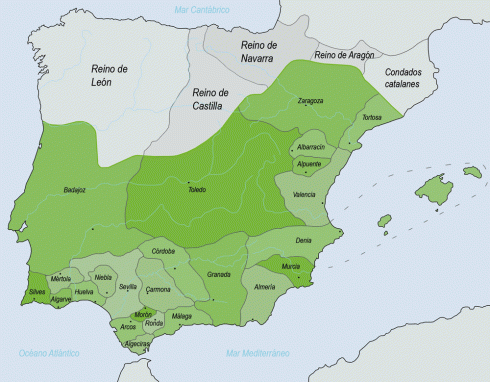
* The happy Muslim Iberia of convivencia — co-existence — only lasted for at most two centuries, as long as the Umayyad Caliphate with its capital at Córdoba lasted.  That caliphate was replaced by new and much more religiously orthodox and intolerant Berber kingdoms from North Africa under which Spain devolved into small Muslim emirates — the taifain which conditions for Spanish non-Muslims came to resemble those of dhimmi elsewhere in the Muslim world.  (See also rayah: “…both in contemporaneous and in modern usage, it refers to non-Muslim subjects in particular, also called zimmi.”  The “dh” sound of Arabic is usually replaced by a “z” sound in Irano-Turkic usage, as in Ramadhan and Ramazan.)

Taifas2 1031 after fall of CórdobaThe taifa of the Iberian peninsula in 1031. (By 1248, when Seville fell to Christian siege, the only other major city left in Muslim hands was Granada.


*
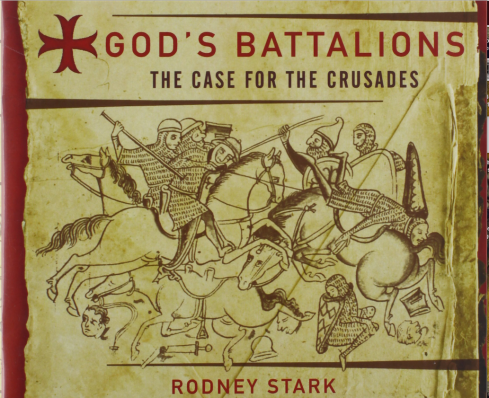
Check out this book about the Crusades: God’s Battalions: The Case for the Crusades by Rodney Stark.

Screen Shot 2017-08-20 at 11.36.28 AM

It’s a cruddy, badly written and amateurish book (but, you know…”Out of the mouths of babes…” Psalms 8:2 and Matthew 21:16; you can’t expect an academically serious historian to write something like this, as he’d lose all funding and probably his job), but it asks a serious question: why have we in the modern West come to consider the Crusades the beginning of aggressive Western imperialism, a kind of proto-colonialism, and not, as Stark asks, a perfectly predictable response to the aggression of Islam/Arabs?  I mean, sorry, it’s a question I’ve always been afraid to articulate: but who conquered two thirds of the Roman Christian world and the whole of the Sassanian world in less than a century to being with?

Next:

* That the Crusades have remained a traumatic memory seared in the collective consciousness of Arabs everywhere, that Syrian mothers still scare their children into obedience by telling them that Richard the Lionheart is coming to kidnap them, is an urban myth.  Arabs didn’t remember the Crusades any more than we (Greeks) collectively remembered the Fourth Crusade that dealt the fatal blow to the Eastern Roman Empire (the Ottomans really just mopped up what was left).  Arabs only “remembered” the “trauma” of the Crusades when the West and the above mentioned guilty Western intelligentsia “reminded” them

* On to another inconvenient truth that follows on the above: the Byzantines recovered fairly quickly from the loss of the Levant and Egypt to the Arabs in the 7th century, and in fact, may have emerged stronger as a more compact, ethnically and linguistically Greek polity.  Then, under the early Comnenoi in the 12th century (Alexios, Ioannes and Manuel), they showed their resilience again as they reconsolidated their rule over the Balkans and, taking advantage of the crumbling of the Seljuks caused by the appearance of new Turks in Asia Minor, reconquered a large part of western Anatolia, despite facing renewed aggression from the Italian/Sicilian Normans to the West and from these newer Turkic states on the East; with the First Crusade’s help, they even recaptured Antioch and the surrounding region for a brief period.  The Fourth Crusade’s conquest and sack of Constantinople in 1204, though, was an event it was impossible to recover from.  Several Greek successor states that emerged then reunited into an empire under the leadership of the Palaeologoi out of Nicaea and retook Constantinople in 1261, but from then on this remnant Roman Empire was, despite a new cultural and artistic flourishing, a political and military sitting duck.  Add to these facts that Levantine Christians and Armenians who ended up in the reconquered Crusader states — at the time of the Crusades the regions we’re talking about were, by some estimates, still almost 50% Christian — were subjected to violent reprisals by their newly returned Muslim overlords that diminished their numbers through flight and conversion and we come to the inevitable conclusion: in the long run, the greatest victims of the Crusades were eastern Christians.

* For Jews, whose horrific experiences with the Christian Westjust went from bad to worse over two millenia, culminating in the Holocaust, and for whom it seems to have been particularly tempting to see the historical lands of Islam as the “Goldene Medina” where Jews lived in peace and acceptance, it wouldn’t hurt to keep in mind that the biggest pogrom in mediaeval Europe in terms of numbers slain occurred in 1066 in Muslim Granada.  This was when a Jew-cum-uppity-nigger, Joseph ha-Nagid, became too powerful as the vizier at the emir’s court in Granada — that city whose languid beauty and graciousness is the Fetish-in-the-Crown of pro-Moorish apologists.  He was crucified and, by some estimates (many consider them discredited, but you have to ask why), 4,000 Jews were killed.  I don’t know if crucifixion was supposed to have some kind of retaliatory significance given he was Jewish.  But, according to Bernard Lewis, the Berber Muslim mob that carried out this pogrom were egged on by a poem of a certain Muslim, Abu Ishaq:

Bernard Lewis writes:

“Particularly instructive in this respect is an ancient anti-Semitic poem of Abu Ishaq, written in Granada in 1066. This poem, which is said to be instrumental in provoking the anti-Jewish outbreak of that year, contains these specific lines:

Do not consider it a breach of faith to kill them, the breach of faith would be to let them carry on.
They have violated our covenant with them, so how can you be held guilty against the violators?
How can they have any pact when we are obscure and they are prominent?
Now we are humble, beside them, as if we were wrong and they were right!
[my emphases]”

“My emphases” are obviously meant to highlight the zero-sum game that is monotheism and particularly Islam: “obscure/prominent” and “wrong/right”.  No sense that there’s room for both or many as in polytheism or Hinduism (let’s not get into whether Hinduism is really polytheism right now).  Just “right” and “wrong”.  If you’re wrong you’ll be tolerated as long as you don’t get too big for your britches.  And: “why am I obscure when they’re prominent?” sounds like the battle cry of curdled ressentiment we’ve heard from Sayyid Qutb to Mohammed Atta and his buddies and back to Abu Ishaq if not to the very beginnings and to Ishmael himself, the rejected illegitimate son of Abraham and of the slave Hagar

Lewis adds though: “Diatribes such as Abu Ishaq’s and massacres such as that in Granada in 1066 are of rare occurrence in Islamic history.”

Well, ok then…

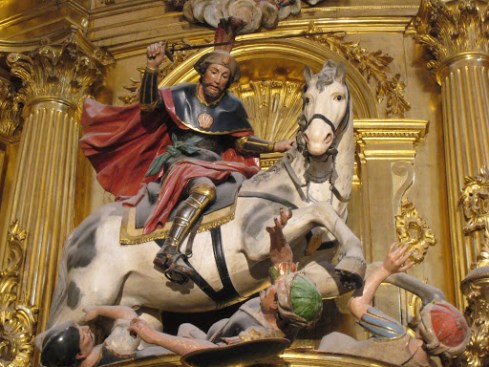
* Spanish Catholicism has been (Yes – “Nobody expects the Spanish Inquisition…”) for great periods of our common history, terrifying, especially for the Jews and Muslims the Arabs left behind in Spain and for the subjected-to-close-to-genocide inhabitants of the New World.  I admit to having played around with Santiago imagery in the past, but the connotations became too hard to stomach (see this interesting article: “The Transference of ‘Reconquista’ Iconography to the New World: From Santiago Matamoros to Santiago Mataindios“).  The Spanish Catholicism of the Reconquista and the Counter-Reformation is easily the most abominable form Christianity has ever taken — along with the Puritans, of course, and Luther and his Taliban, of course, and American Evangelists, of course, etc. etc.  But, still, you have to ask: the legitimacy of force and conquest in the spreading of the faith; massacre or forced conversion as legitimate proselytizing methods, enslavement of the defeated enemy — where did Spanish Catholicism get those ideas from?  They’re not in the Gospels.  And forced conversion is not present in Judaism either, which — remember — is not interested in converting you, my little goy.  Maybe — just maybe — after 800 years you start to resemble your enemy.  Even the Spanish concept of limpieza de sangreblood purity — that you have no Muslim or Jewish ancestors, probably unfeasible to impossible in Iberia — seems to mirror the chauvinism of early peninsular Arabs, and the apart-ness status they lived under in early Islam.  Any ideas?

Santiago statue

Santiago Matamoros

I’ve had quite some fun with the response to this; like I said, I should get Part II posted in a couple of days or so.

Comment: nikobakos@gmail.com


Barcelona addendum: why the Western, “leftist” intelligentsia bears a nasty share of the guilt, part I

21 Aug

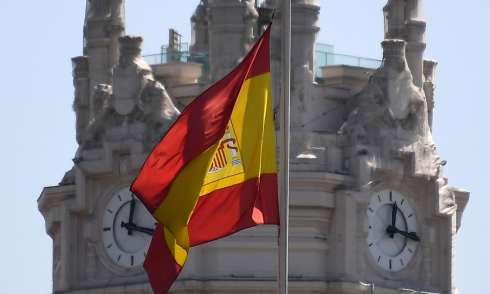
Spanish flag Cibeles PalaceA Spanish flag at half-mast in front of Cibeles Palace in Madrid. Photograph: Gabriel Bouys/AFP/Getty

A lot of Greeks here have asked me “Why Spain?”  When the 2004 attacks on the Madrid commuter trains which killed 192 people were carried out, Spain still had troops in Iraq, which then new Prime Minister José Luis Rodríguez Zapatero shamefully withdrew as soon as he could after defeating José María Alfredo Aznar López, who got Spain into Iraq in the first place.  Involvement in Iraq had been unpopular with the Spanish electorate from the beginning, and pressure had already been mounting on Aznar to withdraw troops after seven Spanish intelligent agents were killed by Iraqi insurgents in November of 2003, but the Madrid bombings were planned by Al Qaeda to occur just three days before Spanish elections.  I was not an Aznar man by any stretch of the imagination, but for Spaniards to cave in to Al Qaeda terror like that and elect a Prime Minister whose first act, essentially, was to withdraw the country’s troops from Iraq, was a show of collective cowardice from a people whose ballsiness I’ve always admired that seriously dismayed me.  But since Spain is no longer a nation with troops in Muslim lands, what’s the problem.

So here in the Guardian is the answer to “Why Spain?”:

Although most are thought to have been radicalised by the war in Syria, some jihadis find Spain a peculiarly atavistic target because of the country’s 700-year period of Moorish occupation. Islamic State was quick to look to the past and claim credit for the Barcelona attack, trumpeting: “Terror is filling the crusaders’ hearts in the Land of Andalusia.” [my emphasis]

See the New York Times’ video: “The Islamic State’s Claim to Spain”

OK…I’ve bitten off more than I can chew I think, so let me resort to bullet points.  Some Al-Andalus and Crusades fun bubbles I’d like to pop:

* The happy Muslim Iberia of convivencia — co-existence — only lasted for at most two centuries, as long as the Umayyad Caliphate with its capital at Córdoba lasted.  That caliphate was replaced by new and much more religiously orthodox and intolerant Berber kingdoms from North Africa under which Spain devolved into small Muslim emirates — the taifain which conditions for Spanish non-Muslims came to resemble those of dhimmi elsewhere in the Muslim world.  (See also rayah: “…both in contemporaneous and in modern usage, it refers to non-Muslim subjects in particular, also called zimmi.”  The “dh” sound of Arabic is usually replaced by a “z” sound in Irano-Turkic usage, as in Ramadhan and Ramazan.)

Taifas2 1031 after fall of CórdobaThe taifa of the Iberian peninsula in 1031. (By 1248, when Seville fell to Christian siege, the only other major city left in Muslim hands was Granada.


*
Check out this book about the Crusades: God’s Battalions: The Case for the Crusades by Rodney Stark.

Screen Shot 2017-08-20 at 11.36.28 AM

It’s a cruddy, badly written and amateurish book (but, you know…”Out of the mouths of babes…” Psalms 8:2 and Matthew 21:16; you can’t expect an academically serious historian to write something like this, as he’d lose all funding and probably his job), but it asks a serious question: why have we in the modern West come to consider the Crusades the beginning of aggressive Western imperialism, a kind of proto-colonialism, and not, as Stark asks, a perfectly predictable response to the aggression of Islam/Arabs?  I mean, sorry, it’s a question I’ve always been afraid to articulate: but who conquered two thirds of the Roman Christian world and the whole of the Sassanian world in less than a century to being with?

Next:

* That the Crusades have remained a traumatic memory seared in the collective consciousness of Arabs everywhere, that Syrian mothers still scare their children into obedience by telling them that Richard the Lionheart is coming to kidnap them, is an urban myth.  Arabs didn’t remember the Crusades any more than we (Greeks) collectively remembered the Fourth Crusade that dealt the fatal blow to the Eastern Roman Empire (the Ottomans really just mopped up what was left).  Arabs only “remembered” the “trauma” of the Crusades when the West and the above mentioned guilty Western intelligentsia “reminded” them

* On to another inconvenient truth that follows on the above: the Byzantines recovered fairly quickly from the loss of the Levant and Egypt to the Arabs in the 7th century, and in fact, may have emerged stronger as a more compact, ethnically and linguistically Greek polity.  Then, under the early Comnenoi in the 12th century (Alexios, Ioannes and Manuel), they showed their resilience again as they reconsolidated their rule over the Balkans and, taking advantage of the crumbling of the Seljuks caused by the appearance of new Turks in Asia Minor, reconquered a large part of western Anatolia, despite facing renewed aggression from the Italian/Sicilian Normans to the West and from these newer Turkic states on the East; with the First Crusade’s help, they even recaptured Antioch and the surrounding region for a brief period.  The Fourth Crusade’s conquest and sack of Constantinople in 1204, though, was an event it was impossible to recover from.  Several Greek successor states that emerged then reunited into an empire under the leadership of the Palaeologoi out of Nicaea and retook Constantinople in 1261, but from then on this remnant Roman Empire was, despite a new cultural and artistic flourishing, a political and military sitting duck.  Add to these facts that Levantine Christians and Armenians who ended up in the reconquered Crusader states — at the time of the Crusades the regions we’re talking about were, by some estimates, still almost 50% Christian — were subjected to violent reprisals by their newly returned Muslim overlords that diminished their numbers through flight and conversion and we come to the inevitable conclusion: in the long run, the greatest victims of the Crusades were eastern Christians.

* For Jews, whose horrific experiences with the Christian West just went from bad to worse over two millenia, culminating in the Holocaust, and for whom it seems to have been particularly tempting to see the historical lands of Islam as the “Goldene Medina” where Jews lived in peace and acceptance, it wouldn’t hurt to keep in mind that the biggest pogrom in mediaeval Europe in terms of numbers slain occurred in 1066 in Muslim Granada.  This was when a Jew-cum-uppity-nigger, Joseph ha-Nagid, became too powerful as the vizier at the emir’s court in Granada — that city whose languid beauty and graciousness is the Fetish-in-the-Crown of pro-Moorish apologists.  He was crucified and, by some estimates (many consider them discredited, but you have to ask why), 4,000 Jews were killed.  I don’t know if crucifixion was supposed to have some kind of retaliatory significance given he was Jewish.  But, according to Bernard Lewis, the Berber Muslim mob that carried out this pogrom were egged on by a poem of a certain Muslim, Abu Ishaq:

Bernard Lewis writes:

“Particularly instructive in this respect is an ancient anti-Semitic poem of Abu Ishaq, written in Granada in 1066. This poem, which is said to be instrumental in provoking the anti-Jewish outbreak of that year, contains these specific lines:

Do not consider it a breach of faith to kill them, the breach of faith would be to let them carry on.
They have violated our covenant with them, so how can you be held guilty against the violators?
How can they have any pact when we are obscure and they are prominent?
Now we are humble, beside them, as if we were wrong and they were right!
[my emphases]”

“My emphases” are obviously meant to highlight the zero-sum game that is monotheism and particularly Islam: “obscure/prominent” and “wrong/right”.  No sense that there’s room for both or many as in polytheism or Hinduism (let’s not get into whether Hinduism is really polytheism right now).  Just “right” and “wrong”.  If you’re wrong you’ll be tolerated as long as you don’t get too big for your britches.  And: “why am I obscure when they’re prominent?” sounds like the battle cry of curdled ressentiment we’ve heard from Sayyid Qutb to Mohammed Atta and his buddies and back to Abu Ishaq if not to the very beginnings and to Ishmael himself, the rejected illegitimate son of Abraham and of the slave Hagar

Lewis adds though: “Diatribes such as Abu Ishaq’s and massacres such as that in Granada in 1066 are of rare occurrence in Islamic history.”

Well, ok then…

Some questions:

* Why does the Western liberal never tire of reminding us how bloody the massacre that accompanied the First Crusaders’ conquest of Jerusalem was, but if you dare compare that to one of the first acts of the first community of Muslims — the decapitation of an entire tribe of Jewish men and boys and the distribution of the women and younger children among them as slaves (sound familiar?) — or the orgy of bloodletting and destruction the Ghaznavids unleashed on India, or the comparable massacre and enslavement by the Ottomans of whatever remained of the population of Constantinople on May 29th, 30th and 31th, 1453 (when a city that has resisted falls you get three days to pillage, massacre and enslave and then you have to stop: let’s not get greedy), then you’re an Islamophobe like the creepy Sam Harris or the silly Bill Maher or even the flip-flopping Maajid Nawaz (I never trust a convert) who’s “cherry-picking” events and quotes in order to make his hateful, Islamophobe argument?

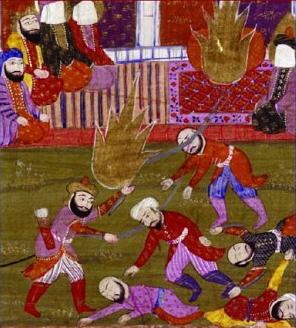
Banu_Qurayza Battle of the Khandak Detail from miniature painting The Prophet, Ali, and the Companions at the Massacre of the Prisoners of the Jewish Tribe of Beni Qurayzah, illustration of a 19th-century text by Muhammad Rafi Bazil. Manuscript now in the British Library.

(At least, as far a I know, no Western descendant of the Crusaders celebrates either the fall of Jerusalem or the 1204 Sack of Constantinople with this kind of clownishness:

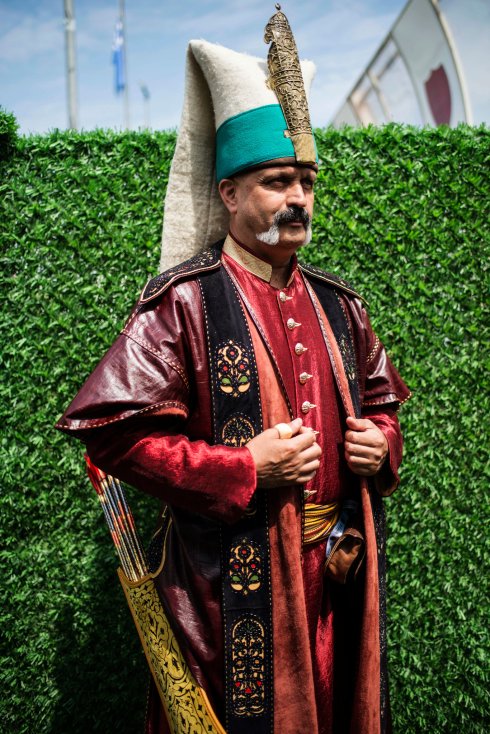
turkisharchers8-superJumbo

…the fifth annual Conquest Cup, an archery competition that celebrates the anniversary of the conquest of Constantinople in 1453.” [my link] the Times writes, oblivious to the fact that this celebration commemorates an event which to some might mean a history of death and enslavement.  And they just cheerily put it in the sports section, when it’s as easy to find this offensive as it is to find a Confederate soldier or Robert E. Lee monument offensive.  But imagine the Times just putting Southern Civil War battle reenacters in the sports section as a wacky, cool, exotic event; there’d be a screeching riot of anger they’d have to deal with that they would never forget.  Let’s re-enact some slave auctioning too then.  I mean, whatever, Turks can have their fun.  I’m not going to turn into one of the jerks who kvetches until the Helmsley building takes down its Cross lighting display during Christmas.  But then drop the religion-of-peace argument.)

* I am so sick of the clichéd accusation of “cherry-picking” so beloved by the insufferable Mehdi Hassan (see below) and his like, but let’s take the term as textually literal and see.  If I took a basket and starting looking through Muslim scripture and history for legitimized violence and intolerance, I think I’d end up with a pretty hefty basket-load of cherries; c’est-à-dire, if something is “cherry-picked” it doesn’t mean that the cherries are actually light on the tree and we’ve picked the very few that there are this year, for whatever reason, or that they don’t taste like what we think they taste like.  And let’s rethink the word “tolerant.”  “To tolerate” is a word that in contexts other than Western liberals’ defense of Islam is offensive; it means, I’ll be merciful and compassionate, if you accept your second-class status.  Needless to say — it pisses me off to have to add this caveat — the Old Testament is just as loaded, if not more, with cherries ripe for the picking, as is the New Testament aside from the Gospels and Acts; pain-in-the-ass Paul’s re-Judaizing of the Gospels’ message with his moralism and legalism and chauvinistic zeal, is nasty and, worse, boring (like I said, always watch out for the convert), and the psychotic vengeance-poem of Revelations (Apocalypse in Greek) sends chills up my spine — and not chills of repentance, just disgust — whenever I’m exposed to it.

* Spanish Catholicism has been (Yes – “Nobody expects the Spanish Inquisition…”) for great periods of our common history, terrifying, especially for the Jews and Muslims the Arabs left behind in Spain and for the subjected-to-genocide inhabitants of the New World.  I admit to having played around with Santiago imagery in the past, but the connotations became too hard to stomach (see this interesting article: “The Transference of ‘Reconquista’ Iconography to the New World: From Santiago Matamoros to Santiago Mataindios“).  The Spanish Catholicism of the Reconquista and the Counter-Reformation is easily the most abominable form Christianity has ever taken — along with the Puritans, of course, and Luther and his Taliban, of course, and American Evangelists, of course, etc. etc. — but, still, you have to ask: the legitimacy of force and conquest in the spreading of the faith; massacre or forced conversion as legitimate proselytizing methods, enslavement of the defeated enemy — where did Spanish Catholicism get those ideas from?  They’re not in the Gospels.  And forced conversion is not present in Judaism either, which — remember — is not interested in converting you.  Maybe — just maybe — after 800 years you start to resemble your enemy.  Even the Spanish concept of limpieza de sangreblood purity — that you have no Muslim or Jewish ancestors, probably unfeasible to impossible in Iberia — seems to mirror the chauvinism of early peninsular Arabs, and the apart-ness status they lived under in early Islam.  Any ideas?

Santiago statue

Santiago Matamoros

* And the insufferable Mehdi Hassan below.  I loved him as host of Al Jazeera’s The Café.  Then he appointed himself the ummah’s defender against the likes of Sam Harris or Richard Dawkins or Christopher Hitchens and became as annoying as hell.  He seems to think that speaking a mile a minute in an Oxbridge accent with just enough working-class twang to suggest a Bradford boy done good will win him arguments…snide, cliché-ridden, “super-cherry-picking,” an accusation he likes to throw at others.  Exhausting, but you have to admire his energy I guess.  I don’t know if you’re the best “ambassador” of Islam, though, when you yourself have started to develop strange physical ticks in an attempt to monitor your own rage.

Comments, questions, answers, corrections, tirades, please send to:

Comment: nikobakos@gmail.com

Memo to: a certain generation of “progressive” Turks

4 Aug

From: NikoBakos

Re: the final and total castration of the Turkish military

Date: August 2017

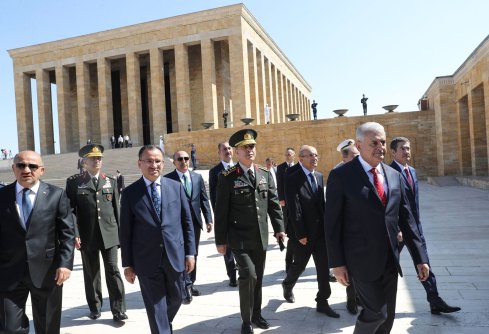
Ataturk Mausoleum Yildirim Chiefs of staffPrime Minister Binali Yildirim of Turkey, front right, and the chief of staff, Gen. Hulusi Akar, third from left, visit the Mustafa Kemal Ataturk Mausoleum before the Turkish Supreme Military Council meeting in Ankara on Wednesday. Credit Adem Altan/Agence France-Presse — Getty Images

ARE YOU HAPPY NOW???

I have two groups of friends in Constantinople:* one a group of mostly Alevi**, first-generation urbanites (from Dersim and Antiocheia); another of at least several urban generations, who are pure “White” Turks in every way.

A sub-category of this second group of friends (who are fast becoming ex-friends) are/were or considered themselves to be “leftists” (“I should cough” as one of the characters in Hester Street says).  These were always violently allergic to anything that had to do with the military, Turkish or otherwise.

Peaceniks, of course, our rift began when it proved completely in their interest to paint me as a super-American hawk during the Iraq war, even if I’m deeply un-American in my self-identification and was never a supporter of Bush’s adventure.  I simply did not know what to think about the idea of invading Iraq and toppling Saddam Hussein and took issue with their knee-jerk, anti-American attitude, with their facile certainty they knew what to think.  In the end I just decided that anybody who was automatically against the completely justified invasion of Afghanistan and the removal of the Taliban — and if that’s a tragically uncompleted project, that doesn’t mean the initial result or victory was not worthwhile…ASK ANY AFGHAN — was going to be a robot-thinker about any kind of American intervention or just about war of any kind, so I couldn’t be bothered.

Of course, these types DON’T KNOW ANY AFGHANS to ask, because they’re shameless hypocrites living in their pleasant, sheltered suburbs in C-Town, who know our Cyclades better then they know the rest of their own country — certainly better than I do — and wouldn’t dare head out to Afghanistan, even on a dare.  Why do they irritate me so much?  It’s simple.

If the original sin of the Right is selfishness, the original sin of the Left is self-righteousness, by which I mean the need to see one’s self as morally correct no matter what, even if this means a breezy indifference to the realpolitik or the reality of what’s really happening on the ground.***

Of course, they were steadfast in their belief that the Turkish military was an institution of bastardized Kemalism that was the greatest anti-democratic force in their society.  This was their justification for eventually rejecting their parents’ admittedly corrupt CHP as well, Turkey’s Kemalist Republican party.  And yet it’s ironic that the Turkish military’s “anti-democratic” orientation has repeatedly prevented the complete descent of that society into chaos.  One of these types has a whole sob story she used to recite to me about how, as a young girl in the 70s, she was terrified every day when her father left the house that he wouldn’t come home because of the terrible and constant terrorist violence that was then occurring on the streets of Constantinople.  But it was the military that put an end to that violence in 1980, like it was the military who got rid of Menderes, architect of the 1955 anti-Greek pogrom, in 1960.  And as soon as Erbakan started exceeding his limits (btw, he was the first who tried talking about limiting alcohol consumption and tables on the street in Pera and Galata), the military got rid of him too in 1997 — not exactly cause and effect there.

As a Greek, there’s obviously little love lost on my part for the Turkish military.  I just feel that if Turkey’s twentieth-century history, culminating in the Erdoğan phenomenon, has proven the country to be incapable of forming a democratic civil society that doesn’t spin out of control into violence, corruption and chaos, then you just don’t have the luxury of being anti-military.  Furthermore, from our perspective, Erdoğan’s pre- and post-“coup” military is a far more threatening force than it was previously.  Violations of Greek air space have increased exponentially under Erdoğan’s tenure, as has his, and formerly Davutoğlu’s, irresponsibly imperialist Neo-Ottoman language.  And just like it wasn’t a military junta that organized the pogrom of 1955, it wasn’t a military government that invaded Cyprus in 1974, ethnically cleansing and occupying 40% of the island to protect a Turkish minority that is only 18% of the island’s population.

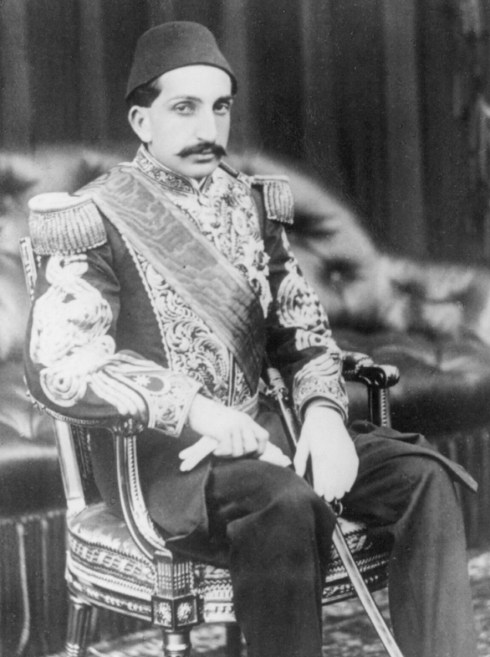
Lately there had been a weird shift in their attitudes though, as it has slowly sunk in that they had supported (“I voted for him!  My God!!”) the most un-democratic, anti-consitutional, religiously retrograde, paranoid, chip-on-the-shoulder lunatic to rule Turkey since Abdülhamid (photo below).  After the takeover and purging of the daily Zaman in March of 2016, I ran the idea past a few of them: “do you think it’d be a good idea for the military to step in? …they already have more unconstitutional dirt on him than on most Turkish heads of state.”  And even the Teşvikiye girl who had worried so much about her father, didn’t get apoplectic on me like she would’ve done in the past; she simply mumbled passively, in the static cadences of Turkish passivity: “I don’t even think they’re in a position to do anything at this point.”****

AbdülhamidAbdülhamid

Worse was one who said to me: “What Turkey needs now is unity.”  Well, your compatriots have actually shown a quite impressive amount of unity in the face of the Erdoğan challenge.  Every time he has engineered some sort of spectacular violence to terrify them over the past almost three years, they have unitedly come back, in elections and referenda and the mob-mobilization they have always been so good at, to give this “most un-democratic, anti-consitutional, religiously retrograde, paranoid, chip-on-the-shoulder lunatic to rule Turkey since Abdülhamid…” an even greater mandate on power than he had before: Daddy please save us!

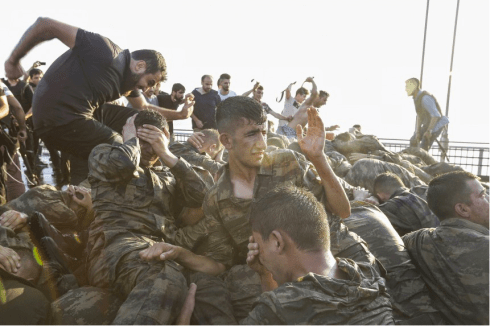
Infantile beyond belief.  Is that the “unity” you wanted?  There was great unity in the mob hysteria that this supposed coup was met with (no, I don’t believe it was Gülen; no, I don’t think it was the army, unless it was army that already knew it was going to be sacked; no, I don’t think he didn’t know; I’d probably refuse to believe that Erdoğan wasn’t the architect of the whole thing — see the New Yorker‘s great Dexter Fillins’ “Turkey’s Thirty-Year Coup”).  They displayed impressive unity lynching poor little Mehmetçiks just following orders on the Bosporus Bridge (scenes guaranteed to make the hair of Greeks and Armenians stand on end), impressive unity in the Nazi-style rallies the Great Leader has convened, impressive unity in heckling men from the army and journalists and writers being led into a show trial that can quite possibly end in their execution or certainly life sentence (see “Inside Erdoğan’s Prisons” in the Times) and with the kerchiefed teyzes screaming for blood outside the courthouse in Ankara — and I’m sure they’ll show impressive unity in supporting the reinstating of capital punishment if that goes up for a referendum soon.

Turkish thugs and soldiersTurks beating up young conscripts on the Bosporus Bridge, defending their democratic right to elect a dictator who has abolished Turkish democracy for the most part and soon will have the power to go after whatever’s left…Turkish “unity” in action.

IS THAT THE UNITY YOU WANTED?  The unity of Kristallnacht? (or the “Septembriana” — same difference.)  The unity of Nüremberg?  The unity that comes with thinking that you can enfranchise the newly rich, provincial pious, those with absolutely no democratic education — or education of any kind — and that they won’t turn on you like swine before which pearls have been cast?  (Plato said that the “demos” — the people — shouldn’t have the right to vote because they’ll always vote for the tyrant — τυραννόφρων; Dostoevsky’s Grand Inquisitor says precisely the same thing.)  Did you want the unity of the Italians and the Germans who respectively put Mussolini and Hitler in power with their vote?  Or the Americans who voted for Trump?  Or the Russians who voted and will again vote for Putin?

Tabrik migam, then.  You got it.

And this is the cherry on your birthday cake: Erdoğan replaces the military chiefs of staff with his own men.  Good luck ever getting rid of him now.  He’s now in a position of total control, with no challenges whatsoever.  You’re stuck for life.

*************************************************************************************

* The days when in the p.c. stupidity of the metapoliteuse we used to refer to Constantinople as “Istanbul” — I mean when speaking Greek…airport announcements and newspaper by-lines used “Ιστανμπούλ“…in Greek…are over.  I’ve now taken to calling it Constantinople in English as well, as Turks are free to call Salonica Selanik or Bulgarians and Macedonians Solun and I have no problem.  I’m not going to tell others what to call cities historically important to them; it actually makes me happy.  For more on this see my: Names: “Istanbul (not Constantinople)”…and Bombay! and keep an eye out for my “Boycott ‘Mumbai” campaign” post.  In general except an upswing in South Asian posts as we approach the seventy-year anniversary of Partition.

** My friends bear out the truth that Turkey’s Kurdish-Zaza Alevis and Syria and Lebanon’s Alawites are religiously the same branch of semi-Shia Islam.  The ones from Dersim have recognized that Syrian Alawites are also Alevi like them, even if that hasn’t made them Assad supporters; and the ones from Antiocheia (Antakya in Turkish or Hatay province in the logic of Turkish science fiction nationalist narrative) are just plain Alawite Arabs, who have understood that if there’s anything separating them from Syrian or Lebanese Alawites, it’s only the Turkification campaign they were subjected to when Turkey annexed that part of then-French-mandate Syria in the 1930s.  If papers like the Times feel the need to add the caveat that they’re different in every article they publish on the subject, it’s because they’re ignorant, the Turkish Press Office has made a fuss every time they don’t add that caveat, and it’s easy to think that people separated into difference by the ethnic nation state aren’t religiously brothers.  I’ve written extensively on this in a Twitter dialogue I had with a Turk who thought everybody should fight “lies and defamation” against their country when they appear in the media:

Syrian Alawites and Turkish Alevis: closer than I thought

Turkish Alevis and Syrian (or Lebanese…or Turkish?) Alawites — a Twitter exchange

Alevis and Alawites addendum: a “p.s.” from Teomete

More on Alevis and Alawites…or Alevis and Kurds…or Iraqi Kurds…or…Christian Kurds…or Assyrians…or…

Look out for Alevis in the current struggle in Turkey.  Whereas Kurds proper are not trusted by the political establishment or most Turks because they’re convinced they’ll never give up their separatist aspirations, Alevis, who suffered terribly under the Ottomans and the early republic and still do on some level, are still loyal to the Turkish Republic and Turkey itself.  This puts them in the position to become the secular backbone of all democratic impulses that still exist in that country, something like African-Americans in the United States were in the mid-twentieth century, since their form of Islam does not aspire to becoming the State itself, as all forms of conventional Sunni Islam do.  They were a disproportionate share of the casualties and deaths that occurred during the crackdown of the 2013 protests, not because they were targetted specifically, but simply because they were already a disproportionately large percentage of the protesters.

*** It may seem irrelevant, but this type always reminds of a passage in Chesterton’s Orthodoxy in which he trashes this kind of moral correctness by trashing the New Agers of his time:

“Only the other day I saw in an excellent weekly paper
of Puritan tone this remark, that Christianity when stripped of its
armour of dogma (as who should speak of a man stripped of his armour of
bones), turned out to be nothing but the Quaker doctrine of the Inner
Light. Now, if I were to say that Christianity came into the world
specially to destroy the doctrine of the Inner Light, that would be an
exaggeration. But it would be very much nearer to the truth. The last
Stoics, like Marcus Aurelius, were exactly the people who did believe in
the Inner Light. Their dignity, their weariness, their sad external care
for others, their incurable internal care for themselves, were all due
to the Inner Light, and existed only by that dismal illumination. Notice that Marcus Aurelius insists, as such introspective moralists always do,
upon small things done or undone; it is because he has not hate or love
enough to make a moral revolution. He gets up early in the morning, just
as our own aristocrats living the Simple Life get up early in the
morning; because such altruism is much easier than stopping the games of
the amphitheatre or giving the English people back their land. Marcus
Aurelius is the most intolerable of human types. He is an unselfish
egoist. An unselfish egoist is a man who has pride without the excuse of
passion. Of all conceivable forms of enlightenment the worst is what
these people call the Inner Light. Of all horrible religions the most
horrible is the worship of the god within. Any one who knows any body
knows how it would work; any one who knows any one from the Higher
Thought Centre knows how it does work. That Jones shall worship the god
within him turns out ultimately to mean that Jones shall worship Jones.
Let Jones worship the sun or moon, anything rather than the Inner Light;
let Jones worship cats or crocodiles, if he can find any in his street,
but not the god within. Christianity came into the world firstly in
order to assert with violence that a man had not only to look inwards,
but to look outwards, to behold with astonishment and enthusiasm a
divine company and a divine captain. The only fun of being a Christian
was that a man was not left alone with the Inner Light, but definitely
recognised an outer light, fair as the sun, clear as the moon, terrible
as an army with banners.”  [All bold emphases mine.]

**** “yanlış oldu” — See Loxandra‘s amazing “duck with bamya” chapter; I never tire of recommending it.

Comment: nikobakos@gmail.com

Πουλάμε τρέλα — “selling craziness” — ordinary Greeks’ take on the Greek “recovery”

1 Aug

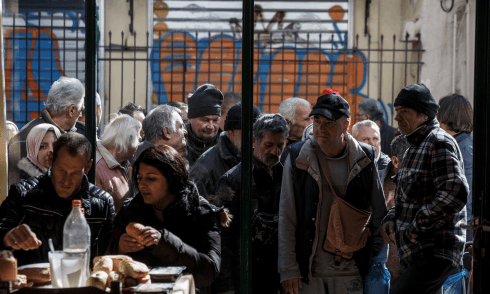
Greek soup kitchen 2017Greek people queue to enter a soup kitchen run by the Orthodox church in Athens. Photograph: Alkis Konstantinidis/Reuters

There’s an expression in Greek: “Πουλάει τρέλα” — He’s selling craziness, literally, which is used when it seems like someone is acting like they don’t get it, or don’t understand, or didn’t see, or didn’t notice, in order to escape some kind of responsibility :

“Sorry officer, I didn’t realize how fast I was going.  Oh, is that the speed limit here?”

“Oh, is the rent due?  Is it the first of the month already?”

“300 Euros per month for Greek workers and 150 for pensioners seem like perfect living wages to me.”

Last week, Prime Minister Alexis Tsipras, to some the architect of Greece’s whole mess — a little unfair — or just an adolescent false messiah making crazy promises, announced that the Greek government bonds had gone on the market again, supposedly a vote of confidence from the financial community.  “The worst is behind us.”

And the entire Greek people, across the entire political spectrum, did a collective double-take and mumbled: “Huh?”  No people on earth have become as cynical about their politicians as Greeks have, and the government’s cheap optimism has been taken, not just as “selling craziness” by most, but as an added slap in the face, especially since most feel that news about bonds “coming out” in the markets is just preparing the ground for a fourth package of added austerity measures on the part of the European Union and its institutional partners (known collectively here, in a kind of scarily Orwellian, Big Brother language, as “the Institutions.”)

But let the article in the venerable Guardian tell you the rest in this past Sunday’s article: Greek debt crisis: ‘People can’t see any light at the end of any tunnel’

Money quote in my opinion:

“For the poorest of the poor Syriza has been good,” said Mourtidou. “But it has not done what the vast majority hoped and that is very dangerous. Tsipras had a calming effect when he came along. There isn’t another Tsipras to promise us the world and now I fear the earth could be trembling under our feet. The next choice could be the far right.  [My emphases].

It is a common concern. Greeks have responded to loss with fortitude and resilience but a mood of uncertainty prevails. Amid the rage and disappointment many worry the power of loss could assume other more menacing forms.

“Uncertainty is the new normality,” psychology professor Fotini Tsalikoglou noted. “It could manifest itself in apathy, violence, more uncertainty, we just don’t know.”

Comment: nikobakos@gmail.com

Turkey and Silence

6 Jan

istanbul-mourning

I’ve been silent for a year, more or less. And the reason is pretty simple: Turkey. It’s been hard to watch a country you feel (or should) so close to, are for better or worse geographically adjacent to, (mostly worse), and which is so key in every way to the subject matter and internal structure of this blog, implode in such spectacular fashion and not have something to say.

And yet I didn’t have anything to say that could do justice or offer any insights into what was happening. I look back at a blog entry from the end of 2015 about my arriving in C-Town on November 2nd, the day after Turks gave Erdoğan a parliamentary reward for inciting the unspeakable violence that had already occurred — and would soon start spiralling exponentially out of control — instead of punishing him for it, and note that I feel an internal tectonic shift towards the place and its people; a weird, kind of science-fiction-like creepiness and discomfort…City of Zombies.

But every time I’d try to say something, events would overgallop and trample me and I’d say nothing again. Instead of posting here, I started writing acerbic, aggressive-aggressive emails to small groups of friends – partly to get my bile out, partly to hurt some of them. I felt myself starting to fall back on ancestral nastiness: Greek clichés of Turks as inherently slow-geared: a kind of dumb manipulable mob, one who’ll sooner or later be steered by the powers-that-be that they revere so idiotically into finding a way to take out their society’s dysfunction on us.

It’s been nice to be in Jiannena since Christmas. (“Jianniotes’ Jianniotiko passion for their Jiannena is well-known…” states with unapologetic Jianniotiko pride the introduction to a really interesting book I’,ve stumbled across here about the little known late Roman and early Byzantine history of the city.*) It is an addictively pleasant town and on December 30th some friends of mine from Istanbul came to spend a few days with me here. We were glad to see each other. It had been a long time. The weather was chilly but bright and sunny. The raki bracing. And to show two Turkish friends around a city whose primary tourist sites are Ottoman, and its general ‘Ottomaness,’ is the kind of irony in such matters that I love.

So I think it might have been a kind of perverse blessing to be with them New Year’s morning after the Reina attack in Ortaköy. Here were two real people I love, in pain: not straw men to beat up or take out my frustrations on. And that made a difference. It slows down your thinking.  It doesn’t let you cut emotional or intellectual corners. I might actually have something to say soon.

Comment: nikobakos@gmail.com

*************************************************************************

* index-jp

Ιωάννινα: Ίδρυση – Χωροταξικός Ρόλος – Μορφή της Πρωτοβυζαντινής Πόλεως (Ioannina: Foundation, Functional Layout, Form of the Proto-Byzantine City); Βασίλης Αναστ. Χαρίσης, Αρχηιτέκτων (Vasiles Anast. Harises, Architect)

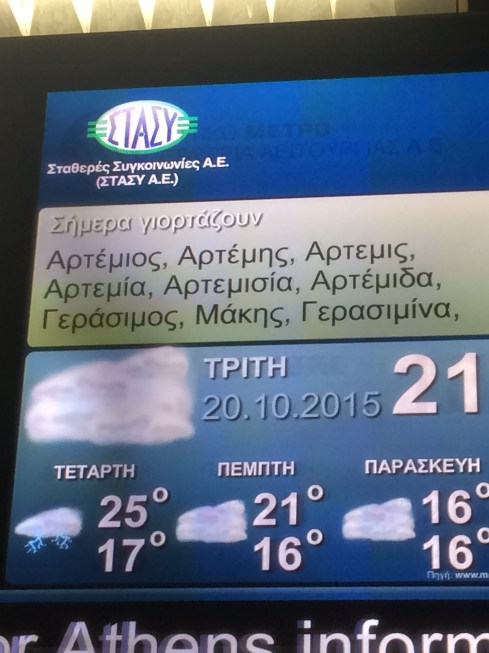
Photo: Athens metro — “Today is the nameday of…”

3 Dec

IMG_0833In recent years — I don’t know how long — the Athens metro system has began to add a list of daily namedays to the signs on platforms that give passengers the date, time and weather — so they don’t forget to at least call or text and well-wish their friends and relatives.  A nameday, for those who could possibly still not know, is the feast day of the saint you were named after.  Above the weather, the sign in the photo, which I took back on October 21st, says: “Today is the nameday of: Artemios, Artemes, Artemis, Artemisia, Artemida, Gerasimos, Makes, Gerasimina, etc.”  It’s really different versions of two names — Artemis and, the most popular among them, the male Gerasimos, the patron saint of the Ionian island of Cephalonia — but the Orthodox calendar usually celebrates more than one saint on each day of the year, since it didn’t go through their files the way the Catholic Church did after Vatican II and remove from the calendar those saints whose miracles didn’t have the requisite scientific backing (……)

Saints’ days and namedays have come up on several occasions on this blog, probably the most detailled exposition of the tradition on my part is this post from last December: Today is my nameday,” from which there’s a money quote below in case you don’t want to wade through the whole text.

This is all a part of a very tender traditionalism that has taken hold of a segment of the Greek soul since the current economic and social crisis began, the kind of refuge a society is wont to take in comforting old forms of social behavior and interaction under such circumstances, but had begun before things hit rock bottom the way they have now; it had actually started to lift as soon the the heavy malakia of metapoliteuse thinking had started to wear off as early as the 90s: this term — metapoliteuse – is defined briefly in the first footnote of this post: “Careful what you wish for…Erdoğan and Ottoman Turkish” — but culturally included a rejection of all things Church-and-Orthodoxy-related as part of the reaction against the right-wing, the monarchy and the Church of Greece’s unforgivable support in the 60s and 70s for the junta that tormented Greece with its idiocy until it fell in 1974  (See much of Pamuk’s commentary on the much more radical spiritual vacuum in which the Turkish Republic’s anti-clericism left his own class in Turkey and that may be part of the state that society finds itself in today.)  I owe readers a post that will be called “The Perfect Metapoliteuse Idiot” to borrow the term and subject matter from Mario Vargas Llosa‘s book “Guide to the Perfect Latin American Idiot” which describes a sociological phenomenon and type startlingly similar to its Neo-Greek counterpart.

manual-del-perfecto-idiota-latinoamericano-de-atlantida-4387-MLA3538134950_122012-F

And so the nameday makes a comeback.  Not that the Western birthday celebration and its obnoxious gimme-gimme narcissism has not also taken root here; it has.  (And like everywhere else, no one thinks about what a baby learns about the world when a glowing piece of confectionery is shoved in front of his face and all the big, powerful adults in his life chant to him like he’s the emperor.)  But the nameday celebration, in which you give and, generally, don’t expect to receive, is still going strong.

(Let me make just one note here: the “traditionalism” of which I’m speaking has nothing to do with the invented, racist, cruel Neo-Traditionalism of Golden Dawn and its supporters; theirs is the obnoxious militaristic “tradition” — including its revolting Spartan/Leonidan warrior pretenses that has nothing to do with any real past — of a reborn Greek fascism.)

Music, food, a renewed interest in agricultural life and processes — often as a form of survival — tiny gracious gestures of etiquette — all of these are parts of this renewal.  But what surprises me the most are the ones that concern religious observations.  Often these are performed in recognition of their cultural beauty and not necessarily as expressions of any deep spiritual impulse.  Still.  All the more, in fact.  I, for example, had always been terrified of having to spend what I thought would be a barren, empty Easter in modern Greece, which I had never had to in my life; when I finally did last year (see: “Σήμερον κρεμάται επί ξύλου…“) I was pleasantly surprised at how immersed the society was in the observation of this central, defining pole of our identity.

And now we’re in the middle of the Christmas fast, which began forty days before Christmas, on November 15th.  This is the period known as Advent in the West, for those who still remember, and as the word implies, indicates that Christmas, like Easter, was once an anticipatory holiday, with a forty-day period of fasting and relative sobriety preceding it, like Easter still is and has in the East.  Christmas was not the consumption orgy that now starts in late October and a tree that goes up on Thanksgiving and gets thrown out before New Year’s even.  Christians waited for Christmas: and it began on Christmas Eve — with the setting up of the decorated evergeen in the northern European tradition, as the West’s entire literary tradition has it, and then the celebration of the “twelve days” that ended on January 6th.  But all that was scrapped because it doesn’t fit in with distinct shopping-spree periods or quarterly earnings reports and didn’t allow enough time for too many exhausting, gluttonous “holiday” parties with people you don’t want to be with and for buying plastic crap to hang on your door.

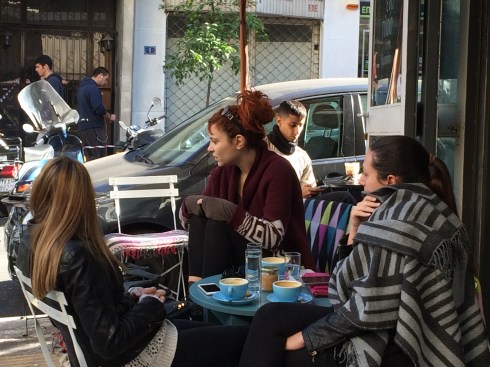
So that bright Sunday Attic afternoon, the first day of the Christmas fast, I was sitting here (below) in a very, sehr cool little cafe-bar in Pagkrati (a very cool little neighborhood), when a pretty, elegant twenty-something girl suddenly said to her boyfriend in a testily audible voice: “Σου είπα ότι είναι νηστεία σήμερα και δεν αρταίνομαι ” — “I told you it’s the start of the fast today and I don’t partake” — using an archaic form for “partake”“αρταίνομαι” — that I can’t find the etymological root of.  I nearly fell off my chair.

Plastera Cafe 1Plastera Cafe 3

Plastera Cafe 4Plastera Cafe 2

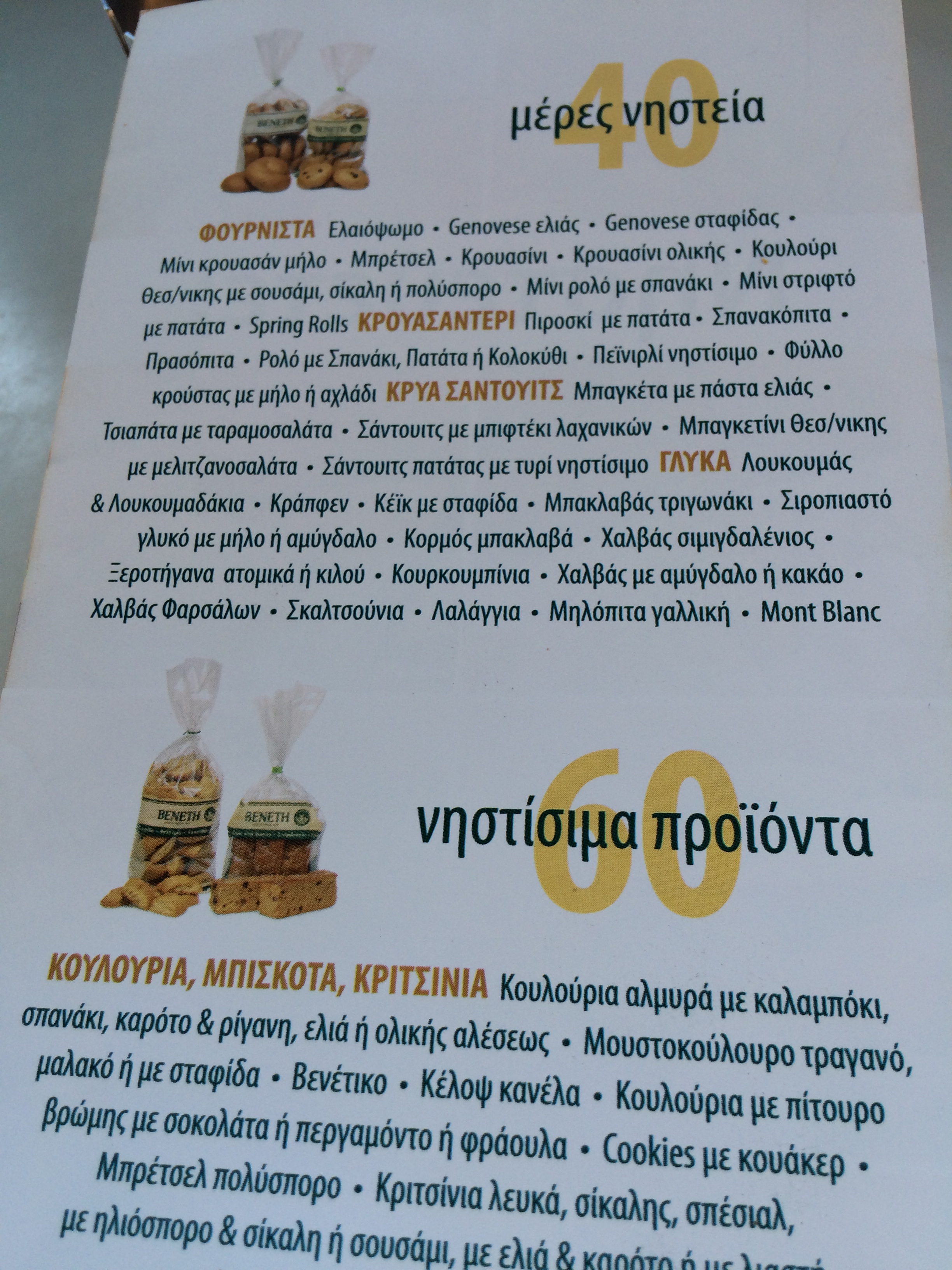
And then Venetis, a large bakery-patisserie-café chain here — which actually has some pretty good stuff — has this notice on its tables: “Νηστεύετε;” – “Are you fasting?”  And on the back: “40 μέρες νηστεία…60 νηστίσιμα προϊόντα.” — “40 Days of Lent…60 Lenten Products.”  

IMG_1162

IMG_1168.JPG

Commercial.  But a commercial use of something latched onto in the zeitgeist air.  Un-heard of…laughing-stock corny…less than even a decade ago.

Quote from “Today’s my nameday” that I mention at top:

“What I most love is that, among Greeks, your nameday is a day critical to your honor and reputation…

“…It’s a day when it’s your obligation to give and serve and prove your noblesse and not, as Western birthdays have become, a day when you sit around waiting for others to do for you or give you gifts.  Western, American, birthdays are only slightly less gross to me than the totally American ugliness of wedding and baby showers: “I’m getting married and/or I’m pregnant; so I’m having a party where you have to bring me things.”  And don’t even start me on bridal registries, where you tell people, not just that they have to bring you something, but what they have to bring you.”

Comment: nikobakos@gmail.com

Börek II — or Burek and the end of Yugoslavia

26 Aug

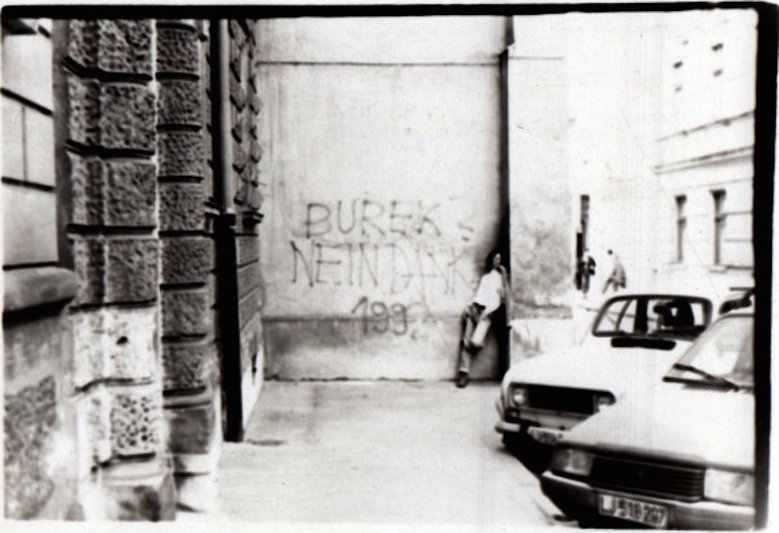
Börek Nein Danke

(click)

This is a piece of graffiti that appeared in the Slovenian capital city of Ljubljana in 1992, at the beginning of the worst period in the Yugoslav wars and after Slovenia had become independent. “Burek [‘börek’ in Turkish, pronounced exactly like an umlauted German ‘ö’]? Nein Danke.” Burek? Nein Danke. “Burek? No Thank You.” What a silly slogan, ja? How innocuous. What could it possibly mean? Who cares? And how can NikoBako maintain the bizarre proposition that a piece of graffiti in a rather pretentious black-and-white photograph is an important piece, in its ugly, dangerous racism, of the break-up of Yugoslavia.

Back up then. There are certain — usually material — aspects or elements of Ottoman life in the Balkans, which, even for Christians in the region, despite the centuries of unfortunate hate and reciprocal bloodletting (and no, I don’t think pretending that wasn’t true or that “it wasn’t that bad” is the key to improving relations between us all now; I think the truth is the key), remain objects of a strange nostalgia and affection. They linger on — even if unconsciously, or even as they’re simultaneously an object of self-deprecating humour or considered homely backwardness – as evidence that Ottoman life had a certain refinement and elegance that these societies have now lost. You sense this often intangible and not explicitly acknowledged feeling in many ways. Folks from my father’s village, Derviçani, for example, now go to Prizren in Kosovo to order certain articles of the village’s bridal costume because they can no longer find the craftsmen to make them in Jiannena or Argyrocastro, and they’re conscious of going to a traditional center of Ottoman luxury goods manufacture. You feel it in what’s now the self-conscious or almost apologetic serving of traditional candied fruits or lokum to guests. Or still calling it Turkish coffee. Or in Jiannena when I was a kid, when people still had low divans along the walls of the kitchen where they were much more comfortable than in their “a la franca” sitting rooms. 1* Perhaps the sharpest comparison is the way the word “Mughlai” in India still carries implications of the most sophisticated achievements of classical North Indian…Muslim…culture, even to the most rabid BJP nationalist. 2**
49614968

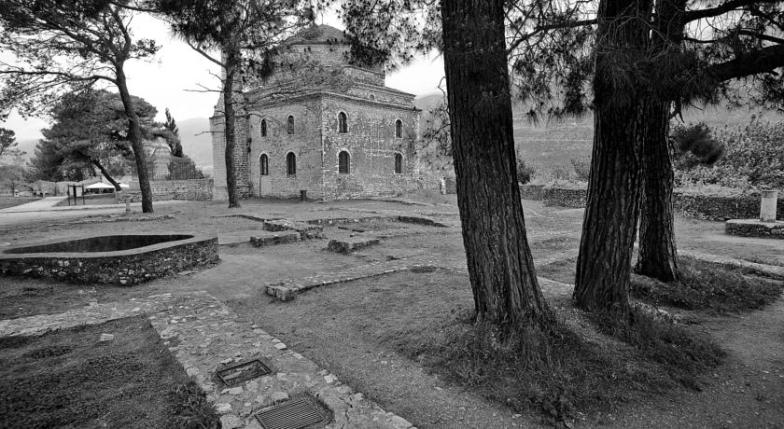
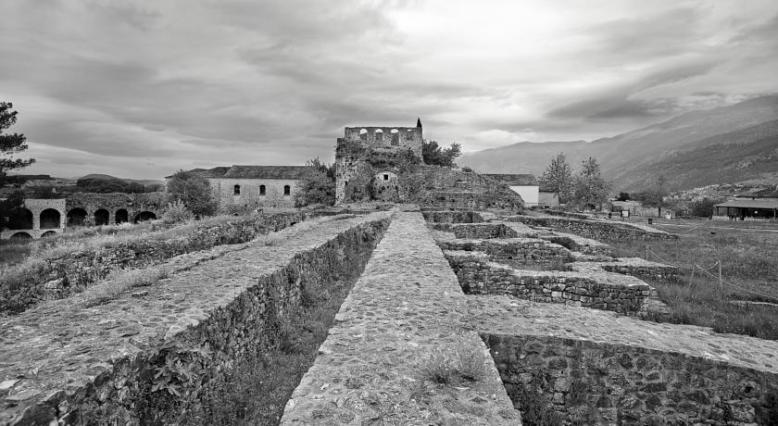
There are some places where this tendency is stronger than in others. Sarajevo and Bosnia are obvious; they still have large Muslim populations though and, after the 90s, Muslim majorities. But Jiannena – which I’ll call Yanya in Turkish for the purposes of this post, the capital city of Epiros and one often compared to Sarajevo: “a tiny Alpine Istanbul” – is also one such place. Readers will have heard me call it the Greek city most “in touch with its Ottoman side…” on several occasions. You can see why when you visit or if you know a bit of the other’s past: or maybe have some of that empathy for the other that’s more important than knowledge.
49611950

About half Greek-speaking Turks before the Population Exchange, Yanya was a city the Ottomans loved dearly and whose loss grieved them more than that of most places in the Balkans. It’s misty and melancholy and romantic. It has giant plane trees and had running waters and abundant springs in all its neighbourhoods, along with a blue-green lake surrounded by mountains snow-capped for a good five or so months of the year. It experienced a period of great prosperity in the eighteenth and especially nineteenth century, when it was not only a rich Ottoman commercial city but also a center of Greek education: “Yanya, first in arms, gold and letters…” – and, especially under the despotic yet in certain ways weirdly progressive Ali Paşa, was the site of a court independent enough to conduct foreign policy practically free of the Porte and fabulous enough to attract the likes of Pouqueville and Byron, the latter who never tired of commenting on the beauty of the boys and girls Ali had gathered among his courtiers, as Ali himself commented profusely on Byron’s own. All the tradition of luxury goods associated with the time and the city: jewelry, silver and brassware, brocade and gold-thread-embroidered velvet, sweets and pastries – and börek – still survive, but are mostly crap today, even the börek for which the city used to be particularly famous, and your best luck with the other stuff is in the city’s numberless antique shops.
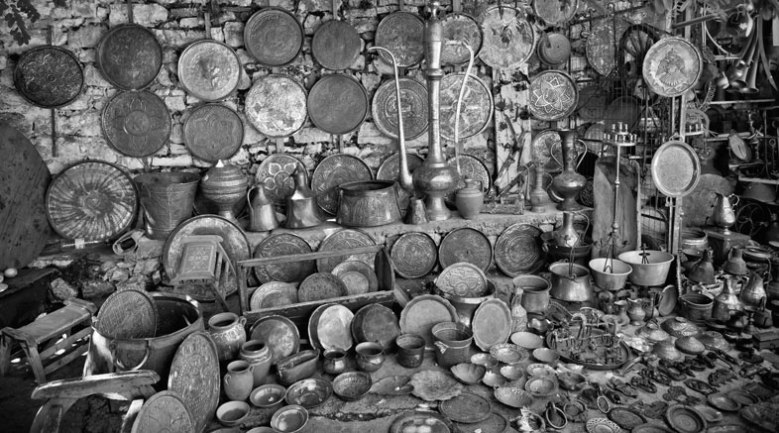
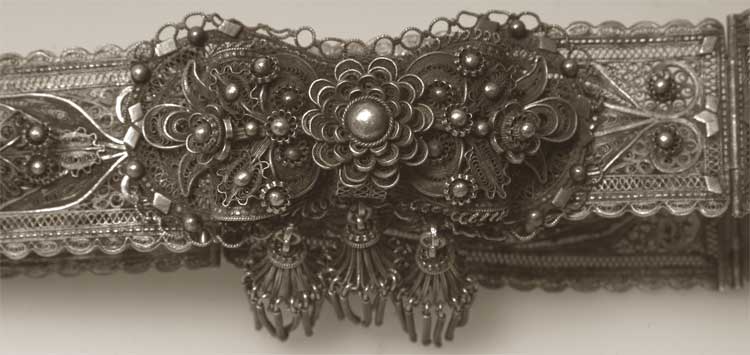
ioannina-epirus-greece-the-antiqe-market-hip

identical to yiayia's belt

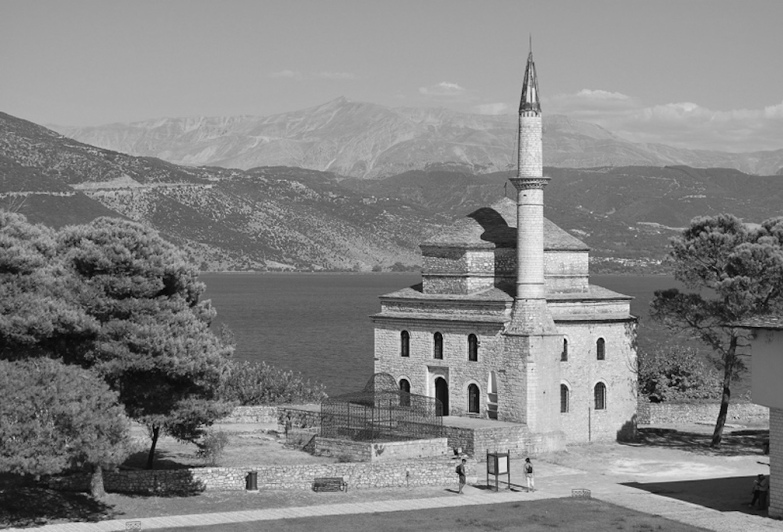
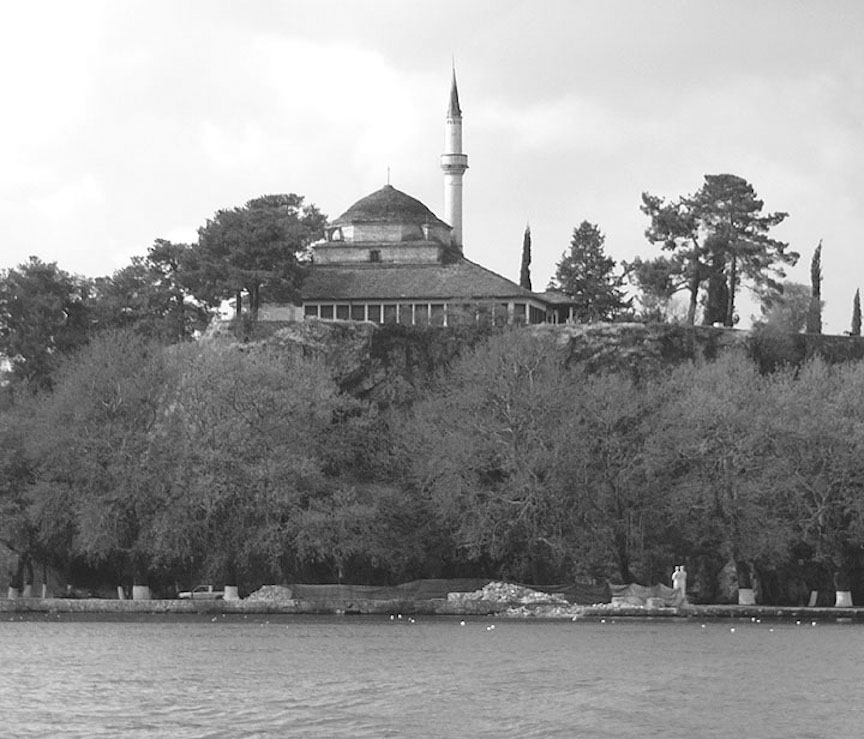
It also, unusually, and which I like to ascribe to Yanyalıs’ good taste and gentlenesss, has preserved four of its mosques, the two most beautiful in good condition even, and on the most prominent point of the city’s skyline.  It would be nice if they were opened to prayer for what must be a sizable contingent of Muslim Albanian immigrants now living there — who are practically invisible because they usually hide behind assumed Christian names — but that’s not going to happen in a hundred years, not even in Yanya.  Maybe after that…we’ll have all grown up a little.
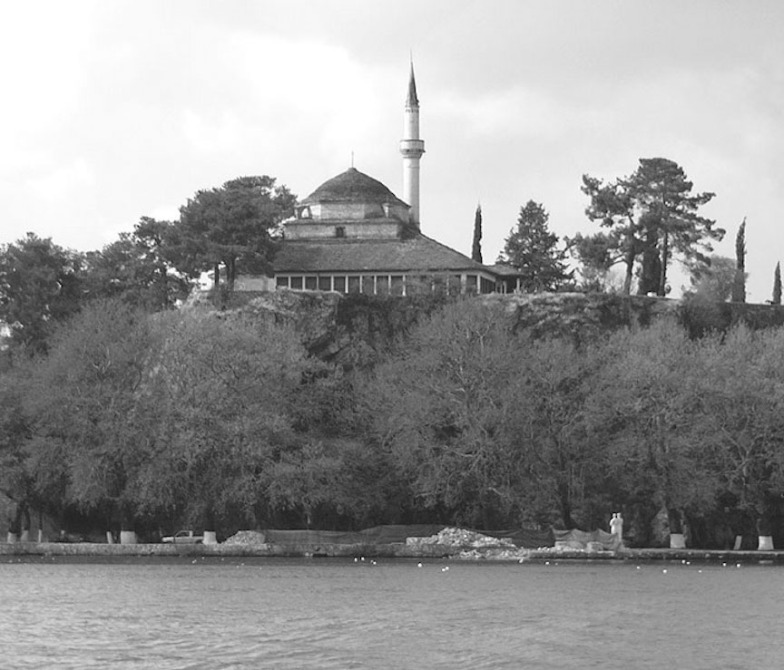
ioannina165

janina

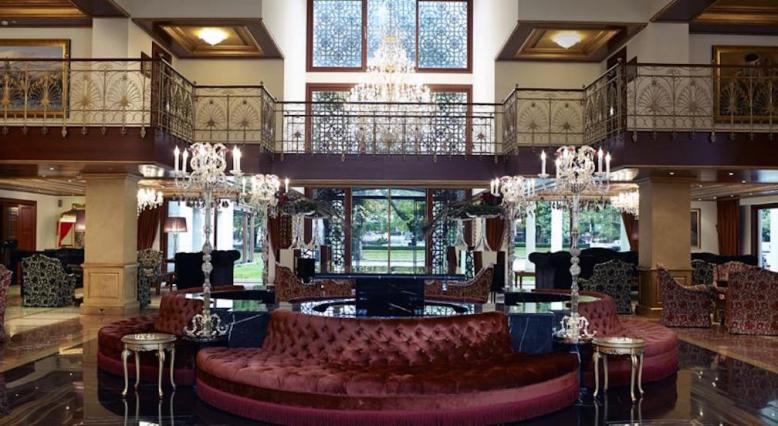
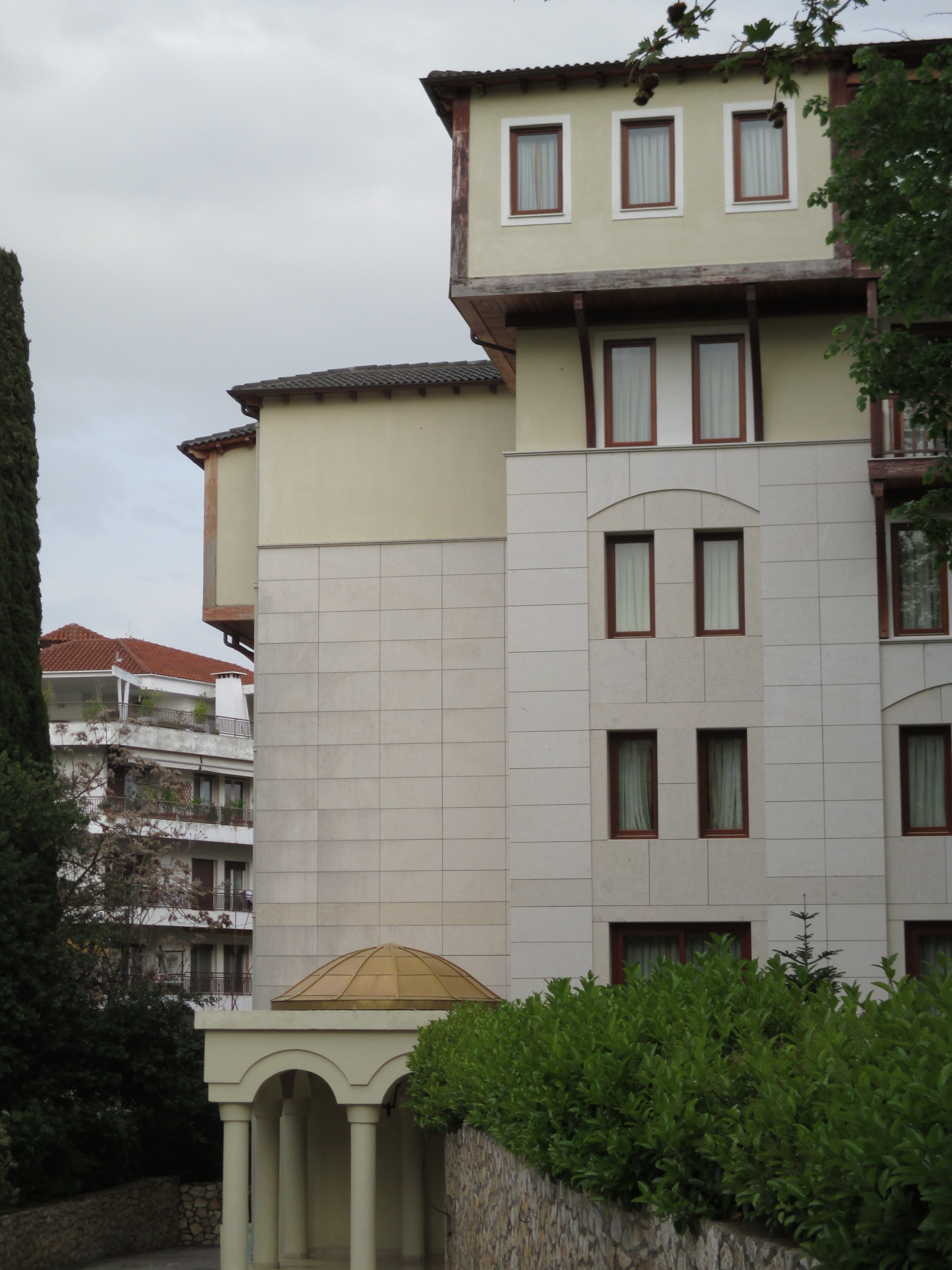
And, alone perhaps among Greek cities, only in Yanya can one open a super-luxury hotel that looks like this, with an interior décor that I’d describe as Dolmabahçe-Lite, call it the Gran Serail, and get away with it. 3***
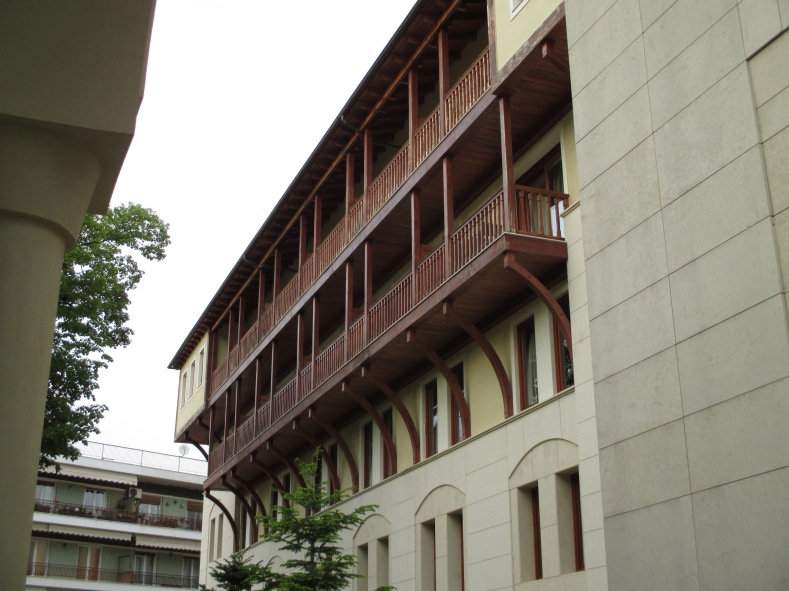
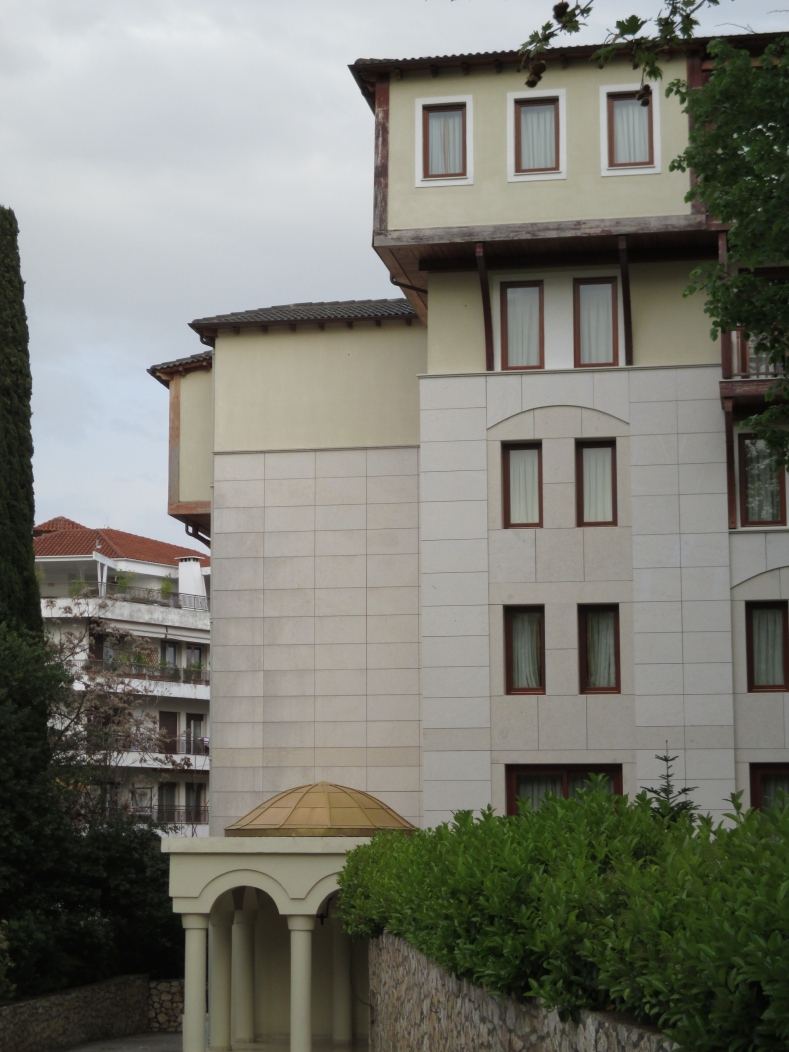
IMG_0213

IMG_0215

44471198

Digression Bakos. What’s the point? What does this have to do with Yugoslavia? I’m not digressing. I’m giving a prelude. “People don’t have the patience for this kind of length on internet posts.” I don’t post. I write, however scatterbrainedly. And not for scanners of posts. For readers. However few have the patience.

So. Croatians don’t eat börek. The prelude should have been enough for me not to have to write anything else and for the reader to be able to intuit the rest. But for those who can’t…

The graffiti on the wall in the photo at top is dated 1992, but I think it had appeared as a slogan as early as the late 80s when Slovenes and Croats started airing their completely imaginary grievances against Serbian domination of Yugoslavia and making secessionary noises. What it meant is that we, Hapsburg South Slavs, were never part of the Ottoman Empire and therefore never were subject to the barbaric and development-stunting influences of said Empire that Serbs and whoever those others that live south of them were, and therefore have the right to be free of the intolerable yoke of Serbdom. We don’t eat burek. Not only do we not eat burek, but you offer it to us and we’ll refuse in German – “Nein Danke” – just to prove how much a part of the civilized Teutonic world of Mitteleuropa we are. 4*** (I think it was Kundera who wrote about the geographical ballooning of “Central Europe” after the fall of communism, till “Eastern Europe” finally came to mean only Russia itself. ‘Cause as we now see, even Ukraine is part of Central Europe.)

Why this yummy pastry dish was singled out as a sign of Ottoman backwardness and not, say, ćevapi or sarma, I can’t say.
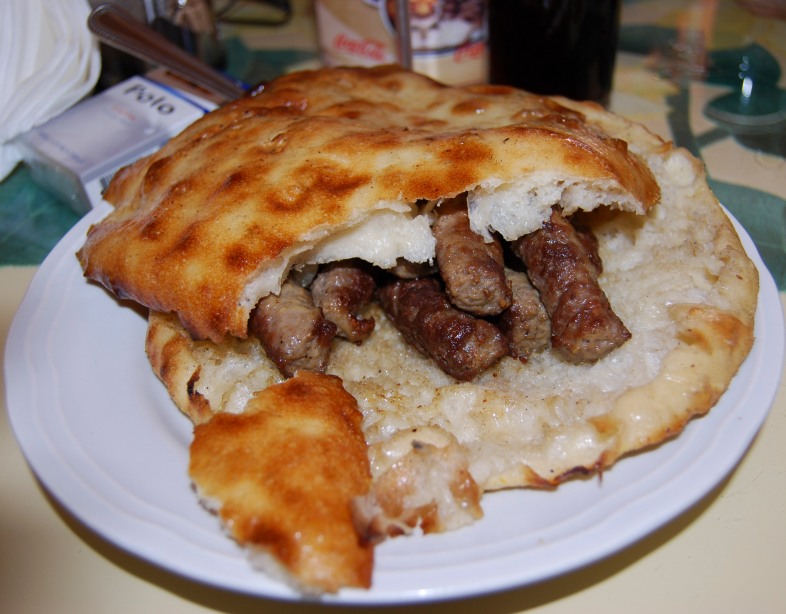
Cevapi54

Ćevapi — köfte, essentially — (above) and sarma (stuffed cabbage) below.
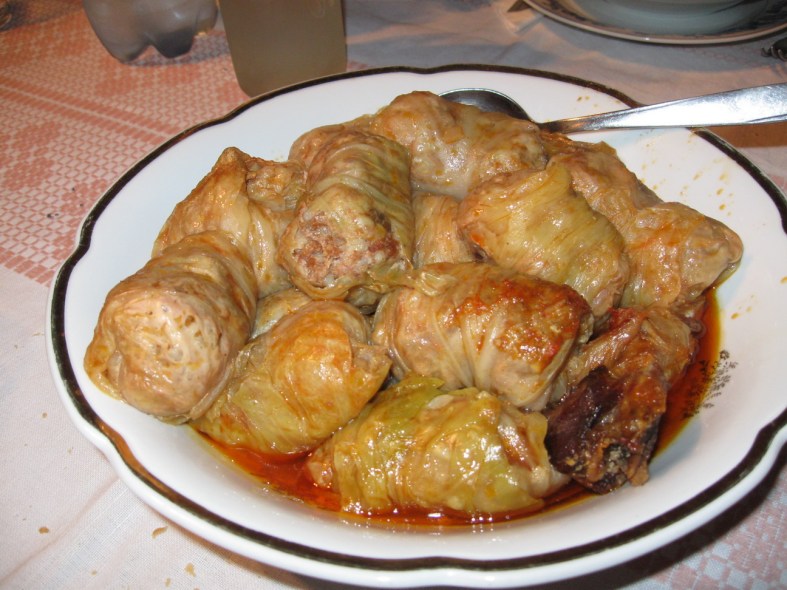
sarma raspakovana

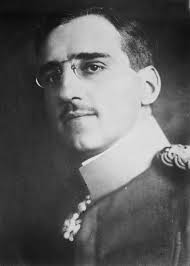
And when I talk about Hapsburg South Slavs I’m obviously talking about Croats, because, let’s face it, who cares about Slovenes? And there may be very few, if any, compelling historical or cultural reasons of interest to care about Croatians either, except, that as most readers must know by now, I consider them the people most singularly responsible for the Yugoslav tragedy. And this post is my chance to come clear about why I feel that way. There may be lots of interpretations of what the “Illyrianist” intellectuals of Vienna and Novi Sad and Zagreb had in mind when they started spouting theories of South Slav unity in the nineteenth century; countless theories about how Yugoslavia or the original Kingdom of the Serbs, Croats and Slovenes was formed; many analyses of what happened in Paris in 1919 and what kind of negotiations led to the Corfu Declaration; and reams of revisionist stuff written about exactly what Croatia wanted out of this union. But, for me, one basic fact is clear: that Croatians were always part of Yugoslavia in bad faith; that they wanted something out of the Serb efforts and Serbian blood that was decisive in defeating Austria in WWI, but that that something was independence, or greater autonomy within an Austria that they probably never expected to be dismembered the way it was – anything but what they felt was being subjected to Belgrade. And that became immediately clear upon the formation of the state when they – being, as Dame Rebecca calls them, good “lawyers” – began sabotaging the normal functioning of the Yugoslav government in any way they could, no matter how more democratic the Serbs tried to make an admittedly not perfect democracy, no matter how many concessions of autonomy Belgrade made to them. If there were any doubt as to the above, even when Radić and his Croatian People’s Peasant Party had turned the Skupština into a dysfunctional mirror image of today’s American Congress, even when a Macedonian IMRO activist working in tandem with Croatian fascists assassinated Serb King Aleksandr in Marseille in 1934, it was subsequently made brutally clear by the vicious death-spree Croatian, Nazi-collaborating fascism unleashed on Serbs during WWII, a true attempt at ethnic cleansing that dwarfs anything the Serbs may have done during the 90s — which is dwarfed again by what Croatians themselves did in the 90s again: the most heinous Nazi regime, “more royalist than the king,” as the French say — more Nazi than the Nazis — to appear in Eastern Europe during WWII.  And they have not been even remotely, adequately,  held to account by the world for any for any of the above; all this ignored, even as the West maintains a long list of mea-culpas it expects Serbs to keep reciting forever.
Alexander

King Aleksandr of Yugoslavia (click)

And so, when they got their chance in the 90s, with the backing of a newly united, muscle-flexing Germany, Croatians abruptly and unilaterally and illegally declared their long-wished for (but never fought-for) independence. And so did Slovenia; but again, who cares about Slovenia? It was a prosperous northern republic that may have held the same Northern-League- or-Catalan-type resentments against a parasitic south that was draining its wealth, but it was ethnically homogeneous and its departure left no resentful, or rightfully fearful, minorities behind. But Croatia knew, when it declared its independence – as did, I’m sure, their German buddies – that they were pulling a string out of a much more complex tapestry. And did it anyway. And we all saw the results. 5*****

So when a Croat says “Nein Danke” to an offer of burek, without even the slightest concern about his past reputation and avoiding any German associations, it is for me a chillingly racist and concise summation of Saidian Orientalism, a slogan that sums up not only the whole ugliness of the tragic, and tragically unnecessary, break-up of Yugoslavia, but the mind-set of all peoples afflicted with a sense of their being inadequately Western, and the venom that sense of inadequacy spreads to everything and everyone it comes in contact with. I’ve written in a previous post about Catalan nationalism:

All of us on the periphery, and yes you can include Spain, struggle to define ourselves and maintain an identity against the enormous centripetal power of the center.  So when one of us — Catalans, Croatians, Neo-Greeks — latches onto something — usually some totally imaginary construct — that they think puts them a notch above their neighbors on the periphery and will get them a privileged relationship to the center, I find it pandering and irritating and in many cases, “racist pure and simple.”  It’s a kind of Uncle-Tom-ism that damages the rest of us: damages our chances to define ourselves independent of the center, and damages a healthy, balanced understanding of ourselves, culturally and historically and ideologically and spiritually.  I find it sickening.

(see also: “Catalonia: ‘Nationalism effaces the individual…'” )

We’re signifying animals. And our tiniest decisions — perhaps our tiniest most of all – the symbolic value we attribute to the smallest detail of our lives, often bear the greatest meaning: of love; of the sacred; of a sense of the transcendent in the physical; of our self-worth as humans and what worth and value we ascribe to others; of hate and loathing and vicious revulsion. Nothing is an innocently ironic piece of graffiti – irony especially is never innocent, precisely because it pretends to be so.

And so I find anti-börekism offensive. Because a piece of my Theia Vantho or my Theia Arete’s börek is like a Proustian madeleine for me. Because I’m not embarrassed by it because it may be of Turkish origin. Because I think such embarrassment is dangerous – often murderously so, even. And because I think of eating börek — as I do of eating rice baked with my side of lamb and good yoghurt as opposed to the abysmally soggy, over-lemoned potatoes Old Greeks eat – as an act of culinary patriotism. 6****** And a recognition that my Ottoman habits, culinary and otherwise, are as much a part of my cultural make-up as my Byzantine or even Classical heritage are. Because just like Yugoslavia, you can’t snip out one segment of the woop and warf and expect the whole weave to hold together.
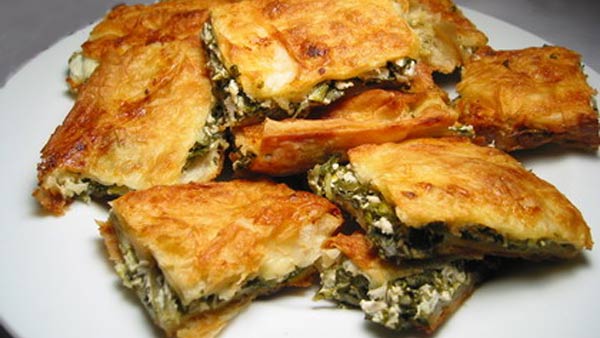
spinach-burek

******************************************************************************************************************************************************************

*1  One thing judo taught me — or rather what I learned from how long it took me, when I started, to learn to sit on my knees and flat feet — is how orthopedically horrible for our bodies upright, Western chairs and tables and couches are.  (By couch here I don’t mean the sink-in American TV couch, which you sink into until you’re too fat to get out of — that’s another kind of damage.)  Knee and lower back problems at earlier ages are far more prevalent in the Western world precisely because of these contraptions that artificially support and distort our body weight in destructive ways.  I remember older aunts in Epiros, in both Jiannena and the village, being able to sit on a low divan on the floor and pull their legs up under their hips with complete ease — women in their eighties and nineties and often portly at that — because their bodies had learned to sit on the floor or low cushions all their long and very mobile lives; they looked like they didn’t know what to do with themselves when you put them in a chair.  I’m reminded of them when I see Indian women their age at mandirs, sitting cross-legged, or with legs tucked under as described, through hours-long rituals, rising to prostrate themselves and then going down again, and then finally just getting up at the end with no pain and no numbness and no oyyy-ings.

**2  The two masterpieces of this point: the celebration of the sophistication and sensuality of the Ottoman sensibility and a trashing of Neo-Greek aesthetics — and by extension, philisitinism, racism and Western delusions — are Elias Petropoulos’ two books: Ο Τουρκικός Καφές εν Ελλάδι“Turkish Coffee in Greece,” and Tο Άγιο Χασισάκι “My Holy Hash.”  Part tongue-in-cheek, part deadly serious, both books are both hilarious and devastating.

***3  Unfortunately, to build this palace of Neo-Ottoman kitsch that would make Davutoğlu proud, one of Greece’s classic old Xenia hotels, masterpieces of post-war Greek Modernism and most designed by architect Aris Konstantinidis, was torn down, and most of these hotels have suffered similar fates throughout the country, as the nationally run State Tourist Organization was forced to sell off its assets by the privatization forced on Greece then and to this day.
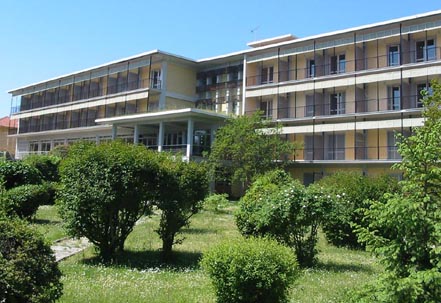
Xenia Jiannena

The Jiannena Xenia, above, built in the old wooded grove of Guraba, just above the center of town, and, below, perhaps Konstantinidis’ masterpiece, the Xenia at Paliouri in Chalkidike. (click)
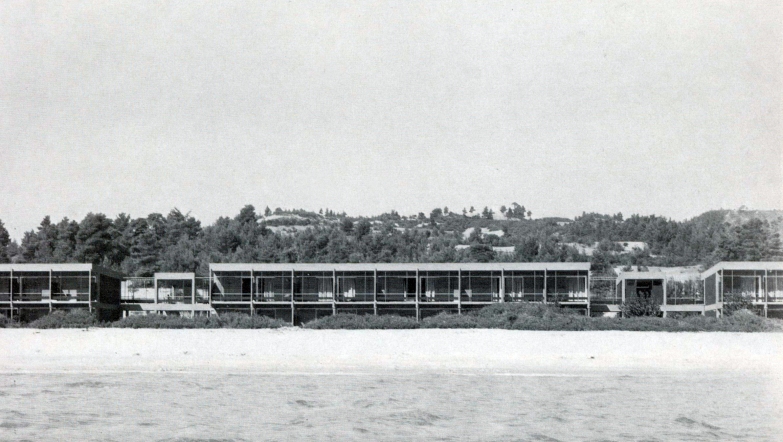
Eot-paliouri-1962-2

Fortunately, Jiannena preserves one of Konstantinidis’ other masterpieces, its archaeological museum, below. (click)
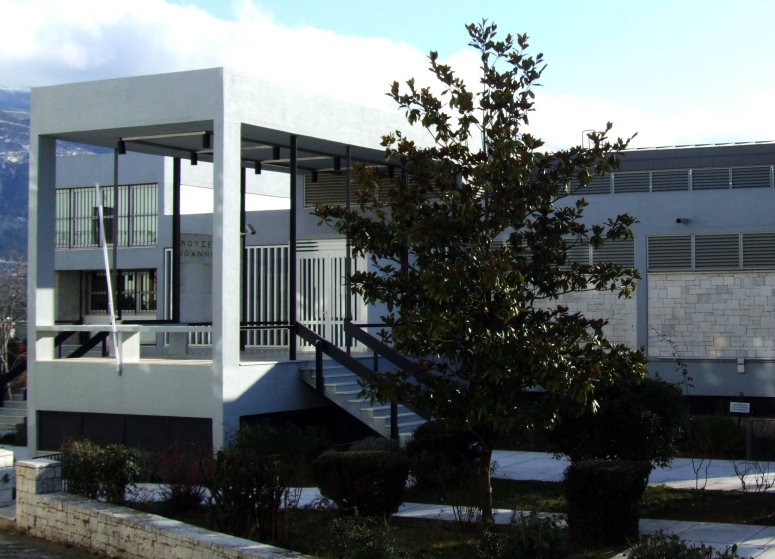
100_6975_-_Kons.Ioan1

****4  Ironically, the strudel that Croats and Slovenes imagine themselves eating in their Viennese wet dreams is probably a descendant of börek; and take it a step further: let’s not forget that croissants and all danish-type puff pastry items are known generically as viennoiserie in French.  So the ancestor of some of the highest creations of Parisian/French/European baking arts is something that a Slovene says “nein danke” to in order to prove how European he is.  Talk about the farcicalness of “nesting orientalisms.”
croissant

*****5  Of course, in every case, this assumption-cum-accusation, about the parasitic South draining the North of its resources, is patent bullshit.  Southern Italy, the southern Republics of Yugoslavia, Castille, Galicia, Andalusia, and the southern tier of the European Union today, may get disproportionately more in the allotment of certain bureaucratic funds compared to the tangible wealth they produce.  But they also provide the North, in every single one of these cases, with resources, labor and markets on which that North gets rich to a far more disproportionate degree and stunts the South’s growth in the process.  So haydi kai…

It’s become a common-place — and not inaccurate — observation that the catastrophic economic pressure Germany is today exercising on the nations of Southern Europe for the sake of making some sick moral point is the fourth time it’s wrecked Europe in less than a centurythe third time being when it decided, immediately upon reunification, to show the continent it was a political player again by practically single-handedly instigating the destruction of Yugoslavia.

******6
patattes

Over-oreganoed and over-lemoned — like much of Greek food — and overdone, over-salted and over-oiled, perhaps the only thing more repulsive than the soggy potatoes Old Greeks bake with lamb or chicken (though one horrible restaurant — which New Yorkers are for some reason crazy about: I mean like “take-the-N-train-out-to-Astoria-and-wait-for-a-table-for-an-hour” crazy — criminally serves them with grilled fish) is the serving of stewed meat with french fries.  You’ve hit the rock bottom of Neo-Greek cuisine when you’ve had a dry, stringy “reddened” veal or lamb dish accompanied by what would otherwise be good, often hand-cut french fries, sitting limply on the side and sadly drowning in the red oil.

Comment: nikobakos@gmail.com

“Atatürk in the Nazi Imagination” by Stefan Ihrig

30 Mar

Adolf Hitler in the workshop of the sculptor Josef Thorak, with Thorak’s bust of Atatürk behind him, Munich, February 1937Adolf Hitler in the workshop of the sculptor Josef Thorak, with Thorak’s bust of Atatürk behind him, Munich, February 1937 (click)

From The New York Review of Book.  See whole article: Hitler & the Muslims by Steve Coll in April 2, 2015 volume.

Money quote (at least for our purposes):

“The aim of Atatürk in the Nazi Imagination is to document that the founder of modern Turkey deserves to be remembered as a figure equal to Mussolini in Hitler’s early political imagination. Mustafa Kemal Pasha, later glorified as Atatürk, had a record of military action that included cleansing what Hitler believed to be the inherently sapping multiethnicity of the expired Ottoman Empire.

“Indeed, in Ihrig’s account, apart from Atatürk’s personal inspiration, the organized mass killing of Armenians by Turks during World War I—the events now recognized as the Armenian Genocide—explicitly influenced Hitler’s thinking about the extermination of Jews as early as the 1920s. Ihrig quotes a multipart essay published in Heimatland, an influential Nazi periodical, by Hans Tröbst, who had fought with the Kemalists during what Turks knew as the War of Independence:

‘The bloodsuckers and parasites on the Turkish national body were Greeks and Armenians. They had to be eradicated and rendered harmless; otherwise the whole struggle for freedom would have been put in jeopardy. Gentle measures—that history has always shown—will not do in such cases…. Almost all of those of foreign background in the area of combat had to die; their number is not put too low with 500,000. [emphasis in original]’

“In incipient Nazi historiography, Ihrig writes, “the ‘fact’ that the New Turkey was a real and pure völkisch state, because no more Greeks or Armenians were left in Anatolia, was stressed time and again, in hundreds of articles, texts, and speeches.” Of course, the Nazi Holocaust was constructed in its own setting, from its own sources; one should not overemphasize the Armenian precedent, and Ihrig does not. Yet here is a documented example from the early industrialization of ethnic murder in which one campaign of genocide influenced another.

And a key point:

“Politically, Atatürk’s success offered a model of how to overcome the humiliation and prostration imposed on World War I’s losers at Versailles. Atatürk not only seized power through bold action in the name of the Turkish nation, he also forced European capitals to renegotiate the terms of the treaty they had imposed…”

Comment: nikobakos@gmail.com

“Χριστός Ανέστη” — Christ Has Risen — and I’m so damn PROUD…

25 Jan

I swear to God those were the first words — the two most totemic in the Greek language — that instinctively leapt out of my mouth when a very loved cousin of mine in Athens answered her mobile today.

Anastasis_fresco_(Chora_Church)The Resurrection fresco in the church of the Chora in Constantinople (click)

I don’t know what will happen.  Tomorrow, me…and Greeks all over the world will wake up sober — or hungover — and have to figure out how this thing is actually going to work.

But one thing all of us need to understand is the power of language and discourse.  By “discourse” I mean the idea and interpretations that people give and ascribe to the phenomena in the world around them; that discourse is “poetic” and a process of “poiesis”— not poetic like Byron or Baudelaire — but poetic in the original Greek sense of “making” or “creating.”  What that means is that DISCOURSE: what people say about things, how people talk about and interpret reality, the opinions and analyses of that reality, are not an either accurate or inaccurate view of that reality but a code and a language that create that reality.  This is simple stuff.  Intro to Deconstruction.  Foucault 101.  And nowhere is it truer than in the “game of chicken” played in the arena of political economics.

So, like I said in GREEK ELECTIONS,” if a critical mass believes a hypothesis is true — or just possible — then it becomes true; then actions and gestures on the ground, and praxeis in the “real,” physical world will create that reality, poetically.  And if we continue to bolster — worse, think we deserve — the Troika’s Neo-Liberal discourse of exploitation, then it will continue.  If we support a discourse, if we believe that an alternative to that reality is possible, then it will emerge.  It only took some workers in a Gdańsk shipyard to say: “I’m not gonna pretend that I believe this shit anymore”; it only took a heroic Gorbachev to say: “This isn’t working”, for the most horrific political economic system that has ever been inflicted on humanity, and that seemed as eternal and as immoveable as Everest, to come crashing down like a house of cards from one day to the next.

This will work, if we let it.  They’ll feed us a language of fear, which if we swallow, will ruin us.  If we simply keep in mind: “That’s what you think — and want us to think — but we won’t,” change will come.

ALSO, we, as ROMANS, should be immensely proud that so many other left-leaning, anti-austerity parties from the rest of the European periphery: Spain, Portugal — and even from Prussia itself and other parts of Merkelstan — came to be part of these elections.  If it gives them only a tiny drop of optimism, if it makes them feel like: “Yes, we can say ‘No!’ too”, it will be a by far greater gift to them than anything else we supposedly gave the West in the past.

YESSSSSSSSSSSS!!!!!!!!!!!!!!!!!!!!

greece_2243418c

Comment: nikobakos@gmail.com